21 Oct 2020

Nigerian government unleashes massacre against police brutality protesters

Bill Van Auken


Nigeria’s government has unleashed deadly violence against the anti-police brutality protests that have rocked the country for nearly two weeks. On Tuesday night, it sent in soldiers firing live ammunition to massacre peaceful protesters and quell a movement that has posed an increasingly direct challenge to the rule of the corrupt bourgeois state headed by the former general and coup leader, President Muhammadu Buhari.

Social media posts showed protesters killed and wounded in the military attack on a large crowd that had blocked the toll gates at the Lekki-Ikoyi bridge, paralyzing an expressway that links Lagos island with the Lagos mainland in Nigeria’s sprawling commercial capital. While the scale of the massacre was not immediately clear, one witness reported to the BBC that he had seen at least 20 bodies and more than 50 wounded. Before the troops moved in, they cut off the lights and the CCTV camera at the toll plaza.

There were reports that troops were carrying away bodies to hide the extent of the death toll, while one medical professional reported that wounded were being evacuated from a nearby hospital for fear that the army would come to round them up and kill them.

Lagos authorities Tuesday announced the imposition of a 24-hour curfew across the city of 20 million, declaring, “We will not watch and allow anarchy in our state.” Previously, the Nigerian army warned it was prepared to step in against “subversive elements and troublemakers.”

Nonetheless, crowds continued to block major roads, including access to the city’s international airport, while witnesses reported that a police station in the Orile Iganmu district of Lagos was set on fire on Tuesday. While the curfew was supposed to begin at 4 pm, the authorities extended the deadline to 9 pm, in the face of mass defiance, which continued into the night.

What began as a movement demanding the dissolution of the hated SARS (Special Anti Robbery Squad)—an elite unit of the Nigerian Police Force known for killing, torturing and extorting Nigerian civilians, particularly the country’s youth—has continued to grow.

The Buhari government claimed last week that it had disbanded SARS—replacing it with a new unit, dubbed Special Weapons and Tactics or SWAT, the same name given to elite police killing squads in the United States. The president insists that he is committed to “police reform” and that he regards the protesting youth as a father would his children. The government’s vicious reaction in the streets, however, tells a very different story.

Dozens of people have lost their lives in the protests, while many more have been detained by the police. One of them, a 17-year-old girl, identified only as Saifullah, ended her life in a jail cell in the northern Kano state, reportedly tortured to death.

The government has unleashed hired gangs of thugs armed with clubs and knives against the demonstrators, severely wounding many. The police themselves have attacked protesters with tear gas, water cannon and live ammunition.

The protests demanding a halt to the operations of the SARS police date back to at least 2017, with the government repeatedly claiming that it had “reformed” the unit and the cops themselves continuing their brutality with complete impunity. According to a report issued by Amnesty International, the SARS police routinely engaged in extra-judicial killings, kidnappings, rapes and “torture including hanging, mock execution, beating, punching and kicking, burning with cigarettes, waterboarding, near-asphyxiation with plastic bags, forcing detainees to assume stressful bodily positions and sexual violence.”

In addition to the deep-seated hatred of the repressive and corrupt police, Nigeria’s mass protests are fueled by popular anger over conditions of mass unemployment, endemic poverty and unprecedented social inequality in Africa’s largest country, with a population of 206 million. All of these longstanding conditions have been sharply exacerbated by the COVID-19 pandemic and the government’s disastrously incompetent response, combined with its drive to reopen the economy with complete indifference to workers’ lives.

According to Oxfam, Africa’s three wealthiest billionaires—Nigeria’s Aliko Dangote the richest among them—have more wealth than the bottom 50 percent of Africa’s population, 650 million people across the continent. The five wealthiest Nigerians have a combined net worth of $29.9 billion, according to the aid agency, which is enough to lift 112 million Nigerians out of poverty.

Today’s revolt in Nigeria has deep historical roots that reach back to the colonial oppression exercised by the British empire. The country’s independence was granted by the United Kingdom in 1960 under an arrangement that kept Queen Elizabeth as Nigeria’s monarch and head of state. Far from spelling the liberation of the masses of oppressed, this deal, like similar arrangements reached elsewhere on the continent, ushered in an aspiring national bourgeoisie, eager to lay hold of the existing state apparatus and forces of repression inherited from the colonialists, and committed to defending the artificial borders that they created as a guarantee of their own wealth and power.

The first four decades of independence were marked by continuous military coups and bitter civil wars, including the Biafra conflict that claimed the lives of 3.5 million, most of them children who were starved to death.

The internecine struggles within the Nigerian national bourgeoisie, which continue to this day, have centered on who gets their snouts deepest into the country’s oil wealth, which accounts for 90 percent of foreign exchange earnings and 80 percent of government revenues and is largely controlled by transnational energy corporations, including Royal Dutch Shell, Agip, ExxonMobil, Total S.A. and Chevron.

The bitter experiences in Nigeria, as throughout Africa and the rest of the former colonial world, have provided confirmation in the negative of the Theory of Permanent Revolution elaborated by the great Russian revolutionary Leon Trotsky, and upheld by the Fourth International that he founded in 1938. He explained that in colonial and oppressed countries, only a fight for power by the working class could advance the struggle against imperialism and ensure genuine national liberation and democratic and social rights for workers and the oppressed masses. This revolution is permanent in that the working class, having seized power, cannot restrict itself to democratic tasks and will be compelled to carry out measures of a socialist character. At the same time, the revolution is permanent in a second sense in that it can achieve victory only to the extent that it is extended in a unified fight of the international working class for world socialist revolution.

The conditions for such an internationally unified struggle are rapidly emerging, founded objectively upon the unprecedented global integration of capitalist production and the increasingly similar conditions confronting the workers of the world.

The emergence of simultaneous mass protests against police murders and brutality in Nigeria, the United States, Chile, Colombia and other countries provides stark confirmation that the critical issue in these struggles is class, not race, as posited by the Democratic Party and its pseudo-left satellites in the US in an attempt to divert and stifle a united movement of the working class against capitalism.

While the Nigerian protesters clearly drew inspiration from the mass, multi-racial protests that swept the US in the wake of the police murders of George Floyd, Breonna Taylor and others, they chanted the slogan “Our Lives Matter,” speaking for working people and youth not only in Nigeria, but across the planet.

The police constitute the guardians of private ownership of the means of production and of the obscene wealth accumulated by financial and corporate oligarchs and the most privileged layers of the upper middle class. They stand guard over the yawning chasm of social inequality dividing this ruling elite from the masses of workers and oppressed.

In every country, an end to police brutality requires a struggle against capitalism that can be waged successfully only by uniting the working class across racial, ethnic and gender lines, as well as across national borders in a common fight for socialism.

Further signs of the “devastating impact” of the pandemic on arts and artists: What are the implications?

David Walsh


The ongoing destruction of the jobs, incomes and aspirations of tens of thousands of artists of every kind in the US and elsewhere has implications that go beyond the immediate cultural sphere.

More astute bourgeois commentators are expressing concern. After all, what would it mean if this unemployed or under-employed, increasingly disaffected social grouping were to begin to think more critically about the economic structure of society, in short, to question capitalism? What would the consequences be if artists began in serious numbers “to hold … the mirror up to” contemporary American life?

LOST ART–Measuring COVID-19’s devastating impact on America’s creative economy

The news reports and statistics remain stunning. In September, the co-authors of a Brookings Institution report, “Lost Art: Measuring COVID-19’s Devastating Impact on America’s Creative Economy,” published the month before and to which we will return, issued a further appeal, “We need all hands on deck to save America's arts and culture economy.”

Professors Richard Florida (University of Toronto) and Michael Seman (Colorado State University) observed in USA Today that the “COVID-19 pandemic has decimated arts and culture in America, wiping out as many as half of all jobs for performing artists and musicians, and nearly a third of jobs for all those who work in the creative economy broadly spanning arts, music, theater, design, entertainment and media.”

“From April through July,” they continued, “about 2.7 million jobs and $150 billion in revenue were lost. As the crisis took hold this spring, the average income of American artists and creatives plummeted to just about $14,000 a year.”

The two academics noted that as “brutal as the losses are in jobs and dollars, the longer-run costs to society are even more devastating.” Far too many of the “more than 100,000 community theaters, art galleries, music venues, performance spaces and arts organizations of all sorts have closed their doors already; many more will likely shutter before the crisis ends.”

Hallie Flanagan, national director of the Federal Theatre Project, on CBS Radio for the Federal Theatre of the Air (1936)

Florida and Seman expressed the hope in their USA Today piece that a Biden-Harris administration, were it to become a reality, would “put together a modern-day version” of Franklin D. Roosevelt’s New Deal programs for artists, such as the Federal Art Project, the Federal Writers’ Project and the Federal Music Project, all initiatives of the Works Progress Administration (WPA). Those programs collectively subsidized painters, photographers, writers and musicians, including Dorothea Lange, Jackson Pollock, Jacob Lawrence, John Steinbeck, Ralph Ellison, Richard Wright, Zora Neale Hurston and others. The music project “not only supported professional musicians but also documented America’s indigenous music, from blues and work songs to folk, bluegrass and more.”

This is a delusional expectation. If Joe Biden and Kamala Harris take power, as they indicate in nearly every one of their actions and statements, it will be on an extremely right-wing, militarist and anti-working-class basis and program. The possibility of social reform on the level of Roosevelt’s policies has been absolutely excluded by the deep-going and advanced crisis of American capitalism.

The Brookings Institution is a prominent establishment think tank. The reference to the New Deal reveals that the concerns of Florida and Seman, as they themselves point out, are not merely economic. The subsidization of artists and others during the Great Depression was part of the greater effort to attach professionals and intellectuals to existing institutions, including the Democratic Party, and generally slow or prevent the eruption of social convulsions. After all, as another Brookings Institution paper (“Want to reduce global fragility? Empower civil society”), also published in August, commented: “COVID-19 is acting as an accelerant for instability and unrest worldwide.”

Notwithstanding their perspective and agenda, Florida and Seman point to facts in their “Lost Art” report that are unprecedented. In addition to the figures cited above, the co-authors estimated that the “creative industries” would “sustain a loss of nearly a third (31 percent) of all employment and 9 percent of sales from April through July.” Florida and Seman calculated that the “hardest-hit sector” would be the fine and performing arts, which would “suffer estimated losses of almost 1.4 million jobs and $42.5 billion in sales. These losses represent 50 percent of all jobs and 27 percent of all sales in that sector.”

On September 10, the Art Newspaper carried this headline, “It is not just artists who are starving: how the US can rebuild its creative industry post-Covid.” The article points out that along with the “starving” artists, museum workers face “mounting job cuts as institutions and non-profits slash budgets.” And, on the commercial side of the art world, “event venues and galleries are whittling staff down to a core few as business remains limited or suspended. A UBS and Art Basel report published yesterday finds that one third of galleries surveyed downsized their staff in the first half of 2020, losing an average of four employees, with around half of the losses being full-time employees.”

Americans for the Arts reported last week that by mid-September “artists/creatives” were “among the most severely affected workers by the pandemic. 63 percent have become fully unemployed. They expect to lose an average of $22,000 each in creativity-based income in 2020 ($50.6 billion, nationally).”

Other findings by Americans for the Arts:

  •  95 percent of artists report loss of income.

  •  79 percent experienced a decrease in creative work that generated income (62 percent “drastic decrease”).

  •  67 percent are unable to access the supplies, resources, spaces or people necessary for creative work.

  •  78 percent have no post-pandemic financial recovery plan.

Additional snapshots:

The Wisconsin Policy Forum reports that government officials estimate that 33.9 percent of those employed in the arts, entertainment and recreation sector in the state filed initial claims for unemployment between March 15 and July 5, which was the third highest among all sectors, behind only accommodation and food services (39.1 percent) and manufacturing (37.1 percent). “On a per-capita basis, Wisconsin ranked last in the nation in state funding support [for the arts], at 13 cents in 2020.”

Metropolitan Opera shut down

Musicians of the Metropolitan Opera, according to Slipped Disc, who have gone unpaid since April, “say 30 percent of their number can no longer afford to live in the New York area and are seeking new lives elsewhere. Peter Gelb, the Met general manager, has said he will only pay the musicians if they agree to radically reduced rates. Federal support for the musicians is non-existent.”

This picture of cultural devastation, with governments unable or unwilling to assist in any serious manner, will contribute to the radicalization and shift to the left by serious artists. There will be no return to “normal.”

Writing in 1938, Leon Trotsky explained that “the union of art and the bourgeoisie remained stable, even if not happy, only so long as the bourgeoisie itself took the initiative and was capable of maintaining a regime both politically and morally ‘democratic.’” Such a relationship existed “in the same historical plane” as “granting special privileges to the top layer of the working class, and of mastering and subduing the bureaucracy of the unions and workers’ parties.”

The decay of bourgeois society, Trotsky continued, meant “an intolerable exacerbation of social contradictions.” A crisis-ridden ruling class feared “superstitiously every new word, for it is no longer a matter of corrections and reforms for capitalism but of life and death.” All this has become very real and concrete in the US, along with the rest of the globe.

At the outset of the pandemic, in March 2020, we argued that the “ongoing and irreversible discrediting of capitalism will profoundly influence the further development of contemporary film, music, painting, literature and theater. Once again the naked drive for profit at any cost will provoke disgust and horror among artists, its underlying barbarism exposed for all those with eyes to see.

“It seems safe to predict that the attention of the best artists will swing in the direction of more critically examining the social and economic contradictions of the system in which they live, and which now endangers them and everyone else. The artists, along with the rest of the population, will want to know: How was this possible? Who is responsible? What can be done?”

This remains our view.

Demonstrations in Thailand continue as government rejects protesters’ demands

Ben McGrath


Students, young people, and other protesters are continuing to demonstrate against the government in Thailand, defying a state of emergency declared last Thursday. On Monday evening, protesters issued two new demands to the government—the release without charge of all those who have been arrested and the revocation of the emergency declaration—and warned that there would be a “surprise” if these demands are not met.

Monday was the sixth day of protests in a row. Thousands protested in the Thai capital of Bangkok at three main locations, with a rally taking place at the city’s Kaset intersection and the Bangkok Remand Prison where activists such as Jatupat Boonpatararaksa and nearly 20 others have been held since being arrested last Tuesday. The third location was the Ministry of Public Health Station on the MRT, Bangkok’s mass transit system. Protests over the weekend also took place in Chiang Mai in the north and in other cities.

Protesters occupy a main road as they gather at a junction in Bangkok, Thailand, October 15, 2020 [Credit: AP Photo/Sakchai Lalit]

Authorities in Bangkok have attempted to prevent rallies by shutting down public transportation, but thousands have continued to gather to press for their demands. Police previously attacked peaceful demonstrators with water cannons, chemical irritants, and tear gas on Friday.

In an indication of growing dissatisfaction with the government, Perakarn Tangsamritkul, a 23-year-old demonstrator, told the New York Times on Saturday, “I wasn’t always politically active. You should have met me three months ago. Now I understand why we have to be here. We have to speak out.”

According to the police, 74 people have been arrested since October 13. The Thai Lawyers for Human Rights organisation stated that only 19 have been released on bail. However, the government has flagged hundreds of thousands of messages across various social media platforms and threatened legal action against protesters who post pictures of themselves online at rallies.

The protesters are continuing to call for their three core demands: the resignation of Prime Minister Prayuth Chan-ocha and his government, the writing of a new constitution as well as for reforms to the monarchy, and the end of political repression of government. Prayuth recalled parliament on Monday, which had been in recess, to discuss means for ending the protests.

Parliament President Chuan Leekpai also called for talks between parties on Sunday to discuss how to end the protests, an indication that parties like Move Forward will attempt to use their influence among youth to shut down the demonstrations. Prayuth stated last Friday that he would not resign. He claimed on Monday that “the government has already compromised to some degree,” though none of the protesters' demands have been met.

None of the main protest leaders who were arrested last week has been released on bail. In addition, two protesters who have been accused of “violence” against Queen Suthida’s motorcade, which drove past a rally on Wednesday, face life behind bars under the country’s draconian lèse-majesté law. The monarchy and King Maha Vajiralongkorn have drawn the scorn of young people for his control of tens of billions of dollars, his use as a government propaganda symbol, and the attack on free speech as a result of the lèse-majesté law, which protesters want abolished.

At the same time, the government is stepping up repression under the state of emergency declaration issued last Thursday by launching investigations into four media outlets: VoiceTV, Prachathai.com, The Reporters, and The Standard. They have been accused of spreading information that could “cause unrest in society.”

Shawn Crispin, senior Southeast Asia representative for the US-based Committee to Protect Journalists commented: “There is no legitimate reason for Thai authorities to block coverage of the ongoing protests in the country, and the press must be allowed to work freely.”

The government is attempting to restrict access to messaging apps like Telegram, which have been used to organise protests. The Ministry of Digital Economy and Society sent a letter to the National Broadcasting and Telecommunications Commission calling on the latter to block the app. Activists moved from Facebook to Telegram fearing online censorship and the deletion of their pages.

Numerous connections are also being drawn between the protests in Thailand and those that began in Hong Kong in 2019. Young people and workers in both regions face social and economic inequality.

The Bank of Thailand has reported that in a country of nearly 70 million people, just 500 people control 36 percent of Thailand’s corporate equity, each amassing approximately 3.1 billion baht ($US100 million) in annual profits. At the same time, 91.7 percent of Thais earn less than $US10,000 annually, according to the Credit Suisse Research Institute.

Youth also face a serious growth of unemployment. The government estimated that in March more than half a million recent university graduates were unable to find jobs. The Federation of Thai Industries estimated in July that eight million people overall could be out of work by the end of the year due to the impact of the COVID-19 pandemic.

Furthermore, the World Bank estimates that nearly 10 million people so far have been made economically insecure. Since March, 70 percent of the Thai workforce has seen their average monthly wages slashed by nearly half. With Thailand’s GDP expected to contract by as much as 10 percent this year, the government and big business will attempt to force the working class and youth to foot the bill for this economic decline, further exacerbating declining working and social conditions.

Thai students and youth should reach out to workers throughout the country by raising demands to improve working and social conditions in addition to their current democratic demands. They should also reach out to the working class in Hong Kong, mainland China, and throughout the region. The struggles faced by millions in Thailand are shared around the world.

At the same time, students and youth must place no faith in politicians who claim to negotiate on their behalf with the Prayuth government. The root cause of conditions in Thailand, including the attacks on democratic rights and social conditions, is capitalism, which every section of the Thai bourgeoisie defends.

Europe on course for double-dip recession

Nick Beams


Barely a week after the International Monetary Fund’s World Economic Outlook report pointed to a gradual strengthening of the global economy in 2021, the foundations of its forecast are starting to look increasingly shaky.

Earlier this week, China reported that its economy had grown by 4.9 percent in the third quarter, following 3.2 percent growth in the second quarter and a contraction of 6.8 percent in the first three months of the year.

The increased growth was the result of the containment of the COVID-19 pandemic and a major state-backed boost in industrial production, but the Chinese result is the only positive number on the horizon. There is no prospect that China can repeat the role it played after the 2008 crisis, when its massive stimulus measures, fueled by a growth of debt, provided a boost to the world economy, and commodity exporting countries in particular.

While the spokeswoman for China’s official statistics bureau, Liu Aihua, said the rebound was conducive to China’s own growth and would “play a positive role in promoting a global economic recovery,” the data actually fell short of economists’ expectations, with signs of a slowdown in infrastructure development.

Liu acknowledged that the situation in the major economies was “dismal” and the global economic outlook was “unstable and uncertain.”

Nowhere is this more so than in Europe. The IMF forecast an 8.3 percent contraction in the euro zone economy for this year, followed by a “bounce back” of 5.2 percent for 2021. However, this now seems increasingly unlikely as COVID infections surge across the continent.

The Financial Times reported this week that “Europe’s economy is sliding towards a double-dip recession” in the face of a second wave of infections.

Katharina Utermöhl, senior economist at Allianz, told the FT: “I can’t believe how fast the second wave has hit. We now see growth turning negative in several countries in the fourth quarter—another recession is absolutely possible.”

Another economist remarked that the virus resurgence, business lockdowns and “confidence shocks” made a double-dip recession “the central scenario.” Klaas Knot, the Dutch central bank governor and a member of the governing council of the European Central Bank (ECB), warned that with many countries experiencing a second weave of infections “recovery now seems further way than we had hoped for. And the economic impact is deepening.”

The FT cited an unnamed member of the ECB’s governing council who said central bankers were watching high frequency data to try to measure the impact of the second wave. “Demand effects are dominating at the moment, and labour-intensive service sectors are being very badly affected. A double-dip is possible,” the banker is reported to have said.

The ECB’s forecasts of three percent growth in the fourth quarter and a return of the euro zone economy to its pre-pandemic level in 2022 are now increasingly in question.

This week, the FT published a stinging critique of the IMF and the European Union, authored by Shahin Vallée, a former adviser to the president of the European Council and the French economy minister. He wrote that meetings of the IMF, G20 finance ministers and EU leaders “all seem to point to the failure of international economic policy coordination.”

Vallée complained that while the IMF had called for ambitious international policy support, it was not leading by example and had deployed only 10 percent of its available funding resources. Meanwhile, G20 finance ministers were haggling over extending debt relief for developing countries and had “suspended a mere $14 billion in interest payments.”

Last July, EU leaders reached an in-principle agreement to undertake a joint €750 billion borrowing program, to take effect next year, to help member states pay for the economic damage inflicted by the pandemic. But negotiations over the details of the program have become bogged down over stipulations that payments could be suspended to countries that breached EU values.

As Vallée wrote, what had seemed to be a historic breakthrough “increasingly looks like a quagmire.”

“What is most concerning perhaps,” he continued, “is that many member states are still betting on a sharp recovery in 2021 and planning fiscal policy accordingly. Few really understand that while the political agreement of July might turn out to be a turning point for European federalism, it will not on its own address the depth and breadth of the economic shock of 2020 and 2021.” He noted that Germany and France were both planning to reduce their deficits as a percentage of GDP.

“Meanwhile, the pandemic in Europe is not contained, the weekly death toll is moving towards its April peak and the economy is far from being on a recovery path,” he added.

He warned that EU policy resembled what was done in 2011 when austerity measures produced a double-dip recession following the financial crisis of 2008.

The IMF has reported that overall government debt is expected to rise to 100 percent of global GDP this year, reaching 125 percent of GDP in the major economies.

But this debt is not being incurred to sustain the jobs and livelihoods of workers, or to fund measures to deal with the pandemic. It is above all a bailout of major corporations that have incurred massive increases in debt over the past four decades, a process that has accelerated in the period since the financial crisis of 2008.

The increase in debt was not used to finance productive investment, but to engage in so-called “financial engineering,” such as share buy-backs and other measures to boost stock prices.

An article by FT columnist Robin Wigglesworth this week pointed to the extent of this process. Four decades ago, Standard and Poors had given 65 companies around the world a triple-A rating, equivalent to 6 percent of its total ratings. Another 679 companies received ratings in the A range.

Now there are only five companies with a triple-A rating, out of nearly 5,000, and fewer than 14 percent of all rated companies have ratings in the A range.

He noted that while the pandemic was a shock that would have threatened the soundest of companies, “the fact that so many companies around the world are far from sturdy is a major reason why governments and central banks had to go to eye-popping lengths to moderate a tidal wave of corporate bankruptcies.”

The chief economist at the World Bank, Carmen Reinhardt, told the IMF-World Bank meeting last week, “First you worry about fighting the war, then you figure out how to pay for it.”

That question, however, has already been answered. The payment will be extracted through a massive assault on the working class, just as it was after the global financial crisis of 2008. This time, however, it will be carried out even more ferociously.

Australian unions offer to protect employers from “wage theft” penalties

Max Boddy


After months of confidential talks on “industrial relations reform” between trade union, government and big business representatives, the Australian Council of Trade Unions (ACTU) has volunteered further sacrifices of workers’ conditions in a plea to cement the trilateral partnership.

ACTU secretary Sally McManus last week offered to end civil or criminal penalties for employers paying workers less than their legally-entitled wages, saying she hoped that the employer groups and Prime Minister Scott Morrison’s government would reciprocate with concessions toward the unions.

ACTU secretary Sally McManus (Credit: actu.org.au)

In her appeal, McManus divulged some of the far-reaching agenda advanced in the talks by the corporate elites, which are demanding the further dismantling of workers’ conditions. At the same time, McManus pleaded for the unions to retain their role as the best mechanism for policing the working class.

To demonstrate the success of the tripartite collaboration since March, McManus divulged that “broad agreement” had been reached on numbers of measures. One was an agreement to grant immunity from punishment to businesses that underpay their staff, with fines being issued only in “extreme cases.”

In other words, no financial penalties, however meagre, would be imposed on employers that have stripped millions of dollars from low-paid workers via “wage theft”—paying workers even less that the low wages agreed between employers and the unions.

Such an agreement would give a green light for employers to continue to underpay workers, a practice that is rampant in Australia, carried out by large companies, including retail chains, agricultural business that exploit backpackers, high-end restaurants and universities.

According to a 2019 PricewaterhouseCoopers (PwC) report, based on modelling from estimates and data from the government’s own Fair Work Ombudsman, underpayments total approximately $1.35 billion each year. Sectors most involved are construction, healthcare, social assistance, accommodation, food services, and retail.

The data indicates that wage theft affects approximately 13 percent of the workforce, more than one million people. As the PwC model is based on official estimates, the true scale of the workers affected and the money stolen could be much higher.

McManus’s appeal came after talks broke down last month between union leaders and employer representatives in five closed-door industrial relations “working groups.” The results of these secretive talks, hidden from the view of workers, are due to be revealed in an omnibus bill later this month.

McManus told the Australian she was “concerned” about ­ “employer lobbyists” who were urging “the government to adopt some of the more extreme ideas.” Her anxiety is that some of these proposals could cut the unions out of dispute negotiations, undermining their control over workers and triggering rank-and-file resistance.

Some employer groups are seeking to bypass the unions by removing the need to take disputes to the Fair Work Commission (FWC) industrial tribunal. The FWC, in which the unions have a cemented status, supervises the anti-strike laws introduced by the last Labor government with the agreement of the unions.

Last month, Master Builders of Australia chief executive Denita Wawn publicly opposed an agreement struck between the ACTU and the Business Council of Australia (BCA), which represents the largest companies.

The deal featured a fast-track system for registering union-negotiated enterprise agreements with the FWC, in return for the scrapping of the Better Off Overall Test (BOOT), a test that supposedly prevents workers being worse off under a new enterprise agreement. BOOT, in reality, has allowed unions to sell out jobs and basic rights. But doing away with it would permit companies and unions to dismantle workers’ conditions more openly.

The Australian Mining and Metals Association and the Australian Industry Group also rejected this pact. Their proposals included eight-year enterprise agreements on new projects, with the FWC having no role in resolving disputes, thus reducing the reliance on the unions.

According to McManus these employer organisations are pushing for the eradication of penalty and overtime rates, instead creating a single base rate of pay for all employees. They also want a new form of casual employment, with no compensation for overtime or any pay loadings.

In line with the function of unions, McManus couched her appeals in pro-business terms. She said: “Consumer confidence is one of the main things in economic recovery. If workers get the message their pay could be cut permanently… this is not good for confidence.”

Regardless of what the Liberal-National Coalition government includes in its upcoming legislation, McManus’s appeals show that the unions will deepen their collaboration with big business and employers amid mass unemployment and the worst economic and social breakdown since the 1930s Great Depression.

In fact, McManus told the Guardian the ACTU had not made any demands for sector-wide bargaining or calls to reform insecure work and the gig economy, because the employers would not agree.

Since the beginning of the COVID-19 pandemic, the unions have intensified their decades-long alliance with big business and the government. In March, the ACTU helped employers cut the pay and conditions of millions of workers in hospitality, retail and clerical work. It also agreed that employers across the board could do likewise under the JobKeeper wage subsidy scheme.

For this, Industrial Relations Minister Christian Porter proclaimed McManus to be as his “BFF” (best friend forever). This friendship is not an aberration. It is taking to a new level the relations established under the Accords between the ACTU and the Hawke and Keating Labor governments in the 1980s and 1990s, which provided for the deregulation of the economy and the destruction of hundreds of thousands of jobs across industry and manufacturing.

Now the COVID-19 pandemic has accelerated the destruction of working class conditions. The unions are working closely with their “friends” to prevent eruptions of resistance. For workers to fight this assault they have to break from the unions and form rank-and-file committees to unify the struggles of the working class nationally and internationally against the capitalist profit system.

Breonna Taylor grand jury was never given option to indict killer cops

Jacob Crosse


An anonymous grand juror in the Breonna Taylor case released a letter through their attorney on Tuesday accusing Republican Kentucky Attorney General Daniel Cameron of not allowing the jury to consider whether homicide charges could and should be brought against any of the police responsible for her death.

The killing of Taylor, along with the police murder of George Floyd in Minneapolis, Minnesota on May 25, was the catalyst for thousands of multiracial and multiethnic protests against police violence in the US and internationally. In cities such as Portland, Oregon and Louisville, demonstrations were held for over 120 consecutive days despite relentless police terror and intimidation, the imposition of unconstitutional curfews and the disappearing of peaceful protesters.

Breonna Taylor, 26, was killed by police when she was shot at least eight times during a "no-knock" search warrant of her apartment on March 13.

In Louisville, and hundreds of other cities with Democratic leadership, police have allowed fascists sympathizers and white supremacists gangs such as Oath Keepers and III Percenters to violate curfew and “patrol” the protests with police in their attempts to silence peaceful demonstrators.

The letter was allowed to be disseminated to the public after Jefferson County Circuit Court Judge Annie O’Connell ruled on Tuesday morning that all 12 jurors in the case would be allowed to speak publicly on the proceedings if they choose. This is a rare exception in the normally secretive grand jury process, not normally granted in order to protect the police and shield evidence from the public.

In explaining her decision to allow the jurors to speak if they choose, O’Connell wrote that “justice requires disclosure of the grand jury proceedings in this case.” Cameron’s office had requested a stay of any court order, arguing that by allowing anyone to speak out may compromise the right to a fair trial of fired officer Brett Hankison, the only cop charged with a crime.

O’Connell objected, writing that Cameron’s argument had “no basis in reality.”

In the letter, released through attorney Kevin Glogower and attributed to “Anonymous Grand Juror #1,” the juror wrote that: “After hearing the Attorney General Daniel Cameron’s press conference, and with my duty as a grand juror being over, my duty as a citizen compelled action. The grand jury was not presented any charges other than the three Wanton Endangerment charges against Detective Hankison.”

It continues: “The grand jury did not have homicide offenses explained to them. The grand jury never heard anything about those laws. Self defense or justification was never explained either. Questions were asked about additional charges and the grand jury was told there would be none because the prosecutors didn’t feel they could make them stick.”

The letter was released nearly a month after Cameron, in a widely viewed September 23 press conference, claimed that state prosecutors had “walked the grand jury through every homicide offense.” After Cameron, who is African-American, announced his decision, which only included the three counts of wanton endangerment against Hankison for shooting into the neighboring apartments, Trump praised Cameron for doing “a fantastic job. I think he’s a star.”

The letter concludes that the “grand jury didn't agree that certain actions were justified, nor did it decide the indictment should be the only charges in the Breonna Taylor case. The grand jury was not given the opportunity to deliberate on those charges and deliberated only on what was presented to them. I cannot speak for other jurors but I can help the truth be told.”

A second anonymous grand juror also wrote that they were “pleased with this result and will be discussing possible next steps with counsel.”

Cameron, lying through his teeth during the September 23 press conference, said that “the grand jury agreed” that former Louisville Police officer Brett Hankison, and current officers John Mattingly and Myles Cosgrove were “justified” in their actions, which resulted in the death of Taylor. The police, serving a “no-knock warrant,” broke into Taylor’s apartment after midnight on March 13 and fired 32 rounds into her apartment.

Taylor was shot six times while Mattingly was also struck by a bullet, which according to an FBI ballistics report was fired by Taylor’s boyfriend, Kenneth Walker. However, Walker's attorney, Steve Romines, has cited a Kentucky State Police ballistics report released after Cameron’s press conference that does not conclude that Mattingly was necessarily struck by the single round Walker fired, and could have been a case of “friendly fire.”

Sam Aguiar, one of the attorneys for the Taylor family, wrote in a statement following the release of the letter that Cameron “tried to hide behind secrecy rules and now his lies got exposed.” Aguiar and Benjamin Crump, another attorney for the family, reiterated their calls for the appointment of a new “independent prosecutor.”

Cameron has acknowledged that prosecutors under him did not offer the grand jury the option of charging any of the officers with homicide. In a statement released Tuesday night, Cameron justified his decision, saying that he would not bring charges against the officers “if they could not be proven under Kentucky law.” and that “indictments obtained in the absence of sufficient proof under the law do not stand up and are not fundamentally fair to anyone.”

As is the case in every single country, the question of “fairness under the law” is a class question. The bourgeois courts and police are instruments of class rule, created not to enforce “fairness” but to uphold class exploitation. Justice will continue to elude the thousands of victims of police violence as long as the system they are sworn to protect remains. The fact is police, as special armed bodies, are granted enormous power by the capitalist state to kill whenever they “feel threatened,” including when breaking into someone’s home regardless of whether they have actually committed a crime.

20 Oct 2020

Nuclear War Makes a Comeback

Carol Polsgrove


On websites where policy makers, scholars, and military leaders gather, concern about the possibility of nuclear war has been rising sharply in recent months as China, the United States, and Russia develop new weapons and new ways of using old ones.

On War on the Rocks, an online platform for national security articles and podcasts, Tong Zhao, a senior fellow at the Carnegie-Tsinghua Center for Global Policy, reported August 11 on public calls in China “to quickly and massively build up its nuclear forces” on the theory that only a “more robust nuclear posture” would prevent war with the United States.

The biggest nuclear arms budget ever is nearing approval in the US Congress, and the Trump administration has raised the possibility of resuming nuclear tests. President Trump has pulled the United States out of the1987 Intermediate-Range Nuclear Forces (INF) treaty with Russia, while the New Start Treaty capping Russian and U.S. nuclear warheads and delivery systems is set to expire next February if the two countries don’t agree to extend it.

For its part, Russia appears poised to equip its navy with hypersonic nuclear strike weapons, and according to the British newspaper The Independent, “The Russian premier has repeatedly spoken of his wish to develop a new generation of nuclear weapons that can be targeted anywhere on the planet.”

Meanwhile, momentum to stop the proliferation of nuclear weapons has faltered. Nine nations now hold nuclear arms in an increasingly unsettled international scene. Recent research has shown that a nuclear exchange between just two of those with lesser arsenals—India and Pakistan— “could directly kill about 2.5 times as many as died worldwide in WWII, and in this nuclear war, the fatalities could occur in a single week.” Burning cities would throw so much soot into the upper atmosphere that temperatures and precipitation levels would fall across much of the earth—bringing widespread drought, famine, and death.

Clashes between India, Pakistan, and other nuclear armed states have become frequent enough that the International Red Cross marked the 75th anniversary of the bombings of Hiroshima and Nagasaki with a warning: “[T]he risk of use of nuclear weapons has risen to levels not seen since the end of the Cold War.”

For 75 years, the nuclear Sword of Damocles has dangled over the earth. There is widespread agreement among analysts that the long lull may soon be over—due in part, to the end of the Cold War. During those decades, the United States and the USSR cooperated not only to avoid bombing each other into oblivion but also to discourage other nations from gaining their own nuclear arms, in part by spreading their nuclear umbrellas over their allies.

That international system has dissolved. In addition to the United States, Russia, and China, other nations have nuclear weapons and more are likely to acquire them. And a new possibility has appeared on the horizon: the increased likelihood that nuclear weapons could be introduced into conventional warfare in regional wars.

In a monograph published by Lawrence Livermore Laboratory, US defense policy and strategy analyst John K. Warden writes that “in the capitals of potential adversary countries,” the idea is taking hold “that nuclear wars can be won because they can be kept limited, and thus can be fought—even against the United States.

What can the United States do to convince adversaries not to introduce nuclear weapons into a conventional war—to make clear, in advance, that taking such a step would lead to fatal consequences for the country that took it?

The answer from the US national security establishment, as the fiscal 2021 defense budget suggests, is a readiness to fight fire with fire: If the “adversaries” of the United States hold out the threat of introducing nuclear weapons in a conventional war, then (the argument goes) they should expect that the United States will respond in kind.

How many weapons and delivery systems would that require? A lot, according to the nuclear budget for the Departments of Defense and Energy now going through Congress. At a time when Covid-19 has shaken the foundations of the federal budget, Congress is close to approving $44.5 billion for fiscal 2121 to modernize nuclear warheads, delivery systems, and the infrastructure that supports them.

Sierra Club Nuclear Policy Director John Coequyt has called on Congress “to resist the current renewal of the nuclear arms race and to ban the use of nuclear weapons,” and Sierra Club members have mobilized to try to stop funding for nuclear war projects in their neighborhoods.

In South Carolina, for instance, Tom Clements, Sierra Club member and director of Savannah River Site Watch, has joined other groups in challenging plans for expanded plutonium pit production at the Savannah River Site. And the Ohio Sierra Club’s Nuclear Free Committee has opposed production at the Portsmouth Nuclear Site in Piketon of “high-assay low-enriched uranium” that could be upgraded for weapons use, in the United States or elsewhere.

While such efforts often focus on local effects of nuclear weapons production, they also manifest a larger concern. Says the Club’s Nuclear Free Core Team’s Mark Muhich, the renewed nuclear arms race is “an existential threat both to human civilization and to the earth.”

The Communist Party of China: Putting the People First

Kim Petersen


Wherever we lift one soul from a life of poverty, we are defending human rights. And whenever we fail in this mission, we are failing human rights.

— Kofi Annan, former United Nations Secretary-General

Among other items “proclaimed as the highest aspiration of the common people,” the preamble to the Universal Declaration of Human Rights states that “… human beings shall enjoy freedom … from want.”

The UDHR preamble goes on to state that “fundamental human rights, in the dignity and worth of the human person … have [been] determined to promote social progress and better standards of life in larger freedom.”

Article 25(1) outlines what each human should rightfully be availed of:

Everyone has the right to a standard of living adequate for the health and well-being of himself and of his family, including food, clothing, housing and medical care and necessary social services, and the right to security in the event of unemployment, sickness, disability, widowhood, old age or other lack of livelihood in circumstances beyond his control.

Accordingly, anyone lacking the rights listed in article 25(1) would be construed in some level of poverty.

Fortunately, the UN has committed itself to Ending Poverty, and it claims that it has made strides in that direction since 2000. However, Philip Alston, the UN special rapporteur on extreme poverty and human rights, threw a monkey wrench into the narrative that extreme poverty is nearing eradication based on the World Bank’s measure of extreme poverty. His report finds that more accurate measures indicate only a slight decrease in the fight against poverty in the past thirty years.

The current UN special rapporteur on extreme poverty and human rights, Olivier De Schutter, in his September 2020 report pointed to challenges in dealing with poverty such as the COVID-19 pandemic and “how climate change will have devastating consequences for people in poverty.”

In the capitalist United States, 2019 statistics revealed that 10.5 percent of Americans live in poverty, a drop of 1.3 percent from 2018 — the lowest published rate since such estimates began in 1959.

Currently, the poverty situation is exacerbated by COVID-19 along with the fact that there are about 26 million Americans without health coverage (2019 figures).

Capitalist Canada, which has universal medical care, also continues to struggle with poverty. This is apparent from the proliferation of tent cities — indicative of homelessness. Sadly, this poverty is not always greeted with compassion for the downtrodden.

Regardless of a plethora of western-based billionaires and several western companies listed in the Fortune 500, there is a moral argument to be made that a society that permits the poor to sink in a sea of plenty is, to put it mildly, an unfulfilled society.

Imagine instead a place where everyone has a home, water and ample nutritious food, adequate clothing, and no one needs to fear becoming injured or ill and not receiving medical care. If a nation were to achieve becoming a compassionate society where the basic needs of all are met, should it not be shouted from rooftops across the globe? Shouldn’t other countries be exploring how they could achieve such human rights for all its citizens?

However, there is no need to merely imagine because there is such a place soon to be free of poverty. But the rooftops elsewhere are largely silent. Why? Because such a monumental feat is not being feted by the capitalist countries of the world. In fact, the self-proclaimed leader of the so-called Free World (albeit not free of poverty) has made the eradicator of poverty the enemy du jour.

In the US, the descriptor “Communist” is used as a pejorative by president Donald Trump and his officials.

US secretary of state Mike Pompeo said, “We gave the Chinese Communist Party and the regime itself special economic treatment, only to see the CCP insist on silence over its human rights abuses as the price of admission for Western companies entering China.”

The self-admitted liar, cheater, and thief Pompeo alleges the contradiction that the CCP could be simultaneously pulling people out of poverty and committing human rights abuses. Why should anyone believe him?

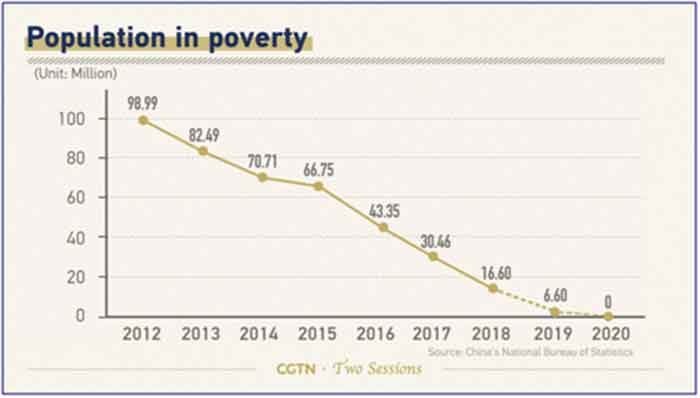
Since the 1980s, the Communist Party of China had lifted over 700 million people out of poverty. Now, China is nearing its goal to eliminate absolute poverty in 2020. Chairman Xi Jinping, also general secretary of the CCP Central Committee and chairman of the Central Military Commission, has not wavered in ridding the country of poverty despite the imposition of COVID-19.

Xi has been feted by Chinese media for his visits and concern for poor villagers.

Poverty alleviation was a priority in his roughly 80 domestic inspections over the past eight years. These trips took him to some of the country’s most remote and impoverished areas.

He once cited an old Chinese adage: “Great leaders of nations treat their people like a father loves his son and an elder brother loves his younger sibling. They will be saddened to hear of their people’s hardship or toil.”

Xi’s personal history is one of having endured years of poverty, having spent much of his youth living with rural peasants. This experience contributed to Xi’s focus on poverty elimination.

Xi knows well that poverty is incompatible with socialism. Accordingly, the CCP has identified the factors causing poverty in various areas and devised for each case a custom poverty relief plan. The plans are then followed up on to ensure effective outcomes.

In Chinese history, the Mandate of Heaven justifies the ruler. The people are above the king whose rule is based upon the support of the people. To continue to rule, the king must ensure that the people are protected and provided for. This was reflected in Xi’s statement, “Poverty alleviation must have genuine effects that can win the approval of the people and stand the test of practice and history.”

Poverty is not just being fought on the Chinese homefront, China is also involved in the global anti-poverty fight, helping developing countries grow their economies and improve their people’s livelihoods. China’s Belt and Road Initiative has helped develop the economy of countries, creating employment and enhancing people’s lives.

The Chinese Ministry of Commerce reports that “Chinese companies’ non-financial direct investment in 54 countries along the Belt and Road grew by over 33 percent to reach 72.18 billion yuan in the first seven months of 2020.”

The World Bank estimates that worldwide the Belt and Road initiative could help lift about 7.6 million people from extreme poverty and 32 million from moderate poverty.

The Leading Nation

Although China is already the world’s biggest economy, it is the eradication of poverty that places China at the forefront of global nations. Leaders in other countries would do well to learn what is applicable from the Chinese experience and provide for the needs of the populace. As their nations are signatories to the UDHR, they have committed themselves to this undertaking.

Many challenges still face China and the CCP. As the ancient Chinese sage Lao Tzu said, a journey of a thousand miles begins with a single step.

China sees the elimination of poverty as a necessary step in becoming a moderately prosperous society in all facets.

Follow the Money: Banking, Criminality and the FinCEN Files

Binoy Kampmark


It was all a fitting reminder of Bertolt Brecht’s remark that bank robbery lies in the province of amateurs.  The real professionals of plunder establish banks.  Last month, the labours of Buzzfeed and the International Consortium of Investigative Journalists revealed just that.  Centre stage: international banking misbehaviour. And my, was there much to go on.

The journalists had been combing through leaks comprising 2,121 suspicious activity reports (SARs) filed with the US Financial Crimes Enforcement Network (FinCEN) between 2000 and 2017.  The relevant amount in terms of transactions: somewhere in the order of $2 trillion.  It was awfully good of the banks themselves to be filing such reports with the US Treasury.  But such matters are mere formalities; there is no incentive for the bank in question to stop trading with a shady client, despite what is suspected in the report.  The point is to merely keep an account of it.

The criteria for an SAR are not sharply defined.  Matthew Collin of the Brookings Institute suggests a few: unclear sources and ill-defined beneficiaries; a nexus with a jurisdiction historically noted for financial crime and irregularity.  Another “common sign of suspicion is one in which a client attempts to avoid attention from the authorities by making several deposits below $10,000, which is the automatic reporting threshold.”

The FinCEN Files highlight five stellar performers in the movement of illicit cash: JP Morgan Chase, HSBC, Standard Chartered Bank, Deutsche Bank and Bank of New York Mellon.  A few instances are worth mentioning.  Despite being fined $1.9 billion in the US for money laundering, HSBC moved money through its US operations to accounts in Hong Kong in 2013 and 2014.  Central to this was a Ponzi investment scam known as WCM777.

The brainchild of Chinese national Phil Ming Xu, self-styled “Dr Phil,” the World Capital Market scheme promised returns of 100 percent profit in 100 days.  Xu vigorously promoted this version of monetary paradise through social media, webinars and seminars.  Gullible investors obliged, seduced by a rather grotesque combination of God and Mammon.  (Xu was courting the evangelical market.)  $80 million was raised and, for the unsuspecting investors, lost.

In the aftermath of the losses, direct physical harm resulted.  Santa Rosa investor Reynaldo Pacheco extolled the virtues of WCM777 to family and friends.  One acquaintance Pacheco had recruited to the scheme took umbrage at having lost $3,000.  Taking matters rather seriously, she enlisted the services of three men in April 2014.  They kidnapped the doomed Pacheco and bludgeoned him to death with rocks, leaving his remains in a creek bed in Napa, California.

Despite such events, and the knowledge that WCM was the subject of investigative interest in three countries, HSBC continued moving money for the investment fund.  As the ICIJ describes it, over “$30 million tied to WCM flowed through the bank in 2013 and 2014 – at a time when HSBC was under probation as part of its deferred prosecution deal with America authorities.”

Not to be outdone, JP Morgan is also revealed to be more than the obliging middleman in dirt-caked transactions.  An SAR filed by the bank in 2015 reveals that its London office might have assisted moving some of an amount totaling $1.02 billion. JP Morgan had provided services to ABSI Enterprises, a shady offshore company, between 2002 and 2013, despite being unclear of the firm’s provenance and ownership.  The filed SAR disclosed how the parent company of ABSI “might be associated with Semion Mogilevich – an individual who was on the FBI’s top 10 most wanted list”.  Such relationships demonstrate that capitalism lacks nationalist allegiances: Mogilevich is, after all, the emperor of Russia’s organised crime network.

JP Morgan’s reaction to such unmasking was an excuse all the banks have used at some point.  “We follow all laws and regulations in support of the government’s work to combat financial crimes.  We devote thousands of people and hundreds of millions of dollars to this important work.”

The amounts involved boggle, but they really ought to boggle more.  Minds have been tasked with trying to comprehend the deep sea of money laundering, and they have been left baffled in the drowning.  The United Nations Office on Drugs and Crime has an estimate: each year, between 2-5 percent of global GDP, or $800 billion to $2 trillion – is laundered.  In all this we see the tarnished, and, in banking circles, the acceptable fruits, of globalisation.

The United Nations Office on Drugs and Crime puts it down to various vectors: the development in financial information, the innovation of technology, the advance of communications.  All “allow money to move anywhere in the world with speed and ease.  This makes the task of combating money-laundering more urgent than ever.”  Using the image of depth, “dirty money” becomes more difficult to identify as it plunges into the system, being rinsed and laundered.

The root of the problem is a deeply conventional one.  Money is to be made.  Banks make money handling money.  Rinsing and washing, they still earn fees for the service.  They are also encouraged by their staying power as indispensable international citizens.  Politicians of various shades come and go.  They occasionally spout demagogic promises about reforming and regulating the banking sector, but these voices will eventually pass.

Mechanisms are also in place that serve as damp slaps on the wrist than genuine incentives for reform.  The deferred prosecution agreement (DPA) is a central part of the US government’s approach to induce change within a bank’s transaction practices.  The reporting system is also feeble.  Banks often filed SARs months after the suspicious transaction, often several with the same client.  No action would be taken.  A corollary of such filings is the value of such SARs.  In the hope of preventing regulatory consequences, banks may issue an avalanche of them for regulators at FinCEN to investigate.  Since 2003, the number of SARs from banks has quadrupled.  FinCEN’s staffing has not kept the pace 178 in 2001; 300 in 2020.

This is not to say that kid gloves have always been the order of the day.  Penalties have resulted.  Since 2008, $36 billion worth in financial institution fines have been issued, with the bloc of North America taking about $27.9 billion. But such punishments have done little to chasten the sinners.  Like thorny flagellation for the pious, the expectation of such treatment is built into the belief system. The sin is permitted to continue.

This is the institutional understanding that permeates the regulators and the regulated.  Little wonder that FinCEN was unimpressed by the leaks.  “As FinCen has stated previously,” the body asserted in a statement, “the unauthorized disclosure of SARs is a crime and can impact the national security of the United States, compromise law enforcement investigations, and threaten the safety and security of the institutions and individuals who file such reports.”