26 Oct 2020

The Muslim World denounces French President’s remarks against Islam, its prophet

Abdus Sattar Ghazali


The General Secretariat of the Organization of Islamic Cooperation (OIC) has condemned continued attacks and incitement against Muslim sentiment and insults of Prophet Muhammad, Anadolu Agency (AA) reported.

A statement by the 57-member pan-Islamic OIC criticized the “discourse from certain French politicians, which it deems to be harmful to the Muslim-French relations, hate-mongering and only serving partisan political interests.”

It said the OIC “will always condemn practices of blasphemy and of insulting Prophets of Islam, Christianity and Judaism” as it condemned any crime committed in the name of religion.

The statement rejected the incitement against Islam, its symbols and linking Islam and Muslims with terrorism.

According to AA, the OIC statement also denounced the killing of French teacher Samuel Paty, who was decapitated on October 16 in a Paris suburb.

French teacher Samuel Paty, who had shown students cartoons of the Prophet Muhammed, was beheaded outside his school. The man suspected of the beheading was an 18-year-old Moscow-born Chechnyan. The assailant was shot by police and later died of his injuries.

Erdoğan says Macron needs ‘mental treatment’

President Macron’s anti-Islam rhetoric sparked a diplomatic crisis between France and Turkey when France recalled its ambassador from Ankara after Turkish President Recep Tayyip Erdoğan said Saturday Macron needs “mental treatment” because of his hostility toward Islam.

“What is Macron’s problem with Islam and Muslims? He needs mental health treatment,” Erdoğan said at the ruling Justice and Development Party (AK Party) congress in central Kayseri province. “What can be said to a head of state that treats millions of members of a religious minority in his country this way? First of all, (he needs) mental check,” Erdoğan added.

In response, a French presidential official told Agence France-Presse (AFP) that Paris was recalling its envoy to Ankara for consultations. Ambassador Herve Magro would meet Macron to discuss the situation, the official said.

France recently launched an extensive witch hunt against the Muslim community following Macron calling Islam a problematic religion that needs to be contained. Many nongovernmental organizations and mosques have been shut down in recent weeks, while assaults against Muslims have peaked.

Macron this month described Islam as a religion “in crisis” worldwide and said the government would present a bill in December to strengthen a 1905 law that officially separated church and state in France. He announced stricter oversight of schooling and better control over foreign funding of mosques.

Tellingly, James McAuley of The Washington Post wrote on Oct 23: Instead of addressing the alienation of French Muslims, especially in France’s exurban ghettos, or banlieues — which experts broadly agree is the root cause that leaves some susceptible to radicalization and violence — the government aims to influence the practice of a 1,400-year-old faith, one with almost 2 billion peaceful followers around the world, including tens of millions in the West.

Days after beheaded teacher Samuel Paty’s killing, two female attackers stabbed two Muslim women in headscarves and called them “dirty Arabs” as they walked near the Eiffel Tower. “There is a hysterical climate,” according to Rachid Benzine, a French political scientist.

Arabs condemn Macron’s remarks about Islam

Several Arab countries have condemned the French incitement against the Islam and the Prophet of Islam, warning that these repeated insults fuel hatred among the peoples.

In a statement, the Secretary General of the six-member Gulf Cooperation Council (GCC) Nayef al-Hajraf described Macron’s statements against Islam as “irresponsible” and “cause to spread the culture of hatred among the peoples”.

“Such [French statements] come out at a time when efforts are underway to enhance tolerance and dialogue between cultures and religions,” al-Hajraf said in a statement.

The GCC includes Saudi Arabia, United Arab Emirates, Qatar, Bahrain and Oman.

Kuwait’s Foreign Ministry also expressed resentment at the French republication of the anti-prophet cartoons. A ministry statement warned that these insults will “ignite the spirit of hatred, violence and enmity, and jeopardize the international community’s efforts to spread the culture of tolerance and peace among peoples of the world”.

Pakistan Premier denounces Macron’s ‘encouragement of Islamophobia’

Prime Minister of Pakistan Imran Khan on Sunday denounced what he called was “encouragement of Islamophobia” by French President Emmanuel Macron, saying the European leader had chosen to “deliberately provoke” Muslims, including his own citizens.

In a series of tweets, the premier said that the sign of a leader was that he united people, like former South African president Nelson Mandela. “This is a time when President Macron could have put [a] healing touch and denied space to extremists rather than creating further polarization and marginalization that inevitably leads to radicalization,” he said.

The premier regretted that the French president had instead chosen to encourage Islamophobia by “attacking Islam rather than the terrorists who carry out violence, be it Muslims, White Supremacists or Nazi ideologists”.

Arab trade groups boycott French products over insults

Several Arab trade groups have announced their boycott of French products in response to incitements against the Islam and insulting statements against Prophet Muhammad, Turkish newspaper Yanishafak reported Monday.

Arab activists also launched several social media campaigns for the boycott of all French products, using several hashtags as (#boycottfrance #boycott_French_products #ProphetMuhammad).

In Kuwait, several trade groups such as Alnaeem Cooperative Society, the Suburb Afternoon Association, Eqaila Cooperative Society and Saad Al Abdallah City Cooperative Society. The three groups published photos showing French products being removed from their shelves.

In Qatar, Alwajba Dairy Company and Almeera Consumer Goods Company said they will boycott the French products and will provide other alternatives.

Qatar University also joined the boycott campaign, announcing that it decided to postpone the French Cultural Week in protest of the anti-Islam insults.

“Any denigration or violation of the Islamic beliefs, sanctities and symbols are absolutely rejected,” the university said in a statement. “These insults harm the universal human values and the high ethical principles of all societies,” it added on Twitter.

Not surprisingly, France called on Arab countries on Sunday to end calls to boycott French products. “These calls for boycott and attacks on our country pushed by a radical minority are without merit and must be stopped immediately,” French Foreign Ministry spokeswoman Agnes von der Muhll said in a statement.

The 2020 youth uprising in Thailand

Junya Yimprasert


Thailand in brief

With a population of around 67 million, which includes some 40 ethnic groups and languages, the success of the decades long struggle for fully representative democracy in the Kingdom of Thailand is of vital importance to not only the health and aspirations of the peoples of Thailand itself, but also for the future of the ASEAN.

During the USA-Indochina War of 1950 – 1975 more-or-less the whole of Thailand was used by the USA as a military facility. From 1947 onwards the US military presence in Thailand functioned to bolster the Monarchy and Royal Thai Army, enhancing the ability of both to operate in tandem to successfully block the democratic process, as clearly evidenced by the succession of no less than 12 monarcho-military coups. The current wave of protest across Thailand is attempting to say that the time has come to end this succession.

After the most recent military coup in 2014, the leader of the coup and Commander-in-Chief of the Royal Thai Army, General Prayuth Chan-o-cha, appointed himself Prime Minister, and continues today (mid-October 2020) as a pathetic royalist dictator attempting to cling to power by refusing to countenance in any meaningful way the reasons why he is being confronted with massive protest.

In October 2016, after the passing of old King Bhumibol (Rama 9, 1946 – 2016), Crown Prince Vajiralongkorn was enthroned as Thailand’s new King, as Rama 10, the tenth king of the Chakri Dynasty. The Chakri Dynasty came into existence in 1782, when Rama 1 terminated the Taksin Dynasty by executing King Taksin and most of his relatives and their families.

238 years under the Chakri has meant that Thailand remains one of the very few countries in the world that has been unable to liberate itself from the brutality of feudal monarchism.  Today Rama 10, King Maha Vajiralongkorn (68), Thailand’s Head of State, the richest monarch in the world, untouchable by law in Thailand, appears to have only one abiding interest: his own interest.

Alongside the fundamental, determined, violent rejection of the concept of equal rights, the survival of the Chakri Dynasty depends in part on ensuring that its diplomatic service is served exclusively by royalists that present, north, south, east and west, to Europe, the USA and China, a sweetly acquiescent impression of the good intentions of the good Kingdom.

Thai democracy in Brief

Stirrings to establish a constitution for Siam began some 120 years ago during the reign of Rama 5. The Palace was successful in suppressing this early attempt and 30 years were to pass before, at the hour of dawn on 24 June 1932, a lightning, bloodless coup d’état brought 150 years of absolute rule under Chakri monarchs to a sudden stop. The coup was led by a group of young scholars and military officers. Calling themselves Khana Ratsadon, the People’s Party, they did aim to open the road to democracy for Siam (Thailand), but the journey has been and remains painful.

Khana Ratsadon consisted of a rather elite group of civilians, government officials, aristocrats and military officers who had met and begun planning the coup as students in France in the 1920s. Pridi Phanomyong, a farmer’s son, led the political wing and Lieutenant-Colonel Phibunsongkhram the military wing. On that early morning in 1932, completely unknown to the people, within the space of a few hours, Siam was changed from an absolute monarchy to a constitutional monarchy.

The new Government of Siam was still dominated by the military but it did at least aim at some kind of democracy: the 1932 Constitution did state that the people of Siam (not yet Thailand) held sovereign power. Nonetheless the continuous, systematic refusal of the Palace, royalists and military elite to accept universal suffrage and the sovereign authority of an elected Parliament has meant that, still today, after 88 years, such a state has yet to be achieved.

Monarcho-militarism versus democracy

The first royalist coup against Thailand’s fledgling movement for democracy came in 1933. Despite being fed with money by Rama 7 it failed. The royalist elite made a second attempt in January 1939 against the government of Phibunsongkhram, now Prime Minister and also Field-Marshal. This attempted coup also failed and resulted, by order of Phibun, in the execution of 18 leaders, life imprisonment for several and long sentences for others

Prince Chainart, the uncle of King Ananda (and Prince Bhumibol), received a life sentence. The Palace placed PM Phibun under enormous pressure to release Chainart, but Phibun stuck to his guns. It was not until after the withdrawal of Japanese troops, when Field-Marshal Phibun was pushed from power, that Prince Chainart was pardoned, in September 1944. As the last remaining son of Rama 5, Prince Chainart returned to being the most influential person in Palace politics.

On 9 June 1946 King Ananda was found in bed with a bullet through his head. Prince Chainart stepped in as Regent on 16 June and took over the Chairmanship of the Supreme Council of State the following year. Prince Bhumibol, Ananda’s brother, having recently returned from Switzerland to permanent residence in the Palace, became King Bhumibol, Rama 9. Suspicion that he was somehow involved in his brother’s death still hangs in the air. His public coronation took place on 5 May 1950, a date that can be seen as marking the beginning of systematic efforts to re-establish the power of the monarchy.
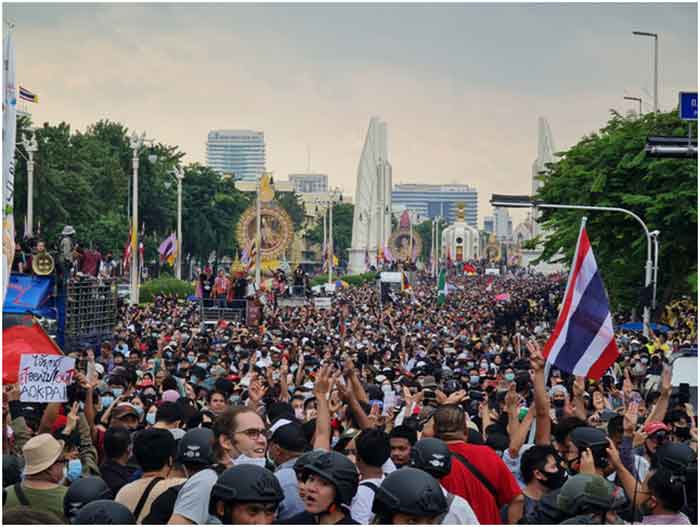
Thai Democracy Monument, 14 October 2020

70 years of oppression and suppression

The roots of Thailand’s political chaos, and of the widespread discontent and massive protests of  today, are found in the last 70 years of extreme, royalist propaganda. For Thai children born after 1946  “Killing communists for nation, religion and King” was standard fare.

Below are just a few of the horrific happenings that punctuate the history of the Land of Smiles after Bhumibol became king.

  • 25-28 April 1948. Hundreds of Royal Thai police and army in Narathivat Province surrounded the village of Dusongdor and murdered about 400 villagers.
  • 28 Feb – 01 March 1949. By order of Field-Marshall Phibun, chief of the military junta, 5 members of the Pridi Alliance for Democracy were assassinated. After being arrested and handcuffed, four of them, all Members of Parliament, were riddled with bullets in the back of a van, and the fifth, the Chief of Police Intelligence, was shot dead in the street.
  • 13 December By order of the Chief of the Royal Thai Police, the Leader of the Labour Party, Tieng Sirikhan, a former MP from Sakon Nakhon Province, was brutally murdered in Bangkok together with four friends. Their bodies were taken to be burnt in Kanchanaburi Province, 200 km from the scene of the crime.
  • 1971-1973. During this period of ‘killing communists for nation and king’, in Pattalung Province alone around 3,000 villagers were brutally murdered by the Royal Thai Army. Some were burnt alive in drums of oil, some pushed into sacks to be dropped down the side of a mountain or pushed out of helicopters.
  • 14-15 October 1973. Monarcho-military crackdown on students and working-class people protesting on the streets of Bangkok. 77 people were killed, most by military gunfire. 847 were wounded.
  • 6 October 1976. Monarcho-military crackdown on student protest. According to official government records, 41 students were killed by a mixed-force of Royal Thai Army, Royal Thai Border Guard and para-military ‘Protect the Monarchy’ thugs. 30 bodies were identified, 10 were too damaged to identify. 26 male and 4 female bodies were returned to their families by the Police for cremation. Hundreds were injured. 3,154 students were arrested. Thousands of people went into hiding, most fleeing to the forest. In anger over the brutality of the oppression many did join the Communist Party of Thailand, and remained in hiding until granted immunity after the Communist Party was dissolved in 1980.
  • 17 – 19 May 1992. Monarcho-military crackdown. This ‘Bloody May’ witnessed about 45 killed on the streets of Bangkok, about 38 by bullets from the Royal Thai Army. Reports indicate that about 70 people ‘disappeared’.
  • April-May 2010. Monarcho-military crackdown under Prime Minister Abhisit (‘Democrat Party’), who declared a ‘Live firing zone’, in other words issued elite troops with license to kill Thai civilians. 99 people were killed on the streets of Bangkok, almost all by military snipers. About 2000 were wounded. 470 were arrested. When official records say ‘wounded’ or ‘died on the spot’ they forget to add ‘from a military bullet to the back of the head’.

From the few records that are available, the death-toll from political oppression and extrajudicial killings since 1946 adds-up to somewhere over 13,000, but this figure in no way speaks of the actual number of people that have died as a result of political oppression and military crackdowns.

Coups and Kings

From the beginning, all of the Chakri Ramas have refused to respect or recognise the democratic aspirations of the peoples of Thailand.

Up until the last, King Bhumibol (Rama 9) argued that the people are not ready for democracy. He presented himself as a king god-sent to care for the people, with, naturally, the mercifully god-sent assistance of the commanders of the Royal Thai Army, the US military and 12 military coups.

All of the governments that came from the 28 general elections held during Bhumibol’s reign were prevented by one means or another from completing even one 4-year term, all except one, that of Thaksin Shinnawatra from 2004 to 2008.

The Thaksin governments were brought to office and power through land-slide elections and twice brought down by monarcho-military coups, in 2006 and 2014.

The 2014 coup was conducted for one purpose alone: to ensure the transition from Rama 9 to Rama 10 be kept under the control and management of a military commander trusted by the Palace, in other words to ensure yet again that the critical concerns and interests of the people could be flattened-out and kept harmless.

Dictator Prayuth

The leader of the 2014 coup, General Prayuth Chan-o-cha, Commander-in-Chief of the Royal Thai Army, disbanded all elements of the elected government, tore-up the Constitution and set-up a military junta calling itself the National Council of Peace and Order (NCPO) and presented the country with a National Legislative Assembly (NLA). Half of the 220 seats of this ‘legislative assembly’ were filled with people hand-picked by the NCP and half were military officers. The function of the NLA was to rubber-stamp the dictates of the NCPO.

After slipping out of uniform and appointing himself Prime Minister in August 2014 and by heading-up both his NCPO and NLA set-ups, Prayuth, honouring his many predecessors, slid from Royal Army Commander-in-Chief to Thailand’s Royal Dictator-in-Chief, and proceeded, as did all his predecessors, to drafting yet another Constitution (Thailand’s 20th since 1932), and to employing all possible ways and means to delay the demand of the furious majority for a general election, in order to give his junta as much time as possible to consolidate power over the electorate.

After a full year allocated to the official, national mourning for King Bhumibol, Crown Prince Vajiralongkorn was crowned in 2016. His very first move as Head of State was the issuance of orders to amend the junta’s 2017 Constitution even further in his favour: to increase his personal freedom, to greatly increase his personal military power and to massively increase his personal wealth. All of this passed, the public aghast, completely unopposed.

Nonetheless, with the world watching and public demand for a general election growing and EU sanctions causing Thailand humiliation if not pain, Prayuth could not delay a general election forever.

After several bluff start-ups for the purpose of generating further delay, the junta did eventually grant the population a General Election on 24 March 2019, but not without engaging all the tricks in the royalist playbook, all financed by the national budget, to ensure that the opposition could not win. The 2017 Constitution stipulated that it was to be the 250 members of the reconvened Senate, who were all junta-appointed, that voted in a new Prime Minister. Furthermore, the judges of the so-called Constitutional Court, which was a product of the 1997 People’s Constitution, were by now (after the coups of 2006 and 2014) all junta-appointed judges quite at ease with disqualifying and dissolving any opposition parties and parliamentary candidatures that they deemed unsuitable. In all ways the 2019 General Election was rigged to make it impossible for the opposition to win.

These royalist game-plays are well-understood and extremely wearisome for the majority of Thai people, because they know simultaneously that they have only two options: to submit or protest.

Protest began gaining momentum after the Constitutional Court had the temerity to dissolve the largest opposition party, the Future Forward Party, that had won 80 of the 220 seats of the NLA in the 2019 election.

King Maha Vajiralongkorn

Old King Bhumibol (1946 – 2019) was surely vaguely aware that his son Crown Prince Vajiralongkorn had an infamous reputation as a sex-addict with a mafia-like life-style, but he did not want to break with royal precedent. When Bhumibol passed away on 13 October 2016, Vajiralongkorn was named king. His 3-day public coronation was staged in May 2019 at a cost of around 32 million USD.

Thailand’s new king, now 68, abandoned and humiliated his first wife soon after they were married. In 1996 he banished his second wife and the four sons he had with her. In 2014 he placed his third wife under house arrest and imprisoned her parents, three brothers, a sister, her uncle and several other relatives. He married his fourth wife in 2019.

According to the 2014 Constitution, as amended by Vajiralongkorn himself, the Thai king’s status is now closer to that of an absolute monarch than to that of a constitutional monarch.

As noted above, before the people could blink, their new King had taken some major steps to strengthen his position, by increasing his direct personal command, by some tens of thousands, of the 80 000 strong Royal Guard, and by providing himself with direct personal access to the vast wealth of the Crown Property Bureau, to which his father had only limited access. As the wealthiest monarch in the world, with something in the region of  50 – 60 billion Euro at his disposal, he still demands a vast sum from Thai taxpayers, not less that one billion Euro, to finance his personal expenses, many palaces and the so-called ‘royal projects’.

The future of this king is already severely haunted by overwhelming evidence that, since 2016, nine democracy activists, who had sought refuge from the military junta outside Thailand, have been hunted-down and murdered by his agents – assassination squads.

In true medieval style, this King is also famous for casting anybody who displeases him into his own dungeons, to be tortured. The stories are many and bad. One place, the Thawee Watthana Prison in the grounds of the Thawee Watthana Palace in western Bangkok has a very dark reputation: those who don’t come out alive are reported as having died by suicide and so on.

At the present time Thailand’s Head of State has been spending by far the greater part of his time with his harem at the Grand Hotel Sonnenbichl in Bavaria, Germany, supported by 100 or so servants and body guards. There are women and servants in his entourage that exist solely as royal prisoners. It is said that even here those who displease the king are also abused and beaten, and made too afraid to approach the German police, terrified that their families in Thailand will face retribution.

In Thailand the King can do and does as he pleases with complete impunity. Nobody can bring charges against him, he lives completely above the law. Most Thais are to some extent aware that their new king is cruel and somehow criminal, but until now their thoughts and feelings have been silenced by the draconian laws of the military junta, in particular the laws of lès majesté and the so-called computer crime laws, which can cause anybody to find themselves in jail for many years for any indication or accusation of disrespect, true or false, towards His Majesty or his His Majesty’s relations, affairs, interests or projects.

Nonetheless, the fact that, as Covid-19 exasperates existing destitution everywhere, this King chooses to live a life of luxury in Germany, abusing women, wasting vast sums of taxpayer’s money and sending out agents to kill popular dissidents, has finally stirred-up open expression of disgust in Thailand itself.

Does this King of Thailand also think himself above and beyond the laws of Germany and the European Union? Does he imagine that he is not subject to the Universal Declaration of Human Rights, that his kingship is beyond the reach of the International Criminal Court? Apparently he does, but increasing numbers of people. including most of the youth of Thailand, are starting to find him guilty on all counts.

2020 Youth Uprising

It was early in 2020 when students first started appearing on the streets of Bangkok in large numbers – to protest the dissolution, by the judges of the Constitutional Court, of the Future Forward Party, the main opposition to the Prayuth junta.

The arrival of Covid-19 gave Prayuth a defensible but also convenient reason to declare a State of Emergency and stifle protest. Nonetheless, by this time the majority of Thai people had become deeply tired of their Dictator and what he said or didn’t say or did or didn’t do began to feel somewhat irrelvant. Youthful Thailand was coming to a common understanding, a consensus, that it was time to inform General Prayuth that his illegitimate regime was illegal and his modus operandi impossible to tolerate any longer.

On 18 July the youth of Thailand, from secondary schools to universities – from all across Thailand, rose up in protest against the military-enforced status-quo. The broad, red-hot dynamism of the demands of the students, demands that range all the way from removing militant disciplinary codes in schools to radical reform of the Monarchy itself, began to electrify the whole country.

WHERE is JUSTICE?

Thailand has arrived at a long-predicted, dangerous but inescapable juncture. In facing the potentially ruthless, implacable monarcho-military establishment, youthful Thailand needs, right now, the understanding, support and solidarity of the International Community.

How can the logical, common-sense, standard, decent, normal and natural aims and demands of this youth-led uprising against autocratic rule be supported?

For many years there has been a broad convergence of analysis and common opinion and a gathering of momentum around recognition that there is no way for Thai people, for the population at large, to move from the past to the future, to be able to engage with full hearts, minds and full power with local, regional and global matters, issues and crises, while a patronising, monarcho-military alliance hovers over them, assuming right to own or disown their every thought, hope, wish, desire, invention, movement and action.

King Vajiralongkorn, Head of State, is a well-known abuser of human rights, an abuser of the privileges afforded to him by birth, a pathological abuser of women, a vile executioner, an owner of some 10 000 slaves, some of them trafficked, and, for the youth of Thailand and of the world, the worst possible example of a human-being, let alone Head of State.

Since people in Thailand have zero resort to meaningful justice – or appeal, at the start of 2020  ACT4DEM joined forces with PixelHELPER in Germany to bring the crimes of King Vajiralongkorn directly to courts of justice in Europe.

General Prayuth is a puppet of the Chakri monarchy and powerless without it, thus our work at present is focused on bringing the attention of the Germany Bundestag, European Union, United Nations and all people around the world who love Thailand, to the extreme degrees of corruption and cruelty exhibited by King Vajiralongkorn.

We aim to ensure that King Vajiralongkorn will be forevermore prevented from beating, torturing and murdering any more people, as well as being prevented from throwing any more desperately needed, hard-earned public money down the drain of his own selfish desires.

Together we can end this reign of fear before it gets worse.

Together we will ensure that justice prevails.

COVID’s deadly toll on people with Alzheimer’s and dementia

Benjamin Mateus


On October 23, the Centers for Disease Control and Prevention (CDC) estimated that excess deaths from late January through October 3 had reached close to 300,000 cases, of which 198,000 (66 percent) were attributed to COVID-19. There have been over 61,000 deaths in the US attributed to dementia from June to September, 11,000 more than usual in this timeframe, according to Politico.

One of the hidden tragedies of this preventable health crisis has been the deadly toll on the elderly who suffer from dementia, a general condition of the brain (and not a normal part of aging) that leads to a long-term and gradual decrease in the ability to think and remember. When the condition becomes severe enough—changes in mood, difficulty with speech and decline in motivation—it leads to the inability to conduct normal daily functions of life. Consciousness, however, is not affected.

Of deaths not directly attributed to COVID-19, heart disease and Alzheimer’s and dementia were the two leading causes that saw spikes initially in March and April, then again in June and July, as the pandemic shifted to the Sunbelt states.

The faces of dementia. Photo from welldoing.org

Washington Post analysis of CDC data found that there were about 13,200 excess deaths attributed to Alzheimer’s and dementia from March until mid-August. Physicians treating these patients are reporting increased cases of falls (from lack of nursing home staffing), more pulmonary infections (some attributable to aspiration of food from swallowing difficulties), rapid onset of depression, and frailty among those that had been stable over several years.

Sharon O’Connor, who runs a program for dementia patients at Iona senior Services in DC, told the Post, “We have clients who have lost almost 30 pounds. Some just don’t have reason to get up anymore, so they stay in bed all day. Others sit by themselves in a dark room.” Patients that can still communicate explain they have a sense of foreboding from being cut off from everything they knew. Dining facilities are closed for nursing home residents. Music therapy, games and various forms of exercise have abruptly ended. Worse, families who were essential components of the care they received are no longer allowed to enter the premises.

This is, however, not a phenomenon limited to the United States. A recent editorial published in Lancet Neurology cited a report by the International Long-term Care Policy Network that focused on the high death rates among people with dementia worldwide during the COVID pandemic.

It wrote, “Deaths linked to SARS-CoV-2 infection in care homes, 29 to 75 percent occurred in people with dementia across Australia, Brazil, India, Ireland, Italy, Kenya, Spain, the UK, and the USA. The disproportionate effect on people with dementia is being exacerbated by restricted access to health care services, removal of face-to-face support, and interruptions to diagnoses and research.” A critical aspect in the stark neglect of people with dementia has been the disproportionate lack of funding for much needed research in this field.

Alzheimer’s is the most common form of dementia, contributing to 60 to 70 percent of people with the disease. Globally, there are almost 10 million cases diagnosed annually and the prevalence of the disease is around 50 million, up from 20 million in the 1990s. Life expectancy after a diagnosis of dementia is usually five to 10 years. Though associated with the elderly, 9 percent of cases affect those under the age of 65.

Fig 1 US weekly excess deaths from Alzheimers and Dementia 2020

Factors known to mitigate and reduce the risk of dementia include regular exercise, a healthy diet, abstaining from smoking and drinking alcohol, and controlling blood pressure, blood sugar levels and cholesterol levels. Risk factors for dementia that have been heightened by the pandemic include depression, social isolation and cognitive inactivity. Additionally, poverty plays a significant factor in exacerbating risks for dementia.

A longitudinal study conducted in England with 6,200 subjects across the span of 12 years noted that the risk of dementia was 50 percent higher among the poorest as compared to the richest people. According to the author, Dr. Dorian Cadar, “We found a positive association between lower wealth and dementia incidence that was independent of education, area-level deprivation. … This suggests a higher risk for individuals with fewer financial resources.” Wealth provides access to adequate nutrition, cultural outlets and increased social networks of which the working class is deprived.

The social impact of the condition cannot be overstated. Even among health care providers, there is a lack of awareness and appreciation for dementia which leads to stigmatization and delay in diagnosis and necessary referrals and care. Its emotional, physical and financial pressures and stresses on families and caregivers is considerable. To place this in economic terms, the direct medical and social care costs worldwide has been estimated at $818 billion, or 1.1 percent of gross domestic product.

The response by governments in protecting and caring for nursing home residents has been nothing short of disastrous. Despite all the promises made, shortage of testing, staff and personal protective equipment has turned nursing homes into solitary confinement prisons for the elderly who have been left to rot in their beds completely forgotten.

The pandemic in the United States is seeing daily cases surge passed their summer highs as the death rate is beginning to uptick. The policy of “focused protection” has been exposed for the fraud it is. The idea that somehow the most vulnerable will be protected is leading to their deaths. Either COVID-19 will kill them, or the isolation will.

Fig 2 Dementia in the elderly. Stock photo fromGetty images

Beth Kallmyer, vice president of care and support for the Alzheimer’s Association, told Politico, “Protecting these vulnerable people has not been a priority. We’ve been through two waves and we haven’t made any real changes. Why has this not been sped up in long-term care?”

Fundamentally, the rational and sane public health measures to mitigate, contain, trace and quarantine clusters of infection and drive infection rates down until the disease is eradicated is not a far-fetched concept and would allow the necessary breathing room to address these critical immediate medical concerns being raised as trials on vaccines are allowed to be completed.

The World Health Organization has even reasserted that the world still has time to turn this around. However, it requires placing the social well-being of all people ahead of the narcissistic needs of a financial system that can only thrive on the acquisition of ever more surplus value.

Because this layer of the population that has contributed their entire lives to maintaining the present financial infrastructure is no longer productive, they matter little in the policies being adopted to confront the pandemic. And, in fact, the culling of this layer has significant rewards for a ruling class bent on curtailing all expenditures that do not contribute to their future dividends.

Continuing wage dispute at the Berlin’s Charité hospital

Markus Salzmann


A wage dispute at Charité Facility Management (CFM) in Berlin, Germany, which has been smoldering for years, has flared up in recent weeks. The employees of the subsidiary of Berlin’s Charité hospital find themselves confronted by an alliance of the city’s “red-red-green” coalition government (Left Party, Social Democrats (SPD) and Greens) and the Verdi Union.

Several strikes this year, the last occurring in August, were ended by the union without achieving tangible results. The CFM workers are demanding wage adjustments to match the wages paid in the parent company, as well as better working conditions.

Fourteen years ago, CFM was spun-off of Charité by the Berlin Senate—at that time a coalition of the SPD and the Left Party—to reduce employment costs and diminish working conditions. Although the 2016 red-red-green coalition agreement promised wage matching with other public servants, the monthly salary of CFM members remains up to €800 below that of their peers. Moreover, Charité has continued outsourcing non-medical staff, continuing the pernicious downward spiral.

A warning strike a the Berlin Charié, 2015

Until 2018, Charité owned a 51 percent stake in CFM, which provides services such as cleaning, transport and catering for the hospital, the remaining 49 percent belonged to VDH Health Care Services GbR, owned by the companies Vamed, Dussmann and Hellmann. Charité bought back the 49 percent stake in 2019, giving it 100 percent control.

This buy-back was preceded by a long Senate and union campaign promising better pay and conditions. What in fact occurred confirmed the prediction of the WSWS in March 2017, that the buy-back would “not improve the precarious working conditions of the 2800 employees,” but rather, “establish low wages and diminished working conditions for the entire Charité.”

In these 14 years there has been no lack of anger and willingness to fight on the part of CFM workers, protesting wages that all but preclude a decent life. The majority of Charité workers likewise demand re-incorporation of spin-offs and wage equalization. Yet over the years, the Verdi union has worked hand-in-glove with the Senate parties to implement austerity policies at the workers’ expense.

The current wage dispute is no different. The Greens and the Left Party sent declarations of solidarity to striking CFM employees while at the same time strictly opposing wage equalization in the Senate. Verdi has secretly negotiated with the Senate for over four weeks.

At the beginning of October, the governing mayor Michael Müller (SPD) introduced conciliatory procedures, cynically affirming the necessity of an increase in income for CFM employees, only to immediately backtrack, saying any wage agreement must be brought into line with the company’s profitability. This same argument was used to spin-off the CFM in 2006 and to justify the low wage regime ever since.

As reported by the Left Party-associated publication Junge Welt, the mediator requested by Verdi is none other than Gregor Gysi, the long-time head of the Left Party’s predecessor, the PDS, and who acted as deputy mayor and Senator for Economics in Berlin in 2002. This would be the height of audacity and a threat to the employees of CFM and Cherité. Gysi was one of the architects of the radical austerity policies that largely destroyed the capital’s social infrastructure.

Gysi took on this office to “carry through hard cuts,” as he told the Tagesspiegel at the time. He wished to make the city “more interesting for serious investors” and to make the administration “leaner, less bureaucratic and more transparent.” Hardly was he in office before the SPD and PDS passed a double budget for 2002/03 that far overshadowed the anti-social austerity measures the black-red (conservative Christian Democratic Union and SPD) coalition senate had implemented in the previous ten years, establishing the framework for the cuts at Charité and all other municipal hospitals.

For years, only a small number of employees have taken part in the toothless protests organized by Verdi. Often only a few dozen union bureaucrats and their pseudo-left-wing supporters showed up. The unions have cheated and lied to the workforce for too long.

The unions and establishment parties are far more concerned by the growing anger in the hospital workforce than by the toothless protests of Verdi. They fear broader, uncontrollable strikes threatening the capitalist system. The last years have seen an increase in strikes and protests against low wages and miserable working conditions. The coronavirus pandemic has exacerbated social tensions.

Just last week, nurses from Charité and Vivantes stopped work for several days in the course labor negotiations. Clinics in other German states also struck.

For 16 months now, employees of the Asklepios clinic in the city of Seesen have been on strike for better pay and better working conditions. The private clinic owner, known for poor working conditions, has long cooperated with Verdi to stifle the strikes. As the taz newspaper commented, “many employees appear willing, if necessary, to continue striking indefinitely.” An assembly of strikers recently declared itself unanimously in favor of continuing the labor dispute.

During the pandemic, strikes of nurses, doctors and hospital staff for occupational safety and better conditions have broken out internationally. In France, Spain and the US, among others, thousands have stopped work to demand better protections.

A successful struggle by CFM workers can only be waged independently of the unions. It depends on the establishment of independent action committees and requires an international and socialist perspective.

ICE uses torture to pressure African asylum seekers to agree to deportation

Meenakshi Jagadeesan


Immigration and Customs Enforcement (ICE) officials in a privately run detention center in Mississippi have been accused of torturing asylum seekers from Africa in an effort to get them to sign their own deportation papers. This latest saga in the on-going grotesque war on immigrants carried out by the Trump administration was revealed last week by the Guardian, which followed up on an October 8 complaint filed by groups including the Southern Poverty Law Center (SPLC) and Freedom for Immigrants (FFI) on behalf of eight asylum seekers.

The report details a horrific situation in which ICE officials have engaged in an “brutal scramble” to get the asylum seekers out of the country before the presidential election on November 3. Detainees spoke of being choked, beaten, pepper sprayed, and threatened with even further violence unless they consented to being placed on charter flights back to their home countries.

The asylum seekers from various African countries—particularly the Democratic Republic of Congo and Cameroon—have been unwilling to sign off on their own deportations, which is not surprising since the very reason for their coming to the US is to escape persecution in their own countries. Many of them in fact have asylum hearings pending. However, ICE has shrugged away even the pretense of respect for basic human rights and due process.

The West Texas Detention Facility in Sierra Blanca, Texas, in February, 2017 (WSWS Photo)

The disgraceful treatment of African asylum seekers was brought to light this past year in part because of organized protests, including hunger strikes, by 40 Cameroonians detained in ICE’s Pine Prairie Facility in Louisiana.

The detainees have spoken up about the appalling conditions in the detention center, the lack of protection against COVID-19, and the bullying and frankly illegal behavior of various immigration officials including a systematic attempt to dismiss identification documents or evidence and pressure asylum seekers to give up on their cases even before an appeal is heard. It is also now known that ICE has retaliated against the detainees for protesting by using force and subjecting them to long stretches of solitary confinement.

The latest revelations are even more horrifying. One of the detainees, identified as DF in the complaint, said that on being asked by an ICE agent to sign his deportation order on September 28: “I refused... He pressed my neck into the floor. I said, ‘Please, I can’t breathe.’ I lost my blood circulation. Then they took me inside with my hands at my back where there were no cameras.”

The place that DF was taken to is a punitive wing known as “Zulu” in the Adams county center, where reports indicate torture is carried out regularly without any restraints. Describing his experience in Zulu, DF stated: “They put me on my knees where they were torturing me and they said they were going to kill me. They took my arm and twisted it. They were putting their feet on my neck. While in Zulu, they did get my fingerprint on my deportation document and took my picture.”

Another detainee, CA, said he was forced to the ground, sat on, handcuffed and pepper sprayed. “I was crying, ‘I can’t breathe,’ because they were forcefully on top of me pressing their body weight on top of me. My eyes were so hot ... I was dragged across the ground...The officers told me to open my eyes. I couldn’t. My legs and hands were handcuffed. They forcefully opened my palm. Some of my fingers were broken. They forced my fingerprint on to the paper.”

On October 13, approximately 100 asylum seekers were put on a charter flight that took off from Fort Worth Alliance Airport in Texas. There was no flight plan filed, but the immigration rights group Witness at the Border, which tracked the flight said it stopped in Senegal, Cameroon, the Democratic Republic of Congo and then Kenya before flying back to Texas. DF was one of the people on the flight. His fate is unknown. CA, who was supposed to be on the flight, was pulled out at the last minute because of the intervention of human rights advocates. However, ICE officials have assured him and others that have remained that this was merely a temporary reprieve from certain deportation.

Reports of gratuitous cruelty and general inhumanity of the Trump administration’s attitude towards immigrants, refugees and asylum-seekers have been a nearly daily occurrence. But this latest exposure merits a special place in the annals of criminal behavior.

The US Senate recently passed a resolution that acknowledged the Cameroonian government’s human rights abuses including torture, imprisonment and extra-judicial killings directed particularly at the Anglophone community, to which most of the asylum seekers belong. Even the Trump administration—not known for its respect for common decency—revoked Cameroon’s trade privileges because of its abuses.

It is a grim irony that those who fled their country to escape torture are now being tortured by US state officials in order to force them to return. What makes this particularly ugly is the fact that the illegal torture is being carried out to give this process the gloss of legality—as in, the asylum seekers voluntarily signed off on their deportation, which in many cases is the same as claiming that they willingly signed their own death sentences.

In response to the complaints, Sarah Lociano, an ICE spokeswoman declared: “ICE is firmly committed to the safety and welfare of all those in its custody. ICE provides safe, humane, and appropriate conditions of confinement for individuals detained in its custody.” Lociano’s claims mirror those of Trump, who callously declared during the last Presidential debate that the 545 immigrant children who are yet to be reunited with their parents are “in facilities that are so clean, they’re so well taken care of.” This will no doubt come as a surprise to those who have experienced the dubious hospitality of the various ICE-run detention camps and the children who have been torn from their parents.

It should be noted that two of the women who had given testimony about forced sterilizations at the Irwin detention center in Georgia were put on the October 13 deportation flight to Africa. This suggests that the flights were not just part of a desperate effort to remove asylum seekers, but also get rid of any possible witnesses who might provide evidence of the rampant criminality of the current administration’s anti-immigrant policies.

Sri Lankan parliament boosts president’s autocratic powers

K. Ratnayake


Last Thursday, the Sri Lankan parliament rubber-stamped the 20th Amendment to the constitution, which gives sweeping autocratic powers to the executive presidency—in line with the demands of President Gotabhaya Rajapakse,, who was elected last November.

Rajapakse’s Sri Lanka Podujana Peramuna (SLPP)-led alliance government secured the votes of 156 MPs, or more than the two-thirds majority required in the 225-member parliament, to push through its constitutional amendment.

Several MPs from the Muslim parties, affiliated with Samagi Jana Balavegaya (SJB), the main opposition party, voted for the bill as did a SJB member, who declared that the country needed a “strong president.” Rajapakse visited parliament prior to the vote, ensuring that all his party’s MPs endorsed the constitutional change.

Gotabaya Rajapaksa (AP Photo/Eranga Jayawardena)

The amendment repeals the 19th constitutional change introduced in 2015 that limited some of the president’s powers. The restrictions included: preventing the president from dissolving parliament until after it had served four and half years; establishing independent commissions to appoint top state officials and judges; and ensuring that the president could appoint or remove ministers only on the advice of the prime minister.

Opposition parliamentary parties, including the SJB, Tamil National Alliance and the United National Party (UNP), and several other groups, filed petitions in the Supreme Court arguing that the 20th amendment nullified the “sovereignty of the people.” They called on the court to rule that the amendment had to be endorsed by a referendum, as well as a two-thirds parliamentary majority.

The Supreme Court, however, gave a green light to the amendment, with changes to some of the clauses but keeping intact the amendment’s key dictatorial provisions. It ruled that if its proposed changes were adopted, the bill could be passed with just a two-thirds parliamentary majority. Accordingly, the government made some cosmetic modifications and the amendment was put to the vote.

Under the amended constitution, the president is empowered to appoint or remove the prime minister and cabinet ministers; dissolve parliament after only two and a half years; appoint the chairmen of commissions on elections, police, human rights, bribery and corruption and finance. The president can also appoint top judges and the attorney general.

A parliamentary council, which includes the prime minister, parliamentary speaker and the opposition leader, will be established to offer advice on the appointment of these top officials. The president, however, is not bound by the council’s opinion.

Presidential immunity from litigation was proposed in the original 20th amendment, but was dropped after the Supreme Court ruled that this clause required endorsement by a referendum.

Presenting the 20th amendment to parliament, Justice Minister Ali Sabry claimed that there was nothing new, it only reestablished the 1978 constitution. The country had been ruled under that constitution for four decades and so there was nothing to fear, he declared. “Our attempt is to enable the president to exercise people’s power once again.”

Sabry’s claim that the president will be exercising “people’s power” is ridiculous. Every constitution since Sri Lankan independence has been an anti-democratic conspiracy by ruling elites against the working class and the poor. He failed to explain why Rajapakse needed such sweeping autocratic powers enshrined in the 1978 constitution today.

The 1978 executive presidential constitution, which was established by the then UNP government and appointed its leader, J.R. Jayawardene as president, was introduced in response to a deep political crisis of the Sri Lankan ruling class.

The president’s autocratic powers were used to crush popular opposition to the government’s open-market economic policies, and the associated assault on the social rights of workers and the poor. These powers were also used to invoke and conduct the 30-year communal civil war against the separatist Liberation Tigers of Tamil Eelam (LTTE) and to divide, weaken and suppress the working class and oppressed masses.

The move towards dictatorship in Sri Lanka is in line with the drive by the ruling classes in every country towards fascist and autocratic rule. The Trump administration is rallying fascistic forces and preparing a coup, amid the November presidential elections, while in India, Prime Minister Narendra Modi is bolstering his own autocratic government. Rajapakse has even promised to go beyond the existing laws and introduce a new constitution.

Since coming to power, Rajapakse has installed many retired and in-service generals into key government posts and repeatedly claimed the need for special powers. On October 9, he summoned ruling alliance MPs to a meeting, in order to address some “differences” over the 20th amendment.

While all of the alliance parliamentarians had agreed that the president should be given strong powers, some Sinhala extremist MPs were critical of allowing people with dual citizenship to be given government office positions. The Sunday Times reported that some of these critics were “shouted down” and that Rajapakse “kept repeating the words, ‘I want to deliver’ several times during interventions.”

In fact, the Rajapakse government will respond to the increasing impact of the pandemic and collapse of the Sri Lankan economy with even more ruthless attacks on workers and the poor. While COVID-19 cases now exceed 7,800 and many parts of the country are under curfew, the government, like its international counterparts, is determined to keep the factories open and wants everyone to keep working.

The opposition parties made bogus protests and criticisms inside parliament, but let the government pass the legislation. Many grossly inflated the “positive sides” of the 19th amendment and made futile appeals to the government.

The 19th amendment was introduced by the President Maithripala Sirisena and Prime Minister Ranil Wickremesinghe-led government that came to power in 2015.

During the 2015 presidential election campaign, Sirisena and the parties now in the opposition pledged to abolish the executive presidency. Once in power, however, the “unity government” dropped its promise, turned against workers and the poor, and introduced limited changes in the 19th amendment.

Former President Maithripala Sirisena, skipped last week’s parliamentary vote but shamelessly directed MPs from his Sri Lanka Freedom Party, now in alliance with the ruling party, to back the new amendment.

Opposition leader Sajith Premadasa from the SJB, a recent split-off from the UNP, declared that there must be a rule with “checks and balances” for democratic governance. SJB MPs arrived at the parliament in a motorcade, wearing “No to 20A” armbands. Premadasa did not explain why the UNP had introduced the 1978 constitution and maintained it for decades.

Janatha Vimukthi Peramuna leader (JVP) Anura Kumara Dissanayake demagogically declared: “Unlimited power was in the hands of the leader of tribal societies and the king of monarchies. This constitution is a return to those eras.”

In 2004, the JVP supported the autocratic executive presidency and joined President Chandrika Kumaratunga’s regime. It hailed the use of these anti-democratic powers which were utilised to conduct Colombo’s bloody war against the separatist Liberation Tigers of Tamil Eelam.

Last week, as COVID-19 infections rapidly spread across the country, the JVP declared that the “people should be united as a country,” echoing the positions of the SJB. As the economic and political crisis deepens, every faction of the bourgeois establishment is joining together in class unity, with the aim of covering up the real target of these new dictatorial powers: the working class.

There is no constituency among the bourgeois parties and their pseudo-left hangers-on for the defence of democratic rights. The working class can only defend its democratic and social rights by mobilising its political and industrial strength, and rallying the rural poor and the youth.

COVID-19 “long-hauler” phenomenon presents in children and teens as schools reopen against expert advice

Katy Kinner


As schools reopening across the globe result in catastrophic consequences in the spread of COVID-19, Facebook groups and recent articles showcase the stories of children and adolescents who continue to have extended and often debilitating symptoms weeks to months after an initial COVID-19 infection.

In May, adults began reporting persistent and sometimes debilitating symptoms weeks to months after their initial COVID-19 infection. They gathered on social media and began to call themselves “long-haulers.” They demanded that the condition receive attention from the scientific community and published a patient-led research paper on the condition.

Formal research on the subject of long-haulers is slim and in pediatric long-haulers there are only a few studies and surveys percolating.

People wait in line outside of a COVID-19 testing site during the coronavirus pandemic, Thursday, July 16, 2020, in Opa-locka, Fla. (AP Photo/Lynne Sladky)

Existing research on post-viral illnesses following previous viral outbreaks such as SARS suggest that roughly 5-10 percent of adults infected could experience extended symptoms. Data from an Italian study published in JAMA showed that only 12.6 percent of patients hospitalized with COVID-19 reported being symptom-free after 60 days.

The CDC also published results from a survey of symptomatic adults who had a positive outpatient test result for COVID-19, which showed that 35 percent of participants had not returned to their baseline health 2-3 weeks after testing. Physicians from a hospital in Paris, France recently reported seeing roughly 30 long-haulers per week beginning in mid-May. All of the above studies showed that even those with no previous health issues who had mild initial infections could become long-haulers.

The evidence in children is only anecdotal, but during a time of a quickly developing, unprecedented pandemic, this type of evidence should not be discounted. The first murmurings of extended COVID-19 symptoms in adults were discussed on Facebook groups that quickly swelled to contain a collective membership in the tens of thousands.

On the Facebook group “COVID-19 Long-Haulers Discussion Group”—a group with 9,600 members—parents participate in a thread on long-hauler symptoms in their children. The discussion thread has hundreds of comments through which parents describe their children’s symptoms and offer advice to others.

Parents share a sense of helplessness as they watch their children grow weak and stop participating in activities they once loved. Others describe watching their children faint from low blood pressure or cry from new onset anxiety. Below are several comments, each from different mothers, that illuminate the struggle with this phenomenon. Their names have been removed for their privacy.

  • “Both of my kids and I have had post-COVID symptoms. Fever, sore throat, GI issues, aches, exhaustion. On month three now; [my kids] are starting to have more energy and fewer fevers, but they still have symptoms.”
  • “My daughter has been sick for almost three months. The GI issues and the anxiety are the worst part. I just don’t know how to help her. She just turned nine.”
  • “Two of my kids are having long-hauler symptoms. They are eleven and eight and they both have hypoglycemia issues now and they are tired all the time. They seem pale to me. My eight year old told me today that the back of his neck and shoulders hurt and he sometimes feels a sharp pain run through his brain. My heart breaks because I have had long-hauler symptoms too and I know how he feels and I don’t want him to feel anything like it.”
  • “My daughter has lost thirty pounds, she has heart problems, she has joint swelling and pain, she spends four hours a week at therapy, she has weird infections, she fights fatigue daily, she has brain fog. I just found out yesterday that she has a weak heart with a constant rapid heart rate. She just hasn’t been the same.”
  • “My kiddo couldn’t believe all the little kids going to school this morning. She started crying for them. She doesn’t understand why the kids are going to school when they can end up like her. I wonder how many kids are like ours? Not much mention of them. All you ever hear is [covid is] not that bad for kids.”

A recent New York Times article profiled a 12-year-old girl who fell ill with COVID-19 in March and still has symptoms. She describes having chest pain, fatigue, dizziness and difficulty concentrating. While she now attends some in-person classes at school, she is unable to walk her usual 15-block commute and still doesn’t have the energy for once-loved extracurriculars. The same article tells the story of a 19-year-old former collegiate track and cross country runner who still has severe respiratory symptoms, and a 14-year-old girl, struggling with severe fatigue, who told the New York Times, “The future is not looking too bright for me personally.”

The concept of viral infections inducing chronic or post-viral illness is not new. Previous studies of illnesses like SARS and Epstein-Barr show long recovery periods that sometimes turn into life-long chronic medical conditions. While it is too early to tell exactly what long-haulers are suffering from, some physicians agree that the clinical course appears to mirror conditions like Postural orthostatic tachycardia syndrome (POTS) and Myalgic Encephalomyelitis/Chronic Fatigue Syndrome (ME/CFS).

POTS is a dysregulation in the body’s ability to coordinate the act of blood vessel squeeze and heart rate response. As a result, blood pressure cannot be kept stable and the heart compensates, often beating quickly in an effort to raise blood pressure, especially during position changes. This can be a chronic condition, with varying levels of severity, the worst of which leaves people reliant on wheelchairs.

ME/CFS is a disabling and complex illness that requires much more research. It appears to affect all body systems and is life-altering, confining many to bed for months to years. There is no known cure and symptoms are vast and varied, and include fatigue, brain fog (forgetfulness, difficulty concentrating, difficulty word finding) and chronic pain.

Both conditions, especially ME/CFS, are frequently written off as psychological conditions. Patients are sent home with prescriptions for anti-anxiety medication and told it is all in their heads. Those who seek second opinions or repeat medical visits are chastised or labeled as drug-seeking. Many in the chronic illness community refer to this dismissiveness from medical professionals as “medical gaslighting” and studies show it can cause trauma or even medical PTSD in some patients. Medical gaslighting is also a common experience among long-haulers.

The stories of families and children dealing with continued COVID-19 symptoms is even more heartbreaking in the context of new data released by the American Academy of Pediatrics. The October 19 report revealed two particularly crucial pieces of data that run contrary to the lies peddled by the mainstream media and government officials that COVID-19 is not harmful for children.

Results from the report show that children represent approximately 10.9 percent of all COVID-19 cases, a figure that encompasses a total number of 741,000 recorded positive test results since January. This result is derived from data from 49 states as well as New York City, Washington D.C., Guam and Puerto Rico. Results also show that from October 1 to October 15 there were 84,319 new child cases reported, a figure which represents a 13 percent increase in child cases over two weeks.

Limitations in this data collection included differing definitions of “child” in each state ranging from 0-14 to 0-20 years. In addition, there is no universal, national format or metrics for reporting COVID-19 cases, so this differs substantially by state. Lack of sufficient testing, especially in the beginning of the pandemic, also warps the data and leads to underestimates of infections.

The American Academy of Pediatrics data continue to show low mortality rates in children. According to this report, 120 children have died from COVID-19. However, COVID-19 deaths across all ages are likely underreported.

Any death or any child saddled with chronic illness is unacceptable. Both are tragedies that could have been avoided with online learning, adequate personal protective equipment for teachers, longer shutdowns and a rational, science-based approach to school reopenings.

The drive to reopen schools is part of a global campaign by the ruling elite—both Republican and Democrat—who are intent on reopening schools and accelerating the spread of the pandemic in the name of “herd immunity.” The Democratic Party and its backers in the teachers unions are in full agreement with the campaign to reopen schools. Their only difference with the Trump administration is that, instead of using blunt force, they advance the fraudulent claim that reopening schools can be done “safely,” with cosmetic safety measures.