19 Nov 2020

Thai protests for democratic reforms continue despite violent police attack

Peter Symonds


Thousands of young people, who have been demanding democratic reforms, continued to protest yesterday in Thailand after the police used water cannon and tear gas against demonstrators the previous day. At least 55 people were treated in hospital on Tuesday, including six with gunshot wounds.

The protests, which have lasted for months, took place as the Thai national assembly considered seven motions to amend the country’s anti-democratic 2017 constitution drawn up by the military junta that seized power in a coup in 2014. The coup leader and now prime minister—former army chief Prayuth Chan-ocha—instigated the “national consultation” in a bid to enlist the support of opposition parties and defuse the ongoing demonstrations.

Protesters occupy a main road as they gather at a junction in Bangkok, Thailand, October 15, 2020 [Credit: AP Photo/Sakchai Lalit]

The politically heterogeneous protest movement has centred on demands for a new constitution, Prayuth’s resignation, and measures to curb the monarchy. This includes the repeal of a draconian lèse majesté law under which anyone deemed to be insulting the monarchy can be jailed for up to 15 years.

The national assembly met as a joint session of the 500-seat House and 250-seat Senate—the former was elected in 2019 and the latter consists of military appointees. Any motion required not only a majority of the joint sitting but the support of one third of the Senate, ensuring that it would not pass without the support of Prayuth and the top military brass.

Only two of the seven motions were passed yesterday—to establish a constitutional drafting committee with a limited scope. In particular, it will have no mandate to change clauses of the constitution related to the military. A motion by iLaw, the Internet Law Reform Dialogue, that would have allowed all aspects of the constitution to be changed, was defeated. The two motions that were passed still have to be ratified by a second and third vote, then by King Maha Vajiralongkorn.

Thousands of protesters gathered on Tuesday at a rally held outside the national assembly building in a bid to influence legislators. Police turned water cannon on the demonstrators after they attempted to break through barricades and enter the grounds of the legislature. Clashes also broke out with pro-monarchy supporters who hurled stones and other objects at the protesters.

Panumas “James” Singprom, a leader of the Free Youth group, said that three protesters were shot and two had suffered broken legs. Police claimed that they did not fire live ammunition, but did confirm that one protester had been shot in the thigh, and a passerby had also been shot in the hip. Erawan emergency services said that six people had received gunshot wounds and three remained in hospital.

While some reports indicate that the gunshots occurred after the police withdrew, the police and military have a record of using provocateurs. The clashes that ensued with pro-monarchy supporters may well have been used to turn firearms on the protesters in a bid to intimidate them and could presage a far more aggressive crackdown by the military-backed government.

The violent attacks on the pro-democracy protesters provoked a large turn-out yesterday. By Wednesday evening, more than 10,000 demonstrators surrounded a police headquarters building in Bangkok which was splashed with blue and yellow paint—the colours of the chemically-laced water fired at protesters the previous day.

Sucharn Thoumrungroje, a 20-year-old engineering student, said he decided to attend Wednesday’s rally after learning of what happened at the national assembly on Tuesday. “I feel that it is unacceptable that the state used force against its people,” he told Associated Press. “I understand that there are risks in taking part in rallies but I will come as much as I can to show that we are not afraid and stand firm on our demands.”

Before the demonstration broke up, a large protest was announced for November 25 at the offices of the Crown Property Bureau, which manages the vast holdings of Thailand’s royal palace. Its resources, controlled by King Maha Vajiralongkorn, are estimated to be worth more than $40 billion.

The protracted protests reflect deep-seated hostility among young people in particular to the anti-democratic methods used by the traditional Bangkok elites—the monarchy, military and state bureaucracy—to maintain their political domination. The military, with the support of the monarchy, ousted democratically-elected governments in 2006 and 2014—the first led by the billionaire businessman Thaksin Shinawatra, the second by his sister Yingluck Shinawatra.

The current government is nothing more than a thinly veiled front for the military and its allies. Moreover, while he stepped down as army commander in chief to become prime minister, Prayuth has never been elected. He was appointed as an “outside prime minister” by a joint session of the national assembly, as allowed in the 2017 constitution.

The Shinawatras and their Pheu Thai party represent a layer of the Thai ruling class whose interests have been frustrated by the traditional elites and their business cronies. At the 2019 election, young voters supported the Future Forward Party (FFP) founded by Thanathorn Juangroongruangkit, a top executive of the Thai Summit Group, which was established by his father and is the largest auto parts manufacturer in the country. Thanathorn was disqualified from parliament earlier this year on trumped-up charges and the FFP dissolved. Its MPs have now formed the Move Forward Party (MFP).

Both opposition parties are seeking to exploit the protests to extract concessions from the military-backed regime. However, these oppositional layers of the ruling class are far more fearful of the student protests sparking a mass movement of the working class, than they are of the military. Moreover, neither party has any fundamental commitment to democratic rights and improved living conditions for working people. In office, Thaksin Shinawatra was notorious for imposing pro-market restructuring and instigating a murderous “war on drugs.”

The danger confronting the student movement is the lack of a clear political perspective. As is the case around the world, the struggle for democratic rights is completely bound up with the fight to abolish capitalism which, in its worsening crisis, is driving the ruling classes to autocratic methods of rule. A genuine struggle for democracy requires a turn to the working class and the fight for a socialist future.

Macron prepares “global security” law banning the filming of French police

Anthony Torres & Alex Lantier


On Tuesday, President Emmanuel Macron’s government presented its “global security” bill to the National Assembly. Coming after the announcement of plans for a law against “separatism” ostensibly targeting Islamist groups, this bill is part of a campaign to establish a permanent state of emergency, handing draconian powers to the police.

Its provisions are unprecedented. Anyone publishing of images of a public event including police agents in a way that could “harm the agent’s physical or psychological well-being” faces one year in jail and a €45,000 fine. This purely subjective criterion, which allows police to arrest anyone filming them simply by stating that they feel uncomfortable being filmed, undermines freedom of the press and any attempt to hold security forces accountable for police brutality.

Emmanuel Macron (en.kremlin.ru)

The law also grants police vast new powers to carry out video-surveillance of the population. Access to security cameras in stores or public institutions as well as apartment complexes will be granted not only to national but also municipal police. Moreover, the bill authorises police to deploy drones with facial recognition technology to overfly and monitor public protest marches.

It comes, moreover, after it emerged that the government quietly slipped a provision into its law authorising university research funding to effectively ban protests in universities. It reads: “Penetrating or remaining in an institution of higher education without authorisation by legislative or regulatory acts or by the appropriate authorities, in order to disturb the tranquility or good order of the establishment, can face penalties.” These include three years in prison and a €45,000 fine.

It is evident that, after years of mounting social protests in France and internationally, a turning point has been reached. After bloody repression of strikes and “yellow vest” protests, the Macron government was terrified by international mass protests that erupted, including in France, after the police murder of George Floyd in Minneapolis this spring. Facing mounting public anger at the massive death toll from COVID-19, the ruling elite is trying to establish a police dictatorship.

Unsustainable levels of social inequality and the state criminality like that revealed by the pandemic are everywhere undermining whatever remains of democratic forms of rule. In America, Trump is refusing to admit defeat in the presidential elections and launching a coup, appealing to far-right militias to try to keep him in office. In France, the government is trampling upon constitutionally protected rights, such as press freedom and the right to protest, ramming through an illegitimate law in a desperate attempt to silence opposition by creating a climate of police terror.

There is no question that this law is illegitimate and incompatible with a democratic form of government. The United Nations Human Rights Council and the French government’s own human rights ombudsman have both denounced the law as violating fundamental democratic principles.

The UN noted that publishing images of police is “not only essential to respect the right to free information, but also legitimate in order to exercise democratic control of public institutions. Their absence could in particular prevent the documentation of potential abuses and excessive use of force by security forces during demonstrations.” The UN warned that by enacting the law, France would violate the Universal Declaration of Human Rights as well as the European Convention of Human Rights.

Claire Héron, France’s human rights ombudsman, warned that the law is “not necessary to protect police and paramilitary police, unduly threatens freedom of expression, and creates obstacles to control their action.” She also found that filming demonstrators as under the terms of the law could “directly threaten the privacy” of demonstrators and “potentially threaten the freedom to demonstration, which the state is tasked with protecting.”

While the bill was being presented to the National Assembly, journalists’ unions and human rights groups held protests against this antidemocratic law. In Toulouse, around 1,300 people, including “yellow vest” protesters marking the two-year anniversary of their protests, met in the city centre and were dispersed by riot police firing tear gas an hour later. Around 700 attended in Bordeaux and Lyon, where protests took place before the police prefecture, as well as several hundred in Marseille and Rennes, on Republic Square.

In Paris, several hundred protesters gathered in front of the National Assembly on Tuesday, while deputies inside began debating the bill. Riot police surrounded them, firing volleys of tear gas and arresting 33 people.

A journalist at the France3 public television station filming the demonstration on assignment with a cell phone was arrested and detained. “Identified by his press card, he was nonetheless arrested and freed today in the early afternoon. No reason for the detention was given and no charges were filed,” France3-Paris stated, adding that it “condemns with the greatest firmness this abusive and arbitrary arrest of a journalist while at work.”

France’s public television authority issued a statement, declaring: “Management of France-Télévisions condemns this restriction on press freedom and the exercise of the right to inform” and “reserves the right to undertake necessary legal action.”

Nonetheless, members of Macron’s Republic on the March (LREM) party insisted they would ram the law through at all costs. Interior Minister Gérald Darmanin, who while presenting his “anti-separatism” law has appealed to anti-Semitic and anti-Muslim sentiment by denouncing kosher and halal food aisles in supermarkets, made clear that this law is intended to muzzle the press.

Darmanin defended the arrest of French state television personnel, saying that if they want to cover demonstrations, journalists “must be closer to the authorities” and “furnish them with reports.”

A fascist stench is rising from the Macron administration. Jean-Michel Fauvergue, a co-sponsor of the “global security” bill and the former leader of the French national police’s RAID assault squad, indicated that he felt censorship is necessary to stem rising public outrage at the state and the security forces. He said that the law would “win back terrain” lost in the “war of images” that “authority, the state in particular, is currently losing.”

Fauvergue did not say it, but the target of the war waged by the state is the people, and above all the working class.

In the last five years, countless videos on social media have exposed acts of savage police brutality against “yellow vest” protesters, striking transport workers, and student protesters. During the “yellow vest” protests alone, more than 11,000 people were arrested and detained, over 4,400 wounded by police, two-dozen people lost eyes and five lost hands, while one onlooker, Zineb Redouane, aged 80, was shot and killed with a police tear gas canister. The Macron government decorated the police officer who led the unit that killed Redouane.

Fighting the Macron administration’s fascistic policies, including its policy of forcing workers and youth to remain at work and school and thus spread the coronavirus, requires the independent political mobilisation of the working class on a socialist and internationalist programme. The union bureaucracies and their political allies, including the big-business Socialist Party (PS) and Jean-Luc Mélenchon’s Rebellious France (LFI) party are all integrated into the police-state apparatus.

While LFI official Danièle Obono criticised the “global security” bill for potentially encouraging “self-censorship” in France, Hervé Saulignac for the PS commented: “There are red lines that should not be crossed. Even [former conservative President Nicolas] Sarkozy never went that far.” These criticisms are hypocritical, however: it was the PS that set into motion the suspension of democratic rights, imposing a two-year state of emergency in 2015. Mélenchon’s legislative group voted for the state of emergency in the National Assembly at the time.

The “global security” law is in the direct continuity of the policy carried out by the PS, backed by the LFI, preparing the legal terrain for Macron to install a permanent state of emergency.

The twin threats of COVID-19 and the financial aristocracy’s drive to dictatorship pose vast challenges to workers and youth. Halting the virus at schools and workplaces worldwide requires the forming of safety committees—independent from the unions, which support the back-to-work drive—to inform workers and students, and press for a lock-down policy allowing them to safely shelter at home. Fighting the drive to dictatorship requires a socialist political movement, fighting to transfer power to such independent bodies of the working class in France and internationally.

Over 800 nurses strike Philadelphia area hospital for improved staffing

Samuel Davidson


Over 800 nurses at St. Mary Medical Center in Langhorne, Pennsylvania, 30 miles northeast of Philadelphia in Bucks County, went on strike Tuesday morning after management refused their demands to improve staffing levels at the hospital. Working conditions for the staff are at dangerously low levels, endangering nurses and patients amid the surging COVID-19 pandemic.

Like the United States in general, Pennsylvania has seen a spike in infections with the seven-day average for new cases climbing tenfold from 500 in July-August to over 5,000 now. The positivity rate has shot up from 5.9 percent to 23.1 percent during the same period.

Nurses on the picket line. (Image Credit: PASNAP/Facebook)

Last week, 911 emergency responders had to divert all new patients from St. Mary’s for 15 hours because the hospital was full and could not handle any more patients. The strike at St. Mary’s is only the latest expression of growing outrage of healthcare workers throughout the United States who are risking their lives without adequate resources while officials allow the pandemic to spread uncontrolled.

Beth Redwine, a nurse, told the Philadelphia Inquirer that she and her co-workers are striking for the community. “Truly, the reason we are out here is that, God forbid, they have to come to the hospital, we can give them the care and attention they deserve,” she said. Other nurses told the paper that it is impossible to keep staff when they can get paid $6-7 an hour more at nearby hospitals.

Understaffing is particularly dangerous because hospital workers must place a COVID-19 patient on their stomach to help with the task of breathing with a ventilator. This life-saving technique, called “proning,” requires “up to a half-dozen nurses and aides to perform,” Rebecca Givans, a labor studies specialist at Rutgers University, told National Public Radio. “Having a shortage of staff means that every COVID patient cannot have that level of care and people may die because of that.”

Nurses at St. Mary Medical Center voted to join the Pennsylvania Association of Staff Nurses and Allied Professionals (PASNAP) last year, but the union has not been able to negotiate its first contract yet. Nurses voted by 85 percent to authorize the strike.

Hospital management has attacked the nurses for walking off the job during the pandemic and has pledged to keep the hospital working with non-union staff. Although the union announced that the strike would only last two days, the hospital said it would not allow nurses to return to work until Sunday.

“We are hearing concerns from our community that PASNAP, which has placed patient safety at the center of their platform, would choose this time—when the country and our local community contend with a COVID-19 surge—to exercise their right to strike,” hospital officials said in a statement.

This is completely cynical for officials who sit in corporate offices far away from the viral spread and more concerned about containing costs and boosting shareholder returns than ensuring safe conditions for patients and hospital workers alike.

St. Mary’s is one of the most profitable hospitals in the Philadelphia area, making an average of $58 million in profits in each of the last three years. It is owned by Livonia, Michigan-based Trinity Health, a massive “non-profit” Catholic health system, which operates 93 hospitals and 120 continuing care locations in 22 states. Trinity CEO Michael Slubowski pocketed $2.5 million in the year ending June 2019, according to company records.

Trinity received $600 million in federal grants in April and May as part of the $175 billion CARES Act bailout of healthcare providers by the US Congress and another $1.6 billion of Medicare advance payments. Nevertheless, Trinity has furloughed workers and slashed costs to compensate for lost income during the pandemic.

This has only increased the dangers of exposure for health care workers who have seen 1,700 of their colleagues die from COVID-19 since the pandemic began.

“Who is going to take care of my two daughters if I get sick and die,” asked a Pittsburgh nurse who is supporting the strike. “There is no one to care for them. Worse yet, what if I bring it home to them and one of them gets sick.”

“Healthcare workers are not slaves. They are in no way obligated to work in unsafe conditions,” one commenter supporting the strike posted on social media.

The number of COVID-19 cases in Pennsylvania is only expected to rise as the winter months set in. This weekend, hundreds of thousands of college students, many infected with the coronavirus, return home for the extended winter break and will only lead to greater spread.

In the face of the growing pandemic, the Democratic administration of Governor Tom Wolf has taken no action to stop the spread. He is following the lead of Republican President Donald Trump and President-elect Joe Biden, repeatedly stating that the government will not issue another stay-at-home order.

Nurses at three other Philadelphia area hospitals have also voted to strike. While nurses at Mercy Fitzgerald in Delaware County reached a tentative contract, staff at St. Christopher’s Hospital for Children in Philadelphia and nearby Einstein Medical Center have voted overwhelmingly to strike.

PASNAP has not called out these nurses, forcing the St. Mary’s nurses to strike on their own. PASNAP and other unions do not want a broader struggle which would immediately come into conflict with the Wolf administration and the Democratic Party.

St. Christopher’s Hospital for Children in Philadelphia was bought last year by Tower Health and Drexel University, which began cutting staff almost immediately. The hospital has closed down one of two floors that care for children suffering lesser afflictions. This move forced staff to keep children longer in the emergency room and intensive care then they need to be.

One registered nurse at St. Christopher’s told CNN that staffing was the “number one issue.” In a scathing denunciation of the for-profit health care system, the nurse said. “We’re in an era of health care being run by hedge fund groups. They do not care about where or how long they run as long as they make them profitable. They’re not invested in these hospitals.”

While nursing staff is being cut, Clint Matthews, the CEO of Tower Health made nearly $2.8 million last year, and Einstein CEO Barry Freedman’s made nearly $4 million.

Peaceful antiwar protesters sentenced to federal prison terms during pandemic

Kevin Reed


Three Catholic activists from the group known as the Kings Bay Plowshares Seven were sentenced last week to between 10-14 months in federal prison for protesting against nuclear weapons at a US naval base in St. Mary’s, Georgia on April 4, 2018.

The sentences of the Catholic Worker antiwar protesters were handed down in a virtual courtroom by Judge Lisa Godbey Wood of the US District Court for the Southern District of Georgia.

Kings Bay Plowshares Seven on April 4, 2018 before they entered the US naval base to protest against nuclear armed submarines. [Photo credit: kingsbayplowshares7.org]

Carmen Trotta, 58, of New York City and Clare Grady, 62, of Ithaca, New York, were sentenced to 14 and 12 months in prison, respectively, on November 12. Martha Hennessy, 65, was sentenced to 10 months on November 13. All three were also sentenced to three years of supervised probation along with restitution payments of $25 per week. Hennessy is the granddaughter of Dorothy Day, the founder in the 1930s of the Catholic Worker movement.

Although Judge Wood imposed less time than specified by court sentencing guidelines, she rejected appeals from supporters of the protesters that they get no prison terms at all under conditions of the raging coronavirus pandemic.

As Martha Hennessy told the Intercept, “I’m hoping that with the amount of time that I’ve been given, that I will be there only briefly, and then I hopefully will be sent either to a halfway house or home confinement,” adding, “There are millions of people who are trapped and contracting Covid-19 and dying in the prison system. Ninety percent of prisoners are people dealing with violence, trauma, poverty, addiction, neglect, abuse in childhood—and this is how we’re treating them?”

Kings Bay Plowshare Seven attorney Matthew Daloisio said that the defendants have been punished enough and warned that some of them have previous health conditions that make them more susceptible to serious harm from the pandemic. Daloisio added that he questions why prison would be applicable to the protesters at all.

The seven Plowshares activists were charged with three felonies—conspiracy, destruction of government property and depredation—and misdemeanor trespass for breaking into the Kings Bay Naval Submarine Base and carrying out various nonviolent acts of protest against the presence of six nuclear submarines armed with 20 Trident warheads at the base.

They broke into the naval base by using a bolt cutter on a remote gate and then walked two miles through swamps to locations where they prayed, splashed bottles of their own blood onto a wall, spray painted messages against nuclear weapons onto a sidewalk, hammered on parts of a shrine to nuclear missiles and hung protest banners before they were arrested.

The Kings Bay naval facility, which covers 16,000 square acres in Camden County, Georgia—approximately 35 miles north of Jacksonville, Florida—is the US Atlantic Fleet’s home port for the nuclear-armed submarines.

The defendants were convicted on all four counts against them on October 24, 2019 after a two-day 12-member jury trial at which they were barred from citing their religious convictions or mounting what is known as a “necessity defense” and argue that their lawbreaking was necessary to halt the far greater crime of nuclear war.

The sentencing of Trotta, Grady and Hennessy follows by approximately one month the sentencing of Plowshares protesters Patrick O’Neill of Garner, North Carolina, to 14 months and two years of probation, and Jesuit Father Steve Kelly of the Bay Area in California, to 33 months, minus time served since the incident, plus three years of probation. Catholic Worker activist Elizabeth McAllister of New London, Connecticut, was sentenced in June to time served, plus three years of probation, after spending more than 17 months in prison awaiting trial.

The final member of the Kings Bay Plowshares Seven, Mark Colville, 59, of New Haven, Connecticut, has been granted a delay of his sentencing hearing until December 18 because he refused to waive his right to appear before the judge in open court instead of attending a virtual hearing.

The three activists that appeared before Judge Wood last week were permitted to make statements prior to their sentencing. Carmen Trotta told the court, “[I] deeply believe that what our country needs, desperately, is a great deal more resistance to its ongoing foreign policy, which is a threat to the globe, not merely for nuclear weapons, but even through, simply, the ongoing war.”

The aggressive prosecution, conviction and sentencing of the peaceful antinuclear war Plowshares protesters—who chose to take their nonviolent action on the 50th anniversary of the assassination of the Martin Luther King, Jr.—demonstrate that the political and judicial establishment in the US cannot tolerate organized political opposition to imperialist militarism and war.

As has also been the case throughout the protests against police violence that began last spring following the murder of George Floyd by Minneapolis cops on Memorial Day, the ruling elite is prepared to use the forces of state repression against peaceful protesters demanding equality and basic democratic rights.

Growing support among workers for shutdown of nonessential production as US death toll tops 250,000

Jerry White


Anger is growing at US factories and workplaces as the coronavirus pandemic rages out of control. The death toll has surpassed 250,000, and new cases and hospitalizations are rising sharply in nearly every state in the country. Workers, however, are being kept on the job, forced to risk their lives and the lives of their loved ones for profit.

The concerns and opposition of workers is largely ignored by the corporate media. However, articles published on the World Socialist Web Site on the spread of the contagion in workplaces are being widely read by workers and circulated on social media.

One worker at the GM assembly plant in Flint, Michigan, wrote to the WSWS: “I feel that each plant should test every employee and send us home for quarantine for two weeks and cut all overtime until this virus has slowed down!”

A worker at a Fiat Chrysler parts plant in Michigan wrote, “Don’t forget about us here at the Marysville Axle Plant. We have dozens of employees and supervisors out due to Covid and almost no safety protocol except temperature checks at the door. Not a single person here feels like their lives matter. Car parts are more important than our lives.”

Similar conditions prevail throughout the country and in every industry. Mike Hull, a victimized Texas educator and founder of the Facebook group “Teachers against Dying,” told the WSWS: “Too many people are getting forced out, too many are dying, and the sickening thing is how much it was preventable. There has to be an urgency.”

Workers are demanding collective action. At the Sterling Heights Assembly Plant (SHAP), where at least one worker, Mark Bianchi, has recently died, workers are discussing “going to the blue line,” that is, downing their tools and moving to a safe area away from the assembly line. This is what SHAP workers and other Fiat Chrysler workers in Michigan, Ohio, Indiana and Windsor, Canada, did in mid-March, forcing the closure of the North American auto industry and other lockdowns, which saved the lives of tens of thousands of people.

Educators, nurses and other workers are already taking action. As hospitals are overwhelmed with a flood of COVID-19 patients, 800 Philadelphia-area nurses at the Saint Mary’s Medical Center in Langhorne, Pennsylvania, walked out Tuesday to demand adequate staffing and protective gear and decent wages.

With educators gambling with their lives each time they are forced to enter a school building, teachers in Utah organized a sickout last week, and so did educators in Midland, Texas, where it was announced Tuesday that Midland High teacher John Anthony had died of COVID-19. On Friday, teachers in Alabama are organizing a protest and seeking support from autoworkers at the Hyundai plant in Montgomery. After weeks of rising infections and demands by teachers to halt in-school instruction, New York City schools will close today, despite the best efforts of the Democratic Party-run city and state governments to keep them open.

The entire political establishment is opposed to the most elementary action needed to save lives: the immediate shutdown of nonessential businesses, schools and universities until the pandemic is under control.

The mere suggestion last week by epidemiologist Michael Osterholm, a member of Biden’s coronavirus task force, that there should be a four- to six-week lockdown, combined with full income for those affected, led to a selloff on Wall Street, immediate disavowals by the Biden transition team, and Trump’s declaration that “this administration will not be going to a lockdown,” which led to a recovery of share values.

The massive loss of life is the product of definite policies, which serve definite class interests. The Trump administration and the Democratic Party first concealed the dangers of the pandemic to protect the stock market and prevent widespread walkouts by workers. After the passage of the bipartisan CARES Act in late March, both parties launched the back-to-work campaign to force workers to pay for the massive bailout of the super-rich.

Congress then deliberately allowed federal jobless aid to expire by July, leading to a staggering half-a-trillion-dollar fall in personal income. It has refused to pass a new stimulus package, leaving some 12 million jobless workers in danger of losing their unemployment aid by Christmas. The aim is to starve workers to risk their lives on the job.

Workers want to take action to stop the spread of the virus. They know that every day they go into work they are risking their lives and the lives of their family members. Many are asking, however, how they can get by if they are not working. “I really don’t know what to do because I really can’t afford to stop working,” one autoworker in Flint, Michigan, told the WSWS. “I’m still suffering financially from the shutdown back in March. But on the other hand, I don’t want to spread this disease to my loved ones.”

The “choice” workers are being forced to make, between sacrificing their health or their economic well-being, is premised on the subordination of the response to the pandemic to the profits of the corporations and the wealth of the ruling class.

The Socialist Equality Party demands a halt to all nonessential production and the immediate closure of schools and universities. While masks and social distancing are necessary, such measures will not stop the spread of the virus in workplaces. As for the possibility that a vaccine will be widely available sometime next year, this makes it all the more necessary to take every action now to save lives.

This must be accompanied by full compensation to all workers affected by the shutdowns, including $1,000 a week so they can live, along with the suspension of student and credit card payments, rent and mortgages. Small businesses must be made whole, so they can survive until the pandemic is under control.

A massive allocation of resources is needed to ensure that children have state-of-the-art technology and high-speed internet connections for remote learning, parents have the means to care for children, and the psychological and social problems associated with a period of isolation are adequately and compassionately addressed. A massive public works program must be launched to build the infrastructure necessary to distribute the vaccine when it is available and to provide regular testing, contact tracing and free medical treatment to contain and finally eradicate the disease.

The resources for this exist. Trillions of dollars have been handed out to the banks and corporations to fuel the record rise in the stock markets, amidst mass death and social devastation. The private fortunes of Jeff Bezos, Elon Musk and the rest of America’s billionaires have grown by $637 billion. GM, Ford and FCA piled up nearly $8 billion in profits in the third quarter alone. The giant for-profit hospital chains HCA, Tenet and Universal, all bailed out with public funds, saw a rise in third-quarter profits.

The fight against the pandemic is not primarily a medical issue. It is a political struggle. The necessary measures to save lives require a frontal assault on the wealth and power of the corporate and financial oligarchy, which controls both political parties.

To take the necessary action, workers need new organizations of struggle, independent of the unions, to build up support for walkouts and a general strike to halt production. Throughout this crisis, the unions have been irrelevant. Where they exist, they have simply mouthed the lies of the corporate executives and politicians about “reopening safely” while concealing information about outbreaks.

Autoworkers, teachers and other workers are building a network of rank-and-file safety committees to coordinate this fight. These initiatives must be broadened and expanded to encompass every section of the working class, and to unite the struggles of workers in the US with workers in Europe, Latin America and throughout the world.

The struggle to defend health and safety of workers must be combined with the building of a powerful political movement of the working class in the US and internationally which is aimed at establishing workers’ power, seizing the ill-gotten fortunes of the super-rich and reorganizing economic life along socialist lines, based on the principles of human solidarity and social equality.

18 Nov 2020

Hong Kong: Beijing Presses the Cleanup

Thomas Hon Wing Polin


Is China a sovereign country? The question may seem ludicrous. But it must be asked of the US and other Western politicians and media objecting loudly to Beijing’s disqualification of four opposition lawmakers in Hong Kong. That act has sparked the resignation of 15 other “pro-democracy” legislators.

A sovereign nation has the unchallengeable right to remedy political deficiencies in territory under its jurisdiction. The four dismissals were an act by the Standing Committee of the National People’s Congress, constitutionally China’s highest organ of authority. They were part of a bid to close a longstanding loophole in Hong Kong governance, under which government officials — including lawmakers — weren’t required to pledge loyalty to the administration and sovereign they were serving, and were free to collude with hostile foreign forces.

China has moved to fix this deficiency, bringing the Hong Kong system into line with national and international — including Western — practices. So the ferocious criticism simply suggests that the West, at least subliminally, doesn’t recognize China’s sovereignty over Hong Kong. That would be the latest absurdity the Western powers have flung at Beijing since America’s Trump regime decided three years ago to punish the Chinese, essentially for being too successful.

To call the dismissed and resigned politicos Hong Kong’s “pro-democracy opposition” would be to beautify and flatter them inappropriately. In the 23 years since the territory’s return to China, they have not behaved at all like the “loyal opposition” in the Western countries they profess to admire. Instead, they were far more like saboteurs of their own city, working traitorously with China’s ill-wishers abroad to undermine their own nation’s interests.

The “pan-democrat” legislators resemble nothing if not political thugs. They draw generous salaries from public coffers not to make laws, but to prevent them from being made and even to break them. In the process, they have turned Hong Kong’s once-august Legislative Council into a House of Brawling Monkeys. These China-hating charlatans were key accomplices in the Black Terror last year, launched by their local street-fighting comrades and backers in Anglo-America. For two decades, Hong Kong’s negligent, neocolonialist authorities pandered to their depravities, allowing them repeatedly to bring governance to a virtual standstill without penalty.

But the color revolution last year has changed all that. By overplaying their hand, Hong Kong’s Sinophobic “democrats” and their Anglo-US allies finally provoked Beijing into putting its foot down. Its first major move to rectify Hong Kong’s countless neocolonial anomalies was to enact a National Security Law on June 30. It targeted sedition, secession, terrorism and collusion with external forces. That quickly stopped the riots and other forms of political violence, restoring some much-needed peace and stability amid the COVID pandemic.

The NPC Standing Committee decision was Step 2 of the cleanup. It not only removed the wayward lawmakers but laid down baselines to overhaul Hong Kong’s entire governing machinery and purge it of neocolonial influences. All government employees will be required to pledge allegiance to Hong Kong and China, as well as the territory’s Basic Law. Foreign collusion will be forbidden. National security will be protected. These strictures, which exist in most jurisdictions worldwide, will apply also to Hong Kong’s foreigners-dominated judiciary, which has long behaved like an independent fiefdom.

Instead of crippling One Country, Two Systems, Beijing’s moves will protect its integrity and put it back on track, after a serious, 23-year derailment. They seek a return to the guideline laid down by the inventor of OCTS himself, Deng Xiaoping. It is that “only patriots must rule Hong Kong.”

The time is over when the Anglo-American establishment can continue to treat Hong Kong as its neo-colony.

The Federal Government Owns 92% of Student Debt. Will Biden Wipe It Out?

Sarah Anderson & Margot Rathke


Washington is abuzz with ideas for actions the Biden-Harris administration could take that would not require Congressional approval. One of the buzziest: cancellation of student debts owed to the federal government.

The U.S. Department of Education owns about 92 percent of the $1.6 trillion in U.S. student loans and many legal scholars say the Department has the authority to wipe these burdens away with the stroke of a pen.

“This is the single most effective executive action available to provide massive consumer-driven stimulus,” Senator Elizabeth Warren wrote in a Washington Post op-ed.

Back in September, Warren joined with Senate Democratic Leader Chuck Schumer to call on the next president to cancel up to $50,000 in federal student debt for every borrower in the United States. That would eliminate loan obligations for more than three-quarters of the approximately 44 million Americans with student debts.

Melezia Figueroa is one of those many millions. The first in her family to graduate from college in the United States, she worked hard and was lucky enough to receive scholarships. But as the cost of living soared and wages stagnated, she still had to take out tens of thousands of dollars in loans.

“As a working adult in this country, I’ve had to decide between daily food, medicine, shelter, and paying off this debt — and daily survival will win out every single time,” she said on a November 13 webinar organized by the Congressional Progressive Caucus Center.

Now the National Coordinator of the Student Debt Campaign, Figueroa explained that debt cancellation would help her generation “fulfill our potential and contribute not just what little we can, but the best we can to society.”

Both Figueroa and Warren point out that student debt cancellation would help narrow the racial wealth gap. On average, Black students have to take out larger loans to get through college than their White peers. A National Center for Education Statistics study reveals that Black Bachelor’s degree graduates have 13 percent more student debt and Black Associate’s degree graduates have 26 percent more than White graduates with those degrees.

Black graduates also face greater challenges in paying off their student debt because of their lower average incomes. Black Bachelor’s degree and Associate’s degree holders earn 27 percent and 14 percent lower incomes, respectively, than Whites with the same degree.

The Other America

Liz Theoharis


The New Politics of the Poor in Joe Biden’s (and Mitch McConnell’s) USA
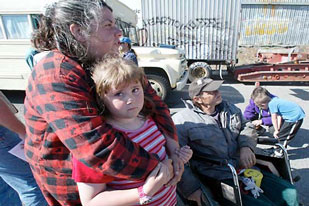
In the two weeks since Election 2020, the country has oscillated between joy and anger, hope and dread in an era of polarization sharpened by the forces of racism, nativism, and hate. Still, truth be told, though the divisive tone of this moment may only be sharpening, division in the United States of America is not a new phenomenon.

Over the past days, I’ve found myself returning to the words of Dr. Martin Luther King, Jr., who, in 1967, just a year before his own assassination, gave a speech prophetically entitled “The Other America” in which he vividly described a reality that feels all too of this moment rather than that one:

“There are literally two Americas. One America is beautiful… and overflowing with the milk of prosperity and the honey of opportunity. This America is the habitat of millions of people who have food and material necessities for their bodies; and culture and education for their minds; and freedom and human dignity for their spirits…

“But tragically and unfortunately, there is another America. This other America has a daily ugliness about it that constantly transforms the ebulliency of hope into the fatigue of despair. In this America millions of work-starved men walk the streets daily in search for jobs that do not exist. In this America millions of people find themselves living in rat-infested, vermin-filled slums. In this America people are poor by the millions. They find themselves perishing on a lonely island of poverty in the midst of a vast ocean of material prosperity.”

In Dr. King’s day, that other America was, for a time, laid bare to the nation through mass social unrest and political change, through the bold actions of the freedom fighters who won the Voting Rights Act and then just kept on fighting, as well as governmental programs like the “War on Poverty.” And yet, despite the significant gains then, for many decades since, inequality in this country has been on the rise to previously unimaginable levels, while poverty remained locked in and largely ignored.

Today, in the early winter of an uncurbed pandemic and the economic crisis that accompanies it, there are 140 million poor or low-income Americans, disproportionately people of color, but reaching into every community in this country: 24 million Blacks, 38 million Latinos, eight million Asians, two million Native peoples, and 66 million whites. More than a third of the potential electorate, in other words, has been relegated to poverty and precariousness and yet how little of the political discourse in recent elections was directed at those who were poor or one storm, fire, job loss, eviction, or healthcare crisis away from poverty and economic chaos. In the distorted mirror of public policy, those 140 million people have remained essentially invisible. As in the 1960s and other times in our history, however, the poor are no longer waiting for recognition from Washington. Instead, every indication is that they’re beginning to organize themselves, taking decisive action to alter the scales of political power.

For years, I’ve traveled this country, working to build a movement to end poverty. In a nation that has so often boasted about being the wealthiest and freest in history, I’ve regularly witnessed painful divisions caused by hunger, homelessness, sickness, degradation, and so much more. In Lowndes County, Alabama, for instance, I organized with people who lived day in, day out with raw sewage in their yards and dangerous mold in their homes. On Apache land in Oak Flats, Arizona, I stood with native leaders struggling to cope with generations of loss and plunder, most recently at the hands of a multinational copper mining company. In Gray’s Harbor, Washington, I visited millennials living in homeless encampments under constant siege by militia groups and the police. And the list, sadly, only goes on.

As the future administration of Joe Biden and Kamala Harris heads for the White House (no matter the recalcitrant loser still ensconced there), the rest of us must equip ourselves with both courage and caution, living as we do in a divided nation, in — to be exact — two very different Americas. Keep in mind that these are not the insulated, readymade Americas of MSNBC and Fox News, of Republicans and Democrats, of conservatives and liberals. All of us live in a land where there are two Americas, one of unimaginable wealth, the other of miserable poverty; an America of the promised good life and one of almost guaranteed premature death.

Unleashing the Power of Poor and Low-Income Voters

One enduring narrative from the 2016 election is that poor and low-income voters won Donald Trump the White House, even if the numbers don’t bear it out. Hillary Clinton won by 12 points among voters who made less than $30,000 a year and by 9 points among voters who made less than $49,999; the median household income of Trump voters then was $72,000.

Four years later, initial estimates suggest that this trend has only intensified: Joe Biden attracted more poor and low-income voters than President Trump both in the aggregate and in key states like Michigan. Trump, on the other hand, gained among voters with annual family incomes of more than $100,000. Last week, the director of the MIT Election Data and Science Lab noted that this “appears to be the biggest demographic shift I’m seeing. And you can tie that to [Trump’s] tax cuts [for the wealthy] and lower regulations.”

In 2016, there were 64 million eligible poor and low-income voters, 32 million of whom did not vote. In 2020, it’s becoming clear that poor and low-income voters helped decide the election’s outcome by opting for a candidate who signaled support for key antipoverty issues like raising the minimum wage, expanding health care, and protecting the environment. In down-ballot races, every congressional member who endorsed Medicare for All won reelection, even in swing states. Imagine then how many dispossessed and disenfranchised voters might have turned out if more candidates had actually been speaking to the most pressing issues of their lives?

Seventy-two percent of Americans said that they would prefer a government-run healthcare plan and more than 70% supported raising the minimum wage, including 62% of Republicans. Even in districts that went for Trump, voters passed ballot measures that, only a few years ago, would have been unheard of. In Mississippi, people voted to decriminalize medical marijuana, while in Florida a referendum for a $15 minimum wage got more votes than either of the two presidential candidates.

If nothing else, Election 2020 revealed a deeply divided nation — two Americas, not one — though that dividing line marked anything but an even or obvious split. A startling number of Americans are trapped in wretched conditions and hungry for a clean break with the status quo. On the other hand, the rampant voter suppression and racialized gerrymandering of the last decade of American politics suggests that extremists from the wealthier America will go to remarkable lengths to undercut the power of those at the bottom of this society. They have proven ready to use every tool and scare tactic of racist division and subterfuge imaginable to stop poor Black, Latino, Asian, Indigenous, and white potential voters from building new and transformative alliances, including a new electorate.

It’s time to move beyond the defeatist myth of the Solid South or even the dulling comfort of a Midwestern “blue wall.” Across the South and the Midwest, there are voter-suppression states still to win, not for a party, but for a fusion movement of the many. The same could be true for the coasts and the Southwest, where there remains a sleeping giant of poor and low-income people yet to be pulled into political action. If this country is ever going to be built back better, to borrow Joe Biden’s campaign pledge, it’s time to turn to its abandoned corners; to, that is, the other America of Martin Luther King that still haunts us, whether we know it or not.

Fusion Politics in the Other America

When Dr. King gave his “Other America” speech, he was preparing for what would become the last political project of his life: the Poor People’s Campaign. At a time when the nation appeared to be fraying at the seams, he grasped that a giant social leap forward was still possible. In fact, he envisioned a protracted struggle that might catapult this country into a new era of human rights and revolution not through sanguine calls for unity, but via a rousing fusion of poor and dispossessed people from all walks of life. And that, as he imagined it, would also involve a recognition that systemic racism and other forms of hate and prejudice were crucial to the maintenence of the two Americas and had to be challenged head-on.

The idea of such fusion politics echoed earlier chapters of political reckoning and transformation in this country. From the post-Civil War era of Reconstruction into the 1890s, newly emancipated Blacks built unprecedented, if fragile, alliances with poor whites to seize governing power. Across a new South, fusion parties expanded voting rights, access to public education, labor protections, fair taxation, and more. In North Carolina in 1868, for instance, legislators went so far as to rewrite the state constitution to codify for the first time the right of all citizens to “life, liberty, and the enjoyment of the fruits of their own labor.”

For nearly 30 years, I’ve been part of a modern version of fusion organizing, even as I studied earlier examples of it — and this country’s history is rich with them. Indeed, the modern Poor People’s Campaign that I co-chair is itself inspired by such past fusion movements, including the version of politics I was first introduced to by multiracial welfare rights and homeless organizing in the 1980s and 1990s.

Organizations like the National Welfare Rights Union and the National Union of the Homeless first grew in response to the neoliberal politics of President Ronald Reagan and his attacks on the poor, especially the Black poor, or, as he put it, “welfare queens.” In response to such myths and deep, divisive cuts, out of shelters and from the streets, poor people began to organize projects of mutual aid and solidarity, including “unions” of the homeless.

By the 1980s, the National Union of the Homeless had been created and had upwards of 30,000 members in 25 cities. Meanwhile, organizers across the country soon escalated their efforts with waves of coordinated and nonviolent takeovers of vacant federally owned buildings at a time when the government had abdicated its responsibility to protect and provide for its poorest citizens. Those poor and homeless leaders also helped the Homeless Union secure guarantees from the federal government both for more subsidized housing and for protections of the right of the homeless to vote.

Today, in the middle of an economic crisis that could, in the end, rival the Great Depression, I’m reminded not just of those moments that first involved me but of the fusion movements of the early 1930s. After all, in those years, shanty towns called Hoovervilles — given that Herbert Hoover was still president — cropped up in cities across the country.

Not unlike the tent cities of the Homeless Union and the Welfare Rights Movement in the 1980s and the ones appearing today, those Hoovervilles were where masses of the unemployed and homeless gathered to survive the worst of that depression and strategize on how to resist its misery. Multiracial Unemployed Councils organized and fought for relief for workers without jobs then, preventing thousands of evictions and utility shutoffs.

Meanwhile, in the abandoned fields of the Southern Delta from Arkansas to Mississippi, groups like the Southern Tenant Farmers Union pioneered the dangerous work of organizing Black and white tenant farmers and sharecroppers. When the New Deal coalition bet its future on compromise with white Southern extremists, members of that union were among the last guardians of the rights of poor agrarian workers. Their lonely clarity on the significance of fusion politics in the South stood in stark contrast to the rise of an unmitigated politics of white reaction there.

Today, as top Democrats like Joe Biden and Senate Minority Leader Chuck Schumer claim the legacy of Great Depression-era President Franklin Delano Roosevelt, remember the fusion organizing that helped bring him to power and pushed him to enact change. I’m thinking in particular of the more than 40,000 unemployed veterans of World War I who arrived in Washington D.C. in 1932 to demand the early payment of promised bonuses, previously only considered redeemable after 1945. That Bonus Army, as the veterans called it, collected many of the fraying threads of the American tapestry, making camp, sometimes with wives and children, on seized public land just across the Potomac River from the capital’s federal office buildings, while holding regular nonviolent marches and rallies.

Eventually, President Herbert Hoover ordered the U.S. Army to tear down the camp in a violent fashion. The mistreatment of those poor and war-weary veterans in the process proved to be a lightning rod for the public and so Hoover lost to FDR in the presidential election later that year, setting the stage for a decade defined by militant organizing and major shifts in national policy.

The Mandate of the Poor Today

There are already those in the media and politics who are counseling restraint and a return to the pre-Trump days, as if he were the cause, not the consequence, of a nation desperately divided. This would be nothing less than a disaster, given that the fissures in our democracy so desperately need mending not with nice words but with a new governing contract with the American people.

The battleground states that won Joe Biden the presidency have also been battlegrounds in the most recent war against the poor. In Michigan, hit first and worst by deindustrialization, millions have struggled with a failing water system and a jobs crisis. In Wisconsin, where unions have been under attack for years and austerity has become the norm, both budgets and social welfare policies have been slashed by legislatures. In Pennsylvania, rural hospitals have been closing at an alarming rate and, even before the pandemic hit, the poorest large city in the country, Philadelphia, had already become a checkerboard of disinvestment and gentrification. In Georgia, 1.3 million renters — 45% of the households in that state — were at risk of eviction this year. And in Arizona, the climate crisis and Covid-19 have ravaged entire communities, including the members of Indigenous nations who recently turned out to vote in record numbers.

The people of these states and 15 more helped elect Joe Biden and Kamala Harris, and count on one thing: with their votes, they were calling for more than just an end to Trumpism. They were demanding that a new era of change begin for the poor and marginalized. The first priority in such an era should, of course, be to pass a comprehensive relief bill to control the pandemic and buoy the millions of Americans now facing a cold, dark winter of deprivation. The House and the Senate have a moral responsibility to get this done as soon as the new administration takes office, if not before (though tell that to Mitch McConnell). The first 100 days of the Biden administration should then be focused, at least in part, on launching a historic investment in securing permanent protections for the poor, including expanded voting rights, universal healthcare, affordable housing, a living wage, and a guaranteed adequate annual income, not to speak of divestment from the war economy and a swift transition to a green economy.

That should be the mandate of our next government. And that’s why we, the overflowing millions, must harness the fusion politics that was so crucial to the election of Joe Biden and Kamala Harris and organize in the best tradition of our predecessors. Real social progress rarely comes slowly and steadily, but in leaps and bounds. The predictable stalemate of the next administration and its Republican opposition can’t be broken by grand speeches in the House or Senate. It can only be broken by a vast social movement capable of awakening the moral imagination of the nation.

It’s time to get to work.