20 Nov 2020

Increased use of food banks by middle-income families in UK as food poverty surges

Dennis Moore


Charities have identified an increase in the number of middle-income families being forced to use food banks.

These families are defined as the “new hungry” and constitute a growing layer of those who had previously had decent incomes and led a comfortable lifestyle. Now they are increasingly having to claim welfare benefits and use food banks to be able to feed themselves and their families.

The Feeding Britain network, a charity working with food banks, reports that its members have started providing food to middle-income families, often with mortgages and cars. They were typically business owners and the self-employed, thrown into financial crisis because they had lost their jobs during the pandemic and not been picked up by the benefit system.

Footprints in the Community food bank in northern England receives recent donation (Image credit: Twitter/Footprints_UK)

“We now see families at food banks who before the pandemic were able to pay their bills and still be comfortable enough to put food on the table. For the first time in many years that is no longer the case,” said the charity’s national director, Andrew Forsey.

The wider use of food banks by what would have only recently been considered a more affluent layer is a growing trend and an indicator of how the pandemic has created a far-reaching cost of living crisis.

Prior to the pandemic, the majority of those using food banks were typically destitute, without financial means, awaiting welfare benefit payments or low-paid workers not earning enough to feed themselves or their families.

Food banks have been handing out more and more food parcels throughout the pandemic as increasing numbers of families and individuals struggle to survive. Feeding Britain’s network of charities reported a staggering increase in demand from those needing food aid between March and September. This is expected to get a lot worse during the current lockdown.

The Beaumont Leys Food bank in Leicester went from providing food to 50 families to 500 families a week as the pandemic took hold in March. The NewStarts food bank in Bromsgrove, Worcestershire reported that demand had risen by 700 percent over the same period. Bonny Downs community association in East Ham, London handed out food to 4,000 people between April and June and there were lengthy queues forming an hour before the food bank opened.

Many of those who have lost their jobs are having to claim Universal Credit (UC) for the first time and are confronting the bitter reality that what they receive is not enough to live on. The Tory government increased UC by a meagre £20 a week following the onset of the pandemic, taking the total amount for an individual’s living expenses from just £73 to the still paltry £93 a week.

Jen Coleman from Black Country Food Bank said, “The £20 increase [in Universal Credit] has not meant that those in poverty have suddenly become better off, it has meant that they have been able to survive.”

While the UC increase was miniscule, millions will be thrown into yet deeper poverty if the government press ahead with their proposal to remove the £20 a week top-up, planned for April 2021.

For millions of workers and young people, the preceding decade was characterised by the imposition of austerity and cuts to essential services, driving a rise in the number of families depending on food banks to feed themselves. In the last five years, demand for emergency food has increased and since the onset of the pandemic the number of those being forced to use food banks has shot up—with half of those using food banks doing so for the first time.

Food charities reported that the first full month of lockdown in April this year was their busiest ever, with Britain’s biggest food bank network, the Trussell Trust, reporting that in the last two weeks of March demand for food parcels increased by 81 percent compared to the same period in 2019. It gave out 89 percent more food parcels in April than the same time last year, with the number of families requiring help doubling.

In the first six months to September, a record 1.2 million emergency parcels were handed out by the Trussell Trust. The number of food parcels the organisation handed out to children rose by 122 percent, with 470,000 parcels going to them.

In May, the Food Foundation reported that over 5 million people in the UK were living in households with children who had experienced food insecurity during the lockdown. The government and the Labour Party had to be forced by a popular campaign launched by England footballer Marcus Rashford to extend its free school meals programme to include the six-week summer holidays.

Data from the Trussell Trust, which runs 1,300 food banks, showed that greater demand was due to people moving from a wage income to benefits and people working for low wages. Low income, benefit delays and sickness or ill health were the three main reasons people were being referred to a Trussell Trust food bank, according to its latest report.

In 2017, 1.5 million people experienced destitution and were not able to afford essentials. Modelling carried out by Edinburgh’s Heriot-Watt University forecast that the economic impact of the pandemic in 2020/21 will lead to 670,000 additional people being pushed into destitution for the remaining part of 2020—a consequence of losing jobs, income and businesses.

This will translate into an additional 300,000 emergency food parcels having to be distributed in the last quarter of 2020, an increase of 60 percent on the same time last year.

Many of those who have been furloughed throughout the pandemic have lost 20 percent of their income as the scheme only covers 80 percent of wages. This disproportionately affects the low-paid who were typically already living a hand-to-mouth existence when working full-time. In the coming winter months, many of these families face the stark choice between paying for heating or putting food on the table.

The government’s main concern during the pandemic was to protect the interests of big business and finance, handing billions to the banks and the corporations, implementing a “herd immunity” policy and providing pitiful to non-existent financial support to furloughed workers and those who lost their jobs. The effect of this policy was to starve especially low-paid workers back into unsafe workplaces.

The burden of feeding the increasing numbers of people unable to find work has meanwhile been placed at the foot of overstretched food banks and charities, now feeling the strain of growing demand as more and more people end up hungry.

Toyota workers in India continue strike, defy state back-to-work order

Shibu Vavara & Arun Kumar


Over 3,000 workers at two Toyota Kirloskar Motor Private Limited (TKM)-owned car assembly plants in Bidadi, India, 50 kms from Bengaluru (formerly Bangalore), are continuing their strike in defiance of a back-to-work order issued by the Karnataka state government on Wednesday. Striking workers have been locked out since November 10 in an attempt to break a sit-in-strike launched by workers the previous day against the suspension of a union leader.

Three days after locking out the workers, Toyota escalated its witch hunt, suspending another 39 workers for supposed “acts of misconduct,” even though the facility has been closed. Workers have refused to return to work until management lifts the suspension of all 40 workers.

Locked out striking Toyota workers outside of plant

On Tuesday, Karnataka Deputy Chief Minister C. N. Ashwath Narayan, a member of Prime Minister Narendra Modi’s Hindu-chauvinist Bharatiya Janata Party (BJP), announced his decision to “prohibit” the ongoing strike and end the lockout following a meeting with officials from the company, the TKM Employees Union (TKMEU) and the state government. Making it clear his strikebreaking order was driven by the ruling class’s aim of developing India as a more attractive cheap-labor platform than China, Narayan said, “The whole world is looking at India as an alternative to China, and countries like Japan, South Korea and Taiwan are eager to set up shop in Karnataka. Under such a situation, there should not be any talk of strikes and lockouts.”

The TKM auto plants are 89 percent owned by the Japanese auto giant Toyota Motor Corporation, while Kirloskar Group, an Indian conglomerate, owns the remaining 11 percent. The sprawling 432-acre industrial complex in Bidadi employs 6,500 hourly and salaried workers and has an annual capacity of 310,000 vehicles. Workers produce the MPV (Multi-Purpose Vehicle) Innova, the Fortuner SUV and Corolla and Camry passenger cars for the Indian market.

The present conflict began when TKMEU Treasurer Umesh Gowda Alur went to management on November 9 to relay workers’ complaints over the unbearable speedup on the assembly line. This led to a heated argument after which management suspended Alur. Workers responded by launching a sit-down strike to demand Alur’s return and an end to the oppressive working conditions.

A striking worker told the WSWS: “Toyota continues to brutally exploit workers at its manufacturing plants. In 2014, when workers went on strike, management declared a lockout and suspended 32 workers. When it lifted the lockout, management insisted the suspended workers would not be taken back until they went through a series of disciplinary inquiries. After the inquiries, it only reinstated 12 workers three years later. The fate of seven workers is still pending. The remaining suspended workers decided to leave the company.”

The worker then described conditions in the plant. “The management treats union leaders badly and gives them no respect. When it reopened the plants last June, it employed fewer workers to follow the COVID-19 safety rules. That meant fewer workers were responsible to meet the same production quotas that existed with the full capacity of workers. We used to produce an Innova car in every 3 minutes but now we are being told to do the same in 2.5 minutes.”

These conditions are similar to what workers face at the Maruti Suzuki car assembly plant at Manesar, in the northern Indian state of Haryana. In 2011-12, they launched a year-long struggle to break with the company stooge union and improve their conditions. Maruti Suzuki management and the Congress Party-led Haryana state government responded by launch a joint vendetta to crush the rebellion, destroy the newly formed Maruti Suzuki Workers Union (MSWU) and demonstrate to global investors that no resistance to industrial slavery would be tolerated. In March 2017, 13 militant workers, including the entire leadership of the MSWU, were sentenced to life imprisonment on trumped-up murder charges.

“Supervisors on the floor have to give you permission to go to the bathroom,” the Toyota worker continued. “As soon as they let you go, they start counting the time until you return to your position. The time is calculated, and it is deducted from your salary.” If workers do not meet their production targets, he added, they do not get their pay.

Striking TKM workers are camping outside the factory after management announced it was locking out workers and told them to vacate the premises. Workers are continuing their strike and denouncing management’s efforts to intimidate them.

In a cynical attempt to justify the lockout, management told the media that it was to protect workers against the spread of the coronavirus. “As a part of the sit-in strike, the team members were unlawfully staying on the company’s premises and compromising COVID-19 guidelines, thereby leading to a potentially dangerous situation in the factory. This led TKM authorities to declare a lockout for unionized employees bearing in mind the safety and well-being of its employees.”

In fact, TKM management has been oblivious to the safety of workers. The plants were reopened on May 26, after being shut for 55 days under the Modi government’s lockdown measures. Although management claimed it was enforcing new safety protocols, two workers tested positive on June 7 and 16 respectively, forcing the plants to close again.

When they reopened on June 19, it was with a “reduced workforce” and with office staff working from home. Since then, virtually every day a dozen workers are infected due to workers being crammed together on the assembly line. By October 28, at least 565 workers at the complex tested positive and two had died. So, any suggestion that management expelled striking workers from the plant to protect them from the virus is a patent lie. Like the state government, management’s true aim is to break the strike and force workers to surrender.

According to media sources, the holiday season has been prosperous for the company, which has seen a rise in sales over last month, up 52 percent between September and October. This is still 1.87 percent below last October’s sales. Under those conditions, the company is determined to resume production as soon as possible to cash in on higher holiday sales no matter what the cost to workers from the spread of the COVID-19 virus.

TKM management has resumed talks with TKMEU with the aim of ending the strike and restarting production. The back-to-work order is also being used by management to force them back to work.

It is not clear yet whether TKMEU officials will cave in to management and the government’s demands and quickly end the strike. In any case, neither the TKMEU nor any of the other unions has a program to fight the corporate onslaught, which is supported by all of the capitalist parties, from the BJP and Congress to the two principal Stalinist parties, the Communist Party of India (Marxist) or CPM and the smaller, older Communist Party of India (CPI).

Rather than mobilizing auto and other workers throughout Karnataka and the rest of the country, TKMEU officials are appealing to management and government officials. TKMEU President Prasanna Kumar Chekkere told Business Line, “The workload is very heavy. We are not given leave even for personal emergencies. We want them to consider our requests on humanitarian grounds.” He said the union has also written to the Labor Department seeking redress for workers’ grievances.

The TKMEU has called a meeting of striking workers for this morning at the protest site outside the plants to announce its decision on the strike. Given its past record, it is likely the union will capitulate to the state government’s order. In April 2014, the TKMEU worked quickly to end a one-month strike after a similar order by the state government, then led by the Congress party. A deal was reached that did not meet a single demand of the workers.

The state repression of autoworkers and other sections of the working class poses the need for an independent political strategy for Indian workers. Like other global auto giants, Toyota is using the pandemic to accelerate the restructuring of its international operations, slash jobs and reduce labor costs. To fight the global corporations, autoworkers need an international strategy and must coordinate their struggles across borders.

The Indian trade unions are mostly tied to the various capitalist parties, including the Stalinists, and are tied to the national framework. Like the nationalist unions around the world, they have responded to globalization by suppressing working-class opposition and voluntarily accepting reductions in labor costs in order to attract foreign investment.

To take forward their struggle, workers need new organizations, including action committees controlled by rank-and-file workers themselves, and a new socialist political strategy. The lockout should be transformed into a strike of regular, contract and apprentice workers at the Toyota plants and a broader mobilization of the working class throughout every industry and the public sector.

The fight against multinational corporations like Toyota requires the unification of Indian workers with their class brothers and sisters in Australia, Japan, the US and Europe in a common fight to defend jobs and living standards and oppose the capitalist system.

No justice for families 10 years after New Zealand’s Pike River mine disaster

Tom Peters


November 19 marked the 10th anniversary of the 2010 Pike River coal mine disaster. Twenty-nine miners died after a series of underground explosions in a mine located on the remote West Coast of the South Island. Their bodies have never been recovered.

More than 100 family members of the victims gathered yesterday at the entrance to the mine. They observed a minute’s silence at 3:44 p.m., the time of the first explosion, and read out the names of the dead.

Dean Dunbar at his son Joseph’s memorial stone

The Labour Party-led government held an event at parliament in Wellington, with 34 people from six families taking part. Anna Osborne, who lost her husband Milton in the mine, and Sonya Rockhouse, whose son Ben died, gave speeches calling for greater enforcement of workplace safety and justice for the victims. Osborne said: “WorkSafe NZ’s investigations have remained weak, their enforcement poorly resourced, and they most often simply choose not to prosecute. In New Zealand you can, rightly, go to jail for killing a kitten… but not for killing a worker.”

Prime Minister Jacinda Ardern declared that the Labour Party government “stands with you and the Pike 29” and was “very close to fulfilling the commitment” to re-enter the mine to gather forensic evidence and reopen the investigation into the disaster. She stated that the families had “suffered because no-one was held accountable at the time.” In fact, to this day no charges have been laid against Pike River Coal’s (PRC) managers and executives.

The entire New Zealand ruling elite, including successive National Party and Labour Party governments, big business, government departments, police, sections of the judiciary and trade unions have carried out a decade-long cover up of the causes of the tragedy and denied justice to the families of the deceased miners.

The disaster was an industrial crime, caused by gross negligence and cost-cutting by PRC, which placed production and profit ahead of workers’ safety and their lives. The mine had inadequate ventilation, faulty methane gas sensors and no suitable emergency exit as required by law.

Map of Pike River Mine showing the drift, the mine workings and the rockfall (red X) (Source: Pike River Recovery Agency)

A 2012 royal commission of inquiry found that there were at least 21 times in seven weeks when methane levels were in the explosive range. The mine was a death trap that could have blown at any time and there were many warnings, which management ignored. Those responsible include not only the company, but also the Department of Labour (DoL, now called WorkSafe), which knew about the blatant safety violations but did not shut down the mine.

Complicit throughout has been the Engineering, Printing and Manufacturing Union (EPMU), now renamed E Tu, which suppressed opposition by workers to safety breaches. After the explosion EPMU leader Andrew Little defended PRC, telling the media there was “nothing unusual” about the company and it had “a good health and safety committee that’s been very active.” Little subsequently became a Labour Party MP and in 2017 was made “Minister Responsible for Pike River Re-entry.”

Successive National Party and Labour Party governments had slashed regulations and gutted the DoL’s specialist mines inspectorate, which had just two inspectors in 2010. Labour MP Damien O’Connor later admitted that he had been warned about the increased risk of a mining disaster because of deregulation, but took no action.

The DoL charged PRC chief executive Peter Whittall for safety breaches, but the charges were dropped in a sordid deal in 2013 between Whittall and the government agency. The Supreme Court later found the deal was unlawful, but charges were not reinstated.

Seeking to prevent any further investigations, the previous National Party government planned to permanently seal the mine without recovering the bodies. This was only stopped when the miners’ families protested in 2016 along the road to the mine, gaining widespread support in the working class.

The Labour Party and its allies, the Greens and New Zealand First, campaigned in the lead-up to the 2017 election promising to re-enter and re-investigate the mine. Ardern’s government then established a Pike River Recovery Agency (PRRA).

Three years later, however, there have still been no prosecutions. Crucial physical evidence has gone missing or been destroyed by police, who never treated the mine as a crime scene and allowed PRC management to remain in charge of the site following the disaster.

The re-entry only began in May 2019 and is proceeding slowly. In March 2020, Little stated that the PRRA would not excavate into the workings of the mine beyond a rockfall at the end of the 2.3-kilometre drift tunnel. Little told a parliamentary committee in June: “There is always a limit to these things and I have no intention of returning to Cabinet for any further resources.” He said it was “just impractical” to go beyond the rockfall, even though that is where the miners’ bodies are most likely to be.

An incident form submitted by shift supervisor Dene Murphy in June 2010 drawing attention to grossly inadequate ventilation. One of many warnings that was ignored. (Source: Royal Commission into the Pike River disaster)

The government intends to seal the mine by the end of March 2021.

Dean Dunbar, whose son Joseph had just turned 17 and was on his first day underground when he died at Pike River, told the World Socialist Web Site: “Here’s how I look at it. It’s very simple: in a modern society you don’t wipe out 29 men and boys, entomb them and walk away.”

He added that if the government was “going to put a dollar amount on the recovery of Joseph and 28 others, then [they should] at least put a couple of bore holes on the other side of the rockfall to make sure our blokes aren’t all sitting there together, which is where we think they are.” If there was no attempt to investigate beyond the rockfall, “then that just tells us they don’t really want to know what happened.”

Dunbar said, “I now understand the phrase: the cover-up becomes worse than the original crime.” Evidence that was blown out the mine’s ventilation shaft—a door to a control panel on an underground fan—could identify the cause of the first explosion. It had been photographed but then “mysteriously went missing.”

Bernie Monk, whose son Michael died at Pike River, said the families had waged a decade-long battle for the truth. Former National Party Prime Minister John Key and Police Minister Judith Collins falsely claimed that the mine could not be re-entered and the force of the first explosion meant “everyone died straight away, it was a burning inferno, everyone was ashes and there was nothing to recover.”

Bernie Monk (center, arms folded) and other family members and supporters blockading the road to Pike River in 2016. (Source: Facebook)

Richard Healey, an electrical engineer who independently investigated the disaster on behalf of some of the families for 18 months, told the WSWS: “We now know that actually parts of the mine are remarkably undamaged.” Images taken in 2011 by cameras lowered through bore holes, some of which were made public six years later, showed intact bodies, along with items such as rubber hosing and a wooden pallet.

Monk, Dunbar and Healey say the evidence strongly suggests there were survivors after the first explosion on November 19, 2010, and potentially after the second explosion five days later, shielded by the rockfall. “We have an image of an open self-rescue canister lying on the floor with the self-rescuer [emergency breathing apparatus] removed. That pretty much tells me that someone was in there and accessed that equipment,” Healey said.

In 2011, when the mine site was in the hands of receivers who still employed managerial staff from PRC, hundreds of cubic metres of concrete were poured down a slim-line ventilation shaft into the underground “fresh air base” where self-rescuers were stored. Healey feared that this would have “destroyed any possibility of recovering evidence” from the area.

Healey also strongly criticised the PRRA’s investigation, saying it was “destroying” the crime scene. Those gathering evidence were mining professionals, not forensic investigators or police photographers. They were using “ancient” equipment including “a camera which has about the performance of a very old cell phone,” instead of LiDAR technology used by police to create detailed 3D images.

In response to claims by the media and politicians that the mine re-entry has become too expensive, Monk pointed out that there had been an $80 million insurance payout to PRC’s major shareholders NZ Oil & Gas and the Bank of New Zealand. He asked, “Why wasn’t that used to do the job we’re doing today?”

Monk said the record of the police gave him no confidence that the current investigation would result in successful prosecutions. He added: “We didn’t have to go down the mine to bring charges against people because the royal commission stated that there were [multiple] times in the seven weeks leading up to the explosion that mine could have blown up.”

He described the 2012 royal commission as “a farce” because Whittall and Doug White, PRC’s general manager, were told by their lawyers not to answer questions that could incriminate them. In an extraordinary decision, the commission placed a 100-year embargo on all the evidence it looked at, hiding it from public scrutiny.

Monk and Dunbar also criticised Little and the EPMU. The union had never made any criticisms of PRC before the explosion and never organised any strikes over health and safety, even after a group of miners protested the lack of emergency gear underground. It ensured that there was no further interruption to operations.

Monk noted that the EPMU had not supported the families’ 2016 protests against the attempt to seal the mine, despite 11 of the dead miners being union members. He approached a union leader at a memorial service last year to ask them to push for an investigation beyond the rockfall. “He said to me: ‘Bernie, you know they’re never going through that rockfall.’” Monk replied: “You want us to come up here every year and put our fists in the air and say ‘solidarity’ when there’s 11 of your men sitting buried in Pike River and you haven’t got off your arses.”

The story of Pike River, both the preventable deaths and the ongoing cover-up, mirrors similar tragedies internationally, including the 2010 Upper Big Branch mine explosion in West Virginia, which also killed 29 people, and the Grenfell Tower fire in London where 72 people died.

In New Zealand, it was followed by the collapse of the CTV building in the 2011 Christchurch earthquake, which killed 115 people. Police decided it was not in the “public interest” to prosecute anyone for its multiple dangerous construction flaws. Likewise, no one has been held accountable for 21 deaths caused by the White Island/Whakaari volcanic eruption last year. Despite numerous warnings, tourism companies had profited from dangerous excursions to the island.

The chief political lesson Pike River and all these disasters is that workers cannot rely on any of the established political parties, police, government regulators or trade union bureaucracies to protect their safety. All these organisations are loyal to the profit system and seek to subordinate workers to the demands of big business. This fact has been underscored by the COVID-19 pandemic: in one country after another, unions are collaborating with governments and corporations to force workers to risk exposing themselves to the deadly coronavirus by returning to workplaces before it is safe and without proper precautions.

Biden, Pence both reject lockdowns to save lives as coronavirus pandemic explodes

Patrick Martin


At press conferences held only minutes apart Thursday afternoon, President-elect Joe Biden and Vice President Mike Pence each flatly rejected any possibility of a lockdown of the US economy to save lives, despite the impending catastrophe from the coronavirus pandemic.

The twin statements amounted to a joint, bipartisan declaration that hundreds of thousands of Americans must die rather than sacrificing the profits of Wall Street and giant corporations, which demand that workers stay on the job no matter how hazardous the workplace has become as COVID-19 spreads uncontrollably in virtually every American state.

Democratic presidential candidate former Vice President Joe Biden meets with residents of Kenosha at Grace Lutheran Church in Kenosha, Wis., Thursday, Sept. 3, 2020. (AP Photo/Carolyn Kaster)

Pence’s statement was merely the reiteration of the longstanding policy of the Trump administration. He appeared at the first public briefing by the White House coronavirus task force in many months, only in order to make it emphatically clear that there was no change in Trump’s policy of back-to-work and back-to-school.

The timing of the press conference seemed to be determined by the announcement the day before that schools in New York City, the largest US school district, would end in-person instruction and revert to online instruction only because of a sharp increase in the positivity rate in COVID-19 tests administered to city residents.

Pence declared that the policy of the Trump administration remained that all schools should reopen for in-person instruction, even though this will mean a horrific toll in disease and death among teachers, students and school workers.

The Biden statement had more political consequence, since it was a declaration by what is still expected, by the media and corporate America, to be the next administration, one which was elected in large measure because of popular outrage over the indifference and callousness evinced in Trump’s handling of the pandemic.

Biden was therefore at pains to demonstrate that he would be as obedient a servant of big business as Trump, so that there would be no reason for the financial aristocracy to seek to overturn Biden’s clear-cut victory in the Electoral College and the popular vote.

Appearing side-by-side with his running mate Kamala Harris, Biden offered his usual mixture of vague and mushy responses to questions about economic policy, the transition process and Trump’s efforts to overturn the election. But on the lockdown question he was categorical and definitive.

After an hour-long video conference with 10 Democratic and Republican state governors, largely dealing with the coronavirus pandemic, Biden first acknowledged that the United States had reached “another tragic milestone, 250,000 deaths,” and the vast suffering this has caused. Biden then offered the victims of the pandemic only his prayers, while praising the governors for their bipartisan efforts to encourage mask wearing and restrict venues like bars and restaurants.

The president-elect said there was a great deal of consensus among the governors on the need for economic relief for states and cities, whose budgets have been devastated by COVID-19 related shutdowns and expenses. “The federal government has to deliver this relief sooner rather than later,” he said, although he gave no hint as to how this would be accomplished given the six-month-long deadlock in Congress on the issue.

After a few generalities about the difficulties of coordinating the delivery of a vaccine to 330 million Americans—once one or more vaccines have been approved by federal agencies—and boilerplate remarks about how America could accomplish any goal if we “come together as a country,” Biden took several questions.

He announced that he had already made a selection of a treasury secretary, although he did not reveal the name, and said that the person would be widely accepted within the Democratic Party as well as to “moderates” who had supported his campaign. In other words, not Senator Elizabeth Warren or anyone else identified with the left-populist wing of the Democrats. He voiced general support for the policy of the Federal Reserve, which has pumped trillions into the financial system over the past eight months, fueling the rise in the stock market and in the personal wealth of the billionaires.

When one reporter cited Biden’s previous statements as a candidate, that he “would support a nationwide shutdown if scientists recommended it,” Biden responded sharply, “it was a hypothetical question, and the answer was I would follow the science.”

He continued, “I’m not going to shut down the economy period. I’m going to shut down the virus. That’s all I’m going to shut down and let me say that again. No national shutdown. No national shutdown because every region, every area every community can be different. So there is no circumstance that I can see that would require a total national shutdown.”

Biden went on to give a few banal examples of different degrees of restriction on operations of gyms, restaurants and churches, but he avoided the central issue of keeping large factories, warehouses and office buildings open, facilities which have been shown to be among the most important vectors for mass infection by coronavirus.

Besides his categorical assurances to corporate America that there would be no return to lockdown conditions, Biden spoke extensively, but in a deliberately obscure manner, on the increasingly frenzied efforts of the Trump campaign to overturn his election victory.

One reporter asked him to “take a step back and look at the way the president is handling in his refusal to concede. What do you think is really going on here?” Given the opportunity to characterize Trump’s actions as a political coup, Biden reduced the issue to Trump’s personality and psychology.

“Let me choose my words,” he said. “I think we are witnessing incredible irresponsibility, incredibly damaging messages being sent to the rest of the world about how democracy functions and I think it is—well I don’t know his motives, but I think it’s totally irresponsible.”

Asked about Trump’s summoning Michigan Republican officials, including leaders of the state legislature, for a meeting at the White House today, Biden dismissed the suggestion that this action was “meant to overturn the election.” He described it as “another incident where he will go down in history as one of the most irresponsible presidents in American history.”

He then continued, “It’s not within the norm at all. The question’s whether it’s even legal. But it will be interesting to see who shows up. We have won Michigan. It will be certified. We will end up making clear that they are—that we won.”

Biden’s press conference was held several hours after the Trump campaign’s attorneys, headed by former New York City Mayor Rudy Giuliani, held a 90-minute media briefing (beginning with a 60-minute diatribe by Giuliani) to publicize false and unprovable charges about vote-counting software supposedly being used to transform a “landslide victory” for President Trump into Biden’s current 306–232 lead in the Electoral College, and six-million-vote lead in the popular vote.

Without offering a shred of evidence, Giuliani, Sidney Powell and Jenna Ellis made a series of claims based on anti-communist hysteria and outright anti-Semitism, charging that the Venezuelan government and Jewish billionaire George Soros had interfered in US elections in order to defeat Trump.

A major focus of these wild conspiracy theories, including xenophobic allegations about the votes of Americans being counted in Germany by a Spanish company, was the claim that Biden’s lead of 148,000 votes in Michigan—his largest lead among the six states now being contested by the Trump campaign—was the result of systematic fraud by Democrats in Detroit and Lansing.

Soon after, the White House announced that top Michigan Republicans would meet with Trump in the White House on Friday. The leader of the state senate, Mike Shirkey, and the leader of the state house, Lee Chatfield, both declared this week that they did not support the state legislature appointing electors to replace those chosen by the voters on Nov. 3.

Such an action would have no precedent in American history, and would amount to a direct and unconstitutional usurpation of power by the Republican Party and Trump.

19 Nov 2020

Consumer Price Index: “There is Zero Basis for any Concerns About Inflation”

Dean Baker


+ US CPI overall and core CPI were both flat in October, up 1.2 percent and 1.6 percent year over year, respectively. A sharp drop in energy prices lowered overall US CPI, with the core being held down by a drop in medical care prices by 0.4 percent.

+ Rental inflation remains low; rent proper and owners’ equivalent rent were both up 0.2 percent in October — increasing to 2.7 percent and 2.5 percent, respectively, over the last year. Rents in the NYC metro area fell slightly in October, up just 0.6 percent since March; likely a lower rise (or fall) in the city itself.

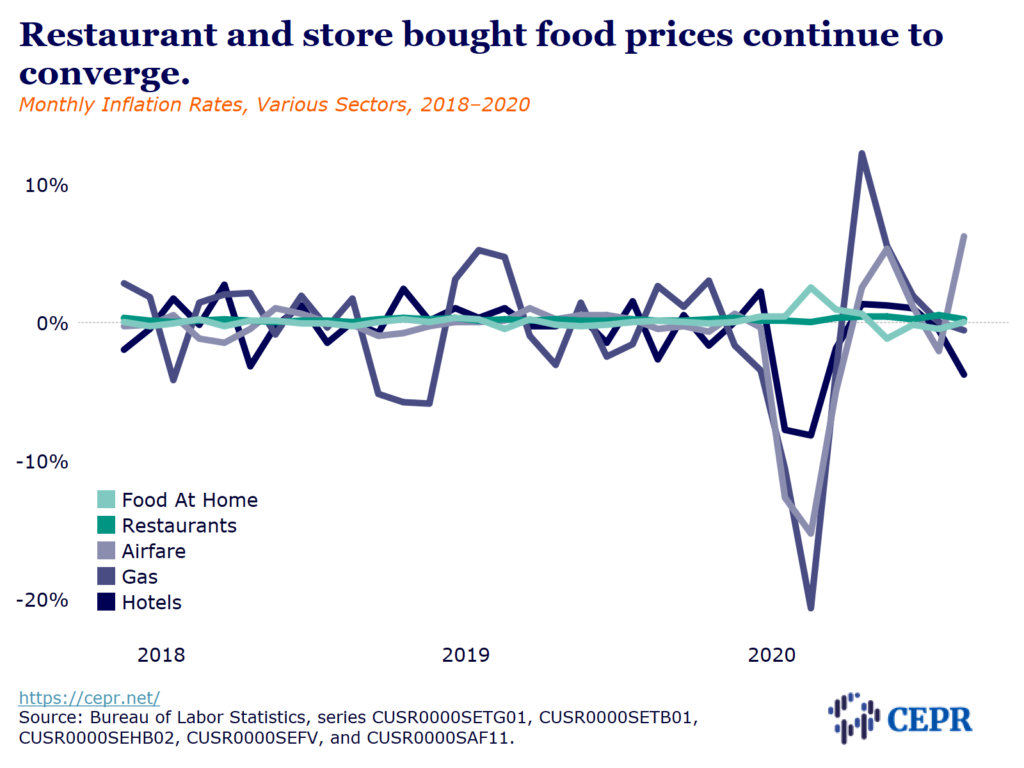
+ Hotel prices fell sharply: a 3.7 percent monthly drop. This  likely indicates a fall in business due to the spread of pandemic. Prices are now down 15.9 percent year over year.

+ Restaurant and store-bought food prices continue to converge, former up 0.3 percent, while latter up 0.1 percent, over last year 3.9 percent and 4.0 percent, respectively.

+ Used vehicle prices fell 0.1 percent after rapid increases, still up 11.5 percent year over year. New vehicle prices were up 0.4 percent — an unusually large price increase, up 1.5 percent year over year. This is likely an anomaly, but it’s  worrying if it is not. Car insurance was down 2.3 percent in October after a 3.5 percent September drop.  This 7.1 percent year over year drop likely reflects much less driving and fewer accidents. Airfares jumped 6.3 percent in October, still down 20.0 percent year over year.

+ Prescription prices were down 0.4 percent in October and year over year. It’s important to remember this does not factor in the cost of new drugs. Health insurance prices (administrative costs and profits, not premiums) dropped 1.2 percent, after a 1.5 percent drop in September. They are still up 10.2 percent year over year.

+ Finally, college tuition continues to fall. It was down 0.1 percent in October, up just 0.6 percent year over year.

Overall, there is zero basis for any concerns about inflation in this story. The economy is being hit hard by a pandemic (see hotels) and likely could use support.

Beyond COVID-19: the Power Struggle Over Alternatives for Health Care Reform

John Geyman


Today we face the COVID-19 pandemic, with its resultant economic downturn and systemic racism—the triple crises that have exposed the serious problems of U. S. health care. It is now obvious to most observers that the system is broken, raising the question of how it can be put together through the political process after a hotly contested election season filled with disinformation and confusion about potential reform alternatives.

Corporatization, privatization, a shift from not-for-profit to for-profit health care, and the growth of investor-owned corporate health care have been dominant themes in the transformation of U. S. health care since the 1980s. We have seen a 3,000 percent growth in the numbers of administrators and managers compared to a minimal growth in the numbers of physicians.

The profit-driven medical-industrial complex continues to lead the way on the S & P 500 as the “system” raises prices to what the traffic will bear, limits choice and access to care, erodes our safety net, and leads to rampant profiteering, corruption and fraud. It has predictably failed us as we attempt to deal with the crises exposing the soft underbelly of our supposed system.

The increasing urgency for fundamental health care reform is shown by these indicators wrought by today’s triple crises and the inadequate response by the Trump administration:

+ More than 55 million uninsured Americans (including the uninsured before the pandemic) and 87 million underinsured.

+ Increased privatization (for profit) of public programs involving two-thirds of Medicare and three-quarters of Medicaid programs.

+ Private health insurers being allowed by the Trump administration to expand marketing of short-term plans, “junk insurance,” with very limited benefits of short duration without any protections for pre-existing conditions.

+ Long delays for newly unemployed workers to receive jobless benefits, with lack of oversight and transparency.

+ Shifting responsibility for health care to the states, allowing them to set premiums and other cost-sharing for Medicaid beneficiaries and impose lifetime caps on Medicaid benefits.

+ Decimation of the safety net, especially in lower-income urban settings and rural areas.

+ Relaxing regulatory standards at the FDA and EPA.

+ Budget cuts for Medicaid and Medicare, the Centers for Disease Control and Prevention (CDC), Social Security, Planned Parenthood, and other essential programs.

After all these years, the GOP has still not come up with its own health care plan, but their policies bear witness to their approaches to health care. They see no problem with corporate control in a multi-payer financing system, a profiteering medical-industrial complex, cost sharing for patients to have “more skin in the game,” and shifting responsibility from the federal government to the states. Without a health plan, the GOP just wants to kill the ACA and let the market’s supposed efficiency work its magic with minimal regulation.

We currently have three reform alternatives before us being contested in this election cycle. Let’s assess the advantages and disadvantages of each.

Build on the Affordable Care Act (ACA)

The ACA did bring health insurance to about 20 million previously

uninsured Americans, mostly through expansion of Medicaid in 31 states. It also set in place protections against private insurers denying coverage based on pre-existing conditions.

Ten years after its passage, however, the ACA is still just another Band Aid on a broken system far short of universal coverage. It has failed to control health care prices and costs, and leaves a profiteering private insurance industry in place. Private health insurance continues to be pricey and unaffordable for many, while disparities and inequities persist with many Americans still delaying or foregoing essential care.

Prior to this pandemic, employer-sponsored insurance (ESI) involved about 150 million workers, by far the largest group covered by private health insurance. But the pandemic has demonstrated the total inadequacy of ESI based on these facts:

+ The labor market is inherently unstable—by the time they reach age 50, Individuals have held an average of 12 jobs; 66 million left or lost jobs in 2018, with many not regaining insurance in another job.

+ ESI is increasingly expensive both for employers and employees, prompting employers to shift more costs to their employees, including ever increasing high deductibles, as employees pay more in lost wages. As a result, ESI has more gaps in coverage, and often cannot be relied upon when serious illness or accidents occur.

+ Small business, representing 88 percent of all businesses on Main Street with fewer than 20 employees and with less than $100,000 in annual revenue, had great difficulty in providing ESI before the pandemic and has been especially hard hit in its aftermath.

Medicare for Some; Variants of a Public Option

Many centrist Democrats have been promoting the advantages of one or another variant of the public option, which would in effect become Medicare for Some. These are the main variants:

+ Lowering the eligibility age for Medicare to 60, as favored by presidential candidate Joe Biden,

+ A Medicare buy-in public option plan for sale alongside private plans on the ACA exchanges,

+ A pay or play plan whereby employers could choose between purchasing private insurance or paying a payroll tax of about 8 percent, and

+ Expansion of privatized Medicare Advantage, labeled by critics as Medicare Disadvantage!

While seen by some as less disruptive and politically more achievable, Medicare for Some would fail to bring sufficient system reform for these reasons:

+ Would leave a failing private health insurance industry in place, with its administrative overhead four to five times higher than that of traditional Medicare.

+ No capacity for cost containment.

+ Lack of comprehensive benefits.

+ Added administrative complexity and bureaucracy.

+ Would fall far short and never reach universal coverage.

Medicare for All

This is the most logical and only alternative that can bring universal

coverage to accessible, affordable health care for our population. It is not a new idea. As a presidential candidate in 1912, T. R. Roosevelt included national health insurance in his platform, as did Harry Truman in 1948. FDR also included it in his New Deal program in the mid-1930s until he backed off because of strong opposition from the AMA.

The current bill in the House of Representatives, H. R. 1384, clarifies Expanded and Improved Medicare for All. When enacted, it will bring:

+ Universal coverage of comprehensive health care for all U. S. residents through a single-payer, publicly financed Medicare for All system of national health insurance (NHI).

+ Full choice of physician, other health care professionals, and hospital anywhere in the country.

Coverage of all medically necessary care, including outpatient and inpatient services; dental, hearing and vision care; laboratory and diagnostic services; reproductive health; maternity and newborn care; mental health services; prescription drugs; and long-term care and supports.

+ Elimination of cost sharing at the point of care, such as copays and deductibles, with no need to get pre-authorization through private insurers.

+ Administrative simplification with efficiencies and cost containment through large-scale cost controls, including (a) negotiated fee schedules for physicians and other health professionals; (b) global budgeting of hospitals and other facilities; and (c) bulk purchasing of drugs and medical devices.

+ Elimination of employer-sponsored health insurance and also the private health insurance industry with its onerous administrative costs and profiteering.

+ Allocation of 1 percent of its budget over the first five years for assistance and retraining of the estimated 1.7 million workers displaced by single-payer NHI.

+ Improved quality of care and outcomes for both individuals and populations due to universal access to essential care and increased funding for public health.

+ Regional funding for rural and urban areas that are medically underserved.

+ Shared risk for the cost of illness and accidents across our entire population of 330 million Americans.

+ Cost savings that enable universal coverage.

Gerald Friedman, Ph.D., professor of economics at the University of Massachusetts Amherst, has done ongoing studies of the costs of single-payer Medicare for All over the last 10 years. He finds that, had it been in place in 2019, we would have saved more than $ 1 trillion that year. Figure 1 shows how these savings would have occurred, in billions, for three areas of health care spending—provider administration (the billing process); payments to hospitals, drug companies and medical equipment manufacturers (through bulk purchasing and negotiated prices); and insurance administration (interaction with multi-payer insurers). Those savings are how we can afford Medicare for All, since the money is already there.

Figure 1.

MEDICARE FOR ALL SAVINGS COMPARED TO CURRENT SYSTEM, 2019

Source: Friedman, G. The Case for Medicare for AllPolity Press, Medford, MA, 2020, pp. 62-63.

We have been repeatedly told over at least four decades that the free market will fix our system’s problems of access, costs, and quality of health care. That claim has been proven false by long experience. For-profit corporate stakeholders, often investor-owned, have demonstrated their commitment to profits over the public interest. The enormous medical-industrial complex that has evolved is a powerful barrier to reform, but the common good can be achieved if positive forces for change coalesce in this nodal crisis time requiring fundamental reform.

These claims by critics and opponents of Medicare for All can be readily refuted by evidence:

We can’t afford Medicare for All; it will bankrupt us. 

We can’t afford the system we have. The private health insurance industry has been bailed out by subsidies from the federal government for many years, currently at $685 billion a year, projected by the Congressional Budget Office to double in another ten years. An excellent study by the Political Economy Research Institute at the University of Massachusetts Amherst projects that Medicare for All will save the U. S. $5.1 trillion over a decade through savings from replacing our for-profit market-based multi-payer financing system. Middle class Americans will see savings of up to 14 percent, while 95 percent of Americans will pay less than they do now for health care and insurance.

Medicare for All will be too disruptive.

This scare tactic by opponents ignores how disruptive private health insurance is now, with loss of insurance with job change or loss, narrowing networks, and insurers leaving unprofitable markets. The transition to traditional Medicare in the mid-1960s was seamless, even before computers.

NHI will be a government takeover.

Quite the contrary. Under NHI, physicians and other health care professionals will be enabled to stay in private practice, with simplified billing and less paper work. Private hospitals and other facilities will be stabilized during and beyond the pandemic with stable, year-to-year operating budgets.

NHI will bring rationing.

This claim totally ignores the rationing by ability to pay that plagues millions of Americans who can’t afford care when needed, delaying or forgoing care altogether with worse outcomes later on. NHI will remedy this problem.

Patients will lose choice.

This is absurd, since they will gain choice of physicians, other health professionals, hospital and other facilities, which they value much more than choice of insurer.

Physicians won’t like it.

A majority of physicians already support Medicare for All, beleaguered as they are with changing policies of health insurers, pre-authorizations, restricted networks, changing drug formularies, and other requirements related to reimbursement. Because of these administrative problems, which take so much time from patient care, a growing number of physicians are burning out and retiring early.

While we can expect powerful opposition to Medicare for All from corporate stakeholders in the medical-industrial complex, the status quo and the ‘old normal’ are no longer tenable. With the ongoing impacts of the triple crises, 2021 is a unique political moment when health care reform can be enacted. The stakes couldn’t be higher for Americans, the economy, and recovery beyond the pandemic. Do we have the political will to move to a ‘new normal’ with Medicare for All?

Subtly, China pressures Gulf states to reduce regional tensions

James M. Dorsey & Alessandro Arduino


Public debates about China’s Middle East policy are as much internal Chinese discussions as they are indications of where Beijing’s thinking is going and efforts to nudge countries like Saudi Arabia and the United Arab Emirates to accommodate potential policy changes.

Relying on scholars rather than officials, China is signaling to Gulf states adjustments they would have to make to enable China to become more engaged in regional security and geopolitics.

The subtext in the scholars’ writings and statements is that a failure to reduce tension, particularly with Iran, could persuade China to either reduce its economic involvement in the Middle East or focus on relations with non-Arab states, two of which are arch-rivals of Saudi Arabia and the UAE.

At the bottom line, China’s subtle hints at what it would like Gulf states to do is in line with a Russian proposal that calls for a non-aggression agreement with Iran and possibly Turkey that would significantly reduce the risk of disputes spinning out of control and allow China to expand its engagement beyond economics.

In the latest blast, Chinese Middle East scholar Fan Hongda suggested that China rather than “overestimating” the importance of Arab states should pay more attention to the Middle East’s non-Arab powers, Turkey, Israel, and particularly Iran.

“Given Iran’s expressed willingness to strengthen bilateral relations (with Beijing), China needs to respond more actively,” Mr. Fan said in an op-ed published by Lianhe Zaobao, a Chinese language newspaper in Singapore.

Driving the point home, Mr. Fan argued in two articles in Hamshahri, a popular Iranian newspaper published by the municipality of Tehran, that China should forge closer ties to Iran irrespective of US policy or potential Arab opposition. “These overcautious concerns have no advantage whatsoever for the ‘second most powerful country in the world,” Mr. Fan said referring to China.

The timing of Mr. Fan’s article will not have been lost on Gulf leaders. It comes on the back of the publication in Iran of a draft 25-year multi-billion dollar Chinese-Iranian agreement on economic and military cooperation. The draft sparked intense speculation about Chinese Middle East policy and how realistic an agreement was.

To capitalize on the speculation, Iran substantially increased the number of companies populating its pavilion at this month’s China International Expo (CIIE) in Shanghai.

Mr Fan’s article was further published as US President-elect Joe Biden prepares to take office in January with the stated intention to break with Donald J. Trump’s harsh ‘maximum pressure’ sanctions policy and return the United States to the 2015 international agreement that curbed Iran’s nuclear program. Mr. Trump withdrew from the agreement in 2018.

China’s suggestion that it has alternatives in the Middle East puts pressure on countries like Saudi Arabia and the UAE as they try to come to grips with a Biden administration that is likely to put greater emphasis on human rights and take a more critical view towards Gulf involvement in wars in Yemen and Libya.

Similarly, the suggestion anticipated a Biden administration effort to rejigger, if not reduce, the United States’ security commitment to the Middle East and possibly entertain a more multilateral regional architecture.

Mr. Fan’s proposal follows an article by prominent Chinese scholars Sun Degang and Wu Sike  arguing that the Middle East was a “key region in big power diplomacy with Chinese characteristics in a new era.”

Messrs. Sun and Wu indicated that Chinese characteristics would involve “seeking common ground while reserving differences,” a formula that implies conflict management rather than conflict resolution.

The scholars said Chinese engagement in Middle Eastern security would seek to build an inclusive and shared regional collective security mechanism based on fairness, justice, multilateralism, comprehensive governance, and the containment of differences.

Earlier, Niu Xinchun, director of Middle East studies at China Institutes of Contemporary International Relations (CICIR), widely viewed as one of China’s most influential think tanks, adopted a different tone to drive the same message home: China’s interest in the Middle East was waning. To avoid losing China, Gulf states need to create a degree of stability.

“For China, the Middle East is always on the very distant backburner of China’s strategic global strategies … Covid-19, combined with the oil price crisis, will dramatically change the Middle East. (This) will change China’s investment model in the Middle East,” Mr. Niu said.

With few exceptions, Gulf states and media have largely remained silent about Chinese voices that reflect thinking in Beijing that calls into question China’s relations with key Arab states.

No doubt, Gulf states believe that China’s dependence on Middle Eastern energy and their significance to the Belt and Road Initiative (BRI) makes them all but indispensable.

The BRI is Chinese President’s Xi Jinping’s energy, infrastructure, and telecommunications-driven Eurasia-wide signature foreign policy initiative.

While the Gulf states may not be wrong, they remain vulnerable in an environment in which shifts in US policy force them to hedge their bets and be more attentive to the positions of China in an increasingly multi-polar world.

Said Mordechai Chaziza, an expert on China-Middle East relations: “Beijing has indeed become more concerned about the stability of Middle Eastern regimes. Its growing regional interests combined with its BRI ambitions underscore that Middle East stability, particularly in the Persian Gulf, is now a matter of strategic concern for China.”