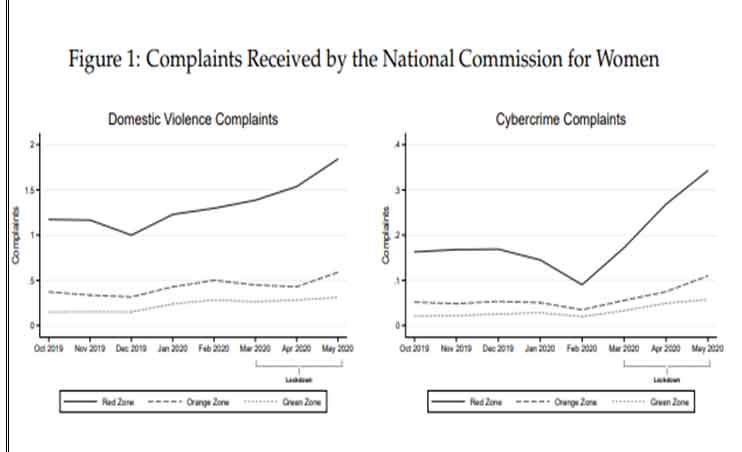
One in three women worldwide experience physical or sexual violence. Most of this violence is perpetrated by either their intimate partner or a relative. Due to the Coronavirus pandemic outbreak and the subsequent lockdown, the violence against women, especially domestic violence, has increased significantly. This is known as the Shadow Pandemic.
With the reports of the second wave of the COVID-19 pandemic intensifying in recent days, there is a real threat of the intensification of the shadow pandemic.
Inlined with the global trend, India has also seen a spike in the number of reported domestic violence cases during the first period of lockdown enforcement due to COVID-19. According to a report by Saravana Ravichandran & Manisha Shah of the University of California, Los Angeles, India has seen a higher magnitude in domestic violence cases in districts that saw the strictest lockdown measures. It also states that in districts where a larger proportion of husbands saw domestic violence as justified, larger increases in domestic violence complaints have been observed. According to the National Commission for Women, complaints across various kinds of violence against women have seen a sharp rise during the lockdown, especially domestic violence and cybercrime.
Due to Covid-19 Pandemic, many people, especially working in the unorganized sector, have lost their jobs. The lockdown, combined with the unemployment, has increased the anxiety level of people. There were news reports of husbands beating up their wives for issues as trivial as not putting garlic in daal.
The violence is not limited to beating. There have been cases of homicides as well amidst the lockdown.
In Azamgarh district of Uttar Pradesh, Irshad (49) killed his wife Amina (45) after a heated argument. A 45-year-old man in Telangana’s Meerpet allegedly strangled his 40-year-old wife to death for failing to give him food on time.
In India, domestic violence against women is seldomly discussed and rarely reported. On a normal day, men used to stay outside home for the most part of their day. But, due to the lockdown, women are bound to spend more time at home with their abusers and are also unable to seek any support. Also, the possibility of getting a job in this scenario is difficult, which furthers restrains unemployed women from taking any drastic step against their family or partner.
The United Nations has started working to tackle the shadow pandemic worldwide by taking out $25m from its emergency fund. 30% of this fund is proposed to be given to women-led local organizations that prevent violence and help survivors access medical and legal help, family planning, mental health services, and counselling.
Sheba George from Ahmedabad leads one such organization, SAHR WARU- A Women’s Action and Resource Unit. Sheba George says while SAHR WARU is working towards reducing inequalities between genders and empower women, an NGO or a set of NGOs cannot bring the entire change. She points out the need for Government and the Corporates to take necessary steps towards this. During this shadow pandemic, it would be very important for the Government to take note and enact proper steps towards the cause. There could be an argument that says that Governments are currently occupied in fighting the COVID wave and the health emergencies, but historically, even in the pre-pandemic era, the efforts in this area have been minimal. The Nirbhaya fund, launched in the wake of the 2012 gangrape, has only seen 36% usage since 2013.
The diminishing efforts Corporates in reducing inequality are also alarming. The CSR expenditure in reducing inequality has decreased almost three times (187 Cr. vs. 525 Cr.) in 2018-19 when compared to 2017-18. Only 10% of this spend comes from Public Service Undertaking (PSU)s, showing a picture of no focus towards reducing inequality, which in turn results in empowering women.
Victims of domestic violence need to understand that any kind of violence is totally unacceptable, and the perpetrator deserves to be punished by law. Often abusing, slapping and beating are deemed non-serious, and women usually bear these in silence. But ignoring such instances fuels the aggressive behaviour of the perpetrator and later leads to even more violence.
There are a number of helplines for domestic violence and free online counselling websites that victims can use for relief.
One of the major factors in bringing change in the long term would be to stimulate young minds in understanding gender equality as a part of their curriculum. Gender equality in mainstream education would help change children’s patriarchal mindsets and help them understand the rights of women. Education in this regard through National television might also contribute to gender equality.
The security forces of the Kurdistan Regional Government (KRG) in northern Iraq fired on demonstrators protesting over unpaid wages, killing eight people, and injuring 65 more. One member of the security forces was also killed.
Families of some of the dead claimed their relatives were shot while walking through crowds of protestors.
Protesters in Saidsadiq, Sulaimaniya on December 9, 2020. (Credit: BKirkuk/Facebook)
The protests began on December 3 when thousands of public sector workers in Iraq’s semi-autonomous KRG, took to the streets of Sulaimani, the capital city of Sulaimaniya province, to demand their unpaid wages. Around 1.2 million workers have not been paid for much of this year as the KRG has run out of cash. Budget disputes with the federal government in Baghdad and Iraq’s economic crisis have been compounded by the fall in oil prices and the pandemic-related downturn. The protesters were met with water cannon, rubber bullets and tear gas.
Since then, the anti-government protests have escalated, spreading to other towns in the Sulaimaniya province as well as to Halabja province, amid widespread anger over unpaid salaries, unemployment, poverty, a lack of basic services, electricity, water and fuel shortages, and government corruption. On Sunday, protesters in Said Sadiq torched the offices of the two main Kurdish political parties as well as the mayor’s office.
The KRG said it would not allow “unlicensed” protests and that it would initiate legal proceedings against those who damaged government property. It has restricted access to the internet and suspended for one week regional TV station NRT’s broadcasts, raiding its office in Sulaimani in an effort to prevent the protests escalating further. On Wednesday, the authorities in Sulaimaniya banned all vehicular movement for 24 hours.
These latest protests follow similar demonstrations over unpaid wages and pay cuts in November when the government used tear gas to disperse the demonstrations.
In August, the Kurdistan Democratic Party (KDP), which controls the western areas of the KRG, deployed large numbers of security forces to suppress demonstrations in Erbil and Duhok provinces, resulting in numerous injuries, particularly in the city of Zakho.
Security forces also attacked and arrested journalists and shut down a major TV channel, while the broadcasters and newspapers associated with the two ruling parties—the Kurdistan Democratic Party (KDP) and the Patriotic Union Party (PUK)—barely covered the clashes. These two rival and corrupt mafia-like gangs that fought each other in the mid-1990s run the KRG as their personal fiefdoms with scant tolerance for dissent, criticism and the niceties of bourgeois democracy. Other powerful figures have their own private militias to maintain their own corrupt profiteering.
The KDP, which rules over the KRG’s 5.1 million population, has been led by the Barzani family ever since its creation seven decades ago, with Nechirvan Barzani holding the presidency and Masrour Barzani, the son of the previous president, holding the premiership. The Barzani clan has monopolized most commercial activities in the region, amassing a huge fortune.
In all, more than 280 people were arrested and subjected to abuse. Al-Jazeera cited the Rights and Freedoms Advocacy Committee, an NGO, as stating, “Among those arrested were “teachers, civil servants, journalists and human rights activists, some of whom have been subjected to physical and psychological torture, prolonged solitary confinement, and denied access to legal aid and visitations.”
It is part of a vicious crackdown on reporting. According to the Metro Center for Journalist Rights, based in the PUK-dominated Sulaymaniyah province, there have been 98 violations against media organisations and journalists in the KRG in the first six months of 2020. Only the media organisations linked to the two main parties have been spared. The KRG is also introducing legislation clamping down on digital media.
The latest Human Rights Watch report describes KRG rule as being “the same as other parts of Iraq for outspoken people” and states, “Kurdish authorities are continuing to use vaguely worded laws to intimidate and silence journalists, activists, and other dissenting voices.”
On Monday, KRG Prime Minister Masrour Barzani called for patience and blamed the crisis on the federal government, claiming that Baghdad had failed to transfer four monthly payments of $270 million to Erbil, the KRG’s capital. He called on Iraqi Prime Minister Mustafa al-Kadhimi “to instruct the federal Finance Ministry to release the region’s funds.” On Wednesday, Barzani said, “The protests that started in Sulaimani and Halabja were peaceful. However, they were taken advantage of.”
Protestors attack offices of ruling PUK in Sulaimaniya province. (Social media)
Facing a catastrophic financial crisis with the collapse in oil demand and prices, the Iraqi government teeters on the brink of insolvency. The financial transfers to the KRG, whose relations with Baghdad deteriorated after its failed bid to create an independent Kurdish state in 2017, are bound up with the political deadlock in Iraq’s parliament that have prevented the agreement of the 2021 budget law. This is now unlikely to be approved before the new year. While al-Kadhimi had sought parliament’s approval to borrow $34 billion, parliament sanctioned just $10 billion, barely enough to cover the wage bill for Iraq’s 4 million public employees, who have seen their salaries delayed for nearly two months, until the end of the year.
This has further strained relations with the KRG, where three out of four workers are paid by the regional government.
The $270 million which the federal government in Baghdad pays to the KRG monthly is a reduction from an earlier agreement under which it paid $400 million. The cut was enacted after the KRG began to export its oil independently. New legislation requiring the KRG to remit to Baghdad the revenues from its direct oil sales to Turkey in return for its share of the federal budget prompted Kurdish legislators to storm out of parliament in anger.
In addition to the economic crisis, the KRG’s Peshmerga forces have clashed with Turkey’s outlawed Kurdistan Workers Party’s (PKK) fighters, of whom some 5,000 fighters are stationed in the KRG, with the potential to ignite an all-out conflict. PKK forces recently sabotaged the KRG’s pipeline to Turkey, suspending oil exports, as part of its 35-year insurgency against Turkish rule. The conflict has led to the deaths of some 40,000 people, the destruction of 4,000 villages and the forcible displacement of up to one million people. These clashes take place in the wake of Turkey’s cross-border counter-PKK operations including airstrikes, which Baghdad views as an infringement on Iraq’s sovereignty.
US officials hypocritically expressed their concern over the crackdown on protesters during a meeting with KRG leaders in Erbil on Wednesday. Washington has had a long relationship with the Barzani clan’s Kurdish Democratic Party, having backed the KRG with military and financial aid and used the KRG’s Peshmerga as shock troops in fighting the Islamic State in Iraq.
The Pentagon has established a major base near Erbil and is reportedly setting up other semi-permanent bases near the Iranian border, making the KRG a center of US imperialist operations in the region. Washington is also anxious to prevent any further unrest in Iraq, which has been rocked by anti-government protests. Barzani has sent a delegation to Baghdad to discuss the crisis.
For its part, the Kurdish working class increasingly views the KRG’s ruling cliques as willing tools of Washington and its allies, whose support enables the KDP and PUK to quash public dissent and opposition to their plunder and exploitation.
Iraq has become a key political battleground in the Trump administration’s drive to establish unfettered US domination over the world’s principal oil-exporting region and its preparations for a military confrontation with Iran. This in turn is bound up with Washington’s build-up for “great power” confrontation with China—attempting to use military force to establish a chokehold over the energy resources upon which the Chinese economy depends.
These developments take place amid a new and even more dangerous phase of the US’s war preparations and provocations against Iran, including the dispatch of US B-52 bombers to the Persian Gulf for second time in three weeks with the potential for mass casualties among the tens of thousands of US troops deployed in the region. This could provide President Donald Trump, who has refused to concede Joe Biden’s victory in the recent presidential elections, with a pretext for realizing his threats to impose martial law and upend the transfer of power.
The British and French governments are at loggerheads over Brexit and as yet cannot reach agreement on commerce, trade, imports and exports. But they can find ample mutual purpose to persecute and trample on the democratic rights of migrants, refugees and asylum seekers.
Rather than offer shelter to those fleeing the impact of decades of Western military aggression, the two governments have joined forces for the most odious and reactionary campaign to scapegoat them in the public eye.
A Border Force vessel brings a group of people thought to be migrants into the port city of Dover, England, from small boats, Saturday Aug. 8, 2020. The British government says it will strengthen border measures as calm summer weather has prompted a record number of people to attempt the risky sea crossing in small vessels, from northern France to England. (AP Photo/Kirsty Wigglesworth)
A new deal between the Johnson government in London and Macron administration in Paris, was agreed on November 28 by British Home Secretary Priti Patel and her French counterpart, interior minister Gérald Darmanin.
Speaking following talks with Darmanin, Patel announced how the new package “effectively doubles the number of police on the French beaches, it invests in more technologies and surveillance—more radar technology that support the law enforcement effort—and on top of that we are now sharing in terms of toughening up our border security.”
This pledge to brutalise migrants comes only days after French security forces rampaged through the streets of Paris in what can only be described as a police riot, ruthlessly beating migrants and journalists.
Both governments, despite pleading poverty to their citizens over the response to the pandemic, managed to conjure up millions for a host of new state-of-the-art military surveillance technology, drones, radar equipment, cameras and optronic binoculars.
Officials revealed how the UK has provided France with a total of £192 million of funding since 2014 aimed primarily at preventing migrants crossing the Channel by tunnel, train, ferry and in dinghies. The majority was spent on infrastructure like border controls and security in and around Calais on the French coast.
During the weekend the deal was signed, French patrol boats intercepted 45 migrants, including a pregnant woman and children apparently suffering from hypothermia, struggling to make the crossing cross from France. There have been more than 8,000 crossings so far during 2020. In 2019 there were 1,844 crossings and 299 in 2018.
The additional measures to prevent asylum seekers crossing the English Channel came into force December 1. French police patrols will be doubled along stretches of coast with the shortest and easiest crossing distances to the UK. The manhunting of migrants and asylum seekers along this stretch will lead to more deaths by forcing desperate people to begin their journey from more remote sections of coastline and attempt even more dangerous methods and routes to reach the UK.
Four people attempting to make the crossing are known to have died last year and seven so far this year.
Patel claimed the agreement between the two European governments represented a significant advance in their “shared mission to make Channel crossings unviable”. She said the number of migrants making the crossing had grown exponentially and blamed trafficking gangs for “facilitating” dangerous journeys. Lying through her teeth, Patel continued, “We should not lose sight of the fact that illegal migration exists for one fundamental reason: that is because there are criminal gangs—people traffickers—facilitating this trade.”
The Home Secretary knows full well the tide of humanity forced to flee to Europe from the Middle East, North Africa and the Persian Gulf does so not because of human traffickers. These extremely vulnerable people are fleeing from the wars, fratricidal conflicts, and economic and ecological destruction created and exacerbated by the world’s imperialist powers, foremost in Europe by Britain and France.
The Tory government are doubling down on their policy of creating a “hostile environment” for immigrants, refugees and asylum seekers. The Home Office is seeking to criminalise migration by painting a lurid and inaccurate picture in the public eye of “criminal migrant gangs” crossing the Channel and “invading” the UK.
The Anglo-French deal was criticised by Amnesty International UK. Steve Valdez-Symonds, the organisation’s refugee and migrant rights programme director, declared, “Women, men and children make dangerous journeys across the Channel because there are no safe options provided for them—to either reunite with family in this country, or access an effective asylum system, to which they are entitled. The UK government must share responsibility for providing sanctuary with its nearest neighbour. This continued focus on simply shutting down routes to the UK is blinkered and reckless—it does nothing but increase the risks that people, who have already endured incredible hardship, are compelled to take.”
Last month, it was revealed that migrants are being jailed by the Johnson government for taking the tiller of the flimsy vessels used to cross the Channel. Those steering the craft are being charged with “facilitation”. People seeking asylum are being sent to prison for preventing their seaborne craft from drifting aimlessly in the dangerous conditions and busy shipping lanes of the Channel.
The immigration enforcement unit is analysing drone footage of the boats carrying migrants across the English Channel in order to single out for prosecution those who steer the vessel. Thus far eight migrants who steered vessels on the perilous journey have been jailed since August. The draconian sentences handed down range from 16 to over 30 months in prison. To heap insult upon injury, migrants serving these prison terms are eligible for deportation once their sentences are served because their sentence was for longer than 12 months—under the Labour Party’s 2007 Borders Act.
Gloating government press releases announcing the imprisonment of migrants for steering dinghies describe people frequently fleeing the devastation wrought by NATO forces as “people smugglers”. This legal outrage is in breach of the United Nations Refugee Agency definition of smugglers as facilitating journeys for “a financial or other material benefit”.
The Home Office is also engaged in an attempt to cover up any public knowledge of the horrendous conditions at a former army barracks where asylum seekers are held behind barbed wire.
Visitors to the Napier barracks near Folkestone, Kent must now sign the Official Secrets Act to prevent them from speaking about the numerous hunger strikes, suicide attempts, general malaise, unrest and regular medical emergencies among residents.
Volunteers who provide clothing, amenities, company and counselling to the 400 male asylum seekers held at Napier barracks are being issued with a confidentiality form by the private security firm on behalf of the Home Office. The Guardian, who saw firsthand the agreement, say it commits the signatory to treating as confidential any information about Napier “service users” i.e. the asylum seekers.
Such information is subject to the Official Secrets Act, designed to guard issues of national security, intelligence, defence, international relations and information which has been entrusted in confidence to another country. Breaking the Official Secrets Act threatens a jail term of up to two years in prison.
A spokesperson for the Home Office gave a dismissive response to press queries: “We have worked closely with our accommodation provider Clearsprings Ready Homes and stakeholders to ensure the Napier site is safe and secure.”
The Guardian reported that while the Home Office commissioned Clearsprings Ready Homes to run Napier, the company has subcontracted significant responsibilities for the day-to-day management of the detention centre to “a letting agent and property management firm called NACCS”. The detention of asylum seekers is therefore being run by a company of private landlords and property developers.
The Pacific territory of French Polynesia, including Tahiti, continues to see the number of people infected by COVID-19 escalate. As of December 10, confirmed cases had risen to 15,332. More than 5,000 new cases were recorded in the past month alone, with 210 in 24 hours to last Saturday.
Seven deaths in the last four days has brought the total number of fatalities since the pandemic began to 86. There are 62 people currently in hospital with 28 of them in intensive care. All but 62 cases occurred after borders were reopened in July and mandatory quarantine requirements abolished. The virus had been halted from late March with a lockdown and border closures.
On July 15, in a desperate bid to resurrect the moribund tourism industry and reignite the economy, President Edouard Fritch re-opened the territory to international visitors. Flights from Los Angeles recommenced with US residents and others able to enter without needing to quarantine. Over 28,000 tourists have entered since the border’s reopening, 90 percent from the US and France. The French government briefly put restrictions on travellers from France last month, but flights are being resumed next week.
The virus has spread from the urban areas of Tahiti to the outer islands of Bora Bora, Raiatea, Huahine and Hao. Fritch initially acknowledged that the pandemic had worsened in the US, and would do so in the territory as well, but claimed that if French Polynesia failed to open up the economic consequences would be “catastrophic.” He falsely predicted that case numbers would plateau at about 200.
With the health situation out of control, Fritch has continued to insist it would have been “irresponsible” to keep the borders shut, claiming 20,000 workers would have been condemned to unemployment. He absurdly told the assembly that from late May the territory was “COVID-19-prepared.”
The territory’s administration is consciously pursuing the criminal policy of “herd immunity” demanded internationally by business interests. In late October a curfew was called over a weekend in Tahiti and Moorea, but then shortened for people to return to work. A previous curfew in May was lifted after judges described it as an attack on “individual liberty” and declared it illegal.
Noting that the infection rate was twice that of mainland France, a trade union leader, Patrick Galenon, last month called for a lockdown to be re-imposed. However, the unions dropped empty threats of a general strike in September after Fritch flatly refused to re-establish quarantine requirements for incoming travelers. School attendance has remained compulsory, despite calls by teachers for tougher containment measures, and fruitless appeals by teacher unions.
United States territories in the north and west Pacific have also seen a surge of COVID-19 cases. Guam, which is the site of a major American military base, has experienced a high rate of infections since August and is one of the worst hit parts of the US and the Pacific. Guam’s total number of confirmed cases is around 7,000, with 113 deaths—significant for a population of only 165,000.
In November, over 1,700 people on Guam tested positive for the virus, almost 60 each day. So far this month, cases have reduced to less than half that number, prompting Governor Lou Leon Guerrero to declare the territory has started to “turn a corner.”
With the US federal administration in control of Guam’s borders however, local officials have been limited in what they can do. According to the co-chair for the Independent Guam organisation, Michael Luhan Bevacqua, Guam’s dependent status has undermined its response to the pandemic in some key ways. Bevacqua told Radio NZ the US military had a habit of “doing its own thing,” despite local guidelines.
In the Northern Marianas (CNMI), four arrivals this past week tested positive for COVID-19, taking the total number of cases to 113, including two deaths. Out of the 111 cases in the CNMI, 87 are from incoming passengers including 45 from the US mainland, 30 from Guam and 11 from other countries.
The CNMI has now gone 112 days without any community transmission. Health authorities are pinning their hopes on obtaining COVID-19 vaccines soon.
American Samoa is the only US Pacific jurisdiction that remains COVID free. The local governor recently denied entry to three US Air Force planes with 30 personnel on a mission to Antarctica. They were prevented from stopping overnight, and sent on to Auckland. Unlike many Pacific countries, including Samoa, repatriation flights for residents trapped overseas have not yet begun.
In Papua New Guinea (PNG), the region’s largest and most populous country, an ongoing political crisis has been pitched into fresh confusion after three government MPs tested positive for COVID-19.
Responding to an application by the opposition, the Supreme Court has ordered parliament to sit next Monday, paving the way for a motion of no confidence against Prime Minister James Marape. Parliament’s speaker, Job Pomat, had been advised by health officials that the parliament would only be safe to sit again if testing cleared a majority of MPs.
PNG’s total number of cases is now 645, including seven known deaths. Of the country’s 22 provinces, 16 have had confirmed cases of the virus. This includes 12 new cases from a significant cluster in West New Britain province with 42 infections. The country’s testing regime remains woefully inadequate—only 30,000 people have been tested from the population of over eight million.
Fiji has 11 active cases of COVID-19. Two sailors who arrived on a freighter recently from Tonga have tested positive, joining two Fijians who travelled from New Zealand a week earlier and are now in border quarantine. Twenty-five locals including staff from the Biosecurity Authority, the Ports Authority and Customs were all in quarantine.
Before the arrival of the pandemic, the region was already facing a health crisis with rampant diseases such as diabetes, a deadly measles outbreak, polio, malaria and tuberculosis. According to a UN report last week, over a dozen Pacific countries have seen an increase in HIV/AIDS. PNG, which has some of the world’s worst health indicators, has an estimated 52,000 HIV cases while Fiji experienced 117 deaths from AIDS over the past year alone.
Pacific islands’ public health systems are fragile and already at or near full capacity. They face being overwhelmed if COVID-19 cases become more widespread. A study published in the Lancet in September warned that efforts to combat endemic diseases could be derailed if COVID-19 measures are forced to be prioritised, thus dramatically increasing deaths across the region.
Meanwhile aid funding to health programs from the main local imperialist power, Australia, have been slashed in favour of infrastructure spending, in order to compete with growing Chinese investment. While Canberra’s overall aid to the Pacific has increased over five years, it has reduced dedicated health funding to the Cook Islands by 75 percent, Fiji by 22 percent, the Solomon Islands by 13 percent and Samoa by 36 percent.
The European Central Bank has expanded its bond-buying program by €500 billion, taking it to a total of €1.85 trillion, extended emergency measures from June next year until at least March 2022, and provided further cheap funding for major banks.
But because the increase in the stimulus package was largely expected, financial markets are looking for more.
In her introductory press conference statement on Thursday, ECB President Christine Lagarde said the extension of its pandemic emergency purchase program (PEPP) reflected “the prolonged fallout from the pandemic for the economy and inflation.”
Incoming data and projections by ECB staff, she said, “suggest a more pronounced near-term impact of the pandemic on the economy and a more protracted weakness in inflation than previously envisaged.”
The ECB has forecast that the euro zone economy will contract by 2.2 percent in the fourth quarter of this year, with the downturn to continue next year. It has cut its forecast for growth in 2021 to 3.9 percent compared to its previous projection of 5 percent.
Lagarde said the outlook for inflation—a sign of rising economic activity—remained “disappointingly” low. The ECB forecast that prices would rise by just 0.2 percent this year with inflation increasing to 1.4 percent per annum in 2023—well below its target rate of around 2 percent.
Lagarde said weaker balance sheets and uncertainty about the economic outlook were “weighing on business investment.” Overall the risks to euro area growth remained “tilted to the downside,” but had become less pronounced.
The general reaction in financial circles to the policy announcements was that they were the product of a compromise between the different factions on the governing council, with German representatives favouring less stimulus.
A comment on Bloomberg described the ECB package as “an uneasy compromise between different factions. The problem is, it falls short of matching the central bank’s dire economic outlook.”
Describing Lagarde’s outlook as “gloomy,” it said the pessimistic view would “call for extremely bold measures,” but in “trying to make too many different parties happy, the ECB shied away from doing all it could.”
These sentiments were reflected in other comments. Randall Kroszner, a former US Federal Reserve governor, told the Financial Times: “I understand what they are trying to do—giving the markets more confidence—but I don’t think it will be enough and it is quite likely they will have to come back and do more.”
Frederik Ducrozet, a wealth management strategist, said the decisions were “underwhelming” and a sign of “compromise between dovish and hawkish members of the governing council.”
“We can’t help but feel like the ECB should have delivered a bolder package… to make sure that they don’t need to do more next year in case something goes wrong again,” he said.
The extent to which the endless pumping of money into the financial system has been accepted as the “new normal,” had tended to obscure the vast transformation in the global financial system and the ever-increasing role of the central banks in propping it up.
While yesterday’s ECB decision was generally regarded by financial markets as not enough, it did represent a one-third increase in the size of the PEPP with Lagarde indicating it could be expanded further if required.
The latest measures mean that the ECB will continue to absorb around three-quarters of all the new debt issued by euro zone governments next year. In remarks to the Wall Street Journal Jörg Krämer, the chief economist at the Frankfurt-based Commerzbank, said it was “carte blanche” for finance ministers.
“The ECB is likely to finance de facto the entire 2021 budget deficits of the euro countries,” he said.
In other words, the situation is developing where one arm of the capitalist state, the government, issues debt and another arm, the central bank, buys it. This situation has only previously existed in time of war.
It is expected that with the increased debt resulting from the effects of the pandemic, euro zone government debt will rise by €1.5 trillion, taking total debt to more than 100 percent of the size of the euro zone economy.
The central purpose of these extraordinary measures is not to provide a boost to the real economy, but to ensure the continued supply of ultra-cheap money into the financial markets.
They have become completely dependent on this inflow to finance the speculative boom which has seen some $30 trillion added to the market capitalisation of global stock markets since they plunged in mid-March before being rescued by massive government and central bank intervention.
The next indication of the direction of central bank policy will come when the US Federal Reserve holds its final meeting for the year. Markets will be looking for signs of how the Fed intends to continue its asset-purchasing program that has played such a central role in sending Wall Street to record heights.
Croatia’s border with Bosnia and Herzegovina has become a place notorious for violence against migrants and asylum seekers for years now as part of the EU’s policy of fortress Europe. While the Croatian authorities have categorically denied that this is taking place, particularly at the hands of their own police force, an investigative report by Der Spiegel magazine has now detailed migrants’ horrific accounts of being brutalized in the area.
The report outlines sadistic beatings, torture involving electric shocks, simultaneous kicks to the body by multiple officers, among other things. It also makes clear that not only the refugees themselves fear repercussions, but so do other witnesses who help them. There is video footage of the immigrants’ ordeal from when a migrant hid his cellphone in his clothes. Der Spiegel and the media group Lighthouse Reports verified its authenticity. The officers filmed are wearing black balaclavas on their faces and cannot be identified.
The article in Der Spiegel focuses on the story of a young Pakistani migrant Ibrahim. He suffered a number of serious beatings while trying desperately to escape into Italy with many others who shared a similar fate. They dubbed the bloody process of trying to outmaneuver the men at the Croatian border “the Game.” Ibrahim has tried to accomplish this dangerous task dozens of times, before being able to escape to Slovenia, where he and the others waited to no avail for smugglers to take them the rest of the way. Days went by without food or drink before they surrendered to Slovenian authorities. The migrants asked for asylum, but they were instead taken back to the Croatian officials, who tortured them again.
Ibrahim later managed to make it to Italy, but the many months on the Croatian border devastated him. He still has headaches and problems with his knee, but the psychological damage is far greater.
After these barbaric acts of violence against defenseless migrants became public, the EU felt obliged to criticize the Croatian authorities. European Union commissioner Ylva Johansson has reportedly sent a letter to the Croatian Interior Ministry, in which she pressed it to investigate the allegations made by the migrants. She added publicly that “the violence at the border cannot continue” and that “this will not help Croatia in its efforts to join the Schengen area.”
This is just hypocrisy. As much as they continue to deny it publicly, the European ruling elite in Brussels, Berlin and elsewhere is directly responsible for not only the violence at the Croatian border with Bosnia and Herzegovina, but also the countless migrant deaths in the Mediterranean Sea. This is the true EU policy toward the refugee crisis. It is also their policy towards the working class as a whole.
Croatia, a member of the European Union since 2013, is a key country in the EU’s “fortress Europe” policy. The violence against refugees has been organized at the direct behest of the EU, which pays the Croatian security forces well for this inhumane service. “Over the years, Amnesty International and other organizations have documented numerous violations, including beatings and torture of migrants and asylum-seekers by Croatian police, whose salaries may have been paid for by EU funds,” the director of Amnesty International’s European Institutions Office Eve Geddie said.
The EU’s weak public attempts at feigning concern will only further embolden ruling circles in Zagreb to continue to give their border police a free reign to commit these violent acts. It is certainly meant to be understood that way as well. In other words, all parties involved know that there will be no real consequences for the Croatian government once the bad publicity from this story has died off.
While Croatia’s police chief and Interior Minister, the Social Democrat Ranko Ostojić, believes that retired officers currently part of the reserve are to blame for the so-called push backs, high-ranking officials of the Croatian government, such as Foreign Minister Gordan Grlić Radman, continue to vehemently deny any wrongdoing by their men at the border. As for the Interior Ministry, it issued a statement responding to the report. It claimed that migrants either have accidents that cause their documented injuries, or even more outrageously, they accuse the migrants of harming themselves, in order to blame Croatian border police.
The country has a long and dark history of extreme right-wing politics. During World War II, (long before the current nation gained its independence from former Yugoslavia in 1991), the Ustaše led by Ante Pavelić, formed the fascist puppet regime known as the Independent State of Croatia (NDH).
After the war, Josip Broz Tito’s Yugoslavia was formed using the Stalinist bureaucracy in the Soviet Union as a model. During that time, the regime crushed any pro-Ustaše sentiments. But after the violent and bloody breakup of Yugoslavia and Croatian independence, these fascist tendencies resurfaced and have been prominent ever since.
Franjo Tuđman, the most prominent figure of Croatian independence and its first president, started his political career in Tito’s Communist Party, like many other reactionaries in the region. Later, he founded the right-wing Croatian Democratic Union (HDZ), which has been in power once again since 2016 under Prime Minister Andrej Plenković.
In Croatia, much like the rest of the Balkans and indeed beyond, the political establishment has moved sharply to the right after the restoration of capitalism. Various governments have pushed though brutal austerity measures and privatizations for years, causing unemployment and suffering which is now intensified by the COVID-19 pandemic. As with their Western European counterparts, the Croatian government and other Eastern European regimes have refused to take serious measures to contain the virus and kept schools and factories open. As a consequence, infections and deaths are mounting. In Croatia, a country with a population of just over four million, over 163.000 people have been infected with COVID-19, and 2,420 people have died so far.
In the final analysis, the war against refugees at Europe’s external borders is part of the deadly offensive against the entire working class. In order to defend its interests and wealth the ruling class is resorting more and more openly to fascist violence and dictatorship.
In response to the release of a report exposing Australian military atrocities in Afghanistan, the Canadian Armed Forces (CAF) has doubled down on its long-running efforts to cover up its own war crimes in the region.
Released in mid-November by the Inspector-General of the Australian Defence Force (ADF), the report found there is “credible evidence” that Australian Special Forces murdered at least 39 Afghan civilians and prisoners between 2009 and 2013, and committed torture and other abuses, such as desecrating victims’ bodies. While the report was heavily redacted to cover up the details of these crimes, it did emerge that Special Forces units had a “blooding ritual,” in which newly deployed members shot and killed prisoners, then planted weapons on them to make it look like the victim was an enemy combatant.
Canadian troops in Kandahar, Afghanistan (Wikipedia)
The report also points to a history of military atrocities and coverups committed by the Australian Special Forces, from the Boer War at the beginning of the 20th century to the Vietnam War. At the same time, it absurdly claims that nothing was known about the systematic war crimes they carried out in Afghanistan above the unit commander level.
Upon the report’s public release, the Canadian military immediately sought to distance itself from its Australian allies. When pressed by the media on the nature of its collaboration and joint actions with Australian Special Forces units mentioned in the report, the CAF Special Operations Forces Command (CANSOFCOM) conceded that its members did conduct missions with Australian Special Forces in Afghanistan—some of whom are now accused of war crimes. But it insisted that “no concerns were raised” by CAF personnel about the conduct of their Australian colleagues. “CANSOFCOM was not aware of these allegations until this inquiry was launched,” Major Amber Bineau told Global News.
The CAF’s attempt to whitewash Canada’s role in the military occupation of Afghanistan enjoys the full backing of the state and all parliamentary parties. Its goal is to gloss over Canada’s long-and well-documented record of complicity in torture and abuses during its decade-long (2001-2011) direct role in the neocolonial Afghan war.
Extensive evidence of Canadian war crimes
During the Canadian military’s Afghan intervention, evidence repeatedly surfaced of CAF complicity in torture. The CAF routinely and willfully handed over Afghan detainees to the Afghanistan National Directorate of Security (NDS), the national secret service, although top-ranking Canadian military and government officials knew that it systematically employed torture.
The Liberal government of Paul Martin negotiated in 2005 an agreement with the Afghan government to transfer prisoners to its control, ignoring warnings raised by former diplomat Eileen Olexiuk that they would be at risk of torture. Her warnings were confirmed the following year, when the US State Department admitted that torture was widely used in Afghan prisons.
In 2009, the Afghanistan Independent Human Rights Commission office in Kandahar estimated that about one in three prisoners handed over by Canadians were “beaten or even tortured in local jails.” This was followed by the testimony of Canadian diplomat Richard Colvin, who told a parliamentary committee that it was likely that all the Afghans handed over to the NDS by the CAF “were tortured, beaten, subjected to electric shocks, denied sleep, and raped or otherwise sexually abused.” Colvin added, “Many were just local people—farmers, truck drivers, tailors, peasants; random human beings in the wrong place at the wrong time; young men in their fields and villages who were completely innocent but were nevertheless rounded up.”
The following year, Canadian Armed Forces’ interpreter Ahmadshah Malgarai testified before a parliamentary committee that the Canadian military “used the NDS as subcontractors for abuse and torture.”
If the Canadian military can continue to claim in the face of this mountain of evidence that they were not involved in war crimes in Afghanistan, it is due to the criminal role played by all of the parliamentary parties, from the Conservatives and Liberals to the New Democrats and Bloc Quebecois.
As popular anger grew following Colvin’s devastating testimony, Prime Minister Stephen Harper prorogued parliament for two months in December 2009 in order to shut down a parliamentary committee looking into the Afghan detainee issue.
When a Military Police Complaints Commission inquiry was initiated, the Conservative government used every tool in the box to obstruct the inquiry, which ultimately never heard a single witness. Harper and his ministers also refused to turn over documents relating to the Afghan detainee issue to the House of Commons, resulting in his minority government being found in contempt of parliament—the first time parliament had passed such a motion in almost a century.
Facing the prospect of a federal election in which the Canadian military’s crimes in Afghanistan would potentially loom large, which nobody within the political establishment wanted, the opposition Liberals, NDP, and Bloc Quebecois connived with the Tories to censor discussion of the issue. An agreement was reached for a tiny committee made up of two MPs from each party to review tens of thousands of documents related to the Afghan intervention under strict conditions and the threat of criminal prosecution if anything was publicly revealed without the approval of hand-picked jurists and the military. As the World Socialist Web Site noted at the time, “By negotiating a deal with the government that largely removes the Afghan detainee issue from public debate and allows the government, bureaucracy and military to exert decisive influence over what the public learns about Canada’s involvement in war crimes, the opposition parties have become a party to the government-led cover-up.”
Less than a year later, after securing a parliamentary majority in the 2011 federal election, the Harper government shut the inquiry down, with barely a whimper of protest from the opposition.
In June 2016, a group of military police officers went public with accusations that high-ranking military police officers had ordered the abuse of innocent Afghan detainees—“husbands, fathers, farmers”—and that the CAF had systematically covered up their actions. The previous November, the Military Police Complaints Commission of Canada (MPCC) had launched an inquiry into their allegations, but the top brass of the military police refused to cooperate with the inquiry, including by denying the MPCC access to vital documents and recordings. Justin Trudeau and his Liberal government responded by spurning calls for a public inquiry. Leading the government effort to cover up CAF war crimes, Defence Minister Harjit Sajjan, who had himself served as a CAF intelligence officer in Afghanistan, declared, “Throughout military operations in Afghanistan, the government of Canada ensured individuals detained by the Canadian Armed Forces were treated humanely and handled, transferred or released in accordance with our obligations under international law.”
At this time the NDP joined in the calls for a public inquiry into the detainee issue. But it supported Canada’s role in the invasion and occupation of Afghanistan—including agreeing under its 2008 coalition agreement with the Liberals to serve in a government pledged to waging war there till 2011. Moreover, just like their ostensible Liberal and Conservative opponents, the NDP backs Canada’s continued participation in US military-strategic offensives around the globe.
The criminality of Canadian imperialism
The latest denial by the Canadian military of its involvement in war crimes, which has gone unchallenged within the political establishment, underscores that the entire political elite supports predatory imperialist wars and has no commitment to basic democratic rights.
Former Canadian Defence Minister David Collenette recently told the Guardian that the war crimes committed by the Canadian Airborne Regiment while stationed in Somalia during 1992-93, including the torture and murder of Somali teenager Shidane Arone, “revealed a systemic problem with the institution from which the individuals came.”
Since then, ruling elites in Canada and the other major imperialist powers have undertaken a pronounced turn toward militarism, vastly expanded the power and reach of the national-security apparatus, criminalized social opposition, and eviscerated democratic rights.
The Canadian military and government’s involvement in war crimes is not an aberration of an otherwise humanitarian foreign policy. Rather, it is an inevitable outcome of the neocolonial and imperialist character of the wars that Canada waged in Afghanistan, continues to wage in the Middle East, and is preparing for with a more than 70 percent 10-year hike in military spending.
The US-led invasion of Afghanistan was the opening volley in the “war on terror”—a phoney war that for the next 15 years or more would serve as the pretext for Washington to wage an endless series of wars, aimed at offsetting its global economic decline, that have killed 12 million people and displaced 59 million.
Canada’s ruling elite was quick to embrace the “war on terror.” It did so with the triple aim of advancing its own predatory global interests; strengthening its alliance with Washington under conditions where Canada’s role as America’s principal economic partner was being undermined by China and Mexico; and justifying increased repressive powers for the state. The military and political establishment also welcomed the Afghan war as the opportunity to jettison once and for all the liberal nationalist myth of Canada as a “peace keeper”—a myth that served to bolster popular support for the Canadian state, but became an encumbrance to pursuing the more aggressive foreign policy demanded by Canadian capital.
Since participating in the October 2001 invasion of Afghanistan, Canada has been engaged in almost perpetual war in alliance with Washington. This includes the Canadian Armed Forces’ decade-long leading role in the Afghan counter-insurgency war, its participation in the 2004 overthrow of Haiti’s elected president and the 2011 “regime-change” war in Libya, and its operations, ongoing since 2014, in Iraq and Syria. Canada is also deeply integrated into the US military-strategic offensives against Russia and China.
At the same time, core democratic rights, including the right to remain silent and the presumption of innocence, have been grossly undermined, while the national security apparatus has been handed extraordinary powers of surveillance and intimidation with the support of the entire ruling elite.
Canada has become the second biggest arms exporter to the Middle East, where Canadian-made armoured vehicles had been used by the despotic Saudi regime to violently suppress domestic protests and fuel its war with Yemen. In October, news broke that Canadian defence contractors manufactured components for Turkish drones used in the Armenia-Azerbaijan conflict in the Nagorno-Karabakh region.
As the pandemic accelerates and the economic crisis and social misery deepen, due to the government’s homicidal back-to-work and back-to-school policies and bailout of the financial elite, the ruling class fears social revolt. Consequently, it is turning more and more toward authoritarian forms of rule.
Under these conditions, the military is emerging as an increasingly significant and repressive force in Canadian society. In August, a leaked document revealed that the military responded to the pandemic by initiating information operations” based on methods the CAF had developed during the Afghan war. Draft proposals, subsequently withdrawn, called for soldiers to broadcast government-approved propaganda on social media and hastily established radio stations with the aim of “shaping” public opinion. The order also called for “exploiting information,” i.e., mass surveillance, to detect possible indications of civil unrest.
It should come as no surprise in this context that no major political figure in Canada from any party has challenged the Canadian military’s outrageous and demonstrably false claim that its personnel were not involved in war crimes in Afghanistan, or demanded an inquiry into the actions of Canada’s Special Forces there. As loyal defenders of Canadian imperialism and the capitalist state, the political establishment, from the right-wing Tories to the nominally “left” New Democrats and Greens, have no interest in exposing the atrocities and war crimes of the Canadian military.
Earlier this month, Amazon Web Services (AWS) introduced five services that use artificial intelligence and machine learning to monitor industrial processes and personnel. The company is promoting these services, which incorporate sensors and computer vision technology, as tools that enable manufacturers and warehouses to improve efficiency, maintain security and ensure workplace safety. But the danger is very real that these services will be used to identify, monitor and retaliate against workers who attempt to organize industrial actions in the workplace.
Amazon Web Services Office in Houston, Texas (Wikipedia)
AWS, a subsidiary of the e-commerce behemoth Amazon, offers cloud computing platforms and application programming interfaces to businesses and governments. The company reported revenue of $35.03 billion in 2019.
Two of the new services, Amazon Monitron and Amazon Lookout for Equipment, focus on machinery. Amazon Monitron is designed to detect equipment anomalies and predict when maintenance will be needed. Amazon Lookout for Equipment allows users to send sensor data to AWS for analysis and predictions of equipment failure.
The more insidious services are the AWS Panorama Appliance, the AWS Panorama Software Development Kit (SDK) and Amazon Lookout for Vision. Customers can install the AWS Panorama Appliance to add computer vision capabilities to their existing camera systems. The appliance interacts with the customer’s cameras and analyzes video feeds for unusual activity. To perform this analysis, the appliance uses computer vision models that previously have been trained for analyzing manufacturing, construction and other industries, according to an AWS press release.
The company says that the appliance can ensure workplace safety by monitoring social distancing and enforcing the use of personal protective equipment. But companies will use the AWS Panorama Appliance to safeguard their profits. The computer vision models that the appliance uses can undoubtedly be “trained,” if they have not been already, to detect workers doing “suspicious” things such as talking together discreetly or passing literature to each other.
The AWS SDK allows manufacturers to build their own cameras and train their own computer vision models. Amazon Lookout for Vision analyzes images that customers send to it and alerts them about defects in products or machine parts. Although promoted as a quality control service, it conceivably could likewise be directed toward identifying “unusual” worker behavior.
Management at Amazon is aware that the company’s well-deserved reputation for workplace surveillance and retaliation could contribute to a public backlash against its new services, and the company is anxious to dispel such concerns. “AWS Panorama does not include any pre-packaged facial recognition capabilities,” an Amazon spokesperson told Business Insider. Even if this statement is true, it provides no reassurance to workers. Indeed, even if a computer does not recognize a worker on camera, his or her supervisor will.
Amazon itself has an entire division, the Global Security Operations Center (GSOC), that is tasked with spying on its workers in every country and thwarting their efforts to oppose unsafe and grueling conditions. Among GSOC’s managers are John A. Barrios, an 11-year veteran of the Federal Bureau of Investigation, and Nathan Nguyen, a former US Army intelligence analyst. Leaked documents show that GSOC is tracking very carefully the time, location, and number of participants in organizing efforts and industrial actions by Amazon workers.
Amazon does not limit itself to physical surveillance of its employees. It also spies on communications between its workers on company listservs. Amazon has also been exposed for monitoring for communications related to labor organizing efforts at its facilities and its Whole Foods Market grocery stores, according to a report in Vice News .
Nor does Amazon limit its surveillance to internal communications. The company monitors its workers’ posts on social media platforms such as Facebook. It scrutinizes these posts for any signs of an attempt by workers to organize or to plan a strike. One example is the company’s elaborate spying on Amazon Flex Drivers, who work as independent contractors. Amazon created a special Advocacy Operations Social Media Listening Team to monitor drivers’ interactions with journalists and conversations about potential strikes.
Other leaked documents show that Amazon has developed ties with the notorious Pinkerton detective agency, which has physically attacked workers and broken up strikes for more than a century. Documents from November 2019 show that Amazon sent Pinkerton spies into a company warehouse in Wroclaw, Poland. More recently, the Spanish newspaper El Diario reported that Amazon had hired Pinkerton to spy on a strike near an Amazon warehouse not far from Barcelona.
These surveillance methods constitute only what is known publicly about Amazon’s practices.
Since mid-March, the approximate beginning of the pandemic in the United States, Amazon’s CEO Jeff Bezos has increased his wealth by tens of billions of dollars. Bezos has gained this windfall while keeping workers at their posts in warehouses and fulfillment centers where social distancing is impossible. He initially told employees that they would have to wait their turn for masks and allowed weeks to pass before he implemented even cosmetic safety measures. In all, 19,816 Amazon employees in the US had become infected with COVID-19 by early October, according to company figures.
Amazon workers are speaking out on social media and have organized walkouts. They are joining auto workers, teachers and other workers who have begun to fight back against the criminal response to the pandemic perpetrated by all the major employers together with the entire political establishment. In the face of these looming struggles, Amazon has recognized a business opportunity in this situation—and has offered its specialized industrial surveillance tools to companies facing similar dangers of a workers’ insurrection.