13 Dec 2020

As farmers intensify protests in north India, working-class anger erupts in Karnataka in the south

Keith Jones


Working-class anger is exploding in the southern Indian state of Karnataka, even as hundreds of thousands of farmers from north India camped on the outskirts of the national capital, Delhi, threaten to intensify their agitation against the central government’s pro-agribusiness “reform” laws.

Both are resisting the attempts of India’s capitalist ruling elite, spearheaded by Prime Minister Narendra Modi and his far-right, Hindu supremacist Bharatiya Janata Party (BJP), to exploit the socioeconomic catastrophe triggered by the COVID-19 pandemic to intensify the exploitation of India’s workers and toilers.

Women activists shout slogans during a protest organized by pro-Karnataka groups in Bengaluru, India, Saturday, Dec. 5, 2020 (AP Photo/Aijaz Rahi)

In the name of “reviving” the economy, which contracted by more than 15 percent in the half-year from April through September, the Modi government has accelerated its privatization drive and pushed through farm and labour law “reforms” long demanded by big business. It has rewritten the labour code to criminalize most worker job action and to promote “labour market flexibility.” Employers now have even more latitude to use contract workers and “hire and fire” workers at will.

Early Saturday morning, workers at a Wistron-owned cellphone and IT manufacturing facility in Narasapura, Karnataka vandalized management offices and overturned the cars of senior executives after the Taiwan-based transnational refused to pay them back wages of three months or more. The violence erupted at the conclusion of a protest involving 2,000 workers who had just come off the night shift. The workers attempted to reason with Wistron managers, but became enraged when they arrogantly dismissed their complaints

At the company’s behest, police have arrested at least 132 workers.

Workers at the Wistron facility are subject to a brutal work regime while producing goods, such as iPhones and biotech equipment, for some of the world’s largest and most profitable companies, including Apple, Microsoft and Lexar.

Moreover, the company, citing the long COVID-19 pandemic shutdown, has slashed the workers’ monthly pay by 25 percent or more.

According to The Hindu, Wistron’s Narasapura industrial park facility has around 15,000 employees, but only 1,400 of them are actually on the company payrolls. The rest are contract workers. Initially, the company operated three shifts of eight hours each, but currently it has only two 12-hour shifts.

“There is no one to hear our woes,” a worker told The Hindu. “In addition to nonpayment of salary, we are also facing wage cut issues. So much harassment at work. Even after working all the days in the month, most of us are seeing loss of pay because the attendance system is corrupt. They call us for OT (overtime), but at the end of work they say it (will be compensated with time off). When we apply for it, HR (Human Resources) never sanctions it.”

The Karnataka BJP state government has rushed to Wistron’s support. It has ordered police deployed to the recently opened plant and placed full blame for the “wanton violence” on the brutally exploited workers. Deputy Chief Minister Ashwath Narayan condemned the workers for taking the “law into their own hands,” adding that they should have raised any complaints in the “appropriate forums,” i.e., with the Labour Ministry.

This is a cynical farce. The Labour Department, like the government as a whole, is at the beck and call of the employers. This is exemplified by their actions during the month-long strike/lockout of 3,000 Toyota Kirloskar Motor (TKM) workers at the company’s facilities in Bidadi, which lies, as does Narasapura, on the outskirts of Bengaluru (Bangalore), Karnataka’s largest city and capital.

The TKM autoworkers’ strike and Maruti Suzuki

The state government has denounced the strike as a threat to investment and repeatedly ordered the TKM workers to return to work on the company’s terms. These include a 25 percent increase in monthly output from 80,000 to 100,000 vehicles per month. Last week, Karnataka Chief Minister B. S. Yediyurappa and the state labour minister met with senior TKM executives to plot their next moves to break the workers’ resistance. According to news reports, they discussed the possible mass arrest of strike leaders and issuing an ultimatum to the workers to return to work or be fired.

The majority Toyota-owned TKM is adamant the plant be made “globally competitive” so as to ensure investors reap the full rewards of a planned joint venture with India’s largest carmaker, Maruti Suzuki. Also a Japanese subsidiary, Maruti Suzuki plans to invest up to $1 billion in the Bidadi assembly plant, as part of a global restructuring of the auto industry at workers’ expense.

Toyota workers and Karnataka farmers stage joint procession in Bengaluru (Photo: WSWS)

Speaking to an online business conference late last month, Maruti Suzuki India Chairman R.C. Bhargava said that the sole focus of Indian government policy should be on making industry more competitive. He boasted that Maruti Suzuki has been able to boost output each year without hiring more workers.

In 2012, the Congress Party state government of Haryana, police, courts and Maruti Suzuki management launched a legal vendetta against workers at the company’s Manesar, Haryana assembly plant, who had spearheaded working-class resistance to precarious contract labour jobs and brutal working conditions in one of north India’s largest industrial belts. After a company-provoked altercation, during which a fire gutted part of the plant, police arrested hundreds of workers on frame-up charges, on the basis of lists of “suspects” supplied by management. The company then purged 2,400 permanent and contract workers and reopened a little more than a month later with phalanxes of police deployed in and outside the factory.

Thirteen workers, including the entire leadership of the Maruti Suzuki Workers Union, which workers had formed in 2011 in a revolt against a pro-company union, were ultimately jailed for life after a kangaroo-court trial on trumped-up murder charges. They remain there to this day.

The Karnataka Employers’ Association has been pressing for the BJP government to violently suppress the TKM workers’ struggle, beginning with the “arrest of troublemakers.” In a Nov. 30 letter to the state government, it shrilly complained this “illegal agitation” is scaring off investors and threatens to spread and “totally vitiate … industrial relations in the entire area.”

The Karnataka transport strike

Big-business fears of an upsurge in class struggle are now being realized.

The day before the altercation at Wistron, tens of thousands of bus drivers and conductors employed by four Karnataka government-owned transport companies, including the Bangalore Metropolitan Transport Corporation, launched a strike to demand that they be classified as government employees. By changing their status, they hope to make it more difficult to gut their jobs and conditions through privatization, and to obtain the better pay and job security guarantees that workers directly employed by the state government enjoy. The workers are also demanding compensation for the families of the nearly 50 workers who have died of COVID-19 as a result of being forced to work amid the pandemic and without proper personal protective equipment.

The strike developed outside and in opposition to the unions, most importantly the Stalinist-led All India Trade Union Congress (AITUC), long the dominant force among Karnataka transport workers.

The BJP state government is threatening to invoke the draconian Essential Services Maintenance Act to criminalize the strike, and to mobilize private bus operators to ply the routes shut down by the strike. But on the weekend, its efforts appear to have largely focussed on seeking to enlist the unions’ support in bringing the strike to an end.

The government has accused a farmers’ organization, the Karnataka Rajya Raitha Sangha (KRRS), and its president Kodihalli Chandrashekar, hardly a radical, of “instigating” the transport workers’ strike. Workers and farmers organized under the banner of the KRRS mounted a joint protest in Bengaluru on Thursday.

The next day, the striking TKM workers also held a protest with farmers in the state capital.

The Nov. 26 all-India general strike and the farmers’ agitation

These actions follow on from the Nov. 26 one-day general strike in which tens of millions of workers across India walked off the job to protest the Modi government’s big-business socioeconomic policies, including it three pro-corporate farm “reform” laws, and to demand emergency relief for the hundreds of millions whom the government and India’s ruling elite have left to fend for themselves amid the pandemic and India’s worst ever economic contraction.

That same day, farmers launched their Dilli Chalo (Let’s go to Delhi) agitation. Through massive state repression—including the deployment of paramilitary forces, tear gas and water cannon attacks, and the placing of the entire state of Haryana under Section 144 orders, prohibiting all gatherings of more than four people—Modi and his BJP succeeded in preventing the famers from reaching Delhi as planned on Nov. 27. But defying the police gauntlet, tens of thousands of farmers, principally from the northwestern states of Punjab and Haryana, and western Uttar Pradesh, did make it to the borders of the Delhi National Capital Territory.

The number of farmers and farm family members amassed at Delhi’s border points has since swelled to more than 350,000. The BJP government having offered no more than cosmetic changes to the farm laws, the farmers are vowing to step up their protests beginning today.

These developments attest to the breadth of the popular opposition to the Modi government and to a growing sense of social solidarity. They also constitute a challenge to the entire ruling class, which brought the would-be Hindu “strongman” Modi and his far-right BJP to power six years ago, so as to intensify their drive to make India a cheap-labour haven for global capital and advance their great-power ambitions on the world stage, principally by integrating New Delhi even more fully into Washington’s strategic offensive against China.

The protest movement is also cutting across the BJP’s incessant campaign to whip up anti-Muslim communalism, so as to divide the working class. Not coincidentally, the same week working-class anger erupted in Karnataka, the BJP-dominated lower house of the state legislature passed a Hindu fundamentalist Prevention of Slaughter and Preservation of Cattle Bill, which will be used to harass Muslims, Dalits and other minorities.

The Indian strikes and worker protests and the farmers’ agitation are part of a worldwide growth of class struggle—spanning from Greece, Italy, and France, to Chile, Nigeria, South Korea and the USA—fueled by the mercenary response of the world’s rival national capitalist elites to the COVID-19 pandemic. They have systematically prioritized profits over human life and are exploiting the social crisis produced by the pandemic to dramatically intensify the decades-long assault on worker rights, public services and jobs. Their aim is to make working people pay for the unlimited sums governments and central banks have funnelled into the markets to prop up the fortunes of the financial oligarchy and profits of big business.

Everywhere the central question is that of arming the incipient global upsurge of the working class with a socialist internationalist program: breaking the political hold of the pro-capitalist trade unions, the establishment “left” parties and their pseudo-left accomplices that have suppressed and sabotaged the struggles of the working class for decades; and forging an alternative revolutionary working-class leadership.

The BJP government has been pushed onto the back foot. But the political forces that claim to speak in the name of the Indian working class—most importantly the Stalinist parliamentary parties, the Communist Party of India (Marxist), the Communist Party of India, and their respective trade union affiliates, the Centre of Indian Trade Unions and the AITUC—are doing everything they can to demobilize and politically smother the working class.

When the farmers called for a Bharat Bandh (all-India shutdown) last Tuesday, the Stalinist parties and the unions instructed workers to remain on the job. This goes hand in hand with their efforts to divert the mass opposition to Modi behind the right-wing opposition parties, first and foremost the Congress Party. That is the party that, till recently, was the preferred governing party of the Indian ruling class and that long spearheaded the implementation of pro-investor policies and its pursuit of a “global strategic partnership” with Washington.

What the Stalinists are above all determined to prevent is the working class intervening as an independent political force, using the crisis the farmer protests have provoked to fight for its own class demands and to advance a socialist program to rally India’s toilers behind it in a struggle against the Modi government and the entire Indian capitalist order. Such a program would defend not only the farmers, but all the rural masses—first and foremost, the impoverished agricultural workers and landless peasants—from the encroachments and privations of big business and animate the fight to fuse the struggles of Indian workers with their class brothers and sisters around the world.

12 Dec 2020

International Experts Issue Important Warning on Non-Ionising Radiation

Bharat Dogra


In recent years a lot of  attention has been drawn to the high hazards of non-ionising radiation which have unfortunately been ignored for too long. Adding in a very significant way to these warnings last month an organization of prominent international experts  issued an important statement on serious and adverse health impacts of Non-Ionising Radiation (NIR). This statement has been issued by Physicians’ Health Initiative for Radiation and Environment (PHIRE). PHIRE is an independent association of medical doctors and associated specialists assembled for the purposes of improving education regarding health effects of non-ionising radiation.

This statement says– Medical experts and practitioners from around the world have united once again to make clear their concerns regarding the health effects of escalating non-ionising radiation (NIR) exposures. NIR is electromagnetic energy ranging from Extremely Low Frequency (ELF) waves right the way up to Ultraviolet (UV). In particular, they are concerned about radiofrequency (RF) emissions from existing mobile phone networks, Wi-Fi, and the rollout of 5G.

Further this statement adds–Whilst such emissions were historically presumed to be biologically inert, and are still purported to be safe by many to this day, there is now highly credible evidence to the contrary. The main risks associated with exposure to such (wireless) non-ionising radiation in the peer-reviewed scientific literature include: increased cancer risk, cellular stress, increase in harmful free radicals, genetic damage, structural and functional changes of the reproductive system, learning and memory deficits, neurological disorders, and negative impacts on general well-being in humans.

Summarizing the mounting evidence on high health impacts of NIR this statement asserts – Mounting human epidemiological evidence of increased cancer has now been corroborated by ‘clear evidence’ of carcinogenesis from animal studies. These include the two largest investigations ever undertaken globally, from the widely respected National Toxicology Program (USA), and Ramazzini Institute (Italy). What is more, law courts are now validating such links: with compensation for health damages from mobile phone radiation being won in a growing number of cases internationally. Some legal teams are so certain of negative health effects that civil suits for Wi-Fi and other wireless injury are now being brought on a ‘no win no fee’ basis, and insurance underwriters consider related risks to be ‘high’.

This statements draws attention to the fact that hundreds of peer-reviewed scientific studies have demonstrated adverse biological effects occurring in response to a range of NIR exposures below current safety guidelines; however, emissions continue to escalate. Medical evidence of harm has now reached the critical mass necessary to inspire the medical community to step out of their usual roles, stand up and speak out regarding their concerns.

The document has been signed by medical groups representing over 3,500 medical doctors so far, including experienced clinicians and widely published and respected scientists who are experts in this field. It declares current safety levels to be inadequate and highlights some of the disease processes linked with NIR exposure in peer-reviewed publications; it points out the vulnerabilities of children  and other hypersensitive groups, whose symptoms may include sleep problems, impaired concentration, headaches, and mood disturbance; it also highlights the contravention of Human Rights and Equalities Acts and requests urgent responses from governments and health authorities to halt further deployment of emitting technology and address current public health failures.

Professor Anthony B. Miller, MD. Professor Emeritus, Dalla Lana School of Public Health, University of Toronto (UofT) has said, “This statement has been supported by several senior medical experts – This is an important statement that should be read by all concerned with public health. Those responsible for exposing children to non-ionising radiation, especially in schools, should take immediate action to reduce exposure to non-ionising radiation of the children entrusted to their charge. There is sufficient evidence to now classify radiofrequency radiation as a human carcinogen. Action must be taken now to reduce human exposure to non-ionising radiation to as low as can be achievable, including a moratorium on the introduction of 5G.”

Dr. Damien Downing – President of The British Society for Ecological Medicine (BSEM) has said, “In my lifetime our exposure to radiofrequency radiation has increased by up to a billion  times. There is no excuse any more for pretending this is not harmful – to us and to all life on the planet. Radiofrequency radiation is the new tobacco. Anybody sincerely reading the science should be deeply, deeply concerned.”

Dr. Erica Mallery-Blythe – Founder of Physicians Health Initiative for Radiation and Environment (PHIRE) and author of the 2020 NIR Consensus Statement has  said, “The message from these doctors and scientists is a simple one: “Progress is not progress when the cost to be paid is our health and the health of our children … Let us stop, take a breath and use our human genius for true evolution that enhances our lives rather than sabotages them.”

The PHIRE statement as well as the opinion of several experts included in this statement is an important addition to the growing evidence on serious hazards of non-ionising radiation and there is compelling evidence about the seriousness of these hazards. It is important to draw more attention to these hazards and to the PHIRE statement which presents updated evidence on the seriousness of these hazards.

The Shadow Pandemic- Violence against women during COVID-19

Sushmita Das


One in three women worldwide experience physical or sexual violence. Most of this violence is perpetrated by either their intimate partner or a relative. Due to the Coronavirus pandemic outbreak and the subsequent lockdown, the violence against women, especially domestic violence, has increased significantly. This is known as the Shadow Pandemic.

With the reports of the second wave of the COVID-19 pandemic intensifying in recent days, there is a real threat of the intensification of the shadow pandemic.

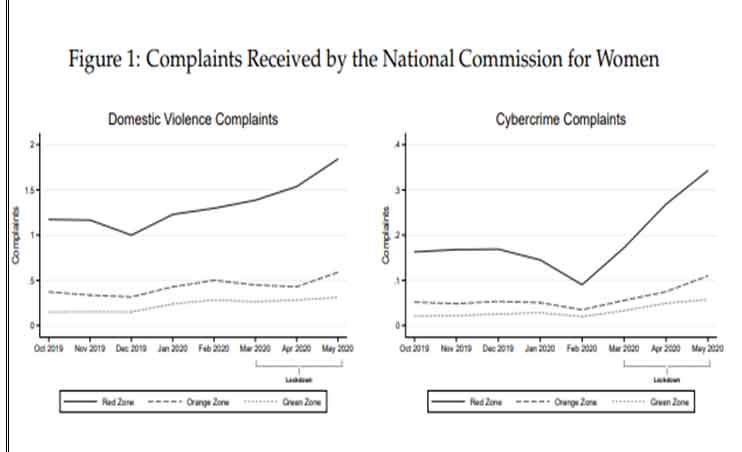
Inlined with the global trend, India has also seen a spike in the number of reported domestic violence cases during the first period of lockdown enforcement due to COVID-19. According to a report by Saravana Ravichandran & Manisha Shah of the University of California, Los Angeles, India has seen a higher magnitude in domestic violence cases in districts that saw the strictest lockdown measures. It also states that in districts where a larger proportion of husbands saw domestic violence as justified, larger increases in domestic violence complaints have been observed. According to the National Commission for Women, complaints across various kinds of violence against women have seen a sharp rise during the lockdown, especially domestic violence and cybercrime.

Due to Covid-19 Pandemic, many people, especially working in the unorganized sector, have lost their jobs. The lockdown, combined with the unemployment, has increased the anxiety level of people. There were news reports of husbands beating up their wives for issues as trivial as not putting garlic in daal.

The violence is not limited to beating. There have been cases of homicides as well amidst the lockdown.

In Azamgarh district of Uttar Pradesh, Irshad (49) killed his wife Amina (45) after a heated argument.  A 45-year-old man in Telangana’s Meerpet allegedly strangled his 40-year-old wife to death for failing to give him food on time.

In India, domestic violence against women is seldomly discussed and rarely reported. On a normal day, men used to stay outside home for the most part of their day. But, due to the lockdown, women are bound to spend more time at home with their abusers and are also unable to seek any support. Also, the possibility of getting a job in this scenario is difficult, which furthers restrains unemployed women from taking any drastic step against their family or partner.

The United Nations has started working to tackle the shadow pandemic worldwide by taking out $25m from its emergency fund. 30% of this fund is proposed to be given to women-led local organizations that prevent violence and help survivors access medical and legal help, family planning, mental health services, and counselling.

Sheba George from Ahmedabad leads one such organization, SAHR WARU- A Women’s Action and Resource Unit. Sheba George says while SAHR WARU is working towards reducing inequalities between genders and empower women, an NGO or a set of NGOs cannot bring the entire change. She points out the need for Government and the Corporates to take necessary steps towards this. During this shadow pandemic, it would be very important for the Government to take note and enact proper steps towards the cause. There could be an argument that says that Governments are currently occupied in fighting the COVID wave and the health emergencies, but historically, even in the pre-pandemic era, the efforts in this area have been minimal. The Nirbhaya fund, launched in the wake of the 2012 gangrape, has only seen 36% usage since 2013.

The diminishing efforts Corporates in reducing inequality are also alarming. The CSR expenditure in reducing inequality has decreased almost three times (187 Cr. vs. 525 Cr.) in 2018-19 when compared to 2017-18. Only 10% of this spend comes from Public Service Undertaking (PSU)s, showing a picture of no focus towards reducing inequality, which in turn results in empowering women.

Victims of domestic violence need to understand that any kind of violence is totally unacceptable, and the perpetrator deserves to be punished by law. Often abusing, slapping and beating are deemed non-serious, and women usually bear these in silence. But ignoring such instances fuels the aggressive behaviour of the perpetrator and later leads to even more violence.

There are a number of helplines for domestic violence and free online counselling websites that victims can use for relief.

In the short term, the Government should use national television to raise awareness about the possible ways victims could seek help. There is also a need of more ways of reporting an abuse without detection. In Spain One smart innovation in Spain’s Canary Islands, since copied in a number of countries, is for victims to use the code “Mask-19” at local pharmacies to discreetly signal their plight, according to Financial Times. Government should also provide financial assistance, so that more women could escape their abuser.

One of the major factors in bringing change in the long term would be to stimulate young minds in understanding gender equality as a part of their curriculum. Gender equality in mainstream education would help change children’s patriarchal mindsets and help them understand the rights of women. Education in this regard through National television might also contribute to gender equality.

Iraq’s Kurdistan Regional Government uses deadly force against wages protests

Jean Shaoul


The security forces of the Kurdistan Regional Government (KRG) in northern Iraq fired on demonstrators protesting over unpaid wages, killing eight people, and injuring 65 more. One member of the security forces was also killed.

Families of some of the dead claimed their relatives were shot while walking through crowds of protestors.

Protesters in Saidsadiq, Sulaimaniya on December 9, 2020. (Credit: BKirkuk/Facebook)

The protests began on December 3 when thousands of public sector workers in Iraq’s semi-autonomous KRG, took to the streets of Sulaimani, the capital city of Sulaimaniya province, to demand their unpaid wages. Around 1.2 million workers have not been paid for much of this year as the KRG has run out of cash. Budget disputes with the federal government in Baghdad and Iraq’s economic crisis have been compounded by the fall in oil prices and the pandemic-related downturn. The protesters were met with water cannon, rubber bullets and tear gas.

Since then, the anti-government protests have escalated, spreading to other towns in the Sulaimaniya province as well as to Halabja province, amid widespread anger over unpaid salaries, unemployment, poverty, a lack of basic services, electricity, water and fuel shortages, and government corruption. On Sunday, protesters in Said Sadiq torched the offices of the two main Kurdish political parties as well as the mayor’s office.

The KRG said it would not allow “unlicensed” protests and that it would initiate legal proceedings against those who damaged government property. It has restricted access to the internet and suspended for one week regional TV station NRT’s broadcasts, raiding its office in Sulaimani in an effort to prevent the protests escalating further. On Wednesday, the authorities in Sulaimaniya banned all vehicular movement for 24 hours.

These latest protests follow similar demonstrations over unpaid wages and pay cuts in November when the government used tear gas to disperse the demonstrations.

In August, the Kurdistan Democratic Party (KDP), which controls the western areas of the KRG, deployed large numbers of security forces to suppress demonstrations in Erbil and Duhok provinces, resulting in numerous injuries, particularly in the city of Zakho.

Security forces also attacked and arrested journalists and shut down a major TV channel, while the broadcasters and newspapers associated with the two ruling parties—the Kurdistan Democratic Party (KDP) and the Patriotic Union Party (PUK)—barely covered the clashes. These two rival and corrupt mafia-like gangs that fought each other in the mid-1990s run the KRG as their personal fiefdoms with scant tolerance for dissent, criticism and the niceties of bourgeois democracy. Other powerful figures have their own private militias to maintain their own corrupt profiteering.

The KDP, which rules over the KRG’s 5.1 million population, has been led by the Barzani family ever since its creation seven decades ago, with Nechirvan Barzani holding the presidency and Masrour Barzani, the son of the previous president, holding the premiership. The Barzani clan has monopolized most commercial activities in the region, amassing a huge fortune.

In all, more than 280 people were arrested and subjected to abuse. Al-Jazeera cited the Rights and Freedoms Advocacy Committee, an NGO, as stating, “Among those arrested were “teachers, civil servants, journalists and human rights activists, some of whom have been subjected to physical and psychological torture, prolonged solitary confinement, and denied access to legal aid and visitations.”

It is part of a vicious crackdown on reporting. According to the Metro Center for Journalist Rights, based in the PUK-dominated Sulaymaniyah province, there have been 98 violations against media organisations and journalists in the KRG in the first six months of 2020. Only the media organisations linked to the two main parties have been spared. The KRG is also introducing legislation clamping down on digital media.

The latest Human Rights Watch report describes KRG rule as being “the same as other parts of Iraq for outspoken people” and states, “Kurdish authorities are continuing to use vaguely worded laws to intimidate and silence journalists, activists, and other dissenting voices.”

On Monday, KRG Prime Minister Masrour Barzani called for patience and blamed the crisis on the federal government, claiming that Baghdad had failed to transfer four monthly payments of $270 million to Erbil, the KRG’s capital. He called on Iraqi Prime Minister Mustafa al-Kadhimi “to instruct the federal Finance Ministry to release the region’s funds.” On Wednesday, Barzani said, “The protests that started in Sulaimani and Halabja were peaceful. However, they were taken advantage of.”

Protestors attack offices of ruling PUK in Sulaimaniya province. (Social media)

Facing a catastrophic financial crisis with the collapse in oil demand and prices, the Iraqi government teeters on the brink of insolvency. The financial transfers to the KRG, whose relations with Baghdad deteriorated after its failed bid to create an independent Kurdish state in 2017, are bound up with the political deadlock in Iraq’s parliament that have prevented the agreement of the 2021 budget law. This is now unlikely to be approved before the new year. While al-Kadhimi had sought parliament’s approval to borrow $34 billion, parliament sanctioned just $10 billion, barely enough to cover the wage bill for Iraq’s 4 million public employees, who have seen their salaries delayed for nearly two months, until the end of the year.

This has further strained relations with the KRG, where three out of four workers are paid by the regional government.

The $270 million which the federal government in Baghdad pays to the KRG monthly is a reduction from an earlier agreement under which it paid $400 million. The cut was enacted after the KRG began to export its oil independently. New legislation requiring the KRG to remit to Baghdad the revenues from its direct oil sales to Turkey in return for its share of the federal budget prompted Kurdish legislators to storm out of parliament in anger.

In addition to the economic crisis, the KRG’s Peshmerga forces have clashed with Turkey’s outlawed Kurdistan Workers Party’s (PKK) fighters, of whom some 5,000 fighters are stationed in the KRG, with the potential to ignite an all-out conflict. PKK forces recently sabotaged the KRG’s pipeline to Turkey, suspending oil exports, as part of its 35-year insurgency against Turkish rule. The conflict has led to the deaths of some 40,000 people, the destruction of 4,000 villages and the forcible displacement of up to one million people. These clashes take place in the wake of Turkey’s cross-border counter-PKK operations including airstrikes, which Baghdad views as an infringement on Iraq’s sovereignty.

US officials hypocritically expressed their concern over the crackdown on protesters during a meeting with KRG leaders in Erbil on Wednesday. Washington has had a long relationship with the Barzani clan’s Kurdish Democratic Party, having backed the KRG with military and financial aid and used the KRG’s Peshmerga as shock troops in fighting the Islamic State in Iraq.

The Pentagon has established a major base near Erbil and is reportedly setting up other semi-permanent bases near the Iranian border, making the KRG a center of US imperialist operations in the region. Washington is also anxious to prevent any further unrest in Iraq, which has been rocked by anti-government protests. Barzani has sent a delegation to Baghdad to discuss the crisis.

For its part, the Kurdish working class increasingly views the KRG’s ruling cliques as willing tools of Washington and its allies, whose support enables the KDP and PUK to quash public dissent and opposition to their plunder and exploitation.

Iraq has become a key political battleground in the Trump administration’s drive to establish unfettered US domination over the world’s principal oil-exporting region and its preparations for a military confrontation with Iran. This in turn is bound up with Washington’s build-up for “great power” confrontation with China—attempting to use military force to establish a chokehold over the energy resources upon which the Chinese economy depends.

These developments take place amid a new and even more dangerous phase of the US’s war preparations and provocations against Iran, including the dispatch of US B-52 bombers to the Persian Gulf for second time in three weeks with the potential for mass casualties among the tens of thousands of US troops deployed in the region. This could provide President Donald Trump, who has refused to concede Joe Biden’s victory in the recent presidential elections, with a pretext for realizing his threats to impose martial law and upend the transfer of power.

Johnson and Macron governments step up collaboration in persecution of migrants, refugees and asylum seekers

Simon Whelan


The British and French governments are at loggerheads over Brexit and as yet cannot reach agreement on commerce, trade, imports and exports. But they can find ample mutual purpose to persecute and trample on the democratic rights of migrants, refugees and asylum seekers.

Rather than offer shelter to those fleeing the impact of decades of Western military aggression, the two governments have joined forces for the most odious and reactionary campaign to scapegoat them in the public eye.

A Border Force vessel brings a group of people thought to be migrants into the port city of Dover, England, from small boats, Saturday Aug. 8, 2020. The British government says it will strengthen border measures as calm summer weather has prompted a record number of people to attempt the risky sea crossing in small vessels, from northern France to England. (AP Photo/Kirsty Wigglesworth)

A new deal between the Johnson government in London and Macron administration in Paris, was agreed on November 28 by British Home Secretary Priti Patel and her French counterpart, interior minister Gérald Darmanin.

Speaking following talks with Darmanin, Patel announced how the new package “effectively doubles the number of police on the French beaches, it invests in more technologies and surveillance—more radar technology that support the law enforcement effort—and on top of that we are now sharing in terms of toughening up our border security.”

This pledge to brutalise migrants comes only days after French security forces rampaged through the streets of Paris in what can only be described as a police riot, ruthlessly beating migrants and journalists.

Both governments, despite pleading poverty to their citizens over the response to the pandemic, managed to conjure up millions for a host of new state-of-the-art military surveillance technology, drones, radar equipment, cameras and optronic binoculars.

Officials revealed how the UK has provided France with a total of £192 million of funding since 2014 aimed primarily at preventing migrants crossing the Channel by tunnel, train, ferry and in dinghies. The majority was spent on infrastructure like border controls and security in and around Calais on the French coast.

During the weekend the deal was signed, French patrol boats intercepted 45 migrants, including a pregnant woman and children apparently suffering from hypothermia, struggling to make the crossing cross from France. There have been more than 8,000 crossings so far during 2020. In 2019 there were 1,844 crossings and 299 in 2018.

The additional measures to prevent asylum seekers crossing the English Channel came into force December 1. French police patrols will be doubled along stretches of coast with the shortest and easiest crossing distances to the UK. The manhunting of migrants and asylum seekers along this stretch will lead to more deaths by forcing desperate people to begin their journey from more remote sections of coastline and attempt even more dangerous methods and routes to reach the UK.

Four people attempting to make the crossing are known to have died last year and seven so far this year.

Patel claimed the agreement between the two European governments represented a significant advance in their “shared mission to make Channel crossings unviable”. She said the number of migrants making the crossing had grown exponentially and blamed trafficking gangs for “facilitating” dangerous journeys. Lying through her teeth, Patel continued, “We should not lose sight of the fact that illegal migration exists for one fundamental reason: that is because there are criminal gangs—people traffickers—facilitating this trade.”

The Home Secretary knows full well the tide of humanity forced to flee to Europe from the Middle East, North Africa and the Persian Gulf does so not because of human traffickers. These extremely vulnerable people are fleeing from the wars, fratricidal conflicts, and economic and ecological destruction created and exacerbated by the world’s imperialist powers, foremost in Europe by Britain and France.

The Tory government are doubling down on their policy of creating a “hostile environment” for immigrants, refugees and asylum seekers. The Home Office is seeking to criminalise migration by painting a lurid and inaccurate picture in the public eye of “criminal migrant gangs” crossing the Channel and “invading” the UK.

The Anglo-French deal was criticised by Amnesty International UK. Steve Valdez-Symonds, the organisation’s refugee and migrant rights programme director, declared, “Women, men and children make dangerous journeys across the Channel because there are no safe options provided for them—to either reunite with family in this country, or access an effective asylum system, to which they are entitled. The UK government must share responsibility for providing sanctuary with its nearest neighbour. This continued focus on simply shutting down routes to the UK is blinkered and reckless—it does nothing but increase the risks that people, who have already endured incredible hardship, are compelled to take.”

Last month, it was revealed that migrants are being jailed by the Johnson government for taking the tiller of the flimsy vessels used to cross the Channel. Those steering the craft are being charged with “facilitation”. People seeking asylum are being sent to prison for preventing their seaborne craft from drifting aimlessly in the dangerous conditions and busy shipping lanes of the Channel.

The immigration enforcement unit is analysing drone footage of the boats carrying migrants across the English Channel in order to single out for prosecution those who steer the vessel. Thus far eight migrants who steered vessels on the perilous journey have been jailed since August. The draconian sentences handed down range from 16 to over 30 months in prison. To heap insult upon injury, migrants serving these prison terms are eligible for deportation once their sentences are served because their sentence was for longer than 12 months—under the Labour Party’s 2007 Borders Act.

Gloating government press releases announcing the imprisonment of migrants for steering dinghies describe people frequently fleeing the devastation wrought by NATO forces as “people smugglers”. This legal outrage is in breach of the United Nations Refugee Agency definition of smugglers as facilitating journeys for “a financial or other material benefit”.

The Home Office is also engaged in an attempt to cover up any public knowledge of the horrendous conditions at a former army barracks where asylum seekers are held behind barbed wire.

Visitors to the Napier barracks near Folkestone, Kent must now sign the Official Secrets Act to prevent them from speaking about the numerous hunger strikes, suicide attempts, general malaise, unrest and regular medical emergencies among residents.

Volunteers who provide clothing, amenities, company and counselling to the 400 male asylum seekers held at Napier barracks are being issued with a confidentiality form by the private security firm on behalf of the Home Office. The Guardian, who saw firsthand the agreement, say it commits the signatory to treating as confidential any information about Napier “service users” i.e. the asylum seekers.

Such information is subject to the Official Secrets Act, designed to guard issues of national security, intelligence, defence, international relations and information which has been entrusted in confidence to another country. Breaking the Official Secrets Act threatens a jail term of up to two years in prison.

A spokesperson for the Home Office gave a dismissive response to press queries: “We have worked closely with our accommodation provider Clearsprings Ready Homes and stakeholders to ensure the Napier site is safe and secure.”

The Guardian reported that while the Home Office commissioned Clearsprings Ready Homes to run Napier, the company has subcontracted significant responsibilities for the day-to-day management of the detention centre to “a letting agent and property management firm called NACCS”. The detention of asylum seekers is therefore being run by a company of private landlords and property developers.

COVID-19 death toll continues climbing in the Pacific

John Braddock


The Pacific territory of French Polynesia, including Tahiti, continues to see the number of people infected by COVID-19 escalate. As of December 10, confirmed cases had risen to 15,332. More than 5,000 new cases were recorded in the past month alone, with 210 in 24 hours to last Saturday.

Seven deaths in the last four days has brought the total number of fatalities since the pandemic began to 86. There are 62 people currently in hospital with 28 of them in intensive care. All but 62 cases occurred after borders were reopened in July and mandatory quarantine requirements abolished. The virus had been halted from late March with a lockdown and border closures.

On July 15, in a desperate bid to resurrect the moribund tourism industry and reignite the economy, President Edouard Fritch re-opened the territory to international visitors. Flights from Los Angeles recommenced with US residents and others able to enter without needing to quarantine. Over 28,000 tourists have entered since the border’s reopening, 90 percent from the US and France. The French government briefly put restrictions on travellers from France last month, but flights are being resumed next week.

The virus has spread from the urban areas of Tahiti to the outer islands of Bora Bora, Raiatea, Huahine and Hao. Fritch initially acknowledged that the pandemic had worsened in the US, and would do so in the territory as well, but claimed that if French Polynesia failed to open up the economic consequences would be “catastrophic.” He falsely predicted that case numbers would plateau at about 200.

With the health situation out of control, Fritch has continued to insist it would have been “irresponsible” to keep the borders shut, claiming 20,000 workers would have been condemned to unemployment. He absurdly told the assembly that from late May the territory was “COVID-19-prepared.”

The territory’s administration is consciously pursuing the criminal policy of “herd immunity” demanded internationally by business interests. In late October a curfew was called over a weekend in Tahiti and Moorea, but then shortened for people to return to work. A previous curfew in May was lifted after judges described it as an attack on “individual liberty” and declared it illegal.

Noting that the infection rate was twice that of mainland France, a trade union leader, Patrick Galenon, last month called for a lockdown to be re-imposed. However, the unions dropped empty threats of a general strike in September after Fritch flatly refused to re-establish quarantine requirements for incoming travelers. School attendance has remained compulsory, despite calls by teachers for tougher containment measures, and fruitless appeals by teacher unions.

United States territories in the north and west Pacific have also seen a surge of COVID-19 cases. Guam, which is the site of a major American military base, has experienced a high rate of infections since August and is one of the worst hit parts of the US and the Pacific. Guam’s total number of confirmed cases is around 7,000, with 113 deaths—significant for a population of only 165,000.

In November, over 1,700 people on Guam tested positive for the virus, almost 60 each day. So far this month, cases have reduced to less than half that number, prompting Governor Lou Leon Guerrero to declare the territory has started to “turn a corner.”

With the US federal administration in control of Guam’s borders however, local officials have been limited in what they can do. According to the co-chair for the Independent Guam organisation, Michael Luhan Bevacqua, Guam’s dependent status has undermined its response to the pandemic in some key ways. Bevacqua told Radio NZ the US military had a habit of “doing its own thing,” despite local guidelines.

In the Northern Marianas (CNMI), four arrivals this past week tested positive for COVID-19, taking the total number of cases to 113, including two deaths. Out of the 111 cases in the CNMI, 87 are from incoming passengers including 45 from the US mainland, 30 from Guam and 11 from other countries.

The CNMI has now gone 112 days without any community transmission. Health authorities are pinning their hopes on obtaining COVID-19 vaccines soon.

American Samoa is the only US Pacific jurisdiction that remains COVID free. The local governor recently denied entry to three US Air Force planes with 30 personnel on a mission to Antarctica. They were prevented from stopping overnight, and sent on to Auckland. Unlike many Pacific countries, including Samoa, repatriation flights for residents trapped overseas have not yet begun.

In Papua New Guinea (PNG), the region’s largest and most populous country, an ongoing political crisis has been pitched into fresh confusion after three government MPs tested positive for COVID-19.

Responding to an application by the opposition, the Supreme Court has ordered parliament to sit next Monday, paving the way for a motion of no confidence against Prime Minister James Marape. Parliament’s speaker, Job Pomat, had been advised by health officials that the parliament would only be safe to sit again if testing cleared a majority of MPs.

PNG’s total number of cases is now 645, including seven known deaths. Of the country’s 22 provinces, 16 have had confirmed cases of the virus. This includes 12 new cases from a significant cluster in West New Britain province with 42 infections. The country’s testing regime remains woefully inadequate—only 30,000 people have been tested from the population of over eight million.

Fiji has 11 active cases of COVID-19. Two sailors who arrived on a freighter recently from Tonga have tested positive, joining two Fijians who travelled from New Zealand a week earlier and are now in border quarantine. Twenty-five locals including staff from the Biosecurity Authority, the Ports Authority and Customs were all in quarantine.

Before the arrival of the pandemic, the region was already facing a health crisis with rampant diseases such as diabetes, a deadly measles outbreak, polio, malaria and tuberculosis. According to a UN report last week, over a dozen Pacific countries have seen an increase in HIV/AIDS. PNG, which has some of the world’s worst health indicators, has an estimated 52,000 HIV cases while Fiji experienced 117 deaths from AIDS over the past year alone.

Pacific islands’ public health systems are fragile and already at or near full capacity. They face being overwhelmed if COVID-19 cases become more widespread. A study published in the Lancet in September warned that efforts to combat endemic diseases could be derailed if COVID-19 measures are forced to be prioritised, thus dramatically increasing deaths across the region.

Meanwhile aid funding to health programs from the main local imperialist power, Australia, have been slashed in favour of infrastructure spending, in order to compete with growing Chinese investment. While Canberra’s overall aid to the Pacific has increased over five years, it has reduced dedicated health funding to the Cook Islands by 75 percent, Fiji by 22 percent, the Solomon Islands by 13 percent and Samoa by 36 percent.

European Central Bank increases stimulus but markets want more

Nick Beams


The European Central Bank has expanded its bond-buying program by €500 billion, taking it to a total of €1.85 trillion, extended emergency measures from June next year until at least March 2022, and provided further cheap funding for major banks.

But because the increase in the stimulus package was largely expected, financial markets are looking for more.

In her introductory press conference statement on Thursday, ECB President Christine Lagarde said the extension of its pandemic emergency purchase program (PEPP) reflected “the prolonged fallout from the pandemic for the economy and inflation.”

Incoming data and projections by ECB staff, she said, “suggest a more pronounced near-term impact of the pandemic on the economy and a more protracted weakness in inflation than previously envisaged.”

The ECB has forecast that the euro zone economy will contract by 2.2 percent in the fourth quarter of this year, with the downturn to continue next year. It has cut its forecast for growth in 2021 to 3.9 percent compared to its previous projection of 5 percent.

Lagarde said the outlook for inflation—a sign of rising economic activity—remained “disappointingly” low. The ECB forecast that prices would rise by just 0.2 percent this year with inflation increasing to 1.4 percent per annum in 2023—well below its target rate of around 2 percent.

Lagarde said weaker balance sheets and uncertainty about the economic outlook were “weighing on business investment.” Overall the risks to euro area growth remained “tilted to the downside,” but had become less pronounced.

The general reaction in financial circles to the policy announcements was that they were the product of a compromise between the different factions on the governing council, with German representatives favouring less stimulus.

A comment on Bloomberg described the ECB package as “an uneasy compromise between different factions. The problem is, it falls short of matching the central bank’s dire economic outlook.”

Describing Lagarde’s outlook as “gloomy,” it said the pessimistic view would “call for extremely bold measures,” but in “trying to make too many different parties happy, the ECB shied away from doing all it could.”

These sentiments were reflected in other comments. Randall Kroszner, a former US Federal Reserve governor, told the Financial Times: “I understand what they are trying to do—giving the markets more confidence—but I don’t think it will be enough and it is quite likely they will have to come back and do more.”

Frederik Ducrozet, a wealth management strategist, said the decisions were “underwhelming” and a sign of “compromise between dovish and hawkish members of the governing council.”

“We can’t help but feel like the ECB should have delivered a bolder package… to make sure that they don’t need to do more next year in case something goes wrong again,” he said.

The extent to which the endless pumping of money into the financial system has been accepted as the “new normal,” had tended to obscure the vast transformation in the global financial system and the ever-increasing role of the central banks in propping it up.

While yesterday’s ECB decision was generally regarded by financial markets as not enough, it did represent a one-third increase in the size of the PEPP with Lagarde indicating it could be expanded further if required.

The latest measures mean that the ECB will continue to absorb around three-quarters of all the new debt issued by euro zone governments next year. In remarks to the Wall Street Journal Jörg Krämer, the chief economist at the Frankfurt-based Commerzbank, said it was “carte blanche” for finance ministers.

“The ECB is likely to finance de facto the entire 2021 budget deficits of the euro countries,” he said.

In other words, the situation is developing where one arm of the capitalist state, the government, issues debt and another arm, the central bank, buys it. This situation has only previously existed in time of war.

It is expected that with the increased debt resulting from the effects of the pandemic, euro zone government debt will rise by €1.5 trillion, taking total debt to more than 100 percent of the size of the euro zone economy.

The central purpose of these extraordinary measures is not to provide a boost to the real economy, but to ensure the continued supply of ultra-cheap money into the financial markets.

They have become completely dependent on this inflow to finance the speculative boom which has seen some $30 trillion added to the market capitalisation of global stock markets since they plunged in mid-March before being rescued by massive government and central bank intervention.

The next indication of the direction of central bank policy will come when the US Federal Reserve holds its final meeting for the year. Markets will be looking for signs of how the Fed intends to continue its asset-purchasing program that has played such a central role in sending Wall Street to record heights.

Croatian government and EU intensify violence against refugees

Branko Krasnic


Croatia’s border with Bosnia and Herzegovina has become a place notorious for violence against migrants and asylum seekers for years now as part of the EU’s policy of fortress Europe. While the Croatian authorities have categorically denied that this is taking place, particularly at the hands of their own police force, an investigative report by Der Spiegel magazine has now detailed migrants’ horrific accounts of being brutalized in the area.

The report outlines sadistic beatings, torture involving electric shocks, simultaneous kicks to the body by multiple officers, among other things. It also makes clear that not only the refugees themselves fear repercussions, but so do other witnesses who help them. There is video footage of the immigrants’ ordeal from when a migrant hid his cellphone in his clothes. Der Spiegel and the media group Lighthouse Reports verified its authenticity. The officers filmed are wearing black balaclavas on their faces and cannot be identified.

The article in Der Spiegel focuses on the story of a young Pakistani migrant Ibrahim. He suffered a number of serious beatings while trying desperately to escape into Italy with many others who shared a similar fate. They dubbed the bloody process of trying to outmaneuver the men at the Croatian border “the Game.” Ibrahim has tried to accomplish this dangerous task dozens of times, before being able to escape to Slovenia, where he and the others waited to no avail for smugglers to take them the rest of the way. Days went by without food or drink before they surrendered to Slovenian authorities. The migrants asked for asylum, but they were instead taken back to the Croatian officials, who tortured them again.

Ibrahim later managed to make it to Italy, but the many months on the Croatian border devastated him. He still has headaches and problems with his knee, but the psychological damage is far greater.

After these barbaric acts of violence against defenseless migrants became public, the EU felt obliged to criticize the Croatian authorities. European Union commissioner Ylva Johansson has reportedly sent a letter to the Croatian Interior Ministry, in which she pressed it to investigate the allegations made by the migrants. She added publicly that “the violence at the border cannot continue” and that “this will not help Croatia in its efforts to join the Schengen area.”

This is just hypocrisy. As much as they continue to deny it publicly, the European ruling elite in Brussels, Berlin and elsewhere is directly responsible for not only the violence at the Croatian border with Bosnia and Herzegovina, but also the countless migrant deaths in the Mediterranean Sea. This is the true EU policy toward the refugee crisis. It is also their policy towards the working class as a whole.

Croatia, a member of the European Union since 2013, is a key country in the EU’s “fortress Europe” policy. The violence against refugees has been organized at the direct behest of the EU, which pays the Croatian security forces well for this inhumane service. “Over the years, Amnesty International and other organizations have documented numerous violations, including beatings and torture of migrants and asylum-seekers by Croatian police, whose salaries may have been paid for by EU funds,” the director of Amnesty International’s European Institutions Office Eve Geddie said.

The EU’s weak public attempts at feigning concern will only further embolden ruling circles in Zagreb to continue to give their border police a free reign to commit these violent acts. It is certainly meant to be understood that way as well. In other words, all parties involved know that there will be no real consequences for the Croatian government once the bad publicity from this story has died off.

While Croatia’s police chief and Interior Minister, the Social Democrat Ranko Ostojić, believes that retired officers currently part of the reserve are to blame for the so-called push backs, high-ranking officials of the Croatian government, such as Foreign Minister Gordan Grlić Radman, continue to vehemently deny any wrongdoing by their men at the border. As for the Interior Ministry, it issued a statement responding to the report. It claimed that migrants either have accidents that cause their documented injuries, or even more outrageously, they accuse the migrants of harming themselves, in order to blame Croatian border police.

The country has a long and dark history of extreme right-wing politics. During World War II, (long before the current nation gained its independence from former Yugoslavia in 1991), the Ustaše led by Ante Pavelić, formed the fascist puppet regime known as the Independent State of Croatia (NDH).

After the war, Josip Broz Tito’s Yugoslavia was formed using the Stalinist bureaucracy in the Soviet Union as a model. During that time, the regime crushed any pro-Ustaše sentiments. But after the violent and bloody breakup of Yugoslavia and Croatian independence, these fascist tendencies resurfaced and have been prominent ever since.

Franjo Tuđman, the most prominent figure of Croatian independence and its first president, started his political career in Tito’s Communist Party, like many other reactionaries in the region. Later, he founded the right-wing Croatian Democratic Union (HDZ), which has been in power once again since 2016 under Prime Minister Andrej Plenković.

In Croatia, much like the rest of the Balkans and indeed beyond, the political establishment has moved sharply to the right after the restoration of capitalism. Various governments have pushed though brutal austerity measures and privatizations for years, causing unemployment and suffering which is now intensified by the COVID-19 pandemic. As with their Western European counterparts, the Croatian government and other Eastern European regimes have refused to take serious measures to contain the virus and kept schools and factories open. As a consequence, infections and deaths are mounting. In Croatia, a country with a population of just over four million, over 163.000 people have been infected with COVID-19, and 2,420 people have died so far.

In the final analysis, the war against refugees at Europe’s external borders is part of the deadly offensive against the entire working class. In order to defend its interests and wealth the ruling class is resorting more and more openly to fascist violence and dictatorship.