23 Dec 2020

From Mass Agriculture to Corporatisation of Agriculture

Bhabani Shankar Nayak


Modi and His Washington Masters in Dismantling of Agricultural Economy and Food Security in India
The surge of wealth of Indian billionaires and the Modi led BJP government’s onslaught on poor, marginalised and farmers continue to grow simultaneously as masses face annihilating pandemic of Coronavirus. There is 90 % rise of Indian billionaire’s wealth over last one decade. It is not accidental. The Modi government has reduced corporate income tax from 30 to 22 percent starting from the financial year 2019/20. It has also provided many other opportunities and incentives and foregoing exemptions to corporations. The new corporates established in India after 1st October 2019 will only pay 15 percent. The Modi government further pursuing economic and agricultural policies to further marginalised the poor farmers and empower the wallet of his Hindutva capitalist cronies by reforming agricultural policies to dismantle all safety nets. Modi government follows the policy prescriptions of his Washington masters in the International Monetary Fund (IMF).

The Executive Board of the IMF concluded its consultation with the Government of India on 25th of November 2019 and released its Country Report No. 19/385 in December 2019.  The report openly acknowledges deletion of market sensitive information and policy intentions as part of the half-baked IMF’s transparency policy. However, this country report reveals the policy prescriptions for the deepening of market forces in Indian economy. The IMF advocates and encourages the Government of India to reduce corporate income tax and implement both land agricultural reform for further trade and investment liberalisation. It further prescribed to increase and integrate wholesale agriculture markets for the expansion of agricultural exports. The New Agriculture Export Policy (2018) as designed by the Modi government as prescribed by the IMF aims to double agricultural exports to US$ 60 bn by 2022. The IMF further argues that the slow progress in reforming labour, land, and agriculture are creating setbacks in the structural reform process for economic growth and investment. The strengthening of business climate is the central objective of IMF and Modi government. In order to achieve these goals, the Modi led BJP government has approved the Agri-Market Infrastructure Fund of INR 20 billion to be used for development and up-gradation of infrastructure in 10,000 rural agricultural markets and 585 regulated wholesale markets.

It is within this context, the launch of the Adani Agri Logistics is not accidental but a systematic business initiative for procurement, storage, transportation and distribution of food in India. The Adani Agri Logistics is going to develop monopoly over food market. The corporatisation of agriculture and marketisation of food security is going to accelerate hunger and starvation deaths. It will destroy and pave the path for the privatisation of Food Corporation of India. The corporate takeover of the Food Corporation of India is going to be socially and economically disastrous for India and Indians.

The BJP led Modi government is implementing three dangerous agricultural policy reforms prescribed by the IMF. These policies are concomitant with the requirements of market forces. The agricultural reforms policies under the Farmers (Empowerment and Protection) Agreement of Price Assurance and Farm Services Ordinance, 2020 are associated with three acts; i) the Farmers’ Produce Trade and Commerce (Promotion and Facilitation) Act, ii) the Farmers (Empowerment and Protection) Agreement on Price Assurance and Farm Services Act; and iii) the Essential Commodities Amendment Act. These policies are going to destroy farmers freedom to produce and diminish the security of their products and livelihoods. It is a death warrant against agricultural communities and farmers in India. The corporate takeover of Indian agriculture and growth of contract farming will accelerate agricultural capitalism in which corporates will command production, consumption and distribution, and control the lives of 60 percent of Indian population who are engaged in agricultural activities.  Agriculture is the source of livelihood for 494.9 million landless Indians and 263 million Indians depend directly or indirectly on agriculture for their everyday survival.

The Modi government is accelerating agrarian crisis to create business opportunities for the corporations. The agrarian crisis and food insecurities in India move together. The food self-sufficiency, required agricultural production for buffer stocks and accessibility of food for all in India should not just be a dream but a reality given the availability of agricultural technology, land and labour. But unfortunately, successive governments are dismantling every social and economic safety nets designed after Indian independence. The Pradhan Mantri Fasal Bima Yojana (PMFBY) is not an insurance for farmers but an income source for private insurance companies in India. This policy will ensure farmers in debt trap in the name if improved flow of credit. On the other hand, the PM Kisan Pension Yojana for small and marginal farmers is a way to consolidate small saving of poor, small and marginal farmers for corporate investment. These policies are detrimental to Indian economy and its people.

India has followed an integrated approach to agricultural economy and food security policy after independence. Production, availability and accessibility of food for all were the objectives of the integrated policy. The objective was to provide minimum support price to farmers and inspire them to produce food for food security of the country. The Agricultural Produce Marketing Committee (APMC) was established to procure the products and safeguard farmers from the market and maintain price stability to access food for survival. The public distribution system was developed to ensure food security by distribution of food and rationing during food crisis. The Food Corporation of India was integrated within such an integral policy framework to provide buffer stocks to face situations of scarcities caused by natural calamities or war. From food to fashion, the market has always failed to develop a mechanism of egalitarian distribution. The markets only work towards the concentration of wealth in the hands of few and marginalise the masses.

The successive governments led by the Congress Party has destroyed the integrated policy approach to agriculture and food security in India. The Universal Public Distribution System was dismantled by the Congress governments by reforming it as Revamped Public Distribution System and Targeted Public Distribution System. These reforms have destroyed integrated and universalistic characteristics of the agricultural and food security policy to allow market forces to grow during half-hearted liberalisation during 1980s and full-fledged liberalisation and privatisation after the 1991 new economic reforms. The BJP and RSS used to oppose these reform policies during those days in the name of nationalism. But RSS and BJP stand today on the foundations of reform policies created and shaped by the Congress party. There is no difference between Congress Party and BJP when it comes to economic policies. Both uphold the interests of the corporations.

The ruling and capitalist class strategy is to expand consumerism and market of food in a massive scale as a result of which masses will continue to seek work for food. Such a feudal approach of Hindutva capitalism is suitable for political dominance of BJP, social and cultural hegemony of RSS, and economic dominance of corporates over Indian people and their resources. The food insecure and unemployed Indians will always be available as a massive army of low waged labourers for Indian and global capitalist class to amass their profit by inflicting mass misery. The agricultural reforms will accelerate corporatisation of agriculture and create conditions where farmers will be slaves in their own land. The landless farmers and agricultural workers will be low waged workers. Mass misery, hunger and unemployment are going to be three net outcomes of these policies while pushing India and Indians to live under corporate feudalism. The long-term outcomes of these reform policies are going to be more dangerous. Long term food insecurity and unemployment creates conditions for slave society.

The ruling and non-ruling elites in India have found their poster boy in Modi and ideological brotherhood with the BJP and RSS to pursue their hegemony.  The IMF argument behind the productivity of agriculture and empowerment of farmers is dubious. These agricultural reform policies are not going to increase productivity in Indian agriculture and farmers are not going to be prosperous. The capitalism as a system is always against productivity and mass prosperity. Economic productivity of labour has increased with the growth of science and technology, but mass prosperity did not grow. Like the rest of the world, India is witnessing concentration of wealth and marginalisation of masses and their everyday life.  As Prof. David Graeber has argued “the ruling class has figured out that a happy and productive population with free time on their hands is a mortal danger” to their command and controlled system of hegemony called free market capitalism. It is clear that Indian billionaires and their Brahminical social and economic order find its safety net under the leadership of Modi. The western capitalist systems were evolved over centuries of trial and error, but Indian capitalism has built by its consciously designed foundation of caste based Brahminical order. The ruinous economic policies, social disability and political stability are three weapons of Indian ruling and non-ruling class led by Modi. It is important to see the agricultural reform policies within these strategies of corporate cronies of Hindutva government led by Modi.

The farmers movement against the agricultural reform policies of Modi government gives new hopes deepening of democracy for a better India. It has exposed the corporate character of Modi government. It has dismantled the hegemonic narrative of neoliberal governance by the BJP and RSS. The mainstream media and all the hypocritic propaganda of BJP and RSS have failed to hide the authoritarian nakedness of Modi government and all its failures. The united working-class movement in support of Indian farmers can only save India and Indians from medieval forces of Hindutva. The bigotry of BJP and RSS can never be an alternative. These forces can never provide a peaceful and prosperous India to Indians. India needs a second wave of freedom struggle against caste, capitalism and Hindutva to ensure liberty, equality, justice, secularism, socialism and democracy enshrined in the Constitution of India. It is the duty of every Indian to rebuild their country by defeating Hindutva forces and their corporate cronies. The secular and democratic struggles are only path in history for a peaceful and prosperous future for India and Indians.

Self-defense: A simple step towards ending violence against women

Mounica Rudra


Violence against women:

            Violence against women (VAW) is one of the significant problems in the country. It is very underreported because of multiple personal and societal reasons like embarrassment, fear of retaliation, the family’s privacy, and victim-blaming issues by society. According to a study conducted by WHO, at least 1 in 3 (~35%) women faced physical and/or sexual violence in their lifetime. Many forms of violence occur in various situations like Rape, Marital rape, Domestic violence, Dowry Violence, Honor Killings, Acid throwing, forced marriage, Force-feeding, Sexual harassment, Stalking, etc.,

The situation in India:

            Many forms of violence are either unreported or neglected especially in Inda. This is due to certain beliefs and cultural values followed in the country. The main reason for this is believed to be the gender inequality index at 0.488 (2019); this puts India at the bottom 25% in the world’s rankings.

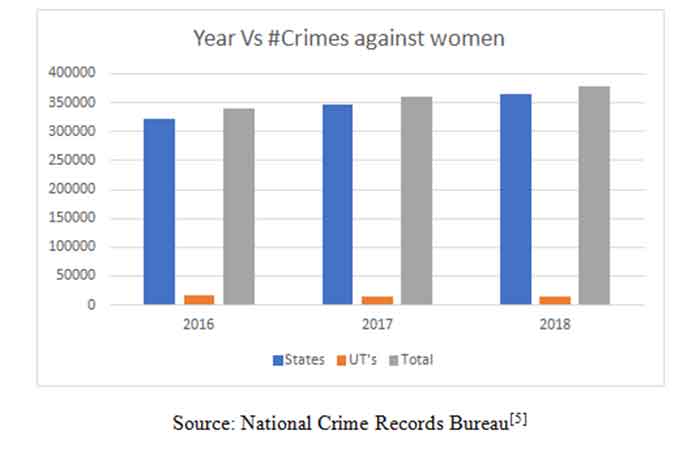
From the graph above, we can see that the number of cases are increasing every year, and these are just the reported ones. Government data shows that 99% of sexual violence cases are unreported, which might be valid for other crimes. So, the numbers on the graph are on the lower side.

Situation worldwide:

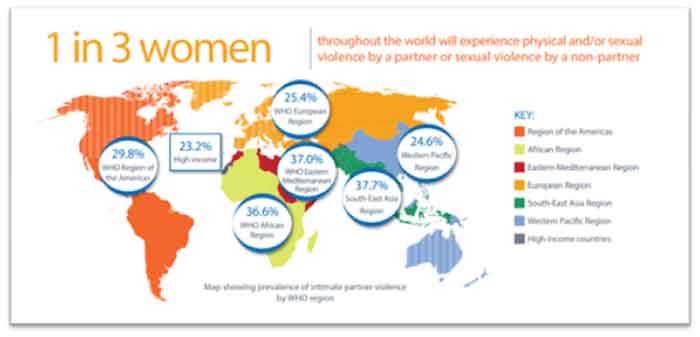
According to a study conducted by WHO, this map shows the prevalence of crime across different regions.

Source: WHO

WHO also assessed the health impact on the individuals who have suffered violence, and here are the statistics

  • Twice as likely to experience depression
  • 5 times more likely to have HIV or other sexually transmitted diseases like syphilis, Chlamydia, or gonorrhea.
  • 42% of women who experienced sexual violence have suffered injuries as a result.

So, Just like India’s situation, VAW is prevalent across different regions and is mainly observed in the developing nations.

Impact of COVID-19 on violence against women:

Reports by UN WOMEN show that crimes against women have intensified during the pandemic, especially domestic violence. Reasons for the increase in violence could be the strain put on money and health, which heightened tensions in the family, and living in confined spaces added to this. There were limited resources to help women, as many of them were diverted to aid COVID patients in many countries.

Coming to statistics, Argentina has seen a 25% increase in emergency calls, Cyprus and Singapore has registered a 30% increase in distress calls. A similar situation was witnessed in different countries like Canada, USA, UK, Germany, etc.,

Leading causes of VAW:

            Understanding the causes will help solve the problems at the root level and take precautions, which is a very complex exercise looking at the minimum shift of attitude over the decades. Some of the leading causes are lack of fear in the perpetrator’s mind about getting caught and being punished, perpetrators’ belief that they have the right to abuse, long history of unequal power dynamics between man and women, gender inequality, to remain dominant and discrimination. To deal with these causes, changes are needed from different levels of the socio-political system.

Existing laws to protect women:

There are many laws in place to help women fight against violence. The important ones are

  • Violence against women reauthorization act of 2013: This law helps victims of sexual assault and domestic violence
  • Family violence prevention and services act (FVPSA): This provides shelters and resources to victims of domestic violence and their children
  • Sexual harassment of women at workplace (Prevention, Prohibition, and Redressal) Act of 2013: This act is in place to ensure women’s safety at the workplace.
  • Protection of women from the domestic violence act of 2005: This is a civil law enforced to protect women from physical and mental abuse at home.
  • Dowry prohibition act of 1961: This act provides safety against asking or taking dowry at the time of marriage. Dowry is also one of the main reasons for abuse in the country
  • The immoral traffic (prevention) act of 1956 (ITPA): This law is put in place to limit prostitution by cutting down various aspects of sex work, reducing trafficking. 

Solutions to protect women:

To protect themselves, one should be self-reliant and not always depend on higher authorities to take action. With the prevailing crime rates, it is more than necessary for every woman to stay safe and use self-defense techniques. Many crimes that happen against women can be stopped if there are systems that make girls physically and emotionally strong to stand up for themselves.

Self-defense techniques promote confidence to tackle the attacker. They empower the ability to use your hands and feet with certain swiftness and emerge victorious from an undesirable situation. Self-defense is not just a tool to protect oneself. It also embeds self-confidence, which helps in achieving much more.

Different initiatives taken by NGO’s/ Companies:

Along with the constitutional laws, so many other sectors and organizations work together to stop this

  • Loreal:

Along with an NGO Hollaback, Loreal has come up with a program called STANDUP against street harassment. This is a training program that helps prevent street harassment and create safe and inclusive spaces for all. This has two training programs which tells what to do “when you see it happen” or “If it happens to you.” You can check out the website here and signup.

  • Red brigade Lucknow:

The vision of this NGO is FLOW (Fearless life of women). They believe that the way to achieve this is to learn self-defense and be self-reliant. They want to propagate the idea of self-defense using “NISHASTRA” (New Instrument against Sexual Harassment and Stand Against Rape Aggression), which has been very useful from their experience.

This technique is a blend of learning’s from various methods, incidences, situations & real experiences shared by sexual violence survivors. Many countries’ self-defense techniques that precisely fit for self-defense against sexual violence are also included in the training. You can check out their website here.

The way forward:

  • Women should be made aware of different helplines and services that are present in case they experience violence.
  • Work with men from various backgrounds to sensitize them about the issue
  • The government should tie-up with NGOs and various organizations to eradicate the stigma around the problem so more people will report and help end this problem.

Rethinking Solid Waste Management in India

Aastha Dhiman, Mitesh Rajput &  Ravneet Kaur 


Solid waste management in India is one of the most misunderstood topics in the country. It is one of the most pertinent issues due to the wave of rapid urbanization and subsequent lifestyle changes that come across along with it. The per capita waste generation of urban areas in India is around 200-600 grams per day. This waste includes different types of garbage that are not appropriately segregated at the point of generation and, therefore, never get adequately treated in the following cycle.

The municipal corporations in India define specific guidelines for disposal, segregation, and collection of solid wastes. Solid Waste Management Rules 2016 focus on segregation of waste at source, responsibility on the manufacturer to dispose of sanitary and packaging wastes, user fees for collection, disposal, and processing from the bulk generator.

Despite significant development in social, economic, and environmental areas, Solid Waste Management (SWM) remains a significant problem in India. The informal sector has a crucial role in managing and extracting value from this waste. Approximately 90% of residual waste is currently dumped in landfills rather than disposed of adequately at appropriate sites. Current SWM systems are inefficient. Only about 70-80% of the municipal waste gets collected, and only 25 % of this waste is processed and treated. The untreated waste has a negative impact on public health, the environment, and the economy. Many urban local bodies opt for capping of landfills so that the waste does not cause harmful health hazards. But landfills without bottom liners and sideliners allow the leachates originating from waste to seep into the ground and cause groundwater pollution.

Most of India’s significant organizations currently do not have separate dustbins for disposal of biodegradable, non-biodegradable, and paper waste. Even if some organizations try to do it, at the collection points, these wastes tend to get accumulated again due to a lack of proper value chains in the waste management system. This also happens due to the lack of implementation of municipal policies of waste segregation. As a result, the segregated waste again adds up in landfills.

Therefore, each category of waste should be segregated at the point of discard so that treatment is easy and none of it gets piled up in the dump yards.

  • The most common form of waste that all households generate in an urban scenario is kitchen waste. Most of this waste is biodegradable, and hence this should be segregated in the kitchen separately from the non-biodegradable wastes. The appropriate method to dump this waste is to have an organic compost (preferably a minimum of 12 feet deep) and compost the waste after dumping.
  • The second type of waste most generated in the urban scenarios is the biomedical waste. This is mostly generated by hospitals, pharmacies, and left-over medicines at homes. While some of this waste is not harmful, most of it consists of syringes, solutions, and other toxic waste that is not suitable for landfills. Sadly, most of this waste ends up in the open and is prone to spread diseases and harm stray animals. The most common treatment for such wastes is to incinerate the harmful chemical and biomedical waste. Approximately 90% of regulated medical wastes are suitable for autoclaving, particularly microbiological wastes. Gas sterilization, chemical disinfection, and microwave disinfection are other prominent forms of medical waste disposal. While disposing of such wastes, one thing to be kept in mind is that these techniques require more capital investment. Hence, the waste generators might not be willing to segregate the wastes at the point of generation and send them to appropriate disposal centers.
  • Thirdly, plastic, glass, or other materials are generated in the house as non-biodegradable wastes. These wastes generally are not segregated material-wise at the point of generation. However, after collection, these are classified and can be sent to appropriate recycling plants by the type of material.
  • The fourth type of waste most generated in urban areas is the e-waste. Since we have started using technology at each point in our lives, and fast-moving gadgets are flooding the market, e-waste has become a large part of urban waste generation. However, there are not enough disposal mechanisms known to the common population. Most of the e-waste can be recycled, refurbished, resold, or salvaged. Suppose the electronic component or device cannot be reused. In that case, it is prudent to recycle the materials present in the waste at designated recycling plants meant specifically for such electronic wastes.

Therefore, at the household level, there needs to be proper segregation and disposal of wastes so that all these kinds of waste can be managed and treated appropriately. Article 51 A of India’s Constitution says that it is the fundamental duty of every citizen of India to protect and improve the natural environment, including forests, lakes, rivers, and wildlife.

Most of the waste management sector initiatives focus more on cleaning, but we need to understand that cleaning and waste management are two different concepts. Hence, we further look at some of the rules defined by law that regulate SWM policies in the country.

Solid Waste Management Policy Change

The Solid Waste Management Policy was changed after 16 years in 2016 to include segregation of waste at the source. This is done such that there could be recovery, reuse, recycle.

The responsibility is on the waste generator to segregate the waste into three categories.

  • Biodegradable Waste
  • Dry Waste (Plastic, paper, wood)
  • Domestic Hazardous (Sanitary Napkins, cleaning agents)
  1. Brands: All the bodies (Institutional, hotels, event organizers) are responsible for the waste segregation at the source. Some directions are given to brand owners, too, to reduce the generation of waste. Sanitary Napkin brand has been directed to increase awareness for the disposal and ensure a proper disposal mechanism (like providing a bag for disposal) for their product. Brands that generated packing non-biodegradable waste (Food & beverage industry) are directed to set up a system to collect back the plastic waste generated.


  1. Fines: Municipal Authorities have been given the freedom to levy penalties for non-segregation of the waste. It is mandated not to bury or burn the waste on public premises. A waste processing facility is to be set up by all local bodies with a population of more than 1 Mn within two years of time.


  1. Waste to Energy: Non-Recyclable waste could generate energy used in manufacturing processing plants or thermal power plants. The Ministry should create an infrastructure to give incentives or put a minimum cap for the industry to use such waste to create an effective circular economy framework.


  1. Landfills: The landfill sites should be away from rivers, ponds, highways, and habitable areas. The emission standards have been made stringent. Construction of landfills on the hills has to be avoided. Sanitary Landfills could be there in plain areas. However, processing facilities are functional in hilly areas.


Implementation Issue of Solid Waste Management

The main issue is the garbage; instead of getting treatment keeps on rising in the landfill. The municipal bylaws have not changed in the new policy; the municipal corporation could evade responsibility from mandatory waste collection.

One of the significant issues is that the people who collect the waste by going from door to door do not segregate the waste as they are not integrated in the system & do not have proper education or training. The problem at the consumer end who is responsible for the generation of waste is that they do want clean surroundings and prefer garbage not piling up. Still, the issue is they are reluctant to put effort into segregating waste.

Swachh Bharat Mission was started in 2014 with the mission of making India Clean. Solid waste management as part of its mission and the government has taken several measures for it. In one of the case studies of SWM in Solapur, Maharashtra, the research found that 20% of the waste generated in a day remained uncollected. This directly affects human living conditions. Most of the waste-collectors van are open vehicles carrying waste, creating a nuisance of odor & smell as they travel across the city. Significant waste is collected from community bins & commercial establishments.

The waste, when collected, is dumped in the landfill. The landfill site maintenance is deplorable in India. Most of the waste dumped on open. The lack of maintenance of landfills affects the groundwater leading to its contamination because of leachate percolation.

The workers are affected at each level who are responsible for solid waste management. They face health hazards and also injuries because of dealing with sharp scrap material. The workers are more prone to respiratory diseases like asthma & T.B. The workers involved in loading garbage face eye infection problems. The rag pickers suffer from all kinds of pathogenic diseases and are not entitled to the medical facility for their health issues. They hardly earn enough to sustain their two times meal in a day. They are not accepted by society & the irony is they are termed as “Kachrawala” whereas they are the ones cleaning the surrounding.

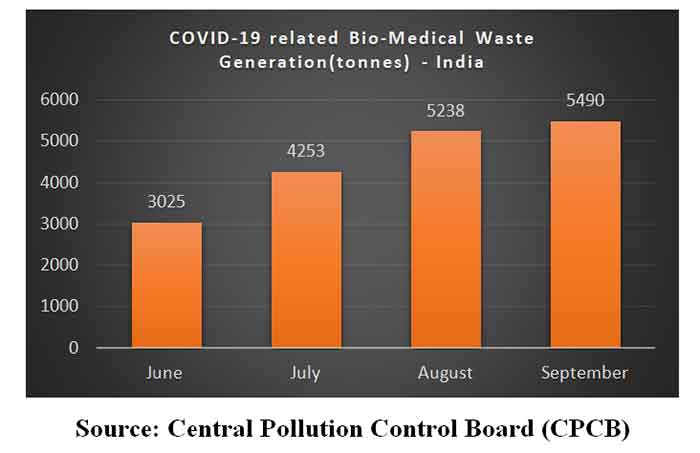
Also, in the current times of Covid, medical waste is an alarming concern that needs to be handled even before covid medical waste has been a concern for the nation. According to the Central Pollution Control Board (CPCB), India generates 559 tonnes of biomedical waste a day. 7% of daily medical cannot be processed, that is around 15000 tonnes a year. It is going to lead to a biohazard if the waste is not processed. Some of the infections caused by bio-waste are gastrointestinal, respiratory, Hepatitis, AIDS, etc. Even after a policy change, there are not strict measure in case someone violet rules. Only a show-cause notice or suspension of license is possible. Many projects remain stuck because of the lack of coordination between the environment ministry, CPCB & state level agencies to identify land for the processing waste.

The residential sector is generating more medical waste. The significant contribution is sanitary pads, earbuds or contaminated objects with blood. The government should come up with stringent medical waste regulations too and also promote industry & startups to take up the challenge of handling Medical waste. In the COVID-19, India has generated 18000 tonnes of bio-medical waste in 4 months.

Source: Central Pollution Control Board (CPCB)

The issue is all about the lack of awareness & reluctance of people. Mixing of general solid waste with biomedical waste would result in an additional load on Common Bio-medical Waste Treatment Facilities (CBWTF) incinerators, which are not designed for domestic solid waste. Recyclables that can be stored by isolating it for 3-5 days can be stored & reused. Many people do not know about it, and then through every bio-medical waste into the Yellow bins. The policy needs to rethink the Refuse, Reduce & Recycle policy in the Healthcare sector waste management. Non-segregation of bio-waste with dry waste is leading to a huge crisis.

Changes required to improve solid waste management/new ways of SWM.

Solid waste management policy was implemented to handle the informal sector better and formalize waste collection management. Without a doubt, there has been a lot of improvement in terms of the policy. A new rule has a wide scope of areas covering municipal areas and urban agglomeration, census towns, notified industrial townships, areas under the control of Indian Railways, airports, SEZs, and places of pilgrimage.

Even after the implementation of SWM, still a lot could be done to improve Solid waste management in India.  Some points are mentioned below

Decentralization of waste management – New policy has focused on the centralized committee, but the current system requires a strong and independent and decentralized waste management authority to regulate waste management. Without clear regulation and enforcement, improvements will not happen. Strong waste regulations can drive innovation.

For ex- Ambikapur in Chhattisgarh and Vellore present an excellent example of the same where the waste was collected in a decentralized manner, composted naturally, and is planted.

Attitude & behavior change for waste management – No matter how many policy reforms are on paper. Still, no policy will be successful if the masses do not become a part of it. In order to bring a fundamental shift in public mindset and behaviour towards producing less trash and not littering. Masses should be educated for behavioural change in the storage and disposal of waste. Municipal bodies should probe in media to educate the masses in the separation of waste. NGOs and community participation should be encouraged.

Training & development at an early stage– There is a need to develop training and capacity building at every level. All Indian school children should understand the importance of waste management, the effects of poor waste management on the environment and public health, and everyone’s role and responsibilities in the waste management system. This will develop responsible citizens who regard waste as a resource opportunity.

Levy heavy penalties for not following rules – The new waste management policy fails to impose a heavy penalty on defaulters. Due to the high informal system level, it is difficult to track in case of poor implementation of rules. Also, there is no defined penalty for defaulters, rather it at the discretion of local bodies.

Financial incentives or Tax subsidies for waste management companies – There has been a surge in waste management companies. To mobilize the solid management, govt could fund SWM companies, and infrastructure must be raised from waste producers through a waste tax. Also, the govt. should push companies to take up SWM activities under CSR activities. These funding activities and incentives would probably be sufficient to mobilize the masses for effective waste management throughout India.

Laying down explicit technical norms: It is imperative to make Bio-mining and Bio-remediation compulsory for areas wherever it can be applied because it is one of the most effective processes & eco-friendly. Use of these processes should not be kept at the discretion of local bodies, and rather an independent body should be responsible for deciding the geographical constraints that could prevent the use of the techniques mentioned above.

The decision-makers at all levels of government must opt for more innovative and green approaches rather than falling for the technology-extensive costly methods of waste disposal, which usually are being lobbied for by the manufacturers of such technologies.

Some exceptional case studies of other countries

Case study 1.0 – An artificial island in Singapore (Semakau Landfill: Not Just A ‘Rubbish Island’)

The ‘landfill’ world automatically brings a picture of a smelly garbage mountain to mind because that’s what it usually is. A landfill converted into a bio-diverse hotspot is now home to vibrant mangroves, rich coral reefs, and capital of birds and marine life. The Semakau Landfill is the first offshore landfill in Singapore is designed to protect the natural environment that resulted in an eco-park.

In India, offshore landfills are a great win-win for coastal cities, provided that enough island space is available or there is scope for artificial islands. Also, the Waste to Energy concept of Sweden is an amazing initiative, and if clean energy can be produced, the method can be utilized to electrify rural India and tier 2,3 cities where electricity is a problem.

Case study 2.0: Trading Trash for free Health care

In Malang, Indonesia, 55000 tonnes of waste every day. People living in the city did not have health insurance. Medika, a healthcare company, created clinical insurance that will allow people to exchange garbage for medical services and medicines.

In India, a similar approach could be taken to provide health insurance for the people to exchange their waste in rural and urban regions. This will tackle poverty & also waste problems in the country. This will increase the percentage of recycling waste in India.

Conclusion

The population growth, and especially the creation of megacities, is making SWM a major problem in India. The current situation is that Informal Indian SWM has insufficient waste treatment and dumping facilities. There are significant problems associated with public engagement in waste management, and there is typically a lack of accountability in the community for waste. There is a need for community knowledge to be cultivated and people’s attitudes towards waste to be improved, as this is important for implementing proper and sustainable waste management systems. Sustainable and economically viable waste management combined with the safe disposal of residual waste through the construction of engineered landfills and waste-to-energy installations will ensure maximum resource production from waste. India is facing problems relating to waste policy, the selection of waste technologies, and the availability of adequately qualified people in the waste management industry. India will continue to suffer from inadequate waste management and the effects on public health and the environment until these essential criteria are met.

The dramatic shift in how waste management regimes operate in India will take more than 4-5 years. The 2016 SWM rules lower the hope for the implementation of a decentralized solid waste management mechanism. It will, however, be challenging to see how source segregation functions on the field. To press for better enforcement of these laws, a major awareness campaign needs to be planned in association with governments, NGOs, students, and other stakeholders. The rules need to concentrate on making solid waste management a people’s movement by bringing the problems, concerns, and management of solid waste to residents and grassroots.

A Comprehensive Analysis of Three Controversial Farm Laws

Bharat Dogra


Introduction

It is rare for any legislation to become the rallying point of such large-scale and prolonged opposition as the three farm laws enacted together this year in India have become. The biggest  farmers’ movement of recent times in India has emerged to protest against this ‘kala kanoon’ or black laws as these three laws have been repeatedly labeled by the movement of farmers.

The demand of the farmers’ movement for repealing these laws is also supported by several other sections of society.  The three laws have rather pompous, pretentious titles but essentially seek to change the existing systems of farm production ( giving a push towards facilitation of contract farming) as well as storage and marketing of farm produce. Several eminent experts have lent their support to the key demand of the farmers’ movement for the repeal of these three laws.

Need and Framework of Comprehensive Analysis

Hence a comprehensive analysis of the many aspects and impacts of these three highly controversial farm laws is clearly needed. However to appreciate the implications of these three laws it is important also to look at the background and perspective of the wider farming situation in India and world. Without such a perspective the full implications of these three laws cannot be fully realized or understood.

So we start with this wider perspective within which the three laws need to be located and then look at various specific aspects  of these laws like those relating to impact on farmers, implications for food security etc. Finally, we also need to look a little beyond the present debate on three farm laws to examine the policies we actually need.

Wider Crisis in Farm and Food System

There is a deep and widespread crisis of world farming and food systems linked mainly to the quest of powerful corporate interests to dominate these systems. These powerful interests, who seek not just very high profits but also dominance at various levels, are able to secure the collusion of several governments and key persons in policy and implementation. Together they make a very powerful combination.

They promote policies which relentlessly increase the sale of their expensive seeds and inputs, breaking the self-reliance of farmers and increasing their dependence and costs, regardless of adverse impacts of excess of these inputs on environment, while at the same the corporate interests also try relentlessly increase their grip on crop processing, trade and marketing to get a very large share of the total market receipts.

The key to securing guarantee of high corporate profits  is to secure dominance at various levels, and also to secure legal base of this dominance.  Hence there have been endless new laws of patents, trade, farming  contracts in recent years.

Their machinations create increasing problems for family farms ,or small and medium farmers in many countries, as they are increasingly brought under pressure to increase their farm-expenses while their share of market receipts is  reduced by a greater share going to corporate interests. The big companies and traders increase their share while   farmers  lose out.

The ever-increasing greed for more profits and higher market share on the part of big corporate interests also plays havoc with the objective of providing safe and healthy food to all,  ending hunger and malnutrition.

Incredibly all this has been taking place on a vast scale in the name of development and progress, involving much manipulation. To make the system based on manipulation work, the system tries to co-opt some of the bigger and influential farmers, while governments keep announcing some temporary concession or relief for  farmers, all the more so at election times when political parties vie with each other for this, but the basic trend of big corporate interests increasing dominance of food and farming systems, while marginalizing the bulk of small farmers , harming environment, health and sustainability continues. From time to time exploited farmers unite to demand justice, but unable to challenge the bigger forces , often their demands have rather narrow aims.

In addition there is the impact of multilateral and bilateral  trade treaties, or other international and trade treaties by which food and farming systems are impacted. Here too the richest countries , in flagrant violation  of the principle of correcting historic injustice, as well big agribusiness companies  use these treaties and agreements to inflict further injustice and constraints on farmers of developing countries.

All this has been  experienced in the context of farmers of India as well, the overwhelming majority of whom are small and medium farmers who have been reeling under the combined impact of fast increasing costs, marketing problems and escalating debts. Compulsions of electoral democracy prompted many governments to create some protective structure for them, but this too has been under the threat of trade agreements ( notably the WTO) and big corporate interests wanting a wider and unrestricted role for their expansion. They would like to have a legal guarantee for this before making  bigger investments.

It is in this wider context that the debate on three farm laws should be seen. The current ruling regime is known to be very willing  to push corporate interests, particularly of some crony capitalists considered to be very close to the ruling regime.

Impact on Farmers

One of these three laws relates to facilitating  a much bigger role for contract farming . However the worldwide overall experience of small farmers and family farms regarding contract farming for big business concerns has been that of increasing tensions, (as they have to follow many conditions, losing their freedom), increasing costs ( as companies foist expensive inputs and technologies on them ) and feeling cheated time and again ( as companies make arbitrary decisions on grading their produce or reject it due to not meeting stringent, unfair standards). The recently enacted law to promote contract farming has attracted more specific criticism also for terms biased in favor of corporate interests, and for leaving dispute resolution outside normal  civil court jurisdiction.

The other two laws seek to create a new framework of untaxed, unrestricted purchases by private business outside the area of officially designated market areas for farm produce (APMCs or Agriculture Produce Marketing Committees.), while at the same time removing existing restrictions on excess stocking and hoarding of even essential, staple foods by private traders and companies. These have been rightly criticized by farmers as a strong signal of moving away from government protected and regulated MSP ( officially announced Minimum Support Price) based system. On the other hand, the government has said time and again in its defense that it has no intention of dismantling the APMC-MSP based existing system ( which plays a rather limited effective role in the entire country as a whole but a much more dominating role in the green revolution states like Punjab and Haryana). Yes, the government may not officially announce dismantling of this system, but the farmers say rightly that its recent laws send strong signals of gradually moving away from this by providing unrestricted, untaxed new marketing avenues to big business which can spread fast.

Hence farmers have good reason for concluding that the three laws create a framework for moving away from a reasonably protective system to one dominated by big business interests having close links with  ruling regimes, not even giving farmers the protection of normal civil courts if things go wrong with them, making the situation very uncertain and difficult in times of rising costs.

Impact on hunger , food security of poorest people

In conditions of widespread poverty and low purchasing power of a large number of households, there is no guarantee that market by itself would give high priority to producing adequate  staple food needed for keeping away hunger and malnutrition. So this has to be ensured by a protective system based on MSP- government procurement-PDS ( public distribution system) and nutrition schemes. But when the government moves away from protective farm and food system to one dominated by big agribusiness interests of national and global food/farming system, with huge capacity to hoard and speculate, then both production and marketing will move away from reducing hunger to  maximizing profits. The new trends unleashed by these laws move towards profiteering and speculation , that too in increasingly globalized systems. As more production takes place in conditions governed by contract system and dominated by big companies with global reach, production will be pushed by global profits and speculation and not by the needs of hungry and malnourished people in the country.

Impact on sustainability and environment protection

The present condition of Indian agriculture, particularly in so-called leading green revolution areas, is not at all good from the point of view of sustainability and environment protection. The situation certainly needs to be improved. But the trends unleashed by the new laws are likely to lead to further deterioration rather than any improvement in this important context. Cropping patterns and methods of production need to be in keeping with the needs of soil health and water conservation as well as other aspects of protection of environment and bio-diversity. But contract farming dictated by big companies just trying to maximize their profits pays scant regards to all this, often imposing highly resource-extractive cropping patterns and technologies, as their profits ignore social and environmental costs and count only cash costs and earnings. Agribusiness companies operating in global contexts for profit maximizing are notorious for their tendency to loot and scoot, as they plunder the resources of a region and then move away to a new area, leaving behind ravaged land and depleted water aquifers.

Impact on states and decentralization

There has been a strong feeling that under the impact of global and national corporate interests, the central government intrudes rather too heavily in areas like agriculture for which decisions should instead be taken at the level of states and panchayati raj ( rural decentralization) units. This trend increases with these three overbearing new farm laws. A more specific complaint is that state earnings from APMC/mandi taxes will decrease and development work supported by these earnings will suffer too, this too at a time of overall financial crisis in many states.

Impact on democracy and parliamentary procedures

These three farm laws have been also criticized as undemocratic as the necessary consultations with state governments, panchayati raj institutions, farmers’ organizations and independent experts were not held. These were introduced first as ordinances, objectionable in itself. Then the process of referring to parliamentary committee, which would have still provided one way of consultations with stakeholders, was also ignored. Then the passing of law in the upper house or Rajya Sabha had peculiar undemocratic features which were opposed by opposition parties and attracted several adverse comments.

 Amendments or Repeal

As even government ministers and representatives have admitted, in the course of negotiations, that amendments are needed in these laws, another issue of debate has been whether farmers’ movement should accept amendments , or stick to its demand for repeal of laws. So far the farmers’ movement has been steadfast in asking for repeal, which is a well-justified stand. Supporting this stand a letter sent by ten eminent economists to the Agriculture Minister has stated, “ amending a few clauses will not be sufficient to address the concerns rightly raised by farmers…We appeal that the government withdraw these acts.” This unanimous  view of these very senior economists, who have served in very prestigious government-supported and other institutions and are also known for their commitment to justice and public interest related issues, is thus very similar to the view of the farmers’ movement.

Wider Issues

Beyond the debate on these laws, several issues need to be addressed. There is a strong need for agricultural progress based on justice and protection of environment, a social-ecological approach. Solutions have to be found in a much wider paradigm than one limited mainly by narrow economic concerns. Welfare and equality aspects of landless rural households should also get adequate attention.

We end by recommending strongly for immediate repeal of these three controversial farm laws, lifting of all cases against farmer activists, followed in due course by much wider measures for resolving the rural crisis on the basis of justice and environment protection.

22 Dec 2020

Australian government hires private debt collectors to hound welfare recipients

Martin Scott


Less than a month after the federal government agreed to a $1.2 billion settlement over the unlawful “robodebt” scheme, it has issued a new call for tenders from private debt collectors to hound welfare recipients for allegedly receiving overpayments.

The new contracts will include several provisions that indicate the department intends to take a more aggressive approach to debt recovery.

The welfare queue outside a Centrelink office in Sydney last March (Photo: WSWS)

Cases will initially be divided equally among a panel of three companies. Their performance will supposedly be assessed according to a “balanced scorecard” comprising “debt recovery performance, customer satisfaction levels, adherence to agreed service levels and contractual arrangements; and quality operational outcomes.”

In fact, the tender documents make clear that financial performance—the percentage of debts recovered—will be the primary determinant of how many cases are referred to each company after the first quarterly review.

The documents state: “Financial performance is critical in terms of achieving a level of performance that will ensure a [company’s] share of the referral volumes is maintained or increased.”

While other government agencies, such as the Australian Tax Office, pay a flat fee to private debt collectors, Services Australia (formerly the Department of Human Services) will pay a commission rate, creating a strong incentive for the companies to bully clients into paying their alleged debts in full, rather than challenging the claims or negotiating partial payments.

Previously, external collectors had 180 days to recover debts. Under the new tender they will have only 56 days, forcing them to pursue repayments more aggressively. The shortened timeframe will also put the alleged debtors under increased pressure to comply rather than attempt to argue their case.

In an effort to suppress public criticism of the program, the companies will be required to inform the department “within an hour” of a customer saying they will contact the media or members of parliament.

While Services Australia has engaged external debt collectors in the past, more than 90 percent of debts have been handled by the agency itself. By contrast, 43 percent of debts raised under the unlawful “robodebt” program between July 2016 and March 2017 were referred to private contractors.

Under the punitive requirements of Centrelink, the welfare arm of Services Australia, those receiving payments must report their income fortnightly. The already pitiful payments begin to be reduced if workers earn more than $300 a fortnight from other sources.

The “robodebt” scheme was introduced in mid-2016 in an aggressive move to claw back “overpayments” to welfare recipients alleged to have under-reported their income to Centrelink. The automated process compared Centrelink records with “income-averaged” data from the Australian Tax Office.

Before it was halted in November 2019, around 900,000 “robodebt” notices were issued. Those receiving the notices were threatened with penalties and jail sentences if they failed to pay the fraudulent debts.

In many cases the alleged overpayments had occurred years earlier, making it virtually impossible for workers to disprove the agency’s claims.

Compounding the problem, it was extremely difficult to contact Centrelink to dispute the notices. In 2017–18, around 50 million calls to the agency were met with a busy signal. The officially-reported average hold time of just under 16 minutes is a vast underestimation, because the clock is reset each time a call is transferred, and “abandoned calls”—in which the caller hangs up in frustration without speaking to an operator—are not counted.

This is the direct result of decades of public service job cuts under successive Labor and Liberal-National governments, and the privatisation and outsourcing of many aspects of Centrelink’s operations.

The Labor party has publicly criticised “robodebt” in an attempt to exploit public opposition to the scheme for political benefit, but in fact the practice of issuing debt notices based on “income-averaging” and “data-matching” was instituted under the Gillard Labor government in 2011.

Although the current Liberal-National government was forced to concede in November last year that the entire “robodebt” regime was unlawful, by August 2020 only 80 percent of the debts issued had been refunded. Even after the class action victory last month, some of those targeted by the scheme will have to wait until at least February 2021 for restitution.

While Australia has so far avoided the horrific COVID-19 infection and death rates seen internationally, the country has not escaped the economic fallout of the global pandemic.

Between December 2019 and May 2020, the number of Australians receiving unemployment and other income support payments through Centrelink doubled, from around 820,000 to 1,640,000. The official (significantly understated) unemployment rate increased from 6.9 percent in September to 7 percent in October, and remains at a level not consistently seen for more than two decades.

These figures are almost certain to balloon in April next year with the cessation of JobKeeper, which is currently subsidising the wages of around 1.5 million workers.

Despite the ongoing economic crisis and continuing risk of contracting COVID-19, stringent income and asset tests, as well as “mutual obligation” requirements compelling welfare recipients to attend job interviews and/or do unpaid work, have been reintroduced.

Between September 28 and November 30, 250,112 payments were suspended by Centrelink for failure to comply with “mutual obligation” requirements.

Centrelink debts were “paused” in April, but have now been resumed, and the agency will begin demanding payment in February.

The terms of the new external debt collection contracts illustrate the lengths the Australian ruling elite and political representatives will go to in order to claw back a portion of the poverty-level welfare payments issued to the country’s most vulnerable residents.

While the new developments are an escalation, there is nothing new in the approach. For decades, Labor and Liberal-National governments have forced the unemployed, disabled and elderly to endure dehumanising treatment and relentless bureaucracy in exchange for pitiful welfare payments as low as $40 a day.

The continuing assault on welfare recipients, along with cuts to education, health, public transport and all forms of social expenditure, is part of a broader drive to lower taxes for the wealthy and force workers to accept poorly-paid and insecure jobs.

The UK’s COVID-19 mutation: The deadly result of a “herd immunity” policy

Robert Stevens


The UK recorded nearly 700 more COVID-19 deaths (691) yesterday and a further 36,804 new cases of the disease.

This brings the official death toll, based on measuring the number of deaths of people who perished within 28 days of a positive test, to 68,307—the second highest in Europe after Italy. Taking into account fatalities where COVID-19 is mentioned on the death certificate, UK deaths stand at around 80,000. Yesterday, the Office for National Statistics (ONS) revealed that excess deaths—above expected levels since the start of the pandemic in March—had reached 81,300.

The Times front page headline reading "Mutant Virus is 'everywhere'"

The same day the Times led with the headline “Mutant virus strain is ‘everywhere’”. This was their take-away from comments made by the Conservative government’s Chief Scientific Officer Sir Patrick Vallance at Monday evening’s Downing Street press briefing.

Vallance, speaking alongside Prime Minister Boris Johnson, said, “The new variant is spread around the country… It’s localised in some places but we know there are cases everywhere, so it’s not as though we can stop this getting into other places, there’s some there already.”

Vallance said there was no evidence that the mutation, known as VUI-202012/01, was more dangerous than the original strain, “so if you catch it the disease looks the same as any other form of Covid infection”. But he acknowledged that it was “more transmissible, which is why we see it growing so fast and spreading to so many areas.”

The danger to the individual infected is not the primary issue here. A more transmissible virus will infect more people more quickly, leading to hospitalisations that could easily overwhelm the National Health Service and therefore lead to more deaths. Yet Vallance, Pilate like, simply declared that there would be a further spike in cases very soon after an “inevitable period of mixing” over Christmas.

This is only a certainty because the government has allowed it to happen, in the full knowledge of the deadly implications of such gatherings. Millions were told by the government they could gather in household “bubbles” of three for a five-day period from December 23. It was only after the deadly consequences of the new strain could no longer be concealed that the government was forced last Saturday to introduce more restrictive Tier 4 measures covering London and much of the south east.

In this May 24, 2020 file photo, Britain's Prime Minister Boris Johnson's senior aid Dominic Cummings leaves 10 Downing Street, in London. (AP Photo/Alberto Pezzali, File)

As at every other stage in this pandemic, the Johnson government had ample time to take the necessary measures required to save lives and avoid a catastrophic situation. Yet they did nothing.

According to available facts, the new strain was first detected on September 20, 2020, in Kent, South East England. It was detected by the Covid-19 Genomics UK (COG-UK) consortium, which undertakes random genetic sequencing of positive COVID-19 samples around the UK. Established in April this year, COG-UK is a partnership of the UK’s four public health agencies, the Wellcome Sanger Institute, and 12 academic institutions. It has sequenced 140,000 virus genomes from people infected with COVID-19.

A swab test from a patient with the mutation was sent September 20 from Public Health England’s Lighthouse Lab in Milton Keynes to the Porton Down military laboratory in Wiltshire for analysis.

At that stage there were around 3,700 daily cases of COVID-19, but due to government policy the UK epidemic was already beginning a resurgence, undoing the curtailing of its spread during the national lockdown in place for over 2 months from March 23.

September was the month that all schools were reopened, followed by colleges and universities, after being in lockdown for several months. So determined were the government to have the parents of children back in workplaces and generating profits for their friends in big business that the order for the schools to be reopened was made as early as July 2. Education settings would be a crucial means for the untrammeled spread of the virus.

In early October, the swab tested positive for the new strain and the Department of Health was informed, but apparently not government ministers.

By early November, the virus had spread rapidly, with nearly 30 percent of all infections in London testing positive for the new variant. By mid-December, the mutated virus was responsible for nearly two-thirds of cases in the capital.

According to reports, the New and Emerging Respiratory Virus Advisory Group (NERVTAG) committee, which advises England's Chief Medical Officer Chris Whitty, was supposedly not given information about the mutation until early December. Channel 4’s factcheck site reported, “Scientific advisers say the alarm was not raised about the potential danger of increased transmissibility from VUI-202012/01 until December 8.”

NERVTAG chair Professor Peter Horby said the first preliminary data about the virus was handed to NERVTAG only on December 11 and it was discussed by them that day.

It wasn’t until December 14, 85 days after the mutation was first detected, that the government was supposedly finally informed and reported the mutation to the World Health Organization.

That day Health Secretary Matt Hancock told parliament that over 1,100 cases of the new strain had been identified in nearly 60 different local authorities. According to a December 16 British Medical Journal article, “the true number will be much higher.”

On December 18, NERVTAG reportedly informed ministers about the “substantial increase in transmissibility” resulting from the new strain.

The following day, December 19, Whitty and Vallance decided it would be a good idea to attend a NERVTAG meeting to discuss its spread.

The same day, Johnson made his public announcement of Tier 4 measures with no household mixing and a limit on Christmas gatherings to December 25 in other tier areas.

The entire episode reveals that the government’s COVID-19 infrastructure is criminally dysfunctional, with the work of scientists carrying out crucial work in identifying new strains, including VUI-202012/01, being ignored for months.

Any system in which public health was the first priority would have seen a body such as NERVTAG—in possession of knowledge regarding the great danger posed by the mutation—insisting on a national lockdown.

Moreover, not only would a government operating on the same basis have instant access to this information of life and death importance. It would have no need to be told to impose one because the first lockdown would still have been in place until the virus had been properly contained.

Ultimately the spread of the new strain “everywhere”, including in a growing number of countries outside Britain, is not down to rank incompetence but due to government policy.

The new strain developed and then spread under conditions where nothing is being allowed to come before the interests of the corporations and their raking in ever greater profits. Even when told on December 14 of how infectious the new strain was, Johnson still told the UK population, two days later, that it would be “frankly inhuman” to scrap existing plans for a three household “bubble”, five-day Christmas, and to have shops open 24 hours a day.

All workplaces of course remained open. Moreover, December 14 was the same day that Education Secretary Gavin Williamson threatened legal action against three London councils, Greenwich, Islington and Waltham Forest, unless they reversed their instructions that schools in their areas close a few days earlier for Christmas—under conditions in which London had become the epicentre for the spread of COVID-19 and schools were among the main vectors.

The government has been guided throughout the pandemic, despite having to put in place highly inadequate restrictions from time to time, by its brutal “herd immunity” agenda. Their declared policy at the outset was that as much of the population as possible should be infected with the virus, no matter the cost to lives.

Last March, the Times reported that Johnson’s then main advisor, Dominic Cummings, explained the government’s coronavirus policy at a closed doors event held in London at the end of February. Those present, reported the newspaper, summarised Cummings’ position as “herd immunity, protect the economy, and if that means some pensioners die, too bad.”

In March, Chief Scientific Officer Vallance declared alongside Johnson at a Downing Street briefing, “It’s not possible to stop everyone getting it, and it’s also not desirable.”

On March 5, Johnson said on a TV show, “perhaps you could take it on the chin, take it all in one go and allow the disease, as it were, to move through the population, without taking as many draconian measures.”

This, a policy of death, has let the COVID-19 virus in all its variants spread virtually without hindrance, leading to the horrific situation millions face today.