26 Dec 2020

Domestic Violence in India: Has anything changed?

Shrey Banka


While the entire nation went into a lockdown on March 25, 2020 in a fight against the novel coronavirus, not many could have foreseen that the lockdown would lead to a “shadow pandemic”. As per a recent report by India’s National Commission for Women (NCW), 587 domestic violence complaints had been lodged during March 23 – April 16 period, a sharp 48% rise over the 396 complaints filed in the previous 25 day period. The situation even worsened with a total of 1,477 complaints registered between March 25 and May 31, the highest number of cases recorded during these months in past ten years.

Sadly, these numbers may not even represent the full extent of the problem since as per National Family Health Survey (NFHS) 2015-16, roughly 77% of women who experienced domestic violence didn’t ever mention it to anyone and even less than 1% of the women actually sought help from the police. Extrapolating these reporting trends paints a grim mind-numbing picture of the state of women who had been locked down with their abusers during this pandemic.

But the problem of domestic violence isn’t new in India. In a survey conducted by the Thomson Reuters Foundation in 2018, India was ranked as the world’s most dangerous country for women among the 193 United Nation member states. Women are not only facing abuse at their homes but also at educational institutes and workplace. The recent case of the murder of a female college student in Faridabad in broad daylight is a testimony to the deplorable state of women safety in the country. The issues that contribute to this abysmal state of women safety in our country are manifold.

The first and one of the most fundamental reasons for atrocities against women is the social stigma and the societal norms attached to domestic violence. The effect of society on domestic violence operates at two levels. One is that in many Indian households, the conditioning of female and male children is done such that they tend to accept male dominance as a given and the female grow up to become women who are unaware of what legally constitutes as exploitation and violence. There was a time when the women weren’t cognizant of the fact that physical violence by their husbands was a legal offence. While the awareness has improved since then, the NFHS study in 2105-2016 revealed that 52% women and 42% men among those surveyed still believed that a man was justified in beating her wife. The awareness about mental and sexual violence is even lower with sexual violence being the type of violence with the highest proportion of cases (80%) where the victim didn’t talk about the violence to anyone. The second level of societal influence in domestic violence cases is the stigma that is faced by a woman who files a complaint against her husband or his family. After filing a case or resorting to mediation, societal elements including the in-laws and the relatives point fingers at the victim as the one who took her “family” to the court. The fear of this kind of a hostile atmosphere and the associated adverse repercussions also deter women from raising their voice against their abusers. Lack of financial independence of many of the victims also becomes a significant cause of concern for the women when considering asking for help or seeking justice.

Secondly, even if the women somehow muster the courage to overcome all these deterrents and seek help, the inadequacy and lax nature of Indian law and administration make justice a distant dream for these women. India has a slew of laws and guidelines meant to protect women from violence and harassment. These include IPC Section 498A, The Protection of Women from Domestic Violence Act 2005, Section 125 of The Code Of Criminal Procedure (CrPC) among others. But the multitudes of laws have not been successful in ensuring that the victims get justice. One of the faults in these laws was recently corrected by the Supreme Court on November 7. Due to lack of uniformity about the provision of maintenance for women filing cases for divorce or domestic violence, and the guideline of the maintenance being payable only after the case is resolved, the accused in such cases had been exploiting loopholes in laws and trying to drag the cases for years so that they could adjust their official reported financial health over the years of the court case in order to pay lesser maintenance expenses. In some cases, they were able to completely get away with the payment due to the women petitioner losing her morale and needing financial assistance over the years of the court case. The recent judgment by Supreme Court in a case between a Mumbai-based couple addressed these uncertainties and loopholes in the law that obstruct justice to the women. The ruling lays out detailed guidelines about alimony and maintenance, stating that maintenance has to be paid right from the day of filing of the petition and the amount to be paid will be based on the financial position of the partners at the time of filing of the court. This ruling should help remove the incentive for the defendants to prolong the case and facilitate a quicker redressal.

Even the stringent laws that should ensure justice for women fail to do so because of the lack of proper implementation of the same. One of the key examples of this would be the failure of The Protection of Women from Domestic Violence Act 2005, a law which is touted as a “milestone” by the Supreme Court of India. The act stipulates that the court proceedings in cases of domestic violence must be concluded within 60 days. If the implementation had indeed been as per the letter of the law, it would have been a milestone step towards curbing domestic violence in India. One can find an abundance of media reports that describe the plight of the women whose cases have been dragging for years and the victim hasn’t received a single rupee of maintenance during the proceedings. Another more recent example of implementation failure is the rise in reports of police officers refusing to lodge domestic violence complaints during the lockdown.

As a consequence of the factors mentioned above, a majority of the women facing domestic violence and harassment in our country still want to resolve the disputes by mutual understanding and mediation. Even in the worst scenarios, they still prefer filing for a divorce rather than initiating proceedings against the abuser for the violence she has faced. From the victim’s point of view, this at least prevents her from being dragged into a long drawn legal battle and allows her to start a new life for herself. Moreover, the lapses in the provision of justice to the victims actually bolster the confidence of the abusers and make them fearless about the legal consequences of their actions.

Even though we live in a country where many female goddesses are worshipped, our society, our legal administration and our judicial system have collectively failed the female citizens of our country. In order to improve the current situation, a change in societal mindset aided by foolproof laws and higher conviction rates is imperative.


25 Dec 2020

How Jesus Christ should be ressurrected today on his birthday?

Harsh Thakor


As a crusader of liberation of man and not a performer of miracles

The real Jesus Christ and what is professed today by the Church or Christianity at large today is like Chalk and Cheese. Today we celebrate Christmas, but we forget to give the day true respect. The Christian community immortalizes Jesus Christ for performing miracles like turning wine into water or resurrecting from the grave .Historically after the collapse of the Roman Empire the oligarchy of the Church became more powerful and morally as repressive. patronizing opressor classes. Who can forget the great crusades, the Spanish inquisition or even the Church giving shelter to the Nazi generals in World War 2.

Today whatever the great teachings of Christianity in essence the Church is blessed or blesses capitalism. It supports the worldwide trend of Islamaphobia and endorses many imperialist projects.It also in in an organised way launches a vendetta against all scientific thought like Darwin’s theory of evolution or Steve Hawkins .The church today is simply a tool of the opressive ruling classes, endorsing all profit motive.

However we must not confuse the teachings and life of Jesus with the practices of later Christianity or the Church. Without doubt he was crusader for the liberation of humanity or even a revolutionary in his own right. Who can forget how he confronted the Jewish moneylenders by destroying the very temple and openly condemned their exploitation of the common man. Historically very few have dealt such a striking blow in the very belly of the opressors as Jesus. He had powerfully idealistic overtones when preaching ‘Love thy enemy’ but also had Communistic shades when advocating ‘Love thy neigbour’ which imbibes teaching of serving the people.He galvanised poor masses in the manner of a revolutionary .This very feature inspired advocates of liberation Theology. In recent times many church priests have supported the revolution in Phillipines or even in Latin American countries.

Historians need to delve into the root causes of how team of crusaders for liberation turned into a ruthless oligarchic or opressive bureaucracy.

Ofcourse we have to respect views like those of Bertrand Russel who in a most subtle manner launched a tirade against the hypocrisy of Christianty.However he praised Christ as a monumental figure as a crusader for serving humanity. Ironically however much they condemned organised religion even Marx and Engels foresaw some revolutionary or humanistic leanings of Jesus. On the other hand today we have Scientific atheists today like Richard Dawkins who oppose social revolution. Today I would visualize the same Jesus at the very root confronting Operation Green Hunt in India, professing secularism to defeat Hindutva fascism ,launching a crusade against Multinationals and other manifestations of globalization, supporting the movements of the workers and peasantry and the war designs of imperialist nations. Whatever the invention of miracles the Bible recounts many instance of Jesus championing the poor .Even if Marxists are atheists they should not condemn those who belie in Christ, but attempt to mobilize them into joining collective causes against opression.

Today we have to strike a balance with supporting the progressive elements in Christianity and the Church and attacking the unscientific aspects of religion .We can reproduce the writings of Darwin,Bertrand Russel or Steve Hawkins in golden letters but need not blindly attack Christianity. Instead we should glorify the positive aspect of the Christian struggle for liberation against Rome. Wholeheartedly we should expose events like the Spanish inquisition but glorify how in recent times the Church has come to the side of revolutionary movements. Father Stan Swamy is a living example. No way can Jesus be classed as a Communist as capitalism did not prevail in his era and very primitive feudalism. Still while rejecting concepts like Miracles the Bible could be an invaluable source of research for progressive historians.

Jesus being crucified on the cross, symbolizes a crusader laying his life to liberate humanity from tyranny and even his teaching ‘forgive them for they do not know what they are doing’ is an expression of his mission to change the very soul of man.Ofcourse there are ambiguous positions like ‘turning your cheek ‘to your neighbour or enemy which compromise revolutionary spirit .A positive aspect of Christ was his experience in revolutionizing the ‘inner self’ .Without a spiritual change a true revolution cannot be launched.The ‘Semon on the Mount’ is an ideal example when he tapped the soul at the very core. I have no doubt that today Jesus would have been a major crusader against imperialism and capitalism. In a subtle manner it was revolutionary Che Guevera who emulated many attributes if Jesus.

Today we have to ressurect spirit of Jesus in accordance with the neo-global imperialist fascist offensive striking the world and explore those elements in Christianity that re coherent with creating a genuine liberated society. It is pertinent that many great Marxist revolutionaries were originally Christian liberation theologians. Thus it is not the physical Jesus resurrecting but his spirit blazing  to liberate humanity.

Quoting chairman Joma Sison of National Democratic Front of Phillipines “I agree with the proposition that the tradition of Jesus Christ as social revolutionary is in dire need of resurrection against the Christian Right. There are certain acts and words of Jesus that side with the poor and powerless and that there are those that side with those in authority and condone the wealthy. But communists can have for allies Christians who are inspired by Jesus as a social revolutionary. Thus, the Christians for National Liberation (an association of Catholics and Protestants) is a major ally of the CPP within the National Democratic Front of the Philippines. Although Christianity was a tool of Spanish colonialism for ruling the Philippines, the martyrdom of the Filipino priests(Gomez, Burgos and Zamora) generated national consciousness against the colonizers. Many Filipino priests joined the Philippine revolution against Spanish colonialism and against their Spanish religious superiors. The principle of continuing the unfinished Philippine revolution towards national liberation, democracy and socialism guides the Christians for National Liberation. The adherents of this organization and movement find support from the Constitution of the Modern Church (Mater et Magistra), proclaimed by the Vatican in the 1960s, which promotes ecumenism that means dialogue and cooperation among Christians, other believers in God and nonbelievers (including atheists). CPP cultural cadres quote from the New Gospel of Christianity todo propagit aamong the Christian masses and metaphorical artistic works and performances which avail of the figure and story of Christ as social revolutionary. The meeting ground of the communists and the Christians is the second great commandment which states, “Love thy neighbor” which also means “Serve the people”.

Quoting comrdae Mercedes Sanchez “If Jesus really existed, he was undoubtedly a social reference for questioning the society of that time. Today, he would probably be in Delhi with the farmers, or in the northeast defending the citizenship of minorities, or in Kerala fighting against pseudo-communists who use the same tactics as the extreme right for their own benefit. Any religion only causes problems even if it is lived differently in each country.What really matters in his thoughts has been twisted by the church covered with an incredible hypocrisy and nowadays…many are confused about him. There are those who confuse Jesus and Christianity and reject him instead the institution.”

“Remember that Catholic celibacy was not established until the 12th century and it was out of lust as a pope upon being rejected decided that if he could not have sex with whom he desired, no one would. It was then, when the internal struggles for power increased and there were three popes at the same time fighting for power and control of the rich Catholic Church. That struggle lasted about forty years if I remember correctly. Since then and until the 20th century, things have not changed much. There have been schisms in Christianity creating divisions. Catholicism is the most traditional and conservative school. Its norms are brutal for today’s society but fortunately for the Church and the Catholic believers, in the 20th century there were those who, getting up the courage, decided that this had to change and started a new current called “liberation theology” whose members were rusticated by the Vatican but never stopped practicing as priests even though they had partners, children and social struggles ( Stan could very well be one of them). They participated in the social revolutions in Cuba, Honduras, El Salvador, Brazil, Nicaragua….people like Camilo Torres, Ellacuría, Helder Camera, Claudio Cardenal… and many others.””

Quoting blog Necessity and Freedom in article ‘Re-Proletarianisation of Jesus’

“t was this Jesus, so admired by Eugene Debs and the author Bouck White, who penned the first radical interpretation of Jesus in his Call of the Carpenter, that must be resuscitated. Both Debs and White considered the message of Jesus, which had cultivated a small but devoted following as striking fear into the hearts of the religious and political powers of Jesus’ day. According to Debs, this was the reason for Jesus’ execution.”

He denounced the profiteers, and it was for this that they nailed his quivering body to the cross and spiked it to the gates of Jerusalem, not because he told men to love one another. That was a harmless doctrine. But when he touched their profits and denounced them before their people he was then marked for crucifixion.”

“He denounced the profiteers, and it was for this that they nailed his quivering body to the cross and spiked it to the gates of Jerusalem, not because he told men to love one another. That was a harmless doctrine. But when he touched their profits and denounced them before their people he was then marked for crucifixion.”

“Historically we know that this interpretation is correct, due to the fact that crucifixion was a punishment for a political crime against the State, not religious heresy. Jesus was executed because he was leading a nascent peasant and artisan based revolution in a region of the Roman Empire that was under less stringent controls due to its lack of proximity to Rome. The tradition of the radical Jesus also posits that the destruction of the temple, and the tearing of the curtain, after Jesus’ death was not a supernatural event, but a riot launched by followers and sympathizers right in the seat of the regional religious and political power.”

“But what does this mean in our contemporary setting? Because religion is still with us, especially now that Christianity serves as a part of the dominant ideological state apparatus used to oppress the masses, we must soberly grapple with our own interpretations of Jesus. For communists I find this question to be negligibly important. However, I do believe it is important for us to challenge the prevailing narrative, so often used to justify the existing economic and political order, on its own terms, but with a revived counter-narrative based in a biblical tradition that is just as revolutionary as it is spiritual. Even in our own secular political tradition, which correctly eschews religious dogma, many revolutionaries which we admire were at least formally like Jesus. Both Lenin and Mao operated on the peripheries of empire, and based themselves amongst the poor and downtrodden, just as Jesus did.”

“Unlike today’s Christians, many of which often uphold the “justness” of our own society, the communists are the ones who advocate for the end of the exploitation of labor, for the radical transformation of social relations, and for a mass emancipatory movement to smash the old society and build a new one, as Jesus himself did. The radical Jesus, whether we believe in the supernatural elements of Christianity or not, is an integral part of our own revolutionary tradition, one that is in dire need of resurrection.”

EXAMPLES OF JESUS AS A CRUSADER AGAINST ENEMIES

And what did Jesus have to say about the exploitation of Labor, was he on the side of Capital and absentee landlordism as the modern purveyors of right-wing Christianity would have us believe?

Go to now, ye rich men, weep and howl for your miseries that shall come upon you. Your riches are corrupted, and your garments are motheaten. Your gold and silver is cankered; and the rust of them shall be a witness against you, and shall eat your flesh as it were fire. Ye have heaped treasure together for the last days. Behold, the hire of the labourers who have reaped down your fields, which is of you kept back by fraud, crieth: and the cries of them which have reaped are entered into the ears of the Lord of sabaoth. Ye have lived in pleasure on the earth, and been wanton; ye have nourished your hearts, as in a day of slaughter. Ye have condemned and killed the just; and he doth not resist you. – James 5:1-6, KJV

Happy New French Revolution!

Satya Sagar


As 2021 arrives I am not planning to wish anyone a ‘Happy New Year’ while everything wrong with the world remains deeply entrenched. And anyway, nothing really changes with the mere flip of a calendar page.

Instead my wish will be for a ‘Happy New French Revolution’. This time on a planetary scale, against the corporate monarchs, the political aristocracy and a paid, proselytising media wantonly leading the world to ecological, economic and social disaster.

There is no doubt 2020 has been the nastiest year anybody can remember in decades and I know many are eagerly looking forward to its departure. The passing year, was marked by the catastrophic Covid-19 pandemic, widespread economic collapse, rising racial, ethnic, religious hatred and virtually no action on climate change.

If at all, the only positive legacy of 2020 could be that it was like a mirror shoved in the face of humanity, forcing it to confront its own sorry self and if possible learn a few hard lessons.

The most obvious issue for the world to reflect upon is the abysmal response to the pandemic and the terrible state of health systems and healthcare in most parts of the globe, including the ‘developed’ nations.  As I write this, there are an average 2000 people dying every day in the United States due to Covid-19, the highest anywhere in the world, with Europe becoming the first region to cross 500,000 COVID-19 deaths, accounting for one-third of the global toll.

Ironically, these are typically the kind of numbers associated for very long with many developing countries, struggling with diseases related to malnutrition, tuberculosis, malaria, AIDS. Which brings us to one of the root causes of global health problems, the two-faced approach of the world to the health needs of poorer societies.

For instance, if Covid-19 had been a problem confined to a few pockets of Asia or Africa it is very doubtful anybody in power anywhere or in global media would have even noticed it, leave alone enforced national lockdowns.  Such discrimination is linked to the historically skewed distribution of global resources, itself a result of centuries of colonisation and other exploitative processes, both within and across nations.

Today, the world is passing through an era of what can only be called ‘corporate monarchy’- a system whereby those with inherited wealth or with monopoly control over various streams of income rule unchecked – having subdued entire political systems, all democratic institutions  and even reason and logic with their accumulated wealth.  Currently,  the world’s richest 1 percent, those with more than $1 million, own 44 percent of the world’s wealth and the top eight billionaires own as much combined wealth as the poorest half of the human race.

During the past year alone, when millions lost jobs and many more were left on the brink of starvation, the world’s billionaires added over USD 10 trillion to their already mind boggling wealth. It’s a pattern repeated not just globally but also within all countries and such easy accumulation of wealth should be declared nothing less than a crime against humanity itself.

The only problem though with the term ‘humanity’ used here is that we still live in a world where  a large section of the global population is not considered human at all by those in power. The planet is still too divided between ‘superior’ and ‘inferior’ races, castes, language and lifestyle groups and not every intelligent biped descending from homo habilis or homo erectus is accepted as a member of the species homo sapiens too.

And today, all these deep-seated prejudices are being promoted most vigorously by none other than the very beneficiaries of the unequal global order – to divert attention from the open loot of planetary resources they are indulging in. However, one has to acknowledge, that for many reasons, the currency of hate does circulate well even among the victims of the unjust world order,  which in turn enables those in power to perpetuate their control over ordinary citizens.

Among the reasons for this strange phenomenon of the oppressed supporting their own oppressors is the power of modern propaganda, but a deeper factor involved may lie in the way we have evolved over long periods of time. In the struggle for survival humans have become hardwired to use their technological and managerial abilities to domesticate and subordinate other species and Nature itself.  This has deeply ingrained the notion, even among the relatively weak or oppressed,  that preying upon those even weaker is fine as long as one can look down on them as some kind of ‘aliens’ or ‘animals’ or ‘microbes’.

What this really implies is that the solutions to exploitation of humans by other humans cannot be found by merely focusing on the internal dynamics or politics of human societies alone.  Addressing inequality and hierarchy will also need a serious  rethinking of the ‘master-slave’ relation that the dominant homo sapiens has established with the rest of Planet Earth.

If the SARS-COV2 virus had any blunt message to convey to the entire human species it was essentially that we are not really as invincible as we have foolishly believed for too long. And that our survival is dependent not only on well-being of the human collective but also that of every other living creature on Earth. (You can’t eat a pangolin and have your pension too!)

This gives us a clue as to how we can begin to deal with the ‘mother of all dangers’ confronting humanity – one larger than any viral pandemic –  that of climate change, which threatens to make the planet uninhabitable and wipe out much of the human population. Even while addressing the issue of inequitable sharing of resources,  the response to this threat calls for a completely new contract with everything around that sustains us.

A new magna carta or even a deeply spiritual approach based on respect for Mother Nature, whereby no one takes more than what they can give back and certainly does not get to hoard wealth in any form. Something, not very different from what many indigenous people around the world already practice, but are heavily penalised for by the rest of our species.

In that sense the new French Revolution the world urgently requires will have to go beyond the human centeredness of the old one and extend the slogan of ‘Liberty, Equality, Fraternity’ to include ‘Ecology’ also to the list.  2021 itself may be a bit too soon but hopefully it won’t be too long before guillotines also come out on the streets of the world’s major capitals to reclaim power from monopolists of every hue currently holding sway over our planet. (Perhaps even a solar powered ‘green guillotine’,  that will also ensure when finally the heads of royalty roll – they do so with zero emission of climate altering fumes)

I know all  this sounds a bit macabre, but as the craziest year in living memory departs and given the current state of the world, you can’t really blame me for wishing you all a Happy New French Revolution!

Engagement for environment

Farooque Chowdhury


All aware citizens know the state of Bangladesh environment. Bangladesh courts of law regularly rule in favor of environment. Bangladesh media cover the area every day. Bangladesh environment activists regularly stand for environment. The commoners take care of environment and nature within their capacity, which is chained by capitals.

And, some capitals regularly, everyday and all the time, exploit and expropriate Bangladesh environment and nature. The powerful actors encroach on public lands including river and canal banks, and forest, stealthily, and, at times, with advantageous collusion, overtly devour hills and hillocks, use river and ground water as coolant for machines and for production of commodities, pump out warm water and harmful chemical filled-effluents discharged from machines into public water bodies including rivers and canals, dump wastes on public lands and lands of unorganized citizens weak in terms of political power, spew smoke filled with fatal gases into air, extract, and at times, export sand, and carry on many such acts of encroachment – acts of exploitation and expropriation. This is a very general, broad and brief description of the exploitation and expropriation of nature and environment and ecology – the commons, the “elements”/areas/spaces owned by the Bangladesh people. A closer look, not presented in this article, will portray a much complex and cruel, barbaric picture – a process of capitalist economy.

These facts tell: The Bangladesh environment is a two-sided story: [1] resistance, reinvigoration and rejuvenation; and [2] exploitation and expropriation – encroach, deface, demolish, destroy, devour and pilfer – and the much-known drive – profit and accumulate. It is a story of juxtaposition of two opposite sides with opposing interests, seemingly competing with each other. But, actually, it’s not a competition between the two.

Rather, the second party – the exploiters, the expropriators – is in competition with self, between its components while the rest – the resisters, the regenerators and the like – is essentially opposed to the [1] acts harmful to environment, ecology and nature, and [2] competition between the components of the second party. The competition is, to put it simply, for accumulation by the capitals involved with exploitation and expropriation of human beings and environment and nature. Capitalist exploitation and expropriation are the capitals’ methods of reproduction, accumulation.

Capital can’t sit idly. To survive, it has to be in unceasing motion and expand. In the areas of environment, ecology and nature in an economy based on exploitative system, the capitals in motion exploit and expropriate labor and nature. Consequently, as outcome of the motion, the exploitation, etc. of environment, ecology and nature come out; and, in the exploitative system, the exploiters, a few in broader societies, gain while the exploited, multitudes, the people, suffer. The system not only fattens itself with unpaid labor of the working class; it also exploits/appropriates and expropriates nature, environment and ecology. Moreover, it also maintains and nourishes the conditions for continuing with its acts of exploitation/appropriation and expropriation as maintenance of the conditions is essential for its survival. With exploitation/appropriation and expropriation, the system produces commodities; and it’s part of reproduction process as “[w]hen viewed […] as a connected whole, and in the constant flux of its incessant renewal, every social process of production is at the same time a process of reproduction.” (Marx, Capital, vol. I, Progress Publishers, Moscow, erstwhile USSR, 1977)

And, “[c]apitalist production […] under its aspect of a continuous connected process, of a process of reproduction, produces not only commodities, not only surplus-value, but it also produces and reproduces the capitalist relation; on the one side the capitalist, on the other the wage-laborer.” (ibid.) In the case of the Bangladesh environment, owners of private capital that exploits and expropriates environment, the nature are at one pole, and the rest – the people, the sufferers due to the exploitation and expropriation – is at the opposite pole.

Whatever the exploiters, the expropriators exploit and expropriate from nature/ecology/environment, metamorphoses into their capital, which strengthens their power to exploit and dominate, and, in turn, the exploited, the people, the owners of the commons/nature/ecology/environment, turn into the deprived, the destitute, the poor, the wretched. Thus, the capitals involved turn into producers of deprivation, destitution, poverty, wretchedness. The appropriation of surplus value, as part of the process, goes on simultaneously, and the generated surplus value is reconverted into capital, which is reinvested – the accumulation of capital, as “employing surplus-value as capital, reconverting it into capital, is called accumulation of capital.” (ibid.)

The commodities whatever are produced by capitalist exploitation and expropriation of labor and nature enter market. This entire act/process encroaches on people’s life and people’s inalienable, fundamental and democratic rights. Market itself is incompatible with democracy. And, if it’s people’s democracy, not a “democracy” of a few powerful, market conclusively undermines people’s democratic rights, practices and space. Jacques Attali, neither a disciple of Lenin nor a follower of Mao, but the first head (1991-1993) of the European Bank for Reconstruction and Development, special advisor (from 1981 to 1991) to Francois Mitterrand, then president of France, and one of the leading intellectuals in the mainstream, sharply dissects market and democracy: “[T]hese [democracy and market economy] two sets of principles often contradict one another and are more likely to go head-to-head than hand in hand”. (“The crash of Western civilization: The limits of the market and democracy”, Foreign Policy, No. 107, summer, 1997) Attali adds: “[T]he market economy and democracy […] are more likely to undermine than support one another.” (ibid.) Moreover, he admits: There’s “inherent conflict between the market economy and democracy”. (ibid.) No doubt, he is talking about the bourgeois democracy. If this is the state of bourgeois democracy with the “graceful” touch of market, then, the state and scope of people to initiate measures related to environment/ecology, environmental/ecological rights, participation in political process to determine issues concerning environment/ecology/biodiversity, democratic space to save/regenerate environment/ecology and the capitals slaughtering  environment and nature is easily perceived. It’s a hostile reality with an antagonistic relation. “The social relation of capital […] is a contradictory one. These contradictions, though stemming from capitalism’s internal laws of motion, extend out to phenomena that are usually conceived as external to the system, threatening the integrity of the entire biosphere and everything within it as a result of capital’s relentless expansion.” (John Bellamy Foster, “Capitalism and Ecology: The Nature of the Contradiction”, Monthly Review, vol. 54, issue 4, September 2002) The Bangladesh environment is not free from this reality – the social relation of capital.

Capitals that exploit and expropriate labor and nature, and hurt environment include finance capital, and capital from international lenders.

In addition, there’s no reason to look at capitals’ anti-environment acts in different areas in an isolated, compartmentalized way – one capital isolated from another, one devastating act isolated from another, one area isolated from another. That, the isolated/compartmentalized approach, is an erroneous and novice way of looking at the process spanning society and economy, life of people, environment and ecology as, in the case of environment and ecology, all are connected to all. The first and second informal laws of ecology, which Barry Commoner and others refer, are: [1] everything is connected to everything else, and [2] everything must go somewhere. These two tell the interconnections in ecology. (Cited in John Bellamy Foster, The Vulnerable Planet, A short economic history of the environment, Monthly Review Press, New York, 1994) The interconnection turns stronger, deeper and wider while capitals continue interacting with and exploiting, actually decimating, nature. It enfolds food, health, habitat, legislation and its execution/non-execution, political power, allocation of funds, scientific activities/research, greater society, etc. Labor is obviously there.

With all these, the question of class power and class equation can’t go absent. A part of a capital is busy with food and its processing while another part of the same capital expands in the areas of health care or manufacturing or habitat, and another part is in the service sector or agriculture or chemicals processing, and thus goes the game. These all have implications for environment, ecology and nature, which mean implications on people’s life and rights; and, in short, on all these capitals exploit – labor and nature.

Therefore, a few lines of contradictions appear explicitly while a few remain implicit. The contradictions make further developments. Most of the environment-initiatives deny looking or fail to look at these contradictions and their sources. For some of these initiatives, this denying or failing is reneging interests of people/environment and ecology; and for some, it’s “idleness” – unwillingness to labor for searching [1] thoroughly and deeply, and [2] the source of the problem/phenomena. A caustic tongue may characterize this practice as ignorance instead of idleness.

But, in this century, writes Curtis White, the battle against the expropriation of the earth must unite with the fight against the expropriation of human beings, ultimately challenging the dialectic of expropriation and exploitation, and the entire “barbaric heart” of capital. (The Barbaric Heart, cited in John Bellamy Foster, “Marx, value and nature”, Monthly Review, vol. 70, issue 3, July-August, 2018) The engagement for environment in Bangladesh is no different: The fights against exploitation and expropriation of earth and human beings should unite with broader alliance as the two are basically a single issue – humanity.

Any absence of this unity is not lack of rationale for the unity, but lacking in [1] articulating the rationale; [2] initiating unity; and [3] giving up the required initiative to those who are unwilling to walk along the united path – engage for environment, engage against capitals killing our earth, slaughtering our environment, exploiting human beings and nature. Consequently, flamboyant environment “crusaders” rage, but miss one of the basic issues related to environment – capitals’ crushing character – and abstain from the essential task.

Health Imperialism and Discriminatory International Laws

Soraya Sepahpour-Ulrich


“Hypocrisy can afford to be magnificent in its promise, for never intending to go beyond promise costs nothing.” – Edmund Burke

 Joe Biden’s statements on resuscitating the 2015 Joint Comprehensive Plan of Action (JCPOA) has also reignited an old debate inside Iran. With the Rouhani administration clearly siding with those pushing for unconditional return to the ‘deal’ signed with the U.S.  and five other world powers, it is important to discuss what is at stake – specifically as it relates to medical isotopes and Iran’s enrichment needs.

 While the United States and its western ‘allies’ demand that Iran stop all enrichment of up to 20% for its research reactor and medical isotopes, the US government has continued its efforts to commercialize nuclear medicine.

 In 2011, while the Obama administration was busy talking in secret with the ‘reformist’ groups attempting to influence and undermine Iran’s rights under the Non-Proliferation Treaty (NPT), the U.S. Congress passed the American Medical Isotopes Production Act of 2011” . The Bill calls for providing uranium to private sector companies to make medical isotopes with U.S. government undertaking the task of waste removal: “The lease contracts shall provide for the Secretary to retain responsibility for the final disposition of radioactive waste created by the irradiation, processing, or purification of leased uranium.” It is important to read the entire Bill here: E:\BILLS\S99.IS (govinfo.gov)

 Under Section 6 titled ‘DOMESTIC MEDICAL ISOTOPE PRODUCTION, the Bill stipulates:

 “(a) In General.— Chapter 10 of the Atomic Energy Act of 1954 (42 U.S.C. 2131 et seq.) is amended by adding at the end the following:

 “Sec. 112. Domestic Medical Isotope Production.

“a. The Commission may issue a license, or grant an amendment to an existing license, for the use in the United States of highly enriched uranium as a target for medical isotope production in a nuclear reactor, only if, in addition to any other requirement of this Act.”

 Clearly not a proliferation concern.  America is the arbitrator of international treaties – it would seem with cooperation from other powers. But Iran’s uranium enriched to 19.75% – considered to be LEU and necessary for research reactors and medicinal purposes – has to be halted.

 Through National Nuclear Security Administration, the U.S. is monopolizing and handing control over global medical isotope production to profit-driven companies. Here is the statement published on NNSA’s website:

 “As part of its mission to minimize the use of highly enriched uranium (HEU), NNSA’s Office of Material Management and Minimization was tasked to lead the Molybdenum-99 (Mo-99) program. Mo-99 is an isotope that is used in over 40,000 medical procedures in the United States each day, but is 100% supplied by foreign vendors, most of which use HEU in the production process.”

 It also identifies four private companies currently working with the U.S. government:

NorthStar Medical Radioisotopes, LLC, located in Beloit, Wisconsin

  • SHINE Medical Technologies, located in Janesville, Wisconsin Northwest
  • Medical Isotopes, located in Corvallis, Oregon
  • Niowave, Inc., located in Lansing, Michigan”

Medical isotopes are a lucrative, growing business and one that is essential to human health.

Radiotherapy can be used to treat some medical conditions, especially cancer, using radiation to weaken or destroy particular targeted cells.

  • Over 40 million nuclear medicine procedures are performed each year, and demand for radioisotopes is increasing at up to 5% annually.
  • Sterilization of medical equipment is also an important use of radioisotopes

The global radioisotope market was valued at $9.6 billion in 2016, with medical radioisotopes accounting for about 80% of the total, and poised to reach about $17 billion by 2021. North America is the dominant market for diagnostic radioisotopes with close to half of the market share, while Europe accounts for about 20%.  Hence, 70% of the global medical radioisotopes goes to a population of 778 million people (US 331 and EU 447 million) while 7 billion (global population 7.8 billion less US and EU) are left with only 30%.

Where there is health imperialism, profit, and discrimination, there is Bill Gates.  According to the Journal of Economics and Sociology (2015), Bill Gates, the single biggest contributor to World Health Organization (WHO):

 “Gates calls for discussion “about which parts of the process [WHO] should lead and which ones others (including the World Bank and the G7 countries) should lead in close coordination.” While the article contains perfunctory nods to U.N. authority, as well as brief lip service to the idea of strengthening public health services in poor countries, there can be little doubt that Gates is advocating a new form of international institution, transcending the United Nations, targeting the developing world, and effectively controlled by the wealthy nations of the West”.  

 It comes as no surprise therefore that Gates in involved with nuclear medicine.  “TerraPower, the nuclear research venture founded by Bill Gates, is joining with Isotek Systems and the U.S. Department of Energy in a public-private partnership aimed at turning what otherwise would be nuclear waste into radiation doses for cancer treatment.”

 Such benevolence.  But sovereign signatory nations party to the NPT are not permitted to cure their sick.

 Furthermore, the more affluent people living in countries with limited access to nuclear medicine, find their way to the US or the EU for treatment, benefiting from their affluence while taking their home country’s wealth to the West.  And the gap is only growing.

 In the USA there are over 20 million nuclear medicine procedures conducted per year, and in Europe about 10 million. In Australia there are about 560,000 per year, with 470,000 using reactor isotopes. The use of radiopharmaceuticals in diagnosis is growing at over 10% per year.

 But in spite of the dire shortage of medical isotopes as reported by IAEA report – April 2020, JCPOA and the signatories, are demanding that Iran not produce this life-saving nuclear medicine.

 The degree of double standards and hypocrisy cannot be emphasized enough. Only 10 nuclear reactors, many of which are nearing 50 years of operation, produce over 95% of the world’s supply. In 2007, Poland used HEU to supply medical isotopes – and continued.   Why and how is it that the IAEA and other members states have no problem with Poland possessing HEU?    “In 2007, during a supply crisis in the molybdenum 99 market (caused by breakdowns at some of the older reactors, particularly the Canadian NRU reactor), Poland’s MARIA reactor increased its HEU-based production of molybdenum 99 to fill the gap. Though the crisis has passed, the Polish reactor does not appear to have reduced its production. It too uses HEU fuel and targets.

 One of the main suppliers of medical isotope is the Netherlands using bomb grade/HEU to process.    Obviously not an issue with the IAEA or the U.S. or anyone else.  South Africa has maintained around 80 kilograms of its HEU according to NTI Civilian HEU: South Africa | NTI   Clearly, blessed by America as they are working on producing LEU medical isotopes while the U.S. looks the other way

 It is not clear how anyone can accept so much discrimination in applying science, and to enforce not only lawlessness, but health imperialism.

How long for civilization?

Andrew Glikson


The definition of insanity is doing the same thing over and over and expecting different results. – Albert Einstein.

As the world is trying to hopefully recover from the tragic effects of COVID-19, it is reminded there is no vaccine for the existential threat for its life support systems posed by global warming, nor for the looming threats of future wars and nuclear wars fueled by warmongers and $trillion preparations by military-industrial complexes.

Between 1740 and 1897 some 230 wars and revolutions in Europe suggested war remained deeply ingrained in the human psyche and civilization. The question is whether the currently approaching catastrophes can be averted.

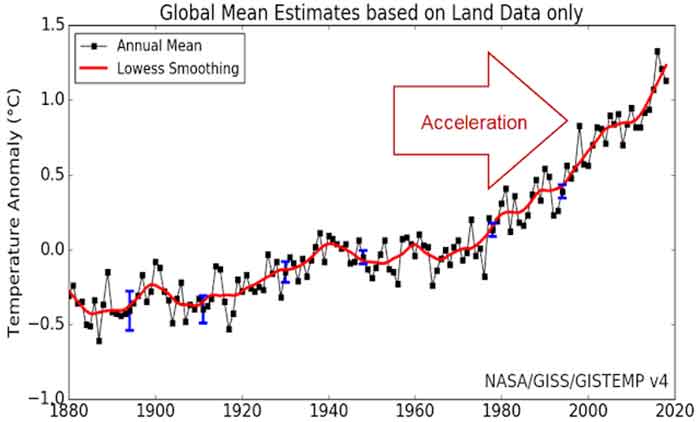
No one wishes to believe in the projections made in the recent book The Uninhabitable Earth’, except that these projections, made by David Wallace-Wells, are disturbingly consistent with the current shift in state of the climate toward +4 degrees and even +6 degrees Celsius above pre-industrial levels, as indicated by the current trends (Figure 1) and conveyed by leading climate scientists and the International Panel for Climate Change (IPCC).

Figure 1.Global mean temperature estimates for land areas (NASA).

Facing the unthinkable consequences of global warming is pushing climate scientists into a quandary. In private conversations, many scientists express far greater concern at the trend of global warming than they do in public. However, faced with social and psychological barriers, as well as threats of losing positions and jobs, in business, public service and academia, a majority keeps silent, displaying lesser courage than school children.

According to James Hansen (2012), NASA’s former chief climate scientist: “You can’t burn all of these fossil fuels without creating a different planet”. According to Joachim Schellnhuber (2015), Germany’s chief climate scientist: ‘We’re simply talking about the very life support system of this planet’and ‘If we don’t solve the climate crisis, we can forget about the rest’.

Referring to a phenomenon he termed “scientific reticence”, James Hansen (2007) states: “I suggest that a “scientific reticence” (namely a reluctance to convey worrying news) is inhibiting the communication of a threat of a potentially large sea level rise”.

According to Bajaj (2019): “when it comes to climate change, the need for excessive caution and absolute certainty of the results is manifesting as silence from the mainstream science on the worst yet probable consequences and the worst-case scenarios that are looking increasingly likely”. A paradox emerges where scientists who experience scientific reticence are still accused of being alarmists.

This is because an evaluation of the probability of a risk needs to be related to the magnitude of the risk. For example, the inspection of the engines of a Jumbo Jet carrying 300 passengers need to be even more rigorous than that of a commuter van, or evaluation of the risk posed by a potential failure of a nuclear reactor even more critical than that of a conventional power plant, as is the absolute safety of a particle accelerator.

By analogy with the dictum Those who do not learn from history are doomed to repeat it projections of future climate trajectories need to take account of studies of the past behaviour of the atmosphere-ocean system. The pace of current global warming exceeds those of the last 2.6 million years by an order of magnitude, with calamitous consequences for biological systems.

As indicated by the basic laws of physics, the principles of climate science and empirical observations in nature, under an increase of greenhouse gas concentrations by about 50 percent , global warming is inevitable. While modeled future climate change trajectories may vary, depending whether observations are based on recent measurements, paleoclimate data or models, the consequences of such an increase are inevitably catastrophic. Whereas IPCC models portray linear warming trends to 2300, other models take account of the flow of ice melt water from Greenland and Antarctica into the oceans and thereby irregular warming (Glikson, 2019).

Given the warnings issued by leading climate scientists and the IPCC, while nations keep investing their dwindling $trillions in its military-industrial complexes in preparations for future war/s, our world is losing its last chance to save its planetary life support systems.

Power Requires Structure, Structure Requires Discipline

Vincent Emanuele


“Kind-hearted people might of course think there was some ingenious way to disarm or defeat an enemy without too much bloodshed and might imagine this is the true goal of the art of war. Pleasant as it sounds, it is a fallacy that must be exposed; war is such a dangerous business that the mistakes which come from kindness are the very worst.”

― Carl von Clausewitz

“In practice, we always base our preparations against an enemy on the assumption that his plans are good; indeed, it is right to rest our hopes not on a belief in his blunders, but on the soundness of our provisions. Nor ought we to believe that there is much difference between man and man, but to think that the superiority lies with him who is reared in the severest school.”

― Thucydides

Ordinary Americans will never win the reforms we need to survive until or unless hundreds of thousands of poor and working-class people across the United States participate in the political process. It’s really that simple. The existing left does not have the numbers or resources, hence power, to win meaningful reforms.

The primary impediment to political organizing efforts is the lack of left-wing political institutions and structures. Unions must be rebuilt. Political institutions, perhaps in the form of new parties or structures somewhat similar to the DSA, must be developed. Community organizations, churches, tenants’ unions, and cultural projects will also play vital roles. In short, we need it all, and we need it now.

One of the obstructions to building structures and institutions is the unhealthy and unproductive cultural habits of poor and working-class people, including those already involved with political efforts. Here, I’m not so much talking about our eating habits or lack of exercise, though both are worthy of debate and discussion — I’m specifically thinking about the inordinate amount of time American adults spend on immature cultural activities that hinder organizing efforts: binge drinking, drug abuse, video games, Netflix, cosplay, etc. In my experience, Americans, particularly progressives, can muster any number of excuses to avoid cultural and political engagement.

To paraphrase the late-great comedian, Bill Hicks, the right is up at 4:00am, ready to fuck the world, whereas my left-wing friends wake up at noon, hungover and depressed.

We face a tremendous contradiction: on the one hand, serious, long-lasting, strategic, and powerful political structures must be developed in order to successfully channel the righteous anger and frustration felt by so many poor and working-class Americans, but in order to build those structures, we need poor and working-class Americans prepared to take the helm.

Here, things get tricky. While it’s true that we can find plenty of examples of successful single-issue or union campaigns — it’s also true that such efforts are limited in scope and do not represent bigger trends in American society.

This is the case for many reasons. First, existing activists and organizers do not adhere to a strict set of methods and skills that are absolutely required to build long-lasting structures. Second, existing activists and organizers (not all, but many) treat their efforts like a hobby or job. Politics is neither.

Politics is war. And we’re fighting for our lives. Over 320,000+ Americans have died of COVID-19. Tens of millions of people have been catapulted into poverty, with millions facing eviction on January 1st, 2021. Nurses, warehouse workers, teachers, retail, grocery store, and service-sector workers of all stripes have been used, abused, killed, and discarded by a ruthless economic system and a federal government beholden to it.

We face unprecedented challenges: climate change, increasing risk of global pandemics, nuclear proliferation, a fully globalized and technologically integrated financial system/economy, and an increasingly fragmented social and cultural landscape, which has given rise to right-wing movements across the planet.

The time for uplifting stories about resistance is long gone. We’re not here to speak truth to power— we’re organizing to survive, and survival requires winning.

What do I mean by winning? In the short-term, winning would look like Medicare For All, free childcare, increasing Social Security payments, expanding public housing, abolishing student debt, substantially increasing funds to public schools, and enacting some form of UBI, basically Bernie’s program, but with minor additions.

But Vince, why not go bigger? Because it doesn’t matter how badly we want or wish or scream for certain policies: the U.S. left lacks the basic institutions necessary to shift the balance of power away from elites and to ordinary people, hence we’re in no position to demand more. If we want more, we have to organize a base capable of demanding more. That requires a lot of hard work (social media posts, YouTube channels, and pithy essays won’t cut it).

We face unprecedented challenges: climate change, increasing risk of global pandemics, nuclear proliferation, a fully globalized and technologically integrated financial system/economy, and an increasingly fragmented social and cultural landscape, with each trend fueling right-wing movements across the planet. That’s the context in which we’re living, fighting, organizing, and dying.

Do I want more than Bernie’s reforms? Fuck yes. I’m with Jim Morrison: “We want the world, and we want it now!” But wanting and actually doing are two different things.

Achieving the goals I laid out above would significantly improve the lives of poor and working-class people. For many, such reforms would mean the difference between life or death.

If, of course, an opportunity to push a more radical agenda presents itself, existing activists and organizers should jump on it, but they should do so with a vision and strategy. Indeed, the uprisings following the murder of George Floyd represent the limitations of what a non-organized left can achieve. Yes, millions can turn out for protests, but without organizations and institutions to keep them engaged, little is accomplished in terms of meaningful reforms or long-lasting institution-building.

All that said, in order to build successful institutions, especially long-lasting structures capable of taking on and defeating the most murderous and powerful government and corporate sector in the world, the U.S. left will need heavy doses of discipline, accountability, commitment, and seriousness, which requires challenging people.

Right now, I have friends, neighbors, and former coworkers in their mid-50s, unemployed, sitting at home playing video games all day. I have friends in their 30s, trade union members, who spend their weekends cosplaying. They’re not alone. Americans spend a disproportionate amount of their time distracted from the political world. Can you imagine our grandparents playing dress-up while fascism marched through Europe?

To be clear, I’m not prescribing misery — what I’m saying is that people in this country need to grow the fuck up. Remember, everything is on the line. Yes, I also enjoy sports, parties, concerts, art, working out, my cat, going to the beach, visiting historical sites, family gatherings, and a whole host of shit that must, for the moment, take a backseat to political organizing efforts.

Creating institutions and cultural norms that facilitate solidarity, love, creativity, and fun should be the ultimate goals of our political efforts. In other words, let’s organize and fight back, then truly enjoy life. Yes, we can find enjoyment while fighting back, but I worry that too many Americans, particularly self-identified leftists, process politics as entertainment.

In fact, the absurd proliferation of left-wing podcasts and media outlets is perhaps the best measure of this ongoing and troubling trend. For every left political organization that’s created, at least one hundred left media outlets are born — another sign of the deeply immature, narcissistic, and unserious nature of left politics in the U.S.

Here, I’m not prescribing burn out, nor am I prescribing workaholism. I’m not asking you to discipline yourself for a corporation, government agency, or ungrateful spouse, nor am I encouraging you to beat yourself up in order to live up to some unobtainable cultural or beauty standard — I’m encouraging you to get disciplined and fight back for yourself and your loved ones, and yes, even for the people you don’t personally know.

I’m arguing that you should take politics seriously, which first requires taking yourself seriously — your life, desires, values, family, and friends. That means waking up early. That means making daily plans. That means making weekly work schedules. That means sticking to them. The best political organizers I’ve met over the years are also, unsurprisingly, quite organized in their personal lives. We should cultivate more.

In the end, the left will never accomplish much without building structures and institutions, and building successful structures and institutions requires disciplined, accountable, and serious people. Everything self-proclaimed leftists do in terms of organizing or activism should take place with these things in mind. We’re fighting a war, not hosting a dinner party. Act accordingly.

The U.S. and Yemen: Will Biden End the Nightmare?

Eve Ottenberg


Biden has lots of promises to keep. Or break, if he wants to follow a grand old presidential tradition. Foremost among those to keep is ending U.S. support for the slaughter in Yemen. If Biden backslides on this, he should be fought and stopped pronto. Obama greenlighted this war, Trump stubbornly continued to aid the Saudi bombing campaign, and candidate Biden promised to end it. U.S. arms and military assistance to the Saudi assault have, over four years, pulverized Yemen, the poorest country in the Middle East, unleashing two plagues and famine. Cholera broke out, but even worse was the starvation caused by the Saudi blockade. Even humanitarian aid cannot get in. And this, during a lethal Covid-19 pandemic.

Trump could have ended this nightmare. Congress voted to stop assisting the Saudis militarily, by passing the War Powers Resolution on Yemen, thus giving Trump plenty of cover to retreat from a monstruous, ongoing crime. Congress was partly motivated by the horrific Saudi murder and dismemberment in its Istanbul embassy of Washington Post journalist Jamal Khashoggi. But Trump vetoed that bill in April 2019, and it was no secret that he did so largely to protect lucrative U.S. arms deals with the Saudis. This was particularly despicable given his campaign pledges to end American’s pointless forever wars – and Yemen is arguably one of those. But Trump’s transactional affection for the Saudi dictator prevailed over the tens of thousands of Yemenis killed by U.S. weapons and U.S.-assisted famine. It was a venal, cowardly veto and an international disgrace. Nothing can excuse it. Had American military aid stopped, so would have the war. Thousands of lives would have been saved. Hundreds of thousands of children, stunted by malnutrition, would have had enough to eat. The whole world witnesses Yemen’s agony. It also witnesses U.S. complicity in this crime.

Over 100,000 people have perished in Yemen since Saudi Arabia began bombing it in 2015, in a doomed attempt to dislodge rebel Houthis. More than 85,000 have starved to death. Those are long, slow, excruciating deaths. According to the International Red Cross last week, roughly 24 million Yemenis need aid and “the majority of the country really needs UN and humanitarian funding in order to meet their basic day-to-day needs.” Aljazeera reports that last month, “Yemen had received less than half of the emergency funds it needed this year…About 13.5 million Yemenis currently face acute food insecurity.” Four million Yemenis have been displaced.

Still, the Saudi attempt to crush the rebel Houthis continues. For a while it seemed the Saudis might relent – that was back in September 2019, when the Houthis launched successful missile attacks on Saudi oil facilities, tankers and airports. These remarkably precise and economically devastating assaults got Saudi attention. The price of shares in the enormous Saudi oil company, Aramco, fell precipitously, as Saudis and the world realized that the tough, determined, supposedly outgunned bands of Houthis could decimate the kingdom’s fossil fuel infrastructure. Temporarily terrified, the aggressor seemed ready to negotiate. Indeed, in November 2019, indirect peace talks mediated by Oman were reported. But now the war blazes on again full blast. The British Independent observed in August that 2020 “could be the worst year yet for hunger in Yemen, with millions on the brink of famine.”

Since being elected president, Biden has said little about Yemen. But during the campaign, he referred to Saudi Arabia as a “pariah state,” and announced: “I would end U.S. support for the disastrous Saudi-led war in Yemen and order a reassessment of our relationship with Saudi Arabia.” He also promised to “end the sale of material…to the Saudis where they’re going in and murdering children.” Even back in 2019, Biden said it was “past time to end U.S. support for the war in Yemen.” So the president-elect has a track record of pronouncements against the war. Now we shall see if congress again finds the spine to pass a bill ending U.S. support. If it does, it’s hard to imagine Biden wouldn’t sign it. Even if congress doesn’t, the president on his own can stop much of this butchery.

According to the Independent on December 17, however, there’s “no end in sight” for the Yemen war. “The Houthis hold areas in the north and center” of the country, the publication explained. “The government, supported by the coalition, has as its sphere of influence Aden as well as the south and east.” That coalition is led by the Saudis and the United Arab Emirates. In the past, troops and fighter jets from Kuwait, Qatar, Bahrain, Jordan, Egypt, Morocco and Sudan, along with support from U.S. mercenaries from the entity once called Blackwater have participated in the assault. Aside from their ally Iran, the Houthis are fairly isolated. According to Human Rights Watch, which appears, for once, to be on the right side of an issue, “Defense Department officials have misled congress about their ability to track and analyze coalition strikes in Yemen…support of Saudi Arabia…remains a top state department priority.” On this issue, as on aggression toward China, the pentagon and the Trump regime see eye to eye: both are fine with more killing in Yemen.

The Trump regime picked a side in a civil war that the U.S. arguably has nothing to do with. Anything for its rich friends the Saudis, despite any atrocities, any savageries. But back in November, The Arab Weekly contradicted other media assessments and reported that the Saudis wanted to expedite the Yemeni settlement process. Its focus is on a “joint declaration” between the Yemen government it recognizes and the Houthis. “The Arab coalition wants to achieve a breakthrough in the Yemen war file before the end of this year,” the weekly reported. If this is true, the coalition sure has a strange way of showing its peaceful intentions. Things are worse in Yemen than ever.

So prospects for peace right now are not especially bright. The best hope for starving, brutalized Yemen lies in a new Biden administration, which should scrupulously honor its promise to stop promoting genocidal war crimes and thus bust up the Obama-Trump legacy of blood in Yemen. Without U.S. military backing, with actual U.S. condemnation of Saudi Arabia, the war would end quickly. And for once, all too infrequently in its foreign policy, the U.S. would step over to the correct side of history. Trump and Obama chose barbarism over civilization in Yemen. One of Biden’s first acts should be to reverse that.

Dreamers Deserve a Path to Citizenship

Diana Anahi Torres & Valverde


I grew up undocumented in America. As a kid, I often saw little hope for the future in the country I considered home.

In high school, I was denied scholarships, financial aid, and college admissions because of my status. It seemed like all I could hope for was a job cleaning homes, like most undocumented Mexicanas did in my hometown.

Luckily, the support of my community — and a big change in immigration policy in 2012 — changed that.

First, with the help of many teachers, family, and friends, I was able to attend Amherst College with a generous financial aid package. Then, in 2012, President Obama finally bowed to pressure from the immigrant rights movement and created the Deferred Action for Childhood Arrivals (DACA) program.

Under DACA, undocument applicants like me who’d arrived as young children were temporarily shielded from deportation. If we’d arrived early enough, stayed in school, and stayed out of trouble, we got temporary Social Security numbers and two-year work permits.

This program changed everything for me. For the first time in my life, I could apply to jobs where I could receive health benefits and save for retirement. If I got sick, I could go to the doctor. If I wanted to buy a home, I could. And if I wanted to pursue a professional degree, I could.

So I did. And today I’m an immigration attorney.

Countless other young people also benefited. Tom K. Wong, a political scientist at the University of California, surveyed over 3,000 DACA recipients from across the country. Wong found that after receiving DACA, about 69 percent of respondents got a higher paying job and about 56 percent got a job with better working conditions.

With their new jobs and spending power, these “DACAmented” youth started contributing approximately $4 billion dollars in taxes every year. Clearly, DACA benefitted not only individual DACA recipients but the economy at large.

But if these past four years have taught us anything about DACA, it’s that DACA is simply not enough. As soon as President Trump came into power, he worked tirelessly to abolish DACA by executive action, throwing the futures of hundreds of thousands of young Dreamers into jeopardy.

These incessant attacks spread fear throughout the community. I constantly feared that one day ICE agents would break into my home and tear me out of bed. I dreamt of men in black suits with guns pursuing me through dark streets.

At work, DACAmented clients pleaded with me with fear in their eyes. “If Trump eliminates DACA, I’ll lose my job as a teacher,” one said. “Can you help?” Sadly, most of the time, there was nothing I could do.

For me, the fear ended only a few months ago after an interview at the U.S. Citizenship and Immigration Services office with my U.S. citizen husband, when I was finally granted permanent resident status.

This is the first time since President Trump’s election that I feel safe. It’s the first time I feel like ICE can’t burst through my living room door and take me away from my loved ones to a place I barely remember. I finally feel like I can plan for my future.

That feeling is priceless. And it is a feeling that all young undocumented people who have grown up in this country deserve to feel.

Joe Biden and Kamala Harris have promised to protect Dreamers and our families. They need to keep that promise and reverse all of Trump’s attacks on DACA within the first 100 days. But that’s not enough. They also need to push for legislative reforms that would grant us a pathway to citizenship that can’t just be taken away by the next administration.

It is the right thing to do. All of us deserve to live a full, safe, and fearless life full of promise.