29 Dec 2020

One year into the pandemic, 65,000 deaths in the US in one month

Andre Damon


One year after the first cases of COVID-19 were identified in China, December was the deadliest month of the pandemic both in the United States and throughout the world.

More than 65,000 Americans lost their lives to the virus over the past 28 days. At the present rate, deaths in December will be double what they were in November, when nearly 37,000 people died. The United States accounts for about a third of the global death toll of 175,000 over the past month.

Medical personnel work in the intensive care ward for Covid-19 patients at the MontLegia CHC hospital in Liege, Belgium, Friday, Nov. 6, 2020 [Credit: AP Photo/Francisco Seco]

By the end of this week, total deaths in the US will surpass 350,000, and the number of people who have tested positive for COVID-19 will reach 20 million. Another 193,000 people could die in this country over the next two months, according to predictions from the University of Washington’s Institute for Health Metrics and Evaluation.

Experts have warned that even this scenario may be optimistic. “We very well might see a post-seasonal—in the sense of Christmas, New Year’s—surge,” said Dr. Anthony Fauci, director of the National Institute of Allergy and Infectious Diseases, on Sunday. “The projections are just nightmarish,” Peter Hotez, an infectious disease specialist at the Baylor College of Medicine, told CNN.

In a warning to the rest of the world, the number of daily new cases hit an all-time record of 42,000 in the UK yesterday, driven by the emergence of a new strain of the disease that medical experts estimate is 56 percent more transmissible than the original.

US Health and Human Services Assistant Secretary Brett Giroir said Monday that the new and more dangerous strain of the virus is “likely” already present in the United States. He was left to speculate because, unlike the UK, the US does not have a genetic surveillance system in place to ascertain the presence of different strains of the disease.

Meanwhile, the COVID-19 continues to surge throughout the country. “California is now the only place (state or country) in the world” with more than 1,000 new COVID-19 cases per million people, noted physician Eric Topol.

Southern California, the state’s most populous region, as well as San Joaquin Valley, in the state’s center, have 0 percent ICU bed capacity. On Sunday Los Angeles County-USC Medical Center Chief Medical Officer Dr. Brad Spellberg said that the hospital faced a “massive crisis.” Another hospital in the region has begun issuing guidelines for patients and families as to how the hospital will make decisions on who will live and who will die in the case that care has to be rationed.

In the midst of this disaster, no section of the US political establishment is calling for emergency measures to contain the pandemic. Last week, President-elect Joe Biden warned that the “darkest days are ahead of us, not behind us.” And yet he has rejected the demand by Dr. Michael Osterholm and other scientists for an emergency shutdown of nonessential production, declaring, “I am not going to shut down the economy, period.”

Despite campaigning in opposition to Trump’s handling of the pandemic, Biden has adopted Trump’s signature policy demands: “open the schools” and “open the businesses.”

This is despite the influx of scientific data proving the importance of closing schools and businesses in containing COVID-19. A study published this month in Science found that closing schools and universities reduces the spread of COVID-19 by 38 percent, and closing nonessential face-to-face businesses reduced transmission by 18 percent.

In the media, the scale of the catastrophe unfolding in the United States is less and less reported. A deliberate decision has been made to focus attention not on mass death and the overwhelming of the US health care system, but on the initial production and distribution of vaccines.

But as the federal government begins distributing vaccine doses to states, the US has inoculated just one-tenth of the number of people it had planned—just 2 million of the 20 million people health authorities said would be vaccinated by the end of the year. Images emerged yesterday of lines of hundreds of elderly patients lining up outside for limited doses.

A report in Kaiser Health News called the US vaccine rollout a “mess,” noting that many states have not received close to the number they were promised. “Throughout the COVID-19 pandemic, the US health-care system has shown that it is not built for a coordinated pandemic response (among many other things) … Why should vaccine distribution be any different?”

Even in the best of circumstances, the vaccine will not be broadly available until sometime in the spring or summer of next year. Moreover, scientists have warned that the emergence of the new, more infectious strain of the virus means that a higher percentage of the population will have to be vaccinated to stop community spread of the coronavirus.

The refusal of the entire political establishment to take the necessary measures to save lives is a continuation of its policy throughout the pandemic. No measures will be taken that contravene the interests of the financial oligarchy. To this end, governments around the world deliberately embraced the doctrine of “herd immunity”—calling for the mass infection of the population, with one White House official declaring, “We want them infected.”

This has led to the uncontrolled spread of the pandemic, with hundreds of thousands of dead, together with the greatest surge of hunger and unemployment since the Great Depression. On the other hand, this same policy has produced the massive enrichment of the financial oligarchy, whose wealth has soared as the US central bank pumped trillions of dollars into the financial markets.

And the markets continue their relentless rise. The Dow Jones Industrial Average increased 200 points to a new record yesterday, leading the wealth of the US’s billionaires to rise even further. Over the past year, Jeff Bezos, the world’s richest man, saw his fortune grow by $77 billion, hitting $192 billion on Monday. The wealth of Elon Musk, now the second richest man in the world, has surged from $28.5 billion to $160 billion.

Urgent measures must be taken to prevent mass death! But this requires that the working class intervene independently, in opposition to the pandemic profiteers and their political representatives.

The Socialist Equality Party demands the immediate closure of all nonessential businesses and schools. This must be accompanied by full compensation for lost wages and small business income, paid for through the expropriation of the vast sums hoarded by the rich. Trillions of dollars must be invested in health care infrastructure to treat, contain and eradicate COVID-19, and ensure society is protected from the threat of infectious diseases in the future.

Pandemic profiteers: Forbes adds 50 health care moguls to its list of global billionaires

Genevieve Leigh


For the richest layer of society, the year 2020 has proven to be one of soaring profits and the accumulation of personal wealth on a scale never before seen. The world’s billionaires collectively increased their already massive fortunes by more than a quarter (27.5 percent) from April 2020 to July 2020 alone, reaching a record total of $10.2 trillion.

Billionaire Amazon founder and Washington Post owner Jeff Bezos talks about the history and character of the Post during a dedication ceremony for its new headquarters in Washington [Credit: AP Photo/J. Scott Applewhite, File]

According to a new report by Americans for Tax Fairness (ATF) and the Institute for Policy Studies (IPS), the total wealth of US billionaires grew by $1.064 trillion during the first nine months of the coronavirus pandemic, a 36 percent increase. For context, this increase in wealth—that is, not the total wealth of these individuals, but only the money they made in the first nine months of the year—is more than it would cost to send a stimulus check of $3,000 to every one of the roughly 330 million people in America.

Among the most profitable sectors has been the health care industry. A report released in October by wealth manager UBS and professional services firm PricewaterhouseCoopers notes that the billionaires in the health care industry increased their wealth by 36.3 percent between April 7 and July 31, from a total of $402.3 billion to $548 billion. The health care industry is second only to the tech industry in total increase in billionaire wealth.

Just before Christmas, Forbes magazine released a new survey revealing that at least 50 health care capitalists hailing from 11 different countries entered the ranks of the world’s billionaires in 2020.

Who are these newly minted billionaires and just how much wealth are they hoarding?

* Uğur Şahin is a Turkish citizen and CEO of BioNTech, the German biotech firm that is partnering with Pfizer on the latter’s vaccine. Şahin’s net worth is now $4.2 billion. BioNTech shares now trade at $101.63, up 614 percent since the close of the first trading day last year. The company is worth more than $24 billion.

Even with his $4.2 billion, Şahin was not the main beneficiary of BioNTech’s surge in the markets. Thomas and Andreas Strungmann, German twins and early investors in the company, have each added $8 billion to their net worth this year from their holdings in the firm. Already billionaires to begin with, they are each now worth about $12 billion.

* Stéphane Bancel is a French citizen and CEO of the Massachusetts-based biotechnology company Moderna. Bancel has gained $4.8 billion in wealth this year, giving him a net worth of $5.3 billion.

At the start of 2020, when he first became a billionaire, Bancel owned about nine percent of the company. As the firm’s stock surged by more than 550 percent with news of the company’s contract for a vaccine, he sold roughly $40 million worth of Moderna stock held by himself or associated investment funds.

Chief Medical Officer Tal Zaks has sold around $60 million worth of stock and President Stephen Hoge has sold more than $10 million.

* Moderna’s skyrocketing stock price also lifted two others into the health care billionaire club: Harvard Professor Timothy Springer (net worth $2 billion) and MIT scientist Robert Langer (net worth $1.5 billion). Springer and Langer were founding investors in Moderna , whose rise has turned Springer’s initial $5 million investment into roughly $1.6 billion.

* Sergio Stevanato is a new billionaire hailing from Italy. He has made his fortune as the majority shareholder in the privately-owned Stevanato Group, which is making glass vials for several dozen vaccines around the world.

The common feature in almost all of the health care billionaire fortunes has been the massive surge in stock prices. As the virus quickly became global, investors flocked to companies involved in the development of vaccines, treatments, medical devices and related fields. At the same time, the Federal Reserve in the US and central banks in Europe and around the world ensured the rise in stock prices by pumping trillions of dollars into the financial markets.

The speculators’ wealth ballooned as the market continued to rise despite, or rather because of, the dire state of affairs for workers. The capitalist economy was only able to produce the historic rise in the markets on the backs of millions of workers, forced back into factories and workplaces under unsafe conditions.

It did not take long for investments to pay off for health care executives. According to a Business Insider investigation, executives in charge of biotech and pharma firms working on COVID-19 treatments and vaccines have raked in more than $1 billion by selling stocks.

Pfizer CEO Albert Bourla sold 60 percent of his stock on the same day the company announced the high success rate of its vaccine. The stock-selling bonanza was denounced as “unethical” at the time by some media outlets. However, most concluded that the action was completely legal.

The financialization of the health care industry, leading to the creation of this growing class of health care billionaires, was in the making long before the COVID-19 pandemic.

The spike in wealth among health care billionaires widens when one compares the health care sector from the beginning of 2018 to the end of July 2020. Over that period, the total wealth held by 1,690 health care billionaires increased by 50.3 percent, to $658.6 billion.

An even wider view reveals profound levels of inequality in the world’s richest capitalist country: US billionaires’ total wealth in March 2020 was 12 times greater than their total wealth in 1990.

For these billionaires and multi-millionaires, the year 2020 will be remembered as the year they could finally afford that private island they had been dreaming about. But for billions of workers and youth throughout the world, 2020 was a year marked by mass death, social misery and suffering.

Hundreds of millions lost loved ones to the virus this year. Most of those families said goodbye to mothers, fathers, sisters, brothers, spouses or children over the phone, unable to be with their dying family member. Millions more lost their jobs, health insurance and ability to provide for their families. For many, the year will be remembered as the first time they waited in a food line, depended on an unemployment check or were evicted.

As 2020 comes to an end, the attitude of the ruling elite to the plight of the working class is starkly revealed in the so-called stimulus bill just signed by Trump: a pittance of $600 to the workers.

It is becoming all too clear to millions of workers that their lives and well-being have been, and continue to be, deliberately sacrificed in the interests of Wall Street. Immense anger is building up. Nothing has been done to control the pandemic. In the coming months, the virus is predicted to kill hundreds of thousands more.

In some ways, the ballooning profits of the health care giants and the exploding personal wealth of their top executives and investors demonstrate most starkly the incompatibility between a system based on private ownership of industry and finance and production for profit and the well-being and very lives of the vast majority of the population.

Health care infrastructure is decayed and under-funded. Health care workers—nurses, aides, technicians—are woefully underpaid and overworked. Hospital workers get sick and die because of inadequate personal protective equipment and overwhelmed hospitals, the lack of testing and tracing, the homicidal herd immunity policies of governments dictated by the profit interests of big business.

The drive for private profit at every point cuts across the need for a rational, nationally and internationally coordinated effort to vaccinate every man, woman and child worldwide at no cost and as rapidly and safely has possible.

Meanwhile, the health care capitalists rake in money hand over fist. The working class must take action to save lives, including the expropriation of the fortunes of the health care billionaires and transformation of their private companies into publicly owned and democratically controlled utilities. Only in this way—in the fight for socialism—can the full potential of science and technology be harnessed in the interests of humanity.

House overrides Trump veto of military spending bill

Patrick Martin


By a huge bipartisan margin, the House of Representatives voted Monday evening to override President Trump’s veto of the National Defense Authorization Act. The vote was by 321 to 87, with Democrats voting to override by 211–20, and Republicans by 109–66. Two independents, both anti-Trump former Republicans, split their votes.

The veto override was the first of Trump’s presidency, an indication of the slavish subordination of House and Senate Republicans to the ultra-right president. It came only 23 days before Trump is scheduled to leave office, when his successor, Democrat Joe Biden, is to be inaugurated on January 20, 2021.

House Speaker Nancy Pelosi, of Calif., speaks during her weekly briefing, Friday, Nov. 20, 2020, in Washington [Credit: AP Photo/Jacquelyn Martin]

It is no accident that the veto override came on the bill that sets policy for the Pentagon and authorizes $740 billion in military spending. A National Defense Authorization Act (NDAA) has passed Congress for 60 consecutive years and has never before been vetoed, as both capitalist parties and all previous presidents are on their knees before the US military-intelligence apparatus.

Trump vetoed the legislation only because of disagreements on secondary issues, and because he had been privately informed that his veto would be overridden in both the House and Senate and the bill would become law without his signature.

The objections voiced by Trump were entirely irrelevant to the main thrust of the legislation. He objected to provisions that allowed the Pentagon to review the naming of military bases after Confederate generals and rescind those names over a three-year period. This is expected to take place quickly and include Fort Bragg in North Carolina, Fort Hood in Texas, and Fort Benning in Georgia, three of the most prominent US military compounds.

Trump also insisted that the NDAA be the vehicle for rescinding Section 230 of to the Federal Communications Act, which exempts internet platforms and internet service providers from liability for the contents of postings by their users. Section 230 has also been cited by platforms like Facebook and Twitter as giving them authority to apply labels to tweets and postings by Trump that are obviously false, inflammatory or direct incitements to violence.

There is no connection between section 230 and the Pentagon budget, except in Trump’s mind. Since the NDAA was certain to pass, the president sought to add a measure directed against the social media companies that were balking at his most outrageous and provocative postings. In reality, the bulk of the censorship by social media companies is directed against left-wing, antiwar and socialist groups, not the racist and fascist right.

None of these issues was discussed in the brief debate in the House of Representatives before the vote to override, which was almost perfunctory.

Representative Mac Thornberry of Texas, the ranking Republican on the House Armed Forces Committee, was the only Republican to speak. His name is in the title of the NDAA this year, a tribute from both parties on the occasion of his retirement after a long career carrying water for the military and defense contractors.

Thornberry thanked his Democratic partners, saying that the bill before House was the “exact same bill. Not a comma has changed” from the bill passed only three weeks earlier. He hailed the legislation for providing “new tools to deal with a newly aggressive China” and maintaining US support to Israel, as well as providing for cyberwar efforts to be directed against Russia. He urged an override of the Trump veto.

The Democratic chairman of the same committee, Adam Smith of Washington, also urged an override of the veto. He declared, “It is enormously important to give our troops the support that they need to carry out the job that we all are asking them to do.” Echoing Thornberry, he cited the supposed Russian cyberattack on US government facilities, heavily publicized—without any underlying evidence—over the past two weeks, as a particularly important reason for passing the legislation with or without Trump’s support.

The veto override, which has the effect of approving a record outlay for the US military machine, had the support of the entire Democratic leadership, from Speaker Nancy Pelosi on down. While Trump had claimed that China would applaud passage of the NDAA, this was simply more racist demagogy from the White House. The actual substance of the legislation is to arm American imperialism to the teeth against both major rivals, China and Russia, and against any other country, such as Iran, that might become a target.

The number three House Republican, Liz Cheney of Wyoming, daughter of the former vice president and arch-warmonger, supported the override vote, citing particularly the increase in pay for the military. “Congress must uphold its highest responsibility—providing for the defense of this nation—and ensure this bill becomes law,” she declared.

Only two Democrats had opposed the NDAA three weeks ago when it passed the House—Rashida Tlaib of Michigan and Tulsi Gabbard of Hawaii. Several other Democrats seeking to strike a “left” or “antiwar” posture chose to vote against the bill and uphold Trump’s veto this time around. These included Alexandria Ocasio-Cortez, Ayanna Pressley, Ilhan Omar, Jesus “Chuy” Garcia of Chicago and the co-leaders of the House Progressive Caucus, Mark Pocan and Pramila Jayapal.

But the total of 20 Democrats opposing the NDAA were safely short of having any impact. While the Republicans failed to muster the two-thirds needed to override, instead marshaling a narrow majority, the 10-1 margin among Democrats was more than enough to ensure that the record spending for the military would move one step closer to enactment.

The Senate is expected to take up the veto override on Tuesday, with Senate Armed Services Committee Chairman James Inhofe of Oklahoma strongly urging a vote against Trump. “The NDAA has become law every year for 59 years straight because it’s absolutely vital to our national security and our troops. This year must not be an exception,” he said in a statement after Trump’s veto.

Millions in US face weeks without income due to delay in paltry “relief” bill

Jacob Crosse


On Sunday night, President Donald Trump signed a $2.3 trillion bill that combines a $900 billion bipartisan coronavirus “relief” package with a $1.4 trillion omnibus spending bill. Trump had been withholding his signature, claiming to oppose the minuscule size of the $600 direct payment included in the bill.

In this July 15, 2020, file photo, job seekers exercise social distancing as they wait to be called into the Heartland Workforce Solutions office in Omaha, Neb [Credit: AP Photo/Nati Harnik, File]

The delay in signing the bill has already caused confusion regarding the resumption of unemployment payments to some 14 million people. On Saturday, two programs created by last March’s CARES Act, the Pandemic Unemployment Assistance (PUA) program and the Pandemic Emergency Unemployment Compensation (PEUC) program, expired. PUA was designed to provide relief for workers who wouldn’t normally qualify for state benefits, such as contractors, the self-employed and so-called “gig” workers. PEUC provided up to 13 weeks of unemployment aid to workers who had exhausted their state benefits, which for most last 26 weeks, but for others, depending on the state where they reside, can last a mere 12 weeks.

The legislation specifies that payments are to begin after December 26, 2020 and end no later than March 14, 2021. States are not allowed to begin disbursing the $300 weekly unemployment payments until the bill becomes law, and with the one-week delay, millions may be receiving only 10 weeks’ worth of payments instead of 11, beginning in 2021.

In an email to the Hill, Elizabeth Pancotti, a policy adviser at Employ America, estimated it could take up to six weeks for jobless workers to begin receiving payments again. “Some states may be able to stand this up in a week or two if we get guidance quickly from [the US Labor Department] but allowing the programs to lapse has created such a mess at many state UI [unemployment insurance] offices, so it could be 4-6 weeks before workers receive payment,” Pancotti wrote.

This means that some 14 million unemployed workers will not be receiving anything for at least a week and perhaps considerably longer. Among them are millions who will be unable to put food on the table or pay for needed health care, prescription drugs, gasoline, cell phone bills and other basic necessities.

Last Tuesday, Trump posted a video in which he denounced the bill he had previously promised to sign, calling it a “disgrace” for the paltry size of the direct payment it provides—$600 as compared to the $1,200 provided under the CARES Act. He demanded that the stipend be raised to $2,000—itself totally inadequate to offset the loss of income suffered by working-class families and small business owners during the pandemic and the accumulated debt from unpaid rent, car payments, student debt, mortgage payments and other obligations.

After a weekend of uncertainty, Trump released a statement on Sunday night advising that he had signed the legislation and that the House of Representatives would take up a measure to increase the direct payment from $600 to $2,000 for single adults who made under $75,000 in 2019, or $4,000 for couples who reported earnings under $150,000. On Monday, the House, in a 275–134 vote, passed the measure. However, it is not expected to pass in the Republican-controlled Senate.

According to the Center on Budget and Policy Priorities, approximately 9.2 million renters who have lost employment income during the pandemic are behind on rent, while the Census Bureau estimates that more than 11.3 million households are behind on rent or will not be able to meet rent obligations next month. Overall, Moody’s Analytics estimates that renters collectively owe some $70 billion, with 12 million owing an average of nearly $6,000.

On Monday, the Dow Jones Industrial Average surged by more than 200 points, setting a new record, buoyed by the miserly scale of the “relief” and repeated assurances from the Federal Reserve that it will continue to pour billions into the financial markets every day to keep stock prices rising and the personal fortunes of the rich and the super-rich expanding at a near-exponential rate. The so-called relief bill provides generous “extender” tax breaks to major companies such as NASCAR and Anheuser-Busch, and increases the deduction executives can claim on “business” lunches from 50 percent to 100 percent.

The bill continues the bipartisan war on immigrants with $15 billion set aside for Customs and Border Protection, nearly $8 billion allotted for Immigration and Customs Enforcement, and an additional $20 million for “border processing coordinators.”

On the same day the House Democrats voted for the measly increase in the stipend to $2,000—expecting the measure to die in the Senate—they voted overwhelmingly to overturn Trump’s veto of the defense authorization bill, which provides $740 billion for Washington’s war machine. Even if the $2,000 stipend does make it through the Senate, it will do little to alleviate the social catastrophe that has left over 330,000 people in the US dead from COVID-19. Other indices of the social disaster include:

• Over 73 million unemployment claims since mid-March

• 50 million people facing food insecurity, according to Feeding America

• Over 162,000 evictions in 27 US cities, according to the Eviction Lab at Princeton University On Sunday evening, House Speaker Nancy Pelosi hailed Trump’s signing of the bill as a “down payment” to help “struggling Americans stay afloat.” One social media user responded to Pelosi by writing:

“To stay afloat many people are homeless right now, kids are hungry. My child can have a Xmas [because] I had to choose between food or a place to stay. You guys keep saying you care about Americans but it does not show. Because 600 would have never been an option if any of you guys cared.”

Justin Saboo wrote to Pelosi on Twitter that it was “... very amusing to all of us that you think $600 will help struggling Americans ‘stay afloat.’ $600 won’t even pay one month of rent. Yet, somehow, you think $600 will ease everyone’s pain. You wouldn’t know anything about that with your $114 million wealth would you?”

In the $900 billion “relief” bill, only $166 billion is earmarked for $600 direct payments to US citizens and their children, while $120 billion is allocated for the extension of federal unemployment benefits through mid-March.

Over a third of the bipartisan relief bill is dedicated to the Small Business Administration, including $284 billion for the misnamed Paycheck Protection Program, which was ostensibly created to provide low-interest grants and loans to small businesses, but has instead been used by large corporations, sports teams, the politically connected and wealthy landlords to enrich themselves while laying off thousands of workers. The program has generated nearly $3 billion in revenue through fees for large US banks such as JPMorgan and Citibank.

The bill contains only $20 billion for the purchase of vaccines, with an additional $22 billion to help states with testing and contact tracing. Only $9 billion is earmarked for vaccine distribution, which is already well behind intended benchmarks, with less than 2 million vaccines administered in the US thus far.

The $25 billion in rental assistance is several factors lower than what is needed, meaning that millions of families will face eviction in roughly one month, pending further congressional action. Another $15 billion was provided to the major airlines, which already received $25 billion earlier this year and still proceeded to lay off over 90,000 workers.

The $1.4 billion set aside to continue the construction of Trump’s border wall is slightly less than the $2 billion set aside for the Federal Emergency Management Agency, to be distributed to states in order to assist the hundreds of thousands of families that will be paying for coronavirus-related funeral expenses.

Confronting an “Assertive” China: Nearly All Roads Lead to Taiwan

Sandip Kumar Mishra


China’s disruptive behaviour through 2020 has increasingly led the international community to become more vocal about the difficulty of coexisting with a Beijing that is “assertive,” “irresponsible,’’ and “opaque.” This sentiment is not new, nor is it evenly distributed. However, China’s irresponsible handling of the COVID-19 outbreak has these sentiments more pronounced. Its imposition of a new security law in Hong Kong, border standoff with India, and provocations in the South and East China Seas, have accelerated regional discussions on counterbalancing options. These countries have begun to gear themselves to deal with China’s ‘grey-zone assault’ and ‘wolf-warrior diplomacy’.

One of the beneficiaries of Beijing’s misconduct and growing anti-China sentiment is Taiwan. In a July 2020 joint statement, the US and Australia talked about Taiwan's important role in the Indo-Pacific region as well as their intent to maintain strong unofficial ties with Taiwan.” The statement also asserted that the two countries would support Taipei’s membership to any international organisation where statehood is not a prerequisite, and invite it as an observer to those that require statehood. In a veiled reference, both the US and Australia said that “recent events” had made their resolve to support Taiwan stronger.

It is important to remember that Taiwan has been unable to participate in World Health Organisation (WHO) meetings since 2017 because of Chinese objections. However, there are now growing demands from the US, Europe, and Japan to reverse this. Hokkaido, Japan’s largest prefecture, passed a resolution urging Tokyo’s support for Taipei’s engagement in in the World Health Assembly (WHA). Japanese Foreign Minister, Taro Kano, suggested a similar intent in a speech in May 2020. In November, a bipartisan caucus of the Japanese Diet passed a resolution making the same request of its government as Hokkaido prefecture. Australia has also expressed its support of Taiwan’s inclusion in the WHA. 102 members of the European Parliament and four German lawmakers wrote an open letter in favour of a WHA invitation to Taipei.

In India, too, strong positive sentiment in favour of Taiwan has surfaced over the past several months. Many have argued that India should play up the ‘Taiwan card’ in the midst of tensions with China. The border standoff has been the main propeller for a reconsideration of New Delhi’s approach to Taiwan. India feels that its policy of silence to manage relations with China has not paid off. Thus, there are now popular demands to forego India’s adherence to the ‘One China’ policy. Suggestions about a free trade agreement with Taiwan, such as the ones struck by Singapore and New Zealand, have been made. This becomes an important proposal especially in light of India’s decision to stay out of the Regional Comprehensive Economic Partnership (RCEP) agreement, as one way for New Delhi to compensate for the self-imposed exclusion.

The US has signed the Taipei Act to expand the scope of relations with Taiwan, and to encourage other countries and international organisations to establish, and/or strengthen official and unofficial bilateral relations as well. The US has sold US$ 5 billion worth of arms to Taiwan in 2020. President-elect Joe Biden is expected to continue this policy of support. Biden and Taiwanese President Tsai Ing-wen reportedly share a good working equation; in fact, after winning the presidential election, Biden indicated his interest in deepening ties with Taipei.

Taiwan has also carefully and diligently been working to harness this current goodwill and solidify its diplomatic positioning globally. It has reached out to the US, Japan, India, Australia, and European countries to enunciate its position on China. Taiwanese Foreign Minister, Joseph Wu, has called on Australia to stand up for democracy and help Taiwan against Chinese threats. Wu has also appealed to like-minded countries including Canada to discourage China from a full-scale forced takeover of Taiwan. President Tsai Ing-wen recently spoke at a high-profile webinar organised by the Australian Strategic Policy Institute— the first such participation of its kind by Taiwan’s top leadership. Australian In November 2020, Australian Prime Minister Scott Morrison identified Taiwan by name (without any qualifiers) as a possible travel bubble candidate.

Rising anti-China sentiment in the region has created a huge diplomatic opportunity for Taiwan. However, it is important to remember that there are multiple structural constraints—including China’s economic inducements—that may hold many countries back from formalising relations with Taipei, or indeed, enhancing them to higher levels. The current environment may be encouraging for Taiwan, but still, a long distance has to be covered before any qualitative diplomatic change can be achieved.

28 Dec 2020

China Has the World’s Largest Economy, Get Over It

Dean Baker


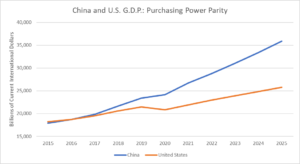
It is more than a bit annoying to hear reporters endlessly refer to China as the world’s second largest economy. It isn’t. It’s the world’s largest economy and has been since 2017. Here are the data from the International Monetary Fund.

Source: International Monetary Fund.

As the chart shows, China’s economy first passed the U.S. in 2017. It is projected to be more than 16 percent larger this year, and by 2025 is projected to be almost 40 percent larger by 2025.

Purchasing power parity (PPP) measures of GDP are based on applying a common  set of prices for all goods and services produced across countries. While it is difficult to measure accurately, most economists view PPP as being the better way to calculate GDP, since it reflects living standards and does not fluctuate with currency values. China does have four time the population of the United States, so it is still much poorer on a per capita basis.

The fact that China has a larger GDP than the United States is important for policy debates since many people seem to hold illusions are about the ability of the U.S. to influence China. While United States can take steps that will damage China’s economy, even the harshest measures will only have limited impact, and China will be able to take steps to overcome them through time. This is important background for debates on China policy.

Russia Is Cracking Down on Political Performance Art, Again. Why It Should Listen, Not Lash Out.

Damelya Aitkhozhina


Performances by artists and activists on political topics have been a sensitive spot for the Russian authorities for years. But as the authorities’ crackdown on civil society intensifies, so does the creative non-violent response exposing and drawing attention to it.

This in turn increases the pressure authorities exert on the artists and activists in efforts to crush free speech. The flurry of prosecutions in recent months has made this clear.

On November 28, two women dressed in costumes like those worn by Snegurochka (“Snowgirl”), a companion to Russia’s version of Santa Claus, were on a central square in Moscow. With them was a man dressed as a riot police officer. He stood with his back to a lamp post while the women tied him up with packaging tape and signs reading “Careful, Fragile.”

The women were Pussy Riot activists Rita Flores (aka Margarita Konovalova) and Mariya Alyokhina, and the “policeman” was the artist Farkhad Israffili-Gelman. With them was a photographer, Gleb Kuznetsov.

They posted photographs of the event and tweeted, “Since July 2019 paper cups or plastic bottles became weapons, but the worst weapon against the people is a police state.” The performance referred to the 2019 “Moscow case,” in which several people faced serious criminal assault charges for throwing empty plastic bottles or cups toward the police. In December that year, President Vladimir Putin said that if prosecutions were not pursued for throwing plastic cups at police, things would escalate to rioting. The fragility of riot policemen became a running joke among political activists.

By December 3 of this year, police had detained all four artists.

They detained Flores at a hospital where she was seeking treatment for a medical condition. Her lawyer told me that on the way there, a plainclothes police officer attempted to get into the ambulance, claiming to be her acquaintance. Before that they stood guard outside her apartment over the weekend.

Alyokhina stated that before she and Flores were detained, somebody shut off the electricity in their apartments. While the others were released pending court hearings, Flores was detained overnight, charged with repeatedly violating public assembly rules and sentenced to 20 days in detention for this entirely peaceful protest performance.

Alyokhina, Flores, and Israffili-Gelman were also detained on November 4 and 10, apparently preemptively, when they put on the costumes they eventually used for the performance. Both times, they were detained before they did anything, and the police gave them no explanation. Their lawyer told me that later they were charged with an administrative infraction for not wearing masks and gloves in a public space, as required by the city’s COVID-19 rules, and that they were being tracked by the police, as police would appear in places they visited shortly thereafter.

A History of Persecutions

Apparently, the police see these artists and activists as so dangerous that it justifies this attention over real law and order problems.

Perhaps this is because on October 7, Pussy Riot put rainbow flags on several key government buildings in Moscow. Alyokhina explained that this action was for President Putin’s birthday, to make that day “LGBTQ visibility day.” One of their lawyers said that in subsequent days, 11 activists were detained. Most were released with a charge sheet for violating public assembly rules. But on October 9, a court sentenced one of them, Alexandr Sofeyev, to the maximum 30 days in detention for repeated violation of these rules. Three others, including Alyokhina, were fined.

On the same day, a left-wing activist, Vladimir Shulenin, left a “birthday present” for Putin at the presidential administration building. It was a mock certificate of appreciation “for maintaining poverty and dictatorship,” along with a pair of flippers and glue, apparently in reference to the Russian slang expression “gluing flippers,” meaning dying or death. He left the items next to the building’s entrance.

Shulenin’s lawyer, Mansur Gilmanov said that  the police claimed that he did not act alone and therefore considered his action a mass gathering, which requires advance authorization. On November 27, a court fined him RUB 15,000 (approximately $200) for violating public assembly rules.

In early November, Pavel Krisevich carried out a performance on a square across the street from the Federal Security Service (FSB) building in Moscow. He was covered in fake blood and tied to a cross, while other activists set files of criminal cases around him on fire. Reportedly, the paper was covered by chemical compounds burning at 40 degrees Celsius and was safe for him and others. Krisevich told the media  that his performance represented political prisoners. Shortly thereafter he was arrested and court sentenced him to 15 days in detention for noncompliance with police orders.

That was not his first performance related to political cases. Among other performances he staged, during the summer he put up a poster with images of vulvas in support of Yuliya Tsvetkova, a Russian artist and activist who is being prosecuted for posting a series of body-positive drawings of naked women on social media.

On December 1, the university Krisevich had been attending expelled him, referring to his November performance and stating that his actions “did not correlate with the moral character” of graduates. He intends to appeal. Prior to that he was attacked in a Saint Petersburg train station. Two men approached him and demanded that he kneel and apologize to them. When he refused, they threw antiseptic green dye in his face, which has become a common feature in vigilante attacks on critics in recent years. Krisevich stated that they identified themselves as “Orthodox Christian jihadis.”

In Samara, Karim Yamadayev, creator of the amateur web-series “Judge Graeme,” from Tatarstan, is on trial for “insulting authorities’ and “justifying terrorism” before a military court. He has been in detention since January 2019, when he was searched, interrogated, and detained for a video posted on YouTube. In the video he played a judge at a mock trial of Putin, the head of the state oil company Rosneft, and a presidential spokesperson, on charges of corruption and embezzlement. The video strongly implies that each defendant is executed off camera. The creators had a disclaimer that the video was an art project.

The video is undoubtedly distasteful to many, but to bring a criminal prosecution — much less terrorism charges, with a potential sentence of seven years in prison — is an egregious violation of freedom of expression. On December 2, his trial was suspended because Yamadayev is suspected to have contracted the coronavirus while in detention. Yamadayev was previously detained twice on charges of violating rules on public assemblies when he created an installation with a grave of Putin and headstones symbolizing the death of opposition. He served over a month in detention for that offense.

Don’t Lash Out, Listen

In a rare demonstration of at least some common sense, in November an appeals court in Perm suspended the remaining prison time for Alexander Shabarchin. In August, a court had sentenced him to two years in prison and another activist to a suspended sentence for hooliganism after they put up a doll with Putin’s face and signs reading “Liar” and “War Criminal.”

It was an entirely peaceful act that posed no danger or harm to anyone. The court ruled that it amounted to public humiliation of Putin. And although neither of these young men remain behind bars, both have criminal records that may have a negative impact well on their future.

These graphic political performances are symptoms of pent-up public frustrations. It would be smarter for the authorities to listen to people’s critical voices, especially the distressed ones, even when they are expressed through controversial performance. Even if the authorities don’t want to listen, they have an obligation under international law to respect freedom of expression, and not lash out.

27 Dec 2020

Imposed restrictions, protests and the future of Hong Kong

Amir Mohammad Sayem


The Hong Kong protests of 2019, also known as Anti-Extradition Law Amendment Bill Movement, drew huge attention from many across the world. In fact, Hong Kong protests, which started in June (2019) against the proposed Extradition Bill to allow extradition of Hong Kongers to mainland China for trial, intermittently continued for more than a year and led to brutality of police force and thousands of arrests. Even if the bill could not be passed by reason of unprecedented protests, another controversial bill — the national security bill — was promulgated in 2020. This new law drove further protests in Hong Kong and, of course, strongly raised an old question anew: Will Hong Kong be completely controlled by China similar to mainland Chinese cities in the future?

In my opinion, increased control over Hong Kong is not unlikely all in all in the future, although full control may not be a reality. In fact, Hong Kong, which was ruled by Britain as a colony for more than 150 years with the 1842 Treaty of Nanking signed after the 1841 First Opium War and given back to China Under the “one country, two systems” arrangement in 1997, is undergoing some major changes — especially in political terms — since 2003 by reason of continued direct and indirect interventions of the mainland Chinese government that aims at exerting greater control over Hong Kong, even if it became a Special Administrative Region with the 1984 British-China Joint Declaration and continues to maintain governing and economic systems separate from those of mainland China.

As is rightly criticized, the Chinese government is gradually weakening rule of law, civil rights and freedom of media and eliminating every trace of liberal democratic values, which Hong Kong — reputed as Asia’s World City, one of the most advanced capitalist economies around the world and a multi-party political system — was enjoying before its being handed over to China by Britain. Some examples of restrictive moves can be the central government’s decision to implement nominee pre-screening before allowing Chief Executive elections, declaration of patriotism as a prerequisite for holding office in Hong Kong, disqualification of six elected pro-democracy legislators after the 2016 Legislative Council elections, and passing of a controversial bill criminalizing disrespect for China’s national anthem.

But the promulgation of the 2020 national security law is obviously a big jump in China’s efforts to achieve its goal of making Hong Kong a fully controlled city — at least after 2047 when the historic handover agreement will end — through coercion or trickery. Indeed, the recently promulgated security law that includes 66 articles criminalizes any acts of secession, subversion, terrorism and collusion with foreign powers with a maximum sentence of life in prison. Under the new law, street protests and advocacy of outspoken local voices are almost impossible in Hong Kong. Though the government insists that ordinary people will not be affected, this law, as a consequence, can significantly suppress democratic rights and facilitate enactment of further laws favoring China’s agenda.

Given that China is a big power — economically and militarily — and has loyal government in Hong Kong, it may be easier, at least somewhat, to implement its agenda, significant for making it more capable of realizing its ultimate goal of exerting greater influence in Asia and beyond. In fact, the Hong Kong’s parliament, the Legislative Council, is leaned to Beijing because it is only partially democratic — about half the seats are directly elected by voters. More importantly, the Chief Executive is primarily elected from a restrictive pool of candidates supportive by an Election Committee that is composed of 1,200 members from four major sectors. The central government has the opportunity to influence the nomination of primary candidates and election of the Chief Executive and, hence, can keep the Hong Kong government answerable to Beijing — not to electorate — and achieve China’s goals with imposing of laws restricting diverse rights of Hong Kongers in the future too.

But it cannot be as easy for the Chinese central government and the pro-Beijing Hong Kong government as is said to forcefully implement the China-isation agenda especially in political terms in Hong Kong. As it appears, Hong Kong people have shown a tendency of protesting restrictive moves of the government.  In fact, the government’s restrictive steps that led to increased protests in the past including protests in 2003, 2012, 2014 — known as the Umbrella Movement — and 2019 have already brought some successes and can motivate Hong Kongese to be more determined for the realization of their diverse rights with massive movements in the future increasing the possibility of making situations chaotic.

It is undeniable that people of Hong Kong, which has a limited democracy, enjoyed a high level of civil liberties for generations compared to those of mainland China — a country controlled by a single party — and that the Hong Kong government generally respects the human rights of the citizens, even if there are some limitations. Of course, China guaranteed the former British colony to continue to govern itself and simultaneously maintain many independent systems until 2047. Also, the Basic Law holds out the ultimate aim of universal suffrage in electing Hong Kong’s leader and legislature, though China reserved the right to interpret the law. It does not seem reasonable to force Hong Kongers to subdue to unjustly imposed restrictions of mainland China, though Hong Kong, which was taken a 99-year lease by Britain in 1898, is rendered as its inalienable territory.

Not less important is the fact that many countries that ideologically favor democracy and have economic interests in Hong Kong — one of the economic hubs where many multinational companies of different countries including the UK are located — will continue to put pressure upon Beijing and the Hong Kong government. The USA, the UK, Australia, Canada and some other countries are much critical to the controversial security law; by this time, the USA has imposed sanctions. Such transboundary acts can put barriers to the implementation of China-isation agenda and may unsurprisingly motivate Hong Kongers, including a segment of pan-democratic bloc, who call for greater autonomy to strongly call for independence, though such a position is still far from the mainstream segment.

As it seems, future course of the semi-autonomous Hong Kong largely depends on what steps China make in the days to come and how Hong Kongers react to. But it is desired that Hong Kongese enjoy economic, political and other rights in the future too. In my opinion, the Hong Kong government should listen to people’s voices instead of working for realizing China’s goals and, more importantly, mainland China should refrain from application of force, should not deprive Hong Kongers of their deserved rights and keep autonomous status of its indisputable territory. Roles of the United Nations and human rights organizations may also be effective in upholding diverse rights of Hong Kongers.

Women’s Woe: Masking Insidious Domestic Abuse under Covid-19 Crisis

Divya Sharma & Anita Banerjee


Engulfing the globe under its grim, the unprecedented Corona Virus (COVID-19) has surprisingly shown an upsurge in domestic violence cases worldwide. India being the second most populous country has witnessed around 2.5 times spurt in domestic abuse cases since the nationwide lockdown in March 2020, which is the most prevalent form of crime often termed as Intimate Partner Violence (IPV) that is a gender-based violence sabotaging women within the so-called safe shell of the house.

Having considered the horrifying surge in domestic violence and incidental emergency, the clarion call issued to all countries to prioritize women safety by the United Nations Secretary General Antonio Guterres on 6th April 2020,  has been grossly discounted, resulting in domestic abuse cases affecting the overall well-being of the women. It not only reveals the apathy of the Government in addressing the shadow pandemic but also unfolds weaker institutional mechanism for reporting domestic violence cases.

Despite having piecemeal legislations protecting the rights of women against discrimination, violence and atrocities in 21st century, India is declared “the most miserable country for women safety” in “The World’s Most Dangerous Countries for Women, 2018” Report by Thomson Reuters Foundation. World Health Organization (WHO) with the London School of Hygiene and Tropical Medicine and the South Africa Medical Research Council revealed that every third women (around 35 per cent) in India suffers sexual or physical violence in their lifetime. Added to this, around 27 per cent of women since the age of 15 years battles against harsh violence in India according to the Fourth National Family Health Survey (NFHS-2018) by Union Health Ministry.  For that matter, Uttar Pradesh with 59,445 cases in 2018 is declared the most unsafe state for women according to “Crimes of India-2018” Report released by National Crimes Records Bureau (NCRB) making domestic abuse the top gender- related crime in India. Most Populous State of U.P. is so understaffed (1:1000), exasperating the situation further where women are even more underrepresented. Additionally, the Global Gender Gap Index (2020) places India in 112th position among 153 countries, having   also dropped fourteen places from 2006, reflecting higher gender imbalances and ineffective policies in complying with the principles of rule of law which has led to impairment of women in the society.

The medical infrastructure in India has revealed that it is insufficient, if not non-existent, to meet the challenges posed by Covid-19 pandemic. While ordinary victims of physical or sexual violence were already exposed to a deficient societal evil, the pandemic unfortunately has degenerated their conditions with the likes of depression, post-traumatic stress disorder (PTSD), abortion, miscarriage, suicidal gestures, gynaecological problems, sexually transmitted infections, including HIV, to name a few, as reported by WHO’s Department of Sexual and Reproductive Health and Research (SRH). This can further be supported by Gender Inequality Index Rank 2019 placing India in 95th position in terms of health, worsening the conditions of women.

We are at crossroads in this pandemic times, highlighting the shortcomings of the existing institutional framework pertaining to women safety laws. The plight of women in India has been overlooked during current COVID-19 crisis leading to catastrophic situation caging women at home with her tormentor spouse, where she remains at the mercy of a person who should be behind bars in unfortunate cases. It brings to the fore our policy failure and lack of coherent National Strategy to meet the 2030 Agenda for Sustainable Development and Sustainable Development Goals (SDG3), without adequately addressing domestic abuse and access to affordable healthcare. It also speaks volumes about inefficacy of fixing priorities by the Government when the National Commission of Women does not even have Constitutional Status despite its duties falling under Fundamental Rights of women as a whole, perhaps carefully avoided to shield it from Writs directed at them, considering the rampant failure of laws to protect women from Domestic Violence. It is important to treat women in Domestic roles at par with the ‘essential services’ workers and the protection so extended must cover measures to mitigate the adverse effects of the pandemic and its responses. India, sadly, has abundant of laws relating to women’ safety, but has very weak mechanisms to enforce it, besides women centric laws has proved to be obsolete in the present crisis.

Interestingly, Sweden was ranked the best Country for women as per CEOWORLD, while India lags at 49. The French government has encouraged victims to discreetly seek help at pharmacies. The Italian government on the other hand has launched a new app, “YouPol” that will enable them to ask for help without making a phone call. Whereas most  Indian Women lack the access and awareness to technology, especially for destitute women, leaving no choice for her to spend on technological infrastructure, while prioritizing existential well- being of family as a homemaker. An illiterate woman in rural part of India cannot be expected to be as adept in seeking legal remedies as a literate Urban Indian Woman. Though the Government of India has sanctioned Rs 1,672 crores under ‘Nirbhaya Fund’ by the Ministry of Home Affairs for women safety, only 9 % or lesser have been utilised, abysmally showing lackadaisical approach of the states and union territories towards women security in the country. Government needs to pull up its socks.

However India is yet to devise pragmatic methods unique to Indian Women’s plight, to tackle domestic violence in this crisis, making it more cumbersome in a Patriarchy driven society. It is this patriarchy which manifests in coercive control over women, needs to be addressed at its root as the victims of domestic abuses are riddled with barriers unable to meet ends of justice, primarily because the system of justice has been unable to evoke confidence in such victims. The government, judiciary and the society need to work in tandem to uproot the demon before domestic violence turns into a pandemic. To live in a country “where the mind is without fear”, it is pertinent that women who constitute around 50% of total population should become “Nirbhaya” (Fearless) only then the “head will be held high” by our country in its entirety.