29 Jan 2021

The Power of Magick: Why Materialists, Atheists And Marxists Need It

Bruce Lerro


 Magick is the science and art of causing change to occur in conformity with the Will.
  ― Aleister Crowley, The Book of Thoth           

ORIENTATION

Throwing the baby out with the bathwater

In two articles I wrote in 2019, Facing the Music: Religion, Nationalism and Sports Have Enchanted the Working Class; Socialism Hasn’t  and Re-Enchanting Socialism: How Not to Throw the Baby out with the Bathwater  I argued that socialism, at least in Yankeedom, has denied the use value of the techniques that religion, sports and nationalism use to create altered states of consciousness. They do this because, in one way or another, they serve the powers that be. Typically, Marxists and atheists dismiss these techniques as simply smoke and mirrors, based on illusions. They can’t imagine using images, music, song, or dance to alter states of consciousness and to be used to inspire socialists. In addition, socialists and atheists do not pay much attention to the importance of holidays as a way to support an appreciation of our past as well as for grounding the present and the future on special occasions. Celebration of the holidays helps people to remember the big picture.

Not such strange bedfellows

I made the pitch that Marxists, and to a lesser extent anarchist, were missing the boat by not aligning with Neopagans. I argued that Neopagans had the following commonalities with Marxists:

  • They were this-worldly as opposed to other-worldly.
  • The material world was good, not a reform school or a way station.
  • Nature was self-regulating, rather than dependent upon a deity.
  • Society and nature were evolving.
  • Pagans were naturally anti-authoritarian.
  • Most pagan values were anti-capitalist.
  • Most neo-pagans are pro-science.

My claim

In this article I want to argue that magick is a technique used by neopagans for altering states of consciousness that can be used by materialists, atheists and Marxists to change moods when we feel fragmented, blue, anxious or depressed. Secondly, Marxists, atheists and anarchists have a cavalcade of female and male heroes to populate ever month of the year which can be used on holidays to remind us that we stand on the shoulders of giants. I am changing the spelling from “magic” to “magick” for reasons I will explain shortly.

THE POTENTIAL OF CELEBRATING HOLIDAYS

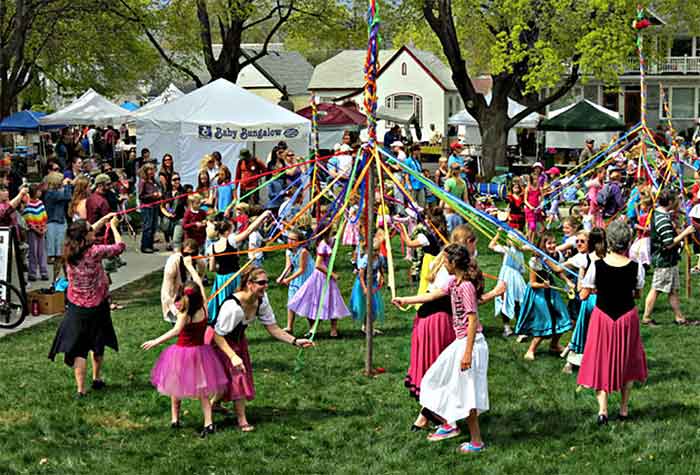
Holidays at their best don’t just remind people of the changing of the seasons or planting and harvesting in agriculture. The changing of the seasons can be linked to the planting, seeding and reaping of socialist projects throughout the year. One holiday where we can see the power of ritual for neo-pagans is on May Day, dancing round the Maypole. It’s important to understand that this corresponds with socialists’ May Day which draws thousands of revolutionaries together throughout the world. But May Day should be celebrations, time off from work, rather than using the day to protest or strike for one reason or another as some socialists have done. As I point out in my article Re-enchanting Socialism, socialists in Europe used to make costumes, sing and dance and perform plays on May Day. What does this do for socialists?  It reminds those of us who are socialists of the big picture, that workers of the world have one struggle and should unite. Why can’t socialists have at least quarterly seasonal celebrations just the way Catholics, Jewish or Muslims have their holy days?

As for materialists and atheists, we can easily name twelve scientists, one for each month to celebrate science. Darwin, Newton, Leibnitz, Einstein, you get the picture. A humanist group I once belonged to in San Jose developed something that became known as “Darwin Day”. It became a celebration that was even backed by the mayor of Menlo Park, who was a humanist. Richard Dawkins even came to speak one year. Atheists have a lot of work to do if we want to compete with religion over the sway of human beings. We need to use mythology for saturating the five senses systematically. Experiencing the world non rationally for an hour won’t kill you! The techniques that sports, religion and nationalists use to sweep people away are rooted in sympathetic magic. These same techniques can be used to combat the downside of sports, religion and nationalism to combat controlling people through mystification, distraction and fear. At the same time these techniques have come to be used to inspire hope, confidence and community to change the world, right here on earth!

OVERCOMING THE STEREOTYPES OF WHAT MAGICK IS 

The Magick I Discuss is Not For Fostering Perceptual Illusions

Let us begin by distancing ourselves from preconceived ideas about what magick is. The first misconception is of magick as a secular activity – like pulling rabbits out of a hat or making people levitate. These are optical illusions that are created by professionals who call themselves magicians. We have no quarrel with professionals who do this for a living, but this is not the kind of magick I am talking about. This involves taking advantage of habitual perceptual cues in the service of inducing people to see things that are not there. In fact, magickians of sacred experience changed the spelling of magic to “magick” to differentiate themselves from parlor or professional magic.

Magick is not a Technique for Changing the World

Spells vs prayers

In these sections I will be relying on two books I have written about the nature of magick and how it differs from religion. One is called From Earth Spirits to Skygods and the other is Power in Eden. In terms of sacred experience, the root meaning of magick is to “shape or make vigorous”. This means magick is an active, irreverent activity in which groups of people take matters into their own hands. This can be contrasted to religion. In origin, religion means to “bind-back”, implying that something was lost that needs to be put back together. The unity that has been torn apart is the evolution of society into classes. All the “great religions” originate in class societies and mostly help to justify those class hierarchies.

The difference between magick and religion can also be understood by contrasting the difference between a spell and a prayer. A spell is like a recipe. If you mix the ingredients in the right order, the results are more or less guaranteed. In primitive forms of magick, there was little or no reliance on sacred presences, or even much in the way of specialists in sacred experience such as a shaman. A prayer on the other hand, involves a deity or high god who listens to the prayer. There is also a priest who intervenes to make sure everything is done correctly. A prayer is a plea for help. You ask God for something and then you hope that He will hear your prayer. The individual is passive. Magickians don’t ask for anything. We use our knowledge of social psychology and we change ourselves!

How tribal magick worked

The system of primitive and secondary magick was predominant in tribal societies and agricultural civilizations before the rise of the monotheistic religions between 1500-1000 BCE. In these societies, altered states of consciousness were achieved by casting a circle, “drawing down” the stellar gods into the circle, calling down specific sacred presences that are connected to the hunt or the harvest (in the case of agricultural states) into the circle. These gods and goddesses were known to be susceptible to certain incenses, music, stones, and herbs which have been called by historians of magic, “correspondences”. By “seducing” the gods with their favorite fragrances, food, gems and music it was thought to increase the chances of the tribe getting what it wanted. Where they went wrong was in thinking that: a) the gods and goddesses were real objective entities; and b) the magick they performed actually changed the world.

Why has magick hung on?

This kind of magick has been around all the way back to hunting and gathering societies of at least 100,000 years ago.  Even after the triumph of monotheism, magic hung on marginally in rural areas of society. During the Renaissance, during the Scientific Revolution, through the Enlightenment and to the end of the 19th century magic was alive among certain sectors of the upper classes. At the end of the 19th century, it blossomed because of dissatisfaction with both Christianity and the mechanization of science.

If this kind of magick did not really do what the people imagine it did because the gods and goddesses are not real and because magic did not really change the world, why has it stayed with us for thousands of years? Is it simply a matter of the clergy and the upper classes manipulating the workers and peasants into believing things that were not true to keep control over them, as the Enlightenment thought? Partly I agree that this is true. However, it does not account for the presence of magic:

  1. when there were no classes as in hunter-gatherers – or
  2. when it was alive among the witches in the 17th century, in spite of the opposition of the Church, scientists and merchants;
  3. when magic existed among the working-class artisans, middle and upper middle classes in the form of alchemy where no political control was involved.

Something else was going on, but what was it?

WHAT DOES MAGICK REALLY DO?

Magick is the art and science of altering states of consciousness at will through the use of imagination, the senses, the emotions through the arts. The techniques can be used for good or for bad purposes. The entire field of advertising is an industry in the use of black magick. Often the association with changing states of consciousness is that it is some kind of secular, recreational escape from reality. Of course, some of that is true, but my reasons for arguing for altered states of consciousness are dead serious. People alter their states of consciousness primarily for social and personal needs, not just for fun.

When hunter gatherers chase a man dressed as a reindeer around the circle making stabbing gestures, are they really creating some magic-at-a-distance which affects the reindeer in the surrounding tundra? Of course not. But what atheists and Marxists miss is that what tribespeople are doing as they dance, sing, drum, run and leap. They are changing their state of consciousness to build their confidence that they will act in a coordinated and effective way when they do go out on the hunt. So, what is changed in magick is the social psychology of their confidence levels.

THE POWER OF MUSIC AND THE ARTS

At the end of every year, some socialists I know gather at a member’s house and sing the Internationale together. What does this do? It calls forth and reminds people that despite recent right-wing downturns, there is a great socialist tradition of success to uphold. The victories of the Paris Commune and the revolutions around the world are recited. But this gathering could be so much richer. Surely there are socialists in the profession of dance that have thought about what socialist dancing would be like. It could easily resemble the dances around the Maypole. These folks could also surround themselves with the portraits of the great socialists, the way the Catholic Church showcases all the patron saints around the church.

Let’s put it this way. Richard Wagner, despite his right-wing politics knew a great deal about altering states of consciousness. As a composer and theatrical director, he synthesized the poetic, the visual, the musical and dramatic arts into a single collective experience. He understood that separating and secularizing the arts limits the prospects for altering states of consciousness. He understood the power of a total art experience at the Bayreuth Festivals. Socialists should create our own version of the Bayreuth Festivals with our own twists.

On an individual level, I might be coming out of a sad state or an anxious state, but when I put on the music of Beethoven’s Ode to Joy or Antonin Dvorak’s New World Symphony, I get swooped away into something higher and deeper than my present troubles. Magick is simply the art and science of how to create particular altered states through the systematic use of music and the arts.

When I was going through a relationship break-up, I would force myself to drive an hour to the Stanford Rodin museum in Palo Alto to draw his sculptures for three hours. In the process of doing that I would be reminded of my identity as an artist, the fellow students and art teachers I had, and how my art teacher used to tell me I drew like Tiepolo. I would drink the same coffee I drank when I drew there to strengthen the altered state in other circumstances. The message was – I am larger and more than my relationships, as painful as they might be.

Guided imagery

In the last 50 years, hypnosis has introduced guided fantasies into its repertoire to help people relieve stress by using their imagination to go to another place, a peaceful place. Often this involves the use of CDs. The hypnotist would take you to a peaceful lake where you lay across a boat soaking in the sun as the boat slowly drifted down the river. You watch the cloud formations; you hear the birds calling out as you drift off to sleep.

This is all well and good, but what these hypnotists failed to do is give credit where credit is due. Hypnosis is a secularized version of magical techniques that have been known for centuries. Mesmer himself recognized this. When hypnotherapists light incense and burn candles, they are just helping the imagination wander and then focus. Magick is about the controlled and systematic use of imagination, that’s why some magickians put an “I” in front of the word magick and turn it into “imagick”.

BRINGING IT ALL TOGETHER: SATURATING THE SENSES

The Catholic Church as closeted black magickians

The Protestants were right about Catholics being closeted magicians and here’s what I mean. When I was a boy my grandmother would go with my parents and I to Sunday morning Mass. Within about three blocks of the church, I could hear the organ slowly inviting us to come forth, inviting me to listen. When we finally arrived at the church my eyes would be drawn to the multi-colored stain-glassed windows. Once inside, my vision was intensified by the vividness of the vestments of the priest. As we moved toward the pews, the smell of incense seeped into my nostrils (“ah, I’ve been here before”).  As I settled into the pew, I ran my hands over the solid oak pews. The floor was made soft by thick, richly covered rugs. Then the choir began to sing something like Ava Maria. We were expected to move throughout the service – standing, sitting, kneeling – all designed to create altered states at different angles (kinesthetics). Three quarters of the way through the Mass, I went to receive holy communion which appealed to my taste. At the end of the service, as we left, the organ music rose again, but this time loud and uplifting (go forth).

The purpose of all this was to create a memorable experience, one that we would want to return to. Regardless of what the Catholic Church thinks it is doing, it is creating a magical altered state of consciousness in its parishes. Given the educational and religious history of the Catholic Church, its authoritarian politics, its murdering of witches and its child abuse, along with advertising, it can easily qualify as black magick.

MY WORK ON THE TREE OF LIFE

Initiating a magickal psychology

In the time period about 1990 I, met a woman named Sophia who identified as a witch and who knew a great deal about something called the Tree of Life, also called the Qabalah, a Jewish mystical symbol system. She had started her own school on the western mystery traditions. I had been interested in western magic for about ten years, but I never saw a way to apply it in any practical, psychological way.  She knew how to “work the Tree” and she taught it to me and others. There are many ways to interpret the tree, its spheres and pathways (see the diagram below). As a Marxist and atheist, I had no interest in thinking that the gods or planets on the tree, its spheres and pathways, were real or that I could influence the planets through these magical activities. However, I was fortunate enough, thanks to Sophia, to discover the works of Israel Regardie, a trained Reichian therapist, who gave psychological interpretations for working on the tree. He helped me to translate magickal work into psychological work on myself
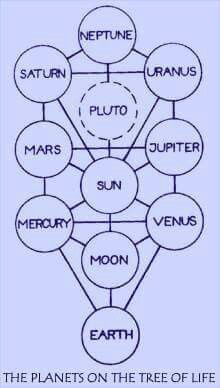
 Spheres on the Tree

The Tree has ten spheres and twenty-two paths, as you can see on the diagram. One interpretation of the spheres is that they are planets. Each of the planets was the home of a god or a goddess. Each god and goddess had positive and negative characteristics. What was very helpful to me was to learn in more depth what the gods and goddesses were like. More importantly, the idea was that all the gods and goddesses were inside of everyone, a kind of collective unconscious. By reading about the pros and cons of each god and goddess, I was learning about the gods that were very strong in me and those that were very weak and needed work. It was very powerful to see all my psychological strengths and weaknesses mapped across the Tree as if they were parts of my body. All this was appealing to my imagination as well as it did to others, I’m sure.

Pathways as mythology

As most of you know, the Greeks didn’t just present their populace with gods and goddesses to believe in. They had a mythology which was a history of the interactions of the gods and goddesses. The twenty-two paths on the Tree of Life is the story of the interactions between the gods and goddesses on the Tree. So, when you work a path, you are told a mythological story about the gods’ and goddess’ interaction on that path just like the stories in Greek mythology. The twenty-two paths and the mythological stories are like 22 archetypal situations that the gods and goddesses get themselves into. This provides a structure for the archetypal situations human beings find themselves in. For as has been said “As above so below”. “Above” refers to the gods and goddesses, “below” refers to human stories.

The three pillars on the Tree

There are three pillars on the Tree, representing the three methods for altering states of consciousness. The left-hand pillar is the path of structure covering Saturn, Mars and Mercury. The right-hand path is the pillar of dynamics – Uranus, Jupiter and Venus. The middle-path is the pillar of balance: Neptune, Pluto, the Sun, the Moon and the Earth.

The left-hand path is the path of celestial, high magic practiced by upper-middle class magicians of the Renaissance like Ficino and Giordano Bruno, Robert Fludd, John Dee and many others including the followers of the Golden Dawn at the end of the 19th century. The right-hand path is the “earth magic” path”, most associated with wiccans, which reached some working-class women. This has been called “kitchen magic” by Starhawk. Both the left and the right-hand paths are methods of altering states of consciousness through the saturation of the senses, the imagination and the emotions. The middle path is a mystical, not a magical path. Its way is to empty the senses, imagination and the emotions. This is the path of meditation, fasting and sensory deprivation. Mystics like Saint Teresa or Jakob Böhme are examples in the West, as are yogis of the East.

Casting a magickal circle

You begin by stepping into a magickal circle of your own construction. You can mark it up with letters and symbols which you could create with thick cloth that can be taped down on the floor. I actually used permanent magic markers directly on our garage floor which we transformed into an art and writing studio for me. The magical circle contains the four elements, the four seasons and all the planets that surround the circle. The actual magickal operation involves the saturation of the senses with the music, incense, colored lights, candles, herbs, metals and dance that corresponds to the goddess upon whom you are calling. The intention is to lose yourself in the mythological stories which go with the gods and goddesses you invoke. The purpose is to build up a sensual memory for each goddess and god. You use them to build up strength to bring forward the goddess or god within yourself in dealing with the life problems which correspond to their domain.  This is done through the use of the arts – journal writing, written self-affirmation and art-work – drawing, sculpting and mask-making.

Regularizing the ritual

Each of the spheres has a set of correspondences, including a day of the week, specific stones, metals, animals, herbs and music. In performing magical rituals, I bring down the planets from the sky metaphorically into my magical circle so that I can work on my psychological problems. I would work the Tree as a psychological “tune-up” every week or two.  If I wanted to work on a particular psychological problem, I would metaphorically evoke the planet under which the department of the problem falls. If I wanted a “tune-up” through the mythological stories, I would work each of the 22 paths. What I used to do is work one path every two weeks so it would take me 44 weeks to go through all the paths. Both the work in the planets and the paths took me about 90 minutes and I worked them once a week (not that different from therapy, but in my opinion, much more imaginative and creative).

Psychological explanations of magickal work

  • Opening up access to the unconscious – the gods and goddesses within – including emotions, senses, imagination, dreams and fantasies.
  • Objectifying my relationship between conscious and unconscious in a concrete form (writing poetry, stories, drawing, mask-making and sculpture) representing the problem I am are working on.
  • Dialoging between the god, goddess and path and my individual psychology.
  • Putting the results of the dialogue into action with an effort that strives to overcome the problem in real life.
  • Integrating and internalizing the results of that action into my psychology, hopefully building confidence.

Steps in the Magical procedure

  • Identify the problem you want to work on and write it in a sentence in your magical notebook
  • Identify your strengths and problems in order to strategize how to solve the problem.
  • Set up an “atmosphere” for the goddess or god in whose province the problem resides, including the appropriate candles, colored lights, mythological drawing, appropriate metal, appropriate stone, appropriate animals (perhaps small sculpture) appropriate robe, herbs, music and movement (dance, gestures).
  • Review a story about the path or sphere – there are books for this including The Shining Paths by Dolores Ashcroft- Nowicki.
  • Take a guided visualization journey with a CD. The book Magical States of Consciousness by Denning and Phillips is good for this.
  • Review the relationship between the strengths and weaknesses of the gods and goddesses and your own strengths and weaknesses.
  • Objectify the problem and solution in some kind of concrete form using poetry, music, drawings, masks and sculpture.
  • Write a self-affirmation which goes with how you’d like to be which is drawn from the mythological story. Write the self-affirmation 5 minutes every day for twenty-one days.
  • Identify what action steps need to be taken each week to deal with the problem.
  • Record your reaction to the journey in your magical journal.
  • Bring the ritual to closure through food, drink and dance and put away all atmospheric props.

I’ve given you an example of how an individual could create an altered state of consciousness. There are neo-pagan groups all over the country that do versions of these rituals, either with the Tree or Life or some other symbolic system and they do it collectively. See Drawing Down the Moon by Margot Adler for examples of this. Some of these folks are political anarchists. Marxian socialists badly need to incorporate something like these rituals for our social and psychological health, especially in these dark times. Otherwise, we will be left behind – as we have been for two centuries by religion, nationalism and sports.

OBJECTIONS AND REBUTTAL

Some of you Marxists, especially in the United States might think these rituals are ludicrous on an individual level, let alone performing them in groups. Are you going to lead the workers in these rituals? “Over my dead body” you might say. Well, your dead body just may be trampled to death for masses of people are interested in magick. With any luck, the workers are going to lead you. Most of humanity is thrilled by this pageantry if it is organized well. The fact that the Catholic Church is still drawing working-class people in despite its anti-working-class history, its murderous persecution throughout history and its record of child abuse. We must learn from the Catholics, just like the Catholics learned from the pagans.

Many materialists and Marxists may be afraid of the reification of imagery and the danger of believing these rituals literally change reality instead of only our psychological states. Sorry, but the answer to reification is not some ascetic denial as the protestants tried to do. The answer is to have rituals, song, music and dance that are not superstitious. A magickal practice that we have, not a practice that has us.

CONCLUSION

If materialists, atheists and Marxists expect to first compete with religion, nationalism and sports, we must learn to create our own mythologies, rituals, music, dance, song, pilgrimages and holidays. We need to be theatrical stage managers where we suspend judgment temporarily just as we do in the movies or at plays for the purpose of having a deep, moving or cathartic experience.

If this has any appeal, we don’t have to reinvent the wheel. Pagan traditions have a rich historical system to draw from that easily competes with the Catholic Church. All these techniques are in the service of altering states of consciousness through magick to create focused and inspired states of consciousness which invites atheists and materialists to be even better scientists and invites socialists to be even better at creating a socialist heaven on earth.

Students in Thailand wage epic protests against the monarchy

Sam Rubin


College and high school students began to hit the streets in February 2020, angered at the government outlawing the only opposition party in parliament — the Future Forward Party. When Covid-19 struck and all schools were shut down, the rebellion stalled. But not for long. Deepening anger at suppression of free speech and mounting economic need erupted in mid-July as tens of thousands across the country marched and rallied. It quickly became an unprecedented challenge to Thailand’s centuries-old monarchy, formerly known as the kingdom of Siam.

Gross inequality reigns. Thailand’s king, 68-year-old Maha Vajiralongkorn, is the richest ruler on the planet, with an estimated worth of approximately $40 billion. When the Covid-19 pandemic started, he relocated to the Bavarian Alps with his  harem of 20 concubines.

His lifelong excesses are paid for by the public, which suffers severe poverty and staggering economic inequality — among the highest in the world. The richest 1% of Thais own about 67% of the country’s wealth; the poorest 50% own less than 2%. Predictably,  conditions have severely worsened during the pandemic.

Young Thais see no viable economic future for their generation. Neither do Thailand’s nearly 40 million workers. Only 1.5% of them belong to unions, because labor law prohibits it. Twenty-five million work in the informal sector and get no social security. A great many of the four to five million migrant workers, primarily from Myanmar (Burma), Cambodia and Laos, are “unqualified” for Covid-19 relief.

Given these stark conditions, it is no wonder that the peoples of Thailand are building for radical change. Social media and encrypted chat services have provided a powerful medium for that. Dissent has been organized and emboldened as never before, while the out-of-touch government struggles to keep up with bombast on the internet. Such new organizing skills played a crucial role in activists’ ability to pull off very large and frequent protests in 2020 and attract enormous international support.

Many of the earliest organizers and participants have been women students.  As The New York Times reported, they are increasingly speaking out against “a patriarchy that has long controlled the military, the monarchy and the Buddhist monkhood, Thailand’s most powerful institutions.” Reproductive rights, the wage gap, and a rape culture have all been highlighted during rallies. Working women are heavily discriminated against, impoverished and angry.

Other targets. The roots of discontent include the corrupt government of pro-monarchy Prime Minister Prayut Chan-ocha, who took power through a coup in 2014. Prayut, a retired military general, then established a repressive military junta to crack down on dissent and curtail democracy in the interests of the monarchy and the capitalist class. Prayut and his military remain firmly in power under a very thin facade of bourgeois democracy with a so-called constitution and parliament. Thailand is actually a dictatorship. Its military appoints the Senate. A crooked election in 2019 confirmed Prime Minister Prayut and his right-wing party and politicians.

As the rebellion mounted, the government enforced a ban on public gatherings in October, and reimposed one of the world’s strictest lèse-majesté laws, which make criticizing the monarchy a treasonous, imprisonable crime. But the rebels were not deterred. Inspired by insurgence in Hong Kong and elsewhere, they organized spontaneous “pop-up” demonstrations throughout the country. Despite police tear gas, chemical-laced water cannons and violent pro-royalist thugs, they continued to take to the streets in tens of thousands, breaking over the New Year’s holidays to regroup. The movement is predominately youth, but others are increasingly on the front line — union and non-union workers, retirees, and militant LGBTQ+ activists.

Demonstrators have escalated their demands, exposing the profound crimes of Thailand’s ruling class and monarchy. They are calling for: resignation of the Prime Minister; repeal of lèse-majesté laws; amnesty for all imprisoned by these laws; freedom of political expression; investigation of murders of dissidents; parliamentary scrutiny of the king’s actions; regulation of the king’s finances; slashing the amount of public funds allocated to the king; relinquishment of the royal fortune; cessation of pro-monarchy propaganda in public relations and education; abolition of the royal charity funds so that all of the monarchy’s assets will be auditable; prohibiting the king from endorsing coups.

Their call for a new constitution sharply curbs the power of the monarchy, enhances the power of elected officials, and gives people more democratic rights.

As the rebels’ far-reaching demands swell, the government increases its repressive reaction. This provokes further revolt, which in turn enhances the massive popular will to change a system that less than a year ago seemed impregnable.

Covid-19 Makes the Rich Richer, the Poor Poorer: That is Capitalism

R Chowdhury


“When the laws undertake to make the rich richer and the potent more powerful, the humble members of the society have a right to complain of the injustice to their government.” — President Andrew Jackson

P B Shelly invoked an injunction from the Bible to explain the effect of capitalism in widening the gap between haves and have-nots. “The rich get richer and the poor get poorer,” said the British poet, borrowing an aphorism from the Gospel of Mathews, which says: To him that hath, more shall be given; and from him that hath not, the little that he hath shall be taken away. The Covid-19 proved it.

Virus of Inequality

The worst impact of the Corona is that it has widened the gap between the already existing huge class-inequality: rich got richer, poor became poorer. The Pandemic has already claimed over 2 million lives after having attacked 100 million so far. No known past catastrophes, Great Wars and Crusades included, caused such human loss.

In the US alone, 40 million lower echelon people lost their jobs in the past year as a result of the Corona. On the other hand, the rich increased their fortune by more than $600 billion. Jeff Bezos of Amazon saw his worth increased by nearly $50 billion, Microsoft’s Steve Ballmer earned $16 billion, Elon Musk and Sheldon Adelson of the Casino world together made $23 billion, while the Zoom owner netted $2.5 billion, just to name a few.

Globally, the Oxfam calculates the gain of the wealthy at nearly $4 trillion in 10 months of the Pandemic plague between March and December 2020.  But it will take decades for the poor to bail themselves, if they at all do, out of the plight they suffered from the scourge of the Corona.

According to an Oxfam survey, 87% of the nearly 300 economists from 79 countries believe that the pandemic will create an increase in income inequality. They also think that racial inequality will rise as a result of the pandemic. 67% of them think their governments do not have an adequate plan that can tackle inequalities.

“COVID makes the rich even richer–and takes away from workers,” writes Chris Tomlinson in the Houston Chronicle on December 29, 2020.

Situation in South Asia is rather pathetic. “Millions had risen out of Poverty. Coronavirus Is pulling them back,” writes journalist Maria Abi-Habib, based in New Delhi, referring to the sufferings of the poor in the region. 

The Oxfam calls it “The virus of inequality.” The US would have seen 22,000 lesser victims among the poor, largely Blacks and Latinos, if they could afford or had improved treatment facilities as did the Whites. Could a black come out of his Corona bed within two days as did Donald Trump? Or the Johnson? Or the Trudeau? Or the (Tom) Hanks?

The Covid-19 brought the most affected categories to their knees. If jobs were equally divided between genders, there would be 112 million fewer women to risk losing it, asserts Oxfam. It also says that the Pandemic will go down in history because the “inequality will continue to increase in almost all countries of the world.”

The scenario will continue when governments disproportionately give more to help the rich and large corporations. Again, the irony is when the stock market rebounds, the rich has the money to invest and profit, while the lower classed do not.  Additionally, the rich-friendly tax system keeps the billionaires at the top.    

To fix this economic anomaly, Oxfam urges the governments to invest more in public services and the richest individuals and corporations to pay fair share of their tax”

US President Andrew Jackson (1829-1832) wrote while giving Veto on an economic bill, “When the laws undertake to make the rich richer and the potent more powerful, the humble members of the society have a right to complain of the injustice to their government.”

Australian university cuts to jobs and courses to intensify in 2021

Mike Head


As campuses start to reopen for 2021, it is clear that historic cuts to jobs, courses and conditions for university staff and students will deepen this year, on top of the destruction of close to 90,000 jobs last year.

Multi-billion dollar revenue losses from the collapse in international student enrolments will worsen in 2021, compounding the impact of decades of funding cuts by Liberal-National and Labor Party governments alike.

Part of the University of New South Wales in Sydney (Credit: UNSW promotions)

Australia’s public university managements, like other employers, are also exploiting the COVID-19 pandemic to bring forward restructuring plans. Many humanities, arts, languages, science and maths courses, in particular, are being decimated.

This will further transform their institutions into highly-casualised and corporatised enterprises servicing the vocational requirements of big business. Australian National University (ANU) Vice-Chancellor Brian Schmidt recently told staff members and students: “We don’t expect to ever return to business-as-usual pre-COVID.”

For the universities, as for the capitalist economy as whole, the pandemic has proven to be a trigger event. It has intensified and accelerated the destructive processes dictated by the financial elite for decades, particularly since the “education revolution” unleashed by the last Greens-backed Labor governments of Kevin Rudd and Julia Gillard from 2007 to 2013.

That market-style “revolution,” which was endorsed and policed by the National Tertiary Education Union (NTEU), stripped universities of $2.7 billion in 2012–13 and scrapped the previous system of block funding, forcing them to compete with each other for student enrolments to finance their operations.

As a result, the universities became heavily dependent on charging international students exorbitant fees, treating them as cash cows. By 2019, more than 40 percent of the sector’s annual student revenue came from these students, mostly from China, India and other Asian countries.

In October 2019, almost 51,000 new and returning international students arrived in Australia. By October 2020, as a result of the pandemic, this figure had fallen by 99.7 percent, to just 130.

By last October, the actual number of fee-paying foreign students enrolled in Australian courses had dropped by 13 percent, from 580,202 to 502,206, and that total will drop more quickly from 2021 to 2023 as students complete their courses and few new ones arrive.

According to Australian government data, about 120,000 international students, or 24 percent of the enrolled cohort, were due to finish their courses between last October and this month alone.

In 2019, universities reported $9.8 billion in revenue from foreign students. Modelling by Universities Australia, the employers’ body, shows by 2023, its members stand to lose $16 billion due to the loss of international students.

As it further slashed funding last year, the current Liberal-National Coalition government falsely held out hopes that a rollout of COVID-19 vaccines could allow universities to resume large enrolments of international students in 2021, easing their financial blow.

This was part of the government, corporate and media drive to reopen the economy and get all workers back into workplaces, for the sake of corporate profit, regardless of the resurging global COVID-19 catastrophe and the ongoing danger of outbreaks in Australia.

This week, however, Prime Minister Scott Morrison told reporters that talk of instituting “vaccination passports” to permit the return of international students was “somewhat premature.” He added: “It is not a silver bullet because there are still limitations to what these vaccines can do.”

This followed warnings by epidemiologists that it was not yet known whether any of the vaccines would reduce transmission, how long immunity would last, and whether the vaccines would be fully effective against the mutant coronavirus strains emerging around the world.

Various universities and state and territory governments had pushed plans to trial the return of some students. These included flying in 300 students to South Australia, 350 to the Australian Capital Territory, 63 to the Northern Territory and setting aside up to 1,000 quarantine places per week in New South Wales for international students and temporary migrants. But these efforts stalled in the face of public concern after the more infectious UK variant arrived in Australia.

At the end of 2020, university managements unveiled a “second wave” of job destruction and course closures, which included hundreds of retrenchments, both “voluntary” and forced, at ANU, La Trobe, Swinburne, University Technology Sydney and the Australian Catholic University.

The opening weeks of 2021 will see further cuts implemented. At both Western Sydney University (WSU) and Macquarie University, for example, the managements have said they will announce the final results of scores of “change proposals” that were issued just before the New Year break.

Staff at WSU were bluntly informed by email this week: “Implementation of approved changes will commence from the date the Vice-Chancellor approves the change plan.”

At ANU, the management “disestablished” 75 positions in the College of Science just before Christmas, and demanded that “surplus to requirement” staff immediately apply for redeployment, a first step toward retrenchment. The “ANU Recovery Plan” proposes that 130 positions in total will go from the College, so more job losses will be unveiled soon.

None of this would be possible without the role of the NTEU, the main campus union, which has systematically suppressed resistance by university workers, opposed calls for industrial action and struck regressive deals with individual universities to impose job and wage cuts.

As soon as the pandemic erupted, the NTEU requested closed-door talks with the employers and in May volunteered a “Job Protection Framework” by which universities would cut wages by up to 15 percent and still inflict unprecedented job losses, totaling at least 18,000 to 20,000. That proposal was eventually abandoned by the employers in the face of rank-and-file hostility, which cast doubt on the union’s ability to enforce the agreement.

Nevertheless, the union proceeded to push through similar deals at one university after another. In the union’s annual report for 2019-20, published near the end of 2020, national president Alison Barnes declared it had been a successful year for the NTEU. “Indeed, the Union has grown even stronger,” she insisted.

Since mid-December, nothing has appeared on the NTEU’s website and social media platforms about the intensifying job losses, thus keeping its members in the dark and indicating its continued complicity in the onslaught.

The NTEU is being assisted by pseudo-left groups that falsely claim to be socialist, such as Socialist Alternative, Socialist Alliance and Solidarity. Echoing Barnes, one of their numerous former members now entrenched in union bureaucracies, called on university workers to “build the union.” That means to shore up the union apparatus that is blocking any unified fight by the working class.

The only alternative to this disaster is being advanced by the Socialist Equality Party and the Committee for Public Education. We are urging university workers and students to draw the essential conclusion—the need to form genuine new working class organisations, rank-and-file committees, completely independent of the NTEU and other trade unions.

These committees would seek to organise a nationwide, unified struggle for secure well-paid jobs and basic rights, protect staff and students from unsafe COVID-19 conditions and link up with educators nationally and internationally who are facing similar critical struggles.

That requires opposing the dictates of the capitalist profit system, which is enriching the world’s billionaires at a staggering pace at the expense of the lives and livelihoods of working people. It means turning to a revolutionary socialist perspective based on the working class taking power in order to completely reorganise society in the interests of all, instead of the wealthy elites.

Johnson plans end of UK lockdown, with terrible loss of life

Thomas Scripps


Prime Minister Boris Johnson’s Conservative government is preparing to end the UK’s national lockdown, with the seven-day average daily death toll at over 1,200 and hospitalisations at over 38,000.

More than 29,000 people have died in just the last 28 days. One day after the government announced 100,000 COVID-19 deaths in Britain, Johnson was already announcing plans to sacrifice more lives on the altar of corporate profits.

Speaking to the House of Commons Wednesday, the prime minister announced the government would set out a “roadmap” to lifting public health restrictions in the week beginning February 22. It will “begin opening of schools on Monday 8 March.”

UK Prime Minister Boris Johnson holds a Covid-19 press conference in 10 Downing Street on Wednesday evening after announcing the plan to reopen schools (picture by Pippa Fowles / No 10 Downing Street)

This is the date argued for by the Coronavirus Recovery Group (CRG) of 70 rabidly anti-lockdown Tory MPs. Chair of the CRG Mark Harper had threatened prior to Johnson’s announcement, “Once the top four risk groups have been vaccinated and fully protected by March 8—assuming the Government hits the February 15 deadline—the Government must start easing the restrictions.”

Political debate in Britain is so far to the right that this murderous strategy is being presented as a compromise. According to the Times, Johnson overruled Education Secretary Gavin Williamson, who had been pushing for opening schools after half-term, on February 22.

Sir Keir Starmer and the Labour Party support Johnson’s agenda. Starmer told Johnson at Prime Minister’s Questions Wednesday that he welcomed “any step forward in opening schools”, and this “should be a national priority”. He advised that the government “use the window” of the February half-term to vaccinate teacher and support staff—as a way of overcoming opposition.

The Tories and the right-wing media are conducting a ferocious propaganda offensive to advance their objectives. They claim, with sickening cynicism, that they are motivated by concern for children’s and families’ educational and mental wellbeing.

Seventeen Tory MPs have joined campaign group UsForThem, demanding schools be reopened as soon as possible. They have published statements in the Sun and the Daily Mail lamenting “mental health crises”, “safeguarding hazards”, “pressures” on parents, the “attainment gap” between rich and poor children and damaged “life chances”.

This rotten and dishonest campaign serves two purposes. First, as an effort to divide the working class, setting struggling families forced to stay at home—who the government have done nothing to support—against school workers.

Second, to cover up the real motivation for school reopenings as a necessary step to throwing open the economy in the interests of the super-rich. As Harper explained on Radio 4’s Today programme Monday, “It seems to us [that] at that point you need to start bringing the economy back to life, and the first thing that needs to be reopened are our schools.”

The cost to human life will be terrible. When schools reopened in September, the Office for National Statistics (ONS) estimated that one in 1,400 people in England had COVID-19 in the week August 30-September 5. The most recent major study, by Imperial College London and covering the period up to January 22, found that the rate was one in 64, and up to one in 35 in London.

According to the Imperial study, the current lockdown is barely bringing this number down, if at all. The authors estimate the national reproduction number (R number) to be 0.98, with a possible range of 0.92 to 1.04.

The director of the study, Professor Paul Elliott, warned, “We’re not seeing the sharp drop in infections that happened under the first lockdown and if infections aren’t brought down significantly, hospitals won’t be able to cope with the number of people that need critical care.”

Scientific studies prove that schools being open significantly increases rates of infection, meaning the pandemic will be pushed into a new period of exponential growth by Johnson’s actions, with tens of thousands more deaths.

The government have tried to sweep this fact under the rug by focusing all discussion on the risks associated with schools on the teacher death rate released by the ONS Monday, which suggests teachers are at less risk of death from COVID-19 than the broader working population.

Even if this claim is accurate, it says nothing about the role schools play in accelerating community transmission. The government’s deceitful rhetoric was summed up in Johnson’s self-contradictory statement in Parliament, “schools are not unsafe, schools are safe” but “they bring communities together,” and “a large number of kids are a considerable vector of transmission.”

On another front, the government is pushing the claim that, since 13 million people—the over 70s and care home residents—will be protected by vaccines by March 8, according to official plans, the risks of the pandemic will have evaporated.

No one should expect the government to meet any target it sets itself, least of all for the deployment of vaccines which are increasingly the subject of fierce international competition. But even if these 13 million are vaccinated, this is only one dose and still leaves millions more vulnerable people at risk of severe disease. In recent weeks, roughly 40 percent of people admitted to hospital with COVID have been aged 18-64.

The question of whether the vaccines prevent transmission as well as illness is also unanswered. The government’s Scientific and Advisory Group for Emergencies (SAGE) produced a paper in December warning, “If the vaccine has no effect on transmission, then once restrictions are lifted there would be another epidemic wave. Whilst it would be less severe than without vaccination, there would still be very many hospital admissions and deaths.”

After being forced into a third lockdown this month—substantially weakened compared to last spring—by the threat of popular opposition, the government is planning a return to its unrestrained herd immunity programme.

Workers recognise the immense dangers they confront. A survey by the Times Educational Supplement of over 5,500 school workers found that 75 percent would be “frightened” or “worried” if their schools opened this term.

However, this opposition is being suppressed by the trade unions to prevent it taking organised political form. Following Johnson’s announcement, the National Education Union (NEU), NASUWT, Association of School and College Leaders (ASCL) and National Association of Headteachers (NAHT) responded as one to extend a hand to the government.

Mary Bousted, joint general secretary of the NEU, said, “We all want schools to open, but like the Prime Minister we want them to open when it is safe to do so… We agree with Boris Johnson that this is a balancing act.” Her only criticism was that Johnson risked creating “false hope” and that his “misplaced optimism” was “pre-empting a decision that will have to be made in mid-February at the very earliest.”

Patrick Roach, general secretary of NASUWT, stated that “a clear plan for how schools will be fully reopened whenever the lockdown restrictions are lifted remains a key question which the Government must now work urgently and openly with the profession to address.”

ASCL leader Geoff Barton declared his union “very happy and keen to work with the government on the detailed planning for the safe reopening of schools to all pupils.”

Paul Whiteman, NAHT general secretary, called on the government to “collaborate with school leaders and their teams to make sure that there is a workable plan for lifting the lockdown.”

The fight over the reopening of schools is the front line of an international drive by the ruling class to throw open their economies. Chicago teachers’ refusal to return to in-person learning while the pandemic rages shows the sentiments of school workers throughout the world. Earlier this month, it was effective walkouts of school staff which pushed Johnson to finally implement a national lockdown. In Germany, a Network of Action Committees for Safe Education has adopted a statement calling “For a European-wide strike against school reopenings”.

COVID-19 infections among UK nursery workers deepens funding crisis

Harvey Thompson


The situation in early years education settings across the country is deteriorating day by day from the spread of COVID-19.

Nurseries and early years settings were not included in the government’s limited national lockdown announced on January 4.

Nurseries along with special educational needs providers were informed they would remain open despite a deadly increase in the pandemic—exacerbated by a newer more transmissible strain of the virus—because according to the official government rationale the under-fives were “unlikely to be playing a driving role in transmission.”

Children have breakfast at the Little Darling home-based Childcare after nurseries and primary schools partially reopened in England after the COVID-19 lockdown in London, Monday, June 1, 2020. (Photo: AP Photo/Frank Augstein)

These lies are refuted by the experience of nursery staff. Infections and hospitalizations are sweeping through nurseries and early years settings, particularly in the capital and the south-east of the country.

On January 18, Nursery World reported that four staff members had been hospitalised with COVID-19 from the London Early Years Foundation (London’s largest group of “social enterprise nurseries”) and over a third of its settings had been forced to close.

There have been 48 positive cases at the London Early Years Foundation (LEYF) since the start of the year. In that time, 14 out of 39 LEYF nurseries have closed due to staff having to self-isolate. LEYF warned that many more nurseries are set to follow CEO June O’Sullivan described the new variant of the virus as “spreading like wildfire” among staff at LEYF’s nurseries, with 22 positive cases in one week at one nursery and 16 positive cases across eight sites in one weekend alone.Following the nursery closures, O’Sullivan tweeted: “16 cases of Covid19 across 8 @LEYFonline sites in one weekend—48 cases this year (and counting), including four staff in hospital. What was the DfE @educationgovuk saying about nurseries being low risk???”

On January 21, ITV news ran a piece that contains video interviews with nursery staff on the dangerous and impossible conditions they now face.

Jo Godbold, the owner of Sunny Kids Pre-School Nursery in Kent—where COVID-19 outbreaks among staff have forced the setting to close three times—said: “We’ve been told its safe. But that’s a lie. Because categorically, people are getting ill. And people are going to hospital. We feel like we’ve been forgotten and lied to.”

At the same setting, Caroline White—who has two sons who are potentially at higher risk of contracting the virus—described the intolerable situation: “Most of us are scared. I’ve definitely had my moments where I’ve sat in bed and cried… You’ve got to be a motivator as well for the children. You’ve got to motivate the parents. To show them that they’re safe and we’re happy to have them back. But at the same time, you feel conflicted to be here yourself.”

As Sunny Kids Pre-School Nursery is privately run, it received no help from the government despite being instructed to stay open. Staff have had to purchase their own COVID-19 rapid flow tests.

An online survey, which was conducted jointly by the Early Years Alliance (EYA) and independent sector analysts Ceeda between January 15 and January 19, received 3,555 responses from those working in the early years and childcare sector. Data on positive test results is derived from survey responses from 2,675 nurseries and pre-schools and 673 childminders.

If the findings are even close to a representative snapshot across the sector then it paints a devastating picture.

The key findings were:

• Nearly 1 in 10 of nursery and pre-school staff and one in 12 childminders have tested positive for COVID-19 since December 1 (during a period of just 7 weeks)

• Around half of early years practitioners (48 percent of nursery and pre-school staff and 54 percent of childminders) say they don’t feel safe in their current workplaces.

• Around 94 percent of nursery and pre-school staff and 87 percent of childminders believe that the early years workforce should be prioritised in the second phase of the COVID-19 vaccination programme.

• Based on these findings, the authors of the survey estimate that around 31,000 staff working in nurseries and pre-schools and almost 3,000 childminders have tested positive for the virus since the beginning of December.

• An estimated 63 percent of nursery and pre-school respondents said there was “a moderate to high risk” that their whole setting may need to close in the next few weeks due to staff shortages as a consequence of the impact of COVID-19.

As many staff point out, in nurseries it is doubly impossible to socially distance as toddlers and babies need constant close care from nappy changing to the contact and affection that supports their development and learning.

There are currently no confirmed plans for lateral-flow testing in nurseries and pre-schools. Neil Leitch, chief executive of the Early Years Alliance, which seeks to “raise awareness of the early education sector amongst MPs, Peers, decision-makers and influencers” said the safety worries were “a cause for serious concern.” He called on government to implement rapid coronavirus testing among early years staff “as a matter of urgency.”

The government does not publish data on the number of COVID-19 cases among early years staff. Ofsted, the governments’ school inspectorate, publishes a list of the number of settings that have reported incidences of the virus but it does not include the number of individual cases, or provide a breakdown showing how many staff and/or children are affected.

This means that each outbreak in a setting reported to Ofsted is only counted as one in the statistics, even if there are multiple cases involved.

Prior to the pandemic, there was a serious funding and staff crisis in early years but now many settings are teetering on the brink and face closure.

The World Socialist Web Site reported in August on the dire situation in the early years sector, pointing out that 50 percent of England’s 280,900 Early Years (EY) workforce is paid less than the minimum wage. Low pay is one of the main reasons given for leaving the job, alongside increasing work demands and a lack of training. More than one third of EY workers stay in their job less than two years.

The article noted, “EY providers rely on Local Authority funding for 30 hours of funded payments, which amounts to just £1,000 per child each year, if the setting has a qualified EY teacher. This is paid on an hourly basis, equating to an average of £4.38 per child, which barely covers costs and guarantees downward pressure on wages.”

This was in August before the full reopening of schools in September.

As the pandemic worsens, nurseries and early years settings across the country are describing their workplaces as deadly environments, having to operate within a financial crisis.

The EYA/Ceeda survey found that:

• Early years occupancy levels are currently 58 percent in nursery and pre-schools compared to 86 percent in January 2020, and 54 percent in childminding settings compared to 92 percent in January 2020.

• 51 percent of nurseries and pre-schools and 35 percent of childminders expect to be operating at a loss at the end of the spring term based on current levels of government support.

During the autumn term, the Department for Education funded the early years sector based on pre-Covid levels of child attendance. During the current term, funding is based on the number of children currently registered at early years settings. This decision was made despite the fact that many providers have seen a huge fall in new registrations over recent months.

Despite nurseries remaining open, many parents have decided not to send their children due to fear of the virus. A recent Opinium poll for the Observer newspaper found a majority (61 percent) saying it is time for nurseries to shut. Some parents, because they are adhering to stay-at-home rules, are self-isolating. Many have lost their jobs and are struggling to pay bills or are on furlough.

High quality early years provision is vital to a child’s cognitive, social and emotional development, especially in more deprived areas where parents struggle at home. For those key workers who rely on nurseries, additional fully funded support must be available to enhance the cleaning and safety of all preschool and nursery facilities. Staff must receive full personal protective equipment and regular testing, with a fully qualified nurse on site at all times.

Biden administration continues “maximum pressure” assault on Iran

Bill Van Auken


In its first days in office, the Biden administration has made it clear that it intends to continue enforcing the “maximum pressure” campaign of draconian sanctions and military provocations that have brought misery to the people of Iran, while threatening to plunge the Persian Gulf region, and indeed the entire world, into war.

This was driven home with the announcement by the US Central Command (CENTCOM) that it had conducted another fly-over of the Persian Gulf by a lone B-52 Stratofortress. This was the sixth such provocative deployment of the heavy bombers to threaten Iran since November, and the first carried out with Biden as commander-in-chief. While the previous overflights involved two B-52s, this one consisted of the lone bomber accompanied by a squadron of F-15s from Saudi Arabia, Iran’s most virulent enemy in the Arab world.

President-elect Joe Biden speaks after the Electoral College formally elected him as president, Monday, Dec. 14, 2020, at The Queen theater in Wilmington, Del. (AP Photo/Patrick Semansky)

In addition, Bloomberg reported that the US Justice Department has ordered a tanker allegedly carrying Iranian oil seized and brought to the United States.

In the course of his presidential election campaign, Biden had pledged to rejoin the 2015 nuclear accord between Tehran and the major powers. The agreement, known as the Joint Comprehensive Plan of Action (JCPOA), which the Trump administration unilaterally abrogated in November 2018, traded the lifting of economic sanctions for stringent limitations on Iran’s civilian nuclear program. After breaking the deal, the Trump administration not only re-instated the old sanctions, but imposed a whole series of new ones designed to strangle the Iranian economy and starve the country’s population into submission.

In his first press conference as Biden’s secretary of state, Antony Blinken on Wednesday conditioned a US return to the nuclear accord on Iran first resuming its full compliance with the terms of the agreement, while indicating that Washington would throw a demand for still more concessions from Tehran into the bargain.

“President Biden has been very clear in saying that if Iran comes back into full compliance with its obligations under the JCPOA, the United States would do the same thing,” Blinken said at the State Department press conference.

“But we are a long ways from that point. Iran is out of compliance on a number of fronts. And it would take some time…for it to come back into compliance in time for us then to assess whether it was meeting its obligations.”

Iranian officials have insisted that it is up to Washington to unconditionally lift the sanctions that it imposed when it tore up the international agreement in violation of a United Nations resolution. Tehran has promised that in return it will quickly reverse steps it took in response to both the unilateral US action and the failure of the western European signatories of the agreement to take any significant actions to offset the illegal US sanctions regime. Tehran’s steps have included the accumulation of greater quantities of enriched uranium and the enrichment of uranium to a higher level than allowed under the agreement, as well as the reactivation of advanced centrifuges that had been shut down under the deal.

Blinken went on to insist that Washington would demand that Tehran renegotiate the 2015 accord, replacing it with a “longer and stronger agreement” that would presumably impose perpetual restrictions upon Iran’s nuclear agreement while addressing what the new secretary of state described as “a number of other issues that are deeply problematic in the relationship with Iran.” This refers to a US bid to force Iran to scrap its conventional missile program and give up its influence in Middle East in the interests of US hegemony over the oil-rich region.

In response to the US demands for concessions from Iran, the country’s foreign minister, Javad Zarif, on Thursday tweeted what he described as a “reality check” for Blinken. It was the US, he pointed out, that had “violated JCPOA” and “blocked food/medicine to Iranians,” punishing Iran “for its adherence to the agreement.” Iran, he insisted, had “abided by the JCPOA” and “only took foreseen remedial measures” in response to US aggression.

“Now, who should take 1st step?” Zarif asked. In earlier tweet, he made clear Tehran’s position: “It was the US that broke the deal—for no reason. It must remedy its wrong; then Iran will respond.”

Meanwhile, an Iranian government spokesman appealed directly to the Biden administration to lift sanctions that have restricted the country’s ability to import vaccines needed to combat the COVID-19 pandemic, which has hit Iran harder than any other country in the region, with 1.4 million reported cases and nearly 60,000 reported deaths.

“Since [Biden’s] administration claims not to be anti-science like the previous one...one expects it to free the transfer of Iran’s own foreign exchange resources to fight the coronavirus and for health and food, and lift banking sanctions quickly,” government spokesman Ali Rabiei told state television.

With its appeal for “unity” with the Republican Party, the Biden administration has little stomach for a swift and sharp reversal of the “maximum pressure” campaign imposed by Trump. Leading right-wing congressional Democrats, including Senator Robert Menendez, the incoming chairman of the Senate Committee on Foreign Relations, have also opposed any letup of US aggression against Iran.

Biden has also pledged to “engage” with Israel before taking any steps to change the current “maximum pressure” regime against Iran, while Blinken has repeatedly stated that the new administration views Israel’s security as “sacrosanct.”

Tel Aviv has not only opposed any US return to the JCPOA but has threatened to militarily attack Iran and its nuclear facilities in response. This was expressed most directly by the new chief of staff of the Israel Defense Forces (IDF), Lt. Gen. Aviv Kochavi, who gave a bellicose speech on Tuesday, declaring a return to the Iran nuclear deal an “intolerable threat” to Israel. He said that “anything that is similar to the current deal is a bad thing, and we cannot allow it,” adding that he had ordered the IDF to prepare new “operative plans” for attacking Iran.

Significantly, the first high-level US official to visit Israel since Biden’s inauguration is Gen. Kenneth McKenzie, the commander of the CENTCOM, which oversees the US military buildup against Iran as well as the Pentagon’s operations throughout the Middle East. He arrived on Thursday for talks with Kochavi and the IDF general staff.

The visit comes after the Pentagon quietly shifted Israel from the jurisdiction of the European Command to CENTCOM, enabling closer military collaboration in military operations against Iran. Israel had been excluded from CENTCOM to facilitate winning the support from right-wing Arab oil monarchies and dictatorships for US wars of aggression in the Middle East. While previously these regimes had formally opposed military ties with Israel because of its oppression of the Palestinian people, they have since abandoned this pretense, with several of them signing US-sponsored “normalization” agreements with Tel Aviv in the interests of forging an anti-Iranian axis.

Conversely, the first high-level Israeli visit to Washington since the change in administrations will be that of Yossi Cohen, the chief of Israel’s spy agency Mossad, who will meet with Biden on the Iran question.

The inflammatory rhetoric of the Israeli government toward Iran is driven in part by an election in March—the fourth in barely two years—in which Netanyahu, who is facing trial on multiple corruption charges, is appealing to his right-wing base. This makes the threat of war no less real, however, under conditions in which Tel Aviv has carried out continuous airstrikes against Iranian-linked targets and organized the Mossad assassination of Iran’s top nuclear scientist, Mohsen Fakhrizadeh, in November.

Nor will the threat of an eruption of US militarism in the Middle East lessen under a Biden administration. Blinken and others who have returned to positions of power in Washington were the architects of the US-orchestrated wars for regime change in both Libya and Syria.

Moreover, they view Iran through the prism of the US conflict with China and the strategic imperative of securing US domination of the Middle East, which provides much of China’s energy imports.

The ratcheting up of Trump’s reckless and dangerous anti-China policy is being pursued by the veterans of Obama’s “pivot to Asia.” The warmongering character of the new administration’s attitude toward Beijing was clearly expressed by Biden’s nominee for US ambassador to the United Nations, Linda Thomas-Greenfield, who told a Senate panel Wednesday that China is a “a strategic adversary,” whose actions “threaten our security, they threaten our values and they threaten our way of life.”