15 Feb 2021

Despite mass deaths, Poland ends lockdown

Martin Nowak


The Polish government is gradually ending its lockdown, even though the pandemic is still raging and hundreds are dying every day from COVID-19.

Museums, art galleries and shopping centres have been allowed to reopen since 1 February. Even before that, face-to-face classes for the first to third grade were resumed. As of 12 February, hotels, cinemas, theatres, philharmonic halls and opera houses can reopen at 50 percent capacity, as well as sports fields, ski slopes and swimming pools.

The number of new infections has decreased since the peak in November but has remained above 5,000 a day since January. Hundreds continue to die daily because of COVID-19. With about 36,000 new infections in a week, the seven-day incidence per 100,000 inhabitants is only slightly below 100, and thus far beyond the mark above which the infection incidence can be controlled or contained.

Polish miners at the Wujek mine in Katowice (AP Photo / Czarek Sokolowski)

According to the Polish Ministry of Health, mortality increased by 67,000 in 2020, the decisive factor being COVID-19. The country’s population, which has been declining since the introduction of capitalism, shrank by 115,000 last year.

The spread of new strains of the virus increases the dangers of the pandemic. The British variant arrived in Poland after the Christmas holidays at the latest. More than 800,000 Poles work in Britain. They constitute the second largest minority in the country after people from India. Only Germany has a larger ex-pat Polish community.

In the Czech town of Trutnov, located in the border triangle between Poland and Germany, around 60 percent of sequenced samples contained the novel corona strain. To make matters worse, Poland has particularly low testing rates compared to other European countries, with the number of daily tests at around 40,000.

For Poland, with a population of about 40 million, this level of testing is criminally low. Germany, with just over twice the number of inhabitants, tests around 140,000 people a day, and the Czech Republic, with 10 million inhabitants, tests 20,000.

On top of that, the vaccination campaign in Poland, as in Germany, is a debacle. About 80,000 vaccine doses are currently distributed every day. Continuing at this rate, it would take almost two years to vaccinate the entire population. Due to the mass deaths this winter, the previously restrained willingness to be vaccinated has largely given way to surging demand. The vaccination rate has increased by leaps and bounds, rising from 43 percent in the autumn to 70 percent in January.

This surge led to the collapse of the official hotlines for the allocation of vaccination appointments. For example, after the start of vaccinations for people over 70, up to 300,000 people dialed in at the same time.

At the same time, there are several known cases of illegally giving preferential treatment for vaccinations. The extent of this is shown by an inspection at the Warsaw University Hospital. It turned out that almost half of 450 vaccine doses received by the institution went to 200 people who had no connection with the hospital, including celebrities and politicians.

In the first half of 2020, Poland had come through the pandemic relatively unscathed. This was due to a rigid containment policy with extensive curfews, so that the incidence of infection was mainly concentrated in the businesses that continued to operate. For example, the Silesian mining region temporarily developed into a hotspot; in June, one in two new infections came from this region. Even then, it was clear how indifferent the government was to the deadly danger to workers.

As the summer progressed, it became clear that none of the European governments would impose another hard lockdown during the coming autumn and winter. There was an unspoken consensus that the interests of big business were more important than human lives, and they moved to a herd immunity policy.

Professor Andrzej Horban, the chief adviser to the prime minister and chairman of the National Medical Council, openly admitted this to Dziennik Gazeta Prawna. He explained that over the summer there had been an “absolutely deliberate” herd immunity strategy. “Protect a little, infect a little,” he said. He flatly denied the health risks to younger people and scoffed at the possibility of long-term damage from the coronavirus. He also made clear that a large wave was expected and that forecasts to this effect were already available in September.

Even more criminal is the fact that the government did not impose even a partial lockdown until November, when the incidence rate was already over 200 per 100,000 and tens of thousands of new sufferers were being added daily. Even based on the Ministry of Health’s position that the system would collapse with more than 30,000 daily infections, it was clear that mass deaths could no longer be prevented.

Government spin also included the National Stadium in Warsaw, which had been converted into a temporary clinic and was grandly called the “national hospital.” Prime Minister Mateusz Morawiecki had inspected it himself shortly before the opening.

However, it became known shortly afterwards that the 500 beds, including about 50 intensive care beds, were never used to capacity. Pictures of the empty rows became public via Twitter, and at the end of November a resident doctor declared anonymously in Polityka: “I came here to fight the pandemic. Instead, I am now staying in a five-star hotel and sitting around in an empty hospital. The reason I'm talking about it is because I'm embarrassed to be part of it.”

The creation of such Potemkin villages, as some newspapers called them, was not without reason. The government tried to cover up the fact that the health system, which has been broken for decades, is one of the worst in Europe. Poland, for example, is fifth to last among OECD countries in terms of the number of doctors per 1,000 inhabitants.

Despite the murderous consequences of its policies, the Polish bourgeoisie is hell-bent on ending the lockdown. In doing so, it is joining the European competition to reopen the economy. Italy, Germany and Austria have also already decided on relaxations and are in the process of implementing them.

While the PiS government is deciding on far-reaching relaxations, so-called lockdown rebels already started the action “OtwieraMY” (“We open up”) in January. Not only dozens of businesses in the catering and tourism sectors opened, but also gyms and bars, in contravention of government regulations. They received ample support from local politicians, the pro-opposition media and the courts, which declared the government’s coronavirus restrictions unconstitutional. Likewise the Polish Business Congress. Its president, Sławomir Mentzen, is vice-chairman of the radical right-wing Korwin Party.

The Polish bourgeoisie is divided over the consequences of the PiS government’s extreme right-wing and authoritarian course, which only last week drove tens of thousands of people onto the streets against the reactionary abortion law. However, it is absolutely united on the question that profits come before protecting health.

Austrian government ends lockdown despite spread of coronavirus variant

Markus Salzmann


On February 8, Austria’s black-green (conservative-green) coalition government ended entirely what had only been mild lockdown measures. This means that schools and commerce will be fully open despite the fact that infection and death rates remain high and very contagious viral variants are rapidly spreading in the country.

The number of new infections remains elevated. On Friday, 1,731 cases were reported, with a seven-day incidence continuously above 100 per 100,000 population. Over 432,000 people have already been infected with COVID-19 in a country of 8.8 million; 8,195 people have died from it as of Sunday. The situation in clinics remains tense despite recent declines in caseload.

The policy of Chancellor Sebastian Kurz and his coalition of the conservative People’s Party and the Greens can only be described as criminal. As it did last spring, the Viennese government has led the way among European states in dropping all protective measures against the coronavirus pandemic and allowing the contamination of the population with all its disastrous consequences.

Austrian Chancellor Sebastian Kurz (Bild: kremlin.ru / CC BY-SA 4.0)

After the initial spring lockdown, infection rates and mortality rates dropped in April. Starting in May, however, the government lifted all relevant protective measures, despite urgent warnings from scientists and the confirmation of these warnings in other countries.

Citing the interests of the economy, even as infection rates rose exponentially again in September and October, the government insisted that the country could not afford another lockdown. It was decided that businesses and schools must open fully, and that tourism should not be restricted.

Only in October, faced with a dramatic rise in infections and a catastrophic situation in the clinics, the government was forced to introduce measures to contain the pandemic. They proved too late and were entirely inadequate. While schools and stores were largely closed, businesses remained open.

Now schools, kindergartens, commerce and cultural institutions are open, as well as services such as hairdressing and massage. As predicted, in the first few post-lockdown days city centres and stores were completely overcrowded.

The hygienic measures attending the re-openings are window dressing to lull the population into a false sense of security. For example, the requirement to wear FFP-2 masks and free coronavirus testing cannot compensate for contact restrictions. For that, free tests are coming far too late.

The relaxations now enacted are the first step in a total abandonment of precautionary measures. The opening of restaurants and hotels is already being eagerly discussed and will not be long in coming. Ski slopes in the tourist strongholds were allowed to open before Christmas even though the winter sports resort of Ischgl was the European epicentre for the spread of the COVID-19 pathogen last year.

The situation is particularly dramatic in the state of Tyrol, where the so-called South African variant B.1.351 of the coronavirus is on the rise. Experts have reported around 300 cases to date, roughly half of which are currently active. Previous findings show that infections with the South African variant of the virus are often far more severe and more resistant to the available vaccines.

The government in Vienna issued a travel warning for Tyrol, requiring a negative test for travel to and from the region. Since this policy only applies as of last Friday, and is only in force for 10 days, experts do not expect prevention of spreading.

Ending protective measures under these conditions has been strongly criticized by doctors and scientists. “A hard lockdown makes sense from a medical point of view,” Richard Greil, one of the country’s leading infectious disease experts, told SALZUBRG24 in an interview.

Gerald Gartlehner, an epidemiologist at Danube University in Krems, also criticized the fact that “a lot of time was lost” responding to the South African cluster in Tyrol. It had been known for some time “that Tyrol was becoming a hotspot for the South African mutant.” The current measures are “not optimal,” he said.

Gartlehner noted that vaccines against the variant hardly offer protection. “All indications are that the AstraZeneca vaccine is quite ineffective against the South African variant. If we give the South African virus free rein, then that vaccine, which has the largest share in Austria, will not work.” Other experts confirm this.

Gartlehner makes clear what the result of the government’s irresponsible policy will be. “Every model I know shows the same picture, namely a sharp increase in the incidence of infection due to the relaxations and the British mutation. The only difference is when the threshold of 200 is reached. The pessimists say the end of February; the optimists say the second week of March.”

Andreas Bergthaler, a virologist at the Academy of Sciences, shares this view with the Kurier newspaper: “In eastern Austria, the British mutation, which is a lot more contagious, already accounts for up to 40 percent of cases. From an epidemiological standpoint, there is no argument for the current relaxations.”

The unscrupulousness of the government is especially apparent in the opening of schools. To justify risky in-person classes, the so-called “nose-picker test,” an antigen test that the students take themselves, was introduced. Yet the test is both voluntary and obviously totally inadequate.

Gartlehner noted that the fact that only 56 students tested positive in the first “nose-picker test” in schools suggests disfunction of the approach since the percentage should be much higher. Either the tests or the self-performed swabbing did not work well.

Kurz and his government know very well the consequences of their policies and pursue them deliberately, despite their costing countless lives.

Health Minister Rudolf Anschober (Greens) said earlier this month that re-opening was intended to provide “perspectives” and “security.” In doing so, he admitted that two months ago the health care system had been “on the brink.” At the same time, he noted that clinics still treat hundreds more patients than in normal times.

The brutal policy of re-opening in the interests of the economy is supported by a broad alliance of all parties and trade unions. ÖVP, Greens, SPÖ and the right-wing liberal Neos support the move and thus accede to the demands of the far-right Freedom Party, which for its part now goes even further and demands the complete lifting of all protective measures, even in Tyrol.

SPÖ leader Pamela Rendi-Wagner said the return to face-to-face teaching was “right and necessary.” Neos leader Beate Meinl-Reisinger told the ORF news outlet: “Exactly what we demanded over the weekend will be implemented.”

The head of the teachers’ union, Paul Kimberger, expressly supports the re-opening of schools, even if this puts hundreds of teachers’ lives in danger. In his view, the alternative to face-to-face teaching has reached its limits, he explained in an interview with Deutsche Welle. “The realization of the last weeks and months is that distance learning cannot replace face-to-face teaching.”

US Bureau of Labor Statistics reports 5,333 workers died on the job in 2019, or one every 99 minutes

Steve Filips


The US Bureau of Labor Statistics (BLS), an agency within the US Department of Labor (DOL), reported last month that 5,333 US workers died due to workplace injuries in 2019, an increase of 2 percent from the previous year. This is the highest number of workplace deaths in the United States since 2007.

This grisly figure has been steadily rising since a temporary decline during the 2008-2009 recession, when millions of people left the labor force altogether. In the years since, the jobs wiped out by the financial crisis have been replaced by new jobs overwhelmingly concentrated in low-wage, highly exploitative sectors of the economy.

As horrific as they are, the BLS figures are in fact a vast undercount, in part because it does not count deaths due to workplace related diseases. Given the omission of disease-related deaths, as well as the undermining of reporting of workplace COVID-19 infections and deaths by the federal government, it is likely that the figures for 2020, once they are released in next year's report, will represent a far larger undercount of the real number of workplace fatalities than in 2019.

Tesla Motors Assembly Line (Image Credit: Steve Jurvetson/Flickr)

According to an AFL-CIO report, “Death on the Job: The Toll of Neglect,” which analyzed data from 2018, on average 14 workers died on the job each day in the US, and an estimated 95,000 workers died from chronic occupational illness.

“Due to limitations in the current injury reporting system and widespread underreporting of workplace injuries, this number understates the problem. The true toll is estimated to be two to three times greater—or 7.0 million to 10.5 million injuries and illnesses a year,” the AFL-CIO report stated. According to the report, only 3.5 million injuries were reported in 2019.

While the figures from 2019 do not include deaths which occurred during the coronavirus pandemic in the US, they shed light on why COVID-19 has had such a devastating impact in the United States. Even before the pandemic, workers in America were subjected to horrific conditions, with more Americans dying at work each year than died during the entire eight years of the Iraq War.

Meanwhile, rising levels of inequality have led to worsening health outcomes, including a decline in the average expectancy. The deadly social consequences of the engorgement by the corporate oligarchy on society’s resources was demonstrated in a recent study by the Lancet medical journal which found that 200,000 Americans would still be alive if mortality rates in the country had kept pace during the pandemic with the average for advanced countries.

Meanwhile, both capitalist parties have systematically hollowed out workplace safety regulations and enforcement. Though the Trump Administration starved Occupational Safety and Health Agency (OSHA) of funds, under the Democratic administration of Barack Obama OSHA also faced a funding crisis. OSHA oversees the enforcement and implementation of safety rules at 8 million workplaces with a combined 130 million workers, but has little more than 2,000 employees and an annual budget of half a billion dollars.

Many of the deaths accounted for in the BLS figures had been previously reported on in the World Socialist Web Site in 2019. This includes:

• Two young UPS part-time package handlers, Austin Stache, 20, of Rancho Cucamonga, and Noe Tinoco Jr., 22, of San Bernardino, California

• Duntate Young, 23, a young Federal Express worker with two young children was killed in November 2019 at the Memphis, Tennessee based company’s World Hub

• Jill Greninger, 35, a young mother who died at the Economy Locker Storage Company in Muncy, Pennsylvania

According to the BLS report, 642 workers died in 2019 due to “exposures to harmful substances or environments,” the highest level since records began in 2011. Workplace suicides increased in 2019 to a total of 307, a 34 percent increase from 2015. Unintentional overdoses also increased for the seventh consecutive year to 313. This means that over 11 percent of all workplace deaths in 2019 were “deaths of despair.”

According to the report, 2,122 died due to transportation accidents in 2019, a 2 percent increase from the 2018 total of 2,080. A substantial portion of this figures are commercial drivers. “Nearly 1 out of every 5 fatally injured workers was employed as a driver/sales worker or truck driver,” the BLS report states.

Workplace deaths were disproportionately concentrated among older workers, reflecting the impact among this segment of increased speedup and longer work shifts. “Fatalities among workers age 55 and over increased 8 percent from 1,863 in 2018 to 2,005 in 2019, which is the largest number ever recorded for this age group.” The death toll for all workers over 45 years of age was 3,087, or 58 percent of the total. By comparison, only 44 percent of the workforce as a whole is over the age of 45. This figure remains significantly higher than it was before the Great Recession.

Some of the factors which have led to increased deaths among older workers can be seen among truck drivers, and the average age of the workforce is 55. Because of a lack of hiring, drivers face greater risks because they are forced to work longer hours, frequently at night, and have added physical responsibilities like helping unload their truck or trailer, factors which lead directly to driver fatigue.

It is plausible that the pandemic will cause a spike even in non-COVID-19 fatalities in the trucking industry. During the pandemic, even more goods have been transported by truck, which accounts for 70 percent of the total amount of goods shipped according to an estimate from the American Trucking Association (ATA).

The BLS study is a portrait of the social devastation of a society in deep crisis and driven by irrational profit motives. It demonstrates the need for the independent mobilization of the working class against the capitalist system.

Democratic Senators introduce new bill to remove Section 230 internet speech protections

Kevin Reed


On February 5, three Democratic Party US Senators introduced legislation called the Safeguarding Against Fraud, Exploitation, Threats, Extremism and Consumer Harms (SAFE TECH) Act, which would modify laws that provide internet companies with legal protections for content posted on their platforms by users.

In a press release accompanying the draft legislation, US Senators Mark Warner of Virginia, Mazie Hirono of Hawaii and Amy Klobuchar of Minnesota state that their proposal aims to “allow social media companies to be held accountable for enabling cyber-stalking, targeted harassment, and discrimination on their platforms.”

Senator Warner says in the press statement that the Section 230 provisions are outdated and ineffective and have enabled internet companies to “do nothing to address foreseeable, obvious and repeated misuse of their products and services to cause harm.” Warner claims that the 1996 law has “provided a ‘Get Out of Jail Free’ card” and allowed “scam artists, harassers and violent extremists to cause damage and injury” on the giant social media monopolies’ platforms.

This Oct. 23, 2019, file photo shows Facebook CEO Mark Zuckerberg testifying before a House Financial Services Committee hearing on Capitol Hill in Washington. (AP Photo)

Furthermore, Warner states the proposed bill “doesn’t interfere with free speech,” but holds the online firms “accountable for harmful, often criminal behavior enabled by their platforms to which they have turned a blind eye for too long.”

The language of Section 230 as contained in the 1996 Communications Decency Act is brief. It states, “No provider or user of an interactive computer service shall be treated as the publisher or speaker of any information speech provided by another information content provider.” This statement has functioned for twenty-five years as a legal shield for internet companies, including the social media platforms, to both moderate content that violates the law and their own community standards without also being liable for everything that users post on their systems.

In an example of the way Section 230 works, the United States Court of Appeals for the Second Circuit in July 2019 affirmed a lower court’s decision that Facebook could not be held liable for violent attacks coordinated and encouraged by user accounts linked to Hamas, the militant Islamist group. A court majority opinion said Section 230, “should be construed broadly in favor of immunity.”

Another explanation of the law says that as long as it cannot be proven that an internet service provider is knowingly helping a user commit a crime, any illegal content posted on a platform is the responsibility of the user alone.

The key modification to Section 230 by the SAFE TECH Act proposal is that it would lift the immunity protections for service providers where payments are involved. The edits would reduce the phrase “information speech” to just “speech” and then add the following to the end of the sentence: “except to the extent the provider or user has accepted payment to make the speech available or, in whole or in part, created or funded the creation of the speech.”

Some online information experts argue that these changes are significant and would effectively destroy the speech protections that have been in place since 1996. Jeff Kosseff, a cybersecurity law professor at the US Naval Academy who authored the book The Twenty-Six Words That Created the Internet, told TechCrunch, “A good lawyer could argue that this covers many different types of arrangements that go far beyond paid advertisements. Platforms accept payments from a wide range of parties during the course of making speech ‘available’ to the public. The bill does not limit the exception to cases in which platforms accept payments from the speaker.”

Meanwhile, Oregon Democratic Senator Ron Wyden, who is one of the original authors of Section 230, also told TechCrunch that, while the SAFE TECH Act draft bill may be “well-intentioned,” it would, “devastate every part of the open internet, and cause massive collateral damage to online speech.”

Wyden also said, “Creating liability for all commercial relationships would cause web hosts, cloud storage providers and even paid email services to purge their networks of any controversial speech.” Others have warned that the language of the bill would impact many other paid services from Substack and Patreon—online platforms that enable bloggers, artists, musicians, podcasters, writers and videographers to offer their exclusive content to audiences for fees—to other kinds of premium online content to web hosting.

The latest proposal from Warner, Hirono and Klobuchar is not the only legislative initiative aimed to “fix” Section 230. In June, Senators Brian Schatz (Democrat, Hawaii) and John Thune (Republican, South Dakota) introduced the Platform Accountability and Consumer Transparency (PACT) Act as a bipartisan effort to update the pivotal sentence in the 1996 law.

At the time, Schatz and Thune described their bill as strengthening “transparency in the process online platforms use to moderate content and hold those companies accountable for content that violates their own policies or is illegal.” Critics of the proposal said the PACT Act would do more harm than good and referred to the provision that internet service providers had to publish an “acceptable use policy” and also set up a call center with live human beings responding to anyone who is upset about user moderation choices as “dumb.”

Another proposal championed in July by Senators Lindsay Graham (Republican, South Carolina) and Richard Blumenthal (Democrat, Connecticut) and supported by the Senate Judiciary Committee called the Eliminating Abusive and Rampant Neglect of Interactive Technologies (EARN IT) Act was widely criticized as both an attack on online speech and a stealth effort to force through back door access to strong encryption on consumer-level electronic devices and software providers by law enforcement.

According to a report in the Wall Street Journal on Saturday, there are 34 different legislative proposals to update Section 230 from Democrats and Republicans in the House of Representatives, the Senate and the White House. The Journal —which describes Section 230 as the “foundational covenant between the government and internet platform”—makes the point that “the question of how to fix the internet with updates to Section 230 is far-reaching and complex.”

Many experts have commented on the fact the provisions of the 1996 Communications Decency Act were adopted in an era of the internet and World Wide Web when the distinction between online service providers and online content publishers was much clearer than today. The emerging contradictions over liability for illegal content as well as moderation policies express, in part, the blurring of the lines by social media platforms such as Facebook that simultaneously exhibit the attributes of both a service provider and a publisher.

The clash of these objective characteristics of social media with outdated and inadequate legal framework are further exacerbated by the conflict between the private ownership and management of the online platforms for profit and the national base of this property relationship with the mass daily content creation and consumption activity of billions of people across the entire globe.

While many of the proposals to update the US law focus on “harassment,” “intimidation” and “cyber-stalking,” a far more important consideration for the Democrats and Republicans is making changes that will reign in and control online content, especially to prevent the development anti-capitalist and socialist political ideas from going viral on the platforms.

It is no accident that the stepped-up drive to overturn the Section 230 immunity provisions is taking place amid the general breakdown of democratic forms of rule and the growth of fascist political movements within the US and around the world. These are both a response of the ruling establishment to the emerging struggle of the working class against the global capitalism.

Pro-democracy demonstrations return to Thailand despite increased repression

Ben McGrath


Several hundred protesters gathered in Thailand’s capital of Bangkok on Saturday to denounce the government’s use of draconian lèse majesté law against critics and participants in last year’s pro-democracy demonstrations that demanded the law’s abolition and the reform of the monarchy. Similar protests also took place last Wednesday.

Activists climbed Bangkok’s Democracy Monument and draped it in a red cloth, which they stated represented the blood of fighters for democracy. When hundreds of people attempted to march to the Grand Palace, the residence of Thailand’s King Maha Vajiralongkorn, police in full riot gear surrounded them, instigating small scuffles. Some protesters threw paint at the police while authorities claimed some also threw firecrackers at officers.

Prime Minister Prayuth Chan-ocha and his military-backed government continue to refuse to yield to the demands of demonstrators and resorted to increasingly repressive methods since pro-democracy protests began last year.

Mass protest on Saturday at Sanam Luang, Bangkok (Credit: @arulprk)

Chutima Kaenpetch, one of the protesters on Saturday, stated the reason for the renewed protests. “We want Article 112 to be revoked plus the release of four of our leaders and other political prisoners convicted by this law.” Article 112 of Thailand’s criminal code contains the lèse majesté law which provides for jail terms of between three and 15 years for anyone, including minors, deemed to have insulted the monarchy.

The immediate impetus for that latest protests was the Thai authorities’ denial of bail to four prominent activists while awaiting trial on sedition, violating the lèse majesté law, and other charges. The four include Arnon Nampa and Parit Chiwarak, two of the most well-known leaders in the pro-democracy movement. At the same time, many activists in Thailand have been drawn inspiration from pro-democracy demonstrations involving hundreds of thousands in neighboring Myanmar against the February 1 military coup there.

Wednesday’s rally of around 1,000 and the second protest on Saturday were the largest since gatherings declined last December as the number of COVID-19 cases in Thailand rose drastically. Smaller demonstrations also took place in January as the police charged protesters and activists for their involvement in the movement.

The protests began last year, led by students and young people demanding democratic reforms. This included the re-writing of the Thai constitution, Prayuth’s resignation, and an end to the persecution of government critics. Prayuth seized power in 2014 in a military coup, ousting the government of Prime Minister Yingluck Shinawatra, the sister of former Prime Minister Thaksin Shinawatra, also ousted in a coup in 2006.

Since last July, more than 50 people have been charged under the the lèse majesté law, with most but not all released on bail. The high number of people charged and the severity of the sentences are clearly aimed at intimidating protesters.

Patsaravalee Tanakitvibulpon, a university student facing multiple charges including two lèse-majesté counts, told the New York Times earlier this month: “The government does not act according to a democratic system. The government is using the law to shut us up, not allowing us to talk.”

In January, the Thai courts sentenced Anchan Preelert, a former civil servant, to 43 and a half years in prison for sharing audio clips on social media in 2014 and 2015 supposedly critical of the Thai monarchy. Originally sentenced to 87 years behind bars, this was halved after Anchan agreed to plead guilty.

Sunai Phasuk, a senior researcher on Thailand for Human Rights Watch, commented: “[The] court verdict is shocking and sends a spine-chilling signal that not only criticisms of the monarchy won’t be tolerated but that they will also be severely punished.”

The political opposition led by the Pheu Thai party is trying to divert anger towards the Prayuth government behind a no-confidence vote slated for this week based on its mishandling of the COVID-19 outbreak. Last week’s protests were originally called to back the no-confidence vote, with the focus only altered after the authorities refused to grant bail to the prominent protest leaders.

The way forward for Thailand’s pro-democracy movement is not through bourgeois parties or the parliament. The opposition postures as opponents of the government in order to prevent young people from breaking with establishment politics. While they may differ on how best to carry out the interests of the capitalist class, they are united in their opposition to any mass movement particularly of the working class.

Young people and students wanting to fight for democratic rights should turn to the working class, in Thailand and internationally. Around the world amid the deepening social and economic crisis accelerated by the COVID-19 pandemic, the ruling classes are turning to autocratic and fascistic methods of rule to crush a resurgence of the class struggle.

Democracy is incompatible with the present political and economic system of capitalism. As a result, the struggle for democratic rights is intimately bound up with the fight for social rights and a socialist future.

Australian COVID-19 vaccine roll-out still uncertain

Martin Scott


While COVID-19 vaccinations have begun in at least 47 countries, some two months ago, the first stage of Australia’s inoculation roll-out will not start until the end of February. The first shipment of the Pfizer vaccine arrived in Australia today but according to Health Minister Greg Hunt, distribution and inoculations will take some further weeks.

Only the Pfizer vaccine has thus far been approved by the Therapeutic Goods Administration (TGA) for use in Australia. Even with the announcement early this month that the Australian government had ordered an additional 10 millions doses of the Pfizer product, at least one other vaccine will be required to cover the entire population.

Australia has also ordered 53.8 million doses of the AstraZeneca/Oxford vaccine, which is cheaper and easier to store than the Pfizer drug, but may be less effective, according to clinical trials. The TGA has not yet approved the AstraZeneca vaccine for use in Australia.

COVID vaccine (Stock image credit: Envato)

The country also has an agreement with Novavax to supply 51 million doses, but the company’s vaccine is still in Phase 3 trials and has not yet been approved for use anywhere in the world.

Global COVID infections have reached almost 110 million with deaths almost 2.5 million as a result of the herd immunity policy adopted by capitalist governments worldwide. The rollout of the vaccine is yet another example of the inability of the capitalist system to address the global pandemic. In last year’s race to secure lucrative vaccine contracts, these companies promised far more than they could deliver. In response to the resulting shortages, governments are engaging in nationalist squabbles as the global daily death toll continues to increase.

The reality is that no vaccination program will be successful unless it is carried out on a global scale and accompanied by serious measures to limit the spread and mutation of the coronavirus.

Already, variant strains of COVID-19 have emerged with some degree of resistance to the vaccines, and as long as the virus is allowed to flourish anywhere in the world, the globalised nature of modern production will allow it to spread, causing new outbreaks, even among vaccinated populations.

South Africa has temporarily halted rolling out the AstraZeneca vaccine over concerns it does little to prevent mild to moderate infection from the B.1.351 variant (also known as 501Y.V2) most common in that country.

A small study conducted by Wits University in Johannesburg appeared to show that the vaccine only prevented 10 percent of the 2,000 volunteers participating in the trial from developing at least one symptom of COVID-19.

Australian Health Minister Greg Hunt attempted to downplay these reports with a cautiously-worded statement that did not address the South African worries about mild infection and transmission among vaccinated people.

Hunt said: “There is currently no evidence to indicate a reduction in the effectiveness of either the AstraZeneca or Pfizer vaccines in preventing severe disease and death.”

In fact, the South African study was only focused on mild to moderate symptoms, and did not attempt to draw any conclusions about severe cases. In other words, there is no evidence relating to severe disease and death because it has not been investigated.

Prime Minister Scott Morrison recently told 2GB Radio: “Our vaccination program will not be completely hostage to the production schedules of countries overseas. That sovereign capability to produce the vaccine here, we made high priority.”

Clearly it was not made such a high priority that any serious effort was made to scale up and modernise Australia’s vaccine manufacturing capacity. CSL is the only pharmaceutical company in the country able to manufacture vaccines on even the scale necessary for seasonal flu shots. It does not have the technology to produce messenger RNA vaccines, such as the Pfizer and Moderna products.

The Commonwealth Scientific and Industrial Research Organisation (CSIRO) is planning to open an Advance Biologics Manufacturing Facility at the end of this year, but this will not have the capacity to produce vaccines for Phase-III clinical trials, let alone on the scale necessary to inoculate the entire population.

A year ago, CSIRO was at the forefront of global research into COVID-19, as the first organisation outside of China to produce enough of the virus to begin pre-clinical studies, and the first in the world to establish that ferrets react to SARS-CoV-2 and could be used for animal testing.

The research organisation was hampered, though, by years of wage caps and funding cuts, including the removal of eight biosecurity research positions in 2014.

While Pfizer’s trials show efficacy of 95 percent 12 days after patients receive their second dose, the AstraZeneca vaccine was found to be effective in only 62 percent of trial participants receiving the standard regimen of two full doses a month apart.

A more promising efficacy of 90 percent was found among a smaller number of patients who first received a half dose of the AstraZeneca vaccine, followed by a full dose a month later. Further analysis of the data has revealed that many of those who initially received the smaller dose also received their second dose later, suggesting that the time interval between doses may have a substantial impact on the efficacy of the vaccine.

Only limited conclusions can be drawn from this data, because the reduced doses and greater time interval were accidental and therefore not properly randomised.

The massive difference in efficacy between the two cohorts does imply that failing to administer the vaccine precisely and on schedule could result in lower levels of immunity than expected.

Doing so will present major challenges to Australia’s underfunded health system, and the lack of detail released so far about the roll-out suggests that many questions about priority, distribution, and record-keeping are still unresolved.

The distribution of the Pfizer vaccine presents considerable logistic problems as it must be stored at ultra-cold conditions of minus 70 degrees Celsius with a rigid distribution regimen. Once the vaccine thaws it has to be used within five days.

The federal government announced $1.9 billion in funding for the vaccine rollout early last week, bringing the total expenditure on COVID-19 vaccines and treatments to $6.3 billion. This pales in comparison to almost $500 billion dollars handed over to major corporations during the pandemic, in the form of direct bailouts, tax cuts, and wage subsidies.

In order to fulfil the federal government’s plan to complete the vaccine rollout by the end of October, around 200,000 doses will need to be administered each day, a similar rate to that currently being achieved in the UK, which has more than twice Australia’s population distributed across 1/32 of the land mass.

While Australia and New Zealand have avoided the catastrophic infection rates and death tolls seen internationally, both countries have been repeatedly hit by outbreaks stemming from failures at quarantine hotels housing returned travellers and international passenger and cargo transport workers.

Widespread vaccination against COVID-19 will become increasingly critical as all other measures to limit transmission of the virus continue to be eased as part of the back-to-work drive of big business.

Sydney’s short-lived mask mandate in shopping centres and supermarkets was lifted last month although the state’s chief health officer conceded that it was “too premature to say” that community transmission had been eliminated.

Morrison remains adamant that the JobKeeper wage subsidy and the Coronavirus Supplement for welfare recipients will not be extended beyond the end of March, stepping up pressure on workers and small business owners to put aside their health concerns and return to work.

CDC’s politically motivated guidelines fuel media campaign to reopen US schools

Benjamin Mateus


Over the weekend, a corporate media blitz made perfectly clear the purpose of the latest guidelines on school reopenings issued by the Centers for Disease Control and Prevention (CDC) last Friday. The weekslong propaganda campaign falsely claiming that schools are not vectors for the spread of COVID-19 now has the full imprimatur of the CDC and is rapidly escalating in order to reopen schools in all districts currently remote-only.

Numerous articles and editorials have been published since Friday in the print media, either praising the guidelines for their loose recommendations or demanding that they go even further.

The New York Times carried an article entitled, “C.D.C. Draws Up a Blueprint for Reopening Schools.” The Washington Post, owned by Amazon CEO Jeff Bezos, carried an article entitled, “CDC offers road map for safely reopening schools.” The Associated Press headlined its article, “CDC: Strong evidence in-person schooling can be done safely.” The Wall Street Journal, the principal mouthpiece of the financial oligarchy, titled its main article, “CDC Presses K-12 Schools to Reopen.”

Pre-kindergarten teacher Sarah McCarthy works with a student at Dawes Elementary in Chicago. (Ashlee Rezin Garcia/Chicago Sun-Times via AP, Pool, File)

On Sunday morning, CDC Director Dr. Rochelle Walensky appeared on CNN’s “State of the Union,” CBS’s “Face the Nation,” and NBC’s “Meet the Press,” invoking the guidelines to promote the reopening schools everywhere in the coming days and weeks.

On “Face the Nation,” Dr. Walensky was asked, “Should areas of this country where there is B.1.1.7 still have in-person classes?” She replied, “There are over 1,000 B.1.1.7 cases that we have documented … in 39 states.” She added, “we have projections that it may be the dominant strain by the end of March. That said, the amount of disease in school is very much related to the amount of disease that’s in the community.”

Without providing any evidence, Dr. Walensky stated, “There’s very limited transmission between students, between students and staff.” Where this occurred, she blamed school staff for being negligent and spreading the virus in schools, saying this was due “breaches in mask wearing.” She stressed that “what we’re really advocating for now is … in the high areas of transmission, the red zones you just talked about, getting our K-5 kids back in a hybrid mode,” that is, part remote and part in-class learning.

Over the weekend, researchers found that more than 99 percent of all children in the US presently reside in what are classified as “red” zones by the CDC guidelines for having high levels of COVID-19 transmission. But the guidelines explicitly state, “At any level of community transmission, all schools have options to provide in-person instruction” (emphasis added).

In the highest “orange” and “red” tiers, the guidelines recommend, “Elementary schools in hybrid learning mode or reduced attendance” and “Middle and high schools in virtual only instruction unless they can strictly implement all mitigation strategies, and have few cases; schools that are already open for in-person instruction can remain open, but only if they strictly implement mitigation strategies and have few cases.”

These aspects of the guidelines will be quoted by superintendents, governors and other officials across the country in the coming weeks to reopen schools and to keep them open, even as new surges from the more infectious variants of the virus spread throughout schools, which lack the resources to provide the most elemental safety and mitigation measures, let alone those suggested by the CDC.

The CDC guidelines were published the day after Chicago Public Schools (CPS) began reopening last Thursday, after the Chicago Teachers Union (CTU) carried out an abject betrayal of its members by pressuring them to accept the deadly reopening plan. Opposition continues to grow in Chicago and other school districts like Philadelphia and Montclair, New Jersey, where educators continue to resist back-to-school orders.

The Biden administration, emboldened by the CTU’s betrayal, has charged the CDC and political apparatus to swiftly move on the offensive in a coordinated effort to promote these unscientific and dangerous guidelines and seize the initiative. The events of the past two weeks have been a carefully orchestrated counterattack on educators fighting to save lives.

Educators and parents have taken to social media to lambast Biden and the CDC for what amounts to a criminal endeavor that is putting their lives and that of their communities at incredible risk. In dozens of Facebook groups opposed to school reopenings across the US, members posted hundreds if not thousands of critical comments.

On one post, an educator wrote, “It just shows how the system does not care about COVID spreading and hospitalizing or even killing teachers, bus drivers, cafeteria staff and the other people who would be in the buildings with poor ventilation. Neither does it care about the students, who would get COVID and be asymptomatic, but bring it home and kill their parents and grandparents!”

Another commenter wrote, “CDC’s integrity has been thoroughly corrupted.” One teacher commented that the only difference between Trump and Biden was that Biden is telling them to return to school with a smile.

The release of the latest CDC guidelines takes place just before the US passes the grim milestone of over 500,000 deaths from COVID-19 in the span of less than one year. New variants are spreading largely undetected throughout the country. Study after study has proven that children are often asymptomatic carriers of the disease and can readily infect others. Hospital systems have been overwhelmed repeatedly and health care workers are chronically exhausted and distressed.

Under these conditions, for Dr. Walensky to endorse sending school children and teachers back to classrooms while so many unknown variables are involved represents the complete subordination of science to the political aims of the Biden administration, which has repeatedly made clear its determination to reopen the majority of K-8 schools by mid-April.

Such disregard for public safety should disqualify Dr. Walensky as head of a scientific body. But it is precisely for her political subservience to the Democratic Party and financial oligarchy that she was selected for this position, not her adherence to scientific principles.

A review of the guidelines’ references indicates many of the selected studies are of limited significance and use biased surveys done in a specific school over a limited time frame. Many provide no concrete context or understanding of how the coronavirus passes through children and schools in the community settings.

The guidelines highlight studies conducted early in the pandemic, when schools globally were closed as an initial response to containing the spread, deriving conclusions that are no longer valid. They have uncritically accepted claims made in studies that children were not vectors at home, while ignoring the cautionary remarks made by their authors that their findings might be flawed as children rarely present with symptoms.

In some cases, updated information on the seroprevalence of antibodies in children has not been cited. This completely invalidates their claim of a thorough scientific review. They do not even admit that data exists that refute their conclusions, a crucial principle in scientific writing.

In an opinion piece published in the San Diego Union-Tribune, Dr. Delano-Wood, Ph.D., stated succinctly, “In order to analyze exposure and transmission in schools, you have to actually be collecting data in schools. The best way to collect data would be to do surveillance testing for all students each week. … Unfortunately, these types of data sets do not exist since almost no school nationwide do such testing, thus making inferences about the extent of COVID-19 spread in schools impossible to know. The vast majority of available studies show strong evidence of spread in schools throughout the world, and it’s disingenuous to say that this virus only spreads in homes.”

National contact tracing programs are abysmally limited, while local public health institutions are underfunded and understaffed. Accurate systematic data collection has been mired in corruption or willful sloppiness.

The CDC guidelines are offered as suggestions and are not binding. School districts will continue to have free reign on whether and how to reopen, and the guidelines will provide school boards and politicians with a modicum of “scientific” justification for their criminal policies.

Fundamentally, the crux of these guidelines is to ensure schools remain open during high community transmissions, in order to pressure parents to return to work in unsafe workplaces. The guidelines state, “K-12 schools should be the last settings to close after all other mitigation measures in the community have been employed, and the first to reopen when they can do so safely.”

13 Feb 2021

Why 2021 is humanity’s make-or-break moment on climate breakdown

Laurie Macfarlane


Last year will be remembered for many things, and let’s be honest: most of them will be bad. But amidst the hardship and suffering, there is a positive story to be told.

2020 was perhaps the first time in living memory when governments around the world took radical action to put the interests of public health and wellbeing above that of private profit. For a world that is so dominated by the logic of capitalism, that’s no small triumph.

It’s tempting to say that this was a one-off response to a one-off pandemic. But this is to misunderstand both the nature of COVID-19 and global capitalism. If you hoped we could leave life or death political decisions behind us in 2020, then I’m here to disappoint. Because in 2021, the stakes are even higher.

First, some context. Before COVID-19 gripped the world’s attention, humanity’s primary challenge was clear: our fossil fuel-based economic system had pushed our natural environment beyond safe operating zones, threatening the foundations upon which civilisation depends. Without “rapid, far-reaching and unprecedented changes in all aspects of society” we were on track to experience devastating and irreversible damage to our climate and ecological systems, and the end of life as we know it.

In recognition of this stark reality, in 2015 world leaders signed the Paris Agreement which aimed to limit global warming to 1.5C above pre-industrial levels. Achieving this would require a global mobilisation of resources on an unprecedented scale to rapidly cut emissions.

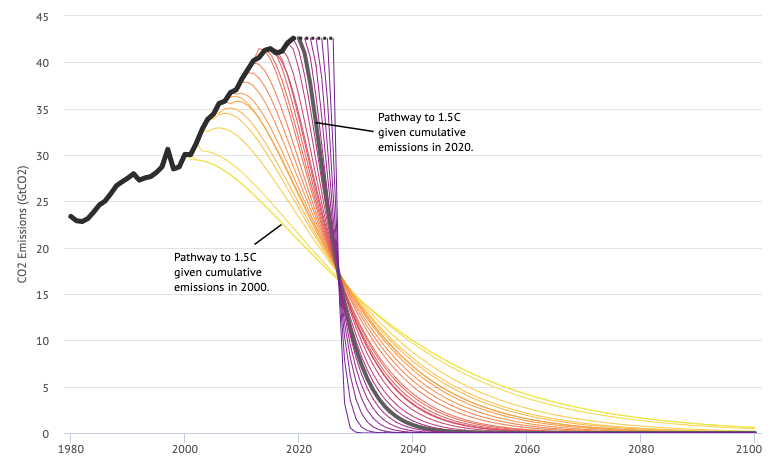
Although impressive on paper, for the most part this was not matched by action. Emissions continued to rise every year after the agreement was signed, leaving our “carbon budget” for staying within the 1.5C target shrinking ever smaller. On current trajectories, the world is expected to breach the 1.5C ceiling in less than a decade – and hit 3C of warming by the end of the century. Each passing year of inaction produces a compounding effect, necessitating ever steeper carbon reductions in future years.

Screenshot 2021-01-07 at 10.54.59.png

Emission reduction trajectories associated with a 66% chance of limiting warming below 1.5C, without a reliance on net-negative emissions, by starting year. Solid black line shows historical emissions, while coloured lines show different pathways to limiting warming to 1.5C. | Carbon Brief

In short: time is rapidly running out. For this reason alone, 2021 was always going to be a critical year in the fight against climate breakdown. But then COVID-19 came along.

‘The Great Pause’

Twelve months ago it looked like 2020 was going to be another record breaking year for carbon emissions. But as COVID-19 rapidly spread around the world, businesses were forced to close, international travel ground to a halt, events were cancelled, and people were told to isolate at home.

Unsurprisingly, this ‘Great Pause’ caused carbon emissions to fall – according to the Global Carbon Project global emissions fell by 7% in 2020. Despite being the largest relative fall since the Second World War, this still pales in comparison to what is needed to meet the Paris targets. If warming is to be limited to 1.5C then emissions need to fall by 14% every year until 2040.

Some have cited these falling emissions as evidence that COVID-19 has helped to “save the planet”. As well being wildly exaggerated, these claims are also offensive: the idea that a pandemic that has caused immense suffering and killed more than a million people should be celebrated is obviously perverse. Pandemic-induced lockdowns do not provide a model for climate action.

More importantly however, those who say the pandemic will help the environment have got things precisely backwards. Like many other infectious diseases, COVID-19 has its origins in the encroachment of human activity into natural ecosystems. As more and more countries have sought to maximise economic growth, activities such as logging, mining, road building, intensive agriculture and urbanisation have led to widespread habitat destruction, bringing people into ever closer contact with animal species. As the United Nations’ environment chief, Inger Andersen, put it: “Never before have so many opportunities existed for pathogens to pass from wild and domestic animals to people.”

According to the US Centers for Disease Control and Prevention, three-quarters of new or emerging diseases that infect humans originate in animals. In the case of COVID-19, it is believed that the virus originated in China’s bat population and was then transmitted into humans via another mammal host. On our current trajectory, while COVID-19 might be the first pandemic many of us have experienced, it will almost certainly not be the last.

COVID-19 is therefore not a random act of God. Like climate change, it is a symptom of accelerating environmental breakdown, which in turn is a product of an economic model that is reliant on growth and accumulation. Seen in this light, the idea that COVID-19 can somehow aid the environmental crisis is absurd: they are two sides of the same coin. To address both, we need to tackle the root cause.

Building back better?

As vaccines start to be rolled out across the world, attention is now turning to how the global economy can be rebooted. With unemployment soaring and economic hardship mounting, leaders will face growing pressure to reinstate ‘business as usual’ as quickly as possible. But doing this would not be a neutral act – it would be an active decision to deepen our environmental crisis. Restoring the status quo after defeating COVID-19 would be like celebrating beating lung cancer by smoking a hundred cigarettes. The cure for the disease can never be its cause.

The upshot is that the pandemic has shown that it is possible to radically restructure economies on short timescales, provided there is the political will to do so. Many countries have already promised to ‘build back better’ from the pandemic. In 2021, this rhetoric must be matched by reality. If the pandemic itself cannot cure the environmental crisis, the way we structure the recovery from it most certainly can.

Instead of spending billions to return national economies to their destructive path, governments must instead forge a different path by unleashing a vast programme of investment to decarbonise the global economy as fast as is feasibly possible, and bring our environmental footprint within fair and sustainable limits. Countries in the Global North that have played a disproportionate role contributing to environmental breakdown have a moral obligation to lead by example, while supporting a global just transition. As well as placing the global economy on a more sustainable path, this would create a new wave of high-skilled, low carbon jobs. Crucially, it would make future outbreaks of animal-borne diseases such as COVID-19 far less likely.

Some will question if we can afford such an undertaking. But the pandemic has shown that affordability is always a political constraint – not a technical one. Central banks have created trillions of dollars to prop up economies throughout the crisis – redirecting even a fraction of this towards green investments could put the world on track to meet the 1.5C temperature goal. With interest rates at record lows, there has never been a better time to turbocharge the green transition. The question is not whether we can afford to do this – it is whether we can afford not to.

In 2008 we bailed out the banks. This time, we must bail out the planet.

Crunch time for the carbon superpowers

Learning the right lessons from COVID-19 will be critical, but it’s far from the only important event this year. When it comes to meeting our climate goals, nowhere are the stakes higher than in the world’s largest two economies: the US and China. Together these two countries account for nearly half of all global emissions, and it will be virtually impossible to avert climate catastrophe without both making radical changes. Whether we like it or not, much of the power to materially reduce humanity’s carbon footprint lies in Washington and Beijing. Fortunately, 2021 is shaping up to be a decisive year in both countries.

Joe Biden has replaced Donald Trump as the 46th president of the United States. In the face of mounting pressure from climate campaigners, Biden announced that he will ensure the US reaches net-zero emissions no later than 2050. However, some fear that in power Biden will be heavy on rhetoric but light on concrete action. And with a political system awash with fossil fuel dollars and climate denial, there are questions about whether he can deliver, even if he tried to.

In China, President Xi Jinping has already pledged to make the country “carbon neutral” by 2060. Crucially however, the details of how this will be delivered will be unveiled in Communist Party’s long-awaited 14th five-year plan, covering 2021-25, which will be published in March. Of particular importance will be the binding targets that are set on the proportion of non-fossil fuels in the primary energy mix and the trajectory of coal power capacity. Both will have a huge impact on China’s emissions-reduction efforts over the coming five years.

Taken together, it’s not much of a stretch to say that President Biden’s climate package and China’s next five-year plan could be the most consequential policy packages in human history.

Beyond Paris

At its core climate change is a collective action problem: the short-term interests of each individual country are in direct conflict with longer-term interests of the planet as a whole. It’s therefore essential that national action is led by international cooperation. Once again, 2021 provides us with a critical juncture.

In November world leaders will gather in Glasgow for COP26, the successor to the landmark Paris meeting of 2015. Under the terms of the Paris deal, countries pledged to reconvene every five years to improve their carbon-cutting ambitions. COP26 will provide perhaps the last opportunity for world leaders to agree on targets that are compatible with limiting warming to 1.5C. By the time the next major COP meeting comes around in 2026, it may well be too late.

The amount at stake this year is therefore difficult to overstate. If there was ever to be a crunch point in the climate crisis, then 2021 is it. We face a fork in the road, and the decisions taken over the next 12 months will determine which path we choose. If promises to ‘build back better’ from COVID-19 are fulfilled; the Biden administration lives up to its pledges on climate change; China’s five-year plan delivers on its decarbonisation commitments; and COP26 is a success – then we might have a chance of averting climate catastrophe.

The flipside of this is that if none of this happens, our prospects look drastically different. If ‘build back better’ turns out to be an empty slogan; President Biden’s climate plan fails to pass the gridlock of the US political system; China’s five-year plan includes a vast expansion of coal power plants; and COP26 is a diplomatic failure ­­­­– then we will find ourselves locked into a very dangerous trajectory indeed.

A constellation of events like this doesn’t come along every year. Time is short – so let’s make it count.