24 Feb 2021

What Planet Is NATO Living On?

Medea Benjamin & Nicolas J. S. Davies
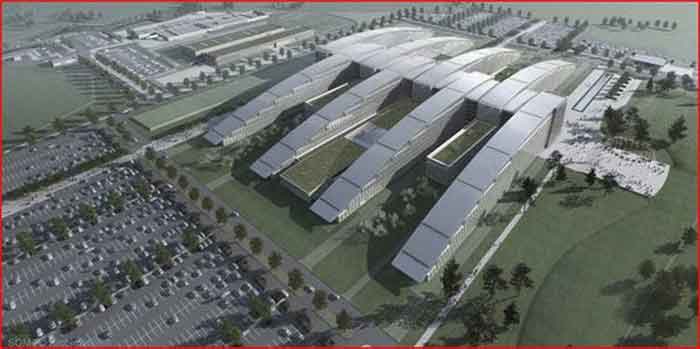


NATO headquarters in Brussels (Photo: NATO)

The February meeting of NATO (North Atlantic Treaty Organization) Defense Ministers, the first since President Biden took power, revealed an antiquated, 75-year-old alliance that, despite its military failures in Afghanistan and Libya, is now turning its military madness toward two more formidable, nuclear-armed enemies: Russia and China.

This theme was emphasized by U.S. Secretary of Defense Lloyd Austin in a Washington Post op-ed in advance of the NATO meeting, insisting that “aggressive and coercive behaviors from emboldened strategic competitors such as China and Russia reinforce our belief in collective security.”

Using Russia and China to justify more Western military build-up is a key element in the alliance’s new “Strategic Concept,” called NATO 2030: United For a New Era, which is intended to define its role in the world for the next ten years.

NATO was founded in 1949 by the United States and 11 other Western nations to confront the Soviet Union and the rise of communism in Europe. Since the end of the Cold War, it has grown to 30 countries, expanding to incorporate most of Eastern Europe, and it now has a long and persistent history of illegal war-making, bombing civilians and other war crimes.

In 1999, NATO launched a war without UN approval to separate Kosovo from Serbia. Its illegal airstrikes during the Kosovo War killed hundreds of civilians, and its close ally, Kosovo President Hashim Thaci, is now on trial for shocking war crimes committed under cover of the NATO bombing campaign.

Far from the North Atlantic, NATO has fought alongside the United States in Afghanistan since 2001, and attacked Libya in 2011, leaving behind a failed state and triggering a massive refugee crisis.

The first phase of NATO’s new Strategic Concept review is called the NATO 2030 Reflection Group report. That sounds encouraging, since NATO obviously and urgently needs to reflect on its bloody history. Why does an organization nominally dedicated to deterring war and preserving peace keep starting wars, killing thousands of people and leaving countries around the world mired in violence, chaos and poverty?

But unfortunately, this kind of introspection is not what NATO means by “reflection.” The Reflection Group instead applauds NATO as “history’s most successful military alliance,” and seems to have taken a leaf from the Obama playbook by only “looking forward,” as it charges into a new decade of military confrontation with its blinders firmly in place.

NATO’s role in the “new” Cold War is really a reversion to its old role in the original Cold War. This is instructive, as it unearths the ugly reasons why the United States decided to create NATO in the first place, and exposes them for a new generation of Americans and Europeans to examine in the context of today’s world.

Any U.S. war with the Soviet Union or Russia was always going to put Europeans directly on the front lines as both combatants and mass-casualty victims. The primary function of NATO is to ensure that the people of Europe continue to play these assigned roles in America’s war plans.

As Michael Klare explains in a NATO Watch report on NATO 2030, every step the U.S. is taking with NATO is “intended to integrate it into U.S. plans to fight and defeat China and Russia in all-out warfare.”

The U.S. Army’s plan for an invasion of Russia, which is euphemistically called “The U.S. Army in Multi-Domain Operations,” begins with missile and artillery bombardments of Russian command centers and defensive forces, followed by an invasion by armored forces to occupy key areas and sites until Russia surrenders.

Unsurprisingly, Russia’s defense strategy in the face of such an existential threat would not be to surrender, but to retaliate against the United States and its allies with nuclear weapons.

U.S. war plans for an assault on China are similar, involving missiles fired from ships and bases in the Pacific. China has not been as public about its defense plans, but if its existence and independence were threatened, it too would probably use nuclear weapons, as indeed the United States would if the positions were reversed. But they’re not—since no other country has the offensive war machine it would need to invade the United States.

Michael Klare concludes that NATO 2030 “commits all alliance members to a costly, all-consuming military competition with Russia and China that will expose them to an ever-increasing risk of nuclear war.”

So how do the European people feel about their role in America’s war plans? The European Council on Foreign Relations recently conducted an in-depth poll of 15,000 people in ten NATO countries and Sweden, and published the results in a report titled “The Crisis of American Power: How Europeans See Biden’s America.”

The report reveals that a large majority of Europeans want no part in a U.S. war with Russia or China and want to remain neutral. Only 22% would support taking the U.S. side in a war with China, 23% in a war with Russia. So European public opinion is squarely at odds with NATO’s role in America’s war plans.

On transatlantic relations in general, majorities in most European countries see the U.S. political system as broken and their own countries’ politics as in healthier shape. Fifty-nine percent of Europeans believe that China will be more powerful than the United States within a decade, and most see Germany as a more important partner and international leader than the United States.

Only 17% of Europeans want closer economic ties with the United States, while even fewer, 10% of French and Germans, think their countries need America’s help with their national defense.

Biden’s election has not changed Europeans’ views very much from a previous survey in 2019, because they see Trumpism as a symptom of more deeply rooted and long-standing problems in American society. As the writers conclude, “A majority of Europeans doubt that Biden can put Humpty Dumpty back together again.”

There is also pushback among Europeans to NATO’s demand that members should spend 2 percent of their gross domestic products on defense, an arbitrary goal that only 10 of the 30 members have met. Ironically, some states will reach the NATO target without raising their military spending because COVID has shrunk their GDPs, but NATO members struggling economically are unlikely to prioritize military spending.

The schism between NATO’s hostility and Europe’s economic interests runs deeper than just military spending. While the United States and NATO see Russia and China primarily as threats, European businesses view them as key partners. In 2020, China supplanted the U.S. as the European Union’s number one trading partner and at the close of 2020, the EU concluded a comprehensive investment agreement with China, despite U.S. concerns.

European countries also have their own economic relations with Russia. Germany remains committed to the Nord Stream 2 pipeline, a 746-mile natural gas artery that runs from northern Russia to Germany—even as the Biden administration calls it a “bad deal” and claims that it makes Europe vulnerable to Russian “treachery.”

NATO seems oblivious to the changing dynamics of today’s world, as if it’s living on a different planet. Its one-sided Reflection Group report cites Russia’s violation of international law in Crimea as a principal cause of deteriorating relations with the West, and insists that Russia must “return to full compliance with international law.” But it ignores the U.S. and NATO’s far more numerous violations of international law and leading role in the tensions fueling the renewed Cold War:

–           illegal invasions of Kosovo, Afghanistan and Iraq;

–           the broken agreement over NATO expansion into Eastern Europe;

–           U.S. withdrawals from important arms control treaties;

–           more than 300,000 bombs and missiles dropped on other countries by the United States and its allies since 2001;

–           U.S. proxy wars in Libya and Syria, which plunged both countries into chaos, revived Al Qaeda and spawned the Islamic State;

–           U.S. management of the 2014 coup in Ukraine, which led to economic collapse, Russian annexation of Crimea and civil war in Eastern Ukraine; and

–           the stark reality of the United States’ record as a serial aggressor whose offensive war machine dwarfs Russia’s defense spending by 11 to 1 and China’s by 2.8 to 1, even without counting other NATO countries’ military spending.

NATO’s failure to seriously examine its own role in what it euphemistically calls “uncertain times” should therefore be more alarming to Americans and Europeans than its one-sided criticisms of Russia and China, whose contributions to the uncertainty of our times pale by comparison.

The short-sighted preservation and expansion of NATO for a whole generation after the dissolution of the U.S.S.R and the end of the Cold War has tragically set the stage for the renewal of those hostilities – or maybe even made their revival inevitable.

NATO’s Reflection Group justifies and promotes the United States’ and NATO’s renewed Cold War by filling its report with dangerously one-sided threat analysis. A more honest and balanced review of the dangers facing the world and NATO’s role in them would lead to a much simpler plan for NATO’s future: that it should be dissolved and dismantled as quickly as possible.

Myanmar: Exploiting lessons learnt in the Middle East

James M. Dorsey


Demonstrating for the third week their determination to force the country’s military to return to its barracks, protesters in Myanmar appear to be learning lessons from a decade of protest in the Middle East and North Africa.

By the same token, Myanmar’s protesters, in stark contrast to public silence about the military’s brutal repression of the Rohingya minority in recent years, seem to want to forge a national identity that supersedes past emphasis on ethnicity and/or religion.

In doing so, they, like their counterparts in Lebanon and Iraq, reject sectarian policies that allowed elites to divide and rule and distract attention from economic and social grievances held by all segments of the population.

As they resist the military’s February 1 coup that nullified a democratic election won in November in a landslide by Aung San Suu Kyi’s National League for Democracy (NLD) because of alleged electoral fraud, protesters confront many of the same obstacles that demonstrators in  Thailand, Turkey, Sudan, and Algeria face.

The ability to address desperately needed reforms with a buy-in from the military will shape a return to democracy and the sustainability of the transition. Taking military concerns into account reforms will have to include civilian control of the military, defining the military’s mission in national defence rather than ideological terms, and regulating the armed forces’ vast economic interests.

The Middle East and North Africa provide cautionary tales like Egypt that eight years after a coup has become a brutal dictatorship and Libya, Syria and Yemen that are wracked by war, as well as potential models, that would serve Myanmar’s democratization well.

Tunisia, the one Arab country to have pushed political transition relatively successful, was able to do so because Zine El Abidine Ben Ali, the Tunisian autocrat who was overthrown in 2011, had ensured that the military had no vested interest in the country’s political system.

Mr. Ben Ali decimated the military leadership, severely cut the budget of the armed forces early on in his 24-year rule and sidelined the military, relying instead on security forces and law enforcement. As a result, the military effectively stood aside when protesters staged mass anti-government demonstrations.

The positioning of Tunisia’s armed forces may not offer Myanmar immediate options, but it highlights the need for a military that understands itself as a national institution rather than a party with vested political and economic interests.

Of more immediate importance to Myanmar is the fact that Mr. Ben Ali as well as the leaders of Egypt, Libya and Yemen were toppled by an informal alliance between civil society and either factions of the military or the armed forces as a whole. They shared a short-term interest in removing the incumbent from power.

The same is true for Southeast Asia’s people power revolts in the Philippines and Indonesia in the 1980s and 1990s. In Myanmar, it was the military that opted for a degree of political liberalization following decades of intermittent mass protest.

It took Tunisian civil society’s engagement with the security forces as well as other segments of society and the existing power structure to nurture the democratization process. By contrast, the process was derailed in much of the Middle East by a post-revolt breakdown of the alliance, often aggravated and/or manipulated by external forces.

The Tunisian approach enabled all parties to manage the inevitable divergence of interests once Mr. Ben Ali had been toppled, juxtaposing civil society’s quest for wholesale political and economic reform with the security forces’ insistence on the preservation of their economic and political interests and rescue of as much of the Ancien regime as possible.

In Tunisia, like in other post-revolt countries, the divergence kicked in the moment the incumbent was removed. The Middle East and Southeast Asia’s experience demonstrates that the pitfalls are embedded in the compromises made to establish a transitionary government.

Inevitably, the military and/or security forces either constitute the transition government or are a powerful part of it. Their track record is one of taking liberties in protecting their interests.

Like in Myanmar this month, the military crosses red lines when the transition endangers those prerogatives. Learning how to counter the pitfalls of perilous but inevitable cooperation with at least segments of the military and/or security forces is a work in progress.

Turkey provides a different set of lessons. President Recep Tayyip Erdogan’s turn towards repression and authoritarianism in the wake of a failed military coup in 2016 suggests that civilian control does not offer a magic wand even if the takeover was foiled by protesters who set aside their social, ideological, and political differences.

If this is a cautionary tale, Turkey also offers solutions to at least one of the issues: the military’s economic interests. Turkey’s military, even before the imposition of civilian control, put its economic house in order by creating a conglomerate, one of the country’s largest, that is owned by the military pension fund and subject to regulation, civic and commercial law, and markets like any other privately held institution.

As civil obedience in Myanmar persists, protesters have certain advantages.

Rather than being on their own, the protesters benefit from being at the forefront of a wave of defiance and dissent that for the past decade and no doubt the next is fueled by a breakdown in confidence in political systems and leadership.

With the pandemic, the widespread mismanagement of public health responses, the global economic downturn and dislocation, and technological change, the coming decade promises to be perhaps even more turbulent.

In addition, Myanmar protesters’ may be beneficiaries of the electoral defeat of US President Donald Trump and the rise of Joe Biden, who has pledged to make human rights a central plank of his foreign policy.

Granted, US adherence in its foreign policy to its human rights values has at the best of times been checkered.

Nonetheless, Mr. Biden’s approach, even if imperfectly applied, erases the permissive environment that autocrats enjoyed during the Trump years.

There is, moreover, a reason to believe that Mr. Biden will be truer to his pledge because it is key to US efforts to repair the credibility and reputational damage suffered by the United States because of Mr. Trump’s America First policy; disdain for multilateralism, international institutions, and international law; empathy with autocrats; and disregard for human rights.

Playing into Mr. Biden’s emphasis on human rights is the fact that the protests, like in Lebanon and Iraq, appear to have broken down ethnic and religious fault lines.

Yangon’s usually hidden Rohingya community has openly joined the protests four years after detained democratically elected Myanmar leader Aung San Suu Kyi stood by and later defended the military’s ethnic cleansing of the Rohingya, more than 700,00 of which fled to Bangladesh.

Burmese who in recent years used Twitter to attack and threaten Rohingya activists living in exile have apologized since the February coup, recognizing that military rule poses a threat to all.

Political transition, like reconciliation, is a long-drawn-out process that can take up to half a century to play out. It is a process of two steps forward and steps backwards as Myanmar is discovering now.

The Myanmar military understands that tacit Russian and Chinese support may not be as much of a lifesaver as it was in the past. That may explain the military’s reluctance to crush the protests even if the likelihood of an imminent crackdown is high.

If the experience of Egypt is anything to go by, the military can brutally suppress and keep a lid on unrest for a period of time. It may preserve the military’s interests for a while, but it cannot provide sustainable economic solutions or ensure stability.

In contrast to Egypt, protesters in Myanmar have the advantage that they are demanding recognition of a current election outcome that could put a new government in a position to redefine the role of the military and regulate its economic interests.

Based on the experience of Egypt, one core bone that the government would likely have to throw the military is immunity against prosecution for past crimes. That may be a bitter pill to swallow and violate principles of truth and accountability as an important pillar of transition.

As Egypt demonstrates, it offers no guarantee of keeping the military in its barracks. But it may be the carrot that helps entice the military to make the concessions needed for a democratic transition.

For now, Myanmar cries out for non-partisan independents capable of helping the military and the protesters to back away from a zero-sum game that seems destined to result in bloodshed.

That is likely to prove a gargantuan task as Indonesian Foreign Minister Retno Marsudi spearheads efforts by the Association of Southeast Asian Nations (ASEAN) to mediate a way back from the brink.

In the words of former International Crisis Group Myanmar analyst Morten B. Pedersen “when a military obsessed with order and stability…confronts an essentially leaderless popular movement driven by youthful anger and shattered hopes, compromise is perhaps the hardest thing of all.”

Media censors British Medical Journal description of pandemic deaths as “social murder”

Robert Stevens


On February 4, the BMJ (formerly, British Medical Journal) published an editorial accusing the world’s governments of “social murder” in their collective response to the pandemic.

The response to this devastating statement by the media and politicians of all stripes in Britain was to ignore and conceal it.

The editorial, “Covid-19: Social murder, they wrote—elected, unaccountable, and unrepentant”, was written by Kamran Abbasi, the executive editor of the journal.

The BMJ editorial: "Covid-19: Social murder, they wrote—elected, unaccountable, and unrepentant"

“Murder,” the editorial begins, “is an emotive word. In law, it requires premeditation. Death must be deemed to be unlawful. How could ‘murder’ apply to failures of a pandemic response?”

But, it argued, “After two million deaths, we must have redress for mishandling the pandemic…

“At the very least, covid-19 might be classified as ‘social murder,’ as recently explained by two professors of criminology. The philosopher Friedrich Engels coined the phrase when describing the political and social power held by the ruling elite over the working classes in 19th century England. His argument was that the conditions created by privileged classes inevitably led to premature and “unnatural” death among the poorest classes.”

The editorial concluded, “The ‘social murder’ of populations is more than a relic of a bygone age. It is very real today, exposed and magnified by covid-19. It cannot be ignored or spun away. Politicians must be held to account by legal and electoral means, indeed by any national and international constitutional means necessary.”

An article on the significance of the BMJ editorial published on the WSWS has been read tens of thousands of times.

The BMJ is the world’s oldest and one of the most prestigious medical periodicals, with a publication history going back to 1840.

Abbasi, a doctor, is a major figure in the medical world. His BMJ biography notes, “In his career as a medical editor, Kamran is a former acting editor and deputy editor of The BMJ, editor of the Bulletin of the World Health Organization, and a consultant editor for PLOS Medicine. He is editor of the Journal of the Royal Society of Medicine and JRSM Open. He created three major e-learning resources for professional development of doctors, including BMJ Learning and the Royal Society of Medicine's video lecture service.”

“Kamran has held board level positions and been chief executive of an online learning company. He has consulted for several major organisations including Harvard University, the UK's NHS, the World Health Organization, and McKinsey & Co. In addition, Kamran is an honorary visiting professor in the department of primary care and public health at Imperial College, London. He is a fellow of the Royal College of Physicians of Edinburgh and the Royal College of Physicians of London, patron of the South Asian Health Foundation, and a member of the General Advisory Council of the King's Fund.”

The Guardian, despite its claim to publish the “independent journalism the world needs”, gave the editorial just five paragraphs in its daily “Coronavirus live” roundup during the afternoon of February 4 and no independent article. There was no reference to the BMJ’s editorial in the TimesDaily TelegraphIndependentDaily MirrorDaily Mail or Financial Times.

The message from the ruling class and its media echo chamber was clear. There must be no public discussion allowed on a statement pointing out that “the conditions created by privileged classes inevitably led to premature and ‘unnatural’ death among the poorest classes.”

Finely attuned to the threat from below, Britain’s ruling elite wants no public discussion of the issue of social murder as it prepares to end the “last lockdown,” with the virus and its dangerous mutations allowed to rip through the population once again to deadly effect.

Among those giving the BMJ article a wide berth was John McDonnell, the former shadow chancellor of the Labour Party under its then nominally “left” leader Jeremy Corbyn.

John McDonnell [Credit: Wikipedia Commons]

In July, 2017, McDonnell told the BBC regarding the June 14 Grenfell Tower fire, which claimed 72 lives, “There’s a long history in this country of the concept of social murder where decisions are made with no regard to consequences of that, and as a result of that people have suffered. That’s what’s happened here, and I’m angry... I believe social murder has occurred in this instance and I believe people should be accountable.”

The WSWS noted in an article on McDonnell’s statement, “McDonnell did not say so, but he was citing Frederick Engels in The Condition of the Working Class in England (1845). Engels, the co-founder with Karl Marx of scientific socialism, wrote condemning the British ruling class for the impact of fetid water supplies, cramped housing and disease on the working class:

"When society places hundreds of proletarians in such a position that they inevitably meet a too early and an unnatural death, one which is quite as much a death by violence as that by the sword or bullet; when it deprives thousands of the necessaries of life, places them under conditions in which they cannot live—forces them, through the strong arm of the law, to remain in such conditions until that death ensues which is the inevitable consequence—knows that these thousands of victims must perish, and yet permits these conditions to remain, its deed is murder just as surely as the deed of the single individual."


Engels as a young man

McDonnell was denounced by the ruling Conservatives for his description of Grenfell and by MPs from his own party, including Emma Dent Coad, the newly elected Labour MP for the constituency in which Grenfell is located.

Four years on, amid a pandemic that has taken at least 126,000 lives in the UK, McDonnell has dropped all talk of social murder. In a November 21, 2020 interview, prominent Guardian journalist Owen Jones asked McDonnell, “Given we’ve got the worst death toll” and “You said Grenfell was social murder,” how he categorised the pandemic.

McDonnell replied, “On Grenfell when I said social murder, social murder was developed as a concept from Engels onwards. Then you realise that you are using language that people don’t fully appreciate.” He described the “shock horror condemnation I was getting from a whole range of media outlets as well as individuals who should have known better…,” in contrast to “when I met a lot of the Grenfell residents, they were all completely supportive.”

He then made clear that he had learned his lesson regarding what can be said. The pandemic could not be described as social murder he insisted, “I think that what we are seeing now is criminal negligence where advice is being given from experts to government ministers and the government ministers have overridden that advice and as a result of that people have died and others have suffered badly. And its affected whole families and communities. So, I think it is criminal negligence.”

The WSWS article cited above noted that McDonnell was correct to describe Grenfell as social murder but that he “should be judged by his actions, not just his words. Having said that the guilty should be punished, workers should demand to know what he is doing about it?

“McDonnell, Corbyn and any politician who presumes to speak on behalf of the working class has the responsibility to name the guilty and fight nationally and within parliament for them to be brought to justice.”

McDonnell would never do this as, “Among those whose political decisions led to the Grenfell inferno are the leadership of the Conservative Party, past and present, and of the Labour Party too—all those who have jointly presided over endless privatisations and savage social cuts that have continued unabated since 1979. The culpable include Tony Blair, Gordon Brown, David Cameron, Theresa May and her likely successors, such as former Mayor of London Boris Johnson, who laid waste to London’s fire service.”

McDonnell is not just shielding Johnson with his silence on social murder but the Labour Party, which, initially under Corbyn and then his replacement as leader, Sir Keir Starmer, has allied with Johnson in a de facto government of national unity since they start of the pandemic. Last August, when over 40,000 lives had already been lost, McDonnell came forward to endorse Starmer’s “constructive opposition” to Johnson. He said, “I think Keir’s got this exactly right. He’s approached the government in a constructive way—and we’ve got to get through this crisis together…”

Johnson and Starmer have relied on the trade union bureaucracy who have dedicated their entire energy and huge apparatus to suppressing every struggle of the working class and policing the herding of workers back into unsafe workplaces and schools.

It is this murderous agenda that accounts for why the BMJ’s editorial is treated like radioactive material, not just by the Tory party and corporate media but by the entire political spectrum, including Labour’s nominal “left-wing” and its trade union backers.

Global vaccination at the mercy of competing national interests

Jean Shaoul


Speaking after last week’s placeholder event for the delayed Munich Security Conference, France’s President Emmanuel Macron confirmed the role of vaccines as a geopolitical weapon in a war of influence—a war that the West was in danger of losing.

Warning, “You can see the Chinese strategy, and the Russian strategy, too”, the French President openly expressed his bitter hostility to the circulation of their vaccines to countries in the Middle East, Asia, Africa and Latin America that are seeking vaccines at affordable prices.

Macron stressed the importance of sending at least enough doses to vaccinate health care workers in Africa, because of the increasing role being played on the continent by cheaper Russian and Chinese vaccines. He warned that the West’s slow response would leave the strength of the West “a concept, but not a reality.”

This is an unvarnished declaration of the political realities governing every national ruling class’ response to the pandemic. Their dominant concern is not the health of the world’s population, but the struggle for commercial and geostrategic advantage. The burning need for a global immunization programme has accelerated this ruthless struggle, in what is being euphemistically described in the corporate media as “vaccine diplomacy.”

Palestinian workers unload a truck from 20,000 doses of Russian-made Sputnik V vaccine upon its arrival to Gaza Strip, at the Rafah crossing border with Egypt, Sunday, Feb. 21, 2021. The 20,000 doses of Russia's Sputnik V, donated by the United Arab Emirates and organized by Abbas rival Mohammed Dahlan, entered the Palestinian enclave through its border with Egypt. (AP Photo/Khalil Hamra)

Just 10 countries have carried out 75 percent of all vaccinations worldwide amid a pandemic that has officially infected more than 112 million people and killed nearly 2.5 million.

Leading the world are Israel with 82 doses per 100 residents, the United Arab Emirates with 54, the UK with 25, and the US with 17, compared to a global average of only 1.7 per hundred.

Wealthy countries have bought up far more vaccines than they need. The European Union (EU) has ordered 1.6 billion doses for its 375 million adult population, enough for just under 900 million people, the UK 219 million full vaccinations for its 54 million adults, and Canada 188 million full vaccinations for its 32 million adults. The US and European countries have reportedly considered or implemented bans on exporting vaccines until they finish their own programs.

The world’s rival capitalist cliques are relying on mass vaccination as a means of reopening their economies, ensuring their corporations and banks’ profits and diverting popular opposition away from their bailouts of the rich and back-to-work and back-to-school drives.

Government funding serves to underwrite the monopoly profits of Big Pharma, even though the vaccines are largely the product of publicly funded research. Last October, the US, the EU and the UK rejected India and South Africa’s request to the World Trade Organization to waive intellectual property protection for the vaccines and allow developing countries to manufacture or import generic versions.

Control over vaccine distribution and local licensing also strengthen the national powers’ political and economic influence—their “soft power”—over allies and enemies alike.

If or when the richest countries share their excess doses, they will likely donate or sell them at low cost bilaterally to their allies and client states instead of distributing vaccines through multilateral public health initiatives such as Covax—a Public-Private Partnership comprising international health organizations including the World Health Organisation, the Coalition for Epidemic Preparedness Innovations (CEPI) and GAVI, the Vaccine Alliance.

From a rational and global healthcare, economic and social perspective, such nationalism will harm everyone.

With 130 countries yet to receive a single dose, most of the necessary vaccinations are not set to take place until 2022 and 2023. Not only is that far too late to halt the spread of the disease, but it may also be necessary to revaccinate those who have already received the jabs as new harmful mutations prove resistant to the vaccines developed.

Unable to pay the exorbitant prices demanded by Big Pharma, some 94 poor and middle-income countries have signed agreements with Covax, which will supply vaccines free to the very poorest countries in proportion to their population. But with the Western-produced vaccines typically selling within the EU at between $9 (Sanofi/GSK) and $18 (Moderna)—only the AstraZeneca vaccine is selling on a not-for-profit basis at $2—Covax, which has struggled to get enough supplies, hopes to be able to deliver just 2.3 billion doses this year.

Even this is dependent on receiving further funding and will at best cover just 20 percent of its target population of frontline heath workers, the old and the vulnerable. While the US pledged an immediate $2 billion donation to the Covax programme at Friday’s G7 meeting, it said it would provide a second tranche of $2 billion later only but after other nations make donations up to at least $15 billion—far short of the total vaccination effort that is expected to cost $35 billion.

While Canada, Norway and the UK have said they will donate some of their surplus vaccines, Covax has no power to compel others to do so.

In the meantime, countries are sending their vaccine surpluses to near neighbours, or to achieve “national security” or foreign policy goals. Spain announced it will sell 30,000 excess doses to the tiny tax-haven of Andorra at cost.

In these circumstances, the supply of Russian and Chinese vaccines is seen as a major threat by the imperialist powers. The United Arab Emirates (UAE) is one of the first countries to approve the Chinese-made Sinopharm vaccines, donating them to countries where it has strategic or commercial interests, including 50,000 doses each to the Seychelles and Egypt.

On Friday, it was revealed that Israel had agreed to buy Sputnik V vaccines from Russia as part of a prisoner-swap deal to secure the release of an Israeli woman who had apparently strayed into Syria. Israel has given at least one vaccine shot to nearly half its 9.2 million population while denying vaccines to the Palestinians in the occupied West Bank and Gaza. Syria, now entering the 11th year of a proxy war funded by the US, the Gulf monarchs and Turkey to overthrow the regime of President Bashar al-Assad, has yet to begin its vaccine rollout.

Chinese Foreign Minister Wang Yi in a recent trade mission to south east Asia promised Myanmar 300,000 doses, 500,000 doses each to Pakistan and the Philippines and an initial one million doses to Cambodia. Wang Yi secured a $45 million deal with Indonesia for three million Sinovac doses with a further 100,000 doses for CanSino. Beijing is also offering small quantities of its vaccines free of charge to Egypt, Equatorial Guinea, Zimbabwe and Bangladesh, as a precursor to larger sales contracts.

Egypt, which has a significant pharmaceutical industry, is anxious to become a production centre for the Chinese vaccine in Africa, even as Sinopharm has agreed to build a manufacturing plant in Morocco next year.

Russia has signed deals with more than 50 countries from Latin America to Asia for 1.2 billion doses of its Sputnik V vaccine and started delivering doses to Hungary and Serbia ahead of EU approval. With limited productive capacity of its own, Moscow is looking overseas to expand production, signing agreements with 15 companies in 10 countries to produce 1.4 billion jabs, with Germany interested in “joint production” of Sputnik V, according to the Financial Times .

Iran, whose efforts to obtain the vaccine have been hampered by US sanctions, has rejected US and UK-produced vaccines, although it will access them through Covax, approving Sputnik V while seeking to develop its own vaccine in collaboration with Cuba.

India, which produces 60 percent of the world’s vaccines, is determined not to be outdone by its arch-rival in the region, China. It is giving away millions of AstraZeneca doses, made locally under licence, to its neighbours, including Afghanistan, Bhutan, Cambodia, Maldives, Bangladesh, Nepal, Myanmar, and the Seychelles, as a central plank of its trade and foreign policy. It has concluded deals to supply Brazil and Morocco with vaccines and plans to supply Mongolia and Pacific Island states. India’s foreign ministry said it had supplied 15.6 million doses of the vaccine to 17 countries either through donations or commercial contract.

In an indication of the desperate scramble to obtain the vaccine, Pakistan has so far only been able to obtain the Sinopharm vaccine and is still waiting for its 17 million allocation under the Covax scheme. It is allowing private companies to import four coronavirus vaccines (Sputnik V, the AstraZeneca and two Sinopharm vaccines) and sell them without a price cap, ensuring that only the financial elite will have access to them.

Washington has responded by seeking to discredit China and Russia’s vaccines, which are both effective and capable of being stored at the standard 2C-8C (35.6F to 46.4F), in contrast to other vaccines that require cold or ultra-cold storage—a major factor in Egypt, Morocco, United Arab Emirates and Bahrain’s choice of China’s Sinopharm vaccine as part of their national rollouts. The US has derided China and Russia for pushing what it calls their “vaccine diplomacy” offensive, arguing they have only vaccinated a small number of their own citizens.

The disastrous response of all the major capitalist powers to the global pandemic even as they prepare for “great power conflict” and a new scramble to recolonize the world serves to confirm the urgency of putting an end to capitalism and the subjugation of human health to private profit. It poses the utmost necessity of the international working class intervening to expropriate the pharmaceutical and all the major industrial corporations and transform them into publicly owned and democratically controlled utilities in the service of humanity.

Canada’s parliament condemns China for “genocide” on eve of Trudeau-Biden summit

Roger Jordan


With all-party support, Canada’s House of Commons overwhelmingly approved a provocative motion Monday that condemns China for perpetrating a “genocide” against the country’s Uyghur Muslim minority and other Turkic peoples.

Introduced by the hard-right Conservatives, the motion equates Beijing’s state surveillance and repression of the Uyghurs with the Nazi holocaust and other horrific crimes.

It is the latest salvo in a propaganda campaign aimed at providing a bogus human rights cover for Canadian imperialism’s ever expanding role in Washington’s all-sided diplomatic, economic and military-strategic offensive against China—and under conditions where US President Joe Biden has vowed to wage “extreme competition” with China.

President Joe Biden speaks after holding a virtual meeting with Canadian Prime Minister Justin Trudeau, in the East Room of the White House, Tuesday, Feb. 23, 2021, in Washington. (AP Photo/Evan Vucci)

MPs from all parties, including the governing Liberals and the nominally “left” New Democrats and Greens, backed the “genocide” motion, and a Bloc Québécois (BQ) amendment that urged Ottawa to press for the 2022 Winter Olympics to be withdrawn from China.

With the exception of Garneau, all members of the Liberal cabinet, including Trudeau, absented themselves from the House of Commons during Monday’s vote. Garneau abstained.

In the face of opposition charges of “inaction” and appeasement, Trudeau and Garneau have been at pains to stress that their government would be willing to embrace the “genocide” charge, if done in coordination with Washington and the other G-7 imperialist powers.

The incendiary charge of “genocide” levelled against the Stalinist Communist Party regime in Beijing is politically motivated. While there is no doubt that China’s government, which represents the interests of a corrupt capitalist oligarchy, is carrying out widespread repression against the Uyghurs of Xinjiang province and the working class throughout the country, the lurid claims that it is committing a “genocide” have no basis in fact. They are being promoted in the United States, Canada and other Western imperialist countries with the aim of demonizing China, labelling those who oppose the US strategic offensive against China as apologists for “crimes against humanity” and creating a base of popular support for aggression and war with Beijing. It is a classic case of human rights imperialism, which has been used by Washington, Ottawa and the other imperialist powers to justify one war of aggression after another over the past 25 years.

The claim that Beijing is conducting “genocide” against the Uyghurs goes hand-in-hand with the promotion of totally discredited claims, originating from far-right groups and now embraced by the Biden administration, that the coronavirus was released from a lab in the Chinese city of Wuhan.

The passage of the China genocide motion came on the eve of yesterday’s virtual summit between Trudeau and President Biden. Picking up from where the far-right Trump administration left off, Biden and his secretary of state, Anthony Blinken, have vowed to continue and intensify Washington’s bullying of Beijing. Unlike Trump, however, whose policy was characterized by unilateralism, Biden has indicated that he will work to cobble together an alliance of Western “democracies” to more effectively confront China and use “human rights” issues to try to give this offensive a “progressive” hue.

In a recent speech to an online meeting of the Munich Security Conference, Biden invoked Europe and America’s “shared democratic values” to appeal for “transatlantic unity” to “push back against the Chinese government’s economic abuses and coercion that undercut the foundations of the international economic system.”

Canada’s ruling elite views its three-quarter-century-old military-security partnership with Washington as pivotal to its global imperialist interests and ambitions, and shares the US Republican-Democratic bipartisan consensus that the rise of China constitutes an unacceptable threat to North American imperialist hegemony. That is why it is hitching its wagon to Washington’s anti-China offensive.

Monday’s unanimous parliamentary vote comes after a crescendo of anti-Chinese propaganda from the media and the political establishment. Last month, a letter sponsored by the BQ demanding that the 2022 Winter Olympics be stripped from China due to its “genocide” against the Uyghurs was supported by representatives of all parties in the House of Commons and the Quebec legislature, including the two pro-Quebec independence parties in the Quebec legislature, the Parti Québécois and the pseudo-left Québec Solidaire.

The Conservatives and New Democrats, the “left” and “right” flanks of this all-party coalition for strategic conflict and war preparations against China, are demanding that the Trudeau government go even further in integrating Canada with the US offensive against Beijing.

NDP international development spokesperson Heather McPherson chastised the Trudeau cabinet for failing to endorse Monday’s “genocide” motion. “Cabinet hid,” she complained. “It seems to me to be very along the same lines of their China policy to date, where there is such a lack of action.”

The “action” demanded by these pro-imperialist warmongers includes the formal exclusion of Chinese tech giant Huawei from Canada’s 5G telecommunications network on the basis of “national security” concerns. It also includes the call for Canada to withdraw from the Chinese-led Asian Infrastructure Investment Bank, which is seen by Beijing as an important pillar of its Belt and Road initiative aimed at expanding Chinese trade and economic activity across Central Asia, Africa, the Middle East and Europe.

Last year, even as it provided the big business minority Liberal government with the votes needed to retain power, the NDP joined forces with the Conservatives and BQ to create a special parliamentary committee, over the government’s objections, charged with reviewing and pressing for the “reset” of Canada’s policy towards China.

The opposition parties’ denunciation of the Liberal government for allegedly failing to adopt a sufficiently hardline approach to Beijing must serve as a warning to the working class as to the extent the entire establishment is gripped by imperialist anxiety and militarism.

Trudeau and his Liberals long ago abandoned their plans to seek an Australia-style free trade agreement with China. Instead, with the full support of their trade union allies, they worked with Trump to renegotiate the North American Free Trade Agreement to make it a more explicit trade war and geopolitical bloc, so as to strengthen North America’s twin imperialist powers against their rivals, above all China and Russia. The US-Mexico-Canada Agreement specifically prohibits free trade deals with “non-market economies,” a euphemism for China.

In December 2018, the Trudeau government ordered the seizure of Huawei Chief Financial Officer Meng Wanzhou on bogus charges of violating illegal US sanctions on Iran, and the Canadian military has dramatically expanded its presence in the Asia Pacific in recent years, including with “freedom of navigation”-type operations in the Taiwan Strait.

In his first discussion with Biden after his assumption of the presidency, Trudeau reiterated his government’s commitment to expand bilateral military-strategic cooperation, above all by upgrading the North American Aerospace Defence command (NORAD) so that this Cold War-era military alliance is ready for a nuclear conflagration with Moscow or Beijing

Following Monday’s vote, Garneau made clear in a statement that the Liberal cabinet’s tactical decision to abstain on the non-binding vote did not represent a weakening of its hardline stance towards China. Garneau welcomed “parliamentarians working together and debating this critical issue,” reiterated the government’s call for an international investigation of the “allegations of genocide” and said Canada “will continue to work with international partners”—that is, the US, Britain, France, Germany and Japan—“to defend vulnerable minorities.”

For the Conservatives, NDP and their backers in the ruling class, this does not go far enough. The opposition parties have repeatedly assailed the government from the right on military spending, with the NDP complaining that the Liberals, who have announced a more than 70 percent hike in military spending, are guilty of underspending on defence and leaving Canada’s armed forces ill-equipped to fulfill their imperialist operations around the world.

Well aware that this mad program of military rearmament and great power confrontation enjoys no popular support, the ruling class is working through their political parties and media mouthpieces to whip up a bogus narrative of Canada standing up for “democracy” and “human rights.” Tory leader Erin O’Toole gave voice to this drive following Monday’s vote, declaring, “There is real suffering going on in China, there’s a genocide happening, and Canadians, while we’re free traders and I’m very proud to be a free market party, our values are not for sale.”

Just who does O’Toole think he is kidding? Canada’s “values” and its denunciations of reputed violations of international law invariably correspond to its imperialist ambitions and those of its closest ally, the United States. In 2003, when the Bush administration launched its illegal war of aggression against Iraq on bogus claims of “weapons of mass destruction,” then Canadian Prime Minister Jean Chretien dismissed all talk of the war being a violation of international law, quipping cynically that this would be a question for historians to decide decades hence. In 2011, the Canadian military joined NATO’s war on Libya, claiming they were upholding “human rights” and the “responsibility to protect,” as they bombarded the country and used Islamists as shock troops to overthrow the Gaddafi regime. After NATO’s bombs caused the deaths of tens of thousands of innocent civilians and plunged the country into civil war, a Canadian Armed Forces commander acknowledged that Ottawa had functioned as “Al Qaeda’s air force.”

However, the hypocrisy and dishonesty of the “human rights” imperialists does not make their pro-war campaign any less dangerous. On the contrary, they hope that the incessant repetition of the lie of Chinese “genocide” will poison the political climate, creating the conditions for them to pursue a campaign of aggression against China in alliance with Washington, whose logic is a catastrophic military conflict, unopposed. As the banner headline on the front-page of yesterday’s Globe and Mail’s gleefully declared, “Yea: 266 Nay 0–China committing genocide, parliament declares.”

Macron government doubles down on right-wing attack on French universities

Alex Lantier


Following the adoption of the “anti-separatist” law in the French National Assembly, Higher Education Minister Frédérique Vidal has continued to defend the government’s measures announced over the past week to bring universities into line with the law. Vidal proposed to investigate all university research in France and to take action against academics guilty of supposed “separatism” and “Islamo-leftism.”

Vidal’s proposal highlights the anti-democratic character of the “anti-separatism” law. It restricts religious freedom, overriding the 1905 secularism law in France. It contains a far-reaching attack on the right to association, as all associations are kept under constant threat of dissolution for the actions of their members. In the context of universities, the law is now being used to impose the political criteria of the extreme right on academic researchers.

Above all, this is aimed at suppressing a growing political radicalization among students and in the working population over the coronavirus pandemic and the policy pursued by the French ruling class.

More than 600 university higher education lecturers have already signed a statement demanding Vidal’s resignation. Published in Le Monde, it denounces Vidal’s project and the government’s indifference to the fate of students, who have been cut off from casual employment during the pandemic and been forced by the lack of government support to turn to charities for food and other essentials.

“The violence of the law underscores the cowardice of a minister who remained silent about the distress of students during the pandemic, just as she was deaf to our questions about a law on research programs that was massively rejected by researchers,” they write.

Deploring the intellectual “poverty” of Vidal’s arguments, “culling from the repertoire of the extreme right an imaginary “Islamo-leftism,” while threatening “intellectual repression,” they write: “Frédérique Vidal jumps on the conspiracy theory of ‘Islamo-leftism’ and accuses us of rotting the foundations of the university. She wants to launch an investigation, threatens to divide and punish us, to create suspicion and fear, and trample on our academic freedoms. We consider such a minister unworthy of representing us and we strongly demand her resignation.”

Vidal’s proposal highlights the dictatorial nature of the projects of the entire ruling class and the need for a political mobilisation of the working class. The right wing and the Macron government openly demand the repression of so-called “Islamo-leftism.” The Stalinist French Communist Party and Jean-Luc Mélenchon’s Unsubmissive France (LFI) voted for large portions of the law in the Assembly. Just like the coronavirus pandemic itself, the anti-separatist law can only be fought with a mobilisation of workers independent of the trade union apparatuses and the establishment political parties.

French President Emmanuel Macron attends a video-conference meeting with World Health Organization (WHO) Director-General Tedros Adhanom Ghebreyesus amid the COVID-19 outbreak. (Christian Hartmann/Pool via AP)

Large sections of academics are aware that Macron is working to rehabilitate the political traditions of European fascism. His lead collaborator is Gérald Darmanin, the Minister of the Interior and former supporter of the far-right Action Française. Sorbonne President Jean Chambaz linked the hunt for “Islamo-leftism” to the campaign by the Nazis and Action Française against communism and the Jews in the 20th century.

On France Info, Chambaz called for “denouncing this kind of position.” She added: “‘Islamo-gauchism’ is an absolutely imprecise term, coming from extreme right-wing circles, taken up by certain Republican deputies who would like to ban the teaching of certain disciplines at the university. ... It makes me think more of the slogans of the 20th century denouncing Judeo-Bolshevism.”

Confronted with the opposition of students and teachers toward Macron’s policy of “herd immunity” to permit the coronavirus to spread, Chambaz was compelled to implicitly denounce the government. Responding to Vidal’s claim that Islamo-leftism is “gangrene” for society, Chambaz said: “What is the real gangrene for society? It is discrimination, ghettoization, social inequality in access to employment, in access to education, to culture, and the failure of public policy in this area over the last 50 years.”

The essential issues involved in the “anti-separatist” law and, more broadly, the pandemic, are becoming increasingly clear. The European Union is hostile to the basic health measures that have stopped the virus in China and Taiwan. The ruling class has maintained corporate production at all costs, even if it is not essential for the €2 trillion in capital provided by the EU in bailouts to banks and big business. This has been at the cost of almost 800,000 lives and has permanently undermined the economy and the social conditions of workers and young people.

To impose this policy over social opposition, the ruling class is moving to create an authoritarian regime, in continuity with Macron’s brutal police crackdown against the “yellow vests.”

The fear of a political radicalisation of young people and a social explosion dominates all the European governments. In Spain, the coalition government of the Social Democrats with Podemos, the Spanish ally of Mélenchon’s LFI, has thrown rapper Pablo Hasél into prison for denouncing the monarchy. In the United Kingdom, the right-wing government is establishing a “freedom of speech” commission that would impose financial penalties on universities that allow protests against academics tied to the government.

In France, the Macron government is continuing its effort to bring universities into line. The Minister of National Education, Jean-Michel Blanquer, has called “Islamo-Leftism” an “undeniable social fact,” and Darmanin has claimed that the university and public services “are affected by Islamism sometimes aided by leftists.”

This weekend, Vidal confirmed to the Journal du Dimanche that the government would not abandon its plan against the universities. Hypocritically declaring her commitment to academic freedom, Vidal let it be known that the investigation is aimed against a political radicalisation in the universities.

“There will indeed be an inquiry,” she declared, insisting on her willingness to “quantify things, to get out of the feeling and the presupposition” about the “entry of Islam” into the universities. She went on to say that the target of the investigation would not be “Islamo-leftism,” but any radical thought: “When I use the term ‘Islamo-leftism,’ used by the journalist who interviewed me, I have in mind all the forces of radicalism in our society.”

This comment, presented as a denial to reassure the JDD and its readers, in fact underlines the anti-democratic nature of Macron’s projects.

Far from limiting the number of subjects or theories that the state is to monitor and suppress, Vidal’s comment expands them. It is known that Macron was personally terrified by the “yellow vest” protests and the growth of strikes in France throughout 2018. Historical studies of working class movements, revolutions, and a broad array of political theories opposed by the extreme right and the police could be targeted.

Vidal added that no topic would be banned so long as it did not provoke political militancy or activism. She said: “One can obviously do postcolonial studies in France or work on intersectionality. The whole issue is to distinguish between the work of scientists and those who use this work to carry an ideology and nurture activism.”

In reality, the pandemic and the increasingly overt authoritarian character of the bankrupt capitalist system underscore the necessity of a mass political intervention by the working class and youth. This is inseparable from a broad movement to the left by the population against the defenders of the political establishment, including their pseudo-left variety, who have supported the policies of “herd immunity” and the police state that has been built up in Europe over decades. The defence of academic freedom against Vidal is inseparable from a renewal of the working class struggle for socialism.