On May 10, two high-rise maintenance workers were trapped in a suspended scaffold during a heavy thunderstorm with strong winds and killed. Both workers were cleaning the outside of the glass outer wall at the 17th floor of a skyscraper in Wuhan, the capital city of Hubei Province in central China.
A witness posted a video of this horrific incident online, in which one could see how the suspended scaffold was repeatedly blown meters away and then crashed into the wall of the building. The suffering and eventual death of the two workers, which was viewed more than 10 million times, not only sparked widespread anger over the company’s disregard for the lives of workers, but also revealed a tip of an iceberg of the exploitative and dangerous working conditions of high-rise constructions workers.
Screenshot from video captured by witness
The two workers, Han, 54, and Yang, 34, worked for the Hubei Skyscraper Decorative Arts Engineering Company but without a proper labor contract or any insurance. The construction of the skyscraper was under the supervision of the Wuhan Railway Group Cooperation, which then contracted the construction out to Shanghai Baozhi Ltd. Baozhi subcontracted the outer wall decorative work to the company from Hubei, which employed Han and Yang. Layer on layer of subcontracting is very common in the construction industry in China, giving rise to a blurring of responsibility for workers’ wages and safety.
The decorative company directed the two workers to do the cleaning work at 1:30 p.m. on the day of the tragedy. An hour later, at 2:30 p.m., the two workers attempted to seek help by making phone calls, saying that “electricity was cut off and the metal swing stage [had] stopped working.” Around the same time, a strong wind started buffeting the scaffold, as filmed by the witness, trapping the workers. Twenty minutes later, the suspended scaffold was finally anchored, but both workers were already fatally wounded.
According to the official notice published by Wuhan Emergency Management Bureau, the project manager has already been detained for further investigation. The two workers were sent to the hospital and pronounced dead after attempts made to save their lives. However, this notice is vague on when the workers were sent to the hospital and is at odds with the account given by the relatives of the two workers.
Posts made by relatives on social media stated that they were not notified for about three hours. When they arrived at the scene, the bodies of the two workers had simply been left on the 17th floor of the building covered with plastic canvas. No one from either the Wuhan Railway Group Cooperation or the Shanghai Baozhi was present to speak to them.
At around 11 p.m. that night, dozens of unidentified people wearing identical clothes arrived where the bodies were, robbed the relatives of their cell phones, beat them up, and took the bodies away without any explanation.
The tragic deaths of two workers are completely avoidable and the negligence of the company utterly criminal. Per regulation of Classification of High-Rise Work, high-rise work is strictly prohibited when winds exceed level 5. On the day, the wind in Wuhan reached level 10 in the midst of a thunderstorm.
In an interview, a staff member of the company employing Han and Yang reported that all departments in the company had been notified of upcoming strong winds and were ordered to halt ongoing work around 11 a.m. However, the two workers were still sent up to work in the afternoon and given meaningless advice to take serious precautions.
These terrible deaths have exposed the dangerous conditions faced by high-rise maintenance workers on a daily basis, not just in China but around the world. Most workers spend 8–10 hours suspended in the air each day and are exposed to a number of risks, including the burning temperatures of glass walls in summer, as well as heat stroke and sun burns, and freezing temperatures during the winter.
Construction workers at work, Tianjin, China [Credit: Yang Aijun/World Bank via Flickr]
The greatest danger of all is, of course, of falls—many have witnessed the severe injury and death of co-workers. According to a survey by the Ministry of Emergency Management in 2018, there were 1,732 incidents and 1,752 deaths across the construction industry during the first half of the year, of which 48.2 percent were high-rise, work-related cases.
Responding to popular anger on social media over the Wuhan deaths, the state-run Xinhua news agency published an article two days later, entitled “One needs to keep vigilant about production safety at every single moment.”
This article, full of platitudes about the importance of workplace safety, concluded: “One must keep in mind safety in production, must not leave anything to chance, and should not just remember that human lives are more important than anything once the price in blood has been paid.”
Such empty phrases are simply ignored by companies intent on making profits at the expense of the safety and lives of workers as was demonstrated just two weeks later.
On May 26, despite warnings of thunderstorms and strong winds, three high-rise workers were trapped in a scaffold suspended outside a skyscraper in Tianjin, a city in northeastern China. The scaffold was dashed against the building many times by the wind before the three workers were eventually safely rescued.
The Stalinist Chinese Communist Party (CCP), which has presided over the restoration of capitalism in China, has long been complicit and responsible for the exploitative conditions facing workers. A huge percentage of the working class in China consists of migrant workers coming to big cities for better employment opportunities. On a daily basis, they suffer attacks on wages, wage arrears, prolonged working hours, working without a proper contract (like Han and Yang in this case), and are denied most social services in the cities.
All of this takes place as a result of the CCP regime which protects the profiteering of corporations, has integrated the super-rich into the party apparatus, and uses police-state repression against the struggles of workers.
Responding to brutal cuts in jobs and wages and grossly unsafe conditions at workplaces, a wave of strikes by bus drivers and fare collectors has engulfed bus transportation systems across Brazil over the past year.
A report published last week by the National Association of Urban Transport Companies (NTU) made this clear. Between March 2020 and April 2021, workers carried out 238 strike movements, protests and demonstrations that disrupted the circulation of 88 different bus transportation systems in the country. And given that these struggles have continued at a feverish pace over the past months, this number must already be considerably higher.
Bus workers on strike march in Vitória, Espírito Santo. May, 2020. (credit: CNTTL)
The intense strike movement of bus workers in Brazil is part of an international resurgence of class struggle that has been accelerated by the catastrophic response of capitalist governments to the COVID-19 pandemic.
The pandemic had a tremendous impact on transportation systems. In Brazil, although considered a public service, bus transportation is run by private, profit-driven companies that have incurred substantial losses that they have tried, as much as possible, to shift onto the backs of the hundreds of thousands of workers they employ.
The NTU report states that since the pandemic began, some 77,000 jobs have been cut in the industry. Those workers who have managed to keep their jobs have suffered heavy cuts in their salaries, officially implemented through a wage and hours reduction bill approved last year by Jair Bolsonaro's government, and by delays in payments that have become widespread among the companies.
The attacks on bus workers during the pandemic represented only the most recent escalation of a process that has been going on for the last few years. Bus companies have declared for years that their operations are not profitable enough, and in response they have raised fares, laid off workers and sought to eliminate the jobs of fare collectors, intensifying the workload of the drivers.
The immense anger that has built up among the workers against increasingly intolerable conditions imposed by capitalism were exposed by the explosion of strikes in the last 14 months. Besides paralyzing the transportation systems, bus workers expanded their struggles with protests that took over the streets of capital cities all over Brazil.
In Teresina, capital of Piauí, drivers and fare collectors started a strike in May 2020 against the dismissal of 400 co-workers and cuts in their wages and benefits. They marched almost daily in the streets and in front of the City Palace, raising hand-made signs that read: “I don’t have enough to eat today, imagine tomorrow” and “Bus drivers’ lives matter.”
Although the strike was ended by the union after 50 days, the problems faced by the workers have not been solved. Last Monday, bus drivers from three bus companies in Teresina held their seventh strike since the beginning of 2021, demanding their unpaid wages.
In Vitória, capital of Espírito Santo, a series of militant strikes broke out in different bus companies in the city throughout 2020. The bus workers held several demonstrations and used buses to block traffic on the city’s main avenues. Although their demands were essentially the same, the unification of the workers’ struggle was undermined by the unions negotiating the termination of the strikes with each company.
In one of the longest and most militant strikes in Vitória, at the Tabuazeiro bus company, the workers continued their movement in defiance of decrees by both the courts and the union. “We are now at the company’s door convincing workers to accept the injunction [preventing the strike], but they are not complying with the union’s request,” declared the president of the bus drivers union.
The strikes have increasingly taken on a political character. On election day of the second round of Brazil’s municipal elections, some 2,500 bus drivers went on strike in Rio de Janeiro, Brazil’s second largest metropolis, demanding their unpaid wages. The workers’ protest was interconnected with the widespread repudiation of the capitalist political system at the ballots across Brazil, which reached record levels in the last elections. In Rio de Janeiro, nearly 50 percent of electors refused to choose between the two hated candidates.
This process of political radicalization of the working class expressed itself with special clarity in an episode that occurred in Maceió, capital of Alagoas. In September of last year, a group of bus workers fired from the Veleiro company blocked one of the city’s main avenues, demanding the payment of their outstanding salaries seven months after they were dismissed.
A worker interviewed during the demonstration by a local TV station stated: “This is going to happen to all the workers, to the workers as a class. This is absurd, we are fathers of families. This is happening to the system as whole, it’s the system that is allowing all this. It’s not Veleiro; if it were only the company, it would already have been solved. The system is unable to solve it.”
The protest was met with brutal repression by the government of Renan Filho of the MDB party. The military police Special Operations Battalion was mobilized to conduct a war scenario on the streets of Maceió, attacking the workers with rubber bullets and gas grenades while chanting battle songs.
An official statement from the Veleiro company, in repudiation of the workers’ protest, demonstrated the terror with which the ruling class perceives the revolutionary implications of these growing struggles. The company stated, “If all problems have to be solved in this way, society will live in anarchy.”
Besides the economic demands, the struggles of bus drivers and fare collectors were driven by the highly unsafe conditions in transportation that led to explosive rates of infections among its workers.
Bus drivers accounted for the highest number of workers whose labor contracts were terminated by death over last year. In São Paulo, the largest city in the country, the COVID-19 death rate among bus drivers and conductors is three times higher than the rest of the population. Up until April, according to the union, 131 bus drivers had died from the disease just within the city.
The outbreak of the second wave of COVID-19 in Brazil since the beginning of this year has fueled mass anger among workers against deadly conditions in their workplaces. In the first five months of this year, infections and deaths skyrocketed, jumping from 195,000 deaths on January 1 to more than 470,000 today.
On April 16, bus drivers in Salvador, the capital of Bahia, shut down bus garages and blocked avenues with their cars after the news of the death of two co-workers from COVID-19. In the same period, bus drivers in Vitória went on a one-day strike to protest the unsafe resumption of public transportation, which had been shut down for two weeks to contain the spread of the coronavirus. Other similar protests have taken place in different regions of the country.
At the same time that bus workers were striking, other sections of the Brazilian working class were giving combative responses to the danger of infections in their workplaces. Strikes and protests against deadly conditions have also erupted in the rail and subway transportation systems, among teachers against the unsafe reopening of schools and by oil workers over outbreaks of infections in their plants and offshore platforms.
This clearly demonstrates that the wave of strikes among bus workers in the last period represented a powerful movement of the working class in defense of broad social interests. How is it possible then that these struggles have remained deeply isolated from each other until today?
Just as in every country, the radicalization of Brazilian workers is exposing the absolute contradiction between their interests and those of the corporatist trade unions that claim to officially represent them.
The National Confederation of Land Transport Workers, which includes more than 300 unions, made this abundantly clear in an open letter it sent to the government at the end of February. The union demanded that the state fund the bus companies – the same demand made by the association of the companies – with the stated aim of “mitigating the growing general strike movement” among its ranks.
In the months following the publication of that letter, which were marked by a growing rank-and-file revolt against the increasingly catastrophic situation of the pandemic, the unions employed a series of criminal maneuvers with the aim of sabotaging the workers’ movement towards a general strike.
Seeking to deflect the growing call among workers for the implementation of scientific measures to combat the deadly virus, the trade union federations called for a March 24 action dubbed as the “working class lockdown.” The event was a complete fraud. Not even the innocuous one-day strike announced by the unions was organized in the workplaces. The bureaucrats limited themselves to holding token demonstrations demanding the speeding up of vaccinations.
With the same strategy, the public transportation unions in the state of São Paulo called for a general strike on April 20, also dubbed as the “transportation lockdown.” The call coincided with the highest peak of COVID-19 deaths in Brazil, which exceeded the average of 3,000 deaths per day. In the state of São Paulo alone, 1,389 deaths were registered in a single day in April.
A transportation strike under these conditions would have a colossal impact on the circulation of people and the transmission rate of the virus, and would point towards an independent working-class response to the COVID-19 pandemic. The movement was, however, called off on the day before by the unions after they had a theatrical negotiation with the state government, which agreed to include transportation workers as a priority in the vaccination schedule.
This grotesque betrayal has been widely used as model by local unions across the country, which continue to hold a series of theatrical one-day strikes to alleviate the pressure from rank-and-file workers, which invariably end in their inclusion in the local vaccination schedule.
The wide popular anger against the criminal handling of the pandemic and the social crisis by the fascistic Bolsonaro administration has emerged in massive demonstrations across the country last Saturday.
By isolating and betraying these movements, the corporatist trade unions are playing a key role in implementing the homicidal herd immunity policy of Bolsonaro and the ruling class. The corrupt leaderships behind these unions, connected to the Workers Party and their allies in the pseudo-left, are trying to deflect the growing movement against Bolsonaro into a dirty deal within the bourgeois state.
About the Award: BudStart is Accelerator program of Beer Garage with focus on Global Fintech, APAC and Africa ecosystems. We aim to solve complex business problems through co-innovation/plug & play implementation model partnering with the best-in-class startups from across the globe. We’re looking for game changers from all over the world who are willing to disrupt, put their talents to the test, and push the boundaries of innovation.
Type: Entrepreneurship
Selection Criteria:
Ability to demonstrate the business value & scalability of the solution
Readiness to expand to new geographical regions
Experience with CPGs particularly alcohol/beverages segment would be an added advantage
Innovative Commercial models: OPEX, Gain Share, Lease, etc.
Strong product roadmap
Eligible Countries: African countries
Number of Awards: Not specified
Value of Award:
You will be eligible for Paid Engagement with milestone payments and paid Proof of Concepts (POCs) up to $50,000
You’ll have access to key executives in our global markets with the potential to explore expansion opportunities and have referrals to other corporate partners
You’ll have opportunities to upscale to an Enterprise Grade Product as well as deployment in a live environment. We will assist in the co-creation of a product roadmap
You’ll have access to key ABI leaders and SMEs for functional knowledge, as well as opportunities to attend Beer Garage’s exclusive industry mentor sessions
You’ll have possible opportunities for investment with exposure and recommendation to our VC network/partners as well as opportunity within ABI’s ecosystem with Z Tech and ZX Ventures
You’ll be eligible to access free credits from our partners – AWS and Freshworks. You’ll also have access to all Beer Garage events and other trainings on design thinking, cracking corporate deals, etc
How to Apply: Prepare your pitch deck to attach in the application form. It should include the following:
Problem you are solving
Proposed solution
USP/Differentiator amongst other solutions in the market
Eligible Countries: Sub-Saharan African Countries (Including Sudan)
Fields of Grant: Applications should generally fall into one of these four research-related categories:
Workshop/research training course, in Africa
Travel between Cambridge and Africa
Research Project
Equipment
About the Award: The Cambridge-Africa ALBORADA Research Fund competitively awards grants of between £1,000 and £20,000, for:
research costs (such as reagents, fieldwork and equipment)
research-related travel between Cambridge and Africa
conducting research training activities in Africa (e.g. setting up courses/workshops).
Type: Grants
Eligibility:
Applications should be submitted jointly by an applicant based in Cambridge and an applicant based in a university or research institution in sub-Saharan Africa.
Both applicants must be at post-doctoral level or above, and by completing an 2 application it is understood that they are both doing so with support from their Senior Researcher/Head of Group/Principle Investigator, if they are not in this position themselves.
Both applicants should have a formal link to a research group/department/faculty in their home institution.
The Cambridge applicant must be either working at the University of Cambridge, or at a research Institute affiliated with the University. Previous successful Cambridge applicants have included those from: Wellcome-Trust Sanger Institute; MRC Human Nutrition Research; National Institute of Agricultural Botany (NIAB).
The African applicant must be from a sub-Saharan African research Institution or university. The Cambridge applicants will act as the lead applicants, for administrative purposes, as the awards have to be paid to their Cambridge departments/faculties/institutes.
Requests for additional support from returning Cambridge or African recipients will only be considered in the following instances:
For supporting courses and workshops in Africa that have been previously funded, or are new. Applicants must provide justification that includes evidence that other sources of funding have been sought, and what plans there are for future funding sustainability. Also, a report(s) should have been submitted for the previous funding received
Request for funding for research (reagents, equipment or travel) with the old or a new collaborator, but for a new project. Report(s) should have been submitted for the previous funding received.
Number of Awards: Not specified
Value of Program: Grants are between £1,000 and £20,000. Awards will range from £1,000 – £20,000, and limits apply for categories as follows:
Maximum of £20,000 for applications in the sciences (including equipment)
Maximum of £6,000 for applications in the social sciences and humanities
Maximum of £5,000 for a workshop/course in Africa
Maximum of £3,000 for a travel award
How to Apply:
The online application form has been designed to allow both applicants (Cambridge- and Africa-based) to log in, update, save and eventually submit electronically.
To access the form, the Cambridge based applicant must Register Here. Only applicants with @cam.ac.uk, @sanger.ac.uk, @babraham.ac.uk, @bas.ac.uk and @niab.ac.uk email addresses can register.
The Cambridge-based applicant must then log in to the Cambridge-Africa ALBORADA Research Fund application form, where they will see the words “Invite a 2nd applicant to view/edit this submission”. Click on this link in order to invite the Africa-based applicant to register and edit the forms.
Both the Post and NYT had pieces today on how China is encouraging families to have more babies in order to counter an alleged demographic crisis. The basic story, which has been repeated many times in the U.S., is that China will be seeing a decline in the ratio of workers to retirees, since families have had relatively few children over the last four decades. This is supposed to be really bad news, in fact, a crisis.
In response, China’s government is apparently taking steps to encourage families to have more children. This follows several decades in which it had the opposite policy in place, encouraging families to have just one child.
The crisis story is a bit hard to understand for those of us familiar with arithmetic. Every wealthy country has seen a sharp reduction in the ratio of working age people to retirees. That is something that happens when better living standards and improved health care allow people to live longer. Also, when countries have gotten wealthier, people have chosen to have fewer children.
This rise in the ratio of retirees to working age population has not prevented both working age people and retirees from enjoying higher living standards. This isn’t magic, productivity rises through time as technology improves and workers become better educated. This means that each worker can produce more output in the hours they work.
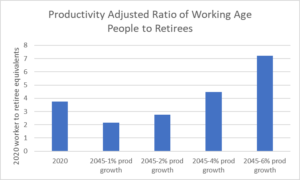
The graph below projects the number of effective working age people per retiree under various productivity assumptions. The first bar shows the 2020 ratio in China of 3.74 working age people to retiree (people over age 60 for this calculation). This ratio is projected to fall to 1.68 by 2045.
Source: Statistica and author’s calculations.
That only looks bad until we factor in productivity growth over the next 25 years. In an extremely pessimistic case, where productivity growth averages just 1.0 percent annually (the lowest sustained rate the U.S. has ever experienced), the ratio of 2020 equivalent workers per retiree would be 2.15. This would mean that the average worker would have to see a decline in their income relative to retiree’s income (i.e. a tax increase), to ensure that retirees have the same income in 2045 as in 2020. This doesn’t imply a decline in workers’ wages, as will be shown shortly.
The next bar assumes a 2.0 percent annual rate of productivity growth over the next 25 years. That is roughly the average in the United States over the post-World War II era. In this case, the decline in the ratio of 2020 equivalent workers is more modest, dropping to 2.76.
China has actually been seeing very rapid productivity growth over the last four decades. Its productivity growth averaged more than 6.0 percent annually between 2009 and 2019. The next two bars show the ratio of 2020 equivalent workers to retirees assuming alternatively 4.0 percent annual productivity growth over the next quarter century and 6.0 percent annual productivity growth over this period.
In the former case the ratio of 2020 equivalent workers to retirees would be 4.48. In the latter case it would be 7.21. This means that if the goal is to ensure that retirees enjoy the same living standard in 2045 as they did in 2020, this can be easily done without any increase in taxes on the working population. In fact, if the goal is to just maintain retirees 2020 living standards, tax on workers can be reduced in these high productivity growth scenarios.
Output Per Person
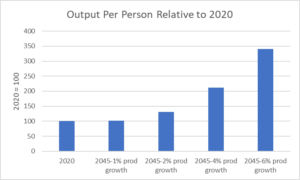
If we’re looking at how demographics affect living standards, another way to evaluate the picture is to look at output per person. This calculation picks up directly the impact of a smaller segment of the population working. The graph below shows the story, with the same set of productivity assumptions in the earlier figure.
Source: Statistica and author’s calculations.
As can be seen, even in the very low productivity growth scenario, output per person would be slightly higher in 2045 than in 2020. That means that it should be possible to structure distribution so that everyone can see an improvement in living standards over this period, albeit a very small one.
If China’s productivity growth over the next quarter century matches the U.S. post-World War II average, then incomes will be more than 30 percent higher in 2045 than they were in 2020. That would allow for substantial improvements in living standards for both workers and retirees.
In the 4.0 percent productivity growth scenario per person income will be more than twice as high in 2045 as in 2020. And if China can sustain the 6.0 percent productivity growth of the last decade, per person income will be 3.4 times as high in 2045 as in 2020.
In short, even modest rates of productivity growth will easily offset the impact of a declining ratio of workers to retirees that China is expecting over the next quarter century. If the country can sustain productivity growth rates anywhere near what it has been seeing, the impact of the drop in the ratio of workers to retirees will be trivial in comparison.
Four Factors that Make the Demographic Problem Less Serious
There are four major reasons why changing demographics pose even less of a problem than indicated in the discussion above. The first has to do with more accurately calculating the ratio of workers to retirees. I was deliberately sloppy about what we were measuring in using working age people to retirees (people over age 60). Many people, generally women, between the ages of 20 and 60 are not in the paid labor force. If the share of women in the paid labor force increases over the next quarter century, then the drop in the ratio of workers to retirees will be smaller than indicated in the calculations above.
There is a similar story on the over 60 part of the calculation. As the country gets richer and the workforce is better educated and healthier, a larger share of the population over age 60 is likely to continue working. This is both because jobs will be less physically demanding on average and also because better educated people are more likely to have jobs they find inherently rewarding. In the United States in 2019, before the pandemic, 56.0 percent of the people between the ages of 60 and 64 were employed. Of people between the ages of 65 and 69, 33. 3 percent were employed on average. Insofar as a substantial segment of this older group in employed, it both raises the number of workers and reduces the number of retirees who need to be supported by the work of others.
The third issue is the pollution and crowding that would result from efforts to increase the population. These negatives are not picked up in measures of GDP, and there is good reason to believe they are substantial. China has done much to clean up its air and water in the last two decades, but many areas still have severe problems. Other things equal, more people consuming more energy and material items, means greater problems with pollution. This can be offset with increased efforts at containing pollution, but these efforts carry a substantial cost.
The problem of more people goes well beyond what we just think of as pollution. More people means more traffic congestion. People will have to live further from work, which means longer distance commutes. Public infrastructure will see more wear and tear and everything from parks and museums to beaches and sporting events will be more crowded. These costs are picked up at best imperfectly in GDP measures, and in many cases, not at all. This means that if China’s solution to its declining ratio of workers to retirees is to have more children, it may be making matters worse for its population a quarter century into the future.
This brings up the final point, which everyone should have guessed by now. Children are also dependents. If our plan for reducing the ratio of workers to retirees is to have more children, that provides zero help at all for the next two decades, and only modest help in the following decade or so.
Meanwhile, the ratio of dependent children to workers will have risen substantially. It will take a very very long time for an increase in fertility rates to lead to fall in overall dependency ratios.[1] In the case of the United States, the total dependency ratio (both young people and older people relative to working age population) was 0.681 in 1945, at end of World War II. Then we had the baby boom, which led to a sharp increase in the ratio of young dependents to working age people.
We did not see the ratio of total dependents to working age population fall back below its 1945 until after 2000, more than 55 years later. We know that China’s leaders are often praised for having a longer- term view, but in this case we are not talking about planning for 2045, but rather 2075.
The long and short is that China does not face a demographic crisis, contrary to what you read in the paper, and encouraging people to have more children is not a good solution.
This coming Sunday, the last state election in Germany before September’s federal election is being held in Saxony-Anhalt. It exemplifies how the establishment parties—the Christian Democrats (CDU / CSU), Free Democratic Party (FDP), Social Democrats (SPD), Greens and the Left Party—are preparing the ground for the far-right.
Saxony-Anhalt Minister President Reiner Haseloff (CDU) (Image: Olaf Kosinsky / CC BY-SA 3.0)
For five years, the CDU, SPD and Greens—in other words, the three parties whose candidates are the most likely to succeed Angela Merkel as federal chancellor—have jointly governed Saxony-Anhalt. The task of this coalition was ostensibly to form a “bulwark against the right,” after the Alternative for Germany (AfD) won nearly a quarter of the vote in the 2016 state election.
Instead, the coalition under Minister-President Reiner Haseloff (CDU) has largely adopted the AfD’s policies, making ever new overtures to the far-right and intensifying social attacks on the population. For example, the state government’s current coronavirus policy, whereby public health measures are being ended step by step, largely corresponds to the AfD’s demand that any lockdown efforts be ended immediately. The Left Party, as a loyal parliamentary opposition, has ensured that the growing opposition against te state government has not found independent expression.
The AfD has benefited from this in two ways. The adoption of its programme by the three-party coalition and the constant advances by CDU politicians, who would have preferred to form a coalition with the AfD immediately, have strengthened the far-right party politically. And the lack of any serious fighting perspective and left-wing opposition has enabled the far-right to use some of the anger over the catastrophic social conditions to their advantage.
Although the AfD has been weakened at the federal level due to internal squabbles and is riddled with neo-Nazis in Saxony-Anhalt, it is scoring well over twenty percent in current polls and is second only to the CDU. At one point in mid-May, it was even just ahead of the CDU.
The SPD, Greens, FDP and Left Party are all scoring around 10 percent in the polls. For the Greens and FDP, which narrowly missed entering the state parliament in the last election, this means an increase, for the SPD a slight loss and for the Left Party a heavy loss. In 2006 and 2011, 24 percent voted for the Left Party. In 2016, the figure was 16 percent.
Saxony-Anhalt has never recovered from the social devastation that followed German reunification 31 years ago, which destroyed tens of thousands of industrial jobs. The social crisis has worsened under the present coalition. In 2016, before the last election, 47 percent of the population rated the economic situation as good; in April of this year, the figure was only 33 percent. Unemployment is 7.5 percent, well above the national average of 5.9 percent. The coronavirus pandemic has deepened the crisis.
Large numbers, and especially younger people, have moved out of the region. While 2.9 million lived in Saxony-Anhalt in 1990, today there are just 2.2 million. Their average age, 48, is the highest of all the German federal states. In the 2017 federal election, there were 2.4 over-70-year-olds for every 18- to 29-year-old eligible voter. The State Statistics Office predicts that the population will decline by a further 11 percent by 2030.
Saxony-Anhalt is highly rural. More than half the population lives in places with fewer than 20,000 inhabitants. In terms of economic output, the state, together with Mecklenburg-Western Pomerania, ranks last nationwide. At 28,700 euros per capita, the state’s gross domestic product is well below the national average of 40,100 euros. The standard of living is correspondingly low.
What binds all the parties represented in the state parliament together is the fear of a social uprising against these untenable conditions. That is why they promote and strengthen the AfD. State premier Haseloff’s constant assurances that they will not cooperate with the AfD under any circumstances, even after this election, are merely empty promises. Haseloff knows that making an open commitment towards the hated AfD would cost the CDU massive vote losses in the state and the federal election. According to a survey, even 77 percent of CDU voters reject cooperation with the AfD.
In reality, the CDU parliamentary group in the state legislature has already made repeated attempts at government cooperation with the AfD during the last legislative period. As early as August 2017, large parts of the CDU parliamentary group voted together with the AfD to form an inquiry commission to investigate so-called “left-wing extremism.”
In summer 2019, deputy CDU faction leaders Ulrich Thomas and Lars-Jörn Zimmer wrote a “memorandum” that openly advocated a coalition with the AfD. The voters of the two parties were pursuing similar goals, it said. It must be possible “once again [to] succeed in reconciling the social with the national”—an unmistakable allusion to National Socialism (Nazism). Today, the party says, “the content of the paper was correct and important,” reports newsweekly Der Spiegel. Thomas and Zimmer are running for 3rd and 4th place on the party list in the state elections.
The leading proponent of this line is Holger Stahlknecht, state interior minister since 2011 and CDU state chairman since 2018. He never misses an opportunity to flaunt his far-right sympathies. For example, he wanted to appoint Rainer Wendt, head of the police union and a figurehead of the extreme right, as a state secretary, only backing down after fierce protests.
Stahlknecht was also responsible for leaving the synagogue in Halle completely unprotected when right-wing terrorist Stephan Balliet carried out his attack there in 2019; only a strong wooden door prevented a massacre. Stahlknecht later complained to police officers about the fact that they could not be deployed elsewhere because they were guarding Jewish institutions. This sparked fierce protests from Jewish organizations.
When it became known that Robert Möritz, a board member of the Anhalt-Bitterfeld CDU district association and a CDU municipal election candidate, had been active in right-wing terrorist circles as a neo-Nazi, Stahlknecht publicly came to his defence.
Last spring, 100 refugees in Halberstadt staged a hunger strike to protest their inhumane treatment by Stahlknecht’s interior ministry. Around 850 people had been locked up in the central contact centre for asylum seekers, guarded by police officers and security guards without any protection against the coronavirus.
It was only when the CDU parliamentary group in the state assembly joined forces with the AfD last December to block an increase in the annual broadcasting levy, paid by all individuals and used to fund public broadcasters, and Stahlknecht publicly defended this in an interview, that Haseloff gave him the boot to save the coalition with the SPD and the Greens. The latter, for their part, then voted against the levy increase to preserve the coalition. The AfD had achieved its goal despite Stahlknecht’s resignation.
At the federal level, the CDU is also ready for collaboration with the AfD—despite claims to the contrary. This is demonstrated by the refusal of its chairman and chancellor candidate Armin Laschet to take action against Max Otte, the “AfD sympathizer with a CDU membership card” ( Der Spiegel).
Last Saturday, the economist and fund manager was elected chairman of the “WerteUnion,” an association of 4,000 arch-conservative CDU and CSU members that also includes the former head of the secret service Hans-Georg Maaßen.
Otte has never made any secret of his sympathies for the AfD. Until January, he headed the board of trustees of the AfD-affiliated Desiderius Erasmus Foundation for three years, he gave lectures to the AfD parliamentary group and organizes the New Hambach Festival every year, where CDU/CSU and AfD parliamentarians meet. He had already publicly announced in 2017 that he would vote AfD. When CDU politician Walter Lübcke was murdered by a neo-Nazi in 2019, he denied the right-wing extremist background of the crime. Even the WerteUnion chairman at the time, Alexander Mitsch, had therefore called for his expulsion.
Nevertheless, when asked about a possible party expulsion procedure against Otte, Laschet replied that this was “not an issue for us because the WerteUnion is not an issue.” In other words, Laschet is letting AfD sympathizers in the CDU/CSU have their way because he is interested in a strong AfD and possible government cooperation with it.
In Saxony-Anhalt, the AfD is dominated by the völkisch-nationalist “Flügel” (“wing”), which has since officially disbanded but continues to set the tone politically. Its election posters read, “Our country—our rules” and “Stop the lockdown madness.” It calls for an end to measures designed to assist the integration of refugees and propagates the slogans of the coronavirus deniers. Björn Höcke, the frontman of the “Flügel” from neighbouring Thuringia, is constantly involved in the campaign. Despite the pandemic, the AfD holds mass rallies and threatens counterdemonstrators with violence.
Among the candidates running for the state parliament are known neo-Nazis. For example, broadcaster MDR’s “Fakt” program identified Mathias Knispel, running in list position 25, as a participant in a demonstration of 700 right-wing extremists in Magdeburg in November 2018 demanding, among other things, freedom for convicted Holocaust denier Ursula Haverbeck.
Maximilian Tischer, an ex-soldier and close friend of former Bundeswehr (Armed Forces) officer Franco A., who is currently on trial in Frankfurt for preparing a violent act of state-endangerment, is running for list position 26. Tischer’s sister is Franco A.’s partner and has a child with him. Maximilian Tischer was temporarily arrested himself because he helped Franco A. fake his false refugee identity and, like him, was active in far-right prepper groups that maintained death lists of political opponents to be executed on a “Day X.” He was nevertheless released.
Since then, he has worked for AfD parliamentarian Jan Nolte, who gave him access to the Bundestag (federal parliament), heads the AfD’s state committee on foreign and security policy in Saxony-Anhalt and sits on the state board of the AfD youth there.
The Greens, SPD and Left Party are unreservedly complicit in allowing this right-wing conspiracy to unfold unhindered. In Saxony-Anhalt, the SPD has governed for ten years, and the Greens have governed for five years together with the CDU, deceptively claiming that they are a “bulwark against the right.” In fact, it is a right-wing bulwark against the working class.
The Left Party would also have joined in had it been asked. Its predecessor, the Party of Democratic Socialism (PDS), had already rehearsed its first government participation in Saxony-Anhalt. In the so-called “Magdeburg Model,” it supported an SPD minority government from 1994 to 1998, under which the official unemployment rate rose to 20 percent. In her latest book, “Die Selbstgerechten” (“The self-righteous”), its leader Sahra Wagenknecht advocates political positions that hardly differ from those of the AfD.
In the state parliament, all parties are already working closely with the AfD. For example, the state parliament committees for “Labour, Social Affairs and Integration,” “Internal Affairs and Sports” and “State Development and Transportation” are led by AfD representatives. Their committee deputies come from the Green Party and the CDU. The Council of Elders is formed by the state parliament president Gabriele Brakebusch (CDU) together with the two state parliament vice presidents Wulf Gallert (Left Party) and Willi Mittelstädt (AfD).
The same is the case in neighbouring Thuringia, where the Left Party heads a minority government with the SPD and Greens that is supported on a vote-by-vote basis by the CDU and itself cooperates with the AfD. It collaborates with the fascists in state parliamentary committees and has helped elect them to high office. Last February, the “left” state prime minister Bodo Ramelow used his vote to make AfD man Michael Kaufmann vice president of the state parliament.
What applies to Saxony-Anhalt also applies to the federal election. In the Bundestag, all the parties are already preparing massive attacks on the working class and youth—to recoup the multi-billions given away to the banks and corporations in the coronavirus crisis, and used to finance the massive rearmament of the Bundeswehr and prepare for new wars, to suppress social resistance by stepping up the powers of the police and intelligence services, and to continue the “profits before lives” policy in the pandemic that has claimed nearly 90,000 lives in Germany alone.
Regardless of who wins the election in Saxony-Anhalt, the AfD will play an important role in the next federal government. It will provide the political line, as is already the case, or serve as a member of the government itself.
The US beef processing operations of the global meat processing company JBS SA were shut down on Sunday by a ransomware cyberattack. The Brazil-based company is the world’s largest processor of beef, chicken and pork products and operates 109 facilities in six countries.
The company confirmed that it had closed its nine beef processing plants in the US, as reported on Tuesday by Bloomberg, based on information obtained from an unnamed United Food and Commercial Workers (UFCW) union official.
A JBS meatpacking facility. (AP Photo/Eraldo Peres)
The company said in a statement on Monday that servers in North America and Australia had been hit by the attack. Reuters reported that the firm halted cattle slaughter in the US and shut down its operations in Australia.
A company representative in Sao Paolo said that its Brazilian operations were not impacted by the hack. JBS Canada reported on its Facebook page that it operated late shifts on Tuesday at its beef plant in Brooks, Alberta after shutting down shifts earlier in the day and on Monday.
JBS issued a statement that the company took immediate action, “suspending all affected systems, notifying authorities and activating the company’s global network of IT professionals and third-party experts to resolve the situation.” The company said its backup servers were not affected and is “actively working with an Incident Response firm to restore its systems as soon as possible.”
Ransomware attacks typically involve remote encryption of all data on host computers combined with messaging that demands a sum of money—often in cybercurrency in the thousands or millions of dollars—in exchange for the decryption key required to restore operational control of the systems.
John Hultquist of the security and government consulting firm FireEye told Reuters, “The supply chains, logistics and transportation that keep our society moving are especially vulnerable to ransomware, where attacks on chokepoints can have outsized effects and encourage hasty payments” to the hackers.
Aboard Air Force One, Biden administration officials were quick to blame Russia for the ransomware attack on JBS without providing any facts or evidence to prove the assertion. White House principal deputy press secretary Karine Jean-Pierre told reporters, “JBS notified the administration that the ransom demand came from a criminal organization, likely based in Russia.” Jean-Pierre added, “The White House is engaging directly with the Russian government on this matter and delivering the message that responsible states do not harbor ransomware criminals.”
The details of JBS SA’s response to the attack, whether the company paid the ransom or not, are unknown at this time. The company is working with the FBI and the Cybersecurity and Infrastructure Security Agency to investigate the breach and provide technical support. Jean-Pierre told reporters, “The White House has offered assistance to JBS, and our team and the Department of Agriculture have spoken to their leadership several times in the last day.”
JBS SA, with its US operations based in Greeley, Colorado, became the world’s largest meat processor through a series of mergers and acquisitions that included Swift & Company (2007), Smithfield Foods (2008), Pilgrim’s Pride (2009) and the pork processing business of Cargill Meat Solutions (2015). It has more than $50 billion in annual sales worldwide and the company employs approximately 25,000 workers in the US.
JBS is notorious for its response to the COVID-19 pandemic, forcing meatpacking workers to stay on the job throughout as part of the “essential workforce.”
With an estimated 20 percent of meatpacking workers contracting the virus and hundreds who have died from it, JBS used intimidation and lies to conceal the extent of infection and keep sick workers on the job during the pandemic. The company relied on its partner in the UFCW to suppress worker opposition that found expression over the last year in multiple wildcat walkouts and protests in defiance of the union bureaucracy across the country.
Company CEO Andre Nogueira sent a message to USA Today on Tuesday saying that “the vast majority of our beef, pork, poultry and prepared foods plants will be operational tomorrow.” Clearly concerned about the impact of the cyberattack on its market position—JBS has a Wall Street value of $76+ billion—Nogueira said, “Our systems are coming back online, and we are not sparing any resources to fight this threat. We have cybersecurity plans in place to address these types of issues and we are successfully executing those plans.”
Industry analysts reported that US meatpackers slaughtered 22 percent fewer cattle than a week earlier and 18 percent than a year earlier, according to estimates from the US Department of Agriculture. Pork processing was also down. Prices for choice and select cuts of US beef shipped to wholesale buyers each jumped more than 1 percent.
The JBS attack happened a few weeks after a similar ransomware breach of the Colonial Pipeline network that shutdown a major artery of refined petroleum product transport to the eastern and southeastern sectors of the US from Texas. In that attack, the FBI claimed a “criminal group” called DarkSide located in Russia was responsible. The Kremlin publicly denied any connection to the hack.
On May 11, Dmitry Peskov, a spokesman for Russian President Vladimir Putin, told US reporters, “Russia has nothing to do with these hacker attacks, and had nothing to do with the previous hacker attacks,” referring to the Colonial Pipeline incident and the SolarWinds hack in late March that compromised nine federal agencies and more than 100 private sector groups for a year by exploiting vulnerabilities on Microsoft's Exchange Server. Peskov added, “We categorically do not accept any accusations against us.”
The FBI released a statement late Wednesday declaring that its investigation had determined the hack had been carried out by groups known as REvil and Sodinokibi and that the agency is “working diligently to bring the threat actors to justice.”
While the FBI did not mention any connection between these groups and Russia, it is widely known in cybersecurity circles that they are thought to be based in the country even though their exact location cannot be precisely identified. In some instances, the two names are joined into one as REvil/Sodinokibi and refer to a specific kind of ransomware discovered in 2019 that is based on the code of a malware platform called GandCrab that uses the ransomware-as-a-service (RaaS) model.
The timing of the JBS cyberattack coincidentally corresponds with the political agenda of the Biden White House as the president prepares for a summit with Putin scheduled for June 16 in Geneva. Biden Press Secretary Jen Psaki said during a press briefing on Wednesday that the administration is not “taking any options off the table” in responding to the JBS attack. Psaki added, “I'm not going to give any further analysis on that. Other than to tell you that our view is that when there are criminal entities within a country, they certainly have a responsibility, and it is a role that the government can play.”
Later in the afternoon, when President Joe Biden was asked if the US would retaliate against Russia for the attack, he said, “We’re looking closely at that issue.”