12 Aug 2021

Sri Lankan president opposes lockdowns, as Delta variant spreads

Sakuna Jayawardana & K. Ratnayake


Sri Lankan President Gotabhaya Rajapakse has rejected increasingly strident calls, by medical experts for lockdowns, to deal with rapidly rising COVID-19 deaths and infections, and an impending breakdown of the health system.

On July 5, Rajapakse removed many coronavirus travel restrictions, and on July 28, directed all state employees working from home to return to their workplaces. The government’s removal of virtually all remaining limited restrictions has added fuel to the pandemic, which is now accelerating, with the highly-infectious Delta variant.

Elderly Sri Lankans queue up to receive their second dose of Covishield, Serum Institute of India's version of the AstraZeneca vaccine during a public vaccination drive against the coronavirus in Colombo, Sri Lanka, Monday, June 28, 2021. (AP Photo/Eranga Jayawardena)

Addressing the media last Friday, following a high-level meeting to review the health emergency, Army chief General Shavendra Silva declared: “The president is not in favour of [a] countrywide lockdown.” Silva is the head of the National Operation Centre for Prevention of COVID-19.

Rajapakse, who attended the meeting, reportedly only offered advice on how to “solve” hospital congestion. The meeting decided to reduce the number of people allowed to attend weddings and funerals, and postponed state functions.

Rajapakse has flatly rejected urgent appeals by medical experts for lockdowns and stricter safety, amid a rapidly increasing daily death toll, with 656 deaths reported in the past six days. Yesterday, the total number of deaths hit 5,464, up from 3,268 on July 5, and the total number of infections rose to 342,079, an increase by 83,380 during the same period.

These figures, however, are not an accurate reflection of the real situation, because the government has deliberately limited testing and tracing. While medical experts are demanding at least 40,000 daily PCR (polymerase chain reaction) tests per day, health officers in the past month have only been able to conduct less than half that number.

Immunologist Dr. Chandima Jeewandara revealed last week that 19.3 percent of those testing positive for COVID-19 in the Colombo district, during the first week of July, were infected with the Delta variant. In the last week of July, the figure increased to 75 percent. In a Twitter message on August 4, he warned that 56 of 94 random samples, analysed from across the island, were infected with the deadly variant.

Last week, Sri Lanka Medical Association President Professor Padma Gunaratne insisted on the urgency of imposing travel restrictions. She is one of many medical experts that have consistently called for lockdowns.

“Two weeks ago, we said that a surge had begun with the Delta variant. Now, after two weeks, we are warning about what could happen in two weeks,” she said. The variant was spreading fast in the heavily-populated Colombo and Gampaha districts, she added, and warned that unless travel restrictions were imposed the situation would escalate out of control.

Sri Lankan hospitals are being overwhelmed. Last weekend, the National Hospital of Sri Lanka in Colombo was treating around 500 patients, up from about 200 the previous week. Additional wards have been allocated to deal with the increase, limiting hospital treatment for other patients.

The bodies of COVID victims placed on stretchers (Facebook)

Colombo South Hospital in Kalubowila is at capacity, with grim images of infected patients sitting in plastic chairs, surrounded by their belongings, on the lawns of the facility and others lying on ward corridor floors.

Colombo South Hospital director Dr. Sagari Kiriwandeniya told Derana TV on Saturday that the facility had stopped routine surgeries, in order to deal with the flood of COVID-19 patients. Asked what would happen if more wards were allocated for coronavirus cases, she bluntly stated: “Then not only COVID-19 patients, but others, will die.”

About 45,000 children under 18 years have been infected, and 14 have died in Sri Lanka since the outbreak of COVID-19 early last year, Dr. Deepal Perera, from the Lady Ridgeway Hospital for children, told the Daily Mirror. The facility, which is being overwhelmed, has been forced to send many of the children to other hospitals.

COVID patients in the crowded corridor of Ragama Hospital (Facebook)

Hospital mortuaries have reached capacity and are storing bodies in outside freezers. The Colombo North Ragama Hospital management told the Director General of Health Services last week that the facility faced an unbearable situation, warning that dead bodies in outside freezers would decay, creating other health problems.

External freezers storing bodies at the Kalutara and Panadura hospitals are also full. Panadura’s mayor told the media that the city had increased its cremations from two to six per day, but did not have the capacity to cremate corpses from Kalutara hospital. Concerns are also being raised that some crematoriums, which are working round the clock, could break down.

Upul Rohana, head of the public health inspectors’ union, told the media that one of the union’s members telephoned to complain that he had spent a whole night near a crematorium. This meant that many health inspectors were not available for contact tracing, because they had to supervise bodies until they were cremated.

Government ministers and parliamentarians, in a desperate attempt to show that the situation was under control, are visiting hospitals, arranging cremations in some areas and asking hospital administrations to allocate more wards for COVID-19 patients. Health authorities have also begun making arrangements for so-called home-based COVID-19 treatment. The result, however, will be more infections and deaths.

Addressing a press conference, Deputy Director General of Health Services Dr. Hemantha Herath denied that the situation in hospitals was dire. He was asked by one journalist to “comment candidly on the situation Sri Lankans would face in the coming days.” He refused to provide any detailed information and, according to a report in the Island, responded that “he might not be allowed to speak to the media again if he spoke candidly about the trajectory of the pandemic in the coming days.”

President Rajapakse, in fact, had previously warned health ministry officials and medical experts not to “panic” people about the pandemic, but directly inform him of any problems.

Parliamentary opposition parties, which from the outset have supported the Rajapakse government’s response to the pandemic, including its reopening of the economy, are now making hypocritical appeals to Colombo to impose a lockdown.

Parliamentarian Tissa Attanayake, from Samagi Jana Balawegaya, the main opposition party, has called on the government to “take proactive measures to lock down” and save lives.

Janatha Vimukthi Peramuna (JVP) Politburo member Nalinda Jayatissa has called for a two-week lockdown to reduce hospital caseloads “to a manageable level.” Tamil National Alliance MP S.P. Rasamanickam declared, “If the health experts recommend a lockdown, the government should abide and comply.”

These parties are seeking to exploit and derail the growing mass outrage against the Rajapakse regime’s criminal indifference towards the health and safety of millions of Sri Lankans.

Last year, following the outbreak of coronavirus infection on the island, these parties participated in an all-party conference, called by the Prime Minister Mahinda Rajapakse, and extended their full support. The JVP-controlled trade unions and other unions attended meetings with employers, called by the labour minister to decide on wage and job cuts and extensions of working hours in the name of saving the big companies.

An editorial in last weekend’s Sunday Times reflected the nervous concerns of sections of the ruling elite to the worsening coronavirus catastrophe: “Some hotels are having functions with bands playing and air-conditioning blasting, while other hotels (used by private hospitals as intermediate care centres) are filled with COVID patients carrying saline bottles. It is almost like the sinking of the Titanic, while the band played on: A tale of two cities.”

The editorial blamed the Rajapakse administration for creating a false sense of security and for insisting “that the mass vaccination program will settle the spike of positive.” It concluded by declaring that the government “must act, and act decisively, to ensure the galloping new variant does not reach a tipping point, a point of no return, by its shortsightedness.”

These concerns are not animated by social health considerations, but fears that the policies of the Rajapakse government—for which the entire ruling class is responsible—will produce a social explosion.

Rajapakse’s insistence that “vaccination is the only solution to keep the economy open” is his response to the devastating economic impact of the pandemic, with a collapse of exports, tourist industry earnings and remittances, and $US4 billion in annual foreign debt repayments over the next four years.

The Rajapakse regime, like every government around the world, is sacrificing the lives of workers and the poor to boost big-business profits and maintain its commitments to international finance capital.

11 Aug 2021

Pegasus and the Global Surveillance Business

Mel Gurtov


We have just learned about a powerful spyware known as Pegasus, manufactured and leased by the Israeli company NSO Group and capable of extracting just about every kind of data stored in a smart phone. The Pegasus Project, a consortium of 17 organizations and individuals, mostly journalists, has acquired a leaked list of 50,000 individuals around the world whose phones may have been hacked, though not necessarily penetrated.

Purportedly developed to track criminals and terrorists, Pegasus is also being widely used to hack into the smart phones of human rights activists, journalists, and their political opponents at home and even abroad.

Who is using Pegasus to track enemies? Only a fraction of the 50,000 hacked phone numbers so far obtained have been examined, but that’s enough to reveal that governments from left to right have made use of Pegasus. Among them: Saudi Arabia, India, and Hungary.

The two people closest to the murdered Saudi journalist Jared Khashoggi, including his widow, are among those whose phones were penetrated. The Modi government in India and the Orban government in Hungary have caused uproars over their use of Pegasus to spy on critics.

Pegagus is also being used against current high-level government officials. Among the people on the list: Three presidents, from France, Iraq, and South Africa; three current prime ministers, from Pakistan, Egypt, and Morocco; and one king (Morocco). That means all of them have been tracked and their private messaging probably collected—though exactly what was culled and who is doing the hacking are uncertain. All these officials refused to turn over their phones for forensic analysis.

There’s a connection between the surveillance industry and lobbying, which I examined a few weeks ago. NSO can only sell its technology with Israeli government approval, which means it must lobby Israel’s defense ministry. And that effort extends to the US. For while NSO maintains that Pegasus will never be used “to conduct cybersurveillance within the United States,” why has it retained a prominent Washington, DC law firm to lobby US officials about NSO’s technology?

It is entirely possible that Pegasus has been used or might yet be used against Americans who, for example, write from home about human rights abuses abroad.

The fact that nothing in a smart phone is safe from Pegasus makes it a weapon, another piece of infowar technology, and all the more insidious for being able to hide within the phone and, even if discovered, be difficult to track.

Just think of all the information a smart phone contains: contacts, passwords, text and email messages, videos, pictures. Planting bugs and wiretapping seem ancient by comparison. A technology like Pegasus conceivably can infect millions of phones anywhere, anytime, giving a government or a gang access to potentially lethal information.

We are nearing the point where technology is driving conflict rather than the other way around. Satellites, drones, spyware, malware, and other forms of cyber attacks—all these enable states to compete and fight at a distance, sometimes (as we have seen with Russian and Chinese hacking gangs) using nonstate actors.

They pose very difficult decisions for individuals on the receiving end. Unless they are government officials, there is no way to retaliate. In the case of Pegasus, its discovery may be sufficient this time around to bring that particular technology down. But it may only encourage others to make a new version that is less detectable.

The fairly obvious solution to cyber attacks is to ban the technology, somewhat the way land mines were banned. In that case, and perhaps in this one, citizen action may work better than relying on the technology’s producer or governments.

But at some point an international cyber security agreement will be necessary. Still, as the Pegasus case shows, you can’t prevent a powerful spyware from getting in the wrong hands and causing inestimable damage.

Consider what the CEO of NSO said: “We understand that in some circumstances our customers might misuse the system.” Surely the understatement of the year. Just recall China’s ubiquitous surveillance system. And the fact that democratic governments are fully capable of misusing the technology—recall that in 2013 the US hacked the phone of Germany’s chancellor Angela Merkel—means that no government and no private company can really be trusted to prevent large-scale abuse.

About the only good news I can report is that management of the fund that controls NSO Group and therefore Pegasus is now being challenged. As The Guardian reports, “Public investors in the private equity firm that owns a majority stake in the Israeli spyware company NSO Group are in talks to transfer management of that fund to . . . a US consulting firm.” Interestingly, the largest of those public investors is the state of Oregon’s public pension fund. Stay tuned.

Australia’s Lockdown Troubles

Thomas Klikauer


By early August, more than half of all Australians (60%) were in lockdown. It should be clear even to the mathematically challenged in and around Sydney that Covid-19 cases slowly go up every day. And so do hospitalizations and, sadly, deaths – hitting even the unvaccinated young. Meanwhile, on a world-scale, Australia’s just below one thousand Corona deaths are a rather small number. Having a low death rate may well be the upside of what Australians commonly call The Tyranny of Distance. It pays to be a country surrounded by water at the end of the world. Yet this has not protected Australians from home-made and self-inflicted Corona troubles.

As Corona death rates still remain rather low, they are on a recent upward trajectory. Simultaneously, what goes down rather rapidly in Sydney is the government’s ability to trace those people who wandered around carrying the virus and infecting unvaccinated others. In the last week of July, the state of New South Wales had 780 Corona infections where the source of the infection could had been traced to its origin. In a further 384 cases, this was no longer the case.

A week later (early August), the state already had 641 cases where the origin of the Corona virus infection was no longer known – almost double the number. In other words, we increasingly no longer know where Corona infections in NSW’s eight million people (of which 5.4 million live in Sydney) come from.

In recent weeks, all of these numbers have been getting worse. Even more problematic is the fact that Australia’s vaccination rate remains stubbornly low. By early August it was slightly above 20% of the nation’s population. In other words, 80% of all Australians were not fully vaccinated.

Worse, the number of vaccinated people climbs painfully slow. If vaccination numbers do not go up dramatically very soon and Covid-19 case numbers do not go down dramatically, Sydney will have to have several more lockdown extensions. This comes in addition to the already six weeks of lockdown Sydney had been experiencing by early August. All indications are that it will get worse.

For some time, New South Wales neoliberal state Premier Gladys Berejiklian has been talked about a so-called gold standard for months. During the last few days, this gold standard has vanished into thin air very fast. Apart from her public relations talk, the stark reality on the ground contradicts her fiction. Even in Berejiklian’s daily press conferences at 11am every morning, her self-re-assuring announcements are starting to sound more grim every day. Yet some of Sydney’s woes are home-made.

Only a few weeks ago, her government oversaw the vaccination of 163 school boys in an elite boarding school. Even though this was later claimed to have happened ‘by error’, conservative Gladys Berejiklian believes that unfairly favoring her equally conservative constituency – the rich and powerful – at the expense of the not so rich and not so powerful is okay.

This sort of corrupt politics is known as pork barreling. According to Ms Berejiklian’s own assertion she strongly believes that pork barreling is not a crime. Hence very quickly, the vaccination of the 163 elite school boys was framed “an accident” by her government. Of course, the boys were asked accidentally whether they wanted to be vaccinated; their parents accidentally gave approval; the school accidentally checked that all forms were filled in and returned; then the school accidentally set up a date for the vaccination; they accidentally hired busses and the boys were accidentally vaccinated; of course, they accidentally received the Pfizer vaccine – rather than the cheaper AstraZeneca.

While this might sound funny, what was not so funny was that while all this was happening –    accidentally of course – essential workers in Sydney where not vaccinated. Among them was a bus driver who carried not only airline crew into Sydney but also the SARS-CoV-2 virus. As a consequence, Sydney had countless infections and virus transmission rates that were about to overwhelm the government’s contact tracing ability.

By early August, the first signs emerged that all this might overwhelm hospitals that had been deliberately run down by years of successive Liberal governments hooked on the ideology of neoliberalism. To make matters worse, Australia’s neoliberals – federally and at state level – have an almost in-bred obsession against state run institutions like hospitals.

Yet, underfunded hospitals are only one of prime minister Scott Morrison’s worries. Worse for him is the ever-looming party-internal battle. For one, if his approval ratings stay low for too long, other Liberals will put a knife into his back – a recent favorite of the Liberal Party. Like some of his predecessors, Scott Morrison will be cut down and replaced in a split second by his very own party mates.

Beyond all this looms the ideological battle between the Liberal party’s staunchly neoliberal free-market wing and its Christian-fundamentalist wing. To add a bit of spice to this, Scott Morrison’s most recent pork barreling in favor of Sydney not only dismayed people in Melbourne but even offended the more neoliberal Melbourne faction of the Liberal party.

Above and beyond all this, Scott Morrison as well as Berejiklian are not only fighting a political PR battle – never mind rising death rates, infections and hospitalizations – they also fight their own neoliberal ideology. The Coronavirus pandemic has forced Australia’s (neo-)Liberals to do the exact opposite of what their ideology tells them. For one, the much hated public service of the state is in great demand and so are publicly funded hospitals, government funded vaccinations centers and Corona tests facilities.

Worse, the neoliberal belief in the free market has been utterly undermined by the Coronavirus pandemic. Fighting the pandemic means coordinated state action. Leaving this fight to the free market, would leave the virus to do what it does best: infect and kill people on a massive scale.

Even worse is the fact that the much hated “red tape” is also in great demand as those eligible for state support during the lockdown need to be separated from those who are not. In short, the Coronavirus pandemic is a nightmare for the ideology of neoliberalism and its political henchmen and -women (e.g. Miss Berejiklian).

At the same time as Corona infections are on the rise and deaths increased steadily, Australia’s vaccination rate remains at the bottom of comparable OECD countries. By early August, Australia ranked 37 out of 38 OECD countries when it came to the proportion of a country’s population that had been fully vaccinated. Yet in August 2021 Australia was about 1½ years into the Coronavirus pandemic that was detected at the beginning of the year 2020.

In other words, Gold-Standard Scott Morrison – Australia’s neoliberal, conspiracy theories believing, and Christian fundamentalist prime minister – has been sitting on this hands for 1½ years. Morrison, also known as Scotty from Marketing because of his ability to see politics as a PR opportunity, has for months been failing to secure enough Pfizer vaccines to get Australians vaccinated.

Yet Scott Morrison was not totally sitting on his hands. He managed to attend the G7 meeting in 2021 – of which Australia is not a member. Whilst there, he went to a pub, visited a graveyard and had lunch in Paris on the way back to Australia. At the same time, Australians were unable to travel.

Worse, under Scott Morrison’s border security regime, a right-wing English “media personality” (read: I have no skills) was allowed into Australia. Yet the former Holocaust-denier-conference attendee was quickly sent home rather quickly after a public outcry of her mocking the state’s quarantine regulations.

In another instance, Australians wanting to come home where threatened by their very own prime minister Scott Morrison with fines and even prison if they tried to come home. Of course, this does not apply to a G7-holidaying prime minister or British right-wing TV nutcase who believes that the Coronavirus pandemic is just another flu.

Meanwhile, 38,000 Australians cannot come home to their own country. Those 38,000 waiting to come are not right-wing chitchats. They are ordinary Australians. Yet, in Scott Morrison’s worldview, some – elite boys in a private boarding school, right-wing TV ideologues, and of course he himself – are more equal than others – ordinary Australians. Adding insult to injury, Scott Morrison has virtually made no provision to get the 38,000 Australians home. After 1½ years, no quarantine facilities have been constructed to quarantine these returning Australians.

In eighteen months, Scott Morrison and his government have done nothing. In 2020, China constructed a hospital in Wuhan in ten days. Instead of vilifying China and trumping China up as the new super enemy, perhaps warmongering Scott Morrison could learn from China? What an evil and heretic thought.

Just when you think it cannot get any worse, rest assured with Scott Morrison it always does. By early August 2021, Scott Morrison had outright rejected Labor’s proposal to give everyone who is vaccinated $300. The plan is to get as many Australians as possible quickly vaccinated. This is, after all, a highly viable strategy to fight the Coronavirus pandemic – get vaccinated. How wonderful it would be if Scott Morrison would adhere to US President Joe Biden’s advice, “if you are not helping, get out of the way!”

At the same time, the Australian army, who has now been called into Sydney to safeguard the lockdown, thinks that such payments actually work. Surprise, surprise it is working in other countries, in Europe and even in the USA. Incentives do work, just ask Dan Pink. They also work in the case of vaccinations. And they continue to work even though Scott Morrison thinks otherwise.

If Australia spent $300 on every single vaccinated Australian, it would roughly cost $7.5 billion dollar to vaccinate a substantial number of Australia’s 25 million people. $7.5bn is way cheaper than a lockdown until Christmas. Some people say, that the lockdown in Sydney will cost the economy $10bn.

In other words, Labor’s plan would have saved $2.5bn. It would also have made very serious inroads into the fight against the Coronavirus pandemic. Yet, if there is no PR opportunity in all this, it is irrelevant for Scott Morrison. Even worse is the fact that since it is a Labor plan, Scott Morrison will never do it.

Still worse, if the lockdown extends until Christmas, say good night to the Christmas sales which for many businesses are the biggest earner in a year. Ironically, it is often small business owners who vote (neo-)Liberal in Australia – the political party that has, at federal (Scott Morrison) and state (Berejiklian) level, comprehensively failed to deliver in the Coronavirus pandemic.

Yet Labor’s $300 offer to encourage vaccination would have the ability to end or at least cut down the lockdown time. Overall, Labor’s $300 offer is substantially more than Scott Morrison’s skimpy $25 food voucher – a mini-compensation for the economic hardship during the 2020 lockdown. Well, the $25 vouchers were just another PR joke.

While Scott Morrison rejects returning $300 per person of tax-money to Australians, he is very happy to waste “almost $3.4m for each person in offshore detention”. Tormenting the innocent in remote detention centers does not come cheap as the case of the Biloela family shows.

In any case, Labor’s $7.5bn vaccination incentive plan is rather minuscule compared to the $100bn we spent on twelve submarines which, let’s face it, are of no help in a Coronavirus pandemic. Yet each and every one of Australia’s 25 million people will have to fork up $4,000 for the U-boats.

Most obviously, Australia’s conservatives put their money – well, our tax money actually – where their mouth is. Scott Morrison’s right-wing government rejects a comparatively small incentive but is very happy to spend thirteen times as much on militaristic toys-for-the-boys. Meanwhile, Australians are months away from reaching a vaccination rate well above 80% which would allow Australia to end the lockdown in a safe way.

In the end, British philosopher John Stuart Mill might have been right when he said, “Conservatives are not necessarily stupid, but most stupid people are conservatives.” Australia’s conservatives may not only be stupid, they are also trapped in their very own ideology of neoliberalism. As the philosopher Theodor W. Adorno once said, “Immovablythey insist on the very ideology which enslaves them.”

Biden Must Call Off the B-52s Bombing Afghan Cities

Medea Benjamin & Nicolas J. S. Davies


Afghanistan2
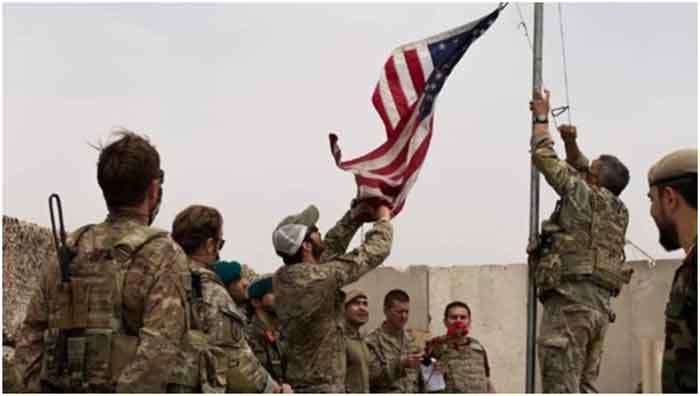
Handover ceremony at Camp Anthonic, from US Army to Afghan Special Forces, Helmand province, Afghanistan, May 2, 2021.

Nine provincial capitals in Afghanistan have fallen to the Taliban in six days – Zaranj, Sheberghan, Sar-e-Pul, Kunduz, Taloqan, Aybak, Farah, Pul-e-Khumri and Faizabad – while fighting continues in four more – Lashkargah, Kandahar, Herat & Mazar-i-Sharif. U.S. military officials now believe Kabul, Afghanistan’s capital, could fall in one to three months.

It is horrific to watch the death, destruction and mass displacement of thousands of terrified Afghans and the triumph of the misogynist Taliban that ruled the nation 20 years ago. But the fall of the centralized, corrupt government propped up by the Western powers was inevitable, whether this year, next year or ten years from now.

President Biden has reacted to America’s snowballing humiliation in the graveyard of empires by once again dispatching U.S. envoy Zalmay Khalilzad to Doha to urge the government and the Taliban to seek a political solution, while at the same time dispatching B-52 bombers to attack at least two provincial capitals.

In Lashkargah, the capital of Helmand province, the U.S. bombing has already reportedly destroyed a high school and a health clinic. Another B-52 bombed Sheberghan, the capital of Jowzjan province and the home of the infamous warlord and accused war criminal Abdul Rashid Dostum, who is now the military commander of the U.S.-backed government’s armed forces.

Meanwhile, the New York Times reports that U.S. Reaper drones and AC-130 gunships are also still operating in Afghanistan.

The rapid disintegration of the Afghan forces that the U.S. and its Western allies have recruited, armed and trained for 20 years at a cost of about $90 billion should come as no surprise. On paper, the Afghan National Army has 180,000 troops, but in reality most are unemployed Afghans desperate to earn some money to support their families but not eager to fight their fellow Afghans. The Afghan Army is also notorious for its corruption and mismanagement.

The army and the even more beleaguered and vulnerable police forces that man isolated outposts and checkpoints around the country are plagued by high casualties, rapid turnover and desertion. Most troops feel no loyalty to the corrupt U.S.-backed government and routinely abandon their posts, either to join the Taliban or just to go home.

When the BBC asked General Khoshal Sadat, the national police chief, about the impact of high casualties on police recruitment in February 2020, he cynically replied, “When you look at recruitment, I always think about the Afghan families and how many children they have. The good thing is there is never a shortage of fighting-age males who will be able to join the force.”

But a police recruit at a checkpoint questioned the very purpose of the war, telling the BBC’s Nanna Muus Steffensen, “We Muslims are all brothers. We don’t have a problem with each other.” In that case, she asked him, why were they fighting? He hesitated, laughed nervously and shook his head in resignation. “You know why. I know why,” he said. “It’s not really our fight.”

Since 2007, the jewel of U.S. and Western military training missions in Afghanistan has been the Afghan Commando Corps or special operations forces, who comprise only 7% of Afghan National Army troops but reportedly do 70 to 80% of the fighting. But the Commandos have struggled to reach their target of recruiting, arming and training 30,000 troops, and poor recruitment from Pashtuns, the largest and traditionally dominant ethnic group, has been a critical weakness, especially from the Pashtun heartland in the South.

The Commandos and the professional officer corps of the Afghan National Army are dominated by ethnic Tajiks, effectively the successors to the Northern Alliance that the U.S. supported against the Taliban 20 years ago. As of 2017, the Commandos numbered only 16,000 to 21,000, and it is not clear how many of these Western-trained troops now serve as the last line of defense between the U.S.-backed puppet government and total defeat.

The Taliban’s speedy and simultaneous occupation of large amounts of territory all over the country appears to be a deliberate strategy to overwhelm and outflank the government’s small number of well-trained, well-armed troops. The Taliban have had more success winning the loyalty of minorities in the North and West than government forces have had recruiting Pashtuns from the South, and the government’s small number of well-trained troops cannot be everywhere at once.

But what of the United States? Its deployment of B-52 bombers, Reaper drones and AC-130 gunships are a brutal response by a failing, flailing imperial power to a historic, humiliating defeat.

The United States does not flinch from committing mass murder against its enemies. Just look at the U.S.-led destruction of Fallujah and Mosul in Iraq, and Raqqa in Syria. How many Americans even know about the officially-sanctioned massacre of civilians that Iraqi forces committed when the U.S.-led coalition finally took control of Mosul in 2017, after President Trump said it should take out the families of Islamic State fighters?

Twenty years after Bush, Cheney and Rumsfeld committed a full range of war crimes, from torture and the deliberate killing of civilians to the “supreme international crime” of aggression, Biden is clearly no more concerned than they were with criminal accountability or the judgment of history. But even from the most pragmatic and callous point of view, what can continued aerial bombardment of Afghan cities accomplish, besides a final but futile climax to the 20-year-long U.S. slaughter of Afghans by over 80,000 American bombs and missiles?

The intellectually and strategically bankrupt U.S. military and CIA bureaucracy has a history of congratulating itself for fleeting, superficial victories. It quickly declared victory in Afghanistan in 2001 and set out to duplicate its imagined conquest in Iraq. Then the short-lived success of their 2011 regime change operation in Libya encouraged the United States and its allies to turn Al Qaeda loose in Syria, spawning a decade of intractable violence and chaos and the rise of the Islamic State.

In the same manner, Biden’s unaccountable and corrupt national security advisors seem to be urging him to use the same weapons that obliterated the Islamic State’s urban bases in Iraq and Syria to attack Taliban-held cities in Afghanistan.

But Afghanistan is not Iraq or Syria. Only 26% of Afghans live in cities, compared with 71% in Iraq and 54% in Syria, and the Taliban’s base is not in the cities but in the rural areas where the other three quarters of Afghans live. Despite support from Pakistan over the years, the Taliban are not an invading force like Islamic State in Iraq but an Afghan nationalist movement that has fought for 20 years to expel foreign invasion and occupation forces from their country.

In many areas, Afghan government forces have not fled from the Taliban, as the Iraqi Army did from the Islamic State, but joined them. On August 9th, the Taliban occupied Aybak, the sixth provincial capital to fall, after a local warlord and his 250 fighters agreed to join forces with the Taliban and the governor of Samangan province handed the city over to them.

That very same day, the Afghan government’s chief negotiator, Abdullah Abdullah, returned to Doha for further peace talks with the Taliban. His American allies must make it clear to him and his government, and to the Taliban, that the United States will fully support every effort to achieve a more peaceful political transition.

But the United States must not keep bombing and killing Afghans to provide cover for the U.S.-backed puppet government to avoid difficult but necessary compromises at the negotiating table to bring peace to the incredibly long-suffering, war-weary people of Afghanistan. Bombing Taliban-occupied cities and the people who live in them is a savage and criminal policy that President Biden must renounce.

The defeat of the United States and its allies in Afghanistan now seems to be unfolding even faster than the collapse of South Vietnam between 1973 and 1975. The public takeaway from the U.S. defeat in Southeast Asia was the “Vietnam syndrome,” an aversion to overseas military interventions that lasted for decades.

As we approach the 20-year anniversary of the 9/11 attacks, we should reflect on how the Bush administration exploited the U.S. public’s thirst for revenge to unleash this bloody, tragic and utterly futile 20-year war.

The lesson of America’s experience in Afghanistan should be a new “Afghanistan syndrome,” a public aversion to war that prevents future U.S. military attacks and invasions, rejects attempts to socially engineer the governments of other nations and leads to a new and active American commitment to peace, diplomacy and disarmament.

Propaganda offensive proclaiming end of UK pandemic wave unravels as COVID case decline ends

Tania Kent


The UK recorded 23,510 new COVID-19 cases yesterday, meaning the total number of cases in the last seven days is 7.3 percent higher than the week before.

This significant development will not halt the ongoing efforts to proclaim the predicted extent of the third wave of the pandemic greatly exaggerated, or the insistence that the vaccination programme means that we can all “learn to live with the virus.”

A drop in COVID infections from the end of July became the occasion for demands that no mitigating measures be considered going forward, and above all that there be no talk of re-implementing a lockdown.

Daily recorded infections had more than halved from mid-July over a two-week period from a high of 54,674 on July 17 to 22,287 on August 2. The drop continued into a third week, prompting some scientists to claim that we have “turned a corner” and others to suggest that “herd immunity” had been reached. There were even demands to stop recording infections as this was misleading given that only the declining rate of hospitalisations mattered.

The “dip” has, however, been short-lived. The virus spread is speeding up once again as the impact of “Freedom Day” on July 19, when Prime Minister Boris Johnson ended all compulsory measures to reduce the spread of the virus and opened up night clubs and mass social events, begins to be felt.

On what has been dubbed "Freedom Day", marking the end of coronavirus restrictions in England, people walk over London Bridge a popular walking route for commuters from London Bridge train and tube stations in London, towards the City of London, during the morning rush hour, Monday, July 19, 2021. (AP Photo/Matt Dunham)

But even as this became apparent, Neil Ferguson, epidemiologist from Imperial College London and a former member of the government’s Scientific Advisory Group for Emergencies (SAGE), who first called for the national lockdown in March of 2020 and predicted that “Freedom Day” could lead to 200,000 daily infections, was wheeled out to assert his belief that “further lockdowns are unlikely” to be required.

Despite acknowledging that COVID cases are expected to rise again in September, when school and university terms begin and more workers return to the office, he insisted, “The UK, like elsewhere, would probably have to accept the continuing presence of COVID-19 as a potentially lethal threat.”

“I suspect for several years, we will see additional mortality,” he continued. “There’s a risk in the winter coming of thousands to tens of thousands more deaths”.

Others also insisted that “living with the virus” means accepting large numbers of fatalities. Professor Paul Hunter, an infectious disease expert at the University of East Anglia, warned that numbers of positive COVID cases will “remain high for our lifetimes” and the coronavirus will never be eradicated. It will, he said, become endemic and circulate throughout the country for generations.

The Mail Online commented that “Scientists believe the virus—called SARS-CoV-2—will eventually morph into one that causes a common cold as immunity builds up over time.”

In contrast, more serious scientists warned against a “premature” interpretation and systematically unraveled the complex circumstances that produced the short-term decline in cases.

Epidemiologist John Edmunds at the London School of Hygiene & Tropical Medicine (LSHTM), referring to the initial dip, said, “One thing it doesn’t mean, is that the United Kingdom has built up enough population immunity through vaccination and natural infection to stop the virus spreading.”

According to Edmunds, the drop might appear more pronounced because of an additional spike in infections in England in mid-July, caused by large crowds watching the delayed Euro 2020 football tournament in pubs, private homes, stadiums and town centres.

There were also many people alerted by NHS contact-tracing apps that they had recently been in close proximity to someone who tested positive. This spate of alerts, derisively dubbed the ‘pingdemic’, where many people were forced to self-isolate, “might have done its job in slowing the spread of the virus”, according to Edmunds.

Another major reason for the temporary decline is the end of the school term. Although officially schools in England closed around July 23, a school-related decline in cases could already be apparent in today’s data because some finished a week or so earlier, older students were off school after their exams, and around 20 percent of pupils were self-isolating by that point. Schools were a key vector in the spread of the virus once reopened with the support of the Labour Party and trade unions.

There has also been a dramatic drop in testing. On July 15, 1,177,716 lateral flow tests were conducted. On July 25, as schools fully closed, the numbers dropped to 791,044.

Deepti Gurdasani, leading data scientist and staunch opponent of “herd immunity”, wrote of the increase in infections in the latest data, “I was hoping that declines would hold at least until schools re-opened, but much depends on the impact of 19th July on behaviour, and it looks like rises may resume earlier. These will no doubt accelerate with school openings. It’s still beyond me why govt [government] removed mask and distancing mandates, and caps on gatherings, allowing large events to go ahead prematurely, creating surges and continuing high transmission (which we’ve had for over a month now) - while >40% remain not fully vaccinated.

“This will further fuel the fire. Let’s remember we got to 50-60 hospitalisations/day for children - the impact of high infection in children just before term ended. What level of illness in children does our gov’t consider acceptable?”

The proportion of those in hospital aged 18-34 years now stands at 20.4 percent, a fourfold increase from the height of the pandemic in January. Despite around 75 percent of the UK adult population now being fully vaccinated, there is still a large pool of susceptible and mainly young people. The highest rate of infection is currently in people aged 16-24, most of whom are either unvaccinated or have not yet received both jabs.

An estimated 34,000 children in the UK are already suffering from Long COVID. This includes 11,000 children aged 2-11 and 23,000 aged 12-16, according to a survey conducted by the Office for National Statistics (ONS). The ONS estimates also suggest that 380,000 people in the UK have experienced Long COVID for at least a year. Overall, just under one million people are thought to be suffering from the syndrome.

Many researchers and scientists are predicting that that the return of school pupils, university students and office workers in September, as well as the possibility that protection from the first round of vaccines will wane, is likely to fuel a larger rise. “I think the summer will be a bit of a firebreak, but that the pandemic will slowly grow again and things will escalate in the autumn,” says Immunology Professor, Alex Richter. “It is by no means all over yet.”

Evidence has also been published showing that vaccinated people infected with the Delta coronavirus variant may be able to spread it just as easily as those who have yet to be immunised. Although the COVID jabs appear to reduce an individual’s overall risk of catching Delta, if infected there is “limited difference” in the viral load between the vaccinated and unvaccinated, according to Public Health England (PHE).

PHE commented, “The vaccine is less effective against Delta than against some other variants, but there are even more evasive variants around in the world.”

Dr Simon Clarke, a microbiology professor at Reading University, told Sky News that if vaccination “only blocks transmission by, say, 50 percent you’ll never get herd immunity even with a 100 per cent vaccine uptake.”

Experts have stressed the need for global surveillance, particularly of new variants, and for vaccination to bring COVID infections under control, warning of the implications of foreign travel over the summer and the return of international students to universities in the autumn.

The pandemic is global and its eradication must be global. The situation confronting the world’s population is at a crisis point. In the United States there is a massive surge of COVID-19 infections due to the spread of the Delta variant, with the seven-day moving average of daily new cases rocketing by over 500 percent.

Israel, one of the world’s front-runners in COVID-19 vaccinations, is reinstating restrictions and warning of a fresh lockdown as serious cases surge. Hospitals could be close to capacity within 20 days based on the current trajectory of the virus. Cases in Australia, touted as a success story in blocking the spread of COVID, are surging.