The COVID-19 pandemic is intensifying in South Korea because the Moon Jae-in government refuses to take the necessary measures to stop the spread of the virus.
The daily number of cases reached a national all-time high of 2,222 on August 11. As of Monday, there have officially been 226,854 cases and 2,173 deaths, including six people who passed away that day.
Healthcare workers in Seoul, South Korea, call for increased staffing at a demonstration on August 5, 2021. (AP Photo/Ahn Young-joon)
The seven-day moving average for daily new cases stood at 1,871 as of Saturday, having almost quadrupled in a month.
The Seoul metropolitan area, the southern city of Busan and Jeju Island are under Level 4 restrictions in the government’s four-tier system. This limits the number of people allowed to gather in groups, but allows businesses and private study academies to remain open, contributing to the spread of the virus. The other regions of the country are under Level 3 restrictions.
A major reason for the sharp eruption of the virus in recent weeks is the slow rollout of vaccines, compounded by the spread of the Delta variant. Only 43.6 percent of people have received one dose of the vaccine, while 19 percent have been fully vaccinated. The situation has been worsened by glitches in the online reservation system, as well as a delay in vaccine delivery from US drug maker Moderna.
Despite this, schools are set to re-open this month following the summer break, with students attending on a rotational basis. This means the virus could spread even more quickly.
Under Level 4 restrictions, all classes should be online. But the Education Ministry absurdly stated on August 9: “Only 16 percent [of students] contracted the virus at school, meaning that schools are the least common place for transmission.”
The government consciously ignores the fact that students may contract the virus from school-aged siblings at home or from parents forced to go to work. Moreover, new studies demonstrate that infection can lead to cognitive impairment worse than that from lead poisoning or from a stroke.
Students, teachers, and parents are speaking out against school reopenings. A student wrote in an online petition to halt the return to in-person classes: “It is difficult for all schools to thoroughly control students’ wearing of masks. And especially during physical activities, the frequency of students’ contact is very high and there is no way to deal with it.”
The drive to force students and teachers back into dangerous classrooms is fueled by the same interests as in other countries: the demand from the capitalist ruling class to keep workers on the job. Since the start of the pandemic, the Moon administration has sought to avoid restrictions on big business as much as possible to meet this end.
When the government introduced its multi-level restriction system in June 2020, daily cases stood at around 50. The system initially had three levels, with the third and highest being implemented if daily cases rose above 100 for 14 straight days. This required the government to close schools and ban gatherings of ten or more people.
By the end of August last year, cases had spiked to well over 200 per day, including 441 new infections on August 27. At the time, schools and private study academies were closed, while other public facilities were either shut or had their hours reduced. The Moon government, however, refused to implement the highest tier restrictions, instead creating a “Level 2.5.” Moon said he wanted to avoid “a huge economic blow,” which in fact meant protecting corporate profits.
In November 2020, the administration formalized this new level and added a “Level 1.5” as well, creating a five-tier system until June this year. The lowest tiers required businesses like restaurants and entertainment facilities to do little more than ask customers to maintain social distancing and to wear masks. Stricter limits were only implemented after daily cases exceeded 400 for Level 2.5 and 800 for Level 3.
The authorities stated last November that their goal was no longer to eliminate COVID-19, but to live with the virus. Then-Prime Minister Jeong Se-gyun stated: “The latest reorganization [in the levels] is aimed at settling a sustainable quarantine system.” That is, the government would do little more than quarantine cases, not try to actively prevent them.
Winter saw a then record-high in total daily cases of 1,240 on December 25. While conditions were met to go to Level 3, the government kept the Seoul metropolitan area at Level 2.5 and the remaining regions at Level 2. Prime Minister Jeong sought to blame ordinary people for not following the rules, saying on December 27: “The key in controlling the spread of the coronavirus is whether we actually carry out the rules in place ourselves.”
While the number of daily cases fell, they remained in the hundreds, even as children returned to schools for the start of the new academic year in March. The same number of cases that had led to school closures the previous August, now was met with little more than a few perfunctory statements from government officials about social distancing.
Throughout the spring months and into summer, daily cases stood at between 500 and 800, with the seven-day average on June 30 sitting at 631. At this point, the government introduced its current four-tier system, which went into effect on July 1, in order to further remove restrictions on big business. As cases surged, the new system was postponed for the Seoul area, while the rest of the country was initially placed under Level 1, the lowest tier.
Since then, the spread of COVID-19 has exploded, producing the worst situation since the pandemic began. Yet the Moon administration is downplaying the danger as much as possible, continuing the drive for profits at the expense of lives.
On Tuesday evening, Prime Minister Jacinda Ardern announced that Auckland, New Zealand’s largest city, and the Coromandel region, will be placed in lockdown for seven days, and the rest of the country for three days, after a 58-year-old Auckland man tested positive for the highly-infectious Delta variant of COVID-19. Six more people, all linked to the man, have since tested positive. The lockdowns could be extended depending on the scale of the outbreak.
The positive cases include a nurse at Auckland Hospital, who is fully vaccinated, and a teacher from Avondale College. Most of the infections are among people in their 20s, who are not yet eligible for vaccinations. The original source of the cluster has not been identified, but genomic testing shows it is linked to the outbreak in the Australian state of New South Wales.
A COVID-19 testing centre in Wellington, May 2020. (Image credit: Wikimedia Commons)
More cases are likely to be found. The 58-year-old man was reportedly infectious since August 12. Health authorities are identifying locations of interest visited by the cases in Auckland and the Coromandel. The list so far includes dozens of shops, bars, cafes and nightclubs, a church and the SkyCity casino.
Schools and universities, many manufacturing businesses, cafes and restaurants have been closed, along with almost all retail outlets except supermarkets and petrol stations. Masks are mandatory on public transport and in shops.
This is the second time the entire country has been placed in a lockdown at level 4, the strictest level. The government was forced to impose a lockdown in late March 2020. Tens of thousands of workers, led by healthcare staff and teachers, had demanded a lockdown in 2020, independently of the teachers’ and nurses’ unions which opposed the measure until the day Ardern announced it.
New Zealand has so far not experienced the same level of deaths as other countries. It has recorded 26 fatalities and just under 3,000 cases of the coronavirus since the pandemic began. The population is extremely vulnerable, however, as only around 17 percent are fully vaccinated. Small outbreaks triggered lockdowns in Auckland in August 2020 and February 2021.
In announcing the new lockdown, Ardern alluded to the disaster that is unfolding in Australia. “We’ve seen the dire consequences of taking too long to act… We’ve seen what happened in Sydney, we don’t want that experience here,” she said.
For weeks, the New South Wales state government refused to impose a statewide lockdown in response to the recent Sydney outbreak, allowing the virus to spread completely out-of-control. So far, 60 people have died in the outbreak. NSW premier Gladys Berejiklian has declared that the government will no longer aim to completely eliminate the virus before reopening the economy—a position that guarantees continued deaths and hospitalisations.
Even under New Zealand’s level 4 lockdown, significant sections of workers remain at risk. Meat processing workers have not been given priority for vaccination, despite being classified as essential workers. They will continue to work in an environment that has been proven internationally to be a major source of COVID-19 infections.
During the first 2020 lockdown, the Meat Workers Union refused to take strike action to protect workers and ignored a petition by workers demanding the shutdown of the industry.
Internationally, governments have responded to the pandemic by placing the interests of big business ahead of the health and lives of the working class. They have been assisted by the trade unions, which act as adjuncts to the corporations and the state.
The Ardern government has been glorified in the international media for its approach to the virus, but it shares the same basic pro-business priorities. The initial restrictions were lifted earlier than the government’s own medical advisors had recommended, with Ardern declaring that public health considerations had to be “traded against the huge economic impact” of the lockdown. This decision, combined with a sharp drop in community testing, produced another outbreak in Auckland in August 2020.
Tens of billions of dollars have been given to businesses, in the form of bailouts, tax breaks and subsidies, and the Reserve Bank has printed billions more for quantitative easing to prop up the banks.
Meanwhile, the government is imposing austerity across essential services. The healthcare system is dangerously under-staffed and underfunded; hospitals throughout the country are already overwhelmed with patients affected by seasonal diseases and respiratory illnesses exacerbated by poor housing conditions.
College of General Practitioners medical director Dr Bryan Betty told Radio NZ on August 11: “We couldn’t afford a situation in New Zealand to have [Delta] out of control in the community because it would risk collapsing or compromising our health system.”
Alarmingly, College of Intensive Care Medicine chair Dr Andrew Stapleton said New Zealand’s intensive care capacity per capita was similar to India’s—where hospitals have been completely unable to cope and millions of people have died of COVID-19. On a normal day only about 25 of the country’s 220 ICU beds are free. He called for greater staffing, and a doubling of capacity.
More than 30,000 nurses and healthcare workers and 1,500 midwives were due to strike this Thursday, for the second time this year, over low pay and the staffing crisis. The New Zealand Nurses Organisation (NZNO) and the midwives’ union MERAS promptly seized on the lockdown announcement to cancel the strike. Many health workers commented angrily on Facebook, with some saying the stoppage ought to have been postponed instead of cancelled outright.
New Zealand has experienced a number of near misses that could have resulted in a major outbreak.
Radio NZ reported that as of August 11, 32 percent of port workers had not received even one dose of the vaccine, and just 58 percent were fully vaccinated—despite border workers supposedly being prioritised. The Port of Tauranga had a COVID-19 scare earlier this month after 11 crew members on the visiting container ship Rio de Plata tested positive. About 94 port workers who had been in contact with the ship had to be tested; only nine had been vaccinated.
Experts have also raised concerns about breaches at the country’s managed isolation and quarantine (MIQ) facilities. These are repurposed hotels, where people returning from overseas are required to spend two weeks. A recent investigation found that Delta transmission had occurred inside the Jet Park Hotel isolation facility in Auckland, when hotel room doors were opened simultaneously for just a few seconds.
The government only belatedly ended quarantine-free travel with Australia in June, after a man who visited Wellington from Sydney later tested positive. New Zealand businesses have continually agitated for the relaxation of border quarantine rules.
Despite the clear risks posed by Delta, on August 12 Ardern announced that the government intends to allow some returning travelers to self-isolate at home rather than in MIQ, if they are fully vaccinated. A trial of the scheme will begin in October.
Next year, the government plans to remove restrictions on travel from “low-risk” and “medium-risk” countries. Ardern did not say which countries she considered “low-risk,” claiming it could change. The announcement was praised by tourism and business lobby groups.
The reality is that the coronavirus pandemic is surging throughout the world and killing more people than ever before. The latest outbreak in New Zealand demonstrates, yet again, that no single country can be considered safe. The pandemic requires an internationally coordinated and properly resourced healthcare response.
Such a science-based public health response, however, is incompatible with capitalism, in which policies are dictated by the profit interests of the super-rich. Governments are recklessly ploughing ahead with reopening schools and businesses, placing millions more lives in mortal danger.
Rome is scorching hot. This beautiful city is becoming unbearable for other reasons, too. Though every corner of the beaming metropolis is a monument to historical grandeur, from the Colosseum in Rione Monti to the Basilica of Saint John Lateran in San Giovanni, it is now struggling under the weight of its own contradictions.
In Via Appia, bins are overflowing with garbage, often spilling over into the streets. The smell, especially during Italy’s increasingly sweltering summers, is suffocating.
Meanwhile, many parts of the country are literally on fire. Since June 15, firefighters have reportedly responded to 37,000 fire-related emergencies, 1,500 of them on July 18 alone. A week later, I drove between Campania, in southern Italy, and Abruzzo, in the center. Throughout the journey, I was accompanied by fire and smoke. On that day, many towns were evacuated, and thousands of acres of forests were destroyed. It will take months to assess the cost of the ongoing destruction, but it will certainly be measured in hundreds of millions of euros.
Additionally, the entire southern Europe is ablaze, as the region is experiencing its worst heat waves in many years. Greece, Spain, Turkey, and the Balkans are fighting fires that continue to rage on.
Across the Atlantic, the US and Canada, too, are desperately trying to battle their own wildfires, mostly direct outcomes of unprecedented heat waves that struck North America from Vancouver to California, along with the whole of the American northwest region. In June, Vancouver, Portland and Seattle all set new heat records, 118, 116 and 108 Fahrenheit, respectively.
While it is true that not all fires are a direct result of global warming – many in Italy, for example, are man-made – unprecedented increases in temperature, coupled with changes in weather patterns, are the main culprits of these unmitigated disasters.
The solution is more complex than simply having the resources and proper equipment to contain these fires. The impact of the crises continues to be felt for years, even if temperatures somehow stabilize. In California, for example, which is bracing for another horrific season, the devastation of the previous years can still be felt.
“After two years of drought, the soil moisture is depleted, drying out vegetation and making it more prone to combustion,” The New York Times reported on July 16. The problem, then, is neither temporary nor can be dealt with through easy fixes.
As I sat with my large bottle of water outside Caffettiamo Cafe, struggling with heat, humidity and the pungent smell of garbage, I thought about who is truly responsible for what seems to be our new, irreversible reality. Here in Italy, the conversation is often streamlined through the same, predictable and polarized political discourse. Each party points finger at the others, in the hope of gaining some capital prior to the upcoming October municipal elections.
Again, Italy is not the exception. Political polarization in Europe and the US constantly steers the conversation somewhere else entirely. Rarely is the problem addressed at a macro-level, independent from political calculations. The impact of global warming cannot and must not be held hostage to the ambitions of politicians. Millions of people are suffering, livelihoods are destroyed, the fate of future generations is at risk. In the grand scheme of things, whether the current mayor of Rome, Virginia Raggi, is elected for another term or not, is insignificant.
Writing in the Columbia Climate School website, Renee Cho highlights the obvious, the relationship between our insatiable appetite for consumption and climate change. “Did you know that Americans produce 25 percent more waste than usual between Thanksgiving and New Year’s Day, sending an additional one million tons a week to landfills?,” Cho asks.
This leads us to think about the existential relationship between our insatiable consumption habits and the irreparable damage we have inflicted upon mother earth.
Here in Via Appia, the contradictions are unmistakable. This is the summer sales season in Italy. Signs reading “Saldi” – or “Sale” – are everywhere. For many shoppers, it is impossible to fight the temptation. This unhinged consumerism – the backbone and the fault line of capitalism – comes at a high price. People are encouraged to consume more, as if such consumption has no repercussions for the environment whatsoever. Indeed, Via Appia is the perfect microcosm of this global schizophrenia: people complaining about the heat and the garbage, while simultaneously consuming beyond their need, thus creating yet more garbage and, eventually, worsening the plight of the environment.
Collective problems require collective solutions. Italy’s heat cannot be pinned down on a few arsonists and California’s wildfires are not simply the fault of an ineffectual mayor. Global warming is, in large part, the outcome of a destructive pattern instigated and sustained by capitalism. The latter can only survive through unhindered consumption, inequality, greed and, when necessary, war. If we continue to talk about global warming without confronting the capitalist menace that generated much of the crisis in the first place, the conversation will continue to amount to nil.
In the final analysis, all the conferences, pledges and politicking will not put out a single fire, neither in Italy nor anywhere else in the world.
The victory of the Taliban in Afghanistan is looking unstoppable as they capture the big provincial cities of Kandahar, Herat and Ghazni without meeting effective resistance from Afghan government forces. Afghan soldiers and security forces are fleeing, surrendering or changing sides as they see no point in dying for a lost cause.
The speed of the Taliban success has caught the world by surprise – as no doubt it was intended to do. There has been no “decent interval” between the US departure and the Taliban attack, as there was in South Vietnam between the final US withdrawal in 1972 and the defeat of the South Vietnamese government by the North Vietnamese army in 1975.
The fact that everything the US and Britain fought for in Afghanistan over two decades is collapsing at such a pace underlines the extent of the Western defeat and will reinforce the belief that the era of the US as the sole super power is coming to an end. As with the Soviet Union in the 1980s, failure in Afghanistan has global implications far beyond the country where the war is being waged. In fact the defeat is more complete than that suffered by the Soviet Union in the 1980s, but after Soviet withdrawal the Communist government in Kabul survived for several years, in sharp contrast to the present debacle.
President Joe Biden may have expected the Kabul government ultimately to lose the war against the Taliban, when he announced the full US pull-out on 14 April, but not so swiftly or decisively. It was President Donald Trump who put in motion the final stages of the US pull-out, but it will be Biden who will pay the political price for the American failure.
Western generals have the gall to say the US retreat was too precipitate and they needed more time to train and prepare the Afghan armed forces. But after 20 years and the expenditure by the US of of $2.3tn in Afghanistan, the claim that the military lacked time or resources is an absurd evasion of responsibility.
Kabul, with a population of 4.5 million, has yet to fall but the lack of resistance elsewhere in the country suggests that it will not hold out for long. The overall failure of the Western-supported regime in Kabul is not difficult to explain. The Taliban defeat back in 2001 was not as decisive as reported at the time because their forces simply went home to their villages or crossed the border into Pakistan where they and their leadership were safe.
The role of Pakistan is a key factor in the US and the Afghan government defeat and follows America’s failure over 20 years to confront the Pakistani authorities. This was understandable since Pakistan has a powerful army, a population of 216 million, and a common border with Afghanistan stretching for 1,616 miles. The Pakistani ISI intelligence service not only supported the insurgents, but directed them strategically and tactically. This was the case when the Taliban first captured Kabul in 1996 and it is likely to be still true as they prepare to take the capital again in the coming days.
Yet there is far more to the Taliban victory than a strong foreign backer. Their commanders could recruit fighters willing to withstand devastating US air strikes in support of American ground forces which numbered 100,000 soldiers at their peak strength. The Afghan armed forces never had a similar core of fighters willing to die for a cause.
In visits to Afghanistan over the years, I have been impressed less by Taliban strength than by the government’s weakness and unpopularity. Friends and casual acquaintances would denounce it as no better than a gang of racketeers gorging themselves on US aid money or on juicy supply and construction contracts.
Western governments were in a state of denial over this. When Peter Galbraith, a senior UN official in Kabul, said that the US and its allies had no credible local partner – referring to the Afghan government of the day – he was promptly sacked. The blindness was willful, with Western diplomats visiting Western and Afghan military strongpoints in rural areas politely averting their eyes from the Taliban flags flying from trees and poles in nearby villages.
At one time in Kabul, I spotted a notice board beside a police post reading in English capital letters “RING OF STEEL”, but the post was entirely empty. I wondered if the sign could be an Afghan joke, but decided that the slogan, and the absent security forces told one a lot about the capabilities of the Afghan regime.
Trillions of dollars were spent by the US in Afghanistan, but Afghan soldiers were often short of food, ammunition, fuel and could not even get defective weapons replaced. These failings were blamed by Westerners on the corruption of the Afghan state and society, but much of the American aid money never made it past the sticky fingers of US consultants and security companies. Wherever this largesse was going, it was not into the pockets of the 54 per cent of Afghans living below the poverty line of $1.90 a day.
Deeply cynical though I have been about the strength of the Afghan army and government, I am still surprised by the sheer speed with which they have disintegrated in the last few weeks. Weaker than even their critics supposed, their final implosion was brought about by a well-planned Taliban military offensive, which focused from an early stage on the north of the country. The dominant ethnic groups here are the Tajiks, Uzbeks and Hazara – in contrast to the largely Pashtun Taliban – who were the core of anti-Taliban resistance before 2001.
By striking in these northern areas first, the Taliban presumably hope to prevent opposition to them coming together to recreate the Northern Alliance, the old anti-Taliban coalition of warlords, which held northeast Afghanistan before 2001.
War in Afghanistan is often not what it seems to the outside world. More than in most civil conflicts, leaders, tribes, militias, cities, villages and individuals change sides to join the likely victor. An old saying declares that Afghans never lose a war – because they always join the winner before it comes to an end. Thus Ismail Khan, a powerful warlord in Herat is reported by the Taliban to have joined their forces, though the government sources say that he was captured.
Such switches of allegiance explain the momentum of the Taliban advance. Twenty years ago, I saw the Taliban likewise abandon Kabul, Kandahar, Herat and Ghazni without a fight. But consolidating these successes may prove difficult because the Taliban are either hated or disliked in much of the country, particularly in the cities, where they will only be able to rule by the use or threat of violence.
“A house constitutes a body of images that give mankind proofs or illusions of stability.” – Gaston Bachelard, The Poetics of Space
There is a vast and growing gulf between the world’s rich and poor. An obscene gulf. If we can read houses, they will confirm this. They offer a visible lesson in social class.
Houses stand before us like books on a shelf waiting to be read, and when the books are missing, as they are for a vast and growing multitude of the homeless exiled wandering ones and those imprisoned, their absence serves to indict the mansion-dwelling wealthy and to a lesser extent those whose homes serve to shield them from the truth of the ill-begotten gains of the wealthy elites who create the world’s suffering through their avarice, lies, and war making.
Many regular people want to say with Edmund in Eugene O’Neill’s play, Long Day’s Journey into Night:
The fog is where I wanted to be. Halfway down the path you can’t see this house. You’d never know it was here. Or any of the other places down the avenue. I couldn’t see but a few feet ahead. I didn’t meet a soul. Everything looked and sounded unreal. Nothing was what it is. That’s what I wanted – to be alone with myself in another world where truth is untrue and life can hide from itself….Who wants to see life as it is, if they can help it?
Yet the rich don’t hide or give a damn. They flaunt their houses. They know they are crooks and creators of illusions. Their nihilism is revealed in their conspicuous consumption and their predatory behavior; they want everyone else to see it too. So they rub it in their faces. Their wealth is built on the blood and suffering of millions around the world, but this is often hidden knowledge.
For many regular people prefer the fog to the harsh truth. It shields them from intense anger and the realization that the wealthy elites who run the world and control the media lie to them about everything and consider them beneath contempt. That would demand a response commensurate with the propaganda – rebellion. It would impose the moral demand to look squarely at the houses of death with their tiny cells in which the wealthy elites and their henchmen imprison and torture truth tellers like Julian Assange, an innocent man in a living hell; to make connections between wealth and power and the obscene flaunting of the rich elite’s sybaritic lifestyles in houses where every spacious room testifies to their moral depravity.
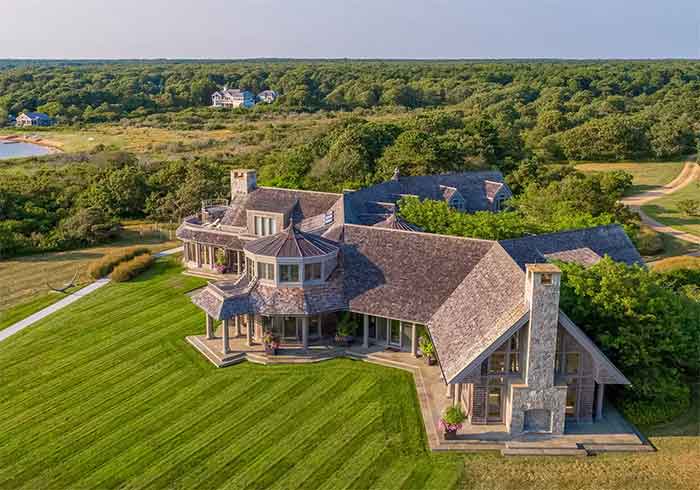
The recent news of Barack Obama’s vile selfie birthday celebration for his celebrity “friends” at his 29-acre estate and mansion (he has another eight-million-dollar mansion in Washington, D. C.) on Martha’s Vineyard is an egregious recent case in point. If he thinks this nauseating display is proof of his stability and strength – which obviously he does – then he is a deluded fool. But those who carry water for the military-intelligence-media complex are amply rewarded and want to tell the world that this is so. It’s essential for the Show. It must be conspicuous so the plebians learn their lesson.
The Obamas’ new house on Martha’s Vineyard
Obama’s Vineyard mansion stands as an outward sign of his inner disgrace, his soullessness.
Trump’s golden towers and his never-ending self-promotion or the multiple million-dollar mansions of high-tech, sports, and Hollywood’s superstars send the same message.
Take Bill Gates’ sixty-three-million-dollar mansion, Xanadu, named after William Randolph Hearst’s estate in Citizen Kane, that took seven years to build.
Take the house up the hill from where I live in an erstwhile working-class town that sold for one million plus and now is being expanded to double its size with a massive swimming pool that leaves no grass uncovered. Every week, three black window-tinted SUVs arrive with New Jersey plates to join two white expensive sedans to oversee the progress in this small western Massachusetts town where McMansions rise throughout the hills faster than summer’s weeds.
Take the blue dolomite stone Searles Castle with its 60 acres, 40 rooms, and “dungeon” basement down the hill on Main St. that was recently bought by a NYC artist who also owns seven grand estates around the country that he showcases as examples of his fine artistic taste. “All these houses have endless things to do — it’s just mind-boggling,” he has said. The artist, Hunt Slonem, calls himself a “glamorizer,” and his “exotica” paintings, inspired by Andy Warhol’s repetition of soup cans and Marilyn Monroe, hang in galleries, museums, cruise ships, and the houses of film celebrities. Like his showcase houses, his exotica must have endless things to do.
What would Vincent van Gogh say? Perhaps what he wrote to his brother Theo: that the greatest people in painting and literature “have always worked against the grain” and in sympathy with the poor and oppressed. That might seem “mind-boggling” to Slonem.
Such ostentatious displays of wealth and power clearly reveal the delusions of the elites, as if there are no spiritual consequences for living so. Even if they read Tolstoy’s cautionary tale about greed, How Much Land Does A Man Need?, it is doubtful that its truth would register. Like Tolstoy’s protagonist Pahόm, they never have enough. But like Pahόm, the Devil has them in his grip, and like him, they will get their just rewards, a small room, a bit of land to imprison them forever.
His servant picked up the spade and dug a grave long enough for Pahóm to lie in, and buried him in it. Six feet from his head to his heels was all he needed.
Where does the money for all these estates, not just Slonem’s, come from? Who wants to ask?
Getting to the roots of wealth involves a little digging. Slonem’s castle was originally commissioned in the late 1800s by Mark Hopkins for his wife. Hopkins was one of the founders of the Central Pacific Railroad, which was built by Irish and Chinese immigrants. Labor history is quite illuminating on the ways immigrants have always been treated, in this case “the dregs of Asia” and the Irish dogs. Interestingly enough, the great black scholar and radical, W. E. B. Du Bois, a town native, worked at the castle’s construction site as a young man. No doubt it informed his future work against racism, capitalism, and economic exploitation.
Wealthy urbanites flooded this area after September 11, 2001, and now, in their terror of disease and death, they have bought every house they could find. Their cash-filled pockets overflow with blood-money and few ask why. To suggest that massive wealth is almost always ill-begotten is anathema. But innocence wears many masks, and the Show demands washed hands and no questions asked.
It is rare that one becomes super-wealthy in an honest and ethical way. The ways the rich get money almost without exception lead downward, to paraphrase Thoreau from his essay, “Life Without Principle.”
Since the corona crisis began, investment firms such as the Blackstone Group have been gobbling up vast numbers of houses across the United States as their prices have gone through the roof. The lockdowns – an appropriate prison term – have set millions of regular people back on their heels as the wealthiest have gotten exponentially wealthier. Poverty and starvation have increased around the world. This is not an accident. Despair and depression are widespread.
There is a taboo in life in general and in journalism: Do not ask where people’s money comes from. Thoreau was so advised long ago:
Do not ask how your bread is buttered; it will make you sick…
But the super-wealthy do not get sick. They are sick. For they revel in their depravity and push it in the faces of regular people, many who envy them and wish to become super-rich and powerful themselves. Of course there are the blue bloods whose method is understatement, but it takes many decades to enter their theater of deception. In many ways, these people are worse, for their personae have been crafted over decades of play-acting and public relations so their images are laundered to smell fresh and benevolent. They often wear the mask of philanthropy, while the history of their wealth lies shrouded in an amnestic fog.
Yet soul murder includes suicide, and while the old and new moneyed ones smoothly justify their oppression of the vast majority, many regular people kill the best in themselves by envying the rich.
Years ago, I discovered some documents that showed that one of this country’s most famous philosophers, known for his lofty moral pronouncements, owned a lot of stock in companies that were doing evil things – war making, poisoning and killings huge numbers with chemicals, etc. But his image was one of Mr. Clean, Mr. Good Guy. I suspect this is typical and that there are many such secrets in the basements and attics of the rich.
But let us also ask where the writers and presenters of the mainstream and alternative media get their money. Although “to follow the money” is a truism, few do. If we do, we will learn that money talks and those who take it toe the line, nor do they live in shacks by the side of the road or rent like so many others. They invest with Black Rock and their ilk and have money managers who can increase their wealth while shielding them from the ways that money is made on the backs of the poor and working people. And they lie about people like Assange, Daniel Hale, Reality Winner, Craig Murray, et al., all imprisoned for daring to reveal the depredations of the power elites, the violence at the heart of predatory capitalism.
Yes, houses speak. But few ever speak of where their money comes from. Those that are on the take – which has multiple meanings – always plead innocent. Yes, I can hear you say that I am being too harsh; that there are exceptions. That is obvious. So let’s skip the exceptions and focus on the general principle. There is a Buddhist principle that right livelihood is a core ethic in earning money. Jesus had another way of putting it but was of course in agreement, as were so many others whom people hold in highest esteem.
Thoreau wrote: “If you are acquainted with the principle, what do you care for a myriad instances and applications.”
The truth is that for most people, work, if they can find it, is drudgery and hard, a matter of survival. The late great Studs Terkel called it hell and rightly said that most jobs are not big enough for people because they crush the soul, they lack meaning. And behind all ledgers of great wealth lie crushed souls. This reality is so obvious and goes by many names, including class warfare, that further commentary would be redundant.
A few years ago, I visited Mark Twain’s house in Hartford, Connecticut. It is advertised as “a house with a heart and a soul.” It is not a house but a mansion, and it was an ostentatious display in Twain’s time. Similar or worse than Obama’s mansion on Martha’s Vineyard today. It has no soul or heart. It was built with Twain’s wife’s family money. Her father was an oil and coal tycoon from upstate New York. Twain reveled in opulent respectability. He lived the life of a Gilded Age tycoon, an American magnate. It is not a pretty story, but the Twain myth says otherwise. Not that he catered to popular tastes to please the crowd and his domineering wife and that he lived in luxury, but that he was a radical critic of the establishment. This is false. For he withheld for the most part the publication of his withering take on American imperialism until after his death. He committed soul murder. But his mansion impressed his neighbors and his humor distracted from his luxurious lifestyle. His house still stands as a cautionary tale for those who will read it.
Baudelaire once said that in palaces “there is no place for intimacy.” This is no doubt why in people’s dreams small, simple houses with a light in the window loom large. Bachelard says, “When we are lost in darkness and see a distant glimmer of light, who does not dream of a thatched cottage or, to go more deeply still into legend, of a hermit’s hut.” For here man and God meet in solitude; here human intimacy is possible. “The hut can receive none of the riches ‘of this world.’ It possesses the felicity of intense poverty; indeed, it is one of the glories of poverty; as destitution increases, it gives access to absolute refuge.”
He is not espousing actual poverty, but the oneiric depths of true desire, the dreams of hope, reconciliation, and simple living that run counter to the amassing of wealth to prove one’s power and majesty. A humble house of truth, not a mansion of lies. This, to borrow the title of William Goyen’s novel, is “the house of breath” where the spirit can live and pseudo-stability gives way to faith, for insecurity is the essence of life.
There is such a hermit’s hut where the light shines. It is the tiny cell in Belmarsh Prison where Julian Assange hangs onto his life by a thread. His witness for truth sends an inspiring message to all those lost in the world’s woods to look to his fate and not turn away. To follow to their sources the money that greases the palms of all the so-called journalists and politicians who want him dead or imprisoned for life, who tell their endless lies, not just about him, but about everything.
The house of propaganda is built on unanimity. When one person says no, the foundation starts to crumble. The houses of the rich dead and crooked souls, erected to project the stability of their bloody illusions, start to crumble into sand when people dissent one by one.
Soon the fog lifts and there is no hiding any more. At the end of the path, you can see the vultures circling overhead as their prey go running out of their mansions in terror.
Officials announced that 70 people died in Turkey as of yesterday amid massive floods last Wednesday in Bartın, Kastamonu and Sinop in the western Black Sea region. The Disaster and Emergency Management Presidency (AFAD) said 47 people were missing.
The recent disaster in Turkey came as hundreds of millions of people are affected by floods, from the US to Germany and Belgium, Britain to China, North Korea and Japan. It raises the urgent necessity of a globally coordinated response, led by the working class, to climate change and the criminal policies of capitalist governments.
The flood disaster in the Black Sea region took place as forest fires in Turkey are still not completely contained. While the response of President Recep Tayyip Erdoğan’s government to the forest fires, especially in the Aegean and Mediterranean regions, has been inadequate, the emergence of the flood disaster led to even harsher social anger and criticism towards the government.
Citing data from the General Directorate of State Meteorology, Anadolu Agency reported that in some regions hit by the flood, precipitation was far higher than the annual average. This exposes the responsibility of the ruling class and its political representatives in several ways.
First of all, heavy rains and floods are the direct result of climate change produced by capitalism. The increase in sudden and heavy rains in recent years was not taken seriously by the government and local administrations. No measures were taken in settled areas through which streams pass through, and governments turned a deaf ear to scientific warnings.
Second, officials ignored the streams’ flood boundaries and allowed high-density construction there. Retired paleoseismology specialist Dr. Ramazan Demirtaş told the daily Sözcü, “The 400-meter width of the river bed has been reduced to 15-20 meters. Then these areas are zoned for construction. But also change the flow rate of the stream. A large mass of water then arrives. As this mass enters a narrow space, the water begins to rise. Then disasters like this happen. Stream beds should not be zoned for construction in any way.”
Third, the impact of the opening of private-sector hydroelectric power plants (HPP) and mines, which intensified under Erdoğan’s Justice and Development Party (AKP) government, in the Black Sea region has been enormous. Despite protests by local residents, with the opening of the mining areas and the building of HPPs, forested areas were removed, stream beds changed, and, as a result, the natural structure of the region was deteriorated for the sake of the capitalist profit.
Finally, the fact that the General Directorate of State Meteorology warned the authorities three days in advance exposes the indifference and the responsibility of the government. On this, Dr. Demirtaş said, “Meteorology has done its part. But after this warning, something had to be done.” He added, “We need to evacuate people three days before or take them to higher ground. And we could have prevented this loss of life. There should have been plans made before the disaster. But we make plans after a disaster happens.”
While scientists try to raise these issues and call for measures on future floods, the Erdoğan government is seeking to shed its responsibility, hiding as usual behind religious fatalism. Attending the funeral of Fatih Keşaplı, who drowned amid the floods in the Bozkurt district of Kastamonu, Erdoğan hypocritically declared, “It is not clear where and how this [flood] would happen. Just like the situation of our brother Fatih.”
An aerial photo shows destroyed buildings after floods and mudslides killed about two dozens of people, in Bozkurt town of Kastamonu province, Friday, Aug. 13, 2021. (Ismail Coskun/IHA via AP)
The government fears that the disaster is intensifying social anger in the working class. Faced with many protests in the region, Interior Minister Soylu made the following statement in Bozkurt, seeking to divert opposition by appealing to nationalism: “This country, state and nation belongs to all of us. While we are trying to heal the wounds of people here, there are those who think ‘how can I harm?’ and ‘how should I make this a political material?’”
After the flood disaster, the government called for financial support to the public by launching an aid campaign, as during the coronavirus pandemic.
A report in the daily Evrensel reveals the crimes of the ruling elites, since this disaster was preventable. According to this article, a report was published by the Water Management Directorate of the Turkish Agriculture and Forestry Ministry in 2019 and flood warnings were issued. The maps prepared with reference to this report showed that in the event of a flood, all residential areas, including the Bozkurt Vocational School, Bozkurt Municipality and Bozkurt State Hospital, would be under water.
Construction Engineer Umut Deveci told Evrensel, “This disaster could have been avoided with much less damage if rehabilitation works had been carried out based on these maps.”
Moreover, geologist Professor Dr. Naci Görür explained the causes of the flood disaster and how to take precautions. “These are called flood plains. These are the most productive agricultural areas in the world. Flood waters calm down in these plains. If you disrupt this system, that is, if you build houses, HPPs, dams, roads, etc. in streams and valleys, if you turn flood plains into residential areas and reduce the natural drainage capacity, you will cause flooding and you will not be able to contain it.”
Görür continued as follows, “Floods and undrained atmospheric waters trigger landslides. Reducing vegetation increases both flooding and landslides. The drainage system in the Black Sea should be managed according to scientific principles and controlled by law. Just like earthquakes, you may not be able to prevent natural floods and landslides, but you can manage and take measures to minimize the damage.”
It remains unclear whether the flash flood occurred due to excessive precipitation or to the opening of the covers of the HPP located above the valley. The State Hydraulic Works (DSİ) claimed that the HPPs played no role, thus clearing the companies with them, by publishing a statement titled “The allegation that flooding caused by HPPs does not reflect the truth.”
The accounts of those who experienced the disaster in Bozkurt refute this statement, however. Local resident Kübra Çelik stated that one hour before the incident, HPP employees called the citizens and the police and warned them about the explosion.
Whether the immediate cause of the disaster is HPPs, environmental destruction or the increase in precipitation, the ruling class and its representatives opened the areas that should not be zoned for construction, narrowed the stream beds and ignored all scientific warnings. This shows that they are responsible for the resulting damages and loss of life.
After the disaster, Environment and Urbanization Minister Murat Kurum, who went to Bozkurt, Kastamonu with Interior Minister Süleyman Soylu, looked at the people who suffered and are in mourning, and announced more future construction plans. He said, “There are collapsed buildings on the stream route. I express that we will heal the wounds of our citizens as soon as possible by constructing new buildings after the end of the search and rescue efforts.”
In short, Kurum was stating that they would continue the same construction errors and that they had no concrete policies to deal with future flood disasters.
National Health Service waiting lists for elective procedures could rise to more than 14 million by Autumn 2022 in the worst-case scenario, and up to 9 million in the most optimistic scenario.
This warning by the Institute for Fiscal Studies (IFS) follows Conservative Health and Social Care Secretary Sajid Javid stating that hospital waiting lists will increase up to 13 million in the coming months.
The fate of millions of people waiting to have an operation is an indictment of the Tory government and the ruling elite. They have let the COVID-19 pandemic run rampant, bringing an already dilapidated NHS to breaking point.
Many hospital trusts and ambulance services are still functioning under enormous pressure and working with reduced capacity. But operating on the maxim of “never let a good crisis go to waste”, the government has called on private hospital groups to step in and provide elective treatment. These private hospitals are set to rake in £200 million profit by providing elective procedures and diagnostic facilities to NHS patients.
A patient is pushed on a trolley outside the Royal London Hospital in east London, Tuesday, Jan. 12, 2021, during England's third national lockdown since the coronavirus outbreak began. Britain, with over 81,000 dead, has the deadliest virus toll in Europe and the number of hospital beds filled by COVID-19 patients has risen steadily for more than a month. (AP Photo/Matt Dunham)
Years of underfunding, reduced bed capacity and staff shortages even before the Coronavirus pandemic hit saw 4.4 million patients on hospital waiting lists. Over the last year, the waiting list has grown by 900,000 to 5.3 million.
But millions more have not joined queues because of disruption to hospital appointments, GP appointments and consultant referrals during the pandemic. According to IFS researchers, “in the first 10 months of the pandemic, there were 3 million fewer elective admissions and 17 million fewer outpatient appointments than in the same period the previous year.” They point out that “since March 2020, 7.4 million fewer people have joined the waiting list than implied by pre-pandemic patterns.”
In one scenario, the IFS estimates that even if 80 percent of patients needing hospital care join waiting lists in the coming period, “waiting lists would soar to 14 million by the autumn of 2022 and then continue to climb, as the number joining the waiting list exceeds the number being treated.”
Patients waiting for more than a year to be treated stood at 336,000 by May this year, compared to 1,600 in February 2020. NHS England figures show that in May, 212,770 patients had waited more than six months for trauma and orthopaedic services while another 130,224 patients who needed eye treatment services faced a similar plight. Hundreds of thousands with heart, gynaecology, urology and other ailments had also waited more than six months.
Many of these patients, including those with cancer and heart conditions, will die or face devastating suffering without timely intervention and treatment. Those who can afford to will be forced to fund treatments themselves, selling homes, exhausting savings and incurring crippling debts while the government washes its hands of any responsibility.
ITVNews recently reported the case of 29-year-old mother Emma Jamieson, who was forced to seek private treatment for her endometriosis. She struggled for four years to get a diagnosis, only to be told she would have to wait another two years for treatment on the NHS. Unable to bear the daily pain she took out a £10,000 personal loan and started a Go Fund Me page to raise the additional funds to pay £14,000 for her hysterectomy operation. Thousands more across the country face a similarly desperate plight.
Among those joining waiting lists are patients with Long COVID. By the beginning of March 2021, over a million people in the UK were reporting symptoms associated with Long COVID, according to the Office of National Statistics. A massive 40 percent of COVID sufferers aged between 19 and 49 had developed problems with their kidneys, lungs or other organs while being treated, according to a study by university researchers, the Department of Health and Social Care and Public Health England.
The burden imposed on the NHS by the criminal “herd immunity” policy of the ruling elite is unprecedented. Prime Minister Boris Johnson’s government has lifted all measures aimed at controlling the virus —including mask-wearing and social-distancing—amid average COVID-19 cases of more than 28,000 in the last seven days. Nearly 6,000 patients are being treated in hospitals nationally.
Hospitals are operating at 95 percent capacity, although safe capacity is 85 percent. This is even before winter pressures of flu and other ailments kicks in. Last month, the Academy of Medical Sciences warned, “A lethal triple mix of COVID-19, influenza, and the respiratory virus Respiratory Syncytial Virus (RSV), could push an already depleted NHS to breaking point this winter unless we act now.”
In a recent interview with the Bournemouth Daily Echo, Chief Executive of The University Hospitals Dorset (UHD) Debbie Fleming admitted that Bournemouth and Poole Hospitals were already “really heaving” and “bracing for a perfect storm of pressures”. She said the past 18 months had taken its toll and staff were “knackered”.
“This summer already feels very different not least because of the pent-up demand we are experiencing. We are unlikely to be able to draw breath before the winter arrives,” she told the Daily Echo.
According to a nurse in the UHD Trust, 37 patients with COVID-19 were being treated, including 5 patients in Intensive Care Units as of last Friday. 140 staff members were absent due to COVID-19 symptoms, isolating and shielding. Waiting lists for elective surgeries at the UHD Trust have climbed to 49,000, with 1,410 patients waiting a year-and-a-half for their elective procedures. 3,449 patients have waited more than a year.
Hospitals across the country are operating with 12 percent less bed capacity as they try to prevent COVID-19 cross infections between patients. Since 1987, successive Labour and Tory-led governments have slashed bed capacity by two thirds to 118,000 in 2020. They are responsible for chronic staff shortages of more than 110,000 health professionals, including 50,000 nurses.
While engaging in the cynical “Clap for our NHS Heroes”, the ruling elite has put health workers through an unending nightmare. Numerous reports from NHS frontline workers and public health experts have pointed to staff burnout caused by repeated waves of COVID-19, massive workloads and attacks on pay, terms and conditions.
But this catastrophic situation has opened a new goldmine for the ruling elite to plunder and privatise the NHS. The Tory government has plans to sign another £2 billion worth of contracts with private hospital firms to create around 7,000 extra beds. Contracts worth more than £2 billion have already been offered to companies since March 2020 to create extra bed capacity and provide non-urgent care. The iNews wrote, “Private hospital groups such as Circle Health, Ramsay Health Care and Spire Healthcare are believed to been among those discussing new and expanded deals with the Department for Health and Social Care.”
“Cost plus” pricing formulas in these contracts allow private companies to claim 8 to 10 percent of profits from the government, refuting NHS England’s argument that these contracts would be “at the same cost to taxpayers.”
While the Brazilian ruling class is promoting the broadest resumption of economic activities, along with the reopening of schools and entertainment venues, celebrating a fictitious end of the COVID-19 pandemic, a third wave of the coronavirus is growing at alarming speed, enhanced by the spread of the Delta variant.
Brazil has already recorded 569,218 deaths and 20,361,493 COVID-19 cases. Despite decreasing numbers in the last period, the country continues to record very high daily averages of more than 28,000 infections and 800 deaths.
In an interview in early August, the physician and neuroscientist Miguel Nicolelis, who has raised the most consistent warnings and predictions about the pandemic’s uncontrolled development in Brazil, described the current situation as an imminent catastrophe.
COVID testing site in Brazil (Credit: Marcelo Camargo/Agencia Brasil)
In a strong image, the scientist compared the development of the epidemic to the movement of the waves, in which the current decreasing moment of epidemiological curve precedes an overwhelming new uprising. “It’s like a wave, a tsunami, that ‘swept the coast’ and now has gone backwards,” he stated. “The tsunami of the second wave in Brazil retreated with the sea only to gain energy, and that energy is going to, in some way, reproduce here the dynamics happening in other countries. ... While the whole world is exploding [with the Delta variant cases], we are just waiting for it to explode here in Brazil.”
Nicolelis further characterized the present moment of the pandemic in Brazil as a “dispute between the Gamma variant and the Delta variant,” and he pointed to the recent news that in Rio de Janeiro the Delta variant already accounted for 45 percent of new cases as a sign that “this dispute is being won by the Delta variant, as expected.”
The most recent data from the Fiocruz Genomics Network further substantiates that dismal prediction. They point out that the share of Delta variant cases in Brazil increased from 2.3 percent in June to 23.6 percent in July, a nine-fold increase. This is a radically faster spread than that recorded with the Gamma variant, which at a similar stage of its development, between December and January, had only doubled its share of the total number of cases.
But if scientists like Nicolelis advocate “keeping mask mandates, restricting crowds, not resuming classes, not opening economic activities, not having soccer games” and in certain cases “decreeing lockdowns,” the joint response of all of Brazil’s governing bourgeois parties is the complete opposite.
An offensive against all measures to contain the virus is being led by the administration of fascistic President Jair Bolsonaro. In an official statement in late July, the ministers of education and health, Milton Ribeiro and Marcelo Queiroga, called for the immediate return of in-person learning and economic activities throughout Brazil. While Ribeiro emphasized that “the vaccination of the entire school community cannot be a condition for the reopening of schools.” Queiroga declared, “It is necessary that we manage to promote a prompt return of economic activities, we have beds available in hospitals, let’s live with this pandemic situation.”
To better elucidate his idea of “living with this pandemic situation,” Queiroga quoted an excerpt from a song by Brazilian composer Lulu Santos that says, Nothing will be again the same way it was one day.” In other words, the Brazilian population should accept as the norm the indiscriminate deaths caused by this pandemic, as well as by others that will predictably surge in the coming years. In his crusade to implement this homicidal policy, last Wednesday the minister offered a guarantee “on behalf of Bolsonaro” that by the end of the year “we will be able to take off these masks once and for all.”
Such sociopathic ideas, which correspond to the deeply reactionary interests of the bourgeoisie, have gained a particularly grotesque manifestation in the policies advocated by the mayor of Rio de Janeiro, Eduardo Paes, of the Social Democratic Party (PSD). On July 29, Paes announced that his city, now the epicenter of the Delta variant in Brazil, will launch in September a continuous year of festivities to celebrate the end of the coronavirus pandemic. He even plans to institute a municipal holiday called “Reunion Day” and stated that he will promote the “biggest New Year’s Eve in the history of the city,” which should be celebrated without the mandatory use of masks.
Similarly, in São Paulo, which has the second highest number of confirmed cases of the Delta variant in Brazil, Governor João Doria of the Brazilian Social Democracy Party (PSDB) declared Monday (August 16) the “Day of Hope” because the entire population up over the age of 18 will have had access to the first shot of the vaccine. The date will coincide with the largest reopening of activities since the beginning of the pandemic. It is especially hypocritical to use such an occasion to talk about “hope” when the rapidly spreading Delta variant is reportedly responsible for breakthrough infections and for the reduction of vaccine protection, especially for those who have received only a first shot.
While the Rio de Janeiro state (but not municipal) public schools have been closed again to contain the advance of the new variant, Doria is continuing to promote the widest functioning of schools in São Paulo, the largest educational system in the country. A large portion of teachers in the state have received only a first shot of the vaccine, while the millions of students who are increasingly susceptible to infection and death have received none at all.
The same anti-scientific measures are being promoted by governments headed by the Workers Party (PT) and its allies. Officials like the governor of Bahia, Rui Costa of the PT, are proceeding with the resumption of in-person classes despite resistance from educators. At the same time, the trade unions controlled by the PT and supported by its pseudo-left satellites, are not organizing any resistance to the homicidal back-to-work policy of the ruling class.
A new explosion of the COVID-19 pandemic and the uncontrolled spread of the Delta variant throughout Brazil will have predictably catastrophic effects on neighboring South American countries. The outbreak of the second wave of the pandemic in Brazil in early 2020 spread across the continent with devastating results. The Gamma variant, originally from Manaus in northern Brazil, rapidly engulfed neighboring countries, critically contributing to the explosion of infections and collapse of hospital systems in countries such as Colombia, Paraguay and Uruguay, causing an overwhelming number of deaths.