3 Nov 2021

Crisis in Sudan is a lesson for the U.S.

Wim Laven


About 2,700 years ago a storytelling slave named Aesop told tales of political, religious, and social themes. They have been popularized for their ethical dimensions and utilized as children’s’ stories for the morals and wisdom they deliver.

In “The Four Oxen and the Lion” Aesop tells of a powerful lion who prowls a field in search of a hearty meal. The four oxen who live there stand tail to tail and offer The Lion horns regardless of the direction of the approach. One day, however, an argument causes the the four oxen to go their separate ways. On their own the oxen do not stand a chance against the lion, who picks them off one by one with great ease.

The moral of the story: united we stand, divided we fall.

Issues of collective security are timeless. In the United States collective security was so important that a 3/5ths Compromise (making slaves 3/5ths of a person for purposes of the census and political power), which inflated the power of slave states, a prohibition against the abolition of slavery (Article I Section 9 of the Constitution prevents Congress from banning the importation of slaves before 1808), and the electoral college (Virginia slaveholder James Madison famously admitted that direct vote of the President was the “fittest” but would hurt the South because they had so many nonvoting slaves) in order to create ‘unity.’

Compromise is a strategic effort where parties to a dispute make concessions—give up some of the demand—in order to achieve other goals or meet other needs.

Sudan is currently in headlines because the military has dissolved the alliance between military and civilian groups effectively blocking the power-sharing Sovereign Council and agreed-upon transitional government. To be clear, the transition from the brutality of Omar al-Bashir’s three decades of power, which ended in a 2019 nonviolent grassroots insurrection to democratic civilian rule was on shaky ground because the Sovereign Council was unelected.

The excitement with ousting al-Bashir has faded and conflict over power has increased political pressures and tensions between both sides; the future of Sudan is uncertain, the coup was not a surprise, but neither is the resistance; the streets are full of peaceful pro-democracy protesters, but while the efficacy of nonviolence is clear the outcome remains to be seen.

Al-Bashir’s loyalists have initiated the military coup d’etat, which bears some parallels to Trump’s illegitimate power grabs and the criminal efforts of his loyalists. But the similarities are limited; where most of the officers pushing for al-Bashir in Sudan last month were arrested, the U.S. House Select Committee to Investigate the January 6th Attack on the United States Capitol say they will get justice, yet nine months later no officials nor Trump have been charged for their efforts intended to overthrow American democracy.

Al-Bashir’s loyalists in Sudan chanted “down with the hunger government” just like Trump’s scream “Stop the steal!” The former demand reforms to the Forces of Freedom and Change coalition, the replacement of the cabinet in power, and a coup overthrowing the government. The latter, according to a recent poll, which found that 66 percent of Republicans believe that “the election was rigged and stolen from Trump,” while only 18 percent believe “Joe Biden won fair and square.”

The rule of law is under attack in both countries. And just like Aesop delivers a lesson on standing together, the people of Sudan present important reminders on the importance of people power and the role of nonviolence safeguarding democratic institutions.

It is easy enough to hope that Trump loyalists will not make a repeat attempt at an insurrection, but the evidence suggests otherwise and the political threats and violence of 2020 and 2021 should be a wake-up call.

There have been too many plots to list and at seemingly every level of government; there have been plans to kidnap Gretchen Whitmer, the Governor of Michigan, who, in June, said: “Threats continue, I have looked out my windows and seen large groups of heavily armed people within 30 yards of my home. I have seen myself hung in effigy. Days ago at a demonstration there was a sign that called for ‘burning the witch.’”

The National Association of School Boards has asked President Joe Biden for federal assistance to investigate and stop threats in a letter outlining 20 cases of threats, harassment, disruption, and acts of intimidation in California, Florida, Georgia, New Jersey, Ohio and other states. The board argues that: “As these acts of malice, violence, and threats against public school officials have increased, the classification of these heinous actions could be the equivalent to a form of domestic terrorism and hate crimes.”

The U.S. and Sudan showcase different stages of division. The people of the U.S. are well served to learn and get involved in Sudan through solidarity. People of the world can all push for frozen assets and travel bans on those responsible for the coup and thank President Biden for his swift action in suspending $700 million in aid to Sudan. Nonviolent but coercive measures like these can pressure the military to yield to the people’s demands. We can also make strong condemnations to the use of political violence and the detainment of political prisoners—who should be immediately released.

When we watch what is happening in Sudan we become better global citizens. We learn about other cultures and struggles, and we increase our empathy for others. We live up to the moral demands that we respond to the injustice that others experience and they gain strength through the increases in unity. But we also learn valuable lessons for the protection of our own fragile democracy. As long as there are people who threaten a violent takeover there must also be people prepared to use the power of nonviolent struggle—to amply the voices of the people—in resisting them.

Trump and al-Bashir may be the lions. But we are the many oxen who can thwart their attacks.

Ecuador’s Neoliberal Government Announces State Emergency to Impose Austerity

Vijay Prashad & Taroa Zúñiga Silva


Ecuador Protest

On October 18, 2021, Ecuador’s President Guillermo Lasso declared a state of emergency for 60 days. This declaration led to the constitutional rights of Ecuadorian nationals being suspended and heavily armed troops flooding the streets in Ecuador. The immediate reason for the declaration was the murder of an 11-year-old boy named Sebastián Obando, who was killed in a crossfire between “an armed robber and a police officer” on October 17 at a cafeteria and ice cream parlor in the Centenario neighborhood in Guayaquil.

The boy, who was shot three times, was shot in the heart, right arm and his back, said his father Tomás Obando. Lasso’s declaration of emergency built on the public outcry relating to this murder. The president said that he needed to suspend the constitutional rights of the people of Ecuador to confront the grip of the drug gangs on the country.

On October 19, U.S. Secretary of State Antony Blinken arrived in Quito to provide U.S. support for Lasso. Blinken met with Lasso, affirming the close ties between the United States and Ecuador. At a press conference held by Ecuador’s Foreign Minister Mauricio Montalvo and the U.S. Secretary of State, Blinken said, “in democracies there are times when, with exceptional circumstances, measures are necessary to deal with urgencies and urgent situations like the one Ecuador is experiencing now.”

Lasso, who was elected in April, has presided over one extraordinary moment after another. The economy of Ecuador splutters as the government struggles to respond to an increase in violent incidents in the country. In September, a prison riot in the Litoral Penitentiary (Guayaquil) resulted in the loss of 116 lives. Earlier, in February 2020, a coordinated series of riots in four prisons led to the death of 79 inmates in Ecuador. Responding to the recent incident in September, Lasso declared a state of emergency inside Ecuador’s prisons, which was a precursor to the national emergency.

Structural Problem, Not Extraordinary Moment

Lasso’s decree suggests that there is something pressing taking place in Ecuador that requires action. Nela Cedeño, a youth leader of the Citizen Revolution of Ecuador, told us that Ecuador has been in a long-term crisis. Just this year, she says, there have been 1,213 murders, many of them unrelated to the drug trade. “The decree [state of emergency] is not justified,” Cedeño said. The data shows an “increase in violence in the country over the past six years, which we understand as a structural problem and not an exceptional situation,” Cedeño added.

Out of Ecuador’s approximately 18 million people, 5.7 million live “in poverty,” and out of “these 5.7 million people, about 2.6 million” Ecuadorians are living “in extreme poverty,” according to the National Institute of Statistics and Censuses. UNICEF calculates that three out of every 10 children in Ecuador under the age of two suffer from chronic child malnutrition. “The country is the second with the highest proportion in Latin America and the Caribbean, after Guatemala,” according to UNICEF. Everyday life in Ecuador deteriorated sharply ever since the implementation of an International Monetary Fund-driven austerity program under the previous President Lenín Moreno. Moreno’s agreement with the IMF in March 2019 resulted in widespread protests across the country.

As part of Moreno’s deal with the IMF, he cut government funding for health care, including firing 3,680 health care workers. As a result, in Guayaquil—where the prison riot had taken place and where Sebastián was murdered—dead bodies were left on the streets during the peak of the COVID-19 pandemic because the health care system was underfunded and overwhelmed. Guayaquil was the “epicenter of the outbreak” during April 2020 and Ecuador had one of the highest rates of COVID-19 in Latin America as a result of the broken health care system. Lasso, whose party only has 12 of 137 seats in the National Assembly, wishes to deepen the austerity program of Moreno; this program includes tax cuts for the wealthy and withdrawal of rights for workers as well as the allowance for foreign companies to continue to operate in Ecuador’s mining sector.

Lasso’s austerity agenda, Cedeño told us, does not solve the problems of the people. There is no agenda to tackle the precariousness of employment, the need for a minimum support price for farmers, the need for subsidies for fuel, the exploding social crisis in prisons, and the general problem of violence in society. The Lasso government is “politically incapable” of dealing with the real problems, so it takes refuge in the militarization of a social crisis, Cedeño said.

Militarization of a Social Crisis

Lasso’s emergency, Cedeño said, has not calmed a “terrified and worried citizenry.” In fact, it was even more frightening when Lasso fired his Defense Minister Fernando Donoso and replaced him with a former general, Luis Hernández. Putting the military on the streets of Ecuador and pushing for laws to allow them to operate without scrutiny (and to give them immunity of action) creates the conditions for a military dictatorship with a civilian fig leaf of a government. Lasso’s emergency decree gave amnesty to the security forces who, he said, are “unjustly condemned for their work.”

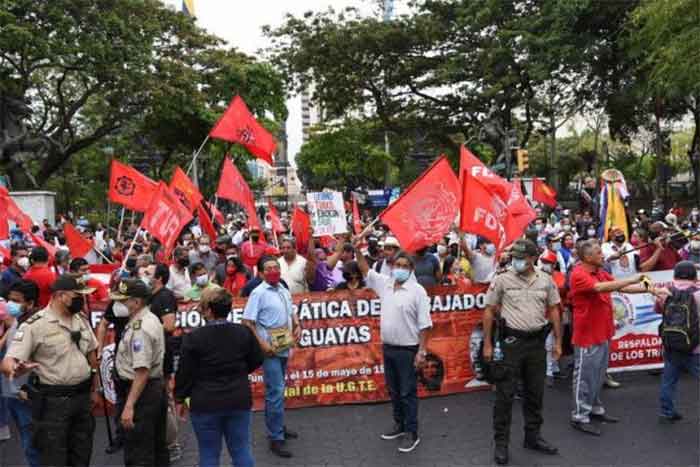
Since 2019, Ecuador’s social movements, including the Indigenous movement, have frequently taken to the streets to demand an alternative path. This year, Cedeño said, “we have had several stoppages and protests against the various measures adopted by the government of Lasso. Farmers, teachers, and transportation workers have been in the lead. Teachers [even] went on hunger strike.”

The decree by Lasso came, Cedeño pointed out, just when the people’s movements gave a call for social mobilizations against the rise in fuel prices and Lasso’s austerity proposals. “It is easy for us to assume that the state of exception [was] declared at the convenience of Lasso,” to protect his policies, and “not because of the violence that plagues the country.”

Protests against the emergency decree began on October 26. Led by the United Front of Workers (FUT), the National Union of Educators (UNE), the Confederation of Indigenous Nationalities of Ecuador (CONAIE), and the Citizen Revolution, the protests took off in earnest. While these protests were met with stiff resistance from the armed forces, they did not fade away. Roads were blocked in key areas in the Sierra and the Amazon and mass demonstrations gathered in front of the Carondelet Palace, the seat of the president in Quito. After a few days of protest, on October 28, CONAIE leader Leonidas Iza called for their suspension to honor the Day of the Dead holidays. Iza said that the protests will start-up again after the celebrations.

Chilean government slashes health staff, critical beds as Delta becomes dominant strain

Mauricio Saavedra


In an astonishingly reckless move, the outgoing right-wing Chilean government in October cut 8,000 positions within the public health system and plans on eliminating 31,000 by the end of the year. Critical and ICU beds are earmarked to be halved from the current level of 4,300. The slashing operation is all the more significant as the Delta variant of COVID-19 has become the dominant strain, and the Health Ministry is progressively removing restrictions, including to international travel.

On September 30, the administration of President Sebastian Piñera not only ended the State of Emergency that placed the deeply unpopular National Defense forces in charge of regional and national borders since March 2020, it simultaneously ended lockdowns and discontinued the supplementary health fund to deal with the pandemic.

A division of labor exists where the ultra-right government proposes, the parliamentary left disposes and the corporatist unions impose. The Health Ministry announced with much fanfare that the Senate joint commission had approved the government’s 2022 budget. Meanwhile the health unions conduct half-hearted and demoralizing token protests, stoppages and marches that convince no one and change nothing.

The Health Ministry is trumpeting the country’s high inoculation rate to justify a homicidal return to pre-pandemic activity that includes reducing expenditure on the public healthcare workforce. It is preparing projected cuts in public spending of up to 22.5 percent next year, even though there are no signs of the pandemic abating. Daily cases dropped during August and September, but October cases again shot past 2,000 in Chile, while in the northern hemisphere Europe is driving a new global upsurge .

While health, education and other social areas will bear harsh cuts, one area that will receive an increase in funding is the forces of repression that since the mass anti-capitalist mobilizations in 2019 have been accused of countless human rights abuses, including crimes against humanity.

Distribution of the number of reported COVID-19 cases (confirmed and probable) by age group and sex. Chile, 24/10/2021(Source: Ministry of Health)

In a televised address, Piñera reported that the 2022 Budget will increase “resources to modernize the infrastructure, equipment and technology of the Carabineros and the PDI [Investigations Police of Chile], to strengthen crime prevention and the fight against drug trafficking and terrorism…”

In September, hospitals in Santiago and the regional centers reported that they didn’t have enough funds to pay thousands of fixed-term employees and were obliged to reduce the number of critical beds available. Primary Health Care centers, run through the municipalities, were forced to cut thousands of personnel dedicated to overseeing contact tracing, testing and isolation measures. Private health conglomerates such as BUPA Chile carried out their own mass dismissals earlier in the year.

These socially criminal policies are in line with demands from international capital that the working class “learn to live with the virus” a doublespeak catchphrase that in reality means sacrificing lives for the sake of profits. It is in keeping with the Chilean State’s response from the outset.

The free market policies imposed by the 17-year-long fascist-military dictatorship of General Augusto Pinochet, and then preached under four decades of civilian center-left and right-wing administrations, have left a public health system starved of resources, PPE, infrastructure and personnel. This is what transformed Chile’s pandemic emergency into a catastrophe.

Beginning in March 2020, as the virus spread across Latin America, the Chilean Central Bank and the Piñera government prioritized a pro-corporate agenda of low interest rates, offering billions in liquidity and asset purchases, and providing loan guarantees that equaled 15 percent of GDP.

Mario Marcel, the Central Bank governor said in an annual address to the Senate that the measure is “comparable to the resources that have been committed in Brazil, but far above what has been done in other Latin American countries.”

Number of health personnel infected and dead from Covid in the Americas (Source: OPS. Infograph: Gina Domingos)

Mining, a non-essential but nationally strategic industry, remained open even though the northern regions where the main copper pits are located became hotspots for the virus. So favorable was the aid and policies that magnates of mining and forestry, banking, investment and retail—Luksic-Fontbona, Ponce Lerou, Paulmann, President Piñera, Salata, Angelini, Saieh, Yarur, Solari-Falabella—increased their fortunes by 70 percent in the last two years.

And so negligible were the government handouts to the poverty-stricken population in 2020 and the beginning of 2021 that the virus spread unabated through the congested and overcrowded working class communes and among the poorest sections of the population. Shantytowns, many of which lack basic necessities of modern life—sewerage, potable water, electricity—sprouted like mushrooms, especially in the northern regions during 2020 and 2021 as thousands of destitute families, especially migrants, faced the crisis with no help.

During the most difficult period the official unemployment rate surpassed 13 percent—though several university studies demonstrated that the real figure reached closer to 29 percent when the furloughed and those not actively seeking work were included. Many were forced to seek work in the informal sector that now accounts for 27 percent of the total workforce. As a result, the demographic most devastated by the virus was the working class.

In face of the COVID-19 pandemic, the government began its response with outright lies about the nature of the virus so as to forestall as long as possible forking out financial resources. For months it minimized the significance of the pandemic; the ex-Health Minister Jaime Mañalich going so far as to claim it would become benign, “something like the common cold.”

From no known cases at the beginning of March 2020, the cumulative number of infections jumped to 184,500 in the middle of June 2020; to 622,000 infections and 20,473 deaths by the end of November. By March of this year, there were just under 1 million infections and 27,000 deaths, doubling to 2 million confirmed and suspected cases and 48,553 confirmed and suspected deaths by the end of October.

Following the removal of Mañalich for repeatedly fudging the COVID-19 infection and fatality figures, his successor, Enrique Paris, expanded an “integrated public-private health network”. This put at the disposal of concierge private clinics enormous state resources, while handing only a fraction to the public health system.

The liberal news site El Desconcierto gave one example of how the private networks profited: “The basic cost of an ICU bed in the Alemana Clinic is 1,066,094 pesos while the State pays 159,760 pesos to the public hospitals for the same service. Private clinics charge 6.7 times higher and the tab is picked up by 80 percent of the population who subscribe to the National Health Fund (FONASA).”

With only 2.5 doctors, 2.7 nurses and 2.0 beds per 1,000 inhabitants, prior to the pandemic, thousands of people on waiting lists were dying long before COVID-19 came around.

La Tercera published in September a detailed report on the number of patients who have died while waiting for specialist consultations and surgeries over the last five years, reaching a high point in 2020 with 16,300 deaths during the first semester—as many as in the whole of 2016. The average surgery waiting time today stands at 18-plus months, although there are cases of patients waiting five years for an operation.

Waiting list deaths. (Source: Ministry of Health, La Tercera)

The waiting list rose astronomically in 2020 due to the prioritization of COVID-19 patients to the exclusion of all chronic diseases. By the first six months of 2020, there were 2.3 million people who were on waiting lists and an untold number of chronic patients went without referrals for fear of becoming infected. Until around August of this year, hospitals had even suspended cancer treatment, according to a report in Cooperativa.

Even with the one-off infusion of resources and personnel, the hospital system has collapsed several times since March 2020. The bed occupancy rate in the Metropolitan hospital system peaked at 98 percent, and patients had to be directed to outlying regions to receive critical care.

COVID-19 positive cases among health workers has surpassed 52,000, and 129 workers have died due to the lack of resources and personal protective equipment, long working hours and moonlighting within the health care system.

“We have 30 percent of the workers on medical leave, including 18 percent on leave due to mental health problems,” said Patricia Valderas, head of the Confederation of Health Workers (FENATS Nacional). “Waiting lists are enormous and we need a good number of trained personnel to attend to the needs of the population.” Her solution was to call on the government to extend the State of Emergency!

Aldo Santibáñez, national leader of the National Federation of University Professionals of Health Services (Fenpruss) told Diario Concepción, “There are people who have not taken holidays for a year and a half or two. And in that sense one understood that the COVID reinforcements, who already have a year and a half of experience, were ideal to stay in the health services to deal with the waiting lists...”

The president of the Medical Association, Izkia Siches, said, “We had hoped that after the pandemic a new standard would be set for how we deliver care. Unfortunately that gap remains.”

But the government, with Senate backing, can completely disregard these and every other demand, knowing full well that the corporatist unions will keep their members in line, that is, until they can’t. The ongoing tragic toll on health workers, and more broadly the working class, is not only a damning indictment of the Piñera government, the parliamentary left and the unions, it presages an eruption of the class struggle that will dwarf the developments in 2019 and come into direct conflict with all the defenders of the capitalist state.

Global markets force Australian central bank to scrap major plank of monetary policy

Nick Beams


The Reserve Bank of Australia (RBA) made a significant change to its monetary policy yesterday, abandoning so-called yield curve targeting. Its governor, Philip Lowe, sought to present the move as a response to the achievement of the central bank’s inflation target earlier than expected.

In fact, the decision signified the failure of the RBA’s efforts to maintain the yield on an Australian government bond maturing in April 2024 at 0.1 percent in the face of powerful global market forces that ripped through the bond market last week.

Reserve Bank of Australia Governor Philip Lowe (Credit: Wikimedia)

After the headline rate of Australian inflation hit 3 percent and the underlying inflation rate moved above 2 percent, there was a major sell-off of short-term bonds, reflecting investors’ opinion that Australia was joining the worldwide rise in inflation.

The sell-off was part of a global movement, with short-term bond markets experiencing “unprecedented volatility” according to George Saravelos, Deutsche Bank’s head of global currency research, in remarks cited by the Financial Times.

Saravelos said the moves in bond markets had been exacerbated by investors being forced to abandon bets that had gone sour, because markets had moved against them due to rising inflation. The situation was “the closest we can get to a distressed market.”

The sell-off in the Australian market, Saravelos said, was the most severe since 1996. As a result, bond prices fell last week and the yield on the targeted bonds rose eight-fold from 0.1 percent to 0.8 percent (the price of bonds and their yield has an inverse relationship).

Last week the RBA was faced with a situation where in order to maintain its yield target it would have had to buy up every one of the available bonds in the market.

In the event, the bank decided to stand aside and basically scrap the policy. Lowe told a webinar yesterday he took the decision using his “discretionary” powers, with the RBA board rubber-stamping the shift.

In yesterday’s statement on monetary policy, Lowe said the RBA board was confronted with three options: to continue the existing policy, lift the target yield or discontinue it altogether.

It decided to take the third option on the basis that the targeting policy, introduced in March 2020, was an “appropriate tool during an exceptional period, but not one to be used on an ongoing basis.”

Lowe sought to put the best face on a bad situation. “The decision to discontinue the yield target reflects the improvement in the economy and the earlier than expected progress towards the inflation target,” he said.

That did not cut much ice. The Australian Financial Review noted: “Lowe is not the first leading public figure to make a virtue out of the disintegration of a strategy that proved unworkable in the face of market forces.”

While it abandoned yield targeting, the RBA said it would continue its policy of quantitative easing—purchasing government bonds at the rate of $4 billion a week at least until February 2022—and maintain its base interest rate at 0.1 percent. Like those of its counterparts internationally, both RBA policies have provided major support for corporations and financial markets.

But the rise in inflation is putting these measures under pressure.

Seeking to reassure the markets, Lowe insisted the decision to end yield targeting did not “reflect a view that the cash rate will be increased before 2024.” But that was no cast iron guarantee. There was “genuine uncertainty as to the timing of future adjustments to the cash rate,” he said.

It was “still entirely possible that the rate will remain at its current level until 2024.” It was “also possible that an earlier move will be appropriate.” It was “plausible that a lift in the cash rate could be appropriate in 2023,” but Lowe ruled out any increase next year.

“I recognise that that some other central banks are raising rates, but our situation is different,” Lowe said.

This wheeling out of the old line of Australian exceptionalism stood in marked contrast to what had just taken place—the RBA had been battered around the head by the operation of global markets and suddenly forced to abandon a key plank of its policies.

On the economic outlook, Lowe said the Australian economy was “well placed to resume its expansion.” Gross domestic product was expected to record a solid gain for the current December quarter. The RBA’s scenario is for economic growth of 5.5 percent for 2022 and for around 2.5 percent in 2023.

Yet Lowe acknowledged that it was “also possible that we experience yet another setback that throws the economy off course.” The source of such a shock could be a new strain of the COVID-19 virus or a decline in vaccine effectiveness.

Financial conditions in Australia, Lowe said, remain “highly accommodative,” with lending rates at record lows. The RBA was “committed to maintaining highly supportive monetary conditions.”

The maintenance of this support to corporations and the financial markets, which is also fueling record housing price rises, depends on the suppression of wages, even as inflation starts to rise.

“While inflation has picked up, it remains low in underlying terms. Inflation pressures are also less than they are in many other countries, not least because of the only modest wages growth in Australia.”

This remark points to the crucial role of the trade union apparatuses in suppressing the growing demands among workers for higher wages under the impact of inflation. This helps the RBA continue with its cheap money policies that have enabled the siphoning of wealth to the upper echelons of society and the continued fabulous enrichment of the billionaires.

Six hundred children have been killed by COVID-19 in the US

Renae Cassimeda


The latest data from the American Academy of Pediatrics (AAP) released Monday shows yet another week of mass infection among children in the US. During the week ending October 28, 100,630 new cases were officially reported, marking the 12th straight week that official cases among children have surpassed 100,000.

Preschoolers eat lunch at a day care center, Monday, Oct. 25, 2021, in Mountlake Terrace, Wash. (AP Photo/Elaine Thompson)

Sixteen additional child deaths were also reported by the AAP, bringing the cumulative death toll to a grim 600 child deaths since the AAP reports began in May 2020.

Given the deliberate cover-up of reporting of child infections, hospitalizations and deaths in many states across the US, in addition to a lack of systematic testing of symptomatic and asymptomatic children and contact tracing, the numbers are a clear underestimate of the real impacts of COVID-19 on children. The ongoing surge in mass infections coincides directly with the reopening of schools under conditions where community transmission has remained high throughout the US and mitigation policies have been severely limited or entirely scrapped. The Centers for Disease Control and Prevention (CDC) states that 74 percent of counties in the US still have high levels of community transmission with over 100 new cases per 100,000 persons in the past seven days.

Since schools began reopening for the fall semester three months ago, one third of total reported cases, or 2.2 million, and nearly one third of deaths among children, or 242, have occurred.

Federal and state governments are knowingly allowing for mass infection and deaths among children in order for parents to remain at work to maintain capitalist production. They are doing so on the basis of lies that children are less likely to catch or transmit COVID-19, which were first advanced by the Trump administration and then by Biden. In February 2021, when the Biden administration was pushing its campaign to fully reopen schools across the US, the president told a concerned second-grade child on national television, “Kids don't get… COVID very often. It’s unusual for that to happen,” adding, “You’re not likely to be able to be exposed to something and spread it to mommy or daddy.”

This was nothing but a bald-faced lie. Nine months later, millions of children have been infected, potentially hundreds of thousands are currently experiencing Long COVID, and hundreds have died in the US.

According to the Kaiser Family Foundation (KFF), among children ages 5-14, COVID-19 was the sixth leading cause of death in August and September. For young people ages 15-24, the virus is now the fourth leading cause of death.

At least 140,000 children in the US and over 5 million children internationally have lost a caregiver since the pandemic began. There is no doubt that children not only are significantly affected by the pandemic now but will also experience significant impacts well into the future. Such a catastrophe has been entirely preventable, yet continues in the US and internationally due to the “herd immunity” policies driven by the prioritization of profits over human lives.

With the approval of the Pfizer vaccine for children ages 5-11 in the US finalized on Tuesday, there is a growing push by government leaders to lift all remaining mitigation measures in schools where they still exist. While vaccinating children is a necessary component to combat COVID-19, vaccines alone are not enough to curb mass infection and deaths.

Emily Oster, an academic who advocated for the reopening of schools before the vaccines were even approved in fall 2020, recently promoted an opinion piece published in the New York Times by Jessica Grose, which calls for “an off-ramp for in-school masking.” Oster tweeted the article with the comment, “Masking off-ramps are necessary. I will admit I have been reluctant to talk about this, in part due to fear of being yelled at. This wasn’t brave. I will try to be braver.”

Oster, an academic with no expertise in epidemiology or virology, co-authored a study last year which significantly downplayed the impacts of COVID-19 on children and was utilized by the CDC and both the Trump and Biden administrations to push forward the reopening of schools. Her call for policies to lift mask mandates in schools, which is being pushed by other media outlets and corrupt scientists, is part of a broader promotion of “herd immunity” policies to spread the virus throughout society and cause it to become endemic.

Despite continued efforts to downplay the dangers of school reopenings, data recently published in the Journal for Infectious Diseases provides yet more evidence to confirm prior studies which show infants, children and adolescents are in fact able to spread the virus and carry potentially dangerous variants similar to adults, regardless of severity of infection.

Lael Yonker, pediatric pulmonologist at Massachusetts General Hospital and co-author of the study, notes that “Kids with COVID-19, even if asymptomatic, are infectious and can harbor SARS-CoV-2 variants. Variants could potentially impact both the severity of the disease and the efficacy of vaccines, as we are seeing with the Delta variant. When we cultured the live virus we found a wide variety of genetic variants.”

Another survey by KFF found that only one third of children ages 5-11 are expected to be vaccinated by early 2022. Coupled with ongoing high community transmission across the US and the looming winter surge, the threat of mass infection and the spread of more infectious variants among a vulnerable population is increasingly likely. Currently, just 48 percent of US children 12-17 have received one dose of the vaccine.

Roughly 69 percent of US school districts require mask use indoors for students and all staff. Multiple districts that still have limited mitigation measures in place, including Los Angeles Unified School District with over 600,000 students, have language in their contracts to revisit COVID-19 safety protocols at the end of 2021.

Other districts with limited mitigation policies already have policies in place to soon lift mask mandates, including in Massachusetts and Nevada. Massachusetts has a state policy that allows an individual school to provide mask mandate exemptions once a school population reaches the 80 percent vaccination threshold, with two districts in the state already reaching this threshold. On Monday, Hopkinton High School will begin a three week trial allowing for mask use to be optional for students and staff, as 95 percent of the school’s students and staff are vaccinated.

The effort to lift all mitigation measures in indoor settings is part of an international trend, most acutely expressed by the Johnson administration in the United Kingdom. Open “herd immunity” policies implemented in UK schools have resulted in a catastrophic surge in child cases, with an average of 20,000 children infected with COVID-19 each day and a total of 103 child deaths in the country.

New studies show mood disorders heighten risk of severe COVID illness and death

John Mackay


It has been well documented internationally that the COVID-19 pandemic has led to an unprecedented impact on the mental health of broad layers of the world’s population. This includes people with existing mental health problems as well as those previously unaffected prior to the coronavirus crisis.

A new study published this month in The Lancet attempted to quantify the global prevalence and burden of depressive and anxiety disorders, finding substantial increases worldwide. The study was a systematic review of published data that reported the prevalence of depression and anxiety before the pandemic, then compared this using 48 papers published during the first 12 months of the pandemic in 2020.

Health care workers transport a COVID-19 patient from an intensive care unit (ICU) at a hospital in Kyjov to hospital in Brno, Czech Republic late last year (AP Photo/Petr David Josek)

The study, performed by investigators from the Queensland Centre for Mental Health Research and the University of Queensland in Australia, presented data compiled from 204 countries and territories. If the pandemic did not occur, model estimates suggest there would have been 193 million cases of major depressive disorder (2,471 cases per 100,000 population) globally in 2020.

However, the study's findings show there were 246 million cases (3,153 per 100,000), an increase of 28percent, an increase of 53 million cases. Similarly, cases of anxiety increased by 76 million, 26 percent above what was expected had there not been a pandemic. More than 35 million of the additional cases were in women, compared with close to 18 million in men.

The study also found younger people were more affected by major depressive and anxiety disorders in 2020 than older age groups. The additional prevalence of both disorders peaked among those aged 20-24 years, translating into 1,118 additional cases of major depressive disorder per 100,000 and 1,331 additional cases of anxiety disorders per 100,000. This was found to decline with increasing age.

Further, the study indicated that some regions of the world fared worse than others, particularly those experiencing military conflict such as North Africa and the Middle East. The latter registered the largest rise in depression of 37 percent. South Asia saw the biggest increase in anxiety of 35%.

The heightened prevalence was associated with increasing COVID-19 infection rates as well as decreasing human mobility. The authors cited “the combined effects of the spread of the virus, lockdowns, stay-at-home orders, decreased public transport, school and business closures, and decreased social interactions, among other factors.” Further, it was estimated that countries more negatively impacted by the pandemic during 2020 were those with the greatest increases of these disorders.

The lead author of the study, Dr Damian Santomauro said in a press release “Our findings highlight an urgent need to strengthen mental health systems in order to address the growing burden of major depressive disorder and anxiety disorders worldwide.”

The authors noted that mental health disorders are among the leading causes of the global health-related burden, with the two most disabling conditions, depressive and anxiety disorders, both ranking among the 25 leading causes of burden worldwide in 2019. This was the case internationally, and across gender lines, a trend that had held since 1990.

Dr Santomauro stated: “Even before the pandemic, mental health-care systems in most countries have historically been under-resourced and disorganised in their service delivery. Meeting the added demand for mental health services due to COVID-19 will be challenging, but taking no action should not be an option.”

The implications of this were highlighted by a study earlier this year which found that sufferers of the mood-related conditions were twice as likely to suffer severe adverse consequences from COVID infection, including serious illness, hospitalisation and death.

Published in July in JAMA Psychiatry, a Journal of the American Medical Association, it was a review and meta-analysis of 21 published studies that included more than 91 million people worldwide.

In an interview with the Australian Broadcasting Corporation’s (ABC) Health Report, senior author Dr Roger McIntyre stated, “…. we've all been familiar with the risk that is afforded if you have cardiovascular disease and obesity, and what we've learned is that the risk with these well-known pre-existing conditions……having a depression or bipolar disorder is in many cases doubling the risk, if not more than doubling the risk. So it is an extraordinary risk.”

While it is as yet unclear the relationship between mood disorders and risk from COVID-19, the authors state that sufferers can show immune dysfunction that may lead to deficiencies in coping with viral infections. Further, people with mood disorders can be at greater risk of cardiovascular disease and obesity which are known to increase the dangers of COVID.

In addition, there are social factors that exacerbate adverse outcomes for those with mood disorders. These patients are increasingly poor, and have limited timely access to preventative health care.

The study authors note that “many individuals with mood disorders reside in congregate facilities, such as psychiatric inpatient units, homeless shelters, community housing, and prisons, where risk of COVID-19 transmission is increased because of the inability to effectively socially distance and/or quarantine.”

Professor Iain Hickie of the Brain Mind Institute at the University of Sydney, added: “One of the mistakes about depression is to think of it as just a psychological response. It's a physiological perturbation. The body is perturbed, in the immune system, in the neuroendocrine or cortisol or stress response system, in the sympathetic nervous system, and in its metabolic system. So, depression is much, much more than just in your head, it's in your body, and your body is perturbed and has trouble then coping with things like infection, with viral illnesses.”

Youth are particularly vulnerable. Professor Hickie explained that mood disorders start in young people, with most before the age of 25 years.

The findings of the report are supported by a similar study design in May 2021 in the journal Psychiatry Research. In over 600,00 COVID19 patients, investigators from the University of Jordan found that a pre-diagnosis of mental health disorders increased the risk of COVID19 mortality and disease severity. Higher mortality occurred in patients with disorders such as schizophrenia.

This is exacerbated by the fear of contracting the virus, becoming seriously ill, the impact of lockdown and decreased social interaction. An earlier study in December 2020 of over 90,000 people from eight countries in the Journal of Affective Disorders revealed substantial increases in the rates of; anxiety (6 to 51%), depression (15 to 48%), post-traumatic stress disorder (7 to 54%), psychological distress (34 to 38%), and stress (8% to 82%).

The situation facing those with mental illness is not the result of the pandemic. The coronavirus has instead exacerbated what was an already existing crisis. This is due to the slashing of mental health care budgets in virtually every country, including the closure of care institutions, the cutting of staffing and beds in hospitals and the increased cost for private mental health treatment.

The World Health Organisation's Mental Health Atlas 2017 report found in a survey of 169 countries that spending on mental health on average was less than 2 percent of health budgets. Development assistance for mental health has never been more than 1 percent of global development assistance for health.

These research findings suggest that the crisis triggered by COVID will see a drastic increase in morbidity and mortality for those suffering from mental health disorders globally, not only during the pandemic, but for many years to come.

In addition to the toll taken by cuts to mental health services, the criminal response of governments to the pandemic has greatly exacerbated the pressures facing working people. While bailing out the banks, and forcing the working class to pay, capitalist governments have lifted lockdowns and other essential safety measures, allowing the virus to circulate, and millions to die, to ensure that corporate profit-making and capitalist exploitation can continue.

Anglo-French tensions overshadow opening of COP26

Thomas Scripps


Outside of the stage-managed proceedings of the conference chamber, the global COP26 climate summit has been dominated by the breakdown of Anglo-French relations.

Amid the talk of “international unity” and “global solutions”, Britain, the summit’s host, and France have been unable to put to bed a dispute over a few dozen fishing licenses in the English Channel.

The fishing industry as a whole represents no more than 0.1 percent of each country’s annual GDP.

Far from defusing the issue, the governments of Boris Johnson and Emmanuel Macron escalated the conflict to the point of issuing threats of “force”, trade wars and international legal action.

Prime Minister Boris Johnson and French President Emmanuel Macron at the COP26 summit. 01/11/2021. Glasgow, United Kingdom. (Credit: Picture by Simon Dawson / No 10 Downing Street/FlickR)

For several months, France has accused Britain of maliciously refusing to grant fishing licenses to some of its trawlers. Last Wednesday, French authorities detained a British vessel, the Cornelis Gert Jan, in Le Havre port, claiming it “was not on the list of fishing licenses granted to the United Kingdom” by French and European Union (EU) authorities.

French ministers then threatened a series of intensified checks on goods heading from France to Britain, and on British vessels in French waters, if licenses were not granted to all French ships by November 2, amounting to a semi-blockade. Other threats were made to shut off French electricity supplies to the island of Jersey, a British crown dependency.

Fisheries Minister Annick Girardin declared, “Now we must speak the language of force because I believe unfortunately that this British government understands nothing else.” This May, both Britain and France sent gunboats to the waters around Jersey during a protest of roughly 60 French vessels outside its capital, St Hellier’s port.

As COP26 delegates began to arrive in the UK Saturday, Britain’s Brexit minister Lord Frost threatened to invoke Article 16 of the UK’s withdrawal agreement with the EU, unilaterally suspending elements of the deal.

President Macron and Prime Minister Johnson held a half-hour one-on-one discussion on Sunday but emerged bellicose. Macron insisted, “The ball is in Britain’s court. If the British make no movement, the measures of 2 November will have to be put in place.”

Johnson accused France of trying to “punish” the UK for Brexit, adding, “It will be for the French to decide if they want to step away from the threats they have made in recent days about breaching the Brexit agreement… Our position has not changed.”

With COP26 underway, UK Foreign Secretary Liz Truss set a deadline of 48 hours for France to withdraw its proposed additional checks on UK goods and fishing ships before initiating legal action. Truss accused France of making “completely unreasonable threats” and behaving “unfairly”.

Commentators began to issue dismayed statements that this affair was upstaging an international gathering of the world’s governments, supposedly meant to coordinate a response to the existential threat of climate change.

The Observer ’s front page on Sunday warned, “France and UK told: End dispute or you’ll wreck Cop26 summit”. It quoted Chris Venables, head of politics at environmental charity Green Alliance, saying, “It’s quite frankly ridiculous that this row could destabilise the start of Cop26.”

Ian Dunt, a columnist for the i newspaper, wrote, “COP26 is being undermined by nationalist jingoism”. He concluded, “here we are, squabbling like children, while the world burns around us.”

At the eleventh hour, Macron told reporters Monday evening that France had suspended its planned measures against Britain. He explained, “Since this afternoon, discussions have resumed on the basis of a proposal I made to prime minister Johnson. The talks need to continue.”

Frost will meet France’s minister for European Union (EU) affairs Clément Beaune in Paris Thursday.

Whether or not Britain and France manage to keep up appearances for the duration of COP26, the fundamental tensions between the two will remain unresolved. The fact that the first days of the summit were overshadowed by such a fierce dispute over so miniscule an economic issue points to the major geopolitical interests at work under the surface.

Britain continues to pursue membership of an inner circle of a US-led political and military alliance, directed primarily against China, which it hopes will help sideline the EU. Crossed swords with France are an opportunity to put pressure on European fault lines.

France is seeking to stop these plans in their tracks and build the EU into a bloc capable of striking agreements with America on its own terms, especially as regards differing agendas for conflict with Russia and China. It hopes to make the UK an example of the fact that, in the words of French Prime Minister Jean Castex writing to President of the European Commission Ursula von der Leyen last week, “leaving the Union is more damaging than remaining in it.”

Both Johnson and Macron are also playing to their right-wing constituencies—Johnson over asserting post-Brexit sovereignty and Macron on the question of French fishing, which has a symbolic status with the far-right whose candidates are hotly contesting him for the presidency in next year’s election.

The concern expressed by political commentators over this Anglo-French conflict is motivated less by its impact on potential climate agreements—except to the degree that it threatened to shatter the fraud of serious international action—but its implications for the stability and predatory ambitions of world imperialism.

Financial Times columnist Gideon Richman was most explicit, writing on Monday, “UK-French rivalry puts the west at risk”. He warned, “The western alliance cannot afford that. The poison between the UK and France is liable to spread and infect Nato, the G7 and international negotiations on everything from climate change to trade.

“UK-French frictions will also make it harder to form common western positions in disputes with China and Russia. Thomas Wright of the Brookings Institution worries that Britain and France risk turning into ‘the Japan and South Korea of Europe’—two close American allies that are also bitter rivals.”

Rachman’s proposed solution only emphasises how deep the inter-imperialist crisis goes. “To use the language of counselling,” he writes, “the Americans need to ‘stage an intervention’.” But he is forced to acknowledge, “America’s ability to play the role of honest broker is complicated by Aukus [the agreement on nuclear military technology between the US, UK and Australia which overwrote a prior agreement between Australia and France].”

“Complicated” is an understatement. The other diplomatic fiasco vying for top billing at COP26 is the feud between Macron and Australian Prime Minister Scott Morrison.

On Sunday, Macron accused Morrison of lying about his intentions to renege on the original submarine deal with France. Morrison accused Macron of levelling “slurs” and “sledging off Australia”. He responded on Tuesday by leaking a private text sent to him by the French president ahead of the AUKUS announcement, a move denounced by French officials.

Macron’s hostility to Morrison is a none-too-veiled expression of frustration and distrust with the chief architect of the AUKUS deal, the United States, which President Joe Biden’s admission of “clumsy” diplomacy will do nothing to placate.

Although technically playing out on the sidelines of COP26, these conflicts present a far more accurate picture of international relations and capitalism’s response to climate change than the main event. The imperialist interests and tensions on show exclude any measures which impinge on the profit motives of each state’s major corporations and vital national industries. They make impossible any genuine global collaboration on any of the crises confronting humanity.