19 May 2022

Mexico Leads in Opposing the Cuba Blockade and US Imperialism

W.T. Whitney Jr.


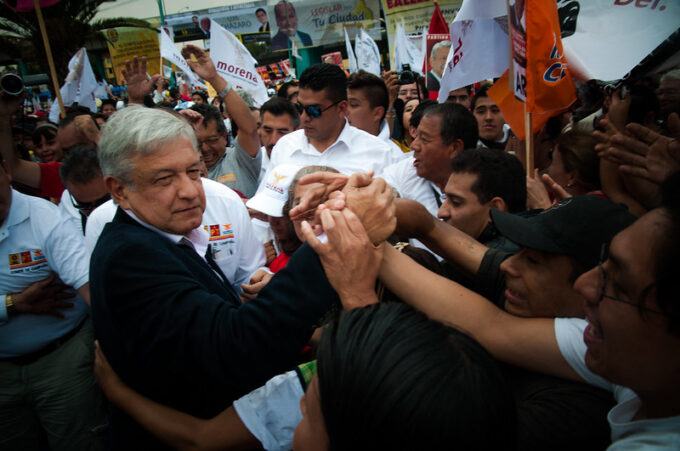
Photograph Source: Eneas De Troya – CC BY 2.0

Mexican president Andrés Manuel López Obrador (AMLO) visited Cuba on May 8-9. He began by highlighting regional unity as good for equal promotion of economic development for all states. AMLO addressed themes he had discussed previously when Cuban president Miguel Diaz-Canel visited Mexico City in 2021.

At that time AMLO, by virtue of Mexico serving as president pro tempore, presided over a summit meeting of the Community of Latin American and Caribbean states (CELAC). He proposed building “in the Western Hemisphere something similar to what was the economic community that gave rise to the current European Union.”

Two days later, AMLO included Diaz-Canel in a celebration of the 200th anniversary of Mexican independence. Praising Cuba’s dignity in resisting U.S. aggression, he called for an end to the blockade.

Months later in Havana, on May 8, 2022, AMLO, speaking before Cuban leaders and others, recalled “times when the United States wanted to own the continent …. They were at their peak in annexations, deciding on independence wherever, creating new countries, freely associated states, protectorates, military bases, and … invasions.”

U.S. leaders, he declared, need to be convinced “that a new relationship among the peoples of America … is possible.” He called for “replacing the OAS with a truly autonomous organism.” CELAC presumably would be that alternative alliance. Formed in 2011, CELAC includes all Western Hemisphere nations except for the United States and Canada.

The United States in 1948 established the Organization of American States (OAS) for Cold War purposes. When the OAS expelled Cuba in 1962, only Mexico’s government opposed that action and later Mexico was one of two nations rejecting an OAS demand to break off diplomatic relations with Cuba.

AMLO predicted that “by 2051, China will exert domination over 64.8% of the world market and the United States only 25%, or even 10%.” He suggested that, “Washington, finding this unacceptable,” would be tempted “to resolve that disparity through force.”

AMLO rejected “growing competition and disunity that will inevitably lead to decline in all the Americas.” He called for “Integration with respect to sovereignties and forms of government and effective application of a treaty of economic-commercial development suiting everybody.” The “first step” would be for the United States “to lift its blockade of this sister nation.”

AMLO’s visit prompted agreements on practicalities. The two presidents determined that Cuba would supply Mexico with medications and vaccines – particularly Cuba’s anti-Covid-19 Abdala vaccine for children. Mexico’s government will send almost 200 Mexican youths to Cuba to study medicine; 500 Cuban physicians will go to Mexico to work in underserved areas. The two presidents signed a general agreement providing for expanded cooperation in other areas.

Before arriving in Cuba, AMLO had visited Guatemala, El Salvador, Honduras, and Belize. Along the way he reportedly complained that, “The United States may have awarded $40 billion in aid to Ukraine but doesn’t fulfill its promise of years ago of helping out Central America.”

The two presidents’ encounter in Havana raises the question of a long-term Mexican role in mobilizing collective resistance to U.S. domination and the U.S. blockade of Cuba. Mexico is well-positioned to lead that effort, what with strong economic and commercial connections with the United States. The United States, leaning on Mexico as an economic partner, may well be receptive to certain demands.

According to the White House-based Office of the U.S. Trade Representative, “Mexico is currently our largest goods trading partner with $614.5 billion in total (two way) goods trade during 2019.”

Beyond that, and in relation to Cuba, Mexico has its own revolutionary tradition and longstanding ties with Cuba.  She is well-placed to lead a strong international campaign to undo the U.S. blockade.

In his major speech, AMLO cited support from Mexico in Cuba’s first War for Independence. He mentioned Cubans’ collaboration with Mexico’s much-admired president Benito Juárez and pointed out that Mexico in1956 hosted Cuban revolutionaries led by Fidel Castro as they prepared for their uprising against Batista. AMLO cited former Mexican President Lázaro Cárdenas’s solidarity visit to Cuba in 1961 after the CIA -organized Bay of Pigs invasion. In token of cultural ties between the two peoples, Mexico was the guest of honor at Havana’s recently concluded International Book Fair.

José Martí warrants special attention. In exile, Martí lived, taught and wrote in Mexico City from 1875 to 1875. Afterwards he stayed connected with Mexican friends. Martí would later write admiringly about the liberal reforms of Indian-descended president Juarez, whom he regarded as the “impenetrable guardian of America.”

That “America” would be “Our America,” which became the title of a Martí essay with deep meaning for unity and for separation from the United States. “Our America” proclaimed that the culture and history of lands south of the Rio Bravo (Rio Grande) originated autonomously, quite apart from European and U.S. influences. The essay appeared first in January 1891, in two journals simultaneously.  One was El Partido Liberal, published in Mexico, the other being a New York periodical.

Unity among Latin American and Caribbean nations appears to be precarious as the U.S. government prepares to host the 9th Summit of the Americas in Los Angeles, on June 6-10. The Summit is an offshoot of the OAS which, according to its website, “serves as the technical secretariat of the Summits process.”

The United States has indicated that the leftist governments of Cuba, Venezuela, and Nicaragua won’t be receiving invitations. AMLO, speaking in Havana, reiterated his objection and once more stated that if nations are left out, he will not attend. Nor will the presidents of Bolivia and Honduras, Luis Arce and Xiomara Castro, respectively.

The presidents of several Caribbean nations will also be staying away. They point to the hypocrisy of U.S.-appointed Venezuelan president Juan Guaidó being invited, but not Cuban president Miguel Díaz-Canel.  Unhappy with U.S. advice on transparency of elections and Russia-Brazil relations, Brazilian president Jair Bolsonaro will not attend.

The conclusion here is that the old system of regional alliances is unstable and that the timing may be right for renewed resistance to U.S domination and the blockade. Now would be the occasion for U.S. anti-imperialists and blockade opponents to align their strategizing and efforts with actions, trends, and flux in Latin America and the Caribbean. And, most certainly, they would be paying attention to actions and policies of Mexico’s government.

Martí had often corresponded with his Mexican friend Manuel Mercado.  His letter of May 18, 1895, the day before he died in battle, stated that, “The Cuban war … has come to America in time to prevent Cuba’s annexation to the United States. …  And Mexico, will it not find a wise, effective and immediate way of helping, in due time, its own defender?”

Wall Street plunges as global recession looms

Nick Beams


Yesterday’s large-scale sell-off on Wall Street, in which shares of major retail companies experienced their biggest decline since the October 1987 Black Monday stock market crash, was in response to clear indications the US and global economy are moving rapidly into recession.

A television screen on the floor of the New York Stock Exchange, Wednesday, March 16, 2022, shows the Federal Reserve's decision to raise interest rates. [AP Photo/Richard Drew]

Wall Street has been falling since it reached record highs at the start of the year as increasing interest rates hit high-tech companies whose rise has been fueled by the pouring in of virtually free money by the US Federal Reserve. But this supply is now being cut off as the Fed lifts interest rates in response to the highest inflation in 40 years to clamp down on workers’ wage demands.

As a consequence, the tech-heavy NASDAQ index has fallen by more than 25 percent this year amid signs the speculative bubble is being deflated, increasing the risks of a major crisis in the financial system.

But yesterday’s sell-off, in which the Dow lost more than 1,100 points in its worst day in almost two years, the S&P dropped by 4 percent and the NASDAQ was down by 4.7 percent, marked a qualitative new turn as growing fears of recession took hold.

The shares of Target, one of the biggest US retailers, plunged by 25 percent after the company reported its costs had risen by $1 billion due to higher gas prices and transportation costs.

At the same time, it was hit by falls in discretionary spending as working-class families have had to divert growing portions of their declining real wages to spending on essential items, such as food and gas, in the face of an inflationary spiral which has seen the price of these items rise faster than the official inflation rate of 8.5 percent.

The Target crash was mirrored by Walmart whose shares fell 6.8 percent after dropping by 11 percent the previous day.

Numerous statements by Federal Reserve chair Jerome Powell and other officials have made clear that, if necessary, the Fed will induce a recession on a scale equal to, or even greater than, that instigated by its chair Paul Volcker in the 1980s which created massive social and economic devastation.

Speaking at a conference on Tuesday, Powell made it clear the central bank would push ahead with its lifting of interest rates to suppress growing wage demands.

“Restoring price stability is a non-negotiable need. It is something we have to do. There could be some pain involved,” he said.

Powell’s remarks underscore the essential class and social dynamic which has shaped and determined Fed policy over decades.

When the financial system imploded in 2008 because of the rampant speculation over the previous two decades, fueled by its determination to sustain the stock market after the crash of October 1987, the Fed instituted the regime of quantitative easing, pouring trillions into the financial system.

This brought about a massive redistribution of wealth to the upper echelons of society with stock portfolios rising to record highs as workers were hit with major job destruction as real wage reductions were enforced by the trade unions.

When the COVID-19 pandemic erupted in 2020 and the financial markets froze out of fear that necessary public health measures would impact Wall Street, the Fed shoveled over $4 trillion more into the financial system. The government bailed out the corporations and a return-to-work drive was initiated, in defiance of all science, to ensure the profit flow was not interrupted.

The refusal of governments around the world, following the lead of the US, to institute meaningful measures on an international scale to eliminate COVID-19, led to a supply chain crisis resulting in the escalation of inflation, fueled by the endless supply of money to the Wall Street speculators.

But the class struggle, suppressed for decades by the trade unions, is now re-emerging in the waves of strikes and social protests in the US and around the world.

The same class dynamic which created the crisis is at work, albeit in a different form, as the US Fed and other central banks move to impose a recession to crush this movement.

In the UK, where inflation has hit 9 percent, the highest rate for any of the major economies, the Bank of England governor Andrew Bailey, while warning of an “apocalyptic” increase in food prices, has insisted that interest rate rises will continue whatever the cost. “We have to get [inflation] back to target. And that is clear,” he told the UK parliament this week.

The Fed’s tightening of monetary policy is already impacting on the global economy. Rising interest rates bring economic stagnation while the fall in domestic currencies vis-à-vis the dollar increases debt burdens and lifts inflation, especially in food.

This week the Institute of International Finance, a worldwide grouping of 450 financial companies, warned that the world economy would at best flatline this year with the recession risk “elevated” with a “disorderly tightening of financial conditions” underway.

Less-developed countries, struggling with the effects of COVID-19 and now the escalation of food prices because of the US-NATO proxy war against Russia in Ukraine are already being hit, leading to massive social protests and strikes spearheaded by the eruption against the Rajapakse government in Sri Lanka.

The social eruptions in that country are the outcome of global processes at work in every country and which will intensify in the next stage of the class war being waged by the ruling elites as they seek to make the working class pay for the crisis they have created.

There is no economic upturn in prospect. The trends are the same everywhere. The European economy is stagnant and on the brink of recession. The Japanese economy, the world’s third largest, contracted at an annualised rate of 1 percent in the first quarter. The US economy shrank at an annual rate of 1.4 percent in the same period.

The history of the economic events of the past decades and the past two years, in particular, is a searing indictment of the profit system.

Refusal to act on COVID has led to millions of unnecessary deaths and created an out-of-control upsurge in inflation.

The US-NATO proxy war against Russia has resulted in the food crisis that is imposing starvation on hundreds of millions of people worldwide.

The pumping out of trillions of dollars by the world’s central banks has fueled the inflation fire, while creating a mass speculative bubble that threatens to implode at any time.

And on top of this, finance capital is moving relentlessly to make the working class pay through ever lower wages and cuts to social services by inducing a recession with untold social and economic consequences.

Johnson government pushes UK to the brink of trade war with Europe over Northern Ireland Protocol

Chris Marsden


Foreign Secretary Liz Truss told parliament yesterday that the UK government would soon introduce a law unilaterally changing the Northern Ireland Protocol governing post-Brexit trade with the European Union (EU).

Responding, the EU warned, “Should the UK decide to move ahead with a bill disapplying constitutive elements of the Protocol as announced today by the UK government, the EU will need to respond with all measures at its disposal.”

Truss’s move was anticipated by Prime Minister Boris Johnson during a Monday visit to Northern Ireland and in an accompanying statement posted in the Belfast Telegraph. Johnson, who negotiated the protocol, centred his justification for abandoning it on the claim that he was acting to defend the 1998 Northern Ireland agreement!

UK Prime Minister Boris Johnson meets with Sir Jeffrey Donaldson MP, of the Democratic Unionist Party while visiting Northern Ireland. Hillsborough Castle, 16/05/2022. (Credit: Picture by Andrew Parsons/No 10 Downing Street/Flickr)

The “Good Friday Agreement” brought an end to 30 years of armed conflict between the Irish Republican Army and its political arm Sinn Féin, and the British state forces and their Unionist and loyalist political allies. But it did so by enshrining sectarian divisions, making all aspects of political life conditional on the joint agreement of self-designated representatives of the republican/Catholic and unionist/Protestant communities. What Johnson was in fact stressing is that he was fully behind the Democratic Unionist Party’s (DUP) demand for the junking of the Northern Ireland Protocol.

The May 5 Assembly elections saw Sinn Féin top the poll, with 29 percent of first preference votes, consolidating its hold in Catholic/nationalist areas. The DUP’s vote collapsed in favour of the more hardline Traditional Unionist Voice. But there was also a significant increase in support for the liberal and non “community” aligned Alliance Party. Faced with Sinn Féin’s right to designate the post of First Minister, and a pro-EU party majority in the Assembly, the DUP collapsed it by refusing to nominate a deputy First Minister.

The protocol is designed to avoid the return of a “hard border” between Northern Ireland and the Republic of Ireland post Brexit. But though it displaces external EU customs checks on trade from the North/South border to ports in Northern Ireland and the UK, it has led to significant problems and costs. Checks on goods from the UK at Northern Irish ports now represent a staggering 20 percent of all checks at the EU’s borders.

Johnson is using the DUP’s stance as a weapon against the EU, insisting that the threat to the Good Friday Agreement has emerged because “One part of the political community in Northern Ireland feels like its aspirations and identity are threatened by the working of the Protocol.” He pledged that “this Government is not neutral on the Union”, adding that he was “heartened to hear that Sir Keir Starmer made clear in a recent interview here that the Labour Party under his leadership would campaign for the Union, should there ever be a border poll.” The Good Friday Agreement agrees provision for a referendum on Irish unification in the event of a major demographic and political shift in the northern six counties.

British Foreign Secretary Liz Truss, right, is greeted by NATO Secretary General Jens Stoltenberg prior to a meeting at NATO headquarters in Brussels, January 24, 2022. (AP Photo/Olivier Matthys, Pool)

In parliament, Truss said the government’s intention was to introduce legislation within a matter of weeks to allow goods from Great Britain going into Northern Ireland but not headed onward for Ireland and the EU to go through a “green channel” exempt from customs checks. It would also allow the government to set tax policy for the whole of the UK and provide the option for companies to adopt either EU or UK standards. Such measures would pitch Northern Ireland more firmly into the Brexit project of turning the UK into a low tax, deregulated strategic competitor to the EU.

This is a particular challenge to the Republic of Ireland, which operates as an investment platform for global corporations attracted by its 12.5 percent corporation tax and absence of economic regulations on vast transfers of capital overseas. But for some in the Conservative Party, this is not enough. Writing on Conservative Home, arch Brexiteer Andrea Leadsom urged the government to respond to the “existential threat” of the protocol risking “the break-up of the UK” by establishing a “freeport across the whole of Northern Ireland.”

Vehicles at the port of Larne, Northern Ireland, Tuesday, Feb. 2, 2021. (AP Photo/Peter Morrison)

The response of Sinn Féin is to advance itself as an ally of the European imperialist powers in the conflict with Britain, and as a guarantor of US imperialism’s economic dominance of the Republic and the access of its corporations to the European market. Immediately after the elections, the party’s newspaper An Phoblacht said the Good Friday Agreement was now “directly threatened” by the DUP and the Tory government and appealed for the “EU, and the US administration” to “hold firm” and for “the Irish government to step firmly up to the mark”.

Prior to Johnson’s visit, the party’s Stormont leader Michelle O’Neill met with Irish Taoiseach Micheál Martin in Dublin to declare that the protocol “is here to stay.”

The working class north and south of the border, Catholic and Protestant, faces an increasingly desperate situation as the cost of living becomes intolerable. The hike on fuel, food and housing costs is what most immediately concerns workers and their families. Northern Ireland has the lowest median weekly household income in the UK (£439 a week) after housing costs, which have historically been low but are now rising dramatically. In February, the National Institute of Economic and Social Research warned that Northern Ireland could face a surge in extreme poverty of more than 67 percent compared with a UK average of 30 percent.

For Johnson to claim that the actions of his party are motivated by concerns over the cost of living is a sick joke. But supporting the EU’s own trade war agenda is just another road to hell. It would only line workers up once again behind opposed groups of their own exploiters.

Sinn Féin’s near quarter century of power sharing has done nothing to fundamentally redress the social oppression facing Catholic workers—with its West Belfast heartlands suffering the greatest areas of housing need and the highest levels of intergenerational unemployment. Instead, it has worked with the unionists in imposing austerity on both Protestant and Catholic workers in the interests of big business.

UK Prime Minister Boris Johnson meets with Mary Lou McDonald of Sinn Féin while visiting Northern Ireland. Hillsborough Castle, 16/05/2022. (Credit: Picture by Andrew Parsons/No 10 Downing Street/Flickr)

Last year, when Sinn Féin topped the poll in the Republic of Ireland general election, the party’s finance spokesperson Pearse Doherty said of the south’s 12.5 percent corporate tax rate, “We are a party that believes there needs to be a competitive edge in relation to taxation in this State and that needs to be continued.” He said of the major corporations, “They know that Sinn Féin isn’t going to go after them.”

Support for any imperialist power or their political proxies is made more dangerous still by the fact that all sides in this conflict are participants in an escalating proxy war by the NATO powers against Russia in Ukraine.

Even amid her rant against the EU over Brexit, Leadsom began by asserting that “Vladimir Putin’s violent and illegal attack on Ukraine has brought out the best in Europe. From defensive military support to humanitarian aid and the generosity of European citizens, Putin has done more to strengthen NATO’s unity and Europe’s friendship than at any time since the Second World War.”

UK Prime Minister Boris Johnson visits Thales UK in Belfast which manufactures the NLAW and Starstreak missiles. 16/05/2022. (Credit: Picture by Andrew Parsons/No 10 Downing Street/Flickr)

During his Belfast visit, Johnson visited a Thales UK plant that manufactures the Starstreak high-velocity anti-air missiles and NLAW anti-tank weapons sent by the UK to Ukraine in their thousands, where ITV reported that he “joked ‘watch out everybody’ as he peered through the aiming unit of a lightweight multiple launcher missile system.”

Sinn Féin fully backs this war. It has purged its website of old articles opposing anti-Russia rhetoric, declaring them to be “out of date”, while party President Mary Lou McDonald declares of Ukraine, “Ireland understands the impact of occupation and imperialist aggression…”

The sharp escalation of inter-imperialist antagonisms between the UK and European powers that gave rise to Brexit has found its most grotesque expression in Ireland, where the border between the Republic and the North has no function other than to protect the remaining outpost of Britain’s historic subjugation of Ireland.

Protests against hike in food and fuel prices across Middle East and North Africa

Jean Shaoul


The surging cost of living and the unavailability of basic goods are triggering mass protests around the world.

The Middle East and North Africa has been ravaged for decades by US-led wars and economic sanctions. This situation has been made much worse by Washington’s sanctions and exclusion of Russia from the international payments system, the disruption caused by the war in Ukraine, and repeated droughts brought on by climate change and the mismanagement of water resources, all while the countries’ corrupt elites have plundered the economy.

Tunisian demonstrators gather during a protest against Tunisian President Kais Saied in Tunis, Tunisia, May 15, 2022. (AP Photo/Hassene Dridi)

The impact on global food supplies, particularly of corn, wheat, barley, sunflower oil and seeds, and on prices is immense. Russia and Ukraine, whose April planting season has been affected by the destruction of machinery and equipment and the flight of farmworkers, together normally produce one-third of the world’s wheat. Grain’s global price rose 21 percent in the 10 days from the start of the war in Ukraine in last February.

The Middle East and North Africa is home to some of the largest humanitarian and refugee crises in the world. It imports 50 percent of its wheat from Russia and Ukraine, with countries such as Egypt, Lebanon, Syria, Yemen, Jordan, and Palestine, already battered by inflation or humanitarian crises, among the worst affected. Some countries were battling severe levels of hunger and malnutrition well before the war.

According to the World Bank 20 percent of the region’s people were food insecure in 2020. Now food and fuel prices, at their highest level in decades, are expected to keep rising, making it impossible for even those in work to buy such food as is available.

World Bank Chief economist Carmen Reinhart commented, “I don’t want to be melodramatic, but it’s not a far stretch that food insecurity and riots were part of the story behind the Arab Spring.”

Corinne Fleischer, the World Food Programme’s regional director for the Middle East and North Africa, said, “This crisis is creating shock waves in the food markets that touch every home in this region. No one is spared.”

In Iran, protests that began May 5 in the oil-rich province of Khuzestan have spread across the country after the government cut food import subsidies, leading to up to 300 percent price hikes for some flour-based staples. It also raised the price of basic commodities such as cooking oil and dairy products.

The subsidies were put in place in 2018 when the Trump administration unilaterally pulled out of the nuclear agreement with Tehran, reimposing economic sanctions that targeted Iran’s vital energy exports on which it depends for much of its revenue. The government’s mismanagement of the pandemic and the rise in world food and fuel prices has compounded Iran’s already difficult financial position.

With inflation running at between 40 and 50 percent and nearly half of Iran’s 85 million population below the poverty line, angry protesters have burned down shops. The rallies have seen calls for the country’s top leaders to step down. Protesters have raised demands for greater political freedom and an end to the Islamic Republic.

The government has responded by mobilizing its security forces, with unconfirmed reports that at least four protesters have been killed. It is offering palliatives in the form of cash handouts for two months and thereafter electronic coupons that will allow some Iranians to buy a limited amount of bread at subsidized prices.

On Monday, bus drivers in Tehran went on strike to demand their unpaid wages and the 57 percent wage rise approved by the Supreme Labor Council more than two months ago, with mechanics and other workers at bus terminals taking part. On Tuesday the police was using around 700 of the city’s buses to transport its own staff, while Islamic Revolutionary Guards Corps (IRGC) vans were being used to transport passengers across the capital and IRGC drivers were being trained to drive the city buses.

The police have arrested more than a dozen strikers, including one of the union organisers, while the government has tightened censorship rules for state-controlled media covering the protests. It announced the closure of all schools and workplaces, not just in Tehran but elsewhere where there are strikes and protests.

The protests follow strikes and demonstrations by teachers that have been ongoing in several cities over the last year demanding the implementation of recent legislation that pledged to improve their pay.

In Turkey, 2022 started with a wave of wildcat strikes. Earlier this month doctors went on nationwide strike demanding better wages and benefits. It follows repeated days of strikes over the last six months.

In North Africa, teachers on fixed-term contracts in Morocco went on strike again last week over their lack of job security in a bitter struggle that has been ongoing over the last four years after Morocco’s education ministry ended permanent contracts for public school teachers. While Prime Minister Aziz Akhannouch had promised prior to his election last September to address the long running dispute, he has done nothing to address their grievances.

In Tunisia, thousands of people took to the streets on Sunday in opposition to President Kais Saied, who suspended parliament and the government last summer and assumed executive powers. With the country facing bankruptcy and without the foreign currency reserves to pay food suppliers, leading to shortages, Saied is in talks with the International Monetary Fund that will require further austerity and repression for any bailout package.

The protesters demanded a return to democracy, rejecting his replacement of the independent electoral commission with one he named himself. They chanted, “The people want democracy” and “Saied has led the country to starvation” at the main rally in Tunis city. It was the largest protest in months and follows a far smaller demonstration supporting him a week ago.

It is not just the region’s most impoverished countries that are facing strikes and protests. The rising cost of living has sparked growing unrest in the oil-rich United Arab Emirates (UAE), the playground of some of the world’s richest people, involving the poorest workers—typically migrant workers from South Asia and the Philippines.

Last week fast-food delivery workers employed by Talabat, the Middle East arm of German food delivery company Delivery Hero, braved the UAE’s draconian laws that outlaw unionized labour, ban strikes and imprison or deport striking workers, and stayed home. The workers organised the illegal strike via social media, calling for an increased rate for deliveries over and above their current rate of $2.04 per delivery. It follows a walkout by Deliveroo delivery drivers that forced the company to increase the rate per delivery from $2.04 per delivery to $2.79.

The strike comes after the global rise in fuel prices sent the cost of fuel and other basics through the roof, slashing the take-home pay of riders who must buy their own petrol and making it difficult for them to send home money to their families who depend on the remittances, and themselves face rampant inflation.

Saudi Arabia and Oman were at pains to reassure people that there was no shortage of wheat supplies after India announced a ban on the export of wheat to preserve it supply and ensure food security within the country—although it stressed that all irrevocable contracts for wheat exports would be honoured, allowing Egypt and some other countries exemption from the ban.

Social workers and day care educators carry out warning strikes throughout Germany

Marianne Arens


Warning strikes and rallies involving workers in social and educational services have been taking place across Germany for two and a half months.

On Wednesday, the third and final round of negotiations began in Potsdam. The workers are fighting for better conditions, higher pay scales and reduced workloads. But the negotiations being conducted with the municipal employers by the Verdi and GEW unions, together with the German Civil Servants' Federation, will not resolve any of their problems.

Since the beginning of the pandemic, nursery and social workers have been deemed “essential workers.” At great risk, they have worked the entire time, many contracting COVID-19.

In working class neighbourhoods and social hotspots, they bear the brunt of providing child care, child and youth welfare services, refugee assistance and disability services. But their working conditions have not improved for seven years, since the big day care strike of 2015. Due to the great stress and poor pay in the sector, there is now a shortage of over 173,000 workers at nurseries and day care centres.

Striking day care workers in Frankfurt am Main [Photo: WSWS] [Photo: WSWS]

In recent weeks, thousands have taken to the streets across Germany. Several hundred social workers came to Hanover for a day of action on May 2, and over a thousand kindergarten teachers rallied in Frankfurt am Main on May 4. In Gelsenkirchen, 10,000 educators gathered on May 11, in Hamburg there were over 2,000 on May 12, and another 2,000 demonstrated in Munich.

Large rallies were also held in Kiel, Stuttgart, Leipzig and elsewhere. In Marburg, hundreds of underpaid employees of charitable welfare associations and church organisations protested, although they are not directly affected by the current negotiations. They also function as social workers in schools and centres for the disabled.

Despite a boycott by the major media outlets, the social workers and day care centre workers succeeded in making it clear to the public that things cannot go on like they are. “Day care centres are bursting at the seams, we have no staff,” one kindergarten teacher in Frankfurt said. Another added, “I can’t go on, I’m already exhausted by 11 o’clock in the morning.”

A day care centre director in Bremen said, “I wish politicians would come and work with us for at least one day. Then maybe they will see that this is not just talk from us. The situation is damn serious.”

Many express fears about the future on Twitter. One worker tweeted, “I love my job, but I don’t think I can do it until retirement age.” Practically all agree on waging a longer and more aggressive strike if necessary.

The outbreak of protests by social and education workers is part of a larger movement that is also increasingly affecting health workers. For example, a strike at university hospitals in North Rhine-Westphalia (NRW) has just been extended until May 26. At NRW university hospitals, over 98 percent voted for an indefinite strike. In Frankfurt am Main and Stuttgart there have already been joint rallies of social service workers and nurses.

Nursing staff in Düsseldorf on 12 May, during the indefinite strike at the university hospitals in North Rhine-Westphalia. The large placard reads “Asystole. I can’t carry on!” [Photo: WSWS] [Photo: WSWS]

This movement is by no means limited to Germany. Nurses are currently on strike in Madrid and in California. They are demonstrating throughout Vienna and are at the forefront of the social uprising in Sri Lanka. In Finland, nurses went on strike for a fortnight in April. In Nashville, Tennessee, nurses protested on behalf of a colleague accused of being solely responsible for a tragic medication error. There is also a growing willingness to strike in industry and logistics.

The protests by educators at day care centres and workers in social services are part of this growing movement. Their demands for relief from intolerable work pressures and for better pay resonate strongly with working people. A Forsa survey showed that 87 percent of respondents thought the demand for better pay was justified, and 81 percent would support shorter work hours in social and care services.

However, the negotiations in Potsdam will not bring any solution. This is the third and, for the time being, last round of negotiations. The negotiators from Verdi (public sector union), the GEW (education union) and the dbb (civil service union) represent the same political programme and belong to the same parties—the Social Democratic Party (SPD), Greens, Christian Democrats (CDU)—as their counterparts, the representatives of the Federation of Municipal Employers’ Associations (VKA), with whom they are supposedly negotiating.

The establishment politicians have once again increased the pressure on day care workers and social workers. The federal government has decided to prepare for open war against Russia, and the working class, above all public sector workers, are to bear the cost.

While the federal coalition of the SPD, Greens and Liberal Democrats (FDP) has pulled a special fund of €100 billion for the Bundeswehr (German military) out of the hat, the demands of public service workers are allegedly “not realisable for cost reasons.” This was stated by VKA President Karin Welge (SPD) in an interview with the German press agency dpa.

Welge went on to say that especially in view of the consequences of the Ukraine war and higher energy prices, municipal employers must be able to offer “reliable structures.” “We cannot provide general salary enhancements in the sense that every pay group gets more,” the VKA President said.

Politicians from all the establishment parties are already preparing measures to suppress resistance from the working class. In Saxony, one mayor responded to a warning strike with a lockout. The mayor of Öbisfelde-Weferlingen responded to the all-day warning strike on May 13 by shutting down all of the town’s day care centres and after-school care centres for the day, locking out all workers without pay. In doing so, he prevented the establishment of emergency child care arrangements and punished those who did not receive Verdi strike pay.

In Hesse, the state government told day care centres that it would raise the number of children per specialist from 25 to 30 with immediate effect, due to the influx of refugees from Ukraine. This is their answer to the demand for “relief.”

The trade unions have no answer to these attacks. Verdi leaders Frank Werneke and Christine Behle (both SPD), who have headed the negotiations in Potsdam, share the views of the government politicians on the war against Russia. They are not prepared to call on the working class to take real industrial action, even if the negotiations fail.

On the contrary, the demands being advanced by Verdi are designed to stall industrial action and reach a rotten compromise. They are aimed at achieving slightly better pay through the manipulation of pay scales. They are demanding an extension of the time allowed for preparation and follow-up work, as well as better conditions for the qualification of those joining the profession from other fields, who make up an increasingly large part of the staff. On all of these questions, mini-compromises can be reached that are then counteracted twice and three times over by concessions on other issues.

The demands also distract from the fact that the unions are not defending public sector workers against skyrocketing inflation. As a result of the billions given to the banks and corporations in the financial crisis and the pandemic, as well as the sanctions against Russia, inflation officially rose to 7.4 percent in April. For energy and food it is already much higher.

The introduction of a sliding scale of wages is therefore urgently needed throughout the public sector, although it alone would not improve the educators’ profession.

There is no question that the working class is ready to fight. But it must no longer allow itself to be ordered about by Verdi, GEW, dbb & Co. Significantly, Verdi leader Frank Werneke stressed on the first day of negotiations in Potsdam, “From our side, we have no interest in a week-long strike.”

Pussy Riot, the war in Ukraine and Russia’s upper middle class

Andrea Peters


Over the course of the past week and a half, the Western press has picked up the story, first reported in the New York Times, of the allegedly daring escape of Maria Alyokhina, a member of the anti-Putin punk rock group Pussy Riot, from Russia.

The band first came to prominence in February 2012 when they conducted an unauthorized performance in which they yelled slogans hostile to the Kremlin leader and the Russian Orthodox Church in Moscow’s Cathedral of Christ the Saviour. It landed three of them in jail, part of a broader crackdown on anti-government opposition. In August of that year, Alyokhina, the mother of a four-year-old child, received a two-year sentence for “hooliganism motivated by religious hatred.” She and others were granted amnesty by the parliament in December 2013 and released.  

Maria Alyokhina 2015 in Berlin (Wikimedia Commons) [Photo by re:publica from Germany, CC BY 2.0 , via Wikimedia Commons / CC BY 4.0]

Pussy Riot’s attacks on the Putin government do not go beyond an extremely limited critique of the Kremlin’s anti-democratic character and connections to the nationalist, backward and obscurantist Russian priesthood. The self-described anarchist feminist group has close ties to Russia’s right-wing liberal opposition. They have never evinced the slightest sympathy for the socio-economic oppression of the country’s working class. They have been feted in the West as “freedom fighters,” and with the support of the European Commission, set up the news outlet Mediazona, whose reporting focuses on the repression and brutalities of Russia’s justice system.  

Alyokhina has been arrested and detained several times over the years for oppositional activities. She was on a form of probation, soon to be transformed into a 21-day sentence in a penal colony, when in April 2022 she disguised herself as a courier, left her Moscow apartment, and somehow managed to evade detection when crossing the Russian and Belarusian borders, ultimately making her way to Iceland via Lithuania.

The circumstances of Alyokhina’s departure are such that one can only assume that Russia’s security services, or some segment within it, allowed her to leave, as it is impossible that one of the country’s most well-known anti-Putin activists who is under constant surveillance, evaded detection with a food-delivery costume and a Lithuanian visa. It must have been abundantly clear from the outset that she will play a role in the West’s anti-Russian campaign.

This is already proving to be the case. In the recent New York Times article recounting her departure from Russia, Alyokhina went beyond criticisms of the Putin government or even the demand for its downfall and insisted that the very presence of Russia on the planet is illegitimate and indefensible.

“I don’t think Russia has a right to exist anymore,” she told the newspaper, arguing that its “values” are so degraded that the country is beyond redemption. “Even before, there were questions about how it is united, by what values it is united, and where it is going. But now I don’t think that is a question anymore,” she declared.

Hers are not misplaced words. In identifying Russian “values”—which are part of a society’s culture—as the source of the problem, Alyokhina, now comfortably ensconced in the “artist community” in Iceland, is endorsing nothing short of the destruction of that society as the solution to its ills. In her vision of Russia, there are no class distinctions, there is no exploitation of the working masses by the ruling class, and there are no differences in the “values” of those on the bottom and those on the top. There is also no such thing as American imperialism, much less its “values” of death and destruction. We are meant to think, by implication, that the “values” of Washington and Brussels are the pinnacle of human freedom.

All of this fits entirely with the war propaganda pouring out of the news channels, halls of power and influential institutions in the US and Europe. Russian culture, Russian people and Russian artists are attacked as the source of the problem as much as the Kremlin, transformed into legitimate targets of retribution. There are, however, some exceptions.

The promotion of Pussy Riot comes alongside growing media attention to the apparent plight of Russia’s anti-Putin, middle and upper middle class. Tens of thousands have recently fled their comfortable apartments in Moscow, Saint Petersburg and elsewhere, taking up residence in places such as Georgia, Armenia, Istanbul and Kazakhstan. IT workers, university professors, mid- and high-level managers at private and state-owned enterprises, journalists, attorneys, employees at major cultural institutions and others are jumping ship.

The speed with which many have left Russia is remarkable. By March 13, for instance, the New York Times was reporting the case of one 25-year-old man, now in Armenia, who within weeks of the invasion “quit his job as a lawyer with Russia’s state-owned Sberbank, organized his financial affairs, made out a will and said goodbye to his mother.”

Whatever their opposition to the Russian invasion of Ukraine—which often comes from a pro-US and pro-NATO standpoint—their primary motivation for leaving Russia is the impact of Western sanctions on their living standards and life styles. These layers have benefited from the explosive growth of social inequality during the post-Soviet era, particularly that of the last 20 years under the Putin government. Some may have been longstanding critics of the Kremlin and active constituents of the “liberal” opposition, while others no doubt accommodated themselves to the politics of the government in Moscow so long as it secured for them an acceptable social position. What unites them is their absolute determination not to share the fate of Russia’s working class, which is being hammered by job losses and inflation.

Both the New York Times and Foreign Affairs have featured articles recently about the trials and tribulation of these layers as they open up overseas bank accounts, set up their remote employment from a different location, secure long-term visas and find shops and restaurants that meet their requirements. They sip wine at outdoor cafés in Istanbul, work studiously at their laptops in new apartments in Yerevan and hold signs aloft at pro-Ukraine demonstrations, images show.

The central concern with these social forces from the standpoint of the West is that they can be galvanized into an active, anti-Putin opposition outside of Russia’s borders but with a capacity to also influence the country’s internal politics. In the Foreign Affair’s “Escape from Moscow” article of May 13, the mouthpiece of the leading US think tank, the Council on Foreign Relations, noted with enthusiasm the historically important and right-wing role that Russia’s exiles have played. It appeals for the creation of new institutions of higher education and media outlets that can employ today’s refugees from the Kremlin and turn them into ideological weapons.

“With hundreds of thousands of Russians on the European continent, it is time for European governments to start thinking of these exile populations far more strategically. Rather than remaining on the defensive, trying to deflect the disinformation and cyberwarfare campaigns that Moscow aims at the West, they should draw on this crucial resource to wage a new kind of information war on the Kremlin. And although much of the emphasis in the Western media has been rightly focused on Ukrainian refugees, European governments should be wary of falling into the trap of regarding Russian exiles themselves as the enemy, rather than crucial allies, in the effort to counter the Putin regime,” counsels the magazine.

Cannes Film Festival promotes US-NATO war against Russia

Stefan Steinberg


The Cannes Film Festival is the latest cultural institution or event to disgracefully provide a public stage for Ukrainian president Volodymyr Zelensky to promote the US-NATO war against Russia.

Zelensky addressed the gala opening of the 75th film festival in Cannes on a huge screen via a video link from Kyiv. Drawing heavily on The Great Dictator (1940), Zelensky exploited the profoundly humanist message of Charlie Chaplin’s film classic to claim that the Ukrainian army was striking a blow for cinema and the arts.

“If there is a dictator, if there is a war for freedom, once again, everything depends on our unity. Can cinema stay outside of this unity?” Zelensky intoned. Quoting directly from Chaplin’s speech at the end of The Great Dictator, Zelensky continued: “In the end, hatred will disappear and dictators will die.” The Ukrainian president’s duplicitous speech was then given a standing ovation by the well-heeled audience of film celebrities, super-models, media figures and critics gathered at the festival’s Grand Théâtre Lumière.

2022 Cannes Film Festival poster

Zelensky’s references to Chaplin’s film are repugnant. In The Great Dictator, Chaplin bitterly satirized the fascist rulers of Germany and Italy at a time when Hollywood studios didn’t dare make any such criticism. Chaplin played two roles in the film, the Nazi dictator (named Adenoid Hynkel in the film, but unmistakably Hitler) and an identical looking Jewish barber.

When the barber is mistaken for Hitler, the former gives an impassioned speech to a crowd in which he deplores “a system that makes men torture and imprison innocent people” and calls upon his audience “to free the world—to do away with national barriers—to do away with greed, with hate and intolerance.”

Zelensky, whose government’s promotion of unfettered free market capitalism and extreme nationalism includes full support for the notorious fascist Azov battalion, and his US-NATO backers stand for everything that Chaplin abhorred. In fact, what would a Chaplin make out of the self-satisfied rubbish about “poor, defenseless little Ukraine,” armed to the hilt and financed by the biggest imperialist robbers on the planet?

The shameless promotion of the NATO war against Russia and its puppet Zelensky by the media and bourgeois governments across the globe is being accompanied by the cancelling and demonisation of Russian artists. Cannes festival officials banned any official delegations or reporters from Russia. The only Russian director allowed to feature at the festival was Kirill Serebrennikov, whose new film Tchaikovsky’s Wife, was financed in part by Russian billionaire Roman Abramovich.

This action alone makes a mockery of the festival’s pretence to be the guardian of democratic rights, or art. How many of the greatest masterworks of world cinema have come from Russia? The festival adopted a course of action far closer to an authoritarian than a genuinely democratic approach to filmmaking. How many American movies have been banned by Cannes officials during the decades of criminal invasions or bombings of Iraq, Afghanistan, Libya, Syria and more, resulting in millions of deaths?

The extent to which Zelensky and his media team, with the overwhelming support of the global press and television, have been able to promote the NATO war against Russia is unprecedented.

Just a week ago, a massive media campaign swept the Ukrainian band, Kalush Orchestra, to victory in the European Song Contest held in Italy. Zelensky was quick to respond, thanking the band and declaring, “I am sure that the sound of victory in the battle with the enemy is not far off.”

In defiance of the rules of the competition, which forbids political commentary, a member of the band was able to appeal on stage for international support for Ukraine’s war effort and its soldiers in the steelworks of Azovstal. The European Broadcasting Union, which organises the contest, declared it would take no action against the band for making such a statement.

On April 3, as part of a media and propaganda offensive, which has included appearances before the parliaments of various Western nations, Zelensky addressed the audience at the annual Grammy music awards in Las Vegas to express his hope that the Ukrainian people could soon “be free like the people on the Grammy stage.”

In his comment on the occasion, David Walsh wrote on the WSWS that the reaction of the American media and its “effusion over Ukraine is one of the most mendacious in history. It lives up to what was once said about the ‘patriotic press’ on both sides during World War I, that ‘hacks of all political shades’ were putting out ‘as many lies as has been seen since the creation of the world.’”

Later the same month, Zelensky, who entered the public domain as a little-known actor in a satirical Ukrainian television series, addressed the audience at the Venice Art Biennale, posing as a defender of “the power of art,” which “can tell the world things that cannot be shared otherwise.”

In addition to lining up with the US-NATO war drive, the Cannes festival has underlined its attitude by massively promoting the new Tom Cruise film Top Gun Maverick, a piece of pro-war, patriotic propaganda. The original Top Gun movie (1986) led to a massive increase in recruitment for the US Navy and the top brass in the Pentagon are clearly hoping that its follow-up will have the same effect.

According to the website Brands & Films, Paramount Pictures, the production company for Top Gun Maverick, was provided “a vast amount of access to Naval facilities and staff in the state of California, Nevada and Washington—including permission to fly aircraft, position cameras on and in F / A-18 Super Hornets and Navy helicopters, and protected access to a nuclear-powered aircraft carrier of the class Nimitz.”

The website also notes: “Yet Pentagon funding hasn’t come without any strings attached (it rarely does). In return for the DoD funding, creators of the film and Paramount Pictures had to promise to offer an exclusive screening of the top brass before the film was made public.”

Note from 1939 with the French Government's decision not to participate at the Venice Film Festival anymore, but instead to host its own festival in Biarritz, Cannes or Nice

In the wake of the tidal wave of national chauvinism and war-lust surrounding the Cannes festival, it is worth recalling the circumstances under which the event was founded.

In its statement announcing the exclusion of Russian participants, the festival hypocritically asserted that, “Faithful to its history, which began in 1939 in resistance to the Fascist and Nazi dictatorships, the Cannes Film Festival will always be at the service of artists and film professionals, whose voice is raised to denounce violence, repression and injustices, and to defend peace and freedom.”

Indeed, the film festival in southern France was originally conceived in 1939 (one year before the premiere of The Great Dictator) as a counterweight to the Venice Film Festival, founded seven years earlier by the National Fascist Party to promote the political and cultural aims of Italian dictator Benito Mussolini. In 1938, the Venice event handed out its top award to films from Nazi Germany and fascist Italy, including Leni Riefenstahl’s notorious Olympia, celebrating the 1936 Olympics in Berlin. The fascist propaganda films won out over Jean Renoir’s anti-war and anti-chauvinist La Grande Illusion (subsequently banned in Germany and Italy).

French film figures were outraged and pressured the government of Prime Minister Édouard Daladier to launch a festival in their country. The latter was nervous about offending Mussolini and reluctant to take such action.

In fact, sympathy for Mussolini and Hitler, unstated or otherwise, was rife in French ruling circles. The government that finally did approve the establishment of the Cannes festival had previously reinstituted the six-day week to finance the war effort, banned the Communist Party over the Stalin-Hitler pact and would vote Marshal Pétain into power less than a year later.

The 1939 festival was scheduled to open September 1, the day that Germany invaded Poland, initiating World War II, and had to be cancelled. The tragic events associated with the Cannes festival’s origins ought to serve as a warning about the implications of the filthy, anti-democratic Ukrainian-nationalist drivel the festival is currently serving up.