24 May 2022

As it escalates war against Russia, Biden administration threatens war against China

Andre Damon


On Saturday, US President Joe Biden signed a bill authorizing $40 billion in spending, largely for weapons and other assistance to Ukraine.

One month ago, US military assistance to Ukraine under the Biden administration totaled $4 billion. With the stroke of a pen, Biden has expanded the US commitment to the conflict tenfold.

But with the ink barely dry on the latest weapons shipment, Washington went on to escalate the conflict further. On Monday, US Defense Secretary Lloyd Austin announced that the US would provide Ukraine with Harpoon anti-ship missiles via an intermediary, Denmark. The Harpoon is the standard anti-ship armament of the US Navy, capable of sinking large warships.

The USS Coronado (LCS 4) launches a Harpoon Block 1C missile.

On Friday, Ukrainian Ministry of Internal Affairs adviser Anton Gerashchenko tweeted that “The US is preparing a plan to destroy the [Russian] Black Sea Fleet” as part of a “plan to unblock the ports.” He continued, “Deliveries of powerful anti-ship weapons (Harpoon and Naval Strike Missile with a range of 250–300 km) are being discussed.”

The Pentagon responded by officially denying that the US is actively planning operations to destroy Russia’s navy in the Black Sea. However, Monday’s announcement makes clear that it is engaged in precisely such an operation. The US was already directly involved in the sinking of the flagship of the Russian fleet, Moskva, last month.

As usual, military escalation by the United States is accompanied by a propaganda barrage. In this case, the apologists of US imperialism are declaring that greater involvement in military operations in the Black Sea is dictated by the need to open the ports for global food shipments.

The Washington Post published an editorial entitled “Putin is starving millions of people around the world.” It concludes, “with 20 million metric tons of grain and corn just sitting in storage at Ukrainian ports right now, there’s only so much the rest of the world can do. Mr. Putin’s war is on the verge of becoming Mr. Putin’s global famine.”

The Post’s hypocrisy is jaw-dropping. The United States is the world’s leading practitioner of using starvation as a “weapon” of foreign policy. In 1974, Secretary of Agriculture Earl Butz declared, “food is a weapon. It is now one of the principal tools in our negotiating kit.” In December 1980, John Block, Reagan’s secretary of agriculture, told reporters: “I believe food is the greatest weapon we have.”

The examples of the US using starvation as a weapon include withholding food aid to Chile in 1973 as part of a successful effort to overthrow the government of Salvador Allende and cutting food assistance to Bangladesh in 1974 during a massive famine to punish the country for trading with Cuba.

US sanctions on food and medicine imported by Iraq in the 1990s contributed to the preventable deaths of hundreds of thousands of people, while US sanctions against Iran led to runaway food price inflation, meaning that “following a healthy diet has become more difficult for most Iranians,” according to one study.

As for the present ongoing food crisis, fundamental responsibility lies with the US and NATO powers, which provoked the current conflict and have sought at every point to scuttle efforts at a negotiated solution to the war.

Establishing control over the Black Sea is a vital US war aim. This waterway connects Europe, Russia and the Middle East. It not only holds critical reserves of oil and gas, but serves as a nodal point for hydrocarbon pipelines connecting Europe and Asia.

Even as the United States was escalating its war with Russia, Biden openly threatened to go to war with China, the world’s most populous country and its second-largest economy.

Speaking at a press conference in Japan, Biden was asked, “Are you willing to get involved militarily to defend Taiwan if it comes to that?”

Biden replied, “Yes… That’s the commitment we made.”

Despite efforts by the media to present Biden’s comment as a misstatement or a “gaffe,” the reality is that Biden’s remark corresponds with the views of leading US foreign policy figures.

Richard Haass, president of the Council on Foreign Relations, wrote on Twitter, “This is the third time @potus has spoken out in favor of strategic clarity on Taiwan and third time WH [White House] staff has tried to walk it back. Better to embrace it as new US stance.”

Supporting Biden’s declaration that the US should go to war with China over Taiwan, Haass declared, “The ‘Ukraine model’ [is] inadequate for Taiwan. Taiwan [is] an island that cannot be easily resupplied. Plus local partners & allies in Asia want direct US intervention. Plus Taiwan not nearly as strong as Ukraine. So direct US military involvement would be essential for defense vs China.”

The US-provoked war against Russia in Ukraine has already killed tens of thousands of people and displaced millions. The war against China Biden is threatening would turn the entire Asia-Pacific region, the world’s most populous area, into a war zone, with devastating and incalculable consequences.

Far-reaching plans for military escalation were in place long before Biden even reached the White House. In 2020, Biden published an article entitled “Rescuing U.S. Foreign Policy After Trump” in Foreign Affairs.

Biden pledged, “to counter Russian aggression, we must keep the alliance’s military capabilities sharp.” At the same time, the United States needs to “get tough with China,” he wrote. The “most effective way to meet that challenge is to build a united front of U.S. allies and partners to confront China.”

These plans were limited to the specialist foreign policy press read by beltway insiders, and Biden’s plans to provoke war with Russia and China played virtually no part in his appeal to voters. Instead, Biden publicly pledged to end “forever wars.”

In reality, Biden’s withdrawal from Afghanistan was a repositioning of US forces in preparation for an escalation of the US conflict with Russia and China.

In 2020, the World Socialist Web Site warned: “A Biden/Harris administration will not inaugurate a new dawn of American hegemony. Rather, the attempt to assert this hegemony will be through unprecedented violence. If it is brought to power—with the support of the assemblage of reactionaries responsible for the worst crimes of the 21st century—it will be committed to a vast expansion of war.”

These warnings have been confirmed. For years, the United States military has systematically emphasized its plans to wage “great-power conflict” with these two countries. Now, a war with Russia has already broken out, and Biden’s comments make it clear that the administration is systematically preparing for a war with China.

These conflicts threaten to escalate into a world war, waged between nuclear-armed powers, threatening Europe, Asia, North America and, indeed, the whole of human civilization with destruction.

The Biden administration’s war plans express the relentless drive by US imperialism to reverse its relative economic decline through military means.

Papua New Guinea elections loom amid growing domestic and global crisis

John Braddock


National elections in Papua New Guinea (PNG), due in July, are already facing mounting difficulties. The issuing of writs was postponed for a week on May 12 following the death of Deputy Prime Minister Sam Basil in a car accident.

James Marape (light shirt in the centre) campaigning in Tari with supporters [Image: pmjamesmarape.com]

The delay was to allow for a state funeral and for Basil’s United Labour Party to reorganise itself. Basil was a longstanding MP and member of the country’s ruling elite. He had held major portfolios over his career and had ambitions to be prime minister following the election.

In November 2020, Basil was one of 12 cabinet ministers who defected from the James Marape-led coalition government, plunging it into turmoil. The manoeuvre, designed to force a no confidence vote, was stymied when Marape abruptly adjourned parliament for four months. Basil then returned to the fold.

Polling is due to start on July 9 and finish on July 22, with writs returned on July 29. Normally, several thousand potential candidates come forward to nominate in PNG elections seeking to access money and favours. This year, it is predicted the figure could be as high as 4,000 to contest the 118 seats.

Seven new seats have been created in the parliament. However, ballot papers were printed before the government formally established the new seats. The ballots had to be destroyed and reprinted, and there is ongoing uncertainty over the new districts which have not yet been budgeted for. There could well be a court challenge to their validity.

University of Papua New Guinea academic Okole Midelit told Radio NZ on May 16 that the election poses significant “security risks.” Under-resourced police, widespread availability of illegal firearms, and the politicisation of the security force will present major issues, he warned. Low COVID-19 vaccination rates are also a particular concern, Midelit noted, with less than 3 percent of the population of nearly nine million fully vaccinated.

More than 200 people died in violent clashes during the widely discredited 2017 election. The poll was mired in bribery and corruption, ballot rigging and the wholesale omission of names from the electoral roll. Protests erupted over accusations that vote counting was hijacked.

The narrow victory of then Prime Minister Peter O’Neill was regarded as illegitimate. Explosive social tensions produced by the government’s austerity policies in response to the deepening economic crisis, including the collapse in global energy prices, saw ongoing turmoil over the following year.

In 2019, O’Neill avoided a vote of no confidence by resigning his position and has since faced corruption charges. He was replaced as prime minister by former ally and finance minister Marape, leader of the Pangu Party, who has in turn fended off a series shifting allegiances from within the unstable and corrupt political establishment.

Marape has presided over an escalating economic and social disaster. His government has been criticised for its handling of the closure of the Porgera goldmine and alleged misuse of international funds for PNG’s COVID response. Budget shortfalls have resulted in government debt rising to 40 percent of GDP.

O’Neill, who leads the People’s National Congress Party (PNC), appears to be the main electoral threat to Marape. According to the Post-Courier, O’Neill told a pre-election crowd last week that the PNC is ready to return and “remove thieves, liars and false prophets that have mismanaged and critically run the economy of the country.”

O’Neill, however, remains deeply unpopular. In 2016, police opened fire and injured dozens of people at a protest demanding that O’Neill step down and face fraud charges.

The cynical manoeuvring between rival groups of parliamentarians highlights the vast gulf that separates the poverty-stricken PNG masses and the country’s corrupt and venal political elite. Trust in the government has disintegrated following decades of social deprivation and growing wealth inequality, buttressed by authoritarian military-police measures.

The crisis has been intensified by the COVID-19 pandemic. The government, which ditched national pandemic lockdowns in mid-2020, is responsible for an unfolding disaster. PNG has officially recorded 43,900 cases of COVID and 651 deaths but with testing all but abandoned the figures are meaningless. In March this year most remaining restrictions were removed, including the need for booster shots to be fully vaccinated.

Hospitals have been overwhelmed. Last October, health authorities organised a mass burial of 253 bodies, to relieve pressure on the Port Moresby General Hospital morgue, where bodies were stacked on top of each other as COVID-19 cases surged. Now, the country has begun grappling with a tuberculosis epidemic.

Tens of thousands of workers, estimated as high as 25 percent of the workforce, have meanwhile lost their jobs. Meagre government relief measures such as tax deferrals and loan repayment holidays have been woefully insufficient. According to UN figures, 39 percent of the people live below the poverty line of $US1.90 a day.

There is growing resistance in the working class. In March 2020, 600 nurses in Port Moresby held a sit-in over concerns about the lack of personal protective equipment. Four thousand nurses were then ready to strike over the lack of COVID preparedness, until the strike was called off by the union. More stoppages and sit-in protests took place late last year over nurses’ pay and working conditions.

Marape has appealed for “peace and order” during the elections, declaring there will be “zero tolerance” for any violence. Highlighting the fears within the ruling establishment, Police Commissioner David Manning felt it necessary to warn all candidates and supporters to refrain from violence. “Do not bribe your voters. Do not threaten them,” he said.

The election will be closely scrutinised by both Washington and Canberra. External interference by either or both powers to influence the outcome cannot be ruled out. Australia, the country’s colonial master until 1975, has a long and dirty history in PNG defending the interests of its multinational  mining companies and Canberra’s geo-strategic interests in the Asia-Pacific.

The PNG ruling elite has maintained a precarious balancing act between economic and diplomatic relations with China on the one hand, and the demands of the imperialist powers on the other. PNG’s involvement in China’s Belt and Road Initiative and Beijing’s funding for infrastructure projects has increasingly alarmed Washington and Canberra.

The Australian on Saturday cited unnamed sources saying that China is offering “security support” to help PNG prevent political and ethnic violence during the election. Chinese Foreign Minister Wang Yi is reportedly planning to visit PNG in June. The paper also noted that “Australia is providing about $30m in support towards the conduct of PNG’s elections, while Australian Defence Force aircraft and about 140 personnel will assist with logistics and planning.”

During his term of office, O’Neill turned towards Beijing for financial support, followed by Marape seeking to reduce reliance on Australian aid. Marape said regarding China that PNG is a “friend to all, enemy to none.” His government has meanwhile maintained strong security ties with the US, including holding joint military exercises in each of the last two years.

PNG was pushed more sharply into focus in April when China and the Solomon Islands signed a security pact allowing for Chinese presence. US Indo-Pacific coordinator Kurt Campbell was promptly dispatched to Honiara, to warn the Sogavare government Washington would “respond accordingly,” if China were to establish any basing arrangements.

Underscoring Washington’s wider intent to block any Chinese presence in the Pacific, the US delegation also visited Fiji and PNG and bluntly warned them against any similar treaties with China. The diplomatic intimidation included threats by then Australian Prime Minister Morrison, who said a Chinese base in the Solomons would be a “red line”—that is, a trigger for military intervention.

US/NATO-provoked war in Ukraine creates food crisis in Africa

Jean Shaoul


The war in Ukraine deliberately provoked by United States and its NATO partners, together with sanctions on Russia, have triggered the biggest rise in global commodity prices in more than 50 years.

The United Nations has warned that the war risks tipping 1.7 billion people, one-fifth of the world’s population, into poverty, destitution and hunger—a horrifying scenario the imperialist powers are utilising to step up their warmongering in the Black Sea.

Nowhere is this threat more acute than in Africa.

Malnourished children wait for treatment in the pediatric department of Boulmiougou hospital in Ouagadougou, Burkina Faso. (AP Photo/Sophie Garcia) [AP Photo/Sophie Garcia]

The UN Food and Agriculture Organization’s food price index, a gauge of food prices around the world, hit an all-time high in March, with food now costing 42 percent more than in 2014-2016. This comes at a time when food insecurity is already rising following the COVID-19 pandemic. It is the world’s biggest food crisis since World War II. According to the latest estimates from the State of Food Security and Nutrition around the World, the number of people facing food insufficiency has reached 811 million, up 161 million people in 2019, meaning around one in 10 of the world’s people went to bed hungry.

Africa has suffered more than any other continent. A total of 282 million people or 21 percent of Africans suffered from hunger in 2020, up 46 million on the previous year. Households in sub-Saharan Africa spend 40 percent of their incomes on food, a much higher proportion than those living in the advanced countries who spend 17 percent, according to the Financial Times based on figures from the International Monetary Fund. The African Development Bank puts this figure at 65 percent.

The joint impacts of the pandemic, unemployment, loss of earnings and the lack of social protection have pushed people into long-term poverty and destitution. Today, one in three Africans—422 million people—live below the global poverty line, defined as living on less than $1 per day.

Exports from Ukraine and Russia are at a virtual standstill, where according to UN General Secretary Antonio Guterres there are “nearly 25 million tons of grain that could be exported but that cannot leave the country [Ukraine].” Last year, Russia and Ukraine accounted for nearly one third of the world’s grain exports, one fifth of its corn trade and almost 80 percent of sunflower oil production. According to the US Department of Agriculture, world wheat supplies will tighten, with exports from Russia and Ukraine likely to be 7 million tonnes lower than expected before the war.

According to the African Development Bank, wheat imports make up 90 percent of Africa’s $4 billion trade with Russia and almost half of its $4.5 billion trade with Ukraine. Twenty-three of Africa’s 54 countries depend on Russia and Ukraine for more than half the imports of one of their staple goods. Some countries are even more reliant: Sudan, Egypt, Tanzania, Eritrea and Benin import 80 percent of their wheat and Algeria, Sudan and Tunisia more than 95 percent of sunflower oil from Russia and Ukraine. They are seeing higher prices across the board, under conditions where most African elites provide no social safety net.

The food crisis has been intensified by the multiyear droughts in the Horn, East Africa and the Sahel, locust swarms in East Africa, wars and conflicts, climate-induced floods and food protectionism, while the rampant corruption and economic mismanagement by the continent’s kleptocrats have added to the suffering.

David Beasley, Executive Director of the UN’s World Food programme (WFP), warned recently of the terrible situation in the Sahel, saying, “Around 11 million people in the Sahel area don't know where their next meal is coming from. If they do not get the help they need now, we are talking about starvation, migration and destabilization.”

The UN is warning that 18 million people in the Sahel face food insecurity in the next three months. The worst affected—Burkina Faso, Chad, Mali and Niger—are facing “alarming levels” with nearly 1.7 million people facing emergency levels of food shortages. This takes place as the European powers send troops to suppress the impoverished masses in the region and prevent them from fleeing to Europe.

Conflicts, wars and climate-induced droughts have hit the Central African Republic, Sudan, South Sudan, Ethiopia, Somalia and Kenya. The Horn of Africa/East Africa is facing its worst drought in 40 years, with three consecutive rainy seasons bringing little rain. When it did rain as in 2019, it was torrential, affecting some 3.4 million people and bringing a swarm of locusts that devoured crops. Temperatures have soared to record highs, resulting in the deaths of three million livestock across southern Ethiopia and the arid and semi-arid regions of Kenya since mid-2021. The UN has warned that up to 20 million people in the Horn of Africa could go hungry this year.

Herder Yusuf Abdullahi walks past the carcasses of his forty goats that died of hunger in Dertu, Wajir County, Kenya on Oct. 24, 2021. The aid agency Oxfam International warned Tuesday, March 22, 2022 that widespread hunger across East Africa could become "a catastrophe" without an injection of funds to the region's most vulnerable communities. (AP Photo/Brian Inganga, File)

The cost of fertilizers has risen beyond what most farmers can afford, threatening next year’s harvest. Russia produces around 18 percent of the world’s potash market, 20 percent of ammonia exports and 15 percent of urea. In Ethiopia, amid the war ongoing since November 2020 in the northern Tigray region, the price of fertilizer has shot up 200 percent and food inflation has reached 43 percent. In neighbouring Kenya, drought had already caused a 70 percent slump in crop production even before the war in Ukraine, leaving more than 3 million people facing acute hunger. In Somalia, if no rain has fallen by the end of this month, around 6 million people—38 percent of the population—face extreme food insecurity.

Just as people’s needs are escalating, the aid agencies are struggling to find resources. The WFP requires US$18.9 billion to reach 137 million people in 2022, but its funding gap is bigger than ever. The war is pushing up its costs by $71 million as rising food, fuel and shipping costs reach $850 million for the year. As a result, there will be four million less people reached by the programme. The WFP will have to cut rations in order to reach more people. The UN’s Office for the Coordination of Humanitarian Affairs (OCHA) said that aid groups had launched appeals earlier this year seeking $3.8 billion in aid for the Sahel, but had only received 12 percent of its target.

Many of the world’s largest donors have diverted resources to Ukraine. The UK announced £220 million in humanitarian and development aid for Ukraine as part of its effort to support the US/NATO proxy war. In November 2020, Britain already cut its overall aid budget from 0.7 percent to 0.5 percent of GDP leading to a halving of the UK’s direct humanitarian aid to foreign countries last year, from £1.53 billion in 2020 to just £744 million.

A further factor exacerbating Africa’s food crisis is food protectionism as 23 countries clamp down on the export of food staples or impose restrictions such as taxes or quotas, according to the US think-tank International Food Policy Research Institute (IFPRI). Food protectionism has led to a 17 percent reduction in total world food trade as measured in calories, the same level seen during the 2007-08 food and energy crisis. Since then, Indonesia and India have banned the export of palm oil and wheat respectively.

The continent’s rising debt crisis means that few countries have the means to buy or subsidise food prices, with Ghana, Zambia and Tunisia among the 20 or so countries close to defaulting on international loans.

The food crisis, the result of decisions taken by the world’s capitalist governments, is creating untold suffering for millions, exacerbating the class struggle. United Nations Development Programme Africa’s chief economist Raymond Gilpin warned the world’s financial elites, “Tensions, particularly in urban area, low-income communities, could spill over and lead to violent protests and violent riots.”

23 May 2022

The Persistence of Childhood Poverty in the US

Callie Freitag & Heather D. Hill


In the United States, children are more likely to experience poverty than people over 18.

In 2020, about 1 in 6 kids, 16% of all children, were living in families with incomes below the official poverty line – an income threshold the government set that year at about US$26,500 for a family of four. Only 10% of Americans ages 18 to 64 and 9% of those 65 and up were experiencing poverty, according to the most recent data available.

The official child poverty rate ticks down when the economy grows and up during downturns. It stood at 17% in 1967 – just about the same as in 2020. In many recent years the rate hovered even higher – around 20%.

Another way to measure poverty

Researchers calculate the official poverty rate by adding up a household’s income and comparing it with a threshold of what is needed to survive.

The government has calculated this rate the same way since the 1960s.

One of its shortcomings is that it excludes several sources of income, including tax credits and the Supplemental Nutrition Assistance Program, which are intended to reduce poverty.

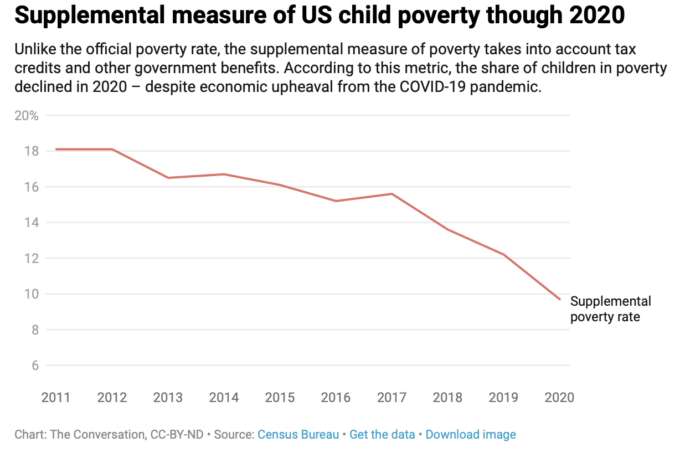
In 2011, the government began to calculate an alternative metric: the supplemental poverty measure. It includes SNAP and tax credits. It also uses thresholds based on the cost of living in different areas of the country. For a family of four, this threshold currently ranges from $24,000 to $35,000, depending on where a family lives and whether they own or rent housing.

According to this alternative measure, 10% of children were living in poverty in 2020, the lowest rate ever recorded.

Depending on which measure you use, either 7 million or 11.7 million U.S. children lived in poverty in 2020.

By both metrics, poverty is higher for children of color. The official poverty rate for Black children stood at 26%, and 23% for Hispanic children, while for white, non-Hispanic children it was 10%.

Before and after 2020

Both child poverty rates had been declining before the COVID-19 pandemic.

The official rate dipped to 14% in 2019 from 21% five years earlier. It shot back up to 16% in 2020, when the pandemic compounded economic hardships for many families.

The supplemental measure of child poverty tells a more complete story.

Steps the government took during the pandemic, including its series of economic impact payments, the child tax credit expansion and a boost in SNAP benefits, led the supplemental child poverty rate to keep declining even during the economic crisis.

The government will release its child poverty data for 2022 in September 2023. But some researchers at Columbia University have monthly data suggesting that child poverty rose steeply after the expiration of the pandemic-era programs. They estimate that 3.7 million more children were living in poverty in January 2022 than in December 2021 because of the expiration of the child tax credit expansion.

Russia, NATO and the Future of Neutrality

John Feffer


Neutrality was once an attractive option in Europe.

Switzerland made non-alignment look almost sexy, with its ski resorts, excellent chocolates, and secure banking system. Then there was Sweden, which refused to join NATO or subordinate its military policy to Moscow, offering instead to broker peaceful compromises between east and west as well as north and south. Austria, divided into four occupation zones after World War II just like Germany, embraced neutrality as the last foreign troops exited the country in 1955. It has sent peacekeepers around the world and offered Vienna as a neutral place for negotiations, like the ones that produced the Iran nuclear deal.

During the Cold War, non-alignment emerged as a third path between Soviet-style communism and American-style capitalism, between two nuclear superpowers, between a poorly delineated East and West. So many countries were eager to go down this path that they formed a new bloc, the Non-Aligned Movement, at the Bandung Conference in 1955, with Yugoslav leader Tito as one of its prime movers.

The end of the Cold War rendered non-alignment moot. Even France, which had left NATO in 1966 because it refused to relinquish control of its military strategy and nuclear weapons, returned to the fold in 2009. And yet some form of neutrality limped along in Europe. A number of countries still rejected formal NATO membership even if, like Sweden and Finland, they were increasingly coordinating their security policy with the alliance.

Russia’s invasion of Ukraine has ended even this attenuated sense of non-alignment.

This week, both Finland and Sweden have formally requested NATO membership. The leaders of these countries are not right-wing, male chauvinist militarists who have been just waiting for an opportunity to reverse their countries’ longstanding policies. Finnish Prime Minister Sanna Marin and Swedish Prime Minister Magdalena Andersson are both dynamic Social Democrats who are not making these decisions lightly.

These new addition to NATO won’t mean a great deal on a practical level. The 30 current members of the alliance don’t really need what few weapons and personnel these countries possess (though Finland, because of its conscription policies, can count on a rather large number of reservists). Sweden has pledged not to host any nuclear weapons or NATO bases. Finland won’t attach such conditions to membership but will likely follow suit in practice.

Russia has offered a rather muted reaction to the announcement. Russian President Vladimir Putin was careful to say that the Kremlin has no beef with either country and that it’s not worried about their accession to NATO. He did point out that Russia would respond if NATO sent any significant infrastructure to the countries, which explains why Sweden took pains to disavow both bases and nuclear weapons.

But this northern expansion of NATO, even if it doesn’t add much to the alliance or trigger a dangerous retaliation from the Kremlin, is still a profound change for Europe.

After all, it basically drives a final stake through European non-alignment.

The Jolt of War

Whenever NATO faces an existential crisis, war comes along like a dose of smelling salts to revive the alliance.

At the end of the Cold War, NATO seemed like a relic well worth mothballing. The Warsaw Pact was gone, the Soviet Union was on its way out, and there seemed no good reason for NATO to exist. A perfectly good inclusive security arrangement had been in place since the mid-1970s—the Conference for Security and Cooperation in Europe—so NATO should have bowed out gracefully with a lavish retirement party.

Instead, NATO strategists started talking about “out-of-area” operations that would involve dispatching troops to the Middle East and North Africa to engage in various missions. The first Gulf War might have served that purpose nicely, but the George H.W. Bush administration instead opted for an ad hoc coalition including several NATO members to push Iraq out of Kuwait.

The war in Yugoslavia that was meanwhile gathering force put paid to the notion that Europe was an entirely peaceful region. NATO became increasingly involved as the conflict spread to Bosnia, ultimately engaging in its first-ever combat mission in 1994 when it shot down four Serbian jets while enforcing a no-fly zone. Later that year, at the request of the UN, it launched its first air strikes against Serb targets. In 1999, NATO engaged in a three-month bombing campaign against Serbia to stop its intervention in Kosovo.

The war in Yugoslavia and the debate over out-of-area operations provided NATO with a patina of relevance that distracted from its quite obvious obsolescence. Indeed, the Clinton administration relied on this patina to push through its proposal to expand the alliance eastward, which required overcoming concerns from the left that expansion would antagonize Russia and criticism from the right that the president was bending over backwards to build cooperation between NATO and the Kremlin. Eastern European countries showed various levels of enthusiasm for joining NATO. They no longer feared Russia, at least not the version presided over by Boris Yeltsin. But they saw NATO membership as a first step toward what they really wanted: accession to the European Union. And the military upgrades that NATO promised were seductive as well.

For half a century, the alliance was in a constant state of preparedness to defend against an attack that never came. During the Cold War and in the immediate post-Cold War era, no country invoked the collective defense mechanism of the Charter’s Article 5. Nor was it easy to forge consensus on NATO missions beyond collective defense. In general, NATO has proven to be an extraordinarily unwieldy institution, composed of very diverse members (for example, Turkey and Iceland). For most of its existence, the alliance met, talked, conducted studies, spent money, engaged in military exercises, but didn’t actually fight. The war in Yugoslavia changed all that, and so of course did September 11.

In the wake of the attacks of September 11, NATO invoked Article 5 and came to the “defense” of the United States by joining the attack against Afghanistan as part of Operation Resolute Support. Even here, though, there was not unified opinion. Several NATO countries contributed troops outside of NATO structures. Even in the United States, Donald Rumsfeld was worried that NATO involvement would somehow diminish U.S. control over the operation. By the time of the invasion of Iraq in 2003, NATO would play no overt role with some NATO members, like Germany, vocally against the war.

The Gulf War, the Yugoslav wars, the attacks of September 11: these all revivified NATO by adding out-of-area operations, actual combat missions, and participation in the “war on terrorism” to its repertoire. Along the way, NATO wandered quite far from its original focus on collective defense.

Even with these new capabilities, however, NATO struggled. Over the last decade, Turkey began buying weapons from Russia. Hungary’s Viktor Orbán was more aligned with Putin’s illiberal philosophy than with the prevailing orthodoxy in Brussels. And Donald Trump, irritated by the apparent reluctance of NATO allies to “share the burden” of collective defense, was threatening to pull the United States out of the alliance.

But once again, war has given NATO new purpose. Russia’s invasion of Ukraine was a stark reminder of why these countries created a transatlantic bond. Ukraine, not being a member of the alliance, had no recourse to the mechanism of collective defense. The tiny Baltic countries, on the other hand, remained inviolate despite their modest militaries.

With a storm raging on the European frontier, it’s no wonder that Sweden and Finland have decided to huddle under the canopy of NATO rather than trying to keep dry under their relatively small umbrellas.

The Future of Neutrality

Prior to his invasion of Ukraine, Vladimir Putin did whatever he could do to promote non-alignment in Europe. He cultivated political friends who challenged NATO (like France’s Marine Le Pen), who railed against Eurocrats in Brussels (like Viktor Orbán in Hungary), and who could play a disruptive role in existing institutions (like Turkish leader Recep Tayyip Erdoğan in NATO and the Council of Europe).

But as soon as Russian troops crossed into Ukraine, Putin hath murdered non-alignment. Regardless of the success or failure of the operation, the Russian president must have known that even his closest European friends would have to choose sides and they weren’t likely to choose his.

Which suggests that Putin had already written off Europe prior to the invasion. All of his investments into the politically heterodox—mostly on the far right but some on the left such as Syriza in Greece—had come to nearly naught. The Western European far right had not marched to power in the wake of Donald Trump’s surprise victory in 2016. And Trump himself went down to defeat in 2020.

For years, Putin criticized liberalism but maintained political and commercial ties with the West. But especially after Trump’s defeat and the emergence of serious anti-government protests in Belarus, Putin’s rhetoric began to shift toward castigating the West in general. In the lead-up to the invasion of Ukraine, the Russian leader began to associate Kyiv’s deviations with its supposed Western puppet masters. Putin subsequently framed the invasion not as a small skirmish on the frontiers of Russian influence but a civilizational clash with a unified ideological foe.

In other words, Putin anticipated that NATO would draw together and even enlarge in the wake of the invasion. He no longer saw much merit in exploiting the fault lines in the Western camp. It’s why he hasn’t raised much of a fuss about Finland and Sweden joining the alliance. Their accession only strengthens his argument that the West is, without exception, unified against him.

Now firmly in the anti-Western camp, Putin hopes to create a united front with China, with India, with all countries that have rebelled against the hegemonic pretensions of the West. He is aided in this effort by the fact that much of the world has refused to send support to Ukraine or sanction Russia.

But joining an anti-Western alliance anchored by the Kremlin? That’s a step too far for all but the likes of Bashar al-Assad, Kim Jong Un, and Daniel Ortega. Unlike in Europe, non-alignment remains an attractive option for much of the Global South. That kind of neutrality, however, will not in the end favor Russia. Neither the formerly non-aligned of Europe nor the currently non-aligned of the Global South are interested in furthering Vladimir Putin’s imperial ambitions.

UK Chancellor Sunak enters Sunday Times Rich List: The face of oligarchic rule in Britain

Simon Whelan


In December 2020 the World Socialist Web Site described the multi-hundred millionaire Conservative government Chancellor of the Exchequer Rishi Sunak as “the living embodiment of government in the service of the financial oligarchy… of rule of, by and for the oligarchy.”

The staggering wealth of Sunak and his wife Akshata Murthy has now elevated them into this year’s Sunday Times Rich List. Their joint wealth is valued at an incredible £730 million.

Akshata Murty (left) and Sunak (right) at an event in 2018 (Credit: Rishi Sunak/Facebook)

This only ranks them a relatively modest 222 posting out of the top 250. However, they are closing fast on being able to enter the top 200 (requiring £861 million this year.) A top 100 position requires at least £1.8 billion.

The chancellor nevertheless joins the upper echelons of UK based super-rich, who are wallowing in grotesque wealth, while he refuses to lift a finger to offer respite to millions of struggling families. The Times acknowledged that Sunak and Murthy were ranked on their list a day and a half after the chancellor warned, that for the British population, “The next few months will be tough”.

It won’t be tough for Sunak and company on the Rich List.

The Sunak’s jointly own four domestic properties; a Grade II-listed Georgian manor house in the village of Kirby Sigston, near Northallerton, in his Richmond constituency, bought for £1.5 million in 2015; a five-bedroom townhouse and an apartment both in South Kensington, London, with records showing the townhouse was last sold for £4.5 million in 2010 and is now worth at least £7.5 million (Kensington and Chelsea is the wealthiest district in the UK.) Last year they were granted permission for a £400,000 extension to the Richmond manor to include a leisure complex with a gym, pool and ballet barre.

Their property portfolio also includes a $7.2 million (£5.5 million) penthouse apartment in Santa Monica, California with views over the Pacific Ocean.

As a government minister Sunak has the free use of a taxpayer-owned apartment in Downing Street, London and at Dorneywood, a grace-and-favour mansion in Home Counties Buckinghamshire.

Never before has a British front-line politician appeared on the rich list since the newspaper began charting and celebrating the fortunes of the super-rich in the late 1980s. That Sunak and his wife rank amongst the super-rich marks a quantitative degeneration of bourgeois rule and is stark confirmation of oligarchic domination over every facet of life in Britain.

Sunak and Murthy’s debut follows the exposure in April of how she had claimed “non-domicile” status in the UK, allowing her to legally avoid paying taxes on the annual dividends she receives from an almost $700 million stake in the Indian based IT company Infosys, co-founded by her billionaire father, NR Narayana Murthy. Infosys is among the biggest companies in India and currently operates in around 50 different countries, including the UK, where it profits from public sector contracts.

Headquartered in Bangalore, Infosys reported revenues of more than $11.8 billion in 2019, $12.8 billion in 2020, and $13.5 billion in 2021.

The Times noted that Murthy’s has received “about £54 million in dividends [from her Infosys holdings] over the past seven and a half years.” Some of the profits were reaped from lucrative £50 million taxpayer-funded contracts secured in the UK, including while Sunak was chancellor. A Daily Mirror investigation revealed last month that Infosys received “£15 million working for the Care Quality Commission, the regulator of UK care homes. In 2019, it won a £5m contract with the Medicines and Healthcare Products Regulatory Agency, and this year secured a £25m IT contract from the Tory-run East Sussex County Council. Infosys is among companies that shared £100m in public sector contracts between 2015 and 2021. It was also one of nine partners in a £10m contract with Tory-run Westminster City Council last year.”

One journalist noted, “The Sunak’s fortune is put down to her [Murthy’s] huge stake in Infosys, and his huge mistake in not having taxed her on the dividends.”

After swelling public anger, Murthy decided under duress to pay UK taxes after stating it was “not compatible with my husband’s job as chancellor”. Murthy’s unpaid taxes alone, the WSWS noted, would cover the April energy bill price hikes of nearly 29,000 UK households.

While people starve as hunger soars, with 250,000 UK households predicted to slide into destitution next year because of soaring food and energy bills, the latter-day aristocrats are unmoved. Among the British companies that Murthy has investments in are gentlemen’s outfitters New & Lingwood, which sells silk dressing gowns for £2,500 and measures Etonians for their tailcoats.

This is a society headed for a social explosion.

UK Chancellor Rishi Sunak addresses the Confederation of British Industry on May 18, 2022 (Credit: Rishi Sunak/Twitter)

The declared wealth and income of the super-rich is always minimised and access to the true figures is legally opaque. The Rich List “measures identifiable wealth, whether land, property, racehorses, art or significant shares in publicly quoted companies—bank accounts to which we have no access and small shareholdings in a private equity portfolio are excluded.” Sunak and Murthy would have debuted sooner on the STRL, but the newspaper noted it was only finally able to confirm Murthy's stake in her father's business over recent months.

As an MP and chancellor, Sunak's government salary is £151,649. That alone places him within the top 1 percent of the wealthiest in society. But this is loose change to the chancellor, who was a multimillionaire in his mid-twenties. Sunak worked for Goldman Sachs bank and a hedge fund run by British billionaire Sir Chris Hohn before entering parliament in 2015. Last year Hohn paid himself £343 million in annual dividend payments after doubling profits at his hedge fund, the largest ever yearly payout to a boss in British history.

Prime Minister Boris Johnson is a pauper compared with the Sunaks, hence his vociferous protests about his Prime Ministerial annual income of £161,000 keeping him in penury.

There are several others within his cabinet he will look at with envy. Education Secretary “Nadhim Zahawi, his wife and their companies have built a £100 million property portfolio” with “more than half bought while Zahawi served as a government minister”, Wales Online noted in April. “The Zahawis personally own five residential properties worth at least £17m three in London, one in Warwickshire and one in Dubai.”

Brexit Opportunities Secretary Jacob Rees-Mogg’s net worth was “well over £100 million”, according to a Spear's Wealth Management assessment in 2019. His Somerset Capital asset management firm brought him a dividend payment of around £800,000 in 2020, with profits for distribution listed at £14.9 million.

Health Secretary Sajid Javid has accrued around £8 million. A former financier he worked for 18 years in the sector, including at Chase Manhattan Bank in New York City. Wales Online noted, “Javid applied for and held non-domicile status for six years during this banking career which allowed him to avoid paying tax in the UK on overseas earnings.”

This year’s list includes a record total of 177 billionaires, up by six since last year. The total wealth of the UK’s billionaires has also jumped to £653 billion, compared with £597.3 billion in 2021 and £490.7 billion in 2020.

The list is headed by Sri and Gopi Hinduja and family, with a net worth of £28.472 billion, the highest in the list’s 34-year history. The Hinduja’s wealth comes from sources including oil, finance, IT and property. Runner up, and up two places and £7 billion in the list, is Sir James Dyson and his family with a net worth of £23 billion.

Not only are the rich getting richer, but they are doing so faster than ever. The rich list calculated the wealth of this year’s UK based 250 richest was more than the combined wealth of the top 1,000 entries only five years ago.

New Zealand Labour government’s budget imposes new burdens on working class

Tom Peters


On May 19, the Labour Party-led government in New Zealand, which includes the Greens, announced another pro-business budget. It will continue and deepen the assault on working people’s living standards while diverting billions to the military and doing nothing to stop the disastrous spread of COVID-19.

New Zealand Finance Minister Grant Robertson addressing parliament (Image: Grant Robertson Facebook)

The budget was delivered in the context of surging global inflation—annual inflation in New Zealand is 6.9 percent—and signs of growing anger among working people. On May 16, 10,000 low-paid healthcare workers held a nationwide strike. Today, disability and aged care workers have protested across the country after the government indicated that 65,000 of these workers would receive a pay rise of no more than 70 cents an hour over 18 months.

The economy is highly dependent on exports of dairy and other agricultural products and vulnerable to supply chain disruption. According to Treasury forecasts, which are always overly optimistic, the economy will grow by just 0.1 percent in each of the second, third and fourth quarters of 2023.

Economists from BNZ bank predict that the country will go into recession due to rising interest rates and inflation. The housing bubble, a major source of speculative investment, is expected to collapse, with some economists predicting a price drop of 10 to 15 percent.

The ruling class is clearly nervous about the leftward shift and increase in workers’ struggles internationally. Finance Minister Grant Robertson declared that the budget was “driven by how we can support New Zealanders’ overall wellbeing” and “deal with the cost-of-living pressures,” while taking a “responsible fiscal approach to keep a lid on debt.”

The media has trumpeted “record” new spending of $6 billion over the next year, however, Robertson himself noted that nearly 70 percent of the new operating allowances were focused “on just meeting cost pressures,” rather than growing public services.

The central figure touted by the government and media was a $1 billion “cost of living” package. This is a series of meagre one-off handouts, including a payment of $350 to approximately two million workers who are paid less than $70,000 a year. This is to be paid out over three months at the rate of $27 a week. Those receiving welfare, the poorest members of society, are not eligible.

Robertson told Stuff that the “temporary and targeted” payment will not “pay every inflationary cost that people have got,” but a bigger payment would pose an “inflationary risk.”

The payment is a drop in the bucket. Infometrics, an economics consultancy group, estimated in February that for the average household “the cost of essentials rose by around $70-$100 per week between December 2020 and December 2021.” This included a $50 increase in rents, driven by housing speculation and a flood of cheap money into the banking system thanks to the Reserve Bank’s quantitative easing measures.

According to Newsroom, NZ has the least affordable housing in the OECD, with 61 percent of people spending more than 40 percent of their income on rent. There are 25,000 people on the emergency waiting list for public housing.

Prime Minister Jacinda Ardern’s government, like governments internationally, has used the pandemic to hand tens of billions of dollars to big businesses, propping up their profits. At the same time, it has imposed a wage freeze across the public sector and refused to address the crisis of under-staffing in the health and education sectors.

Now, amid the worst public health crisis in living memory, the government is increasingly acting as though the pandemic is over. Significantly, the “cost of living” payment is being paid for by dismantling the COVID-19 Response and Recovery Fund, which had been used to fund lockdowns earlier in the pandemic.

Robertson boasted in his budget speech that New Zealand had “come through COVID not just with a low mortality rate, but also with our economy as one of the strongest in the world.” The entire political establishment, along with the media and the pro-capitalist trade unions, have adopted the position that the population must “live with” escalating COVID cases and deaths.

Having ditched its previous elimination policy, which kept the country nearly virus-free for most of 2020 and 2021, the Ardern government has abandoned lockdowns and other public health measures. It has adopted the criminal policy of mass infection.

There are now more than 1,050 COVID-related deaths, the vast majority of which occurred just in the last three months, following the reopening of schools. Hospitals are in a perpetual state of crisis, overwhelmed with COVID cases and related staff absences.

The government is providing $11.1 billion more operational funding for health over the next four years, which Minister Robertson called the “largest investment ever in our health system.” Last year, however, the Council of Trade Unions noted that it would take $2 billion in increased spending each year just to maintain the current inadequate level of health services. The level of unmet need has expanded dramatically, with the government revealing earlier this month that the number of people forced to wait longer than four months for hospital treatment had increased from 15,000 in early 2020 to nearly 36,000.

Much of the health funding will be used to carry out a bureaucratic restructure aimed at abolishing the District Health Boards and creating a new centralised agency, Health NZ, to manage the system.

A new Maori Health Authority is being established, with $188 million allocated to it so far to commission health services specifically for Maori patients. This new race-based bureaucratic structure will lead to a more complicated and divided system, without actually improving services.

The media has largely buried the fact that billions of dollars are being diverted from social spending to the military, police and security agencies. New Zealand, as an ally of US imperialism, is integrated into the reckless drive towards war against Russia and China. Already, the Ardern government has sent dozens of NZ troops to Europe to assist the NATO war against Russia in Ukraine.

Defence Minister Peeni Henare boasted that since taking office the Labour government has “committed $4.5 billion to 12 major defence capability plans—the largest capability investment Defence has ever received.”

This year’s Defence Force capital expenditure is $1.56 billion, an increase of 16 percent. This includes funds to upgrade New Zealand’s two navy frigates. Funding for the army and navy will increase by 13 percent and 10 percent respectively, according to the Janes website.

The two spy agencies, the Government Communications Security Bureau (GCSB) and the Security Intelligence Service (SIS), have received an extra $46 million and $26 million respectively over four years. Newsroom reported: “Since 2017/18, the combined budgets of the organisations have more than doubled to $343 million.”

The government claims that this is needed to stop terrorism, pointing to the March 15, 2019 attack by fascist gunman Brenton Tarrant. In fact, the agencies carry out mass surveillance of people in New Zealand, across the Pacific region and more broadly as part of the US-led Five Eyes intelligence network.

Police will receive an extra $562 million over four years to boost officer numbers by about 400—a total increase of 1,800 compared with when Labour took office in 2017. Some of the new funding will also go towards training more officers to use firearms. The prison system will receive an additional $198.3 million, including funding for 518 more corrections staff.

The government aims to deal with the social crisis that it is presiding over with repressive “law and order” measures and state surveillance. At the same time, the ruling elite will seek to promote nationalism and militarism to divert workers’ hostility and anger onto China and Russia.