25 May 2022

Russian economic problems continue, despite ruble rebound

Andrea Peters


Russia continues to confront ongoing economic troubles, despite the fact that the country’s currency has rebounded, after a massive intervention of Russia’s central bank aimed at stabilizing it. The ruble is now trading at 56.61 to the dollar, up from a low of 121.53 in the immediate aftermath of the invasion of Ukraine. In an effort to bring down the ruble’s value to somewhere between 70-80 to the dollar, about where it was prior to the war, Putin signed an order on Thursday relaxing certain capital controls.

The strong ruble, which is now worth more than it has been in the last four years, is threatening the country’s exports, as it is making the purchase of Russian goods more expensive for overseas buyers. In addition, it is increasing the size of an already-growing federal budget deficit, fueled by military expenditures and measures aimed at ameliorating the effects of Western sanctions. The country’s finance minister estimated that there will be a 1.6 trillion-ruble hole in the Russian budget by the end of this year.

Officially, Russia’s GDP is predicted to shrink by 7.5 percent in 2022. The World Bank puts that number at 11.2 percent. Real incomes, eroded by inflation, wage arrears, layoffs, and a shift to part-time employment, could shrink by as much as 9 percent, according to a recent analysis published in the business daily Kommersant. This estimate is about 3 points higher than that of the Ministry of Economic Development, which predicts that even in the best-case scenario, by 2025 Russians’ real earnings will be below those of 2013, before the first round of Western sanctions began.

The Russian economy is largely being sustained at the moment by oil and gas revenues. Western embargoes, which sent prices skyward, have yet to entirely shut the country out of the global energy market. Although the US and its NATO allies are working to increase Moscow’s isolation, with Germany just announcing that the EU is “days away” from banning Russian oil imports, China, India and other countries are stepping forward to buy up its supply.

In April, Chinese purchases of Russian goods, overwhelmingly oil and natural gas, rose to $8.89 billion, a 56.5 percent increase over a year ago. Still, Russia is selling barrels at about $10 below the market price, with consumers able to command a steep discount.

Rather than diversifying its economy or trade partners, Russia is becoming increasingly dependent on the energy sector and ties with a relatively small number of major buyers. Revenues earned from the sale of oil and gas, which rose from 1.2 trillion rubles in March 2022 to 1.8 trillion in April 2022, made up 63 percent of Russia’s budget last month. As of the first four months of this year, they account for 48 percent, as compared to 36 percent in all of 2021.

While Moscow is reaping significant profits from the surge in oil prices, Russian output is actually falling. As of mid-May, daily oil production was 830,000 barrels lower than in February. There are not enough buyers to make up for lost markets and there are significant logistical challenges with getting the goods to new locales. The infrastructure—pipelines, ports, roads, etc.—necessary to divert large quantities of supply from Europe and deliver it elsewhere do not currently exist and will take years to build.

The situation facing coal producers is emblematic of the crisis. In 2021, Russia sold half of its 440 million tons of the product on foreign markets. One hundred and ten million of that went to Europe, which has now banned purchases of Russian coal, valued at about $8 billion. Indian steelmaker Tata Steel, the largest importer of Russian coal in the country, subsequently declared it too would no longer buy. Big hopes are being placed on the Asian market, but it remains unclear how to get the goods there. As one geography professor at Moscow State University noted, one potential, albeit circuitous, route, through the Baltic Sea, may well be impossible because of the anti-Russian alliance of states arrayed along the body of water’s coastline.

In her remarks to news outlet Rosbalt, Natalya Zubarevicha declared it was possible that the situation would result in labor unrest in Kuzbass, a center of Russian coal production. Low wages, poor working conditions and continual industrial accidents have already fueled workers’ anger here. Recently, a government official described conditions in the industry as “bondage-like.” In the first quarter of 2022, the supply of Kuzbass coal for export fell by more than 10 percent.

“[Strikes] cannot be ruled out,” Zubarevicha said. “Large companies in Russia are now forbidden to fire workers. … [Workers] will not be kicked out the door, but their wages will be cut. It’s hard to say how long they will last in this way,” she observed.

Whatever temporary arrangement Russian companies have managed to secure at the moment may also be short-lived. On Tuesday, NATO leader Jens Stoltenberg threatened countries that continue to trade with Russia as well as China. “Freedom is more important than free trade. The protection of our values is more important than profit,” Stoltenberg declared, in a remarkable discovery of the moral economy.

Oleg Deripaska, one of Russia’s wealthiest men, recently said that it would be a “great success” if the country manages to keep its exports at 80 percent of their pre-war level.

Anti-Russian sanctions are hammering away at the economy in other ways, too. Compared to the same time last year, as of April Russian government revenues from outside of the oil and gas industry fell by 18 percent.  A crisis in imports, which according to the Ministry of Economic Development will decrease this year in physical terms by 26.5% and in value terms by 17.1%, is also taking a toll, as the government is losing revenues from tariffs, customs duties, and value-added taxes.

Officials currently claim that unemployment is running at just 6.7 percent, up from 4.8 percent last year. Over the course of March and April, Russia added 40,000 to the unemployment rolls, bringing the total number of people looking for work to 690,500, say government authorities.

Alexander Safonov, a professor at the finance university under the direction of the Russian government, recently described these numbers as a “crafty figure,” in an interview with Mk.ru. They do not capture the real situation caused by the mass pullout of foreign corporations from the Russian market, the disappearance of overseas purchasers, and production problems due to a lack of components and spare parts.

Many workers have been furloughed or placed on part-time schedules, which obfuscates the real extent of unemployment and underemployment. For instance, Avtozav, one of the country’s major car producers, has repeatedly idled workers over the course of the last several months, including twice in May. Recently, it extended by another seven days a temporary shutdown that was supposed to last from May 16 to 20.

In order to prevent a collapse in the labor market, the government has imposed various restrictions that limit the ability of employers—at least those not in the shadow economy—to lay off workers. Experts anticipate that as these limits expire in the coming months and economic difficulties compound, unemployment will rise into the summer and fall. Some large companies have already said they intend to let go 10 to 20 percent of their workforce.

According to one report in Kommersant, 68 percent of small and medium-sized firms have made cuts to their labor costs, with 25 percent axing salaries and 27 percent firing people. Companies are halting the payment of bonuses and cost-of-living adjustments. Job vacancies, even in industries like construction that have seen an exodus of migrant laborers, are falling.

A woman at an exchange office in Moscow, December 29, 2015 (AP Photo/Alexander Zemlianichenko)

Total wages arrears, reports the government agency Rosstat, stood at more than 1 billion rubles as of April 1. They increased by more than 77 million over the course of March.

Inflation is rampant, with some areas of Russia seeing the price of goods and services climb by nearly 20 percent. The cost of “sanitary technology”—i.e., toilets, drains, etc.—rose by 70 percent between February and April. A recent study by the Social Opinion Fund in Russia found that 80 percent of people said prices continued to increase rapidly last month. Many, particularly those living outside of major cities, are also saying that the quality of goods—in particular, salami, preserved foods and milk products—is declining, according to a study by the Center for the Study of Consumer Behavior.


Quad summit in Tokyo ramps up confrontation with China

Mike Head


Yesterday’s face-to-face meeting in Tokyo of the leaders of the Quadrilateral Security Dialogue (Quad) marked a sharp and systemic stepping up of the US-led war preparations against China.

On every front—military, economic, maritime surveillance, supply chains, and cyber and space warfare—the government heads from the US, Japan, India and Australia endorsed aggressive measures to encircle, isolate and provoke Beijing.

From left: Australian Prime Minister Anthony Albanese, U.S. President Joe Biden, Indian Prime Minister Narendra Modi and Japanese Prime Minister Fumio Kishida at the Quad leaders summit at Kantei Palace, Tuesday, May 24, 2022, in Tokyo. (AP Photo/Evan Vucci)

The summit was a key feature of US President Joe Biden’s five-day trip to South Korea and Japan to display what the White House called a “powerful message” that, even as Washington escalates its proxy war against Russia in Ukraine by pouring in another $40 billion of weaponry and support, it is prepared to fight a war on two fronts, against both Russia and China.

Biden set the tone as the summit began. “This is about democracies versus autocracies, and we have to make sure we deliver,” he insisted. In reality, the White House war drive is about reasserting the US post-World War II hegemony over the Indo-Pacific and extending it to the strategic Eurasian landmass.

The event was dominated by Biden’s deliberate declaration at an international media conference, standing alongside Japanese Prime Minister Fumio Kishida, that the US would intervene militarily if China sought to incorporate Taiwan, which is recognised internationally as part of China.

Kishida followed suit. In formally opening the summit, he repeated previous denunciations of the Russian invasion of Ukraine and linked it to US allegations of Chinese threats to Taiwan. “We should never, ever allow a similar incident to happen in the Indo-Pacific,” Kishida said.

Regardless of subsequent White House claims that Biden’s statement did not represent a ditching of the five decades-old US policy of “strategic ambiguity” on the issue of military intervention, the shift was clear. Today’s editorial in the Australian noted: “The US President, however, has said virtually the same thing on three occasions since August last year—a point not lost on Beijing.”

The editorial said Biden’s “timely warning in Tokyo should disabuse the leadership in Beijing” of assuming that the US “would be unable to afford a two-front war.”

Notably, the US shift was welcomed yesterday by editorials in the Washington Post, which praised it as “less ambiguous and more strategic,” and the Wall Street Journal, which urged Biden to go further by including Taiwan as a nation-state member of the new anti-China economic bloc unveiled at the Quad summit.

As with the US-NATO operation against Russia, the US ruling class is seeking to goad Beijing into a reaction over Taiwan that could become a pretext for war, with reckless disregard for the risk of a catastrophic nuclear conflict.

The official Quad communiqué was bland, as is customary, and avoided overt mention of China. But its language and every initiative announced at the event were directed at accusing China of aggression and blocking Beijing strategically and economically.

The four government leaders said they “strongly oppose any coercive, provocative or unilateral actions that seek to change the status quo” in the Indo-Pacific. These included “the militarization of disputed features, the dangerous use of coast guard vessels and maritime militia, and efforts to disrupt other countries’ offshore resource exploitation activities”—all accusations levied against China’s activities in the South China Sea.

The Quad leaders reaffirmed their resolve to “uphold the international rules-based order where countries are free from all forms of military, economic and political coercion.” Far from standing for “freedom,” these are code words for maintaining the “order” erected and dominated by the US and its allies since World War II.

Two new programs were unveiled at the summit. One was a “Maritime Domain Awareness Initiative.” Under the guise of cracking down on alleged “illegal Chinese fishing,” this will ramp up US-led maritime monitoring and intervention. It will connect existing surveillance centres in Singapore, India and the Pacific to track vessels across South East Asia and the entire Indo-Pacific. The use of satellite imagery and active intelligence sharing has obvious military implications.

The other initiative was an anti-China economic bloc, labelled the “Indo-Pacific Economic Framework for Prosperity” (IPEF). Unlike supposed “free trade zones,” this 13-member bloc is clearly protectionist, designed to bolster US and allied access to regional markets without offering reduced tariffs or greater access to US markets. The White House said it would enable the US and its allies to “to decide on rules of the road.”

The IPEF dovetails with other measures, expanded at the summit, to strengthen global supply chains—which will be vital in a war against China, the world’s second largest economy—reinforce “digital security” by excluding Chinese telecommunications companies, and develop cyber and space war capacities.

In a bid to counter Chinese investment and aid, the four leaders said they would “seek to extend more than $US50 billion of infrastructure assistance and investment in the Indo-Pacific, over the next five years.” They claimed to be “committed to bringing tangible benefits to the region,” but the real thrust is to block Chinese programs.

Moreover, the funds promised, even if provided, are drops in the bucket compared to the needs throughout the impoverished former colonial territories stretched across the strategic ocean.

Likewise, the much-promoted focus on climate change is about escalating US and allied “security” operations, especially in the Pacific, to counter Chinese moves, such as Beijing’s recent security agreement with Solomon Islands.

As if to reinforce that reality, Biden was accompanied at the summit by US Secretary of State Antony Blinken, national security adviser Jake Sullivan and Indo-Pacific adviser Kurt Campbell. Last month, Campbell visited Solomon Islands to warn that the US would “respond accordingly” if its government allowed China to establish any military presence.

For all the purported and belated concern for the impact of global warming on the Pacific islands, the newly-elected Australian Prime Minister Anthony Albanese, in his opening public statement to the summit, directly linked “climate action” to the “security of our region.”

Albanese’s presence at the event, and the commitments he gave there, underscored how much is at stake for the US. Biden effusively praised the Labor Party prime minister for jumping on a plane to join the summit just three hours after being sworn into office on Monday following Saturday’s national election.

It would have been a blow to US credibility if no Australian leader had attended the summit, especially given the strategic importance of Australia as a platform for any war against China, as it was for the US war against Japan in World War II.

Albanese was at pains to swear allegiance to the Quad, saying it was “an honour that this is my first act as prime minister, to attend this important Quad Leaders’ meeting here in Japan.” He was anxious to dispel any doubts in Washington about his government’s commitment, after the last Labor government pulled out of the Quad in 2008, concerned for its impact on relations with China, Australia’s largest export market.

A White House statement released following a side meeting between Biden and Albanese said the pair had also reiterated their support for the US-NATO war against Russia and the “swift progress” of the AUKUS security pact with the UK, a military alliance against China that features the supply of nuclear-powered submarines and hypersonic missiles to Australia.

“He (Mr Biden) commended Australia’s strong support for Ukraine since Russia’s invasion, and the leaders agreed on the importance of continued solidarity, including to ensure that no such event is ever repeated in the Indo-Pacific,” the statement read.

That language indicates that Albanese understood and embraced the US shift on military intervention in Taiwan, despite his later nervous insistence that Australian policy had not changed.

Evidently, Biden made little progress in his ongoing efforts to strongarm the Indian government into lining up behind the US war on Russia, with which New Delhi has longstanding strategic, economic and military ties.

A White House readout of Biden’s meeting with Indian Prime Minister Narendra Modi said Biden “condemned Russia’s unjustifiable war against Ukraine,” adding that the two leaders committed to providing humanitarian assistance. But India’s government made no mention of Ukraine or Russia in its readout.

Instead, an Indian foreign ministry spokesman said Biden and Modi “discussed ways to strengthen cooperation in trade, investment, technology, defence” and “concluded with substantive outcomes adding depth and momentum to the bilateral partnership.”

This was the fourth Quad summit in less than two years, following an in-person gathering in Washington last September and two virtual events. That underscores the increasing importance of this alliance, which has been revived and placed at centre stage by the Biden administration as an essential spearhead of its offensive against China.

Provocatively, US national security advisor Sullivan said Biden’s trip, capped by the Quad summit, sent a message that “will be heard everywhere” and “we think it will be heard in Beijing.”

19 children, two adults killed in Texas elementary school shooting

Chase Lawrence


Another horrific mass shooting in Uvalde, Texas Tuesday left at least 19 children and two school employees dead at Robb Elementary School. It was the 30th shooting at a K-12 school so far this year in the US and the deadliest since the 2012 Sandy Hook school shooting in Newtown, Connecticut where 20 children and six adults were killed.  

The shooting started around 11:32 a.m. local time. The district told Robb Elementary parents to stay away from the school during the day, which was put in lockdown. Children were transported to a nearby civic center from the school to be reunited with their parents afterwards.

The 18-year-old suspect, Salvador Ramos, a student at Uvalde High School, was killed in a gun battle with police, including federal Customs and Border Protection (CBP) agents who responded to the shooting. Uvalde is just 65 miles from the US-Mexico border and the site of a CBP station.  

Police outside Robb Elementary School on May 24, 2022, in Uvalde, Texas. (AP Photo/Dario Lopez-Mills)

Ramos allegedly shot and killed his grandmother and had ditched his car before running into the elementary school armed with an AR-15 and multiple magazines. Sgt. Erick Estrada of the Texas Department of Public Safety told CNN Tuesday night that Ramos was wearing body armor and was able to fight his way past police already at the school and began going classroom to classroom. 

University Health in San Antonio said it had two patients from the shooting, a child and an adult, with their condition unknown at this time. There may be another fatality, according to State Senator Roland Gutierrez, but authorities have not confirmed it.

School shootings have occurred so far in 2022 at a rate of more than one per week. There have been 200 mass shootings so far this year, including a shooting at a supermarket in Buffalo, New York by a fascist gunman who killed ten people.

President Joe Biden, having come back from his warmongering tour in Asia, held a nine-minute press conference where he gave perfunctory remarks, quoting scripture, calling for prayer, and denouncing the gun lobby. “So tonight, I ask the nation to pray for them, to give the parents and siblings the strength in the darkness they feel now,” he said. “As a nation, we have to ask when in God’s name are we going to stand up to the gun lobby? When in God’s name will we do what we all know in our gut needs to be done?” Biden also ordered flags to be flown at half mast at all public buildings for four days. 

Once again Biden, and the political establishment more broadly, are evading the deeper, fundamental issues which give rise to the phenomenon of mass shootings.

The US indeed has the highest per capita gun ownership in the world, in no small part due to lobbying by weapons manufacturers. Former president Donald Trump, Texas Governor Gregg Abbott, Senator Ted Cruz and other fascistic representatives of the Republican Party will be speaking at a conference of the National Rifle Association in just three days. Last year Abbott proudly signed a law which allows Texans to carry a handgun without a license or a permit. 

This, though, does not come close to explaining the mass shootings that have become a horrific part of American life. If anything, the focus of the Democrats on the gun lobby and gun control serves to obscure the real causes of these outburst of violence. 

More information will emerge in the coming days to shed light on the particular circumstances behind the mass shooting in Texas. However, the regularity of such horrific acts of homicidal violence can only be understood in relation to the social reality of the United States, which is riven by extreme levels of inequality and overseen by a ruling class that promotes violence at every turn.

In the US, over 1,000 people a year are killed by the police. Summary executions by the police continue to occur at a rate of three every day. Some of the most recent victims include Patrick Lyoya, a Congolese refugee and auto parts worker who was shot execution style after a traffic stop, and DeAnthony VanAtten, who was shot running away in the parking lot of a grocery store.

The US government under both Biden and Trump has racked up over one million deaths from COVID-19, the highest absolute death toll in the world. The Biden administration has completely embraced Trump’s pursuit of “herd immunity” and dropped all protective measures, preparing the way for the next million deaths. 

Biden is also working to escalate the US/NATO war with Russia, funneling $20 billion in arms to keep the bloodbath in Ukraine continuing. The administration is deliberately and recklessly seeking to provoke a war with both Moscow and Beijing, the largest and third largest nuclear superpowers respectively. 

This is following 30 uninterrupted years of US warfare around the world since the dissolution of the Soviet Union, where US soldiers, tanks, drones, planes and death squads are sent to impose neocolonial rule at the end of a bayonet. Millions around the world have perished at the hands of US arms during this period, with whole societies reduced to rubble. 

This is not the picture of a rational, healthy society. The mass death, wars of aggression, militarism and police killings are the product of a bankrupt ruling class, and this product finds its reflection in the massacres in schools, shopping centers and elsewhere that have become a part of daily life in America.

Turkey denounces Greece as tensions mount in NATO over war with Russia

Ulaş Ateşçi


On March 23, Turkish President Recep Tayyip Erdoğan bitterly denounced the May 16 trip by Greek Prime Minister Kyriakos Mitsotakis to Washington. Declaring that Mitsotakis “no longer exists” for him, Erdoğan made clear that he viewed the trip by Mitsotakis as a breach of trust with far-reaching implications for the NATO alliance.

Erdoğan denounced Mitsotakis for involving the United States in Greece’s conflict with Turkey in the Aegean Sea. “We had agreed with him not to include third countries in our dispute. Despite this, he visited the US and spoke to the Congress, warning them not to give F-16 [fighter jets] to us,” Erdoğan said. He also accused Greece of harboring supporters of the failed NATO-backedmilitary coup in Turkey on July 15, 2016 that nearly succeeded in assassinating Erdoğan.

Erdoğan also let it be known that he viewed the US building of NATO bases in Greece, targeting Russia and growing Chinese economic influence in the region, as a threat to his government. He said: “And most importantly there are nearly 10 bases in Greece. Whom does Greece threaten with those bases? Or why are these bases being created in Greece?”

As he threatens to veto US-backed plans for Finland and Sweden to join the NATO alliance against Russia, Erdoğan has repeatedly denounced NATO bases in Greece and stated that Turkey’s decision not to veto Greece’s return to NATO’s unified military command was a mistake. Last Thursday, he said: “What happened when [Greece] went back? For example, America has now established a base in Alexandroupoli,” a Greek city near the border with Turkey.

The visit of Mitsotakis to Washington undoubtedly placed significant military and strategic pressure on the Turkish government. Mitsotakis wrote on Twitter that his meeting with Biden “demonstrated how Greece/US relations are at an all-time high—in trade, investment, and defense.” He also said that “we will launch the process for the acquisition of a squadron of F-35 aircraft. And we do hope to be able to add this fantastic plane to the Greek air force before the end of this decade.”

Turkey was excluded from the F-35 program by the United States following its purchase of S-400 air defense systems from Russia after the NATO-backed 2016 coup failed.

The rising Greek-Turkish conflict and tensions inside NATO go hand-in-hand with a dangerous escalation in the Aegean Sea. Greece’s Kathimerini reported on “a large-scale Greek naval exercise, Storm 2022, which is currently underway and will be completed on May 27,” amid mutual allegations of airspace violations between Greece and Turkey. It wrote that Turkey sent a message with “two F-16s fighter jets that violated Greek airspace, reaching just two 2.5 nautical miles from the northern port city of Alexandroupoli.”

Turkey claimed Greece violated its airspace twice this week, and that it replied to those violations Friday “based on reciprocity and in accordance with” Turkish Air Force’s rules of engagement.

Kathimerini also criticized Turkey for having “resumed its practice of allowing boats packed with migrants to depart from its coast for the Greek islands in the eastern Aegean. … It was the first instance in some time that such a large number of migrants tried to enter Greek territorial waters from the Turkish coast.”

It is apparent, however, that the Aegean conflict is now bound up with the NATO war on Russia in Ukraine, and US plans for military escalation against Russia and China.

Erdoğan boasted of assisting NATO in the war against Russia in Ukraine. He said, “Even in the war in the north of the Black Sea, about which everyone likes to talk big, it is us who have given the most significant, concrete and beneficial support to Ukraine.” Turkish arms sales to Ukraine rose from $2 million in the first quarter of 2021 to $60 million in the first quarter of 2022. He added that his government “exerts the sincerest efforts to first reach a ceasefire and then to achieve lasting peace in the region by maintaining political and humanitarian relations with Russia.”

Ankara has closed the Dardanelles and Istanbul straits between the Aegean and Black Seas to both Russian and NATO warships since the beginning of the Russian invasion of Ukraine.

The NATO-Russia war threatens workers internationally, and in particular in the Balkans and the Middle East, with a catastrophic nuclear war. Erdoğan’s statement Thursday that “the outbreak of a new world war will benefit neither the region nor the world” points to mounting concerns in the Turkish bourgeoisie over these dangers. Washington’s war aims against Russia in Ukraine—to first take back Crimea and the Donbas, carve up Russia, and install a neo-colonial regime—are similar to its policy against countries across the Middle East, including potentially Turkey itself.

The danger of a world war driven by the imperialist powers, led by Washington, cannot however be fought by bourgeois regimes like the Erdoğan government. Politically reactionary, tied to imperialism and fearful above all of the working class, it is both unwilling and unable to mobilize and unite mass opposition that exists internationally to imperialist war. That tasks falls to the working class.

While Erdoğan is threatening to veto Finnish and Swedish accession to NATO, he is only doing so in the context of horse-trading with the NATO imperialist powers to give him a green light for further attacks on the Kurdish people and military operations in the Middle East.

When Erdoğan announced that he would veto Sweden and Finland joining NATO on the grounds of their support for the Kurdish-nationalist People's Protection Units (YPG), he is targeting US policy. While Washington supports the YPG as a proxy force occupying the north of Syria against the Russian-backed government of Syrian President Bashar al-Assad, the Turkish bourgeoisie is determined to prevent the emergence of a YPG-led Kurdish state on its borders.

To this end, Erdoğan, who has repeatedly invaded Syria since 2016, occupying parts of the country, threatened a renewed Turkish invasion of Syria: “We are starting to take new steps soon regarding the remaining parts of the works which we have launched to create 30-kilometer-deep secure zones along our southern borders.”

Erdoğan has demanded that Sweden and Finland stop supporting the YPG in Syria as well as the Kurdistan Workers’ Party (PKK), which his government bans as terrorist groups. He has discussed this in a flurry of meetings with Dutch Prime Minister Mark Rutte, NATO Secretary General Jens Stoltenberg, British Prime Minister Boris Johnson, Swedish Prime Minister Magdalena Andersson and Finnish President Sauli Niinistö.

On Monday, Erdoğan said: “We have said that these countries have to choose between providing practical and political support to terrorist organizations and expecting Turkey’s consent to their NATO membership, and they have to show this with explicit signs.”

However, US officials still predict that Erdoğan will capitulate to pressure to admit Sweden and Finland into NATO. On Tuesday, Deputy US Defense Secretary Kathleen Hicks said Washington is “confident that Finland and Sweden will be able to resolve those [concerns] with the Turks directly.”

In reality, there are growing signs that the NATO war on Russia threatens to provoke a regional conflagration across the Middle East. Ankara’s preparations for new attacks on the YPG militias come amid claims that Russia is reducing its military presence in Syria to reinforce its forces in Ukraine. There have been several reports that Iranian forces are deploying into Syria to replace Russian troops who are being drawn off to fight on the Ukrainian front.

Yesterday, in an article titled “How the Ukraine crisis could make the Syrian civil war worse,” the Washington Post wrote: “Some might view a reduced Russian role in support of Assad’s regime as a positive development. But our assessment is that these shifts could create significant risks of renewed fighting as well as escalate tensions between Israel and Iran.”

With new COVID-19 outbreak in Latin America, governments let virus rip

Eduardo Parati


After a brief period of decrease in new COVID-19 cases since the devastating wave of the Omicron variant, Chile, Argentina, and Brazil are again recording new outbreaks of the pandemic. Chile has recorded 18,060 and 26,780 new cases in the past two weeks, respectively, a 48 percent increase in one week. Although the number of ICU beds occupied by COVID-19 patients in Chile has not yet increased, the other waves of the pandemic have shown that hospitalizations and deaths follow case outbreaks with a delay of a few weeks.

In Argentina, cases increased by 92 percent in one week, and in the capital, Buenos Aires, by 128 percent. Four weeks ago, the country recorded 8,387 new cases, but that number rose to 33,989 last week, an increase of 305.2 percent. Between the first week of the month and last week, the number of patients hospitalized in moderate to severe condition in Buenos Aires increased 64.5 percent, from 237 to 390.

COVID-19 ICU patient in São Paulo, Brazil (Credit: Gustavo Basso)

In Brazil, the moving average of cases is registering an increase, driven by outbreaks in the southern region of the country. On May 19, it reached an average of 19,128 daily new cases, a 46.7 percent increase over the previous month. Given the large under-reporting of the infections in the country, it is difficult to know the real trajectory of the pandemic. However, data from hospitalizations, pharmacy tests, and school reports indicate that the virus is spreading much faster than the official figures show.

According to data from the Brazilian Association of Pharmacy and Drugstore Chains (Abrafarma), the number of positive tests increased 56 percent between the week of May 2-8 and the week of May 9-15. In the same period, the total number of tests performed increased from 89,236 to 121,272.

The number of hospitalizations in the state of São Paulo is growing, from 1,253 in the first week of this month to 1,666 last week, an increase of 33 percent. At the same time, the total number of patients in ICU beds has increased 11.2 percent since May 1, from 3,179 to 3,536 on May 20.

Last week, classes were suspended in at least four classrooms at the Federal University of Minas Gerais (UFMG) after 17 medical students tested positive for COVID-19 in just seven days. In the ABC industrial region of São Paulo, several reports are coming in from parents about infection outbreaks in schools. The mother of a student at the vocational school ETEC Jorge Street told Repórter Diário: “As far as we know, there were 12 cases in his classroom. And also, in other classrooms of the mechatronics, electronics, and administration courses, there are teachers who are out sick.”

The response to the signs of a new wave of the pandemic by Latin American governments is essentially the same, from self-declared “left-wing” governments such as that of Gabriel Boric in Chile and Alberto Fernández in Argentina, to that of fascistic President Jair Bolsonaro in Brazil.

The surge of infections in Chile is occurring at the same time as COVID-19 testing has reached its lowest rate in more than a year and a half. Tests for entering the country have not been required since March, and, in April, land borders with Argentina, Bolivia and Peru were reopened. On April 14, the Chilean government removed mask mandates in open places, including mass gatherings such as concerts and soccer stadiums.

Boric’s government is adopting a pandemic severity warning criterion based solely on the transmission of “new variants” among the population. In March, with the emergence of the BA.2 subvariant, experts said that this version of the virus has sufficient mutations from the original Omicron variant to give it a new Greek letter. However, admitting the severity of BA.2 would cause alarm in the population and force the government to halt its campaign for ending the remaining mitigation measures. Following the position that “the cure cannot be worse than the disease,” the criteria adopted by the Chilean government allows it to keep the economy open indefinitely during a next wave.

This indifferent and criminal policy in response to the pandemic is one component of the reactionary response of the Chilean pseudo-leftist government to intensifying workers’ struggles, with Boric having sent the Carabineros special forces to violently suppress a strike by oil refinery workers on May 9. The aim is to ensure that workers remain on production lines, in warehouses, and other workplaces generating profits for the capitalists even as the prices of basic products continue to rise, and the spread of the virus continues to hit thousands of people every day.

As of April 6, continuing the policy adopted during the January-February Omicron wave, Alberto Fernandez’s Peronist government in Argentina removed the mandatory wearing of masks in schools and workplaces in Buenos Aires province, where more than a third of the country’s population lives. The end of mandatory use was implemented a few days after the nationwide suspension of the obligation to report positive self-tests to the government and mandatory two-meter social distancing.

In response to the rapid increase in new cases in recent weeks, Argentine Health Minister Carla Vizzotti signaled over the weekend that the new outbreaks will not be met with any public health measures, which are already almost exclusively limited to vaccination. Vizzoti stated, “We begin today in Argentina the fourth wave of COVID-19, in a totally different situation,” adding that the increase in cases has not had a corresponding strain on the Argentine health system because of vaccines.

In late March, Vizzotti declared that “we are in the transition from pandemic to endemic,” almost at the same time as the Bolsonaro government declared the end of the health emergency in response to COVID-19 in Brazil, called ESPIN. The end of ESPIN was announced in April by Brazilian Health Minister Marcelo Queiroga, in the face of criticism from several public health and health professional associations. The decision officially went into effect on Sunday, as the number of hospitalizations accelerates.

Although Queiroga points out that the emergency purchase of vaccines and medicines will continue, experts are warning that the end of the decree could mean an even deeper cut in pandemic testing and surveillance systems. Fiocruz Foundation epidemiologist Ethel Maciel pointed out that deadlines for contracting services and personnel are put in limbo with the end of ESPIN. Maciel said: “Services will be discontinued. Professionals who are hired via decree will have their contracts terminated and this will be quite detrimental to the population.”

The policy of letting the virus spread through the population in the most populous countries in the region threatens to cause a new devastating wave of cases throughout Latin America and creates the conditions for a new collapse of its health care systems, as during previous waves.

In Colombia, which has not yet registered an increase in new cases, Health Minister Fernando Ruíz pointed on May 14 to the “clear probability of negative and highly contagious events in the coming days” and made reference to the serious increase in infections in the US. However, following the line of all governments in the region, Ruíz ruled out any response to the threat of new waves, saying that a “slight increase in [the] positivity [rate] is not worrisome.”

In Bolivia, the health minister of Luis Arce’s pseudo-left government stated, “In the last epidemiological surveillance report we detected the BA.2 variant of Omicron in the country.” The health ministry stated that an increase in cases had been recorded and that the population should prepare for a new wave. Last week, 718 new cases were reported, more than double the previous week with 331 cases.

In addition, the vaccination-only strategy adopted by governments in the region allows the virus to continue spreading and developing new, potentially more transmissible, and virulent variants.

Earlier this month, the first cases of the XQ subvariant of COVID-19 were confirmed, a combination of the BA.1.1 and BA.2. In March, cases emerged of the so-called “Deltacron,” a recombinant version of the Delta and Omicron variants. The emergence of new, more transmissible and aggressive variants points to the risk of versions with greater vaccine escape, transmissibility, and virulence than previous versions. A study by American experts and researchers published this month showed that the Omicron variant was as aggressive as previous strains. The work exposes the false narrative that was propagated in the corporate media and by governments over months that Omicron was “mild.”

At the same time, the indifferent and criminal response of governments to public health issues is being exposed by their attitude toward monkeypox cases on several continents. The WHO has held emergency meetings in response to the disease, which has possibly been spreading for some time without being detected. On May 22, the first case of monkeypox was reported in Buenos Aires.

A global response to the new outbreaks of COVID-19 is needed, using all necessary public health measures, including distribution of high-quality masks, universal vaccination, travel control, temporary lockdowns, testing, and contact tracing, which will eliminate the virus in increasingly large regions of the world.

24 May 2022

Grim 2022 Drought Outlook for Western US

Imtiaz Rangwala


Mesquite Flat Dunes, Death Valley National Park. Photo: Jeffrey St. Clair.

Much of the western U.S. has been in the grip of an unrelenting drought since early 2020. The dryness has coincided with record-breaking wildfires, intense and long-lasting heat waveslow stream flows and dwindling water supplies in reservoirs that millions of people across the region rely on.

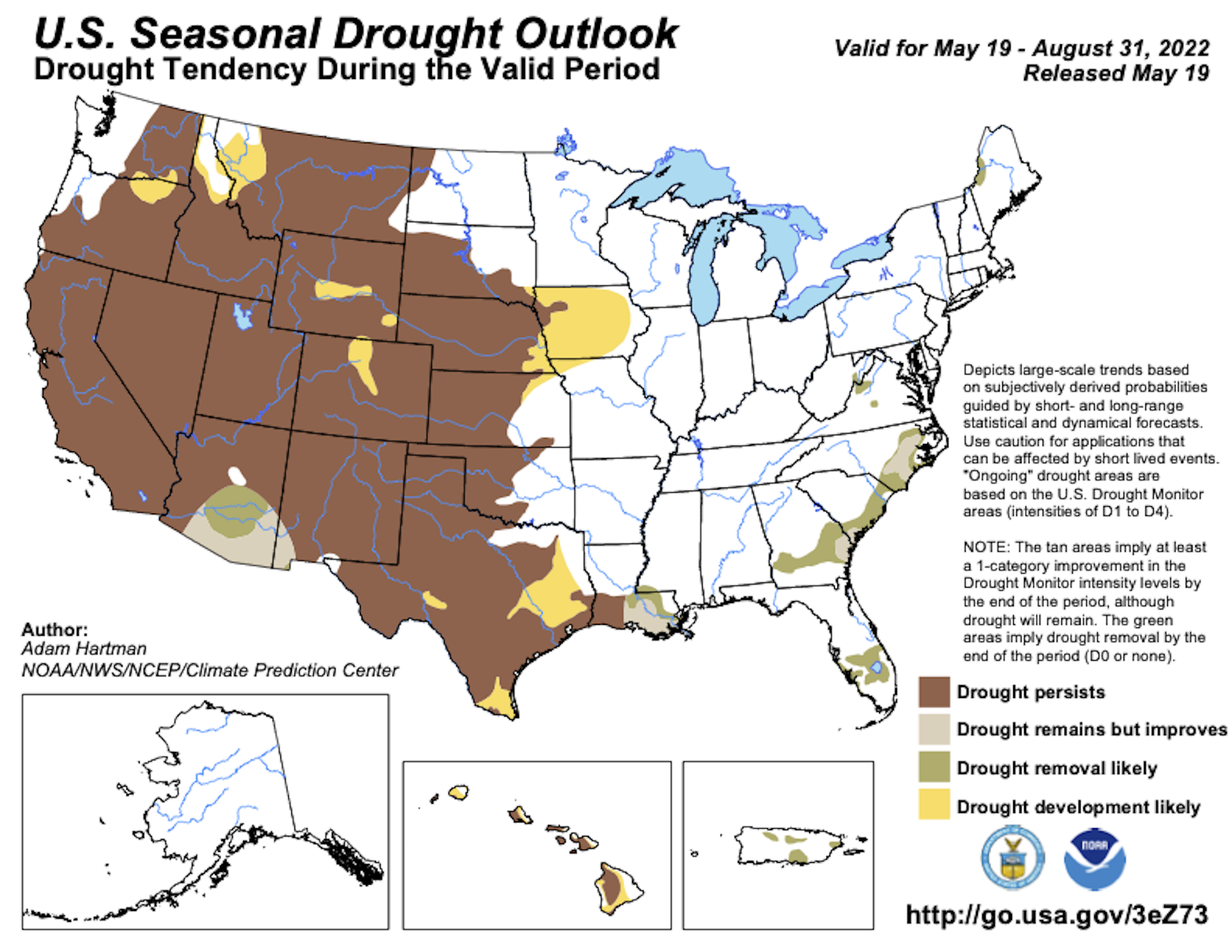
Heading into summer, the outlook is pretty grim. The National Weather Service’s latest seasonal outlook, issued May 19, 2022, described drought persisting across most of the West and parts of the Great Plains.

One driver of the Western drought has been persistent La Niña conditions in the tropical Pacific since the summer of 2020. During La Niña, cooler tropical Pacific waters help nudge the jet stream northward. That tends to bring fewer storms to the southern tier of the U.S. and produce pronounced drought impacts in the Southwest.

The other and perhaps more important part of the story is the hotter and thirstier atmosphere, caused by a rapidly warming climate.

As a climate scientist, I’ve watched how climate change is making drought conditions increasingly worse – particularly in the western and central U.S. The last two years have been more than 2 degrees Fahrenheit (1.1 Celsius) warmer than normal in these regions. Large swaths of the Southwest have been even hotter, with temperatures more than 3 F (1.7 C) higher. Studies suggest the Southwest’s ongoing 20-year drought is the most severe in at least 1,200 years, based on how dry the soils are.

A hotter atmosphere sucks more moisture from the soil

A thirstier atmosphere tends to extract more water out of the land. It exacerbates evaporative stress on the land, particularly when a region is experiencing below-normal precipitation. High evaporative stress can rapidly deplete soil moisture and lead to hotter temperatures, as the evaporative cooling effect is diminished. All this creates hydroclimatic stress for plants, causing restricted growth, drying and even death.

As a consequence of a warming climate, the U.S. Southwest has seen an 8% increase in this evaporative demand since the 1980s. This trend is generally happening across other parts of the country.

The thirstier atmosphere is turning what would otherwise be near-normal or moderately dry conditions into droughts that are more severe or extreme. As the climate heats up further, the increasing atmospheric thirst will continue to intensify drought stress, with consequences for water availability, long-lasting and intense heat stress, and large-scale ecosystem transformation.

Climate models project ominous prospects of a more arid climate and more severe droughts in the Southwest and southern Great Plains in the coming decades.

In addition to direct impacts of increasing temperatures on future droughts, these regions are also expected to see fewer storms and more days without precipitation. Climate models consistently project a poleward shift in the midlatitude storm tracks during this century as the planet heats up, which is expected to result in fewer storms in the southern tier of the country.

Expect flash droughts even in wetter areas

The changing nature of droughts is a concern even in parts of the U.S. that are expected to have a net increase in annual precipitation during the 21st century. In a hotter future, because of the high evaporative demand on the land, prolonged periods with weeks to months of below normal precipitation in these areas can lead to significant drought, even if the overall trend is for more precipitation.

Large parts of the northern Plains, for example, have seen precipitation increase by 10% or more in the last three decades. However, the region is not immune to severe drought conditions in a hotter climate.

At the tail end of what was the wettest decade on record in the region, the northern Plains experienced an intense flash drought in the summer of 2017 that resulted in agricultural losses in excess of $2.6 billion and wildfires across millions of acres. Record evaporative demand contributed to the severity of the flash drought, in addition to a severe short-term precipitation deficit. A flash drought is a drought that intensifies rapidly over a period of a few weeks and often catches forecasters by surprise. The likelihood of flash droughts that can cause severe impacts to agriculture and ecosystems and promote large wildfires is expected to increase with a warmer and thirstier atmosphere.

Flash droughts are also emerging as a growing concern in the Northeast. In 2020, much of New England experienced an extreme hydrologic drought, with low stream flows and groundwater levels and widespread crop losses between May and September. Aided by very warm and dry atmospheric conditions, the drought developed very rapidly over that period from what had been above-normal wet conditions.

As humanity enters a hotter future, prolonged periods of weeks to months of below-normal precipitation are going to be of a greater concern almost everywhere.

Heading into unfamiliar territory

Other forms of droughts are also emerging.

Atmospheric heating is causing snow droughts as more precipitation falls as rain rather than snow and snow melts earlier. Shorter snow seasons and longer growing seasons because of warmer temperatures are changing the timing of ecological responses.

Land is greening up earlier and causing an earlier loss of water from the land surface through evapotranspiration – the loss of water from plants and soil. This could result in drier soils in the latter half of the growing season. As a result, parts of the central and western U.S. could see both increased greening and drying in the future that are seasonally separated across the growing season.

With a rapidly changing climate, we are entering unfamiliar territory. The world will need new ways to better anticipate future droughts that could transform natural and human systems.