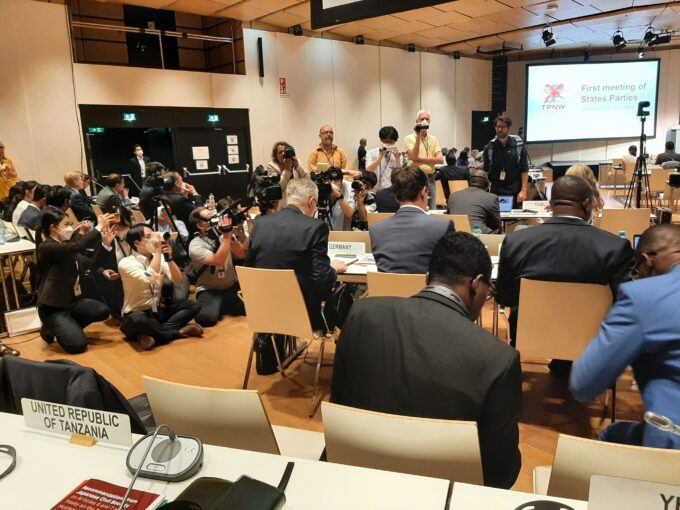
German Representative Rüdiger Bohn (center) speaking June 22nd to the First Meeting of States Parties to the Treaty on the Prohibition of Nuclear Weapons. Photo by John LaForge, for Nukewatch.
The Treaty on the Prohibition of Nuclear Weapons has been ratified by 65 governments, known in diplomatic circles as States Parties. The treaty’s first Meeting of States Parties (1MSP) concluded here June 23, after painstakingly working out — in the words of the International Campaign to Abolish Nuclear Weapons — “a blueprint for the end of nuclear weapons.” The new Treaty is the extraordinary, crowning achievement of ICAN, which won the 2017 Nobel Peace Prize for its efforts.
At 1MSP, The Netherlands, Belgium and Germany — all three of whom use U.S. nuclear weapons on their air force bases — participated as Observer States. The three have not ratified the TPNW, having acquiesced with a string of U.S. administrations — Obama’s, Trump’s, and Biden’s — that conspired at every opportunity to derail, prevent, delay, weaken, and boycott the new ban — in spite of broad public support for nuclear disarmament. Mr. Trump demanded that States Parties withdraw their ratifications. None did. Biden’s White House reportedly urged Japan not to attend the 1MSP as an Observer, and they stayed away.
German and Dutch representatives took their turn and spoke to the MSP on June 22, but both NATO members used exactly the same words to note their government’s explicit disapproval of the TPNW, and to voice their supposed support for the 1970 Nuclear Non-Proliferation Treaty. Both representatives said their governments “will not accede to” the nuclear ban treaty “because the TPNW is inconsistent with NATO doctrine.”
The hypocrisy in German and Dutch opposition is that their “sharing” of U.S. nuclear weapons, while consistent with “NATO doctrine” is totally inconsistent with their hallowed Non-Proliferation Treaty (NPT). In fact, their 50-year-long dismissal of the NPT’s binding (Art. VI) obligation to begin negotiations leading to nuclear disarmament “at an early date” is also completely inconsistent with their feigned support for the NPT.
As German Representative Rüdiger Bohn said June 22, NATO “doctrine” includes the doleful edict, “As long as nuclear weapons exist, NATO will remain a nuclear Alliance.” This embrace of genocidal atomic violence is not an Article of the 1949 North Atlantic Treaty or NATO Charter. It was manufactured entirely by its nuclear-armed members, and there is no legal obligation for NATO to remain a nuclear-armed terrorist organization.
NATO “doctrine” is fluid, strictly advisory, and accepted voluntarily by its members. Even the NATO Charter’s famous Article 5, regarding collective response to a military attack on a member state, declares only that the NATO membership “will assist the Party or Parties so attacked by taking … such action as it deems necessary.”
In comparison, the Non-Proliferation Treaty is binding international law and includes explicit, unambiguous prohibitions and clear, binding obligations. NATO’s ongoing planning, preparations and ever-present threat to launch nuclear attacks (known as “deterrence”), is simply a ritualized practice which can be ended at any time — say by complying with the NPT’s Articles I and II which prohibit any transfer or reception of nuclear weapons between states, or its Article VI pledge to negotiate nuclear disarmament. Indeed, it is the 50-year-long postponement, or rejection of Art. VI that has prompted and propelled the overwhelming success of the new TPNW.
What might have been a week-long celebration of the TPNW’s progress in seeking a world free of nuclear threats, was dimmed by Russia’s ongoing war on Ukraine. It was the war’s spoken and unspoken reminders of ready nuclear arsenals in Russia and NATO that moved the MSP to say, in its final Declaration, that it “condemn[s] unequivocally any and all nuclear threats, whether they be explicit or implicit and irrespective of the circumstances.”
The Declaration castigates nuclear weapons and echoes Daniel Ellsberg’s 1959 essay “The Threat and Practice of Blackmail,” noting that the Bomb is used to coerce, intimidate, plague, curse, and terrify. “This highlights, now more than ever, the fallacy of nuclear deterrence doctrines, which are based and rely on the threat of the actual use of nuclear weapons and, hence, the risks of the destruction of countless lives, of societies, of nations, and of inflicting global catastrophic consequences.”
The Parties agreed to push ahead with resolve to eventually see the nuclear weapons states sign on, saying “In the face of the catastrophic risks posed by nuclear weapons and in the interest of the very survival of humanity, we cannot do otherwise.”
In a lead-up to the World Health Organization’s (WHO) emergency meeting on Thursday to decide on whether the current global outbreak of the monkeypox virus should be declared a Public Health Emergency of International Concern (PHEIC), the World Health Network (WHN), an independent international collaboration of scientists and concerned citizens, said on Wednesday, June 22, 2022, that the monkeypox outbreak conformed to the definition of a pandemic.
The statement reads, “The World Health Network (WHN) today announced that they are declaring the current monkeypox outbreak a pandemic given that there are now 3,417 confirmed monkeypox cases reported across 58 countries, and the outbreak is rapidly expanding across multiple continents.”
They explained that without a concerted global action, the outbreak would continue and move into vulnerable populations such as children, expecting mothers and the immunocompromised. They warned that all people 40 and under who have never previously been immunized against smallpox remain extremely vulnerable to monkeypox, and that spillage into animals such as rodents and domesticated pets would potentially make the pathogen endemic in a broad geographic region with significant long-term consequences.
The WHN declaration states, “Even with death rates much lower than smallpox, unless actions are taken to stop the ongoing spread—actions that can be practically implemented—millions of people will die, and many more will become blind and disabled.” So far, only one death in Brazil has been attributed to monkeypox.
As of June 24, there have been 4,118 confirmed or suspected cases spanning at least 65 countries and territories. Yesterday, 461 more cases were added to the growing total. The seven-day rolling average of new infections has grown to 280 per day and is climbing. Taiwan, Singapore, and South Korea are the latest countries in Asia that have confirmed cases. Other non-endemic countries recently reporting monkeypox cases include South Africa, Croatia, Bulgaria, Colombia, and Gibraltar.
Figure 1: Seven-day average and cumulative cases of monkeypox infections. Source @antonio_caramia gave the WSWS permission to use these figures. Please follow the hyperlink to the website.
The case in Singapore involved a British Airways flight attendant who had attended several establishments on his layovers in mid-June. On June 20, he developed flu-like symptoms and pathognomonic skin rashes, prompting him to seek medical attention. Singapore’s ministry of health told the press that the man was being treated at the National Centre for Infectious Diseases, 13 close contacts had been identified, and tracing was ongoing.
The South Korean citizen who reported to the Korean CDC had just returned from Germany, where cases have been up-trending recently. He was symptomatic on his return flight with headaches, fever, sore throat, fatigue, and skin lesions. Another case is also being investigated.
On Thursday, Health Minister for South Africa, Joe Phaahla, reported that they had confirmed a case of monkeypox in a 30-year-old man from Johannesburg without travel history, meaning it was community-acquired and the extent of infections remains unknown. The health minister assured the press that contact tracing was underway.
With more than 900 cases, Britain leads all other countries in the sheer number of cases. According to the UK Health Security Agency, cases soared by more than 40 percent in less than one week. Europe remains the epicenter of the monkeypox outbreak, with Germany surpassing Spain and Portugal. However, in North America, Canada has seen 267 cases and the United States 173.
Figure 2: Cumulative monkeypox cases across Europe as of June 24, 2022. Source: @antonio_caramia
Professor Yaneer Bar-Yam, Ph.D., President of New England Complex System Institute and co-founder of WHN, stated emphatically, “There is no justification to wait for the monkeypox pandemic to grow further. The best time to act is now. By taking immediate action, we can control the outbreak with the least effort and prevent consequences from becoming worse. The actions needed now only require clear public communication about symptoms, widely available testing, and contact tracing with very few quarantines. Any delay only makes the effort harder and the consequences more severe.”
Dr. Eric Feigl-Ding, Ph.D., Epidemiologist and Health Economist, and co-founder of WHN, added, “The WHO needs to urgently declare its own Public Health Emergency of International Concern (PHEIC)—the lessons of not declaring a PHEIC immediately in early January 2020 should be remembered as a history lesson of what acting late on an epidemic can mean for the world.”
The WHO’s Director-General, Dr. Tedros Adhanom Ghebreyesus, has previously acknowledged that the disease is more widespread than the official numbers suggest. At the emergency committee meeting on Thursday, he reaffirmed this fact stating, “Person-to-person transmission is ongoing and is likely underestimated.” His statement implies that public health officials lack a clear comprehension of where these cases arise and how widespread they are.
Public health officials have been focused on tracing cases among men who have sex with men. The UK Health Security Agency noted that the monkeypox virus appears to be a threat “in the sexual networks of gay, bisexual and other men who have sex with men.”
David Heymann, a professor of infectious disease epidemiology at the London School of Hygiene and Tropical Medicine present at the WHO emergency conference, told the Washington Post, “We’re beginning to understand how widespread it really is. We know it’s widespread in certain populations, and we need to know whether it’s spreading in other populations as well.” Evidence is mounting that there are multiple routes of transmission that also include airborne routes, although it does not spread easily between people and requires close contact.
Figure 3: Monkeypox cases by date and country as of June 24, 2022. Source @antonio_caramia.
Genetic sequencing data places the origin of the outbreak back a few years. Trevor Bedford, an evolutionary biologist at the Fred Hutchinson Cancer Research center in Seattle, told the New York Times that “genomic patterns would suggest this occurred around 2018,” when the virus potentially became better at spreading from person to person.
Anthropologist and Assistant Professor Sagan Friant at Pennsylvania State University, who has been studying the zoonotic interactions of monkeypox in Nigeria, said in May during an interview with WPSU public media for Central Pennsylvania, “Many of the export cases that we’ve seen in the past have had one or few or zero subsequent cases due to human-to-human contact. But now as we’re seeing these multiple cases [in] multiple parts of the globe, you’re seeing sustained human-to-human transmission that is very unexpected and something that we’re keeping an eye on.”
She also explained that the zoonotic interaction between humans and animals goes both ways. Spilling the monkeypox virus from humans back into animals such as rodents in countries outside of previously non-endemic regions would mean that the virus could find a permanent niche throughout the globe, threatening new outbreaks repeatedly.
Genomic analysis of recent cases has surprised virologists. Monkeypox is a large double-stranded DNA virus with very efficient error correction mechanisms during replication. It acquires approximately one or two mutations yearly compared to the 20 to 30 mutations for RNA viruses. However, the current monkeypox virus has gained almost 50 mutations compared to the 2018 version, meaning it should have taken the monkeypox virus several decades to acquire these many changes to its DNA.
Scientists are zeroing in on a family of enzymes called APOBEC3 based on their analysis of recent cases and the specific type of mutations associated with this enzyme. The enzymes are part of anti-viral defense systems that animals, including humans, possess that induce mutations in the virus when they encounter it.
Richard Neher, a computational evolutionary biologist at the University of Basel, speaking with STAT News, explained that “the idea behind such a sabotage scheme is that if you trigger enough mutations, certainly some of them will be deleterious. The virus won’t be able to replicate, and what will be left is just a dead piece of DNA. It’d be like rearranging the letters on your enemy’s typewriter so they can’t get a clear message out.” However, the process is not foolproof, and mutations that incur an advantage may be passed to the next generation.
Dr. Bedford said that while mice carry only one version of the APOBEC3 enzyme, humans possess seven. The implication is that the rapid accumulation of mutations may be a product of the monkeypox virus having shifted to spreading through people rather than from rodents to humans. Neher admitted, “We don’t have a good enough understanding of how this virus interacts with the host [people], or what these individual mutations could do.”
As urbanization, deforestation, and climate change have radically altered the natural habitats of animals and the pathogens that have colonized them, the jump into human hosts becomes ever more inevitable unless efforts are immediately undertaken to study and address this compelling question. Virologist Dr. Michael Malim at King’s College London, who discovered APOBEC3 in 2002, told the Times, “These spillovers from other species, and what that means and what the trajectory is—it’s very unpredictable. And it’s occurring more and more.”
A UN Human Rights Office (OHCHR) investigation has shown that the bullets that killed Al Jazeera journalist Shireen Abu Akleh and injured her colleague Ali Sammoudi, were fired by Israeli forces.
Shireen Abu Akleh (Credit: Arwa/Ibrahim Twitter)
It is a damning refutation of Israel’s preposterous lie about her murder, including that she was shot by Palestinians firing indiscriminately at its troops.
Spokeswoman Ravina Shamdasani told reporters Friday, “All information we have gathered … is consistent with the finding that the shots that killed Abu Akleh and injured her colleague Ali Sammoudi came from Israeli security forces and not from indiscriminate firing by armed Palestinians” and that there was no evidence of “activity by armed Palestinians in the immediate vicinity of the journalists.”
The killing on May 11 of Al-Jazeera Arabic’s widely respected veteran journalist, a US-Palestinian citizen, by Israeli forces while she was covering an army raid on Jenin in the occupied West Bank, caused mass outrage. Clad in a press vest and helmet and standing in open view near a roundabout, she was targeted and shot by Israeli snipers along with her co-producer Ali Sammoudi who was hospitalised.
It was a brazen attempt to intimidate and prevent journalists reporting on Israel’s brutal suppression of the Palestinians. According to the Palestinian Center for Development and Media Freedoms, Israeli troops have killed 30 journalists in the West Bank and Gaza Strip since 2000. In each case, there have been no indictments against the soldiers responsible, testifying to the degree to which US backing guarantees impunity.
Israeli police later stormed her family’s home demanding the mourners take down the Palestinian flags and end the gathering and singing. On the day of the funeral, the police gave the pall bearers such a beating that they nearly dropped the coffin. Soldiers fired sponge-tipped bullets and threw stun grenades at the crowds gathered at the hospital morgue until Abu Akleh’s family were forced to whisk her coffin away in a car as a police officer removed the Palestinian flags covering it.
Israeli police confront mourners as they carry the casket of slain Al Jazeera veteran journalist Shireen Abu Akleh during her funeral in East Jerusalem, Friday, May 13, 2022. [AP Photo/Maya Levin]
Shamdasani said the UN Human Rights Office had gone through photo, video and audio material, visited the scene, consulted experts, reviewed official communications and interviewed witnesses. She confirmed that the Al Jazeera reporter along with her fellow journalists had made a real effort to be clearly visible as members of the press to Israeli soldiers. She said, “The journalists said they chose a side street for their approach to avoid the location of armed Palestinians inside the camp and that they proceeded slowly in order to make their presence visible to the Israeli forces deployed down the street.”
Shamdasani said, “Our findings indicate that no warnings were issued and no shooting was taking place at that time and at that location. Several single, seemingly well-aimed bullets were fired towards them [the journalists] from the direction of the Israeli security forces.” Furthermore, bullets continued to be fired at an unarmed man who tried to help Abu Akleh, as well as a journalist who was sheltering behind a tree. At least 16 shots were fired in total.
She concluded, “It is deeply disturbing that Israeli authorities have not conducted a criminal investigation.”
The UN Human Rights Office report follows an investigation by the Palestinian Authority (PA) published May 26 that arrived at the same conclusion from the autopsy and an examination of the armour-piercing bullets that hit Abu Akleh and Sammoudi. Palestinian officials accused Israel of killing her deliberately, citing the fact that she had been shot in the head even though she was wearing a vest clearly identifying her as a journalist. Palestinian officials have refused to cooperate with any Israeli investigation or hand over the bullets, knowing full well that any such inquiry will allow the soldiers responsible to get off scot-free.
There have been at least five other investigations into Abu Akleh’s death published in international media outlets, including the New York Times, the Washington Post, CNN and the Associated Press, all of which have subjected witnesses’ statements and the video clips to extensive forensic examination by experts and confirmed Israel’s responsibility for her killing.
Israeli officials variously charged the Palestinians with responsibility both directly and indirectly—for Abu Akleh’s death and denying any possibility that Israeli troops had killed her since “the army opens fire only in an orderly, controlled manner,” while others even blamed the journalist for her own death, claiming she was just a paid agent of terrorists.
Later as Israel’s Prime Minister Naftali Bennett realized that Abu Akleh's murder was turning into a public relations disaster, officials went into damage control mode, proposing a joint Israeli-Palestinian investigation.
There would be a police investigation into the attack on the pallbearers carrying Abu Akleh’s coffin out of the hospital morgue. But its outcome was determined in advance. While it found that the handling of the event amounted to police misconduct, none of the commanders in charge of the incident would be disciplined in line with a decision made prior to the investigation. Israel's Police Commissioner Kobi Shabtai told a lawyers’ conference in Tel Aviv, “The bottom line is that the conduct of police officers there was wrong, but not every investigation has to end with heads rolling.”
Eventually, the army accepted the “possibility” that Israeli gunfire had “inadvertently” killed the veteran journalist. However, the military’s advocate general ruled against a criminal investigation by the military police since the incident was a “combat event” with no suspicion of a criminal offense, even though she was a journalist killed in the line of duty.
This is a clear breach of the order put in place in 2011 that requires an investigation into every case of a death in the West Bank, except in a clear case of thwarting of a terror attack or the death of an armed individual during an exchange of fire. Israel has always used this order as the basis for its claim that it is capable of investigating itself, despite few indictments ever following.
Instead, as a sop to international public opinion, an army spokesperson promised a “thorough examination” of the events—with the proviso that without the PA handing over the bullet removed from Abu Akleh’s body it would be impossible to establish the truth.
Israel’s paymaster in Washington rushed to support its regional policeman, rejecting any responsibility to investigate the death of an American citizen, only belatedly echoing Israel’s call for a joint Israeli-Palestinian inquiry, since changed to “an independent, credible investigation.”
According to the army’s own data released in response to a freedom of information request and analysed by Yesh Din, an Israeli human rights organisation, only five (7.2 percent) of all internal military investigations opened in 2019-20 resulted in criminal indictments, and only 2 percent of the complaints received led to the prosecution of a suspect, up from 0.7 percent in 2017-18. The punishment, usually for low level offences rather than manslaughter or murder, typically result in a trivial punishment. The total number of investigations by the army is declining each year.
Abu Akleh’s death is to be added to a legal complaint by the International Federation of Journalists, the Palestinian Journalists’ Syndicate and the International Centre of Justice for Palestinians to the International Criminal Court (ICC). It relates to four Palestinian journalists wearing press helmets and vests—two killed and the other two maimed—and the attacks on international media buildings in Gaza in May 2021. The case argues that Israeli security forces have systematically targeted Palestinian journalists in violation of international humanitarian law and failed to investigate such incidents.
Al Jazeera has referred the case to the ICC, vowing to bring the killers to justice using all available legal means. Israel has dismissed this, saying that as it is not a signatory to the Rome Statute it is not subject to the court’s mandate and outside the court’s jurisdiction as Palestine is not a state. In February 2021, the ICC said its jurisdiction did extend to Gaza and West Bank, making it more likely the ICC can take up the issue.
The COVID-19 pandemic is once again spiraling out of control in a growing number of countries, driven by the highly contagious and immune-evading Omicron BA.4 and BA.5 subvariants. North America, Europe, Brazil, India and Australia are at the epicenter of the latest broad-based surge. After reaching a low of 466,297 daily new cases on May 30, the global seven-day average of daily new cases now stands at 661,420. The number of official new infections is growing despite the widespread dismantling of surveillance and reporting of COVID-19 metrics, with test positivity rates rising in each of these countries and regions.
The sudden rise in test positivity rates means that unreported infections are occurring faster than those being documented by public health departments. For instance, in the United States, where BA.4 and BA.5 account for more than 35 percent of sequenced cases, the seven-day average of daily new cases has risen by roughly 10 percent over the past week, reaching 109,105 daily new cases on Sunday. However, the test positivity rate has been continuously over 10 percent since mid-May and continues to rise. After several weeks in which the average daily death toll stood between 300-350 per day, it has now climbed to 420, according to the Johns Hopkins COVID-19 dashboard.
Portugal, which experienced its second largest wave of infections during the pandemic in early June due to BA.5, also saw its positivity rate exceed 50 percent by June 1. Eighty-six percent of Portugal’s population is fully vaccinated, and 65 percent have had at least one booster shot, yet daily new deaths have surpassed the peak reached during the first Omicron wave over the winter. This highlights the critical fact that COVID-19 vaccines alone will not stem repeated assaults on the population.
Test positivity rates are skyrocketing across the rest of Europe, with Spain reaching 30 percent, France surpassing 20 percent and Germany exceeding 40 percent by mid-June. Brazil is in the midst of its fourth wave, while the fascistic Bolsonaro government has effectively ended all pandemic emergency measures. Testing has, for the most part, come to a standstill.
In the UK, the seven-day average of daily new cases has jumped fourfold from a low of 4,754 per day on June 2 to 19,695 infections per day today, while hospitalizations have surged 27 percent in three weeks, and the death toll has begun to turn upwards once again. As in many countries, the elderly will face the brunt of this assault. Most completed their vaccinations several months ago, and they have limited immunity against infection, with their age and medical condition placing them at risk for severe consequences.
Global map of weekly new COVID-19 cases by country per one million population (Credit: @antonio_caramia)
In Israel, where the vaccination-only strategy has been emphatically promoted, COVID-19 cases have jumped nearly five-fold over the past three weeks, approaching 10,000 cases per day. In the same period, hospitalizations have more than doubled. According to the Jerusalem Post, 255 people are in serious condition, with 41 intubated and two on heart and lung bypass machines. The positivity rate is an astronomical 41.5 percent.
Australia has remained in a continuous undulating surge of infections since the first Omicron wave slammed into the island nation, and daily new cases are once more pushing upwards. As of yesterday, more than 3,000 are in hospitals receiving treatment.
In the past two months, at least four studies have been published in scientific journals proving that the Omicron BA.4 and BA.5 subvariants are highly resistant to immunity from the vaccines, as well as prior infection with the Omicron BA.1 and BA.2 subvariants that have been dominant throughout the world since late November. With immunity from both vaccines and prior infection waning and pandemic restrictions totally lifted amid the summer travel season, the implication is that potentially billions of people could be infected globally in the coming weeks and months.
While nearly every world government refuses to protect their populations from yet another assault by the deadly pathogen, mainland China reported only two COVID-19 cases yesterday. The seven-day average of new COVID-19 infections has declined to just 24. Shanghai, which had defeated a difficult wave of infections last month, reported only a handful of new COVID-19 cases last week.
The differences between China’s dynamic Zero-COVID policy and the imperialist nations’ demand that the working class “live with the virus” could not be more stark. Even without another surge of deaths, the current death rate in the United States would amount to an annual death toll of at least 130,000, almost four times higher than an average flu season and 25 times higher than China’s cumulative death toll from COVID-19.
Furthermore, evidence is mounting that after its acute impact, COVID-19 can cause far more harm to the human body’s various organ systems in a disease process known as Long COVID or Post-Acute Coronavirus Syndrome (PACS), which afflicts 10-30 percent of those infected.
In the US, approximately 50 percent of the adult population was infected by February, a figure which has risen considerably since then. Last week, the US government officially acknowledged that upwards of 20 million American adults are presently suffering from Long COVID, which includes a wide range of symptoms that can assault the cardiovascular, pulmonary, renal, neurological and other organ systems.
Debilitating Long COVID may impact one-third of all Long COVID patients, profoundly affecting their ability to work or care for themselves and their families for an undetermined period. Other studies have emerged that vaccines provide very little protection against Long COVID, and even individuals with mild COVID-19 symptoms face an increased risk of dying from complications from their infections compared to their uninfected counterparts.
For the ruling elites, their inaction in addressing the pandemic is snowballing as they face continued massive labor shortages, a by-product of people sickened by infections and reinfections, and many who have given up on the job markets because of the attack on their living standards. Unrelenting inflation is compounding these processes.
Faced with this mounting crisis, the corporate media is issuing increasingly delusional statements on the pandemic. This was exemplified in a Washington Post Editorial Board statement published Sunday titled “The pandemic is in a twilight zone. Enjoy it—but stay safe.”
The statement begins with a series of absurd claims, writing, “The pandemic has entered a twilight zone, neither causing major disruption to the nation nor vanishing. Everyone is looking forward to a summer without masks or terrifying case spikes. The government has dropped the requirement that international air travelers test before entering the United States. We have vaccines, antivirals and diagnostic tests in surplus. So far, so good.”
Every one of these claims is false. As noted above, the US is presently in the midst of a major surge of infections, which has risen steadily since the beginning of April. This deepening surge has disrupted all industries, in particular, the airline industry where staffing shortages have fueled unprecedented levels of flight delays and cancellations. Funding for vaccines, antivirals and tests is now gone, supplies are evaporating, and congressional Republicans have made it absolutely clear that not a penny more in pandemic funding will be allocated.
Owned by the pandemic profiteer Jeff Bezos (net worth $140 billion), the Post expresses here in the most unvarnished form the recklessness and stupidity of the American ruling class. It is these social parasites who are living in a “twilight zone” of fantasy and self-delusion.
The Omicron BA.4 and BA.5 subvariants are the most contagious versions of SARS-CoV-2 so far. With world capitalism refusing to implement public health measures and thereby providing the virus with billions of hosts, it remains fit to continue evolving into potentially more dangerous variants. This evolutionary process is occurring so rapidly that vaccine makers cannot keep pace with the changes in the virus’ genomic sequence, with scientists warning that the next iteration of the COVID-19 vaccine produced by Moderna is already outdated.
Spain’s PSOE (Socialist Party)-Podemos government has demanded that NATO consider migration, as well as food insecurity and terrorism, to be “hybrid threats.” This reference to NATO denunciations of Russian “hybrid warfare” before the war in Ukraine comes as Madrid prepares to host the 2022 NATO summit from June 28–30.
PSOE Foreign Minister Jose Manuel Albares told Reuters the Spanish government intends to push for the inclusion of these “nonmilitary” threats into NATO’s “Strategic Concept” document, the alliance’s new policy roadmap for the next decade. The document, to be drafted at the conference, will lay out NATO’s “mission” amid the war in Ukraine and the admission of new members such as Sweden and Finland.
NATO must also strengthen its “southern flank”—i.e., the Sahel and Maghreb—Albares told Reuters, even as the military alliance funnels billions of dollars worth of weapons and military vehicles to Ukraine to wage NATO’s proxy war against Russia.
“We want it to be recognised,” Albares stated, “that there are also serious threats coming from the southern flank. Terrorism, cybersecurity, the political use of energy resources and irregular migration affect our sovereignty.” The inclusion of these “hybrid threats” in the NATO strategic document, as well as an explicit reference to the “southern flank,” would have a “deterrent” effect, Albares claimed.
The PSOE-Podemos government’s characterisation of migration as a “hybrid threat” is not only a declaration of its intent to launch a brutal crackdown on refugees and asylum seekers. Madrid means to instrumentalise the arrival of a few thousand refugees a year at its borders to push for neo-colonial wars and interventions in these resource-rich regions of North and sub-Saharan Africa.
“Nobody should doubt that these hybrid threats could be used to challenge our territorial integrity and our sovereignty,” Albares continued. “We don’t have to do anything new; we just have to take into account that a series of threats can come from the southern flank that at any moment could require a defensive reaction from NATO exactly like what we’re seeing on the eastern flank [emphasis added].”
This is nothing less than a call for NATO to turn the Maghreb and Sahel into a new Ukraine, asserting its interests in this region via proxy wars or even direct military intervention.
If migration were to be acknowledged as a strategic, “hybrid” threat, several questions are raised. Would the arrival of refugees on the southern borders of the NATO bloc constitute an “attack” on the alliance? Would this trigger Article 5 of NATO’s treaty, obliging all 30 member states to come to Spain’s “defence” by waging war on impoverished African or Middle Eastern states?
Which country would be considered the aggressor? The one from which the majority of migrants are coming? Or any country that refugees pass through on their way to Europe, and which fails to apprehend them? Each of these scenarios risks the outbreak of large-scale war.
In this regard, it is significant that Albares framed his reactionary demands as being a part of NATO’s ongoing conflict with Russia, explaining that interventions in the Sahel and Maghreb would be necessary to combat the “growing Russian influence” in the region. Referring to the deployment of Russian mercenaries from the Wagner Groupin Mali, he stated: “The presence of Russia [in Mali] doesn’t help anything, doesn’t help to advance democracy, to stabilise, at all.”
The statements made by Albares recall events last autumn. In October and November, as a few thousand refugees from Iraq, Syria, Yemen and other war zones tried to enter the European Union from Belarus, European politicians and media denounced Belarusian president Alexander Lukashenko for supposedly using refugees and migrants as a weapon in a “hybrid war.” Their aim was to ramp up tensions with Belarus, a Russian ally, as part of their campaign to militarily encircle and ultimately wage war on Russia.
Spain’s calls for a strategic focus on the “southern flank” come amid growing Spanish-Algerian tensions triggered by the Algerian-Moroccan conflict over the Western Sahara.
Algerian–Spanish relations have been strained since PSOE Prime Minister Pedro Sánchez recognised Morocco’s claim to the Western Sahara in mid-March. The Western Sahara is a sparsely inhabited former Spanish colonial possession on Morocco’s south-western border, with considerable mineral and phosphate reserves. Rabat has long sought to bring it under Moroccan administration as an “autonomous region.”
After Spain ended its long-standing neutrality in this dispute, Algeria, which has backed the pro–Sahrawi independence Polisario Front, withdrew its ambassador from Madrid. On June 8, reports then emerged that Algiers had officially ended its 20-year treaty of friendship with Spain, although the Algerian government later denied the report.
The Spanish government fears that Algeria, which provided 40 percent of Spain’s natural gas imports in 2021, may now cut energy supplies to the country. This comes as the European Union and NATO campaign for an energy embargo against Russia, the EU’s major oil and gas supplier, amid the war in Ukraine.
Spain’s economy minister and first deputy prime minister, Nadia Calviño, tried to blame Madrid’s deteriorating relations with Algeria on Russia, telling Catalunya Radio she’d “already seen that Algeria was more and more aligned with Russia. [The decision] did not surprise me that much. The important thing is for the EU to respond with unity and determination.”
The call for refugees to be considered a type of “hybrid” warfare is a significant escalation of Madrid’s vicious anti-migrant campaign, which it has adopted directly from the programme of the far-right Vox party.
In a statement on May 18, Vox declared: “The Moroccan government continues to attack Spain through its hostile actions against the autonomous cities [Spain’s North African enclaves of Ceuta and Melilla].” Referring to migrants on the Spanish–Moroccan borders as “hybrid warfare,” Vox continued: “the aggression suffered by Spain is not finding any response in the face of the hostilities of Morocco.”
Vox’s comments themselves echo those made by Prime Minister Sánchez last May. As several thousand Moroccan migrants tried to cross over into Ceuta, Sánchez had all but accused the Moroccan government of waging war on Spain. Rabat, which had reportedly opened its side of the border in retaliation for Spain’s earlier position on the Western Sahara, had “used immigration,” Sánchez stated, “due to disagreements in foreign policy.”
Sánchez declared that this was “inadmissible” and akin to “attacking borders.”
The PSOE-Podemos government already has the blood of thousands of refugees on its hands. Blocking off “legal” routes to enter Spain, it has forced desperate migrants to make perilous sea journeys in unsafe or makeshift vessels, in which thousands have drowned. On Friday, dozens of African migrants were killed and hundreds injured as they tried to climb the border fence between Morocco and Melilla.
On Tuesday, Tesla CEO and multibillionaire Elon Musk confirmed that the company would be laying off as much as 10 percent of its salaried workforce, or roughly 3.5 percent of its total workforce, over the next three months. His announcement has taken place amid disruptions in supply chains, which have impacted the electric vehicle industry, a drop in Tesla’s stocks, and numerous lawsuits filed against Tesla for frequent violations of labor and civil rights laws.
Earlier in the month, Reuters stated that they had obtained emails sent from Musk to executives in which he expressed that he had a “super bad feeling” about the economy and would be carrying out a mass layoff of salaried employees and would “pause all hiring worldwide.”
Since the leaked information, Musk has attempted to reassure employees about the current stability of the company while also openly admitting to Tesla’s economic uncertainty.
An email was sent out to all employees to clarify that the layoffs would “not apply to anyone actually building cars, battery packs or installing solar.” He also stated that Tesla would continue to hire for hourly positions. However, Electrek, a news website focused on electric transportation, later confirmed that there has been a second round of layoffs impacting hourly workers in sales and delivery teams.
The company reported in 2021 that it employed 100,000 people, which would translate to roughly 3,500 layoffs by the end of the summer if the 3.5 percent figure given by Musk is accurate.
On Tuesday, he attempted to reiterate his claims of stability, giving a statement at the Qatar Economic Forum that “A year from now, I think our [employee] headcount will be higher.” Musk’s statement likely reflects an attempt at damage control as Tesla stocks have spiraled following Reuters’ report on the layoffs.
Workers at the company have said they were “blindsided” by the sudden layoff. Some have also taken to social media to lament the poor working conditions among salaried employees at Tesla and to lament that they had not left the company sooner.
On TheLayoff.com, one worker wrote: “They utilized PIP [performance improvement plan, an internal policy often used to justify firings] to trim the people who they don't like for whatever reason. Obviously, Elon doesn’t have any sense about this. He doesn’t think that feeding your family is his job as a boss.”
Another worker left an anonymous post that stated: “Musk has obviously lost his damn mind. He wants everybody to work 60+ hour weeks with no breaks, no vacations, no days off, and certainly no work from home. All of this for the same pay (the lower the better)—just like the ‘exemplary’ employees in China do. You know, the desperate people who have no other choice if they want to survive. That's his ideal employee. If you got away from that, your situation can only improve.”
Musk’s public confirmation of mass firings took place between filing a lawsuit by former employees at Tesla’s factory in Sparks, Nevada—where a separate mass firing took place—and the release of statements Musk gave in late May in which he raises the possibility of Tesla going into bankruptcy.
The lawsuit, which was filed on June 19 by John Lynch and Daxton Harsfield, alleges that Tesla carried out a mass firing of 500 workers at Gigafactory 2 in May and June. The plaintiffs allege that the largest electric vehicle producer was in violation of the Worker Adjustment and Retraining Notification (WARN) Act because it fired over 499 workers without providing a written notice 60 days in advance.
Tesla is also the subject of multiple other lawsuits including one alleging that the company allowed for “rampant sexual harassment” of women at the Fremont, California factory. In a separate suit a judge had awarded Owen Diaz, an African American elevator operator at Tesla’s Fremont plant, $15 million in payment for the racial abuses he experienced on the job. Diaz has rejected the payment, instead calling for a new trial claiming the amount would not change the conduct at the company. In an initial trial Diaz was awarded $137 million by a jury, which was later reduced.
In June, Solomon Chau, a Tesla investor, disclosed that he was also suing the company claiming the poor workplace culture is damaging the company’s reputation and in violation of its fiduciary responsibilities to investors. Chau’s suit specifically names Musk, Tesla’s board members and the company as defendants.
Chau’s lawsuit likely also reflects growing concerns among investors over Tesla’s economic downturn. In an interview with Tesla Owners of Silicon Valley in late May, but published this week, Musk described the factories in Berlin, Germany and Austin, Texas as “gigantic money furnaces,” which are unable to produce because of continued supply chain concerns. Musk specifically pointed to the inability to supply these factories with batteries due to COVID-19 related lockdowns in China.
Tesla operates a plant in Shanghai, which produces batteries used in their vehicles.
Musk also raised the possibility of Tesla going into bankruptcy if it is unable to keep up production. Business experts have also pointed out that the company could face difficulty transferring funds out of China and that Tesla is likely going to announce a drop in earnings compared to the previous year. Analysts at Refinitiv estimated adjusted earnings could drop to $2.5 billion in the second quarter compared to $3.7 billion in the first quarter.
Musk’s statements are surprising given his history of making grandiose claims about the operations of various companies he is a part of. He has frequently used Twitter, a company he is currently attempting to purchase, as a means of encouraging stock and digital currency speculations.
Tesla’s high market valuation, particularly compared to the number of vehicles it produces, has largely been the byproduct of rampant speculation and the ruthless treatment of workers. Throughout the pandemic this has found a particularly sharp expression with Musk rejecting remote work and violating California’s lockdown measures to reopen the Fremont factory.
The announced firings confirm that in times of economic downturn, Tesla and other companies will respond even more ruthlessly to unload the crisis onto the workers.
Notably, the layoffs at Tesla have coincided with job cuts among the more traditional automakers as well as tech companies, and portends further attacks on autoworkers.
The Bank for International Settlements (BIS), the umbrella organisation for the world’s central banks, has called for an escalation of interest rate rises to stop inflation becoming “entrenched,” that is, to hit harder against wage demands by slowing down economic growth, even to the point of inducing a recession.
BIS meeting (Image: BIS annual report)
The call was made in the BIS annual economic report issued over the weekend as leaders of the G7 group of major economic powers were meeting in Germany to determine future action against Russia, and to discuss policies in response to the deepening crisis in the global economy.
“Gradually raising policy rates at a pace that falls short of inflation increases means falling real interest rates. This is hard to reconcile with the need to keep inflation risks in check,” the report said. “Given the extent of the inflationary pressure unleashed over the past year, real policy rates will need to increase significantly in order to moderate demand.”
The BIS pointed to the effects of the previous monetary policies of the world’s central banks in pumping trillions of dollars into the financial system after the global financial crisis of 2008 and the market meltdown of March 2020. These measures had boosted stock markets and lifted asset prices to record highs, especially property.
“The coexistence of elevated financial vulnerabilities and high inflation globally makes the current conjuncture unique for the post-World War II era,” it said.
Tighter monetary conditions needed to bring down inflation could cast doubt on asset valuations, including housing, priced on the basis of persistently low interest rates and the provision of central bank liquidity and “even traditionally more secure assets could be exposed.”
“Bonds, for example, have provided a safe haven for investors in the low-inflation environment of recent decades. During this phase, bad economic times, when the prices of riskier assets like equities typically fall, were generally met with monetary easing, which boosted bond prices. But when inflation is high, economic downturns are more likely to be triggered by tighter monetary conditions, causing both bond and stock prices to fall.”
The BIS said that a “modest slowdown” in the economy “may not be enough,” and lowering inflation “could involve significant output costs, as after the ‘Great Inflation’ of the 1970s.” It said that “some pain will be inevitable,” but the “overriding priority is to avoid falling behind the curve.”
The economic response to the 1970s inflation, which resulted in an upsurge of struggles by the working class around the world, was the “Volcker shock” of the early 1980s.
Under the chairmanship of Paul Volcker, the Fed lifted lifted interest rates to record highs—20 percent at one point—resulting in the deepest recession to that point since the Great Depression to crush wage demands.
But as the Wall Street Journal noted, the risks to the global economy are much greater today because “overvalued assets and high debt … were much less of a concern” at that time.
As with central banks around the world, the BIS insisted that the key issue is wages and “whether inflation becomes entrenched or not ultimately depends on whether wage-price spirals will develop. The risk should not be underestimated, owing to the inherent dynamics of transitions from low- to high-inflation regimes.”
It warned that “price-induced cuts in real wages are likely to prompt workers to seek to recoup the lost of purchasing power” and noted that “in many countries, a substantial part, if not the bulk of wage negotiations were still to come.
In other words, the present upsurge in the struggles of workers seeking higher wages is only the beginning of a much bigger movement building up.
The BIS left no doubt about what the response had to be. It drew attention to the fact that existence of private debt at “historical peaks” and “elevated valuations” could make financial markets overreact. This raised a “policy dilemma” because financial markets reactions “may counsel caution.”
But, it insisted, notwithstanding this “dilemma,” central banks had to press ahead because “the risk of inflation becoming entrenched calls for a more pre-emptive and vigorous response.”
Underscoring this prescription, the BIS general manager Agustín Carstens said, “The key for central banks is to act quickly and decisively before inflation becomes entrenched.”
On top of a pre-emptive strike against wages, the BIS called for cuts in vital government spending, in other words, an austerity drive.
“For far too long,” it said, “there has been a temptation to turn to fiscal and monetary policy to boost growth, regardless of the underlying causes of weakness” and that loosening during contractions had not given way to “consolidation” [that is, major spending cuts] when the economy was growing.
“The temptation to postpone adjustments has been too strong. Such a strategy has arguably generated unrealistic expectations and demands for further support,” the report stated.
The rapidly worsening economic outlook hangs over the G7 leaders meeting now underway in Germany. While the first day of discussions were dominated by moves to increase measures against Russia with regard to oil exports, the economic crisis is a key issue.
A survey of economists conducted by the Financial Times on the eve of the meeting concluded that the risk of recession in Europe and the US had increased markedly following the decision by the US Federal Reserve to “go big” on rate increases with its decision to lift its base rate by 0.75 percentage point earlier this month.
The mood was summed up by Berenberg chief economist Holger Schmieding who said the balance had “tipped” in favour of an economic contraction. “What used to be a rising risk has now turned into a base case,” he told the FT.
“It would have been impossible to imagine at the last G7 summit that we’d be facing a situation like this,” he said. “Things are pretty bad and could get even worse.”
An unnamed “senior German official” cited by the newspaper said at the start of the pandemic there was a “simple consensus” on how to respond through “expansive monetary and fiscal policy.”
“The situation we’re now in is a lot more complex, a lot more difficult. This completely clear, almost instinctive idea that you just pursue expansionary polices is no longer so obvious,” he said.
The way in which the leaders of the major powers will seek to use the economic crisis that their own policies have created in order to intensify the war against Russia and draw China into the line of fire was revealed in Schmieding’s comments.
“It’s not the G7 leaders who have caused these problems—it’s [Chinese president] Xi Jinping and Vladimir Putin,” he said.
That is, the inflation crisis is not the result of the inflationary monetary policies pursued over the last two decades and the refusal of capitalist governments to eliminate the pandemic but the product of Putin’s Ukraine war while the Chinese government is responsible for the supply chain crisis because of its zero COVID policies based on necessary and effective public health safety measures.