30 Jun 2022

The Seven Deadly Sins: Alive & Well in the U.S. of A

David Rosen


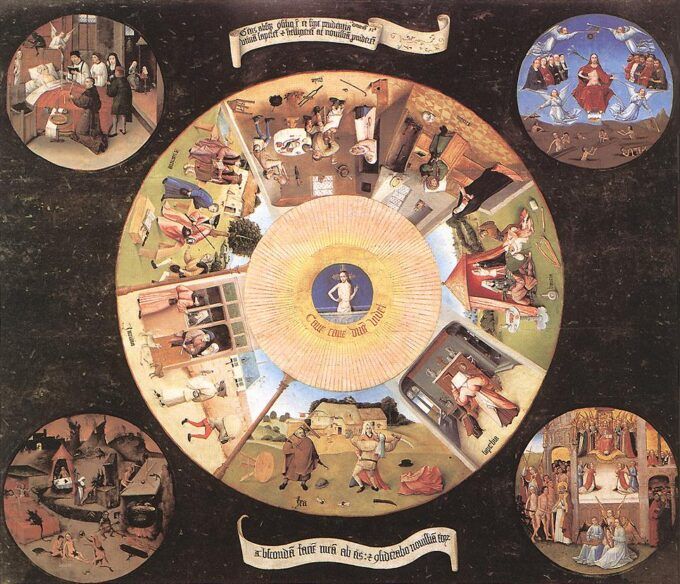
Photograph Source: Hieronymus Bosch’s The Seven Deadly Sins and the Four Last Things – Public Domain

What was the last sin you committed?

The Bible describes “sin” as transgression of the law of God (1 John 3:4) and rebellion against God (Deuteronomy 9:7; Joshua 1:18).

In the year 590, Pope Gregory the Great specified the seven deadly sins:

  • pride – an excessive belief in one’s own abilities;
  • envy – excessive jealousy for others’ traits, status or abilities;
  • anger – excessive fury or wrath;
  • gluttony — an excessive desire to consume more than that which one requires;
  • greed – an excessive desire for material wealth or gain, no matter the consequences;
  • sloth – excessive self-indulgence, laziness, a refusal to accept work discipline; and
  • lust – an excessive craving for the sexual pleasures of the body.

Traditionally, the seven deadly sins were divided into distinct categories:

  • Spiritual sins – pride, envy and anger.
  • Corporal Sins – gluttony, greed, sloth and lust.

It should be noted, in some accounts “gluttony” is not identified as a sin. In Prov 6:16-19, the sins include haughty eyes, a lying tongue, and hands that shed innocent blood, a heart that devises wicked plans, feet that make haste to run to evil, false witness who breathes out lies, and one who sows discord among brothers.” 

Each impulse persists into the postmodern world, defining key aspects of 21st century life.

In 2008, the Vatican revised the list of post-modern sins to now include the following: (1) genetic modification, (2) human experimentation, (3) polluting the environment, (4) social injustice, (5) causing poverty, (6) financial gluttony and (7) taking drugs.

***

The notion of sin, the forbidden, has been an aspect of American social control since the nation’s founding four centuries ago. How it has morphed over time reveals how society has changed.

According to one source, “the sin of pride is the sin of sins. It was this sin, we’re told, which transformed Lucifer, an anointed cherub of God, the very “seal of perfection, full of wisdom and perfect in beauty,” into Satan, the devil, the father of lies, the one for whom Hell itself was created.  We’re warned to guard our hearts against pride lest we too “fall into the same condemnation as the devil.”

It then notes:

St. Augustine of Hippo (354-430 A.D.) wrote, “‘Pride is the commencement of all sin’ because it was this which overthrew the devil, from whom arose the origin of sin; and afterwards, when his malice and envy pursued man, who was yet standing in his uprightness, it subverted him in the same way in which he himself fell. For the serpent, in fact, only sought for the door of pride whereby to enter when he said, ‘Ye shall be as gods.'”

Another source brings pride up to the 21st century noting: “Oddly, its bedfellow is self-hatred. Pride and self-hatred are two sides of the same coin.”

St. Thomas Aquinas defines envy as sorrow for another’s good (ST, II-II, 36,1): “…we grieve over a man’s good in so far as his good surpasses ours…because to do so is to grieve over what ought to make us rejoice, [namely] over our neighbor’s good.”

Vanity Fair writer acknowledged how envy has become a very 21st century indulgence:

Unrequitable envy is no fun at all, but there’s always the flip side: inducing envy in others. This is a pastime for everyone, and one of the main uses of social media. Ordinary people once flaunted their lives in mass holiday mailings. With Facebook and Instagram these holiday letters can be posted every few minutes. 

With regard to the sin of anger, one source reminds us, “Anger is an emotion that has been present since the beginning of humanity. The Bible reveals that the first human ever born (Cain) became so angry at God and his brother (Abel) that he killed his brother (Genesis 4:4-8).” It adds: “Anger has been with people from the start.”

The Catechism of the Catholic Church notes, “Anger as a deadly sin is ‘a disorderly outburst of emotion connected with the inordinate desire for revenge.’ . . . It is likely to be accompanied by surliness of heart, by malice aforethought, and above all by the determination to take vengeance.”

Writing in Psychology Today, Steven Stosny, Ph.D., links anger to entitlement. As reported, “Today people feel entitled not just to the pursuit of happiness, not even just to happiness, but to feeling good most of the time. If they don’t feel good most of the time, someone or something must be to blame.”

Saint Paul, in The Epistle to the Philippians (3:19) condemned gluttony among those who ate greedily and in excess. It was regarded as a sin that could trigger others. However, as has been reported, “it could be either a mortal or venial sin, depending on the severity of intent and the context in which the sin was committed. The pleasures of the stomach were also associated with the pleasures of the loins, namely the sin of lust, which inflames the senses and causes physical upset leading to licentious behaviour. Hence, Christian morality strongly condemned “those whose god is their belly.”

In the 20th century, gluttony was secularized and labeled in the Diagnosis and Statistical Manual of Mental Disorders (DSM) a binge-eating disorder and an estimated 8.5 million Americans suffer the condition.

Thomas Aquinas defined greed as “a sin directly against one’s neighbor, since one man cannot over-abound in external riches, without another man lacking them… it is a sin against God, just as all mortal sins, inasmuch as man contemns things eternal for the sake of temporal things.” (2, 118, ad 1)

However, in Oliver Stone’s 1987 movie, Wall Street, the character Gordon Gekko (played by Michael Douglas) captured the word’s post-modern ethos when he proclaimed, “Greed is good.”

Proverbs 19:15 notes, “Slothfulness casts into a deep sleep, and an idle person will suffer hunger.” A more recent observer notes, “It’s sinful because God designated people to work. … it’s how people provide and care for their family, help their neighbor and community ….”

Another source claims “slothfulness means laziness, sluggishness, or indolence which is the avoidance of activity or exertion. The slothful person is one who not only doesn’t want to work but is one who avoids it as well. This person may even go out of their way to avoid doing work.”

And then there is the sin of lust. The New World was besieged by numerous sex scandals during the first 75 years of Puritan settlement. The Puritan minister, Samuel Willard (1640-1707), once observed, “… in nothing doth the raging power of original sin more discover itself … than in the ungoverned exorbitancy of fleshly lust.” Two offenses were most upsetting: bestiality involving young men and sexual witchcraft among older women. Among Puritans, as John Murrin points out, “Bestiality discredited men in the way that witchcraft discredited women.”

Lust is especially revealing, signifying not only the autoerotic sexual pleasures experienced with oneself as a physical, natural being, but the erotic relations with another(s), whether real or imaginary.  One imaginary expression of lust is pornography that’s become a multi-billion business, gaining widespread popularity in the (ostensibly) Christian, conservative Bible Belt.

Bromleigh McCleneghan, an associate pastor at Union Church, Hinsdale, IL, is the author of Why Chastity Isn’t the Only Option – And Other Things the Bible Says About Sex. Reflecting on contemporary sin, he warns, “When talking about lust and fidelity in the Sermon on the Mount, Jesus counters that mind/body duality, suggesting that you don’t actually have to commit adultery to sin against your partner.”

***

We’ve come a long way since the British settlers first colonized the New World and the belief in “sins” was stamped upon the conscious of a people.

The old “spiritual sins” of pride, envy and anger have been integrated into daily life, with pride morphing into self-hatred, envy into virtual existence and anger subsumed into notions of entitlement.

Similarly, the “corporal sins” of gluttony, greed and sloth have transformed into the post-modern forms of self-indulgence if not, as exaggerations, psychological disorders.

And then there is lust. A host of sexual prohibitions, including masturbation, premarital sex, adultery, homosexuality and interracial sex, are no longer considered sins by civil authorities, most moralists and a significant proportion of the public.

Prostitution has become a discreet business activity, regulated in a few rural counties in Nevada, decriminalized in a growing number of cities and – compared to times of old — relatively free from moralistic and police harassment. Today, the limits to acceptable sex are based on consent among adults or among similarly aged adolescents over 16 or 18 years. Strong prohibitions, both legal and ethical, seek to halt nonconsensual sexual acts like rape, pedophilia, incest and bestiality.

However, for the early Puritans and other colonists, both sin and satin were threats to personal and public life. Today, among some religious moralists sin and satin persists in one’s gender identity, in non-heterosexual relations and in the books one reads (or permit children to read). We can be grateful that, after four centuries, people are no longer executed for consorting with the devil.

The United States Extends Its Military Reach Into Zambia

Vijay Prashad


africomafricom

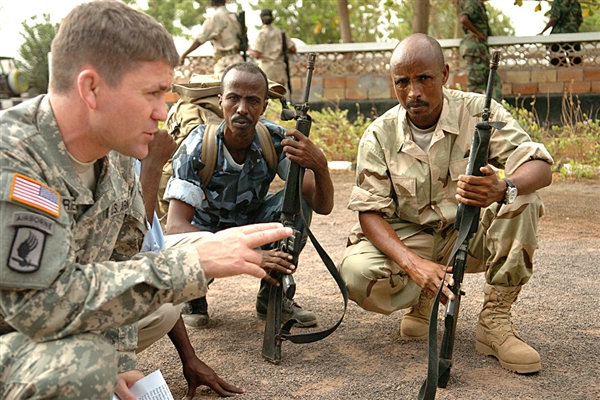
On April 26, 2022, the United States Africa Command (AFRICOM) announced that they had set up an office in the U.S. Embassy in Lusaka, Zambia. According to AFRICOM Brigadier General Peter Bailey, Deputy Director for Strategy, Engagement and Programs, the Office of Security Cooperation would be based in the U.S. Embassy building. Social media in Zambia buzzed with rumors about the creation of a U.S. military base in the country. Defense Minister Ambrose Lufuma released a statement to say that “Zambia has no intention whatsoever of establishing or hosting any military bases on Zambian soil.” “Over our dead bodies” will the United States have a military base in Zambia, said Dr. Fred M’membe, the president of the Socialist Party of Zambia.

Brigadier General Bailey of AFRICOM had met with Zambia’s President Hakainde Hichilema during his visit to Lusaka. Hichilema’s government faces serious economic challenges despite the fact that Zambia has one of the richest resources of raw materials in the world. When Zambia’s total public debt grew to nearly $27 billion (with an external debt of approximately $14.5 billion), it returned to the International Monetary Fund (IMF) in December 2021 for financial assistance, resulting in an IMF-induced spiral of debt.

Two months after Hichilema met with the AFRICOM team, he hosted IMF Deputy Managing Director Antoinette M. Sayeh in June, who thanked President Hichilema for his commitment to the IMF “reform plans.” These plans include a general austerity package that will not only cause the Zambian population to be in the grip of poverty but will also prevent the Zambian government from exercising its sovereignty.

Puppet Regime

Dr. M’membe, president of the Socialist Party, has emerged as a major voice against the United States military presence in his country. Defense Minister Lufuma’s claim that the United States is not building a base in Zambia elicits a chuckle from M’membe. “I think there is an element of ignorance on his part,” M’membe told me. “This is sheer naivety. He [Lufuma] does not understand that practically there is no difference between a U.S. military base and an AFRICOM office. It’s just a matter of semantics to conceal their real intentions.”

The real intentions, M’membe told me, are for the United States to use Zambia’s location “to monitor, to control, and to quickly reach the other countries in the region.” Zambia and its neighbor, the Democratic Republic of the Congo, he said, “possess not less than 70 percent of the world’s cobalt reserves. There are huge copper reserves and other minerals needed for modern technologies [in both these countries].” Partly, M’membe said, “this is what has heightened interest in Zambia.” Zambia is operating as a “puppet regime,” M’membe said, a government that is de jure independent but de facto “completely dependent on an outside power and subject to its orders,” M’membe added, while referring to the U.S. interference in the functioning of the Zambian government. Despite his campaign promises in 2021, President Hichilema has followed the same IMF-dependent policies as his unpopular predecessor Edgar Lungu. However, in terms of a U.S. base, even Lungu had resisted the U.S. pressure to allow this kind of office to come up on Zambian soil.

After news broke out about the establishment of the office, former Zambian Permanent Representative to the African Union, Emmanuel Mwamba, rushed to see Hichilema and caution him not to make this deal. Ambassador Mwamba said that other former presidents of Zambia—Lungu (2015-2021), Michael Sata (2011-2014), Rupiah Banda (2008-2011) and Levy Mwanawasa (2002-2008)—had also refused to allow AFRICOM to enter the country since its creation in 2007.

Is This a Base or an Office?

Zambia’s Defense Minister Lufuma argues that the “office” set up in Lusaka is to assist the Zambian forces in the United Nations Multidimensional Stabilization Mission in the Central African Republic (MINUSCA). Since 2014, the United States has provided around 136 million kwacha ($8 million) to assist the Zambian military. Lufuma said that this office will merely continue that work. In fact, Zambia is not even one of the top five troop contributing countries to MINUSCA (these include Bangladesh, Cameroon, Egypt, Pakistan and Rwanda). Lufuma’s reason, therefore, seems like a fig leaf.

Neither Zambia nor the United States military has made public the agreement signed in April. The failure to release the text has led to a great deal of speculation, which is natural. Meanwhile, in Ghana, where a defense cooperation agreement was signed between the two countries in May 2018, the United States had initially said that it was merely creating a warehouse and an office for its military, which then turned out to mean that the United States military was taking charge of one of the three airport terminals at Accra airport and has since used it as its base of operations in West Africa. “From the experience of Ghana, we know what it is,” M’membe told me, while speaking about the American plan to make an office in the U.S. Embassy in Zambia. “It is not [very] different from a base. It will slowly but surely grow into a full-scale base.”

From the first whiff that the United States might create an AFRICOM base on the continent, opposition grew swiftly. It was led by former South African President Thabo Mbeki and his Defense Minister at that time, Mosiuoa Lekota, both of whom lobbied the African Union and the Southern African Development Community to reject any U.S. base on the continent. Over the past five years, however, the appetite for full-scale rejection of bases has withered despite an African Union resolution against allowing the establishment of such bases in 2016. The U.S. military has 29 known military bases in 15 of the African countries.

Not only have 15 African countries ignored their own regional body’s advice when it comes to allowing foreign countries to establish military bases there, but the African Union (AU) has itself allowed the United States to create a military attaché’s office inside the AU building in Addis Ababa. “The AU that resisted AFRICOM in 2007,” M’membe told me, “is not the AU of today.”

The unanswered questions about Trump’s January 6 coup

Patrick Martin


The two hours of testimony Tuesday by former White House aide Cassidy Hutchinson provided an indelible picture, from an inside source, of the effort by Donald Trump to stage a political coup on January 6, 2021, stop the congressional certification of his election defeat, and remain in office as a fascist dictator-president.

Along with top aides like his personal lawyer Rudy Giuliani and his chief of staff Mark Meadows, Trump expected that after he addressed a rally outside the White House and told the crowd of supporters, including hundreds of armed fascists, to march on the Capitol, he would accompany them, place himself at the head of the mob, enter the House chambers where the counting of electoral votes was underway and seize control.

Vice President Mike Pence and the assembled legislators would be given two choices: Either ratify Trump’s overturning of the 2020 election results and his remaining in power, or be killed. As Trump said, hearing the “Hang Mike Pence” chants from his supporters, “He deserves it.” 

There is little doubt what the congressional Democrats would have done. They would have capitulated, seeking some face-saving operation like a referral of the “disputed” election to a vote by the House of Representatives, conducted according to the procedure of one vote for each entire state delegation, thereby guaranteeing Trump’s victory.

Afterwards, the Democrats and the corporate media would have portrayed the outcome as being in accordance with the Constitution, and any legal challenge would be rejected by Trump’s stooges on the Supreme Court.

That the coup failed owes not at all to opposition from the Democratic Party, and certainly not to Democratic President-elect Joe Biden, who was appealing for the would-be dictator to go on national television and call off his own coup.

The U.S. Capitol under siege by Trump supporters on January 6, 2021. (By Tyler Merbler from USA - DSC09363-2, CC BY 2.0, https://commons.wikimedia.org/w/index.php?curid=98724532)

It seems clear, however, that large sections of the military-intelligence apparatus were watching and waiting, aware of the coup plot but not joining in until it became clearer who would prevail. Trump’s failure to reach the Capitol—under circumstances that remain to be clarified—deprived the mob of on-the-spot leadership and led to its energy being dissipated until police reinforcements arrived, after long delays, to clear the building.

There are vital questions posed by the latest revelations, and all of the information brought forward by the six televised hearings held so far by the House Select Committee on the January 6 attack.

Who were Trump’s accomplices and co-conspirators?

An action as far-reaching as a coup d’etat in the United States could not be the work of an individual, even a president. Trump required dozens, if not hundreds and thousands of co-conspirators, willing to break the law and trample on the Constitution. Hutchinson’s testimony identified Meadows, Giuliani and seven Republican representatives as inquiring about or actively seeking presidential pardons for their actions on January 6, a clear indication of consciousness of guilt. But there must be many more.

What was the role of the military-intelligence apparatus?

No coup can succeed without the active support or passive consent of the armed forces. For more than three hours, the Pentagon delayed approval of the dispatch of National Guard troops to defend the Capitol. No credible explanation has been given for this delay. Neither acting Secretary of Defense Christopher Miller nor any high-ranking uniformed officer has given public testimony about their actions on January 6. What were they doing? Who were they in contact with? What discussions were held?

What was Trump doing in the Oval Office as the attack unfolded?

According to Hutchinson, chief of staff Meadows told her several times during those hours that Trump wanted to be alone in his office. Who was he calling, and what did they discuss? He was certainly speaking to members of Congress who were inside the besieged Capitol. What did they discuss? Was he in direct contact with elements in the crowd who had attacked the building? Was he in contact with leaders of the military-intelligence apparatus? What did they discuss?

Why was the Capitol so lightly defended, and who ordered the stand-down?

The threats of violence on January 6 were not made in secret but widely publicized on the internet and even in the corporate media. There had been previous incidents of violence, including dress-rehearsal attacks on state capitols and the fascist plot to kidnap and kill Michigan’s Democratic governor. Yet the Capitol Police were under no extraordinary alert, and there was no preemptive mobilization of the police and military, as there certainly would have been if Trump had won the election and there were threats of a left-wing protest against the certification of his victory.

What was the Democratic Party doing before the attack? 

It was clear to the Democrats what Trump’s intentions were. He had made no secret of his defiance of the election results, and Biden had said, months before the election, that Trump’s possible rejection of an election defeat was his greatest concern. But after the election, Biden and the Democrats spread complacency, suggesting that there was no substance to Trump’s refusal to concede, only his psychological inability to admit defeat. House Speaker Nancy Pelosi, the top official in Congress, took no action to fortify the Capitol before the certification vote, which Trump was publicly targeting for attack.

What was Biden doing on January 6?

As president-elect, Biden began to receive national security briefings from November 30 on (after an initial delay due to Trump’s refusal to concede defeat). Biden was privy to all the information available to the intelligence apparatus about the threatened violence on January 6, which could not have come as a surprise to him. Yet he said nothing for hours. Why not? Why didn’t he go on television as soon as the dimensions of the attack became apparent and denounce it? Was he in contact with the military-intelligence leadership and, like them, biding his time? Why, when he finally did speak out publicly, was it in the form of an appeal to Trump rather than to the American people?

The comments of House Select Committee members after the hearing and the press coverage which ensued combine to bury these vital political questions, reducing everything to the small change of Trump’s personal conduct—Did he grab the wheel of his protective vehicle, or attack his Secret Service bodyguard, or smash his dinner plate against the wall?

The leading press voices trivialize the hearing, with the Washington Post editorializing, “Jan. 6 testimony shows that Donald Trump is unhinged. Voters must listen.” And the New York Times, which did not even write an editorial publishing a news analysis, headlined, “A President Untethered: In the final, frenzied days of his administration, Donald J. Trump’s behavior turned increasingly volatile as he smashed dishware and lunged at his own Secret Service agent.”

At most, the commentary revolves around whether Trump can be or will be criminally indicted for his actions or about the impact of these revelations on the upcoming midterm elections.

Neither the media nor the Democrats care to discuss what the consequences would have been if Trump’s coup had been successful. What would America have looked like on January 7, 2021? Or on January 20, 2021, with the “peaceful transition of power” forestalled? Or today?

The revelations about January 6 cannot, however, be put back in the bottle. The majority of Americans now believe, according to most polling, that Trump should be indicted and prosecuted for his actions. The Socialist Equality Party fully embraces that sentiment.

The Democratic Party is fearful that in the event of a trial of Trump, there would be evidence coming out of the vast extent of the conspiracy, including large sections of the Republican Party, those whom Biden declares to be his “colleagues” and “friends.” That is why the investigation into January 6 has been dragged out over nearly 18 months, with the most explosive revelations delayed until now. Even the latest exposure seems due to the desire to weaken Trump and his political faction in the November elections, not to alert the American people to the mounting danger to their democratic rights.

But in every capital around the world, capitalist governments understand very well that the United States, the most powerful and heavily armed country in the world, came within minutes of a successful coup, which was forestalled only by bad luck and incompetence on the part of the coup plotters—and that the coup plotters are all at liberty to try again.

Ecuador shaken by anti-government protests, mass strikes over inflation

Dominic Gustavo


Extreme social inequality exacerbated by spiraling inflation, especially food and gas prices, triggered a social explosion in Ecuador. The South American nation of 17.6 million people has been brought to a standstill by mass strikes and demonstrations, plunging the right-wing government of President Guillermo Lasso into crisis. 

Protests began on June 13, when the Confederation of Indigenous Nationalities of Ecuador (CONAIE) group—the largest of the organizations purporting to represent the country’s 1.1 million indigenous people—called for a national strike, issuing a list of 10 demands including: a reduction in the price of gas and diesel; implementation of price controls on agricultural products; social aid for more than 4 million families; a renegotiation of private debts; a moratorium on the expansion of mining and oil operations on indigenous lands; and a greater allocation of resources towards education and public health. 

The Guardian quoted an indigenous woman from Samanga named Sonia Guamangate who gave a sense of the protesters grievances: “The prices have risen in the city but what we get paid for our agricultural products remain the same… Sometimes they are paying as little as $5 or $6 for a quintal [100kg] of potatoes. That’s a year’s work for some of us.” She added, “They call us ignorant Indians. We are not ignorant; we supply the food for the city.”

Tens of thousands of indigenous farmers and rural laborers descended from the Andes slopes and the Amazonian regions, setting up roadblocks throughout the country and marching in provincial cities before converging on the capital. They were joined in the cities by workers and students, who have also faced economic destitution due to inflation. As one worker, mechanical engineer Miguel Terán, told the Guardian: “There is a clamour among the people, especially those who don’t have a job… It’s very difficult to live when all the prices have risen so much. The fuel prices have gone up, so all the basic products have gone up.”

Since June 21, Quito has been effectively paralyzed by protesters blocking off several key roads near the city center where they engaged in a standoff with police, punctuated by violent clashes.

Other parts of the country were similarly shut down and enveloped by deadly unrest. In Puyo, in Pastaza province, indigenous protesters bearing firearms and ancestral spears engaged in street fighting with soldiers and police, in the process setting fire to the police station and patrol cars. At least six protesters have been killed and hundreds wounded in the brutal state crackdown, which has seen unarmed protesters beaten, shot and gassed by heavily armed militarized police. 

The mass protests have effectively paralyzed the Ecuadorian economy, with oil production having fallen by more than half as a result of road blockades, vandalism and the takeover of oil wells, according to the energy ministry which stated, 'In 14 days of demonstrations, the Ecuadorian state has stopped receiving around $120 million.' The ministry warned Sunday that oil production could grind to a complete halt, “because it has not been possible to transport the supplies and diesel necessary to maintain operations.' Ecuador produced about 520,000 barrels of oil per day before the protests. It should be noted however that the transportation unions have refused to go out on strike, limiting the economic impact of the road blockages. Regardless, the supply disruptions have been immense. 

Lasso initially declared a state of emergency over “grave internal commotions” in six provinces and claimed in televised remarks on June 24 that the leader of CONAIE—Leonidas Iza—was attempting to overthrow the government, saying “It is proven that the true intention of the violent (people) is to generate a coup and that is why we call on the international community to warn of this attempt to destabilize democracy in Ecuador ... Mr. Iza can no longer control the situation. The violence perpetrated by infiltrated criminals has gotten out of hand.”

Just a day later however, Lasso abruptly ceded to the demands of indigenous groups to lift the state of emergency, and the National Assembly announced that it would form a commission to facilitate negotiations with indigenous leaders to bring an end to the protests.

Meanwhile the opposition Union for Hope party—aligned with former president Rafael Correa—had called for the impeachment of Lasso, but fell 12 short of the 92 votes required for the legislature to remove the president from office. Tuesday’s impeachment vote in the National Assembly, however, hardly represents an end to Ecuador’s crisis of bourgeois rule.

Oscillating between limited concessions and police state repression, Lasso seized upon the death of a member of the military in clashes with protesters on Tuesday as the pretext for breaking off talks with leaders of indigenous organizations, including CONAIE. This was accompanied by savage attacks by security forces on Quito’s impoverished San Miguel del Comun neighborhood and against a protest at the University of Cuenca in the country’s south.

In an effort to defuse popular anger, Lasso had earlier pledged on Sunday that he would cut gasoline and diesel prices by 10 cents a gallon, in addition to previously announced fertilizer subsidies and debt forgiveness measures.

These are the actions of a regime in desperate crisis, while also reflecting divisions within the Ecuadorian bourgeoisie over how best to control an increasingly restive population. Sections of the oligarchy are losing confidence in the Lasso government’s ability to manage the situation. But whatever Lasso’s fate, the roots of the current crisis are deep, and cannot be solved on the basis of parliamentary maneuvers.

Lasso, a multimillionaire ex-banker, was elected in April 2021 on the basis of the failure of the governments of Rafael Correa and his successor, Lenin Moreno—part of the pseudo-left “Pink Tide” that swept Latin America—to follow through on promises of social reform, instead lurching sharply to the right. 

Though elected on the basis of right-wing populist promises to create jobs and raise living standards, Lasso’s neo-liberal market policies, which were dictated by the IMF, have entailed sharp cuts in social spending, tax cuts for capitalist investors, the lifting of restrictions on mining and oil drilling, and the surrender of key sections of Ecuador’s economy to imperialist capital.

These policies have resulted in a bonanza for foreign investors and the country’s venal ruling elite, on the one hand. On the other, the IMF austerity measures—combined with the impact of the COVID-19 pandemic and inflation—have plunged masses of workers and the rural poor into absolute destitution.

According to a report by the NGO CARE, 2022 saw levels of poverty explode in the already deeply unequal nation, with 35 percent of the population living on less than two dollars a day, and 40 percent of households facing food insecurity. Some 8 percent of children will likely be forced to abandon their studies to work, much of it unpaid care work. 

Ecuador has been ravaged by COVID-19, having recorded nearly a million cases and almost 36,000 deaths, almost certainly an undercount. The economic ramifications of the pandemic caused unemployment to skyrocket, and even today just 33.2 percent of Ecuadorians are formally employed, with 22.1 percent classified as underemployed, according to Ecuador’s national labor statistics. 

Such levels of inequality and poverty have inevitably produced extreme social dislocation. Rates of violent crime, which had been declining for years, exploded in 2021, fueled by gang violence and the growth of drug trafficking operations. Deadly riots in the country’s overcrowded prisons—the last was in May, with 44 dead—have become more common, and have provoked outrage among the population, with distraught relatives blaming the government. Since February 2021, nearly 400 inmates have been killed in six separate massacres. 

To all of this must be added the devastating effect of the spiraling inflation, produced by the instability of the world financial markets and the disruption of international supply chains provoked by the US-NATO proxy war against Russia in Ukraine. 

The social explosion in Ecuador must be seen in this broader context. Similar conditions prevail throughout Latin America, which was already the region with the highest debt in the world and riven by the most extreme social inequality. Whatever the immediate outcome of this struggle, it will happen again, and on a larger scale.

The fear gripping the bourgeoisie was expressed in May of last year by outgoing Colombian President Ivan Duque. As his security forces were gunning down protesters, he warned that the pandemic would be the trigger for “great social unrest” that would soon grip other nations in the region.

US announces plans to flood Europe with troops and weapons

Andre Damon


In remarks at the NATO Summit in Madrid, Spain, US President Joe Biden announced a sweeping increase in US troop deployments to Europe as part of a plan by NATO to militarize the continent for its ongoing war with Russia and escalating conflict with China.

The NATO summit formally invited Sweden and Finland to join the alliance, effectively doubling NATO’s land border with Russia and consummating the military alliance’s decades-long eastward expansion.

Speaking Wednesday, Biden praised the decision of the governments of Sweden and Finland to “move away from neutrality and the tradition of neutrality.”

Biden announced that the US would send another 20,000 troops to Europe, bringing its total deployment there to 100,000.

He pledged to increase the number of US Navy destroyers stationed in Spain’s Naval Station Rota to six.

He also announced the formation of a permanent US military headquarters in Poland, marking an unprecedented US military inroad into a former Warsaw Pact country.

He also announced an additional “rotational brigade” of 5,000 personnel headquartered in Romania, as well as sending two additional F-35 fighter squadrons to the UK and the stationing of additional air defense systems in Germany and Italy.

Biden declared: “NATO is ready to meet threats from all directions, across every domain: land, air and the sea.”

The announcement is the largest military expansion in Europe in decades, the Wall Street Journal commented.

Critically, the summit announced the publication of a new NATO “strategic concept,” defining Russia as the “most significant and direct threat to the allies’ security.” Russia was previously classified as a “strategic partner” in NATO’s 2010 strategy document.

For the first time, the NATO strategic concept also targeted China, declaring that it posed a “challenge” to the alliance.

Individual NATO members pledged unlimited support to the war effort, with German Chancellor Olaf Scholz declaring that Germany would continue to arm Ukraine “intensively—for as long as it is necessary to enable Ukraine to defend itself.”

Significantly, the leaders of Japan, South Korea, Australia and New Zealand joined the summit, leading Foreign Affairs to comment that “battle lines are being drawn that could last for generations.”

The UK is expected to expand its troops stationed in Estonia from 1,000 to 1,700.

The Guardian noted, “In total, eight frontline Nato battlegroups stretching from Estonia to Bulgaria, once designed to act as small initial defence force, are expected to be increased in size to a brigade level of 3,000 to 5,000 troops.”

The overwhelming response in the US media and political establishment to Biden’s further commitment of blood and treasure to the war effort was enthusiastic support.

Hailing NATO’s plans to expand its fighting forces seven-fold, the Washington Post declared that if “Ukraine’s steadfast resistance and the West’s firm stance” continue, “success will follow.”

The New York Times, for its part, praised the would-be former Dictator Donald Trump’s calls for the expansion of US military spending, declaring in an editorial that Trump “wasn’t wrong” to call for Europe to spend more on its military. The Times concluded, “In this fateful moment, NATO must take a serious look not only at deterring Russia but also at itself, its purpose and its readiness to really share that burden.”

The NATO summit also marked a significant shift in the use of the war in Ukraine to more aggressively target China. On Wednesday, the White House added five Chinese companies to a blacklist for allegedly helping the Russian war effort.

The Commerce department claimed that the companies “continue to contract to supply Russian entity listed and sanctioned parties.”

Warning that this was only the beginning, Under Secretary of Commerce for Industry and Security Alan Estevez said, “Today’s action sends a powerful message to entities and individuals across the globe that if they seek to support Russia, the United States will cut them off as well.”

In a critical admission, NATO Secretary-General Jens Stoltenberg admitted that NATO had been expanding its forces in preparation for conflict with Russia for years, declaring, “The reality is also that we have been preparing for this since 2014. … That is the reason that we have increased our presence in the eastern part of the alliance, why NATO allies have started to invest more in defense, and why we have increased [our] readiness.”

Indeed, NATO’s European members along with Canada have increased military spending by between 1 percent and 6 percent every year since the 2014 US-backed coup in Kiev.

Five months after the outbreak of the war in Ukraine, the central war aims of the US and NATO are emerging clearly. In an interview with CNN over the weekend, moderator Jake Tapper asked Secretary of State Antony Blinken whether Russia was “taking over” significant sections of the country.

In response, Blinken downplayed the significance of Ukraine losing whole swaths of its territory, declaring, “let’s not confuse the tactical with strategic.”

He added, “[w]hat’s really important is the strategic proposition that Putin will not succeed in what he’s tried to achieve. … He’s also tried to divide NATO. We’re about to go to a NATO summit, where the alliance is going to show greater unity, greater strength than in my memory.”

In other words, the “strategic” goal of the United States in provoking Russia to invade Ukraine was to create the conditions for a massive rearmament of Europe, under American Aegis.

The immediate targets of this rearmament will be Russia and China, but the massive land forces being mobilized will be used no less at home than abroad.

Pilots protest across the US as flight cancellations mount ahead of Fourth of July weekend

Jerry White & Nick Barrickman


Thousands of Delta Airlines pilots are picketing at airports across the country today to protest exhausting work schedules and years of eroding pay and benefits. The protests take place just before the busy Fourth of July weekend, when 3.5 million Americans have booked flights, and amid another spike in cancellations, delays, misplaced baggage and other chaos at the airports. 

Airlines have sought to ramp up to full capacity for the summer travel season even though they face a chronic shortage of pilots, flight attendants, baggage handlers and other workers. The Federal Aviation Administration (FAA) has also admitted that it is understaffed, particularly at a key air traffic control center in Florida.

On top of the tens of thousands of forced buyouts and retirements the airlines carried out when the pandemic first hit, the shortages are being fueled by a large increase in COVID-related absenteeism, particularly after airlines lifted mask mandates in late April. 

On Wednesday, the official daily average of COVID cases—which is a far undercount of the real figures—reached 108,963, with 32,148 hospitalizations and 377 deaths. Fatalities have been up 17 percent over the last two weeks.

Earlier this week, Forbes wrote, “In effect, airlines face both indirect and direct staffing shortages from COVID. Indirectly, a hangover from the lockdown periods has left staffing thin. More directly—and an issue few are talking about—COVID is making many workers sick so they can’t show up for work.” The magazine also noted, “just two weeks after the end of mask mandates, the number of TSA (federal Transportation Security Administration) employees contracting COVID increased by 50%.”

In addition, large numbers of pilots are taking time off due to fatigue, rather than risk the safety of their passengers and flight crews. 

“They are working us to death,” James, a Southwest Airlines flight attendant told the World Socialist Web Site. “There will always be delays and waits. Customer service, ground crews, everyone is overworked like you wouldn’t believe.”

Due to these intolerable conditions and poor pay, James said, there was a high turnover rate for new workers. “There are new people who witness how us more senior employees get treated. Once they see it, they’re gone,” he said.

James described a recent situation when a pilot asked for leave due to fatigue. “We were all lobbied at 5 a.m., ready to get on the plane, when the captain had to re-route us,” he said. “He had just worked a 12-14-hour shift and was still fatigued.” While safety regulation requires such a pilot to be pulled from the flight to get an additional four hours of rest, he said, the flight attendants were left on-call. “There were three of us. We were left without food, no hotel room, being paid $2 an hour per diem.”

When flight attendants are “mando’ed,” James said, referring to mandatory overtime, they are paid less than the minimum wage no matter how long the delay. Under the terms of the union contract, he explained flight attendants will only get paid the typical $135 a trip if they are on the plane with “doors closed.” 

“The customers were all compensated for the delay, we didn’t even get a room,” he said, adding, “I have to work three jobs to make ends meet.” 

With the global airline industry facing a breakdown, airlines have begun to cut back on flights. As of early Wednesday, more than 520 US flights had been canceled and nearly 1,300 more were delayed, according to airline tracker FlightAware, with American Airlines and United Airlines flights most affected. More than half of all flights in and out of Toronto Pearson, Montreal Trudeau International and Canada's other major airports are being cancelled or delayed, according to DataWazo.

In 2020, the Democrats and Republicans handed the airlines billions in COVID relief funds, allegedly to prevent permanent layoffs when air travel plummeted during the onset of the pandemic. Instead, Delta, United and other airlines forced tens of thousands of workers to take buyouts and early retirements to trim their payrolls. Although air traffic has returned to near pre-pandemic levels, the airlines have not hired back tens of thousands of workers. Instead, they are pushing their current workforces to the brink. 

As for the pilot, flight attendant and other airline unions, they joined the airline bosses in lobbying Congress for the bailout money and then acceded to the companies’ demands for job cuts and wage and benefit concessions. 

With the airlines beating profit forecasts and raising their revenue outlooks, workers, who have borne all the health risks and sacrifices of the pandemic, are demanding substantial improvements in wages, working conditions, and health care and pension benefits.  

Non-scheduled Delta pilots are picketing today at airports in Atlanta, Detroit, Los Angeles, Minneapolis, New York, Seattle and Salt Lake City. Delta’s 13,900 pilots, who are members of the Air Lines Pilots Association (ALPA), have been working under pay rates and work rules last negotiated in 2016. ALPA agreed to an extension of the contract during the first two years of the pandemic and pilots have suffered a pay freeze over the last three-and-a-half years. 

“Delta pilots were front-line leaders during COVID and the recovery,” stated Captain Jason Ambrosi, Chairman of ALPA’s Delta Master Executive Council (MEC). “We helped our airline recover by flying record amounts of overtime and spending more time away from our families than ever before to get our customers safely to their destinations. It’s time for management to recognize our contributions.”

Ambrosi continued, “We’re now going into the Independence Day Holiday weekend and are concerned that our customers’ plans will be disrupted once again. The perfect storm is occurring. Demand is back and pilots are flying record amounts of overtime but are still seeing our customers being stranded and their holiday plans ruined. Unfortunately, these problems have not led to any greater urgency from management to resolve our issues at the negotiating table.”

On Tuesday, 500 FedEx cargo plane pilots held an informational picket outside the FedEx Air Operations Center in Memphis, Tennessee to demand a new contract. ALPA has been negotiating for a new contract since May 2021. “Throughout the pandemic, while many were shutting down and working virtually, FedEx pilots were flying across the globe keeping the world economy intact. We have earned an industry-leading contract through these remarkable efforts and now is the time for FedEx to deliver,” said Capt. Chris Norman, chair of the FedEx ALPA Master Executive Council.

Last week, ALPA signed agreed to a new two-year contract covering 14,000 pilots at United Airlines. The deal, which pilots will vote on through July 15, provides three pay raises totaling 14.5 percent, retroactive to January 2022 and ending in January 2024. The union says it also contains better overtime and premium pay, pension improvements, better scheduling provisions and a new eight-week paid maternity leave benefit. 

With the annual inflation rate currently at 8.6 percent, the two-year increase amounts to an actual cut in real wages. In Phoenix, one of United’s major hubs, inflation is running at over 10 percent. 

Nevertheless, the Wall Street Journal denounced the deal in an editorial board statement, titled, “United Airlines’ inflation warning.” The mouthpiece for corporate America complained, “Workers throughout the economy are demanding bigger raises to compensate for soaring prices,” and warned of the danger of a 1970s style “wage-price spiral.” 

The growing resistance of US airline workers is part of a global struggle, with Ryanair cabin crews striking over pay and working conditions last week in Spain, Portugal, Belgium, Italy; and strikes by Air France pilots and air traffic controllers at the Marseille Area Control Center this week.

Turkey retracts veto on Sweden, Finland joining NATO amid war summit in Madrid

Ulaş Ateşçi


On the eve of the NATO summit focusing on war against Russia in Ukraine as well as confronting China, top officials from Turkey, Sweden and Finland agreed on Tuesday in Madrid to a trilateral memorandum of understanding allowing Stockholm’s and Helsinki’s entry into the military alliance.

After a meeting attended by NATO Secretary General Jens Stoltenberg, Turkish President Recep Tayyip Erdoğan, Finland’s President Sauli Niinistö and Sweden’s Prime Minister Magdalena Andersson, a memorandum was signed by the foreign ministers of these countries.

(Left to right, back row) NATO Secretary General Jens Stoltenberg, Turkish President Recep Tayyip Erdogan, Finnish President Sauli Niinisto, Swedish Prime Minister Magdalena Andersson. (Front row) Turkish Foreign Minister Mevlut Cavusoglu, Finnish Foreign Minister Pekka Haavisto and Swedish Foreign Minister Ann Linde sign a memorandum in which Turkey agrees to Finland’s and Sweden’s membership in the defense alliance in Madrid, Spain, on June 28, 2022. (AP Photo/Bernat Armangue)

Stoltenberg declared: “The door is open—the joining of Finland and Sweden into NATO will take place.” Seeking to present this decades-long imperialist alliance of war and destruction—from the Balkans to the Middle East and Central Asia—as a so-called tool for security, he claimed that “Finnish and Swedish membership in NATO is good for Finland and Sweden, it is good for NATO, and it is good for European security.”

In his doorstep remarks yesterday at the ongoing Madrid summit he announced that the accession of Finland and Sweden to NATO would be “unprecedentedly quick, within few weeks.”

In exchange for the Swedish and Finnish commitments over Ankara’s demands, the Turkish government withdrew its veto on their NATO membership. Turkey was demanding that Sweden and Finland stop supporting the Kurdish nationalist People’s Protection Units (YPG) in Syria, as well as the Kurdistan Workers’ Party (PKK), which Turkish government bans as terrorist groups.

The Turkish ruling class considers it of strategic importance to prevent the emergence of any Kurdish state led by the YPG on its borders, and has been preparing a new military operation against Kurdish militias since late May.

The US-backed agreement sharply exposes the hypocrisy of the imperialist powers on justifying the war offensive against Russia in the name of defending “human rights” and the Ukraine’s right of national self-determination. Coming at a time of escalating state repression against Kurdish media and politicians in Turkey, this agreement gives the green light to a new offensive against the YPG in Syria, which, as before, will lead to hundreds of thousands of displaced people and thousands of deaths.

According to the memorandum, “Finland and Sweden will not provide support to YPG/PYD [Democratic Union Party in Syria], and the organization described as FETO [Fethullahist Terrorist Organization] in Turkey”. Fethullah Gülen is the US-based preacher Ankara blames for the NATO-backed 2016 coup attempt against the Erdoğan government.

The memorandum also states that “Finland and Sweden commit to prevent activities of the PKK and all other terrorist organizations and their extensions, as well as activities by individuals in affiliated and inspired groups or networks linked to these terrorist organizations.”

Sweden has committed to end its arms embargo to Turkey, which it launched against Ankara’s military invasion in Syria targeting the YPG militias in 2019. Both countries also promised to “address Turkey’s pending deportation or extradition requests of terror suspects expeditiously.” Yesterday, Ankara announced that it would seek to extradite 33 alleged members of the PKK or FETO from Finland and Sweden.

In exchange to these commitments, Turkey “confirmed its long-standing support for NATO’s Open Door policy, and agrees to support at the 2022 Madrid Summit the invitation of Finland and Sweden to become members of NATO, ” effectively removing the only obstacle to the opening of a northern front against Russia. Any new membership of the alliance needs a confirmation by all members.

With this provocative move, essentially planned in Washington, Berlin and London, the entire Scandinavian region is to be transformed into a potential war zone in a conflict with Russia. In May, the Finnish and Swedish governments seized Russia’s reactionary invasion of Ukraine to justify their application to join NATO, abandoning their long-standing policies of official neutrality.

Finland shares a 1,300 km border with Russia as Sweden has a significant position in the Baltic Sea, and both countries have been increasingly rearmed by NATO powers against Russia in the last period.

“One of the most important messages from [Russian] President Putin ... was that he was against any further NATO enlargement. He wanted less NATO. Now, President Putin is getting more NATO on his borders”, Stoltenberg said on Tuesday evening. With this statement, the NATO chief more or less admitted that NATO’s decades-long eastward expansion targeting Russia consciously sought to provoke the Kremlin to invade Ukraine so as the US-led alliance could further escalate its confrontation with Russia.

The agreement on NATO enlargement comes just days after it was acknowledged that NATO forces, including the United States, the United Kingdom, Canada, France and Lithuania, are directly involved in the war against Russia in Ukraine. As the NATO powers continue to massively arm Ukraine, Stoltenberg said the military alliance would increase its “high readiness forces” sevenfold, from 40,000 to 300,000, deploying tens of thousands of additional troops, as well as countless tanks and aircraft, directly to Russia’s border.

Moreover, in line with Washington’s “great power conflict” national strategy, NATO is adopting a new strategy taking concrete steps towards targeting not only Russia, but also China – both vast nuclear-armed countries with massive resources of raw materials critical to the imperialist re-division of the world.

While the leaders of four Asia-Pacific countries – Australia, New Zealand, Japan and South Korea – are attending a NATO summit, Stoltenberg declared that the summit would directly address China for the first time, and “the challenges that Beijing poses to our security, interests, and values.”

As Erdoğan’s office declared on Tuesday that “Turkey has made significant gains in the fight against terrorist organisations,” and “Turkey got what it wanted,” Swedish Prime Minister Andersson said it was a “very good agreement.” She added that “We will continue our fight against terrorism and as NATO members also do so with closer cooperation with Turkey.”

In a statement, Finnish President Sauli Niinistö said “Our joint memorandum underscores the commitment of Finland, Sweden and Turkey to extend their full support against threats to each other’s security.”

Leaders of the major imperialist powers expressed their satisfaction with the deal. “Congratulations to Finland, Sweden, and Turkey on signing a trilateral memorandum – a crucial step towards a NATO invite to Finland and Sweden, which will strengthen our Alliance and bolster our collective security – and a great way to begin the Summit,” US President Joseph Biden wrote on Twitter.

Although there was no public US involvement in negations between Turkey, Sweden and Finland, “The final push to resolve the dispute started early Tuesday morning, when President Biden called Mr. Erdogan to urge him to ‘seize the moment’ on the eve of the summit,” according to the New York Times .

British Prime Minister Boris Johnson hailed the deal on Twitter stating that “Fantastic news as we kick off the NATO Summit. Sweden and Finland’s membership will make our brilliant alliance stronger and safer”. German Foreign Minister Annalena Baerbock expressed her government’s “relief” that Turkey had ended its opposition to Sweden and Finland joining NATO.

The main bourgeois opposition Republican People’s Party (CHP) also welcomed the agreement. Yurter Özcan, the CHP representative to the US, tweeted that “The AKP government took the right decision by abandoning its token veto.” Earlier, CHP spokesperson Faik Öztrak said, “As CHP, we would of course be pleased to see NATO strengthened, but Turkey’s interests come first.”

While this agreement confirms the Turkish bourgeoisie’s deep-rooted commitment to imperialism and the NATO alliance, it also underlines the bankruptcy of Kurdish nationalism’s orientation towards the United States and the European powers.

In late May, Meral Danış Beştaş, a leading deputy of the Kurdish nationalist Peoples’ Democratic Party (HDP), declared that “The Kurdish issue can be solved inside Turkey. You cannot solve this issue by blackmailing NATO and vetoing Sweden and Finland. Of course, we do not think that these countries will enter into narrow negotiations. Because both Sweden and Finland have a democratic system, a fair judicial system, and freedom of thought and expression.”