8 Jul 2022

UN documents civilian deaths in Syrian war, ignoring their cause

Jean Shaoul


The war in Syria has cost the lives of more than 306,000 civilians in the ten years between March 1, 2011 to March 31, 2021, according to data collected by the UN Human Rights Office. This does not include soldiers and fighters—believed to be in the tens of thousands—or civilian victims buried by their families without notifying the authorities.

This is the first time the UN agency has provided data on the number of civilians killed in the war. It includes the total number of documented civilian deaths and estimates of undocumented deaths. Earlier figures issued by the UN did not distinguish between civilians and non-civilians and focused only on documented deaths.

The international media has largely ignored the release of these figures, testifying to its acceptance of large-scale civilian deaths even as the rapidly escalating US-NATO proxy war against Russia in the Ukraine threatens to spiral into nuclear conflict.

Michelle Bachelet, UN High Commissioner for Human Rights, said the UN’s data was the “highest estimate yet of conflict-related deaths” in the civil war. The deaths represented “a staggering 1.5 percent of the total population” and gave “a clearer sense of the severity and the scale of the conflict.” She stressed, “Let me be clear, these are the people killed as a direct result of war operations. This does not include the many, many more civilians who died due to the loss of access to healthcare, to food, to clean water and other essential human rights, which remain to be assessed.”

The UN’s figures are derived from the Damascus Center for Human Rights Studies, the Center for Statistics and Research-Syria, the Syrian Network for Human Rights, the Syrian Observatory for Human Rights, the Violations Documentation Center, Syria Shuhada records, Syrian Government records as well as records of the UN Human Rights Office itself. Its database records the full name of the victim, the date and location of death, the actors allegedly responsible and the cause of death by weapon type.

Of the documented deaths, the UN said most were caused by the use of multiple weapons during clashes, ambushes, and massacres, while others were caused by heavy explosive weapons, small arms and light weapons, planted explosives, chemical weapons and unexploded remnants of war.  A significant number died in custody, or as a result of sexual violence, torture, beheading or hanging.

The UN said that many of the deaths were allegedly caused by the Syrian government and its allies, as well as by armed anti-government groups.

Bachelet said that the number of civilian deaths triggered serious concerns as to “the failure of the parties to the conflict to respect international humanitarian law norms on the protection of civilians” and warned that civilian deaths would continue to rise for as long as the war goes on.

She neglected to point out the near weekly bombing raids on densely populated areas by Israel or Turkey’s plans to attack the US-backed Kurdish militias in Syria that will inevitably lead to further hostilities and casualties. On May 23, President Recep Tayyip Erdoğan signaled his intention to invade Syria, saying, “We are starting to take new steps soon regarding the remaining parts of the works which we have launched to create 30-kilometer-deep secure zones along our southern borders.” 

Nowhere does the report list the parties to the war, which it describes as a “conflict”, or how and why it arose: namely as a proxy war waged by reactionary mercenary forces supported, financed and armed by US and European imperialism, Turkey, the reactionary Gulf States and Israel, with the aim of toppling the bourgeois national regime of President Bashar al-Assad and installing a puppet government subservient to Washington.

At no point does the UN explain or even hint at the role the US and its allies played in the deaths of hundreds of thousands of civilians or in the transformation of Syria from a middle-income country into the hell hole that it is today, without access to electricity for more than two hours a day. These same countries, responsible for reducing much of Syria to rubble, continually wring their hands over the Assad regime’s violation of human rights conventions, as they do over Russia’s in Ukraine.

The UN has nothing to say about the illegal occupation of parts of Syria by the US, UK, France, Turkey and Israel, or the US’s destruction of the country’s oil and gas infrastructure around the eastern city of Der al-Zur or its pillaging of Syria’s archaeological artefacts.

The Syrian war, following hard on the heels on the US-led invasions of Afghanistan in 2001, Iraq in 2003 and Libya in 2011, was part of Washington’s efforts to violently restructure Middle Eastern and Central Asian politics, which has cost millions of lives. The Obama administration sought to use the Assad regime’s brutal suppression of the protests that erupted in Dera’a in the south of the country in March 2011 as the pretext for a regime change operation that had been under active consideration for some years and thereby isolate Iran, Syria’s key backer.

As in the operation against Libya’s Gaddafi regime, Washington’s key proxies were Sunni sectarian forces tied to Al Qaeda, including veterans of the Libyan Islamic Fighting Group in Libya, the Al Nusra Front and later the Islamic State in Iraq and Syria (ISIS), Hay’at Tahrir al-Sham, Jeish al-Islam and other Islamist groups in Syria, as US officials and media admitted. As in the case of Afghanistan, in the period after the Soviet invasion in 1979, the US was willing to countenance an Islamist victory since it believed that Turkey and Israel would constrain its reach.

These reactionary forces were extolled as “revolutionaries” by pseudo-left groups, including France’s New Anti-Capitalist Party, Britain’s Socialist Workers Party and the US’s International Socialist Organisation as well as by academics Juan Cole and Gilbert Achcar. These political charlatans in the service of imperialism never bothered to explain the programme and perspective of these “revolutionaries”, much less how such arch-reactionaries as Saudi Arabia and Qatar that outlaw all opposition at home could support a progressive revolution abroad.

It was only when ISIS expanded its field of operations into Iraq, capturing large swathes of Iraqi territory, and came within an inch of reaching Baghdad in 2014 that the Obama administration moved against ISIS. It set up bases inside Syria in breach of Syria’s sovereignty, supported the Syria’s rebel Kurdish forces against ISIS and carried out bombing campaigns against the facilities of both ISIS and the Syrian government and its allies.

Notwithstanding the lavish support of the imperialist powers and their regional allies, these “revolutionaries” proved unable to topple Assad, testifying to the lack of popular support for their far-right, often jihadist politics.

The UN, the major powers and the world’s media have largely ignored the appalling suffering produced by the imperialists’ proxy war, apart from that in the opposition held Idlib province, and skated over the terrible loss of life caused directly and indirectly by their warmongering. While the US-led multinational coalition against ISIS has acknowledged killing at least 1,417 civilians in air strikes in Iraq and Syria since 2014, the monitoring group Airwars has put the actual figure at between 8,192 and 13,244. Nevertheless, such US military investigations as have been carried out found that its troops did not violate the laws of war or deliberately cause civilian casualties.

The Syrian war spawned the world’s largest refugee and displacement crisis, until Russia’s reactionary invasion of Ukraine. Around 5.6 million people fled the country, with another 6.9 million displaced within Syria, while hostilities continue in various parts of the country. Nearly 90 percent of the population lives below the poverty line. Around 14.6 million people—nearly 80 percent of the population and the highest number recorded since the start of the war—need humanitarian assistance. Some 12 million are expected to face food shortages in 2022 as food prices soar and food availability falls. At the same time, appeals for humanitarian aid, unless it is for the rebel held Idlib province, routinely fall on deaf ears.

The destruction of Syria, its economy, agriculture and education and healthcare systems, in a proxy war for the control of the Middle East and its energy resources, must serve as a sharp warning of what is to come as the US and its NATO allies massively escalate the war in Ukraine in a bid to topple Russia’s President Vladimir Putin and seize control of Russia’s vast energy and mineral resources.

German government’s energy policy means billions in aid for corporations, unbearable costs for consumers

Peter Schwarz


The German parliament is planning to pass a package of laws this week giving energy companies billions in aid from the state treasury but this will mean financial ruin and cold homes for working class families. The government introduced the legislation on Tuesday and is thus passing on the costs of the proxy war that NATO is waging against Russia in Ukraine to the general population.

The “Bierwang” gas storage facility belonging to energy company “Uniper” in Unterreit near Munich (AP Photo/Matthias Schrader)

On May 21, the Energy Security Act, originally ratified in 1975 in response to the oil crisis at the time, was renewed. The new version allows energy companies to pass on price increases along the supply chain to end customers, even if they have committed themselves to fixed prices in long-term contracts. They must only announce the increase one week in advance. The prerequisite is that the Federal Network Agency—Germany’s regulatory office for electricity, gas, telecommunications, post and railway markets—invokes the second or third stage of the emergency gas plan.

The new laws go even further. They provide for the introduction of a levy, with which the price increases of particularly hard-hit companies can also be passed on to the gas customers of all other companies. The levy is in addition to the price increases that are already expected.

The increase in heating and gas costs that will result will be unbearable. About one in two homes in Germany is heated using gas. Last year, about 30 percent of all gas in Germany was consumed by private households. “Many consumers will be shocked when they get a letter from their energy supplier,” Klaus Müller, President of the Federal Network Agency, told Funke-Mediengruppe newspapers. He spoke of a possible tripling of prices.

Udo Sieverding of the North Rhine-Westphalia Consumer Centre has also cited this figure, saying, “We assume that gas prices could triple compared to pre-crisis levels.” Many suppliers had already raised tariffs for private consumers: from six or seven cents per kilowatt hour to an average of about 13 cents, and for new customers even to 20 to 25 cents, he said.

And prices are continuing to rise. “Prices are already high, and we have to be prepared for further increases,” said Federal Economics Minister Robert Habeck (Greens).

This will result in an additional annual burden of several hundred or thousand euros per household. According to the Verivox consumer comparison website, an average household with an annual consumption of 20,000 kilowatt hours paid just under €1,200 for gas a year ago. If the price tripled, this would result in an additional annual burden of €2,400. In contrast, the government’s one-time flat rate energy payment of €300 to private households, with which it wants to compensate for the cost increase in September, is a joke.

While private consumers at the end of the supply chain will have to bear the full burden of the price increases, distressed energy companies will be supported by a rescue package worth billions. Under the new laws, they will be propped up—like the banks in the financial crisis and companies like Lufthansa in the pandemic—with generous state loans and equity investments.

The Düsseldorf-based Uniper Group alone, Germany’s largest gas importer, is currently negotiating a rescue package worth €9 billion with the German government.

Uniper is in trouble because gas deliveries from Russia have failed to materialise. Since mid-June, only 40 percent of the possible volume has flowed through the Nord Stream 1 Baltic Sea pipeline because—according to Gazprom—a Siemens turbine that was being serviced in Canada fell victim to anti-Russian sanctions. Starting next Monday, the pipeline will be out of action while being serviced for 10 days and there are doubts whether it will resume operations after that.

To fulfill its supply contracts, Uniper has been forced to buy gas on the spot markets. Prices there have exploded; with speculators making a fortune. On the Dutch TTF trading exchange, a megawatt hour currently costs over €170. In the past, long-term contracts were concluded at €20 to €30.

But instead of drying up the speculation, the German government is fuelling it by providing billions in subsidies to the energy companies and enacting new laws to pass on the costs to end consumers. Tackling speculation would require close international coordination. But this is strictly rejected by the governments of the imperialist powers. While they spare no effort to intensify the war against Russia, the speculators’ profits are sacrosanct.

Many working class families will freeze this coming winter simply because they can no longer pay their gas and heating bills. But the new laws also provide for coercive measures to curb the heating supply. They give the government new powers to prescribe “the saving and reduction of consumption” of coal, oil and gas by legal decree.

The Süddeutsche Zeitung reports that a housing cooperative in Dippoldiswalde, Saxony, has already announced the rationing of hot water to its tenants. At night, in the morning and in the early evening, water is only available cold. This is “a small foretaste of the coming winter—the time for which the government is also feverishly making preparations,” the newspaper comments.

Contrary to official propaganda, the current energy crisis is a consequence of the government’s policies. It is the price being imposed on the population to intensify the war against Russia and for Germany to once again become the leading military power in Europe.

Since German corporations and the government of the Soviet Union signed the Natural Gas Pipe Contract on February 1, 1970, the Soviet Union, and later Russia, has always reliably supplied the agreed quantities of gas throughout all economic and political crises. But in recent years, this has been sabotaged more and more openly by the German side in order to expand its own military and economic influence in Eastern Europe.

Now the gas flow from Russia is threatening to come to a complete standstill—with catastrophic economic consequences. Not only would private households and countless small businesses be affected because they can no longer afford the energy prices, but there is also the threat of a deep recession taking off.

The head of the Bavarian Chamber of Industry and Commerce, Klaus Josef Lutz, sees entire industries and domestic production of basic foodstuffs in danger due to the current “economic war.” “If we don’t have the appropriate gas supply, we may not only be talking about short-time working, but also unemployment,” he warned.

Bavarian state Premier Markus Söder spoke of needing emergency “energy and gas measures for our state.” And the Bavarian Business Association predicts losses in German economic output of 12.7 percent in the event of a halt in Russian gas supplies.

But this will not stop either the federal coalition government of the Social Democrats (SPD), Liberal Democrats (FDP) and Greens, or the Christian Democratic (CDU/CSU) opposition from further intensifying the confrontational course against Russia. They all see Russia’s reactionary attack on Ukraine, deliberately provoked by NATO, as a welcome opportunity to put their great power and militarist plans, long cherished, into practice. To this end, they are also declaring war on the working class in their own country.

Workers at publisher HarperCollins authorize a strike

Erik Schreiber


More than 250 workers for publisher HarperCollins have voted nearly unanimously to authorize a strike. The group includes workers in the company’s editorial, design, sales, marketing, publicity and legal departments. Their demands include higher pay and better family leave benefits. The vote result was 99.5 percent in favor of a strike, which shows a strong desire to fight against declining real wages at a time of high inflation.

The HarperCollins workers have been without a contract since December 2021, when a one-year extension of their previous contract expired. Hence, their wages have remained constant for two-and-a-half years, while prices have soared.

“I worked at Houghton Mifflin Harcourt for two years before HarperCollins bought my division in 2021,” said Carly Katz, audio coordinator, in a statement. “The company’s current offer isn’t even coming close to accounting for the current rate of inflation. If they can buy a whole division and still have record-setting profits, they can raise salaries to match the cost of living.”

The negotiations that began in December are the first since HarperCollins acquired Houghton Mifflin Harcourt’s trade division. HarperCollins refuses to include former Houghton Mifflin Harcourt workers based in Boston in the bargaining unit. Nor will the company recognize the seniority of former New York-based Houghton Mifflin Harcourt staff who now work for HarperCollins.

HarperCollins headquarters in New York, 195 Broadway (Photo credit–Jim Henderson)

The company’s hard line does not result from financial difficulty. HarperCollins is one of the five major publishing companies in the English language. It is a subsidiary of News Corp, which was founded by Rupert Murdoch, the Australian billionaire whose empire of right-wing media outlets extends around the globe. During the fiscal year that ended on June 30, 2021, revenue for HarperCollins increased by 19 percent to $1.985 billion. The company’s earnings soared 42 percent to $303 million. “We set records in any metric you use,” Brian Murray, CEO of HarperCollins, told Publishers Weekly.

The workers who voted to strike are members of United Auto Workers (UAW) Local 2110. Technical, office and professional workers at the New Press, the Museum of Modern Art, the Guggenheim Museum and New York University are also members of Local 2110.

As of this writing, the union has not scheduled a new bargaining session with HarperCollins. Nor has it announced a strike deadline. It has, however, attempted to strike a “militant” tone in its public statements. It is important to note, however, what union officials have in mind by “militancy”: for example, they have blamed “historically low wages” at HarperCollins on the company’s alleged lack of racial and ethnic diversity. There is nothing progressive about dividing workers along racial and ethnic lines. In fact, the trade unions have been instrumental for decades in keeping wages “historically low” in the US. The UAW bureaucracy, a cesspool of corruption, has a long and sordid history of imposing concessions on its members.

In June, the union collaborated with Mayor Michelle Wu of Boston to force an austerity contract on workers at the city’s Museum of Fine Arts (MFA). Like the HarperCollins workers, these workers are members of Local 2110. Under the new contract, two-thirds of workers will receive a minimum 5 percent raise this year and 3 percent increases in the contract’s second and third years. The current rate of inflation is 8.6 percent, and inflation is expected to remain high for some time. Thus, these putative raises represent cuts to workers’ real wages. Even before inflation reached this high level, workers struggled to make ends meet in Boston, one of the country’s most expensive cities to live in.

Local 2110 also betrayed a struggle of graduate student workers at New York University (NYU) last year. The workers’ hourly wage will rise by the end of 2026 to $30 an hour. What that means is that over the course of the next four years, the allegedly generous increase will be entirely wiped out by inflation. In New York City, the country’s most expensive city, even $30 an hour is inadequate for a family. Moreover, only a portion of NYU graduate student workers will receive these raises.

During the strike, the union withdrew its demand that the contract forbid job cuts, thus giving the university a way to compensate for the raises. In addition, the contract establishes a fund to pay for workers’ out-of-pocket health care expenses that will total $700,000 by the end of the contract. But workers’ total out-of-pocket costs are estimated to be $2.4 million. Workers’ disgust with the agreement was reflected in the ratification vote. Even after the union extended the voting period by a week, turnout was barely more than 50 percent.

UAW bureaucrats have not only suppressed workers’ wages, but also helped themselves to workers’ dues payments. Former UAW presidents Gary Jones and Dennis Williams are serving federal prison sentences for stealing millions of dollars in members’ dues money, which they spent on luxury goods and expensive vacations. This corruption extends to the local level as well. In March, Timothy Edmunds, former secretary-treasurer of Local 412 in Warren, Michigan, pleaded guilty to embezzling $2.2 million in union money.

Driven by the pandemic and consequent economic crisis, workers are increasingly rebelling against this corrupt organization. In May 2021, workers at Volvo voted 91 percent to reject a contract that the UAW had endorsed. Since then, workers have rejected at least eight UAW-backed contracts that favored the companies. Most recently, workers at auto parts company Ventra Evart voted 95 percent against a rotten agreement that the UAW’s bargaining team had endorsed unanimously.

French railworkers strike for pay raises as inflation surges across Europe

Anthony Torres


French National Railways (SNCF) workers struck on July 6-7 to demand wage increases indexed to inflation, as broad sections of workers in Europe go out on strike against rising living costs.

Only three TGVs (intercity high-speed rail service) out of four were running on some lines, and two express regional trains out of five. The SNCF reported three TGV running out of five on lines east of Paris, three trains out of four to the north and west, and four out of five in the southeast. Two of three of the discounted Ouigo trains ran. International traffic concerning Eurostar, Thalys and Lyria remained “normal,” according to the SNCF.

Intercity traffic was much more disrupted, with one train out of three on average running. On several lines, there were no trains: Nantes-Bordeaux, Nantes-Lyon or Toulouse-Hendaye. Except for the Paris-Nice line, night trains did not run. The local traffic was also hit, notably with only one train out of two on average in the Paris metropolitan area on the lines J, L, N, R, U of the Transilien network, as well as the lines B, C, D, E of the RER network.

On Wednesday afternoon, SNCF management pledged: “Wage levels will be raised by 1.4 percent, and all salaries will also be increased by € 500 over the year. Production-related allowances (night shifts, Sundays, holidays, standby duty) will be raised by an average of 4 percent. In addition, the starting salaries of operational staff have also been raised by 4 percent.”

All of these measures are retroactive to April 1 but will be visible on pay slips by October, SNCF HR Chief François Nogué said at a press conference. The SNCF said it would open negotiations on wages in December. It is proposing an increase of 3.7 percent for lower salaries and 2.2 percent for executives, i.e., a median of 3.1 percent: 70,000 SNCF employees will receive an increase of more than 3.1 percent and 70,000 less.

The increases proposed by the SNCF are in fact an attempt to impoverish workers. The eurozone’s annual inflation rate was estimated at 8.1 percent in May 2022, up from 7.4 percent in April, according to Eurostat. Of the major components of eurozone inflation, energy is expected to have the highest annual rate of inflation in May (39.0 percent, compared with 37.5 percent in April), followed by food (7.5 percent, compared with 6.3 percent in April), and industrial goods excluding energy (4.2 percent, compared with 3.8 percent in April).

According to Eurostat, inflation in France is below the eurozone average, but at 5.8 percent, it is still rising. Negotiations between SNCF management and the union bureaucracies for an increase in the median wage to 3.1 percent thus will mean a fall in real wages for workers.

The SNCF’s proposal is so insulting that even the union bureaucracies had to react. In a press release, the Pabloite Solidarity Union Democracy (SUD-Rail) federation said that “it’s not enough” and promised that SUD will not “resign itself to approving yet another reduction in the purchasing power of SNCF employees.”

The Stalinist General Confederation of Labor (CGT), the largest union at the SNCF, said, “[T]hese measures are still very inadequate, but it is the mobilization of railway workers that allowed this salary thaw and to wrest these first advances.” In a press release, it proposed “to continue the united movement to demand that management pay more than just inflation compensation.”

The National Union of Independent Labor Unions (UNSA), the second largest union at SNCF, hailed what its Secretary General Didier Mathis called “encouraging measures” on wages.

Workers cannot rely on the union bureaucracies that are negotiating with the SNCF and the Macron administration. Macron and SNCF management are determined to impose a drastic decline in living standards for railroad workers and more broadly of the entire working class.

At the end of June, SNCF CEO Jean-Pierre Farandou indicated that he was determined to impose wage austerity. “We have put the issues on the table, we are trying to build a balance, because increasing wages is one thing, but there is also an economic issue: It costs and we must be careful about the impact on the price of tickets, for example,” he told public television. “At the end of the year, the company accounts must remain balanced so that we do not cost money to the country.”

The strike for wages thus necessarily entails a political confrontation of the workers against Macron and the austerity diktat of the European Union, as well as against corporate management.

Public sector strikes have taken place in Belgium, Italy and Greece. Mass strikes have broken out in Turkey and Spain, while pilots and other airline workers have gone on strike across Europe. And above all, the strike by UK railworkers is drawing massive public sympathy, marking the beginning of a fightback by millions of workers who want to defeat the class warfare offensive of the Johnson government and the employers.

Governments have poured trillions of taxpayer funds into financial markets that have benefited only the super-rich and big business, deepening public debt and driving record inflation. Now NATO governments are pouring billions into military budgets as they aggressively target Russia in Ukraine and threaten China. This war threatens to escalate into a Third World War between states armed with nuclear weapons.

The wars and the restructuring of the European economy that Macron and the banks want to carry out mean launching an offensive against the entire working class.

The offensive of the bourgeoisie cannot be fought within the narrow national framework of trade unionism. The unions, aware that workers will oppose insufficient wage increases, and that the wave of strikes in Europe is turning into an open conflict with the EU and NATO, felt obliged to call this one-day strike. But their aim is to maintain their grip on their members while they prepare to betray them; it is not to wage a struggle against war or against the looting of society by the banks.

7 Jul 2022

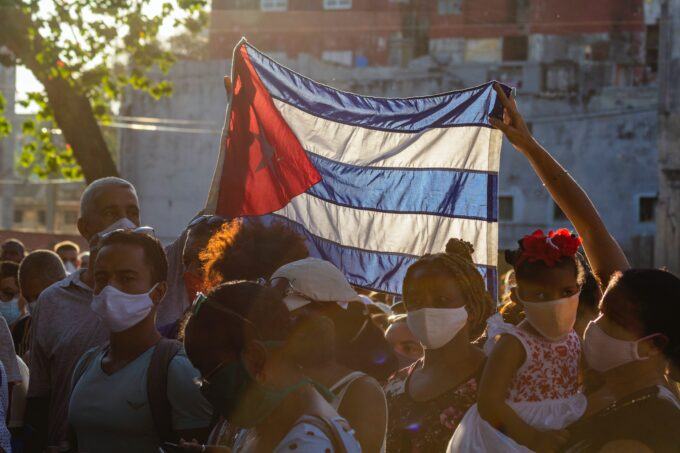
Crisis in Cuba Requires End of US Blockade Now

Tom Whitney


Image by Ricardo IV Tamayo.

Friends of socialist Cuba like good news about that country. Now bad news has its use. Grief and hardship currently are such that, clearly, the U.S. economic blockade of Cuba must end at once. The harsh details, appearing below, testify to potential destabilization in Cuba, danger to Cuba’s socialist project, and the nefarious role of the blockade. A major mobilization against the blockade is due. The need for action is obvious.

The blockade, a 60-year-old relic of history, places few heavy demands on the U.S. public. No governmental funding is required. The Treasury Department issues fines and presidents make ritualistic declarations. People dodge travel restrictions. It’s a slow-motion affair. Distracted pro-Cuba activists may lose track of harassment details. Here they get a refresher course, for motivation toward action. It emphasizes blockade effects on people’s lives.

In the Beginning

Cuba’s vulnerability is the result mainly of U.S. policies directed at “denying money and supplies to Cuba … to bring about hunger, desperation, and overthrow of government.” The words are those of a State Department memorandum of April 6, 1960.

The flow of money to Cuba – international loans and export income –has long been feeble. International banks, financial institutions, and corporations handling dollars on Cuba’s behalf risk big U.S. Treasury Department fines. U.S. legislation blocks Cuba from importing the products of multi-national companies with branches in the United States – even food and medical supplies. For almost 30 years third-country ships docking in Cuba have been prohibited from entering a U.S. port for the following six months. Since 2019 the U.S. government has sanctioned Venezuelan ships carrying oil to Cuba.

The U.S. government harasses Cuba’s tourism industry, the source of most of Cuba’s foreign currency. Restrictions, variably regulated, operate against U.S citizens’ travel to the island. Why? They would spend money there. To discourage potential investors, U.S. legislation enables the heirs of properties nationalized in Cuba to take legal action in U.S. courts against investors who make use of such properties.

Cuba’s commerce with the United States has been nil for 60 years, except for heavily regulated Cuban agricultural exports. The northern neighbor used to be and still could be Cuba’s most convenient trading partner.

People are hurting

The U.S. blockade constitutes the main impediment to Cuba’s industrial production and overall economic development. Soviet Bloc nations formerly provided relief. Since then, strictures placed on imports have caused shortages of raw materials, replacement parts, consumer goods, new tools and machines, and reagents for drug and vaccine manufacture.

The blockade recently has complicated lives already beleaguered by the Covid-19 pandemic and an 11 percent economic recession resulting from the pandemic.

An Associated Press report of June 22 highlights a lack of new housing and impediments to repairing houses. In 2019, 44,000 homes were built, in 2000, 32,000 homes, and in 2021,18,000. Building materials are in short supply. Hurricanes and the pandemic aggravated the situation.

Elderly Cubans experienced isolation and lack of supplies during the pandemic. For two years they’ve experienced weakened cultural and support services and reduced housing options. Fuel shortages in late 2021 led to fewer bus-runs in Havana. Wait-times were even longer. Pharmacies in 2020 had available only 35 percent of their normal stock.

In recent times, infant death rates in Cuba matched the favorable rates of well-resourced countries, and were lower than U.S. rates. Astoundingly, Cuba’s infant mortality rate in 2021 was 7.6 infant deaths per 1000 births, up from 4.9 in 2000 and 5.0 in 2019. Cuba’s 2021 rate of mothers dying from pregnancy and childbirth difficulties was 176.6 – out of 100,000 mothers giving birth – up from 40.0 mothers in 2000 and 37.4 in 2019.

The increases stem from Covid-19 infection mortality added to deaths in non-Covid times. Experts say the deaths of children and mothers can reflect social factors – mothers’ low educational levels, reduced access to healthcare and other services, and poor nutrition. Therefore, the U.S. blockade, which does affect social well-being, may have taken a toll in this area too.

Cuba’s food supply is unstable what with reduced food production, inefficient distribution, marketing based on income levels, and quality variations. At an annual cost of $2 billion, Cuba’s government still must import 60-70 percent of the food consumed in Cuba.

Production levels remain low despite reforms introduced after 2008, among them: land distribution, allowances for farmers’ permanent use of land, marketing reforms, governmental assistance to individual farmers and agricultural cooperatives, new distribution systems, local decision-making on assistance and policies, and ecologically sustainable methods.

The U.S. economic blockade is not responsible for soil deficiencies, officials’ inaction, drought conditions, overgrowth of invasive plants, and the appeal of urban life for rural youth. Blockade effects do show up in farmers’ reduced access to credit and lack of funds for fertilizer, seeds, breeding stock, spare parts, new equipment, and fuel.

Inflation holds sway in Cuba now. Prices, rising for two years, are up now by 70 percent and more. Access to essential goods is impaired. Frustration at high prices and shortages helped trigger island-wide protests on July 11, 2021 and has contributed to record emigration.

The U.S. blockade set the stage for inflation. After losing its commercial partnership with the Soviet Bloc, which disappeared in 1991, Cuba was in trouble. The blockade blocked access to international loans and interfered with income derived from exports, the latter effect stemming from export restrictions. Consequently, funds have been short for importing essential products and for developing the economy.

Cuba desperately needed foreign currency and therefore brought tourists to the island to spend money that would end up with the government. From 1993 on, their money was captured via a new currency called the Cuban convertible peso (CUC). Tourists surrendered their own currencies in exchange for the CUCs.

Cubans, not all of them, acquired CUCs and were able to buy goods and dollars unavailable to Cubans without CUCs. Inequalities emerged. Responding, the government gradually withdrew CUCs from circulation, beginning in January 2021. Anticipating hardships, it raised salaries and pensions payable in Cuba’s “national peso.”

New money in circulation stimulates inflation, especially when goods for sale are in short supply, as in Cuba. The national currency lost value. Tourists, excluded during the pandemic, returned in late 2021. Their money, circulating, added to inflationary pressures. CUCs with a prominent role in Cuba’s informal economy, and still circulating, did likewise. The role of CUCs suggests the blockade’s indirect contribution to inflation.

Persevering

Those defenders of Cuba worried about diminished Cuban-government commitment to bettering people’s lives may need reassurance. Of note:

* Cuban president Miguel Díaz-Canel Bermúdez on June 21 addressed a meeting which elevated the role of social work. Discussion centered on mothers living in cities in “situations of vulnerability.”

* Support programs are in place for elderly Cubans experiencing isolation, for example, the “Accompany Me (Acompáñame) project of telephone assistance and the National Program for Comprehensive Attention to Elders.

* As of 2021, 423 so-called Projects of Local Development promoted food production, small workplaces, and tourism along with socio-cultural, environmental, and research programs.

* The government promotes its program known as “micro, small, and medium [size] businesses.” These mostly privately owned enterprises, numbering 1,188 last year, produce food products, building materials, furniture, textile products, footwear, cleaning supplies, computer accessories, recycling serves, and more.

* The government in April 2021 approved 43 measures directed at increased agricultural production and food availability. Results are far from ideal, an observer notes.

* Prime Minister Manuel Marrero Cruz, on June 24 visited a district in Cardenas to assess progress toward “improvements of roads, water supply, housing construction and social work.”

What to do

Resistance to the U.S. blockade within the United States has been constant for decades, but to no avail. Thanks to the Helms-Burton Law of 1996, the hurdle now is forcing the Congress to act. For that to happen, masses of people must stand up together and weigh in.

But that won’t happen, it seems, as long as activists continue to view the blockade as an isolated issue. What’s needed is collective action on many issues toward changing the direction of the U.S. government itself. The common ground would be justice and decent lives for all people everywhere, Cubans among them.

Also required would be new understanding that U.S. assault on Cuba happens as part of the larger U.S. project of capitalism worldwide and imperialist domination. The big mobilization to end the blockade would be part of a larger mission to take apart that U.S. project. Oppressed and plundered nations would be rescued, Cuba among them.

One adjustment: U.S. progressives ought to reject that old dictum that “Politics stops at the water’s edge.” It sends the message that solidarity with and struggle for oppressed peoples overseas doesn’t matter. That’s not so.

By no means will these suggestions bear fruit in time to end the blockade soon. Hope and struggle will remain. U.S. public opinion favors ending the blockade. People in the United States now fighting the blockade are experienced and want to enlarge the movement. Maybe chaos attending capitalism’s failures, new wars, and international divisions will distract the U.S. government from bothering with Cuba. Maybe international solidarity with Cuba will continue growing. Revolutionary Cuba, with unity and effective leadership, is known for overcoming challenges.

China’s Surveillance State and its Meaning for Us

Mel Gurtov


The Tools of Surveillance

In a recent commentary, I discussed the visit to China of the UN’s chief human rights official on what proved to be a seriously misguided and rather naïve attempt to improve the conditions of the Uyghur population in Xinjiang province. An important element in that mass internment of innocent civilians is China’s ubiquitous surveillance system, which has facilitated the roundup of Chinese Muslims.

That system is not confined to the Uyghurs. It is a many-layered nationwide network designed to collect personal data for police and security units on every Chinese citizen whose behavior or personal characteristics might be troublesome to the authorities. In a word, no one is above suspicion.

Now, a New York Times investigative group has acquired over a “hundred thousand [Chinese] government bidding documents. They call for companies to bid on the contracts to provide surveillance technology, and include product requirements and budget size, and sometimes describe at length the strategic thinking behind the purchases.”

The documents make perfectly clear why China is often called the “surveillance state”: Its facial recognition technology, DNA analysis, and other tools that intrude into people’s identity go far beyond anything other countries use–or George Orwell imagined.

We already knew some dimensions of the Chinese surveillance system before the Times report. For instance, various sources told of Chinese hackers embedding malware in smartphones to track Uyghurs’ movements and conversations, even when they left China.

China’s ministry of public security announced plans to obtain the DNA via blood samples of tens of millions of male adults and children, with Xinjiang and Tibet the starting point for creating a data base to cover virtually the entire population.

Cameras with facial recognition capability are literally everywhere. Western publications on genetics abetted Chinese efforts to identify Uyghurs (as well as Tibetans) by carrying many articles that “had a co-author from the Chinese police, the military, the judiciary or some such government institution,” according to a Belgian geneticist.

The Times report based on contract bidding adds a good deal to this picture. Facial recognition cameras are now installed in private as well as public places. They are capable of collecting voice and iris prints, and race and gender information for inclusion in an ever-expanding data base. Phone tracking not only gives a person’s location but also usernames and certain activities, such as social connections and personal habits.

What do the Chinese authorities have to say about criticisms of the surveillance state?

On one hand, they defend it by insisting it’s necessary to protect against terrorism and crime. There are no abuses of human rights in Xinjiang, only “reeducation” to bring its ethnic majority into the modern age.

On the other hand, the authorities say the criticisms are based on “misinformation and disinformation,” leading to sanctions on Xinjiang products that seek to “contain China’s growth,” disrupt “the international trade order and destabilize global industrial and supply chains.”

As the UN’s recent mission found out, it is impossible to conduct an impartial on-the-spot investigation of either China’s defense or the inhumane punishments it is carrying out.

One action the international community can take is to name and shame the perpetrators of genocide in Xinjiang and Beijing.

Governments can also intercede with technological firms that enable the Chinese to collect and upgrade their surveillance.

Banning the import of products of forced labor, as the US has now done with all Xinjiang-based exports, is another step.

To date, these steps have had limited success, demonstrating anew the difficulties in defending human rights when the means of repression are a matter of global commerce.

It Can Happen Here

Think that the Chinese surveillance state is of no consequence for us?  Intrusive technologies imbedded in social media are already part of our daily lives, monitoring our movement, personal tastes, social views, and even future plans.

Closed-circuit cameras track ordinary citizens and criminals alike. Now, consider how the Supreme Court’s Roe v. Wade decision might deepen the surveillance state here.  If, for example, women must cross state lines, in violation of local law, to obtain an abortion or pills to induce abortion, will they be subject to official tracking for prosecution? Might every pregnant woman in a red state be forced to install a tracking device on her phone? Might anti-abortion states be able to access apps some women use to track their menstrual cycles, nabbing those women believed to be in the early stages of pregnancy?

Police already access email and text messages in cases where a woman is thought to have ended a pregnancy under questionable circumstances. The door will now be open in some states to bringing criminal charges based on cell phone data for an abortion in the first weeks of pregnancy.

I’m inclined to say that in states where abortion is outlawed—and, even worse, if the Supreme Court makes abortions illegal nationwide—the tools of a police state will be endorsed as necessary for full implementation of the law, just as in China.

The Chinese already use apps in cell phones to monitor and quarantine citizens who show signs of COVID. As Xi Jinping said, “Big data should be used as an engine to power the innovative development of public security work and a new growth point for nurturing combat capabilities.” You can bet that some American politicians believe the same, and have particular targets in mind—for starters, racial minorities, human rights protesters, and investigative journalists.

In China, ordinary people have no recourse if the surveillance system catches them. The days of private lawyers occasionally able to defend people in court are numbered. The police are all-powerful; few safeguards of privacy exist. Xi Jinping has provided a model of high-tech authoritarianism that can exist side by side with consistent economic growth.

We should beware.

Pandemic is driving poverty in Germany to new highs

Elisabeth Zimmermann


The poverty rate in Germany reached a new high of 16.6 percent of the population in 2021. According to the Poverty Report 2022 of the Paritätischer Gesamtverband charity association, entitled “Between Pandemic and Inflation,” 13.8 million people lived in poverty, 600,000 more than before the pandemic began.

Bottle deposit collector, a common sight in Germany (Bild: Sascha Kohlmann / CC BY-SA 2.0)

The poverty threshold was regarded as a monthly income of €1,148 for a single household, €1,492 for a single parent with one child, and €2,410 for a couple household with two small children. Since the report covers 2021 it does not consider the impact of the dramatic increase in inflation since the beginning of the year.

Since 2006, the trend in the annual poverty reports has been upward. Ulrich Schneider, Chief Executive of the Paritätischer Gesamtverband, said at the presentation of the report, “The current poverty record is the peak of a trend that has had Germany firmly in its grip for 15 years now. This trend began in 2006. Since then, the poverty rate has risen from 14 to 16.6 percent, despite all the economic successes of this country. The number of poor people increased by more than 2 million in those 15 years—from 11.5 to 13.8 million.”

This trend accelerated in the two pandemic years of 2020 and 2021. The poverty rate climbed from 15.9 to 16.6 percent. “This is the steepest increase in two years ever measured by the micro census,” as Schneider explained. “Never before in recent times has poverty spread so rapidly in Germany as during the pandemic. The increase is unprecedented.”

In 2021, in particular, the economic effects of the pandemic fully impacted on poverty trends. In 2020, poverty had risen from 15.9 to 16.1 percent.

What is striking, is the sharp increase in poverty among the employed and especially among the self-employed. Among the latter, the poverty rate increased by 46 percent, rising from 9 to 13.1 percent. Numerous other reports also confirm that many self-employed people suffered financial losses during the pandemic.

But poverty among those with an employment contract—people who are poor despite working—also rose unusually sharply during the pandemic, from 7.9 to 8.4 percent. The key factors here were income losses due to short-time working and the fact that employees on low wages were hit hardest by pandemic-related income losses.

This was compounded by the rapid increase in part-time working. “It can be surmised that pandemic-related reductions in working hours, with corresponding wage losses, also played a role here,” the presentation says.

Poverty among pensioners and among children and youth also reached new highs in 2021, at 17.9 and 20.8 percent, respectively. More than one in five children and youth grew up in poverty in 2021.

“It is a record for old-age poverty and a new record for child poverty that is reflected in the statistics. Never before have higher values been measured in the micro census. Child poverty is reflected here—as in previous years—primarily in the poverty rate of single parents, at over 40 percent, and of those with many children, at over 30 percent,” the report reads.

The economically inactive and those with a low educational level are also disproportionately affected by poverty. The same is true for people with a migration background (28.1 percent) and without German citizenship (35.3 percent). The poverty rate among students is 30 percent.

The poverty trend also varies regionally. Bavaria and Baden-Württemberg have the lowest poverty rates at 12.6 and 13.9 percent, respectively, while North Rhine-Westphalia (18.7), Thuringia (18.9), Saxony-Anhalt (19.5) and Berlin (19.6) are well above average, with Bremen leading the way at 28 percent.

As in an earlier report, the Ruhr, which has seen massive deindustrialisation, is the top problem region in terms of poverty. In Germany’s largest conurbation with 5.8 million inhabitants, more than one in five (1.2 million) live in poverty. With a poverty rate of 21.1 percent, if the Ruhr were a state, it would rank second to last, ahead of Bremen.

The high poverty rate in the Ruhr is accompanied by a disproportionate number of Hartz IV (welfare) recipients. While the Hartz IV rate was 8.1 percent nationwide in 2021, it was 14.4 percent in the Ruhr, over 18 percent in its cities such as Duisburg, Essen, Herne, reaching 24.4 percent in Gelsenkirchen.

The figures for children and young people are even more dramatic: 22.9 percent of minors in the Ruhr were in families receiving Hartz IV benefits in 2021. The figure was as high as 30 percent in Essen and 39 percent in Gelsenkirchen.

The situation is similarly drastic in other major cities. Berlin, for example, has been known for many years as the capital of poverty.

The statement on the poverty report concludes, “Poverty has increased by leaps and bounds in the pandemic years. Never have we had more poverty since unification [in 1990], never has Germany been more divided.”

This hardly takes into account the rising cost of living since autumn 2021. With an inflation rate of 7.9 percent in May, a Hartz IV or basic old-age welfare payment rate of €449, compared to the previous year, had a purchasing power of just €414. “People who have to live on basic welfare payments—and that is around seven million people—do not know how they will make ends meet.”

About seven million people must live on basic welfare. In addition, there are at least as many again whose incomes are only scarcely above this level because of low wages and incomes. They, too, do not know what they are supposed to live on at the end of the month. And that was the case even before the costs of electricity, heating and food exploded. 1.6 million people are forced to regularly obtain parcels from food banks, which can barely cope with the onslaught of people seeking help.

As Schneider explained, “Our welfare payments quite objectively no longer protect people from poverty.” The extreme rise in the cost of living posed a “very great danger that Germany will simply break up at the lower end of the income scale.”

The Paritätische Gesamtverband criticizes the government’s relief package because it does not decisively fight the increasing poverty. Only 2 of its 29 billion euros flow exclusively to low-income households. This is completely inadequate and will be eaten up by inflation in a very short time. Basic income support recipients, for example, receive a one-time payment of €200, and children whose families must live on Hartz IV are awarded a paltry €20 a month. Even the heating allowances for housing benefit and student grant recipients are not enough.

The report points out that almost half the population has no significant resources in the form of assets and that one in five works in the low-wage sector.

The one-off payments from the government’s relief package are therefore less than a drop in the ocean. Exploding electricity and energy costs are beyond the means of most of the working class and even parts of the middle classes. Current calculations suggest that bills for heating, electricity and gas will double and triple by the end of the year.

In the event of a complete loss of gas supplies from Russia, which the EU and the German government are bringing about with their sanctions against Russia, Mona Neubaur (Greens), the new state Economics and Energy Minister of North Rhine-Westphalia, expects prices for gas to increase sixfold, as she explained in the state parliament on June 30. Gas and energy would then become unaffordable for most people.

Poverty has increased sharply worldwide in the last two years. The culprit is not the pandemic alone, but its exploitation by capitalist governments to carry out an unprecedented redistribution of wealth from the bottom to the top. Except for China, no government has been willing to stop and eliminate the virus with extensive lockdowns and other protective measures while providing adequate compensation for affected workers. Globally, 20 million people have so far had to pay with their lives for the criminal profits-before-lives policies of the ruling class.

At the same time, the central banks cranked up the money presses. Hundreds of billions of euros and dollars have been thrown in the coffers of the corporations and banks, leading to an unprecedented increase in wealth at the top of society and the rise of inflation.

According to the latest Oxfam report, the ten richest individuals in Germany increased their “cumulative wealth from about $144 billion to about $256 billion since the pandemic began.” According to the French consultancy Capgemini, the number of millionaires in Germany grew by about 100,000 to 1.63 million during the pandemic. Many corporations reported record profits despite the pandemic.

The working class in Germany is now expected to pay for the pandemic bailout and war in Ukraine through brutal cutbacks, unemployment, and wage reductions, as well as for the €100 billion euros being spent on arming the Bundeswehr. The billions for pandemic profiteers, armaments and war are to be squeezed out of the working class by means of inflation and wage cuts.