23 Aug 2022

Turkey calls for Ukraine-Russia mediation, signaling deal with Syria

Ulaş Ateşçi


As NATO escalates its war on Russia in Ukraine, Turkish President Recep Tayyip Erdoğan met Ukrainian President Volodymyr Zelensky and UN Secretary-General Antonio Guterres in the western Ukrainian city of Lvov Thursday.

Ukrainian President Volodymyr Zelenskyy, center, Turkish President Recep Tayyip Erdogan, left, and United Nations Secretary General Antonio Guterres shake hands after their meeting in Lviv, Ukraine, Thursday, Aug. 18, 2022. [AP Photo/Evgeniy Maloletka]

During the summit, held nearly two weeks after an August 5 meeting with Russian President Vladimir Putin in Sochi, Erdoğan reportedly discussed diplomatic initiatives to end the war, exchange prisoners of war, continue grain ship deliveries from Ukraine, and arrange a visit to the Zaporizhzhia nuclear facility by International Atomic Energy Agency officials.

Erdoğan said, “The main topic of our meeting was of course the war, which has been going on for nearly six months.” He also reiterated his government’s support for “Ukraine’s territorial integrity and sovereignty.”

Regarding Europe’s largest nuclear power plant, currently seized by Russia, Erdoğan said: “We also voiced our concerns regarding the conflicts taking place around Zaporizhzhia Nuclear Power Plant. We don’t want to experience another Chernobyl.”

“The area needs to be demilitarized, and we must tell it as it is: Any potential damage in Zaporizhzhia is suicide,” Guterres said at a news conference. On Friday, Putin and French President Emmanuel Macron agreed to arrange a mission by officials of the International Atomic Energy Agency to visit the plant.

In a Telegram post, Zelensky said:“We agreed to continue the coordination of the grain initiative implementation.” Four more ships left Ukrainian ports under the July 22 Istanbul grain export deal between Russia and Ukraine, brokered by Turkey and the United Nations, the Turkish Defense Ministry said on Sunday.

Repeating his call for a meeting of Ukrainian and Russian leaders in Turkey, Erdoğan said that ending the war was the focus of the trilateral meeting in Lvov. He hailed the Istanbul deal in July as “exemplary work of historic importance.”

Although Erdoğan called for a “diplomatic solution,” he emphasized Ankara’s support for Ukraine in the conflict: “As Turkey, we exert efforts for the termination of the conflicts by diplomatic means, while also continuing to stand by our Ukrainian friends.”

Ankara has condemned the Russian invasion and has armed Ukraine with Bayraktar drones. However, Turkey has not joined tough US and EU sanctions against Moscow and has significantly increased its trade with Russia since the war began. This has raised concerns in Western capitals that Russia is using Turkey to evade their sanctions.

In an article titled “Surge in Turkish exports to Russia raises western fears of closer ties,” the Financial Times(FT) wrote: “Turkey’s exports to Russia grew 46 per cent by value over the past three months compared with the same period last year as Ankara allowed its companies to step into the gap created by an exodus of western businesses.”

Citing two European Union officials, it said, “EU member states are becoming increasingly uneasy about Turkey’s booming trade with Russia and the potential for it to assist Moscow as a substitute for other European imports and exports.” One official told the FT: “It’s on our radar. … It’s not nice and is not being perceived well by the EU. It’s an irritant.”

Fearing potentially devastating consequences of an escalation of the NATO war against Russia, with which it has strong commercial and military ties, including on energy, Ankara also faces a deepening economic crisis at home and growing working class opposition. With elections slated for next year, the Erdoğan government’s polls are in steep decline. It believes that improved trade with Russia and potential financial aid from Moscow will help contain this domestic crisis.

In Lvov, Erdoğan declared: “Personally, I remain convinced that the war will eventually end at the negotiating table. Mr. Zelensky and Mr. Guterres are actually of the same opinion on this issue. … I believe that it is possible to revive the negotiations based on the parameters that emerged in March in Istanbul. We stand ready to provide every kind of support in this regard and to play once again a facilitating or mediating role.”

Washington and its European NATO allies do not want the war to end before Russia is brought to its knees, however. In April, Turkish Foreign Minister Mevlüt Çavuşoğlu pointed to Ankara’s deepening rift with its NATO allies, declaring: “Until the NATO meeting, we thought the war would not last long. However, after the NATO meeting, an opinion emerged. There are countries that want this war to continue. They want Russia to be weakened, to fall back and perhaps to bring down Putin.”

Conflicts are mounting behind the scenes. Ankara eventually lifted the objections it had to Finland and Sweden joining NATO in order to fight Russia, denouncing Finnish and Swedish support for Kurdish-nationalist groups. On Saturday, however, Turkish Justice Minister Bekir Bozdağ said Sweden and Finland could not join NATO unless they extradite “members of terrorist organizations” to Turkey.

Ankara’s overtures to Russian-backed Syrian President Bashar al-Assad, whom it has been trying to oust since 2011, risks sparking new conflicts with Turkey’s NATO allies. After Erdoğan’s meeting with Putin in Sochi, Çavuşoğlu said he had met Syrian Foreign Minister Faisal Mekdad “on the hoof” last October in Brussels. He called for “political reconciliation” between Damascus and the so-called Syrian “opposition” as the only way out. He also said that the Kremlin wants to arrange an Assad-Erdoğan meeting.

“We have no eyes on Syria’s territory. … We have no interest in defeating or not defeating Assad,” Erdoğan said on his return from Lvov.

In reality, since 2016, Turkey has launched multiple military operations against US-backed, Kurdish-nationalist People’s Protection Units (YPG) in northern Syria, occupying much of the region to keep the YPG from building a separate Kurdish state. Turkey, along with its Syrian Islamist proxies, has created administrative units and opened universities under Ankara’s control in areas of Syria it controls.

Since May, Erdoğan has threatened new offensives against the YPG to create a 30-kilometer-deep zone along the Syrian border, where Ankara could resettle 1 million Syrian refugees. Erdoğan declared, “It is the US and the coalition forces that are the primary breeders of terrorism in Syria,” referring to YPG militias that Ankara considers terrorist organizations. He recently demanded the withdrawal of US forces in Syria, a demand supported by Russia amid the NATO war in Ukraine.

Before declaring Turkey’s “solidarity” with Russia in Syria, he said, “In every step we are taking in Syria right now, we are in contact with Russia through our security forces, our intelligence and our Defense Ministry.”

The Homeland Party, a pro-China, nationalist ally of Erdoğan, announced that a party delegation will “visit Damascus in 10-15 days” for “talks at the highest level.” In a party statement, it declared: “Under these circumstances, Turkey’s cooperation with Syria was of historic importance. [Çavuşoğlu’s] statements are very correct. We congratulate them.”

Ankara reportedly wants Damascus to support the end of the de facto YPG-controlled administration in northeastern Syria and the return of refugees to Syria. Damascus, on the other hand, is demanding to get back parts of its territory now controlled by Turkey and its Islamist proxies.

Erdoğan’s claim to be a “pacifist” working for “world peace” is a hypocritical lie. A key backer of the US-NATO war for regime change in Syria since 2011, Ankara nearly provoked a NATO war with Russia by shooting down a Russian warplane on its southern border in November 2015.

Spanish-Russian journalist Pablo Gonzalez held six months in Polish jail on bogus spying charge

Santiago Guillen & Alejandro López


Spanish journalist Pablo González has languished six months in preventive detention in Poland on fraudulent accusations of spying for Russia. His arrest was coordinated between NATO states, including Spain’s Socialist Party (PSOE)-Podemos government, and has met with silence by European and US media.

Pablo Gonzalez [Photo by #FreePabloGonzález]

The journalist was arrested by Poland’s Internal Security Agency (ABW) on February 28 after the Russian invasion of Ukraine, as he covered the refugee crisis in the Polish town of Rzeszow. He is accused of working for Russian military intelligence (GRU). No evidence has been presented that González handed any information to the Russian secret services, however, or even that he ever had any intention to do so. However, the Polish Prosecutor’s Office asked to prolong his detention last Friday; this will be examined by the regional court of Przemysl today.

Polish authorities’ spurious evidence includes that González was in possession of two passports bearing different names, one Russian and one Spanish—implying that one was a false identity used for espionage. González’s Russian passport names him as Pavel Rubtsov, using his father’s surname; his Spanish document identifies him as Pablo González Yagüe, using his mother’s two surnames. Pablo is the Hispanicised version of the Russian name Pavel.

González is the grandson of one of the “war children”—children transferred to the USSR for safety during the Spanish Civil War (1936-1939) that followed Francisco Franco’s fascist coup in 1936. He has dual Russian and Spanish nationality and his father, whom he visits regularly, lives in Moscow. He has worked for different Spanish media such as the La Sexta television network or the liberal newspapers Público and Gara.

His work for these newspapers, his ability to speak Russian, and his credit card from Caja Laboral (“Workers Fund”), a Basque credit union, were cited as evidence of alleged “pro-Russian” views.

The WSWS reiterates its demand that González should be immediately released. The arrest of a journalist on baseless spying charges is an anti-democratic attack on freedom of information and freedom of speech. It is a reactionary measure aiming to intimidate journalists and silence opposition to official, state-sanctioned narratives on the imperialist proxy war in Ukraine instigated by Washington and its NATO allies.

It comes amid an imperialist campaign to censor Russian media like RT and Sputnik, including cancelling them from social media like Twitter, Facebook, Tik Tok, YouTube and Google News; and seeking to block Russian artists and musicians from appearing internationally.

González is effectively being held incommunicado. Since he spoke to his wife on the day of his arrest, he has not been able to communicate again with her and their three children, or with his Spanish lawyer, Gonzalo Boye. Boye still does not have access to his detention file.

In his first appearance before the judge, he was not allowed to receive the assistance of any lawyer, contrary to international law. Only in the past two months has he been represented by a Polish lawyer who has been prohibited from talking about González’s legal situation, and who has not yet contacted Boye. In May, Polish authorities extended his detention for another three months without further explanation.

The persecution of González has all the hallmarks of a coordinated campaign by US-led NATO governments to make him an example against other voices opposing NATO’s war in Ukraine. The ruling elites in Poland, Ukraine and Spain itself have all been involved in his detention.

In early February, he was detained in Kiev, after receiving a phone call from the infamous Ukrainian security services (SBU) which are key to Ukraine’s war effort and its campaign of domestic repression, including killing Ukrainian diplomats seeking to negotiate peace with Russia.

González was summoned to the capital, Kiev, for questioning. There, he was questioned by the SBU for allegedly being “pro-Russian.” He was then“ invited” to leave the country in three days, though no formal expulsion order was issued.

González returned to the Basque Country, in Spain, where he is based. Then on February 25, the day after Russia invaded Ukraine, González travelled to the Polish town of Rzeszow, on the border with Ukraine, to report on the refugee crisis. Shortly after González’s interrogation by the SBU, the Spanish National Intelligence Centre (CNI) visited the homes of his family members in the Basque Country and Catalonia, reportedly questioning them about González’s life and views, to establish if he was “pro-Russian.”

According to Público, the security agents also told González’s relatives that he was accused of having worked for Gara, described as “a pro-ETA media subsidised by Russia,” and even of “passing information on to Russia.”

In a blatant attempt at intimidation, numerous agents went to Pablo González’s own home, where he lives with his wife Oihana Goiriena, and their three children.

In a clear sign that González’s arrest is part of a broader NATO campaign against anti-war sentiment, the head of British secret services MI6, Richard Moore, defended expulsions and arrests of alleged Russian spies from Europe. He said such measures have allowed the Russian invasion of Ukraine to “run out of steam.”

In a speech at the Aspen Security Forum in the United States, Moore said: “Two of them [Russian spies] have recently been arrested. One of them pretends to be a Spanish journalist, a guy named González Yagüe. He was trying to enter Ukraine to be part of Russian efforts at destabilization.” Moore stated this without providing any evidence.

The PSOE-Podemos government has played a key role in his arrest. At the end of July, during an official visit to Poland, Prime Minister Pedro Sánchez stated that the arrest of González was discussed with Prime Minister Mateusz Morawiecki, but refused to provide any specific content on the conversation. Sánchez also boasted that the Spanish Foreign Minister is in contact with his Polish counterpart to “follow up on the issue” and “provide support to the Spanish family.”

According to González's wife, however, that support has been minimal and has only taken the form of “three visits from the consul, and advice on how to send him letters, how to send him packages, how to make transfers if necessary, and for now, little else.”

Even more cynical is the role of Podemos. Having made perfunctory calls for González’s freedom four months ago in one of its regional branches in Navarre, it has dropped the issue.

Podemos has helped implement Spain’s war efforts against Russia. This includes stationing 800 troops, four Eurofighters and three warships in Eastern Europe; sending tanks, rocket launches and other offensive equipment to the Ukrainian army, including the neo-Nazi Azov Battalion; implementing the EU-NATO’s crippling sanctions against Russia; and raising the defence budget by €10 billion to €25 billion, the largest military expenditure hike in Spain’s history.

At the same time, Podemos is working to escalate domestic repression against journalists in Spain, as well. The PSOE-Podemos government plans to reform Spain’s Official Secrets Law, enacted in 1968 under the dictatorship of General Franco, which included clauses to persecute whistle-blowers. Those accused of publishing classified material face fines of up to €3 million.

Interest rate hikes and inflation deepen crisis for advanced and less developed economies alike

Nick Beams


The increasingly worsening economic and financial situation confronting so-called emerging market and developing economies has been highlighted by the decision last week by Ghana’s central bank to carry out the biggest interest rate hike in 20 years.

Bank of Ghana in Accra (Image: Bank of Ghana)

In an emergency meeting, the central bank lifted its base interest rate by 300 basis points (3 percentage points) to 22 percent, citing “strong underlying inflationary pressures.” The central bank’s base rate has risen by 850 basis points from November of last year when it was 13.5 percent, a level which had been maintained since 2015.

Inflation in Ghana rose in July for the 11th consecutive month and is now running at an annual rate of 31.7 percent, its highest level in almost 20 years. Food inflation is at 32.3 percent, with the largest drivers of price hikes being transport, housing and fuel costs.

Ghana’s currency, the cedi, has lost 25 percent of its value over the past year, and is the world’s second worst performing currency after the Sri Lankan rupee. Like Sri Lanka, the government of President Nana-Akafu Addo and his ruling New Patriotic party is holding discussions with the International Monetary Fund on a $3 billion loan after earlier resisting such a move.

As in Sri Lanka, any bailout will be accompanied by major attacks on the social conditions, wages and jobs of the working class. As the negotiations begin, the central bank’s decision, which will do nothing to bring down inflation, is seen as a “reassurance” by the government and financial authorities that they will carry out the IMF’s dictates.

The world’s three major credit rating agencies have already downgraded Ghana’s government bonds to junk status.

The worsening situation in Ghana is being replicated across the continent and around the world. The Nigerian inflation rate has hit a high of almost 20 percent—the highest in 17 years—as food, transport and energy costs rise rapidly.

In South Africa, the continent’s largest economy, the value of the currency, the rand, fell by 5 percent last week and the yield on 30-year government bonds has climbed to more than 10 percent, as financial and economic conditions worsen. The South African central bank raised its interest rate by 75 basis points last month, a move that was followed in neighbouring Namibia in the biggest hike for 20 years.

The US Federal Reserve has made clear that, if necessary, it will induce recession, following in the footsteps of Fed chief Paul Volcker in the 1980s who lifted rates to record highs.

The “Volcker shock” produced economic devastation in the US and internationally, particularly in Latin America which experienced a “lost decade” in the 1980s.

The US hikes have lifted the value of the dollar, pushing up inflation for basic commodities priced in the US currency and increasing the payments which must be made on dollar-denominated foreign debt.

The interest rate surge is leading to a withdrawal of money from emerging markets, further exacerbating financial problems.

The Institute of International Finance has estimated that last month the outflows from emerging markets stocks and bonds hit a record of $10.5 billion. The combined outflow for the five months to July was $38 billion in the longest period of outflows since records began in 2005.

The damage being inflicted by spiraling inflation—one of the outcomes of the US-led NATO proxy war against Russia in Ukraine—and the rapid rise in interest rates comes on top of the devastation produced by the “let it rip” response to the COVID-19 pandemic.

Between 2019 and 2021, the pandemic led to a sharp rise in public debt in developing economies from an average of 54 percent of gross domestic product to 65 percent.

The outcome is that 38 emerging economies are reported to be on the verge of a debt crisis or already experiencing one. Some 25 of these countries are now spending more than 20 percent of government income just to service foreign public debt. This means a drive against the conditions of the working people as governments cut already inadequate spending on social facilities to meet the demands of the vultures of international finance capital.

The crisis in Asia is not confined to Sri Lanka. The Philippine peso has fallen by 5 percent this year, the Pakistan rupee is down by 20 percent and the Thai baht has dropped by more than 6 percent. Pakistan and Bangladesh are both seeking money from the IMF.

Despite the speculation on Wall Street that the Fed will start to ease up on its interest rate hikes, there is little evidence of this. The Fed is expected to lift its base rate by at least 50 basis points at its next meeting in September with some members of its interest-setting body favouring a third consecutive rise of 75 basis points.

Other central banks in major economies are continuing to lift rates. Last week the Norwegian bank lifted its rate by 50 basis points for the second time this year and indicated that a further rise of the same size can be expected next month.

The bank’s governor, echoing the mantra of major central banks internationally, said a “markedly higher policy rate is needed to ease the pressures in the Norwegian economy and to bring inflation down towards the target.”

Confronted with a growing strike movement of the working class as a result of an official inflation of more than 10 percent and its prediction that it will be 13 percent by the end of the year—higher in basic necessities—the Bank of England (BoE) has made it clear it will continue its rate rises. The central bank’s inflation forecast is at the lower end of estimates with a report from Citigroup predicting that inflation will reach 18.6 percent next January.

The rises will be carried out even as the BoE has forecast that the UK economy will move into a recession lasting at least five consecutive quarters. In fact, the aim of the interest hikes is to produce such an outcome in order to try to batter the working class into submission.

The European Central Bank (ECB), while a later-comer to the rate hikes, is moving on the same path. After lifting rates by 50 basis points last month, it is set to repeat the increase at its next meeting.

There has been speculation in some quarters that the bank may ease back because of the developing recession in Germany and across the continent. However, ECB executive member Isabel Schnabel pointed to a further rise in an interview with Reuters last week.

“Even if we entered a recession, it’s quite unlikely that inflationary pressures will abate by themselves,” she said, noting that the inflation outlook that led to the July decision had not changed “fundamentally.”

Her outlook was underscored by comments to the Rheinische Post by the head of Germany’s central bank—Bundesbank president Joachim Nagel, who sits on the ECB governing council. He said the surge in energy prices was likely to drive inflation to over 10 percent and it would remain high next year.

“The issue of inflation will not go away in 2023,” he said. “Supply bottlenecks and geopolitical tensions are likely to continue. Meanwhile, Russia has drastically reduced its gas supplies, and natural gas and electricity prices have risen more than expected.”

German electricity prices are seven times higher than a year ago as a result of gas price hikes which have increased ten-fold.

Nagel said with higher inflation, further interest rate hikes had to follow.

He went on to reveal what is a linchpin in the strategy of all capitalist governments and financial authorities—the role of the trade unions in imposing the costs of the ongoing breakdown of the global capitalist economy onto the backs of the working class in developed and less developed countries alike.

Nagel said that to this point there were few signs of a wages push, as had taken place in the 1970s, because the trade unions had “acted very responsibly over the past 25 years—and will do the same this time—I’m confident of that.”

22 Aug 2022

Gender-Based Violence in the Pandemic

Cesar Chelala


Image by Mika Baumeister.

One consequence of the ever-evolving COVID-19 pandemic is increasing levels of violence against women of all ages. Gender-based violence (GBV) is a global pandemic that affects the lives of one in three women. GBV may take many forms, including domestic violence, sexual violence and trafficking, and psychological and emotional violence. In many countries, forced child marriages and honor killings are part of this spectrum of violence.

Because of its physical and mental consequences, GBV is an additional public health concern of the coronavirus pandemic. Among the physical consequences are body injuries, gastrointestinal problems, sleeping and eating disorders, chronic pain, sexually transmitted infections (STIs), and miscarriage and unwanted pregnancies. Psychological consequences include depression, lowered self-esteem, suicidal thoughts, alcohol and drug abuse, and post-traumatic stress disorder.

The global cost of violence against women had been estimated at $1.5 trillion, a figure that is bound to increase as the pandemic progresses. According to the American Journal of Emergency Medicine, the number of domestic violence cases rose by 25-33 percent globally in 2020 compared to 2019. The United Nations group UN Women reports that incidents of domestic violence increased 300 percent in Hubei, China; 25 percent in Argentina; 30 percent in Cyprus; and 50 percent in Brazil.

A distinction is made among GBV, domestic violence (DV) and violence against women and girls (VAWG.) GBV is the most inclusive term, and refers to any type of violence directed at an individual based on their gender. According to the United Nations, “It is rooted in gender inequality, the abuse of power and harmful norms.” Although the majority of the victims are women, men and gender-non-conforming individuals also experience this kind of violence.

Domestic violence (DV) is the most common type of gender-based violence. It includes Intimate partner violence (IPV), which occurs between two individuals in an intimate relationship, and it can manifest as sexual, physical, emotional and psychological violence. Although women are the vast majority of IPV victims it can also occur among men. DV includes violence against children and grandparents. Violence against Women and Girls (VAWG) is specifically focused on violence directed at women and girls, as in the case of female genital mutilation.

Domestic violence is not, of course, a new phenomenon. Before the pandemic, it is estimated that 243 million women and girls (aged 15-49) worldwide had been victims of sexual or physical violence during the previous 12 months, in most cases perpetrated by an intimate partner. That number significantly increased during the first couple of years of the pandemic when lockdowns were instituted. According to a UN survey concluded in September 2021, nearly 7 in 10 women said domestic violence increased in their community since the start of the pandemic.

Domestic violence is vastly underreported. According to UN estimates, less than 40 percent of women who are physically abused at home seek help. During lockdown periods, victims may be too scared to call the police for fear their abuser can overhear them. UN Women has called violence against women “the shadow pandemic,” and António Guterres, the UN Secretary-General has said, “Peace is not just the absence of war. Many women under lockdown for #COVID19 face violence where they should be safest: in their own homes.”

In addition to direct violence, other forms of abuse include constant surveillance, strict rules of behavior, restrictive or lack of access to financial accounts and limited access to basic items such as food, clothing and sanitary facilities. All this is complicated by the isolation from families and friends. As a result, shelters for abused women and health systems worldwide are now stretched to a breaking point.

The release of inmates from prisons –which have become a hotbed for the spread of the pandemic— worsens the situation. When some inmates are released, they recreate at home the conditions of violence that landed them in prison. That is why victims should be notified about inmate releases, and local governments should implement preventative and support measures when necessary.

At a time of great need governments, NGOs and the private sector should emphasize the gender perspective into their COVID-19 responses to secure the rights of women. Governments should increase public-awareness campaigns, consider the needs of older women and women with disabilities, increase funding for women’s organizations, ensure women’s economic independence, and improve the communication strategies on how to better deal with the pandemic.

The coronavirus pandemic has had serious deleterious effects on women’s rights and well-being. But it is also a chance for change and improvement. As stated by Phumzile Mlambo-Ngcuka, former Executive Director of UN Women, “We must not only survive the coronavirus, but emerge renewed, with women as a powerful force for recovery.”

An Engineered Food and Poverty Crisis to Secure Continued US Dominance

Colin Todhunter


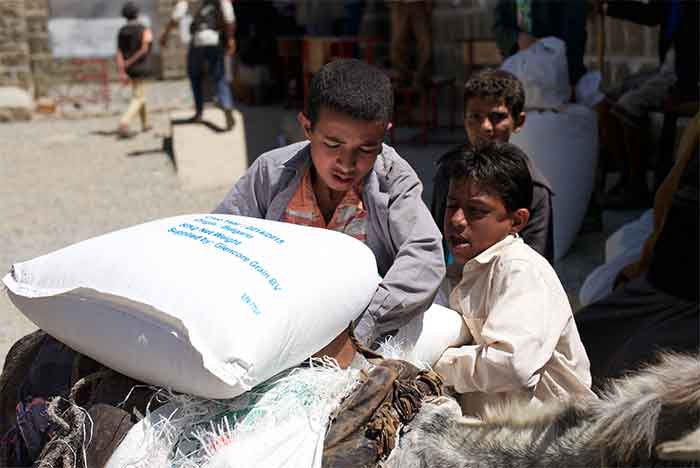
yemen

In March 2022, UN Secretary-General Antonio Guterres warned of a “hurricane of hunger and a meltdown of the global food system” in the wake of the crisis in Ukraine.

Guterres said food, fuel and fertiliser prices were skyrocketing with supply chains being disrupted and added this is hitting the poorest the hardest and planting the seeds for political instability and unrest around the globe.

According to the International Panel of Experts on Sustainable Food Systems, there is currently sufficient food and no risk of global food supply shortages.

We see an abundance of food but skyrocketing prices. The issue is not food shortage but speculation on food commodities and the manipulation of an inherently flawed global food system that serves the interests of corporate agribusiness traders and suppliers of inputs at the expense of people’s needs and genuine food security.

The war in Ukraine is a geopolitical trade and energy conflict. It is largely about the US engaging in a proxy war against Russia and Europe by attempting to separate Europe from Russia and imposing sanctions on Russia to harm Europe and make it further dependent on the US.

Economist Professor Michael Hudson recently stated that ultimately the war is against Europe and Germany. The purpose of the sanctions is to prevent Europe and other allies from increasing their trade and investment with Russia and China.

Neoliberal policies since the 1980s have hollowed out the US economy. With its productive base severely weakened, the only way for the US to maintain hegemony is to undermine China and Russia and weaken Europe.

Hudson says that, beginning a year ago, Biden and the US neocons attempted to block Nord Stream 2 and all (energy) trade with Russia so that the US could monopolise it itself.

Despite the ‘green agenda’ currently being pushed, the US still relies on fossil fuel-based energy to project its power abroad. Even as Russia and China move away from the dollar, the control and pricing of oil and gas (and resulting debt) in dollars remains key to US attempts to retain hegemony.

The US knew beforehand how sanctions on Russia would play out. They would serve to divide the world into two blocks and fuel a new cold war with the US and Europe on one side with China and Russia being the two main countries on the other.

US policy makers knew Europe would be devastated by higher energy and food prices and food importing countries in the Global South would suffer due to rising costs.

It is not the first time the US has engineered a major crisis to maintain global hegemony and a spike in key commodity prices that effectively trap countries into dependency and debt.

In 2009, Andrew Gavin Marshall described how in 1973 – not long after coming off the gold standard – Henry Kissinger was integral to manipulating events in the Middle East (the Arab-Israeli war and the ‘energy crisis’). This served to continue global hegemony for the US, which had virtually bankrupted itself due to its war in Vietnam and had been threatened by the economic rise of Germany and Japan.

Kissinger helped secure huge OPEC oil price rises and thus sufficient profits for Anglo-American oil companies that had over-leveraged themselves in North Sea oil. He also cemented the petrodollar system with the Saudis and subsequently placed African nations, which had embarked on a path of (oil-based) industrialisation, on a treadmill of dependency and debt due to the spike in oil prices.

It is widely believed that the high-priced oil policy was aimed at hurting Europe, Japan and the developing world.

Today, the US is again waging a war on vast swathes of humanity, whose impoverishment is intended to ensure they remain dependent on the US and the financial institutions it uses to create dependency and indebtedness – the World Bank and IMF.

Hundreds of millions will experience (are experiencing) poverty and hunger due to US policy. These people (the ones that the US and Pfizer et al supposedly cared so much about and wanted to get a jab into each of their arms) are regarded with contempt and collateral damage in the great geopolitical game.

Contrary to what many believe, the US has not miscalculated the outcome of the sanctions placed on Russia. Michael Hudson notes energy prices are increasing, benefiting US oil companies and US balance of payments as an energy exporter. Moreover, by sanctioning Russia, the aim is to curtail Russian exports (of wheat and gas used for fertiliser production) and for agricultural commodity prices to therefore increase. This too will also benefit the US as an agricultural exporter.

This is how the US seeks to maintain dominance over other countries.

Current policies are designed to create a food and debt crisis for poorer nations especially. The US can use this debt crisis to force countries to continue privatising and selling off their public assets in order to service the debts to pay for the higher oil and food imports.

This imperialist strategy comes on the back of ‘COVID relief’ loans which have served a similar purpose. In 2021, an Oxfam review of IMF COVID-19 loans showed that 33 African countries were encouraged to pursue austerity policies. The world’s poorest countries are due to pay $43 billion in debt repayments in 2022, which could otherwise cover the costs of their food imports.

Oxfam and Development Finance International have also revealed that 43 out of 55 African Union member states face public expenditure cuts totaling $183 billion over the next five years.

The closure of the world economy in March 2020 (‘lockdown’) served to trigger an unprecedented process of global indebtedness. Conditionalities mean national governments will have to capitulate to the demands of Western financial institutions. These debts are largely dollar-denominated, helping to strengthen the US dollar and US leverage over countries.

The US is creating a new world order and needs to ensure much of the Global South remains in its orbit of influence rather than ending up in the Russian and especially Chinese camp and its belt road initiative for economic prosperity.

Post-COVID, this is what the war in Ukraine, sanctions on Russia and the engineered food and energy crisis are really about.

Back in 2014, Michael Hudson stated that the US has been able to dominate most of the Global South through agriculture and control of the food supply. The World Bank’s geopolitical lending strategy has transformed countries into food deficit areas by convincing them to grow cash crops – plantation export crops – not to feed themselves with their own food crops.

The oil sector and agribusiness have been joined at the hip as part of US geopolitical strategy.

The dominant notion of ‘food security’ promoted by global agribusiness players like Cargill, Archer Daniel Midland, Bunge and Louis Dreyfus and supported by the World Bank is based on the ability of people and nations to purchase food. It has nothing to do with self-sufficiency and everything to do with global markets and supply chains controlled by giant agribusiness players.

Along with oil, the control of global agriculture has been a linchpin of US geopolitical strategy for many decades. The Green Revolution was exported courtesy of oil-rich interests and poorer nations adopted agri-capital’s chemical- and oil-dependent model of agriculture that required loans for inputs and related infrastructure development.

It entailed trapping nations into a globalised food system that relies on export commodity mono-cropping to earn foreign exchange linked to sovereign dollar-denominated debt repayment and World Bank/IMF ‘structural adjustment’ directives. What we have seen has been the transformation of many countries from food self-sufficiency into food deficit areas.

And what we have also seen is countries being placed on commodity crop production treadmills. The need for foreign currency (US dollars) to buy oil and food entrenches the need to increase cash crop production for exports.

The World Trade Organization’s Agreement on Agriculture (AoA) set out the trade regime necessary for this type of corporate dependency that masquerades as ‘global food security’.

This is explained in a July 2022 report by Navdanya International – Sowing Hunger, Reaping Profits – A Food Crisis by Design – which notes international trade laws and trade liberalisation has benefited large agribusiness and continue to piggyback off the implementation of the Green Revolution.

The report states that US lobby and trade negotiations were headed by former Cargill Investors Service CEO and Goldman Sachs executive – Dan Amstutz – who in 1988 was appointed chief negotiator for the Uruguay round of GATT by Ronald Reagan. This helped to enshrine the interests of US agribusiness into the new rules that would govern the global trade of commodities and subsequent waves of industrial agriculture expansion.

The AoA removed protection of farmers from global market prices and fluctuations. At the same time, exceptions were made for the US and the EU to continue subsidising their agriculture to the advantage of large agribusiness.

Navdanya notes:

“With the removal of state tariff protections and subsidies, small farmers were left destitute. The result has been a disparity in what farmers earn for what they produce, versus what consumers pay, with farmers earning less and consumers paying more as agribusiness middlemen take the biggest cut.”

‘Food security’ has led to the dismantling of food sovereignty and food self-sufficiency for the sake of global market integration and corporate power.

We need look no further than India to see this in action. The now repealed recent farm legislation in India was aimed at giving the country the ‘shock therapy’ of neoliberalism that other countries have experienced.

The ‘liberalising’ legislation was in part aimed at benefiting US agribusiness interests and trapping India into food insecurity by compelling the country to eradicate its food buffer stocks – so vital to the nation’s food security – and then bid for food on a volatile global market from agribusiness traders with its foreign reserves.

The Indian government was only prevented from following this route by the massive, year-long farmer protest that occurred.

The current crisis is also being fueled by speculation. Navdanya cites an investigation by Lighthouse Reports and The Wire to show how speculation by investment firms, banks and hedge funds on agricultural commodities are profiting off rising food prices. Commodity future prices are no longer linked to actual supply and demand in the market but are based purely on speculation.

Archer Daniels Midland, Bunge, Cargill and Louis Dreyfus and investment funds like Black Rock and Vanguard continue to make huge financial killings, resulting in the price of bread almost doubling in some poorer countries.

The cynical ‘solution’ promoted by global agribusiness to the current food crisis is to urge farmers to produce more and seek better yields as if the crisis is that of underproduction. It means more chemical inputs, more genetic engineering techniques and suchlike, placing more farmers in debt and trapped in dependency.

It is the same old industry lie that the world will starve without its products and requires more of them. The reality is that the world is facing hunger and rising food prices because of the system big agribusiness has instituted.

And it is the same old story – pushing out new technologies in search of a problem and then using crises as justification for their rollout while ignoring the underlying reasons for such crises.

Navdanya sets out possible solutions to the current situation based on principles of agroecology, short supply lines, food sovereignty and economic democracy – policies that have been described at length in many articles and official reports over the years.

As for fighting back against the onslaught on ordinary people’s living standards, support is gathering among the labour movement in places like the UK. Rail union leader Mick Lynch is calling for a working class movement based on solidarity and class consciousness to fight back against a billionaire class that is acutely aware of its own class interests.

For too long, ‘class’ has been absent from mainstream political discourse. It is only through organised, united protest that ordinary people will have any chance of meaningful impact against the new world order of tyrannical authoritarianism and the devastating attacks on ordinary people’s rights, livelihoods and standards of living that we are witnessing.

Ukrainian government uses war to enforce privatization, passes new anti-Russian laws

Jason Melanovski


As it continues to escalate the war with Russia by carrying out devastating attacks in Crimea, the right-wing Ukrainian government of President Volodymyr Zelensky has continued its schemes to privatize sections of its economy despite widespread opposition within the Ukrainian working class. 

Prior to the beginning of the NATO-provoked war in February, the Zelensky government had made limited progress in its attempts to privatize huge sections of the Ukrainian economy. The opening of the Ukrainian property market and sale of state land in 2021 was sharply opposed by the majority of Ukrainians. In June 2021, a poll by the Kiev International Institute of Sociology showed that 65.2 percent of Ukrainians supported the continued ban on the sale of agricultural land. 

With Russia’s invasion and the ensuing chaos, privatization—a central policy of President Volodymyr Zelensky’s government—had effectively ended, as the Antimonopoly Committee of Ukraine had ceased issuing permits and all notaries and state registries paused operations. Meanwhile, with 6.6 million Ukrainians—over a tenth of the pre-war population of under 40 million—now living as refugees abroad, rather than completely suspend its overreaching plans to privatize state property and organizations until the end of the war, Zelensky has instead used the imposition of martial law to accelerate its long-standing plans.

These plans make clear that the war against Russia means class war at home against the already impoverished and hammered Ukrainian working class. The push to enforce the widely unpopular privatization efforts comes on top of attempts to scrap even the most minimal labor protections.

On June 15, Zelensky announced his government’s plans to launch large-scale privatizations beginning September 1. Subsequently, on July 28, the Ukrainian parliament adopted draft No. 7451 on amendments to the Law of Ukraine “On the Privatization of State and Communal Property,” which is intended to simplify the privatization process. Among several proposals the law will make possible “large-scale privatization at online auctions” and “shortening of the terms of conducting privatization auctions.”

Regarding the upcoming privatization, Prime Minister Denys Shmyhal made clear that the sole purpose of the new legislation was to make sure all privatization took place as rapidly as possible under the guise of “job creation.” 

“The President of Ukraine set the task to launch privatization from September. For this purpose, the Verkhovna Rada adopted the relevant legislation and the government developed all subordinate regulations. We have to make this process as fast as possible,” Shmyhal said. 

According to Oleksii Sobolev, Chief Executive Officer of the state-owned auction house Prozorro.Sale, over 100 state-owned assets are to be sold in Zelensky’s latest round of privatization in September. Specifically, it will focus on the sale of “state and communal enterprises, real estate and land plots, whose value does not exceed $6.7 million.” Amid the economic crisis caused by the war, the sale is also intended to collect much needed funds of Ukrainian towns and municipalities that have been losing huge sums of money in tax revenue.

As to who exactly will be purchasing the previously state-owned enterprises and property, Sobolev stated that 95 percent of investors in Prozorro.Sale are Ukrainian. Regarding the class of investors involved in the auctions Sobolev also stated, “We’re not talking about huge sums of money like a million dollars. We’re talking about hundreds of thousands of dollars for an average privatization project. So that’s definitely in the reach of many Ukrainians all across the country and that is our investor base.”

Ukraine, along with Moldova, is regularly ranked as either the poorest or second poorest country in Europe by organizations such as the IMF. In 2020 its per capita GDP was just $3,726.93 according to the World Bank. Clearly, having “hundreds of thousands of dollars” available to purchase privatized state assets is distinctly not in the realm of possibilities for the Ukrainian working class, which is now bearing the brunt of the costs of the war. According to the United Nations High Commissioner for Refugees (UNHCR) over 6.6 million Ukrainians are now living as refugees across Europe. 

Hand-in-hand with the preparations for large-scale attacks on living standards, the Zelensky government has continued its attempts to inflame ethnic tensions and disorient the working class by attacking Russian language and literature.

On Tuesday, August 16, Ukraine’s Ministry of Education announced that Russian language and literature courses will no longer be taught in Ukraine. Russian is the predominant language in the south and east of the country and in most of Ukraine’s major cities. The banning of Russian instruction will undoubtedly impair the education of Ukrainian students in these regions as they will now study in a language that is not widely used on the street. In addition, they will be educationally deprived in the language that is actually spoken in everyday life in large parts of the country.  

Moreover, most books from Russian or Belarusian authors will be tossed from school curricula despite the fact that many great Russian writers lived in Ukraine, with centuries-long ties between the two cultures. The great Russian poet Alexander Pushkin, for instance, spent 13 months living in Odessa in 1823 after being exiled from Moscow. Demonstrating its wholly reactionary character, the new educational plans even ban Tolstoy’s War and Peace, perhaps the greatest anti-war book ever written. While most of the main figures of Russian literature, such as Pushkin, Tolstoy, Dostoevsky and others, are now forsaken in Ukrainian education, authors whose “life and work were closely connected with Ukraine,” such as Nikolay Gogol and Mikhail Bulgakov, will continue to be taught. 

Anton Chekhov and Leo Tolstoy

Teachers who oppose such measures will undoubtedly find themselves targets of the Ukrainian far right. On Wednesday, the New York Times published an article titled “Behind Enemy Lines, Ukrainians Tell Russians ‘You Are Never Safe,’” detailing the systematic attempts of paramilitary forces to target “traitors” behind enemy lines. These fascist-trained, Ukrainian paramilitaries fully admitted to targeting teachers who teach in Russian by posting photos with their names on telephones, with the threat “For collaborating with the Russians, there will be payback.” 

“The Russians want to teach by their program, not the truth,” the Ukrainian operative codenamed Viking said. “A child is vulnerable to propaganda and if raised in this program, will become an idiot like the Russians. A teacher who agrees to teach by the Russian program is a collaborator.” 

Earlier in July, Ukrainian officials announced new oppressive measures as part of the 2019 “Ensuring the functioning of the Ukrainian language as a state language” law by introducing fines for speaking Russian in public sectors.

According to the Commissioner for the Protection of the State Language, Taras Kremen, “Citizens of the country must use the Ukrainian language in all aspects of social life,” and encouraged people to report offenders. 

Zelensky, himself a native Russian speaker, was elected in 2019 in large part due to his public denunciations of the right-wing xenophobic and war-mongering policies of previous President Petro Poroshenko, who came to power after the 2014 US-orchestrated coup. When Poroshenko signed the infamous “language law” of 2019, requiring all public sector workers to speak Ukrainian, Zelensky opposed the law, writing on Facebook, “We must initiate and adopt laws and decisions that consolidate society, and not vice versa.”

But in the span of a few years, Zelensky and his government have shifted even further to the right of Poroshenko, adopting reactionary laws, banning Russian books, outlawing Russian-friendly political parties, and glorifying and supporting the most rotten fascistic elements within Ukrainian society. Now, the Ukrainian oligarchy is using the long-provoked imperialist proxy war against Russia for a frontal assault against the Ukrainian working class on a social, political and cultural level.

William Ruto declared winner in Kenyan presidential election amid mass abstention

Kipchumba Ochieng


Deputy President William Ruto has been declared the winner of Kenya’s August 9 election, according to the Independent Electoral and Boundaries Commission (IEBC). Ruto, 55, led the United Democratic Alliance (UDA) and received 7,176,141 votes (50.49 percent), beating his rival, Raila Odinga, 77, of the Orange Democratic Movement (ODM) with 6,942,930 votes (48.85 percent). Odinga was backed by outgoing President Uhuru Kenyatta, the son of Jomo Kenyatta, Kenya’s first post-independence president.

Odinga has vowed to challenge the results in the Supreme Court. Four of the seven IEBC electoral commissioners denounced the week-long count and criticized the result as “opaque,” sparking protests in parts of Kenya. “In our view, there is neither a legally and validly declared winner nor a president-elect,” Odinga said. He is expected to challenge them today.

None of the political issues facing masses of Kenyans workers and peasants will be resolved through the conflict between Ruto and Odinga. Whether or not Odinga is successful with his challenge, the incoming president will have nothing to offer to working people. Instead, he will confront an upsurge of the class struggle in Kenya and internationally, amid growing concerns about food insecurity, unemployment, war, and the rising cost of living.

In recent years, mass strikes have erupted among teachers, university lecturers, health workers, port workers and long-distance truck drivers over low pay and precarious conditions. Kenya saw nationwide health strikes in June and August 2020. This January, over 6,000 workers struck against Del Monte Food Processing over inhuman working conditions and poor pay. In March, 400 road construction workers at a Chinese firm struck over unpaid wages. On Tuesday, workers at Kenya Airports Authority, which employs 1,900 staff, issued a strike notice against low pay.

Inflation in July was 8.3 percent, as food prices have climbed 15.3 percent compared to last year, mostly due to the NATO war against Russia in Ukraine. Kenya imports about one-third of its wheat from Russia and Ukraine. Fuel prices have also reached record highs amid intermittent fuel shortages in Kenya.

The conflict between the two rival factions of the bourgeoisie cannot benefit the masses in Kenya. Above, Kibera, the largest slum in Nairobi, Kenya. Source: Wikimedia Commons

Global warming-induced droughts in Northern Kenya have left 4 million people dependent on food aid. Unemployment is also a burning issue, with census data from 2020 showing that nearly 40 percent of young Kenyans were jobless, including many university graduates.

A recent Afrobarometer survey found that the economy is now Kenyans’ first priority, in contrast to 2019 when it was sixth on the list. Only a small minority of Kenyans say that the current Kenyatta government is doing “fairly well” or “very well” at creating jobs (14 percent), “improving living standards of the poor” (16 percent), or “managing the economy” (17 percent).

Broad disillusionment with the ruling elite led to massive abstention on August 9. Around 35 percent of the 22.1 million voters did not come out to vote for president, MPs or local elected officials, according to the IEBC. The 65 percent voter participation was a sharp drop from the 78 percent turnout in 2017, and 86 percent in 2013.

Ruto was the undeserving beneficiary of this sentiment. In these elections, Kenya’s traditional Kenyatta and Odinga political dynasties united and yet failed to stop him. President Kenyatta’s endorsement of Odinga was expected to win the ODM support from the Kikuyu tribe, Kenya’s largest community with 22 percent of the population. But support from Kenyatta, a Kikuyu who has presided over a deepening economic crisis, served as a kiss of death.

In Kikuyu heartlands of Mount Kenya, Ruto swept the vote in the ten counties. Ruto’s UDA took a majority of the region’s parliamentary and senate seats, as well as the governorship, ousting Kenyatta’s Jubilee party.

Ruto won the elections on a pro-imperialist, nativist, anti-Chinese demagogic basis, presenting himself as an outsider and a “hustler” against Kenya’s ruling “dynasties,” contrasting his humble origins with Kenyatta’s and Odinga’s elite upbringings.

He is no outsider, however, having been in politics since 1992 and in power as deputy president for ten years. He co-founded the ODM with Odinga in 2007. He began his political career 30 years ago as the treasurer of the YK’92 group that lobbied for the re-election of pro-Western dictator Daniel Arap Moi in 1992 in Kenya’s first multi-party elections since independence. Moi had ruled Kenya after Jomo Kenyatta’s death, from 1978 to 2002, torturing left-wing opponents and imposing International Monetary Fund (IMF) austerity while amassing a personal fortune of over $3 billion.

Ruto is among the 20 richest people in Kenya, with a fortune conservatively estimated at $360 million based in hotels, real estate, insurance, and a vast chicken farm. Ruto has been repeatedly convicted of land-grabbing.

Ruto has whipped up anti-Chinese sentiment, exploiting anger over Chinese-built infrastructure projects implemented under Kenyatta, several of which were mainly located in affluent neighborhoods. He pledged to publish state contracts with Beijing, like the Chinese-built Standard Gauge Railway, linking the capital, Nairobi, to the key port of Mombasa, and to deport undocumented Chinese workers. In June, Ruto threatened: “Chinese nationals are roasting maize and selling mobile phones. We will deport all of them.”

Odinga, 77, ran as the de facto establishment candidate, with the support of Kenyatta, main media stations. He pledged to bolster Kenya’s manufacturing sector and create jobs, implement monthly direct cash transfers to needy households, and grant universal health care and free education up to the college level.

Odinga is the scion of a Kenyan political dynasty. His father, Jaramogi Oginga Odinga, was Kenya’s first vice president after independence from Britain. Raila obtained his wealth from oil and gas, land, manufacturing and other ventures. His wealth is estimated at $3.3 billion, though he claims to possess $20 million.

Odinga’s campaign was backed by current president Uhuru Kenyatta, ranked by Forbes as Kenya’s richest man and whose family owns a multi-billion-dollar business empire; it is a saying in Kenya that the Kenyattas own half the country. Uhuru’s father Jomo Kenyatta was a longstanding ally of US and British imperialism. The Kenyatta and Odinga families have dominated Kenyan politics since independence in 1963.

During the campaign, Odinga similarly incited anti-Chinese sentiment, pledging to renegotiate the terms of Kenya’s debt to Beijing. Kenya’s debt has surged to $75 billion (67 percent of GDP), from just $16.7 billion (40 percent of GDP) when Kenyatta was elected in 2013.

Ruto, Raila and Kenyatta are longstanding tools of US and European imperialism. They have made Kenya a key base of US-NATO operations in Africa, especially those aiming to control the strategic Horn of Africa. Currently, an estimated 10 to 20 per cent of global trade—including over 6 million barrels of oil per day—transits along the Horn’s shores. This makes East Africa key to a US policy of threatening to strangle China by controlling key maritime trade routes and “choke points.”

Washington and London have military bases in Kenya, from which they have launched drone strikes on Al Shabab, an Islamist insurgent group in Somalia. Since 2011, US- and UK-trained Kenyan troops have fought in Somalia to help Washington control the Horn of Africa. Nairobi also serves as a proxy for Washington’s regional interests in conflicts in Ethiopia, South Sudan, Somalia and the mineral-rich Democratic Republic of Congo.

The NATO military escalation against Russia and China threatens Kenya with disaster. Its bourgeois parties have until now walked a tightrope, siding with imperialism but relying on China for key infrastructure and Russia and Ukraine for critical grain imports.

Washington is increasingly angry at the absence of support for its war with Russia among official circles in Kenya and across Africa. Kenya condemned Russia’s invasion but declined a request by the Ukrainian ambassador to Kenya, Andrii Pravednyk, to address its Parliament. Kenya also failed to sign up for US economic sanctions against Russia.

The workers and oppressed masses of Kenya view NATO claims to be defending Ukrainian democracy by attacking Russia as utter hypocrisy. Britain infamously crushed the 1952-1959 anti-colonial Mau Mau rebellion, killing tens of thousands and detaining 1 million in concentration camps. Once independence was declared, Washington supported the Jomo Kenyatta and Daniel Arap Moi dictatorships.