14 Nov 2022

“Subpoenas” Served on U.S. Weapons Manufacturers

Brad Wolf


What is it like to be so ashamed of the company for whom you work that you cannot bring yourself to admit you work there? Ashamed of the products they manufacture, the innocent people those products kill, the hundreds of billions of dollars of public taxpayer money squandered in a gluttonous pursuit of profits?

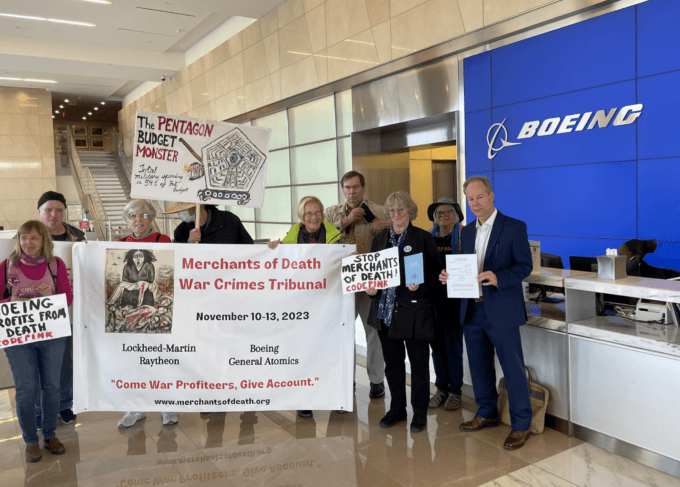
This is life as seen on November 10th, 2022, at Raytheon Technologies in Arlington, VA. Members and supporters of the Merchants of Death War Crimes Tribunal, a public tribunal, served “subpoenas” on four United States weapons manufacturers charging them with War Crimes, Crimes Against Humanity, Theft, and Bribery.

The other three corporations served that same day were Lockheed Martin, Boeing, and General Atomics. These four corporations are representative of the modern-day piracy that is the U.S. war industry, a corporate capture of U.S. foreign policy, the Congress, the Departments of Defense and State, and the U.S. economic system.

Raytheon Technologies occupies a towering office building in Arlington, a stone’s throw from the Pentagon and Arlington National Cemetery, two sites commemorating death and the utter failure of war. Though the Raytheon building has its corporate logo plastered in blood-red letters at the top, once inside no sign exists evidencing this corporate war profiteer. No name, no logo, no receptionist. A sad attempt to hide their dealings in the black art of war.

When asked, security guards refused to acknowledge Raytheon was in the building. Of the dozens of employees who passed, none would admit they worked at Raytheon, averting their eyes as they hurried away. When police arrived to escort the Tribunal members and supporters off premises, the police would not acknowledge Raytheon was headquartered there. Just like the employees, they had their orders. Keep quiet, admit nothing.

It was silent as a tomb except for the voices of the Tribunal members speaking the truth about the trail of suffering and death Raytheon and its corporate brethren have left across Iraq, Afghanistan, Pakistan, Syria, Somalia, and the Palestinian Occupied Territory. Meanwhile, these Merchants of Death have left the United States financially, morally, and spiritually bankrupt.

Raytheon Technologies has a market capitalization of $96 billion. According to Macrotrends, Raytheon Technologies revenue for the quarter ending September 30, 2022 was $16.951B, a 4.55% increase year-over-year. For 2021 it was $64.388B, a 13.79% increase from 2020, for 2020 was $56.587B, a 24.78% increase from 2019, and for 2019 was $45.349B, a 30.68% increase from 2018. In four years, they have garnered almost a 70% increase in revenue. Marketing death is good for profits if you can live with yourself. Apparently, given their silence, many Raytheon employees struggle with this very issue.

Raytheon builds some of the most destabilizing, destructive, and expensive weapons on earth. The Hypersonic Missile which travels in excess of five times the speed of sound — Mach 5 — covering vast distances in minutes. It is “hard to stop and flies nimbly to avoid detection and dodge defensive countermeasures.” All these are attributes which make the missile so destabilizing to a foreign leader who has only minutes to determine whether they are being attacked with a nuclear weapon.

Raytheon makes the Peregrine Air-to-Air Missile which they claim “increases firepower, penetrates bad weather, and goes the distance.” Add to that their plans to use “high power microwaves” in war and we see the epitome of a Merchant of Death.

Boeing, General Atomics, and Lockheed Martin are the same. They too revel in blood money as they build for war and drain the U.S. economy. In fact, some $8 trillion in U.S. taxpayer money has been given to U.S. defense contractors over the last twenty years.

The U.S. War Industry plays a key role in fomenting war with their congressional lobbying, not just pushing for weapons contracts but influencing military strategy, thereby exacerbating and prolonging the anguish of civilians bearing the brunt of these wars of choice. On the issue of war in particular, Congress must be answerable to its citizens, not a handful of corporations.

With their silence on November 10, these weapons manufacturers revealed their shame. Their corporate mission statement is “War Begets Profit.”  For the Merchants of Death War Crimes Tribunal, the mission statement is “Come War Profiteers, Give Account.”  Stand before a Tribunal and be judged.

And so, what is it like to give your talents to a corporation which hides its very existence, to give all your efforts and education and experience in the creation of weapons which kill indiscriminately? Their loss of words, their averting eyes, the damning silence offered in their corporate crypt, is the devastating answer.

230 refugees land in France as spat with Italy sparks EU diplomatic crisis

Samuel Tissot


On Friday morning, 230 refugees rescued by Ocean Viking, a refugee rescue boat operated by the SOS Mediterranean organization, were allowed to disembark at Toulon, on France’s south coast. The boat was only allowed to dock due to the rapidly declining health of its passengers, including 55 children, who have been stranded at sea for over three weeks. It was the longest blockage since SOS Mediterranean began rescuing refugees in 2015.

The humanitarian ship the Ocean Viking makes its way into the military base in Toulon, France, Friday, Nov. 11, 2022. The Norwegian-flagged vessel, operated by the NGO SOS Méditerranée, had been at sea for nearly three weeks carrying around 230 migrants. Italy had refused to allow the migrants to disembark on Italian territory. [AP Photo/Daniel Cole]

The vessel landed in France after the Italian government did not allow the ship to dock, in violation of international law. The Meloni government’s actions triggered a major diplomatic crisis between France and Italy, both members of EU and NATO, exploding the illusion of European Union (EU) unity in the face of the economic crisis and NATO-Russia war in Ukraine.

According to SOS Mediterranean, Ocean Viking rescued 234 people in six operations between October 22 and 26. The boat was illegally refused entry into multiple European ports, and by November 10 the health of the passengers was dire. That morning, 3 critically ill passengers were evacuated by helicopter to Bastia with one relative. In the early hours of November 11, the remaining 230 were evacuated to Toulon.

Currently, three other SOS Mediterranean rescue ships with around 270 refugees rescued are still being denied permission to dock in both Italy and France.

After the evacuation of Ocean Viking, SOS Mediterranean director of operations Xavier Lauth, stated that the situation was the result of “a dramatic failure from all the European states, which have violated maritime law in an unprecedented manner.”

During Ocean Viking’s three-week ordeal, 43 requests were sent to the Italian government to dock, all of which were rejected in violation of international law. Before Friday morning, the French government’s own refusal to allow the Ocean Viking to immediately dock was illegal according to maritime law. Paris continues to do this with the other rescue ships stranded in the Mediterranean.

A major diplomatic crisis erupted as Paris and Rome both violated their obligations under international law and tried to force the other to accept the refugees. The French government has suspended its participation in EU refugee agreements.

In retaliation for the Italian government’s actions, French Interior Minister Gérald Darmanin stated: “Italy is putting itself outside of European solidarity and its commitments (which will have) extremely severe consequences on the bilateral relationship.” The French government has withdrawn from an agreement to take in 3,500 migrants from Italy before Summer 2023 and has tightened controls on its Italian border.

Meloni called the French response “aggressive” and “unjustified,” while presenting the docking of the ship in France as a major victory to her government’s far-right base. On Saturday, the Meloni government doubled down on its stance, issuing a statement along with Greece, Malta, and Cyprus calling for a discussion to re-write the existing EU refugee agreements to limit the number of refugees they would accept.

In Italy, Matteo Salvini, deputy prime minister and secretary of neo-fascist Northern Lega party, rejoiced that his government’s policy meant the “winds have changed.”

In France, far-right leader Marine Le Pen said: “Our country, through the voice of its leader, has given in. It is therefore the beginning, I think, of a series of NGO boats.”

In reality, the French government, like its EU allies, still refuses to admit hundreds of refugees currently stranded in rescue boats, while the EU’s Fortress Europe policy continues to claim dozens of lives every month.

Meloni’s actions are seen in Paris as a serious affront to Macron, who rushed to meet and congratulate the far-right premier the day after she took office, thus working to legitimize the political heirs of Benito Mussolini and ensure Rome’s continued support for war on Russia in Ukraine.

Similarly, her government has violated the EU refugee sharing agreement signed by Italy this summer, causing concern in Brussels over her previous assurances of her commitment to the EU and its support for the war in Ukraine.

The diplomatic recriminations arising from the Ocean Viking scandal has blown apart the appearance of cross-European unity amid the mounting economic crisis and the NATO war against Russia in Ukraine. In its editorial Saturday, the French daily Le Monde described the incident as “A European Disaster.” It warned that the issue of immigration and the response of far-right parties across the continent “threatens the future of the [European] Union itself.”

Franco-Italian antagonisms have surged in recent years, particularly due to the two countries’ support for opposing factions in the Libyan civil war unleashed by the 2011 war in Libya. In 2019, France recalled its ambassador to Italy after a series of political disputes. Three years later, the Meloni government’s unilateral break from EU agreements signals a further intensification of the inter-imperialist rivalries inside the EU.

As it allowed the ship to disembark, the Macron government tried to cynically present its response as evidence of its “humanitarian” concern, as opposed to the Meloni government’s total disregard for human life. Speaking on BFMTV on Sunday morning, government spokesperson Olivier Véran hypocritically claimed, “[our] response was humanitarian,” adding: “France would no longer be France if it did not act as it did.”

In fact, Macron only accepted the Ocean Viking to avoid popular outrage over the prospect of the illegal deaths of 234 rescued refugees a stone’s throw from the French coast. Macron has continued the EU’s Fortress Europe anti-immigrant policy, resulting in thousands of deaths during his presidency.

According to SOS Mediterranean, since it began operating in 2015, 20,182 refugees have drowned in the Mediterranean, including 1,337 since the beginning of 2022.

Furthermore, under Macron, asylum seekers who can reach France are forced to endure appalling conditions. Thousands live in tent encampments on the edge of major cities without adequate access to hygiene facilities and food. In 2020, the French government was condemned by the European Court of Human Rights over the “inhuman and degrading living conditions” of asylum-seekers “living in the street without any resources.”

In this vein, the Macron government has employed a last-minute legal loophole to deny the refugees arriving on the Ocean Viking their full legal rights. In the hours before the boat docked, two strips of land in Toulon and nearby Hyères were arbitrarily declared “international waiting zones.”

Darmanin explained, “the survivors will therefore technically not be on French soil.” This legal chicanery means these refugees cannot seek asylum in France, so they can be deported without legal recourse. According to Darmanin, France has agreed to take just 80 of the passengers; the rest will be sent to 11 other EU states.

In response to the crisis of capitalism, the European ruling class deliberately promotes nationalism, militarism and anti-immigrant hatreds to maintain its grip on power. This increases the prominence of neo-fascism in European political life and creates open divisions in the EU.

These are set to deepen in the coming period, as global warming and wars in Ukraine and beyond drive worsening social and economic conditions internationally, increasing the number of refugees attempting the perilous journey to Europe.

Bomb attack in Istanbul: At least six people killed, 81 injured

Ulaş Ateşçi


Yesterday afternoon, at least six people were killed and 81 injured, two of them seriously, in a bomb attack on Istiklal Avenue, one of the most crowded areas in Istanbul.

Security and ambulances at the scene after an explosion on Istanbul's popular pedestrian Istiklal Avenue, Sunday, Nov. 13, 2022. [AP Photo/Francisco Seco]

While no one has yet claimed responsibility for this murderous terrorist attack targeting civilians, Interior Minister Süleyman Soylu made a statement this morning, claiming that the outlawed Kurdistan Workers' Party (PKK) was behind the attack and that the real “killer” was the United States.

Soylu said, “The person who left the bomb was detained. Within the framework of the findings we have obtained, [the organization that carried out the attack] is the PKK/PYD terrorist organization.” The US-backed Democratic Union Party (PYD) is the Syrian sister organization of the PKK.

Before vowing to retaliate harshly, he said “We have an assessment that the instructions for the action came from Kobani. We have an assessment that the perpetrator of the action passed through Afrin.”  Most importantly, he then directly accused the US of being the real “killer.”

After the blast, which occurred a few hundred meters from Taksim Square, many police and ambulances arrived at the scene. While the police completely evacuated and closed Istiklal Avenue, gunshots were heard close to the scene shortly after the blast. According to a report on halktv.com.tr, police allegedly shot a person, but no statement was made about the incident.

Before leaving the country for the G-20 summit, President Recep Tayyip Erdoğan said: “It would be wrong to say with certainty that this is terrorism, but the first developments, the first information conveyed to us by my governor is that there is a smell of terrorism here.” He added: “As of now, the first determinations are that a woman played a role in this [attack].”

In a statement on the attack, Vice President Fuat Oktay claimed that security and peace prevailed in Turkey. Implying that the attack was intended to send a message to Turkey, he said Turkey “is a country that has achieved stability in every aspect, in terms of development, security and peace. No one can send a message to Turkey, which has a voice in many aspects in its region and in the world, with such acts, nor can anyone turn it from its path.”

The bomb attack in Istanbul occurred amid the ongoing war between NATO and Russia in Ukraine. While the major NATO powers, led by the United States, escalate their proxy war with Russia in pursuit of their imperialist objectives, Ankara is trying to play the role of a mediator and end the conflict. This is not because Ankara is “peace-loving,” but because of its political ties with both Ukraine and Russia, as well as the economic concerns of the Turkish bourgeoisie.

Meanwhile, in Syria, where the Turkish army has maintained a military presence since 2016, tensions between Ankara and its Islamist proxies have been rising for some time. Fehim Taştekin wrote in Al-Monitor on Wednesday that al-Julani’s Hayat Tahrir al-Sham (HTS) recently entered Afrin, which is under the control of the Turkish army and its proxies, taking advantage of disagreements within the Turkish-backed “Syrian National Army” (SMO).

“Turkey has launched a fresh effort to reorganize allied rebels in northern Syria and is reportedly using threats and ultimatums to discipline the disorderly factions that have backed Turkish forces in the Olive Branch and Euphrates Shield pockets in the Aleppo countryside,” Taştekin wrote.

On the other hand, Justice Minister Bekir Bozdağ announced an investigation into the Istanbul attack, while state-owned Anadolu Agency reported that the Istanbul Chief Public Prosecutor’s Office had launched an investigation into “negative posts” on social media about the blast.

The Radio and Television Supreme Council (RTÜK) imposed a broadcast ban on the media on the incident. Moreover, the Information and Communication Technologies Authority (BTK) restricted access to social media platforms on the grounds of preventing “inappropriate images.”

Mehmet Akuş, a worker at a restaurant on Istiklal Avenue, told Reuters about the attack: “When I heard the explosion, I was petrified, people froze, looking at each other. Then people started running away. What else can you do? My relatives called me, they know I work on Istiklal. I reassured them.”

After the blast, statements came from the political establishment and Turkey’s allies. NATO, the United States, the European Union, France, Ukraine and Greece were among those issuing statements of “solidarity” with Ankara.

Kemal Kılıçdaroğlu, the leader of the opposition Republican People’s Party (CHP), wrote on Twitter: “I wish God’s mercy to our citizens who lost their lives in the blast on Istiklal Avenue and a speedy recovery to the wounded. My condolences to our nation!” His far-right ally, Good Party leader Meral Akşener, also expressed her “condolences.”

The Kurdish-nationalist Peoples’ Democratic Party (HDP) also issued a written statement, declaring: “We are deeply saddened and pained by the blast in Istanbul. We wish God’s mercy to our citizens who lost their lives, a speedy recovery to the wounded and our condolences to our people.”

Former HDP co-chair Selahattin Demirtaş, who is currently serving a multi-year jail term, condemned the attack. “No matter for what purpose or justification, every attack targeting civilians is terrorism in law, politics, morality and conscience. We never accept it,” Demirtaş declared on Twitter.

“Efforts to defeat Turkey and the Turkish people through terrorism will fail today just as they did yesterday and as they will again tomorrow,” President Erdoğan said in his remarks.

After yesterday’s blast, certain commentators drew a parallel between the escalation of terrorist attacks in 2015-2016 and the current situation. Amid a deepening economic and social crisis, Turkey is heading into presidential and parliamentary elections in June 2023. Many polls suggest that Erdoğan could lose both elections.

In the general elections of June 7, 2015, Erdoğan’s Justice and Development Party (AKP) lost its parliamentary majority in the face of massive social opposition. In fact, the terrorist attacks that started before the elections have escalated since then.

Around 150 people were killed in terrorist attacks by the Islamic State of Iraq and Syria (ISIS) in Suruç, on Turkey’s southern border, and then in the capital, Ankara. At the same time, the Erdoğan government’s discontent that the People’s Protection Units (YPG), the Syrian sister organization of the outlawed Kurdistan Workers’ Party (PKK), had become the main US proxy force, led to the end of the “peace process” between Ankara and the PKK and the outbreak of a violent civil war.

While a coalition government could not be formed, the AKP managed to regain its majority in parliament in early elections held on November 1, 2015 in an atmosphere of terror and fear. Terrorist bombings by jihadists and the PKK-linked Kurdistan Freedom Hawks (TAK) and violent clashes in Kurdish towns and cities continued. After conflicts between Turkey and its imperialist allies, led by Washington, erupted with a failed coup attempt against Erdoğan on July 15, 2016, Ankara launched multiple invasions into Syria to target the YPG. It occupied significant territory over the objections of Damascus.

Whatever exact forces were behind yesterday’s attack, this climate of terror cannot be understood apart from the thirty years of wars in the region waged by the US-led imperialist powers. These wars, in which the Turkish ruling elite has been complicit, have devastated countries like Iraq, Libya and Syria, while the war in Ukraine threatens all of humanity with a specter of a nuclear conflict.

European study finds hospitalization rates for RSV infections among infants have been higher than expected

Benjamin Mateus


A report published this week in the medical journal The Lancet Respiratory Medicine by Dutch and British scientists is the first international study to accurately estimate the health care burden of healthy infants hospitalized with the respiratory syncytial virus (RSV). The publication is timely in that it arrives amid an epidemic of respiratory infections, particularly RSV, among children across the United States, with a record number of hospital admissions. 

Their data, gathered from July 2017 to July 2020, showed that one in 56 infants (1.8 percent) across several European countries—Spain, Finland, Netherlands, Scotland, and England—born at term and without any medical co-morbidities like heart, lung, or kidney dysfunctions had been hospitalized for RSV infection before their first birthday, a figure twice as high as they had expected. Most of these infants were, in fact, under three months of age, and one in 18 of these admissions required care in an intensive care unit.

As the Centers for Disease Control and Prevention (CDC) has noted, in pre-COVID pandemic periods, upwards of 80,000 children under the age of five are hospitalized in the US annually for RSV. Those at greatest risk from RSV infections include premature infants born before 37 weeks, infants younger than six months of age, as well as those with congenital lung or heart disease who are under two. However, weakened immune systems can contribute to the severity of infections. This fact is critical to appreciate as COVID-19 is known to cause immune dysregulation despite the mildness of the infection.

According to published CDC data on COVID seroprevalence (finding of infection through blood tests) among children, as of late August 2022, it is estimated at over 86 percent. Placing this into context, precisely one year previously, in November 2021, that figure was at 43 percent. At least half of COVID infections among children have occurred in the last 12 months. The current seroprevalence for those 0-4 years of age, the most vulnerable to RSV infections, is 81 percent. 

Despite the repeated dogma that children only have mild disease, evidence is emerging that COVID can cause dysregulation of critical immune cells known as T-cells, which can be prematurely aged through infections with SARS-CoV-2. Not only can these T-cells then lead to unrecognized organ damage, but the exhaustion of those hyperactivated T-cells means they cannot guard against other pathogens.

In a report published in January 2022 in Nature Immunologythe authors found that immune dysfunction persisted for at least eight months after COVID, even in mild to moderate disease. In patients with Long COVID, chronic activation of a subset of T-cells persisted, leading to the observation that “SARS-CoV-2 infection exerts unique prolonged residual effects on the innate and adaptive immune systems and that this may be driving the symptomology known as Long COVID.”

They summarized, “Our data indicate an ongoing, sustained inflammatory response following even mild-to-moderate acute COVID-19, which is not found following prevalent [non-SARS-CoV2] coronavirus infection ... These observations describe an abnormal immune profile in patients with COVID-19 at extended time points after infection and provide clear support for the existence of a syndrome of Long COVID.” 

Further research into the interplay between previous SARS-CoV-2 infections and susceptibility to illness and other infections is urgently needed. Still, there is little interest by the CDC and health officials in such investigations. The implication here, however, is that the pseudo-scientific premise of “immunity debt,” the speculation that pandemic prevention measures stopped children from encountering the virus before, thus leading to severe infections presently, is used as an attempt to dissuade putting forth any policy that calls for employing public health measures to prevent these respiratory illnesses. 

Advocates of “immunity debt,” like Emily Oster, an economist at Brown University who has been a vociferous opponent of any mitigation measures against the SARS-CoV-2 virus, have essentially blamed school closures and lockdowns for the current epidemic of respiratory illnesses among children. Oster has continued to defend her unfounded position that the health risks of in-school spread were relatively low and loss in educational progress too high to warrant such mitigation measures.  

Ample evidence has emerged on the role children have played in the community transmission of COVID through school settings, bringing it back into homes, and through their parents and other family members, onwards into workplaces. The surge in COVID infections among children last year also saw the highest rates of death among the most vulnerable. And now, with the complete lifting of every mitigation measure in schools, it is no surprise that children’s hospitals across the country are inundated. Additionally, the severity of these illnesses may be compounded by the impact of recent COVID infections on their immune systems.

Indeed, these same deluded middle-class layers who incessantly clamor over their position in the pecking order of wealth and prestige offer deranged arguments that germs and microbes are necessary for the well-being of their children. They appear utterly ignorant of the centuries of public health initiatives that have informed scientific comprehension of disease in society and saved the lives of so many children, including their own grandparents.

Any parent who has had to suffer nights of apprehension and anguish helplessly watching their baby gasping for air as their chest retracts to fill their lungs while fighting high fevers and rigors, hoping that their infant will see it through the illness, will be repulsed by the promotion of such insane conceptions as healthy germs. 

Number of all-cause and RSV-Associated acute respiratory illnesses (ARI) by months (panel A), by medically attended ARI (panel B), and hospitalized ARI (panel C). [Photo: The Lancet Respiratory Medicine.]]

Worldwide, RSV causes around 33 million acute lower respiratory tract infections annually in children under five. About 10 percent of cases, or 3.2 million children, are hospitalized, and nearly 60,000 die in the hospital. This is especially the case in low-income and middle-income countries where resources are limited. Forty-five percent of all deaths due to RSV occur in children under six months of age. In poorer regions, RSV is the second most common cause of infant mortality.

As the authors of The Lancet report said, “Almost half of all acute respiratory illnesses in the first year of life were RSV-associated. The burden of RSV-associated hospitalization was highest in infants younger than three months, with an incidence rate of 3.3 per 1,000 infant months. Children born in autumn had a significantly higher risk of hospitalization than children born in other seasons.”

Pediatrician Professor Louis Bont at the Wilhelmina Children’s Hospital in the University Medical Center, Utrecht, the Netherlands, underscored the need to bring vaccines to markets that can help lower the burden of disease and alleviate the pressures being sustained by hospitals.

Comments by Bont follow the recent announcement by Pfizer on their phase three global maternal immunization trial for its bivalent RSV vaccine. Vaccine effectiveness against severe “medically attended” lower respiratory infection was 82 percent in the first three months of life and almost 70 percent in the first six months. The vaccines were given to pregnant women as single-dose vaccines to protect their newborns.

Annaliesa Anderson, senior vice president and chief scientific officer of vaccines research and development, said at the press brief on November 1, 2022, “We are thrilled by these data as this is the first-ever investigational vaccine shown to help protect newborns against severe RSV-related respiratory illness immediately at birth.” Pfizer is currently seeking FDA approval for its new vaccine.

In the meantime, the European Medicines Agency has recently approved a monoclonal antibody treatment (nirsevimab, brand name Beyfortus) given as an intramuscular injection to prevent or lessen the severity of disease with RSV. The treatment was developed by AstraZeneca and Sanofi. When given before the start of RSV season, it appeared to decrease the risk of medically attended RSV infection by 75 percent, but did not reach statistical significance for hospitalization. 

Though the study is a critical contribution to the understanding of respiratory illnesses in children, one crucial finding being overlooked in The Lancet report by the media reporting is any mention of what happened when mitigation measures were implemented at the start of the COVID pandemic—the near elimination of RSV. 

Interestingly, the authors noted that they had to exclude children born after April 1, 2020 from the study because RSV infections across the European Union plummeted abruptly and remained essentially non-existent throughout the first year of their lives. 

As crucial as therapeutics to prevent or treat viral pathogens are in the armament of medicine, the social implications of allowing three-quarters of all pediatric hospital beds in the US to be filled with children infected with RSV and influenza when these can easily be prevented is both a catastrophe and indictment of the capitalist system that bears direct responsibility for these illnesses. 

Already the CDC and health officials have declared the current flu season an epidemic, with a further intensification of respiratory illnesses expected. The recent letter penned by 33 medical groups to President Biden is an open confirmation that the health system in the country is in a state of collapse. Still, hardly a word has emerged from the Biden administration on these issues.

The US midterm elections and the ongoing threat of fascism

Barry Grey


Pundits on both sides of the political aisle are hailing the results of the US midterm elections as a “victory for democracy” and return to “normalcy.” They cite the debacle for Trump-endorsed election deniers, which allowed the Democrats to retain control of the Senate and either limit the Republicans to a miniscule majority in the House, where key races are still undecided, or retain a narrow Democratic majority. This proves, they claim, that the attempted fascist overthrow of the government on January 6, 2021, was a fluke event that will not be repeated.

Supporters of President Donald Trump rally outside the US Capitol on Wednesday, Jan. 6, 2021, in Washington. [AP Photo/Jose Luis Magana]

Over the past several days, two New York Times columnists, David Brooks, a Republican, and Thomas Friedman, a Democrat, have advanced this line in separate op-ed pieces.

In “The Fever Is Breaking,” Brooks writes: “The single most important result of this election was the triumph of the normies. Establishmentarian, practical leaders who are not always screaming angrily at you did phenomenally well, on right and left…”

He continues: “On abortion and many other issues, the median voter rule still applies. If you can get toward the spot where moderate voters reside, you will win elections.”

In “America Dodged an Arrow,” Friedman writes: “Tuesday’s election really was the most important test since the Civil War of whether the engine of our constitutional system—our ability to peacefully and legitimately transfer power—remains intact. And it looks to have come through—a little dinged up, but OK.”

Making an amalgam between the Republican fascist right and the so-called “progressive” wing of the Democratic Party, Friedman asserts that “enough Americans still fall into this independent or centrist camp and do not want to keep dwelling on the grievances, lies and fantasies of Donald Trump… They also don’t want to be shackled by the woke enforcers of the far left…”

Friedman goes on to pay homage to neoconservative Republican warmongers who came out against Trump and joined Democrats on the House January 6 Committee, writing: “We owe a huge debt for keeping the center alive to Republican Representatives Liz Cheney and Adam Kinzinger and Democratic Representative Elaine Luria.”

Both Friedman and Brooks single out for praise former CIA agent and war hawk Abigail Spanberger, who defeated a Trump-endorsed candidate to retain her House seat in central Virginia.

Aside from its pro-war and reactionary political line, this is an utterly delusional, self-serving and dangerous misreading of the election and the political situation in the US.

The very fact that nearly a week after Election Day, control over the House of Representatives remains undecided and both legislative chambers are virtually split down the middle speaks to a highly unstable and volatile situation.

The vote showed that there is no mass popular constituency for the fascistic politics of Trump, but recriminations within the Republican Party, which overwhelmingly supported the attempted coup and backed Trump-endorsed candidates in Tuesday’s election, are accompanied by praise for Florida Governor Ron DeSantis.

The latter—who has viciously attacked immigrants, blocked any COVID-19 mitigation measures, set up a special police force to arrest former convicts who try to vote, shielded far-right and anti-Semitic groups in Florida and championed the banning of “woke” literature—is another fascist. DeSantis, however, has positioned himself as an alternative 2024 presidential candidate by distancing himself from Trump’s “stolen election” lie.

President Biden signaled the Democratic response to the elections last Wednesday, when he called for bipartisan unity with his “Republican colleagues” to prosecute the proxy war against Russia in Ukraine and impose the full burden of the intensifying economic crisis on the working class. When asked what he intended to change going forward, given exit polls showing massive opposition to his seeking a second term as president and anger over raging inflation and falling real wages, he replied, “Nothing,” and proceeded to tout the “accomplishments” of his administration.

Two months ago, Biden gave a nationally televised speech in which he warned that the Republican Party was “dominated, driven, and intimidated by Donald Trump and the MAGA Republicans, and that is a threat to this country.” Now he claims that the election was a popular repudiation of “extremism” of both the left and the right, and signals an end to all investigations of the January 6 coup and its organizers in the name of “moving forward.”

History has repeatedly refuted attempts to complacently brush off the danger of fascism on the basis of electoral setbacks to fascist parties and leaders. In November 1932, the Nazi party’s vote fell from 37 percent to 34 percent in the national parliamentary election, a decline of 2 million votes. More than a few German newspapers wrote off Hitler as “yesterday’s man.” Less than three months later, Hitler was chancellor, and two months after that all of the bourgeois parties in the Reichstag voted for the Enabling Act that gave Hitler dictatorial powers.

The United States today is not Germany in 1932–33. Above all, there is no mass fascist movement in America. But that by no means diminishes the danger posed by the growth of fascism, which has significant institutional support within the police, military and intelligence apparatuses.

Trump’s fate remains uncertain. All indications are that he intends to fight any attempt to dethrone him from within the GOP. But one thing is certain: the Republicans and the Democrats will lurch further to the right in the aftermath of the elections.

Since the rise of real estate speculator and gangster Donald Trump to the head of the Republican Party, the World Socialist Web Site has explained the bankruptcy of the “bad man” theory of history, which absurdly “explains” the turn by ruling classes to authoritarian forms of rule on the basis of the predilections and subjective intentions of individuals. It treats the corrupt and sclerotic corporate-controlled American two-party system as a paragon of democracy, somehow infiltrated by the alien Trump. And it isolates the national development from its international context—the intensification of economic and social crisis, the rise of the class struggle and the descent of ruling classes into global war for control of resources, profits and sources of cheap labor.

The turn by the ruling class to dictatorship and fascism is an international process. One need only cite the Meloni government in Italy, the rise of the AfD in Germany, Le Pen in France, Modi in India, Marcos in the Philippines. It is no accident that this coincides with the growth of working class struggles internationally, which are seeking to break free of the stranglehold of the bureaucratic and corporatist trade union apparatuses.

12 Nov 2022

Poland: Social and economic crisis intensifies as inflation surges past 25-year highs

Martin Nowak


In Poland, the social and economic situation continues to deteriorate. The effects of high interest rates, the war in Ukraine and inflation, which has exceeded 25-year highs, threaten to plunge the country into a deep recession.

Inflation, already 8.6 percent at the end of last year, has climbed to nearly 18 percent despite a government “inflation shield.” Inflation in many other eastern and southeastern European countries is even higher. Even so-called core inflation, which does not take into account the strongly fluctuating prices of food and energy, has exceeded the symbolic 10 percent level.

Polish miners at the Wujek mine in Katowice [AP Photo/ Czarek Sokolowski]

Poland is not a member of the euro zone. The Polish central bank has raised the primary interest rate in steps to 6.75 percent. This is significantly higher than the ECB’s prime rate, which was most recently 1.25 percent. The Polish central bank has recently refrained from further interest rate increases as the rate hikes to date have already caused a significant economic slump.

Fixed interest rates are rare in Poland, so interest rates on existing loans are rising and new investments are becoming more expensive. To date there have been only limited declines in in the sale of consumer goods, but this is mainly due to the high number of Ukrainian refugees (2.6 million according to the UNHCR) currently living in Poland.

A look at the construction sector in particular reveals how devastating the impact of rising interest rates on the Polish economy have been. Compared to the previous year, a drastic 46 percent decline in new residential construction was recorded in August. Since many Polish companies lease their vehicles and machinery, they are also faced with rising costs.

The International Monetary Fund (IMF) has again cut Poland’s growth forecasts for this year and next: to 3.8 percent for this year and to 0.5 percent for 2023. According to the rating agency Moody’s, Poland’s GDP will shrink by 0.2 per cent year-on-year in 2023.

Pawel Borys, president of the Polish Development Fund, posted a gloomy forecast on Twitter. After returning from the IMF and World Bank annual meetings, he wrote that the mood was “as bad as during the 2009 and 2012 crises.” Borys believes that a recession in Germany and Italy will also rebound onto the Polish economy and lead to further growth in unemployment and public debt.

For Poland, the depreciation of the zloty (PLN), which in the last year dropped in value from PLN 3.9 to PLN 5 per dollar, means a rise in the price of imported products, especially from the US, where Poland has signed multibillion-dollar arms purchases. Many Polish companies pay for imported raw materials and components from the Far East in dollars and accept payment for the export of finished products to Western Europe in euro, which “shrinks margins very quickly” due to the dollar’s “stronger position,” as Piotr Soroczyński, chief economist of the Polish Chamber of Commerce, commented.

The social consequences of the crisis have already been devastating. The newly released poverty report (“Poverty Watch 2022”) by the European Anti-Poverty Network provides a glimpse of the rampant spread of poverty in Poland over the past year. According to Prof. Ryszard Szarfenberg, while it has declined in recent years, poverty now wears “the face of an elderly and disabled person.”

About 1.6 million Poles live below the subsistence level. For a one-person household, this is PLN 692 (about $145) per month. This excludes the homeless population, which is not recorded in the statistics. Approximately 4.6 million Poles live in relative poverty, that is, they earn less than 50 percent of the average monthly income. That was PLN 6,688 ($1,480) in September 2022, nominally up 14.5 percent from a year earlier. In view of inflation, however, real wages fell by around 3 percent.

Whereas children and large families used to be the focus of the poverty report, the share of extremely poor children has fallen considerably—from 700,000 in 2015 to 333,000 in 2021— partly due to the 500Plus childcare allowance introduced by the PiS government. However, almost one million children continue to live in relative poverty.

In addition, there are 246,000 elderly people over 65 who live below the subsistence level. Seniors are increasingly asking for food assistance, Szarfenberg points out. Those most affected are those who have no pension entitlement and live on social assistance. This was increased only slightly from PLN 645 to PLN 719 ($143 to $159) in February 2022, despite high inflation.

Szarfenberg considers an increase in poverty of more than 2 percentage points to be likely in the coming year. According to the professor, the main reason is the failure to adjust social benefits to inflation. He points out that family benefits have not been adjusted since 2016.

In fact, the minimal increase in social assistance has already been surpassed several fold by rising prices. Although the government tried to counteract this with its “inflation shield,” the reduction of the value-added tax from 23 to 8 percent and the elimination of the fuel tax, gasoline and diesel prices have reached record highs. Since September, prices have risen by around 170 percent, with a liter of diesel costing PLN 8 ($1.77).

Even a ton of black coal costs PLN 2,000 ($443), twice as much as a year ago, despite state subsidies. Prices on the free market are now PLN 4,000 ($885) and above. In search of cheap coal for the winter, some stand in line for hours or drive hundreds of kilometers to the Czech Republic or Slovakia, where it is still somewhat less expensive.

In response, the government has again legalized the purchase of brown coal by the power plant operator PGE, which was prohibited because of its high emission of pollutants. Its price lies between 190 and 500 PLN per ton ($42-$111), but when burned produces a fourth the heat compared to black coal. Moreover, burning brown coal releases three times more sulfur and five times more mercury into the air.

Rising energy costs have already resulted in cut budgets.

The Jagiellonian University in Krakow, for example, announced that it would no longer be holding its central lectures in person, instead holding them online from October onward because of the rise in electricity prices, which have increased almost 700 percent. There are similar reports from other universities.

Schools and daycare centers were also asked by their municipalities to develop cost-cutting plans, all while repeating platitudes that “the children need to be warm” and that “no distance learning” would be implemented. Shopping centers and retail chains have also announced energy saving measures for lighting and heating.

However, the most severe impact is in the increased price of food. In the first half of 2022, the price of butter rose by 48 percent, meat by 31 percent, and fruit by 24 percent. By September the price of cooking oil had increased by 62, salt, milk, and pasta by 37, flour and rice by 20, and sugar by 100 percent. As a result, the incidence of grievous shoplifting increased 27 percent and petty shoplifting 13 percent in the first half of the year. As the industry magazine Wiadomości Handlowe reported, stores have responded with increased use of anti-theft devices, even on butter.

Opposition parties, together with the unions, are organizing a series of innocuous protests to serve as lightning rods for the rising storm of social conflict. At the same time, they support the government’s war course against Russia and attack the PiS from the right on economic and social policy. They say that state subsidy policies, rising social spending and, in particular, the 500Plus child benefit and overly hesitant interest rate hikes by the central bank are to blame for the misery.

Under the slogan “United and angry at PiS,” pro-opposition groups demonstrated in several cities in recent weeks against increased energy prices and inflation. In each case, only a few hundred participants showed up.

For National Education Day, the opposition also organized protests against the policies of Education Minister Przemysław Czarnek under #KartkaDoCzarnka (Red Card for Czarnek). The teachers’ unions, confronted with a veritable exodus of personnel due to deplorable working conditions, organized a parallel week-long “education village” in front of the ministry and protested last month, drawing a small rally demanding a 20 percent pay raise.

The unions used the same method to stifle protests by nurses, paramedics and doctors a year ago. After tens of thousands protested in Warsaw, the unions staged a so-called “White City” while negotiating with the government for weeks, only to quietly take down the camp having achieved nothing.

NSZZ “Solidarność,” one of Poland’s three major trade union confederations, has now announced “the biggest demonstration in Warsaw in years” for November 17. Talks with the government on wage increases, capping energy prices and lowering the retirement age have broken down, the union said. Miners, steel and auto workers, as well as state employees and police officers, are to be mobilized for the protests.

PSOE-Podemos government ignores surge of COVID-19 cases in Spain

Santiago Guillen


A new wave of COVID-19 is developing across Spain, part of the next global wave of the COVID-19 pandemic. While the Socialist Party (PSOE)-Podemos government’s complete dismantling of testing and data reporting makes it impossible to measure the evolution of the pandemic, cases are clearly rising.

Podemos leader Pablo Iglesias, January 13, 2020. [AP Photo/Manu Fernandez]

The only data available is on the accumulated incidence level of the virus in people over 60 years of age. In September, it stood at 150 cases per 100,000 inhabitants during 14 days. It has now reached 221 cases. Hospitalizations are also rising rapidly, going from 4.8 per 100,000 inhabitants at the end of September to 7 patients per 100,000 inhabitants. In addition, after a month of October with very high temperatures due to climate change, immunologists warn that the arrival of the cold could rapidly increase infections and hospitalizations.

The deaths are hardly ever commented upon in official circles, part of the ruling elite’s new strategy of simply ignoring a pandemic that has already killed at least 20 million people globally and over 115,000 in Spain, 160,000, measured in the more reliable excess-death statistics. However, several hundred people continue to die of COVID-19 every fortnight in Spain.

The criminal downplaying of data is seen in excess mortality. Spain registered a record excess mortality of 32,058 people from January 1 to September 30, 2022, according to data from the Daily Mortality Monitoring Report, prepared by the Carlos III Health Institute. That is, there is an excess of 117 deaths per day without the causes of this increase being known. The alarming figures show an increase in deaths of 94 percent compared to 2019, the year before the pandemic, when 2,862 were recorded as excess deaths.

There is a suspicion that these may be due to cardiovascular diseases linked to Long COVID. José Luis Carrasco, expert in cardiovascular diseases, told the Antena3 news channel that heart diseases have increased by 20 percent. The origin, he observed, “are the effects of COVID-19'. He said: “In Spain the numbers of people who have had COVID are very high”, referring to the fact that over 13.5 million Spaniards have been infected, 29 percent of the population. Segura added: “Anyone who has had the disease has a higher vascular risk.”

Long COVID victims are being abandoned to their fate. In 2021, the Ministry of Health refused to consider Long COVID a disease. This means that most patients with Long COVID are discharged or do not receive any type of pension for work disability when their maximum period of temporary work disability ends. These patients suffer from multiple disabling conditions: fatigue, fever, breathing problems, muscle, stomach, chest or headache pain, difficulty thinking and concentrating, headaches or sleep problems, among others.

The worst part is borne by health workers, 30 percent of whom suffer from this disease and most of whom were infected during work, treating COVID patients, often without adequate protection. They are not recognized as having suffered a professional illness.

A health care worker with Long COVID, 41-year-old Carolina Sánchez, explained to La Razón: “The pain is as if your legs and hands were being pierced with knitting needles, and with small needles in your muscles.” She added: “I cannot keep my daughter with 70 percent of my salary [what she receives under sick leave], I go to work dragging myself.”

Spain’s union bureaucracies have taken no action to defend workers with Long COVID. The large trade union federations, Podemos-linked Workers Commissions (CCOO) and the social-democratic General Union of Workers (UGT), are joining in the silence of the media and the PSOE-Podemos government.

Long COVID victims have organised themselves in the Long COVID Mobilization Platform, calling for protests both in person and online to denounce the situation of these patients. Its manifesto points to the complete abandonment by the PSOE-Podemos government:

“One year has passed since the World Health Organization published the first official clinical definition of Long COVID-19 disease. This definition being agreed upon worldwide and published to facilitate the treatment of those affected, HAS NOT TRANSLATED into research, monitoring or recognition of a disease that already affects more than 17 million people throughout Europe, and continues to increase due to growing infections”.

But if the PSOE-Podemos government does not care about Long COVID victims, it is also indifferent to the rise of COVID-19 infections. The eighth wave is aggravated by its coincidence with the seasonal flu epidemic and also with the arrival of the new variants BQ.1 and BQ.1.1 to Spain, which are expected to be predominant for the month of December. It is unknown if the immunity the vaccines provide will be able to resist the new variants.

Minister of Health Carolina Darias has recently declared in parliament that the new variants could mean “more immune escape.” Nonetheless, the PSOE-Podemos government’s reaction has been to reduce the information available and restrictions.

The monitoring of COVID-19 variants has lost much of its reliability. It is now carried out with fewer than 50 weekly samples compared to 2,000 in summer and 3,500 in January. In addition, the Ministry of Health has reduced the weekly bulletins reporting on the evolution of infections and deaths from COVID-19 from two to one. Until last April, those bulletins appeared daily.

The accumulated incidence data is also unreliable because since April it has only been collected in people over 60 years of age. Lorenzo Armenteros, spokesperson for the Spanish Society of General Practitioners (SEMG), commented bitterly: “There is an information blackout to justify not taking unpopular measures, such as the obligation to wear a mask indoors. We need to know how the virus is circulating, but some think it is preferable not to know.”

Armenteros also stressed that while medical centers are seeing a significant growth in infections, these are only partially reflected in the statistics: “We do not have the real dimension of the disease because we lack, for example, information on young people.”

The role of the PSOE-Podemos government and the media in downplaying the virus is having a terrible impact on mass consciousness. Global society is wholly unprepared for the current surge. According to polls by the Carlos III Health Institute, the public’s perception of COVID-19 has rapidly declined, going from 43 percent of people who in the summer of 2020 thought that, if infected, their disease would be “very serious,' to 13 percent registered in this last round.

All this comes amid a completely overwhelmed public health system. According to the Ministry of Health’s own reports, with the pandemic, the workload among doctors increased by 24 percent and among nurses, 44 percent, while the workforce is stagnant. In reality, the situation is much worse because of the large number of casualties due to COVID, anxiety or depression.

The government claims it will implement a paltry €434 million plan to improve health care, a totally insufficient and ridiculous figure, especially when compared to the €26 billion spent on the Spanish military or the €70 billion of European bailout funds being handed out to the banks and corporations.

The PSOE-Podemos’ response has evolved from vaccine-only strategy to “let it rip” to now, complete silence. These policies are all grounded in allowing companies to continue to extract profits out of workers, even at the cost of workers becoming infected, having to work sick, suffering serious consequences or even dying. Above all, it exposes the pseudo-left Podemos Party, which has claimed to defend “those from below,” but in fact shares the contempt for workers of social democratic, right-wing and neo-fascist tendencies, while working to enrich large corporations.