8 Jun 2023

China slowdown drives Saudi oil production cut

Nick Beams


The most significant feature of the decision by Saudi Arabia to cut its production of oil by 1 million barrels a day in July, with a possible extension, is what it says about assessments of the prospects for the world economy.

The driving force of the decision, announced following the OPEC+ meeting in Vienna on Sunday, is that the much-touted “recovery” of the Chinese economy after the lifting of anti-COVID heath measures is not taking place, leading to a further slowdown in the world economy and sending down the price of oil.

The meeting was held two months after the cartel, which includes many of the world’s major oil producers, announced production cuts to try to sustain prices. But these measures have proven largely ineffective, and the oil price has fallen by 12 percent since the middle of April, touching $70 a barrel at one point last week.

Crown Prince of Saudi Arabia Mohammad bin Salman Al Saud [Photo by en.kremlin.ru / CC BY 4.0]

Saudi Arabia, under the direction of Crown Prince Mohammed bin Salman, has embarked on a major investment and infrastructure program to try to lessen its dependence on oil production. But the program, which has so far failed to attract significant international investor support, depends on oil revenue to be carried out.

The Wall Street Journal has reported that in recent months Saudi policymakers have been warned that “the kingdom needs elevated oil prices for the next five years to keep spending billions of dollars on ambitious projects that have so far attracted meagre investment from abroad.”

According to the International Monetary Fund, Saudi Arabia needs an oil price above $80 a barrel to balance its budget and fund major projects. But as the world economy slows—the IMF has forecast that global growth this year will reach its lowest point, apart from the COVID-19 recession, since the financial crisis of 2008-2009—recessionary trends are exerting downward pressure on oil prices.

Since last October, when OPEC+ cut production by 2 million barrels a day followed by a further cut of 1.6 million barrels in April, the price of Brent crude, the major international benchmark, has fallen by around 20 percent.

Oil prices have kicked up at certain points going as high as $90 a barrel, but the dominant trend has been down. Predictions made earlier this year that the price could go to $100 a barrel have failed to materialise.

The latest Saudi cut is only for July at this stage, but it could be extended. Following the meeting, Saudi Energy Minister Prince Abdulaziz bin Salman, the half-brother of the crown prince, said it was a “Saudi lollipop,” that is, a sweetener for the rest of the group which did not have to make cuts.

“We want to ice the cake with what we have done,” he said. “We will do whatever is necessary to bring stability to this market.”

And in an effort to cover over tensions within the group, he said that “the quality of cooperation is unprecedented.” That seems not to be the case.

Saudi production will be reduced to 9 million barrels a day, compared to its maximum capacity of 12 million.

It appears that the Saudis wanted cuts from other producers but failed to obtain them. According to a WSJ report, there was a “fiery exchange” at the meeting as the Saudis pushed other members to make cuts “but faced stiff resistance, especially from some African producers.”

It was reported that on Saturday Abdulaziz called some African delegates to his hotel suite in Vienna and told them their production quotas would be reduced, but they left the meeting without any agreement, and it was only at the last minute that Kuwaiti and Algerian representatives managed to secure a deal.

In the event, the best the Saudis could obtain was an agreement from others to stick to their existing production targets with the Saudi decision to voluntarily cut production, getting the deal over the line.

The tensions produced by the slowing world economy and its impact on the oil market were in evidence in the lead-up to the meeting.

Throughout this year Abdulaziz has been denouncing short sellers on Wall Street whose speculative activities have been causing prices to fall. Last month he warned they had to “watch out,” an indication that the Saudis would at least try to induce a price increase so that they made losses by gambling on a fall.

In a further indication of the tensions, the Saudi energy minister excluded several journalists, including the entire teams from Reuters and Bloomberg, from coverage of the meeting, presumably because their reports had been encouraging speculation that oil prices would continue to fall.

But there are much more powerful forces at work than the writings of financial journalists. Besides the global slowdown, a major long-term factor is the attempt to shift away from carbon dependence.

In the immediate situation, the chief factor is the slowdown in China. All the latest data on industrial production, consumer spending, the housing and property markets and investment indicate that even the target growth rate of 5 percent for this year—the lowest in three decades—will be very hard to achieve.

The rest of the world, including the major economies, is facing a major slowdown in growth this year, if not a recession, because of the interest rate hikes led by the US Federal Reserve and followed by other central banks.

The hope, including by the Saudis, was that the global economy would be cushioned by Chinese growth after the ending of the COVID-19 lockdowns and other public health safety measures at the end of last year.

As Sydney Morning Herald economics columnist Stephen Bartholomeusz noted: “OPEC+ had expected a big rebound on demand for oil and in the oil price in the second half of this year, but unless China’s economic engine stops sputtering and starts roaring, that would seem unlikely, which leaves further manipulation of the supply side as its major lever.”

But with many producers, particularly in Africa, facing worsening economic conditions, there is little appetite for such moves and even the Saudis, as he noted, are only prepared to proceed a month at a time.

7 Jun 2023

1,000 anti-fascist demonstrators detained in Leipzig, Germany police kettle for hours

Marianne Arens


Police encircled around 1,000 demonstrators in a police “kettle” in the Connewitz district of the city of Leipzig, Germany, on Saturday night for up to eleven hours. The demonstrators were protesting against the harsh sentence delivered on June 1 against the anti-fascist activist Lina E.

German riot police [Photo: Peace for Afrin @ Berlin]

Even captive children were held for hours, initially without access to drinking water or toilets. Everyone in the kettle was forced to provide identification before they were finally released at 05:00 a.m. on Sunday morning. Several persons reported that they had been forced to hand over their mobile phones.

Fifty people were taken to a police detention centre, where 30 were still being held on Monday morning. They face charges of aggravated trespass and assaulting police officers.

Meanwhile, reports on the internet reveal the brutal violence used by police. Tim Lüddemann, a taz reporter, explained in a video: “When the police wanted to clear the street, an officer pulled out his baton and beat me wildly at head height without any reason. In my point of view this was completely irresponsible, because it could have resulted in the worst type of injuries.”

Another video was posted online by Lüddemann and his colleague Konrad Litschko directly from the police encirclement. Litschko said: “The fundamental right to freedom of assembly was very, very limited here.”

On Sunday, Leipzig mayor Burkhard Jung (Social democrats, SPD) thanked the police and called the detained youths “crazy delinquents in Connewitz.”

In fact the Leipzig police kettle was anything but a spontaneous police reaction to violent rioters. Rather, it was a planned provocation aimed at intimidating left-wing protest. At the same time, it served to stir up public opinion in order to enforce stricter laws and dismantle basic democratic rights.

Already on Sunday, the Saxony Interior Minister Armin Schuster (Christian Democrats, CDU) called for a “concept against left-wing extremism” at a federal level. Germany’s Interior Minister Nancy Faeser (SPD) also announced on Sunday that the state would “continue to keep a very close eye on the violent left-wing extremist scene in the coming days and weeks” and would “intervene consistently when criminal and violent acts occur.”

However, the police encirclement in Leipzig shows the extent to which violence originates from the state, which deliberately provokes violence and then ruthlessly exploits it for propaganda purposes.

The demonstration on Saturday evening in Leipzig-Connewitz was in reaction to the Dresden verdict against Lina E. The 28-year-old woman had been sentenced to five years and three months, her three co-defendants to around three years in prison each, for allegedly forming a criminal organisation and attacking and injuring neo-Nazis.

The protest against this harsh sentence was also directed against a state that has a long record of promoting and covering up the crimes of the far right. The most recent examples include the involvement of large numbers of secret service under cover agents in the neo-Nazi NSU gang which murdered nine migrant workers and one police woman and the notorious Hannibal network of prepper groups in the German army (Bundeswehr). The tentacles of right-wing extremism reach into the highest levels of state and politics.

Shortly after last Wednesday's verdict all demonstrations related to the Lina E. case had been banned In Leipzig, following claims that a “non-peaceful course of events” could be expected. A 48-hour police “control area” was imposed over part of the city and only one rally was allowed on Saturday evening.

Jürgen Kasek, a Leipzig lawyer and Green city councillor, had announced the rally under the motto: “Freedom of assembly also applies in Leipzig.” Several thousand participants came to the demonstration at Alexis-Schumann-Platz, among them a great many young people carrying placards with inscriptions such as “Free Lina” or “Solidarity against Nazis!” Also in attendance were families with baby strollers, senior citizens, so-called “Grannies against the right” and a group in solidarity with imprisoned Turkish opposition members.

From the start, the rally was met with an unprecedented police presence: many hundreds of martially equipped police, including officers from several federal states, appeared, along with heavy equipment, an armoured vehicle and water cannons. A police helicopter circled overhead.

The police made clear they would not allow any demonstration, thereby provoking protesters. Some participants shouted at the police “Where were you in Hanau?”—a reference to the shooting of nine people by a far right extremist under the noses of the police. A deputy of the Left Party in the Saxony parliament, Juliane Nagel, also protested loudly and some in the crowd from the anarchist black block threw bottles and stones at the police.

This then served as a pretext for the police to encircle a large part of the demonstration—about 1,000 people in total—in the directly adjacent Heinrich-Schütz-Platz and detain them all night. Frustrated, Green city councillor Kasek stated: “I have the impression that it was never planned that we would be allowed to walk,” the whole thing seemed “like a trap.”

The SPD politician Albrecht Pallas, a former police officer, also criticised the “massiveness of the police presence.” This had had “an escalating effect,” which had mainly affected bystanders.

The taz newspaper commented that an “absurdly expensive large-scale deployment” and a “police circus beyond all proportionality” had been staged for a “few hundred antifas, some of them minors.”

What happened in Leipzig on Saturday night, however, was not an exaggerated isolated incident that got out of hand, but rather an operation planned long in advance. The media had literally been predicting violent protests days before the verdict of Lina E. was announced. When they failed to materialise—the police provoked a counter-reaction with their massive operation.

This was confirmed by the remarks made by the state Interior Minister Schuster on MDR television. Schuster said that “joint decisions” had been made in the run-up to the police encirclement and that there had been “perfect cooperation this weekend: with the city of Leipzig, the police, the public prosecutors and judges, who were also on the scene.”

The police encirclement in Leipzig-Connewitz is part of an escalation of police violence and state armament aimed at suppressing any kind of social and political resistance. A few days before the police crackdown, police carried out nationwide raids on May 24 against leading members of the “Last Generation,” whose website was blocked and whose accounts were frozen, even though they are non-violent environmental activists. This was then followed by the drastic verdict in the Lina E. case and on Saturday the massive police crackdown.

South Korean president pledges restrictions on right to protest

Ben McGrath


The government of President Yoon Suk-yeol in South Korea is stepping up its crackdown on workers’ basic democratic rights, in particular the rights to free speech and assembly. It is part of the revival of the police state measures that the ruling class used for decades to suppress political dissent.

The Yoon administration and the ruling People Power Party (PPP) are seeking to forcibly block the growth of working-class struggle against attacks on economic and social conditions, as well as opposition to the growing threat of a US-instigated war against China.

South Korea President Yoon Suk Yeol, May 29, 2023. [AP Photo/Ahn Young-joon, Pool]

On May 23, President Yoon announced he would strengthen the police and restrict protests, condemning an overnight rally the Korean Confederation of Trade Unions (KCTU) held on May 16 and 17. “It will be difficult for the people to tolerate the actions of the KCTU during the rally that infringed on people’s freedoms and basic rights, and disturbed the public order,” he claimed. “Our government will not neglect or tolerate any form of illegal action.”

During the May 16-17 rally, approximately 25,000 members of the Korean Construction Workers’ Union (KCWU), under the KCTU umbrella, held a march to the presidential office in Seoul to protest the government’s anti-union policies. They staged sit-ins throughout the night in the streets around Gwanghwamun and Seoul City Hall, where many government offices are located. The next day, they were joined by another 15,000 KCTU members to continue their protest.

That demonstration was held, in part, in memorial to Yang Hoe-dong, a KCWU official who died on May 2, after self-immolating the previous day to protest criminal charges being brought against him. The government had accused Yang of extorting money from construction projects, allegations which the union denounced as fabricated.

Following Yoon’s denunciation of the KCTU’s protests as “illegal,” the union confederation held another rally on May 31, with approximately 20,000 taking part. At the demonstration, police carried crowd-control pepper spray for the first time in six years, though it was not used. The authorities also deployed 80 riot squads. Police clashed with union members and four protesters were arrested while another four were injured.

The KCWU released a statement on the May 31 rally, saying, “If they want to stop us from setting up a public memorial space and remembering the deceased, the right thing to do would be for the Yoon Suk-yeol government and Police Commissioner General Yun Hui-geun, who drove Yang Hoe-dong to his death, to first apologize to Yang and his family.” It continued, “The police should not try to crush actions to remember Yang Hoe-dong with violence. The Construction Workers’ Union will continue the struggle according to the wishes of the late activist until they sincerely apologize.”

Despite this posturing, the KCTU does not genuinely represent the interests of the working class. It is closely aligned with the main opposition Democratic Party of Korea (DP), which is pro-capitalist and has backed the US-led war drive against China.

However, the government’s attacks on the union confederation are, above all, an attack on workers’ rights to speak out and protest. While the KCTU attempts to portray itself as a “militant” labor organization, it will fall into line with the demands of the political establishment. The strengthening of the police state apparatus will be used against workers themselves, particularly those who attempt to break the confines established by the unions, such as by taking wildcat strike action or organizing independently.

Workers’ anger is growing as their conditions decline markedly. Statistics Korea reported on May 25 that the lowest, second lowest, and middle quintiles of wage earners saw their incomes increase by 3.2 percent, 2.2 percent, and 2.5 percent respectively in the first quarter of 2023. Factoring in inflation of around 5 percent, these amount to declines in real wages. The top two quintiles, however, saw their incomes exceed inflation, leading to further wage inequality.

Conscious of anti-war sentiment in the working class, the government and PPP are also accusing the KCTU of connections with North Korea. On May 10, the government indicted four former KCTU officials, charging them under South Korea’s draconian National Security Act with espionage and meeting with North Korean spies. The identities of the four have not been revealed.

The allegations against the four include claims that Pyongyang directed them to hold protests against joint US-South Korea military exercises. The government is moving towards labelling any opposition to the growing danger of a US-instigated war with China as “pro-North Korean” in an attempt to intimidate workers and youth from speaking out.

Seoul has already taken an active role in preparing for such a conflict under both former President Moon Jae-in, a Democrat, and now under the right-wing Yoon. In April, Yoon and US President Joe Biden agreed to increased cooperation over the planning and potential use of nuclear weapons.

Furthermore, South Korea participates in the US’s anti-ballistic missile system in the region through the hosting of a Terminal High Altitude Area Defense battery, holds joint military exercises with the US and Japan, and embraces the deployment of US strategic assets to the Korean Peninsula which are capable of carrying nuclear weapons.

More broadly, the Yoon administration’s manoeuvrings are part of growing attacks on democratic rights around the globe. Last week, for example, the South Australia state Labor Party government pushed through parliament new legislation imposing harsh penalties on any protesters causing an “obstruction” in a public place.

Dam collapse in Ukraine causes major humanitarian and ecological disaster

Clara Weiss


In the early hours of Tuesday local time, the Nova Kakhovka dam collapsed in Ukraine’s southeastern Kherson region, which has been held by Russia since the spring of 2022. The collapse of the dam, which has been described as “strategically important,” came amidst the early stages of Ukraine’s NATO-backed “counteroffensive” against Russia.

While it is unclear what caused the dam to break, images from the scene appear to indicate that an explosion occurred.

The collapse of the dam and destruction of the adjacent Kakhovka hydroelectric power plant have created a humanitarian and ecological disaster of immense proportions.

Built in 1956 as part of the Kakhovka hydroelectric power plant, the dam is hundreds of metres wide, 30 meters tall and traverses Ukraine’s Dnipro River. It held 18 cubic kilometers (4.3 cubic miles) of water, about the same volume as the Great Salt Lake in Utah. As of this writing, the rate and scale of water loss is not clear. Thousands of people have been evacuated, and dozens of settlements flooded. The provincial capital of Kherson, which had a pre-war population of about 290,000, is also threatened with flooding.

The Kakhovka hydroelectric power plant was also destroyed. It supplied a significant portion of the population in both Ukrainian- and Russian-held territories with drinking water, including the population of the Black Sea peninsula Crimea, which Russia has claimed since 2014. Their drinking water supplies are now threatened.

The plant also helped cool the six reactors at the Zaporizhzhia nuclear power plant, the largest in Europe, which were placed in a cold shutdown in September. According to the International Atomic Energy Agency (IAEA), which is monitoring the situation, the water supplies for the nuclear power plant in a cooling pond and the adjacent channels are still sufficient for “several months.” The IAEA stated there is “no short-term risk to nuclear safety and security.”

Scientists have warned that the dam collapse may be the biggest ecological disaster in Ukraine since the 1986 Chernobyl nuclear disaster. 

As a result of the damage of the Kakhovka hydroelectic power plant, at least 150 tons of engine oil were released into the Dnipro (or Dniepr) River, according to the Ukrainian government. Another 300 tons of engine oil could be released into the waters in the coming days, with incalculable ecological consequences not just for Ukraine but the entire region. The Dnipro River is one of the largest waterways of Europe.

Speaking to the German Der Spiegel, ecological scientist Oleksandra Shumilova said, “These oil products are not simply diluted and percolate away but are absorbed by living organisms such as vegetation and animals. In addition, oil forms a film on the surface of the water and over a large area, since the area is very shallow, and the water can therefore spread widely.”

Moreover, Shumilova continued, the flooding of a large agricultural area means that “pollutants such as pesticides are washed out and into rivers and oceans.” According to Der Spiegel, 98 percent of Ukraine’s river basins flow into the Black Sea and the Azov Sea, with the remaining 2 percent flowing into the Baltic Sea.

The humanitarian and ecological disaster is hitting workers in Ukraine on top of a horrifying bloodbath on the battlefield and an unmitigated social crisis of historic proportions. Recent figures released by a Ukrainian NGO indicate that 8.5 million people have left the country permanently since the beginning of the war, reducing its population to 29 million. Not all of them live in territories controlled by the NATO-backed Zelensky government. Of these 29 million, only between 9.1 and 9.5 million are gainfully employed, and about one-third of these rely on state salaries. Estimates put the number of Ukrainian deaths out of this small population at up to 200,000, with hundreds of thousands more wounded. It is a scale of mass slaughter and social misery unseen in Europe since World War II.

Russia and Ukraine have traded blame for the disaster, with both sides accusing each other of having deliberately blown up the dam. Some news reports indicate that the dam may have already been damaged through previous fighting last fall. According to CNN, satellite images indicated that the dam was damaged just days before the collapse.

There have also been conflicting reports about who might benefit from the disaster militarily on the battlefield. The Wall Street Journal noted that the flooding would “cut options” for Ukraine’s counter-offensive but also reported that the flooding could wash away fortifications and minefields put up by Russian forces in the area, possibly creating a military advantage for Ukraine’s counteroffensive.

The NATO powers and Ukraine have been quick to blame Russia for the disaster. German Chancellor Olaf Scholz, who has recently erupted in apoplectic rantings against Russia unheard of in Europe since the Nazi period, declared, “All things considered, one must naturally assume that this was an aggression perpetrated by the Russian side in order to stop Ukraine’s offensive aimed at liberating its own land.” 

The US government was somewhat more guarded, with White House spokesman John Kirby stating that the US had not reached a final determination on who destroyed the dam. Kirby added, “We’re still trying to assess what happened here, but the Russians had illegally taken over that dam and the reservoir many months ago, and they were occupying it.” NATO Secretary-General Jens Stoltenberg denounced the dam’s destruction as “an outrageous act, which demonstrates once again the brutality of Russia’s war in Ukraine.”

The truth is that the imperialist powers recklessly and deliberately provoked this war for decades, consciously taking the risk even of nuclear war, no matter the consequences for the population of Ukraine, Russia and the world. Since the Stalinist dissolution of the Soviet Union, NATO systematically expanded to Russia’s borders. A US-backed 2014 far-right coup in Kiev installed a government that spent the subsequent eight years transforming the Ukrainian army into a NATO proxy force and arming Ukrainian neo-Nazis to the teeth to prepare a war with Russia. 

The Russian oligarchy, having emerged out of the Stalinist bureaucracy’s restoration of capitalism in the Soviet Union, was provoked into invading Ukraine, believing that by military means it could achieve some sort of compromise with the imperialist powers. All of the military and political calculations of the Putin regime have been motivated by this delusional belief in the possibility of “peaceful coexistence” with imperialism, which it inherited from the Stalinist bureaucracy, and its profound fear of an international movement by the working class directed against capitalism.

6 Jun 2023

Haiti: Stop the Destruction of a Nation

Seth Donnelly


Image: Emory Douglas.

“As the people of Haiti continually attest, we women in the Grandans are clear that since the coup d’etat of February 29, 2004, this has been the plan to wipe out the Haitian people and our country. We call on all women’s organizations, popular organizations, students and all to stand against this system that generates the high cost of living, misery, corruption and rape that are destroying our lives…”

– From a press release on March 17th, 2023, by Haitian women’s and popular organizations in the Grandans Department of Haiti.

As the current crisis in Haiti has metastasized into one of the worst human rights disasters in the Americas, Haitian activists in the popular movement and in diaspora are increasingly charging the US government– the key force behind the 2004 coup and subsequent occupation of Haiti– with genocide, as reflected in the above quote. They recognize that the ongoing, systematic destruction of the Haitian people as a sovereign nation is not some “random” work of “gangs’, but instead the deliberate outcome of the efforts by the US and “Core Group” powers– in collaboration with members of the Haitian oligarchy– to prevent the vast majority of Haitians from exercising genuine self-determination and popular democracy.

Ever since the Haitian people successfully overthrew slavery and colonialism in 1804, they have been subjected to interventions and policies by the French and US governments– from devastating “debt” collection to brutal military occupation, from coups to neocolonial puppet dictatorships– designed to destroy their existence as sovereign people, as an independent nation. There is extensive evidence to prove the genocidal nature of these historical interventions, including the brutality of the US invasion and occupation of Haiti between 1915-1934. The subsequent US-backed dictatorship of “Papa Doc” Duvalier who ruled Haiti from 1957–1971. Tens of thousands of Haitians were tortured, murdered, and disappeared while even more perished through the structural genocide of impoverishment, malnutrition, death by preventable disease, and extreme exploitation. As journalist Nathalie Baptiste stated:

“Papa Doc presided over the murders of an estimated 30,000 people. Thousands of others simply disappeared or were imprisoned at the notorious Fort Dimanche, a prison known for torture, mutilation and death.”

After “Papa Doc” Duvalier died in 1971, even The New York Times conceded that this US-backed dictator– who had been maintained in power and showered with millions of dollars by the US government– left this legacy in Haiti:

“The Tontons [Papa Doc’s private deathsquad system], sunglass‐wearing thugs whose fanatical loyal ty to Duvalier was rewarded with virtual licenses to torture and kill, murdered thousands of their fellow Haitians. Often they slit the throats of their victims and left them tied to chairs or hanging in market places for days as “examples” of what could happen to anti Duvalierists…By 1971, more than 13 years after he assumed power, little had changed for the great majority. Almost 90 per cent of the people were illiterate and were plagued by yaws, tuberculosis and malnutrition. Per capita income for Haiti’s 4.5‐million people was about $75 a year, compared with the Latin‐American average of about $400.” [emphasis mine]

It is documented that the notorious Tonton Macoutes received training by the US military.

Between 1971 and 1986, the US government maintained and funded the dictatorship of “Baby Doc” Duvalier, perpetuating the same system of terror and exploitation considered a “favorable investment climate” for US corporations.

Openly admitting the US domination of Haiti, Forbes magazine noted on September 22nd, 2022, that “Haiti has been a ward of the US government and international agencies for decades.” And what have been the consequences?

Compare these basic life indicators in Haiti to those in revolutionary Cuba, which broke free from US control in 1959. According to UN data compiled by the Macrotrends, Haiti’s infant mortality rate in 1959 was a staggering 192 deaths per 1000 live births. Despite advances in global health and vaccines over the past 70 years, leading to a dramatic, global reduction in infant mortality, the infant mortality rate in Haiti today remains one of the highest in the world, at 48 deaths per 1000 live births. In stark contrast, as David Blumenthal, former President of the Commonwealth Club, noted in 2016: “Since its 1959 revolution, Cuba’s infant mortality rate has fallen from 37.3 to 4.3 per 1000 live births—a rate equivalent to Australia’s and lower than the United States’ (5.8).” How is that in Haiti today, under US/ UN occupation, the infant mortality remains twelves times higher than that of revolutionary Cuba? This disparity between the countries cannot be explained by the pre-existing 1959 disparity ratio in which Haiti’s infant mortality was only approximately five times higher than that of Cuba. In other words, the disparity ratio in deaths between the two countries has more than doubled following Cuba’s revolution while Haiti has remained firmly under US domination during the ensuing decades to the present.

A similar picture of disparity emerges when it comes to indicators of acute hunger and malnutrition in Haiti and Cuba. According to data by the World Food Programme, “A total of 4.9 million Haitians – nearly half the population – do not have enough to eat, and 1.8 million are facing emergency levels of food insecurity.” [emph.mine] In contrast, regarding Cuba, the World Food Programme states: “Over the last 50 years, comprehensive social protection programmes have largely eradicated poverty and hunger.”

It is impossible to understand these disparities without taking into account and centering the significance of genocidal interventions by the US and French governments in reaction to the Haitian revolution of 1804 and the recolonization of Haiti by the US in the 20th century.

The pattern of US domination was interrupted briefly when the grassroots, non-violent mass movement of the Haitian people later called Lavalas (meaning flood in Kreyol) successfully dismantled the US-backed Duvalier dictatorship in 1986. This created the conditions for the first truly fair and free elections in 1990, resulting in the landslide election of Jean-Bertrand Aristide. The US quickly moved to support the Haitian military and elite to violently overthrow this democracy within 8 months. During the following 3 years of military dictatorship, the US-funded Haitian military and US-funded paramilitary death squad known as FRAPH killed thousands of Haitians. FRAPH leader Emmanuel (Toto) Constant was on the CIA payroll during this reign of terror, threatening to restore the old order.

The democratic resistance by the Haitian people, joined by intensive international solidarity, pressured President Clinton to support President Aristide’s return, although Clinton tried to coerce Aristide into accepting destructive US-prescribed economic policies. Aristide and the Lavalas popular movement refused to follow Clinton’s prescription. The popular, democratic Fanmi Lavalas governments headed by President Aristide– in power at two intervals between 1994 and 2004– pursued development policies that were created and driven by the Haitian people for the benefit of the Haitian people. These policies involved refusing to privatize national resources, increasing the minimum wage, investing public funds in healthcare, education, and cooperatives, subsidizing access to vital resources, and much more. The achievements in poverty reduction and human rights during this decade of popular democracy were undeniable, explaining Aristide’s vast popularity with the Haitian people and the respect for Fanmi Lavalas by international humanitarian leaders such as the late Dr. Paul Farmer. Yet these achievements, just like the brief opening to democracy in 1990, would be destroyed in a second US-backed coup in 2004, waged against President Aristide and thousands of other democratically elected officials on all levels.

Following this coup, Haitians have once again experienced the systematic destruction of their democracy and the social-economic conditions that permit them to exist as a sovereign people, as an independent nation. Crimes against humanity have returned and are intensifying.

Today, there is not a single elected official left in the entire country since the ruling US-installed Haitian Tet Kale Party (PHTK) regime has failed to hold, nor is capable of holding, fair and free elections. On January 9th, 2023, the terms of the last ten remaining Senators in Haiti’s parliament expired, leaving Haitians with no Constitutional representation at any state level. This latest development only lays bare that Haitians have been deprived of meaningful, consistent representation since the 2004 coup, through political repression and US-sponsored fraudulent elections that brought the PHTK into power.

Immediately after the 2004 coup, there was a massive wave of violent repression, targeting officials and activists with Fanmi Lavalas, the most popular political party in the country. Thousands upon thousands of people were killed. In an investigative report published by the British medical journal The Lancet on August 31st, 2006, Athena R. Kolbe and Dr. Royce A. Hutson found that during the first 22-months of the U.S.-backed coup regime, 8,000 people were murdered in the greater Port-au Prince area alone. 35,000 women and girls were raped or sexually assaulted. The violence was politically motivated as part of the coup regime’s war on Haiti’s popular movement.

Subsequent US-sponsored “elections” cemented this political repression by excluding Fanmi Lavalas from participation, as in the 2010–2011 election— dominated by the US and personally manipulated by Secretary of State Hillary Clinton– that resulted in the “victory” of PHTK godfather Michel Martelly. The next election in 2016 that put PHTK puppet Jovenel Moise in power was likewise based on blatant fraud. The result of this political repression is to deprive the Haitian people of political sovereignty.

Under the US/UN occupation, Haitians– particularly in impoverished neighborhoods that are bases of pro-democracy, pro-Lavalas activism– have been subjected to relentless massacres: first those perpetrated directly by UN occupation forces such as the 2005 massacre in Site Soley (Cite Soleil), and in more recent years those perpetrated by the US-funded/ trained Haitian National Police (HNP) and heavily weaponized paramilitaries, most notably the G9 Family and Allies, working with the PHTK dictatorship, such as the 2018 Lasalin massacre (see this video) and the 2019 massacres in the Tokyo and Site Vensan (Cite Vincent) neighborhoods. The Harvard Law School International Human Rights Clinic documented this pattern in its 2021 report “Killing with Impunity: State-Sanctioned Massacres in Haiti”. On May 21st, 2023, the National Human Rights Defense Network in Haiti released a detailed report on recent massacres in Bel Air and Cite Soleil, noting that from “2018 to the present, at least twelve (12) massacres and armed attacks have been carried out in the disadvantaged neighborhoods of Port-au-Prince. In the first 10 cases, the survivors lodged a complaint with the judicial authorities against their aggressors, most of whom were notorious armed bandits and well-known state authorities” [emphasis mine].

The paramilitaries, an outgrowth of the PHTK regime, have also utilized other forms of terror to expand their power. Rape and kidnappings have proliferated along with the massacres under the US/UN occupation and the PHTK regime. The paramilitaries have taken over neighborhoods, burning down houses, and creating a massive internal refugee crisis. In October, 2022, the International Organization for Migration (IOM) released a report showing that the number of people displaced by “gang violence” in Port-au-Prince over the past five months had tripled. Between June and August of 2022 alone, the IOM documented that 96,000 people in Port-au-Prince had been forced into internal exile. Within my own relatively small number of close friends in Haiti, there have already been several deaths and widespread displacement.

Of course, the paramilitary violence has the political function of terrorizing impoverished communities like Bel Air, Cite Soleil, and Lasalin as well as rural areas that are bases of Lavalas resistance, making it all the more difficult for people to assemble and protest for fear of their lives and the lives of their loved ones. But the violence also has the economic function of depopulating these communities, thereby facilitating land grabs. Such brutal dispossession was evident in the early years of the PHTK dictatorship under President Martelly.

Moreover, the paramilitary violence is designed to force people to accept the structural genocide being imposed onto them by the PHTK regime, implementing the austerity dictates of the IMF and the US model of neoliberal “development”, something the Haitians have called the “death plan”. Like IMF-imposed “structural adjustment programs” throughout the Global South, the “death plan” involves these measures by the ruling regime backed by the US and the IMF:

+ Engaging in pervasive corruption and the massive looting of public funds.

+ Perpetuating land grabs and the dispossession of Haitian farmers, including by former PHTK President Jovenel Moise himself to enlarge his personal banana republic, as well as the plunder of Haiti’s vast natural resources (gold, petroleum, bauxite and more) by domestic oligarchs and foreign corporations. The “open” investment climate supported by the PHTK regime is noted in this 2018 US State Department Report on “doing business in Haiti”.

+ Underwriting the super-exploitation of Haitian workers like the Caracol Industrial Park initiative with the Clintons.

+ Eliminating government subsidies on staples such as fuel, consequently plunging even more people into misery.

Predictably, in the aftermath of an agreement with the IMF made in June, 2022, the PHTK regime proceeded to eliminate fuel subsidies in September, 2022, resulting in cost-push inflation ruthlessly punishing the poor majority. By March 2023, a record 4.9 million people were experiencing acute hunger, nearly half the population. Haiti’s food inflation is among the highest in the world, increasing by 48% between February 2022 and February 2023.

The Haitian people have consistently shown steadfast resistance to the US-backed coup and to the neo-colonial policies of the “death plan”. Witness the huge mobilizations right after the coup calling for the return of President Aristide, as captured by the documentary “We Must Kill the Bandits”. Witness the immense protests against Jovenel Moise despite lethal police repression. Witness the courage of activist students like Gregory Saint-Hilaire who organized on his campus and was assassinated by police on October 2nd, 2020. Witness the courage of journalists like Romelson Vilsaint who was shot in the head and killed by police on October 30th, 2022, for his activism. Witness the courage of so many survivors who are still willing to speak out in the face of ongoing terror. Witness the singular act of resistance by Karl Udson Azor on May 21st, 2023, a medical student who publicly took off his shirt and shoes and laid them alongside a Haitian flag on the steps of the Monument of the Heroes of Vèrtières in Cap-Haitien, erected to the last battle of Haitian independence. Azor handed out his money to passing strangers, then sat down, doused himself with gasoline, and burned himself to death in protest over the ongoing destruction of Haiti, as reported in the Haitian media.

In the face of this resistance to mounting genocide, the Haiti Action Committee put out a call for protests throughout the US and the world on May 18th, 2023, Haitian Flag Day. The actions were coordinated to raise international solidarity with the Haitian people and their struggle for national liberation against the US-installed PHTK dictatorship and ongoing US/ UN occupation.

Art by Emory Douglas

Emory Douglas, revolutionary artist and former Minister of Culture of the Black Panther Party, recently created this art in solidarity with the people of Haiti. His art was widely taken up by solidarity activists around the US and the world for May 18th Day of Action. At the top of his art, he chose the words: “Stop the Genocide”, based upon internationally recognized criteria. Similarly, the ongoing, systematic destruction of Haiti as a nation conforms to the criteria established in The Convention on the Prevention and Punishment of the Crime of Genocide (1948) by the United Nations.

Dozens of organizations within and beyond the US endorsed and participated in these actions. Protests inside of the US were held in San Francisco, Washington, D.C., Los Angeles, San Pedro, Atlanta, and Philadelphia. Beyond the US, there were protests in London, Belize, and Guyana. All protests were unified in demanding that the US government and the Core Group:

+ Stop using US tax dollars to fund the brutal Haitian police and affiliated death squads such as the G-9 responsible for gross human rights violations.

+ Stop supporting the Ariel Henry dictatorship.

+ Stop attacking and deporting Haitian refugees. Within one year, the Biden Administration has violently deported more Haitians than the previous three US presidents combined.

+ No more foreign intervention in Haiti. Support the right of the Haitian people to establish their own transition government free from US and Core Group interference. Oppose the fiction– being perpetuated by the Biden Administration– that the Ariel Henry dictatorship is capable of organizing fair and free elections.
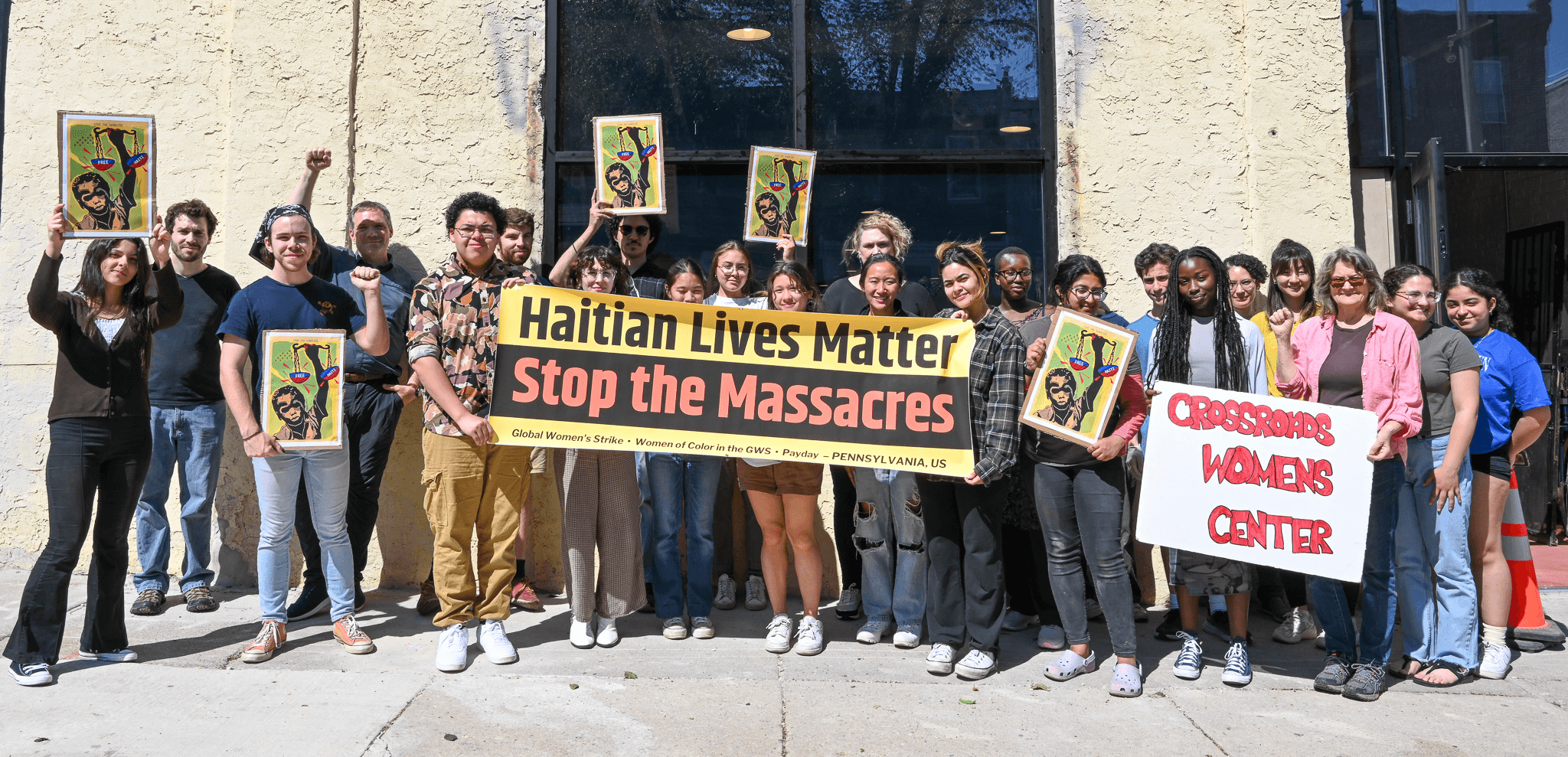
May 18th Protesters in Philadelphia holding up Emory Douglas’ art.

It is past time for the world to act in solidarity with the Haitian people. Haiti, historically and currently, continues to live up to the true meanings of revolution, liberation, and solidarity. The mobilizations on May 18th were another step towards this goal of intensifying international solidarity. As called for in the press release of the women’s and popular organizations of the Grandans, international solidarity is needed now to stop the genocide that is unfolding in Haiti, a genocide made in the USA, subsidized by US tax dollars, and aided and abetted by the “Core Group” and the UN. The array of attacks against Haiti’s grassroots movement for national liberation includes military interventions, fraudulent elections, phony economic assistance, media disinformation to maintain the status quo that benefits foreign multinationals and the Haitian oligarchy. Mobilizations are needed globally to condemn US and UN support for the Ariel Henry dictatorship and to end their policies that are destroying lives in Haiti. Solidarity actions including disruptive non-violent forms of resistance will need to be employed on greater and greater scales–in coordination with the decisive resistance on the ground in Haiti– until the Haitian people can complete their heroic revolution of 1804 and claim true victory once and for all.

Selma James at a May 18th Protest in London organized by Global Women’s Strike.