12 Mar 2025

Former Philippine President Duterte arrested for crimes against humanity

John Malvar


Former Philippine president Rodrigo Duterte was arrested on Tuesday at Ninoy Aquino International Airport in Manila after the International Criminal Court (ICC) issued a warrant charging him with crimes against humanity. Within twelve hours of his arrest, Duterte was flown to The Hague.

A plane carrying former President Rodrigo Duterte to The Hague takes off in Manila, Philippines on Tuesday, March 11, 2025. [AP Photo/Aaron Favila]

The 15-page warrant issued by the ICC panel of three judges charged Duterte with acts of murder “against the civilian population of the Philippines,” under the auspices of his so-called “war on drugs,” both during his terms as mayor of the southern city of Davao and as President. Duterte organized, encouraged, funded, and oversaw a network of murder, involving the police and vigilantes, that killed tens of thousands.

The arrest and immediate extradition of Duterte expresses the intensity of the ongoing political warfare among the Philippine elite over the country’s geopolitical orientation. The country is in the midst of a midterm election, scheduled to be held in May, that is being fiercely contested by the forces allied to President Ferdinand Marcos Jr, on the one hand, and those allied to his rival, Vice President Sara Duterte, daughter of the former president, on the other. Rodrigo Duterte is the most influential figure, the political godfather, of the slate opposed to Marcos.

Washington’s accelerating preparations for war with China are fueling the conflict in the Philippine elite. It has become entirely impossible to balance between economic relations with China and political relations with the United States. During his term as president, Duterte attempted to orient Philippine foreign policy away from Washington, announcing an end to a number of joint military exercises with the United States and refusing to pursue sovereignty claims against China over disputed waters in the South China Sea.

Over the past three years, Marcos, the son of the country’s former dictator, has reintegrated the Philippines in Washington’s war drive. He has opened military bases for US forces, allowed the Pentagon to supervise confrontations with China in the South China Sea with drones, and authorized the US deployment of an intermediate range Typhon class missile launcher system to the country with the capacity to target nearly all of China.

The “war on drugs” is not a divide between Marcos and Duterte. Marcos has continued Duterte’s policies. While the unrestrained bloodshed under his predecessor has been curtailed, the repressive apparatus created by Duterte remains in force, and the police and vigilantes continue to kills scores. If Duterte stands charges for crimes against humanity, Marcos should as well.

Former Philippine President Rodrigo Duterte takes oath during a senate inquiry on the so-called war on drugs during his administration at the Philippine Senate, on Oct. 28, 2024. [AP Photo/Aaron Favila]

The uncertainty surrounding US policy under the new Trump administration has sharpened the political volatility and widened the schism in the Philippine elite. The question of Manila’s geopolitical orientation has been compounded by intense speculation over the slashed funding of USAID and its impact on basic social amelioration programs, and, above all, the impact of possible tariffs on the Philippines economy.

Rice prices in the country are at record highs. The Marcos administration declared a national food security emergency last month. Rodrigo Duterte made rice prices, and Marcos’s inability to control them, a key election issue.

The midterm election, which most critically will select half of the Senate, became a referendum in the elite over the country’s geopolitical orientation and response to deteriorating social conditions. On the last day of the congressional session prior to its adjournment for the duration of the election, impeachment charges were abruptly filed against Vice President Duterte, charging her with corruption and with having called for the assassination of President Marcos. Congress voted to impeach, and the charges will be sent to the incoming Senate for trial.

The Marcos headed campaign has issued repeated statements calling on Filipinos not to vote for “pro-China” candidates. Baseless allegations of massive Chinese spying are being used to whip up an atmosphere of war hysteria and racist nationalism. The function of these lies is to attempt to divert mass anger away from the immense social crisis.

Rodrigo Duterte, running to again become mayor of Davao, headed the opposition slate. On Sunday he travelled to Hong Kong, along with the Vice President and other candidates of the opposition, for a political rally among the large community of Filipino workers there. On Tuesday morning, he was arrested when his return flight from Hong Kong landed in Manila.

The Marcos administration, in a press conference on Tuesday, reported that they received an arrest warrant from the ICC, served by Interpol, at three in the morning on Tuesday and authorized the Philippine police, with an Interpol representative, to make the arrest of the former president. Hundreds of police officers filled the airport. Duterte was taken, not to police custody at Camp Crame, but to the Villamor Air Base, headquarters of the Philippine Air Force.

Duterte’s legal representative filed an emergency case with the Supreme Court, claiming that the international warrant was invalid, as the Philippines had withdrawn its membership in the ICC. The Supreme Court did not convene, saying that it would hear the case the following day. On Tuesday, a private chartered plane flew Duterte to The Hague.

In 2018 Duterte withdrew the Philippines from membership in the ICC, rejecting any international investigation into the ongoing human rights violations of his administration. President Marcos in his brief press conference on Tuesday, absurdly pretended that the decision to arrest and extradite the former president was not a political decision but simply compliance with Interpol. The Philippines was not recognizing the jurisdiction of the ICC, he claimed, but simply responding to a request from Interpol. “Interpol asked for help,” he said, “and we obliged, because we have commitments to the Interpol.”

News of Duterte’s arrest was greeted with immense enthusiasm by wide layers of Philippine society, particularly among students and families of the victims of the war on drugs. Duterte is unquestionably guilty of the crimes of which he is accused.

Duterte publicly instructed the police to shoot people accused of drug dealing, rather than arrest them. He explicitly and repeatedly stated that he was extending immunity from prosecution to all police accused of murder in this campaign. The police, under Duterte’s instructions, began to pay vigilantes money for every person they killed. Mutilated corpses were left in the streets, cardboard signs reading “I’m a pusher” laid across their lifeless bodies.

The best estimate for the number killed by police and vigilantes under the Duterte administration, based on a careful tally of the official death toll and the ratio of vigilante killings to police murder, is around 30,000. The victims were drawn exclusively from the most impoverished and oppressed layers of Philippine society. Duterte’s war on drugs was a war on the poor. It was the fascist face of the ruling elite in suppressing the worsening social crisis and the threat of unrest.

Duterte did not create this apparatus of murder alone. Sen. Ronald dela Rosa, then head of the Philippine National Police, oversaw the daily operations of repression. Duterte’s legal team justified it. A network of businessmen, cabinet officials and religious figures sat on his Anti-Terror Council and oversaw the stripping away of the democratic rights of the population. An overwhelming majority of the legislature, the largest supermajority in Philippine history until then, backed the President. Many of those on the Marcos ticket, who now denounce Duterte, were in fact his enablers.

The Obama administration provided millions in funds earmarked for Duterte’s war on drugs in 2016, after the body count was already in the hundreds, and as Duterte publicly spoke of killing a hundred thousand. The Obama White House only discovered its concern for human rights when Duterte oriented Philippine foreign policy to China. The Trump administration in 2017 enthusiastically endorsed Duterte’s policies. Trump told Duterte in a phone call that he hoped Duterte could teach the US how to use his methods for dealing with the immigrants on the southern border. Joe Biden invited Duterte to a “Summit for Democracy” with a letter that read we “recognize and appreciate your partnership in working to build democratic and human rights-respecting societies that allow all citizens to thrive.”

Political culpability for Duterte’s rise to power rests with the Stalinist Communist Party of the Philippines (CPP) and the various national democratic organizations, such as Bayan, that follow its political line. The CPP long supported Duterte as mayor of Davao. The organization Bayan campaigned for his election in 2016. Jose Ma Sison, head of the CPP, hailed Duterte’s election, calling Duterte a “socialist,” and selected three members of Duterte’s cabinet. In the early stages of his war on drugs, the CPP and Bayan defended the President.

President Ferdinand Marcos Jr himself faces international charges for human rights violations. He was an integral part of his parent’s military dictatorship, serving, among other things, as governor of Ilocos Norte. When Marcos was elected President in 2022, Biden arranged immunity for Marcos against an outstanding arrest warrant in US courts on charges of human rights violations.

The legal case justifying the arrest and extradition of Duterte was presented by Chief Presidential Legal Counsel Juan Ponce Enrile. Now over 100 years old, Enrile was the architect of martial law and the head of an entire apparatus of military torture and murder under the Marcos Sr administration.

The content of the ICC warrant and, above all, the timing of its release are of a highly political character. While details have yet to emerge, the arrest of Duterte could not have occurred without the endorsement and support of Washington, even though the US has not ratified the Treaty of Rome and is not a member of the ICC. However the decision to arrest and extradite Duterte was exactly arrived at, it clearly serves the interests of US imperialism.

Washington defends and funds war criminals when it serves its interests. It threatens sanctions against anyone who aids the ICC in serving its outstanding warrant against Israeli Prime Minister Benjamin Netanyahu for war crimes in Gaza. It backed Duterte’s crusade of murder as long as he served US interests. Duterte’s arrest is part of a political war being waged by Washington for the geopolitical loyalty of Manila in its drive to war with China.

Jobs cull at universities in Wales, part of over 10,000 losses UK wide

Henry Lee


Welsh universities are cutting hundreds of jobs, including 400 redundancies and the closure of courses at Cardiff University. This slash-and-burn campaign takes place with the direct collaboration of the Welsh government led by the Labour Party.

More than half of the universities across Britain have announced thousands of job cuts. Higher education workers have begun to resist, with three weeks of strikes having begun at Dundee University against 200-500 jobs cuts, and workers at Newcastle University and Brunel University striking during March/April against hundreds of cuts.

The Ewing Building, in the city campus of the University of Dundee, Scotland. [Photo by Otsima / Wikimedia / CC BY-SA 4.0]

Members of the University and College Union (UCU) at the University of East Anglia have voted by 82 percent to strike, and a ballot is open at the University of Sheffield where as many as 1,000 staff face redundancy. Ballots are also going ahead at Durham University over plans to cut £20 million from the university’s staffing budget and Keele University over £2.25 million in cuts involving job losses in its School of Humanities and Social Sciences, and Business School.

Stopping the destruction of large parts of higher education will require workers to confront the Labour Party and its partners in the trade union bureaucracy. Any notion that Labour can be pressured to defend education is refuted by the experience of the cuts at Cardiff.

Cardiff plans to shut down its courses in nursing—amid an NHS staffing crisis—music, modern languages and ancient history. Some staff have reportedly been told that if they want to keep their jobs they should prepare to teach at the university’s campus in Kazakhstan!

Staff cuts mean increases in class sizes. It is already common in UK universities that students cannot fit in lecture rooms and have to watch on a screen from another room, or lecturers have to give the same lecture twice to different groups. The vice-chancellor of the University of East Anglia told THE (formerly, Times Higher Education) that increasing class sizes is “one of the easiest ways to improve efficiency and boost productivity”.

There is mass public opposition. Almost 20,000 people have signed a petition to save Cardiff’s School of Nursing, and a petition for the School of Music has over 25,000 signatures.

Cardiff’s is one of only two scholarly music studies courses in Wales. The department, Professor Ian Pace told THE, is “home to arguably the UK’s leading scholars of Liszt, Stravinsky and Janáček, not to mention pioneering, world-leading scholars of Mendelssohn, historical performance, music in Vienna, and both 19th- and 20th-century French music and opera.”

Around half the job cuts will come from the merger and “reshaping” of other departments, including the School of Mathematics, which will become part of the new School of Data Science, Mathematics and Computing. This is despite the fact that universities tend to make a profit on maths students, who need little beyond a blackboard and a mathematician to learn.

Such cuts to “pure” and exploratory science will be driven by the calculation that courses based on AI and data science can take more of the lucrative market for one-year masters, charging enormous fees to international students.

More than 3,000 scientists and mathematicians, including two Nobel prize-winners in physics and 17 Fields medalists (a mathematics prize as prestigious as the Nobel) signed an open letter warning the cuts could be “the beginning of the end of pure and applied mathematics research and teaching”. The letter notes, “Mathematics is the foundation and fuel of AI … Separating mathematical scientists in the proposed new structure is a short-sighted move that will put Cardiff on the back foot in this rapidly developing field.”

As well as the 400 cuts at Wales’s only Russell Group university (a leading public research institution) in Cardiff, another 200 cuts are planned at Bangor University. Aberystwyth University’s recent financial report noted “increased use of a revolving credit facility”. The University of Wales Trinity Saint David will stop offering undergraduate degrees at its historic campus in Lampeter—the first higher education institution in Wales—and older than every English university apart from Oxford and Cambridge.

The UCU has a track record of collaborating with management in job losses, provided they can proceed on a “voluntary” not compulsory basis. Many thousands of jobs have already been cut in the last 15 years in this way.

The union refuses to organise any nationally co-ordinated industrial action to fight the jobs cull—in which over 10,000 of its members jobs are on the chopping block—instead launching a feeble “Stop the Cuts” initiative last week. The campaign’s main purpose is to divert members’ anger into bankrupt appeals to the pro-big business Labour government of Sir Keir Starmer.

Opposed to industrial action with the potential to bring university sector to a standstill, the UCU instead proposes a March 18 rally and parliamentary lobby, and for a national demonstration in London, even later and virtually as term ends, on May 10. Its goals are to “demonstrate the current dire conditions in UK universities and the consequences of government inaction”—as if everyone is not already aware—and that the “UCU will put pressure on the UK government to change their current position and invest and intervene to alleviate the crisis in higher education.”

But Starmer’s right-wing government has made clear it will not prevent widespread destruction of jobs in higher education. Minister for Skills Baroness Jacqui Smith pledged that “there will not be a major reform of the way in which we fund higher education.”

The new chair of the universities regulator Office for Students (OfS), Edward Peck, told MPs last week that bailing out universities in financial difficulties would create a “moral hazard” and risk “universities and colleges and other providers becoming public sector organisations, which I think we want to avoid.”

Labour’s response to the crisis in Welsh universities has been a mixture of denial, token measures and attempts to exclusively blame Cardiff University’s leadership.

Vikki Howells, the Minister for Further and Higher Education in the Welsh government, announced £18.5 million in additional funding, but not to save jobs. The funding is earmarked to be spent on “estates maintenance” and digital projects to reduce operating costs, which only means it will free up more money to be used on paying redundancy costs and other measures to cut the staffing bill.

Much has been made of plans to change Competition and Marketing Authority rules on collaboration between universities, which can only mean sharing services to cut administrative jobs.

In a Senedd debate on February 5, Howells denied that there was even a crisis, declaring “Our universities in Wales are not underfunded. OECD data suggests that universities in the UK are some of the best funded in the world.”

Claiming restricting social spending was the only option, she said “even if we were to cut grants for students or divert funding away from the NHS, schools or local government to increase funding for our universities, as some Members opposite would have us do, universities would still need to change in response to external challenges”. The military budget, being increased by at least £6 billion a year from 2027, was not mentioned by a single member as an alternative source of funds.

For its part, Plaid Cymru, the nationalist Party of Wales, suggested that more funding could be taken out of students’ pockets by “recaptur[ing] around £34 million from maintenance grants that currently go to the 40 percent of Welsh students who study outside Wales”.

11 Mar 2025

Warning strikes in Germany’s public services: “€500 billion for us instead of for armaments”

Marianne Arens


Warning strike in public services, demonstration through Berlin’s Wedding district. The banner reads: “Public services broken and broke,” March 6, 2025

The current public sector warning strikes in Germany express the great anger that is building up in all areas of public services. On Thursday and Friday last week, tens of thousands of care workers, nursery nurses, cleaners, social workers and midwives went on strike. On Monday, ground staff at 13 airports went on strike for the whole day; there were also strikes in the aviation security sector. From Hamburg and Berlin to Frankfurt, Cologne, Düsseldorf and Munich, a total of 13 airports went on strike, resulting in more than 3,000 flights being cancelled for around 400,000 passengers. Strikes at many municipal companies and in local public transport will follow on Tuesday and Wednesday.

Since the coronavirus pandemic, all these operations have been run down. Today, workers are confronted with the fact that the incoming Christian Democrat (CDU)-Social Democrat (SPD) coalition government is pumping hundreds of billions into the arms industry even before taking office, while it starves public services of much-needed funds.

The warning strikes are taking place before the third and decisive round of negotiations on the new public sector contract (TVöD), which will be held in Potsdam March 14-16. The service trade union Verdi is officially demanding 8 percent more pay, with at least €350 more for those on low wages, as well as an extra three days leave.

However, the union leadership already knows that the contract that will emerge will fall far short of meeting these demands. It will be no better than the one they just signed at Deutsche Post, which with 2.3 percent inflation this year only provides for a 2 percent increase, effectively lowering real wages. In addition, 8,000 postal jobs will be cut this year.

Nationwide, more than 2.6 million public sector employees are affected. On March 14, Verdi negotiators Frank Werneke (SPD) and Christine Behle (SPD) will meet with the representative of the municipal employers, Karin Welge (SPD), and current Federal Interior Minister Nancy Faeser (SPD) in Potsdam. Their party, the SPD, together with the CDU/CSU, have just approved taking out war loans of several hundred billion euros. Up to €1 trillion are to be spent on preparing society for war!

In the public sector, this will inevitably lead to even sharper attacks on jobs, wages and social benefits. It is becoming increasingly difficult for Verdi to push this through. For this reason, the token “warning” strikes this week and next week have taken on a greater scale than originally planned. At the same time, Verdi is firmly sticking to its support for the government’s pro-war policies and its close cooperation with the SPD.

Warning strikes in the public sector, demonstration by hospital staff through Berlin’s Wedding district, March 6, 2025

In Berlin’s Wedding district, a Verdi spokeswoman and representative of the Left Party, Stella Merendino, warmly welcomed the SPD’s labour market policy spokesperson to the podium. Several speakers called for a wealth tax and inheritance tax, without mentioning a single word about the “special fund” for war that the SPD has just agreed with the CDU/CSU.

Last Thursday, staff were on strike at the Charité and Vivantes hospital in Wedding, where around 1,500 employees demonstrated for higher wages and better working conditions. Among them were employees of Charité Facility Management (CFM), which had been spun off from the parent company years ago. Since then, around 3,000 CFM employees have been earning up to €1,000 less than the TVöD contract provides for the remaining 23,000 or so Charité employees.

One CMF employee told WSWS, “It cannot be that billions are spent on the rich and on war, and we ordinary workers are supposed to get less and less.”

Guido, who works as a cleaner at the hospital, reported on the poor pay he receives, well below €2,000 net a month despite shift and holiday work. What was particularly important to be addressed, he said, “are the poor working conditions: no paid breaks, every smoking break must be accounted for. We often must clean our work clothes ourselves.” He explained that he thought it “important if we all went on strike together and not just one day here and then another day there.”

What Guido expressed is on the minds of thousands across the country, because the warning strikes are carried out in isolation and separately from one another—precisely to “let off steam,” but not to really mobilise the fighting strength of the working class.

Warning strikes in the public sector, Verdi rally in Nuremberg, 7 March 2025

In Nuremberg, too, several strikers expressed the same wish. “The union should be taking a completely different approach,” a young psychiatric nurse from Middle Franconia told us. “In the social sector, the strike is made difficult for us,” he said. “We don’t want people to die because there is no one in the hospital. But it’s not our fault! We should finally go on strike together properly, that would show solidarity and make sense.” He added, “I would also take to the streets in solidarity with my colleagues at Deutsche Post.”

In Nuremberg, several thousand strikers took part in actions that paralysed the Nuremberg Clinic, other hospitals in Middle Franconia and the youth welfare offices and municipal daycare centres.

Many strikers carried self-made signs and banners with inscriptions such as “It’s not the strike that endangers patients, but the normal state of affairs.” Others read “I can’t work as badly as I’m paid.”

Public sector workers on strike, Nuremberg strikers demand: “500 billion for us instead of for armaments’

“500 billion for us instead of for armaments!” demanded nursing staff on a home-made poster. Others had written: “You’re quick on armaments, but you’re doing nothing for nursing.”

The psychiatric care specialist quoted earlier also told us, “What Verdi is demanding is not enough. Our wages are only slightly above the minimum wage. If we had a four-day week and better pay, staff turnover wouldn’t be so high.” That was why it was important for him to take part in the strike, he said. “A pay freeze—that’s just not on. We have a really stressful job in nursing, and we deserve more money than that.”

With a frown, the same nurse described the latest pay agreement at Deutsche Post as “a big Verdi joke, to be honest.” He said he did not understand why postal workers, like nurses and other public sector employees, were not paid as well as, for example, a skilled Mercedes worker.

10 Mar 2025

The Petrodollar – The US-Saudi Deal that Ruined the World

Daragh Cogley


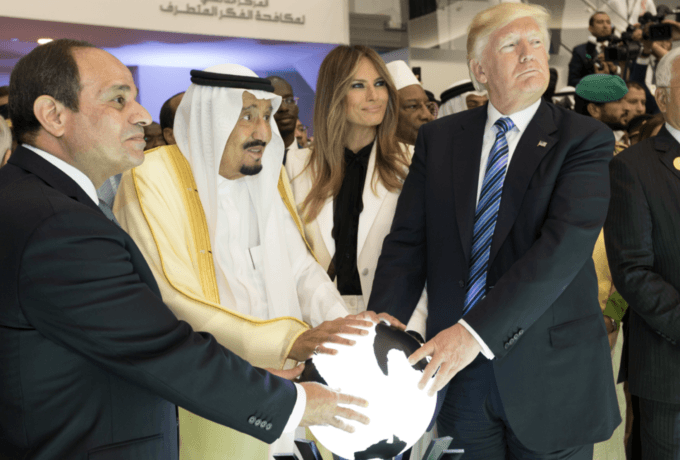
King Salman, Presidents Trump and el-Sisi inaugurate the Global Center for Combating Extremism by touching an illuminated globe of the Earth. Image Wikipedia.

“I’m going to Saudi Arabia. I made a deal with Saudi Arabia. I’d usually go to the U.K. first. Last time I went to Saudi Arabia they put up $450 billion. I said well, this time they’ve gotten richer, we’ve all gotten older so I said I’ll go if you pay $1 trillion to American companies, meaning the purchase over a four-year period of $ 1 trillion and they’ve agreed to do that. So, I’m going to be going there. I have a great relationship with them, and they’ve been very nice but they’re going to be spending a lot of money to American companies for buying military equipment and a lot of other things.” – President Donald Trump, 7th March 2025.

What is the true importance of the US-Saudi relationship in the global economy? It’s based on the two things that make the economy go round – money and oil.

The United States–Saudi “petrodollar” arrangement has underpinned American economic and military power for nearly five decades. In essence, oil exports from Saudi Arabia (and later OPEC broadly) have been priced in U.S. dollars since the 1974, ensuring a constant global demand for the dollar and U.S. Treasury assets. This monetary system forms the hidden backbone of a web of consequences – from U.S. imperialism and geopolitical maneuvering to environmental degradation and extreme wealth accumulation. Today, roughly 80% of global oil transactions are still conducted in USD, illustrating the petrodollar system’s enduring influence. Below, we analyze the historical origins of the petrodollar, explain how this monetary system became a root cause linking finance to geopolitics and ecological crisis, and discuss proposed alternatives like Modern Monetary Theory (MMT) that could break the cycle.

Background

In the aftermath of World War II, the Bretton Woods system (1944) established the U.S. dollar as the world’s anchor currency, pegged to gold, which cemented U.S. economic dominance. However, by 1971 the U.S. faced mounting trade deficits and dwindling gold reserves, as countries sought to trade USD for gold they didn’t have, US President Nixon ended dollar convertibility to gold – a move that threatened the dollar’s supremacy. The solution emerged via oil: in 1974, one year after the oil crisis, Washington and Riyadh struck a pivotal deal (kept secret until 2016) that ensured Saudi oil would be priced exclusively in dollars. In return, the U.S. provided military protection and lucrative arms sales to Saudi Arabia, and Saudi leaders would recycle their oil revenues into U.S. Treasuries and American investments. This U.S.–Saudi arrangement laid the foundation of the petrodollar system, firmly tying the world’s most traded commodity (oil) to the American currency.

The timing was crucial. The 1973 oil embargo had quadrupled oil prices from about $3 to $12 a barrel, sparking a global energy crisis. The U.S. sought to tame this “oil weapon” by binding oil exports to the dollar – thereby turning petrodollars into a pillar of U.S. financial might. By the late 1970s, most OPEC producers followed suit in trading oil for USD, and surplus petrodollars were funneled into Western banks and U.S. debt. This recycling of oil revenues back into American markets propped up U.S. budget deficits and helped finance Cold War expenditures. In effect, oil-exporting nations accepted dollars (often investing them in the US) in exchange for security guarantees and access to American goods and technology. The long-term implications were profound: the dollar became the default currency for global oil trade, bolstering its reserve currency status and enabling the U.S. to maintain economic and military pre-eminence “almost as a matter of course”. This petrodollar order has remained largely intact through the present, anchoring U.S. dominance in the world economy.

2. The Monetary System as the Root Cause

The petrodollar system entrenched the U.S. dollar’s global monetary hegemony, allowing the United States to exert outsized influence without the typical constraints faced by other nations. Because countries worldwide need dollars to buy oil, they hold vast USD reserves and invest in U.S. assets (like Treasury bonds), which funds U.S. deficits and keeps American interest rates lower than they otherwise would be. In practical terms, this means the U.S. can run the printing presses – or more accurately, expand money supply – to finance government spending (military, infrastructure, etc.) without triggering hyperinflation, as the excess dollars are absorbed abroad to settle trade and reserve needs. This unique privilege, often dubbed “exorbitant privilege,” roots many subsequent geopolitical and economic dynamics.

More broadly, the modern money creation process itself is a key structural driver. In most advanced economies, money is created predominantly by private banks issuing loans, not by governments minting cash. About 97% of money in circulation is created by commercial banks when they extend credit (e.g. granting loans), whereas only ~3% is physical cash from central banks. Debt-based money comes with a built-in growth imperative: banks lend money into existence with an obligation to be repaid with interest, meaning total debt continually exceeds the money available to repay it. New loans must constantly be created so borrowers can obtain the funds needed to pay interest on yesterday’s loans. If this expansion falters, the result is a contraction – loan defaults, bankruptcies, and recession – since under our interest-bearing system “an expanding amount of loans are needed to keep the system running smoothly” and avoid a cascading collapse.

Jem Bendell , author of Breaking Together, refers to this phenomenon as the “Monetary Growth Imperative,” wherein the economy “must expand whether society wishes it to or not” just to service the debt overhead. In other words, continual GDP growth is structurally required to sustain the monetary system.

This dynamic has fostered a financialized economy where speculation often outranks production. With easy credit and abundant petrodollars sloshing through global markets, capital tends to chase quick returns via financial instruments rather than long-term productive investment. Private banks, seeking secure profits, create money disproportionately for assets like real estate and stocks (fueling price bubbles) instead of lending to manufacturing or local businesses. As a result, we see huge asset bubbles that benefit the mega-rich but relatively underfunded productive sectors. The monetary system’s incentives thus tilt toward Wall Street over Main Street – leveraging debt to amplify wealth for those at the top. Additionally, the constant need to avoid contraction pressures governments to prioritize policies that stimulate growth (often measured as rising GDP) above all else, sometimes at the expense of social or environmental considerations. In sum, the petrodollar-reinforced debt-money system creates self-perpetuating cycles: the U.S. can flood the world with dollars to sustain its dominance, and globally the pursuit of dollar profits drives speculative finance and a growth-at-all-costs mentality. This underlies many downstream effects from military interventionism to ecological overshoot.

3. Imperialism and Geopolitics

Control over the international monetary system, anchored by the petrodollar, has directly enabled U.S. imperial reach and the expansion of its military–industrial complex. Since foreign governments must hold dollars, they effectively help finance U.S. deficit spending – including the Pentagon’s budget – by purchasing U.S. treasuries. This recycling of petrodollars allowed America to run “guns and butter” policies (funding warfare and domestic programs simultaneously) without bankrupting itself. Petrodollar inflows have explicitly financed U.S. weapons exports and military aid, especially in the Middle East. For instance, petrodollar-rich Gulf states like Saudi Arabia have spent hundreds of billions on American arms over the years, funneling their oil proceeds back into U.S. defence contractors. This symbiosis solidified a regional security architecture with the U.S. as the guarantor – protecting friendly oil monarchies in exchange for their loyalty to the dollar system.

The U.S. has likewise used its monetary and military might to suppress challenges to this order. During the Cold War, pan-Arabist and socialist-leaning movements in the Middle East – which aimed to unite Arab states or pursue independent economic policies – were seen as threats to U.S. “vital economic interests” (i.e. access to oil on U.S. terms. The Eisenhower Doctrine (1957) explicitly targeted Egypt’s Gamal Abdel Nasser and other Arab nationalists, seeking to fracture Arab unity and keep pro-Western regimes in power. This strategy “sowed divisions within Arab ranks, triggering a fierce Arab Cold War” and undermined any concerted effort by oil-producing nations to chart an autonomous course. Later, when individual leaders attempted to bypass the petrodollar system, they often met harsh reprisals. Notably, Iraq’s Saddam Hussein switched to selling oil in euros in 2000, and Libya’s Muammar Gaddafi proposed a gold-backed African currency – moves that preceded U.S.-led military interventions that removed them from power, summed up in the infamous video of Hillary Clinton reacting to Gaddafi’s killing  “We came, we saw, he died”. While many factors were at play in those conflicts, the message was clear: the U.S. would not tolerate challenges to dollar dominance in oil markets.

U.S. alliances in the region further reflect petrodollar geopolitics. Israel’s role as a key American ally (and military foothold) in the Middle East has been heavily financed by U.S. dollars – the U.S. currently has provided Israel with over $250bn since 1959, with unprecedented military-aid being sent to Israel since the beginning of the genocide in Gaza, in excess of more than $20bn. This support, partly enabled by America’s fiscal freedom under the petrodollar system, ensures Israel’s qualitative military edge and U.S. influence over the region’s political trajectory. Conversely, oil-rich countries that resist U.S. hegemony (Iran, Venezuela) have been isolated via sanctions that leverage the dollar’s centrality in global finance. More recently, the U.S. has been able to commit extraordinary sums to distant conflicts – for example, Congress approved $175 billion+ in aid to Ukraine since 2022 – with relatively little immediate economic fallout at home. This level of expenditure (unthinkable for most countries) is buoyed by the dollar’s reserve status and the Federal Reserve’s capacity to create money that the world will absorb. In short, the petrodollar-backed monetary order acts as a force multiplier for U.S. imperial strategy: it finances a global network of hundreds of overseas bases and proxy engagements, and it gives Washington a powerful economic weapon (control of dollar-based transactions) to reward allies and punish adversaries. The result is a geopolitical landscape where U.S. military supremacy and currency supremacy reinforce each other, often at the expense of smaller nations’ sovereignty.

In fact, it is the debt-based monetary system that has trapped many developing nations in a cycle of borrowing and export dependency, often enforced by international financial institutions and trade agreements. Under the current system, countries in the Global South are pressured to extract and export commodities (oil, minerals, cash crops) to earn the foreign currency needed to service debts and pay for imports – effectively subsidizing affluent lifestyles elsewhere at the cost of local ecosystems. Indeed, our “debt-based monetary system” creates a built-in incentive for “world export warfare”, where nations must compete for export markets to try to obtain debt-free income. This wealth transfer occurs through different mechanisms, primarily debt and price differentials in international trade resulting in unequal exchange, which, according to a 2022 paper from Hickel et al, between 1990-2015 alone, resulted in a wealth drain from the South totaling $242 trillion, equivalent to a quarter of Northern GDP.

4. Environmental and Economic Consequences

This debt-fueled, growth-obsessed petrodollar system has also driven environmental destruction and locked in a fossil-fuel-dependent global economy. The arrangement implicitly incentivizes high oil consumption: oil exporting nations earn dollars and invest in growth, while oil-importing countries need growth to afford expanding energy imports. Consequently, the world’s energy and economic structures have been slow to change. As of 2022, about 80% of global primary energy still comes from fossil fuels, a statistic tied to the petrodollar era’s legacy. There is a well-documented 1:1 coupling between global GDP and global energy use, particularly fossil fuel use . In effect, economic growth has meant burning more oil, gas, and coal, leading to rising carbon emissions. Under the current system, if we “don’t keep the global economy growing by at least 3% per year, it plunges into crisis,” doubling the economy’s size every ~20 years. This exponential growth mandate collides with the reality of a finite planet. It translates into ever-expanding extraction of natural resources and ever-expanding waste (greenhouse gases, pollution), because efficiency improvements alone have not stopped total resource use from climbing, due to Jevon’s paradox and the growth-paradigm.

Critically, the monetary growth imperative undermines efforts to transition to sustainability. As Bendell observes, our debt-based monetary system “does not allow a steady-state economy” – it literally “prevents effective climate change mitigation…without monetary reform” Governments are pressured to maximize short-term GDP (to service debts and maintain employment), often prioritizing elite accumulation through inflating asset prices, destructive economic expansion and consumerism over conservation. The petrodollar system reinforces this by promoting fossil-fueled development; countries that grow faster (with high energy use) accumulate more dollars, while those that try to curb fossil fuels risk economic stagnation under current metrics. Meanwhile, oil-rich states have had little incentive to diversify away from hydrocarbons as long as oil revenue secures their geopolitical standing. The result is a vicious cycle: debt drives growth, growth drives fossil fuel combustion, and fossil fuels exacerbate climate change and ecological harm. As one commentator put it, “American empire is inextricably linked with fossil fuels, and to mitigate climate change, it must come to an end”. In other words, genuine environmental solutions require confronting the political-economic system that maintains fossil dominance.

The petrodollar link also explains the slow global response to climate change. U.S. policymakers (and other major oil stakeholders) have often been reluctant to fully embrace decarbonization, not only due to oil industry lobbying but because a shift away from oil threatens the basis of the dollar-centric order. A world less dependent on oil could erode the automatic demand for USD, undermining U.S. financial power. Indeed, analysts note that if renewable energy and electrification significantly reduce oil trade in the coming decades, it “could eventually lead to a reduction in petrodollar flows” and weaken the dollar’s global standing. Thus the climate crisis and the petrodollar system are intertwined challenges. The very same debt-growth engine that boosted GDP (and elite wealth) in the 20th century is now pushing the planet toward ecological breakdown, by making perpetual expansion the condition for economic stability. Breaking this cycle is essential not only for environmental reasons but to free economies from what Jason Hickel calls “the logic of endless growth” that defies planetary limits.

5. Alternative Solutions and MMT

Addressing these deeply interlinked issues requires rethinking the monetary system itself. A range of economists and scholars have proposed solutions to remove the growth imperative and make finance serve people and planet rather than the elite few. One approach is to shift from privately controlled, debt-based money creation to democratically managed money that can be directed toward public purposes. Instead of relying on commercial banks to create money (and channel it into speculation or property bubbles), the state could create and spend new money directly into the real economy, funding useful projects like renewable energy, public infrastructure, healthcare, and education. Such a system of sovereign money (sometimes called “green quantitative easing” or public banking) would inject liquidity where it’s needed for social and environmental goals, rather than inflating huge asset bubbles that only benefit the mega-rich. The money supply could grow or contract in a controlled way to meet societal needs, without the destructive necessity of ever-increasing debt. Notably, the proposal is not for the government to print limitless cash, but to replace interest-bearing bank loans with debt-free public spending as the primary way new money enters circulation. This idea harkens back to thinkers like Samir Amin, who advocated “delinking” developing economies from the dictates of Western finance in order to pursue self-determined development. By reclaiming monetary sovereignty – whether through nationalizing credit creation or regional alternatives to the dollar system – countries could invest in long-term prosperity and sustainability without being trapped by dollar-denominated debt and growth-at-any-cost policies.

Modern Monetary Theory (MMT) offers another lens for solutions, especially for advanced economies like the U.S. and those with their own currencies. MMT economists (e.g. Stephanie Kelton , Fadhel Kaboub فاضل قابوب ) argue that a sovereign government cannot “run out of money” in its own fiat currency the way a household or business can. As Kelton puts it, for a country that issues its own currency, there is never a danger of debt spiraling out of control, because it can always create money to service its obligations. The real limits are not financial but resource-based – inflation will only arise if government spending pushes total demand beyond the economy’s productive capacity (labour, materials, technology). This perspective suggests that scarce funding is not the barrier to tackling issues like poverty, infrastructure, or climate change; what’s needed is political will and careful management of real resources. For example, using an MMT framework, the U.S. or any currency issuing country could finance a Green New Deal – mass investments in clean energy, transit, and green jobs – by issuing currency, without needing to tax or borrow first, as long as idle resources (unemployed labour, etc.) are put to work. Far from causing runaway inflation, such spending would increase productive output and sustainability, and any inflationary pressure can be managed via taxation or other tools. Importantly, MMT also highlights that monetarily sovereign governments don’t need petrodollar recycling or foreign loans to fund themselves; their spending is constrained by what’s available to buy in their own currency, not by foreign exchange. This undercuts the rationale for maintaining structures like the petrodollar – if the U.S. can afford to invest in renewable energy and social programs without Saudi petrodollar recycling, it might reduce the strategic obsession with oil-based dollar supremacy.

Leading voices have emerged to champion these ideas. Economist Fadhel Kaboub, for instance, emphasizes that developing nations can use MMT principles to achieve monetary sovereignty and resilience, rather than depending on IMF loans or dollar reserves. He points to strategies such as building domestic food and energy systems to reduce import dependence and denominating debts in local currency, so that Global South countries can escape the trap of dollar-denominated debt that forces austerity. Jason Hickel, from a “degrowth” and global justice perspective, likewise calls for moving beyond GDP growth as the measure of success and financing a fair economic transformation (especially in the Global South) through public-led investment and technology transfer. Dr. Steve Keen and David Graeber have both called for modern debt-jubilees, to liberate ourselves from this unpayable debt cycle that has dictated and limited human societies for millennia. Their work suggests cancelling odious debts, taxing or expropriating the excess wealth of elites, and redirecting resources toward climate mitigation, adaptation, and human wellbeing – all of which would be easier under a redesigned monetary regime that isn’t predicated on private profit. Even scholars of collapse like Jem Bendell argue that monetary reform is central to any hope of mitigating climate catastrophe; as he bluntly states, without altering how money is created and allocated, societies “will be prevented from effective climate change mitigation” and from adapting to coming disruptions. In summary, these alternative paradigms (sovereign money, MMT, degrowth) converge on a key point: freeing the economy from the tyranny of the petrodollar and debt-driven growth would enable humanity to prioritize ecological stability and equitable development. By reclaiming the monetary commons for public good, we could break the cycle of imperial warfare, environmental exploitation, and elite enrichment that the current system produces.

Conclusion

The U.S.–Saudi petrodollar deal of the 1970s created a self-reinforcing cycle that has shaped global politics, economics, and the environment in far-reaching ways. It tethered the world’s monetary order to fossil fuels and U.S. military might, allowing American elites to amass wealth and power under the guise of “maintaining liquidity” for global trade. The consequences – imperial interventions, entrenched petro-states, financial crises, and climate change – are not isolated problems but different facets of a singular system. Understanding the monetary root cause clarifies why efforts to address issues like endless wars or carbon emissions often hit a wall: the prevailing system is built to expand itself, not to prioritize peace or planetary limits. However, as we have seen, this system is not immutable. History is now at an inflection point where the petrodollar’s dominance is being quietly challenged. China, Russia, and other nations are experimenting with oil trade in other currencies, and U.S. financial sanctions on rivals have spurred talk of de-dollarization. At the same time, the imperative of climate action is pushing the world toward renewable energy, which in the long run will weaken the oil-dollar nexus. These trends suggest that the petrodollar system’s grip may loosen in the coming years.

Yet simply replacing the U.S. dollar with another currency for oil trade would not automatically dissolve the deeper problems – it might just shift the locus of power. The more fundamental change advocated by the thinkers cited above is to redesign how money works and what it serves. By moving to a post-petrodollar era of cooperative monetary policy, debt-free public investment, and truly sustainable economics, it becomes possible to address the interconnected crises at their source. That means breaking the feedback loop of oil, dollars, and weapons, and instead using monetary tools to foster global justice and ecological balance. In conclusion, the petrodollar deal was not just a quirky historical pact – it has been the linchpin of an entire world-system of U.S. hegemony, elite enrichment, and fossil-fueled growth that turbocharged the ‘great acceleration’ that has pushed the global economy far outside what our planet can sustainably support. Recognizing that the monetary system lies at the root of imperialism and environmental breakdown is the first step toward imagining new systems that prioritize peace, shared prosperity, and a livable planet. The challenges are immense, but so are the possibilities if money creation and resource allocation are reclaimed for the common good. The downfall of the petrodollar need not be a crisis; it could be an opportunity to chart a different course for both the global economy and Earth’s future.

Over 1,000 dead as Western-backed HTS regime in Syria escalates massacre of Alawites

Hakan Özal


In Syria, the Western-backed Haiat Tahrir al-Sham (HTS) regime’s massacre of Alawites has escalated, with over 1,000 people killed.

The UK-based Syrian Observatory for Human Rights (SOHR) reported that armed groups affiliated with the HTS regime have killed at least 745 civilians, including women and children, in the coastal region since Thursday. The brutality of the killings was demonstrated by the bodies being left in the streets as a warning.

Relatives and neighbours attend the funeral procession for four Syrian security force members killed in clashes with loyalists of ousted President Bashar Assad in coastal Syria, in the village of Al-Janoudiya, west of Idlib, March 8, 2025 [AP Photo/Omar Albam]

HTS jihadist terror against Alawites and other religious minorities is not new. As the World Socialist Web Site has reported, these attacks have been systematic since it took power in Syria in December, toppling the regime of President Bashar al-Assad. In late December, the aggression of the regime forces led to mass protests.

According to BBC reports, the violence began when residents of Beit Ana village in Latakia refused to hand over a suspect to security forces on Thursday and quickly spread to other coastal cities in the northwest. Armed groups composed of former Syrian army soldiers launched coordinated attacks on government checkpoints, security convoys, and military positions. In response, the interim government forces launched a large-scale operation.

By Saturday, SOHR was already reporting that at least 745 civilians, 148 insurgents, and 125 regime soldiers had been killed during the operation. Alawite men who served in the security forces during the Assad regime were executed by the new government forces, and many Alawite villages were looted and set on fire.

Jenan Moussa, Al-Aan TV’s Middle East correspondent, shared footage on social media related to HTS militia’s attacks in the Latakia region on Friday. The videos show severe violence against individuals described by the Syrian regime as “remnants of the old regime,” with most victims wearing civilian clothes. Moussa’s footage revealed 29 men executed in the Al- Mokhtariyeh area and 11 in Al-Hafa.

The videos included sectarian insults and slogans. In one, an HTS supporter referred to the victims as “dead animals.” Another showed a man in civilian clothes and slippers being shot at close range.

SOHR is an anti-Assad organisation funded by the UK Foreign Office and other European powers. It’s director, Rami Abdulrahman, was imprisoned three times in Syria before fleeing to the UK. He stated that the widespread massacres in areas with dense Alawite populations, such as Jableh, Baniyas, and surrounding regions, are among the worst violence in the 14-year civil war. Abdulrahman emphasized, “This is not about being pro or against the former Assad regime. These are sectarian massacres that aim to expel the Alawite population from their homes.”

On Saturday, social media platforms were filled with photos and condolence messages from Syrian users regarding those killed in the coastal region. Reuters spoke to six residents who reported that thousands of Alawites and Christians fled their homes due to safety concerns since Thursday. Many, mostly women, children, and the elderly, were forced to seek refuge at the Russian military base in Hmeymim, Latakia.

Abdulrahman noted that Alawite civilians, including women and children, were “executed,” and their homes and property looted. He reported that killings, looting, and arson continued throughout the night in Baniyas and surrounding villages as of Saturday.

Aron Lund from the independent research foundation Century International told AFP, “The authority [of the new regime] is based largely on radical jihadists who consider the Alawites to be enemies of God.” Lund added, “When there is an attack, these groups then carry out raids of Alawite villages, which don’t just include armed former soldiers but also vulnerable civilians.”

The Syrian state news agency SANA cited an unnamed security official stating that many fighters went to the coastal regions to avenge attacks against security forces.

Allegations suggest that HTS-affiliated groups, the successor organisation of the al-Nusra Front—which was formerly allied with al-Qaeda—have made calls in mosques stating that “killing Alawites is obligatory.” There are videos supporting these allegations on social media.

Al Jazeera’s correspondent in Damascus, Resul Serdar, reported on Saturday afternoon that the intensity of clashes had significantly decreased, although fighting continued in the outskirts of towns. Serdar emphasized the growing “tragedy” due to increasing casualties, noting, “Hundreds of people have been killed and the majority of them are civilians.”

BBC Verify confirmed the authenticity of two videos showing a corpse being dragged through the streets in Latakia.

A Syrian activist in Latakia told BBC Newshour that the violence has instilled great fear in the Alawite community. The activist, who wished to remain anonymous, said, “They are feeling so fearful… They don’t know what to do. There is no government or state who is ready to help them, to protect them.”

Curfews were imposed in Homs, Latakia, and Tartus, where Alawites are densely populated, while the governor of Latakia announced ongoing power outages in the region.

HTS leader Abu Muhammad al-Jolani (Ahmed al-Sharaa), declared “interim president” after the regime change, defended the massacre in a video message, stating, “Remnants of the ousted regime tried to test the new Syria without understanding it, and today they are relearning Syria.” Al-Jolani stated, “Prisoners should not be humiliated or beaten, as this is against God’s command and the country’s laws,” in order to avoid putting NATO allies in a difficult position.

While the NATO powers, including Turkey, have largely remained silent on the bloody aggression of their new ally, the HTS regime, some of the statements made are an example of utter hypocrisy.

“I am deeply shocked by the numerous victims in the western regions of Syria,” Stefan Schneck, Germany’s special envoy to Syria, said on X. Michael Ohnmacht, the European Union’s envoy to Syria, retweeted Schneck’s post, adding, “I share the opinion of my German counterpart regarding the call for all parties to exercise restraint.”

The NATO powers and their pseudo-left advocates, who claim that Islamist jihadists hostile to basic democratic rights have led a “democratic revolution” in Syria, share responsibility for these massacres. They hailed the coming to power last December of the Islamists they had backed since 2011 in the war for regime change, in order to undermine Russian and Iranian influence in Syria and the broader Middle East, and rushed to cement their ties with the new regime.