19 Sept 2025

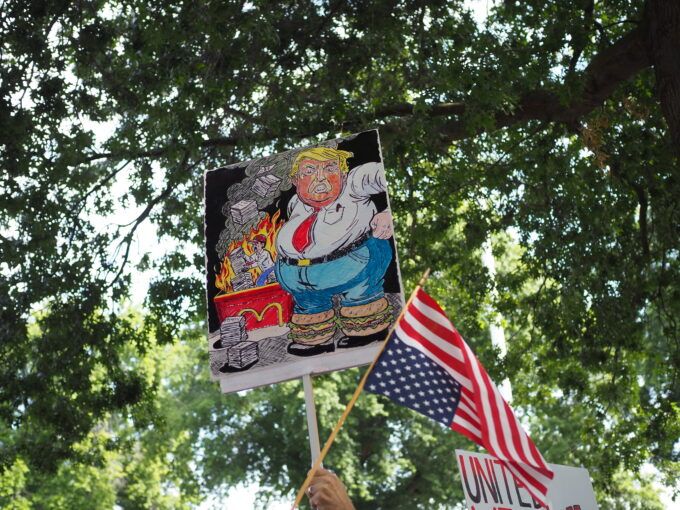
Trump’s Destruction of the US Economy

Michael Hudson


Photograph by Nathaniel St. Clair

Trump has created a crisis for U.S. agriculture with his Cold War weaponization of foreign trade with China and Russia, for manufacturing as a result of his steel and aluminum tariffs, for consumer price inflation mainly from his tariffs, and for affordable housing with his tax cuts that have kept long-term interest rates high for mortgages, auto and equipment purchases, and deregulation of markets giving a free hand to monopoly pricing. 

1. Trump’s Impoverishment of U.S. Agriculture

Trump has created a perfect storm for U.S. agriculture, first in his Cold War policy that has closed off China as a soybean market against and Russia, second in his tariff policy blocking imports and thus raising prices for farm equipment and other inputs, and third in his inflationary budget deficits that are keeping interest rates high for housing and farm mortgage loans and equipment financing – while keeping farmland prices low. 

The most notorious example is soybeans, America’s major farm export to China. Trump’s weaponization of U.S. foreign trade treats exports and imports as tools to deprive foreign countries dependent on access to U.S. markets for their exports, and on U.S.-controlled exports of essential commodities such as food and oil (and most recently, high technology for computer chips and equipment). After Mao’s revolution in 1945, the U.S. imposed sanctions on U.S. grain and other food exports to China, hoping to starve out the new Communist government. Canada broke this food blockade – but it has now become an arm of U.S. NATO foreign policy. 

Trump’s weaponizing of foreign trade – keeping open a constant U.S. threat to cut off exports on which other countries have come to depend – has led China to totally stop its advance purchases from this year’s U.S. soybean crop. China understandably seeks to avoid being threatened by a food blockade again, and has imposed 34% tariffs on U.S. soybean imports. The result has been a shift in its imports to Brazil, with zero purchases in the United States so far in 2025. This is traumatic for U.S. farmers, because four decades of soybean exports to China have resulted in half of U.S. soybean production normally being exported to China; in North Dakota the proportion is 70%.

China’s shift in its soybean purchases to Brazil is irreversible, as that country’s farmers have adjusted their planting decisions accordingly. As a member of BRICS, especially under President Lula’s leadership, Brazil promises to be much a more reliable supplier than the United States, whose foreign policy has designated China as an existential enemy. There is little chance of China responding to a U.S. promise to  restore normal trade by shifting its imports away from Brazil, because that would be traumatic for Brazilian agriculture and would make China an unreliable a trade partner.

So the question is, what is to become of the enormous amount of U.S. farmland that has been devoted to soybean production? Unable to find foreign markets to replace China, farmers are reported to suffer a loss on their soybean production, which is piling up in excess of existing crop storage capacity. The result is a threat of farm foreclosures and bankruptcy, which would lower prices for farmland. And as interest rates remain high for long-term loans such as mortgages, this deters small farmers from acquiring troubled properties. The result is to accelerate the concentration of farmland in the hands of large absentee financial funds and the wealthy.

This shift is irreversible. Despite the Supreme Court ruling that Trump’s tariffs are unconstitutional and therefore illegal, it seems likely that Trump could simply have the bipartisan anti-China Congress and Senate impose these tariffs. In any case, Trump’s policy represents a sea change, a quantum leap into U.S. coercive trade aggression. 

There is zero chance of U.S. China trade in soybeans or other basic Chinese needs from being revived. Neither it nor other countries threatened by U.S. trade aggression can take the risk of depending on the U.S. market.

America’s agricultural cost and income squeeze goes far beyond soybean sales. Production costs are also rising as a result of Trump’s tariffs, especially on farm machinery, fertilizer and credit tightness as the risk of farm debt arrears increase.

2. Trump’s Tariffs are Raising U.S. Industrial Costs of Production

Trump’s tariff anarchy also is causing losses and layoffs of two thousand employees for John Deere and Company, with a demand also falling for other manufacturers of farm equipment. The most serious problem is that its harvesting equipment, like automobiles and all other machinery, is made out of steel, along with aluminum. Trump has broken the basic logic for tariffs – to promote the competitiveness of high-profit capital-intensive industry (especially for established monopolies), largely by minimizing the cost of raw materials. Steel and aluminum are basic raw materials.

These tariffs have hit John Deere in two ways. For its domestic production, sales are low because of the depression of farm income cited above. Yields have soared this year for corn as well as soybean, leading their prices and farm income to decline. That limits the ability of farmers to buy new machinery.

Deere imports about 25 percent of the components of its products, whose cost of is increased as a result of Trump’s tariffs. Deere’s manufacturing facilities in Germany have been especially hard hit. Trump surprised Deere by ruling that over and above his 15% import tariffs on imports from the EU, he is imposing a 50% tax on the steel and aluminum content of these imports.

That also hits foreign producers of farm equipment, leading to new complaints by EU about Trump’s constant “surprises” in adding to his demand for “givebacks” in exchange for not raising tariffs on imports from the EU even further.

3. Trump’s Fight to Accelerate Foreign Reliance on Oil and Hence Global Warming 

Opposing any alleviation to global warming, Trump has withdrawn from the Paris agreement and has cancelled subsidies for wind power, and also for public transportation. This is the effect of lobbying by the oil industry. Not only is U.S. foreign policy dominated by the demand to control oil as the key to weaponizing foreign trade sanctions, but also U.S. domestic economic policy. Soon after World War II ended, Los Angeles tore up its streetcars, forcing its inhabitants to join the automobile economy. Dwight Eisenhower initiated the interstate highway program to favor auto transportation – and with it the consumption of oil. 

Also plaguing U.S. agriculture is a deepening water shortage for crops and destruction caused by flooding, drought and other extreme weather. One cause is the extreme weather resulting from global warming, which Trump denies as part of his policy to support U.S. oil and coal while actively fighting against wind and solar energy production. He has withdrawn U.S. support for the Paris Agreement with other nations to de-carbonize world production.

Insurance costs are rising to unaffordable levels for many areas most prone to storms and flooding, much as the annual cost of housing has soared in Miami and other Florida cities and the southern border states threatened by hurricanes.

A parallel disruption is the rising electric price as well as a water shortage caused by the rising demand to cool the computers needed for Trump’s support of automatic intelligence and quantum computing. The increasing demand for electricity far beyond the investment plans by power utilities to increase their production. Such planning takes many years – and utilities are happy to see the shortages push demand far above supply, enabling prices for electricity to be one of the major contributors to inflating the cost of production.

Trump and his cabinet have made fun of China for spending so much money on its high-speed train service. Western calculations of economic efficiency leave out the all-important balance-of-payments effects of this rail development: It avoids forcing Chinese to drive cars using imported oil. China has no domestic oil industry to dominate its economic planning or foreign policy. In fact, its foreign policy aims regarding the oil trade are the opposite of those in in the United States.

4. Trump’s Sanctions to Weaponize U.S. Exports to Its Designated Enemies

Trump’s (and Congress’s threat) to sabotage exports of computer switches with secret “kill switches” to turn them off by U.S. fiat has led China to cancel its planned purchases from Nvidia. The company has warned that without the profits from exports to China, it will be unable to afford the R&D needed to keep competitive and maintain its monopoly on chip manufacturing.

These trade policies slashing U.S. export markets and imports are just one reason why the dollar is weakening. Other causes are declining tourism as a result of U.S. harassment, especially of foreign students from China, on which U.S. universities have depended as the highest-paying students. 

These non-trade balance-of-payments trends explain why Trump’s high-tariff policy has not led the dollar’s exchange rate to strengthen despite its effect on discouraging imports. Normally that would increase the trade balance. But Trump’s war against all other countries (mainly his European allies, Japan and Korea) has led to a shift of their dependency on U.S. exports (such as soybean) and products against which they are retaliating in order to protect their own balance of payments, e.g., cutbacks in foreign tourism to the U.S., foreign students, dependency on U.S. arms exports – and most of all, financial capital flight seeing that the shrinking U.S. home market must cut into foreign profits and the dollar’s decline will reduce its valuation in foreign-currency terms.

Also, as BRICS and other countries conduct trade in their own currencies, this reduces their need to hold foreign-exchange reserves in dollars. They are shifting to each others’ currencies, and of course to gold, whose price has just soared over $3,500 an ounce.

5. Trump’s Sharp Increase in Inflation, From Electricity and Housing to Industrial Products Made Out of Aluminum and Steel, or Subject to Crippling Tariffs on the Supply of Parts and Necessary Inputs.

Trump’s decision to impose tariffs on basic inputs, headed by aluminum and steel, are increasing prices for every industrial product made out of these metals.

And of course, his tariffs generally are rising prices across the board as companies have waited a polite month or so before raising prices as their existing inventories of goods produced by China, India and other countries are exhausted.

Trump’s deportation of immigrants has increased the cost of construction, which relied largely on immigrant labor – as did agriculture in California and other states at harvest time. It is not clear who, if anyone, will replace this labor.

Instead of attracting foreign investment as Trump has demanded that Europe and other trade “partners” provide, he has made this market much less desirable. What he has done is provide an object lesson in what other countries need to avoid in creating regulations, tax rules and trade policy to minimize their costs of production and become more competitive.

6. Trump’s Monetary Policy is Sharply Rising Long-Term Interest Rates, even If Short-Term Rates Decline.

Long-term interest rates determine the cost of mortgages, and thus the affordability of housing. Trump’s inflationary policy also increased interest rates for long-term bonds. The effect is to concentrate borrowing at short-term maturities, concentrating the problems of rolling over debt in times of financial crisis. This impairs the resilience of the economy.

Many consumer goods imports are bought by the ultra-rich – the 10% of the population who are reported to account for 50% of consumer spending, For them, higher prices simply increase the prestige of such conspicuous-consumption status items (including expensive food delicacies).

Bolsonaro sentenced to 27 years for Brazil coup attempt

Tomas Castanheira


September 7 demonstration in Sao Paulo calling for Bolsonaro's conviction and opposing US intervention [Photo: Paulo Pinto/Agência Brasil]

On Thursday, former President Jair Bolsonaro was sentenced to 27 years and three months in prison for the fascist coup attempt that culminated in the January 8, 2023 insurrection in Brasília.

The conviction for crimes of coup d’état, violent abolition of the Democratic Rule of Law, armed criminal organization, and damages to public patrimony received favorable votes from four of the five justices of the First Panel of Brazil’s Supreme Court (STF).

In addition to the former president, seven members of the “crucial nucleus” of the coup conspiracy were convicted for the same crimes. Gen. Walter Souza Braga Netto, former Chief of Staff and Defense Minister and Bolsonaro’s vice-presidential candidate in 2022, was sentenced to 26 years in prison; Adm. Almir Garnier Santos, former Navy commander, to 24 years in prison; Anderson Gustavo Torres, former Justice Minister and former Federal District Security Secretary, to 24 years in prison; Gen. Augusto Heleno Ribeiro Pereira, former Institutional Security Cabinet (GSI) Minister, to 21 years in prison; Gen. Paulo Sérgio Nogueira de Oliveira, former Defense Minister and former Army chief, to 19 years in prison; Alexandre Ramagem Rodrigues, former Brazilian Intelligence Agency (Abin) director, to 16 years in prison; and Lt. Col. Mauro Cesar Barbosa Cid, Bolsonaro’s former aide-de-camp, had his sentence reduced to two years in prison due to a plea bargain agreement.

The STF trial was based on the understanding that the defendants formed a “criminal organization” under Bolsonaro’s leadership. Between June 2021 and January 8, 2023, it committed various “executive acts” intended, first, to attack the democratic rule of law and, subsequently, to promote a coup d’état.

Although the two elements of the coup conspiracy are inseparably linked, the justices argued that in the first, “it is the constituted government itself, the constituted executive that intends to diminish or end the system of checks and balances.” In the second, “the passive subject is the executive.”

The case’s rapporteur, Justice Alexandre de Moraes, supported his vote to convict by introducing what he deemed 13 “sequential acts” of the coup conspiracy. He declared:

The first point is precisely the use of public agencies by the criminal organization for monitoring political adversaries and for structuring and executing the strategy. And at this moment, in June 2021, the first executive acts were committed to attack the judicial power and mainly the electoral justice, discrediting it, already to delegitimize a potential negative result in the 2022 elections, discrediting democracy itself.

Subsequently, we have the already public executive acts, with serious threats to electoral justice, which derive from all the preparation and use of public agencies. ... [Subsequently,] the use of serious threat to restrict the exercise of judicial power on the famous September 7, 2021. ...

We have the improper use of the Federal Highway Police structure in the second round of elections and the improper use of the Armed Forces structure in relation to the electronic voting system oversight report from the Ministry of Defense.

The activities of this conspiracy assumed a frenetic pace and an increasingly violent character with the approach of Bolsonaro’s defeat in the second round of elections in October 2022.

Among the actions enumerated by Moraes are included:

“...the extremely violent acts on the day of the inauguration of the elected president and vice-president, on December 12, 2022, with attempts including invasion of the Federal Police; ... the placement of a bomb that ended up not exploding, thank God, at the [Brasília] airport, on December 24, 2022.”

The last “sequential acts” are the most critical:

  • The “Punhal Verde e Amarelo” (Green and Yellow Dagger) Plan to assassinate elected President Luiz Inácio Lula da Silva (Workers Party – PT), Vice-President Geraldo Alckmin, and Moraes himself, then president of the Superior Electoral Court (TSE). The detailed plan for these executions “was printed out at the headquarters of the Brazilian government, at the same moment when President Jair Messias Bolsonaro was also there – and the Federal Police proved it,” Moraes stated.

  • The attempted execution of Moraes by Army Special Forces personnel on December 6, 2022, in the operation dubbed “Copa 2022” (Cup 2022).

  • The elaboration of the so-called “Coup Minutes,” which provided for the establishment of a state of exception to prevent the transfer of power to the newly elected government, and its discussion with the commanders of the three Armed Forces.

  • The formation of a “crisis cabinet” under the command of Gen. Heleno and Gen. Braga Netto, to which power would be transferred after a military intervention.

  • The attack on the headquarters of the three branches of government in Brasília on January 8, 2023, which, in the rapporteur’s words, “was not spontaneous combustion, [but] the conclusion of a procedure for seizing and maintaining power at any cost.”

The conviction of the former president and members of the military high command, including three four-star generals and a fleet admiral, is a historic event in Brazil. In a country that lived through two decades under brutal military dictatorship, from 1964 to 1985, this is the first time that generals sat in the defendant’s dock and that crimes against democracy were punished.

But this is not an event of merely national dimensions. The fascist offensive in Brazil is deeply linked to similar political processes developing in all parts of the world – from Latin America to Europe, but above all, in the United States.

The January 8, 2023 coup attempt in Brasília was a direct and inseparable continuation of the coup attempt led by Donald Trump on January 6, 2021 at Washington’s Capitol.

Despite going unmentioned by the STF, there is an undeniable correlation between the beginning of the systematic coup conspiracy by Bolsonaro and his allies, at least since June 2021, and the explosive political events that preceded them in the United States.

Trump’s fascist insurrection at the Capitol, defined by the World Socialist Web Site (WSWS) as a watershed event in international politics, served as a political model for the attempt by Bolsonaro and his allies to set in motion a totalitarian project of power.

On January 10, 2021, in an article titled “Bolsonaro endorses Trump coup, threatens to do same in Brazil’s 2022 election,” the WSWS wrote: “[Bolsonaro] has already announced his intention to use the same lies about electoral fraud in Brazil to mobilize his supporters in a bid to remain in power, whatever the results of the 2022 presidential elections.”

Reporting the presence of Eduardo Bolsonaro, the former president’s son, in Washington during the January 6, 2021 events, the WSWS categorically concluded: “Eduardo did not go to the United States as a tourist. He was effectively summoned as an international observer of Trump’s coup on behalf of Brazilian fascists.”

The profound correlation between the political processes in the United States and Brazil also exposes the hypocrisy of the official triumphalist narrative regarding the conviction of Bolsonaro and his accomplices being promoted by the PT and the media.

The STF trial concluded with a speech by the court’s president, Luís Roberto Barroso, stating: “I believe that we are ending the cycles of backwardness in Brazilian history, marked by coup-mongering and the breaking of constitutional legality.”

This rosy narrative explodes in the face of the counteroffensive already underway to overturn the court’s decision. A campaign for a “broad amnesty” for those convicted of carrying out attacks against democracy since 2019 has won the support of the majority of the right-wing dominated Brazilian Congress and its parties. On September 7, demonstrations held in support of Bolsonaro under the slogan “React, Brazil!” were attended by the governors of the country’s three most powerful states.

The promoters of this campaign were strongly encouraged by the dissenting vote of Justice Luiz Fux, who not only refused to convict Bolsonaro but called for the annulment of the entire process, alleging the “absolute incompetence” of the STF to judge the case.

Bolsonaro’s conviction has become, in fact, a battle horse for new attacks against Brazilian democracy by the same forces that promoted January 8, 2023.

The criminal intervention of US imperialism, in the context of its violent escalation against all of Latin America, is not a minor factor driving this process.

After imposing 50 percent tariffs, openly presented as a means of forcing the suppression of the proceedings against Bolsonaro, the Trump administration is doubling down on its criminal attacks against Brazil following the trial’s conclusion.

On Wednesday, White House Press Secretary Karoline Leavitt declared that political intervention against Brazil “is a priority for the administration and the president is unafraid to use the economic might, the military might of the United States of America to protect free speech around the world.”

The following day, Secretary of State Marco Rubio responded to Bolsonaro’s conviction by declaring on X that “The United States will respond accordingly to this witch hunt.”

Eduardo Bolsonaro, who moved permanently to the US earlier this year, responded even more aggressively. Hailing Leavitt's statement as a “very welcome” demonstration of “the Trump administration's willingness to defend the freedom agenda,” he openly advocated for US military intervention against Brazil. “I think it's worth it for the sake of freedom. Would you accept slavery to avoid war? I want war,' he stated.

“If the Brazilian regime consolidates itself and evolves in the same way as Venezuela... it may well be necessary in the future to bring in F-35 fighter jets and warships,” Eduardo said, referring to the criminal escalation of Washington's imperialist aggression in the southern Caribbean.

The events during the two years that separate the fascist insurrection in Washington from its reenactment in Brasília demonstrate conclusively that the worldwide collapse of bourgeois democracy is an interconnected process. The swift advance of Trump’s dictatorial project makes explicit, furthermore, that it is only intensifying.

Former chief justice appointed as interim prime minister in Nepal

Rohantha De Silva


Three days after the resignation of Nepal’s Prime Minister K.P. Sharma Oli amid mass protests, former Chief Justice Sushila Karki, 73, was installed as caretaker prime minister in Nepal on Friday. Her interim government will be a right-wing capitalist administration, relying on the military’s support, focused on restoring a semblance of political stability in the wake of mass unrest. 

Former Supreme Court Chief Justice Sushila Karki, right, greets Nepalese President Ram Chandra Poudel after taking the oath as interim prime minister during a ceremony at the presidential residence in Kathmandu, Nepal, Sept. 12, 2025. [AP Photo/Sujan Gurung]

Following Karki’s appointment, President Ram Chandra Poudel dissolved the parliament and announced general elections for March 5 next year. Karki’s cabinet is to be limited to 15 ministers, though she can appoint up to 25. She reportedly plans to consolidate power in her hands by holding a number of key ministries, including Home, Foreign Affairs, and Defense.

It is evident that the military and state bureaucracy will largely determine the government’s policies and direction. On Saturday evening, Karki met with Chief of Army Staff General Ashok Raj Sigdel as well as top state officials—Chief Secretary Ek Narayan Aryal, Home Secretary Gokarna Mani Duwadi, and Finance Secretary Ghanshyam Upadhyay. 

The army has been instrumental in installing Karki, with Sigdel holding several rounds of talks with nominated protest leaders last week in a bid to quell the protests. According to the New York Times, ministers and political leaders were held incommunicado in the army barracks for days while the talks proceeded.

The Guardian reported that the major parties objected to the unconstitutional dissolution of parliament. Party leaders only finally consented “after the army chief Ashok Raj Sigdel warned that the military would be forced to declare a state of emergency if no political solution would be found.”

The protest movement, drawn mainly from young people and labelled Gen Z, is politically amorphous, driven by concerns and anger over the lack of opportunities, political corruption and the social gulf between rich and poor. It erupted over the government’s ban on social media, which had been used to expose the lavish lifestyles of the families of politicians.

Along with Karki, others mooted in talks as interim prime minister included populist figures such as former rapper and Mayor of Kathmandu, Balen Shah, 35, and Sudan Gurung, 36, of Hami Nepal (We are Nepal), who capitalise on the frustrations of middle-class urban youth. Balen Shah defeated the candidates of the Nepali Congress and the Communist Party of Nepal-United Marxist Leninist (CPN-UML) in the 2022 mayoral race. Hami Nepal was prominent in fueling the protests through social media.

Several prominent politicians from the Rastriya Swatantra Party (RSP) were also reportedly considered, including its founder Rabi Lamichhane. The RSP, the only party that expressed any sympathy for the protests, was established in June 2022 and has won 20 parliamentary seats by appealing to youth on an anti-corruption platform. 

Significantly, as reported by the Indian Express, army chief Sigdel attempted to promote the royalist politician Durga Prasai as interim prime minister. The army has longstanding ties to the Nepalese monarchy which was brought down by mass protests in 2006 and formally abolished in 2010. The protest leaders opposed Prasai and the army acquiesced, for now, agreeing to the installation of Karki.

Though some areas remained closed, the army began easing restrictions on Saturday, lifting prohibitory orders and curfews in Kathmandu. Police reported at least 51 deaths during protests since Monday, including 21 protesters, nine prisoners, three police officers, and 18 others. 

None of the issues underlying the social discontent in one of the poorest countries in the world will be resolved by the interim government or elections next year. More than half the population—56 percent—is under 30, and facing bleak prospects. Youth unemployment stands at more than 20 percent, forcing millions of young Nepalis to emigrate.

Since 2008, the country has been plagued by political instability, with 14 governments dominated by three major parties—Nepali Congress, the CPN-UML and the Communist Party of Nepal (Maoist) which has split. Sharma Oli of the CPN-UML, who resigned last week, was serving his fourth term as prime minister. The Maoists, who waged a bloody insurgency from 1996, exchanged their guns for a place in the political establishment in 2006 and were instrumental in containing the mass movement that brought down the monarchy.

All of these parties are responsible for the country’s social crisis, which is now being compounded by a global economic downturn and the imposition of the Trump administration’s tariffs. The root cause of the social crisis, however, is not corruption, which undoubtedly is widespread in ruling circles, but capitalism. Corruption arises out of the nexus between big business, government and the state apparatus that is fundamental to capitalism. The government and state do not serve “the people” but the interests of the bourgeoisie—a relationship that is obscured under parliamentary rule. 

This anti-corruption campaign enjoys support, especially among Nepal’s middle class and big business, as a means to push for pro-market reforms, which are worsening the plight of working people. Sri Lanka offers a cautionary example: The current JVP/NPP government, which came to power for the first time in elections last year by riding the tide of opposition to the establishment parties, campaigned on “anti-corruption” and empty promises to improve living standards. In power, it immediately tore up its pledges and is implementing the harsh IMF austerity agenda that is slashing jobs, cutting essential social services and hiking taxes.  

The United States, India and China have all publicly congratulated Karki on becoming Nepal's caretaker prime minister. Bordering China and India, Nepal has been a focus of geopolitical rivalry as the US, backed by India, has ramped up its preparations for war against China throughout the Indo-Pacific. 

New Delhi will undoubtedly seek to exploit the removal of the CPN-UML led coalition government, which had strengthened ties with China, to boost its political and strategic influence in Nepal. Earlier this month, Sharma Oli as prime minister led a Nepali delegation to attend the Shanghai Cooperation Organisation summit in Tianjin, China. During his visit, he held bilateral meetings with Chinese President Xi Jinping and Vice President Han Zheng. Oli also took part in Beijing’s commemorative events marking the 80th anniversary of the end of World War II. 

China also congratulated Karki on becoming the prime minister. A foreign ministry spokesperson declared that the two countries shared “a time-honoured friendship” and that China stood ready to work with Nepal to “enhance exchanges and cooperation in various fields, and further advance bilateral relations.” 

Geo-political intriguing will only compound the crisis engulfing the political establishment in Kathmandu.