1 Apr 2015

The 12th Anniversary Of Aafia Siddiqui's Abduction: What Happened To Aafia Siddiqui And Where Is She Now?

Judy Bello

Aafia Siddiqui on her graduation
Pakistani Woman named Aafia Siddiqui was abducted from a taxi in Karachi, Pakistan along with her 3 children 12 years ago on March 30, 2003. At the time she was vulnerable, recently divorced from an abusive husband; living with her mother; her father had just died of a heart attack. The youngest child was an infant. Following her abduction, Aafia Siddiqui and her children disappeared from view for 5 years. She spent those years in US Black Site prisons in Afghanistan and Pakistan. One can only imagine the torment she suffered there, in a system created to enable the torture and abuse of terrorism suspects. She was a woman alone. They took her children, and threatened them when personal torture was not enough to gain her acquiescence.
They say other women came and went from Bagram and the secret prisons in Afghanistan, but Aafia Siddiqui is the only one whose story is known. This is true in part because she had lived, studied and worked in the United States for more than a decade, but even more so because of the devoted persistence of her family, he mother Ismet, and sister Fowzia, who never for one moment ceased their efforts to find her and bring her home. Using their standing as an upper middle class family in Karachi, a conservative Muslim family, well educated, known for their involvement in various aspects of civil society during, the Siddiqui women engaged with the government at all levels, engaged the press to publicize Aafia’s disappearance and to investigate her whereabouts and the circumstances of her disappearance.
Ismet says that shortly after her daughter’s disappearance, a man came to her door and threatened her. He told her to drop the search for her missing daughter or ‘else’. The two women, Ismet and Fowzia, were convinced that Aafia and her children had been detained by either Pakistani Intelligence (ISI) or the CIA. This is not surprising because Pakistani citizens were frequently disappeared during that period, mostly by the Pakistani Secret Police and Intelligence forces complicit with the American CIA and FBI who were casting a broad net to fish for ‘terrorists’ after 9/11/2001. Thousands were abducted and imprisoned for long or short periods of time. A few eventually landed in Guantanamo, but who knows what happened to the rest?. Many never returned. Thousands of Muslim immigrants were rounded up and questioned here in the United States as well. Many of them were tortured. Many were held for months and years with no accessto legal aid or their families. Many were eventually deported despite having committed no crime.
No, Aafia Siddiqui wasn’t the only person rendered during the first years of the Global War on Terror, nor was she the only Pakistani disappeared under the Musharraf regime. We now know that thousands were rendered from the streets of Pakistan and around the globe during the first years following the 9/11 attacks on the World Trade Center and Pentagon. We know that torture was ubiquitous during that period, while brutal violence against civilians characterized the wars in Afghanistan and Iraq. What is extraordinary about Aafia Siddiqui’s case is that she was a woman, and was taken with her children. Also somewhat unusual is the fact that she had spent many years in the US where she went to college and eventually obtained a PhD from Brandeis, married a Pakistani Doctor and had 2 children; and worked for various charities generally leading a conscientious life of good will. She sent Qurans to prisoners, and taught children at a Mosque in an impoverished city neighborhood.
But after 9/11 it all fell apart. She and her husband were not abducted, but they were interrogated. A young Saudi the government was pursuing had stayed for a while in their apartment building. Her husband had used his credit card to buy night vision goggles, he said for hunting. The marriage was becoming increasingly stressed and at times, violent. Aafia had a long scar on her cheek from a cut caused by a baby bottle her husband admitted to throwing at her. Aafia took her children and returned to her parents’ home in Karachi. She was pregnant with their third child when her husband divorced her and remarried. We are told she seemed nervous and agitated during this period. Who wouldn’t be nervous and agitated under those circumstances? And then, one day she set out for a family visit with her uncle, got in the taxi with her children, and disappeared.
Aafia Siddiqui when last photographed
In July of 2008, Aafia Siddiqui arrived in Manhattan a week after abdominal surgery to remove a couple of bullets from her intestines, and was brought directly into a courtroom in her wheelchair for arraignment on charges of attacking US military personnel in Afghanistan. After a highly publicized trial during which the press consistently referred to her as ‘Lady al Qaeda’, she was sentenced to 86 years in prison and sent to Carswell Medical Center, a high security federal prison in Texas, where she remains to this day, so we are told.
At the trial, no physical evidence was presented by the prosecution. There was none. Basic questions related to context were neither asked nor answered. Where was Aafia Siddiqui between the time of her disappearance 5 years earlier, and her encounter with the soldiers in Ghazni, Afghanistan? Why wasn’t she believed when she said she had been rendered and tortured? Why did the Pakistani Government allow her to be extradited from Afghanistan, then pay a small fortune for lawyers for her, lawyers that she did not want or trust because, whatever their qualifications, they had been selected and paid for by the Pakistani government? Why, when a fragile woman, who was obviously physically and mentally broken, said that she had been tortured, did no one investigate her story?
Between 2003 and 2008, US officials repeatedly denied having Aafia Siddiqui in custody. They insisted that she was not in the system anywhere. But, when she showed up in 2008, they had a story all ready to tell about her involvement with al Qaeda, conferring with Khalid Sheikh Mohammed and some of his associates. They actually said she was married to his nephew Ammar al Baluchi, a charge her family absolutely denies. She was only recently divorced, and had just birthed a child when she disappeared. The specific accusation against Siddiqui was that she had got a mailbox in Maryland for Majid Khan, a young man who had associated with Khalid Sheikh Muhammed in Karachi He had allowed his visa to lapse while he was visiting family in Karachi, and needed a US mailbox address to reapply for it so he could return to the US. . Khan was accused of plotting to commit terrorist attacks on returning to the USA.
But this isn’t the crime Aafia Siddiqui was tried for, just a story leaked to the press. At the time of Aafia Siddiqui’s trial, Majid a few weeks before Siddiqui and her children were, but had lived in the United States and attended high school here. Raised in a middle class suburb of Baltimore, he was restless and unable to decide what to do with his life, so he went to Karachi to visit the extended family and married there. Members of his family were initially detained with him, then later released. According to his brother, Majid Khan was tortured and beaten during this period, and coerced into making unreliable and false confessions
Although he may have known KSM and his nephew, Khan was never proven to do anything other than talk and spin stories. After touring the black sites and being tortured for a couple of years, Khan landed in Guantanamo where he apparently continued talking and spinning stories. Majid Khan was eventually released from Guantanamo in 2012 in exchange for testimony against Khalid Sheikh Muhammad, Ammar Al Baluchi and others. Perhaps Siddiqui did help Majid Khan with his immigration problem. He was a kid who needed help. That is an immigration violation that might keep her from returning to the US. But we don’t even know for sure that she even did that. We do know that Khan told a lot of stories in return for a plea deal in 2012 that capped his sentence at 19 years.
The government, however, claimed that she spent the 5 years she was missing in a terrorist cell developing chemical and biological weapons. She was a scientist, after all, with a PhD. When she was arrested in Pakistan, there were some chemicals in her bag along with some recipes for biological and chemical weapons written in her handwriting and a picture of the statue of liberty, an odd choice for someone who had lived many years in Boston area and Texas before that. These items were brought into evidence. Again, when Aafia Siddiqui explained that she wasn’t that kind of scientist, that she was an educator, she was ignored. Her PhD was in neuroscience as it pertains to learning capabilities. This is a matter of public record at Brandeis University. She was Dr. Aafia Siddiqui, but neither a physician, a chemist nor even a biologist except in a narrow tangential sense. She said she wrote in the documents what she was told to write by men who threatened to harm her children if she did not do as they wished.
Aafia Siddiqui suffered from severe PTSD which made it difficult for her to present a consistently calm and pleasant demeanor during trial. She told the court she had been tortured during the time she was missing, but this testimony was dismissed as untrue and irrelevant. The government, of course, had denied it. She didn’t want the highly paid lawyers hired on her behalf by the Pakistani government because she didn’t trust the motivation of the Pakistani government, and she didn’t like the way they were building her case. But the judge chose to ignore her protest and allowed those lawyers to continue. Judge Berman was privately informed of the details the US held against Siddiqui. The story was apparently leaked to the press as well. But it wasn’t told in open court where she might have refuted it. The jury convicted despite the lack of physical evidence on charges normally bringing a sentence of around 15 years. They did not convict on the charge of premeditation, but Judge Berman added a ‘terrorism’ enhancement to her verdict, and sentenced Aafia Siddiqui to 86 years in a federal prison.
Today, Aafia Siddiqui remains in the psychiatric division of Carswell, seven years into her 86 year sentence. She had a hard time early on, and apparently was beaten at one point, by the guards? Other inmates? That we don’t know. We do know she was in solitary after that. She hasn’t been allowed to receive mail.. I, myself, have sent her many letters, all returned. Early on they came back unopened, marked ‘undeliverable’. When I called the prison to inquire whether I had the wrong address, the person who answered went off to ask advice on what to tell me. He said, when he returned to the phone, that she refused her mail. A few months later when I was in jail myself (for direct action protest at the gate of Hancock AFB) I received a letter from my attorney, and realized that they have to open your mail and inspect it before offering it to you. After I called again to question this issue, my letters started coming back opened.
Aafia Siddiqui hasn’t spoken to her family in more than a year. She has a brother, also in Texas, but he has not been able to see her. No one has had contact with her for over a year now. The last time she was given a chance to talk to her family, to her mother and sister, and the 2 children returned to them after she was imprisoned in the US, was following a national press conference outside the Pakistani Embassy in Washington DC and a well-publicized protest outside Carswell Prison. At the time, Fowzia asked her why she was refusing her mail, and she replied ‘What mail?”
Last year Robert Boyle, a new attorney hired by the family, submitted a motion to vacate to Judge Berrman, requesting that he throw out the verdict because Aafia’s repeated requests for an adjournment of the proceedings so she could find an acceptable attorney were ignored. The motion lays out a detailed argument that Siddiqui’s request was sane and reasonable, and described the potential bias of the Pakistani government and the ways in which their choice of attorneys, even well-known human rights lawyers, might not have been in her best interest. Judge Berman called the lawyers in a few days later and said that Aafia Siddiqui had written a letter to him, asking that the motion be dismissed, and that he was therefore required to dismiss it. He went on to say that he had, in any case, no intention of granting the motion.
Since then, another six months have passed with no word to anyone from Aafia Siddiqui. It’s true she is likely depressed. Is she sick? Is she being heavily medicated? Is she alive? An appeal that had earlier been rejected which focused on procedural issues. This motion that Judge Berman says she asked to have dismissed very directly mirrored her own concerns at the time of the trial. It’s true; she may have done this out of depression or despair. But if she was too disturbed for the Judge to support her initial request in the court room, why was her current request honored without a hearing?
Aafia Siddiqui said that she had been tortured and raped. Why her assertion was dismissed as a fabrication with no investigation, and why were any investigations into her claims treated as collateral conspiracy theories? How did she neatly fall into the hands of US soldiers just as the family felt their sources were near locating her? Why did the Pakistani Government allow her to be extradited if they thought she was innocent? Where are Aafia Siddiqui now and what is her status?
The fact is that Aafia Siddiqui’s story is not so different than many of the other Pakistani, Afghan and Arab men swept up after 9/11. Why is it so unbelievable? All of the evidence is in her favor except for the ‘secret’ evidence and the fact that the US denies her assertions. Would we expect anything different from them? We have heard the stories of others illegally swept up in the rendition program. But maybe we don’t want to believe they would do that to a woman. We’ve heard a lot of stories about horrors visited on women by US soldiers in Iraq and Afghanistan, in Vietnam, but maybe we don’t want to think that might happen to a vulnerable middle class housewife with a PhD in Education. What would they do to cover up committing these atrocities against this kind, well educated, English speaking woman who had spent nearly half her life in the US when she was detained? And to cover up the cover up?

Does Civilisation Mean Insanity And Violence?

Sukumaran C. V.

CIVILIZED MAN SAYS: I am Self, I am Master, all the rest is Other—outside, below, underneath, subservient. I own, I use, I explore, I exploit, I control. What I do is what matters. I am that I am, and the rest is women and the wilderness, to be used as I see fit. —Christina M. Kennedy.
Sanity or healthy normality among humans and other living creatures involves a respect for other forms of life and other individuals. Jack D. Forbes.
Within two years, two tigers were shot dead in Kerala. The reason: they encroached into the ‘human habitats’ and (the first one) killed cattle and (the second one) people. I travelled to the places where these hapless animals were killed and saw that it was not the ‘brutes’ which encroached into human habitats but the human-habitats have encroached and are continuously encroaching into the habitats of these animals depriving them of their home and prey.
To be able to study the (pathetic) condition of our still remaining forests and wildlife, (being a clerk in the panchayat department) I asked for a transfer to the grama panchayat office which situates in the heart of the Nelliayampathy evergreen forests and was able to see the besieged and extremely hopeless condition of our forest cover and the dwindling wildlife.
In every grama sabha I have participated as co-ordinator, people were asking for more street lights and roads and other facilities. They live inside the forest either as settlers or as the workers of tea and coffee estates. If you want to cover a tea estate, you have to travel kilometres. Thousands of acres of evergreen forests have been cleared for each estate. Those were originally dense forests and the habitats of the animals. The animals were and are hunted out. Nobody spoke in favour of the animals or the forest cover. People want electric lights everywhere to ward off animals. They want development which destroys the forests that still survive.
Often I was tempted to talk in favour of the animals and the forest cover. But I preferred my safety to the rights of the animals and the forests. It was selfishness and this same selfishness of the humans is called ‘civilization’ and this civilisation is killing the planet where we live.
As people (most of them estate labourers) could gather only after 5 pm, the grama sabhas would be over only after 9 pm. When we were returning to the office for staying at night, we saw hares and deer darting away from the light of our vehicle and I thought that we are encroaching into their freedom. We are depriving of their freedom to walk freely even at night. Those estates, those roads fragmenting the forests, those electric posts, those offices (panchayat, KSEB, PHC) should be shut down and all the people who live in the forest areas should be driven out and the animals should be given the freedom to wander through day and night without fearing the humans and their vehicles and their electric lines and their roads.
When I told my thoughts to my colleague who was with me, he advised me not to express them anywhere around there if I wanted to live or at least not to be transferred from there. His advice reminded me of what my favourite author Derrick Jensen says in his book The Culture of Make Believe:
“Pretend that you were raised to believe that blacks—niggers would be more precise in this formulation—working for whites is simply part of the day-to-day experience of living. You don’t question it any more than you question breathing, eating, or sleeping.”
“Now pretend that someone from the outside begins to tell you that what you are doing is wrong.....your slaves listen to this outsider, and because of this, your relationship with them begins to deteriorate, even to the point that you begin to loose money...Raised in those circumstances, it would have taken more courage than most of us have, I think, to admit that one’s way of life is based on exploitation, and to gracefully begin to live a different way.”
“Then how about this? Outsiders take away your computer because the process of manufacturing the hard drive killed women in Thailand. They take your coffee because its production destroys rainforests, decimates migratory songbird populations and drives African, Asian, and South and Central American subsistence farmers off their land. They take your car because of global warming, and your wedding ring because mining exploits workers and destroys landscapes and communities. They take your TV, microwave and refrigerator because, hell, they take the whole damn electrical grid because the generation of electricity is, they say, so environmentally expensive. Imagine that these outsiders actually began to succeed in taking away these parts of your life you see as so fundamental. May be you’d start to hate the outsiders and even get a little rough with them, if that was what it took to stop them from destroying your way of life.”
I want to be the outsider, but I am a 'civilised' human the human civilisation doesn't allow me to be the outsider. Mother Earth will be saved only when the entire humans metamorphose into the outsiders and get rid of their insane 'civlisation' which destroys the environment that sustains us.
See how civilisation kills the living world.
Every year Feb. 2 is celebrated as World Wetlands Day. Wetlands are the lungs of any landscape and they preserve water forever for the human and non human inhabitants. And they are the habitats of many birds like the lapwing and water hen; but they are fast vanishing due to the ‘progress and development’ of the humans. Our unsustainable method of constructing homes and flats first ruined our rivers by sand mining. Now the development projects like the metro rail and private airports and roads widening ruin the hills and hillocks in the villages with the quarrying activities. Almost all the rocky hills are being quarried to make rock sand by crushing and every hillock is being destroyed by earth movers to fill the wetlands to construct flats and homes and business malls. Creeks and rivulets and ponds are filled; hills and hillocks and mountains are razed; atmosphere is filled with dust, and cancer is spreading like wildfire. The irony is that instead of annihilating the present development mania which creates an atmosphere in which humans are plagued with ailments and illnesses; we construct super specialty hospitals augmenting the pathetic condition to which our development has driven us.
Whenever I hear about the days like Environment Day, Earth Day, Wetlands Day, Polar Bear Day, World Sparrow Day etc, a fear that the condition of all the things such days represent are made worst by the greedy human interference grips my mind. According to the WWF’s (Worldwide Fund for Nature) Living Planet Report-2014, the number of wild animals in the world has been decreased by the half during the last 40 years!
Biodiversity is the prime necessity for the continuance of Life on Earth, and the humans destroy the very thing which helps them survive on earth. In the first volume of Derrick Jensen’s Endgame, there is a chapter titled ‘A History of Violence’. The third part of the chapter begins thus: “WHY CIVILIZATION IS KILLING THE WORLD, TAKE SIXTEEN. Polar bears: “About half a mile upriver, I came to a very strong shoot of water, from thence I saw several white-bears fishing in the stream above. I waited for them, and in a short time, a bitch with a small cub swam close to the other shore, and landed a little below. The bitch immediately went into the woods, but the cub sat down upon a rock, when I sent a ball through it, at the distance of over a hundred and twenty yards at the least, and knocked it over…The report of my gun brought some others down, and another she bear, with a cub of eighteen months old, came swimming close under me. I shot the bitch through the head and killed her dead. The cub perceiving this and getting sight of me made at me with great ferocity; but just as the creature was about to revenge the death of his dam, I saluted him with a load of large shot in his right eye…I now perceived that two others had just landed about sixty yards above me, and were fiercely looking round them. The bears advanced a few yards to the edge of the woods, and the old one was looking sternly at me. The danger of firing at her I knew was great, as she was seconded by a cub of eighteen months; but I could not resist the temptation.”
“The author,” says Derrick Jensen, “a Captain George Cartwright, really the first person to solidly establish civilization on the shores of Newfoundland, then moved toward another part of the river. “I had not sat there long, ere my attention was diverted to an enormous bear…I drew the trigger…placed my ball in the centre of his scull, and killed him dead….Never in my life did I regret the want of ammunition so much as on this day; as I was by the failure interrupted in the finest sport that man ever had. I am certain, that I could with great ease have killed four or five brace more.”
This is what the human 'civilisation' has been doing to all the animals, birds, forests and the marine life as a whole—cold bloodedly, indiscriminately eliminating the flora and fauna that live around us. The animals do have the equal right as we the humans do to live on the earth, but we deprive them of their right to exist either by killing them directly or by destroying their habitats. Then we celebrate Days like the International Polar Bear Day (Feb. 27) World Water Day (March 22) Zero Emissions Day (Sept. 21) so on and so forth. And emissions increase uncontrollably; water is depleting alarmingly; Polar Bears are on the verge of extinction and wetlands are virtually no more. Now as the hills and hillocks are also vanishing fast, there is a possibility of having a Hills and Hillocks Day too, I presume.
To prove how insane the civilisation we are proud of is, let me quote in detail from the first volume (The Problem of Civilization) of Derrick Jensen’s masterpiece Endgame: “Does anyone have the right to enslave others? More specifically yet, does any group of people have the right to enslave others—human or non human—simply because they have the power to do so, and because they perceive it as their right (and because they have created a propaganda system consisting of intertwined religious, philosophical, scientific, educational, informational, economic, governmental, and legal systems all working to convince themselves and at least some of their human victims it is their right)?”
“Had somebody snuffed civilization in its multiple cradles, the Middle East would probably still be forested, as would Greece, Italy, and North Africa. Lions would probably still patrol southern Europe. The peoples of the region would quite possibly still live in traditional communal ways, and thus would be capable of feeding themselves in a still-fecund landscape.”
“Had someone brought down civilization before 1492, the Arawaks would probably still live peacefully in the Caribbean. Indians would live in ancient forests all along the Eastern seaboard, along with bison, marten, fisher. North, Central, and South America would be ecologically and culturally intact. The people would probably have, as always, plenty to eat.”
“Had someone brought down civilization before the slave trade took hold, 100 million Africans would not have been sacrificed on that particular altar of economic production. Native cultures might still live untraumatized on their own land all across that continent. There probably would be, as there always was, plenty to eat.”
“If someone had brought down civilization one hundred and fifty years ago, those who came after probably could still eat passenger pigeons and Eskimo curlews. They could surely eat bison and pronghorn antelope. They could undoubtedly eat salmon, cod, lobster. The people who came after would not have to worry about dioxin, radiation poisoning, organochloride carcinogens, or the extreme weather and ecological flux that characterize global warming. There probably would have been, as almost always, plenty to eat.”
“If civilization lasts another one or two hundred years, will the people then say of us, “Why did they not take it down?” Will they be as furious with us as I am with those who came before and stood by? I could very well hear those people who come after saying, “If they had taken it down, we would still have earthworms to feed the soil. We would have redwoods, and we would have oaks in California. We would still have frogs. We would still have other amphibians. I am starving because there are no salmon in the river, and you allowed the salmon to be killed so the rich people could have cheap electricity for aluminum smelters. God damn you. God damn you all.””

Gendered Dis-preference In Indian Society

Roli Misra

The parameter of gender complicates numerous explanations and analyses of social behaviour that may otherwise hold. Economically as well as socially advanced countries have shown a sex ratio favourable to the female, but in many south and south-east Asian countries this relationship has not been so straightforward.
Neither education nor affluence have brought about any significant change in attitudes towards and value of women (Patel Tulsi 2004). Sex ratio is a powerful index to examine the social response on female children and also a broad indicator revealing the social fabric and cultural ethos of any country. India represents one of the most adverse Child Sex Ratio (CSR) figures amongst the Southeast Asian countries, reflecting a highly undesirable reversal of the norms of nature. The sex differential in mortality at the national level is the result of discriminatory treatment received by girls and women reflecting strong son preference and relatively less preference for daughters. Pravin Visaria (1971) study was the first major effort to understand the phenomenon of skewing sex ratio. He concluded that higher female mortality in different age groups was responsible for low sex ratio.
In present context with the advent of new technology the practice of female infanticide has been replaced by genocide of millions of women known as female foeticide – denying the girl its very right to take birth. The rapid spread of the use of ultrasounds and amniocentesis for sex determination followed by sex selective induced abortions has created a situation of daughter drought with tragic consequences. The decreasing child sex ratio (0-6 years) has been a concern in India’s demography in recent times as this ratio has decreased markedly from 927 in 2001 to 914 in 2011 for the country as a whole. This decline is more for rural areas from 934 in 2001 to 919 in 2011 and for urban areas it is 906 in 2001 and 902 in 2011. Despite the efforts of the government, civil society organizations, NGOs, UN agencies and the media to keep the issue of female foeticide high on the public and policy agenda, little or no desired results have been forthcoming The census results over the years are indicative of a strong possibility that the traditional methods of neglect of female children are increasingly being replaced by not allowing female children to be born. A new acronym has been coined by Prof. Ashish Bose which is called DEMARU – Daughter Eliminating Male Aspiring Rage by Ultrasound.
There are many states which have come in the category of DEMARU and the obvious reason is strong desirability of having son accompanied by accessibility and affordability of modern technology. Technology facilitates a series of pre-natal diagnostic tools to identify and cure any potential birth defects and associated conditions. In a gross misuse of the scientific tools, female fetuses are selectively aborted after such pre-natal sex determination, in spite of a massive influx of legal regulations banning the same. A number of cultural, social and economic factors influence the relative benefits and costs of sons and daughters. Among the feudal communities property/assets are considered to be the reason behind female foeticide. These families with feudal set up and agriculture base do not want their property to get transferred to their son-in-law (under right to Property Act) hence, prefer to get rid of the girl child at the first instance. It is indeed an irony that physicians in India have been strong supporters of sex selective abortions since their inception. Their argument include that it is the family’s right to make this personal decision that the mother will suffer if she has too many daughters. It is better to get rid of an unwanted child man to make it suffer all its life. For supporters of female foeticide the test appears to be the solution to a number of problems like population control, dowry deaths, bride burning, sexual violence, physical abuse etc. They believe that the reduced sex ratio will lead to an improvement in the status of women and dowry can be replaced by bride price. This kind of bigotry treatment is being practiced since ages and is known to all of us.
There may be a good amount of literature which has been written but all have not come in public notice. Many such girls/women have vanished unheard, unnoticed or are struggling and suffering somewhere on this earth. It needs to be pondered more seriously that how can we transform the mind set of people in a positive way? It is indeed a perplexed situation that how the policies and programmes initiated by the government to control this menace are going to work in communities. To conclude it can only be suggested that sensitization is the most important thing which needs to be done. Campaigns at the grassroots level should be designed to sensitize people to change their deep rooted mindsets about son preference and generate mass awareness on the issue of female foeticide and its consequences.
It is necessary that societal forums need to be engaged more to discuss and dialogue these socio cultural repercussions, bringing them to public domain else it may take generations and centuries to take people out of the son complex situation. People should be made aware of this genocide and they must join hands to save our daughters from their journey from womb to tomb otherwise we shall land into ‘No girl zone’ one day. Lets stop this gendered violence and cruelty and allow the girls to take birth, thus protecting their rights, dignity and position in the society, maintaining the natural order.

Lambs To The Slaughter: The Dying Future Of Higher Education

P K Vijayan

“Professional integrity requires that teachers should be as free to speak on controversial issues as any other citizens of a free country. An atmosphere of freedom is essential for developing this 'morality of the mind'.” This statement was made as far back as 1962, by the Report of the University Education Commission (more widely known as the Radhakrishnan Commission Report), one of the first, and probably the most influential document on higher education in its time. We have come a long way indeed, from that understanding: today, the current writer, along with seven other colleagues of Hindu College, Delhi University, have been found guilty of “gross misconduct in acting against the interests of the college and lowering the dignity of the college by bringing it into disrepute”. The reason? That we wrote a letter to the Hon'ble Lt Governor of Delhi, drawing his attention to various improprieties and irregularities in the construction of a new girls' hostel in the college. For this, we have been punished with loss of pay amounting to two salary increments, for the rest of our careers, and debarment from holding any position of responsibility for no less than five years in the college. Meanwhile, we will be subjected to continuous scrutiny during this period, annual reports will be submitted on our conduct, and a review will be held after five years. All this, for writing a letter.

This is an extremely severe punishment, involving a financial loss of several lakhs of rupees individually over the span of our careers, as well as the blanket denial of all professional opportunities for five years, quite apart from being stigmatized as irresponsible and delinquent. This kind of punishment falls just short of dismissal from service, in the scale of extreme penalties, and is usually reserved for correspondingly extreme sins of omission and commission (e.g., dereliction of duty, moral turpitude, etc.). It is not only incredibly out of proportion to the alleged fault on our part, its sheer excess would smack of spite and vindictiveness, if we were not informed by the Chairman, Governing Body, that the punishment was also intended to be exemplary, a lesson to other college teachers.

Ironically, what provoked this was in fact our living up to the “professional integrity” spoken of by the Radhakrishnan Commission Report, and speaking up as citizens of a free country. Additionally, it must be remembered that Article 19.1 (a) of the Indian Constitution also guarantees the right to freedom of speech and expression – a provision made by no less a figure than B R Ambedkar. By writing to the Lt Governor of Delhi, drawing his attention to the fact that the college administration was undertaking illegal construction in the college without acquiring the requisite clearance from statutory bodies like the MCD, the National Green Tribunal, etc., we were merely giving voice to our collective conscience, as guaranteed by the Indian Constitution – but “professional integrity” is now understood as “gross misconduct”! Even more ironically, although it was the college administration that was patently guilty of misconduct, it turns around and accuses us of misconduct because we spoke up about its illegalities! It then proceeds to foist a farce of an inquiry on us, incidentally initiated suo moto by the Chairman, without being discussed in the College Governing Body, and undertaken, not by an independent third party, but by two members of the very administration that is being accused of committing illegalities. Following on this and various other patent procedural violations and improprieties in the disciplinary process, the Governing Body then decided on this massive penalty.

This must be seen not as an isolated instance of the arbitrariness of an individual college administration, but in the larger context of changes that Delhi University in particular, and higher education in the country in general, is undergoing. A revealing sign of this change and its implications for Hindu College in particular, came a couple of years ago, when the current Chairman of the Hindu College Governing Body publicly stated that Hindu College was a private college (in an attempt to avoid responding to an inquiry under the RTI Act, regarding some administrative irregularities). The fact is that, ever since the publication of the Report on a Policy Framework for Reforms in Education in 2000 (also known as the Birla-Ambani Report), there has been a steady, inexorable push towards privatization of higher education, as a policy direction. Significantly, the Birla-Ambani Report was not commissioned by the Department of Education, or the Ministry of Human Resource Development (MHRD), or the University Grants Commission (UGC) – which would have been the expected bodies to undertake such an enquiry – but by the Prime Minister's Council on Trade and Industry. Commissioning this report was one of the first things that the NDA government did when it came to power in 1998.

This report set the agenda for the series of further reports, policy initiatives and eventually, legislative measures that followed, including - among others - the government’s own National Knowledge Commission's Report to the Nation, 2006-2009 (2009), also known as the Knowledge Commission Report (KnCR); the University Grants Commission’s paper on ‘Strategies and Schemes during Eleventh Plan Period (2007-2012) for Universities and Colleges’ (2011); the annual planning-papers on higher education collaboratively produced by the Federation of Indian Chambers of Commerce and Industry (FICCI), Ernst & Young Pvt. Ltd. (a multination consultancy) and the Planning Commission of the Government of India, from 2011 onwards; the ASHE 2014 (Annual Status of Higher Education of States and UTs in India, 2014) report, brought out by Confederation of Indian Industries (CII), the Ministry of Human Resource Development (MHRD) and the international consultancy firm, Deloitte; and the MHRD’s own Rashtriya Uchchatar Shiksha Abhiyan (RUSA, or National Higher Education Mission) document (2013). It has been matched by a series of similar reports and documents from the private sector, also urging privatization as the panacea for higher education in the country, such as Pricewaterhouse Coopers' document, 'India – Higher Education Sector: Opportunities for Private Participation' (2012); the India Brand Equity Foundation's 'Education Sector in India' (2012); or CRISIL's ‘Skilling India: The Billion People Challenge’ (2010), among others.

Several of these documents note the sheer quantum of the higher education market, as a major selling point (so to speak) for privatization: the estimate is a whopping USD 115 billion, over the next ten years, which boils down (on current conversion rates) to an average of INR 70,000 crores per year. However, this massive market is effectively locked down, inaccessible because still predominantly state controlled and subsidized; its potentially gargantuan profits can be harvested fully only if the state withdraws and permits freer private investment in this sector. As of now, about 52% of higher education is through private institutions; if this is gradually increased as a fallout of the state withdrawing from this sector, the estimated quantum of profits will go up even more.

The real prize for private players of course, is not in raising new institutions from scratch – although, given the magnitude of profits involved, that too is by no means a mean investment option. The real prize lies in taking over existing public-funded institutions, thereby minimizing the investments involved, and then reaping the benefits that accrue from their privatization. The colleges of Delhi University are prime picks in this sense: they not only come with minimal investment requirements, they come pre-loaded, so to speak, with a 'reputation', derived from their affiliation to Delhi University (if not carrying substantial ‘brand-values’ of their own, as in the case of colleges like St Stephen's College, Sri Ram College of Commerce, Lady Sriram College, and of course, Hindu College), and a clientele ready and waiting at the doors.

There are however two major obstacles to the realization of this dream. One is the fact that legislation on higher education has not yet caught up with the pace at which higher education policy has been changing: but this is being addressed by the six new bills on higher education, collectively referred to as the New Education Bills, currently awaiting passage in Parliament. The other is the 'recalcitrant', 'lazy', 'conservative', truculent teaching community that has been fiercely resisting these inexorable impulses towards privatization for almost a decade now. As long as these teachers are around – with their vision of education as a public good, and their understanding of their professional integrity and freedom as sacrosanct – there can be no hope of capitalizing on the hopes and dreams of the explosion of youth who are about to enter higher education – a demographic wave that is referred to, quite shamelessly, in almost all the above-mentioned reports, as India's 'demographic dividend'.

One crucial way in which this resistance has been tackled has been through the simple expedient of increasing contractualization of teaching jobs, de facto if not de jure. By simply refusing to hold interviews for permanent appointments, today, almost half the teaching strength of the university and its colleges – amounting to almost 5000 teachers – is constituted of ad hoc teachers, whose sheer dependence on the system to get permanent posts, render them quiescent. Another has been to not appoint permanent principals in colleges where the need arises, but to administer them through OSDs (Officers on Special Duty), Acting Principals and Officiating Principals. A large number of colleges – including Hindu College – have now had these temporary administrators for several years, all of who are hand-picked for their subservience to authority. A third way has been to unleash a veritable bonanza of awards and grants, but disbursed in a highly selective manner, as incentives to toe the line of the university administration. The teachers' movement has been massively eroded, qualitatively and quantitatively, by these carrot-and-stick measures. But this still does not tackle the existing lot of 'recalcitrant' teachers, many of whom have many years to go before they retire, and continue to challenge these tendencies towards incremental, de facto privatization.

Hindu College is one such college, that is ripe for the picking, but also had – and continues to have – a clutch of such 'recalcitrant' teachers who have been repeatedly questioning the innumerable irregularities, improprieties and violations of rules and procedures on the part of its governing body. This governing body, dominated by a private trust and by a chairman from that trust, appears intent on running the college like its private property, but without having to make the slightest investment in it. Indeed, one of the reasons why it undertook construction post-haste, without waiting for due clearances, is the fact that funds earmarked for infrastructure development, which had sat unused in the college coffers for several years, were set to be recalled by the UGC. If this had happened, the trust would have had to make that infrastructural investment from its own pockets – if not now, then at some later point of privatization, when it would take over the college completely. The idea is to milk the state for all it can give, at this stage, before privatization comes in in full force: the lamb must be fully fattened, at state expense, before it is slaughtered for private profit. Hence the decision to keep this clutch of recalcitrants out of any positions of responsibility, where they can intervene in this shadowy agenda, for five years, during which time we will be “kept under observation” (as if we are prisoners) to ensure we stay quiet. By which time no doubt the entire higher education scenario would have changed, not just in the college but in the entire country.
Hindu College is a test case now, as to how such entrenched 'bad elements' in the teaching community can be dealt with; this is especially clear from the deliberate reference to the punishment as an exemplary one. If the once strong teachers' union now stands weakened and divided, it is substantially because of the carrot-and-stick policies noted above; but it is time to see them for what they are, viz., cynical tactics in a much larger, much more damaging battle for the soul of higher education itself. It is time to come together once again, to resist the last but most brutal measure that is being deployed, in the project to privatize higher education, in the form of such excessive and therefore exemplary punitive measures. These measures are being followed with keen interest by those who would seek to replicate them in other colleges, in this university and outside, so that they too may start paving the way to reaping their crores of profits. For the sake of our professional integrity, then, for the sake of our students, for the sake of the institutions that we have studied and worked in, for the sake of the society to which we belong and to which we are accountable – for everyone's sake, and not just our own, it is time for the teachers' movement to come together once again, and give an exemplary response to the forces that seek to grind us down.

Attacking The Cross: Rise In Anti Christian Violence

Ram Puniyani


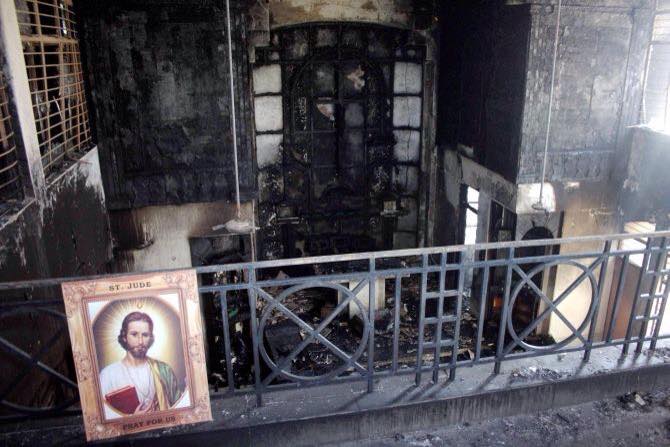
Julio Ribeiro is one of the best known police officers in India. Recently (March 16, 2015) he wrote in his article that he is feeling like a stranger in this country. ‘I feel threatened, not wanted, reduced to a stranger in my own country’. This pain and anguish of a distinguished citizen, an outstanding police officer has to be seen against the backdrop of the rising attacks on Churches and rape of the 71 year old nun in Kolkata. All over the country the rage amongst the Christian community is there to be seen in the form of silent marches, candle light vigils and peaceful protests.
As such during the last several months in particular the instances of attacks, and intimidation of the minority community has become more frightening. There is also a noticeable change in the pattern of violence against them. Earlier these attacks were more in the remote Adivasi areas, now one can see this taking place in urban areas also. The change in frequency of these attacks after the new Government took over is a striking phenomenon.
As such Christians are one of the very old communities in India. Right from the first century when St. Thomas visited Malabar Coast in Kerala and set up a Church there the Christian community has been here, part of the society, contributing to various aspects of social life. The missionaries, the nuns and priests, have also spent ages in the rural hinterlands setting up educational and health facilities and have also founded the most reputed educational institutions in most of the major cities of the country. Christians today are a tiny minority (2.3% as per 2001 census). It has been a community which like any other has its own internal diversity with various Christian denominations.
In this context the rise of anti Christian violence during last few decades in Adivasi areas, Dangs (Gujarat) Jhabua (MP) Kandhamal (Orissa) has been an unnerving experience for the community as a whole and for those believing in pluralism and diversity of the country in particular. The violence which picked up from mid nineties peaked in the burning alive of Pastor Graham Stains (23rd Jan 1999) and later Kandhamal violence in 2007 and 2008. After this there was a sort of low intensity scattered violence in remote areas, till the attack on Churches in Delhi from last several months. The Churches which were attacked were scattered in five corners of Delhi, Dilshad Garden (East), Jasola (South West), Rohini (Outer Delhi), Vikaspuri (West) and Vasant kunj (South), as if by design the whole terrain of Delhi was to be covered for polarization. It was claimed by police and state that the main cause of these has been theft etc.; in the face of the fact at most of the places the donation boxes remained intact. BJP spokesperson are vociferously giving the data that during this period so many temples have also been attacked, which is a mere putting the wool in the eye, as the targeted nature of anti Christian violence is very glaring.
In the meanwhile the RSS Sarsanghachalak, the boss of the Hindu right, to which BJP owes its allegiance, states that Mother Teresa was doing the charity work with intent to conversion. Post the statement two major incidents have come to light. One is in Hisar in Harayana, where a church has been attacked, it’s Cross replaced by the idol of Lord Hanuman and the Chief Minister of Haryana, who again has RSS background, stated that the Pastor of the Church has been alleged to be part of the conversion activities. At the same time RSS progeny Vishwa Hindu Parishad stated that more such acts of attack on churches will take place if conversions are not stopped. This incident reminds one of the placing of the idols of Ram Lalla (Baby Ram) in Babri Mosque in 1949 and then claiming that it was a birth place of Lord Ram. In addition the statement of the Chief Minister gives a clear indication as to how the investigation of the incident will take place and whether the real culprits will ever be nabbed. Incidentally there are no police complaints about Pastors’ conversion activities if any, in the police records. This ‘they are doing conversions’ is a standard ploy which is propagated for anti Christian violence, which one has witnessed so far.
After Bhagwat’s comments on Mother Teresa the anti Christian violence seems to be intensifying by the day and the incidence of Haryana and Kolkata are symbols of that and VHP is openly talking of more attacks. When Prime Minister Modi broke his deliberate silence on the issues of violence against minorities, he did say that religious freedom will be respected. But one also knows that what he says and what he means are mostly not the same. Also that now the silence of last several months has given a clear message to his associates in RSS combines that they can carry on their disruptive and polarizing activities at will. A large section within the Christian community feel that Modi was voted on the agenda of development and this type of violence was not anticipated! That is a sheer naivety, Modi is a RSS trained Pracharak, for whom the divisive agenda remains at the core, to be implemented by a clever ‘division of labor’ implemented through different organizations, which are part of RSS combine popularly known as Sangh Parivar.
As such India has been the cradle of many religions, which celebrated and lived together, a far cry from the present atmosphere which is intimidating the minorities. Christian’s plight in recent times is something to which the concerned democratic rights individuals need to wake up to. This seems to be unfolding of the script, Pehle Kasai Phir Isai, (First Muslim, then Christians). It is not just a violation of their rights; it’s also a violation of very basic norm of democracy. As they say, a democracy has to be judged by the litmus test of level of security and equity its minorities enjoy!

Islam, Peace, Justice & Dialogue

Maulana Wahiduddin Khan

Maulana Wahiduddin Khan's Interaction Interaction with a group of Catholic priests and nuns, New Delhi
Q: You give great importance to peace. Can you share some of your insights on this issue?
A: I am a born pacifist. Peace is an issue that is very dear to me. After long years of study, I discovered that in Islam, peace has the status of the highest good or the summum bonum. Many people in the West think that freedom is the summum bonum, but I don't agree. It is peace that is the summum bonum, the highest good.
Why, you might ask?
The answer is that because without peace, there is no progress. You can't engage in any normal activity, whether religious or secular, if there's no peace.
That said, it is very unfortunate that Muslims don't know the importance of peace. They know only the work of jihad—in the sense of confrontation with others. Some of them are actively engaged in fighting others, while some are engaged in the same thing but passively. Yet, according to my study, peace is Islam's greatest concern, as it should be of every person, no matter what her or his religion, who sincerely wants to bring about real and meaningful change in the world.
Q: In a society characterized by injustice and conflict, how do you think peace can be established?
A: That's a very good question. We all want peace, and so we need to be clear as to the right way or method through which peace can be established.
There is a widespread belief that peace cannot be established without justice. People who advocate this approach argue that, first of all justice must be established and then only can you have peace. And so, they talk of a ‘just peace'.
This is precisely what Muslims everywhere argue—in Palestine, in Pakistan, in Iran or wherever. They say, “Give us justice, and only then will there be peace. Only then will we agree to lay down arms and enter into a peace agreement.”
This type of thinking, however, is completely wrong. According to my understanding, justice is not part of peace. Peace should not be bracketed with justice, or with anything else. If you try to do so, it will only prolong conflict and war, and then peace will become impossible. It is putting the cart before the horse.
This is my experience.
The proper approach in this regard is to accept peace for its own sake, and not to link it with anything—with human rights or justice or whatever. Once there is peace in society, peace between former opponents, existing opportunities can be availed of. After that, gradually, justice may also be established.
This principle is exemplified in the life of the Prophet Muhammad. He and many of his companions were proceeding towards Makkah in order to perform the ‘minor pilgrimage', when they were stopped by their Makkan opponents at a place called Hudaibiya. The Makkans did not let the Muslims proceed to Makkah. At this time, the Prophet entered into a peace treaty with them, which included conditions that were clearly weighed heavily in favour of the Makkans. Yet, the Prophet accepted this peace treaty.
Some of the Prophet's companions wanted to first solve the problems that existed at that time between the Makkans and the Muslims, instead of first accepting peace. The Prophet did not agree with this approach. Instead, he unilaterally accepted the conditions of the Makkans. The Hudaibiya peace treaty thus became possible only because the Prophet accepted all the conditions of the other party and did not insist on justice.
This shows the importance of peace for its own sake in Islam, not linking it to, or predicating it on, justice or human rights. This is expressed in a phrase that appears in the Quran (4:128): As-sulh khair, which means ‘reconciliation is best'. 
Peace at any cost is, thus, a key principle. After long study, I have discovered that peace is the basis of all kinds of positive, constructive activities—educational, economic, social, cultural religious, and so on. And the only way to establish peace is to adopt the formula of ‘Peace for the sake of peace', without attaching any conditions to it.
This formula, I must stress, is not my invention. Rather, it is taught by Islam.
Q: The Prophet's attitude, as reflected in the example of the treaty you mentioned, reflects a deeply spiritual approach, accepting all the conditions of his opponents for the sake of peace. It certainly isn't easy.
A: The choice is actually always between peace without any conditions, and no peace at all. There is no third alternative, such as peace with justice or a ‘just peace', that some people, including many Muslims, insist on.
This is my experience.
I can't think of any society that has been able to establish real peace if justice is insisted on as a necessary condition for it. This sort of condition only leads to the prolongation of conflict, and only further hampers prospects for establishing genuine, sustainable peace.
The Arabs, for instance, seem to believe in this principle of peace-with-justice, and that's why they seem to be perpetually fighting. And because of this, they keep failing, losing everything and not gaining anything at all. This is because this formula of peace-with-justice is simply unworkable in the real world. It might seem alluring or attractive to some, but it is actually completely impracticable.
Q: Ignoring justice in order to establish peace gives the impression that one is indifferent to the injustices that prevail in this world. What do you have to say about this?
A: According to my experience, it is simply impossible to have ideal peace or ideal justice in this world. This has never happened. I believe in workable peace and workable justice, not ideal peace or ideal justice, in this world.
As I mentioned earlier, many people bracket peace and justice, but I disagree with this approach completely. Peace for the sake of peace is workable, but not peace for the sake of justice. This does not mean that I am indifferent to justice. My point is that once there is peace, one can avail of existing opportunities and engage in constructive and positive activities, and then you may be able to secure justice.
Consider the Indian case, for instance. I enjoy perfect peace in India, although there are many Indian Muslims who are negative about India. They say that they are oppressed, that they face discrimination. They talk of communal riots. And so, they are not living in peace. Instead, they are ridden with tension, anger, and hate, and with the desire for revenge.
But take me—I live with complete peace of mind. It is because I am not hankering after ideal justice. I am content with workable justice. Not complaining about this and that has given me the mental peace I need to avail of the many opportunities that abound in India.
Because I was not agitated, demanding ideal justice and protesting against this and that, and because I was content with workable justice, I was able to discover these opportunities and avail of them. This approach led me to be grateful for the many opportunities that exist here.
I think India is a unique country. The Hindus are the only people who believe in the concept of the many-ness of reality. This is a unique concept. The Hindus believe that all religions are true, that I am true and so are you. All other people believe ‘I am true and you are wrong'. They believe in the oneness of reality, that there is only one truth, while the Hindus believe in the many-ness of realty. This concept gave me a wonderful opportunity, to work for my religion, and my work is deeply appreciated by many Hindus, too. This kind of opportunity is absent in other countries.
So, to reiterate a point I made earlier, I always live with peace of mind, because I never claim that justice has been denied to me. When I know that only workable justice is possible in this world, why should I demand or expect ideal justice and complain that it doesn't exist? If I enjoy workable justice, why clamour for something that doesn't and cannot exist in this world?
Q: But what about justice? Ignoring it for the sake of peace might mean legitimizing injustice, isn't it?
A: If you think in terms of ideal justice, you may feel that I might be denying the importance of justice. The fact, however, is that ideal justice is simply impossible in this world. Only workable justice is possible here. To be at peace, you need to recognize this and accept it as a fact of life, as a reality. But if you don't, and if you keep chasing the elusive dream of establishing ideal justice, you will only harm yourself, and others also. You will destroy your peace of mind, and that of other people, too.
In every country, one can enjoy workable justice. And if you cheerfully accept this as a fact of life and live peacefully, you can, as I said, discover and avail of the many opportunities that exist to progress—in both the religious and secular spheres. This will help promote justice, too—but this happens gradually and indirectly, and not by demanding and insisting on justice along with peace.
My point is that according to my definition of justice, only workable justice is achievable in this world, not ideal justice. Workable justice is achievable in any and every country. So, no one can live with the claim that he was denied justice, because workable justice is available everywhere.
Q: But there is so much discrimination, which leads to injustice. What does ‘workable justice' mean in this context?
A: The term ‘justice' itself needs greater clarity. It needs to be more clearly defined. For example, many Muslims complain that in India they are denied justice, that during communal violence, the police acts against them. And so on. 
According to my knowledge, however, Muslims are to be blamed. They are paying the price for their stupid policies.
Q: If ideal justice doesn't exist in this world, and only workable justice does, should we then just forget about ideal justice? Or, should we make efforts to transform workable justice into ideal justice?
A: As I indicated earlier, establishing ideal justice in this world is simply impossible. According to Islam, and also according to Christianity, we have been put in this world as a test. Man is born free, because without freedom, there is no test. God has made us as free creatures, creatures with free-will. And because we are free, we are free to misuse our freedom, too, and this leads to injustice. Since some people are bound to misuse their God-given freedom, this makes it impossible to establish ideal justice in this world.
In fact, ideal justice in this world is not in the Creation Plan of God. Islam accepts this point. In the Quran, there is no verse that says that we have to establish ideal justice. This fanciful notion of establishing ideal justice in this world, through force if necessary, is only the product of some fertile imaginations—as for instance, the Egyptian Islamist ideologue, Sayyid Qutb, who wrote a thick volume on this thesis, titled Social Justice in Islam, wherein he insisted that Muslims must establish a system of ideal justice on earth.
This approach, however, is not Islamic. It isn't practical either.
Q: If ideal justice is not achievable in this world, does it mean we should stop talking about it?
A: I would say that ideal justice in this world is not only not achievable, but that it is also not good for human beings.
Why, you are bound to ask?
This is because if there is ideal justice, there will be no challenge, no competition, no differences, and this will stop the process of intellectual development. Inequalities and absence of ideal justice work as such a challenge. Establishing ideal peace or ideal justice is tantamount to abolishing such challenges. And that, in turn, is tantamount to putting a break in human progress.
You might have heard of the British historian Arnold Toynbee. He wrote a 12-volume treatise, titled The Study of History. There, he talked about a basic law of nature based on the challenge-response mechanism. Challenges, he pointed out, lead to responses, and this leads to human progress.
I fully agree with this thesis. If you are able to establish ideal peace or ideal justice, it means that you have put an end to challenges, and, hence, to human progress. This type of peace or justice has no value really, because challenges are necessary for all kinds of progress, in both the secular as well as religious fields
Q: What do you think is the role of forgiveness in establishing peace? I think it is something that is important.
A: You may be right, but my aim is quite different. I use the term ‘avoidance', rather than ‘forgiveness'. By ‘avoidance' I mean avoidance of clash or confrontation with others.
Avoidance of clash or confrontation is a general principle. When you are driving a vehicle, you have to avoid crashing into another vehicle if you want to be safe and happy. So, too, in society. You need to learn to avoid stepping on other people's toes if you want to be happy and achieve your goals
Forgiveness is, of course, good, but with regard to peace, I would particularly stress the importance of avoiding confrontation with others.
Q: So, if there is peace, it brings about a conversion of hearts, which then might bring about justice?
A: Yes. That's true. That said, I want to reiterate that the concept of justice is not well-defined. People often use it in a very vague way. For instance, I feel that in India, I enjoy justice in the complete sense of the term. But some other Muslims claim that they do not enjoy justice here. So, ‘justice' and ‘injustice' are not well-defined terms. It is your perception that determines if you think you are living with justice or with injustice.
I have never complained that in India I am denied, or have been denied, justice. I believe that I have got justice in India. I also believe that I have more justice in India than Muslims do in the almost 60 Muslim-majority countries that exist. I have visited some of these countries, and so I know this as a fact. I speak from personal experience. India is better than all these countries on the basis of my definition of justice. In Muslim countries, I don't hope to find justice, because in every one of them there is extremism and there's no openness, while in India there is tolerance, there is acceptance, there is openness. According to my definition of justice, I am enjoying justice in India and I have no complaints at all.
Q: I think dialogue between Muslims and Christians is very important. But when I advocate this sort of dialogue, some of my fellow Christians bring up the question of the law against apostasy from Islam in certain Muslim countries. According to this law, if someone abandons Islam, he should be killed. This law, which its advocates say is sanctioned in Islam, doesn't help Christian-Muslim dialogue. In fact, is a major obstacle to such dialogue.
Catholics have now accepted the right of people to choose to follow their conscience. And so, if a Catholic converts to some other religion, he won't be killed. His right to follow his conscience will be respected.
What are your views about the apostasy law in some Muslim countries?
A:  The true Islamic position on apostasy is reflected in this verse of the Quran (2:217):

Whoever of you turns back from his faith and dies as a denier of the truth will have his deeds come to nothing in this world and the Hereafter, and he will be an inhabitant of the Fire, to abide therein forever.
This verse refers to someone who abandons Islam and dies. It mentions that after he dies, God punishes Him in the Hereafter. This indicates that such a person dies a natural death, and is not killed for apostasy. So, this verse clearly shows that capital punishment for apostasy from Islam is not sanctioned by the Quran.
It was only later, maybe two hundred years after the Prophet, that Muslim fuqaha or jurisprudents, devised this law that apostates from Islam should be killed. These fuqaha emerged in the Abbasid period, in the period of Muslim empires. This law that they devised has no sanction in the Quran. It was formulated by the fuqaha, and I don't believe in the fuqaha on this matter.
There is total religious freedom in Islam.? I've written a book in Urdu on this subject of the law of apostas?y?. In that book, I have shown that the punishment of death that is prescribed by fuqaha for apostasy is not Islamic. 
Q: You have contacts with Christian leaders who are interested in Muslim-Christian dialogue. What do you see as the common grounds that Muslims and Christians have to work which can form a basis for them to work together for peace?
A: There is a great common ground in Jesus Christ's commandment to love one's enemies. The Quran (41:34) gives the same teaching, in these words:

Good and evil deeds are not equal. Repel evil with what is better; then you will see that one who was once your enemy has become your dearest friend […]
This Quranic verse indicates that your enemy is your potential friend.
I love the formula ‘Love your enemy'. It's the only formula that can give you positivity. If you love your enemy, it means actually that no one is your enemy, and that you can live in positive thinking. This is really very important in life. Negative thinking is the greatest evil, and positive thinking is the greatest good. And this formula, of loving your enemy, is the only workable formula for positive thinking and positive living.
Q: Christians and Muslims both talk of striving to do God's will. This seems to be major common ground between the two. What do you say?
A: Yes, this can serve as common ground, but there's a problem here, because the concept of doing God's will is differently understood by Christians and Muslims. This is related to their different understandings of God, because of which God's will is also interpreted differently. Stressing this as common ground, then, might create contradictions between the two while engaging in dialogue. And that is something that we must stay away from. Unfortunately, Muslims generally don't do that. Instead, when dialoguing with others, they try to impose or establish their point of view. Because of this, they simply aren't competent to engage in such dialogue.
In contrast to this, the approach I advocate steers clear from contradictions and controversies, and this facilitates, rather than hinders, dialogue and understanding between people of different faiths.
Q: I guess many Christians suffer from the same sense of superiority. They, too, want to prove that they are right and others are wrong.
A: But I, for one, don't do that, I can confidently say. I don't believe in any such superiority or inferiority. I never use these terms. The Quran doesn't say that Islam is a superior religion. This sort of claim is alien to the Quran. The Quran (2:285) tells us that all the many messengers of God are equal and that we should not make any distinction between them. None is superior to the others.
Q: Christianity gives great stress on love. I've read the translation of the Quran, but I've never seen the word ‘love' there. So, is it possible to talk of love as encouraged by the Quran, or is it something else that replaces love and that is central to Islam?
A: The word ‘love' doesn't appear in the Quran, but in its place the Quran uses another word—nush or nasih (For example, 7:62, 7:68). It denotes well-wishing. It is used in the same sense as love is used in the Bible.
Christianity says that we should love our neighbour, and Islam says that you should be your neighbour's well-wisher. Both mean the same thing really. In fact, you should love all and be a well-wisher of all. 
The importance Islam places on love or well-wishing for one's neighbour is indicated, for instance, in this beautiful saying, attributed to the Prophet of Islam:
Gabriel counselled me so persistently about the rights of the neighbour that I felt he was going to declare him an heir.


(Interaction with members of the Islamic Studies Association at the Islamic Centre, New Delhi, 1 March, 2013)