3 Apr 2015

New York exhibition looks at “political art” of the 1930s

Fred Mazelis

The Left Front: Radical Art in the ‘Red Decade,’ 1929-1940, at the Grey Art Gallery, New York University, New York City, January 13-April 4, 2015
The exhibition currently on view at New York University’s Grey Art Gallery is indeed an ambitious one. Entitled “The Left Front: Radical Art in the ‘Red Decade,’ 1929-1940,” it presents the work of dozens of American artists, both immigrant and native-born, who were radicalized in this period of the Depression, revolutionary struggle, the rise of fascism and the looming threat of world war.
The show, consisting of about 100 works by 40 artists, originated in the Chicago area at the Mary and Leigh Block Museum of Art at Northwestern University. It has been enlarged and expanded at NYU, using books, periodicals, photographs and film from the university’s well-known Tamiment Library, with its important holdings on the history of the socialist and labor movements in the US.
Much of the Grey Gallery exhibition consists of lithographs and other prints, in line with the emphasis of these artists on producing work for a mass audience instead of wealthy patrons or the art market. Many of the artists are not well-known, although the names of Louis Lozowick, Kenneth Hayes Miller, Rockwell Kent, Isabel Bishop, Raphael Soyer and especially Stuart Davis will be more familiar to those acquainted with 20th century American art.
The show examines the work of politically conscious artists in the period between the 1929 Wall Street Crash and the Second World War. This is undoubtedly an important subject, both for art-historical and aesthetic as well as political reasons. As the director of the Block Museum notes in the extensive guide to the show, “In light of the recent global recession, the study of artworks created by artist-activists in the 1930s provides a crucial historical backdrop for understanding artists’ responses to moments of social, political and economic crisis—then and now.”
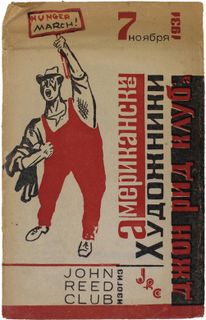
‘American Artists of the John Reed Club’ (1931) in ‘The Left Front.’ Photo: Amherst Center for Russian Culture/Amherst College
Unfortunately, the historical backdrop is not seriously and truthfully explored. While it is certainly worthwhile to view many of these works, an in-depth presentation must surely go beyond the fairly obvious issue of what immediately propelled these artists to take up their work.
What were the social and historical circumstances that moved them to come around the John Reed Clubs? The JRC were initiated by the US Communist Party in 1929 and named after the famed American journalist and Communist, the subject of the movie Reds, who wrote the classic account of the October 1917 revolution, Ten Days That Shook the World (1919), and died of typhus in the Soviet Union in 1920.
What was the role of the Communist Party, to which most of these artists gravitated, during this period? How was the work of these artists affected by the events of the 1930s? What became of the “Left Front”? (The title of the show is taken from the name of a short-lived Chicago-based art magazine in the early 1930s, but the curators are applying it to a broader movement during this decade.). What was the significance of the aesthetic issues these artists wrestled with, and how were they related to the struggles within the Soviet Union on “proletarian culture” and “proletarian art”? On these issues the NYU exhibit is often superficial where it is not misleading.
Either because it is too demanding, or perhaps because it cuts too close to the political bone, the curators fail to confront the centrality of the rise of Stalinism and Trotsky’s fight against the bureaucracy to 20th century cultural life. The artists under consideration in the present show were not the product of some relatively “organic” or contradiction-free left-wing artistic development, as the exhibition suggests. The movement the artists adhered to, the Communist Party, had suffered a fatal degeneration by the mid-1930s, and, in fact, was dominated by anti-Marxist conceptions about art and society.
The classical Marxist tradition of Plekhanov, Trotsky, Voronsky and others, which insisted upon the objective character of artistic cognition, had been repudiated by a petty bourgeois bureaucracy in the CPUSA and the Stalinist movement internationally that was hostile to the independent movement of the working class and frightened of genuinely challenging artistic work. Within the American CP, the Marxist conception that culture should enlighten and uplift the mass of the population through a determined struggle was rejected, in favor of an adaptation to national-populist traditions, generally empty rhetoric about art as “a weapon” and uncritical allegiance to the Soviet bureaucracy.
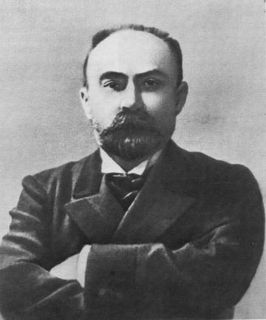
Georgi Plekhanov
Most of the artists represented here associated themselves with the conception of “proletarian art.” This false theory, which attracted much support in the years after the 1917 Revolution, proceeded from an abstract and formal identity between art and politics. It denounced most of the art of the past as “bourgeois” and therefore reactionary, and announced, in a leap that was the antithesis of Marxism, that the working class now had to create—laboratory-style—its own art.
Both Lenin and Trotsky bitterly opposed these views. Trotsky argued inLiterature and Revolution (1924) and many other writings and speeches that the art of the future would be socialist, not proletarian art, and that the proletariat, as an oppressed class, had to assimilate the cultural achievements of the past in the building of a new, classless society.
The debate over proletarian art played a significant role in the growing nationalist degeneration of the Russian Revolution, fought by the Trotskyist Left Opposition. “Proletarian culture” was utilized, especially after Lenin’s death, by the conservative bureaucracy under Stalin. It became part of the repudiation of socialist internationalism. The Stalinists used the slogan to justify an indefinite period of rule by the national-opportunist bureaucracy.
Opposing the rejection of past culture, Trotsky wrote, “It would be monstrous to conclude…that the technique of bourgeois art is not necessary to the workers. Yet there are many who fall into this error. ‘Give us,’ they say, ‘something even pock-marked, but our own.’ This is false and untrue. A pock-marked art is not art and is therefore not necessary to the working class. Those who believe in a ‘pock-marked’ art are imbued to a considerable extent with contempt for the masses and are like the breed of politicians who have no faith in class power but who flatter and praise the class when ‘all is well.’”
This was not, of course, an argument against realism in art or in literature, but rather the insistence that realism and naturalism had to be genuine, not based on flattery and an unreal idealization of the working class or anyone else. Trotsky argued that the artist who genuinely devoted him- or herself to the struggle against capitalist exploitation had to grasp the dialectical relationship between image and reality.
Trotsky’s opposition to “proletarian art” was an eloquent answer to the attempt to straitjacket literature and art. As he wrote in 1938, “Truly intellectual creation is incompatible with lies, hypocrisy and the spirit of conformism. Art can become a strong ally of revolution only insofar as it remains faithful to itself.”
These issues are not seriously addressed in the exhibition, although they come in for one or two brief mentions. In fact, although Trotsky wrote voluminously on the subject of socialism and culture, the quote in the above paragraph is the only mention of his views, and it is almost buried inside a glass case alongside a copy of one of the early issues of Partisan Review, the magazine founded by anti-Stalinist intellectuals who briefly flirted with Trotskyism in the late 1930s.
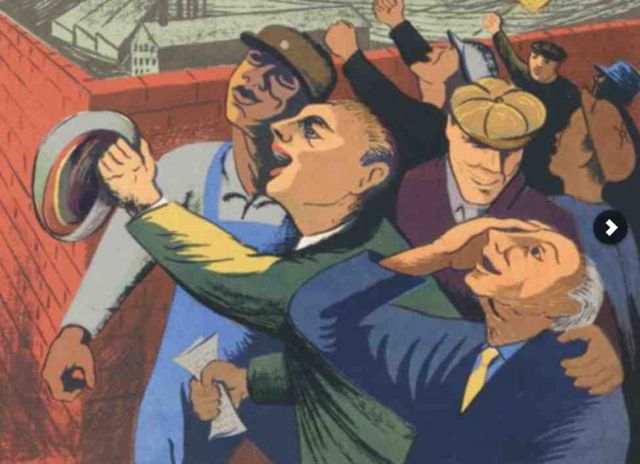
Harry Gottlieb (American, b. Bucharest, Romania, 1892-1992), "The Strike is Won," 1940. Color screenprint, 12 1/4 x 16 1/2 in. Collection of Belverd and Marion Needles
There is more than a bit of “pock-marked” art in The Left Front. Even if many of these artists were well-meaning, their work exhibits little of the “faith in class power” that Trotsky referred to.
Several examples stand out, especially among the artists based in Chicago who perhaps were under the influence of a syndicalist outlook in that industrial center, which in turn reinforced the doctrine of proletarian art.
Morris Topchevsky (1899-1947), a prolific artist active in Chicago, is represented by a number of works in this show, including Strike Against Wage Cuts (1930), a watercolor and pencil sketch that is little more than an idealized depiction of workers being addressed by a strike leader. A lithograph by Harry Gottlieb (1895-1992), The Strike Is Won (1937) is even more in the tradition of Stalinist socialist realism, with its lifeless portrayal of saintly workers and upturned faces.
There is little that is genuine and nothing that is revolutionary about these works and a number of others along similar lines in the exhibit. These include Mitchell Siporin’s (1910-1976) watercolor Spanish Civil War (after Goya), an unimaginative transposition of Goya’s famous The Third of May, 1808, the depiction of Spanish resistance to Napoleonic occupation, to the Spanish Civil War of the late 1930s.
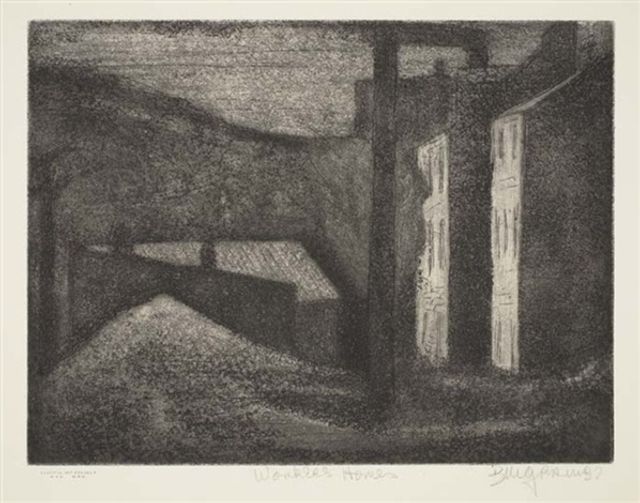
Blanche Grambs (American, b. Beijing, China, 1916-), "Workers' homes," 1937-38. Etching and aquatint, 9 x 11.7 in.
There were other artists, to be sure, who produced more serious work despite the constraints of “proletarian art.” William Gropper (1897-1977) was well-known as an artist and cartoonist. His 1935 lithograph, Uprooted, has some strength, and the work of Blanche Grambs (1916-2010), including Workers’ Homes, is affecting in its somber portrayal of the sacrifices and struggles of workers in the Depression.
There were also artists who rejected the conception of “proletarian culture.” Louis Lozowick (1892-1973) stands out for his sharply critical comments. He is quoted in the exhibition, next to an interesting 1930 lithograph, Still Life with Breakfast, declaring, in 1929: “[O]ne way in which a revolutionary artist can affirm allegiance to his cause is by repudiating that petty bourgeois legacy, the unsolicited heroization of the worker… art has its own specific problems of importance to the artist and the worker.”
Lozowick went on to become a leader of the John Reed Clubs during the Stalinist “Third Period” in the early 1930s. While it is unclear when or whether he broke politically with Stalinism, his work was never characterized by the rigidity of “proletarian art,” and his remarks quoted above suggests he was not unacquainted with Trotsky’s criticism.
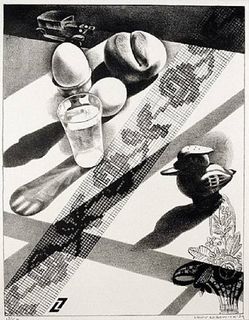
Louis Lozowick (American, b. Ukraine, 1892-1973), "Still Life with Breakfast," 1929. Lithograph, 10 3/8 x 8 in.
Stuart Davis (1892-1964) is perhaps the most well-known artist in the show. He exhibited as part of the legendary 1913 Armory Show—which introduced American audiences to European Impressionists, Fauvists and Cubists—when he was only 21 years old. He was, at least during the “Red Decade,” close to the Communist Party, but he never showed any interest in the Stalinist line on art. The exhibit includes one of Davis’s typically jazz-influenced modernist works, the 1939 lithograph New Jersey Landscape.
An entire section of the NYU exhibition comes under the heading of “The Popular Front.” In terms of historical context, this is perhaps the weakest part of the show. The prominent wall caption explains that the John Reed Clubs were closed down and in 1936, “former John Reed Club members organized the call for an American Artists Congress…as a more inclusive artists’ collective with new goals.” It goes on to explain, “The American Artists Congress reflected a changed political program for the international left.” The purpose of the Popular Front was “to build an international coalition among Communists, Socialists, Democrats and independent leftists of all persuasions.”
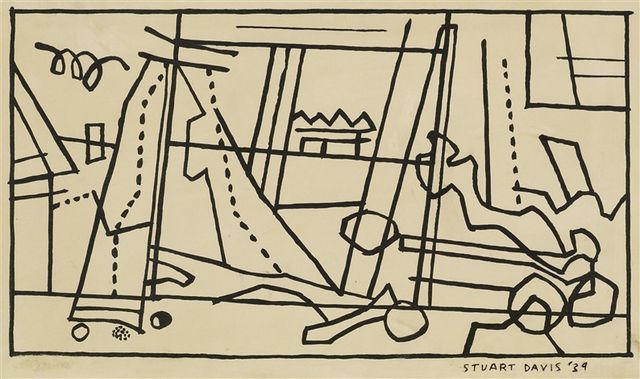
Stuart Davis, (American, b. Philadelphia, PA., 1892-1964), "New Jersey Landscape (Seine Cart)," 1939, 7.63 x 13.63 in.
This is a serious falsification of the nature of the Popular Front, why it came into being and how it functioned. The “international left” referred to by the curators was the Stalinist apparatus and its counterrevolutionary operations all over the world. While it pursued a coalition with “democratic” imperialists like Roosevelt, virtually the entire leadership of the October Revolution was framed up and executed in the infamous Moscow Trials of 1936-38. The Popular Front was not separate from this drowning of the revolution in blood. In Spain GPU assassins murdered left-wing critics such as Andres Nin and Trotsky’s secretary Erwin Wolf, in a crucial element of the Stalinists’ betrayal of the Spanish Revolution. In the US the explosive CIO movement was brought firmly under the control of the Democratic Party, with the Stalinists playing a crucial role.
It should be noted that the shutting down of the John Reed Clubs paralleled the shift inside the Soviet Union from the Third Period line in which “proletarian culture” was the official doctrine. Without fundamentally altering the theoretical framework, the Stalinist cultural dictators now insisted on “socialist realism,” which prescribed “uplifting” work that was above all aimed at glorifying Stalin and the bureaucratic apparatus.
As for those who strayed from this diktat, their treatment was most prominently illustrated by the violent attacks on composer Dmitri Shostakovich and his opera Lady Macbeth of Mtsensk in 1936. The Soviet experimental theater director Vsevolod Meyerhold was arrested in 1939 and executed the following year. Many lesser-known artists in the USSR suffered the same fate, or simply retreated into silence.
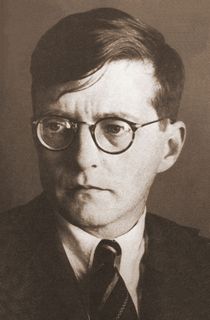
Dmitri Shostakovich
Outside the Soviet Union, a somewhat looser approach was—or had to be—taken, in line with the needs of Moscow’s foreign policy. There was greater leeway for artists like Davis, Lozowick, Miller, Bishop and others, as long as they made no political criticisms.
The “historical backdrop” provided by this exhibition says nothing about any of this. Instead these years are celebrated as the heyday of “activist art” of the 1930s. While it briefly mentions aesthetic differences, they are not developed and above all are not related to the shifts in Stalinist policy during this decade.
Clearly the sympathies of the curators are with the liberals who welcomed an alliance with the Stalinists, an alliance directed against the working class. That is why, after ignoring the Stalinist crimes in the USSR, Spain and elsewhere, the exhibition suddenly explains that the “Red Decade” ended in disappointment with the announcement of the Stalin-Hitler nonaggression pact in August 1939. The membership of the AAC quickly plummeted, reflecting the disaffection of its liberal members as well as the confusion of Communist Party supporters. The liberals were generally unmoved by the Moscow Trials (or approved of them), but the disruption of the US-Soviet alliance was another matter.
The primary impression left by the curators of this exhibition, especially in its concluding sections, is nostalgia for the Popular Front. If only Stalin had not temporarily allied himself with Hitler, they seem to say, the “activist” artists of the 1930s could have continued their work.
Politically this means a continuing orientation, 75 years later, to the capitalist Democratic Party, the line now pursued by the pseudo-left. Aesthetically it suggests an uncritical revival of what passes for “populist” art, today focused largely on identity politics as well as various forms middle-class protest.
The enormous struggles impending against poverty, inequality and the threat of world war will doubtless give birth to new artistic trends. The main lesson to be taken from “The Left Front” exhibition is that it will be necessary to fight against contemporary versions of “pock-marked” art. For all those who wish to confront the question, “What is revolutionary art?” there is no substitute for a serious study of Trotsky and the work of the Trotskyist movement on the issues of culture and revolution.

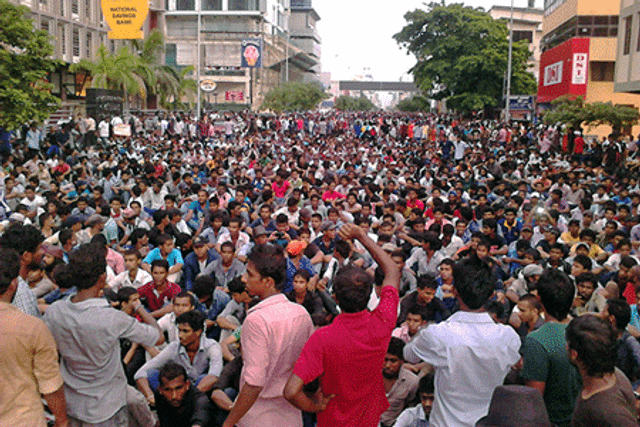
Sri Lankan police crackdown on protesting students

Pradeep Ramanayake

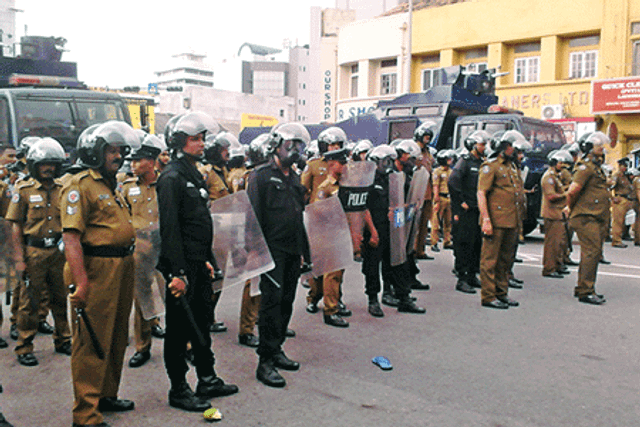
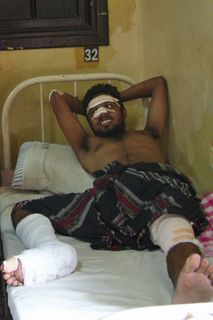
Sri Lankan police brutally assaulted university students marching to Prime Minister Ranil Wickremesinghe’s office in central Colombo on Tuesday. Riot police used tear gas and water cannon against the students who were planning to present a list of demands. Five students were injured and five others were arrested. Police were later forced to release those arrested after students staged a sit-down protest on the main Galle Road.
Students demonstrate in central Colombo
Thousands of students marched eight kilometres from Jayawardenepura University to central Colombo. Their 14 demands included the payment of promised increases in Mahapola student loans, the withdrawal of new fee regulations for school education, the abolition of private universities and the withdrawal of increased Open University course fees. The protest was organised by the Inter University Students’ Federation (IUSF), which is controlled by the fake-left Frontline Socialist Party (FSP), a split off from the Sinhala communalist Janatha Vimukthi Peramuna (JVP).
It was the first police attack on students since President Maithripala Sirisena won office in January. Sirisena promised to end the “dictatorial rule” of former President Mahinda Rajapakse and to guarantee democratic rights.
Prime Minister Ranil Wickremesinghe’s office released a statement about the police assault. Hypocritically it declared that the “occurrence of such an unfortunate situation is regrettable” but then attempted to justify the attack. “If the protesters had peacefully allowed their representatives to reach the Prime Minister’s Office such a situation would have not arisen,” it declared.
The immediate cause of the students’ outrage was the government’s failure to increase Mahapola student loans. The Sirisena government promised to lift the interest free loans from 2,500 rupees (about $US19) to 4,000 rupees. Sirisena’s election manifesto promised to raise the loan to 5,000 rupees. In February, the Jayawardenepura University student welfare department even named the students who would receive the increased loan. The university administration, however, unilaterally reversed this decision.
Police deployed to attack students
Sirisena and the United National Party (UNP) also promised during the election to increase public employees’ salaries by 10,000 rupees in two instalments but have since reduced the promised wage rise and changed it to an allowance.
The new government has also attacked public education by imposing a new system of levying school fees. Under the cover of preventing corruption, it has cracked down on school administrations that have been forced to collect resources from parents because of inadequate government funding. A circular entitled “prohibition of informal money collection in schools” has now formalised these collections, effectively ending free public education.
Last year, the Rajapakse government dramatically raised Open University student fees to 60,000 rupees. The students have been protesting for the past three months to demand withdrawal of the increase. Sri Lankan university students lack properly-equipped lecture halls and rooms, labs, libraries, lecturers, research opportunities and hostel facilities.
The former Rajapakse government suppressed student opposition by abolishing studentships, suspending classes and mobilising police to assault and arrest protesting students. In line with plans to impose new austerity measures against working people, the Sirisena and UNP-led coalition government is using similar repressive measures.
The International Monetary Fund (IMF) recently refused a request from the Sirisena government for a $4 billion loan. It demanded that the government fulfil pledges made by the previous government to reduce its budget deficit to 4.4 percent of gross domestic product this year and to 3.8 percent of GDP by 2016. The IMF has also called for the further privatisation of state-owned enterprises.
While Sirisena and the UNP-led government face a new general election in June, this week’s attack on students demonstrates that it will not hesitate to crack down on any resistance to austerity measures by workers, the poor and young people.
One of the students injured in the police attack
The ongoing student protests are an indication of a growing anger and militancy. While Tuesday’s march showed students’ determination to fight the government’s cuts to public education, it also exposed the bankrupt program of the IUSF leadership, who are desperately claiming that the new government can be pressured to change course.
During the presidential election, the IUSF leadership, including its convener Najith Indika, gave back-handed support to Sirisena’s campaign. The IUSF organised meetings of university academics who vociferously backed Sirisena. Immediately after Sirisena was elected, Indika sent him a letter imploring, “We expect at least some democratic reforms under your temporary government.”
Contrary to the IUSF’s appeals, the Sirisena government, which is driven by the demands of the international banks and the intensifying crisis of global capitalism, will intensify its assault on public education, health and other vital social programs and basic democratic rights. This can only be fought by mobilising students, workers and the poor on the basis of the socialist and internationalist program advanced by the International Youth and Students for Social Equality and the Socialist Equality Party.

Malaysian prime minister under pressure over US-led economic pact

John Roberts

Malaysian Prime Minister Najib Razak is facing an increasing challenge from within his United Malays National Organisation (UMNO), the major force in the 14-party Barisan Nasional (BN) coalition government. UMNO, based on the national capitalist elite, has exercised autocratic power in Malaysia since independence from Britain in 1957.
Former Prime Minister Mahathir Mohamad is bitterly opposed to Najib for signing up, in 2010, to US President Barack Obama’s proposed Trans-Pacific Partnership (TPP). The TPP is a mechanism through which Wall Street is seeking to fully open up economies in the Asia Pacific for American trade and investors. Above all, the TPP is directed against China.
Through the TPP, the US is pressing for the dismantling of national regulatory measures and the protection of the “intellectual property rights” of American corporations, particularly in areas such as software, media and pharmaceuticals. Mahathir has denounced the 12-nation TPP as a plan to colonise Malaysia.
Among the TPP’s provisions are many that would adversely affect the protected business empires that cluster around UMNO, including those regarding investment rules, state-owned enterprises and the country’s pharmaceutical industry.
The moves against Najib stem from the basic economic and foreign policy differences that erupted between Mahathir and the Anwar Ibrahim-led wing of the ruling elite in 1998 following the 1997 Asian financial crisis. Mahathir dumped Anwar as deputy prime minister for supporting US-backed International Monetary Fund demands to dismantle the protectionist measures underpinning UMNO’s Malay-dominated business base.
Mahathir, now 89, who left office in 2003 after 22 years, formally withdrew his support from Najib last August. Tensions built up after the 2013 election in which the BN won only 47 percent of the vote to the PR’s 51 percent. The ruling coalition was saved by a blatant gerrymander that gave it 133 seats to the opposition’s 89. Mahathir held Najib responsible for the debacle.
Mahathir’s faction includes Deputy Prime Minister Muhyiddin Yassin, former Finance Minister Daim Zainuddin, senior UMNO figure Jazlan Mohamed and Mahathir’s son, Kedah state Chief Minister Mukhriz Mahathir. When pro-Najib UMNO leaders called a national meeting of UMNO’s 191 divisional leaders on March 8 to pledge support for Najib, 31 did not turn up.
Mahathir has also condemned Najib for limiting the economic preference system for ethnic Malays, implementing some pro-market “reforms,” abolishing the Internal Security Act and initially promising to repeal the Sedition Act. The economic preference regime dovetails with the race-based electoral system that discriminates against Chinese and Indian Malaysians.
The Mahathir faction has honed in on a scandal surrounding Najib’s national investment fund, the 1Malaysia Development Bhd (1MDM). Founded in 2009 to promote foreign direct investment, it has had little success, while amassing debts reported to total $US11.2 billion.
According to a Bloomberg report,1MDB has trouble servicing its debt. A syndicate led by Deutsche Bank is owed a payment of $975 million in September. Poor rating of assets will adversely affect a 1MBD float planned for later this year. Last month, Deputy Prime Minister Muhyiddin declared that the government should not bail out 1MDB.
The Sarawak news portal Sarawak Report alleged that Low Jho Teck, a Penang business figure, was involved in siphoning off $US700 million in a petroleum deal that involved 1MDB. Jho Teck is a close friend of Najib’s stepson Riza Aziz. As chairman of 1MDB, Najib is vulnerable to questions about its operations. Last year, Asia Sentinel reported a study that identified strange sources of loans taken out by 1MDB.
Last month, Mahathir seized on a New York Times article that pointed to Najib’s considerable family assets in the United States. Mahathir asked about the source of this enormous wealth.
Public bickering inside UMNO continues despite the jailing of the opposition coalition People’s Alliance (PR) leader Anwar Ibrahim on February 10 for five years and stepped-up attacks on dissent using the anti-democratic Sedition Act.
Najib’s government, in fact, has intensified its anti-democratic assault on the opposition parties since Malaysia’s highest court overturned Anwar’s 2012 acquittal on a trumped-up charge of sodomy on February 10. Anwar was immediately consigned to jail to serve out his five-year sentence.
Following a demonstration of 10,000 in support of Anwar in Kuala Lumpur on March 7, the police on March 16 arrested Anwar’s eldest daughter, Nurul Izzah. She was detained on sedition charges for making a speech in parliament quoting her father’s criticism of the court for “bowing to political masters” and being “partners in a crime that contributed to the death of a free judiciary.”
Malaysia’s Sedition Act, which dates from British colonial times, criminalises speech with an undefined “seditious tendency.” This is believed to be the first time since 1978 that a member of parliament has been arrested under the notorious Act. For now, Nurul has been released on bail, pending further police inquiries.
These repressive measures were designed to appeal to UMNO’s extreme right wing and undermine support for the Mahathir faction, but the internal backstabbing has continued.
Najib’s political weakness has made him more dependent on the ultra-nationalists and Islamists inside UMNO. Najib has refused to say whether federal UMNO will support moves by the Parti Islam se-Malaysia (PAS) government in Kelantan to impose the reactionary Islamic criminal code, which includes penalties of amputation and stoning to death.
PAS leaders in the state secured the support of local UMNO lawmakers against PAS’s partners in the PR coalition—Anwar’s secular Malay-based Keadilan and the ethnic Chinese based Democratic Action Party. Even if the measure does not get the backing it needs in the national parliament, it has the potential to break up the PR.
Economic developments are exacerbating the political instability. Exports fell by 8.2 percent in January, year on year. The ringgit has fallen 6 percent this year against the US dollar, mainly due to falling oil and gas prices. Oil and gas exports make up 20 percent of exports and 30 percent of government revenues. In January, Najib announced $1.5 billion in spending cuts and pushed ahead with the extremely unpopular goods and services tax, which commenced on April 1.
The Obama administration has pushed hard to bring Malaysia into its anti-China “pivot to Asia” strategy, which includes the TPP, and Najib has responded by seeking to deepen the relationship. For this, he has received Washington’s de facto support for his repressive measures against Anwar and the opposition.
Obama visited Malaysia last April, the first trip by a US president since 1966, and will do so again in November to discuss intelligence sharing and military cooperation, under the “strategic partnership” that Najib and Obama announced last year.
Now concerns are being expressed in Washington about the instability of Najib’s leadership and its potential impact on Malaysia’s pro-US orientation. The US Council of Foreign Relations website on March 18 carried an article entitled “Growing Political Crisis in Malaysia?”
In Malaysia, as elsewhere across the Asia-Pacific region, the aggressive drive by the Obama administration to encircle China, militarily and economically, is fracturing relations within ruling circles.

Underground gas fire shuts down central London

Paul Mitchell

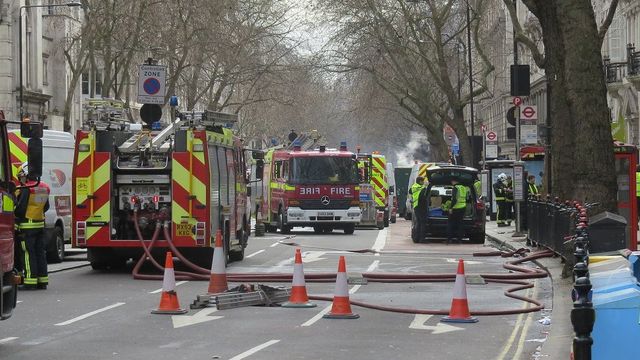
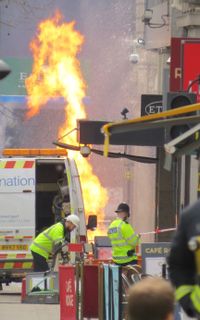
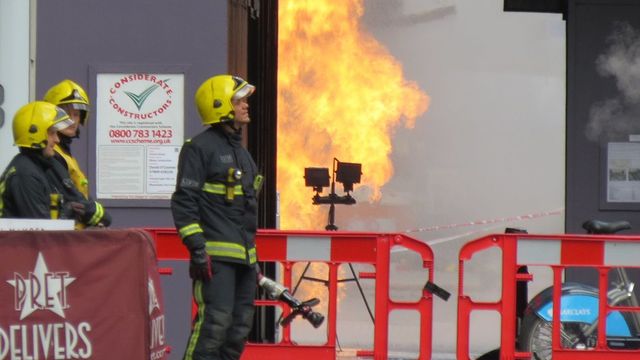
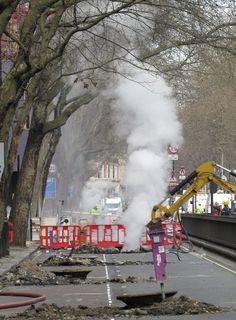
An underground gas fire spotted midday Wednesday in Kingsway, one of central London’s major north-south roads, caused chaos, cutting off power and plunging the area into darkness. Balls of fire and plumes of toxic smoke were still shooting out of manholes and cracks in the road 24 hours later.
Dozens of fire engines, police and utility vehicles, and hundreds of firefighters, police officers, gas and electricity workers remained in Kingsway and neighbouring roads, all of which remain closed to traffic.
Firefighters on the scene in London
Thousands of workers had to be evacuated from the areas around Kingsway, one of London’s busiest office and shopping districts. At the top of the road, Holborn Underground rail station was closed. Offices, colleges, theatres and shops were shut down, as were the Royal Courts of Justice, Britain’s most important law courts. Telecommunications companies O2 and Vodafone reported little or no network coverage across Central London because the fire had destroyed cabling to a phone mast.
Emergency workers and police at the scene of one of the fires
Students at the prestigious London School of Economics (LSE) were forced to find temporary accommodation. The LSE Provost and Deputy Director emailed staff and students to say, “All LSE’s central campus buildings have been evacuated and closed off.”
London Fire Brigade assistant commissioner, Dany Cotton, said, “This is a technically difficult and unusual incident to tackle as it is underground. Firefighting in tunnels is very hazardous and one of the reasons that the fire is still burning is because of the dangers involved in extinguishing the fire before the gas supply is shut down, which could result in the risk of a subsequent gas explosion.
“Firefighters have, however, been applying water through access points throughout the night, to control the spread of the fire. The fire is contained in the tunnel and we are making steady progress and working with the utility companies and the police to bring this incident to a close.”
The fire brigade said a faulty power cable had triggered the blaze, but that it was unconnected to another underground fire nearby earlier in the day. On Wednesday afternoon, a smaller underground fire broke out a couple of miles away in Stoke Newington.
Firefighters at one of the fires near the LSE on Wednesday
Matt Rudling, a spokesman for UK Power Networks, owners of London’s power cables, tried to deflect criticism from the company, declaring, “The gas is still burning under there and until we can gain access to that particular area we won’t understand what’s caused it and what we can do.” He added, “The Healthy and Safety Executive have been working closely with us in working to mitigate these issues.”
Holes dug by emergency workers at Kingsway
A policeman told this reporter that the area was likely to remain closed for several days, and then the road needed to be inspected and repaired. A power worker said that Kingsway was “notorious” for the number of tunnels and ducts carrying all the utility services—gas, electricity, water and telecommunications.
Besides the utility infrastructure, underneath Kingsway is a complex of tunnels, dug by London Transport during the Second World War, which later became the London terminal of the first-ever transatlantic telephone cable. During the Cold War, the underground became a “city under a city,” one of many such secret subterranean complexes designed for the purpose of surviving nuclear warfare. They are now derelict, awaiting redevelopment. 
The power worker explained, “It only needs a spark to come in contact with a gas leak and it travels along the ducting, melting everything along the way. There’s so much building going on in London and everyone wants their power ‘now’. It means everyone is under pressure to get the job done.” 

Germany and France stage joint military build-up

Peter Shwarz

A joint meeting of the German and French cabinets on Tuesday in Berlin reached an agreement for Germany and France to jointly build a combat drone, and work together more closely on satellite reconnaissance.
In the coming months, an agreement to develop a European drone will be signed, with Italy also participating. Over the course of this year, an initial study will concretise the requirements for the new aircraft. The project will also be opened up later to other interested parties such as Spain and Poland. The new drone should be operational no earlier than 2020 and no later than 2025.
It will be a drone capable of flying for up to 24 hours at a height of 3,000 to 15,000 metres, and will be able to gather intelligence as well as fire missiles. So far, only the US and Israel have built such drones.
Airbus (Germany, France), Dassault (France) and Finmeccanica (Italy) had already made a proposal for such a craft two years ago. They will probably be responsible for the development and construction of the new drone, which will consume hundreds of millions, if not billions of euros, according to experts.
The joint cabinet meeting also decided to extend Franco-German cooperation on military reconnaissance satellites. A corresponding agreement should be signed by June. Among other things, the German Ministry of Defence will invest €210 million in the future French reconnaissance system CSO (Composante Spatiale Optique) to gain greater access to its satellite imagery.
President François Hollande and Chancellor Angela Merkel justified the joint rearming with strategic arguments. It would ensure greater independence from the industries and information of other states, Hollande said. This is a sign of technical competence and a question of political power. Those who know the situation, can act”, he said, and “those with their own satellite imagery, are free to decide.”
In an interview with the Süddeutsche Zeitung, French Defence Minister Jean-Yves Le Drian particularly stressed the decoupling from the United States. “We Europeans can do it, we Europeans should have done it long ago”, he said. “When we finally do it, then we increase the independence from the United States in this field, technically and militarily.”
Le Drian explicitly supported the plans for a European Army brought into play by German Defence Minister Ursula von der Leyen and European Commission President Jean-Claude Juncker in recent weeks.
Chancellor Angela Merkel said she was “very happy” that the long existing plans were finally being implemented. “The project shows how closely we work together,” she said.
Plans for a European Army and close military cooperation between Germany and France had existed in the 1990s. The aim is to enable Europe to pursue its own global interests independently of the United States.
Some of these plans have already been implemented. For example, an existing Franco-German corps was converted into a European Brigade. Several European armaments projects—like the Euro Fighter, the NH90 helicopter and the A400M transport aircraft—were agreed.
However, with the Iraq war, which divided Europe into supporters and opponents in 2003, the failure of the EU constitution project in 2005 and the 2008 financial crisis, these plans ground to a halt. Fiscal policy conflicts between Germany and France were exacerbated. In foreign affairs, France has focused on its former colonial territories in Africa and the Middle East, while Germany turned towards Eastern Europe.
The conflict with Russia in Ukraine, and the deepening of the crisis in the Middle East, then brought Germany and France closer together again. In both cases, the closing of ranks was in response to the aggressive and sometimes erratic actions of the US.
In Ukraine, Paris and Berlin in particular supported the putsch in Kiev, which brought a pro-Western regime to power. However, for economic reasons, they do not want to push sanctions against Russia too far, in contrast to Washington, and reject building up the Kiev regime militarily. In the Middle East, they regard the United States as increasingly responsible for the entire region sinking into war.
In its efforts as a “power in the centre”, Germany is striving to become the hegemonic power in Europe and a world power, seeking close cooperation with France in order not to be isolated. This is why Berlin has demonstratively, albeit mostly symbolically, supported the French military intervention in Africa. And in foreign policy initiatives such as the Minsk Agreement and the Lausanne negotiations with Iran, German Foreign Minister Frank-Walter Steinmeier always stresses solidarity with his French counterpart Laurent Fabius.
France is pleased with this support. After the joint cabinet meeting in Berlin, Merkel and Hollande cynically used the Germanwings disaster in the south of France and the attack on the satirical magazine Charlie Hebdo to justify their military and foreign policy cooperation.
Since the beginning of the year, Germany and France had “come closer together” as a result of several “critical tests”, Merkel told the press conference. Hollande added, the Franco-German friendship had become “more a Franco-German fraternity in the last few weeks”. In the past crises, “our two countries [were] only one country”. Germany and France were “two big states, who also play their role on the world stage”, and want to “influence Europe and the fate of the world”.
However, this evocation of liberty and fraternity also covers over deep-going conflicts and contradictions that can always break out again. Economically, France, which has long been stagnating, feels crushed by the German export offensive. And nationalist parties are growing in both countries, like the National Front, which rejects cooperation between the two governments.
In addition to military and political aims, the drone project also pursues economic objectives. Huge profits and technological advantages are always linked with multi-billion-euro defence projects.
US manufacturers have sold their drones to Europe, but have refused to grant access to the technical documentation. Foreign technology is “mostly like a so-called black box,” reports Die Zeit. “European operators may not open up and inspect important components, let alone maintain and repair them. Despite transatlantic partnership—that goes too far, especially for the Germans”.
From a German perspective, the drone project is also another step in a systematic military upgrade, which is being driven forward ever faster since government representatives announced the “end of military restraint” at the beginning of last year. Only ten days ago, the cabinet agreed to increase the defence budget by €8 billion.
The German defence ministry does not want to wait until the planned euro drone is ready—which the experience of previous European armament projects suggests could be a long time. Later this year, it will decide on the purchase or leasing of American or Israeli attack drones. This involves the Israeli “Heron TP” drone and the infamous “Predator” from the United States.

Rising inequality, poverty in Ann Arbor, Michigan

Naomi Spencer

Washtenaw County, Michigan has been held up as a “bright spot” in a state decimated by years of plant closings and deindustrialization. Located in Southeast Michigan it has been favorably contrasted to nearby Detroit, which recently went through bankruptcy and has suffered staggering losses of jobs and population.
The county has been held up as a “knowledge economy” model for recovery in Michigan. Along with the University of Michigan (U of M) in Ann Arbor and nearby Eastern Michigan University in Ypsilanti, Washtenaw County is home to substantial hospitals and research facilities as well as numerous technology startup companies.
However, alongside the increase in high-skill “knowledge jobs” over the past ten years, inequality has soared and the wages of the majority of working families have declined.
A study released March 30 by the Center for Labor and Community Studies at the University of Michigan-Dearborn finds that fully 37 percent of Washtenaw County residents cannot make ends meet.
The authors found that “despite net positive job growth the area’s economy has produced increasing inequality and alarming long-term trends in employment patterns and earnings.” (The study, “Growing Together or Drifting Apart? Economic Well-Being in Washtenaw County’s new “Knowledge Economy,” can be found here in PDF.)
The study emphasizes that workers earning the least have suffered the greatest losses in real wages, while those in the top income bracket saw gains. The bottom 37 percent of Washtenaw County workers earned less than $32,000 in 2013.
This amount is less than a “basic needs budget” as defined by the Michigan League for Public Policy (MLPP), which takes into account cost of living by county.
Even as the economy plunged into recession and home values declined, rent rates continued to spiral—further burdening the poorest sections of workers and those who lost their homes to foreclosure.
Housing inflation is partly driven by the cost of attending U of M, one of the most expensive public universities in the United States. Out-of-state annual tuition has a list price of more than $41,000 for 2014-2015.
A construction boom on luxury apartments has driven the cost of an average one-bedroom apartment over to $1,500 a month in downtown Ann Arbor. Many units are priced at $2,500 or more per month, and condos are listed for well over $1 million.
Meanwhile, property management agencies across the city have jacked up rents more than 10 percent in the past year alone. Most report 100 percent occupancy and waiting lists of six to eight months.
Not surprisingly, Washtenaw County’s housing costs are the highest in the state. According to the MLPP, this pushes the basic monthly needs budget for a family of four in the county to $5,340.
That means that if both parents in a household are working, they would need to earn more than $32,000 apiece in order to meet the annual basic needs budget of $64,080.
The MLPP budget includes nothing beyond housing, childcare, food, transportation, health care, and household and personal expenses (including a phone bill). It does not include debt payments, utility bills, or budget for unexpected expenses, savings, or spending for a vacation or holiday. Many families are one medical emergency or car breakdown away from destitution, bankruptcy, or eviction.
One in four Washtenaw County households—many with dual wage earners—are struggling to meet basic needs. As a result, more than one in five children live in poverty based on the MLPP budget.
One indication of the social crisis is the rising number of homeless public school children in the county. The federal Education Project for Homeless Youth (EPHY) estimated that at least 1,400 children would need assistance with basic supplies in fall 2014 due to living in unstable situations. “I think there’s an expectation that we’re rebounding and we’re getting back on our feet,” Washtenaw County’s EPHY coordinator, Kristin Duff, told MLive.com. “The housing issue is a very big issue and there aren’t simple solutions. It’s disheartening because there aren’t enough resources for these families.”
An Ann Arbor City Council-commissioned analysis of housing affordability in the county in January 2015 found that a majority of renters—56 percent—were “rent burdened,” paying at least a third of their income toward keeping a roof over their heads. One in three renters were found to be paying more than half of their incomes into rent.
That analysis found that among residents earning less than $35,000 a year, fully 9 in 10 are rent burdened.
Between 2005 and 2013, the U of M-Dearborn study reported that the county saw an increase of 15,000 “knowledge jobs,” a gain of 23 percent. Behind this growth in knowledge-based employment is a large increase in low-wage service jobs. Indeed, as the knowledge-based economy grew, industrial jobs in the county plummeted by 12,000—a decline of 31 percent.
Workers who were laid off from plants such as the Ford Visteon or Willow Run auto factories in Ypsilanti were faced with entering occupations in retail, hospitality, and customer service—all jobs averaging less than $10 an hour. As a consequence, Ypsilanti is nearing a 30 percent official poverty rate and the city’s population has declined by double digits since 2000.
The U of M-Dearborn study found that nine of the ten most common jobs countywide pay less than $32,000, and these same poverty-level jobs were projected to see the largest growth over the next five years.
The study also reveals a widening inequality within the knowledge economy. At U of M, the authors note, “income inequality between tenure-track and other faculty has been growing, and among all employees those in low-wage jobs have experienced real wage declines,” while higher-paid employees have seen gains.
Including its medical center, the University of Michigan employs some 38,000 workers, accounting for nearly one in five jobs in Washtenaw County. Between 2005 and 2013, employment on the Ann Arbor campus grew 21 percent. Tellingly, the study finds that that low-wage employment at U of M grew by 72 percent over the same period.
These statistics reflect the scale of attacks on the position of academics, especially adjunct and part-time faculty and researchers in higher education across the country, including at institutions that are flush with cash like U of M.
“This new knowledge economy is not going to deliver,” UM-Dearborn continuing education specialist David Reynolds, one of the study’s authors, told the Ann Arbor News. “It’s delivering greater inequality and the erosion of the standard of living of the majority.”

Obama declares “national emergency” based on alleged cyber threats from Russia, China

Thomas Gaist

In yet another escalation of the drive by the US ruling class to establish unconstrained control over the world’s information networks, US President Barack Obama issued an executive order Wednesday declaring a “national emergency” over cyber attacks on US targets. The order authorizes economic sanctions and the seizure of financial assets and other forms of property from any entity considered a “security risk.”
Obama’s six-page order, “Blocking the Property of Certain Persons Engaging in Significant Malicious Cyber-Enabled Activities,” warns that the sweeping powers, are necessary to combat an “unusual and extraordinary threat to national security” stemming from cyberattacks against US infrastructure. The order also asserts new powers to impose travel restrictions against alleged security threats, which can be exercised against any “partnership, association, trust, joint venture, corporation, group, subgroup, or other organization.”
The executive order also authorizes the US secretary of the treasury to impose financial sanctions on foreign entities accused of hacking American computer systems, clearing the way for escalated confrontation with the Russian, Chinese and Iranian governments, all of which US officials now regularly accuse of sponsoring hacking operations against Western banks and corporations.
The legislation “will give us a new and powerful way to go after the worst of the worst,” Obama wrote in an online post. In a strong indication that the order will be used as the pseudo-legal basis for new sanctions and other provocations against US rivals, Obama directly accused Russian and Chinese hackers of launching cyber attacks on American troops.
“The same technologies that keep our military strong are used by hackers in China and Russia to target our defense contractors and systems that support our troops. Networks that control much of our critical infrastructure—including our financial systems and power grids—are probed for vulnerabilities by foreign government and criminals,” Obama wrote.
“Our primary focus will be on cyber threats from overseas,” Obama wrote, vowing that the White House would move aggressively to ensure that full use is made of the expanded cyberpolicing powers.
Obama also boasted about his administration’s efforts to expand direct data sharing between corporations and the government. The US government is “working to improve our ability to quickly integrate and share intelligence about cyber threats across government and with our foreign partners” and “working to share more information about threats and solutions with industry,” he wrote.
The supposed threat of cyber attacks against US companies and infrastructure is a major component of US war propaganda aimed at preparing public opinion for war with a number of targets, above all China and Russia.
Following the lead of the Federal Bureau of Investigation (FBI), the US media and political establishment hyped accusations beginning in November that North Korea had launched a cyberattack on Sony Pictures. The US government subsequently imposed sanctions against North Korean officials supposedly involved in the attack.
Wednesday’s decree grants broadly defined emergency powers to the Treasury Department modeled on those give to the “counterterrorism” agencies in the wake of 9/11.
The order gives the government “a powerful new tool” against “those who would exploit the free, open, and global nature of the Internet to cause harm,” according to Treasury Secretary Jacob Lew, and will enable the Treasury to project power against overseas US cyber-adversaries, according to John Smith of the US Office of Foreign Assets Control.
The US government requires “the full range of tools across the spectrum in order to actually confront the cyber threats that we face,” White House cybersecurity chief Michael Daniel told reporters Wednesday.
Claims of the US government to be defending legality are laughable. US cyber operations systematically violate democratic protections established in the Bill of Rights against arbitrary searches and seizures. The FBI has aggressively sought changes to Rule 41 of the Federal Rules of Criminal Procedure which would dramatically loosen Fourth Amendment-based warranting requirements for electronic hacking operations by the government, and effectively enable agents to implant malware on any computer they choose, without asking a judge for specific authorization.
As a result of programs initiated under the Bush administration and expanded under Obama, the National Security Agency and other federal bureaucracies already enjoy virtually complete access to data stored on the servers of the major telecommunications providers. FBI Director James Comey insisted in appearances last year that major cellphone providers grant back doors into their security systems to ensure that US agents free access to cellular data of US smart phone users. Obama has presided over the expansion of programs run by the NSA and FBI to collect, analyze and share personal data from the general population in vast quantities.
Rather than a concern for security, the Obama administration’s cyber-emergency decree is part of efforts by the US government to establish essentially limitless powers for its intelligence agencies to spy on and hack rival governments and working people around the world.
Numerous experts have warned that complex malware technology deployed by US agencies is accelerating the spread and evolution of weaponized software. Extensive purchasing by the US government of “zero day” hacking “exploits,” programs specially tailored to exploit previously unknown vulnerabilities in widely used software platforms, has fueled the growth of markets for new offensive hacking techs and other pathological forms of software.

Germanwings crash: Details are clearer but motive remains unknown

Christoph Dreier

Ten days after the crash of Germanwings flight 4U9525, recovery teams have located the second “black box,” the flight data recorder, of the Airbus 320. Brice Robin, the public prosecutor in Marseille, told a press conference that the discovery of the recorder constituted “an indispensable addition to understand what happened, especially in the final moment of the flight.”
The black box logged approximately 500 parameters. This includes data on speed, altitude, engines, the actions of the pilots and various control readings from the aircraft. “These facts are crucial to us in determining the truth,” said Robin.
Until now, only the first “black box,” the cockpit voice recorder had been analyzed. Those recordings indicate that when the pilot left the cockpit to use the restroom, copilot Andreas Lubitz locked him out and took control of the plane. According to statements by the French public prosecutor, the recordings prove that Lubitz intentionally altered the course of the flight, setting it on a collision course with a mountain. During this time he is supposed to have been breathing calmly and had possibly put on an oxygen mask.
These assumptions could be confirmed by the second black box. Investigators are especially hopeful for information that would reveal when and by whom the plane’s descent was initiated. This information could also clarify whether the copilot in fact locked the captain out on purpose, or if it was due to a malfunction of the door’s locking mechanism. The discovery of other technical problems is also possible.
Independently of the flight recorder’s information, the public prosecutor in Düsseldorf presented on Thursday new findings that suggest Andreas Lubitz had planned the alleged act in advance. On Thursday, authorities disclosed that a computer was found in the home of the copilot which may have belonged to him. The browser history from March 16 through 23 contains several relevant search queries.
According to the prosecutor, one search “was concerned with medicinal treatments, another with information on methods for committing suicide. On at least one day, the person concerned spent several minutes grappling with search terms relating to cockpit doors and their security measures.”
While details about the crash itself are becoming clearer, the motive remains largely unexplained. On Monday, the Düsseldorf prosecutor announced that inquiries into the personal and professional life of Andreas Lubitz had “provided no viable information regarding a possible motive.”
However, there are indications of serious psychological problems. According to investigators, prior to obtaining a pilot’s license, Andreas Lubitz had been suicidal and spent a long time under psychiatric care. A press statement from the public prosecutor explained that “since then, and until recently, Lubitz had taken sick leaves for further visits to neurologists, psychiatrists and therapists, but suicidal tendencies or aggression toward others had not been confirmed.”
Tuesday evening, Lufthansa said that following an interruption in his training, Andreas Lubitz had informed the company’s flight school in Bremen that he had recovered from a serious depressive episode. He underwent a psychological examination in which nothing abnormal was found, and he was able to continue his training. For reasons of personal data protection, Germanwings—a Lufthansa subsidiary—was not informed of his medical history, said a company spokesperson.
By this point, investigators from the public prosecutor’s office had already found torn up doctor’s notes in the copilot’s residence that would have excused him from work on the day of the crash. Clearly, Andreas Lubitz wanted to hide his health problems from his employer.
There has been much unsubstantiated speculation in the press about the nature of Lubitz’s illness. The Bild newspaper claimed that the investigation had shown that he had been involved in an auto accident ten days prior to the crash. It claimed he had gone to a doctor afterwards on account of problems with his vision.
Citing information from an unnamed European government official, CNN claimed that the copilot’s girlfriend of many years had said he suffered from psychological problems.
However, the 26-year-old did not “know the extent of the problems.” The couple had been “optimistic” that together they could cope with the health problems of the Germanwings employee. According to Spiegel Online, Lubitz’s girlfriend had assumed that he was on his way to recovery.
In light of the fact that he was deemed fit to carry out his work and had a stable social life, the indications of possible psychological problems fail to explain his alleged act. Diagnoses of depression or bipolar disorder, which it has been assumed Lubitz suffered from, can indicate the possibility of suicidal planning, but have no direct relationship with the intentional and planned killing of 149 completely innocent people, most of whom were strangers to Lubitz.
Depression researcher and former head of the Max Planck Institute in Munich, Professor Florian Holsboer, explained on Monday on the German talk show “Tough but Fair,” that sometimes a person diagnosed with depression will take the life of other people when he commits suicide, but these are normally close relatives. However, this was not the situation with the Germanwings flight. “Depressed people do not commit such acts,” he said and suggested that a delusional idea could have played a role.
According to suicide expert Thomas Bronisch, even in cases of delusion, such acts are very rare. “If you consider everyone who has schizophrenia, the proportion who commit a serious crime or kill someone is smaller than the proportion in the average population. There is absolutely no evidence that psychologically disturbed people are fundamentally more dangerous,” he said.
Even if a psychological diagnosis of the copilot were substantiated, it would only provide a description of his condition, not an explanation for his act. The killing of 149 innocent people defies a simple explanation. In the final analysis, it can only be explained in the context of a deeply brutalized and dysfunctional society.
This makes all the more remarkable the readiness of politicians and the media to use this disturbing act of violence to present quick solutions that amount to calls for increasing the power of the state apparatus.
The Germanwings crash has supposedly demonstrated the limitations of security measures taken at airports. Interior minister Thomas de Maizière announced on Thursday that identification would now be checked on all flights within Europe. The minister said that the crash had made it clear how little is known about passengers.
Demands to dismantle the right to patient confidentiality have gone even further. Christian Democratic Union traffic expert, Dirk Fischer, demanded a loosening of the confidentiality requirement for patients of certain professions: “Pilots must go to doctors dictated by their employers. These doctors must be exempt from the duty of confidentiality,” said the Rheinischen Post .
The president of the pilot union Cockpit, Ilja Schulz, sharply denounced such plans in the same newspaper. “If my doctor were exempt from the duty of confidentiality, I would not tell him about any of my problems because I would be afraid of having my pilot’s license revoked,” Schulz said. “If the duty of confidentiality remains in place, on the other hand, a doctor can provide real help.”
The president of the German Medical Association, Frank Ulrich Montgomery, also spoke against loosening the requirement. “Both patient secrecy, which is protected by the constitution, and the duty of doctors to keep patient information confidential are precious assets as well as a human right for all German citizens,” said Montgomery.