6 Apr 2015

Assessing The Iranian Framework Deal

Rizwana Abbasi

Most of the discussions between P5+1 (US, Russia, UK, France, China and Germany) and Iran over the last weeks have been focused on quantifiable variables such as the number and range of the centrifuges, the amount of low-enrichment uranium (LEU), the length of the deal and its implementation under intrusive monitoring system of the IAEA and access to the Iranian facilities.
It is important to note that the framework deal is not a treaty but a voluntary arrangement between the P5+1 and Iran. The voluntary arrangements are in the form of agreed guidelines that participants accept or chooseto disregard, as they deem appropriate. Thus, this agreement holds no legal legitimacy or backing.
What are the two sides' agreed guidelines (which are not released yet in form of a document) under the framework agreement? First, Iran will reduce the number of its centrifuges from 19000 to 5,060, which are used to enrich uranium. Additionally,excess centrifuges would be disassembled and placed under monitored storage.  Iran would also consider limiting its stockpile of LEU from 10,000 kilograms to 300 kilograms(insufficientamount for a nuclear weapon) for 15 years. Thisis indeed a tremendous breakthrough and significant arrangement. Iran has also agreed not to build any enrichment facilities for 15 years and will keep the enrich uranium level not above 3.7 percent –the level justified for commercial power plants. This is immensely an encouraging development and productive outcome which invalidates hard-liners' criticism. 
Secondly, the two sides have agreed thatthe design of Iran's heavy-water reactor placed at Arak facility will be modified thereby keeping it from producing plutonium, a weapons-usable fuel.Iran agreed that it will significantly limit its plutonium output and that it will not develop any capability to separate plutonium from spent fuel for nuclear weapons development.  Iran has indeed made pretty tough choices thereby displaying a decisive and measured approach.Iran will not develop a reprocessing capability (the back end of fuel cycle – a vital component in developing a plutonium bomb) and Iran will not build a new heavy – water reactor for 15 years.
Thirdly, Iran would allow stringent International Atomic energy Agency (IAEA)'s inspection under the Additional Protocol (AP) which Iran stopped adhering to and now agrees to follow it again. The APreinforces unannounced inspection of the IAEA. This would mitigate mistrust between Iran and the IAEA. Thus, inspectors now could get access to the supply Chain through which Iran obtains material for its nuclear programme. Inspection would last for 25 years, indeed longer than the implementation period of the agreement itself. In addition, Iran would institute transparency and accountability measures. Undeniably the enhanced and intrusive monitoring would help promptly detect any possible future clandestine nuclear weapons activities or material diversionin the Iranian facilities.
Fourthly, the Iranian Fordow nuclear facility will cease enriching any uranium and will be  transformedinto a research centre.Furthermore, Natanz facility will be the focus of all the enrichment activities. There it will use only its first generation centrifuges (IR-1)to enrich uranium for ten years. The additional advanced IR – 2m centrifuges will be stored for that period of ten years under the IAEA monitoring system. In fact advanced centrifuges models the IR-2, IR-4, IR-6 and IR-8 will not be used for enrichment for ten years and will be placed under the IAEA's inspection.
More so, it is agreed that Iran will implement modified code 3.1 of the subsidiary arrangements, which requires Iran to give early notification when itconstructs new nuclear facilities. Iran will take further measures to address concerns over the possible military dimension (PMD) of its programme. 
Fifthly, in response Iran would receive sanction relief that have sharply hit and reduced its sale of oil and impeded access to the international market and crippled its economic progress.The US and EU proliferation related sanction will be lifted after the IAEA verifies that the agreed steps have been practically implemented on transparent ground. All the UNSC resolution focused on Iran will be lifted concurrently. Additionally, transparent procurement channel will be initiated thereby permittingIran get what it needs for civilian nuclear development thus, giving assurances to the opposite side that the material will not be diverted for military purposes.
Sixthly, the tough decisions and demands were attached to research and development issues and finally, the Iranians procured the right to research and development, but not to use more modern technologies for production for the next 10 years.
 What is the US perspective?American high profile officials are of the view that even if Iran breaks the deal, it would not be able to develop sufficient critical material for a nuclear weapon at least for a year, giving the international community time to respond. President Obama pronounced and lauded that the deal “cuts off every pathway” for Iran to develop a nuclear weapon.“If Iran cheats,” he said, “the world will know it.” Indeed the practical manifestation of the above agreed guidelines will prevent suspicions and minimize uncertainties.

What is the Iranian perspective: Indeed Iran has resisted pressure, sanction and isolation for so long. There was huge pressureinside Iran for an end to Western sanctions on the oil and banking sectors. There was strong realization in Iran that engagement is better than isolation, thus, they were willing to come out of isolation. Thus, this deal has increased their profile in the comity of nations. The deal will indeed help incentivize Iran to develop cooperation with the IAEA and international community.

Hassan Rouhani said, “the deal would lead to a new page” of cooperation with the international community and insisted that his country would abide by obligations. “we will live up to the promises provided the opposite side abides by as well”. Iran might ask for the immediate lifting of sanction nevertheless, it would be a gradual process until the IAEA ensures that Iran abides by the rules and implements the agreement on transparent ground.

However, Iran yet has a long way to go. The Iranian negotiators will have to address significant political objections from hard-liners, the military and scientific community. Further public support and possible reaction will be seen in the next weeks and month.
  How important is the deal for regional stability?  Though, this deal is not in any way linked to the existing regional crisis and unsettled ongoing political process in the Middle East. A nuclear Iran would have had domino effect in the region. Thus, the deal appears to have far reaching and stabilizing impact on the region. Though, Prime Minister Benjamin Netanyahu of Israelhighlighted on 3 April that a deal with Iran poses a grave danger to the region and the world. Along with this many leaders in Arab countries also criticized the deal, which comes amid tensions over Iran's possible involvement in Yemen, Syria, Iraq and Lebanon. In this context, President Obama has called King Salman of Saudi Arabia on 3 April to reassure that he remains deeply concerned about “Iran's destabilizing activities in the region,” and invited the King and other Gulf leaders to Camp David in this spring to address the Middle Eastern crisis.
How important is the framework deal for the nuclear non-proliferation Regime? Will it increase or decrease the proliferation trends?The Iranian nuclear behavior until recent past seemed to have marginalizing the potential and legitimacy of the nuclear non-proliferation regime.Nevertheless, Iran's changed behavior in the shape of this framework deal and agreement has certainly increased the profile of the regime, its legitimacy and the IAEA's effectiveness and efficacy. It has revived the spirit of the nuclear non-proliferation treaty as well.
The Stumbling Block:  The US Congress, Republican lawmakers and the hardliners who complain that the deal falls short of their expectations are the major stumbling block in the finalization of this framework agreement. Some may demand permanent limits on Iran's nuclear activities. The hardliners think that sanctions would coerce Iran to dismantle its nuclear infrastructure. It would be great that the Congress should support not oppose the vital diplomatic and political efforts to address this complex issue.  Indeed, it goes without saying that the deal has very strong backing and support from the P5+1 and it is a difficult task for the congress to scuttle the deal at this stage.
Conclusion: the deal is a spectacular outcome and great victory for all the players involved. The agreement covers considerable details and tougher arrangements far beyond our expectations. Arguably, any deal with Iran with resulting relief in sanctions indicates a cautious and measured approach in which the responses will be graduated. Thus, normalization of relations, lifting of sanctions would further bridge gaps and difference between the IAEA and Iran.  However, coming months would add a great deal of legal and political wrangling indeed and the practical decision would be tougher than this agreement which we have to wait and see.  The months and year ahead are significantly difficult and all the players have to take a measured approach with careful moves to reach a final agreement with subsequent implementation.

Wilderness Society Sells Out

Alexander Reid Ross

The Wilderness Society is celebrating with the Southern Utah Wilderness Alliance over striking a deal with the conservative elements in the state. Trading away half a million acres of land to the energy industry for 1.5 million acres of wilderness seems good on paper, after all. And after the Bundy Ranch fiasco in Nevada, rapprochement between the greens and the far right seems like exactly what the country needs.
But not everybody is happy.
Local groups Utah Tar Sands Resistance and Peaceful Uprising are crying foul. “This is very much a sell out,” organizer Raphael Cordry told me over the phone. “It’s very disappointing. They’re trading the lives of the people of Utah and their health and wellbeing for some wilderness area, and the area that they’re trading is the place we’ve actually been protecting.”
“They’ve been calling it a sacrifice zone, and we knew this, so it’s not a surprise,” Cordry told me.
The Wilderness Society is shy about discussing the impacts of what the Wall Street Journal is calling “the Grand Bargain.” To Wilderness Society spokesperson Paul Spitler, “It’s pretty refreshing to see a new approach.”
Plus ça change, plus c’est la meme chose.
“We have seen for the past twenty years that the Bureau of Land Management and School and Institutional Trust Lands Administration have been strategically swapping parcels of land that was originally checker boarded, so they trade off and make that a contiguous stretch of land.”
This spate of parcels is located in northeastern Utah at the Book Cliffs. With fir trees, bears, turkeys, elk, and deer, the land is by no means an empty wasteland. But that’s precisely what the energy industry intends to make it into with a tar sands operation that has been in the works for more than twenty years.
Even Jimmy Carter invested in oil shale at the end of his term, but the tar sands have been kept at bay through a mixture of timing, lawsuits, and activist engagement amounting to direct action. The high oil prices of recent years led to increased initiative to exploit the oil shale and tar sands in the region.
The region is located at the headwaters of the Colorado River. Lying eight thousand feet elevation, where the Green River and White River feed into the Colorado, the land forms a crucial watershed locale for the 30 million people who rely on the Colorado River for their drinking water downstream.
As the drought-stricken states in the West, particularly Colorado and California, have begun to clash over access to water, problems of pollution are growing increasingly menacing.
In Alberta, where the 97,000 square kilometers of boreal forest ecosystem has been leased to active tar sands mining, the people who live downstream from the Athabasca River are getting cancer at extremely high rates, along with the animals who rely on the fresh water systems being destroyed by the extensive bitumen mining. Much of the vital freshwater ecosystem has been reduced to what looks like a mixture of a vast industrial mountaintop removal site and a molten parking lot.
In nearby Vernal, Utah, increased infant mortality rates have already been documented in the region. The oil and gas drilling is leaking methane, such that now the air pollution in the rural area is equivalent to living in Los Angeles.
The light, noise, and water pollution next door to the sacrifice zone is also already intense in the tar sands region of Utah, before the main mining has even commenced.
“The wilderness areas will not be valuable if all the streams contain carcinogens.” Cordray told me. “When you’re out in the middle of nowhere you can hear every machine.”
Illegal Permission
The land in the sacrifice zone on the Book Cliffs is the land of the Ute people, and mining on their land is regulated by the EPA. The corporations involved in the tar sands are moving forward with strip mining the Ute’s land without the EPA’s proper permission. Instead, Utah is illegally allowing the corporations to allow strip mining on Native lands.
The Governor of Utah, an ultra-right climate denier, appoints the Utah Department of Water Quality and the Department of Environmental Quality. The Department of Water Quality issued a permit for strip mining the Ute’s lands without so much as a water discharge, claiming there is no water on the land at all, despite an abundance of evidenced spring water.
The legislature of Utah is also stacked with climate deniers, and the American Legislative Exchange Council (ALEC) hosted their convention in the state in 2013 to improve efforts to transfer federal lands to private businesses.
US Oil Sands, the Canadian company doing the tar sands mining, is connected not only to ALEC, but to the euphemistically-named Institute for Clean and Secure Energy (ICSE), which operate in the University of Utah. The ICSE spends the money it gets from Chevron, among other energy sources, in the laboratory to make it cheaper to turn oil shale into gasoline.
Last year, Utah Tar Sands Resistance interrupted an annual confab at the University with the BLM head at the podium, revealing the extent of collusion occurring at the highest-level institutions in the region.
“The people involved will grind up every inch of the earth,” Cordray told me. “They don’t care.”
Party Politics
Salt Lake City is among the top cities with the worst air quality in the US today, with Kennecott copper mine, among other industrial players, choking the environment. State lands in Utah contain recently uncovered leaking wells leading to health problems, and the regulators have a tendency to look the other way.
“This is a party, and they don’t want it to get spoiled. They want to provide energy, and they ignore the health impacts.”
It’s not only the energy and mining industries chomping at the bit to pass the Grand Bargain. The ultra-conservative ranchers, who along with rejecting evolution also likely believe their cattle can chew on bitumen like the cud of the earth, are ecstatic—a surprise, given the amount of caterwauling they have made over the smallest partitions of wilderness in the past (Moab in 1979 comes immediately to mind).
Among these wealthier landowners boosting the Grand Bargain is San Juan County Commissioner, Phil Lyman, who obtained recent celebrity status after leading an ATV ride through protected Native archeological/traditional lands in the aftermath of the Bundy standoff.
Against the Violent Enemies of Democracy
Lyman is from the old guard that includes Bundy and the late Dick Carver, former County Commissioner of Nevada’s Nye County and staunch Christian Identity believer who became famous for bulldozing an unpermitted mining road through a national forest with an armed posse calling itself the “Fourth of July Vigilantes” back in ’94 at the dawning of the militia movement.
This crew is connected not only to the patriot, and militia movements, but the old John Birch Society and County Rights groups that came together with Wise Use (and, incidentally, the Posse Comitatus and Klan groups that converged with the Aryan Nations and Christian Identity groups) to terrorize environmentalists and conservationists throughout the late-1980s and 1990s.
According to David Helvarg in his important book, War Against the Greens, the Wise Use movement, astroturfed by big industry, helped boost the stature of white supremacist groups: “while they may have felt they were controlling the agenda, by legitimizing and lending credibility to the Far Right these industries helped create and expand political space for the violent enemies of democracy.”
Right now, a terrible battle is brewing over the fate of the West, with a good amount of people funded and fueled by the Koch hatoraide wanting to transfer all federal lands to state hands. The goal of the right-wing populists of the Sagebrush Rebellion and Wise Use, whose legacy the current astroturfed movement inherits, is ultimately full privatization. Transferring federal lands to either oil-and-gas leases or directly into state lands is remarkably close, if not a kind of recasting of that goal.
With the oil prices low right now, “the Grand Bargain” looks like a real estate investment for oil companies speculating on prices. In other words, it’s a land grab, which is why the old guard of the Wise Use movement and Sagebrush Rebellion is so excited to push the deal through Congress, where it is likely to be presented later this spring.
But Cordry is optimistic. “Since 2005, Peaceful Uprising and Utah Tar Sands Resistance and groups like them have staved off the tar sands,” Cordray tells me. “Now that the prices have dropped, we’re hoping to push US Oil Sands into bankruptcy.”
Utah Tar Sands Resistance will be holding a peaceful vigil to observe what they are doing from May to October. Last year, 27 people were arrested in the area as hundreds converged to hold a vigil. Go to http://www.tarsandsresist.org/ to find out more about how you can get involved in the struggle to protect the land, air, and water for future generations.

Doing the Nuclear Dance

Binoy Kampmark

“We will have just enough centrifuges to make carrot juice.”
-Alireza Mataji, Twitter, Apr 3, 2015
It did finally arrive, though any chat about “framework” is bound to require a closer look at the fillings, strength of timber and assortment of various measures of quality. It did take upwards of eighteen months and the work of Tehran with the 5+1 Group (US, Britain, France, Russia China plus Germany), yielding the Joint Comprehensive Plan of Action (JCPOA).
Such a framework was always going to be problematic. Everything has to begin with a dominant premise, in this case that one nation state could not be allowed a nuclear weapon, while others, generally speaking, are allowed to continue their merry way modernising, refining and doing what is deemed necessary to keep a fictional deterrent alive. This fudging came with the issue that is so fundamental to the Nuclear Non-Proliferation slow dance: you do not get to use nuclear energy as long as you focus on peaceful uses. Doing so entails assistance, encouragement and inspection. Not doing so suggests usurpation and a brattish disposition.
In attempting to strangle the Iranian program, the use of sanctions was always going to be the beating incentive. Easing them, or lifting them altogether, was not so much an olive branch as a coated stick. The agreement ensures that EU sanctions on matters nuclear-related and financial will be terminated. The US guarantees to cease its secondary economic and financial sanctions of a nuclear related nature, linking it to International Atomic Energy Agency verification of Iran’s undertakings.
The framework agreement sees Iran agreeing to cut its centrifuge supply by two-thirds (19,000 to about 6,000). The reduction of the existing stockpile of enriched uranium by 97 percent is also in the deal, as is a promise to continue enrichment at levels far less than those required to make a nuclear weapon.
As the joint statement by the EU High Representative Federica Mogherini and Iranian Foreign Minister Javad Zarif outlined, “As Iran pursues a peaceful nuclear program, Iran’s enrichment capacity, enrichment level and stockpile will be limited for specific durations, and there will be no other enrichment facility than Natanz. Iran’s research and development on centrifuges will be carried out on a scope and schedule to be mutually agreed.”
There are specific outlines regarding the conversion of Fordow from an enrichment site to that of a “nuclear, physics and technology centre.” Fissile material will be prohibited at Fordow, while Iran will be assisted in “redesigning and rebuilding a modernised Heavy Water Research Reactor in Arak that will not produce weapons grade plutonium.” According to Iran’s President Hassan Rouhani, “we have both maintenance of nuclear rights and removal of sanctions alongside constructive interaction with the world.”
The ultimate issue lurking in the background is persistent anxiety and terror. The nuclear weapon, horrifying as it is, is a grotesquery that has been normalised. The use of atomic weapons signalled normalisation – the distortion, rather, has come from the preventive measures of powers who have obtained treasures they would rather others did not have. The gap is supplied by a wilful cultural myopia: some are better to have it than others. The very existence of the nuclear weapon obliterates such distinctions – it is either possessed, or not.
The nuclear exception, however, makes it imperative that a state like Iran must give undertakings that “enrichment and all nuclear-related technologies are only aimed at Iran’s development and will not be used against any other countries” while other nuclear states, including those not within the NNPT regime, are entitled to ignore such otherwise pie-in-sky assertions. They know that once the weapon is obtained, it will not be relinquished.
The language of nuclear diplomacy is also constraining. Agreements may well be reached, but selling them like decent products with a viable historical warranty is something else. “This is very complicated,” claimed an unnamed senior Obama administration official to Politico.2 “A lot of this is hard to talk about to the American people.” There are senators in Congress in open opposition, promising every stonewalling trick in the book. There are lobby groups with deep pockets keen to see this deal collapse.
Senior Israeli journalist Ari Shavit has gotten on the cataclysmic bandwagon, viewing the deal as an error “as big” as George W. Bush’s disastrous gambit in Iraq. He sees the normalisation of Iran’s ambitions as triggering a potential “multi-player nuclear arena” in the Middle East. “If Iran goes nuclear, Saudi Arabia, Egypt, Turkey and the Gulf states will go nuclear.”3
This form of calculation has a certain crude merit to it, though it allows Israel to remain the default nuclear state in a sea of Muslim state contenders, the grand non-Muslim balancing act against other perceived fanaticisms. The nub of the matter here is one that Israel’s Prime Minister Benjamin Netanyahu insists upon with fanatical consistency: you can’t let the Mullahs get the bomb. For Shavit, “Does an agreement that allows Iran to keep 6,100 spinning centrifuges really lock under 1,000 locks and bolt behind 1,000 bolts the Iranian nuclear project?” The deal, in short, is hardly punitive enough.
The Iranian establishment will also have to be doing their local sell, convincing citizens that their government hasn’t been doing just that little bit of a sell-out. The hard-liners, quiet through the negotiations, may see a chance to strengthen their hold. On the surface, this remains a “nuclear program”.
In practice, it is also a concession to the dictating agendas of other powers – the dangerous game being played in the powder keg playground of the world. “No matter how we try to sugar coat it,” argues economist Saeed Laylaz, who has ties with the Rouhani government, “this means we no longer will have an industrial-scale enrichment program. This is the price we have to pay for earlier mistakes.”4 Nuclear weapons remain forms of sovereignty, even if they are absurdly dangerous.

Violence Against Journalists and Community Leaders on the Rise in Guatemala

CSO

Over the past few weeks, Guatemala has witnessed some of the worst violence against journalists in recent times. Election years are the most dangerous times for journalists in Guatemala, regardless of their political leanings. So far in 2015, three journalists have been killed, many have received threats and been assaulted, and over 10 Indigenous community leaders have been jailed. The persecution of those who dedicate their lives to exposing the truth and informing their communities is of great concern to human rights organizations around the globe. Community radio reporters in Guatemala are well aware of the struggle for freedom of expression, as they are constantly immersed in it themselves. Now, even journalists from larger networks, like Prensa Libre, are finding themselves under attack.
On March 10, 2015, at around 1:00pm in the central park of Mazatenango, Suchitepequez, Guatemala, two journalists were shot to death. Danilo López and Ramiro Salazar, journalists from the national media networks Prensa Libre and Radio Nuevo Mundo, respectively, were the victims, while Marvin Túnchez, a local  journalist, was gravely injured. Witnesses affirm that the murderers rode a motorcycle and after committing the crime quickly fled to the mayor’s home, where they hid. The mayor of Mazatenango denied the allegations. However, Miguel Angel Mendez, the director of Prensa Libre,  stated on their official webpage that Danilo López had expressed concern over threats he had received from two mayors in Suchitepequez. "I condemn this crime in the strongest possible way. We stand in solidarity with the family and have alerted the international community that it is time that Guatemalans show more concern about the terrible atmosphere of danger and lawlessness that prevails in this country," Mendez added.
On the night of March 13, 2015, in Chicacao, Suchitepequez, 20-year-old cameraman Giovanni Villatoro, of  Noticiero de Intercable, was shot to death by two men on a motorcycle. Several community and human rights organizations condemned the attacks and demanded that authorities clarify the facts and safeguard the lives of journalists, who should be valued for their contribution to democracy in the country. Iliana Alamilla, Director of the Center for Informative Reports on Guatemala (CERIGUA) stated, “Journalists from outside the capital are most vulnerable to danger and attacks. As the journalist community mourns, we urge the authorities to make efforts to safeguard the lives of journalists."
In a similar attempt to inhibit the efforts of Indigenous communities, to access information and defend their territories, two Indigenous community leaders were arrested without any real charges in Guatemala City on March 24, 2015. Rigoberto Juarez and Domingo Baltazar are Q’anjob’al Indigenous leaders from Huehuetenango who have been fighting for their territories against hydroelectric companies in the region. Both leaders were in the capital denouncing human rights violations against their community of Santa Eulalia when the National Police arrested them without a warrant. Ricardo Cajas, a Mayan lawyer, was assaulted during the arrest when he attempted to ask the police to identify themselves and show an arrest warrant. The arrest of these two leaders adds to the list of now 15 Q’anjob’al Mayan activists arrested as political prisoners since 2012. The First Declaration Hearing was held on Friday March 27,  in the Tower of Courts in Guatemala City, where attempts were made to liberate both leaders. As they left the hearing, agents of the National Police once again arrested Rigoberto Juárez, this time accusing him of plagiarism, kidnapping and incitement to commit crime. He was transferred back to the jails under the Tower Courts in Guatemala City.
The increased violence against all political, community and media leaders in Guatemala is of serious concern to both the national and international community. Community protests have been organized demanding thorough investigations of all the killings and arrests. Guatemala is facing a time of turmoil as corrupt political leaders attempt to hold their positions, suppress freedom of expression that might threaten their power, and exploit Indigenous communities’ resources.  

Belize: Maya Land Rights Case to be Heard in International Courts

CSO

The Maya people of Toledo are scheduled for a hearing to reaffirm their land rights case at the regional Caribbean Court of Justice in April of 2015, after almost a decade of back and forth in the national courts in Belize.  Their claim to the land has been upheld twice in the Supreme Court, once in 2009 and again in 2013.  The government of Belize continues to assert that the land title the Maya hold should not be considered Native or Indigenous land title, but merely based on a long period of occupation.  However Maya leaders are optimistic about the ruling:  "We are of the belief that it is our unity, our long standing customary practices that has sustained us and our humble leadership that yet again we will achieve not only the favors of the court but the minds and hearts of many people. The struggle of the Maya is the struggle of all people,” announced Alfonso Cal, President of the assembly of traditional leaders, looking forward to the hearing.
Indeed, this case has upheld Indigenous land rights at every stage, and has become precedent setting in Belize as well as internationally, where it has caught the attention of Indigenous Peoples fighting similar land rights battles with their colonial governments. Senior Counsel Antoinette Moore, the Belizean lawyer working on the case, noted, "The final appeal of the Maya communities of southern Belize before the Caribbean Court of Justice raises the important issues of Indigenous land rights, equality, and cultural integrity in the post colonial Commonwealth Caribbean."
The Maya have been fighting to legally established their land rights, guaranteed to them in international human rights documents like the UN Declaration on the rights of Indigenous Peoples, since 1997, when several Maya villages learned that their ancestral land had been declared a national park without their consent or involvement. A decade of domestic legal cases later, the Supreme Court of Belize handed a major victory to Indigenous Peoples by ruling that the Maya villages of Conejo and Santa Cruz have customary tile to the lands they traditionally use and occupy in accordance with their ancestral land tenure system. In 2010 the Court extended that title to all Maya villages of southern Belize.   
Meanwhile, the Belizean government has tried to avoid implementing the decisions at each stage, bringing appeals to the decisions, and in 2010 has used their authority over the natural park Sarstoon-Temash, to grant oil concessions to Texas oil company US Capital Energy.
Pablo Mis, spokesperson for the Maya Leaders Alliance, spoke of the heavy toll this antagonism has taken on the Maya people. "We have been dragged through the courts, we have been placed against each other and we have been called immigrants to the lands where the sacred bones of our ancestors rest. Like the trees of our land we swayed under pressure but kept reaching out to the sunlight. Our spirit was never broken. Looking ahead, our desire as the Maya Q'eqchi and Mopan communities of southern Belize is to begin the transition to a new model of living in harmony with nature and with one another."
International human rights bodies have overwhelmingly ruled in favor of the Maya.
The UN Human Rights Committee and the Inter-American Commission on Human Rights have called on Belize to recognize Maya land rights and desist from issuing resource extraction concessions.  These recommendations come on the heels of similar pronouncements from the UN Committee on the Elimination of Racial Discrimination (CERD) and the UN Human Rights Council in its Universal Periodic Review of Belize, and consistent support from former UN Special Rapporteur James Anaya.
The hearing will take place April 22-24, 2015 in Belize City where the court will be sitting to commemorate the fifth anniversary of Belize joining the Caribbean Court after formally replacing the UK-based Privy Council in June 2010.

Iran Nuclear Deal: Lessons from North Korea

Vyjayanti Raghavan

After over a decade-long and torturous negotiation, Iran and the US reached an agreement over the former’s nuclear program. There has been some light applause from the international community but that is all. Only US President Barack Obama has been trumpeting its success.

The rest of the world’s muted response is for good reason: a previous such agreement that the US reached in 1994 with a country aspiring to achieve nuclear weapons – North Korea – came badly unstuck. In that agreement too, promises were made and broken by both sides in a cloud of acrimony.

There are two problems with such agreements. First, the nuclear weapons policy of the country wishing to build nuclear weapons is determined by its medium term threat perceptions. Second, such agreements are put in place by a strategy (on the part of the nuclear- aspirant country) to buy time while it wards off international pressure in the form of sanctions etc. This being so, there is an inbuilt structural flaw in such agreements that allows both parties to cry foul that the other side is reneging.

Countries can start finding faults over the smallest things if they do not want to stick to the agreement.
The Iran nuclear deal is therefore reminiscent of what happened when North Korea signed the Geneva Accord in 1994. The Iran deal could follow the same pattern unless great care is taken – and even then it could come unstuck.

The US-North Korea DealTo recall, the US had entered into negotiations with North Korea only because it had threatened to withdraw from the NPT. According to the final agreement, North Korea agreed to remain in the NPT, to submit to regular IAEA inspections, and to give up its entire nuclear program.

In return,  the US agreed to end the provocative Team Spirit military exercises that it carried out annually with South Korea, lift the economic sanctions, and provide North Korea with proliferation-resistant Light water Reactors.

There was an overall sense of relief and euphoria all around, just as now. But as it turned out, the agreement unravelled very quickly. This was essentially because it had been hurriedly entered into by both parties without much thought put into the details. In a sense, both parties were trying to buy time and seek a temporary solution.

The US had signed because it was convinced that it was only a matter of time before the Kim Jong-Il regime would collapse. It never occurred to Washington that it might not, which is what happened eventually. The US had not worked out either the details of the costing of the LWR or the incompatibility of the existing distribution infrastructure in North Korea for meeting its domestic energy requirements. More importantly, in the current context, the US’s approach all along had been to contain North Korea’s nuclear program and not to eradicate it, just as it is in Iran’s case.

Finally, when it came to implementing the agreement, other obstacles cropped up because not all of North Korea’s nuclear facilities had been covered and the US made that a major issue.

On North Korea’s side, its real motives were to only engage with the US in negotiations and get as much as possible out of it to help with its persistent electricity shortages.  But it was determined to build nuclear weapons and was not going to give up so easily. It also feared a pre-emptive attack by the US, just as Iran fears one by Israel.

In the end, both sides began picking on minor infringements – such as very minor delays in doing things that had been agreed upon. The result? Within a few years, the agreement was a dead letter.

Deja Vu?So, after a lot of finger-pointing by both sides about bad faith, in 2002, the agreement failed completely and North Korea withdrew from the NPT in 2003.

Will history repeat itself in the case of the Iran-US agreement?

The answer depends on its weakest points, and there already is one to begin with: domestic politics. Obama and Iran’s Supreme Leader Ayotallah Khamenei both have to cater to hardliners at home. While Khamenei prefers the agreement to be vague, leaving Tehran room to work out the details with the hardliners before the deal is finally signed in June, US Secretary of State John Kerry is being forced to present the specifics to the Congress – which in effect means that this could result in differences right from the start.

The two countries have a few months to work things out and maybe everything will turn out well. But on the face of it – Saudi Arabia is already tapping Pakistan for a nuclear cover – it appears like it will be a difficult task. 

South Korea: US THAAD or Chinese AIIB?

Sandip Kumar Mishra

It is not an easy choice for South Korea to decide about participating in two initiatives, one spearheaded by the US and the other by China. The US insists on South Korea joining its Terminal High Altitude Area Defense (THAAD) system, which is said to be a missile defence system to protect South Korea against any military adventurism by North Korea. However, the THAAD may allegedly be used to spy on China and Russia, and so the latter forbid South Korea’s participation in any such system. In another move, China has been quite active in the establishment of the Asian Infrastructure Investment Bank (AIIB), which has been seen as a serious challenge to the existing international and regional economic arrangements that are largely dominated by the West and Japan. China is being quite persuasive in getting South Korea on board by offering it a founding member status. However, the US is not happy with the AIIB initiative and would like South Korea to keep away from it.

The contest between the US and China for the Asia-Pacific has made it difficult for South Korea to choose between THAAD and AIIB purely on the basis of its self-defined national interests. South Korea, has been trying to emerge as a middle power in regional politics since 2009, and finds it regressive to go back to either/or choices between the US and China. Under the rubric of its middle power diplomacy and as part of its ‘New Asia initiative’, South Korea became active in providing Official Development Assistance (ODA) to some of the poorest countries in the world, participated more actively in the various international organisations, and more importantly, tried to inject new positive agendas in regional politics by supporting ‘green growth’ etc. The global presence of South Korean companies and the popularity of South Korean cultural products in neighbouring countries, known as as ‘Hallyu’, have provided further impetus to South Korea’s rising stature in the region. South Korea’s attempt to balance between the US and China also emanates from its desire to play a more autonomous and constructive role between them, and this is considered a sine qua non of its emergence as a middle power. 

Pragmatic realities also demand that South Korea should avoid taking sides between the two countries in any disagreement between them. The US military presence in South Korea and its security commitment to Seoul has been an undeniable fact for decades. However, China is also emerging as an important partner for South Korea by being its number one trading partner, in addition to its key role in South Korea’s dealings with North Korea. South Korea would thus like to maintain good relations with both the US and China for these practical reasons as well.

However, the dilemma South Korea faces on the THAAD and AIIB front is a difficult one. The best option, which has been prescribed by many scholars and even policy-makers and politicians in South Korea, is that it should join both initiatives. By doing so, South Korea would not be seen as defying either the US or China, and will be a position acceptable to both. Already, the US has diluted its position on South Korea joining the AIIB from ‘being unacceptable’ one year ago to ‘South Korea could decide by its own’, and there are chances that China would also come to terms with South Korea joining the THAAD.

However, the AIIB with China and the THAAD with the US do not go well with South Korea’s behaviour as a middle power, which would suggest a relatively more autonomous space in its policy-making. The AIIB is an economic platform and network led by China with whom South Korea already has massive economic exchanges; joining the AIIB therefore would not bring any fundamental shift in its bilateral relations with China or the US. Already, many close friends of the US such as the UK have declared their participation in it, and it would not be a big issue if South Korea also decides to joins. However, THAAD is different. Many scholars disagree with the claim that it is aimed at North Korea - they claim that its real targets are China and Russia. The skeptics say that the THAAD would not be very effective in averting the North Korean threat as the geographical proximity between South and North Korea is very close. Moreover, it is also said that South Korea has been trying to develop its own indigenous Korean Anti-Missile Defense (KAMD) system. For all these reasons, at the beginning, South Korea said that it was not interested in the THAAD. Furthermore, joining the THAAD would strain South Korea’s relations with both China and Russia and thus would hamper South Korea’s middle power diplomacy.

So, a rational choice for middle power South Korea would be to join the AIIB but to refuse the THAAD. But the choice for South Korea as an American ally would be to join the THAAD and not the AIIB. South Korea announced its decision to join the AIIB on 26 March 2015 but is yet to make its position clear on the THAAD. It would interesting to see what choice South Korea makes, as it would determine South Korea’s approach to regional politics in the future as well as its own place in its emerging dynamics.

Myanmar: Democracy in Brakes

Wasbir Hussain

Signals emanating from Myanmar indicate the country’s semi-civilian government is pursuing democracy with the brakes on. The brutal crackdown of a student protest by the authorities in early March has once again brought the spotlight back on a nation that was under military rule for 49 years until 2011. Apart from sowing seeds of doubt among the citizens about the possibility of actually experiencing a democratic free spirit in the days ahead, Naypyidaw’s decision to put down the student movement against the National Education Bill has upset donor countries and human rights groups across the world.
The student protestors, led primarily by the All Burma Federation of Students’ Unions (ABSFU), have a set of 11 main demands that include the right to establish student unions at their institutions, freedom to study the country’s ethnic languages and greater funding for education. The National Education Bill passed by Parliament in September 2014 prohibits student politics by not allowing the formation of students unions. On 10 March, the police used brutal force to break a protest by students and monks in the city of Letpadan, some 140 km north of Yangon, Myanmar’s commercial hub.
The government’s action on the students may have been disheartening for Western countries that have supported Myanmar’s rather reluctant march to democracy, but many would think four years on the slippery road to a democratic form of governance is a bit too early to give a verdict on the intentions of the people at the helm of affairs, which includes the military. The biggest irony in the whole story is the near silence of the country’s best-known symbol of democracy, Aung San Suu Kyi, leader of the National League for Democracy (NLD). The NLD had in fact backed the controversial educational bill last year.
If Ms Suu Kyi has refrained from demonstrating her sympathy for the students’ protest, except for urging all sides to keep away from violence, she has also not bothered to lend her voice against human rights violations by the country’s government. It is not difficult to see through Ms Suu Kyi’s game-plan as she and her party is seeking the support of the government in revising Myanmar’s constitution which currently bars her from running for president. The military-drafted constitution has a clause preventing anyone with a spouse or children of foreign citizenship from becoming president. The daughter of independence hero General Aung San, Ms Suu Kyi’s sons are British nationals. She and her sons, of course, have a huge following in Myanmar. 
Despite the ban on Ms Suu Kyi from becoming president, the NLD is planning to contest the national elections later this year. If this is the case, backing the students in their genuine demand for more freedom in matters relating to affairs at educational institutions would have been a good strategy for Ms Suu Kyi and the NLD to adopt. After all, the role of students as a moral and political force is rooted in the 1920s and 1930s when Ms Suu Kyi’s father General Aung San was at the forefront of a movement that sought autonomy for universities and the right to set up student unions. The democracy movement that Myanmar witnessed subsequently has its roots in this students’ stir.
Ms Suu Kyi’s silence on the students’ protest may have anguished her supporters as of now, but they know she is Myanmar’s best bet to usher in true democracy, and are expected to rally around her in any case. The NLD, too, is aware of this fact and have therefore taken the decision to contest the elections. Ms Suu Kyi and her colleagues seem to be convinced that if the NLD were to win the polls, it would give them greater power and authority in parliament to bring about further amendments to the junta-drafted constitution and do away with the controversial clause that bars her from becoming president.
The current semi-civilian establishment in Naypyidaw, too, would obviously want the opposition NLD to contest the national elections later this year because without that the polls would look like a sham electoral exercise in the eyes of the international community. That may hurt Myanmar’s interest in view of the liberal aid now pouring in for the country’s development after years of sanction against the brutal military regime. Moreover, this would be the first election under the country's new democratic system, and as such is very significant. In March, therefore, Myanmar President Thein Sein met Ms Suu Kyi for the fifth time since the Nobel laureate's release from house arrest in 2010. Presidential spokesman and information minister Ye Htut said, “It was a one-on-one meeting and they discussed matters concerning constitutional amendments and holding a free and fair general election.”
The latest crackdown on the students reminded everyone of the 1988 student uprising in the country that was quashed by the government, with hundreds killed and imprisoned. The crisis drew international attention on Myanmar’s struggle for democracy and freedom from a brutal military-led dictatorship. That was supposed to have been history when in 2011 Myanmar’s generals stepped down, and the government began a process of reforms, with the backing of the US. The impact of this transition has been felt on the economy that is fast evolving, but the country’s road to democracy has been rocky to say the least.
The US has built its case for extending liberal aid to Myanmar keeping in view the aspirations of the Burmese people. The US has been saying it is providing assistance to deepen and accelerate Myanmar’s political, economic, and social transition; promote and strengthen respect for human rights; deliver the benefits of reform to the country’s people; and support the development of a stable society that reflects the diversity of its people. Total US assistance to Myanmar between 2012 and mid-2014 is estimated at US$ 202,185,000. But, contrary to expectations, national reconciliation is not happening and the road has been thorny. There has been fighting recently between ethnic Kokang rebels and the Myanmar army in north eastern Shan state that sent thousands of refugees fleeing across the border into China.
India’s stakes in Myanmar, too, are heavy. As the world’s largest democracy, India is expected to aid Myanmar in consolidating its transformation into a true democracy. If it succeeds in doing so, New Delhi will not only have a democratic neighbour, but will have managed to wean Myanmar away considerably from the grip of the Chinese. The attempt by the Narendra Modi government to raise the bar on India-Myanmar relations is a good effort in this direction. Myanmar is already showing signs that it could actually be against becoming a strategic pawn of China. New Delhi’s strength lies in the fact that while recognising and backing Ms Suu Kyi in her struggle for democracy, it maintained more than cordial relations with Myanmar’s military establishment. What is needed is consolidation of the ties, demonstrated by Prime Minister Modi’s November 2014 visit and talks with Myanmar’s leaders, and, of course, a continuous nudge not just to march along but value the true ideals of democracy.

5 Apr 2015

Ukraine's Economy Plunges: So, Who Should Pay For It?

Eric Zuesse

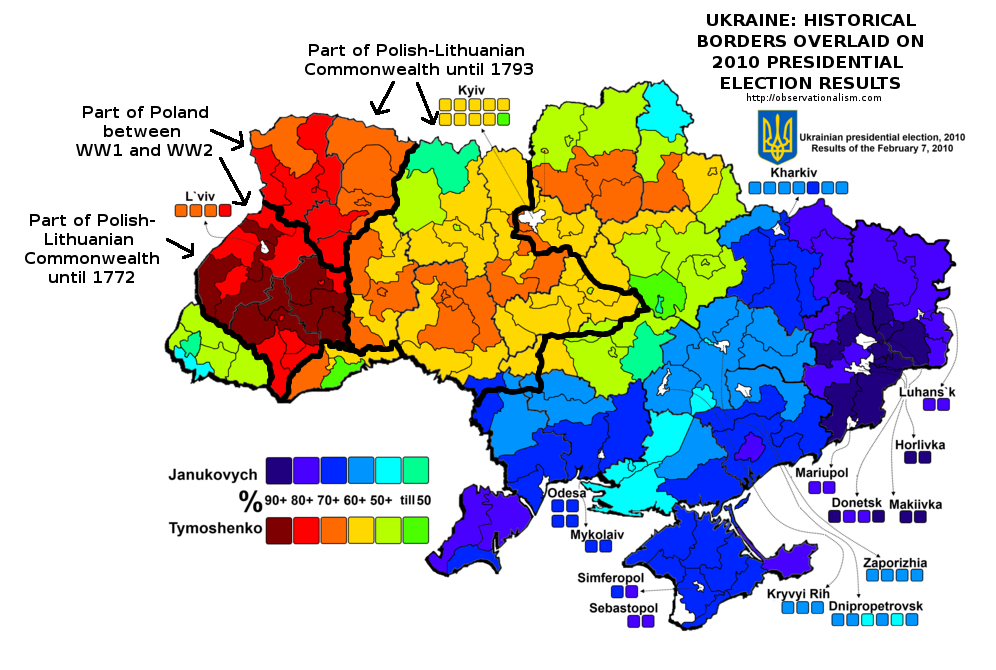
According to Ukrainian news-accounts, Ukraine's economy is rapidly falling. On April 2nd was reported that “Sales of new cars in Ukraine fell to the lowest in 15 years,” and that March's sales-volume (number of cars sold) was 23% less than that in February. Even more startlingly, "The general decline in sales of vehicles in Ukraine in January-February 2015 compared to the same period in 2014 was 67%.” So, whenever comparisons go back not merely month-to-month but to the situation prior to the February 2014 coup by the Obama Administration in Ukraine (which was quite violent and surprised EU leaders, who knew nothing about it in advance), this automotive sales-decline is especially stark.

Broad-based polling also supports the conclusion that the Ukrainian population are suffering from the consequences of Obama's 2014 coup. Ukraine's pro-Western Razumkov Center think-tank has periodically since 2004 (“the Orange Revolution”) asked Ukrainians, “Is the situation in Ukraine developing in a right or wrong direction?” The latest “right direction” score, March 2015, is 17.5%, which is the lowest such score in nearly three years. The highest score in the past 10 years was 41.3%, in June 2010, right after the man whom Obama overthrew in 2014, Viktor Yanukovych, was elected President. The second-highest such score was 26.1%, in December 2013, which was their first poll taken after Yanukovych had turned down the EU's offer because Ukraine's Academy of Sciences had calculated that it would cost Ukrainians $160 billion — it would destroy the economy. (Maybe their economists got that right, after all.) But, though the Ukrainian public were relieved at that rejection of the EU's offer, the U.S. CIA and the U.S. Ambassador to Ukraine were definitely not, and so they secretly organized public “Maidan” demonstrations against this turn-down, and used those public demonstrations as cover for their far-right, rabidly anti-Russian, mercenaries, to execute the actual coup, masked and cross-dressed as if they were government security forces shooting into the crowd so that the violence would be blamed on President Yanukovych. Here was Obama's agent, Victoria Nuland, on the phone on 4 February 2014, telling America's Ambassador in Kiev whom to get to be appointed to run the government after the coup; and her choice, “Yats,” was appointed 22 days later, on February 26th, and he still runs the country today, and probably for as long as Obama remains pleased with his performance.

Another recent news report, this one on April 1st, headlines “German business is ready to leave Ukraine” and it says: “German businesses are disappointed in Ukraine, and contracting. Most of the 600 companies operating in the country, are currently conducting an audit to determine the desirability of further functioning — exploring options for going out of business with minimal losses — according to the director of the Eastern Committee of German Economy, Chairman of the German-Ukrainian Forum, Rainer Lindner.”

However, yet another Ukrainian news-report, this one on April 2nd, headlines, "Merkel pledges to support investments of German business in Ukraine,” and it notes that, during Chancellor Angela Merkel's joint press conference with Ukrainian Prime Minister Arseniy Yatsenyuk in Berlin on April 1st, she had said, "We talked about this a lot, and discussed ways that will encourage German companies to come to Ukraine,” not leave it.

Already, $40 billion from EU and U.S. taxpayers, through the IMF and other financial intermediaries, are propping up the post-coup regime in Ukraine, and yet that sum is still less than investor George Soros claims is needed: $50 billion. And, so, various ways are being sought to leave Russia holding the bag for these losses, as much as possible (and at least to the tune of that needed additional $10 billion). 

On April 1st, Britain's Financial Times bannered, "Ukraine's debt haircut showdown looms,” and reported that "academics say another option might be for Ukraine to make Russia's debt unenforceable in English courts, arguing that Russia's annexation of Crimea should be set off against the debt.” That way, when Ukraine's citizens get their pensions and health care and other government-services cut back in order to pay the accumulated debts of the Ukrainian Government (which were largely pocketed by Ukraine's aristocrats or “oligarchs”), those debt-payments will end up going to the new, Western, (post-coup) investors, and not to the former, (pre-coup) Russian (and Chinese), ones. Western investors don't care about Ukrainians, but they absolutely hate Russians (and don't much like Chinese, either). Any money that's skimmed off of Ukrainian citizens should be heading westward, not eastward, they argue. Their chief argument right now is that Russia ‘stole' Crimea, and that therefore Russians forfeit any right to anything from Ukraine — including the tens of billions of dollars that Russians had lent to Ukraine before Obama's 2014 coup turned Ukraine into an anti-Russian military platform (for NATO missiles against Russia, according to the Obama Administration's plans and anti-Russian propaganda).

The Cato Institute, of the libertarian Koch brothers, has even presented an extremely right-wing former economic advisor to Russia's President Vladimir Putin, Andrei Illarionov, as being their chief spokesperson for this Russia-stole-Crimea argument against Illarionov's former employer. Headlining in a February 2015 publication from the Razumkov Center think-tank, “The Point of No Return,” Illarionov argued:

“The fact that Russia should return Crimea to Ukraine is indisputable,” even though Russia disputes it. He went on: “It does not matter in any way how exactly Crimea was transferred from RSFR's jurisdiction to that of the Ukrainian SSR in 1954, … since the entire transfer was executed based on the decisions of the supreme legislative bodies of the USSR, RSFR, and Ukrainian SSR, in full compliance with the legislation in force at the time. …
“Likewise of no relevance is the allegedly pro-Russian public opinion in Crimea, … even if the majority of its population really would vote for the annexation. … 
“Neither is the Crimean jurisdiction an issue of the Crimean population. …
“The issue of Crimea's ownership is the prerogative of only one subject of international law: the owner of the territory. The owner of the Crimean peninsula is the state of Ukraine.”

Here is the reason why he was dismissing what the people who live in Crimea wanted (and which they wanted even more after the coup): he knows that they had sound reason to be especially terrified of the people whom the Obama Administration had placed in control of Ukraine, and that more than 90% of Crimeans were enormously relieved for Crimea to be restored as part of Russia, which it had been part of from 1783-1954.

That's how Crimeans came to be protected from the hell that has been imposed by Obama's Ukrainian regime against the ‘terrorists' who live in Ukraine's Donbass region in the former Ukraine's far-east, which had voted 90% for Yanukovych, and so who didn't accept Obama's coup overthrowing Yanukovych — for that rejection of Obama's dictatorship over them, they are called ‘terrorists' by Obama's regime, which has now invaded and bombed there twice and will probably do it yet a third time, rather than grant the residents of Donbass what Britain recently (and with no bombing) granted the residents of Scotland: the opportunity to decide for themselves whether to continue being a part of that country. (But, inconsistently, Britain's rulers won't acknowledge the same basic human right to the residents of Crimea and Donbass, who have far more reason to reject Obama's rule than Scotts did to challenge UK's.)

In keeping with standard libertarian theory (such as at Cato), and with standard economic theory, which theory is that the sole real purpose of government is to enforce the rights of owners to their property, Illarionov (an admirer of the far-right economist Milton Friedman) says that a nation is its land and the physical property on and under it, not its residents (unless they are slaves; i.e., property themselves). He rejects basic democratic theory, such as is embodied in America's own Constitution, which opens with its Sovereignty Clause as its Preamble:

“We, the people of the United States, in order to form a more perfect union, establish justice, insure domestic tranquility, provide for the common defense, promote the general welfare, and secure the blessings of liberty to ourselves and our posterity, do ordain and establish this Constitution for the United States of America.”

Libertarians (and economists) assume that all rights reduce down to the right to property. But America's Founders didn't even include that right among its list of concerns upon which the USA was actually founded. Instead of sovereignty residing in property, or even in propertyholders, it resides in the people, and only in them (regardless of whether, or how much, property they might happen to own). This is a fundamentally different view of the purpose of the State, and of government — the view that government exists for the ruled, and not for the rulers (not for the benefit of the aristocracy). That the rulers are merely the elected representatives of the people, and can be dismissed by them, at will, by the people.

The RedCoats, the (troops hired by) British aristocracy in the 1700s, have apparently won the ideological war in more-recent times. Vladimir Putin will now necessarily be compelled by circumstances to decide whether or not he agrees with his former chief economic advisor on that fundamental matter; or, instead, with the Founders of the USA on it — this country which has unfortunately been subsequently conquered by a counter-revolution by the domestic aristocracy (especially after the Supreme Court's 2010 Citizens United decison), even without its people so much as knowing about (much less, understanding) the American counter-revolution that now is ruling us.

I develop this discussion further (in economics, law, ideology, and morality) in my just-issued book, Feudalism, Fascism, Libertarianism and Economics. It explains how this counter-revolution was waged in America and then went on to win the ideological war world-wide — and what must now be done in order to reverse the aristocracy's victory and to restore democracy.

But it's all summed up right here, in these very concrete news-events regarding Ukraine. Because: if what is at issue in government is the property, and not the people, then feudalism is again dominant, only under a more modern name. And that's the question and choice which is now at issue, regarding Ukraine, Crimea, Russia, and the future of the entire human species. This little piece of history, then, is just a microcosm of the whole, of our lives, and of those that will come after us.