6 Apr 2015

Scottish National Party leader Nicola Sturgeon denies claim she wants a Conservative government

Julie Hyland

Scottish National Party (SNP) leader Nicola Sturgeon has denied a report that she would prefer Conservative Party leader David Cameron as prime minister after the May 7 General Election to Labour leader Ed Miliband.
The allegation was made by the Daily Telegraph, which claimed to have seen a leaked official British government memo detailing a private meeting between Sturgeon and Sylvie Bermann, French Ambassador to the UK.
According to the newspaper, Sturgeon, who is first minister in Scotland’s devolved parliament, told Bermann that Miliband was not “prime minister material.”
Sturgeon said the claim was “categorically, one hundred percent untrue.” Bermann’s spokesman denied the report, as did the French consul general in Edinburgh, Pierre-Alain Coffinier.
The official who drafted the memo also appeared sceptical about the claim. Reporting on the “truncated meeting” between Sturgeon and Bermann, the memo records that the first minister had “confessed that she’d rather see David Cameron remain as PM (and didn’t see Ed Miliband as PM material). I have to admit that I’m not sure that the FM’s [Scottish First Minister’s] tongue would be quite so loose on that kind of thing in a meeting like that, so it might well be a case of something being lost in translation.”
The leak came less than 24 hours after the first televised debate in the general election campaign between seven party leaders. Cameron and Miliband were joined by Sturgeon, Nick Clegg of the Liberal Democrats, Nigel Farage of the anti-European and xenophobic UK Independence Party (UKIP), Leanne Wood for the Welsh nationalist Plaid Cymru and Natalie Bennett for the Green Party.
The participation of such numbers in an official televised debate is a first. It is a sign of the disintegration of the political set-up in Britain, under the weight of sharpening class tensions and divisions within the bourgeoisie itself.
According to opinion polls, Sturgeon won a sympathetic hearing from the seven million plus TV audience, with one poll placing her overall winner. One of the most searched for terms on the Internet was, “Can I vote for the SNP in England?”
Sturgeon’s appeal underscores the continued collapse of the Labour Party, which is widely reviled as no different than the Tories. It is committed to major spending cuts, differing only as to the speed with which they should be implemented. Miliband’s efforts to try and present Labour as more in tune with working people, pledging to curtail zero-hour contracts and raise the minimum wage, have little traction.
In the TV broadcast, the nationalist parties successfully pointed to Labour’s role in the devolved administrations in Scotland and Wales, where it is imposing spending cuts—some £28.9 million in Glasgow alone—and blocked measures in Wales to ban zero-hour contracts for social care workers. It was noticeable too that Miliband avoided any conflict with Farage, as Labour is keen to stress its own anti-immigrant credentials.
Writing in the Telegraph, former Labour Party and GMB union official Dan Hodges complained, “Ed Miliband’s left flank has suddenly—and dangerously—been exposed” by the debate.
Labour is polling poorly across the UK and is forecast to be wiped out in Scotland, with the SNP the beneficiary. This increases the likelihood of a hung parliament, in which the Scottish nationalists would play the role of kingmaker in a new government at Westminster.
The SNP has ruled out a coalition with the Conservatives, but has said it would support a minority Labour administration on a case-by-case basis
In response, the Tories are making a barely concealed appeal to English nationalism to prop up their vote, trying to outflank UKIP on the right. TheTelegraph is at the forefront of this offensive, with one columnist declaring Sturgeon to be the “most dangerous woman in Britain.”
Writing in the newspaper, Conservative London Mayor Boris Johnson claimed that a Labour government would be the dog “wagged by a Scottish SNP tail.”
“The SNP positively drool about the swingeing new taxes they could impose on the English, especially in London and the South East,” he wrote, forecasting five years of “socialism” in the event of an SNP-backed Labour administration.
For her part, Sturgeon made great play of her party’s “leftist” credentials during the TV debate to reassure working people in England that a vote for the SNP in Scotland would be to their advantage. It would ensure that a Labour government would be held to account, she suggested, with a “strong team of SNP MPs” voting “not only to end austerity—but to restore England’s NHS [National Health Service].”
There is no truth in the claims made by either Johnson or Sturgeon.
For all the SNP’s criticisms of Labour, Sturgeon took to the pages of The Observer on Sunday to offer to make Miliband prime minister. She farcically described this as a potential “anti-austerity” pact, just shortly after attacking Labour for voting only weeks ago with the Tories to push through a further £30 billion in spending cuts.
For all Johnson’s hyperbole, the SNP has no fundamental differences over austerity. Like Labour, its dispute with the Tories is only over a time frame. It proposes a “modest” increase in public spending—just 0.5 percent each year—supposedly targeted at economic revival.
The SNP’s manifesto is so modest that there is barely anything there. It states it will support an increase in the minimum wage to £8.70 an hour by 2020. That is just 20 pence more than is pledged by Labour over the same period, during which the minimum wage could be expected to rise in line with inflation automatically to £7.50.
Even this paltry increase is, like Labour’s pledge, dependent on “favourable” economic conditions. Outside of this, the SNP has promised only to try and sign 500 companies up to pay a “living wage” to their employees, limited means-tested help for the poorest students, and a £20 million fund over the next three years to “tackle violence against women.”
The SNP’s support for Labour comes despite Miliband making clear that any government he leads would never agree to scrap the Trident nuclear submarine project. This demand is the SNP’s sole remaining attempt at an anti-war pose, having officially abandoned its opposition to NATO.
Sturgeon has said that Trident is a “red line” in “terms of any formal arrangement with Labour”. But given that such a formal arrangement is not on the table, such guarantees come cheap.
She has said that SNP backing for Miliband would not be dependent on his agreement to a further referendum on Scottish independence. Just as significantly, Sturgeon refused to confirm that the SNP would insist on Labour including plans for full fiscal autonomy for Scotland in the home rule bill Miliband has pledged to introduce within 100 days of taking office. She said only that the SNP would argue for “maximum powers” in the new parliament.
Following September’s referendum, the SNP pledged to go for “Devomax”—full fiscal autonomy. This would mean ending the Barnett formula, under which funding is centrally allocated throughout the UK, making Scotland dependent on the revenues it raises locally.
This was before the collapse in oil prices on which the SNP had made the case for Scotland’s separation from England. They have fallen from $110 a barrel at the time of September’s referendum to $60.
Some 370,000 workers are employed in the North Sea oil and energy sector, but an estimated 10,000 offshore jobs have already gone since the oil price fall.
The Anglo-Dutch oil group Shell has confirmed it is cutting 10 percent of its 2,400 workforce in the North Sea, on top of the 250 already implemented last August. It is increasing employees’ working hours from the current pattern of two weeks on, two weeks off, to three weeks on, three weeks off. Expro is cutting 60 jobs, mainly in Aberdeen. The Abu Dhabi National Energy Company TAQA UK is cutting 100 jobs, and Talisman Sinopec 300.
North Sea oil workers in the Unite and GMB trade unions are balloting on industrial action, which could result in their first strike since 1979.

USW continues betrayal of remaining oil refinery strikers

Tom Hall

The United Steelworkers union’s isolation of striking oil workers continues as the employers at the few refineries that remain on strike seize upon last month’s national sellout agreement to push for even more draconian cuts, secure in the knowledge the USW will not lift a finger to defend these embattled workers.
Some 3,000 workers are still on strike at BP, Marathon and LyondellBasell facilities in Indiana, Texas and Ohio. Last Friday, the union pushed through a sellout local agreement at Marathon’s refinery in Catlettsburg, Kentucky where workers are expected to return next week.
The new contract was passed by a vote of 226-153 according to lead union negotiator David Martin, indicating a large opposition, even after two months in which the USW has sought to starve workers into submission. The deal includes meager raises contained in the USW national agreement that hardly keep up with the rate of inflation: The new contract also contains “language that will limit routine maintenance contracting,” according Martin, the same vague language that will do nothing to stop the replacement of fulltime workers with lower-paid contractors with no job security or health and pension benefits. The union also agreed to implement an alternate work schedule, with 12-hour workdays.
A spokesman for Marathon hailed the agreement. The union attempted to claim victory, with Martin declaring, “We got what we wanted on the national side and part of what we wanted on the local issues.” Just two weeks ago, however, during a week of negotiating under a federal mediator, Martin publicly declared the union’s willingness to settle merely for an extension of the previous contract, which Marathon rejected.
Workers at the Catlettsburg refinery, one of the first refineries called out on strike on February 1, have endured eight weeks of a strike in which the USW has refused to provide benefits from its $350 million strike fund, instead distributing grocery store gift cards and forcing workers to apply for what help is available, cap in hand, to local union committees and welfare agencies. Unable to survive such conditions many workers at the remaining refineries have crossed picket lines and returned to work, while others see no purpose in continuing the strike under the treacherous leadership of the USW. It is under these circumstances that the USW was able to ram through the local contract in Catlettsburg, despite a significant “no” vote.
While abandoning the interests of oil workers, the USW apparatus is concerned only with protecting its own financial and institutional interests. Workers have reported that one of the demands the USW is seeking at the BP-Husky refinery near Toledo, Ohio involves getting some contractors who currently belong to building trades unions under the jurisdiction of the USW so it can collect their dues money.
A reporting team from the World Socialist Web Site visited the picket line at the BP-Husky refinery late last week. There were only three pickets when the reporters arrived. A younger worker immediately approached reporters, having recently read the World Socialist Web Site  s article on the USW “solidarity” rally in Whiting, Indiana.
The worker, who asked to remain anonymous, told reporters he believed that the oil workers’ struggle could have a broader impact. “What happens here will help determine what happens with other workers,” he said. “We are the talk of Jeep,” he continued, referring to the Chrysler Jeep plant in Toledo where auto workers face a September contract deadline.
At the same time, he expressed frustration at the fact that so many of his fellow workers, including some of his friends, were crossing the picket line, and the low level of support, including financial support, from the union. He said workers had to bring their utility bills to the union hall, where a union committee would decide who and what would get paid. Strikers also received a meager $100 in Kroger grocery store gift cards.
He said it wasn’t entirely clear to him why the strike was continuing. The union is going to do whatever it wanted, in his opinion. Speaking about the USW’s attempt to get contractors at the refinery to pay dues, he said, “That doesn’t seem right. They would be paying twice.”
Another worker with eight years seniority complained bitterly about the treatment workers received from the police. “The laws are all on the company’s side. The law isn’t for the workingman. I remember when I was young, people were out there on strike fighting for their rights. Now you get eight people on a picket line and they call the police.”
“The world isn’t what it was,” he continued. “The strike isn’t a weapon any more and it doesn’t seem we can stop them.”
At the two Houston-area plants still on strike, the LyondellBasell refinery in Pasadena and the Marathon refinery in Texas City, the companies have gone on the offensive, seeking nothing less than a total capitulation. LyondellBasell representatives walked out of federally mediated negotiations last month, reportedly so abruptly that union negotiators “thought they were just taking a break.”
Union representatives have responded with handwringing, arguing that their services in maximizing the company’s profits are not being sufficiently appreciated. “We have played a key role in the record setting profits seen this last year,” an update sent to members of USW Local 227 read. “We are running this refinery better today than ever. And what do we get for it? What do we want for this? Nothing. We are not greedy. A roll over from the last contract is all we expect. To try and punish the very group that puts their lives on the line every day to help LyondellBasell reach these milestones is not only unconscionable, but an insult and a slap in the face.”
Marathon has been arguably more provocative at Texas City. In full view of picketers, management tore down crosses erected at the refinery two weeks ago during a candlelight vigil to commemorate the tenth anniversary of the explosion at the refinery that killed 15 people and injured more than 150 more. The USW responded with a tepid request that the crosses be returned so the local could erect a memorial at the union hall.
The bitter experience of the refinery workers of the past two months underscores the complete bankruptcy of the trade unions and the need for workers to break with these corporatist organizations and build new organizations of struggle, independent of the unions and the Democratic Party.

Alabama prisoner released after 28 years on death row

Tom Carter

On Friday, Alabama prisoner Anthony Ray Hinton was released after spending 28 years on death row for a crime he did not commit. He spoke to reporters at a tearful press conference as he walked out of the Jefferson County Jail, joined by family members and the attorneys who had worked to secure his release.
Hinton denounced Alabama officials who fought tenaciously for years to secure his execution, when a simple forensic test would have proven his innocence. “When you think you are high and mighty and you are above the law, you don’t have to answer to nobody. But I got news for them, everybody who played a part in sending me to death row, you will answer to God,” Hinton declared.
Now 59, Hinton spent much of the past three decades in solitary confinement in a 5-foot by 8-foot cell. If the Alabama authorities had gotten their way, Hinton would have been executed long ago, either by the electric chair or by lethal injection.
Hinton was convicted of a series of deadly shootings at Birmingham restaurants in 1985. However, there were no fingerprints or witnesses, and the only evidence against Hinton was that six bullets from three crimes allegedly matched an old revolver that police found at Hinton’s mother’s house. Recent tests confirmed that the bullets, in fact, could not be linked to the revolver.
The local authorities appear to have been under political pressure to secure a conviction, in light of a spate of similar crimes. The innocent Hinton—a warehouse worker who the prosecutor determined was guilty and “evil” based solely on his appearance—was the unlucky target.
Attorneys from the nonprofit Equal Justice Initiative have been trying to secure Hinton’s release since 1999. However, Hinton’s legal team encountered obstinate resistance from state authorities at every step, even after they presented strong evidence of Hinton’s innocence.
In other words, Alabama authorities pressed ahead with the campaign for Hinton’s execution even though they knew he was likely innocent. They were willing to sacrifice Hinton’s life in order to avoid embarrassment to themselves.
“They had every intention of executing me for something I didn’t do,” Hinton said Friday. In a statement posted on the EJI website, lead attorney Bryan Stevenson said, “The refusal of state prosecutors to re-examine this case despite persuasive and reliable evidence of innocence is disappointing and troubling.”
After a protracted legal battle, the US Supreme Court finally ruled in 2014 that Hinton had received constitutionally deficient assistance of counsel and should receive a new trial.
Hinton’s capital murder trial approached the Kafkaesque. His attorney had mistakenly believed that he was only permitted to spend $1,000 on a ballistics expert, and the only expert he could hire for that price was a one-eyed civil engineer who admitted on the stand that he had trouble operating a microscope.
Following the Supreme Court’s ruling, forensic scientists with the Alabama Department of Forensic Sciences confirmed that the revolver could not be linked to the crimes, and the state finally agreed to dismiss the charges against Hinton.
While Hinton was on death row, Alabama executed approximately 50 inmates. Many of these people were known personally to Hinton, up until the time that they were led away to the death chamber.
Hinton’s release occurred around a week after the exoneration and release of Ricky Jackson in Ohio, after he had spent nearly 40 years in prison. The principal witness for the prosecution in Jackson’s case recently recanted his testimony, saying that it was all lies that the police had pressured him to repeat.
The American “justice” system has been scandalized by the number of convicts later proven to be innocent, including many who were deliberately framed up by the police. Since 1989, there have been more than 300 exonerations through DNA evidence, including eighteen prisoners on death row. However, these numbers likely only represent the tip of the iceberg.
America has by far the world’s biggest prison population—2.4 million people—and the highest imprisonment rate. Meanwhile, 3,000 individuals are on death row. The 16-year legal battle by a team of attorneys to secure Hinton’s release, going all the way to the Supreme Court, underscores the difficulty of obtaining any relief, even in an egregious case where the prisoner facing execution is demonstrably innocent.
Stevenson spoke at Friday’s press conference, calling Hinton’s case a “miscarriage of justice” and Hinton’s release after nearly 30 years “bittersweet.”
“We have a system that treats you better if you are rich and guilty than if you are poor and innocent and this case proves it. We have a system that is compromised by racial bias and this case proves it. We have a system that doesn’t do the right thing when the right thing is apparent,” Stevenson said.
Much has happened in the three decades since Hinton was incarcerated. Having spent most of his time in solitary confinement, Hinton has never browsed the Internet, sent an email, or even used a computer. On the day of his release, Hinton’s attorneys gave him a smartphone, relating that Hinton was “mystified.”
Hinton’s mother passed away in 2002, while he was still incarcerated. Stevenson told reporters, “Of all the things he has endured, the death of his mother caused the most pain.” Hinton’s first act as a free man was to travel to the cemetery to lay flowers on her grave.

Mass strike by Vietnamese shoe workers

Ben McGrath

A week-long wildcat strike involving thousands of workers at a shoe factory in Vietnam ended Thursday on the basis of government promises to reconsider a social insurance law that would limit workers’ payouts. Like other countries, Vietnam is under pressure from international finance to scrap or rein in social programs.
As many as 90,000 workers struck on March 26 at a complex owned by the Taiwanese company Pou Yuen, which produces shoes for Western companies like Nike and Adidas, as well as for brands such as Converse and Reebok.
The strike took place in Ho Chi Minh City’s Tan Tao Industrial zone. Neighboring factories were also closed at times. A second factory located in Tien Giang province, near the city, went on strike on April 1, prompting the government to step in to placate workers’ anger.
The strikes were particularly significant in that workers opposed government policy, not just poor working conditions.
Workers demanded the dropping of a planned revision to the social insurance legislation. Under the current law, workers who leave an employer before their retirement age can receive a lump sum from their pension fund, to which they and their employers contribute. This provides workers with a financial cushion while seeking new employment.
Under the new law, workers would be unable to touch their money until reaching retirement age, which is 60 for men and 55 for women. The government also proposed last year to raise the retirement age to 62 for men and 60 for women.
During the strike, workers held peaceful demonstrations despite provocations from company security guards. Thousands of workers staged sit-ins, occupying the plant and refusing to perform their jobs or even turn on the lights. They also blocked a nearby highway at various times, prompting the government to dispatch a large police force equipped with batons.
On the second day of the strike, workers entered the factory, but were barred from leaving by security guards, who attacked the strikers, electrocuting some. Thanh Nien News quoted an anonymous worker saying: “Four workers at section C were injured but it is unclear if the guards used electric shock batons or set up electricity there.”
Many workers expressed anger toward the company as well as the government. One striker, Le Van Tin, told the media: “Our company does not support us. It just calls us to get back to work.”
After the second factory joined the strike, the government sought to end the revolt as quickly as possible. Minister-Chairman of the Government Office—a body that assists the prime minister—Nguyen Van Nen called the workers’ demands a “legitimate request.” He said the government would convey a request to the National Assembly on May 20 to reconsider the social insurance law.
The government is simply trying to buy time to force the new law onto workers. Nen stated: “Workers should be calm and should not follow any provocation or instigation of anyone to do anything that goes against their legitimate interests.”
Above all, Hanoi is trying to prevent more workers from joining protests against worsening labor conditions in a country where the workforce is heavily exploited. Employers and the government are intent on under-cutting the labor costs of rival clothing and footwear industries in countries such as Cambodia and Bangladesh.
The official Vietnam General Confederation of Labour (VGCL) implored workers to return to their jobs when the strike broke out on March 26. It also denounced “bad elements” that caused unrest. Dang Quang Dieu, head of the VGCL’s law policy board, declared that workers would accept the new law once they knew “what benefits they will have when they cannot receive lump-sum social insurance allowance payments.”
The VGCL, to which country’s trade unions are affiliated, exists for the purpose of imposing the government’s agenda on Vietnam’s working class. It is working hand in hand with the government to impose the new law, which will only be the beginning of the dismantling of the pension system.
Vietnam offers low wages to transnational corporations and a workforce suppressed by Hanoi’s Stalinist regime. The average monthly wage in Vietnam is only $US197, compared to $391 and $613 in Thailand and China respectively. That is how, last year, Vietnam became the largest exporter to the US from among the 10 Association of Southeast Asian Nations (ASEAN).
Despite the massive profits that corporations like Nike and Adidas, together with electronics companies like Samsung reap from the Vietnamese working class, workers are being told that their pension system will run a deficit by 2021 and be depleted by 2034.
Workers and employers are supposed to pay into the social insurance system. According to Thanh Nien News, however, many private sector businesses have delayed or failed to make payments, accounting for a debt of more than $590.5 million.
The international financial institutions have demanded that the government “reform” the pension system. A June 2012 report by the US-dominated World Bank called on Vietnam to adopt a “modern” pension system, bemoaning the “generous pension benefits” Vietnamese workers earned.
The drive to dismantle workers’ benefits flows from the intensification of the doi moi (renewal) program of pro-market “reforms” imposed by the Stalinist Communist Party of Vietnam regime to attract foreign investment and integrate Vietnam into the world capitalist economy.

Political crisis in Pakistan as Saudi Arabia demands it join war against Yemen

Sampath Perera

Saudi Arabia’s demands that its long-time ally Pakistan participate in its US-backed war against Yemen have produced a political crisis in Islamabad.
In the nearly two weeks since Riyadh declared that Pakistan was part of its war coalition, Islambad has undertaken a whirlwind of diplomatic activity, as it attempts to balance between Sunni monarchies in the Gulf and neighboring Iran. At the same time, Pakistan’s political and military establishment are fearful of a further outbreak of sectarian tensions within the country.
Air attacks by the Saudi airforce and its allies—targeting Houthi rebels backed by Iran and forces loyal to former dictator Ali Abdullah Saleh—continue to kill dozens of civilians on a daily basis in Yemen, while laying waste to towns and cities.
Riyadh, encouraged by Washington’s backing, has not only spurned calls for a halt to its illegal war; it is also completing preparations for the coalition of states it leads to mount a ground invasion, with the aim of delivering a blow to its regional rival Iran, which has backed the Houthi rebels.
The war has already intensified sectarian tensions between predominantly Shiite and Sunni states and militias across the greater Middle East. These developments are especially troubling for Pakistan, where decades of US intervention and wars have produced deep sectarian divides.
A majority Sunni country, Pakistan also has a sizable Shiite minority that makes up 20 percent of its population, or about 40 million people. Sunni Islamist fundamentalist militia, which arose out of the CIA-backed proxy war against the Soviet Union in Afghanistan, have killed several thousand Shiites and other minorities in the country over the past few years.
Responding to Saudi news reports that Pakistan had joined the war against Yemen, Islamabad initially came out with contradictory and ambiguous statements. It declared its support for Saudi Arabia while publicly refraining from making any commitment to become directly involved.
On the day that airstrikes began, Prime Minister Nawaz Sharif declared, “Any threat to Saudi Arabia’s territorial integrity would evoke a strong response from Pakistan.” However, the following day the government informed the parliament that it had made “no decision to participate in this war.”
A day later Sharif offered “all potentials of the Pakistani army” to Saudi King Salman bin Abdulaziz Al Saud in a telephone conversation.
The government then sent a delegation—including Defence Minister Khawaja Asif, National Security Advisor Sartaj Aziz and top generals from the military— to Riyadh last Monday to “assess the situation.” Following their return, Sharif himself left for Ankara, where he met both Turkish Prime Minister Ahmet Davutoglu and President Recep Tayyip Erdogan.
In a joint press conference held with Davutoglu, Sharif declared, “We are concerned at the overthrow of the legitimate government in Yemen by use of force by non-state actors,” referring to the Houthi rebels. He added that Pakistan is committed to defending “Saudi Arabia’s sovereignty and territorial integrity.”
In fact, there is no threat to Saudi Arabia from Yemen. Sharif’s remarks were aimed both at placating the Saudis and providing a justification for the military support Islamabad has already provided or may provide in the future. Sharif went on to claim that Pakistan is for a “peaceful solution to the Yemen conflict.”
There are also concerns within the political establishment that a backlash from Tehran—with which Pakistan shares a 700 kilometre border and which has considerable influence in Afghanistan—could further destabilized the country. Iranian officials met Pakistani Ambassador Noor Mohammad Jadmani to convey their concern over reports of Pakistan’s participation in the war. They insisted on a “policy of non-interference,” while requesting a “dialog” on the crisis with Islamabad. Iran’s Foreign Minister Javed Zarif is scheduled to visit Pakistan this Tuesday.
The concerns within the ruling class were reflected in Sharif’s call for a joint session of the lower and upper house of the parliament for today. Co-chairman of the main opposition Pakistan Peoples Party and former president Asif Ali Zardari last week threw his support behind the government, declaring, “It becomes collective responsibility of the international community to join hands against the [Houthi] militia to protect Saudi Arabia and Yemen.”
The emerging consensus indicates that Pakistan will likely expand its role in the war, even if publicly it continues to claim its policy is one of “non-intervention.” At the same time, the political establishment is seeking to avert a sectarian backslash in the country. Defence Minister Khawaja Asif explained the risks to parliament last month, saying, “In Syria, Yemen and Iraq, division is being fuelled and it needs to be contained. The crisis has its fault lines in Pakistan too, [we] don't want to disturb them.”
The dilemma was further expressed by an editorial in the English daily Dawnon March 27, which asserted that Pakistan should not take sides between Saudi Arabia and Iran, “considering Pakistan’s strategic relationship with the former and geographical proximity with the latter.”
In February 2014, then Saudi Defence Minister Prince Salman, in a rare three-day visit to Pakistan, effected a shift in Islamabad’s position in relation to Syria. Pakistan threw away its “non-interference” policy and called for “a transnational governing body with full executive powers”—in other words, the ouster of President Bashar al-Assad. Weeks later it was revealed that Saudi Arabia had agreed to $1.5 billion in aid to the crisis-ridden Pakistani economy.
According to the US-based Brookings Institution, “Pakistan has received more aid from Saudi Arabia than any country outside the Arab world since the 1960s.” It is also a major source of foreign remittances to Pakistan, which last month alone amounted to $453 million. The money from “more than 1.5 million often poorly treated migrant workers,” according to Al Jazeera.
Saudi Arabia and Pakistan, with the encouragement of Washington, have extensive military ties. Since the 1960s, Pakistani troops have been stationed in Saudi Arabia, providing essential defence forces for the reactionary fiefdom. Saudi Arabia’s intimate relationship with Pakistan developed in the 1980s when it funded US-backed dictator Zia-ul Haq’s “Islamisation” of Pakistan policy and the war in Afghanistan in accordance with US strategic aims. It is in this period that Sharif emerged as a protégé of Zia and developed close relations with the Saudi monarchy.
Pakistan is said to have received up to 60 percent of the funding for its nuclear project from Riyadh. According to recent US and British news reports, this was done in the expectation that the Saudis could obtain nuclear weapons from Pakistan at will, especially if Iran were ever to develop them.
Pakistan also faces practical limitations on how much support it can give Riyadh in the Yemen war, as it is already waging a war in the Federally Administered Tribal Areas in the north-west against Islamist fundamentalist militias, as demanded by and in collaboration with Washington. It also maintains high troop levels along the border with its arch-rival India to the south and is waging a brutal repression in the Balochistan province on the border with Iran against separatist nationalist militias.
Whatever the maneuvers of the ruling class, the escalation of war in Yemen will have a deeply destabilizing impact on Pakistan, while intensifying the danger of a regional war throughout the Middle East and Central and South Asia.

UK sends military trainers to Syria

Jean Shaoul

On March 26, as Britain’s general election campaign began, Defence Secretary Michael Fallon announced that Britain would send 75 military trainers and staff to aid the so-called “moderate” opposition forces in Syria.
The announcement marked an expansion of Britain’s aggressive role in the United States-led intervention, which is targeting not only the Islamic State in Iraq and Syria (ISIS), but also the Syrian regime of President Bashar al-Assad.
Britain is the second largest contributor to the coalition campaign in Iraq against ISIS, providing arms to the Kurdish Peshmerga forces and reconnaissance and operational support for air strikes in Iraq, along with military advisers and several hundred combat-ready troops to train local forces.
It has not, however, participated in the air strikes on Syria being carried out by the US, Canada and various Middle East countries.
The Ministry of Defence said of its Syria operation that it would “train and equip thousands of screened members of the opposition over the next three years to help them defend Syrian communities against ISIL’s brutal attacks before leading offensives themselves.” This follows the announcement of a “train and equip” programme involving the US, Saudi Arabia and Qatar, a similar mid-February announcement of a programme to “train and equip” fighters at a Turkish base, and another announcement at the end of February of plans to train the opposition in Syria in the next four-to-six weeks.
There was no mention of who the “moderate forces” in Syria are. That is because there are no such forces. The aim of the training programs is to create a militia capable of installing a regime in Syria willing to carry out the dictates of the imperialist powers.
The training, supposedly after screening applicants to weed out extremist Islamic militants, will take place in Turkey and other countries in the region that are part of the anti-ISIS coalition, presumably including Jordan.
Defence Secretary Fallon also announced that the UK will send two Sentinel aircraft to Iraq to provide area-wide surveillance of ISIS and track IED (improvised explosive device)-laying activity. These aircraft will join Britain’s Tornados and Reaper Remotely Piloted Aircraft that have conducted 194 strikes over Iraq and gathered intelligence, working alongside the all-weather electronic surveillance aircraft, Rivet Joint.
The Conservative-Liberal Democrat coalition government signed up to the US plans against ISIS in Iraq and Syria last year with the full support of the opposition Labour Party. In justifying the government’s plans to join the coalition against ISIS, Prime Minister David Cameron declared last September at the United Nations that the “international community” must not be “so frozen with fear” by past mistakes that it fails to confront the threat of ISIS. “We need to act and we need to act now,” he said.
The announcement that Britain will deploy military trainers for the war in Syria follows in the wake of the decision by Cameron to send military advisors to Ukraine. The government is seeking to counter criticism from leading figures in the defence and political establishment that Britain has become virtually invisible on the international arena.
A scathing report from the House of Commons Defence Committee last February lambasted the government for its limited involvement in the war against ISIS. It said Britain had conducted only 6 percent of the air strikes against ISIS in Iraq, and that during its December visit to Iraq, the parliamentary committee had found only three British military personnel outside the Kurdish regions, compared to 400 Australians, 280 Italians and 300 Spanish.
According to the report, the committee was shocked at the inability or unwillingness of Britain’s leading military personnel to explain their Iraq strategy, or even say whether a strategy exists. The committee added that no one would say who is in charge of the UK’s intervention.
It noted that with both the Iraqi and Peshmerga forces needing “structural reform,” degrading ISIS, containing it and making it ineffectual might be a more realistic and immediately achievable aim than attempting to destroy it.
The parliamentary committee went on to call for the UK to “play a greater role in the fight against ISIS in Iraq and Syria.” It recommended a larger deployment of troops to Iraq for “training” purposes and greater “defence engagement” with the regional powers, although it was not in favour of deploying British combat troops.
The government’s announcement that it is sending military advisors to Syria, made without the consent of the Syrian government, is in violation of international law and tantamount to a declaration of war.
The United Nations Security Council has been unable to provide the necessary legal fig leaf for war against Syria due to opposition from Russia. According to Reuters, Syria’s state news agency Sana has charged that British support for the Syrian opposition amounts to a “commitment to supporting terrorism.”
The British government is using ISIS as a pretext to reverse its humiliating climb-down in August 2013, when it was forced to abandon plans to bomb Syria. Amid divisions within the ruling class over strategy and widespread popular opposition, a resolution authorising the bombing of Syria was defeated in parliament.
Washington and London had seized on a chemical attack in a Damascus suburb, most likely carried out by US-backed Islamists, as a casus belli—an opportunity to activate plans for regime-change in Syria. But concern within military circles that the US and Britain were grossly unprepared for a war that could bring them into headlong collision with Russia split the Conservative Party. A total of 30 Conservative MPs voted against the government’s resolution, joining with the Labour Party, which opposed an air intervention in Syria.
Partly as a result of the vote, the Obama administration shelved its plans to join the Islamists in attacking Syrian government forces, and instead stepped up its efforts to reach a deal with Iran as a means of isolating China and Russia, Syria’s main backer.
When asked by Labour leader Ed Miliband in parliament in August 2013 for an assurance that Cameron would not use the royal prerogative to start a military intervention without parliamentary approval, Cameron replied, “I can give that assurance… it is clear to me that the British parliament, reflecting the views of the British people, does not want to see British military action.” But the dispatch of military advisers to Syria is in evident violation of that pledge.
Speaking in Toronto during an official visit to Canada last Friday, Foreign Secretary Philip Hammond expressed support for the Canadian government’s decision to join the air bombardment of Syria and his dismay over the British parliament’s vote against air strikes in 2013. Saying that the mission’s ultimate goal remained the same, he concluded, “We're delighted that others are able to do the lift in Syria that is equally required.”
The US-stoked wars in Iraq, Libya, Somalia, Afghanistan and Yemen, and the civil war in Ukraine, are getting barely a mention in the current British election campaign. This is not surprising, since there is little popular support for these wars.

Mass killings, looting in Tikrit by US-backed Shiite militia

Patrick Martin

According to media reports and public denunciations by Sunni Arab officials in Iraq, Shiite militias have engaged in mass executions and widespread looting and destruction of property in the city of Tikrit since it was recaptured last week from Islamic State in Iraq and Syria (ISIS) forces.
As many as 76 people were summarily executed by militia forces, who dragged the bodies through the streets of the conquered city, a former stronghold of longtime Iraqi ruler Saddam Hussein, who was born nearby. Militiamen plundered stores and set fire to homes and businesses, in some cases claiming to be taking preventive action against the possibility of bombs having been left behind by ISIS.
Following a month-long battle, Shiite militias completed the conquest of Tikrit on March 31 after American warplanes joined the fight and obliterated the last ISIS holdouts in the center of the city.
Ahmed Al Krayam, head of the provincial council of Salahuddin province, told reporters, “Tikrit is under chaos and things are out of control. The police force and officials there are helpless to stop the militias.” Both Al Krayam and the governor of Salahuddin left Tikrit, the provincial capital, on Friday night, protesting the failure of the Iraqi government to curb looting and murder.
“Houses and shops were burnt after they stole everything,” Krayam told Reuters. Saying that hundreds of buildings had been burned, he added, “Our city was burnt in front of our eyes. We can’t control what is going on.”
The Wall Street Journal interviewed a Tikrit resident, Waleed Omar, who had fled the city during the fighting earlier this month. “This looting issue is 100 percent true and it means new suffering for the people of Tikrit,” he said. “Islamic State displaced people in Tikrit after committing horrible abuses against them, and now the militias are looting and burning their homes.”
A factor in the savagery of the Shiite forces was the fact that Tikrit had been the longtime political base of Saddam Hussein, who brutally repressed a Shiite uprising in 1991. Moreover, at nearby Camp Speicher, an abandoned US military base, Sunni ISIS fighters had allegedly murdered some 1,700 captured Iraqi Army soldiers after separating the Sunnis, who were released, from the Shiites, who were slaughtered.
The revenge killings raised the specter of a general sectarian bloodbath as the Shiite militias and the army of the Shiite-dominated Baghdad regime enter largely Sunni-populated areas, including Anbar province in the west and Nineveh province in the northwest. The latter includes Mosul, Iraq’s second-largest city.
The speaker of the Iraqi parliament, Salim al-Jabouri, a Sunni, warned the government on Friday that it had to take action against those who “conspire against the security and stability of Iraq.” Prime Minister Haider al-Abadi, a Shiite, said the military would start arresting and prosecuting looters in Tikrit. But the balance of forces in the city is lopsided in favor of the militias, which outnumber regular army troops by at least four to one.
Amnesty International announced Thursday that it was investigating reports of “widespread human rights abuses” by Shiite militiamen during and after the conquest of Tikrit and neighboring towns and villages.
Amnesty senior crisis response adviser Donatella Rovera said: “We are investigating reports that scores of residents have been seized early last month and not heard of since, and that residents’ homes and businesses have been blown up or burned down after having been looted by militias… There have also been reports of summary executions of men who may or may not have been involved in combat but who were killed after having been captured.”
The New York Times, in an April 2 report, quoted Muen al-Khadimy, a senior official of the Badr Brigade, the most powerful Shiite militia, saying that his group took no ISIS prisoners in Tikrit. “To be honest, everywhere we captured them we killed them because they were the enemy,” he said. Khadimy claimed that all ISIS fighters were assumed to be suicide bombers and killed as a precaution.
By Friday, American officials were admitting to reporters that summary executions and looting were taking place in Tikrit and warning that such actions could undermine the US-backed coalition against ISIS, which includes the Sunni-ruled monarchies of the Persian Gulf.
“It’s bad,” one US military official told the Wall Street Journal. “This is not what we want. This is not what al-Abadi wants.”
Earlier US press reports, however, stressed the growing collaboration between US military forces and the Shiite gunmen responsible for the latest wave of atrocities in Iraq. The New York Times described “a template for fighting the Sunni militancy in other parts of Iraq: American airstrikes and Iranian-backed ground assaults, with the Iraqi military serving as the go-between for two global adversaries that do not want to publicly acknowledge that they are working together.”
The Times continued: “The template, American officials said privately this week, could apply in particular to the looming battle to retake Mosul, Iraq’s second-largest city.”
The same article noted last week’s congressional testimony by Gen. Lloyd J. Austin, head of the US Central Command, who declared flatly, “I will not—and I hope we will never—coordinate or cooperate with Shiite militias.” The Timescited the rebuttal by “a senior Obama administration official,” who said Austin “may have gone a little far.”
The Washington Post reported the situation in Iraq under the headline “After Tikrit victory, Iraq’s new challenge: Win over Sunnis.” The newspaper did not elucidate how this could be accomplished in the midst of the sectarian slaughter of Sunnis.
These press commentaries merely repeated, parrot-like, the claims of the Obama White House, which described the Iraqi force that conquered Tikrit as “a multi-sectarian force that’s being led by the Iraqi military,” although Shiite militias comprised at least 20,000 fighters compared to 4,000 regular troops.
The reports of mass killings in Tikrit confirm that American imperialism has not returned to Iraq to fight atrocities and mass murder by ISIS, but rather to prop up the puppet regime established by the invasion of 2003 and the subsequent eight-year occupation of the oil-rich country.
Even before the fall of Tikrit, there were widespread reports of ISIS-style atrocities, including beheadings, by Iraqi military units and Shiite militias trained and armed by the United States. ABC News reported last month that investigations had begun into possible war crimes, including torture, executions, decapitations and desecration of corpses, some of them documented by online videos.

Iran nuclear deal: US prepares for new wars

Peter Symonds

The framework nuclear agreement struck last Thursday by the US and its negotiating partners with Iran, while still facing obstacles, marks a significant strategic shift in American foreign policy.
For the entire period since the 1979 Iranian revolution overthrew the US-backed Shah—that is, for 36 years—Washington has maintained a stance of unremitting hostility to the Iranian regime. This has been a constant in US policy in the region and internationally. Now the US has reached a deal that holds out the possibility of a broader rapprochement between Washington and Tehran.
Confronting opposition in the political/military establishment at home and from US allies in the region, President Obama has touted the agreement as the only alternative to “another war in the Middle East.” But the diplomatic efforts to secure a deal with Iran have nothing to do with a turn towards peace. Rather, they are aimed at buttressing US imperialism’s position in the Middle East and Central Asia as it prepares for war with more powerful rivals, Russia and China.
As part of its plans to secure US hegemony in the Middle East, the Bush administration targeted Iran, declaring it in 2002 to be part of an “axis of evil” along with Iraq and North Korea. Flush with apparent victory after the 2003 invasion of Iraq, a senior administration official let the cat out of the bag, declaring in a widely reported remark: “Anyone can go to Baghdad. Real men go to Tehran.”
Even as the US military occupation of Iraq descended into a quagmire, the Bush administration seized on Iran’s nuclear programs as the pretext for pressure and provocations against Tehran, culminating in advanced preparations for American military attacks in 2007.
Bush pulled back from an all-out war with Iran amid rising criticism within the US political establishment of the military disasters he had overseen in Afghanistan and Iraq. In the course of the 2008 election campaign, Barack Obama declared that in bogging the US military down in the Middle East, Bush had failed to counter China’s rising influence, especially in Asia.
In what became known as the US “pivot” or “rebalance” to Asia, the Obama administration has since mid-2009 mounted an aggressive diplomatic, economic and military strategy aimed at subordinating China and the broader Indo-Pacific region to the US, if necessary through war.
At the same time, Obama initiated a “carrot and stick” approach to Iran—holding out the possibility of a negotiated end to the nuclear standoff, while dramatically escalating economic sanctions on Tehran and maintaining the threat of military strikes.
Significantly, one of Obama’s chief foreign policy mentors was former national security advisor Zbigniew Brzezinski, a long-time advocate of a Washington-Tehran axis in line with his insistence that American global hegemony depended on securing US dominance of the vast Eurasian landmass stretching from Eastern Europe through Russia to China. Iran is strategically situated at the crossroads of Central Asia, the Middle East and the Indian subcontinent.
The deepening breakdown of world capitalism since 2008 and rising geo-political tensions have imparted a new urgency and recklessness to Washington’s plans. In August–September 2013, the US came to the very brink of war with Syria, only to pull back at the last minute amid divisions in the American ruling elite over the war aims, the failure of the British government to secure parliamentary backing, and vigorous opposition from Russia and Iran. Tehran had warned Washington that military intervention in Syria could lead to war with Iran.
The Obama administration responded to the debacle by adopting an aggressive two-prong strategy. While moving toward a confrontation with Moscow, which became evident with Washington’s open intervention in Ukraine in late 2013, Obama accelerated nuclear talks with Iran that had already been secretly underway.
He spoke via phone with newly-elected Iranian President Hassan Rouhani during the annual UN meeting in September 2013—the first publicly acknowledged contact between American and Iranian government heads in more than three decades. An interim nuclear agreement was reached in November 2013 and finally implemented in late January 2014, even as Washington’s intrigues in Ukraine intensified, culminating in the fascist-led coup in Kiev in February 2014.
From the outset of negotiations with Iran, the Obama administration made clear that any agreement would be on Washington’s terms. The result has been a drawn-out process extending well beyond the original deadlines, in which Iran’s bourgeois-clerical regime has made sweeping concessions on every issue.
While the US has conceded that Tehran can retain a nominal nuclear program as a face-saving measure, Iranian negotiators have agreed to dramatically reduce the country’s uranium enrichment capacity, wind back existing stockpiles of enriched uranium, and allow the most intrusive inspection regime ever devised.
The US, on the other hand, is bound by nothing—offering only a “suspension” of international sanctions once Iran has fulfilled its many tasks. Moreover, the entire framework of sanctions will be kept at the ready, to be “snapped back” in the event Iran is said to be in “non-compliance.” As a result, the US has free rein to re-impose crippling sanctions without having to secure the support of China and Russia in the UN Security Council.
The agreement has provoked divisions in Iranian ruling circles, but the predominant faction represented by Rouhani insists that a deal is necessary not only to end the immediate sanctions, but also the longstanding US economic blockade. Rouhani was a leading figure in the so-called reform governments of presidents Hashemi Rafsanjani and Mohammad Khatami, who pressed for a deal with Washington along with a sweeping pro-market restructuring to open up Iran as a cheap labour platform. As the Iranian bourgeoisie aligns itself more and more closely with Washington, it will intensify the attacks on the Iranian working class.
Whether the agreement will finalised in the next three months is far from certain. The Obama administration is facing bitter opposition from the Republicans in Congress as well as sections of the military/intelligence apparatus, as well as from American allies in the Middle East, particularly Israel and, less publicly, Saudi Arabia, the Gulf States and Egypt.
While Israeli Prime Minister Benjamin Netanyahu continues to warn of the imminent danger of an Iranian nuclear bomb, as he has done for at least a decade, the underlying concern of Israel and other US partners is that a turn by Washington to Tehran could diminish their own importance, and thus their bargaining power with the US. Far from stabilising the Middle East, the finalisation of an agreement could well inflame tensions as Iran’s rivals seek to shore up their own positions.
In a broader historical sense, the deal is not worth the paper it is written on. If and when it is expedient, the US will shred the agreement, as has happened many times in the past. The Libyan regime of Muammar Gaddafi cut a deal in 2003 to give up its WMD programs only to find itself the target of a NATO-led war for regime-change in 2011. Amid its own economic decline, US imperialism will stop at nothing in its reckless drive for global domination at the expense of its major rivals.

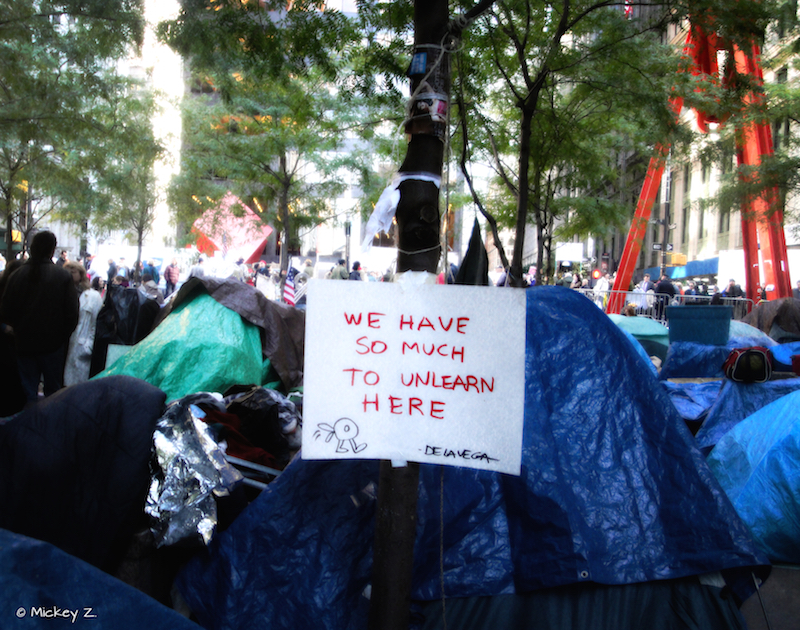
Activism = Appetite For Destruction

Mickey Z.


Photo credit: Mickey Z.
“The hands that build can also pull down…” (Jeremiah 1:10)
Way too many people imply that unless a critic expounds a specific strategy for implementing a new paradigm, their opinion is worthless.
This reaction ignores the essential role critical analysis plays in a society where problems --- and their causes -- are so cleverly disguised. When discussing the future, the first step is often an identification and demystification of the past and present.
I’ve written and spoken words like this many, many times. The audience I’ve aimed for was made up of those yet to embrace any form of protest. I was coaxing, pleading, cajoling anyone within earshot to stop seeking excuses to avoid joining the struggle. I still am.
However, more and more, I find myself directing such sentiments towards my fellow activists. Mired in archaic tactics, counterproductive single-issueism, fear-driven stagnancy, and ego-driven inertia, the realm of dissent is a minefield for anyone seeking or suggesting new ideas, fresh perspectives, broader coalitions.
No one fears change more, it seems, than those ostensibly struggling for change. If you don’t believe me, go ahead and try getting the activists you know to consider a new approach.
To question tactics is reflexively perceived as a counterproductive attack. To introduce the idea of solidarity with other groups and issues is to invite an accusation of co-optation. To suggest a re-evaluation of any kind is deemed an unforgivable betrayal.
To point out the very obvious fact that we -- as activists and as earthlings -- are losing, with no hint of imminent reversal, is to exile oneself from one’s activism circle.
Reality check: The issues and factors that splinter communities in the general population -- privilege, propaganda, ego, fear, and so on -- very much exist within the activist world.
These factors lead us to stalemates, in-fighting, schisms, and thus: failure. Unless we accept the challenge to completely re-imagine our modes of dissent, we’ll remain on the same path. We’ll remain, hurtling at warp speed, towards economic, social, and environmental collapse.
What should we be doing? Outside of encouraging broader and broader intersectionality and coalitions, I don’t know.
What I do know is this: What we are doing -- the tactics and methods we so passionately cling to and defend -- don’t work and some have never worked.
Everyone knows we’re sincere, we’re dedicated, we’re “hardcore.” It’s time now for everyone to accept that we’re also largely and tragically ineffective.
There’s no shame in admitting we could’ve done better… much better. But even if there is shame, why must we let it outweigh the task at hand?
If we truly want drastic and sustainable social change, all the protest sign wavers, social media warriors, arrest compilers, obsessive meeting holders, under- and over-organized organizers, and relentless spotlight seekers must join together to destroy the old blueprint.
Step 1: Smash the activism archetype, including its foundation.
Step 2: Rebuild a flexible structure under the guidance of new architects and artisans.

Majority Of U.S. Citizens Are Against Surveillance By Their Government, Shows Poll

Amnesty International USA

The United States’ mass surveillance of internet and mobile phone use flies in the face of global public opinion, according to a new poll published in mid-March by Amnesty International. The majority of U.S. citizens, 63%, are against their government’s surveillance
The release marks the launch of a worldwide UnfollowMe campaign, a global initiative calling on the leaders of the U.S. and UK - as well as their close allies - to ban indiscriminate mass surveillance and intelligence sharing.
The poll, which questioned 15,000 people in 13 countries across every continent, found that 71% of respondents are strongly opposed to the U.S. monitoring their internet use. Meanwhile, nearly two-thirds of the respondents said they wanted tech companies like Google, Microsoft and Yahoo to block governments accessing their data.
The majority of U.S. citizens (63%) are against their government’s surveillance scheme compared to only 20% in favor.
“International public opinion clearly supports the scale back of mass surveillance,” said Steven W. Hawkins, Executive Director of Amnesty International
USA.
“If he wanted to, President Obama could halt surveillance programs that are jeopardizing the privacy of tens of millions of people around the world—he has the authority. He mandated limited protections for non-citizens more than a year ago, but they still haven’t come to fruition.
"Despite the President’s promises of reform, mass surveillance could prove to be a permanent scar on the USA’s human rights record, just like unlawful drone strikes and impunity for CIA torture."
In June 2013 whistle-blower Edward Snowden revealed that the U.S. National Security Agency was authorized to monitor phone and internet use in 193 countries around the world, collecting 5 billion records of mobile phone location a day and 42 billion internet records – including email and browsing history – a month.
“We’ve got agencies looking through webcams into people’s bedrooms. And they’re collecting billions of cell phone location records a day,” whistle-blower Edward Snowden said on Amnesty International’s blog in March. “They know where you got on the bus, where you went to work, where you slept, and what other cell phones slept with you.”
KEY FINDINGS
The enemy within?
# In the U.S., less than a quarter of U.S. citizens approve of their government spying on them.
# Only 20% approve of technology companies giving the government access to data like emails, messages and social media activity.
# Among Americans aged 60 or above, the number drops even more -- only 13 percent approve of their government spying on them/nearly 75% disapprove.
# Half of U.S. citizens polled approve of spying on foreign national inside the United States.
# In contrast, when it came to people living around the world, support for surveillance drops 14 points, to 36% of U.S. citizens polled.
# Opposition to U.S. mass surveillance is strongest in Brazil, Germany.
# Strongest opposition to U.S. intercepting, storing and analyzing internet use came from Brazil (80% against) and Germany (81%).
# Key U.S. allies also oppose surveillance.
# The U.S. shares the fruit of its mass surveillance program with Australia, Canada, New Zealand and the United Kingdom under the Five Eyes Alliance. Even in these countries, more than three times as many people oppose U.S. surveillance (70%) as support it (17%).
# Tech companies under pressure to help, not hinder, privacy rights.
# People also think tech companies like Google, Microsoft and Facebook have a duty to secure their personal information from governments (60%) as opposed to providing the data to the authorities (26%).
Surveillance at home
In all 13 countries covered by the poll, people do not want their own government to intercept, store and analyze their phone and internet use. On average, more than twice as many people oppose surveillance by their government (59%) as those who approved (26%).
Most opposed to mass surveillance by their own government are people in Brazil (65%) and Germany (69%). Spain (67%), where reports that the NSA tapped 60 million Spanish phone calls were met with outrage in 2013, also topped the opposition table (67%).

NOTE [TO EDITORS]
All figures, unless otherwise stated, are from YouGov Plc. YouGov conducted separate polls in 13 different countries. Total sample sizes in each country range from 1000 to 1847 respondents. Fieldwork was undertaken between 4 - 16 February. The surveys were carried out online. The figures in each of the 13 country surveys have been weighted and are representative of all adults (aged 18+) living in the relevant countries.
All multi-country averages have been calculated by Amnesty International.
On March 10, a lawsuit was filed in U.S. federal court, with Amnesty International USA as a plaintiff, challenging NSA mass surveillance.
On March 5, Amnesty International joined other human rights organizations in calling on the European Court of Human Rights to rule on the legality of mass surveillance being carried out by the UK’s intelligence agency GCHQ.]