7 Apr 2015

Fascist leader Yarosh appointed advisor to Ukrainian army

Johannes Stern

Dmitro Yarosh, the founder and leader of the fascist Right Sector organization, has been appointed official advisor to the commander-in-chief of the Ukrainian army. The Ukrainian Ministry of Defence announced the appointment. In addition, the paramilitary militias of Right Sector are to be integrated into the armed forces.
A statement on the Ministry of Defence’s web site on Sunday read: “Colonel-General Viktor Muschenko, chief of staff, and Dmitri Yarosh have agreed on the form of cooperation between the Right Sector and the Armed Forces of Ukraine.” The Ukrainian army expressed its great “appreciation” for the “contributions” of the volunteer battalions, which “rendered outstanding services to the defense of Ukraine.”
Muschenko is quoted as saying: “We understand the need of changes and increase of efficiency at all the army levels. We also consider various models of formation of the army reserve. We are developing the reforms and will implement them. We gathered all the patriots and defenders of Ukraine under a single leadership. The enemy understands our unity and that its attempts end in failure. We have one goal and the united Ukraine. The Army becomes stronger each week.”
For his part, Yarosh declared that “unity was the key precondition for further successful fighting.” In order to “protect the state against external enemies,” Right Sector’s volunteer battalions were prepared to integrate themselves into the official Ukrainian army.
These announcements make clear that the fascist militias that played a central role in the overthrow of President Viktor Yanukovych on February 22, 2014 are increasingly setting the tone in the pro-Western regime led by oligarch Petro Poroshenko. They are needed to continue fighting pro-Russian separatists in eastern Ukraine and suppressing protests against the unpopular war and austerity policies of the regime in western Ukraine.
The program of the Right Sector, which regards itself as a successor to the fascist Organization of Ukrainian Nationalists (OUN), is well known. It is right wing and nationalist, recalling in many respects the fascist ideology of the Nazis with whom the OUN collaborated during World War II. Like the Nazis, Yarosh and the Right Sector regard communists, liberals, homosexuals, Jews, Russians and the working class as their enemy.
A few weeks after the Maidan coup of February 2014, Yarosh gave an interview to Spiegel Online in which he said: “I am a Ukrainian nationalist. My goal is a strong state.” He described liberalism as “a variant of totalitarianism,” said he was “against gay marriage,” and criticized the “anti-Christian” character of the European Union. He expressly supported Ukraine’s Association Agreement with the EU, which involves massive attacks on the living standards of the working class.
In his pamphlet Nation and Revolution, Yarosh formulates his program even more clearly. He opposes parliamentary democracy and advocates ethnically-based nationalism. He seeks to spread “nationalist ideology across the entire territory of our state,” strip eastern Ukraine of all Russian influence, and enforce the “leading role of the core nation in the state.”
Further programmatic points of the Right Sector include the nuclear rearmament of Ukraine and a ban on the Party of Regions and the Communist Party.
The integration of the Right Sector into the Poroshenko regime shatters the official propaganda about a “democratic revolution” in Ukraine. Amid intensifying social attacks and preparations for a new military offensive in eastern Ukraine, the program of the fascist Right Sector, which is responsible for terrible crimes such as last year’s massacre in Odessa, has effectively been given the official imprimatur of the government.
The formal integration of the Right Sector into the regime goes hand in hand with the announcement that the Ukrainian parliament (Rada) plans to proscribe “communist ideology.” Ukrainian Justice Minister Pavel Petrenko announced on television: “In the near future, namely May 9, parliament is expected to adopt a package of laws banning communism. We should have done this twenty years ago.”
Petrenko added that the current parliament has the political will and requisite majority to “draw the curtain over the communist veil that has draped itself across Ukraine for 20 years.”
The regime applied for a ban of the Communist Party of Ukraine last July and dissolved the Communist faction in the Rada. The Communist Party, which had worked closely with the Yanukovych regime, criticized the government’s offensive in eastern Ukraine as a “war against its own people.”
On the basis of the struggle against “communism,” the regime installed and financed by the West is turning ever more directly into an ultra-right dictatorship. From the perspective of the ruling elite in Ukraine and its backers in Washington and Berlin, the creation of such a regime is necessary to impose a program of austerity and war in the face of mounting popular opposition.
In an interview with the Süddeutsche Zeitung this weekend, Ukrainian Prime Minister Arseniy Yatsenyuk painted a bleak picture of the country. “Our time has already expired,” he said. “Sometimes it is very hard to explain to people why we pass through so many painful reforms at the same time.”
Nevertheless, he added, reforms were “inevitable” and “the only way to save our economy.” He continued, “And yes, many people are disappointed, tired, tired of war.”
Die Zeit recently described the social disaster in Ukraine as follows: “Ukraine, which is actually replete with important raw materials such as iron ore, coal and natural gas, and was once the granary and center of engineering of the Soviet Union, cannot even pay its people a minimum wage above the level of Ghana and Zambia, the poorest countries in Africa.”
The article continued: “Those who in the past thought of poverty spreading to ever broader layers of society thought of Greece or Portugal, where poor elderly people have killed themselves because they could not pay for electricity and food. Ukraine has now moved onto this list. This does not apply only to areas where there is war. Even in the west of the country the lack of money and opportunities plagues more and more families. In a recent survey, 40 percent reported they felt poor.”
Early last week, Ukrainian Interior Minister Arsen Avakov announced that starting April 20, American soldiers will begin training units of the Ukrainian National Guard in western Ukraine, near the Polish border. The US will also deliver weapons for the Guard units.
The fascist forces of the Right Sector will now work directly with, and be armed by, the US military in order to serve as shock troops against the Ukrainian working class and a component of NATO’s preparations for war against Russia.

The political issues in the Chicago mayoral election

Kristina Betinis & Patrick Martin

A runoff election for mayor is being held today in Chicago, the third-largest city in the United States. The contest is between two Democratic Party candidates: incumbent Rahm Emanuel, a close political associate of President Obama, and Jesus “Chuy” Garcia, a long-time Democratic Party operative who is being promoted as a supposed “left” candidate.
The election has national and international significance. The basic issues facing working people in Chicago—the government-corporate assault on jobs and living standards, the closure of schools and decimation of public education, the rising tide of police violence and repression—confront workers and young people across the country. The bipartisan nature of these attacks is underscored by the political monopoly long exercised by the Democratic Party in Chicago.
Today’s election presents in sharp relief the bankruptcy of all political programs and perspectives that are oriented to the Democratic Party. The crisis in Chicago poses the need for the working class to break with the two parties of big business and mount an independent political struggle directed against the financial oligarchy and its profit system.
There is growing disaffection from the entire corporate-controlled political system and mounting signs of renewed class struggle. That is why elements within the political establishment and sections of the trade union bureaucracy, backed by the various fake-left organizations that orbit the Democratic Party, launched the phony “populist” campaign of Garcia. Its purpose is to head off an independent movement of the working class.
Mayor Emanuel embodies the foulest characteristics of American politics in general and the Democratic Party in particular. An operative in the Clinton administration, Emanuel made millions as an investment banker before returning to the White House as Obama’s chief of staff.
As mayor, Emanuel has pursued the same policies in Chicago as Obama on the national level. He has presided over the closure of 50 schools, attacks on the jobs and pensions of teachers and public employees, and a wave of police violence against youth and working people. The money siphoned from essential services has funded tax cuts and other subsidies for corporations and wealthy investors.
Emanuel’s failure to win 50 percent of the vote in the first round of the election, held in February, revealed the deep hostility in the working class to his right-wing policies. It was also a rebuff to Obama, who campaigned for his former aide in southside Chicago.
The Chicago Teachers Union and the Service Employees International Union have spearheaded the campaign of Garcia. It is a measure of the right-wing character of the Democratic Party that the best they could come up as the supposedly “progressive” face of the party was a longtime functionary of the Democratic machine in the city. In the final days of the campaign, Garcia has sought to capitalize on a report of rising homicides in Chicago by stepping up his denunciations of Emanuel for refusing to hire 1,000 more cops. This has been accompanied by attacks on the incumbent mayor for being fiscally irresponsible.
This has not prevented the International Socialist Organization (ISO) and other pseudo-left organizations from either directly promoting Garcia or promoting the unions that back his campaign. Like their counterparts in the Syriza government in Greece, the ISO and other middle class groups that base themselves on racial and gender politics smell the opportunity to get positions of power and influence and improve their financial situation. Their task is to spout occasional “left” phrases while helping maintain the political stranglehold of the Democratic Party on the working class.
It is impossible to halt the attack on working class living standards and rights outside of a struggle to build a political movement of the working class that is independent of the capitalist politicians and directed against the capitalist system. The Democratic and Republican politicians endlessly proclaim that there is no money to meet pressing social needs. But the ranks of multi-millionaires and billionaires continue to grow, along with the obscene levels of wealth they control. These are the paymasters of both corporate-controlled parties.
The fortunes of the Wall Street parasites and corporate CEOs must be seized and put to good use providing decent-paying jobs and building schools and affordable housing. The corporations and banks must be nationalized and turned into publicly owned and democratically controlled entities, so that the economy can be run for the benefit of the many rather than the profit of a few.
There is a massive working class in Chicago, with rich traditions of industrial and political struggle dating back to the fight for the eight-hour day in the 1880s, the Haymarket Martyrs and the first international May Day demonstrations. The mass struggles of the 1930s led to the formation of industrial unions in auto, steel, trucking, meatpacking and other industries.
These organizations, however, were subordinated by the union leadership to the Democratic Party, undercutting any possibility of a radical restructuring of social relations. Over the last four decades, the pro-capitalist unions have suppressed working class resistance to the explosive growth of social inequality.
The 2012 strike by 29,000 Chicago teachers was betrayed by the leadership of the teachers union, which includes a prominent member of the ISO. The strike was nonetheless a sign of the reemergence of open class conflict in the city. This was part of a broader trend, reflected more recently in widespread protests against police brutality and the strike by oil refinery workers.
The Socialist Equality Party is fighting to build a political movement to unite every section of the working class—black, white and immigrant, employed and unemployed, young and old—in a common struggle to take political power and carry out the socialist reorganization of economic and political life. The central lesson of the Chicago mayoral election is the need to build the SEP and its youth movement, the International Youth and Students for Social Equality.

Yemen: Why the Current Strife will Continue

Ranjit Gupta

Soon after its formal establishment in 1932, Saudi Arabia invaded Yemen and absorbed the Yemeni provinces of Asir and Najran, in 1934. Since then, Saudi Arabia has tried to influence internal political dynamics by using a ‘carrots and sticks’ policy to ensure that unfriendly regimes did not come to power in Yemen, but with limited success. For these reasons Yemenis have not been well disposed towards Saudi Arabia.

Except for intermittent periods of relative ‘stability’, from 1962 onwards, Yemen has witnessed continual internal armed conflicts between regional and tribal groupings. Ali Abdullah Saleh, a Zaidi Shia himself, was president of North Yemen from 1978 to 1990 and of united Yemen till 2012. Major protests against his autocratic rule started in the mid-1990s. The most powerful amongst them was by the Ansar Allah, under the leadership of Hussein al Houthi, from the Saada region in the north, but there were no sectarian motives behind this. This led to a concerted military campaign against the Zaidi Shia grouping, during which Hussein al Houthi was killed in September 2004, even as Saleh was dubbed a puppet of the Americans and yet another ‘civil war’ in Yemen began.

Saleh’s inability to control the burgeoning mass demonstrations in Yemen, which were part of the so-called Arab Spring unrest, led to him being forced to step down by the GCC countries in 2012; adept at switching alliances, Saleh opportunistically allied with the Houthis in 2014 in an effort to recapture power. Having headed the army and the country for so long, Saleh enjoys a considerable support within the army (even though it is a predominantly Sunni army), and particularly amongst the powerful Republican Guard. This support has contributed particularly significantly to the Houthis taking control of most of the country including almost all its main cities and ports in just a few months. The president and his cabinet were arrested.

Having escaped, the President of Yemen, Abd Rabbu Mansour al Hadi, a southerner, and previously a vice president under Saleh, first fled to Aden and after the presidential palace came under attack there, fled to Saudi Arabia. Al Hadi has no support base in north Yemen and little real support even in southern Yemen, except in Aden. Meanwhile the former supporters of al Qaeda in the Arabian Peninsula (in Yemen) who have recently allied themselves with the Islamic State, have steadily been expanding its control of major areas of southern Yemen.

All this has led to Saudi Arabia abandoning its traditional cautious, deliberate, low key diplomacy and adopting a surprisingly muscular approach, apparently at the behest of the very young and completely inexperienced new Saudi Defence Minister, the youngest son of King Salman, Mohammad bin Salman Al Saud. Incredibly, in a matter of days, Saudi Arabia successfully forged a grand Sunni alliance and launched ‘Operation Decisive Storm’ involving extensive air strikes against Houthi and Saleh forces in and around Sana’a, Taiz, Hodeidah and even Aden in the past week, but has been unable to dent the Houthi/Saleh dominance.
 
A particularly notable feature is the large military commitments made by the members of this coalition, with Saudi Arabia contributing 100 fighter jets, 150,000 soldiers, and some naval units; Bahrain and Kuwait deploying 15 fighter jets each; Qatar contributing 10 jets; and Jordan contributing 6. Even Sudan has promised 3 jets. Egypt is deploying unspecified naval and air force units, and ground forces will be deployed “if necessary.” Concerted efforts to persuade Pakistan to join are being led by King Salman himself. Turkey is being strongly wooed too. This underscores Saudi Arabia’s alarm about developments in Yemen.
Frenetic Saudi rhetoric notwithstanding, there is little credible evidence of Iran having provided large enough consignments of weapons, to make a tangible difference, to the Houthis. But, Iran has now made very significant gains in Yemen: direct flights between Tehran and Sana’a started in March; with several ports now being under Houthi control, theoretical possibilities of Iranian weapons supplies to Yemen have opened up. This will inevitably happen if needed. Iran has already signed several agreements with the Houthi authorities to supply Iranian oil, help in construction of power plants, modernisation of strategic ports, etc.

Thus, Iran has acquired credible locus standii and will now inevitably be an active player in the processes to determine Yemen’s future, particularly now that the nuclear deal has been signed. The issue of the ‘lost provinces’ may well be reopened.

Clearly, the war cannot be won through air strikes alone. Given that Saudi troops had performed particularly poorly against the then much weaker and less organised Houthis in 2009-2010, and have no real combat experience, they are hardly likely to do any better this time, fighting against battle-hardened Yemenis in their own terrain. A military victory is unimaginable. A semblance of peace, the normal situation in Yemen, can only be re-established through negotiations mainly between the parties directly concerned – Iran and Saudi Arabia under US auspices sitting down with the Houthis.

There is very little prospect of a Saudi-friendly government emerging as the end result of such negotiations. Thus, the unfolding events in Yemen are likely to prove another and particularly major strategic setback for Saudi Arabia. Meanwhile, Yemen is likely to remain embroiled in violent civil strife for some years to come.

Politics of Correctness: The Legacy of Lee Kuan Yew

Asanga Abeyagoonasekera

“I always tried to be correct, not politically correct."
Lee Kuan Yew
Drawing open the curtains to what is the festive month of April in many parts of Asia and the world, on 02 April, one hundred forty two students were slaughtered in Garissa University College in Kenya by al Shabab:  an al Qaeda-linked Somali terrorist outfit. A statement issued by al Shabab warned Kenyans that their cities will run red with blood. Such acts put to shame the broader human race.
On the very day that this author was making a presentation on counter-radicalism and de-radicalisation in Antalya, Turkey, the Saudi-led Arab league initiated Operation Decisive Storm against al Qaeda militants advancing in Yemen. Although hard power can be used to suppress terrorists such as in the case of Sri Lanka, the challenge is the ability to destroy an idea or commitment to a cause using soft power after the military victory. Sri Lanka displayed to the world that a terrorist insurgency can be defeated with will and skill. However, over a period of militarised conflict, the ideology of the State and the counter-ideology of terrorist factions are long-term processes that seep into the societal mindset - removal of such ideologies requires strategic and thoughtful processes.
The Islamic State (IS) infrastructure can be dismantled by harnessing the political will of Western and Middle Eastern powers, and by building international partnerships. Although the threat of the IS and al Qaeda-directed attacks persist, the dominant threat remains in the form of self-radicalised homegrown cells and individuals. One approach to a counter-terrorism strategy may be to work towards creating a multinational, multi-pronged, multi-agency, and multi-jurisdictional framework with the aim of countering upstream counter-radicalisation and downstream de-radicalisation.
In Sri Lanka, the former Rajapaksa Cabinet of one hundred ministers was reduced to less than forty, which was remarkable. This was reiterated in February to the distinguished delegates from around the world in Nepal at the Consortium of South Asian Think-Tanks (COSATT) by this author. Last month, President Sirisena appointed another 26 Ministers - eleven more Cabinet Ministers, five State Ministers and ten Deputy Ministers - which is back to the same position as before. This new appointments to create a ‘National Government’ concept could be a move to avoid the SLFP MPs from drifting towards the former President. To do this, they had to break the election pledge of a limit of 30.
The usual conduct is that if Ministers or MPs are not part of the Government, they sit in the opposition. However, presently in Sri Lanka it is possible to belong to both Government and Opposition and be national. It is important to ponder who would function as the real opposition to the present National Government.
10 out of 25 promises fulfilled and less than 20 days to go for the completion of 100 days. A major constitutional reform - the 19th Amendment, - electoral reform, and the RTI act are still in the process of implementation. A dramatic change to the constitution is expected from the 19th amendment but should such a change be done in a rush as an urgent bill? One of the issues for rushing without public consultancy was the consequence of the post implementation of the 13th amendment, which created many complications. It is necessary to debate, deliberate and seeks public input in such processes.
Despite a quagmire of post-election domestic political issues, the initial State visit of the newly elected President Sirisena to China took place last week. The visit was a success with positive remarks from the Chinese President, who said, “China puts Sri Lanka in an important position in neighborhood diplomacy” and pledged that the two sides will continue to deepen cooperation in every sector.
The hotly debated US$1.4billion port city project remains suspended. Assistant Minister of Chinese Foreign Affairs Liu Jianchao’s stated that this is China's biggest investment project in Sri Lanka. The Colombo Port City Project that was suspended for months by the new Government is to continue. This came as a shock to the general public and this was rectified by several remarks by Deputy Minister of Foreign Affairs of Sri Lanka, who said that it is still under suspension. Still, Beijing pledged around US$1 billion in new grants during the visit of President Sirisena.
Many Chinese contracts and projects had been questioned for the process of awarding and not following a proper approval procedure during the past regime. While the new Government is working to rebalance between New Delhi and Beijing, in an interview with the South China Morning Post former President Rajapaksa defended his actions and said China was being used as a political scapegoat. "I wanted development for Sri Lanka and China was the only one which had the resources and the inclination to help me," he said.
What the people aspire to and vote for remains better living conditions and not internal political battles. A lesson from one of the political giants who passed away last week who built his nation with a brilliant mindset, Lee Kuan Yew, demonstrated nation-building with sincerity which led to great heights. The emphasis in his masterly approach was correctness in approach at all times, and not placing political correctness at his strategies centre.

American Civil War And Marx

Alan Johnstone

April 9, 2015 is the 150th anniversary year of the end of the American Civil War. From 1861 to 1865 about 620,000 soldiers lost their lives. One estimate of the death toll is that ten percent of all Northern males 20–45 years old, and 30 percent of all Southern white males aged 18–40 perished. It was perhaps one of the bloodiest wars in U. S history. Not all whites in the slave states of the Confederacy wanted to secede. Many wanted to stay in the Union. However, the vast majority of poor whites weren’t abolitionists even though they didn’t thrive economically because blacks were enslaved and their slavery actually hindered their economic development. Even though slavery was against their own class interests, poor whites continued to support the slave system on the hope that eventually, as Marx noted, they might become slaveholders themselves.
Marx and Engels and the First International backed the Republican Party and its candidate Lincoln. It was a new party that had emerged from the conflict in the Kansas territory prior to the Civil War. Karl Marx viewed the war, not as Southern apologists saw it (‘a war of Northern aggression’), but rather one of Southern aggression through which the plantation owning class hoped to preserve their political dominance. Marx recognised that the core reason for the war was chattel slavery, an economic system in which people are kept in bondage and not compensated for their labour. As today, apologists for the secession of the Southern states argued that other issues, such as state’s rights or tariffs, rather than slavery, explained the insurrection. Marx argued in his October 20, 1861, Die Presse article, ‘The North American Civil War’ he took Alexander Stephens, the vice president of the Confederacy, at his word when Stephens proclaimed what Southern secession was really all about. Wrote Marx:
‘The question of the principle of the American Civil War is answered by the battle slogan with which the South broke the peace. Stephens…declared in the secession Congress, that what essentially distinguished the Constitution hatched at Montgomery from the Constitution of the Washingtons and Jeffersons was that for now for the first time slavery was recognized as institution for good in itself, and as the foundation of the whole state edifice, whereas the revolutionary fathers, men steeped in the prejudices of the eighteenth century, had treated slavery as an evil imported from England and to be eliminated in the course of time.’
Marx continued:
‘The cultivation of the Southern export articles, cotton, tobacco, sugar, etc., carried on by slaves, is only renumerative as long as it is conducted with large gangs of slaves, on a mass scale and on wide expanses of a naturally fertile soil, which requires only simple labor. Intensive cultivation, which depends less on fertility of the soil than on investment of capital, intelligence and energy of labor, is contrary to the nature of slavery.’
If slavery were contained in the existing slave states, it would go into economic decline. Slave-owners would fall behind in political power to the emerging Northern capitalists, and this would cause a rift between the slaveholders and the poor whites who would no longer have the chance of becoming masters themselves. Containing slavery would jeopardise the compatible relationship of the ruling slaveholder class and the poor whites. In a brilliant passage describing this process, Marx wrote:
‘The number of actual slaveholders in the South of the Union does not amount to more than 300,000, a narrow oligarchy that is confronted with many millions of so-called poor whites, whose numbers have been constantly growing through concentration of landed property and whose condition is only to be compared with that of the Roman plebeians in the period of Rome’s extreme decline. Only by acquisition and the prospect of acquisition of new Territories, as well as by filibustering expeditions, is it possible to square the interests of these ‘poor whites’ with those of the slaveholders, to give their restless thirst for action a harmless direction and to tame them with the prospect of one day becoming slaveholders themselves.’
Many of the American revolutionaries of the 18th century wanted to contain slavery to the original thirteen states, and eventually to legislate it out of existence. The original Northern states allowed slavery, but over time the institution was outlawed. Slavery was forbidden in the Northwest Territory, the area today known as the Midwest. Most of the Constitution’s framers hoped that the institution of slavery would wither away in the South. But the Industrial Revolution in England, and the ever-expanding British textile industry, drove up demand for cotton. The Southern planters received a new lease on life. They began growing cotton for the emerging European textile market, which required more land, and more slaves to work the land. With their slave system thriving, the slave-owners wanted to ensure that this profitable enterprise would expand and prosper. The more farsighted plantation owners could foresee that an ever-expanding majority of Northern voters, irritated by slavery’s competition with ‘free labour,’ would eventually outvote the pro-slavery South in a presidential election. To compensate for this loss of political power, the slave-owners had expanded into the new western territories, trying to establish them as slave states. These new slave states would guarantee the planters two senators each, which positioned the Senate to block any attack on their ‘peculiar institution.’ Nevertheless, Northerners would have more votes in the House of Representatives, and pro-slavery forces recognized this dilemma. Consequently, the South’s power was focused on the less-democratic US Senate, where each state, no matter how small its population, received the same representation. This battle between free state Northerners and pro-slavery Southerners would erupt into civil war in 1850s Kansas as people from both regions rushed into the territory.
A strict confinement of slavery within its old terrain, therefore, was bound according to economic law to lead to its gradual extinction, in the political sphere to annihilate the hegemony that the slave states exercised through the Senate, and finally to expose the slaveholding oligarchy within its own states to threatening perils from the ‘poor whites.’ In accordance with the principle that any further extension of slave Territories was to be prohibited by law, the Republicans therefore attacked the rule of the slaveholders at its root. The Republican election victory was accordingly bound to lead to open struggle between North and South. And this election victory, as already mentioned, was itself conditioned by the split in the Democratic camp.
Marx had a clear view about how abolition would be the first step for enabling slaves in America to be effectively mobilised by the Union to overcome the old order, which he saw represented not only by the Confederate states themselves but also those pro-Union 'border states' in which slavery was still legal. Without abolition, he argued practically, the Confederacy would be able to mobilise all of its able-bodied men into military service. He was impatient with Lincoln's diplomacy for keeping the Northern 'border states' in the war on the Union side, advocating force be used to make abolitionism a declared Union war aim, while simultaneously transforming the struggle into ‘revolutionary waging of war’. Marx must have felt fully vindicated when the first black troops entered into the Union service shortly after the Emancipation Proclamation (January 1863). He also hailed the thaw in Britain's relations with the US in the wake of the Trent Incident, to the extent that the two countries signed a treaty in 1862 for jointly suppressing the slave trade.
Workers from Manchester to London organised in opposition to active British support for the slave South—helping to block the clearly marked intentions of Lord Palmerston, the British Prime Minister, to intervene militarily in the U.S. Civil War. This action on the part of the workers went against their own immediate economic interests and was, as Marx wrote to Engels on April 9, 1863, “an act almost without precedent” in the history of the working class. Marx himself attended the mass meeting of the London Trades’ Union Council in March 1863, in which the skilled workers of London proclaimed their support for the war against slavery and opposition to British intervention on the side of the Confederacy.

The Pitfalls Of Liberal Capitalism

G. Asgar Mitha

Towards the end of the twentieth century, the American capital system had replaced feudal, social and communist economies followed by liberal capitalism in the late twentieth century. In my opinion liberal capitalism is a combination of all three systems.
Thomas Piketty French economist and author of Capital in the Twenty First century wrote that returns to capital are rising faster than economies are growing. The wealthy are getting wealthier while everybody else is struggling. Inequality will widen to the point where it becomes unsustainable – both politically and economically. Noted economist Joseph Stiglitz argues that income inequality is also a moral issue and is hurting the economies.  
The situation has changed far more drastically since the financial crisis of 2008 when the bankers, corporations and financial institutions were bailed out while the ordinary Americans lost their jobs and houses and fell on difficult times. It has created neo-slavery (neo-feudalism), not only in the USA but in Europe (notably Greece) as well as those countries that have subscribed to liberal capitalism. Will this lead to a backlash and a failure? What could replace the system and under what circumstances? 
Having studied in USA and living in Canada since 1969 and working in Pakistan and oil producing countries I've noted the same equality imbalance beginning in the twenty first century. Baby boomers like myself have been very fortunate for whom debt was a bad four letter word. That was capitalism when income was more fairly distributed and corporations were fair and not as big until the early 90's. Then came greed generated by globalized equity markets and the addiction to technology resulting in an exponential growth of debt. The big corporations started fixing prices among themselves and sucking the money upwards from the small investors in a manner similar to a vacuum cleaner lifting up the dirt from the floor. Today the big corporations are far more powerful than the state they operate in and the politicians supporting them. Our form of democracy is bribery, on the highest scale- Gore Vidal.
So how do the big corporations and the state (politicians) collude to distract the masses from their problems and prevent a backlash? Since they also control the media, lies filter downwards that nothing is wrong with liberal capitalism. The average person works five days per week while figuring out how to make ends meet with rising costs of goods and debt management. When nothing makes sense, the theatres, restaurants and bars are available for relaxation on the weekends,  that much needed vacation or relaxing in front of the television to watch the Saturday and Sunday night sports. The big corporations own everything in their conglomerate form- from the very basic food in grocery stores to banks, newspapers, television, sports, hospitals, banks, oil, airlines, pharmaceuticals, education, land development, consumer outlets, etc. I tried to find something they do not own and gave up. Big corporations even have a say and share in what the state controls and have challenged its very legitimacy.
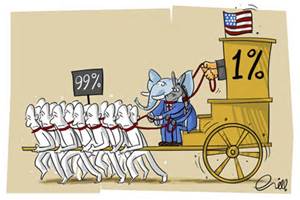
Big corporations get together and decide on an agenda and venue for a war - a diversion tactic to prevent a backlash and a means for making more money selling weapons to some rich oil sheikh or poor Asian or African nation. It just happens that America's two property right wing parties with different names represent the big corporations controlled by that one percent. The party in power, whether signified by the elephant or the mule, brings in the pollsters from the payrolls of the big corporations and cook up numbers to provide legitimacy for the agenda such as that for the wars in Iraq and Afghanistan. It is the state's jobs to lie on the behalf of the big corporations.
The big corporations and their supporters are quite confident that their system of liberal capitalism is invincible. It just seems that the ninety-nine percent of the neo-slaves are well tethered to go in the direction charted out for them by the elephant and the mule cracking the whips. The corporations avoid being seen. The only problem is that history does not lie that other invincible systems have failed in the past. It also tells us the mannerisms. They collapse by a combination of complex internal and external factors.  
The internal factors have already become obvious. As central capitalism exports terrorism and extremism, directly or indirectly or in collusion with political subscribers of capitalism in other countries, a form of social terrorism has grown due to waste, greed, debt, religious decay and dissatisfaction. This home grown social terrorism has appeared in the forms of mental illnesses, notably depression. Drugs, alcoholism, family breakdowns and high rates of divorces have led to criminal activities - parents killing each other or their children, mass killings in schools and malls, suicides, etc.  Andreas Lubitz, a co-pilot of Germanwings flight 9525 deliberately crashed a plane carrying 150 passengers in Europe's French Alps. Germanwings admitted that Lubitz had been suffering from mental problems. The internal factors are prevalent both in countries exporting capitalism, terrorism and weapons as well as in the countries adopting liberal capitalism. It includes religious extremism, child slavery, gambling, sex trades, and global usage and addiction to drugs. Stiglitz is correct that income inequality is not only become a moral issue but it is hurting economies.
External factors that might contribute to the failure of liberal capitalism are time functions such as a major setback in a war agenda, natural catastrophes, religious revival or globalization of currency wars. The best of the war agendas can fail due to combinations of poor planning or natural catastrophes such as Napoleon's and Hitler's invasion of Russia due to intense winters. Religious revivals are also known to bring down great empires such as witnessed by the Christian revival that challenged the mighty Roman Empire in Europe and the Middle East or the Islamic revival that eventually brought peaceful changes in Arabia and Persia. In their purest forms, the teachings of Islam and Christianity are no different as are all other great religious teachings. Big corporations are averse to religion and reject it as being fundamentally stripping their power and control over the people.
The fissures are becoming evident that liberal capitalism could widen to the point where it becomes unsustainabledue to the internal and external factors and be replaced with a socio-capital system by honest politicians breaking up big corporations. It is not implausible.

The Iran Nuclear Agreement: A Step In The Right Direction

Chandra Muzaffar

There is no guarantee that the preliminary agreement reached in Lausanne, Switzerland, on 2nd April 2015 between Iran, on the one hand, and the United States and five other world powers, namely, Britain, China, France, Germany and Russia, on the other, in relation to Iran’s nuclear programme will lead to a final accord at the end of June this year, as envisaged by the parties concerned.
There is considerable opposition to the agreement especially in the US. A lot of Republican lawmakers and some democrats are opposed to it. They allege that the deal does not protect Israeli interests. There are powerful Israeli lobbies in the US who have condemned it. The Israeli Prime Minister, Benjamin Netanyahu, an implacable opponent of any negotiations with Iran from the very beginning, has described the agreement as a threat to the very survival of Israel! Netanyahu and his allies in the US are mobilizing various groups and individuals to stop the signing of the final accord.
Some of the hardliners in Iran within religious, political and media circles are also unhappy with the Lausanne agreement. They feel that it imposes severe restrictions upon Iran’s nuclear programme and infringes upon the nation’s sovereignty. But the vast majority of Iranians --- it appears from media reports --- are in a celebratory mood. They are happy because the final accord will lead to the lifting of sanctions pushed forward by the US, the European Union and the United Nations in recent years that have weakened the Iranian economy and brought widespread suffering to the people.
The sanctions were terribly unjust because they were based upon the false premise that Iran was manufacturing nuclear weapons when the International Atomic Energy Agency (IAEA) which had over years conducted the most intrusive and extensive inspections of Iran’s nuclear facilities failed to produce even an iota of hard evidence that suggested that Iran’s nuclear programme had some other ulterior motive. Doubts raised on a couple of occasions and accusations hurled by IAEA inspectors, highlighted by the global media, turned out to be hollow largely because they were inspired by fabricated “evidence” supplied by Israeli intelligence.
It is also important to emphasise that right from the outset Iran’s supreme leaders, first Imam Khomeini and then the current spiritual head, Ayatollah Khamenei, had declared on a number of occasions that manufacturing, storing and deploying nuclear weapons is “haram” ( prohibited) in Islam. Iran’s nuclear programme is only for peaceful purposes with the focus upon generating electricity and undertaking medical research. The agreement recognizes Iran’s right to develop nuclear energy for such goals. Harnessing nuclear energy for peaceful purposes is part and parcel of the national agenda of more than 40 countries --- a right recognized under the Non-proliferation Treaty (NPT) of which Iran is a signatory.
To demonstrate in unequivocal terms its total commitment to peaceful uses of nuclear energy, Iran should now lead a campaign to declare West Asia and North Africa (WANA) a Nuclear Weapons Free Zone. No country and no entity in the region should be allowed to manufacture, keep or use nuclear weapons. Every country and every entity should be prepared to be subjected to IAEA inspections. This will put the only state in the region that is known to possess nuclear weapons to the test. Israel should not be treated as a special case in this instance. There should be a massive mobilization of public opinion within and without WANA to force Israel to dismantle its nuclear arsenal. It is grossly unfair that the one entity that has been most vocal in denouncing Iran’s unproven nuclear weapons has escaped scrutiny of, and censure about, its own nuclear weapons arsenal from the world community. After the Lausanne agreement we should all now turn our attention to Israel and demand that Israel demolish its stock of nuclear weapons immediately and pledge not to produce such weapons any more. A nuclear weapons free WANA is the best hope for peace and security for all the states in that region, including Israel.
Iran should also campaign to abolish other weapons of mass destruction such as biological and chemical weapons from WANA. There are a few states in the region that continue to stockpile such weapons. This again will help usher in an era where there is less barbaric violence and brutal massacres.
In this regard, Iran should also join groups in other parts of the world and campaign for the prohibition of war as a means of settling conflicts between and within nations. It would be amazing if such a campaign took root in WANA which has witnessed so many wars since the end of the Second World War. In fact, I had hoped when a revolution took place in Iran in the name of Islam in 1979 that Iran would pioneer a new approach to international relations by championing the cause of a world without war and a world without nuclear weapons and other weapons of mass destruction.
It may still happen if the agreement of 2nd April evolves into a comprehensive accord at the end of June 2015 and politics in WANA slowly moves in a different direction.

A Pro-Ukraine Television Channel in Crimea

Roger Annis

The Guardian and the The Moscow Times are reporting that broadcasting of “the world’s only Crimean Tatar-language television channel” ceased last week. The ATR channel had until April 1 to renew its license to broadcast by Russia’s state media overseeing body, Roskomnadzor. Its renewal application failed.
ATR’s previous license was issued by Ukraine. The station is majority owned by Russian businessman Lenur Islyamov. He also owns a children’s television channel and two FM radio stations. These have also gone off the air. (Russian-language news report here.)
The Moscow Times reports in its article that the head of information and communications for Crimea, Dmitry Polonsky, accuses the channel owners of deliberately provoking a political controversy by repeatedly submitting incomplete license applications,.
The Guardian takes a harder tack than the Times, saying in its story headline that ATR is being “silenced” because it is critical of the decision by the Crimean people last year to secede from Ukraine. Reporter Alec Luhn writes, “Although the official reason the channel wasn’t registered was mistakes in its paperwork, ATR’s director, Shevket Memetov, tied the forced closure to the channel’s occasionally critical coverage of life under Russian rule.
“Crimean Tatars have faced disappearances and police searches under the new government.”
And further, “Although ATR is not a 24-hour news channel, it has unflinchingly covered many of the problems that have arisen since Crimea joined Russia, including interruptions of utilities and food supplies, huge lines at the ferry crossing to Russia and the second-highest inflation rate in the world. In December, the United States and the European Union placed an economic embargo on Crimea.”
The U.S. State Department has joined in, issuing a statement on April 2 which called the situation at ATR “latest in a string of actions that undermine freedom of expression in Crimea.”
The European Union says ATR’s inability to obtain a prompt license renewal is “a blatant violation of the right to freedom of expression” in Crimea and calls it “part of a wider pattern of persecution and intimidation of the Crimean Tatar community”.
The Guardian‘s Luhn reports on the press conference last month by the leader of the Crimean National Assembly Sergei Aksyonov in which he spoke of the role of ATR in agitating against the decision one year ago to leave Ukraine.
report last month in Russian media cites Aksyonov: “We clarified to channel management that it is unacceptable to escalate the situation and provoke people’s fear associated with the fact that the channel gives hope for the return of the Crimea to Ukraine, inciting other people to action, and talking about how people who received Russian passports will be treated badly.
“The work of such channels on the territory of the Republic in the current semi-military time is unacceptable.”
The ‘Milli Firqua’ Peoples Party of Crimea, comprising a network of Tatar social organizations, denies that the licensing of ATR is an act of political suppression. In a published article on March 27, it states that the cultural programming of the channel was very praiseworthy but its news reporting was not.
Since its inception, the ATR television channel fervently played the role of the speaker of Parliament, methodically promoting the ideology of aggressive nationalism and the ‘values’ of Western democracy and their overseas patrons.”
The March 27 article traces the murky financial backing of ATR that allowed the channel to rise to prominence from its inception in 1994. Much of the channel’s expansion was financed by little known interests in Turkey and then by the aforementioned Russian businessman who bought it in 2011.
ATR frequently aired the views of the Crimea Mejlis, a decades-old commission of the Crimea Tatar national assembly called the Kurultai. The Mejlis came to be controlled by right-wing, pro-Ukraine business and political interests. Milli Firqua says that appearances by non-Mejlis Tatar representatives on current affairs programs on ATR were very rare.
Milli Firqua challenges the narrative common in Western media that the Mejlis speaks for all Crimean Tatars. In an interview one year ago, Milli Firqua leader Vasvi Ennanovich explained that his party and the leaders of the Mejlis each have the support of 15 to 20 per cent of Crimean Tatars while the majority of the population does not engage directly in political expression or activity.
survey of the Crimean population conducted in December 2014 asked for opinion of the “decision of Crimean authorities to join Russia”. Approximately 30 per cent of Tatar respondents say it was “wrong”, while an equal number say it was “generally right” and another 20 per cent say it was “absolutely right”. The final 20 per cent “don’t know” or refused to answer.
That survey as well as another one in January which was partly funded by a Canadian government agency and published by the large, German public relations firm Gfk, showed overwhelming satisfaction in Crimea with the decision to rejoin Russia. The survey showed that even Crimeans of Ukrainian descent, who comprise 24 per cent of the peninsula’s population, were overwhelmingly favorable.
Tatars comprise app. 12 per cent of Crimea’s population. According to a census in December 2014, the population of the peninsula is 2.3 million. Crimean Deputy Prime Minister Dmitry Polonsky said last November that the population of Crimea had increased by 280,000 since the referendum vote in March 2014 to secede from Ukraine and join the Russian Federation.
Milli Firqua is critical of Crimea’s political leaders for failing to respond to proposals it made last year to democratize the Tatar media landscape, including creating a Tatar-language public broadcaster. It notes that many companies owned by wealthy Ukrainians in Crimea were nationalized or sold to different business interests following secession. But little or nothing was done about media ownership and broadcasting.
The party says that failure to act has allowed a “spectacle” to occur over the licensing of ATR. “Today, as a result of the negligence, incompetence or malice of officials, Crimea has a huge scandal with tantrums and screaming about national discrimination and infringement of fundamental human rights and freedoms, and a barrage of negativity broadcast to a international multinational audience. As a result, a threat of destabilization of the Crimean Peninsula has been skillfully played out against the background of noisy information to discredit Russia on an international scale.”
Milli Firqua was formed in 2006. It participated in several elections to the Crimean autonomous assembly during Ukraine’s rule over the territory. It defines its goal as “revival of the Crimean Tatar nation and the preservation of its national territory”. (See its Russian language Wikipedia page here.)
Crimea’s national television channel ‘Krym’ reports in the Tatar language. There are other Tatar language media, including the newspapers ‘The Voice of New Crimea’, ‘New World’ and ‘The Star’.
On April 21, 2014, Russian president Vladimir Putin issued a decree restating an earlier decree from the time of the Soviet Union that condemned accusations of collective guilt of the Crimean Tatar population for collaboration with the occupying Nazi German army during World War Two. Putin announced at the time, “I have signed a decree to rehabilitate the Crimean Tatar population, the Armenian population, Germans, Greeks – all those who suffered (in Crimea) during Stalin’s repressions.” The announcement was made to a meeting of Russia’s State Council and was shown live on state television.
Putin called for measures to encourage the “national, cultural and spiritual renaissance” of the minority groups. The decree aims, “to restore historical justice and remove the consequences of the illegal deportation (of the groups) and the violations of their rights”.
Crimean Tatars have their own political assembly (the Kurultai) and the right to education in their language. Since March 2014, economic and cultural ties have developed with Tatarstan, one of the republics of the Russian Federation with a population of 3.8 million.
Despite all this, Tatars are voicing important grievances. One is a claimed slow pace of political reform that would grant more political representation. And another is the unresolved claims to land and related property lost during the WW2 era deportation and its aftermath. Russian Foreign Minister Sergei Lavrov told journalists on April 4 that Russia is drafting a law to guide land redress for Crimean Tatars.
Read also:
New pipelines begin supplying fresh water to CrimeaSputnik News, April 4, 2015‘Russian geologists have tapped a fresh water supply in Crimea which will allow for the delivery of water throughout the peninsula via new pipelines. The Russian Defense Ministry has sought to provide Crimea with more water since Ukraine’s new authorities blocked access one year ago.’
Crimea: Do Amnesty International claims of ‘climate of fear’ in Crimea have any basis?, by Alexei Timofeichev, in Russia Beyond The Headlines, March 24, 2015
The propaganda war over Crimea’s break from Ukraine, by Roger Annis, published on New Cold War.org, Dec. 13, 2014

Understanding Iran’s Nuclear Ambitions

Musa al-Gharbi

Iran’s nuclear program was founded in 1957 as part of U.S. President Eisenhower’s “Atoms for Peace” initiative. As part of this deal, the United States helped provide the training, technology and infrastructure allowing Iran to become a nuclear power. It was America that built Iran’s first nuclear reactor in 1967, subsequently providing them with the highly-enriched uranium to power it.
Soon thereafter, Iran began researching how to weaponize the technology. Ironic from today’s vantage point, Israel played a pivotal role in helping Tehran develop this capacity–much to the chagrin of the United States at the time. Washington would soon see further “Atoms for Peace” investments in India, Pakistan and Israel translated into weapons programs—with these latter three refusing to sign onto the U.S.-sponsored Nuclear Non-Proliferation Treaty (NPT), and eventually obtaining the bomb. In a further irony, all three have emerged as critical U.S. allies in the region despite these maneuvers.
For his part, Reza Shah did sign onto the treaty in 1968, although this did not end his ambition for weaponized nuclear capacity, which was ultimately brought to a halt by the 1979 Islamic Revolution which drove him from power.
Iran’s new religious leadership not only reaffirmed the NPT signed by the deposed dictator, but Ayatollah Khomeini disparaged nuclear weapons as haram under Islamic law–a binding fatwa reiterated and expanded in 2005 by Khomeini’s successor and current Supreme Leader, Ayatollah Khamenei.
However, Western leaders distrusted Iran’s religious government, and have from the outset sought to contain or even overthrow the Islamic Republic. Iran’s nuclear program became the primary means of justifying these ambitions in 1995 when, as a result of extensive lobbying by AIPAC, the United States first declared Iran’s nuclear program as a national security threat and priority.
Since that time, much of the intelligence supposed to demonstrate Tehran’s nuclear ambitions has been falsified and heavily politicized—even to the point where the IAEA has recently initiated an extensive review of their past reports on Iran’s nuclear program, worried that key evidence provided to the agency by Israel, the U.S. and the MEK may have been tampered with or be otherwise unreliable. The organization has not been able to substantiate that the Islamic Republic has ever had a nuclear weapons program.
Even U.S. and Israeli intelligence agencies, who endorse (and generally provided) this intelligence are in agreement that the Iran’s suspected nuclear weapons program has been inactive for more than a decade, with no evidence that the Islamic Republic intends to “sprint” for the bomb in the foreseeable future. Instead, all parties agree that Iran has been fully compliant with the terms of the nuclear negotiations entered into in 2013.
Why Does Iran Want Nuclear Power?
Critics of Iran often wonder why the Islamic Republic is pursuing nuclear technology so doggedly, if their intentions are strictly peaceful–given the country’s extensive fossil-fuel resources, nuclear power seems superfluous in their estimation.
There are a number of reasons:
First, Iran’s nuclear program has been an important focal point of national pride–and not just since the Islamic Revolution, but really since the program was first developed under Reza Shah.
While the aforementioned NPT calls on nations to refrain from developing or proliferating nuclear weapons technology, the treaty affirms it as a right for all signatories to enrich uranium and develop nuclear technologies for peaceful purposes. And given that, as we have explored, critics have failed to demonstrate that Iran’s nuclear weapons program is anything but peaceful—Iranians believe that it is the U.S. and its allies who are violating international norms and laws by carrying out hostile actions against a non-aggressor state with the express aim of undermining said nation’s sovereignty and denying their rights.
But there are pragmatic dimensions as well.
Yes, Iran is a fossil-fuel superpower, possessing more than 10% of the world’s total proven oil reserves, 15% of its natural gas reserves, and 1.9 billion short-tonnes of coal reserves. However, these “dirty” energy sources are increasingly subject to regulations and fees aimed at limiting and reducing their use; much of the world is increasingly moving off of fossil fuels to renewables, and seeking to dramatically increase fuel efficiency in the interim.
While there will be increased energy demands in the developing world in the coming years, China is increasingly committed to reducing its carbon footprint as well. Energy producers may continue to sell fossil fuels to other developing nations, for instance in India and across Africa, but it will likely be at a much lower price.
This is in part because, even as demand for fossil-fuels is set to decline across the richest countries, the supply is expanding dramatically: the United States has ramped up its energy production and exports (to include becoming a net-exporter of petroleum); there may be a similar shale-boom coming in the Mediterranean and North Africa. Oil from Libya and Iraq would make a huge impact on global supplies if and when those countries become more fully-operational. And despite the increasing glut in the energy market, countries like Russia and Saudi Arabia have been relentless about maintaining production.
So betting on nuclear over fossil fuels is an attempt to be on the right side of dynamics in the energy market–especially given that oil prices are already painfully low, even to the point of destabilization, for those nations whose economies rely principally on the sale of these fuels.
Diversifying Iran’s energy portfolio is also a means of ensuring that they will be able to continue selling fossil fuels down the line. For instance, due to increased urbanization and other trends– not only will Saudi Arabia be unable to continue to sell oil indefinitely, they are projected to become an oil importer by 2030: domestic demand will exceed production. And because the entire Saudi economy is premised on oil sales, it is not clear how it will continue to function once the country burns through its (admittedly immense) monetary reserves.
An integrated Iran would likely see a similar boom in domestic energy use. By using nuclear energy to offset increased local demand, Iran would protect its ability to continue selling fossil fuels internationally over the medium-to-long term.
There are also myriad other important but peaceful applications of nuclear technology in the domains of medicine, industry and agriculture. In short, Iran has a legitimate stake in nuclear power, and they argue, a legitimate right to develop it.
However, given the high financial and other costs of producing nuclear power, when paired with the risks these plants pose to the health of the public and habitats, Iran may be better served in the long term by pursuing options like wind, solar and hydropower. To the extent that economic normalization, when paired with continued limits on Iran’s nuclear enrichment and production capabilities, provides the incentive and opportunity for Iran to pursue these alternative energy sources, they will be stronger for it. In fact, given the Islamic Republic’s high and growing degree of technical sophistication (ranking among the top of the world in spite of the sanctions), and their acute awareness of the dangers of climate change, they could easily become a world leader in this domain–commensurate with the Ayatollah Khamenei’s recent call for swift action to protect the environment, which he described as a divine obligation for Muslims, and for human beings in general.

CIA Black Sites and Washington’s Allies

Binoy Kampmark

They certainly sought to please in those initial dark days when a position at the NATO table was at stake. This was something of a New World Order – the attacks after September 11, 2001 did certainly allow Washington to make that spurious case. The stakes were high, and the “need” for pressing intelligence saw a crude clipping of various liberties and protections.
Unfortunately, in so doing, willing allies and proxies lined up their maps, their facilities, and their accomplices in what became a global program of interrogation and torture. These locations willingly offered by host states came to be known as “black sites” and proved all too attractive to powers and institutions.
Lithuania’s case is a particularly conspicuous one. Its authorities have been reluctant to admit providing cover for CIA activities, let alone any specific location. A parliamentary inquiry held during 2009-2010 went so far as to suggest that such a provision had, in fact, been made, advising that prosecutors take the lead. The report in question noted a detention centre set up near Vilnius in 2004-2006.
But it also spoke in tones of reservation – CIA aircraft had landed in Lithuania, but it was not clear whether human cargo had accompanied it. (Why such aircraft would be found on Lithuanian soil without such cargo is an odd point in itself.)
Four years ago, the prosecutors dropped the investigation like a steaming hot potato. The action suggested that something foul was afoot – such a procedure did not look good for the US-Lithuanian relationship, and uncovering any more details than was necessary would have proven, at least in the public eye, impairing.
This has not stopped such actions as those of Saudi-born Abu Zubaydah, who became a near cult figure of the extraordinary rendition program during the Bush years. Zubaydah’s recourse has been through the European Court of Human Rights, where he is seeking to show that Lithuania violated the European Convention on Human Rights. He is arguing that Lithuania is responsible for his unlawful detention, torture and ill-treatment, the deprivation of the right to private and family life, the unlawful transfer from Lithuania, and ongoing violations of his right to legal recourse.
Then came the Senate Intelligence Committee Report on the CIA’s interrogation program, one waged with tentacle-like spread across a range of jurisdictions and continents. Its lurid subject matter got various prosecutors in a range of countries concerned. Had they been too slow off the mark? Much evidence suggested that they had.
The detention centre “Violet” noted in the Senate report seemed eerily close to the descriptions put forth in the Lithuanian parliamentary investigation. The Senate report noted how an amount approximating to $1 million was provided by the US to “show appreciation” for its creation, money which was conveyed via various “complex mechanisms” to evade the government ledgers.
Initially, it did not seem that much would change. Last month, Loreta Grauziniene, speaker of the Lithuanian parliament, told Reuters that, “No new inquest will be considered, because there is no longer sufficient support for it among parliamentary members.” In making such an observation, the speaker merely affirmed the link between state criminality and the will behind prosecuting it. Former president Valdas Adamkus typifies such indifference, insisting that “there were no prisons or prisoners in Lithuania,” a view he would maintain till seeing the incriminating “documents before my eyes”.
This month saw a slight modification of the stance. Lithuania’s senior prosecutor, Irmantas Mikelionis, “decided on January 22 to cancel the January 21, 2011 decision of prosecutors to stop the investigation into possible abuse, and has restarted the investigation.” According to Rita Stundiene, a spokeswoman for the prosecutors, “The prosecutor renewed a previously terminated probe and merged it with the ongoing pre-trial investigation [into the case of Mustafa al-Hawsawi].”
Emphasis will be directed at the alleged violation of two articles of the Lithuanian criminal code: the illegal transportation of a foreigner through Lithuanian territory (the case on CIA prisoner Mustafa al-Hawsawi provides a classic example); and the abuse of power by a state employee resulting in significant harm. In themselves, these read like misdemeanours, minor procedural blots. In actual fact, such conduct was the hallmark of CIA interrogatory procedures, aided and abetted by various state authorities.
Whether the renewed investigation is going to do anything more than keep the common record busy for a time is hard to know. As one of Zubaydah’s lawyers, Helen Duffy, argues, the gesture on the part of the Lithuanian prosecutors might also be construed as a tactic to ward off more concrete legal scrutiny in Strasbourg. “There is every reason to be sceptical about whether this is a meaningful investigation.” Any investigation, to be effective, had to be total.
Such prosecutorial actions tend to be kept on the books, and rarely move off them into the realm of action and consequence. Too much is deemed at stake for such alliances. Justice, in that sense, takes the most distant of backseats, while the soiled hands of the torturers remain in service.
Lithuania’s politicians generally have less of an interest in seeing CIA operatives, and their accomplices, behind bars than holding the fort against what is seen as a viable Russian threat from the east. Bigger enemies loom. Prosecutorial grit, in other words, is lacking.