9 Apr 2015

Harun Farocki’s Labour in a Single Shot in Berlin: An exhibition of films about working people

Hiram Lee

Labour in a Single Shot is an exhibition curated by German filmmaker Harun Farocki (1944-2014) and his wife Antje Ehmann. It brings together dozens of short films made under Farocki’s guidance, all of which are united around a single theme: work. Having already toured a number of cities internationally, the collection was recently displayed at the House of World Cultures in Berlin.
Farocki (born in the Sudetenland, now the Czech Republic, to an Indian émigré father and German mother) and Ehmann began the project in 2011, when they hosted video production workshops in fifteen countries. Filmmakers attending the workshops were asked to “produce videos of 1 to 2 minutes in length, each taken in a single shot.” The subject to be filmed was labour, “paid and unpaid, material and immaterial, rich in tradition or altogether new.”
In the end, several hundred films about working people were created. A generous selection of them appears in the exhibition. They may also be seen free of charge on the project’s official web site.
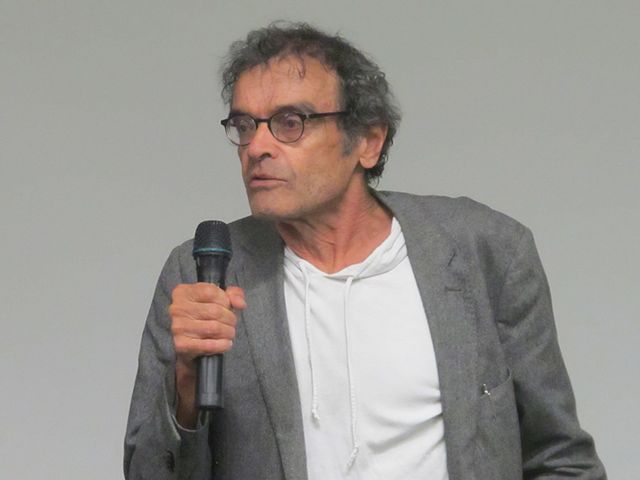
Harun Farocki in 2013
When Farocki’s collaborators are able to capture the rhythm and energy of working people, their films become interesting. In Amy van Houten’s aptly named Nimble Fingers, one watches as a worker at a textile factory in Johannesburg, South Africa, performs quality checks of completed clothing. In Mena el Shazly’s Cola Bottles, workers in Cairo, Egypt, move a new shipment of soda bottles into storage by tossing heavy bundles of them back and forth, at a speed that allows little margin for error.
In both cases, the workers move swiftly, performing tasks that have BECOME second nature to them. They know their jobs and perform them with expert hands, lending an almost effortless appearance to what is surely difficult work.

Amy van Houten’s Nimble Fingers
Footage from Bangalore, India, is among the most impressive. In Cart Avenue, an elderly man hauling a heavy load by wheelbarrow is forced to wait as a parade of revelers passes before him. In Drum, we see people washing CLOTHES and beating them with tremendous effort against stone basins. In Shoe SHOP, stacked boxes of shoes are thrown to a man who catches them, still stacked, before placing them on shelves.
Unfortunately, a majority of the films are less interesting than those described. Much of the footage PRESENTED is not especially noteworthy.
Many of the filmmakers have adopted “direct cinema” techniques and taken them to the extreme. This is point-and-click filmmaking in which the attitudes of the artists toward their subject mostly remain a secret; virtually any kind of critical voice is abandoned so that “reality may speak for itself”—at least that’s the idea. In large part, they simply film what is taking place and dutifully deliver it to audiences.
This “objective” approach, never as neutral as it purports to be, is not so much a way of showing things as they are, but rather PRESENTING them in the most superficial, unchallenging manner. Lacking an understanding or interest in the social forces behind and historical roots of the conditions they observe, the filmmakers find themselves adrift. They shoot anything and everything, elevating the arbitrary and obvious to the level of the profound, never quite able to tell them apart.
Of course, these are not intended to be narrative films, as such, nor lengthy documentary exposés. The project is more akin to a photography exhibition. But where are the images that speak volumes, which expose something essential about their subject?
When it comes to a film like Putin, the contribution from director Oleksiy Radynski, this “neutral” approach is especially troubling. In Radynski’s film, a Vladimir Putin impersonator stands on a street in Moscow, while just a few feet away lookalikes of Lenin and Stalin pose together for a photo with a tourist. All of them are linked together by a single panning shot.
What is the filmmaker trying to say, and what is his attitude toward the figures in front of his camera? It’s impossible to say for certain (although ONEfears the worst), but at the very least an unserious attitude toward some of the most important questions raised by the events of the last century lingers beneath the work.
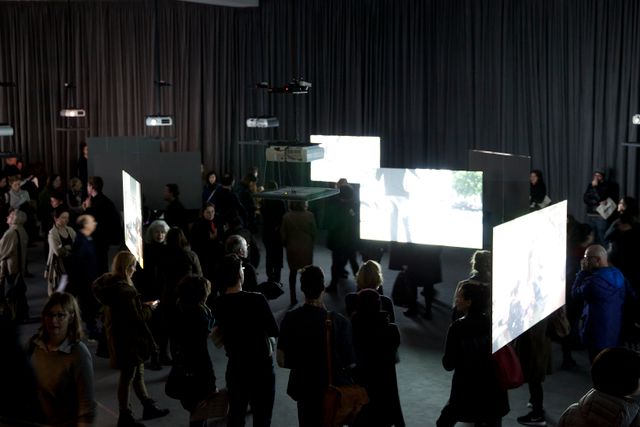
Farocki exhibition opening
In a room adjacent to the main exhibition gallery, sixteen monitors are set up in a row. The first shows the film that inspired the project and has fascinated Farocki for decades: Workers Leaving the Lumière Factory in Lyon, by brothers Auguste and Louis Lumière. Made in 1895 and lasting only 46 seconds, the film is composed of a single, static shot of workers leaving a factory at the end of their shift. The remaining fifteen screens show modern-day versions filmed in each of the project’s fifteen locations, as workers pour out of their factories to be captured on video in a single, motionless frame.
The results are generally tedious and repetitive. Workers do not need to go to an exhibition to encounter the same tedium they experience every working day. The often poorly-placed cameras have recorded little of interest or significance. The only exception is a film of young, smiling women who run as they leave their workplace in Hangzhou, China.
Augmenting the main exhibit is Farocki’s own 2006 video installation Workers Leaving the Factory in Eleven Decades. A truncated version of his 1995 film Workers Leaving the Factory, it displays movie clips of workers leaving their jobs on 12 different monitors simultaneously. One finds it difficult to say more about it than that, so small was its impact. Some of the images are striking, but less so than when situated in their original narrative contexts.
Harun Farocki died July 30, 2014, at the age of 70. By that time he had made more than 90 films on a wide range of subjects. Labour in a Single Shot proved to be his last major project.
Farocki belonged to a generation of artists who emerged from the protest movements of the late 1960s to make a number of radical, anti-war films that might be better described as “video polemics.” In the wake of the betrayal of the revolutionary upheavals of the 1960s and early 1970s by the Stalinist and other bureaucracies many artists were drawn to post-modernism, and the ideas associated with the critical theorists of the Frankfurt School.
Farocki’s work had much in common with the mostly unwatchable films of Jean-Marie Straub and Danièle Huillet and those made by Jean-Luc Godard in collaboration with the Dziga Vertov group between 1968 and 1972. Like Godard, Farocki was closest to Maoist politics at this time.
The post-modern deconstruction and repurposing of found images and other formal exercises were the hallmarks of such films. They tended to be cold, academic works, as lifeless as they were condescending. Rejecting the ability of the working class to act for itself, and side-stepping the issue of the role played by definite political tendencies and leaderships, these filmmakers sought out largely formal means of shocking what they believed to be a complacent, or worse, complicit population into action.
As the WSWS noted in 2003, “For the most part … Farocki is the master of the obvious, rather pedantically explaining to his audience things he feels it ought to know.” He seems, we wrote, to be one of those leftists “who has intriguing ideas about every imaginable process … except the most critical ones.”
“One has no idea, after the viewing of several of his films and reading interviews and some of his own essays, where he stands on the critical experiences of the 20th century: above all, the fate of the Russian Revolution, Trotskyism versus Stalinism, the nature of the regimes in East Germany and eastern Europe, German reunification, etc.”
Farocki produced several didactic political films that either defended reactionary Maoist conceptions or do not hold up well today. In The Words of the Chairman (1967), pages from Mao Zedong’s “Little Red Book” are turned into literal weapons. Inextinguishable Fire (1969), about the use of Napalm bombs in the Vietnam War, features an infamous scene in which Farocki burns his own arm with a cigarette to illustrate the magnitude of Napalm burns by comparison.
The present exhibition does not suffer from the excesses of those films. Farocki did not quite end up where Straub (now without Huillet) or Godard have. He devoted his last project, whatever its limitations, to the lives of working people, and they are not presented unsympathetically. But his orientation toward protest politics and the political education he received in those circles left him incapable of treating his subject with the seriousness it deserved.
Ultimately, Labour in a Single Shot is not so much a project devoted to working people and casting light on their plight in modern capitalist economies, but rather the technical-formal problem of how best to film them. Among the questions Farocki posed to workshop participants were: “What kinds of labour processes set interesting cinematographic challenges?” and “Almost every form of labour is repetitive. How can one find a beginning and an end when capturing it?”
In an attempt to arrive at an answer, Farocki imposed on himself and dozens of other filmmakers, constraints that were essentially arbitrary and had no organic connection to their material. It all but guaranteed the mishandling of his theme.

China’s former security chief indicted on corruption charges

Ben McGrath

The Chinese regime’s supposed “anti-corruption” campaign has reached the highest levels of officials linked to giant state-owned enterprises (SOEs). Those targeted include Zhou Yongkang, the head of China’s security apparatus until 2012, and others directly connected to ex-Chinese leader Jiang Zemin.
Zhou is the most senior party official ever to be prosecuted in the name of combating corruption. He was formally indicted last Friday on charges of bribery, abusing power and leaking state secrets. No date was given for his trial, which will be conducted in Tianjin, a northern port city near Beijing. Last December, the former Chinese Communist Party (CCP) Politburo Standing Committee member was expelled from the ruling party.
The anti-corruption campaign is a pretext for the current leadership of President Xi Jinping, who took office in November 2012, to purge the government and the CCP of powerful political opponents while imposing economic restructuring designed to further open up China to private and foreign investment. Xi hopes that by eliminating Zhou and his allies, he can break the resistance in ruling circles to his government’s plans to deregulate the SOEs.
Jiang Zemin, president from 1989 to 2002, protected the top 100 SOEs from privatization. Figures such as Zhou Yongkang and former Chongqing party boss, Bo Xilai, gained power while advocating the transformation of the biggest SOEs into “national champions” that could compete with global transnational corporations. Bo was sentenced to life imprisonment on corruption charges in September 2013.
Zhou, Bo and their allies were not at all opposed to the restoration of capitalism in China over the past three decades but wanted to protect their powerbases and financial interests in the SOEs.
While Jiang Zemin so far remains unscathed, numerous other “tigers”—or high-ranking government officials—have fallen. Xu Caihou, a former vice-chairman of China’s Central Military Commission, and Ling Jihua, a onetime candidate for the Politburo, were accused of corruption last year. The two men, along with Zhou and Bo, were dubbed the “New Gang of Four” by Chinese media. Xu died from bladder cancer in March.
As part of Xi’s purge, an inspection of 26 SOEs began last month. The sweep has already netted several company chief executives. On March 15, auto manufacturer FAW Group Corporation’s chairman Xu Jianyi was accused of “severe violations of discipline and the law.” The following day, PetroChina general manager Liao Yongyuan was placed under investigation on similar charges. “Violations of discipline” has become a common euphemism for corruption allegations.
FAW is one of the leading auto manufacturers in China with ties to both Jiang Zemin and Zhou Yongkang. Jiang spent his early career in FAW and then, while president, backed an industrial faction that included Zhou and Xu Jianyi. The auto industry has reportedly resisted “reforms” of SOEs since Jiang left office.
Zhou is also closely connected to the oil faction, having built up his career in the China National Petroleum Corporation (CNPC), and becoming its general manager in 2006. Liao Yongyuan was close to Zhou. Jiang Jiemin, the former CNPC chairman, was expelled from the CCP at the October 2014 plenum. PetroChina is the listed arm of the CNPC.
Corruption is rife throughout China’s Stalinist bureaucracy, which enriched itself through the looting of state property as it oversaw the restoration of capitalism from the 1980s. But this campaign is directed elsewhere—at breaking up the power bases that have rested on the largest SOEs. The petroleum industry was Zhou’s “independent kingdom,” commented Wang Zhengxu, an associate professor at the University Nottingham in the UK.
During the CCP’s 2013 Plenum, the government unveiled extensive plans for economic deregulation to encourage foreign investment in fields such as telecommunications and energy, two of the industries also targeted in the recent investigations. Last year’s plenum built on this, claiming that the party would pursue the “rule of law,” indicating that the government would continue its “anti-corruption” push in conjunction with economic deregulation.
This campaign is intensifying. Premier Li Keqiang stated at the beginning of last month’s National People’s Congress: “Oversight over state assets will only get tougher, and elements of corruption will be thoroughly investigated and punished.” The 11-day congress, which ended on March 15, was used as a platform to push ahead with economic restructuring aimed at the SOEs. Saying of the proposed reforms, Li declared: “But however painful it might be, we are determined to keep going until our job is done.”
Other executives caught up in recent investigations had connections to cliques in the steel, oil and electricity industries that resisted the restructuring plans.
On March 31, Cui Jian, the deputy general manager at the state-owned Baosteel Group Corporation was accused of violations of duty. The next day, China Southern Power Grid vice-president Xiao Peng and former China National Offshore Oil Corporation vice-general manager Wu Zhenfang were accused of “duty-related crimes” and “suspected serious violations of party discipline.” No further details were provided. Xiao was the fourth executive from his company to be placed under investigation since March.
The Chinese government is also targeting IT industry bureaucrats. Two high-level officials at telecommunications company China Unicom were accused of corruption at the end of last year. General manager of network construction Zhang Zhijiang was arrested on December 15 and Zong Xinhua, the general manager of IT and e-commerce, was arrested three days later. Both men have ties to Jiang Zemin through the latter’s son, Jiang Mianheng, a powerful figure in China’s telecommunications industry.
These developments are being monitored keenly in international media and financial circles as evidence of Xi’s consolidation of power and his willingness to carry through the wholesale pro-market agenda that will more fully open China up to global corporate exploitation.
An article in the London-based Financial Times commented: “Mr Zhou’s trial will confirm Mr Xi’s status as the country’s most powerful ruler since Deng Xiaoping, the transformative post-Mao leader who launched the reform and opening program that has made China the world’s largest economy by some measures.”

Affordable housing increasingly scarce in New York City

Philip Guelpa

The spiraling cost of housing in New York City is pushing growing numbers of workers into increasingly marginal housing or onto the streets. The officially recorded homeless population of the city living in shelters now exceeds 60,000, the highest number since the Great Depression.
The city’s programs to address homelessness and the diminishing availability of affordable housing are totally inadequate to meet the need, forcing people to live in squalid conditions, and are, in fact, designed primarily for the benefit of slumlords and real estate developers.
Last month, New York City’s Department of Investigations (DOI) released a scathing report regarding the city’s homeless shelters. The report, the result of a year-long study, focused on 25 shelters, operated and managed by the City Department of Homeless Services (DHS), which houses approximately 2,000 homeless families. It found that these shelters “exposed residents to serious health and safety violations such as extensive vermin infestations, blocked or obstructed means of egress, non-working smoke and carbon monoxide detectors, and improper and/or missing Certificates of Occupancy.”
The report also found that the City is paying exorbitant rents to the private owners of these shelters, twice or more the going rates of comparable apartments in the surrounding neighborhoods. These shelters, known as “cluster housing,” are leased from private landlords in an attempt to compensate for the grossly inadequate supply of city-owned facilities faced with accommodating an ever-growing homeless population. Owners reportedly drive out existing tenants in order to participate in the much more lucrative city program, which has become a multibillion-dollar business.
Another recent report, prepared by the non-profit investigative organization ProPublica, found that conditions in New York City Housing Authority (NYCHA) public housing, the largest such system in the country, with more than 400,000 tenants, remain horrific. Despite continuing complaints and protests by residents, large numbers of dangerous and unhealthy conditions, including water leaks that result in extensive mold growth and have the potential to spark electrical fires, go unaddressed for months and even years.
It is a testament to the desperate state of housing availability in the city that despite these conditions there is at present a waiting list of more than 250,000 for apartments in the city’s NYCHA public housing developments. The system is currently running a $98 million budget deficit, projected to reach $400 million by the year 2025, and there are no plans for new construction.
On the contrary, NYCHA is accelerating sales of “unused” parcels of land, including green space and parking areas, to private developers. News reports indicate that 54 parcels amounting to 441,000 square feet of public land have already been sold off. These sales are certain steps towards the ultimate privatization of the system.
Meanwhile, in the richest city in the world, construction of luxury housing is booming, as are the prices. Last year, a single apartment, located in a newly constructed building on West 57th Street, just south of Central Park, was sold for over $100 million—a new record. Others in the same vicinity have recently gone for prices in the mid to high tens of millions.
The mad pace of construction of ultra-high luxury residential towers, dubbed in a recent issue of the New York Review of Books as “Conspicuous Construction,” is ramping up to feed the ever-growing appetite of the world’s super-rich for ostentatious and often barely occupied living quarters.
These apartments are especially attractive to elite foreigners as a mechanism to “offshore” their wealth in what they perceive as a safe haven. Such purchases are often conducted in highly cloaked transactions, and hence have been given the moniker Towers of Secrecy by the New York Times.
At the same time, the city’s working class is facing increasing difficulty in finding an affordable place to live caused in part by the knock-on effect of this colossal real estate bubble. While new luxury apartments are being built at a dizzying rate, the number of affordable units is declining substantially.
According to the Census Bureau, since 2001, more than 100,000 apartments that rented for between $500 and $900 a month have been lost. Additionally, since 1997, between 300,000 and 400,000 formerly rent-regulated apartments have been opened to the free market as laws have been loosened at the behest of the real estate lobby, lessening the available housing for middle income families.
Mayor Bill de Blasio’s election pledge to “build or preserve” 200,000 housing units over the next 10 years, even if achieved, would be woefully inadequate to compensate for these losses, let alone the likely additional declines in the future. Even this goal would require a rate of approximately 20,000 housing units per year. In fact, the pace has declined over the past several years, from 17,000 in 2012 to 13,000 in 2014, and has never exceeded about 18,000 over the last decade. Furthermore, the necessary funding to achieve the stated goal is dependent on a significant influx of money from the state and federal governments, which is unlikely to materialize.
As if the ever-increasing prices were not enough to generate super profits for developers, the boom in luxury housing is being supported by a City program of tax breaks, known as 421-a, that funnels $1.1 billion per year to construction of mostly high-end units, including the 57th Street building cited above, under the pretext that a certain percentage of units are supposed to be “affordable.” This is a fraud. The majority of buildings constructed under this program are located in Manhattan, the city’s richest borough. Even those in the outer boroughs, however, are overwhelmingly designed for those who can afford market rates.
A recent study of the 421-a program by the group Real Affordability for All found that in a sample of 61 buildings in Brooklyn that received support from the program only 6 percent of the resulting apartments had rents below market rate. Furthermore, only 31 out of the 257 supposedly affordable units were rented at rates that were within the feasible budgets of families making less than last year’s median income of $41,000 for renters in the city.
Most of these buildings also benefit from federal tax abatements and from City programs that allow for the construction of a greater number of units than would normally be allowed under zoning ordinances. Furthermore, the requirement to maintain the affordable rents on the designated units expires when tenants move out or after a fixed time period, allowing the landlords to then charge market rates. The end result is that real estate developers are being supported in the construction of highly lucrative housing for the city’s elite justified by the a fig leaf of affordable units.
Available data indicates that only about 12 percent of the apartment units built under the 421-a program during 2013-2014, about 13,000, are nominally affordable. The Real Estate Board of New York, the principal industry lobbyist, has stated that if the program is not renewed next year, when it is scheduled to expire, construction of even this totally inadequate level of supposedly affordable housing will cease.
Now, under cover of promoting additional affordable housing, Mayor de Blasio is proposing a new program, dubbed “Zoning for Quality and Affordability,” that would substantially loosen zoning regulations, allowing the construction of even taller buildings in areas where they are not currently permitted. Such a change has long been sought by the city’s developers, as it would maximize the use of the limited and expensive available real estate to build even more “market rate” apartments, especially in Manhattan, and, therefore, boost profits even further, with minimal benefit to most city residents.

Right-wing Democrat reelected as Chicago mayor

Kristina Betinis

Incumbent Chicago Mayor Rahm Emanuel won Tuesday’s first-ever runoff election, beating his challenger, Cook County Commissioner Jesus “Chuy” Garcia, to win a second term. Emanuel retained his seat with a little more than 55 percent of the vote to Garcia’s 44 percent.
Voter turnout in the city was 39 percent, slightly higher than during the first-round election February 24, where five candidates divided a near-record low turnout of 33 percent. Emanuel’s margin is expected to widen as the thousands of mail-in ballots are counted.
Garcia carried wards with large Spanish-speaking and immigrant populations and led among families with children in Chicago Public Schools, while Emanuel posted majorities in historically African-American wards, in white working-class areas, and on the affluent north lakeshore. A CBS exit poll indicated that those who identified as union households were split nearly evenly between the candidates.
Having survived an election that demonstrated the vast unpopularity of his right-wing, pro-business policies, Emanuel is preparing to move even further to the right, with a frontal assault on the pensions of city workers, including teachers, and city services.
The vehicle for a new round of cuts will be the claims of a “fiscal crisis” involving estimated unfunded pension obligations of about $20 billion. The choice of pensions as the scapegoat for the crisis is entirely arbitrary and false, since one could more justly say the fiscal crisis is caused by state and federal cuts in aid to the cities, or the collapse of tax revenues stemming from Emanuel’s handouts to corporate Chicago.
The focus on pensions, promoted by the media as soon as the returns from Tuesday’s elections came in, is aimed at intimidating opposition to the impending cuts with the claim that there is “no money” to meet supposedly exorbitant pension payments.
In the coming year Chicago is required by law to pay an additional $550 million to make up major city pension fund shortfalls brought on by the “pension holidays” under the previous administration of Richard M. Daley, when city leaders chose not to make payments to the pension funds. Last year, Illinois legislators cut pensions for 57,000 city workers, dumping responsibility for about $10 billion in pension payments.
Major cuts are being planned across the state in the bipartisan plan to reduce the deficit without raising taxes or borrowing. This week, in an effort to immediately close a $1.6 billion budget shortfall, Illinois Governor Bruce Rauner—a Republican who has close ties to Emanuel—suspended $26 million in funding for social services affecting immigrant integration programs, funerals and burials for those on public assistance, autism support, youth support and HIV-AIDS programs. A plan worked out by Rauner and Democratic legislative leaders will slash 2.25 percent of state spending across the board for the last three months of the current fiscal year.
Throughout the campaign, Emanuel worked to place the city’s financial crisis at the center of the runoff, commenting to the Washington Post, “Who is better to steer this ship and right this ship financially, educationally and continue to make the critical investments? That’s the question. And that’s what people have to decide.”
Emanuel’s reelection is by no means a popular mandate for the pro-business and anti-working class policies of the Democratic Party. There was no alternative on the ballot, since the so-called “progressive” opponent Garcia did not propose substantially different policies. More than half the eligible voters did not go to the polls.
The political forces behind the Garcia campaign—the liberal wing of the Democratic Party, the Chicago Teachers Union and Service Employees International Union, and the International Socialist Organization—are presenting the runoff campaign as a success, claiming it had the effect of convincing Emanuel to be slightly less dictatorial in managing the city.
CTU president Karen Lewis, who will negotiate a new contract for more than 20,000 teachers this year, broadcasted a statement via text message, “Together we brought a landmark election season to Chicago! For our contract, let’s keep engaging Chicagoans to ensure the best for our students.”
Last year, Lewis made the opening move in the negotiations in a press statement to Crain’s and the Chicago Sun-Times, offering to cut non-retired teachers’ pensions. The budget shortfall for the Chicago Public Schools system is estimated at $1 billion. Unfunded pension liabilities for CPS teachers currently sit at $9 billion.
CTU Vice President and ISO member Jesse Sharkey claimed, “Rahm in 2011 is not Rahm in 2015. He really had to get off his high horse to win. And I think that, as his campaign has shown, there are ways he can act less imperious that can make his life easier.”
American Federation of Teachers national president Randi Weingarten commented, “This will be the threshold issue. Will he be…the man who said he could change? Or will he go back to vintage Rahm?”
These remarks underscore the pretense by the AFT and CTU officials that it is the mayor’s leadership style—whether he will work with the unions to implement cuts—and not any fundamental differences in policies on worker rights, retirement benefits, or the rebuilding and expansion of the decrepit public education system.
Teachers and other city workers must view this as a sharp warning that the unions are preparing to sabotage their struggles as they did in the one-week teachers strike in 2012, which the CTU called off abruptly, paving the way for Emanuel to push through the closure of 50 schools and the elimination of more than a thousand jobs.

US defence secretary warns China over Asian maritime disputes

Peter Symonds

On his first trip to Asia since being appointed, US Defence Secretary Ashton Carter warned China against inflaming territorial disputes in the South China and East China Seas. Speaking yesterday in Tokyo alongside Japanese Defence Minister Gen Nakatani, Carter declared that the US took “a strong stance against the militarisation of these disputes.”
Carter’s comments were in line with those of Admiral Harry Harris, commander of the US Pacific fleet, in Australia last week. Harris accused China of building artificial islands on disputed atolls and outcrops in the South China Sea in order to construct military facilities. “China is creating a great wall of sand with dredges and bulldozers,” Harris claimed.
In an interview published yesterday in the Yomiuri Shimbun, Carter declared that China’s land reclamations “seriously increase tensions and reduce the prospects for diplomatic solutions.” He called on Beijing to “limit its activities and exercise restraint.”
Carter’s remarks are entirely hypocritical. As part of its “pivot to Asia,” the Obama administration, far from exercising restraint, has provocatively encouraged China’s neighbours, including Japan, the Philippines and Vietnam, to more aggressively assert their maritime claims.
While proclaiming its neutrality in the territorial disputes, Washington is clearly backing China’s rivals. In Tokyo last year, Obama unambiguously committed the US to support Japan in any war with China over the disputed Senkaku/Diaoyu islands in the East China Sea.
Responding to Carter’s remarks, Chinese foreign ministry spokeswoman Hua Chunying called on the US to be “more responsible,” adding: “We hope the US side can respect the wishes of China and relevant countries to resolve the problem through dialogue.”
Just days before leaving for Asia, Carter delivered a major speech in Arizona reaffirming the US commitment to the “pivot” or “rebalance” to the Indo-Pacific region. The “pivot” is a comprehensive diplomatic, economic and military strategy targeting China and aimed at ensuring the continued dominance of American imperialism in the world’s fastest growing economic region.
Significantly, along with the US military build-up in Asia, Carter focussed on the economic plank of the “pivot”—the Trans-Pacific Partnership (TPP)—which confronts US Congressional opposition. “You may not expect to hear this from a Secretary of Defence,” he said, “but in terms of our rebalance in the broadest sense, passing [the] TPP is as important to me as another aircraft carrier... It would help us promote a global order that reflects both our interests and our values.”
The comment underscores the TPP’s importance to Washington and its aggressive character. The US is aiming at nothing less than dictating the terms of trade and INVESTMENT throughout Asia so as to benefit American corporations and economic interests. Carter emphasised that “our military strength ultimately rests on the foundation of our vibrant, unmatched and growing economy.”
Central to the TPP is the protection of the “intellectual property rights” on which giant US electronic, media and drug companies heavily depend, and the scrapping of all legal, regulatory and governmental obstacles to American INVESTMENT. At this stage, China is not a party to the negotiations, but is instead pursuing its own trade and economic agreements.
Carter outlined the extensive build-up and restructuring of US military forces in the Asia-Pacific that are geared above all to a war with China. This includes:
* New military hardware is being developed, specifically tailored to the Pentagon’s AirSea Battle war plan, which envisages a massive air and missile assault on mainland China from US bases and naval assets in the western Pacific. In addition to “a new, long-range stealth bomber and a new, long-range anti-ship cruise missile,” Carter explained that the US was working on “new weapons like a rail gun” using electromagnetic forces, and “new space, electronic warfare and other advanced capabilities, including some surprising ONES.”
* The Pentagon has already dispatched some of its most sophisticated weapons systems to Asia, including the latest Virginia class nuclear submarine and P-8 surveillance aircraft, as well as fighter aircraft and bombers. “We will continue to push our most advanced weaponry to the Pacific, including, for example, our newest stealth destroyer, the Zumwalt,” Carter said.
* The US is comprehensively redistributing its military forces throughout the region, including new basing arrangements with Australia, Singapore and the Philippines. In North East Asia, the Pentagon is restructuring its bases in Japan, especially on Okinawa, and South Korea and transforming Guam into a “strategic hub” for the region. “In Japan, Korea and Guam,” Carter boasted, “we are in the middle of four of the largest military construction projects since the end of the Cold War.”
* The US is “constantly refreshing our alliances” in the region. Carter emphasised that this involved “establishing brand new partnerships” and maintaining “an increased tempo of training and exercises.” As he spoke, the annual US-South Korean war games were underway. The US and the Philippines are about to begin their annual Balikatan military exercises, which have doubled in size from last year and also include Australian military personnel.
The main purpose of Carter’s visit to Tokyo was to finalise new US-Japan defence guidelines that will integrate the Japanese armed forces more directly into US military activities, interventions and wars.
With Washington’s encouragement, Japanese Prime Minister Shinzo Abe has pressed ahead with an expansion of the country’s military and security apparatus and moved to end constitutional and legal restrictions on its activities. Last year, his government “reinterpreted” the country’s constitution to allow for “collective self-defence”—that is, to enable the Japanese military to take part in US wars of aggression.
The rewritten bilateral defence guidelines reflect this “reinterpretation.” They will allow Japan to respond to an attack on US forces—real or concocted—even if the US was not acting in defence of Japan at the time.
An unnamed senior US defence official enthusiastically told the Washington Post that the new rules were “a big, big deal.” He focussed particularly on the greater integration of anti-ballistic missile systems that the guidelines would enable. “With missile defence, the more radars you have and the more shots you have, the higher the probability of a [missile] kill is.”
There is nothing “defensive” about the anti-ballistic missile systems that the US is jointly developing with Japan and South Korea. Above all, they are part of the Pentagon’s strategy for fighting a nuclear war with China. In the wake of a US first nuclear strike, the anti-missile systems would seek to shoot down any remaining Chinese missiles.

Toronto Symphony bans pianist critical of Kiev regime

Roger Jordan

Under pressure from right-wing Ukrainian-Canadian groups, the Toronto Symphony Orchestra (TSO) removed Ukrainian-born pianist Valentina Lisitsa as the featured soloist at two Toronto concerts that were to be held this week. The TSO sought to replace Lisitsa with another pianist, but after a public outcry simply cancelled the concerts.
An internationally recognized pianist who has played with major orchestras in North America and Europe and has a large online following, Lisitsa has drawn the ire of the right wing because she has challenged their false narrative about the “democratic” character of the pro-western Kiev regime.
In Twitter postings stretching back to the weeks following the US-German-orchestrated, fascist-led coup that drove Ukraine’s elected president from office, Lisitsa been heavily critical of the Kiev regime. She has denounced it for its rampant corruption, ties to Nazi sympathizers like the Right Sector, and mistreatment of the Russian minority, and for the brutal war it has waged against the pro-Russian separatist forces in eastern Ukraine.
The cancellation of Lisitsa’s performances of Rachmaninoff’s Piano Concerto No. 2 is a brazen act of political censorship.
The management of the TSO, one of the country’s leading cultural institutions, initially sought to cover up why it had cancelled Lisitsa’s performances. It simply said she was no longer available to play in Toronto and had been replaced.
Only after Lisitsa revealed that she had been dumped from the TSO program and instructed by management not to reveal why did TSO President Jeff Melanson acknowledge that the cancellation was due to pressure from Ukrainian nationalists .
Melanson justified the decision by citing “ongoing accusations” from” Ukrainian media outlets” that Lisitsa has used “deeply offensive language.” In an attempt to intimidate the musician, the TSO had previously forwarded Lisitsa a letter from a prominent lawyer at the country’s largest law firm, Borden Ladner Gervais, that said she could be denied entry into Canada under section 319 of Canada’s criminal code, which makes the “willful promotion of hatred” illegal.
The TSO’s actions threaten artistic freedom and freedom of speech and have ominous implications for musicians and artists everywhere. As Cara Zwibel of the Canadian Civil Liberties Association put it in comments to the CBC, “I think there is a problem with the message that this sends to artists that they may have trouble getting jobs or keeping jobs if they express views that are unpopular or controversial.”
The TSO’s banning of Lisitsa represents a cowardly capitulation to reactionary political forces—forces that enjoy the strong backing of the Conservative government of Stephen Harper.
Protests against Lisitsa’s appearance came from the Ukrainian Canadian Congress (UCC), a right-wing organization that purports to represent Canada’s large Ukrainian diaspora community. Heavily influenced by extreme Ukrainian nationalism, the UCC is virulently anti-communist and anti-Russian. Some of its affiliates were founded by veterans of the Organization of Ukrainian Nationalists (OUN), which collaborated with the Nazis in World War II, including in the mass extermination of Jews, and many continue to venerate OUN leader Stepan Bandera.
Lisitsa has for some time been a target of the Ukrainian right because she has rejected the Western-backed propaganda that the Ukraine crisis has been caused by Russian aggression. Her concerts have repeatedly become the occasion for protests by Ukrainian nationalist groups. Last September, the EuroMaidan Press website published an appeal for supporters to join them in calling for a boycott of Lisitsa’s concerts in Pittsburgh.
The TSO’s ban will encourage these right-wing elements to go after Lisitsa elsewhere, as well as other artists who take a critical position towards the pro-western Kiev regime.
So as to ostracize Lisitsa, her Ukrainian nationalist opponents have labelled her a stooge of Russian president Vladimir Putin. This is a slur. What they object to is her heartfelt challenge to their false narrative.
As Lisitsa explained in the Facebook posting announcing the TSO’s banning, she initially had great hopes that what she terms the “Maidan Revolution” would end the domination of Ukraine by a corrupt oligarchy, but these hopes were quickly dashed.
“I was so proud of my people!” wrote Lisitsa. “But the ruling class doesn’t let go easily. They managed to cunningly channel away the anger, to direct it to other, often imaginable, enemies—and worse, to turn people upon themselves. Year later, we have the same rich people remaining in power, misery and poverty everywhere, dozens of thousands killed, over a million of refugees.”
In her statement, Lisitsa explains that she felt she could not remain silent as “the country of my birth, of my childhood, of my first falling in love…was sliding ever faster in to the abyss. Children die under bombs, old ladies die of starvation, people burned alive”
She said that she has been seeking to expose the abuses going on in Ukraine, particularly against the Russian-speaking minority. “I took to Twitter in order to get the other side of the story heard, the one you never see in the mainstream media.
“To give you just one example: one of my feats was to confront French fashion magazine Elle who published a glowing cover story about women in Ukrainian army. After the research I have shown to the magazine in my Twitter posts that the ‘cover girl’ they have chosen to show was in fact a horrible person, open Neo-Nazi, racist, anti-Semite who boasted of murdering civilians for fun! The magazine issued a written public apology.”
The ability of the UCC and its supporters to aggressively target those hostile to its right-wing positions is made possible thanks to the close collaboration they enjoy with the Canadian government and more generally the unanimous support the ruling class and political elite have given to the US-NATO drive to transform Ukraine into a Western satellite.
Canada has been one of the most outspoken supporters of the Kiev regime since the February 2014 coup and is participating in the build-up of NATO forces on Russia’s borders.
The Harper government is supplying non-lethal military aid to the Ukrainian army. But it is also facilitating the supply of weapons, including guns and drones, to the Ukrainian army and aligned ultra-nationalist and fascist militias through the UCC and its Army SOS organization. Two Conservative MPs attended a recent Army SOS fundraising event in Toronto that raised more than $50,000 to be spent on arms and military gear (see “HYPERLINK "https://www.wsws.org/en/articles/2015/03/11/cana-m11.html" Canada helping arm Kiev regime to fight Ukrainian civil war“).
At a UCC gathering in Toronto on February 22, Conservative immigration minister Chris Alexander delivered an inflammatory speech in which he gave the government’s full backing for an aggressive course towards Russia. He called the conflict with Russia “the biggest issue facing the world today,” stressed that “ every option” is “on the table” in regards to defeating Putin—a euphemism for all-out war with Russia—and said there was “ no scenario” for peace and security for this world” that does not involve defeating Russia in Ukraine.
Such are the sentiments being encouraged by the Harper government among its far right allies in the UCC, and it is in this context that the targeting of Lisitsa must be seen. Anyone who questions the official narrative of the Ukraine crisis is to be demonized as a supporter of Putin and Russian aggression.
That the TSO has bowed to this campaign is a disturbing development. Under conditions in which democratic rights are under sustained attack, the TSO has made it clear that it is willing to sacrifice the rights of freedom of speech and artistic freedom to meet the demands of the Canadian ruling class and its far right allies.
The justification the TSO has provided for its decision could hardly have been more hypocritical. The TSO statement read, “As one of Canada’s most important cultural institutions, our priority must remain on being a stage for the world’s great works of music, and not for opinions that some believe to be deeply offensive.”
The TSO has not merely provided a platform for groups defending the reactionary politics of the Kiev regime, including the persecution of Ukraine’s Russian minority. Its capitulation to the censorship demands of the UCC has strengthened precisely those forces pushing for the US and its allies to intervene militarily in Ukraine against Russia, a move that threatens to trigger an all-out conflict between the major powers.

Greece’s Tsipras manoeuvres with Russia in bid to strike better bargain with Europe

Robert Stevens

Greek Prime Minister Alexis Tsipras met Russian President Vladimir Putin in Moscow Wednesday, the first day of a two day trip. He was joined on the trip by a delegation of ministers.
The Syriza-led government is establishing closer ties with both Russia and China as a counter to its failure to reach an agreement on imposing austerity to the satisfaction of the European Union (EU), European Central Bank (ECB) and International Monetary Fund (IMF). The moves towards Russia are seen by sections of the Greek bourgeoisie as a bargaining chip in their ongoing negotiations with the European powers over Greece’s austerity proposals and the repayment of its €315 billion total debt.
Today, the bankrupt Greek state is to pay a €450 million loan instalment owed to the IMF. However, due to the financial stranglehold the ECB has over its economy, it is likely that Greece will run out of cash within weeks without further external loans. Greece cannot obtain an outstanding loan of €7.2 billion unless it begins the imposition of austerity measures stipulated by the agreement it signed with its creditors on February 20.
Tsipras’ trip caused consternation in ruling circles in Europe and the United States. Both are concerned over any breach in their united offensive, as the NATO alliance moves forward with its provocative encirclement and isolation of Russia, while continuing its crippling economic sanctions against the Putin regime. Greece plays a key role as NATO’s southernmost flank, with a geostrategic location in the Balkans and large ports and other infrastructure.
In the days leading up to the trip, senior political figures warned Greece that developing closer ties with Russia, including any request for loans or opposition to sanctions, would be considered hostile to EU interests.
European Parliament President Martin Schulz, speaking to the Muenchner Merkur Tuesday, warned Tsipras, "Greece demands and gets a lot of solidarity from the EU. We can therefore also ask for solidarity from Greece and for this solidarity not to be ended unilaterally by pulling out of joint measures.” He warned Tsipras, “He should base his actions in Moscow on that.”
Judy Dempsey, senior associate at the Carnegie Europe think-tank said, “Relations between Russia and Greece have been very close over the years, but this is a new dimension. Tsipras is trying to play off Russia against the EU in his negotiations to get what he wants from the eurozone. Clearly this is Putin’s attempt to trade off one EU country against another.”
Putin and Tsipras announced a year of Greece-Russia cooperation and signed a number of accords following their two-hour talk. The most important agreement was signed by Foreign Minister Nikos Kotzias, who along with Energy Minister Panagiotis Lafazanis, the leader of Syriza’s Left Platform, was part of the delegation. Along with his Hungarian counterpart Peter Szijjartow, they added their support to Russia’s Turkish Stream gas pipeline project.
On Tuesday, Russia secured the support of Serbia, Macedonia and Turkey for the project. The agreement calls for the creation of “a commercially viable option of route and source diversification for delivering natural gas from the Republic of Turkey through the territories of our countries to the countries of Central and South Eastern Europe.”
Russia’s access to sea ports in the region is a major strategic concern for the US. In February Russia signed an agreement with Cyprus to give its navy access to Cypriot ports. A central factor in the US-backed coup in Ukraine was the US attempt to deny Russia access to the Crimean port of Sevastopol in the Black Sea, where Russia has a naval base.
Speculation mounted prior to the trip that Greece might ask Russia to provide it with loans. At this stage Athens has not made a request, and the claims were denied by the Tsipras government.
Putin confirmed during the post-talks press conference, “The Greek side did not contact us with any requests for help.” Russia was interested in investing in Greece as part of any privatisation programme the Syriza government would unveil, he said. Russia could make loans for “major projects in energy,” he added. "Of course we are interested in pipelines, ports and airports, as well as energy generation and other resources."
Tsipras used the occasion to declare Greece’s opposition to the EU’s ongoing sanctions against Russia, which are due to be discussed again by Europe’s leaders in July. As the sanctions require the unanimous support of all EU members, Greece has the power to veto them--a situation that would threaten the integrity of the NATO alliance and the EU.
Tsipras said, “The counter sanctions imposed by Russia have inflicted pain on the Greek economy. But we know the retaliations were a response to sanctions [against Russia], the logic of which we do not entirely share. We openly disapproved of the sanctions. It is not an efficient solution. We think it could bring about a new Cold War between Russia and the West.”
Syriza is a pro-capitalist government. Since coming to office, it has sought to reach a deal with the European powers over its debt mountain and austerity measures. While seeking to cement alliances, including with Russia, it is desperate to maintain its relations with Europe’s major players.
Tsipras told the media in Russia, “This is a European crisis, not a Greek one--a European solution must be found. Greece is a sovereign state and it has been in a complex economic state."
He added, “We are a sovereign state--I repeat--and we can use this to sign agreements in our common interest in order to combat the crisis… We want to create bonds of trust with Russia, as a member of the EU."
Tsipras’ trip occurred only days after Finance Minister Yanis Varoufakis’ visit to the US for discussions with IMF Managing Director Christine Legarde and Treasury officials of the Obama administration.
Following the talks, in which Varoufakis will no doubt have complained of how Greece is being forced to turn to Russia, the Greek ministry issued a statement emphasising the concern of the US with continuing EU intransigence over Greece’s debt. It read, “US officials conveyed the importance the Obama administration places on an honest agreement between Greece and its partners and on preserving the unity of the euro zone.” The ministry said the US was ready to act as an “honest broker” in the negotiations between Athens and its creditors.
Tsipras’ trip to Moscow has nevertheless done nothing to arrest Greece’s mounting financial crisis. On Tuesday, a Greek senior official told theFinancial Times that Athens would be able to meet its immediate debt repayments to its international creditors, “but it will be a squeeze to raise cash for domestic payments in the second half [of the month]. Next month is a different matter. We are going to run out of money unless reforms are legislated to make some bailout funds available.”
Prior to Tsipras’ talk of Greece being able to pursue its own strategies as a “sovereign” nation, Wolff Guntram, the director of Bruegel, a European think-tank, said baldly, “A sovereign is called a sovereign as it can decide who to pay first. However, Greece is not completely sovereign, as the ECB has leverage over what the government can do.”

Tsarnaev found guilty on all counts in Boston bombing trial

Barry Grey

A Boston jury on Wednesday found Dzhokhar Tsarnaev guilty on all 30 counts laid against him in connection with the bomb blasts near the finish line of the April 15, 2013 Boston Marathon, which killed three people and wounded another 264. The verdict followed 11 hours of deliberations over two days.
The dead included a 29-year-old restaurant manager, Krystle Campbell, who was watching her boyfriend run the marathon; Lingzi Lu, a 23-year-old Boston University graduate student from China; and eight-year-old Martin Richard, who was watching the race with his family. The dead boy’s sister lost a limb as a result of the bomb detonated by Dzhokhar Tsarnaev, one of 17 people who lost limbs in the two blasts.
Dzhokhar Tsarnaev’s older brother Tamerlan, who was killed in a shootout with police on April 18, detonated the bomb that killed Campbell.
Tsarnaev was also convicted of murdering a Massachusetts Institute of Technology police officer three days after the bombings, when he and Tamerlan were seeking to flee in the face of a massive police dragnet.
Seventeen of the counts carry a possible death sentence, and the same jury of seven women and five men that convicted the 21-year-old Tsarnaev will hear arguments in the sentencing phase of the trial, expected to begin as early as next week and last two or more weeks.
That the defendant would be convicted on most, if not all, of the charges had not been in doubt. While Tsarnaev had pleaded not guilty, in both her opening and closing arguments in Federal District Court, the lead defense lawyer, Judy Clarke, had conceded that her client had participated in the bombings.
In her April 6 closing argument, Clarke told the jury: “We don’t deny that [Dzhokhar] fully participated in the events… When you go back to the jury room, we’re not asking you to go easy on [Dzhokhar]. The horrific acts that we’ve heard about, the death, destruction and devastation that we’ve heard about, deserve to be condemned, and the time is now.”
She argued, however, that the mastermind behind the bombings was Tamerlan, who had used his overweening influence to lure the younger Tsarnaev into the bombing plot. Clarke told the jury, “But if not for Tamerlan, it would not have happened.”
From the start of the trial, which began March 4, the strategy of the defense team has been to concede their client’s guilt while laying the basis for pleading extenuating circumstances in the second, sentencing phase of the proceedings. The goal is to convince at least one juror to reject a sentence of death by lethal injection, resulting in a penalty of life in prison without parole.
Of the 95 witnesses called in the course of 15 days of testimony, the prosecution called 92 and the defense only 3. The entire defense case in the first phase lasted barely 5 hours.
Massachusetts does not have a death penalty and there has traditionally been broad opposition to it within the state. The current proceeding, however, is a federal trial, which can result in execution.
The federal prosecutors are pressing for the death penalty. Their case in the first phase centered on graphic testimony from survivors, family members of victims and rescuers describing the carnage and suffering caused by the bombings. They argue that the younger Tsarnaev brother was no less motivated by Islamist jihadist ideology and no less involved in the planning and execution of the crime than Tamerlan.
There is no doubt that Dzhokhar Tsarnaev is guilty of participating in a horrific crime. But the more fundamental political issues in the bombing atrocity are being excluded from the voluminous media coverage of the trial and were not alluded to by the defense team in the first phase of the proceedings.
These relate to the response of the authorities to the bombings and unanswered questions concerning previous warnings received by the FBI and CIA about the terrorist sympathies of Tamerlan Tsarnaev, as well as extensive links between the FBI and CIA and the older brother, and the Tsarnaev family more generally.
The bombings became the occasion for a massive mobilization of police and military forces in Boston and its suburbs. A state of siege was imposed for most of April 19, ostensibly in pursuit of one 19-year-old suspect. Metropolitan Boston was occupied by heavily-armed police and National Guard troops.
They deployed in the streets, supported by armored vehicles, Humvees and Black Hawk helicopters. Residents were ordered to “shelter in place” while police, with automatic weapons drawn, carried out warrantless searches. The transit system was shut down, passenger train service was halted, and businesses, schools, universities and other public facilities were closed.
The Boston events had the character of a dry run for dictatorship. The virtual silence on this police state operation in the media commentary on the current trial is consistent with the lack of any significant criticism at the time from within the political or media establishment.
So too is the media silence on a host of unanswered questions about prior warnings and links between Tamerlan Tsarnaev and state agencies. These include:
* Why did the FBI and CIA fail to respond to warnings from Russian security in 2011 and 2012 concerning Tamerlan Tsarnaev’s support for Islamist separatist and terrorist organizations in Russia’s North Caucasian regions? Why did they ignore Russia’s request that Tsarnaev, an ethnic Chechen, be prevented from traveling to these regions?
·* Why did the FBI clear Tamerlan Tsarnaev of harboring terrorist sympathies in 2011 after supposedly carrying out an intensive investigation? Why did the agency claim there was no “derogatory” information against him, even though it suspected him of having participated in the Waltham, Massachusetts murder of three Jewish men on the tenth anniversary of the 9/11 attacks?
* Why was Tamerlan Tsarnaev allowed to travel to Dagestan in January of 2012, without even being questioned at the airport? He remained there for six months and reportedly made contact with Islamist groups that have carried out terror attacks against Russian targets. Why was he allowed to return to the US without even being stopped at the airport and questioned on his return?
* Why did the FBI, CIA and Homeland Security Department fail to inform their state and local counterparts on the Boston joint terrorism task force of their contacts with Tamerlan Tsarnaev prior to the Boston Marathon?
These unanswered questions suggest that US intelligence was seeking to use Tamerlan Tsarnaev to further its covert anti-Russian operations among Chechen and Dagestan separatists. These regions also supplied many of the foreign fighters recruited by the CIA for its proxy war for regime change against Syrian President Bashar al-Assad.
Last year, defense lawyers for Dzhokhar Tsarnaev filed papers with the Federal District Court alleging that the FBI had tried to recruit Tamerlan as an informant. The defense has requested all information relating to the FBI’s investigation of Tamerlan, but the government has blocked the release of such documents.
There is another connection between the Tsarnaev family and US intelligence. Ruslan Tsarni, the uncle of the Tsarnaev brothers, ran a US group in the 1990s called the Congress of Chechen International Organizations, which helped supply anti-Russian insurgents in Chechnya with military equipment. The organization was registered at the home of his father-in-law, Graham Fuller.
Fuller had been vice chairman of the National Intelligence Council at the CIA under President Reagan and had worked for the agency in a number of countries, including serving as CIA station chief in Kabul.

Industrial action mounts in France against Socialist Party’s austerity drive

Pierre Mabut

Industrial action is spreading in France in defense of jobs and working conditions and in opposition to the austerity policies of the Socialist Party (PS) government and the European Union (EU).
Air traffic controllers launched a series of 48-hour strikes yesterday over mounting attacks on working conditions and plans to raise the retirement age from 57 to 59 years in 2017. Nearly half of all short- and medium-haul flights were cancelled at French airports. The strikes are slated to continue through the month of April.
The government has reportedly refused point-blank to negotiate with the main controllers’ union, the SNCTA (National Union of Air Traffic Controllers), on the demands the union has presented.
Over 400 workers at Radio France have been on strike for three weeks against government plans to lay off up to 380 workers, mainly technicians, in order to erase a €21.3 million deficit. The government intends to sell off or merge local radio stations, pool their program resources, and rationalize Radio France’s two orchestras.
Journalists joined the strike last Friday. The seven government-run national and local radio stations are either off the air or running a skeleton service, with little or no news programming. The strike is already the longest in 10 years.
Radio France CEO Mathieu Gallet, a front man for the PS, has provoked workers with claims that the company will not survive beyond this summer if cuts are not implemented, while spending €100,000 to renovate his office. Radio France workers passed a motion demanding Gallet’s immediate resignation, but the union bureaucracy is merely complaining that Gallet refuses to negotiate restructuring plans and job cuts with the unions.
Gallet has the government’s full backing. Culture Minister Fleur Pellerin has said that the layoffs—referred to as “voluntary”—are “probably necessary”. She has called for a “programme of social modernization.”
The joint union committee controlling the strike is pleading for the appointment of a government mediator to break the deadlock, knowing full well that he or she will do the government’s bidding.
Yesterday’s strikes overlap with a one-day march called for today by the union bureaucracy as a safety valve for growing opposition to the PS government and EU austerity policies. Workers at public hospitals and public schools plan to strike today and organize protest marches in cities across France.
The strikes are an initial response by the working class to moves by the PS government and business lobbies to intensify austerity measures, despite an overwhelming rejection of the policies of the PS in recent local elections. Prime Minister Manuel Valls has made clear he will accelerate his attacks on workers in line with EU demands to reduce France’s budget deficit to 3 percent of gross domestic product by 2017.
At the same time, Valls has found still more money for the employers. On Wednesday, he announced more tax breaks, totaling €2.5 billion over 5 years, for companies investing in new equipment.
The PS and the union bureaucracy are in intense discussions with employers’ organizations on plans for historic attacks on workers’ social rights as part of a reactionary “reform” of labour contracts. The corporate elite aims to scuttle all long-term labour contracts (CDI), allowing employers to hire and fire at will and impose drastic cuts to wages and benefits.
Mass layoffs are already mounting. On April 7, the Vivarte corporation, which runs the La Halle, Kookaï, and André clothing stores, announced 1,600 layoffs amid falling sales. At the end of March, trucking and transport company MoryGlobal filed for bankruptcy, with 2,150 jobs on the chopping block in the biggest corporate bankruptcy in France since appliance maker Moulinex collapsed in 2001.
In seeking to resist policies pursued in France and across Europe by reactionary governments of all political stripes, the working class faces a political struggle against the PS and the EU. The strikes can be successful only if they are linked to a revolutionary and socialist perspective, based on mobilizing broader layers of workers and fighting to unite the entire European working class in struggle against EU austerity.
This means workers have to take the struggle out of the hands of the corrupt union bureaucracies and pseudo-left parties that for decades have suppressed workers’ struggles.
To understand the perspective animating the union bureaucracies, the Stalinist-led Left Front, and the New Anti-capitalist Party (NPA) in France, one need only consider their Greek co-thinkers, the Syriza party. Having come to power in January, Syriza has capitulated to EU austerity demands and is currently raiding the Greek health system, pension funds and social services to pay off Greece’s creditors in the EU and the International Monetary Fund.
Shrugging off Syriza’s attacks on the working class, the Left Front’s Clémentine Autain hailed Syriza as a model for the PS. The answer to austerity, she claimed, was “a renewal of cultural policy” modeled on Syriza’s temporary rescue of the Greek public broadcasting service. She added, “Greece has just reestablished its public television channel. France is running down its audiovisual service. Find the error.”
Autain’s comments are a warning to workers that the Left Front, the NPA and their allies have the same anti-worker agenda as Syriza and would pursue the same policies were they to come to power in France.
They are terrified of the explosive social discontent in the working class, which is deeply alienated from PS President François Hollande, whom the pseudo-left endorsed in the 2012 presidential election. While they call protests to let off steam, they are terrified that a broad mobilization of the working class could rapidly topple the PS government. Should protest strikes escalate into a movement against the PS and the EU, they will rapidly seek to shut it down.
This is the lesson of last September’s strike by Air France pilots against wage and benefit cuts bound up with the introduction of the low-cost airline Transavia. The pilots were in a powerful negotiating position, having halted Air France traffic, and the corporation was hemorrhaging hundreds of millions of euros.
Precisely because its position was so powerful, and it feared that a victory by the pilots would deal a decisive blow to the company and the PS government, the National Airline Pilots Union (SNPL) moved to shut down the strike and organize a defeat. Pseudo-left groups such as the NPA and Lutte Ouvrière (Workers Struggle) hailed the defeat as a victory, trying to spread as much confusion and demoralization as possible.
The working class can bring to bear its immense social power only in a struggle against the PS and the EU, mobilizing workers on an internationalist and socialist perspective.

Girls Have Feelings Too

Khalid Bashir

“She must have been a bit of a loose character anyway , Cell phones in the hands of girls is what is causing trouble.”
“These things tend to happen from boys , after all they are boys’’.
If you live in Kashmir or India chances are you have heard the above lines. Despite deliberations on crimes against women, this "it-was-kind-of-her-fault" mindset refuses to die down. Sure, feminists scream and with media outrage we may shut down such people. However, deep down, the beliefs remain. Isn’t it ? In fact, it's not just men; a lot of women believe the same too.
Centuries have come, and centuries have gone, but the plight of women is not likely to change. Time has helplessly watched women suffering in the form of discrimination, oppression, exploitation, degradation, aggression, humiliation . Male violence against women is worldwide phenomenon. Fear of violence is an important factor in the lives of most women. Fear of violence is the cause of lack of participation in every sphere of life. There are various forms of crime against women. Sometimes it is even before birth, some times in the adulthood and other phrases of life.
Log into YOUR social media Apps , the barrage of ‘ comments , likes, status updates , uploads’ will surely be of the gruesome act of acid attack in Srinagar to Delhi Rape case .Yes i am talking of a dehumanized , cowards who splashed acid on the face of a girl to rapists .What does that convey ; that “I am a male and having a muscle power or simply your are a female and be under my command . Typical male chauvinism . Don’t you dare to stand contradictory with my will or else be ready to bear consequences of hurting my ego .
She may be probably wondering what she had done worth this , will she retaliate in the same way and make life hell for him . Anyway , she won’t because she is a women and has any women up to now hurled back whatever was thrown on her . Today she is at the front page tomorrow on second and finally the more her scars and pain grows the more she will be far from justice . Won’t she ?
The jolt and horrible memories of rape case from shopain to Delhi hadn’t faded away that acid attack acted as a fuel to fire to already bruised body .I wonder what on earth drives us to do so . We are not taking the persons life away ; we are taking their right to live ; because they have a cruel society to face in future . We leave them with scars that will refuse to go away for lifetime.
Will society accept them .If Women of any conflict zone are raped , by oppressors why aren’t they given the respect of those who fell to bullets . Their own society turns away face from them . Why ? When rape , sexual assault, eve teasing , harassment happens why we always tell ‘victim’ to let it go and dump the atrocities . We seem to be GETTING into disease of bystanders effect.
Stringent laws are being brought into place to stop such happenings ,but will law help or do we need to go for ‘Swatch Mann’. Moral education comes handy when society is battered and bruised by evils . These issues BECOME issues, for us ,only when ;media puts them in its agenda and does enough priming to make them long last and drive peoples conscience to streets.
We have Fathers that kill daughters in womb . The people issuing religious edicts against girls .As music BECOMES forbidden in Islam only when played on Guitar by girls. Don’t our boys play music in bands and we invite them on our late marriages . The new culture that has sprung up in Kashmir .
After marriage how many girls are able to carry on their jobs . Why she has to leave job and GET involved in house chores . Why not men .? Many may raise fingers at this statement as it is un Islamic. But from our homes to buses what is Islamic ? What about our marriages ? The girl has a long list to follow to appease her in laws .Aren’t we going for a society where fornication will be cheap and marriage expensive ?
The important question is: Why do such attitudes prevail? Why do so many of our citizens believe women not behaving in a certain way are asking for trouble or are not "good girls"? What is the core fundamental issue HERE? More importantly, how do we convince them to think otherwise – Men are the protectors and maintainers of Women , ( Quran 4 : 34 ).One of the most important things we find in the Human Rights granted by Islam is that a women’s chastity has to be respected and protected under all circumstances .Whether we find her in backwoods or in a conquered city, whether she belongs to our religion or other religion . In Islam ‘as a mother paradise lies the beneath of her feet . As a daughter she opens up the gates of paradise for her parents and as a wife she completes the religion of her husband.’
Our respect for any women should elevate if she BECOMES a victim , because it is not her fault in any way . When she is married she is taunted for dowry , the person demanding beggary should be condemned not the one who couldn’t afford the insane ritual. What’s her fault in giving birth to a daughter , because it is man who is scientifically responsible . And those whose heads hung low when daughter is born , they must remember they too were born to someone’s daughter . Didn’t our prophet Muhammad (PBUH) said "He is Guaranteed paradise one who has 3 daughters & up-brings them well".
“A society that is unable to respect, protect and nurture its women and children loses its moral moorings and runs adrift.”