11 Apr 2015

Scottish nationalist advocates “devo-max” in Aberdeen leaders’ debate

Julie Hyland

Scotland’s first minister, Nicola Sturgeon, has said that she could introduce full fiscal autonomy for Scotland within a year of the May 7 general election.
Sturgeon, leader of the Scottish National Party (SNP), made her remarks during the second televised debate between Scottish party leaders in Aberdeen on Wednesday night. Broadcast on BBC One, Sturgeon was joined by Patrick Harvie (Green), Jim Murphy (Labour), Willie Rennie (Liberal Democrat), David Coburn (United Kingdom Independence Party-UKIP), and Ruth Davidson (Conservative).
Sturgeon said the SNP would push for complete control of taxation and spending in Scotland, “as quickly as the other parties agree to give it,” and would vote for it in the next Westminster parliament.
She has previously avoided confirming that the SNP would press for “devo-max” after the May 7 election. This would mean ending the Barnett formula, under which funding is centrally allocated throughout the UK, making Scotland dependent on the revenues it raises locally.
The SNP is expected to be the prime beneficiary of a collapse in Labour support in Scotland. With Labour and the Conservatives polling neck-and-neck, the makeup of the next government could be determined by the ballot in Scotland.
The SNP has positioned itself as kingmaker. Following the defeat of last September’s referendum on Scottish independence by 55 to 45 percent, it has played down talk of separation as it seeks to win support among workers and youth taken in by its anti-austerity stance but otherwise opposed to independence.
Its main appeal has been that only a strong vote for the SNP in Scotland could keep the Conservatives out of office after May 7. Labour and the SNP could combine with other “progressive” parties, it claims, to block a Conservative administration in the event of a hung parliament.
In the first televised debate in Edinburgh Tuesday evening, which was restricted to the SNP, Labour, Liberal Democrats and the Conservatives, Sturgeon said she was “offering to make [Labour leader] Ed Miliband prime minister.” The SNP would keep Labour “honest,” she claimed.
This is despite the SNP itself highlighting that just weeks before the dissolution of parliament, Labour joined with the Conservatives and Liberal Democrats to back a further £30 billion in spending cuts.
Labour has so far rejected the SNP’s entreaties. Publicly, it claims that it is capable of winning an outright majority, without the nationalists’ help. The possibility of an SNP-backed minority Labour administration is the main plank of Conservative propaganda, arguing that this would produce an unstable government that would be “punished” by the financial markets.
Sturgeon was booed by sections of the audience in the first debate when she said that the call for another referendum on Scottish independence would not feature in the SNP’s manifesto for May 7, but refused to rule it out in the manifesto for elections to the Scottish Parliament in 2016.
The 2016 elections are “another matter,” she responded. Two years ago, Sturgeon had said that the vote on independence was “a once in a generation thing.”
Murphy used her statement to accuse the SNP of opening a “black hole” in Scotland’s finance in Wednesday’s debate. Ending the Barnett formula would leave an immediate £7.6 billion shortfall, he said. While denouncing Westminster austerity, the SNP would have to implement massive spending cuts of its own, he argued.
Home Rule featured heavily in the second debate, which was held in Aberdeen, home to much of the UK’s North Sea energy industry. During last September’s referendum, the SNP had claimed “Scottish oil” would provide the basis for an independent Scotland to break free of Westminster austerity. Since then, oil prices have collapsed by almost half to around $60 a barrel. Some 10,000 jobs in the energy sector have already been lost, mainly in Aberdeen. Many more are anticipated as the oil and energy companies attack pay and conditions.
Just hours after the Aberdeen debate, Royal Dutch Shell announced that it had paid £47 billion for the exploration firm BG—the largest deal of its type for several years. The two firms, which employ nearly 3,000 workers in Aberdeen, said the move was necessary to ensure greater efficiency and reduce costs. A Shell representative said that “quite a few hundred” jobs would be lost.
Murphy exploited the oil crisis to attack fiscal autonomy, stating that the SNP’s own financial advisers, business leaders and “most importantly, trade unions say it will leave a black hole.”
“After the difficult time that Aberdeen and the north-east of Scotland has been through, the idea that we voluntarily give up the pooling and sharing of resources, the ability to transfer money across these islands. I don’t think it makes sense,” he said.
Labour’s plans for a so-called mansion tax would affect just 0.3 percent of Scots, he said, whereas there would be “tens of millions of pounds of money coming from London and the south-east.”
The tax is in reality a paltry sop. Aimed at houses worth £2 million and above, it applies to fewer than 0.5 percent of homes in the UK and will raise just £1.2 billion. In March, to cross-party approval, the government handed some £1.3 billion worth of aid to the energy companies, announcing a cut in the Supplementary Tax on oil firms’ profits from 30 to 20 percent, the reduction of Petroleum Revenue Tax from 50 to 35 percent and other “generous” tax allowances.
The fractious debate in Aberdeen concealed that only the addition of the xenophobic, anti-European Union UKIP candidate enabled the others to pose as “progressives”.
Murphy’s shedding of crocodile tears over the victims of welfare benefit sanctions was especially nauseating. A member of the neo-liberal, pro-interventionist Henry Jackson Society, Murphy played a lead role in both the Blair and Brown Labour governments—voting for the Iraq war and the introduction of university tuition fees.
Davidson made explicit that the Conservatives are intent on far greater spending cuts should they win office on May 7. This was necessary to pay down Britain’s debt, she said—a debt incurred by the £1 trillion bailout of the UK’s banks and super-rich in 2008, repayments on which have gone directly back to the self-same architects of the financial crash.
But “debt reduction” is the mantra of Labour and the SNP alike, who differ from the Tories only as to the speed of implementation.
Murphy played up Labour’s commitment to raise the minimum wage to just £8 by 2020 as a part of ending the “disgusting” scandal of low pay. He studiously avoided answering a question by a local authority worker in the Edinburgh audience whether Labour would end the five-year freeze on public-sector pay.
Sturgeon was also keen to emphasise the SNP’s fiscal credibility. The SNP’s plans for “modest” spending increases would not jeopardise paying down the fiscal deficit, she said, which would take just “two or three years more” to complete.
Noteworthy also was Harvie’s response to the question of what was the Green’s “red line” for supporting a government.
Harvie said the Greens would not support a government “willing to repeat the disastrous neo-liberal economic model that has allowed wealth to be hoarded by those that need it the least while those in the greatest need are left stranded.”
Asked by the moderator in Aberdeen if this meant he would not be prepared to support a government that was based on capitalism, Harvie floundered and laughed nervously.
“I think there genuinely needs to be a re-evaluation of the nature of our economics,” he said. “There is a fundamental problem with the nature of modern capitalism as it stands at the moment, finance capitalism where so much of our economy is owned by the finance industry.”
Pressed again on whether this meant the Greens would not collaborate with a capitalist government, he said, “It’s that word, a red line. I’m not sure that’s meaningful.”
In the last Scottish parliament, the Greens had found “genuine areas of common ground” to work with a minority government, even though they had areas of disagreement, he said.

Obama green lights massive weapons sales to Egypt, Pakistan

Thomas Gaist

The US government will sell advanced weapons systems to Egypt and Pakistan this week, according to statements issued from the White House and the Pentagon.
An initial transfer of some $60 million worth of Hellfire II missiles to Egypt will mark the beginning of new US efforts to “modernize” Egypt’s military arsenal, aimed at insuring a “secure and stable Egypt,” according to the White House.
On March 31, Obama telephoned Egyptian military ruler Abdel Fattah al Sisi to inform the general that he was ending the “executive hold” imposed by the US administration on a limited number of weapons systems in October 2013.
Obama personally assured General al Sisi that he would seek to continue providing $1.3 billion annual military aid packages to the Egyptian regime, which is the number two recipient of US military aid worldwide. The US president vowed that the two would “stay in touch in the weeks and months ahead,” according to a White House press release.
Immediately following Obama’s announcement, the US moved ahead with a pending sale of 20 Harpoon missiles, 125 M1A1 Abrams main battle tank “upgrade kits,” and 12 F-16 fighter jets. Another weapons deal approved Wednesday will send more than 350 US-made Hellfire missiles to Egypt.
With the lifting of the ban, the US will resume unrestricted transfers of “high-grade, sophisticated, big ticket items” to the military dictatorship, according to Tamara Cofman Wittes, director of Middle East Policy at the Brookings Institution, a Washington think tank with close ties to the White House.
The weapons sales are being coordinated by the US State Department and US Defense Department, and tailored to meet the “operational needs” of the latest war against Yemen, a US official told Defense News. “Operation Decisive Storm” was launched against Yemen on March 25 by forces from Egypt, Saudi Arabia, Jordan, and the Gulf monarchies, backed by the US.
“Given the current operational needs, we are making every effort to expedite security assistance to coalition forces,” the official said.
“The State Department is acting promptly on requests for military capabilities from our Gulf partners, in partnership with the Department of Defense,” he added.
Egypt, which previously conducted military operations in Yemen during the 1960s, has deployed at least four warships to the Yemeni coast.
The latest weapons sales to Egypt are an extension of the “robust, long-standing security relationship with Saudi Arabia and other partners in the gulf region,” according to a US State Department statement. The transfer of heavy weapons to Egypt “will contribute to the foreign policy and national security of the United States by helping to improve the security of a friendly country that has been and continues to be an important force for political stability and economic progress in the Middle East,” according to a statement from the Pentagon’s Defense Security Cooperation Agency (DSCA).
Obama’s October 2013 “executive hold” on weapons sales came nearly six months after the military coup led by al-Sisis, and only applied to a handful of weapons systems, with significant military aid continuing to flow. In the immediate wake of the July 2013 coup, the Obama administration refused to impose any restrictions, with White House spokesman Jay Carney announcing at the time of the takeover that “it would not be in the best interests of the United States to immediately change our assistance programs to Egypt.”
Even during the “arms freeze,” the US continued to send various forms of aid to the military junta. During 2014, the US provided some $35 million worth of equipment to Egypt’s armored units, and some $45 million worth of equipment to the Egyptian air force, as well as nearly $70 million worth of guided missiles, according to US government data.
In October 2014, the US furnished a set of 10 Apache helicopter gunships worth more than $170 million.
During this period, al Sisi’s government has orchestrated historic massacres, mass trials and roundups, handing down death sentences against hundreds of political opponents at a time and detained tens of thousands of political prisoners in a system of military prisons and torture camps. Al Sisi’s military junta has banned political opposition, shuttered independent media, and harassed and terrorized journalists, carrying out what Human Rights Watch described as “mass arrests and torture that harken back to the darkest days of former President Hosni Mubarak’s rule.”
In August 2013, Egyptian security forces massacred some 1,000 people at a protest camp near Rabaa, and wounded some 4,000 more. Forces under the command of the Sisi government carried out “indiscriminate and deliberate use of lethal force,” leading to “one of the world’s largest killings of demonstrators in a single day in recent history,” Human Rights Watch noted.
The weapons ban, which the White House insisted would be ended only after a return to civilian rule, has now been lifted with an open military dictatorship still firmly in place, a discrepancy that US officials have not even bothered to address.
The Obama White House is cooperating with al Sisi and his officers to expand Egypt’s capacities to intervene militarily throughout North Africa and the Middle East, in the name of the fraudulent “global war on terrorism” and to enforce the shared interests of US imperialism and the Egyptian national bourgeois elite.
Freshly armed with American weapons, the Egyptian military is preparing to expand its interventions across the Middle East as part of the “unified Arab military force,” which was proposed by General al Sisi himself and officially approved at the March 26 Arab League summit, one day after Arab coalition warplanes began bombing Yemen.
Also this week, the US announced more than $950 million in military aid to Pakistan, including 15 Viper attack helicopters and 1,000 state of the art Hellfire II missiles and more than five years of maintenance, support and training from US government employees and contractors.
A Pentagon statement specifically noted that the attack helicopters will enhance Pakistan’s efforts to target militant groups in North Waziristan and other tribal areas.
Large-scale US weapons exports grew by nearly 25 percent between 2005 and 2014, according to a March report from the Stockholm International Peace Research Institute (SIPRI).
In 2011, the US sold almost $67 billion worth of arms, according to a Congressional report. During the first five years of the Obama administration, the Pentagon approved foreign weapons sales of some $170 billion, a total that is $30 billion greater than the amount sold during the entire eight years of the Bush administration.

French oil giant Total uses Chinese funds to finance Russian oil project

Athiyan Silva

Skirting US and European Union (EU) economic sanctions against Russia over the Ukraine crisis, French oil giant Total is moving ahead with a $27 billion project to develop a liquid natural gas (LNG) at Yamal, near the Arctic Ocean in Siberia. Because sanctions against Russia are cutting off Total’s ability to finance the project from US or European banks, Total is looking to Chinese banks for up to $15 billion.
Total CEO Patrick Pouyanné told the Wall Street Journal that Total will finance the project with a mixture of euros and yuan, the Chinese currency. Pouyanné said there was “a strong willingness to build the project financing [from Chinese financial institutions] and it’s not an easy task, to be clear. We would have preferred to do it with dollars.”
“The oil-and-gas business is mainly a dollar-driven business, so when you begin to use other currencies, you have some currency risks,” Pouyanné said, referring to the danger of sudden shifts in the exchange rate between dollars, euros, yuan, and the ruble, the Russian currency. “You can hedge euros easily. It’s more complex with the yuan or ruble.”
This is the largest private international corporate deal involving Chinese banks, according to the Journal, surpassing a $12 billion loan to German automaker Daimler in 2013 by a group of banks, two of which were Chinese. TotalFrance’s main oil and gas company and one of the big five global oil companies, with 2014 revenues of $235.9 billion—is heavily invested in developing its production capacity in Russia. It expects to produce the equivalent of 400,000 barrels of oil per day in Russia by 2020, or roughly one fifth of its total energy output.
In a sign of the political and strategic character of the project, Total’s plan to develop Yamal is reportedly being followed and supervised by Russian president Vladimir Putin personally. Total expects to produce 16.5 million metric tons of LNG annually at the Yamal plant, which would be shipped to European and Asian, and particularly Chinese, markets via ice-breaking tankers. It is sharing 20 percent for this project with Russia’s Novatek and the China National Petroleum Corporation.
Total’s operations in Yamal point to the deepening inter-imperialist tensions stirred up by the reckless US-led war drive against Russia over Ukraine, and the increasingly fragile role of the US dollar as the leading global currency.
The news that Chinese banks would help fund Total’s Yamal operations came only a few days after a broad coalition of countries—including Britain, Germany, France, Italy, South Korea, and Australia—joined the China-led Asian Infrastructure Investment Bank (AIIB). They openly defied US pressure not to join the AIIB, which Washington sees as a rival to US-led institutions like the International Monetary Fund or the World Bank.
Washington’s financial and military oversight of the collective affairs of the imperialist powers in Eurasia is increasingly challenged. It has been widely noted that the crisis over Ukraine provoked by the February 2014 Kiev putsch backed by Washington and Berlin threatens a nuclear catastrophe, with French president François Hollande warning of “total war” between NATO and Russia.
Now, as North American and European powers seek to exert their influence and their multinational corporations seek to divide up markets in Russia and Asia, the economic conflict over the division of profits is coming to the fore.
Last year, Washington forced Paris to abandon the delivery of Mistral-class helicopter carrier warships to Russia, according to a contract signed in 2011. The first delivery was to take place in October 2014 and the second this year.
In February 2014, a French business delegation traveling to Tehran was blocked by US officials, who threatened to impose penalties for any breach by France of the US-led sanctions regime on Iran.
Last June, France’s largest bank, BNP Paribas, was fined a record $9 billion and faced a partial suspension of its operations in dollars, reportedly because it had violated sanctions imposed by US imperialism on countries like Sudan, Iran and Cuba. Putin claimed that the fine was in fact punishment for France’s failure to strongly support US operations against Russia in Ukraine.
Now, US sanctions against Russia and its “pivot to Asia” aimed at isolating China threaten to cut European multinationals off from lucrative investment opportunities opening up based on fast-growing Chinese markets.
China is turning to closer ties to Russia for energy that would be transported overland, avoiding vulnerable shipping lanes threatened by the US Navy, while Russia is turning to China to find markets to sell energy resources that might face Western sanctions.
Last May, Russian leader Putin visited Shanghai and signed a $400 billion dollar agreement for energy supplies with Chinese leaders. Three months later, work on gas pipeline construction officially began in Siberia towards China.
French and European capitalists are increasingly concerned that the US sanctions are costing them valuable market share and profit opportunities. Last March 25, French and Russian businessmen met in Paris and discussed how to strengthen their economic ties. They revealed their concern about the sanction over Russia.
Thirty-seven of France’s leading CAC-40 corporations operate in Russia, together with 1,200 medium and small companies. Total, carmaker Renault, food corporation Danone, pharmaceutical firm Sanofi, retailer Auchan, and sporting goods store Decathlon all have more than 50,000 workers there.
Michelle Assouline of the Medef business federation declared: “It turns out that political decisions transform into an economic weapon. The sanctions that seem to be directed against Russia are directed against French companies.”
Claude Goasguen, a former minister for state reforms and right-wing mayor of Paris’s wealthy 16th district, bluntly declared: “Europe doesn’t agree with how the sanctions are applied.”

NATO re-armament increases risk of war in Europe

Johannes Stern

NATO’s rearmament in Eastern Europe is increasingly taking on the form of open war preparations against Russia, raising the danger of a nuclear war between the Western powers and Moscow.
On Friday, the Western military alliance completed the first test of its new super-rapid reaction force, the Very High Readiness Joint Task Force (VJTF). As part of the “Noble Jump” manoeuvres, the chain of command from NATO Headquarters SHAPE in Belgium was tested via the NATO command in Naples, the German-Netherlands Corps in Münster, and the units in Germany, the Netherlands, Norway and the Czech Republic. There were troop movements in the Netherlands and the Czech Republic.
The exercise is part of the systematic military rearmament of NATO in Eastern Europe following the pro-Western coup in Ukraine and the subsequent military offensive by Kiev in the east of the country.
Western heads of state and government agreed to the establishment of the VJTF at the NATO summit in September last year in Wales. It belongs to the NATO Response Force (NRF), the NATO rapid reaction force, whose troop strength was doubled in early February to 30,000 soldiers. In an emergency, the 5,000-strong so-called “spearhead” of the NRF can be operational within 48 hours.
A total of 1,500 soldiers participated in the manoeuvres, including 900 from Germany alone. The core of the NRF comprises the 371st Infantry Battalion from Marienberg, in Saxony. According to the German Army, the unit was involved in the exercise and trained at Marienberg. The transfer of the battle group to Poland is planned in the second part of exercise “Noble Jump,” in May.
On their web site, the Bundeswehr (German Armed Forces) posted a propaganda video about the “demanding exercise program” of the battalion, under the title “Grenadiers fit for all scenarios.” The text accompanying the video says: “They go on patrol in a fictitious crisis area, find and defuse roadside bombs, fall into an ambush and prove themselves in urban warfare.” The video itself explains that the Panzer Grenadiers must “be prepared for all crisis scenarios ... as a rapid crisis response element of NATO.”
The leading NATO military leaders make no secret of the fact that one of these “scenarios” is war against Russia. “The scenario relates to the Baltic countries. You can think of the context yourself,” Czech Major General Jiri Baloun said, according to media reports.
The commander of NATO in Europe, General Philip Breedlove, boasted in an official statement: “NATO military planners have been working tirelessly to enhance NATO’s Response Force and implement the Very High Readiness Joint Task Force, and today our progress is manifested in the rapid deployments we see happening in locations across the Alliance.” These measures were “defensive,” but a clear indication that “our alliance has the capability and will to respond to emerging security challenges on our southern and eastern flank.”
In reality, the extent and the thrust of the NATO exercise makes clear that it is anything but “defensive” and is primarily aimed against Russia. According to the Frankfurter Allgemeine Zeitung, “Noble Jump” is only “one of at least 200 NATO manoeuvres planned for in this year.”
On his blog “Eyes Straight Forward,” military journalist Thomas Wiegold has collected a “list of upcoming multinational exercises … where the Bundeswehr is involved this year primarily in terms of NATO-East and the strengthening of deterrence in relation to Russia.”
Among them are: “Persistent Presence 15,” a year-round series of manoeuvres in Poland and the Baltic States; “Falcon Viking,” a long-distance deployment exercise for the interim VJTF; “Noble Jump;” “Steadfast Javelin” in Estonia; “Saber Strike 2015” in Poland, Estonia, Latvia and Lithuania; “Iron Wolf” in Lithuania; “BALTOPS 2015,” a US-organized naval exercise in the Baltic Sea; “Swift Response” in Germany, Italy and Bulgaria; and “Silver Arrow” in Latvia.
The culmination will be the “Super-manoeuvre” Trident Juncture, which will take place in Italy, Portugal and Spain from September 28 to November 6. The manoeuvre, which is being prepared by the “Multinational Operations Command leadership” of the Bundeswehr in Ulm, is, according to NATO information “the biggest NATO operation since the end of the Cold War” and is a full-scale war exercise against Russia.
Officially, at least 30,000 soldiers from all branches of the armed forces will be mobilized, including 3,000 from the Bundeswehr. Internally, however, there is already talk of involving 35,000 soldiers. “If the political situation permits, the Americans will also send an aircraft carrier—that is already 5,000 men,” said Lieutenant Colonel Harald Kammerbauer, the spokesperson of the Ulm command in the tabloid Bild .
According to the official NATO script, the manoeuvre is about bringing “a border war” in the fictional region of Cerasia “to an end before it expands to the entire region.” Kamon, “the aggressor country in the region, refuses international arbitration and invades southwards in order to seize key dams in Lakuta, which was caught ill-prepared to counter the invasion.”
The scenario called SOROTAN, “sees a stand-off in East Cerasia and a legion of problems caused by the stand-off, including increasing regional instability, violation of territorial integrity and a deteriorating humanitarian situation.”
Although the scenario plays out in Africa, it reads like a blueprint for a possible NATO intervention against Russia in Ukraine.
The British Navy Commander Tristan Lovering said that the scenario was “a battle for the narrative.” The “aggressive military dictatorship, Kamon, together with its proxies and surface-to-air missile systems, wages a hybrid war in the region while simultaneously carrying out a negative ‘strategic communication’ narrative that targets its own people and international opinion.”
This is exactly the propaganda that NATO uses to accuse Russia. Although it provoked the conflict in Ukraine, and has encircled Russia militarily, it accuses Moscow of conducting “hybrid warfare” based on “pro-Russian separatists” in eastern Ukraine, and threatening the entire region.
German Lieutenant General Richard Rossmanith, commander of the “Multinational Command” in Ulm, made it unmistakably clear against whom this manoeuvre is directed. “It is the case that relatively independently of where the exercise is staged it has strategic messages, in terms of performance, about what the Alliance can do,” he said, and added threateningly, “And this message is sure to be received by Mr. Putin.”
The Russian president had recently accused NATO of trying to change the military balance in Europe in its favour and of endangering the nuclear balance. But “no one has been able to intimidate us or exert pressure on us,” he threatened, and announced that the leadership in Moscow would “respond accordingly” to such experiments.
To subdue Russia and enforce its geo-strategic and economic interests in Eastern Europe and Asia, the imperialist powers are willing to risk the danger of nuclear war. As part of operation “Atlantic Resolve,” which serves mainly to increase military support to East European NATO countries, the Western alliance is currently intensifying its patrol flights over the Baltic States.
A recent report by AFP illustrates how in training flights, American fighter jets simulated the dropping of bombs in sight of the Russian border. The report warns of the dangers of “sabre-rattling.” Each side could misinterpret an action of the opponent, “triggering a conflict between two powers with major nuclear arsenals.”
The article entitled, “US, Russian War Games Rekindle Cold War Tensions” quoted Ian Kearns, director of the London think-tank European Leadership Network: “A dangerous game of military brinkmanship is now being played in Europe … If one commander or one pilot makes a mistake or a bad decision in this situation, we may have casualties and a high-stakes cycle of escalation that is difficult to stop.”

IMF warns of slow growth, high unemployment

Barry Grey

The International Monetary Fund warned Wednesday that the world economy would remain locked in a pattern of slow growth, high unemployment and high debt for a prolonged period. The forecast, contained in the organization’s updated World Economic Outlook (WEO), marks a shift from previous economic projections in acknowledging that there is little prospect of a return to the growth levels that prevailed prior to the 2008 Wall Street crash.
Parts of the semi-annual WEO were released ahead of the report’s formal issuance this coming Tuesday. The publication of the economic update is timed to coincide with next weekend’s spring meetings of the IMF and World Bank in Washington.
The document’s grim analysis amounts to a tacit acknowledgement that the crisis ushered in nearly seven years ago by the financial meltdown is of a historical and fundamental character, and that the underlying problems in the global capitalist system have not been resolved.
The report focuses on a sharp and persistent decline in productive business investment, particularly in the advanced economies of North America, Europe and Asia, and concludes that “potential growth in advanced economies is likely to remain below pre-crisis rates, while it is expected to decrease further in emerging market economies in the medium term.”
The report adds, “These findings imply that living standards may expand more slowly in the future. In addition, fiscal sustainability will be more difficult to maintain as the tax base will grow more slowly.”
While pointing to a number of factors behind the global slowdown, including an aging population in the advanced economies and declining productivity rates, the IMF overlooks the colossal role of financial parasitism in diverting resources from the productive forces—including, above all, the international working class.
This omission is all the more glaring in light of this week’s developments. European stock markets hit record highs, Asian markets soared, and three mega-merger deals were announced, including two totaling $100 billion in a single day.
These examples of wealth-creation for the corporate-financial elite, entirely divorced from and at the expense of productive investment, illustrate the manner in which the world’s capitalist governments and central banks are financing a bonanza for the rich and super-rich, while the real economy remains mired in slump and the living standards of the vast majority of the planet’s people are driven down.
Speaking Thursday before the Atlantic Council, a Washington DC international affairs think tank, IMF Managing Director Christine Lagarde said, “Six months ago, I warned about the risk of a ‘new mediocre’—low growth for a long time. Today, we must prevent that new mediocre from becoming the ‘new reality.’”
She pointed to “what I have called the ‘low-low, high-high’ scenario: the risk of low growth-low inflation, and high debt-high unemployment persisting for a number of advanced economies.”
Lagarde warned that subnormal growth increased the risks of a new financial breakdown. “This means that liquidity can evaporate quickly if everyone rushes for the exit at the same time—which could, for example, make for a bumpy ride when the Federal Reserve begins to raise short-term rates.”
She also noted that 2015 would likely mark the fourth consecutive year of below-average trade growth.
Her prescriptions for accelerating growth by increasing demand and productive investment were tailored to the interests of big business and hostile to those of the working class. She stressed the need for “structural reforms” in labor markets—a euphemism for stripping workers of whatever job protections remain in place—and removing energy subsidies in oil-importing emerging economies.
The IMF report and Lagarde’s statements echo the warning issued last week in a Financial Times column by Lawrence Summers, Harvard economics professor and former US treasury secretary. Alluding to the concurrence of ultra-low interest rates, soaring stock markets and underlying deflation in the real economy, Summers wrote:
“We may be headed into a world where capital is abundant and deflationary pressures are substantial. Demand could be in short supply for some time. In no big industrialized country do markets expect real interest rates to be much above zero in 2020 or inflation targets to be achieved.  In the World Economic Outlook, the IMF predicts that, in the advanced economies, growth in “potential output,” i.e., output consistent with stable inflation, will average 1.6 percent a year between 2015 and 2020, much lower than the average growth rates before the 2008 crash, when potential output expanded at 2.25 percent.
The IMF forecasts an even sharper decline in growth in emerging markets such as China, India, Brazil and Russia, with potential output overall set to fall from 6.5 percent a year between 2008 and 2014, to 5.2 percent over the next five years. Alluding to the depth and scope of the current crisis, the document states: “Unlike previous financial crises, the global financial crisis is associated not only with a reduction in the level of potential output, but also with a reduction in its growth rate… Shortly after the crisis hit in September 2008, economic activity collapsed, and more than six years after the crisis, growth is still weaker than was expected before the crisis.”
In a chapter entitled “Private Investment: What’s the Holdup?,” the document explains that business investment in the advanced economies declined, on average, by 20 percent during the six years after the onset of the financial crisis, twice the average decline of 10 percent during the six years following historical recessions. It really is no mystery why productive investment has fallen so sharply in the current crisis. Reflecting the immense decay of capitalism as a whole, and, in particular, American capitalism, the corporations have hoarded the trillions they accumulated by slashing jobs and cutting wages and benefits on the one hand, and speculating with the virtually free cash from the central banks and profiting from the inflation of stock prices on the other.
Instead of investing this money in production, they have used it for parasitic purposes such as stock buybacks and mergers and acquisitions. These activities create no real value, but they add to the fortunes of the financial elite. Corporate buyouts, in fact, shrink the productive forces by consolidating facilities and slashing jobs.
This explosion of parasitism was in full swing this week as European stocks climbed to new records, and Japan’s Nikkei index topped 20,000 for the first time in 15 years on Friday, before falling back to 19,907.
The Stoxx Europe 600 index rose 4.49 points Thursday to close at 409.15, surpassing the previous peak of 405.50 reached at the height of the dot-com boom in March 2000. The benchmark index is up more than 19 percent so far this year.
Germany’s DAX index, which hit a record earlier this year, is up 24 percent so far in 2015. Major indexes in France and Italy have recorded gains of more than 20 percent.
In Asia, Japan’s Nikkei has risen 14 percent and Hong Kong’s Hang Seng has climbed 14 percent.
On Wednesday, meanwhile, Royal Dutch Shell confirmed it had agreed to buy Britain’s BG Group for some $70 billion in the biggest deal in the energy sector in more than a decade. This takeover is expected to usher in further mergers and consolidations in the oil and gas industry, resulting in thousands of job cuts.
The same day, Mylan, one of the biggest generic drug groups, announced a bid to buy Perrigo, a maker of cough medicine and allergy remedies, for $28.9 billion. Already, in the first three months of 2015, the total value of health industry deals surpassed $95 billion, a 70 percent increase from the same period a year ago. The day before, the Dutch package delivery company TNT Express agreed to be bought by FedEx for $4.8 billion.
The value of all takeovers announced thus far in 2015 is more than $1 trillion. At the current pace, the volume of mergers and acquisitions for the full year will exceed $3.7 trillion, making it the second biggest year in history after 2007—the year before the financial crash.
Wall Street bankers are raking in millions from these deals. On Wednesday alone, Goldman Sachs helped organize the Shell-BG and Mylan-Perrigo deals, totaling $100 billion. The bank could pocket over $50 million from the Shell takeover alone.

US presidential campaign begins: A travesty of democracy

Patrick Martin

Former Secretary of State Hillary Clinton, the frontrunner for the Democratic presidential nomination, will formally announce her candidacy on Sunday. With a dozen candidates having announced or begun fundraising in the contest for the Republican nomination, Clinton’s official entry into the race marks the de facto beginning of the 2016 US presidential election campaign.
What will unfold over the next 19 months is a travesty of democracy. The American financial aristocracy will select the candidates of the two big-business parties, using its vast wealth and control of the media. This will culminate on November 8, 2016, when the voters will be given the “choice” between two individuals with nearly identical right-wing views, committed to the defense of Wall Street’s interests at home and abroad.
A staggering amount of money is required to be considered a “viable” presidential candidate. Ultra-right Texas Senator Ted Cruz vaulted onto that list by raising $31 million in the first week after announcing his candidacy. Former Florida Governor Jeb Bush, brother and son of former presidents, reportedly plans to raise $100 million in the April-June quarter alone, even before announcing his campaign for the Republican nomination.
By one published estimate, Hillary Clinton will raise and spend between $1.5 billion and $2 billion in the primary and general election campaigns, twice the amount Barack Obama and Mitt Romney each spent in 2012.
To raise these vast sums, all potential presidents must thus pass through a screening process that involves a few thousand billionaires and near-billionaires. According to a revealing report in the Washington Post last week, so-called bundlers who played a vital role in earlier campaigns by combining donor checks into bundles totaling $100,000 or more are now generally ignored by the top candidates. Their cash input is considered insignificant compared to what the “super-PACs” can obtain in one check from billionaires such as the Koch brothers, Sheldon Adelson and George Soros.
The financial oligarchy selects the possible candidates, a process now referred to as the “invisible primary,” and puts them through their paces, using various media-generated attacks and pseudo-scandals to determine which ones are best able to shake off external pressures, ignore public opinion and do the bidding of their corporate masters.
Those selected are invariably right-wing, reliable defenders of corporate America, usually themselves millionaires or multimillionaires. On the Republican side, the announced or likely candidates include four US senators—Ted Cruz, Rand Paul, Marco Rubio and Lindsey Graham—and numerous governors and former governors, including Bush, Scott Walker of Wisconsin, Chris Christie of New Jersey, Rick Perry of Texas, Bobby Jindal of Louisiana and Mike Huckabee of Arkansas.
The Republican Party has moved so far to the right that Jeb Bush, who viciously attacked public education and supported the ultra-right campaign over the comatose Terri Schiavo, is now regarded as the leading “moderate.” His main competition for that role is Christie, promoted by the media as a “moderate” despite his savage attacks on social services and bullying of teachers and other public employees.
Those based primarily on ultra-right Tea Party and Christian fundamentalist elements include Cruz, who provoked a partial shutdown of the federal government in 2013, and Rand Paul, who recently called for a $190 billion increase in military spending.
Those appealing to both the ultra-right and the Republican establishment include Rubio, set to announce Monday, and Scott Walker. The Wisconsin governor, now running even or ahead of Bush in most polls, is best known for his attack on public employees in Wisconsin, which provoked a stormy mass movement in 2011.
On the Democratic side, Clinton is the prohibitive favorite, with the full backing of both the party establishment and Wall Street—and of the trade unions, which plan to spend several hundred million dollars squeezed out of their members to elect a Democratic president.
The former secretary of state and senator will seek to make much of her status as the first female presidential candidate of one of two corporate-controlled “major” parties. This merely copies the playbook of Obama, who became the first African-American commander-in-chief for American imperialism.
While the American media—itself owned by giant corporations or billionaires like Rupert Murdoch—will portray the 2016 presidential as an exercise in democracy, the US political system can be more accurately described, paraphrasing Abraham Lincoln, as government “of the billionaires, by the billionaires and for the billionaires.”
There is little or no correlation between the political sentiments of the working people who constitute the vast majority of the American population and the policies advocated by the Democratic and Republican candidates for president.
By large margins, even in opinion polls conducted by the corporate-controlled media, the American people support sharp increases in taxes on the wealthy to fund social programs and provide jobs for the unemployed; they oppose cuts in Social Security and Medicare and view education, health care and other public services as basic rights; they oppose government spying on the telephone and Internet usage of ordinary Americans, as well as other police-state measures; and they oppose overseas military interventions in the Middle East, Africa and Asia. The Democratic and Republican presidential candidates stand on the other side of the barricades on all these issues.
The electoral process effectively excludes any candidates who challenge the capitalist system. Tens of millions of working people support measures that can be achieved only through a struggle for socialism. But the political monopoly of the two-party system prevents any consideration of such policies.
This political straitjacket has become increasingly intolerable. There are many signs of growing popular disaffection, from declining voter turnout to widespread support for courageous opponents of the emerging police state such as Edward Snowden and Chelsea Manning, the outbreak of strikes despite the efforts of the trade unions, and the wave of protests over police murders.
It requires ever-greater injections of media propaganda, fueled by billions in corporate cash, to maintain the domination of the Democrats and Republicans. But if nothing can be done through the existing political apparatus, this only means that mass discontent will find expression through an explosion that erupts outside of—and against—the state apparatus as a whole and the capitalist system it defends.

Disarm the Police

Rob Urie

The murder of Walter Scott by North Charleston cop Michael Slager is further evidence that police violence is irresolvable without challenging the fundamental precepts by which the police exist. In a narrow sense it is encouraging that after ‘private’ video evidence of the murder was made public the North Charleston police chose to charge Mr. Slager with murder. What isn’t encouraging is that Mr. Slager’s (Black) partner who witnessed the murder apparently signed off on Mr. Slager’s account of events. Also less than encouraging is that the North Charleston police department had declared Mr. Scott’s murder justified until the video surfaced. The evidence that led to the charge of murder was ‘accidental’ as opposed to the result of an internal investigation.
Yet one more unarmed Black man is murdered by the police and the mainstream discourse centers around technological fixes— putting cameras on cops and ‘better training’ of the police. Cameras that the police control are a better method of covering up police violence and ‘better training’ implies that racism isn’t endemic to the broader system of policing, legislation, adjudication and incarceration. The questions not being asked are why the police exist in the first place; why they are armed and if they are to be armed, why citizens don’t have the legal right to defend themselves against police violence? The ‘self-evidence’ of the need for police is premised on maintenance of a social order that has violent repression as its ‘logical’ outcome.
police1
Militarized and heavily armed U.S. cops. Original image source: Review Journal
Michael Slager was an agent of the state acting in that capacity when he murdered Mr. Scott. Mr. Slager’s role was political— his actions were an expression of the state’s power of ‘legitimate’ social repression. As a manifestation of American social history Charleston, S.C. was an entry point for kidnapped Africans brought to the U.S. to labor as slaves. This history illuminates the tenuous nature of the national ‘identity’ that relates Mr. Scott to Michael Slager when race and class remain more inclusive explanations of so much of modern history. Michael Slager would hardly have been so emboldened to murder a white descendant of slavers as he was to murder Mr. Scott. And with Mr. Slager hailing from New Jersey, the historical role of Charleston in the slave trade is nowhere near a complete explanation of his sense of racist impunity.
In earlier history in a place far away from Charleston, the original name of the Black Panther Party was the Black Panther Party for Self-Defense. The stated goal of the Oakland Panthers in arming themselves, as was legal in California at the time, was to stop the Oakland police from murdering Black citizens with impunity. It wasn’t until the armed Panthers entered the state house in Sacramento that the modern gun control movement was born, notably limiting its interests to keeping the poor and powerless disarmed under the principle that, centuries of history to the contrary, concentrated social power exists to ‘protect’ them.
police2
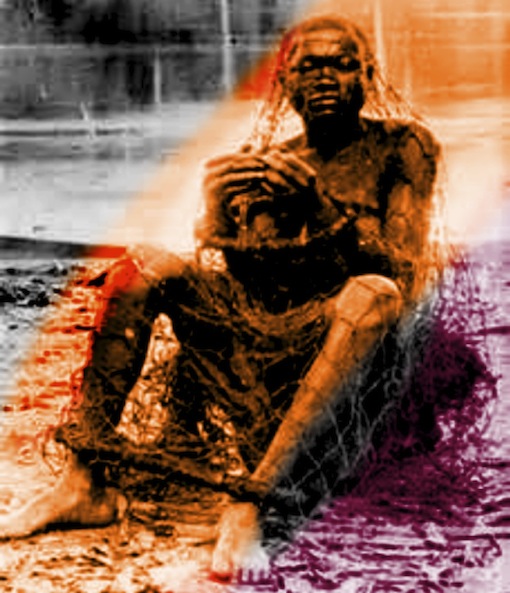
Kidnapped African, a human being, held in bonds. Original image source: aframerhist.wiki.
In the current age of racist / religionist wars for the benefit of economic interests and explained through geopolitics, America’s first Black President commits drone murders of the socially dispossessed overseas much as Michael Slager gunned down Walter Scott with implied impunity in North Charleston. This relationship between American colonial history, imperialism and U.S. wars had been well articulated by Malcolm X, Stokely Carmichael and other Black radicals by the time that Martin King came out in opposition to the Vietnam war in 1967. The Weather Underground had an office a few doors away from the Chicago Panthers and broad understanding had it at the time that mutual interests existed between Black and White radicals and between leftist revolutionaries and anti-war pacifists. This political context that tied seemingly divergent interests together didn’t disappear— it was re-contextualized in the neo-capitalist resurgence of the late 1970s and early 1980s by Ronald Reagan and Margaret Thatcher as dissociated ‘individual’ interests.
police3
Fred Hampton a few months before he was murdered by the Chicago police and the FBI. Original image source: The People’s Law Office (Chicago).
It most likely isn’t readily apparent to many readers how radically anti-historical, and therefore implausible, this ‘individualist’ frame promoted by the political-economic right is. An historical continuity can be drawn from slavery to convict leasing to modern day prison labor and mass incarceration. A material proportion of state actions can be explained in terms of the economic interests served. And an historical line can be drawn from for-profit prisons in eighteenth century England and their modern incarnation in the English speaking, anglophile U.S. This history unites ‘individuals’ in social struggle. The modern idea of individual ‘self-realization’ runs up against the social fact that Walter Scott was murdered because he was a Black man and not because he was the ‘individual’ Walter Scott.
The political content of the individuation of persons united through lived history is to deny the history. The overwhelming preponderance of slaves in the colonial U.S. were kidnapped Africans— they were placed together in American social ontology through being made slaves. This history has historical persistence through race-based social repression. When Margaret Thatcher argued that “there is no such thing as society, there are only individual men and individual women,” she inferred that history had ended because she said it did— that the historical continuity between slavery, convict leasing and ongoing race and class based repression were / are irrelevant to a new equanimity. Unfortunately, no one told the police, the courts, employers or the other lords of the existing order that history had ended.
police4
Rodney King after LAPD beating. Original image source: 99problems.org.
The murder of Walter Scott appears ‘pure’ enough— sufficiently unprovoked, to have struck a chord with the ‘individualists’ who recall passionate accounts of Rodney King repeatedly and aggressively attacking the batons of the LAPD with his head. The point here is that what might be a social inflection point— the North Charleston police charging Michael Slager with murder, still faces the test of history. As fact and metaphor a long tail followed the Attica rebellion— whatever the relations between the guards and the incarcerated citizens at Attica, it was Nelson Rockefeller and Richard Nixon who saw them all as expendable. While justice for Walter Scott, the individual, may be served by Michael Slager’s (by no means assured) extended incarceration the rest of this history remains unresolved.
This detour into the politics of individuation is necessary because there is little possibility of social resolution without recovering the realm of the social. Eric Garner wasn’t a white investment banker when he was murdered by the police and Mike Brown wasn’t Jamie Dimon’s demon spawn taking the family Ferrari for a test drive when he was murdered. The attempts by the police and racist apologists to assign culpability to Messrs. Garner and Brown is to remove history, the social nature by which they were targeted by the police as Black men, to make them individually responsible for a poisoned social history not of their making. The Black Panthers, indigenous rights groups and White radicals were able to (occasionally) perceive, and fight for, joint social outcomes because a broader social interest was understood to exist.
police5
The Weather Underground. Original image source: thedailybeast.com.
After forty years of relentless repetition Reagan / Thatcher / neo-capitalist individuation is now deeply embedded in Western social ontology. To repeat: Walter Scott wasn’t murdered because he was an ‘individual’ but because he was a Black man. No amount of ‘self-realization’ by Mr. Scott would have changed the way that he was perceived by Michael Slager. Social resolution of Mr. Scott’s murder is to end racist police violence and race and class repression. Race and class are the targets of police repression, not the acts of some nebulous ‘self-realized’ individual. Ronald Reagan and Margaret Thatcher didn’t end social repression; they found an effective way of explaining it away. The outcome is the full recovery of unapologetic social repression.
The (Black Panther) Ten-Point Program
We Want Freedom. We Want Power To Determine
The Destiny Of Our Black Community.
We believe that Black people will not be free until we are able to determine our destiny.
We Want Full Employment For Our People.
We believe that the federal government is responsible and obligated to give every man employment or a guaranteed income. We believe that if the White American businessmen will not give full employment, then the means of production should be taken from the businessmen and placed in the community so that the people of the community can organize and employ all of its people and give a high standard of living.
We Want An End To The Robbery
By The Capitalists Of Our Black Community.
We believe that this racist government has robbed us, and now we are demanding the overdue debt of forty acres and two mules. Forty acres and two mules were promised 100 years ago as restitution for slave labor and mass murder of Black people. We will accept the payment in currency which will be distributed to our many communities. The Germans are now aiding the Jews in Israel for the genocide of the Jewish people. The Germans murdered six million Jews. The American racist has taken part in the slaughter of over fifty million Black people; therefore, we feel that this is a modest demand that we make.
We Want Decent Housing Fit For The Shelter Of Human Beings.
We believe that if the White Landlords will not give decent housing to our Black community, then the housing and the land should be made into cooperatives so that our community, with government aid, can build and make decent housing for its people.
We Want Education For Our People That Exposes
The True Nature Of This Decadent American Society.
We Want Education That Teaches Us Our True History
And Our Role In The Present-Day Society.
We believe in an educational system that will give to our people a knowledge of self. If a man does not have knowledge of himself and his position in society and the world, then he has little chance to relate to anything else.
We Want All Black Men To Be Exempt From Military Service.
We believe that Black people should not be forced to fight in the military service to defend a racist government that does not protect us. We will not fight and kill other people of color in the world who, like Black people, are being victimized by the White racist government of America. We will protect ourselves from the force and violence of the racist police and the racist military, by whatever means necessary.
We Want An Immediate End To
Police Brutality And Murder Of Black People.
We believe we can end police brutality in our Black community by organizing Black self-defense groups that are dedicated to defending our Black community from racist police oppression and brutality. The Second Amendment to the Constitution of the United States gives a right to bear arms. We therefore believe that all Black people should arm themselves for self- defense.
We Want Freedom For All Black Men
Held In Federal, State, County And City Prisons And Jails.
We believe that all Black people should be released from the many jails and prisons because they have not received a fair and impartial trial.
We Want All Black People When Brought To Trial To Be Tried In
Court By A Jury Of Their Peer Group Or People From Their Black
Communities, As Defined By The Constitution Of The United States.
We believe that the courts should follow the United States Constitution so that Black people will receive fair trials. The Fourteenth Amendment of the U.S. Constitution gives a man a right to be tried by his peer group. A peer is a person from a similar economic, social, religious, geographical, environmental, historical and racial background. To do this the court will be forced to select a jury from the Black community from which the Black defendant came. We have been, and are being, tried by all-White juries that have no understanding of the “average reasoning man” of the Black community.
We Want Land, Bread, Housing, Education,
Clothing, Justice And Peace.
When, in the course of human events, it becomes necessary for one people to dissolve the political bands which have connected them with another, and to assume, among the powers of the earth, the separate and equal station to which the laws of nature and nature’s God entitle them, a decent respect of the opinions of mankind requires that they should declare the causes which impel them to the separation.
We hold these truths to be self-evident, that all men are created equal; that they are endowed by their Creator with certain inalienable rights; that among these are life, liberty, and the pursuit of happiness. That, to secure these rights, governments are instituted among men, deriving their just powers from the consent of the governed; that, whenever any form of government becomes destructive of these ends, it is the right of the people to alter or abolish it, and to institute a new government, laying its foundation on such principles, and organizing its powers in such form, as to them shall seem most likely to effect their safety and happiness. Prudence, indeed, will dictate that governments long established should not be changed for light and transient causes; and, accordingly, all experience hath shown that mankind are more disposed to suffer, while evils are sufferable, than to right themselves by abolishing the forms to which they are accustomed. But, when a long train of abuses and usurpations, pursuing invariably the same object, evinces a design to reduce them under absolute despotism, it is their right, it is their duty, to throw off such government, and to provide new guards for their future security.
Written: October 15, 1966
Source: War Against the Panthers, by Huey P. Newton, 1980
Source: Marxists.org

Drought: Death by a Thousands Cuts

Robert Hunziker

Drought is like death by a thousand cuts. It steadily but slowly devastates the countryside long before people recognize an emergency at hand.
Excessive drought is but one symptom that climate change has turned vicious.
Worldwide drought conditions are more severe and much quicker to arise than in the past. Inasmuch as fossil fuels like oil, gas, and coal emit evermore carbon dioxide (CO2) into the atmosphere with concomitant increasing levels of global warming, the outlook for escalating drought is clear and imminent.
According to scientific studies to better understand the matrix of global-warming-induced drought conditions: “Historical records of precipitation, stream flow and drought indices all show increased aridity since 1950 over many land areas… which suggest severe and widespread droughts in the next 30–90 years over many land areas resulting from either decreased precipitation and/or increased evaporation,” Aiguo Dai, Increasing Drought Under Global Warming in Observations and Models, Nature Climate Change 3, 52-58, doi:10.1038/inclimate1633, August 5, 2012.
However, when consideration is given to worldwide droughts as of today, the operative question should really be whether more “severe and widespread droughts” can be sustained.
“There has been a general temperature increase (0.5−2C) during the last past 150 years, and climate change models predict a marked increase during the 21st century. It is expected that this will have dramatic consequences for drought conditions, with an increase in water demand due to evapotranspiration,” Sergio M. Vicentep-Serrano, et al, A Multi-Scalar Drought Index Sensitive to Global Warming: SPEI, Instituto Pirenaico de Ecologia, Spanish Commission of Science and Technology.
Droughts are not new phenomena. Droughts are part of nature’s course. Be that as it may, nowadays droughts are no longer just part of nature’s course. According to scientific studies, anthropogenic global warming is at the root of the problem, exacerbating drought conditions on a worldwide basis.
In fact, droughts have become a serious problem across the four corners of the planet.
California
Global warming is hitting California hard.
California’s drought is the result of a particularly steadfast blocking ridge over the Pacific, popularly known as the Ridiculously Resilient Ridge, or ‘Triple R’, which prevents rain from reaching California. Blocking ridges consist of high atmospheric pressure zones that disrupt wind patterns, substantially altering atmospheric flow; as a result, regular Pacific storms are re-routed to the north.
A Stanford research team led by Noah Diffenbaugh, Ph.D. Senior Fellow at the Stanford Woods Institute for the Environment, issued a comprehensive study investigating the link between global warming and California’s drought published in the Bulletin of the American Meteorological Society, September 29, 2014.
According to Bala Rajaratnam, Ph.D. Assistant Professor of Statistics and of Earth System Science, who collaborated on the study: “We’ve demonstrated with high statistical confidence that the large-scale atmospheric conditions, similar to those associated with the Triple R, are far more likely to occur now than in the climate before we emitted large amounts of greenhouse gases.”
The Stanford study points the finger at global warming as a significant cause of California’s severe drought condition.
Ironically, California is the 4th largest oil and gas producer in America, thereby contributing to its own drought by producing CO2-emitting GHG (Greenhouse Gas). As it happens, California “steps on its own foot.”
China
According to China’s State Forestry Administration, over 27 percent of the country now suffers from desertification, more than 1,000,000 square miles, or about one-third of the continental United States, impacting the lives of more than 400 million people (Source: Luan Dong, At the Desert’s Edge Gives a Glimpse of China’s Massive Desertification Challenge, China Environment Forum//Eye On, June 17, 2013).
Remarkably, China’s drought impacts as many people as live in all of North America.
Scientists claim global warming is changing China’s climate. Studies have found the Atlantic Multi-Decadal Oscillation, not the Pacific Decadal Oscillation as previously thought, dominating its influence on China’s drought conditions. According to scientists, this oscillation shift, which is causing severe drought, is the result of global warming. (Source: Nadya Anscombe, Atlantic Multi-Decadal Oscillation Dominates Chinese Droughts, Environmental Research Web- News, March 12, 2015).
Chinese “farmers and water-hungry industries have been wrestling with a long-term water crisis that has dried up more than half the country’s 50,000 significant rivers and left hundreds of cities facing what the government classifies as a ‘serious scarcity’ of water,” Drought Worsens China’s Long-Term Water Crisis, Science/Environment, NBC News, Sept. 24, 2014.
Twenty-five thousand “significant rivers drying up” and hundreds of cities experiencing “serious scarcity of water” is beyond belief, unimaginable but real.
As it happens, burning fossil fuel has dramatically affected China’s climate at the expense of water supplies for agriculture and for industry, meanwhile desertification steadily consumes the northern countryside as the drought threatens to overwhelm important areas of agriculture.
Over time, where will China turn for food staples for a population as large as the EU, North America and South America combined?
India
Global warming’s impact on India’s drought threatens the food supply for countless millions of people. Imagine this: A county of over one billion people with 25% of the land turned to desert. India is such a country.
“Worsening droughts in India are having an impact on the desertification trend, as vegetation dries up and is often never replaced… India’s environment minister, Prakash Javadekar, said that up to 25% of the country was now desert,” Kenneth Rapoza, Worsening Droughts Add To India’s Desertification Problem, Forbes, June 18, 2014.
India’s drought in the “context of global warming” is explained, as follows: “In this study, changes in total dry days, prolonged dry spells, light precipitation, and risk of drought as indicated by Modified Palmer Index (MPI) over India during six decades (1951–2010) are examined quantitatively in the context of global warming. It is found that there are increases of 49% ± 21% and 33% ± 17% in prolonged dry spells and total dry days, respectively, over India for each degree Kelvin (K) increase in global mean temperature,” Anoop Mishra, et al, Changes in Precipitation Pattern and Risk of Drought Over India in the Context of Global Warming, Journal of Geophysical Research: Atmospheres, 119, 7833-7841, doe: 10:1002/2014JDO21471, July 2, 2014.
Taiwan
In Taiwan drought conditions have forced a cut off of water supplies for two days each week in northern regions. Global warming is the problem.
Water supplies are now rationed for two days per week for an indefinite period of time. Rainfall across the island is the lowest since 1947. The vast Shihmen main reservoir is at only 24.5% of capacity. The dry spell is forecast to continue, and it is entirely possible the monsoon rains may not happen this year. Similar to China, Taiwanese climate is changing as a result of global warming.
The number of rain days has decreased significantly in Taiwan over the past 100, 50, and 30 years with the rate of decrease accelerating per decade as extreme dry spells have occurred more frequently in the past 30 years than in any other measured period. Furthermore, monsoons, a regular feature of Taiwanese weather systems, weaken from global warming (Source: Hsu, Huang-Hsiung, et al Climate Change in Taiwan, Scientific Report 2011, National Science Council, Taipei, Taiwan).
As water rationing spreads in Taiwan, up to three million people will be without water on given days (Source: Cindy Sui, Tackling Taiwan’s Water Shortages, BBC News, April 8, 2015).
The World’s Climate System is Changing because of Fossil Fuel CO2 Emissions
“This pattern of intense rain and snowstorms and periods of drought is becoming the new normal in our everyday weather as levels of heat-trapping gases in the atmosphere continue to rise,” Union of Concerned Scientists.
“As the climate system changes in accordance to more CO2 we realize that by polluting our atmosphere we literally pull the carpet out from under our own feet,” Climate Change Impacts: Floods and Droughts, WWF Global.
Divestment
Because the use of fossil fuel ultimately serves to aggravate as well as cause drought, simple logic says eliminating fossil fuel is one answer to the problem.
According to a thorough study of worldwide divestment movements, “The movement to divest from fossil fuels and invest in clean alternatives has gained remarkable speed. It was born in 2011 on just half a dozen college campuses where the students called on their administrations to divest endowments from coal and other fossil fuels. Today, a diverse group of students, philanthropies, and grassroots and environmental organizations from around the globe are driving the movement,” Arabella Advisors, founded by Eric Kessler in 2005 to provide strategic guidance for effective philanthropy.
Already, divestment commitments have shown remarkable growth in only four years represented by more than one-half billion people, or 7% of world population.
Recently, The Guardian, one of the world’s most influential news organizations joined 350.org’s divestment movement as a partner in the “Keep it in the Ground” campaign. Within 24 hours, over 75,000 people joined the effort.
Significantly, Stuart Scott, IESCO, Deputy Director General and member of the Arctic Methane Emergency Group, is working on a key strategic agreement in Norway where it is hoped the entire country will commit to divestment.
“Divest Norway” signature endorsements by individuals from around the world actively build support for the movement: DivestNorway.org/add-your-voice
Severe Drought Haunts the Planet on all Continents.
“The chances of a 35-year or longer “megadrought” striking the Southwest and central Great Plains by 2100 are above 80 percent if the world stays on its current trajectory of greenhouse gas emissions, scientists from NASA, Columbia University, and Cornell University report in a study,” Science Advances, February 2015.
Australia’s “Big Dry” sucked up $4.5 billion in federal government drought assistance from 1995 to 2012. Spain just experienced the worst drought since record keeping began 150 years ago, losing 54% of 2014 crops. Brazil’s drought is the worst in 80 years. Sao Paulo is rationing water for 22 million people. Istanbul’s (pop. 14 million) water reservoirs are at 22% of capacity. The list goes on, and on.
All across the planet drought continues with a relentlessness that chills to the bone. People are aware, and thus, divestment movements are the leading edge towards influencing governments to take corrective action by embracing renewable energy to replace fossil fuel subsidies. Something must be done!