13 Apr 2015

Sri Lanka: Relatives of “disappeared” Tamils protest in Colombo

S. Jayanth

Several dozen relatives of Tamils who were arrested or abducted during the communal war conducted by successive governments in the country’s north and east joined a picket in Colombo last Tuesday.
Most of the protesters were mothers and wives. Many travelled overnight from the northern Mannar district. Holding photographs of their missing loved ones, they demanded that the government release them. They suspect that their children and husbands are alive and detained in secret camps.
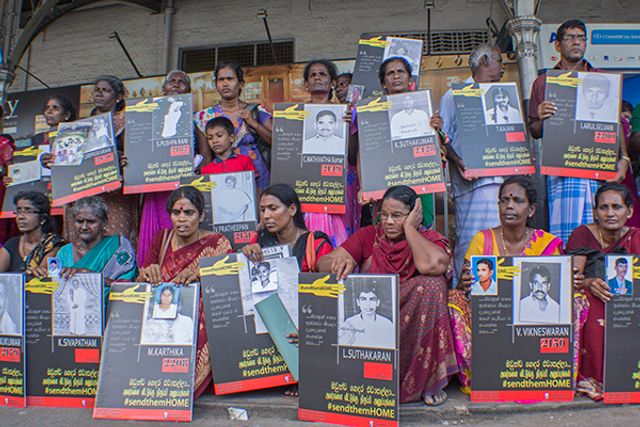
A section of the picket
Thousands of people are still missing, nearly six years after the decades-long war ended with the defeat of the separatist Liberation Tigers of Tamil Elam (LTTE) in 2009. After former President Mahinda Rajapakse renewed the war in 2006, thousands of Tamil youth were detained, tortured and often murdered by the military and associated paramilitary groups.
The UN estimated that more than 40,000 civilians were killed during the final months of the military’s onslaught. More than 10,000 young people were arrested as LTTE members and suspects at the end of the war. Some were dragged to detention centres from military-run refugee camps, where nearly 300,000 people were held behind barbed wire.
Though the government claimed to have released nearly all the “rehabilitated” LTTE suspects, thousands are still unaccounted for. In an attempt by Rajapakse to deflect the criticism of his regime’s war crimes, a Presidential Commission was established to find the “disappeared.” It has received about 15,000 complaints over the past two years, but only investigated 2,000 cases, and relatives have seen no progress.
Koneswary, a mother of five from Mannar told the World Socialist Web Sitethat her daughter Kirthika disappeared during the final days of the war, when she was 14. “After the war was restarted by President Rajapakse in 2006, we fled from Mannar to Kilinochchi to escape from the shells and air strikes. It was a long and horrible journey. Some people had to bury their dead relatives during the escape.
“Finally we were trapped in Putumattalan. During a shell attack there, we missed our daughter. Later an eyewitness told us that she was arrested by the army in a refugee camp.”
Lucia, who has searched for her husband and brother since 2008, said: “A group came in a white van, abducted my husband Roobakanthan in front of me in the Kidachoori refugee camp in Vavunia. My brother Mariyaseelan was abducted in the eastern town of Batticaloa when he visited a friend. I believe they are being detained in a camp or somewhere. We lamented and begged at the Presidential Commission for their release but there was no response.”
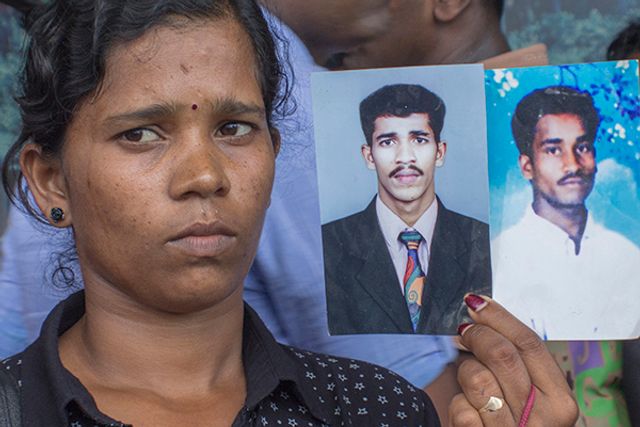
Lucia
Charles Joseph lost his son in 2008. He said some neighbours saw him arrested by the army in a nearby town, but were afraid to give evidence.
P. Muthukaruppan said the army arrested his two sons at Vattuwal during the war’s final phase. He believes that his elder son Antony, now 35, is alive. “I saw him in a recently published photograph,” he said. “Where ever there is picketing on this issue, we go. I don’t have any confidence that this government will solve the problems of Tamil people. However, we demand that they release our loved ones.”
A 15-year-old teenager said his father Anandarajah, 47, was abducted by the Navy at Pesalai in Mannar. “Both the previous and new government promised to find the disappeared persons, but did nothing,” he said.
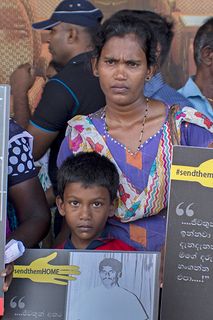
Rajeswari
Rajeswari, who came from Jaffna, told us that her husband disappeared in 2007 after he went to a military office to obtain a security clearance for a job overseas. She has faced enormous difficulties for the past eight years.
Kavitha’s 39-year-old husband disappeared in 2006 at Pallimunai in Mannar. “We were in a military-controlled area,” she said. “My husband went into the town but never returned. No words can explain the difficulties I face with two children.”
Kavitha’s aunt Udaya Chithra said her son was dragged from his bed in Pallimunai, Mannar in 2008 by plain-clothed soldiers, who promised to release him after an inquiry. She had seen a photograph of her son in Welikada prison. “Seven youth were in that photograph,” she said. “Their mothers are here. We believe they are alive.”
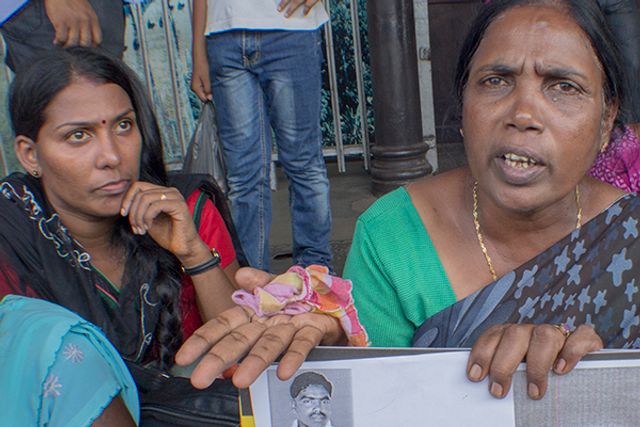
Kavitha and Udaya Chithra
Chithra continued: “If the government can act on its own, then why is there a law? If our children are criminals, why doesn’t it take legal action against them through the courts? … We are not demanding salt or dhal [lentils]; we demand our children who were taken by the government. They are very young. We raised our children with dreams, not to leave them in the hands of these people [the military].”
While the relatives are determined to find their loved ones and obtain justice, the picket organisers promoted illusions in this year’s election of Maithripala Sirisena. In a leaflet, the “Protest of the Street,” a collective of “112 civil groups,” boasted that they “determinedly took the initiative in the victory won on January 8, 2015.” In other words, they campaigned for Sirisena.
The leaflet also warned “communal forces” not to try to reverse this “victory” and issued a call for people to pressure the government to implement its program.
Sirisena’s election win and the formation of a United National Party (UNP)-led government is no victory for the war victims or the working people as a whole. Sirisena was Rajapakse’s acting defence minister at the end of the war. He took office via a regime change operation instigated by Washington with the support of the UNP and former president Chandrika Kumaratunga.
The US, which fully backed the anti-Tamil war, has no concern for democratic or human rights. It only opposed Rajapakse because he maintained close relations with China.
Neither Sirisena nor UNP leader Ranil Wickremesinghe will provide any justice to the war victims or their relatives. The UNP started the war in 1983 and backed Rajapakse’s recommencement of it. As prime minister, Wickremesinghe has publicly disputed the UN figures on civilian casualties, and insisted that the government will not remove military camps from the north and east.

German postal workers strike against outsourcing of jobs

Gustav Kemper

On April 1 and 2, about 10,000 mail carriers from the world’s largest courier company stopped work. The strike comes 21 years after the last major strike at Deutsche Post. The Ver.di service industry trade union was no longer able to hold back the employees’ readiness to fight in defence of their working conditions and was forced to call a short-term strike.
Many workers are incensed, because Deutsche Post intends to outsource its parcel delivery service by setting up the new Delivery Ltd firm with 49 regional branches. The establishment of Delivery Ltd initiates drastic wage cutting and worsening working conditions at Deutsche Post.
Since wages constitute about 50 percent of all delivery costs, these companies use their subcontractors to suppress labour costs and gain an advantage. This and the expansion plans are the reasons why Deutsche Post is attempting to circumvent its obligations to collective wage agreements by outsourcing jobs to Delivery Ltd.
The Ver.di union was forced to call a warning strike, and its functionaries made radical speeches at the strike rallies. But this cannot hide the fact that the service trade union is involved at the highest level in the restructuring of the concern and associated attacks on working conditions.
Eleven union officials sit on the company’s supervisory board as so-called employee representatives with equal voting rights. They are handsomely paid for their work on committees and their support of corporate strategy.
According to the company’s 2014 annual report, last year they received executive board bonuses and attendance fees of €1.3 million. Ver.di deputy chairperson Andrea Kocsis alone received €264,000 for her services as deputy chairperson of the supervisory board.
While postal workers are fearful of their future and are ready to fight against the drastic deterioration of conditions, Ver.di is mainly concerned with the defence of its privileges and influence. The union fears that the transfer of many employees to Delivery Ltd and reduction of wages to the level of the freight and logistics branch will threaten its power and influence.
Ver.di currently negotiates the Deutsche Post wage structure nationwide and is therefore able to secure its role in the concern. Wage contracts for the logistic branch, however, apply only at the state level—not only for Deutsche Post, but to all logistics companies with an official tariff structure.
Under the proposed contract, employees at Delivery Ltd will no longer be subject to Deutsche Post tariff agreements but will be paid in line with rates applying to the freight and logistics industry, whose wage level is about 20 percent below Deutsche Post’s current company rate.
The low-wage tariff of the freight and logistics industry was negotiated and agreed to by Ver.di. The union also approved allocation of Deutsche Post’s parcel delivery to the company’s internal or external branches, stipulating in a wage settlement that this award would be limited to a maximum of 990 parcel delivery districts. The union agreed as well to the termination of non-working days and break periods, while nevertheless celebrating the deal as a great success in securing the jobs of postal workers.
Now it turns out that management is overriding this contract and, as a first step, is setting up 5,000 delivery districts in the new regional companies. Looking ahead, the concern plans to create 10,000 or even 20,000 “new” jobs. In fact, it is replacing a large portion of the approximately 24,000 temporary and part-time positions at Deutsche Post with lower-paid jobs. Those involved will be forced into retirement or sacked if they refuse to switch “voluntarily” to Delivery Ltd and accept the associated reduction in wages.
Ver.di accuses the company leadership of breach of contract and is demanding a reduction in working hours from 38.5 to 36 as compensation for the concessions it made in the contract.
With Deutsche Post’s transformation into an incorporated company in 1995, and its stock market launch in 2000, the aim of the formerly state-owned enterprise has changed. Instead of fulfilling a public service for the population, it is now devoted to making maximum profit for the enrichment of its shareholders and management. The state continues to hold about 21 percent of the shares through its KfW development bank, but the far greater part is allotted to widely spread shareholdings.
While employees’ working conditions and pay rates were downgraded in various rounds of cuts, the company directors rushed to boost shareholder value to the skies—and thereby their own stock-based compensation, which is often more than their fixed salaries—by enforcing a programme of aggressive restructuring and expansion.
In 2013, Deutsche Post CEO Frank Appel was paid a fixed salary of €2 million and given a variable bonus of €3.6 million, i.e., a total of €5.6 million. In 2014, it was €9.6 million. The share price of Deutsche Post has increased in the last three years from €12 to €30.
Former CEO Klaus Zumwinkel, who retired from his post due to tax evasion of some millions of euros in 2008, still received a pension of €20 million. Since then, he has resided in a medieval castle, Castello di Tenno on Lake Garda in Italy, from where he presides as president of the Institute for the Study of Labour (IZA).
Among IZA’s “policy fellows” are Dirk Niebel (former development minister), Martin Kannegießer (president of the engineering unions association), Thilo Sarrazin (former German banker and ex-finance minister of Berlin) and Heinz Buschkowsky (district mayor of Berlin-Neukölln). The institute’s sole partner happens to be the Deutsche Post Foundation, whose executive board consists only of its chairman, Mr. Zumwinkel.
Policies and conditions widespread in the industry include pay cuts via the introduction of new wage scales, proliferation of temporary employment, expanding delivery districts with no corresponding pay increase, and long work days of up to 14 hours. Some 23,400 of the approximately 131,000 employees in the Deutsche Post parcel centres—18 percent of the workforce —are on temporary work contracts.
The proportion is much greater for Deutsche Post’s competitors, as these companies employ almost 98 percent of their parcel delivery staff via subcontractors and thus pay their drivers the lowest wages. Responding to a parliamentary question in January 2015, the federal government stated that 160,000 temporary workers and 187,000 so-called MiniJobbers (low-paid workers exempt from social security provision) were employed throughout the industry in Germany in 2013.
In the summer of 2014, the state of North Rhine-Westphalia conducted a supervisory investigation in which 22 parcel distribution centres and 415 drivers from 131 courier services were reviewed. The study included all the big-name companies: Deutsche Post DHL, DPD, GLS, FedEx, GO, Hermes Logistic, TNT, Trans-o-flex and UPS. It found that 85 percent of these services violated occupational safety and health legislation.
The study concluded with the criticism that the delivery drivers neither complied with prescribed driving and rest periods, nor calculated and documented their working hours. In order to keep their jobs, many parcel couriers have to accept long hours and devastating working conditions resulting from the ruthless competition in the industry.
In May 2014, the NDR radio broadcaster reported on intolerable working conditions at UPS, where delivery drivers’ contractual hours of work were generally limited to 3.5 per day. Since no one can live on such a part-time income, all the drivers must rely on overtime, which can be shortened by UPS at any time. For fear of losing the chance to work overtime due to too many absences, many drivers work even when they are sick.
In November 2014, the Stiftung Warentest consumer organisation concluded that delivery drivers of subcontractor firms are often on the road up to 15 hours at a stretch, although hourly wages are usually less than the minimum wage. Piecework involving the delivery of packages up to 70 kg in weight causes chronic back and joint pain. The sickness rate for workers was 5.6 percent in 2004, and rose to 8.4 percent in 2013.
The promises made at the time of Deutsche Post’s privatisation—greater efficiency and better performance through competition—are refuted every day. Efficiency is being undercut now that the number of logistics networks with distribution centres and corresponding transport organisations—whose construction costs are in the billions—are being multiplied by a variety of competing companies.
Since privatisation, Deutsche Post has greatly reduced its branch network, which formerly secured the basic postal services required by the smallest communities. Some customers in Germany’s southern rural areas now have to travel 20 kilometers to reach a postal service. The cost of sending letters by post has increased 12.7 percent in the last three years.
The fact is that these developments arise from the struggle for domination of the world market. In the 15 years prior to 2014, online trading in Germany grew from €1.25 billion to €40 billion. Deutsche Post’s competitors are trying to gain a foothold, especially in the business client sector and the bulk business of mail order companies.
Three companies control the lion’s share of the global express business: German Post DHL (34 percent), FedEx (26 percent), UPS (22 percent), with smaller companies taking 18 percent. FedEx recently announced plans to take over the Dutch TNT courier service in order to expand its European business. Expansion is achieved everywhere through the lowering of wages and worsening working conditions.
Having secured sales amounting to €56.6 billion and a profit of €3 billion, the Deutsche Post DHL corporation has developed into the largest logistics company in the world. By 2020, the operating profit is expected to rise by an average of more than eight percent annually.
The Deutsche Post DHL concern aims to expand into the markets of India, China, Belgium, the Netherlands, Luxemburg, Slovakia, Czech Republic and Poland and is buying into the logistics companies in those countries.

Indian Stalinists meet amid political-organizational crisis

Deepal Jayasekera & Keith Jones

India’s main Stalinist parliamentary party, the Communist Party of India (Marxist) or CPM, will hold its 21st Congress in the southern port city of Visakapatnam over five days this week, beginning Tuesday.
An integral part of India’s political establishment for decades, the CPM is meeting under conditions of unparalleled political-organizational crisis.
Support for the CPM within the working-class and rural poor has hemorrhaged as a result of its leading role in implementing the bourgeoisie’s drive to transform India into a global hub of cheap-labor production through privatization, deregulation, social spending cuts, and ever-diminishing corporate tax rates.
For two decades starting in 1989, the CPM propped up a string of rightwing national governments in parliament, many of them led by the Congress, the bourgeoisie’s traditional governing party. And in those states where it formed the government, principally West Bengal and Kerala, the CPM implemented what it itself described as “pro-investor” policies.
As a result, the CPM has suffered a series of electoral debacles that have reduced it to a rump in the national parliament and left it governing a lone state, tiny Tripura. In last May’s general election, the CPM and the CPM-led Left Front were utterly incapable of capitalizing on the mass opposition to the Congress government over mass unemployment, skyrocketing food prices, and ever-widening social inequality. While the Hindu supremacist BJP swept to power, winning India’s first parliamentary majority in three decades, the CPM captured just nine seats and the Left Front as a whole a mere dozen. This was far and away the Stalinists’ worst-ever showing in a national election.
In the eleven months since, the CPM has been riven by defections, feuding over who is responsible for the party’s decline, and differences over whether the party should maintain the current rightwing course or pursue even closer relations with the Congress Party.
Last fall, Sitaram Yechury, a longtime Politburo member, openly challenged the Politburo majority, led by the outgoing national secretary Prakash Karat, and submitted a counter document to the Central Committee on the party’s “political-tactical line.” Yechury has long been associated with a West Bengal-based CPM faction that argues the party ought not to have withdrawn support for the Congress-led government in 2008 when it decided to push forward with the Indo-US civilian nuclear accord so as to cement a global strategic partnership with US imperialism.
This faction is uneasy with the current CPM policy of ostensible joint opposition to the Congress and BJP. It believes the CPM should not shut the door to renewing the explicit alliance it had with the Congress between 2004 and 2008—an alliance the Stalinists maintained even as they conceded that the Congress-led United Progressive Alliance government was pursuing neo-liberal policies little different from those of the BJP-led government that preceded it.
In the documents submitted to this week’s CPM congress, these differences have been papered over. Nonetheless they could well break into the open, whether directly or in the contest to succeed Karat, who is constitutionally-obligated to step down as party head, having already served three successive terms as national secretary. Yechury is known to be seeking the party’s top job and according to some press reports is gaining some support from Kerala, hitherto strongly in Karat’s camp.
The documents submitted by the party leadership reassert the CPM’s longstanding call for a “Left Democratic Front,” an alliance that explicitly includes the purported “progressive” sections of the bourgeoisie and which has found practical expression in the CPM’s decades-long pursuit of electoral and parliamentary alliances with a host of rightwing regional and caste-ist parties. Time and again, the CPM has given “pro-poor” and “secular” credentials to erstwhile Congress and BJP allies like the All India Anna Dravida Munnethra Kazhagam (AIADMK) and its rival Dravida Munnethra Kazhagam (DMK) in Tamil Nadu, the Telugu Desam Party (TDP) in Andhra Pradesh, and the Biju Janatha Dal (BJD) in Odisha.
Underscoring that the CPM intends to work to shackle the inevitable mass working-class opposition to the BJP government to these and like reactionary political forces, the CPM’s political resolution welcomes the proposed merger of the Samajwadi Party (SP), Rastriya Janatha Dal (RJD), Janatha Dal (United) [JD(U)], Janatha Dal (Secular) [JD(S)], Indian National Lok Dal (INLD) and Samajwadi Janatha Party (SJP) into a single party. “If this materializes,” says the resolution, “they can emerge as an effective force in Uttar Pradesh, Bihar and some other pockets in North India.”
At the same time, the resolution leaves open the door to a possible alliance with the Congress, if not directly then through alliances with parties that themselves have electoral understandings with the Congress, or in various “anti-communal” fronts. “Given the danger posed by the communal forces,” declares the CPM resolution, “we should strive for the broadest mobilization of secular and democratic forces. Joint platforms are necessary for a wider united movement against communalism.”
In reality, the Stalinists’ systematic subordination of the working class to the Congress and other “secular” bourgeois parties is what has created the political conditions for the growth of the BJP and the Hindu supremacist right as a whole. The Congress has itself repeatedly connived with the Hindu right, and the neo-liberal policies pursued by all sections of the political establishment have fueled the social crisis that, absent a clear alternative from the working class, rightwing elements can feed off in promoting communalism and all manner of social reaction.
In the run-up to the congress, the CPM leadership has been forced to concede that the party is in a shambles, with a declining and aging membership and numerous instances of the “erosion of party standards and communist values,” including corruption, nepotism, adherence to caste prejudices and adaptation to communalism.
The CPM’s political-organizational crisis is particularly pronounced in West Bengal, the east Indian state that the CPM ruled for 34 years continuously, from 1977 to 2011. Hundreds, likely thousands, of party cadres in West Bengal have joined the Hindu supremacist BJP, which the CPM has long denounced as the greatest threat to “democratic India” and on that basis argued for all manner of reactionary alliances with the Congress Party and other bourgeois parties.
Many of the defectors have justified jumping ship to the BJP with the claim that the CPM is too weak to protect them from violence perpetrated by goons working for the Trinamul Congress, the rightwing party that now forms West Bengal’s government. Others like multi-millionaire industrialist Shishir Bajoria have explained their abandoning the CPM for the BJP with the frank admission that it is the best way to gain access to money and power. “The CPM is no more a force in Bengal,” Bajoria told the Kolkata Telegraph last August. “The BJP is the new order that can bring about change in Bengal.”
What this phenomenon underscores is the extent to which CPM rule in West Bengal, especially after it called a halt to further land and other capitalist reforms in the mid-1980s, was bound up with ever closer and subservient relations with big business and a corrupt patronage network that stretched from Kolkata into the West Bengal countryside. Shorn of office, the CPM’s patronage network has collapsed and its big business patrons have moved on to greener pastures.

ISIS takeover of Yarmouk marks new stage in Syrian conflict

Jean Shaoul

The right-wing Islamic State in Iraq and Syria (ISIS) has taken control of most of Yarmouk camp, a Palestinian enclave in one of the suburbs of Damascus. It is the first time ISIS has gained a foothold so near to the Syrian capital, the stronghold of President Bashar al-Assad.
The situation in Yarmouk, long dependent on the United Nations Relief and Works Agency for Palestinian refugees (UNRWA), is dire. It has been under siege by Syrian government forces for the last two years. While the government has sealed off roads to the north into Damascus, roads to the south are held by opposition forces that have signed truces with the government. Only 18,000 people remain, about 10 percent of the former population, with the rest having fled to neighbouring countries or internally displaced within Syria.
Since ISIS entered Yarmouk, fighting between ISIS, the various militias and government forces intensified. UNRWA has been unable to deliver food and basic necessities. There was no drinking water and food assistance was below the minimum needed. Last week, the only remaining functioning hospital was hit by a barrel bomb.
UNRWA spokesman Christopher Gunness told the BBC Friday, “The situation in the camp is beyond inhumane … a hell hole that shames the world and, in the last days, it had descended further.” He had earlier described the situation in Yarmouk as “an affront to the humanity in all of us, a source of universal shame.”
At least 20 civilians, including a 12 year-old child, have been killed since ISIS began its attack. The main fighting was between ISIS and Aknaf Beit al-Maqdis, which is linked to Hamas, the Islamist Palestinian group that runs Gaza, but this has largely subsided, although aerial bombardment by government forces continues.
On Thursday, United Nations Secretary General Ban Ki-Moon raised the spectre of a massacre at Yarmouk at the hands of Islamic State and called for action. He added that residents, including 3,500 children, were being turned into human shields by armed elements inside Yarmouk and government forces outside it.
The danger now is that Washington and its regional allies will try and use the opportunity presented by the ISIS takeover of the Damascus suburb to press for a wider intervention to further their geo-strategic interests in the oil-rich region—juts as they did with the largely Kurdish town of Kobani on Syria’s border with Turkey.
Founded as a Palestinian refugee camp in 1957, Yarmouk looked like any other impoverished Syrian suburb. It was until 2012 home to 180,000 Palestinian refugees and their families who fled in the wake of the 1947 UN partition of Palestine, the ethnic cleansing of the Palestinian Arabs and the ensuing Arab-Israeli war in 1948. More Palestinians arrived after the 1967 Arab-Israeli War.
Others have come from the Palestinian diaspora. Many came in the early 1990s when they were expelled from Kuwait for supporting Iraq’s 1990 invasion of the sheikdom. Tens of thousands arrived after their expulsion by the Libyan regime in 1995 and 22,000 fled Iraq following the 2003 US-led invasion.
When the imperialist-sponsored “uprising” against the Assad regime began in 2011, Yarmouk, no less than the Kurdish regions in Iraq and Syria, was bitterly divided among various Palestinian factions. The Popular Front for the Liberation of Palestine-General Command (PFLP-GC), long a client of the Syrian regime, supported the government, fighting and arresting opposition groups whom it handed over to Syrian security forces. Some groups including Hamas opposed the regime, leading to the expulsion of the Hamas Political Bureau chief Khaled Meshaal, who sought refuge in Qatar. Factions affiliated to the Palestinian Liberation Organisation (PLO) have largely kept out of the conflict.
Most Syrian opposition groups withdrew from Yarmouk under a deal that left only the Palestinian groups opposed to Assad inside.
As elsewhere in Syria, there are a multitude of armed militias in conflict with each other, with fighters and militias constantly changing sides and alliances. All these militias have outside supporters.
The intervention sponsored by the imperialist powers, Saudi Arabia, the Gulf sheikdoms and Turkey aimed at securing the overthrow of the Assad regime, which is backed by Iran, Russia and China, has morphed into a series of proxy wars. These wars have in turn taken the form of a series of vicious sectarian and inter-communal conflicts that have led to the deaths of at least 220,000 people, turned nearly half of the Syrian population into refugees in their own country, neighbouring countries and further afield, and ruined the country.
Clashes between ISIS and Aknaf Beit al-Maqdis broke out after the latter arrested ISIS members operating in Yarmouk. But the advance by ISIS into Yarmouk was facilitated by the Al-Qaeda-linked Al-Nusra Front, which is backed by Qatar and controls several checkpoints into Yarmouk. According to a report in Middle East Eye, Al-Nusra, having previously worked with the Palestinians, appears to have switched sides after Aknaf Bait al-Maqdis failed to come to Al-Nusra’s aid during a fight last month between Al-Nusra and the Syrian Free Army.
Al-Nusra stopped the Palestinians from entering Yarmouk and allowed ISIS in. Jaish al-Islam, a Saudi-backed faction operating in eastern Damascus, which could have entered from Hajr al-Aswad, stood back and refused to fight ISIS. So did Ahrar al-Sham, which also has links to Al-Qaeda and receives its funding from Kuwaiti donors.
For all the talk of the Gulf States joining the US-led coalition against ISIS, they would rather see the end of the Assad regime than fight ISIS.
Last week, Palestinian Authority (PA) President Mahmoud Abbas sent a delegation headed by PLO official Ahmed Majdalani to Damascus to meet with 14 Palestinian factions. Speaking after the meeting, Majdalani stated that they would join with Syrian regime forces in a joint anti-ISIS operation, but it would be dependent upon the government taking action to protect civilian lives and infrastructure. He said, “We agreed that there would be permanent cooperation with the Syrian leadership and the formation of a joint operations room with Syrian government forces and the Palestinian factions that have a significant presence in the camp or around it.”
Within hours, the PLO leadership in Ramallah—itself bitterly divided and doubtless coming under heavy pressure from Washington—flatly contradicted this, issuing a statement saying that it refused to “drag our people and their camps into the hellish conflict that is taking place in Syria.”
It continued, “We refuse to be drawn into any armed campaign, whatever its nature or cover, and we call for resorting to other means to spare the blood of our people and prevent more destruction and displacement for our people of the camp.”
A spokesperson for the Damascus-based Palestinian groups told Middle East Online that the Damascus-based factions would stand by the agreement with the Syrian government to drive the ISIS militants out of Yarmouk.
In the last two weeks, a coalition of militias including Al-Nusra Front took control of the northern city of Idlib, near the border with Turkey. Opposition fighters had controlled the towns and countryside around the city since 2012. Days later, another coalition, also including Al-Nusra, took control of Busra Sham, an ancient town in the south near the Jordanian border, and the last border crossing point with Jordan still remaining under regime control.

Obama heightens tensions over South China Sea

Peter Symonds

US President Obama last week further fuelled tensions with China over territorial disputes with its neighbours in the South China Sea. In comments staggering for their utter hypocrisy, he accused China of not abiding by international rules and “using its sheer size and muscle to force countries into subordinate positions.”
Referring to the South China Sea disputes, Obama told a town-hall event in Jamaica: “We think this can be solved diplomatically,” he said “but just because the Philippines or Vietnam are not as large as China doesn’t mean that they can be just elbowed aside.” His comments followed remarks by the Chinese foreign ministry on Thursday defending its reclamation work in the South China Sea.
Leaving aside the long history of American diplomatic bullying, coups, military interventions and wars around the world—not least in Vietnam, the Philippines and elsewhere in Asia—Obama’s remarks turn reality on its head. As part of his administration’s “pivot to Asia” over the past five years, he has deliberately inflamed what were long-running but relatively low-level, regional disputes in the South China Sea into dangerous flashpoints that risk triggering a broader war.
Former Secretary of State Hillary Clinton set the stage for a confrontation with China when she declared in July 2010 that the US had “a national interest” in securing “freedom of navigation” in the South China Sea. She called for a “binding regional code of conduct” and declared that Washington would encourage multi-lateral negotiations directly cutting across Beijing’s attempts to resolve disputes bilaterally. Replying in an essay, China’s Foreign Minister Yang Jiechi accused Clinton of carrying out “virtually an attack on China.”
Clinton’s remarks were calculated to encourage China’s neighbours, especially Vietnam and the Philippines, to take a more strident stand on their claims against Beijing. Washington has exploited the tensions to forge closer military ties with countries throughout South East Asia, signing a military agreement last year with the Philippines that provides American forces unrestricted access to the country’s military bases.
Over the past year, US officials have effectively dropped their stance of “neutrality” in the maritime disputes and publicly challenged China’s claims in the South China Sea. At the same time, Washington, behind the scenes, encouraged and assisted the Philippine government, now supported by Vietnam, to mount a legal case against China under the UN Convention of the Law of the Sea—an international treaty that the US itself has refused to ratify.
This is the context of the hue and cry from the US and its allies over China’s reclamation work on disputed islets and reefs under its control in the South China Sea. Late last month Admiral Harry Harris, commander of the US Pacific Fleet, condemned China dredging and construction in alarmist terms as “creating a Great Wall of sand, with dredges and bulldozers.”
The US think tank, the Center for Strategic and International Studies (CSIS), fed the campaign with satellite photos and a report highlighting the extent of China’s reclamation. The CSIS, which has closely integrated into the Obama administration’s broader diplomatic and military “pivot” against China, has created a new project—the Asia Maritime Transparency Initiative—dedicated to challenging Beijing’s maritime activities.
Last week in Tokyo, US Defence Secretary Ashton Carter joined the fray, warning China against inflaming the situation in the South China and East China Seas and declaring that the US took “a strong stance against the militarisation of these disputes.”
Chinese Foreign Ministry spokeswoman Hua Chunying hit back last Thursday with a detailed defence of its reclamation work. After restating China’s “indisputable sovereignty” over the disputed islands, she said that the construction was necessary to meet various civilian demands such as typhoon centres, meteorological stations, search and rescue centres, as well as necessary military defence requirements.
Hua criticised the “total double standard” applied by “some countries” to criticising China’s activities in the South China Sea while maintaining a silence on “other countries” that have “illegally occupied” islands and reefs claimed by China and “constructed major structures on the islands. Responding Friday to Obama’s remarks, Hua said: “I think everyone can see very clearly who it is in the world who is using the greatest size and muscle.”
In an editorial Saturday entitled “Chinese Mischief at Mischief Reef”, the New York Times joined the vilification of China, declaring that it had “moved with alarming speed to dredge huge quantities of sand from around the Mischief Reef in the Spratly Islands and use it to create a more substantial land mass.” Justifying Obama’s “pivot,” it concluded: “Increasingly, it seems America must play a vigilant role to discourage China’s attempts to exert its power over weaker Asian states.”
The Obama administration is not simply engaged in a war of words, but is beefing up its military presence and alliances throughout the Indo-Pacific, including in South East Asia, to reassert its dominance in Asia. Last week, the US and Indonesian navies conducted a joint maritime air patrol in waters around Indonesia’s Natuna archipelago in the South China Sea to enhance surveillance capabilities. The US embassy’s defence attaché told the Jakarta Post that the exercise was part of the US “Pacific rebalance” or “pivot.”
Next week the US and the Philippines militaries will hold their annual Balikatan war games, which will be double the size of last year’s exercises and include more than 12,000 military personnel, 100 war planes and four warships.
Having exacerbated tensions in the South China Sea, the US has created a situation in which the war of words can set off a military conflict. Having strengthened military ties throughout Asia, US imperialism is committed to supporting its allies and strategic partners, which compounds the danger of a minor incident in disputed waters escalating into a war between the two nuclear armed powers.
The South China Sea is just one of the potential flashpoints in Asia as well as the Middle East, Eastern Europe and internationally that threaten to trigger an international conflagration. The International Committee of the Fourth International is holding an international online May Day as part of the political fight to build an international anti-war movement of the working class to prevent the eruption of a devastating world war.

Yemen slaughter escalates as regional powers exchange threats

Thomas Gaist

The US-supported Saudi-led coalition is escalating its nearly three week long air assault against Yemen, worsening an already catastrophic humanitarian situation on the ground, UN officials said over the weekend.
At least eight civilians were killed Sunday by Arab coalition strikes against Yemen’s southern province of Taiz. The attacks destroyed residential areas near a military base, a local government source said.
Arab League planes also bombed targets in the Red Sea port of Hodaida Saturday. Saudi coalition air forces have launched more than 1,200 strikes against Yemen since March 26, leaving hundreds of Yemeni civilians dead and turning tens of thousands more into refugees.
“The intensity of the air strikes has increased considerably. There are still reports about fierce fighting in residential neighborhoods, and military operations are covering entirely new territory,” the UN’s Office for the Coordination of Humanitarian Affairs stated this weekend.
Saudi-led naval forces are imposing a blockade on Yemeni airspace and port facilities, in preparation for a full-scale ground invasion.
“At the appropriate time, we will take action on the ground,” Saudi General Ahmed al-Assiri vowed to reporters on Saturday.
What was already the poorest country in the Arab world faces deepening shortages of medical supplies, electricity, water and basic foodstuffs. Several day-old corpses now litter the streets of Yemen’s southern port city of Aden, along with garbage accumulating amidst the breakdown of basic social functions, according to local officials.
Mass evacuations of hundreds of civilians have continued, with nationals from Sudan, Ethiopia, the United States, South Korea, Nigeria, Syria, Indonesia and a number European countries boarding emergency flights out of the country over the weekend. At least 900 refugees have fled across the strait to Somalia during the past week, according to the UN's refugee agency.
The multi-sided civil war was unleashed by the overthrow of the US-backed government by tribal-based militant groups, beginning with the seizure of the capital at Sanaa by Houthi fighters in September 2014.
New clashes between militant groups have erupted in 15 of Yemen’s 22 provincial divisions since the Saudi-led air war began late last month, involving Al Qaeda in the Arabian Peninsula (AQAP), southern separatist groups such as the Southern Movement, the Houthis, and a number of other militant factions aligned with former president Ali Abdullah Saleh.
Houthi fighters killed at least three Saudi soldiers along the Saudi-Yemen border Friday. Some 500 Houthis have died in recent weeks as a result of fighting along the border, according to official Saudi claims.
The US government has steadily escalated its support for the Saudi-led forces since the beginning of the war. As even CNN openly acknowledges, the Saudi-led Arab coalition, which includes the United Arab Emirates, Bahrain, Kuwait, Qatar, Jordan, Morocco, Sudan and Egypt, is being freshly supplied with “advanced US-made weaponry.”
US support now includes deployment of US aerial re-fueling platforms, which are enabling Saudi fighters to deliver multiple “payloads” before needing to land.
The US has announced expanded intelligence sharing with the Saudi monarchy, including information tailored to support Arab coalition air strikes. “We have opened up the aperture a bit broader with what we are sharing with our Saudi companions,” a US official said over the weekend.
US and European warships are standing watch over the slaughter from positions in the Indian Ocean, just outside the Gulf of Aden.
In a joint conference with Saudi Prince Saud al-Faisal, French Foreign Minister Laurent Fabius declared France’s full support for the war.
France is “naturally on the side of its regional partners for the restoration of stability in Yemen,” Fabius said. Paris is seeking to strengthen cooperation with Saudi Arabia, and has offered to assist the Saudi government with nuclear energy development.
Increasingly bellicose rhetoric from regional leaders has further underscored the deadly severity of the political crisis and the growing possibility that the slaughter in Yemen will detonate a much larger war.
Riyadh demanded that Iran cease backing for Houthis Sunday, accusing Iran of aiding “criminal activities” of Houthis and insisting on a cessation of activities “against the legitimate order of Yemen.” Neither Saudi Arabia nor the US has provided any evidence of Iranian involvement in the Yemeni conflict.
“We came to Yemen to help the legitimate authority,” Saudi Foreign Minister Saud al-Faisal said.
Late last week, Iran’s Ayatollah Khamenei accused Riyadh of organizing a “genocide” in Yemen. Pro-Saudi hackers launched cyber-attacks against Iranian TV outlet Al Alam Sunday, posting names and personal information of Iranian journalists who have covered the war.
“Think more if you are going to talk about Saudi Arabia,” the hackers wrote.
The conflict is already sending reverberations beyond the Middle East into Central and South Asia. Pakistan will “have a heavy price to pay for its neutral stand in the conflict in Yemen,” a top UAE minister warned Sunday, implying that Islamabad would face retaliation from the Arab powers for its failure to aid in the war.
The Pakistani parliament has voted unanimously to refrain from participation in the Saudi-led war coalition. The vote came after Saudi representatives sought to secure a commitment of Pakistani war planes and ground forces for operations in Yemen.
“The Pakistani nation has brotherly sentiments for Saudi Arabia and UAE. But the threats by the UAE minister are unfortunate and a matter of concern,” a Pakistani official speaking for the government of Prime Minister Nawaz Sharif said in response to the UAE's threats.
Saudi official Sheikh Saleh bin Abdulaziz visited Islamabad Sunday for an emergency meeting to discuss Yemen and the regional crisis.

Why ‘Global Zero’ is Less of an Illusion

Vijay Shankar


Since August 1945 when two nuclear weapons destroyed the Japanese cities of Hiroshima and Nagasaki and unimaginable horrors visited over 199,000 of its inhabitants, the world has lived with the implicit fear of widespread annihilation. During the Cold War that rapidly shadowed the mass killings of World War II, the two power blocs, the US and the then-USSR, in ‘Strangelove-esque’ logic, amassed over 70,000 nuclear warheads, with the fatal knowledge that the use of a nuclear weapon would set into motion an uncontrollable chain reaction. 

All the while, irrational, and often outlandish, doctrines of intent-to-use were hatched in the opaque corridors of power in Washington and Kremlin. ‘Nuclear mysticism’ of the period embraced Mutually Assured Destruction (MAD), hair trigger arsenals, Launch on Warning (LoW), war-fighting with nuclear weapons, and the idea of flexible response encompassing the prolific use of tactical nuclear weapons, almost as if the resultant escalation could be controlled. Influenced by these very dangerously opposing concepts, the idea was that deterrence would prevail and strategic stability would be the outcome.

The Cold War, in a debilitating conclusion, saw the break up of the Soviet bloc, emergence of a multi-polar world, proliferation of nuclear weapons, emergence of a clandestine nuclear black market and the rise of Islamist radicalism; the aggregate of it all was strategic uncertainty. In this wobbly milieu, in 2008, an international movement was launched with the improbable purpose of eliminating all nuclear weapons. Central to the concept is to check the spread of nuclear weapons and associated technologies, account for and secure all fissile material, eradicate the threat of nuclear terrorism and abolish nuclear weapons. Most world leaders including those of the US, Russia, China, Europe and India, have endorsed Global Zero. 

The plan envisages achieving a Global Zero accord by 2023 and complete nuclear disarmament by 2030. Implementation visualises a four-phased action plan. Phase 1 proposed a bilateral treaty between the US and Russia to reduce arsenals to 1000 warheads each. Phase 2 conceives a further reduction of arsenals by the US and Russia to 500 warheads each, while a multilateral framework called for all other nuclear weapon nations to freeze their stockpiles until 2018 and enjoins them to put in place verifiable safeguards and enforcement systems to prevent diversion of fissile material towards weapon production. Phase 3 requires these nations to negotiate a Global Zero accord by 2023 for the proportional reduction of all nuclear arsenals to the zero level. The final Phase is reduction to zero and the continuation of the verification, safeguard and enforcement systems.

Till recently, the problem with the entire scheme was lack of clarity of what measures would be needed to be put in place in order to establish a multilateral structure that addresses immediate nuclear risks. These immediate nuclear risks are presented by nations adopting a posture of intent to use nuclear weapons first; absence of transparency in strategic underpinnings; development and deployment of tactical nuclear weapons and its corollary of decentralising control; and lastly the hazards of terrorists gaining access to nuclear weapons. During a meeting of the Global Zero Commission in Athens from 30-31 March, 2015, a draft report was presented; and its aim was to reduce the risks of deliberate or unintended use of nuclear weapons through the instrument of establishing a multilateral norm that de-alerts nuclear forces. Refreshingly encouraging was a suggested paradigm shift from intention-to-use to that of intent-to-avoid the use of nuclear weapons. 

Addressing the Commission, as one of the Indian participants, this author underscored that the nation’s nuclear posture was founded on its declared policy of No First Use (NFU), which formed the basis of operationalising the arsenal. Intrinsic to its nuclear orientation was the separation of the custodian of nuclear weapons from controller, achieved not just in word, but by robust technological systems supported by stringent procedures and redundancies at every stage. Central to control was supremacy of polity. In this framework, there was no room for conflict between operational goals and strategic policy. 

On matters of hair-trigger state of alert of nuclear forces with intent-to-use, this author suggested that de-alerting of nuclear forces without a commitment to the NFU did not in any way assuage the situation since there were no apparent restraints to reverse transition from the de-alerted to the alert stage. The Indian and Chinese NFU posture provided a first step towards stability and the final goal of disarmament. On tactical nuclear weapons, this author was unequivocal on India’s stand of being unwilling to distinguish between tactical and strategic nuclear weapons on grounds that control of escalation was not possible once the weapon was used. This author noted that the hazards of non-state actors gaining access to nuclear weapons was a real danger, primarily because jihadists are an integral part of Pakistan’s military strategy, making subversion of their nuclear establishment an existential threat. The narrative was rounded of by this author by re-emphasising that de-alerting of nuclear forces was a natural hand-maiden of a policy of No First Use of these weapons.

Despite the doubts expressed by the Russian participants over the credibility of the NFU, the traction that the twin ideas of de-alerting and NFU generated amongst the Commission was surprising. Equally surprising were the Japanese reservations of how such a policy would affect extended deterrence; perhaps this was more on account of the inability to see a time when the need for nuclear deterrent forces would be a thing of the past.

Karl Marx And Exploitation Of India By Great Britain

Vivek Kumar Srivastava


Image result for karl marx
Though Karl Marx had not written extensively on India and Asia but he still made some valuable insights to the detoriation and exploitation of India by the imperial power Great Britain.
http://indianeducation1.weebly.com/uploads/1/3/6/2/13626591/2080731.gif http://www.lwbooks.co.uk/pix/recent_histdutt.gif
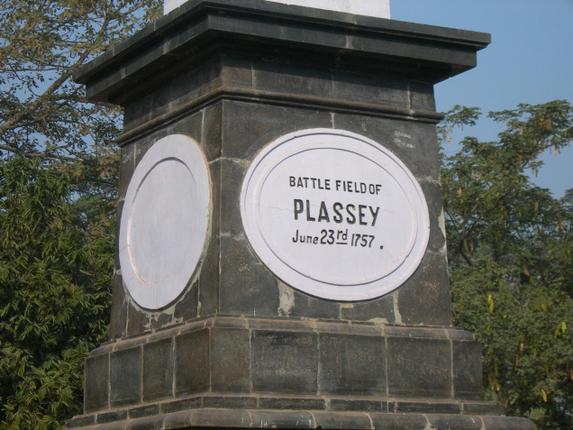
In India many economic historians as DadaBhai Narorji , Rajni Palme Dutta etc. have worked over, how did the British power succeed in  exploiting India? In fact India was put under great exploitation after the 1757 war of Plassey. Britishers had targeted India by all means including corruption which was prevalent in East India Company, by destroying the village system as they made village land first time a private property making effective change in the social system of India. 
Image result for tea plantationhttp://www.columbia.edu/itc/mealac/pritchett/00glossarydata/terms/indigo/iln1869.jpg
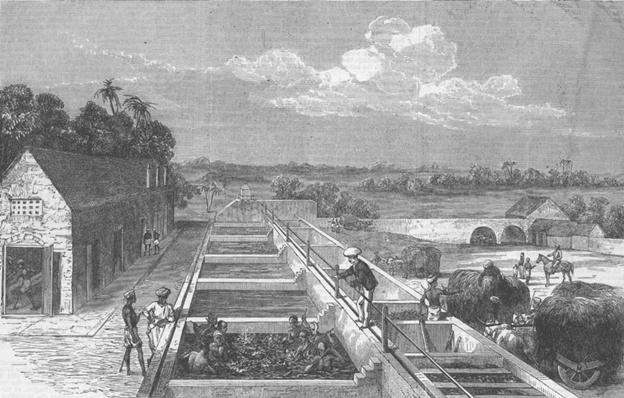
Indigo Cultivation
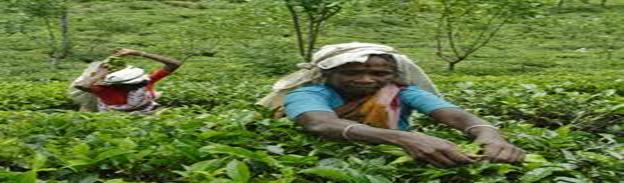
They also introduced the plantation cropping as tea,indigo cultivation thereby replaced traditional cultivation practices. They also introduced the district administration first time in systematic manner under   Hastings in order to secure a proper supply of revenues in which farmers were inflicted pains many times.
1793 Lord Cornwallis' permanent settlement created a new class. Village economy and  life was completely altered. It led towards miseries.
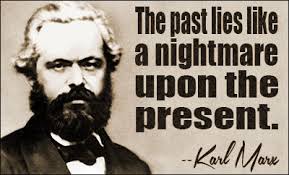
Marx had his own vision in such realistic background. He published an article “The British rule in India” in the New-York Daily Tribune, on June 25, 1853. In this article he dissected the real exploitative nature of British political and capitalist class. This analysis bears a typical Marxist perspective where he reaches to roots of the problem. His first observation is that “there cannot, however, remain any doubt but that the misery inflicted by the British on Hindostan is of an essentially different and infinitely more intensive kind than all Hindostan had to suffer before.
He made such observation as he compared the previous invasion in India. The Sultnat period, Mughal period controlled India but Britishers siphoned off money from the land and converted the people poor , mainly artisans, farmers and village workers had to pay price for that. Indian society remained poor since then as poverty was established in a structural form.
 The structured poverty is difficult to remove. Marx knew this and he therefore infers that “England has broken down the entire framework of Indian society, without any symptoms of reconstitution yet appearing. This loss of his old world, with no gain of a new one, imparts a particular kind of melancholy to the present misery of the Hindoo, and separates Hindostan, ruled by Britain, from all its ancient traditions, and from the whole of its past history.” Britishers divorced the then India with their ancient roots , now people had to work for their survival. They were alienated.
Marx also surmised that after the departure of Mughals , particularly after the demise of Aurangzeb in 1707 , the foreign powers were getting control of the country.
http://www.thehindu.com/multimedia/dynamic/00891/15_SM_P_7_Murshidab_891127g.jpg
 By 1757 they had realized that they could emerge as political power in the country. They acquired the power but paid no attention to the development works. Marx therefore stated that “ now, the British in East India accepted from their predecessors the department of finance and of war, but they have neglected entirely that of public works. Hence the deterioration of an agriculture which is not capable of being conducted on the British principle of free competition, of laissez-faire and laissez-aller.
http://www.scottiepress.org/projects/bales.jpg
Karl Marx also analysed the reason which made Great Britain a rich country as “Europe received the admirable textures of Indian labor, sending in return for them her precious metals, and furnishing thereby his material to the goldsmith, that indispensable member of Indian society, whose love of finery is so great that even the lowest class, those who go about nearly naked, have commonly a pair of golden ear-rings and a gold ornament of some kind hung round their necks. Rings on the fingers and toes have also been common. Women as well as children frequently wore massive bracelets and anklets of gold or silver, and statuettes of divinities in gold and silver were met with in the households.”
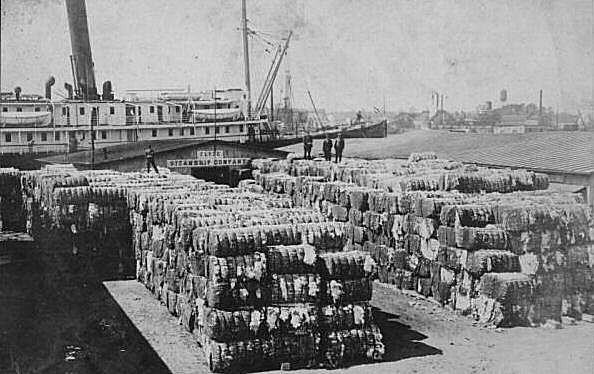
Britishers were always keen to destroy the backbone of Indian agriculture as they thought that Indian exports to England should be discouraged whereas British export should be launched at massive scale. For this reason they dismantled the village economic structure. “It was the British intruder who broke up the Indian hand-loom and destroyed the spinning-wheel. England began with driving the Indian cottons from the European market; it then introduced twist into Hindostan, and in the end inundated the very mother country of cotton with cottons.”
http://www.thehindu.com/multimedia/dynamic/00027/FARMER_2_27320g.jpg
Marx in his analysis also presents the export potential of Britain to India. After destroying the Indian cottage industry and traditional cropping pattern. East India Company with support of British government  filled Indian markets with their products. As for illustration “from 1818 to 1836 the export of twist from Great Britain to India rose in the proportion of 1 to 5,200. In 1824 the export of British muslins to India hardly amounted to 1,000,000 yards, while in 1837 it surpassed 64,000,000 of yards. But at the same time the population of Dacca decreased from 150,000 inhabitants to 20,000. This decline of Indian towns celebrated for their fabrics was by no means the worst consequence. British steam and science uprooted, over the whole surface of Hindostan, the union between agriculture and manufacturing industry.”
This destruction continued even after the assumption of political power in 1858 by the British crown.
Karl Mrax's analysis clearly throws light on the India's exploitation by the Great Britain. The analysis of Marx was so impactful that in India many nationalist Indian economic historians based their analysis on his findings.
http://www.ttu.ee/public/s/sotsiaalteaduskond/Instituudid/avaliku_halduse/.thumbnails/ragnarnurkse_520x589.jpg
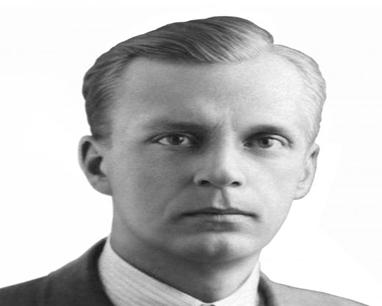
Ragnar Nurkse
The major impact of this exploitation had wider ramification as even after so much time of their departure India has not succeeded in removing the poverty. In the phrase of Nurkse, India has been trapped in the ‘vicious cycle of poverty.'
http://lite.epaper.timesofindia.com/Repository/TCRM/2010/08/14/10/Img/Pc0100200.jpg
This condition is in fact very much shocking as even after so much efforts made by the Indian governments after the independence India has not succeeded to come out from this cycle. The Marxian analysis gives its answer that exploitation was so huge, systematic and well planned that it is not possible to alleviate poverty in easy manner.