14 Apr 2015

Kashmir: The Uneasy Hug!

Mohammad Ashraf

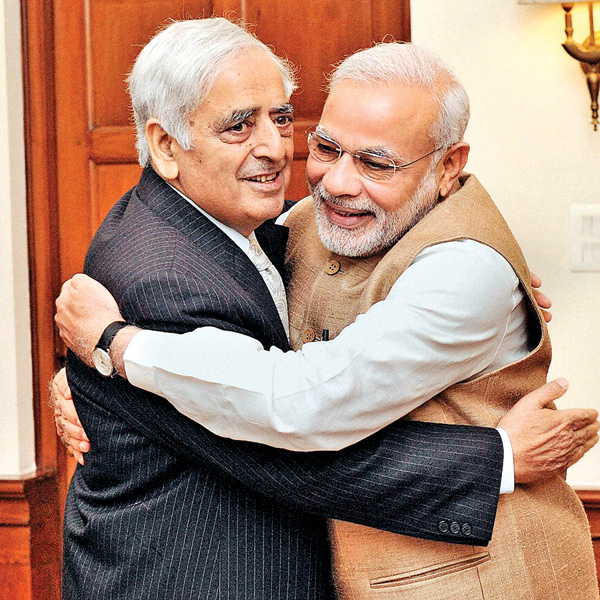
(The hug between Modi and Mufti seems to be turning uneasy like the hug in the Kashmiri proverb, “Kakun Haaputh”!)
A picture of Narendra Modi hugging Mufti Sayed was splashed all over the media just before the swearing in of the new PDP-BJP government in J & K. It represented something like a Bear Hug! The very first hug of these two ideologically opposed leaders seemed an uneasy one and not a normally warm human hug! The picture reminded one of the very common Kashmiri proverbs, “KakunHaaputh”! The story is about a father and a son going into woods and then getting separated. Suddenly, the father hears cries of his son calling him to save him. The father asks what has happened. The son agonisingly cries back that a bear has hugged him. The father shouts, leave the bear. The son shouts back, father I am trying to leave it but it is not leaving me! 
There were a lot of expectations both developmental and political. The moot point is whether the hug was really a positive bear hug and a lasting one and is any of the two leaders really acting as the proverbial bear? Both leaders took a pretty long time in preparing to hug each other. If one minutely observes the facial expression of the two leaders, it appears that Mufti Sayed was not very comfortable in hugging Narendra Modi who on the contrary seems happy and contented. While as Modi is holding him tightly in terms of a true bear hug, Mufti Sayed's hands are open! It may appear that the proverbial bear is Modi but on second thoughts after seeing the recent happenings, the reverse seems more plausible! Especially the uproar and subsequent threats to leave coalition followed by a climb down makes one think that it is now Modi who will be unable to un-hug himself from Mufti Sayed!
Having kept the controversial issues of the north and the south pole on a temporary hold, the first and foremost need of the people in the valley was not only rehabilitation and restoration after the most devastating flood of the century but the fool-proof prevention of future floods and the perennial water-logging of most of the city and other areas. There have been many plans including some with the help of Asian Development Bank executed through the Economic Reconstruction Agency for some of these projects. Unfortunately except a few, most of the projects get allotted or sub-let to small contractors for financial and political gains. The result is disastrous implementation and management of these projects whether connected with drainage, road construction and so on. The living example is the drainage in Srinagar city and the four-lanning of the highway from Qazigund to Srinagar. For a change, the basic infrastructure projects need to be allotted to some of the reputed national or even international construction agencies to ensure implementation and completion on turnkey basis within a definite time-frame. Some examples of the work executed on these bases is the surfacing of some Srinagar roads during governor's rule in mid-eighties and the commissioning of the Uri Power Project during the most disturbed years of the militancy of the nineties.
There were many possibilities in the sphere of good governance and development in all the three regions of the state. The million dollar question was whether the present set up clobbered together after putting a temporary lid on some very controversial and disruptive issues could firmly put its feet on the ground and get a strong hold on the situation. Unfortunately, the reverse seems to be happening. One after the other controversial issues are being deliberately propped up. The return of Pandits has been hanging fire for last 20 years while as the West Pakistan refugees have been waiting for more than 60 years! The refugee issue is more volatile than the Pandit issue. However, the Pandit issue is more sensitive in regard to the valley. There seems to be deliberate attempt to inflame the sentiments and passions of the valley dwellers.Can it be construed as an attempt to get un-hugged from one of the two sides?
Normally, the two sides should have gone full steam ahead in rehabilitation and restoration. The infrastructure is in shambles. In fact, one of the Bollywood heroes recently remarked that Kashmir has everything except the infrastructure! The three most important and urgent tasks to be taken in hand were the restoration, rehabilitation and construction of standard basic infrastructure. This had to be coupled with lessening of the harassment by security personnel of all shades and hues. While the first tasks are still going on at a slow pace, the reverse is happening on the last one because of the new fuel being added to already simmering fire. In fact, a fellow columnist had recently observed that the present phase of Kashmir's popular movement appears to be fizzling out. He should rest assured that the present central government will not allow this to happen and they are renewing the same with their periodic inputs. May be they are regretting the hug and want to end it sooner than later?

Ukraine: The Truth

GARY LEUPP


Reuters headline, April 29: “Ukraine sets sights on joining NATO.”
Radio Free Europe/Radio Liberty headline, April 29: “Far-Right Leader Names Ukrainian Military Adviser.”
Moscow’s official line on Ukraine—and it should not be dismissed just because that’s what it is—is that the U.S. has spent about $ 5 billion backing “regime change” in that sad, bankrupt country, ultimately resulting in a coup d’etat (or putsch) in Kiev in February 2014 in which neo-fascists played a key role. The coup occurred because the U.S. State Department and Pentagon hoped to replace the democratically elected administration with one that would push for Ukraine’s entry into NATO, a military alliance designed from its inception in 1949 to challenge Russia. The ultimate intent was to evict the Russian Black Sea Fleet from the bases it’s maintained on the Crimean Peninsula for over 230 years.
Personally, I believe this interpretation is basically true, and that any rational person should recognize that it’s true. Victoria Nuland, the neocon thug who serves as Assistant Secretary of State for European and Eurasian Affairs and is the key official shaping U.S. Ukraine policy, openly admitted to an “international business conference on Ukraine” in December 2013 that Washington had “invested more than 5 billion dollars to help Ukraine achieve [the development of democratic institutions] and other goals.”
She repeated this assertion in an CNN interview, and former Secretary of State Madeleine Albright has proudly reiterated it as well on cable news. The unspoken goal was Ukraine’s membership in NATO.
(Imagine if a top-ranking official in the Russian Foreign Ministry were to boast of a $ 5 billion Russian investment in undermining the Mexican or Canadian government, with an aim towards incorporating one of those countries into an expanding military alliance. John McCain and Fox News would be demanding the immediate nuking of Moscow.)
Russia, as you know, has relatively few naval bases for a country its size. These face the Barents and Baltic Seas to the north, surrounding Scandinavia. In 1904, when Russian forces were attacked by the Japanese navy at Port Arthur in Manchuria, Russia had to dispatch the Baltic fleet to the region in a voyage requiring six months (and ending in the disastrous Battle of Tsushima). Russian geography poses obstacles to a strong navy.
There is one Russian naval base in Astrakhan on the landlocked Caspian Sea (which is really a vast lake, from which one can sail to Kazakhstan, Turkmenistan, Iran or Azerbaijan but nowhere beyond). And there are several bases in or near Vladivostok on the Siberian Pacific coast, which is iced over part of the year, as well as bases on the Kamchatka Peninsula north of Japan. Russia has a modest naval base at Tartus on the Syrian coast, and a logistics base in Cam Rahn Bay in Vietnam. But the only bases with ready access to the Mediterranean and thence the Atlantic or Indian oceans are those in and around Sevastopol on the Crimean Peninsula on the Black Sea.
Compare the U.S. with over 30 major naval bases on its east and west coasts and Hawaii, and others—some of them huge—in Japan, Italy, Cuba, Bahrain, Diego Garcia and elsewhere! There are more naval bases in the state of California than in the entirety of the Russian Federation.
The U.S. has military personnel stationed in about 130 countries in the world—that is, in two-thirds of the countries who are members of the UN. In contrast, Russia has military forces stationed in, by my count, ten foreign countries, eight of them on its borders. And yet the U.S. press and political class depict Russia and specifically its president Vladimir Putin, a threatening juggernaut. (Just as they once did Saddam Hussein, that lame creature demonized as—as the warmongers always do, before attacking and destroying him—“a new Hitler.”)
Any student at a U.S. university, enrolled in an interdisciplinary program in “international relations” (and educated, as is the norm, by political scientists of the “realist” school) is likely to conclude that—leaving aside the vilified personality of Putin—any Russian leader would insist on retaining the Crimean military assets. Anyone at all! Retention of that historic real estate is a no-brainer. Any outsiders with designs on it (which would include the hawks leading the U.S. Republican Party) are simply unrealistic if not brain-dead.
How could any Russian leader say to Victoria Nuland, “Fine, go ahead, take it,” and hand over this ethnic-Russian region—locus of the Crimean War of 1853-56 and some of the bloodiest battles against the Nazis in World War II, locus of the fateful Yalta meeting between Stalin, Roosevelt and Churchill in February 1945–to forces overtly hostile to Russia? Forces that moreover are inclined to praise Ukrainian fascists who during World War II collaborated with the Nazis, even rounding up Jews for the slaughter at their bidding?
The Reuters article referenced above confirms the intention of the U.S-installed regime to formally apply for NATO membership. It cites Oleksander Turchynov, head of the new regime’s national security council, as stating to the parliament that NATO membership was “the only reliable external guarantee” of Ukrainian “sovereignty and territorial integrity.” (As though Russia, which had a cordial relationship with the previous President Viktor Yanukovich—who, let us repeat, was elected in a poll universally regarded as legitimate and democratic in 2010—has in recent times challenged the “territorial integrity” of Ukraine or any other country!)
It thus validates the key Russian charge that this is all about NATO—the NATO that, following George H. W. Bush’s promise to Mikhail Gorbachev in 1989 that the alliance would not advance “one inch” towards Russia’s borders has in fact advanced to surround European Russia since 1999. NATO now includes Estonia, Latvia, Lithuania, Poland, the Czech Republic, Slovakia, Hungary, Romania, Bulgaria, Croatia and Albania, all expected by group rules to devote 2% of their GDPs to the mutual “defense” effort.
If it does not include Russia’s other neighbors, Belarus, Moldova and Georgia, it is not for lack of trying. The “National Endowment for Democracy” (a “private, non-profit organization” used by the State Department to fund regime change abroad) has sought to draw all of them into NATO. As though this were the most natural thing in the world, for all peoples living in countries bordering Russia to aspire to join an anti-Russian alliance!
Nuland’s talking points for popular consumption on Ukraine include the assertion that the U.S. supports “the Ukrainian people’s European aspirations.” She ignores the fact that the country is deeply divided between east and west, and that in the east there are substantial “Russian aspirations” deeply rooted in a history she does not and indeed disdains to even try to understand. She also conceals the fact that U.S. support for regime change in Ukraine, leading up to the February 22, 2014 coup, was not really based on U.S. support for Ukraine’s entry in the European Union.
The EU is a trading bloc that challenges the U.S. and NAFTA. In a world of imperialist competition for markets and resources, the EU and the U.S. often disagree. Washington is angry that EU members Britain, France, Italy, Spain and Luxembourg are all joining the Chinese-led investment bank Asian Infrastructure Investment Bank (AIIB), mainly because it’s likely to boost the Chinese currency and contribute to the decline of the dollar as the international reserve currency. Congress fumes over the EU’s refusal to allow importation of Monsanto’s genetically modified food products. The U.S. State Department is not in the business of promoting EU membership. That’s not what this is about.
In 2003 Hillary Clinton’s State Department seized on the decision made by ousted Ukrainian President Viktor Yanukovich to back away from a deal he’d initialed with the EU. His advisors told him the austerity regime the EU would impose would be unacceptable, while Russia offered a generous aid package including continued supply of cheap gas.
Yanukovich’s decision to opt for the latter option was based on economic logic, and eminently defensible in economic terms. But the U.S. actively fanned the flames of a movement which depicted Yanukovich’s decision as a betrayal of Ukrainian nationhood and a statement of fealty to Russia. Hence Nuland’s oft repeated sound bite about “European aspirations.” As though Ukraine hadn’t always been part of Europe! As though “Europe” were some shining star, and all those horrible inflictions of terror on the Ukrainian Socialist Republic by European fascists during the 1940s were irrelevant. And as though submission to a Greek-style EU-inspired austerity regime would bring relief to the suffering Ukrainian masses.
In fact, Nuland’s own thoughts on “European aspirations” were sweetly summarized in her phone conversation with U.S. ambassador to Kiev Geoffrey Pyatt just before the putsch in early February 2014. Quite probably leaked by Russian intelligence, and never disavowed by the State Department, the recording shows how Nuland had hand-picked the current prime minister, Arseniy Yatsenyuk, for his post over rivals Oleh Tyanybok (leader of the neo-fascist Svoboda Party, who has publically inveighed against the “Moscow-Jewish mafia ruling Ukraine” and referred to “Muscovites” and Jews as “scum) and Vitali Klitschko, a former boxer and sometimes anti-corruption activist.
In the phone call, Pyatt tells her “I think we’re in play,” meaning everything’s set for a coup. “The Kitschko piece is obviously the complicated electron here, especially the announcement of him as deputy prime minister…I’m glad you sort of put him on the spot as to where he fits into this scenario.” Pyatt had apparently informed Kitschko that despite some EU backing, he was not a suitable candidate for the U.S. (In the call, Nuland blandly asserts that he needs more time “to do his homework.”)
Nuland wanted to marginalize Klitschko, who in the coup’s aftermath was awarded (as consolation prize) the post of Kiev mayor, She wanted to make sure that the former Minister of the Economy, Yatsenyuk, advocate of severe austerity measures and proponent of NATO membership, succeeded Yanukovich.
The phone call makes clear that Nuland had recruited UN officials to endorse the regime change.
Towards the end of the conversation, Nuland tells Pyatt “OK,” signaling that the two agreed on the general strategy. She then alludes to the welcome complicity of several other assets: Jeff Feltman, Robert Serry, and Ban Ki-moon.
She reports that Jeff Feltman has “now gotten both Serry and Ban Ki-moon to agree that Serry could come in Monday or Tuesday.” Meaning: to help facilitate the coup and validate it afterwards.
Who are these people? Geoffrey Feltman, a career U.S. diplomat, was at the time the UN Under Secretary-General of Political Affairs. He is perhaps best known for his tenure as U.S. ambassador to Lebanon between 2004 and 2008 when he exercised so much influence that Hizbollah—echoed by other parties—referred to the Fouad Siniora government as the “Feltman government.”
Robert Serry is a Dutch diplomat who served as NATO’s Assistant Secretary-General of Foreign Crisis Management and Operations between 2003 and 2005 and also had been Dutch ambassador to Ukraine. An advocate of Dutch participation in the Iraq War based on lies, he was a reliable U.S. ally.
Ban Ki-moon is of course the UN Secretary-General who, as South Korea’s foreign minister, pressed for the deployment of South Korean troops in that same Iraq war based on lies. We know from Wikileaks that, prompted by the U.S., he urged the UN Security Council to ignore the UN Board of Inquiry’s report on the Israeli bombing of Gaza in 2008-2009 to avoid U.S. and Israeli embarrassment. It’s safe to call him a reliable U.S. puppet.
Towards the end of the intercepted phone call Nuland signs off: “So that would be great, I think, to help glue this thing and to have the UN help glue it and, you know, Fuck the EU.” Fuck them, that is to say, if their ideas about Ukraine’s future differ from our own.
So much for respect for anybody’s “European aspirations.”
In the same phone call, Nuland notes that Yatsenyev “will need Klitschko and Tyahnybok on the outside, he needs to be talking to them four times a week.” One has to ask: what’s more disgusting, the fact that the U.S. State Department would so attempt to micro-manage a regime change in a sovereign state, or that this neocon Nuland (who just so happens to be Jewish) representing the U.S. government, would urge the U.S. puppet to routinely network with a neo-fascist who describes Jews as “scum”?
In this case, commitment to the expansion of NATO cause plainly trumps the resistance to anti-Semitism cause. Nuland ought to be ashamed of herself.
When confronted last May in a House hearing by Rep. Dana Rohrabacher with photographic evidence of the role of neo-Nazis in the Maidan events, Nuland acknowledged that “there were many colors of Ukraine involved including very ugly colors.” She didn’t mention her own photos with Tyahnybok, all smiles, or her instruction to “Yats” to be on the phone with him four times a week.
The Radio Free Europe article referenced above begins: “The controversial leader of Ukraine’s ultranationalist Right Sector paramilitary group has been named an army adviser.  Ukrainian Armed Forces spokesman Oleksey Mazepa announced on April 6 that Dmytro Yarosh would ‘act as a link between volunteer battalions and the General Staff.’ Yarosh’s Right Sector militia claims to have some 10,000 members, but so far has not officially registered with the government as other paramilitary forces have done. The Right Sector militia is fighting alongside Ukrainian government troops against pro-Russian separatists in the eastern part of the country.”
The neo-fascist Right Sector was formed in 2013 during the Maidan protests in Kiev, amalgamating a number of groups aligned to the Svoboda Party. As the latter was striving for international respectability, its leaders meeting with Nuland and John McCain among others, the Right Sector functioned as its violent activist contingent. It was almost certainly involved in sniper fire on the square, attributed to the regime and used to validate its overthrow.
Now its head is awarded a government post, to coordinate the actions of the right-wing militias (most notoriously the Azov Battalion, which proudly sports Nazi insignia and has attacked civilian targets in east Ukraine). Does this not validate the Russian charge that there is a strong fascist component to the regime?
The situation is complicated. The neo-fascist shock troops deployed to pull off the putsch are not in favor of EU membership. They don’t want its tolerance for diversity, its immigration rules. They have a vision of White Power manifest in their varied symbols, that include Confederate flags, certain Celtic crosses, and swastikas. They might not even favor NATO membership. But as the Radio Free Europe article indicates, their support is valued and needed by the regime.
No matter that Dmytro Yarosh is wanted by Interpol for “public incitement to terrorist activities” for threatening to destroy Russian pipelines in Ukraine. He’s a necessary part of a team, and Washington backs the team. And the State Department and captive media pooh-pooh any suggestion that there’s any fascism here, or any underhanded effort to encircle Russia. It’s all about Ukrainian “freedom,” supported by its benign self, which has in recent memory visited such memorable liberations on Afghanistan, Iraq, and Libya.
There is a fascist-friendly regime in Ukraine, ushered into power by the U.S. State Department. And it does want to enter NATO, and weaken Russia—if possible, by re-establishing control over Crimea and booting the Russian fleet out. Given German opposition to its admission into the alliance, it is doubtful that will occur short-term.
But with crazies running the U.S. State Department, successfully promoting a bogus narrative about what’s happened in Ukraine over the last two years—a narrative echoed slavishly by a clueless mainstream media—it’s just barely conceivable that there might come a day in which U.S. forces join the Azov Battalion in battling forces of the People’s Republics of Luhansk and Donetsk.
It won’t have anything to do with “freedom,” any more than the last few U.S. wars have had anything to do with that abstraction. It will be about imperial expansion, which while it might serve the .01% that rules this country, is not in your interest at all.
HRC and the Arkansas Elite

Jeffrey St. Clair & Alexander Cockburn

Second in a three-part series.
In 1990, the National Law Journal ran profiles of “the 100 Most Influential Lawyers in the United States”. Hillary Clinton was on the list, and for years she would publicly boast that the Journal had named her one of “the nation’s 100 top lawyers”. Finally, the editor of the National Law Journal, Patrick Oster, wrote to Arkansas’ first lady–as she still was in 1991–testily pointing out that the word “influential” is not synonymous with “top” or “best”–the latter two words used by Mrs. Clinton interchangeably.
By “influential” the Journal’s profile writer, Peggy Fisk, had meant a lawyer plentifully endowed with corporate and political connections, which Mrs. Clinton certainly enjoyed in Arkansas where she had become a partner of the Rose Law Firm in 1977, amid the dawn of her husband’s political career as he began his terms as governor of the state. By the late 1980s, Hillary Clinton was sitting on the board of Wal-Mart, with the rest of Arkansas’ business elite crowding her Rolodex. Hillary ignored Oster’s letter of correction, instructing her staff to continue to use the word “best” in invoking the Journal’s profile. She continued to do so for years. Oster was still writing her a decade later about her misuse–including an editorial column in the Journal in 2000, when she was running for the U.S. Senate.
In fact, Mrs. Clinton was not a particularly good lawyer and would have had trouble making any honest list of the 100 best lawyers in Little Rock. In their political biography, Her Way: The Hopes and Ambitions of Hillary Rodham Clinton, Jeff Gerth and Don Van Natta Jr. tell the story about the National Law Journal and also probe her lawyerly skills when she was at Rose Law. She only tried five cases and confided to Vince Foster–another Rose Law partner–that she was terrified of juries. So Foster had to accompany her to court. Because of her lack of prowess in the courtroom, she had to make her way at Rose Law by working her connections as the State’s first lady to bring in clients, and even then her annual partner’s share was mostly below $100,000–the lowest in the firm and very small potatoes for one of the hundred most influential lawyers in America.
The Clintons’ joint income–at least the visible portion–was not substantial: the state paid Bill $20,000 a year, no doubt under the assumption he’d even up the score with kickbacks. So money was on Mrs. Clinton’s mind. Her search for extra income led her into associations that were later to cause endless trouble.
First came the ties with Jim McDougall that were to flower into the Whitewater property speculation and later a huge federal investigation into that deal, unprofitable to the Clintons who had hoped–like many Americans–to make a big score in real estate and solve their money problems at a single stroke.
When things were looking bleak for the Clintons after the Arkansas voters threw Bill out in 1980 after his first term as governor (Arkansas had two-year gubernatorial terms until 1986), she fanned her friendship with James Blair, general counsel of Tyson Foods. Bill Clinton’s Little Rock chief of staff, Betsey Wright, recalled that Hillary “loved Jim Blair. Blair was her money man”. It was Blair who set up an account for Hillary Clinton with Refco, a small brokerage firm run by Robert “Red” Bone, Don Tyson’s former bodyguard and a professional poker player. “Red” Bone got her into cattle future trades. She put up $1,000 and left the trading to Mr. Bone who’s often assumed to have arranged the trades with Blair, to Mrs. Clinton’s advantage. Nine months later, the $1,000 had swollen with miraculous speed into a profit for Mrs. Clinton of $99,000.
When Bill Clinton ran for the presidency in 1992, reporters noted a mysterious spike in the couple’s net worth in the early 1980s and quizzed Mrs. Clinton about it. Her first untruthful explanation was that there had been a windfall in the form of an unexpected gift of cash from her KillingTrayvons1parents. But, aware that the questions wouldn’t stop, she issued ferocious order to her staff about any leakage of her tax records. She told them that if they released the tax records showing the commodity trades, they’d “never work in Democratic politics again”.
The records were stored in the Clinton Campaign headquarters in Little Rock, in a locked room for which only Hillary, Bill and Betsey Wright had keys. Also in “the Box Room” under lock and key were details of Bill’s sexual capers and Hillary’s dealings at Rose Law. An internal ’92 campaign memo, quoted by Gerth and Van Natta, cited 75 “problem files” in the materials in the Box Room, two-thirds of which related to them as a couple or to Hillary alone. When David Ifshin, the campaign’s legal counsel, asked for the key to the room to assess the likely problems, Bill Clinton told him: “We can’t open our closet, we’ll get crushed by the skeletons”.
But two reporters in particular kept pressing: Gerth of the New York Times and James Stewart of the Wall Street Journal. Gerth finally got evidence of the $99,000 profit on a $1,000 trade and confronted Mrs. Clinton. Shorn of the family gift story, Mrs. Clinton avowed that she’d spent her days poring over cattle prices in the Wall Street Journal, that the $99,000 was the fruit of these studies and that she’d quit commodity trading in 1980, after she’d got pregnant with Chelsea, because the trading “was too nerve-wracking”. Unfortunately for this story, details later surfaced amid prosecutor Kenneth Starr’s investigation during the Clinton presidency, showing that in 1981 Hillary had made a trade netting her $6,500 and she hadn’t reported the profit to the IRS.
Amid the Starr probe, the Clintons encouraged the Wall Street Journal’s Stewart to do a book on what they saw as their unfair persecution on the Whitewater deal. As he researched this work, published as Blood Sport, Stewart took a hard look at the commodity trades and pressed Mrs. Clinton for an explanation for all the contradictory stories. Hillary blamed everything on her staff and told Stewart that her own statements should simply be “accepted at face value”.
In the mid-1990s, federal special prosecutor Kenneth Starr’s investigative team in Little Rock was headed by a veteran of the courtroom, Hickman Ewing Jr. Grilled by Ewing before a grand jury on July 22, l995, Mrs. Clinton used the words “I can’t recall” in answer to 50 questions. Later, Ewing told Starr that he rated Mrs. Clinton’s testimony as deserving an F Minus, and he wanted to indict the nation’s first lady. He was contemplating a number of counts, headed by two major lines of enquiry. First came her handling of the commodity trades and her failure to report her profits to the IRS. Second came her conduct amid the collapse of Madison Guaranty Savings and Loan, owned by Jim McDougal. Relevant to this affair were Hillary Clinton’s billings as a legal counsel to Madison Guaranty. These were germane to the question of whether Hillary was being truthful in denying she’d done any legal work for the bank. After many adventures, the records finally came into the hands of Starr’s team and showed that Hillary Clinton had billed Madison Guaranty at the rate of $150 an hour, with a total of 60 hours of supposed work on the Castle Grande deal. The prosecutors had the billings but were never able to look at Hillary’s time sheets. Her secretary removed them from the Rose Law Firm in 1992, and it’s generally assumed the first lady destroyed them.
Webb Hubbell, a partner at Rose Law and one of Hillary’s closest friends, fell from his eminence as deputy attorney general in Clinton’s first term and was convicted and imprisoned on charges of padding by $394,000 his legal billings at Rose Law. Ewing was convinced that Hillary had been doing the same thing. He prepared an indictment. It was the most serious brush with disaster that Hillary ever faced. Paradoxically, she was saved by the indiscretions of her faithless mate. Even as Ewing was urging Hillary’s indictment, Starr was delightedly fingering what he conceived to be the object that would doom Bill Clinton, the semen-stained dress retrieved from Monica Lewinsky’s closet by Starr’s team. The only thing the prurient Starr cared about was nailing Clinton for sexual misconduct, and so he told the disappointed Ewing that there would be no indictment of Hillary.
Even as Hillary Clinton was making trouble for herself and Bill in her legal and business dealings, she was reinventing Bill as a politician. Defeat in 1980 after his first two-year gubernatorial term was a cataclysmic event. Bill called it a “near death experience”. According to Gerth and Van Natta, it was “the only time anyone has seen Hillary Clinton cry in public”. Bill was inclined to throw in the political towel and go back to being a law professor in Fayetteville, where he would doubtless be roosting in tenured bliss to this day, plump and pony-tailed, fragrant with marijuana and still working his way through an endless roster of coeds. But in 1980, over a funereal breakfast of instant grits, Vernon Jordan brokered a deal: Bill Clinton would give up being a southern populist in the mold of Orval Faubus, six-term governor of Arkansas. Southern populism involved offending powerful corporations. Bill lost in 1980 because not only had he taken the un-populist course of hiking the rate on car registration, he’d angered Weyerhaeuser and Tyson Foods. So, for his comeback he would remake himself as a neoliberal. Hillary Rodham would give up insisting on keeping her maiden name and become Hillary Clinton. The man charged with supervising the Clintons’ makeover was selected by Hillary: Dick Morris, a political consultant known for his work for Southern racists like Jesse Helms. Morris ultimately guided President Bill Clinton into the politics of triangulation, outflanking the Republicans from the right on race, crime, morals posturing and deference to corporations. As Hillary said in 1980, “If you want to be in this business, this is the type of person you have to deal with”.
Bill Clinton duly pushed aside the Playboy centerfolds and pored over Dick Morris’ polling data, trimming his positions to suit. He recaptured the governorship in 1982 and as a reward appointed his wife to head a special task force charged with reforming Arkansas’ education system, at that time widely regarded as the worst in the country. The plan Mrs. Clinton came up with showcased teacher testing and funding the schools through a sales tax increase, an astoundingly regressive proposal since it imposed new costs on the poor in a very poor state while sparing any levies on big corporations. The plan went through. Arkansas’ educational ranking remained abysmal, but Hillary won national attention as a “realistic Democrat” who could make “hard” choices, like taxing welfare mothers.
While enjoying this limelight, Mrs. Clinton was invited onto the board of Wal-Mart as the first woman director, the only Rose Law partner at that time to have accepted an outside position. She was also asked by Robert Mac Crate, the president of the American Bar Association, to head up a commission on how to implement a resolution by the ABA to increase the profile of women and minorities in the legal profession. Mac Crate told Gerth and Van Natta that Mrs. Clinton declined, saying that she didn’t want gender equity to be linked with race. She prevailed. Two years later, she agreed to head an ABA commission examining the status in the legal profession. Issues of race were not to be scrutinized.
By 1987, Hillary was wearying of life as first lady of Arkansas and began to press her husband on the 20-year plan they had made long before, whose consummation would be a successful run by Bill for the U.S. presidency. Dick Morris was assigned the task of running polls on Bill’s chances. Betsey Wright was charged with sizing up the “problems”. Morris’ news was grim. The Democratic Party was not sold on the prospect of the governor of Arkansas as their nominee in l988. Betsey Wright sat down with Bill and Hillary and read out to both of them a list of dozens of women Wright believed Bill had had some kind of fling with during his gubernatorial years. Bill’s head sank into his hands, and he mumbled, “I’m not going to run for president and I don’t want to run for re-election as governor either”. As Wright recalled later, Hillary stood up and cried, “If you’re not gonna run for re-election, I’m gonna run”. “Okay”, said Bill, he’d run again. It was Hillary’s call.
The next four years were spent gearing up for the White House run and trying to bury Bill’s past. Amid these efforts Hillary made two huge mistakes, which haunted the Clintons throughout the 1992 campaign and their White House years. Clinton’s opponent in the 1990 governor’s race was Sheffield Nelson, a Little Rock lawyer. Nelson had accumulated a dirt file on Bill, detailing his sexual escapades and the couple’s Whitewater real estate transactions. But he never used this material in the campaign. Nonetheless, in 1990 Hillary Clinton publicly excoriated Nelson, calling him “a vindictive and very bitter man”. The reason for Hillary’s assault was that Nelson, in the climactic weeks of the race, had saturated the airwaves with a series of campaign ads charging Clinton with being a tax-and-spend Democrat. The ads had some effect, and the Clintons had to borrow $100,000 from the Jackson Stephens-controlled Worthen Bank to mount a counteroffensive ad campaign of their own. Nelson, seething at Hillary’s onslaught, duly became bitter and vindictive and, as Clinton’s presidential campaign got under way, he began to leak ripe details from the file he had kept closed in l990.
Her second mistake also came in 1990, when Jim McDougal was facing trial over the collapse of Madison Guaranty Savings and Loan. In his hour of need, he asked Bill to testify as a character witness in his trial. Though Bill was willing to do so, Hillary was adamant that he should avoid any association with McDougal. She successfully persuaded Bill to decline. McDougal was acquitted, but he never forgave the Clintons for their disloyalty. He too began to leak damaging stories about Whitewater to Gerth and other reporters from his rusting trailer in Arkadelphia. Thus, even as she kindled her husband’s presidential bid, Hillary helped spark the fires of financial and sexual scandal that almost destroyed his presidency.
Tomorrow: The White House Years.
Click here to read Part One: From Nixon Girl to Watergate.

A Turning Point in the US Labor Market?

Matt Vidal

Walmart made headlines recently by announcing it is raising its base wage rate to $9 per hour (going to $10 per hour in 2016). In response, Gary Silverman of The Financial Times suggests that “Walmart stirs hopes of a Fordist revival,” referring to Henry Ford’s famous implementation of a $5 day in 1914 – double the going rate at the time.Similarly, Paul Krugman, Princeton economist and New York Timescolumnist, argues that Walmart’s “wage hike seems to reflect the same forces that led to” rising real wages and declining inequality for nearly three decades after the Second World War.
While the comparison between Walmart and Ford is apt in some respects, unfortunately, the broader institutional context of today’s postindustrial, globalized, financialized economy is far different from that of the post-WWII years. As a result, the move by Wal-Mart is unlikely to signal a broad reversal of the current trajectory of the American labor market, which is characterized by stagnating wages and rising inequality.
Silverman is only cautiously optimistic, noting that Walmart employees still suffer from erratic scheduling and that a $9 per hour wage translates to just under $19,000 per year for a full-time worker.
Krugman is far more optimistic: “engineering a significant pay raise for tens of millions of Americans would almost surely be much easier than conventional wisdom suggests.” He argued that “the middle-class society we used to have didn’t evolve as a result of impersonal market forces — it was created by political action,” namely, government wage-setting during WWII and high levels of unionization (along with full employment due to the war), which served to change “pay norms.”
These political forces were critical, no doubt, but the generalization of the fordist high-wage model to the broader economy over two decades required a more intricate – and unique – set of institutions, as I show in a forthcoming chapter in the Sage Handbook of the Sociology of Work and Employment.
The Unique Institutional Context of the Golden Age of American Capitalism
First, the dominant logic of corporate organization in the fordist period was one of vertical integration, which provided a basis for internal training and promotion ladders, generating an employment structure heavy on mid-level jobs. Second, the core of the economy was an oligopolistic manufacturing sector with a high level of unionization. Third, in addition to facing little competition at home, there was almost no global competition in manufacturing – this is the period before the internationalization of production and head-to-head international competition between firms. Finally, under the international monetary regime operating at the time – the Bretton Woods system – there were strict controls on the international movement of capital, which allowed national policy autonomy and the establishment of a keynesian welfare state.
Even with powerful unions, a class compromise between capital and labor was by no means automatic – during the same period the UK had nearly identical structural conditions to the US yet failed to achieve a similar class compromise over wages. In fact, the UK had even higher union density than the US at the time, but the national British Trades Union Congress was unable to control its local unions, leading to unsanctioned workplace-level conflict.
It is easy to applaud Krugman’s comment that “extreme inequality and the falling fortunes of America’s workers are a choice, not a destiny imposed by the gods of the market.” But the good Professor Krugman shares more in common with his fellow economists than his roguish posturing suggests.
In one of the deepest ironies in the social sciences, by praying to the gods of the market, mainstream economists have mistaken a pantheon of pretenders for the real pantheon: the gods of capital. It is in this failure to see capitalism as a class system – the primary goal of which his profit, not efficiency – that Krugman shares much in common with his fellow economists.
From Fordism to Waltonsim
The golden era of American capitalism has been referred to as a fordist growth regime, due to its basis in a high-wage, mass production manufacturing economy. This regime established a virtuous circle of growth in which high wages provided the basis for strong macroeconomic growth.
As I have argued elsewhere, the fordist regime has indeed been replaced by a waltonist regime (pioneered by the Walton Family behind Walmart). The latter is characterized by vertically disintegrated firms and a core employment sector in retail sales, leisure and hospitality, resulting in an economy polarized into high-wage and low-wage jobs, with few mid-level jobs or internal promotion pathways. Additionally, it is characterized by intensified international competition and the domination of global finance.
Under these conditions, the establishment of a high-wage class compromise, like under fordism, would appear to be all but impossible. Why?
First things first. The new Walmart wage is far below what the fordist wage was. Ford implemented his five-dollar day in 1914. In 2014 dollars this amounts to $117 per day (Ford voluntarily reduced his workday to eight hours as part of this initiative), fully 32% higher than the $80 per day Walmart worker will make at $10/hour for an eight hour day.
More importantly, the great fordist class compromise between capital and labor was institutionalized with the Treaty of Detroit in 1950 between General Motors and the United Auto Workers. Under this collective bargaining agreement, unions traded labor peace for wages linked to productivity increases with automatic annual cost-of-living adjustments. The minimum wage in 1968, adjusted for inflation, would be nearly $11 per hour. Wage rates in the GM-UAW contract were likely double or triple that rate, including benefits.
Similar contracts were signed at Ford and Chrysler, with wage bargaining throughout the manufacturing sector based on the pattern set by the Big Three car companies. This, in turn, set a wage norm that was followed by large non-union companies as well – including the retail sales sector, led by companies such as Sears.
In this context of oligopolistic competition, strong unions and lack of international competition, wages had been effectively taken out of competition.
A New Class Compromise?
And today? If we include retail sales and leisure and hospitality as part of a single front-line services sector, it is the largest employment sector in the economy, covering 21% of the workforce versus 16% in government, 13% in professional and business services, 11% in heathcare and 11% in manufacturing.
Costco, a competitor of Walmart, shows that the largest employers in front-line services can afford to pay their workers living wages. In 2004, Costco paid its workers $17 an hour. But this strategy may be dependent on the progressive vision of its co-founder and recently retired CEO, James Sinegal. While its stock has performed very well during its three decades, it has been heavily criticized by Wall Street analysts for prioritizing customers and workers over shareholders. Costco’s strategy appears to be based on a willingness to reject the demands of Wall Street for higher profits. It is an open question whether this vision can survive the change of leadership and whether the company will become the target of a hostile takeover.
In any case, it’s likely that only a small fraction of employers in this sector have sufficiently high profit margins to afford such wages. As sociologists Misha Petrovic and Gary Hamilton have shown (in a chapter in historian Nelson Lichtenstein’s book), Walmart has been able to use its market power to dictate that suppliers commit to its own strategy of high volume, rapid-turnover, with low-margins.
The ten largest employers in the front-line services sector – Walmart, McDonalds, Target, Yum! Brands (owner of Taco Bell, KFC and Pizza Hut), etc. – employ 4.3 million people, just 14% of the 29.9 million workers in the sector. Underneath these firms are a vast number of suppliers, typically much smaller concerns, whose razor thin profit margins are the basis of the fatter margins enjoyed by the giants. With its market power and relentless squeezing of suppliers, Walmart created the conditions of profitably for Costco, namely, low profits and low wages within the global supply chain.
Although more research would need to be done, my guess is that the bulk of the remaining 76% of the front-line services sector consists of smaller, local establishments who also must play the low-margin game established by Walmart, yet don’t have the high volumes to aggregate their thin margins into large profits. While we don’t know their margins, it is likely that these smaller companies – who, again, compete according to conditions and norms established by Walmart – cannot afford to pay higher wages.
The most important lesson from the fordist period is that a high-wage economy requires an institutionalized class compromise, such as that realized with the Treaty of Detroit. There has, quite simply, never in the history of capitalism been a competitive dynamic of wage upgrading on this scale without a powerful union movement. In the absence of such – and in a context of a surplus population of under- and unemployed, which is a basic feature of global capitalism that Marx correctly predicted – competition drives wages down, not up.
Just days after Walmart’s announcement, McDonald’s made a similar minor concession – a raise to $10 per hour in 2016 – again in response to the concerted, union organized, nearly three-year long living wage campaign aimed at the fast food industry. To be sure, it is heartening to see these minor successes resulting from new forms of protest by union-led, community-based coalitions. Unfortunately, without a powerful labor movement, which is necessary to institutionalize a high wage compromise into union contracts – including annual cost of living adjustments – wage hikes by the highest profile employers will not be generalized throughout the broader front-line services sector
If there is any doubt where McDonald’s stands with regard to living wages, simply note that just a few weeks before it announced a slight wage raise, it sued the City of Seattle over its recently passed living wage law. And its wage raise applies only to 9,000 workers, excluding the 750,000 employees who work for franchisees.
History demonstrates that a powerful labor movement is a necessary factor for shared prosperity under capitalism. However, history also suggests that a strong union movement may be insufficient: the golden years of fordism also included other structural conditions that would seem to be necessary conditions, namely, a manufacturing-based economy with oligopolistic competition, vertically integrated corporations, extremely limited international competition, and a strong Keynesian welfare state.
Since progress impels us to look forward and not backward, it’s time to take seriously alternatives to capitalist finance and liberal labor markets. The most important fix within the current system would be to reform American labor law to make it easier for workers to organize unions, but this may not solve the deeper, structural problems of postfordist capitalism. Only more radical changes, such as a universal basic income, may be able to pave a path out of this mess.

Nature’s Global Warming Fix

Robert Hunziker

Mother Earth has experienced five extinction events, but she’s still standing.
Like a prizefighter, she is the Milky Way Galaxy Grand Champion.
Our tenacious planet is armed to fight and conquer global warming without fancy gadgets or special geo-engineering techniques. She can do it on her own, having proven herself time and again, restoring one extinction event after another, and the rest.
We only have to give her a chance, some elbow room to strut her stuff.
Good news, there is no reason to go thru another extinction event to see if nature still has “her stuff.” She does!
In large measure, it’s about dirt versus soil: “Absent carbon and critical microbes, soil becomes mere dirt, a process of deterioration that’s been rampant around the globe. Many scientists say that regenerative agricultural practices can turn back the carbon clock, reducing atmospheric CO2 while also boosting soil productivity and increasing resilience to floods and drought. Such regenerative soil techniques include planting fields year-round in crops or other cover, and agroforestry that combines crops, trees, and animal husbandry,” Judith D. Schwartz, Yale Environment 360, March 4, 2014.
Granted the reduction of CO2 in the atmosphere, increased crop yields, and diminishing floods and droughts sounds too good to be true, like a fairytale dancing in the heads of scientists, but indeed, it is not just a dream. It’s reality because it has happened before. Paleosol, the study of ancient soils, proves it!
November 2014, Tufts University Restore Ecosystems Symposium
Tufts University held a weekend symposium “Restoring Ecosystems to Reverse Global Warming” all about remarkable resilient Mother Earth, and how she can fix global warming, plus provide spectacular spinoff benefits. It really doesn’t get much better than that. As it happens, it’s not a pipedream, assuming the world community comes to its senses.
Adam Sacks, Executive Director, Biodiversity for a Livable Climate, Restoring Ecosystems to Reverse Global Warming, opened the Tufts’ symposium by saying: “Get carbon out of the atmosphere and into the soils. The key to life on Earth is life itself… restoring biodiversity and a livable climate through eco-restoration is at the very heart of the matter.” (Source: http://bio4climate.org/conferences/conference-2014/)
America’s Great Western Frontier Movement
This significant fix for global warming is: Contemplate the Great Western Frontier Movement of the 19th century, in reverse, by going back in time when covered wagon trains rumbled across lush American prairies full of tall swaying grasses. From ridges afar, alienated tribes despondently watched the clumsy-appearing wooden wagons trudge ahead over moist rich soils, interconnecting waterways, sprawling land where indigenous people treated fever with Wild Quinine. This portrait of the American westward frontier movement describes nature’s prescription for fixing global warming.
The great American historian Frederick Jackson Turner’s “frontier thesis” continues to influence historical thinking to this day with his famous treatise, “The Significance of the Frontier in American History” first delivered to a gathering of historians in 1893 at Chicago. According to Turner, every American generation returned “to primitive conditions on a continually advancing frontier line,” thus framing/shaping the fiercely rugged individualism of the people, an unique characteristic to this very day.
The Tufts’ symposium is the pursuit of a renewed “frontier thesis,” backwards in time, rejuvenating the soils back to the 19th century, thereby, returning to Mother Nature the vast paraphernalia nature requires to fix the planet’s global warming crisis.
In order to take carbon dioxide (CO2) back down from 400 ppm to 350 ppm, 200-250 billion tons of carbon must be removed from the atmosphere. If healthy ecosystems are restored, according to the symposium, soil alone can store 320 billion tons of carbon. This remarkable achievement is a natural process, nothing more. As well, the benefits are multifold.
Rather than use of artificial fertilizer and pesticides, destroying soil’s natural nutritional components and its capability to absorb, store, and hold carbon and moisture, reconfiguration of farming captures carbon and moisture in soils and adds multiple benefits to farming systems by enhancing productivity, greater crop yield, and increasing water-holding capacity. It’s a wonderful enriching win-win proposition.
As for only one example of many, by employing farming whereby rows of annuals are planted next to rows of perennials in harmony with nut trees, like chestnuts, good things happen. Incidentally, chestnuts outperform corn “by a mile on an acre-per-acre basis” for starch production without pesticides, without fertilizer.
In only four years time, a managed biodiversity program brings revitalized soil, allowing roots to go deeper, retaining much more water amongst twelve inches of new topsoil. After the fourth year of managed ecosystem restoration, soil absorbs 50 tons/acre of carbon. Thus given enough time, nature helps considerably resolve humankind’s biggest bugbear, bête noire runaway global warming.
According to the award-winning paleobotantist Greg Retallack, Ph.D. Dept. of Geological Sciences, University of Oregon, referencing Paleosols, the study of ancient soils, going back in time: “Grasslands cooled the planet once, and they could do it again.”
Co-evolution of grazes and of grasses, or organisms adapting to other organisms, created a new type of soil, an unprecedented “carbon sink,” which explains the drawdown of CO2 and declining worldwide temperatures into the Pleistocene Age, 2 million-to-12 million years ago.
Grasslands are simply phenomenal at providing moist soil and dry air whereas trees have drier soil and moisture that goes off into the atmosphere. So by definition, grasslands are one of the planet’s greatest natural resources at fighting carbon’s flight into the atmosphere, which, when left unchecked, produces a global warming headache. Additionally, grass is lighter colored than trees, thus, serving as an albedo, reflecting more sunlight back into outer space.
Agroforestry and carbon farming constitute “living soils or a soil food web,” creating a virtual carbon sequester orgy under the ground. In this particular case, “orgy” is precisely as it sounds, an indulgence, feastly dissipating, an orderly bender of CO2 sequestration.
Today, only one percent of the population farms, but only one percent of the one percent are organic; that’s a teeny number. Tufts’ symposium suggests people start to learn a better way to interface with the environment by supporting organizations that do this yeoman-type work.
Large-Scale Restoration of Ecosystems and Soils Needed to Reverse Global Warming
Across the world, people have already figured out this concept, turning barren wastelands into lush paradises full of life. In every instance, nature’s soil was restored, springs sprung, rivers flowed, and flowers emerged.
For example, Floresta da Tijuca in the region of Rio de Janeiro, when 16th century Portuguese colonist-seekers arrived, clearing the forests, decimated to grow coffee, all of the soil was lost, producing barren landscape, dried up springs, and no rivers during the dry season. A hundred years ago, the city of Rio de Janeiro hired laborers to travel, find species and plant them. It took 30 years. Today, a gorgeous manmade forest exists where barren, hardened soils were previously the footprint of environmental degradation. Springs came back and rivers flow once again in beautiful lush forest.
In India, one man spent 30 years rejuvenating a barren, waterless dusty wasteland. He created a 1,360-acre forest, including grasslands, bringing back all wildlife to a richly appointed natural environment.
The Taschen Ranch in Brazil 2001 not a single stick to be found, no springs, no water during the dry season. Three hundred species of trees were added. Today, the springs have come back and fruit is available year round in an environment that enriches the senses by simply inhaling fragrance of purest nature.
In Kroo, South Africa a fence divides a long stretch of flat land with separate ownership on each side of the fence. A photo of the lengthy landscape depicts a barren, dusty desert on one side of the fence but on the other side, rich, lush grasslands as far as the eye can see. The image is extraordinarily bizarre if only because both sides receive the same annual rainfall.
The desert side is carbon-less and water-less, other than seasonal rains, which quickly runoff the hardened soil.
On the other side, grasslands sequester carbon and water in gorgeous rolling fields of purest green intermixed with abundant wildlife. What accounts for this strange dichotomy? The grasslands are holistically managed, replicating nature, the desert side is not. This is the only difference.
Wetlands, which are intractably linked to climate and serve as the link between land and water, are the most productive ecosystem on the planet. Unfortunately, global wetlands have been ravaged with impunity, thus, losing a key natural resource that cleanses water like no other resource, artificial or natural.
According to Jim Laurie, a biologist, restoration ecologist and a speaker at the symposium, “Nature does 90% of the work… Make soil. End global warming.”
“Restoring Ecosystems to Reverse Global Warming” is a spectacular concept, but one has to wonder whether it has “legs,” or in short, what’s required for enough of the world community to embrace the concept to make the difference so nature can fix global warming all by herself. By all appearances, it is a herculean task, for sure.
In the spirit of support for restoring ecosystems, William Moomaw, Ph.D. physical chemist Tufts University, said, “It’s absolutely clear that we can no longer continue burning fossil fuels the way we are burning them.”
He went on to say, “Even if we stop putting all of the CO2 into the atmosphere from fossil fuels, we will not have solved the climate problem because we are not removing CO2 rapidly enough from the atmosphere… We’ve degraded forests so rapidly that they cannot pull it out fast enough.”
The key, according to Dr. Moomaw, is restorative development, whereas we’ve been committing destructive development. “Get carbon out of the atmosphere and into the soils.”

California’s Drought and Water Competition

Shepherd Bliss

Sonoma County, Northern California
“California Puts Mandatory Curbs on Water Use” reports the April 2 New York Times long article at the top of the front-page. “Steps to Confront Record-Setting Drought,” the sub-headline reads. The article describes Gov. Jerry Brown’s executive order—California’s first time restricting water use.
A 25% reduction of water use over the next year is required of residents, golf courses, cemeteries, and many businesses. But wait. “Owners of large farms…will not fall under the 25% guideline.”
Agricultural enterprises can continue to dig deep wells into our common water table and extract as much of our limited water supply as they want, for free. This includes vineyards. It takes around 30 gallons of water to make one glass of wine. That results in extensive water use by an industry that has an agricultural component but is mainly an industrial, commercial bottling operation, often in a rural area zoned for other things. This sounds like a double standard.
“California has about one year of water left. Will you ration now?” a recent Los Angeles Times article asks. Many residents have been rationing. We’re still waiting for answers to this question from large wineries.
The Sierra Nevada’s 400-mile mountain range reveals the seriousness of the problem. California’s largest reservoir holds an average of 15 million acre-feet of water, providing 30% of the water for farms and cities. It’s been four years since the snowpack was normal. The current estimate for 2015 is 8% of capacity, the only time it has been a single digit.
Why should residents conserve water when the large wineries here in Sonoma County and neighboring Napa County are able to extract as much water as they want, without paying for it or having to conserve it? Different rules apply to different folks.
“Experts say ag exception may defeat program,” reads an Associated Press headline. “Some water experts and economists are dubious the crackdown will succeed. Brown’s order exempts agriculture, which consumes 80% of all the water that Californians use,” the AP article notes.
In a Time of Scarcity
“In times of scarcity, human nature is to do one’s share if you think others are making similar sacrifices,” the AP story quotes Jonas Minton, a former senior state water official. Big Wine does not do its fair share of making sacrifices.
“When it appears others are taking more than their share, it can be reduced to every person for themselves,” said Minton. Many think that large wineries take far more than their fair share of the commons, especially water and land. They also pollute the air with their truck-in grapes/truck-out wine industrial operations. As climate change heats up, its warming contributes to less snowpack and hence less water.
“$1 billion drought aid plan unveiled,” headlines a Los Angeles Times article. The plan calls for “personal responsibility.” What about corporate responsibility?
“There is something fundamentally unjust where one segment of the population is given unrestrained access to a vital natural and shared resource while another segment is constrained,” said Geoff Ellsworth of Napa County’s Vision 2050, a coalition of a dozen groups challenging winery over-development in rural areas. He raises ethical questions about the economics that drive the wine industry to horde precious, limited resources, such as water.
“Without proper protections a temptation is created to take more than one’s share of a common shared resource. If water is allowed to be further commodified and controlled by private enterprise then citizens risk becoming collateral damage in a business war,” Ellsworth added. He was raised in a Napa wine family.
Investors from outside California and even beyond the U.S. own many of the large wineries. For example, a Chinese firm recently paid $41 million for land in Sonoma County permitted for a winery and resort. A wine rush into California’s wine industry appears to be happening. It’s a collision course.
“Wineries have been issued permits for 100,000-500,000 case production facilities without adequate investigation or mapping of water resources,” writes Linda Kay Hale from the Valley of the Moon Alliance (VOTMA). “Wineries are allowed to drill 1000 foot wells near creeks because they are on agricultural land. We are exporting our water in the form of wine.” VOTMA has been mapping development and growth in Sonoma Valley for 10 years to protect the Scenic Corridor and to address critical open space buffers, water, and safety issues.
California is the nation’s most productive agricultural state and its wine industry provides much of the U.S.’s wine, for both national and international consumption. To address our growing water scarcity problem, Gov. Brown should focus on Big Wine and Big Ag and not continue their free ride.
After four years of drought and not much relief likely, the water scarcity situation is serious. Gov. Brown’s solution does not solve the problem, because it does not address Big Wine and Big Ag.
Locals Fight Back
Water wars are not new to California. The current oil wars in the Middle East are bad enough. Wait until we get to more intense water wars. Humans can survive without oil, and have for centuries, but not without water.
Here in the historic, natural Redwood Empire–which the wine industry re-branded as the commercial “Wine Country”–a backlash against the larger, corporate wineries grows.
Wineries must obtain permits for a new winery or increased production; they are routinely approved. This year Sonoma’s Board of Zoning Appeals finally turned down one—celebrity chef’s Guy Fieri’s proposal. 150 residents showed up to oppose it.
On April 2 over 100 residents, mainly neighbors, lobbied against Hop Kiln Winery’s application to increase their production, buildings, and events. Though the proposal was eventually approved, residents appreciated that it was down-sized.
“One thing that stuck me at the Napa March 10th Board of Supervisors meeting is that multiple constituencies are beginning to understand the consequences of approving highly impactful projects or projects on sub-optimal parcels – and impacts from non-compliance,” wrote Judith Olney from the Westside neighborhood group, which has been challenging Hop Kiln.
“The Napa grower groups understand that they need to be part of the compliance discussion. Napa Valley Grapegrowers, Winegrowers, and Vintners wrote, ‘We believe that unrealistic winery applications, shored up by the excessive use of variances, should be denied.’” Olney added, “We are all in agreement that vineyard development of steep, timbered watershed lands, where water is scarce, should be denied.”
The Sebastopol City Council on Feb. 3 voted 5-0 to recommend to Sonoma County that they reject the application by Napa County’s Wagner wine family for the huge Dairyman Winery and Distillery. They want to locate on the fast-moving, two-lane Highway 12 between small town Sebastopol and Sonoma County’s capital, Santa Rosa. The final decision is in the hands of the County. Eighteen people testified against the application and only the applicant favored it.
As of press time, over 250 letters during two months opposed the Dairyman application. They came from many neighbors, individuals, and groups such as Sonoma County Conservation Action, Laguna de Santa Rosa Foundation, Preserve Rural Sonoma County, Sebastopol Water Information Group, Western Sonoma County Rural Alliance, the Sonoma County Bicycle Coalition, Sonoma County Water Coalition, and Apple Roots.
“The proposed Dairyman Winery/Event Center would use over one billion gallons of water annually in their production of 500,000 cases of wine and 250,000 gallons of brandy,” said Preserve Rural Sonoma County’s Padi Selwyn, a new group organized to fight winery developments in inappropriate rural areas.
“Because the 25% reduction in water use doesn’t apply to farms at this time, residents will be saving water so that a winery operator and visitors can use it for profit and recreation. People are angry. It is not justifiable to expect residents to let their lawns go brown and curtail water usage while allowing wineries to expand and new ones built. Even a significant drop in residential water use won’t help as much as a small reduction in water usage by farmers in California, who use 80% of the state’s water resources,” Selwyn added.
Dry Farming-Part of the Solution 
Conventionally-grown grapes are water-intensive, but they do not need to be. Most grape-growers in the U.S., until the 1970s, and currently many in Europe, practice dry farming. The wine tastes better, though there may not be as much production.
“Now is the time to look to dry-farming again,” writes John Haggard in his monthly “Wine Banter” column in the April Sonoma County Gazette. He owns Sophie’s Cellars. Many grape-growers and wine-makers benefit the region and are concerned with playing their part to respond to the drought in a socially responsible way. “With the drought that we’re currently in, perhaps (dry farming) is the direction we might move,” Haggard continues.
“Vineyards were never watered before l970 in our county,” writes Janus Matthes, of the Sonoma County Water Coalition and the Community Alliance with Family Farmers. Matthes suggests labeling dry farmed wines in order “to support true water sustainability.”
“We [in Napa] are drawing 1.2 billion gallons of water and putting it on vines that don’t really need it,” Frog’s Leap Winery owner John Williams is quoted as saying in the local daily Press Democrat (PD). “The entire valley was dry-farmed for 100 years until 1976, when the first drip irrigation systems were installed,” Williams said.
Dry farming would help develop sustainable practices, as would being organic. However, it would not be enough to deal with the serious water shortage and other problems. For example, too many natural forests are ripped out to be replaced by artificial vineyards and the quality of life in many rural areas is damaged by these industrial bottling factories. Animals, plants, and nature itself suffer from the practices of many vineyards and wineries.
Our Limited Water Future
The wine industry used to be seen as a darling in Sonoma County, but from reading letters to the PD editor, that has changed. Guy Erdman of Forestville suggests an examination “of the blind infatuation we have had for the wine industry,” which he describes as “water-guzzling” with “unregulated water consumption.”
Erdman mentions specific wineries that continue the dry farming tradition, such as Benzinger in Glen Ellen, Bernier in Dry Creek, and Battaglini in the Russian River Valley. “Will it be humans or grapes?” Erdman asks. In Napa County, wineries that dry farm include Dominus and Napanook.
In another letter to the PD, Ed Peoples criticizes “the spread of so many vineyards around the county sucking up all the water from the river and the aquifers.” He suggests “that the county require the removal of two-thirds of the vineyards.” That will not happen, since the wine industry rules the re-branded “Wine Country.” However, the call for a moratorium on new wineries has been increasing.
“We’ve gone from an agriculture that benefitted all, to a mono-culture that benefits a few,” said Sebastopol grape-grower Bill Shortridge. “We have 70,000 (and growing) Sonoma County acres planted with wine grapes, and only 12,000 acres of food crops.” So much for the diversity that nature relies upon.
Big Wine and Big Ag. tend to farm against nature, rather than with it. Its practices are catching up with Big Wine and Big Ag. California ag’s 2014 drought-induced losses were $1.5 billion, according to University of California at Davis scientists. It is headed for at least a $1 billion dollar loss this year and again next year.
If California’s drought continues, famine may follow.
For more information: www.preserveruralsonomacounty.org.
The acclaimed documentary “Russian River: All Rivers–The Values of an American Watershed.”