14 Apr 2015

The Good Soldier Švejk: A classic satire about World War I

Isaac Finn

The centenary of World War I has been met with patriotic declarations and celebrations from the governments of the same imperialist powers—the US, Britain, Germany, France, Canada, Australia—who washed their hands in the ocean of blood in 1914-18.
Forgotten—or intentionally ignored—is the fact that millions of working people who went through the experiences of the Great War at home or in battle reacted to the slaughter with an attempt to tear down the capitalist system as a whole.
The one successful overturn, the Russian Revolution of 1917, was the progressive response of the working class to the insoluble contradictions of the existing social order.
The social psychology of the European peoples was transformed by the war, what it unleashed and what it portended. Hatred for militarism and imperialism was widespread and absorbed not only by broad layers of workers, but also by many writers, artists and intellectuals.
Among this generation of artists is a group, particularly of writers, that is closely associated with the experiences of the war itself: the poets Wilfred Owen (killed on the front in France in October 1918) and Siegfried Sassoon, and the novelists, Henri Barbusse (Under Fire, 1916) and Erich Maria Remarque (All Quiet on the Western Front, 1929). Other writers of the time contributed notable works about the war, including Ernest Hemingway (A Farewell to Arms, 1929) John Dos Passos (Three Soldiers, 1921) and Ford Madox Ford (Parades End, 1924-28).
Original illustration from The Good Soldier Švejk
Of the novels that directly concern the war, only one among the first rank is a satire (unless one counts portions of Louis-Ferdinand Céline’s Journey to the End of the Night ), not only of the war itself, but of official society as a whole. That is The Good Soldier Švejk (1921-23) by the Czech writer Jaroslav Hašek.
The central character in the novel, Josef Švejk, a dealer in stolen dogs in civilian life, is a Czech soldier who makes himself appear a fool to get around his superiors and fights a peculiar and often hilarious war of attrition against the difficult circumstances he finds himself in. As Cecil Parrott notes in the introduction to a 1974 edition: “Švejk speaks most of the time in double-talk. He pretends to be in agreement with anyone he is dealing with, particularly if he happens to be a superior officer. But the irony underlying his remarks is always perceptible.” Švejk appears desperate to get to the front, for example, “by protesting his patriotism and devotion to the monarchy, when it is clear that his actions only impede the achievement of his proclaimed objective.”
The novel is one of the classics of 20th century literature. The German poet and playwright Bertolt Brecht praised the novel highly and adapted it into a play set during the Second World War. American author Joseph Heller is rumored to have said he would not have written his novel Catch-22 if it not for reading Švejk .
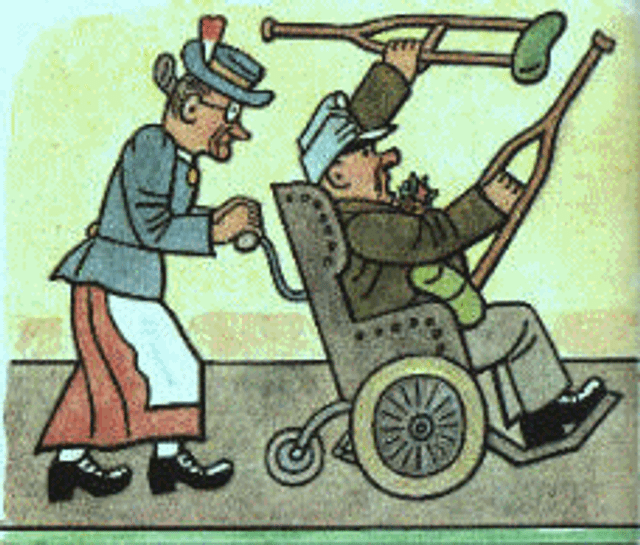
Another original illustration by Josef Lada
The novel was so influential that variations of the word “švejk” were adapted in the Czech lexicon to indicate idiocy and military absurdity. Nationalists and right-wingers throughout Europe despised the work, and by 1925 it was already banned in the Czech military, while the Nazis later publicly burned the German translation.
The novel opens in 1914 in the Austro-Hungarian Empire, a semi-feudal agglomeration of disparate nationalities, including Germans, Hungarians Czechs, Slovaks, Slovenians and other Slavic peoples. It was ruled by the rotting Hapsburg monarchy, with the Emperor Franz Joseph I as its figurehead. The assassination of the heir to the throne, Archduke Franz Ferdinand, by a Serbian nationalist on July 28, 1914, on a state visit to a Sarajevo, was the incident that provided the immediate impulse for the outbreak of the first imperialist war.
It is worth quoting from the first lines of the novel. Švejk is talking with Mrs. Mueller, a charwoman, who informs him that “Ferdinand” (i.e., the Archduke) has been killed. Švejk asks, “Which Ferdinand, Mrs. Mueller? … I only know of two Ferdinands. One of them does jobs for Prusa the chemist, and one day he drank a bottle of hair oil by mistake; and there’s Ferdinand Kokoska who goes around gathering manure. They wouldn’t be any great loss, either of ’em.”
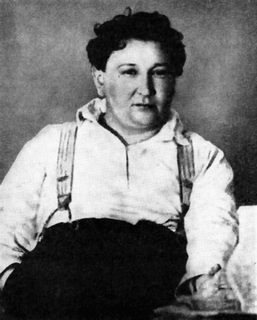
Jaroslav Hašek
This is typical. While Švejk officially declares his devotion to the throne, his comment about “Ferdinand” on the very first page allows his (and Hašek’s) real opinion of the monarchy’s worthlessness to come through. Even after he finds out that it is the Archduke who has been shot, Švejk continues in the same apparently naïve vein: “I wouldn’t mind betting that the man who shot the Archduke put on his best clothes for the job. You know, it wants a bit of doing to shoot an archduke; it’s not like when a poacher shoots a gamekeeper. You have to find out how to get at him; you can’t reach an important man like that if you’re dressed just anyhow.”
And this establishes the tone of the novel. Švejk, who was previously discharged from the army for idiocy, is subsequently arrested for his comments and redrafted into the army to serve in the war effort.
The hero, despite his absurd actions and blissfully unaware demeanor, is placed within a realistically depicted Austro-Hungarian society, with its ethnic divisions, corrupt military bureaucracy and population fearful of the war.
The novel is a scathing portrayal of that tottering society. Hašek drew from his personal experiences, including his time in prison, his travel and his former employment as a dog seller.
First assigned as personal assistant to army chaplain Otto Katz, a convert to Catholicism for career reasons, Švejk has the job of looking after the man who is almost always drunk. Katz eventually loses Švejk in a game of cards, forcing him to be “reassigned” to Lieutenant Lukáš. Under Lukáš, a womanizer, Švejk’s attempts to help the lieutenant set off a chain of events that makes both their lives worse.
An ongoing occurrence throughout the book, Švejk’s actions lead to a tipping point that exposes corruption, police repression and fragile ethnic relations within the empire. A hypothetically ideal soldier, Švejk prefaces all statements to superior officers with “Humbly reported, sir” and often states agreement with whomever he is around.
Švejk, however, is the comic exception to those suffering during the war, many people around him fall victim to the police-military apparatus and young men frequently attempt to injure themselves to avoid being sent to fight in the war.
Hašek occasionally breaks the comedic tone. A striking example of this is his remark about the officers at police headquarters:
“With the exception of a few people who were ready to admit that they were sons of a nation which had to bleed for interests completely alien to it, police headquarters presented the finest collection of bureaucratic beasts of prey, to whom jails and gallows were the only means of defending the existence of the twisted clauses of the law.”
Hašek, who was already an established writer by the time he wrote The Good Soldier Š vejk, took the novel extremely seriously and considered it his masterwork.
Born in 1883 in Prague, son of a high-school math teacher, Hašek’s family relocated several times in his youth. While studying in Prague, he witnessed the anti-German riot of 1897 and participated in ethnic clashes, forming a Czech gang with his classmates.
He was eventually forced to drop out of school at the age of 15 because of his father’s death two years earlier. He briefly worked as an apprentice to a pharmacist and as a bank clerk, while pursuing a career as a freelance writer and journalist.
In 1906, Hašek joined the anarchist movement, and the following year became editor of the anarchist journal Komuna. While he dropped out of radical politics to marry his first wife, Jarmila Mayerová, and win acceptance from her family, he maintained an outlook hostile to the Austro-Hungarian government and all of its political parties.
During the war, he was captured by the Russian army and as a prisoner joined the Czech Legion, under the promise that an Allied victory would allow for the creation of an independent Czechoslovakia.
Influenced by the October 1917 revolution in Russia, Hašek began arguing that only a workers’ revolution could liberate Czechoslovakia. He soon left the Legion to support the new Soviet government, one of a handful to do so. The Czech Legion later became infamous for fighting alongside the White Army against the Red Army during the Civil War of 1918-22.
Hašek went on to become a commissar in Bugulma, a small town in the southwestern region of Russia. He also worked to recruit ethnic minorities and foreign prisoners of war to support the Bolsheviks by working on a variety of journals.
Returning to Prague in December 1920, immediately after the new Czech government had suppressed an uprising of workers and had imprisoned leading Communists, Hašek faced a certain amount of skepticism from Czech Communists because of his questionable pre-war activities. The authorities also pursued him on charges of bigamy, since he remarried in Russia without divorcing his first wife.
The defeats of the first wave of post-war revolutionary struggles, with the exception of the Russian Revolution, apparently discouraged Hašek somewhat. He would later return to his old bohemian circle of friends and to excessive drinking. In private correspondence, he claimed that a socialist revolution in Czechoslovakia was not possible because the workers there were too passive.
In 1921, Hašek began work on Š vejk. Initially, publishers would not take Hašek’s work because they viewed it as Communist propaganda. Once he did get it published, however, the first volume sold so well he was pressured by the publisher and his friend František Sauer to continue writing.
Hašek was slow and inconsistent as a result of his alcoholism and related health problems. Eventually encouraged to move to the rural Lipnice, he died at the age of 39 having only completed a fraction of what he intended to write and leaving his major work unfinished.
Brecht noted in 1940 that Hašek’s realism consisted of a knowledge of human nature, a knowledge that “involves that clear sight of the oppressed regarding the oppressor with whom he must live, it involves that most sensitive ability to feel out his weaknesses and vices, the profound knowledge of his (the opponent’s) real needs and embarrassments, the constant and alert allowance made for the unpredictable and imponderable, etc.”
The Good Soldier Švejk is a work that ought to be widely read. In it Hašek comically and ironically distilled the experience of the oppressed derived from great historical events, which led to a vehement opposition to patriotism, bureaucratic careerism and authoritarianism. Its truths are perhaps more necessary than ever.

US deports Salvadoran war criminal Vides Casanova

Rafael Azul

General Carlos Eugenio Vides Casanova, who headed the Salvadoran National Guard (1979-89) and was Minister of Defense (1983-1989) during the CIA and Pentagon’s dirty war in El Salvador (1979-1992) was deported to San Salvador on Wednesday April 8 after the Board of Immigration Appeals refused to overturn a Florida immigration judge’s order of deportation.
Upon his arrival in San Salvador, Vides Casanova, 77, was met by a protest demonstration of torture survivors and their supporters, denouncing the general and demanding justice. Many were holding signs with the photos of victims of National Guard and Army death squads. It is estimated that the Salvadoran civil war killed 75,000 people, disappeared 10,000, and displaced more than one million.
The Salvadoran civil war took place while Democrat Jimmy Carter and Republican Ronald Reagan occupied the White House. The US had been unable in July 1979 of preventing the overthrow of Nicaraguan dictator Anastasio Somoza by the Sandinista Liberation Front. Amid a rising revolutionary upsurge in El Salvador against the corrupt, US sponsored tyranny of General Carlos Humberto Romero, Washington adopted the bipartisan policy of “no more Nicaraguas,” and became fully embroiled in the civil war on the side of a military-fascist junta that it installed to replace the discredited Romero in October 1979.
The White House armed and advised Vides Casanova’s National Guard and the Army death squads that disappeared, tortured and murdered tens of thousands. Upon taking power, the so-called “revolutionary junta” appointed Vides (then a colonel) National Guard commander. In 1983, Vides was promoted to general and installed as defense minister, replacing General José Guillermo García.
In 2013, federal immigration Judge James Grim in Miami Florida ruled, on the basis of witness testimony and documents, that Vides had known of and participated in the torture and killings of tens of thousands between 1979 and 1992, and, in what is considered an unusual interpretation of the law, ordered Vides Casanova’s deportation.
Commenting on the deportation order, Almudea Bernabeu, an international attorney at the California-based Center for Justice and Accountability (which fought for this result), said, "This is great news. It's been over 12 years since Vides Casanova and Luis Guillermo Garcia (a former general) were exposed as being responsible for ordering the torture of civilians in El Salvador…It took a humongous effort on behalf of the victims to get to this point of getting the US government to start deportation proceedings."
In 1992, a truth commission report revealed the role that the National Guard played in the disappearance, rape and execution on December 2, 1980 of three American nuns and a lay worker –Maura Clarke, Jean Donovan, Ita Ford and Dorothy Kazel— who worked among refugees in El Salvador. The truth commission concluded that Vides covered up and impeded the investigation into these killings, with the objective of absolving the National Guard and the Army of the crime.
Also participating in Vides Casanova’s cover-up was the US government itself, which sought to prevent any challenge to Washington’s continued funding of the Salvadoran military and its death squads. General Alexander Haig speculated, for example, that the four women had been killed for running through a military checkpoint. Four national guardsman convicted of their murder testified in 1998 that they were given assurances that they were carrying out “orders from above” and nothing would happen to them.
The truth commission report also describes how Vides Casanova covered up and impeded the investigation of the disappearance of law students, Franciso Arnulfo Ventura and José Humberto Mejía, from the parking lot of the US embassy in January 1980. Both are still missing. Vides Casanova had actively participated in the investigative cover-up that took place, absolving the National Guard and government forces of all culpability. By this time, Vides Casanova had settled in the United States with permanent resident status.
These acts are merely the tip of an iceberg of crimes against humanity that Vides Casanova committed, participated in and covered up.
In 2002, a Florida jury found Vides and Gen. Jose Guillermo Garcia, another former Salvadoran defense minister, civilly liable for the torture of three Salvadorans, including Carlos Mauricio, a professor of Agricultural Sciences, kidnapped by a death squad and tortured by the military under Vides Casanova. Carlos Mauricio is active in the struggle against the sinister “School of the Americas,” a torture, repression and counterinsurgency academy ran by the Pentagon. There is evidence that the killers of the nuns, and many of those that formed the Army death squads, had been trained at the School of the Americas, including Vides and García.
In 1985, Vides Casanova took a break from directing death squads and the National Guard to address the School of the Americas (now renamed Western Hemisphere Institute for Security Cooperation). Other graduates included El Salvador’s most infamous torturer, Roberto D'Aubuisson (a.k.a. Major Blow Torch, for his preferred torture technique). They, and others, were trained in torture and mass terror. D'Aubuisson was involved in the assassination of San Salvador Archbishop Oscar Romero in March of 1980.
The case against Vides Casanova in the US courts began in 2009, when the Department of Homeland Security charged him with “ordering, inciting, assisting or otherwise participating” in acts of torture extrajudicial killing, all violations of the INA immigration law (Immigration and Nationality Act) and the 1980 Refugee Act that blocked abusers of human rights from immigrating into the US.
In reality, these laws have repeatedly been observed in its breach; the US houses and protects from deportation and extradition thousands of torturers and butchers who acted on behalf of US imperialism, such as Luis Posadas, Orlando Bosch and other participants in the 1976 bombing of the Cubana de Aviación passenger airliner and the bombing of Havana hotels.
Vides Casanova himself protested that, since he had had acted in accordance with US policy at the time, he ought not to be deported.
As the former defense minister’s lawyer, Diego Handel, argued, “The United States government was an active participant on the side of the El Salvadoran government.” He charged that it was unfair to deport Vides Casanova under conditions in which none of the US officials who were complicit in the regime’s war crimes had ever been called to account.
Even after the 2012 deportation decision, the US Justice Department refused to release its records on the immigration hearings for Vides Casanova to New York Times reporter Julia Preston, arguing that the court decision was not final and that it was protecting Vides Casanova’s “privacy.”
Vides Casanova was well known by the US State Department, having visited with US officials repeatedly during the dirty war. His admission as a green card holding immigrant was surely no oversight or mistake.
Whatever reasons the Obama administration had for deporting Vides Casanova, a wealthy man who married into the coffee oligarchy of El Salvador, he will not be tried in El Salvador because of a general amnesty covering the crimes committed under the US-backed dictatorship.

French officials debunk NATO warnings of Russian invasion of Ukraine

Stephane Hugues

US and European claims that Russia is threatening to invade Ukraine are false, based on stove-piped intelligence fed to NATO largely by Washington and contradicted by detailed information available to French intelligence agencies.
This was revealed last month in public testimony at the French National Assembly by Director of Military Intelligence General Christophe Gomart,available on the National Assembly’s web site. For several weeks, Gomart’s testimony was studiously covered up by the French, European and US media. However, the story broke when it was recently covered by Russian state media outlets Russia Today and Sputnik News .
Gomart spoke at a hearing of the Commission on National Defense and the Armed Forces at the National Assembly, discussing France’s draconian new Intelligence Bill legalizing mass electronic surveillance of the population along the lines of NSA spying uncovered by Edward Snowden. He was arguing, in particular, for boosting the budget of his Directorate of Military Intelligence (DRM).
Responding to Deputy Frédéric Lefebvre’s question on relations with NATO, Gomart said: “The real problem with NATO is that US intelligence is preponderant there, whereas French intelligence is only more or less taken into account—from this follows the importance of providing enough intelligence of French origin to NATO commanders.”
Gomart bluntly stated that NATO warnings about an imminent Russian invasion of Ukraine were lies contradicted by the DRM’s information. He said, “NATO had announced that Russia would invade Ukraine, whereas according to our information, nothing supported this hypothesis—indeed, we observed that the Russians had not deployed command centers or a supply chain, notably military hospitals, that would allow for a military invasion, and reserve units had not moved at all.”
He added, “Subsequent events proved us right, because if some Russian soldiers were indeed seen in Ukraine, it was more a maneuver aiming to exert pressure on Ukrainian President Poroshenko than an attempted invasion.”
In his reply to a question by deputy Edith Gueugneau on cooperation with other European countries, Gomart said: “Cooperation with countries in Western Europe is good. The DRM participates in two forums, including one that regularly brings together NATO countries to discuss various subjects.”
Gomart added, “I remember that in one of these forums, someone tried to force our hand on Ukraine. This shows the importance of having concrete and factual intelligence: from this standpoint, France has resources that allow it to make an assessment of the situation and to argue for its point of view.”
Despite the calculated ambiguity of Gomart’s remarks, their implications are staggering. The deputies in the Assembly were remarkably indifferent in their questioning of Gomart on Ukraine, and did not ask him who tried to “force our hand” on Ukraine, and what policies they advocated.
Yet it appears that false information largely provided to NATO by Washington was used to press for NATO preparation for an imminent Russian invasion of Ukraine—that is, a major military build-up placing NATO military forces across Europe on high alert aimed at Russia. The risks posed to the world’s population by such a criminally reckless policy, which heightens the danger of the eruption of all-out war between NATO and nuclear-armed Russia, are incalculable.
Gomart’s assertions were supported by Philippe Migault, an Eastern Europe expert at France’s Institute of International and Strategic Relations (IRIS) think-tank. “France will not be fooled. France has its own sources of information, and we are aware what the explanation for the crisis in Ukraine is,” Migault told Sputnik News.
The remarks of Gomart and Migault underscore the fraudulent character of the NATO war drive against Russia. Since the pro-Western, fascist-led coup in Kiev let to the outbreak of civil war in Ukraine, the Obama administration, the Pentagon, and the European ruling elite have whipped up hysterical propaganda denouncing Russia as an imminent threat to the world order.
Washington used this to launch a sanctions drive to largely cut off Russia from the world financial system, and lead a series of provocative NATO military exercises all along Russia’s borders—in the Baltic ex-Soviet republics, Poland, Bulgaria, and the Black Sea area.
The major European imperialist powers knew that the underlying propaganda was fraudulent, but they backed it and sought to use it for their own purposes. The government of German Chancellor Angela Merkel has exploited the Ukraine crisis to declare an end to the post-World War II policy of German military restraint. Berlin is now adding eight billion euros to its military budget, and Merkel is working with French President François Hollande to form a European army.
The fact that a story about public testimony at the French National Assembly broke in the Russian media underscores the duplicity of the French media and political establishment and its participation in the war drive against Russia. Gomart’s comments were buried in the proceedings of the National Assembly. Neither the government nor any major French news media reported them or, for that matter, Russian media coverage of Gomart’s testimony.
The situation facing the international working class is the most dangerous since the end of World War II or the most tense nuclear standoffs of the Cold War period.
Behind the backs of the world’s population, NATO is bringing the world to the brink of nuclear war, based on lies. The NATO governments collectively have adopted the type of criminal tactics the Bush administration adopted as it launched its war in Iraq, based on false claims that Iraq had weapons of mass destruction (WMD). While the resulting invasion and civil war cost over a million lives, that appalling toll would be dwarfed by the casualties that would result from all-out war between NATO and Russia.
The threat of war with Russia also exacerbates the tensions among the imperialist powers inside NATO. The caustic comments by Gomart and Migault on Washington’s role in Ukraine follow Hollande’s brief warning in February, prior to Minsk talks to broker a temporary peace deal in the Ukrainian civil war, that NATO and Russia could find themselves in a “total” war. At the same time, the European powers’ relatively less aggressive attitude to Russia has provoked bitter recriminations by US officials and foreign policy specialists.
In a recent comment titled “America will lose patience with European appeasement,” Robert Kaplan of the Center for a New American Security think-tank denounced Europe for its lack of military aggressiveness against Russia.
Threatening that opinion in the US foreign policy elite might shift decisively against Europe if it did not fix its policies, Kaplan wrote: “The America security umbrella will not stay up forever. Barack Obama’s alleged lack of resolve in dealing with Mr Putin may say less about the US president’s own foreign policy than about a gradual shift in US opinion. Why should America defend a continent that will not defend itself?”

Congressional briefing paper highlights US/UK tensions

Richard Tyler

The “special relationship” with the United States has been seen by British governments of all political stripes as a counterweight to the challenge it faces from its major European rivals, particularly Germany—enabling the UK to punch above its weight in world politics.
Growing conflicts around the globe over trade, resources, transit routes and geo-political hegemony are now placing such long-standing political relations of the post-war era under enormous strain.
A report prepared by the Congressional Research Service concludes, “The UK may not be viewed as centrally relevant to the United States in all of the issues and relations considered a priority on the US agenda.”
The paper sets out a range of issues for US policymakers to consider in light of the upcoming UK general election on May 7. It finds that the US-UK political relationship is “likely to remain close”, and that the “‘special relationship’ will remain strong on many vital issues in which the UK is a crucial US ally.”
However, it points to the fact that many policy analysts in the US “believe that some reassessment of the ‘special relationship’ may be in order” due to changes in its “geo-political setting.”
The report notes that the 2015 general election is “likely to result in the second hung parliament, with no absolute majority of seats for any party.” This could lead to a “period of ambiguity, constitutional uncertainty and competing interpretations.”
In return for continued US support, the paper presents a list of “concerns” on which it wants reassurance.
One crucial area of concern is Britain’s relation with the European Union, where the UK has largely pursued policies that have bolstered American interests on the continent.
“Should Cameron be re-elected, the referendum campaign and the possibility of a ‘Brexit’ [British exit from the EU] are likely to become central preoccupations of British and EU politics,” the document states. British membership is “essential for efforts to develop more robust EU foreign and defence policies”.
Britain is regarded as “the strongest US partner in Europe, and a partner that commonly shares US views”. Its departure could, therefore, “change the economic character of the EU because the UK generally acts as a leading voice for economic liberalism in EU debates about trade and the single market.”
The paper states “senior Administration officials have reportedly conveyed their concerns that a UK break from the EU would reduce US influence in Europe, weaken the EU’s position on free trade, and make the EU a less reliable partner on security and defence issues.”
In March, Labour leader Ed Miliband began his party’s official campaign for the general election with a speech to corporate heads at Bloomberg’s London headquarters, where he insisted that a Labour government was best placed to avert the “clear and present danger” facing the UK economy from a referendum on British membership in the EU.
His appeal was also clearly directed at Washington. Launching Labour’s business manifesto, he stressed, “If you care about prosperity, then Britain must be a committed member of a reformed European Union.”
The unspecified reforms raised will, like Cameron’s own demands, focus precisely on issues relating to “economic liberalism” and “free trade.” On the military front, the document continues, British support “has often helped add international credibility and weight to US policies and initiatives.”
While this had been the case in 2003, in the US-led war against Iraq, the Obama administration’s plans for a war against Syria in 2013 were derailed when the British parliament voted against supporting this military adventure owing to a combination of public hostility to the planned imperialist aggression and concerns within the military over the level of preparation.
Britain’s defence spending is another area where there are major anxieties in Washington. “US officials have been expressing their growing alarm about the potential effects of cuts to UK defence spending and reductions in the size and capabilities of the British military.”
The paper points to the close collaboration of the US and UK on defence industry cooperation and procurement, with the two countries “engaged in more than 20 joint equipment programmes”. US foreign military sales involving the UK totalled nearly $700 million in 2013, with direct sales to the UK amounting to another $208 million.
However, while Britain was “one of the few NATO countries to consistently exceed the alliance’s tacit defence spending benchmark of 2 percent of GDP,” it notes that “Prime Minister Cameron has thus far declined making a commitment to maintain defence spending” at this level.
“Further reductions in defence expenditure would damage the UK’s credibility as a military ally,” the paper concludes.
The Conservative/Liberal Democrat government has sought to reassure Washington of its support for the policies it is pursuing against Russia. Not only is the UK a staunch advocate of sanctions, but it is fully engaged in NATO’s plans to strengthen its military presence in Eastern Europe and is currently part of a major naval exercise simulating war against Russia.
However, in the section headed “Political relations”, it records that the political fall-out in the UK as a result of Tony Blair’s support for the Iraq war exacted a “high price with the British public and within his own Labour Party.”
It cautions that “future British prime ministers might think twice about boldly supporting controversial US policies or whether they might make more explicit demands of the United States as the price for support.”
“Some British observers became anxious to assert that British national interests come first in deciding British policy, that these interests are not always identical to US national interests, and that the UK should not be overly deferential to the United States in foreign policy issues.”
This alludes in particular to the most recent and bitter fall-out between Washington and London over the Asian Infrastructure Investment Bank (AIIB). Ignoring American entreaties, Britain signalled its intention to join the Chinese-led financial institution, unleashing a flood of other sign-ups, with over 40 countries joining the AIIB.
The section in the report dealing with economic relations is the shortest—under half a page in a 20-page document. Nevertheless, the figures it presents point to the mutual importance of the US-UK bilateral investment relationship, “the largest in the world.” Any significant worsening of US-UK relations could threaten nearly one trillion dollars in foreign direct investment and over $7 trillion in corporate assets, affecting the employment of over two million workers on both sides of the Atlantic, it states.
The document’s conclusion also insists that the UK’s usefulness to the US depends on the determination of its ruling elites to continue to impose tax cuts for business paid for through savage austerity measures targeting the working class. “Many observers assert that a significant degree of the UK’s international influence flows from the success and dynamism of the British economy,” it states, “further raising the stakes on whether the UK can sustain stronger economic growth while continuing to pursue ambitious fiscal consolidation.”

Blackwater mercenaries sentenced for 2007 Iraq massacre

Niles Williamson

A federal district court judge sentenced four former Blackwater Worldwide mercenaries to lengthy prison terms on Monday for their role in the Nisour Square massacre in Baghdad, Iraq in 2007.
Nicholas Slatten, Evan Liberty, Paul Slough and Devin Heard were convicted on charges of first-degree murder and manslaughter by a federal jury in October 2014. The four were part of a security team working for the US State Department in Iraq.
On September 16, 2007 the members of the convoy, unprovoked, opened fire with their automatic weapons on stopped traffic in Nisour Square and also launched stun grenades. The mercenaries continued to fire their weapons as civilians tried to flee the area. One member of the security team did not stop firing his automatic rifle, despite calls to cease fire, until a fellow mercenary threatened to shoot him. Blackwater mercenaries in helicopters also fired into traffic from overhead.
The massacre resulted in the deaths of 17 unarmed Iraqis and wounded at least 20 others.
Monday’s sentencing was the conclusion of a years-long process, which has wound its way through the federal court system. Charges were first brought by the Department of Justice in 2008 and subsequently dismissed by a district judge in 2009 before being reinstated by an appeals court in 2011. The US government rejected Iraqi demands that the Blackwater mercenaries stand trial in Iraq.
Jeremey Ridgeway and Donald Ball, two other Blackwater contractors who were involved in the massacre, were originally charged along with the four others but had their cases resolved previously. Ridgeway struck a deal with prosecutors in 2010 and pled guilty to manslaughter, attempted manslaughter and aiding and abetting. All charges against Ball were dropped in 2013.
The judge sentenced Slatten who was convicted of first-degree murder to life in prison. Liberty, Slough and Heard, convicted of voluntary manslaughter and using a machine gun to carry out a violent crime, were each given the mandatory minimum sentence of 30 years in prison. All four men have filed appeals of their convictions and sentences.
US District Court Judge Royce Lamberth rejected a motion by the defense to reduce the four men’s sentences. “Based on the seriousness of the crimes, I find the penalty is not excessive,” the judge stated. Lamberth also turned down a motion by the federal prosecutor to impose harsher sentences.
Monday’s sentencing hearing was taken up by testimony from family members of the Iraqi victims as well as character witness for the mercenaries. Mohammad Kinani Al-Razzaq testified about the murder of his nine-year-old son, Ali Mohammed Hafedh Abdul Razzaq, demanding that the judge show the former Blackwater employees “what the law is.”
“What’s the difference between these criminals and terrorists?” Razzaq asked rhetorically.
Assistant US Attorney T. Patrick Martin stated that the lengthy sentences handed out Monday would prevent American contractors from carrying out similar atrocities in the future. “You are entrusted to do a job with deadly weapons, but you must use them only when necessary, and their use must be justified. You can’t just shoot first and seek justification later,” he said.
The convictions, handed down in October, have been depicted as an example of the US government’s commitment to justice and democratic principles. “This verdict is a resounding affirmation of the commitment of the American people to the rule of law, even in times of war,” US Attorney Ronald Machen said last year.
While the Blackwater guards are certainly guilty of the wanton murder of innocent Iraqis, the massacre in Baghdad was just one of many notorious atrocities, which flowed out of the logic of the illegal invasion and occupation of Iraq launched in 2003. The perpetuators of these crimes were, among others, President George W. Bush, Vice President Dick Cheney, Secretary of State Colin Powell and National Security Advisor Condoleezza Rice.
Other notorious incidents seared in the collective consciousness are the US military’s assault on the city of Fallujah in 2004 in which white phosphorous and incendiary bombs were deployed, the torture of inmates at the notorious Abu Ghraib prison facility and the Haditha massacre in which US Marines killed 24 unarmed civilians.
There were an estimated 20,000 to 30,000 so-called security contractors employed by the US at the peak of its occupation of Iraq. Blackwater was just one of a number of private firms that were providing security and military services for the US military and State Department. A report by the Democratic staff of the House Oversight Committee released in 2007 found that Blackwater guards were firing their weapons an average of 1.4 times a week and in 80 percent of cases were the first to open fire.
While the four former Blackwater mercenaries have been sentenced to prison, those who placed them in Nisour Square, Bush et al, remain free from even the threat of prosecution. To date none of those ultimately responsible for the destruction of Iraqi society and the deaths of more than a million Iraqis have been held to account. When it comes to those in positions of power the Obama administration has held to its mantra in relation to other crimes of the US government, including systematic torture carried out by the CIA, “look forward, not back.”
Blackwater Worldwide, which has since changed its name to Academi Services, continues to offer its mercenary services to governments around the world. Amidst anti-austerity protests Academi was contracted by the Greek government at the end of 2012 to oversee police services and provide protective services to government members and agencies. German media reported that Academi operators were working alongside the fascist Right Sector militia in Ukraine to suppress pro-Russia separatists opposed to last year’s US backed right-wing coup.

Egyptian junta condemns Muslim Brotherhood chief Mohamed Badie to death

Alex Lantier

In yet another a transparently political verdict, the Egyptian military regime on Saturday condemned to death Mohamed Badie and other leaders of the Muslim Brotherhood (MB), the Islamist organization toppled from power by an army coup in July 2013. Those convicted are expected to appeal the verdicts.
Badie and other MB members were accused of running an “Operations Room” at a sit-in in Rabaa Square in Cairo opposing the July 2013 coup. The army attacked the sit-in and drowned it in blood, killing approximately 1,000 people and wounding 4,500.
Also condemned to death were Omar Malek, the son of leading MB businessman Hassan Malek; former MB spokesman Mahmoud Ghozlan (in absentia); and MB officials Saad El-Hoseiny and Saad Emara.
In a statement, the MB attacked the ruling as “issued vengefully by the junta’s judiciary, who act only on instructions from the Generals, to abuse, oppress, and deal out injustice. We are therefore confident that the junta’s judiciary will fall, just as those unjust sentences will be annulled.”
In the same case, 37 defendants were sentenced to life in prison, including Saad El-Shater, the son of MB business tycoon Khairat al-Shater, and American-Egyptian dual-national Mohamed Soltan, whose father Salah Soltan was condemned to death in the same case. Mohamed Soltan was declared guilty of supporting the MB and spreading lies about the political situation in Egypt in the media.
Mohamed Soltan has mounted a hunger strike to protest his detention, and US authorities felt compelled to denounce the verdict against him.
“The United States condemns the life sentence issued today in Egypt against American citizen Mohamed Soltan,” White House spokesman Josh Earnest said. “We call for Mr. Soltan’s immediate release from prison.... We remain deeply concerned about Mr. Soltan’s heath, which has suffered during his 20-month-long incarceration.”
Human Rights Watch (HRW) executive director for Middle East and North Africa Sarah Whitson denounced the trial as a “sham proceeding.” She added, “The fact that those who publicized the mass killings of 2013 could go to prison for life while those who did the killings receive official accolades perfectly symbolizes the abject failure of transitional justice in Egypt.”
Nonetheless, Washington and its European allies are supporting the Egyptian junta’s mass death sentences and show trials. The Obama administration continues to arm the junta to the hilt, using it as a military proxy for its Middle East wars and guard against the danger of a resurgence of the revolutionary struggles in the Egyptian working class that toppled US-backed dictator Hosni Mubarak in 2011.
The Egyptian junta’s street massacres, show trials, and mass death sentences promote an atmosphere of political terror in Egypt and thus help block renewed working class struggles. They are therefore welcomed in Western capitals. Amid a surge of strikes in early 2014, the junta launched the first mass death sentences condemning 529 MB supporters last March, a further 683 last April, and 185 more in December. Yet the junta has consistently remained a close ally of the United States, as Washington seeks to mobilize it for wars in Libya, Yemen, and beyond.
On March 31, Obama personally telephoned Egyptian military dictator General Abdel Fattah al Sisi, informing him that the White House was eliminating the partial “executive hold” it had imposed on military aid to Egypt shortly after the 2013 coup. Obama assured Sisi that he would seek to keep providing the Egyptian army with $1.3 billion in annual military aid. He added that the two would “stay in touch in the weeks and months ahead.”
On Sunday, the day after the mass death sentence involving Badie was announced, US secretary of state John Kerry telephoned Egyptian foreign minister Sameh Shoukri to discuss bilateral US-Egypt relations. According to an Egyptian foreign ministry statement, they discussed the wars in Libya, Syria, Iraq, and Yemen, as well as collaboration between Washington and Cairo at the UN and on Palestine.
The show trials against the MB have also become closely tied up with reactionary attempts by the junta to broaden its base inside the Egyptian ruling class, so it can join in US-led wars in the Middle East in the face of broad popular opposition. The most pressing conflict appears to be the US-backed Saudi intervention in Yemen. Egypt, which depends financially on Saudi Arabia to fill its budget deficits, is preparing to contribute ground troops to the Yemen war despite misgivings in Egyptian ruling circles.
There is broad concern in Cairo that such an adventure, after Egypt’s disastrous intervention in the 1962-1967 civil war in Yemen, will be a bloody failure, triggering a broader war and inflaming already explosive class tensions in Egypt. “There is no Egyptian answer that respects the general anxiety and can build wide national consensus before deploying troops abroad,” warned Abdallah El-Sinnawi in El Shorouk.
“We shouldn’t jump to war.... We need to know if Saudi Arabia is ready for the costs. Yemen is a sleeping volcano south of the Arabian Peninsula. If it erupts, it will sweep the entire region,” said Sisi supporter Mohamed Heikal in a television interview.
As it prepares to plunge into broader and bloodier conflicts, the Egyptian junta is opening back-channel talks with various forces inside and on the periphery of the MB, seeking some sort of possibly Saudi-backed accommodation. Islamic scholar Tarek al-Bishri is reportedly seeking Saudi support to broker talks between the MB and the Sisi junta.
Last month, Sisi met personally with three leading members of the Dissident Muslim Brotherhood organization, an ostensibly pro-Sisi breakaway from the MB.
The multiple death sentences on various trumped-up charges against Badie and other MB defendants—which trigger a long process of going to Egypt’s Grand Mufti for religious sanction, then facing appeals and finally further trials—are a sinister bargaining chip in these negotiations.
Badie was reportedly among both the 529 condemned to death in March 2014 and the 683 condemned to death in April 2014. While he appeals his latest death sentence, Badie still faces further charges of espionage and of breaking out of jail.
“In the confrontation between the state and political Islam, pressure is being sustained, on the one side, by long prison terms for Muslim Brotherhood leaders.... It is a game of nerves, in which each side is seeking to strengthen its hand for whatever negotiations eventually ensue,” wrote Egypt’s state-run Ahram Weekly.

Australian citizen on US drone “kill list”

Peter Symonds

A front-page article in last Friday’s Australian reported that, for the first time, an Australian citizen—Mostafa Farag—had been placed on the Obama administration’s “kill list” for assassination by drone attack. The lack of any response, let alone criticism, from any section of the Australian political and media establishment underscores not only its support for Washington’s criminal actions but its contempt for democratic rights at home.
Farag is an Islamist cleric, also known as Abu Sulayman al Muhajir, who reportedly left Australia for Syria in 2012 and is now a member of the sharia council or leadership body of the Al Qaeda-linked Al-Nusra front in Syria. He played a role in attempting to mediate between Al Nusra and its breakaway—the Islamic State of Iraq and Syria (ISIS)—but failed leading to bitter recriminations on both sides.
No explanation has been given for the US decision to put Farag on its hit list, which according to the Australian, took place sometime in 2012–13 under the previous Greens-backed Labor governments of prime ministers Julia Gillard and Kevin Rudd. The current Coalition government “was informed soon after it came to office.” All the major parties have sanctioned the targeting of an Australian citizen for assassination without the slightest pretence of legal process.
The cynicism involved is breathtaking. While adding Farag to its kill list, the US and its allies including Australia were fully backing the war being waged by Syrian opposition militias such as Al Nusra to oust Syrian President Bashar al-Assad. The emergence of reactionary Islamist organisations such as Al Nusra and ISIS as the dominant military forces in the Syrian opposition is due in no small measure to large quantities of finance and arms provided by US allies such as Saudi Arabia and the Gulf States.
For the Obama administration, “targeted killings” have become routine. The US has arrogated to itself the “right” to murder anyone, in any part of the world. This includes at least three American citizens who have been killed so far, in flagrant breach of the US law and constitution: Anwar al-Awlaki, his 16-year-old son Abdulrahman al-Awlaki and Samir Khan. Thousands of innocent civilians have died as a result of US drone strikes in Pakistan, Afghanistan, Yemen and other countries.
In April last year, Australian citizen Christopher Harvard and dual Australian-New Zealand citizen Muslim bin John were killed in a US drone strike in Yemen that targeted Abu Habib, supposedly a leading figure in Al Qaeda in the Arabian Peninsula (AQAP). US authorities notified the Australian government of the deaths describing Harvard and bin John as “collateral damage” and suggesting that they had been AQAP “foot soldiers”.
The Australian and New Zealand governments both justified those killings as part of the “war on terror.” Asked to comment on the placing of Farag on the US hit list, spokespersons for Australian Foreign Minister Julie Bishop, former Labor foreign minister Bob Carr and former Labor attorney-general Mark Dreyfus, as well as the US embassy in Canberra, all refused to comment to the Australian on security grounds. The Greens confirmed to the WSWS yesterday that they had issued no comment.
This silent complicity makes clear that there is no line that the Australian political establishment will not cross. Successive governments, Labor and Coalition, condoned the arbitrary imprisonment and torture of two Australian citizens—Mamdouh Habib and David Hicks—who were detained by American authorities in Afghanistan in 2001. Habib was subject to “extraordinary rendition” to Egypt where he was tortured before being sent to Guantanamo Bay and finally released in 2005 without charge. Hicks was held in Guantanamo Bay before being transferred to an Australian prison in May 2007 then released in December 2007 as part of a plea deal. The charges against him were annulled by a US court this year.
At the same time, Labor and Coalition governments have been party to the vendetta against Australian citizen and WikiLeaks founder Julian Assange whose only “crime” has been to expose US imperialism’s war crimes in the Middle East and its diplomatic intrigues and skulduggery around the world. He remains holed up in the Ecuadorian embassy in London after being forced to claim political asylum in the face of trumped-up allegations of sexual assault brought by Swedish authorities. Washington’s aim is to extradite him to the US to face trial on unspecified charges that may include the capital offence of espionage.
The tacit support in Australian ruling circles for the extra-judicial killing of Mostafa Farag, in which the US administration will be judge, jury and executioner, makes a mockery of the official appeals for clemency of two convicted Australian drug smugglers in Indonesia who face the firing squad. This thoroughly hypocritical campaign is both to capitalise on the groundswell of public opposition to the death penalty and to cover up the role of the Australian Federal Police in delivering Andrew Chan and Myuran Sukumaran to Indonesian authorities knowing full well they could face execution if convicted.
In the case of Mostafa Farag, the Australian government is no bystander. The joint US-Australian spy base at Pine Gap in Central Australia plays a central role in intercepting communications and pinpointing targets for drone attack. A Fairfax media article in 2013 indicated that a “primary function” of what is one of the world’s largest satellite ground stations is to identify the “geolocation” of radio signals, including hand-held radios and mobile phones, throughout the “eastern hemisphere, from the Middle East across Asia to China, North Korea and the Russian far east.”
The direct involvement of the Australian political and security establishment in US criminal activities is a warning to workers and young people of the anti-democratic methods that will be used at home to suppress any resistance to its agenda of war and austerity.

US government targeted second American citizen for assassination

Andre Damon

A lead article in Monday’s New York Times describing a debate within the US government over whether to assassinate another American citizen brings into relief one basic fact: the United States is run by criminals.
The Times article revealed the name of an American citizen who had been placed on the so-called “kill list” for drone assassination. Due to a number of contingencies, the life of Texas-born Mohanad Mahmoud Al Farekh was ultimately spared. He was captured in a raid in Pakistan last year and was taken to the United States to face trial in Brooklyn, New York.
It has been known since 2010 that the Obama administration had decided to place at least one US citizen on its “kill list” of targets for drone assassination. This was Anwar al-Awlaki, who was assassinated in Yemen on September 30, 2011, many months later. The killing was a premeditated and unconstitutional act, targeting an individual who had not been charged, let alone convicted for any crime.
In a May 2013 speech at the National Defense University, President Barack Obama formally acknowledged the killing al-Awlaki, while also admitting that three other Americans had been killed as part of the “collateral damage” of other drone strikes. This included Awlaki’s teenage son one month after the killing of his father.
In February 2014, the Associated Press, citing “senior US officials,” reported that the White House was “wrestling with whether to kill [another US citizen] with a drone strike.” That man, unnamed at the time, was evidently Farekh.
Monday’s New York Times article makes clear that the life of Farekh was spared not because of any fundamental constitutional or democratic concerns, but rather as a result of tactical disagreements and jurisdictional conflicts among the agencies responsible for drone killings, including the Central Intelligence Agency, the Pentagon and the Justice Department.
According to the Times, “The Pentagon nominated Mr. Farekh to be placed on a so-called kill list for terrorism suspects; CIA officials also pushed for the White House to authorize his killing. But the Justice Department, particularly Attorney General Eric H. Holder Jr., was skeptical of the intelligence dossier on Mr. Farekh.”
In other words, the decision against murdering Farekh was entirely a matter of expediency, based, according to the Times, on the belief by the Justice Department that his capture would better serve the purposes of American imperialism than his extrajudicial killing.
According to the Times piece, a major reason for not killing Farekh was the fact that he fell through the jurisdictional cracks between the Pentagon and the CIA in their operations inside Pakistan.
The Times writes that in 2013, “The White House directed that the Pentagon, rather than the CIA, should conduct lethal strikes against American citizens suspected of terrorism … But the Pentagon has long been banned from conducting drone strikes in Pakistan, part of a 2004 deal with Pakistan that all such attacks be carried out by the CIA under its authority to take covert action—allowing Pakistan to publicly deny any knowledge of the strikes and American officials to remain silent.”
Between 2004 and 2015, the US killed as many as 3,949 people through drone strikes in Pakistan alone, according to the Bureau of Investigative Journalism.
Top administration officials are well aware that what they are doing is illegal and unconstitutional, particularly in relation to US citizens. One unnamed “former senior official” told the Times that “Post-Awlaki, there was a lot of nervousness” about killing American citizens, reflecting the very real awareness in the Obama administration that its actions could leave it open for prosecution in the future.
Whatever these concerns, however, the Obama administration, along with the entire political establishment, has vigorously defended the right of the president to assassinate US citizens without due process.
Tellingly, the Times reported that congressional leaders functioned not as a restraint and a check on the criminal actions of the White House and CIA, but rather sought to goad the White House to murder Farekh. The article states, “During a closed-door hearing of the House Intelligence Committee in July 2013, lawmakers grilled military and intelligence officials about why Mr. Farekh had not been killed.”
In February 2013, Attorney General Holder made clear that the administration claims its right to extrajudicially assassinate US citizens, even within the borders of the United States.
Holder wrote in a letter to Senator Rand Paul: “It is possible, I suppose, to imagine an extraordinary circumstance in which it would be necessary and appropriate under the Constitution and applicable laws of the United States for the President to authorize the military to use lethal force within the territory of the United States.”
In his May 2013 speech, Obama reinforced his commitment to the drone murder program, declaring, “America’s actions are legal … We were attacked on 9/11. Within a week, Congress overwhelmingly authorized the use of force.”
Obama then declared, seemingly contradicting himself, “For the record, I do not believe it would be constitutional for the government to target and kill any US citizen—with a drone or with a shotgun—without due process.”
This statement revolves around a crude verbal sophistry. In 2012, Attorney General Holder argued that the Constitution’s declaration that no person shall “be deprived of life … without due process of law” did not specify judicial process, but rather could apply to the internal deliberations within the executive branch.
As a result, the administration argued, the types of negotiations between cabinet officials, intelligence agencies and allied governments chronicled in Monday’s Times piece qualify as “due process.”
The Times article on Farekh was certainly cleared with the Obama administration and US intelligence agencies before being published. This may indicate that the turf battles described in it continue, and the article is part of ongoing maneuvers between the military and intelligence agencies of the US state apparatus.
The article is also part of a process of legitimizing and normalizing the clearly illegal and impeachable offenses described. In June of last year, the Obama administration released the drone murder memo outlining is pseudo-legal rationale for killing US citizens. Neither the memo not the crimes it outlined produced any significant objection from within the state or media establishment, the representatives and spokesmen of the corporate and financial aristocracy in America.

Saudi Mercenary’s And The Starvation Of Yemen

Thomas C. Mountain

The Saudi military is almost entirely staffed by mercenaries. The Saudi jets bombing an air defenseless Yemen are piloted by Pakistanis. Its mid and low level officers are mainly from Jordan and most ominously for its ability to actually launch a ground invasion, its rank and file soldiers are almost entirely from Yemen.
That's right, the Saudi army is packed full of Yemeni cannon fodder, which helps explains its ignominious failure in its war with Yemen’s Houthi’s in 2009.
Does anyone really believe that the Yemeni soldiers for hire in the Saudi army are going to willingly, never mind effectively, invade their own country, leaving a trail of destruction in their wake all the while killing, and being killed by, their Yemeni brothers and sisters?
This may explain the reluctance of the Saudi leadership to launch their promised invasion, especially while the Houthi militia’s are still an effective fighting force on the ground.
Supposedly Egypt is going to send its army to help invade Yemen, never mind Yemen being the graveyard for thousands of Egyptian soldiers in what the late President Nasser called Egypt’s Vietnam in the early-mid 1960’s.
The Egyptian army is made up of mostly illiterate conscripts dragooned from the poorest sectors of Egyptian society and has been particularly inept at suppressing the vicious insurgency being waged again President Al Sisi’s regime in the Sinai. If the Egyptian army cant even control its own territory it certainly doesn't bode well for any foreign misadventures it may undertake.
Of course it takes time to prepare the logistics needed to send a large fighting force to invade another country so Egyptian boots on the ground in Yemen may yet happen, but don't hold your breath.
If Yemeni artillery and rockets start blasting shipping of the “Saudi led coalition”, a demand being expressed by massive Yemeni demonstrations, Egypt wont have much choice. The “Bab al Mandeb” (so aptly named “the gate of tears”) is so narrow that all shipping traveling through this strategic choke point between the Indian Ocean and the Red Sea have to pass well within range of even light artillery. President Al Sisi has already raised the alarm of the danger if such a disaster should strike, though preventing such is easier said than done.
And all the while starvation spreads through out Yemen, a country already one of the hungriest in the world. Yemen is one of the most food aid dependent countries on the planet importing by some accounts up to 90% of its food.
The Saudi leadership must figure if they can’t defeat the Yemeni resistance with their airpower they will cut off all food supplies and wait for starvation to bring Yemen to its knees?
To help hurry this process up Saudi war planes have already begun bombing major grain depots in Yemen, as all the while the “Saudi led coalition” has prevented all but the equivalent of a couple of truck loads of supplies flown in by the Red Cross. A couple of truck loads to feed a food aid dependent country of almost 25 million in the midst of a barbaric air bombardment?
As the Saudi air force continues to terrorize the Yemeni population with bombs marked “made in the USA” and malnutrition turns to outright starvation the immediate future for the people of Yemen grows darker by the day.
One thing is certain and that is our world operates under “the rule of law”, the law of the jungle that is, and any crime, including imposing mass starvation will only be met with acquiescence, if not assistance, as Saudi Arabia’s mercenary army continues its aerial onslaught and enforced starvation against the people of Yemen.

Sri Lanka: Deterioration Of The Legal Intellect: (3) Descent Into The Selling Of Children

W. J. Basil Fernando

Last week, several news reports revealed the story of an 8-year-old child (reported as a 10-years-old by some media houses) from Ambathenna, Katugastota. The mother made the initial report about her missing child to the Katugastota police. Initially, the police ignored the complaint and did nothing to begin searching for the child. It was only after a tip-off from a woman who witnessed the sale of the child that the police intervened. According to the reports, the police officers that arrived at the scene were able to recover the Rs. 50,000 used to buy the child.
Further, according to reports, the child is the third one in the family that has four children. The father of the child is said to be disabled and bedridden for a long period of time and the mother has been unable to cater to the needs of the children.
The man who bought the child, and his sister, have been arrested as suspects and later have been released on bail. According to one report, the mother is also suspected as being involved in the sale of her child and has also been arrested. She has not been granted bailed as no one has come forward to stand as surety for her release.
Four years ago, in March 2010, another story made sensational news. That was when a mother of five children threw her youngest child into the Kalu Ganga (River), as she was unable to provide for the child. Before doing this, she had attempted to get her children admitted to an orphanage so that at least there they could find some food to eat, but even that attempt had failed. It was only after this pathetic story of the mother throwing her youngest child into the river received nationwide news coverage that the four elder children were admitted to an orphanage.
Now we have this story about a child being sold in the manner commodities are being sold. The manner in which this story has been reported did not suggest any shock on the part of the various authorities – such as police authorities and childcare authorities – or even among the reporters themselves. No one seems to have noticed the heinousness of this crime and the level of moral degeneration that this country has reached for it to have become possible that one neighbour would conspire to sell a child of another neighbour’s family and to make profit out of it. It appears that the Magistrate himself has not treated the matter with due importance and has simply allowed bail to the two culprits.
This author first encountered a child sale when a human rights organisation in Cambodia brought a male child who was about five-years-old to the United Nation’s Human Rights Centre’s office in Cambodia in the early 1990s. Some persons from the human rights organisation, having heard of a child sale, pretended to be buyers and offered a higher price than the other buyers, with a view to rescuing the child. The child was brought to the UN Human Rights Centre’s office in order to facilitate the possibility of finding a secure place for the child to be taken care of.
Hearing this news of a child sale shocked me, as I had never heard of any such thing before. In the environment in which I grew up, everyone in the neighbourhood considered their neighbour’s children as their own. When we made further inquiries about this child sale in Cambodia, we learned that it was a well-known affair in that country. Under Pol Pot’s regime (1975-1979), the entire country was devastated and over 1/7th of the population died, either due to political prosecution or due to starvation. Among those who suffered most were the children taken away from the parents when they were just infants; according to Pol Pot’s ideology, children acquired reactionary habits if they were allowed to live with their parents. To nurture them in revolutionary habits, the children were taken away from their parents. Though Pol Pot’s regime collapsed after four years, the terrible consequences of those catastrophic years were still manifesting in the early 1990s when the United Nations intervened with the agreement of all political factions in Cambodia in order to seek a political settlement by way of an election conducted under the supervision of the United Nation’s Transitional Authority for Cambodia(UNTAC). Child sales were a part of the legacy of those terrible times.
Now, this child sale at Katugastota, conducted so casually, shows that even such acts are not being considered morally disgusting and socially outrageous. The country’s legal system has become so dysfunctional that even an issue such as a child sale, does not lead to a ringing of alarm bells. Despite communication facilities being so enhanced and advanced in the country, there are no programmes or procedures established within the policing system to deal with a situation involving a missing child or a child sale.
Recall that the Kalu Ganga incident, when the destitute mother threw her child into the River, was soon forgotten. Even that incident did not lead to any political or a popular discourse on the ways to deal with such desperate situations. In comparison, however, the Katugastota child sale has not even received as much public notice as the Kalu Ganga tragedy.
When a legal system becomes so pathetically paralysed that the law enforcement authorities lose capacity to react with empathy even on issues such as child sales, it is a clear indication of a society that has lost any humane sensibility.
What sense does it make to talk about “yahapalanaya” (good governance) in a social environment like that which exists in Sri Lanka today? When even the basic capacity for child-care ceases to be the concern of the State, how could it proclaim to be pursuing good governance?

The Power Of Lies

Paul Craig Roberts

It is one of history’s ironies that the Lincoln Memorial is a sacred space for the Civil Rights Movement and the site of Martin Luther King’s “I Have a Dream” speech.
Lincoln did not think blacks were the equals of whites. Lincoln’s plan was to send the blacks in America back to Africa, and if he had not been assassinated, returning blacks to Africa would likely have been his post-war policy.
As Thomas DiLorenzo and a number of non-court historians have conclusively established, Lincoln did not invade the Confederacy in order to free the slaves. The Emancipation Proclamation did not occur until 1863 when opposition in the North to the war was rising despite Lincoln’s police state measures to silence opponents and newspapers. The Emancipation Proclamation was a war measure issued under Lincoln’s war powers. The proclamation provided for the emancipated slaves to be enrolled in the Union army replenishing its losses. It was also hoped that the proclamation would spread slave revolts in the South while southern white men were away at war and draw soldiers away from the fronts in order to protect their women and children. The intent was to hasten the defeat of the South before political opposition to Lincoln in the North grew stronger.
The Lincoln Memorial was built not because Lincoln “freed the slaves,” but because Lincoln saved the empire. As the Savior of the Empire, had Lincoln not been assassinated, he could have become emperor for life.
As Professor Thomas DiLorenzo writes: “Lincoln spent his entire political career attempting to use the powers of the state for the benefit of the moneyed corporate elite (the ‘one-percenters’ of his day), first in Illinois, and then in the North in general, through protectionist tariffs, corporate welfare for road, canal, and railroad corporations, and a national bank controlled by politicians like himself to fund it all.”
Lincoln was a man of empire. As soon as the South was conquered, ravaged, and looted, his collection of war criminal generals, such as Sherman and Sheridan, set about exterminating the Plains Indians in one of the worst acts of genocide in human history. Even today Israeli Zionists point to Washington’s extermination of the Plains Indians as the model for Israel’s theft of Palestine.
The War of Northern Aggression was about tariffs and northern economic imperialism. The North was protectionist. The South was free trade. The North wanted to finance its economic development by forcing the South to pay higher prices for manufactured goods. The North passed the Morrill Tariff which more than doubled the tariff rate to 32.6% and provided for a further hike to 47%. The tariff diverted the South’s profits on its agricultural exports to the coffers of Northern industrialists and manufacturers. The tariff was designed to redirect the South’s expenditures on manufactured goods from England to the higher cost goods produced in the North.
This is why the South left the union, a right of self-determination under the Constitution.
The purpose of Lincoln’s war was to save the empire, not to abolish slavery. In his first inaugural address Lincoln “made an ironclad defense of slavery.” His purpose was to keep the South in the Empire despite the Morrill Tariff. As for slavery, Lincoln said: “I have no purpose, directly or indirectly to interfere with the institution of slavery in the States where it exists. I believe I have no right to do so, and I have no inclination to do so.” This position, Lincoln reminded his audience, was part of the 1860 Republican Party platform. Lincoln also offered his support for the strong enforcement of the Fugitive Slave Act, which required Northerners to hunt down and return runaway slaves, and he gave his support to the Corwin Amendment to the Constitution, already passed by Northern votes in the House and Senate, that prohibited any federal interference with slavery. For Lincoln and his allies, the empire was far more important than slaves.
DiLorenzo explains what the deal was that Lincoln offered to the South. However, just as empire was more important to the North than slavery, for the South avoiding large taxes on manufactured goods, in effect a tax on Southern agricultural profits, was more important than northern guarantees for slavery.
If you want to dislodge your brainwashing about the War of Northern Aggression, read DiLorenzo’s books, The Real Lincoln, and Lincoln Unmasked.
The so-called Civil War was not a civil war. In a civil war, both sides are fighting for control of the government. The South was not fighting for control of the federal government. The South seceded and the North refused to let the South go.
The reason I am writing about this is to illustrate how history is falsified in behalf of agendas. I am all for civil rights and participated in the movement while a college student. What makes me uncomfortable is the transformation of Lincoln, a tyrant who was an agent for the One Percent and was willing to destroy any and every thing in behalf of empire, into a civil rights hero. Who will be next? Hitler? Stalin? Mao? George W. Bush? Obama? John Yoo? If Lincoln can be a civil rights hero, so can be torturers. Those who murder in Washington’s wars women and children can be turned into defenders of women’s rights and child advocates. And probably they will be.
This is the twisted perverted world in which we live. Vladimir Putin, President of Russia, is confronted with Washington’s overthrow of the elected government in Ukraine, a Russian ally and for centuries a part of Russia itself, while Putin is falsely accused of invading Ukraine. China is accused by Washington as a violator of human rights while Washington murders more civilians in the 21st century than every other country combined.
Everywhere in the West monstrous lies stand unchallenged. The lies are institutionalized in history books, course curriculums, policy statements, movements and causes, and in historical memory.
America will be hard pressed to survive the lies that it lives.