18 Apr 2015

Economic stagnation, financial parasitism dominate IMF-World Bank meeting

Nick Beams & Barry Grey

The spring meeting of the International Monetary Fund and World Bank being held in Washington this weekend takes place under conditions of continuing stagnation in the real economy, combined with unprecedented levels of financial parasitism and social inequality.
Stock prices in the US, Europe and Asia have hit record highs and global corporations have amassed a cash hoard of some $1.3 trillion, fuelled by cheap credit from central banks and government-corporate attacks on workers’ wages and living standards. Yet the IMF warns in its updated World Economic Outlook published this week that the world economy will remain locked in a pattern of slow growth, high unemployment and high debt for a prolonged period.
In a marked shift from previous economic projections, the IMF acknowledges that there is little prospect of a return to the growth levels that prevailed prior to the 2008 financial crash, despite trillions of dollars in public subsidies to the financial markets. This amounts to a tacit admission that the crisis ushered in by the Wall Street meltdown nearly seven years ago is of a fundamental and historical character, and that the underlying problems in the global capitalist system have not been resolved.
A sample of headlines from articles published in the past week by the Financial Times gives an indication of the deepening malaise. They include: “An economic future that may never brighten,” “IMF warns of long period of lower growth,” “Europe’s debtor paradise will end in tears,” “QE raises fears of euro zone liquidity squeeze,” and “Global property bubble fears mount as prices and yields spike.”
The IMF report focuses on a sharp and persistent decline in private business investment, particularly in the advanced economies of North America, Europe and Asia. It concludes that “potential growth in advanced economies is likely to remain below pre-crisis rates, while it is expected to decrease further in emerging market economies in the medium term.”
It goes on to note, “Unlike previous financial crises, the global financial crisis is associated not only with a reduction in the level of potential output, but also with a reduction in its growth rate… Shortly after the crisis hit in September 2008, economic activity collapsed, and more than six years after the crisis, growth is still weaker than was expected before the crisis.”
This is a stunning confirmation of the analysis of the 2008 crash made by the World Socialist Web Site and the International Committee of the Fourth International. On January 11, 2008, nine months before the Lehman Brothers bankruptcy, the WSWS published a statement that began:
2008 will be characterized by a significant intensification of the economic and political crisis of the world capitalist system. The turbulence in world financial markets is the expression of not merely a conjunctural downturn, but rather a profound systemic disorder which is already destabilizing international politics.
The IMF report adds, “These findings imply that living standards may expand more slowly in the future. In addition, fiscal sustainability will be more difficult to maintain as the tax base will grow more slowly.” The meaning of this euphemistic language is that there is no end in sight to the global assault on the living standards and democratic rights of the working class.
The policies of austerity that have already thrown countless millions into poverty are not temporary. They will continue as long as capitalism continues.
The IMF’s updated Global Financial Stability Report, also released this week, acknowledges that central bank policies of holding interest rates close to zero and pumping trillions of dollars into the banking system by means of “quantitative easing,” i.e., money-printing, are having little impact on the real economy. Rather, they are increasing financial risk. According to the report, financial risks have risen in the six months since the last assessment in October 2014.
The IMF’s World Economic Outlook devotes an entire chapter to the slump in private investment. It notes that private investment in the major capitalist economies—the fundamental driving force of global growth—remains at historic lows. As a percentage of gross domestic product, it is below the level experienced in the aftermath of any recession in the post-war period.
But the report, setting the tone for the discussions this weekend among world finance ministers, central bankers and their myriad economic advisers, skirts the colossal role of financial speculation and parasitism in the investment slump and the crisis as a whole. All over the world, banks and corporations are using their massive profits and cash holdings to increase stock dividends and jack up their share prices by buying back their own stock, rather than investing in production. The speculative frenzy is compounded by near-record levels of corporate buybacks and mergers.
All of these activities are entirely parasitic. They add nothing to man’s productive forces. On the contrary, they divert economic resources from productive activity to further enrich a tiny global aristocracy of bankers, CEOs and speculators.
The IMF-World Bank meeting takes place amidst an exponential growth of financial parasitism, the likes of which has never been seen in the history of the capitalist system. In the past year alone, according to an article published this week in the Financial Times, some $1 trillion has been handed back to shareholders—many of them multi-billion dollar hedge funds and investment houses—in the form of buybacks and increased dividends.
Over the past decade, S&P 500 companies have repurchased some $4 trillion worth of shares. Major companies, including Apple, Intel, IBM and General Electric, play a central role in the ongoing buyback frenzy.
Last week alone, three corporate takeovers totalling over $105 billion were announced, including Royal Dutch Shell’s purchase of Britain’s BG Group. The value of all takeovers announced this year to date is more than $1 trillion, setting the pace for 2015 to be the second biggest year for mergers and acquisitions in history.
The result is massively inflated stock prices, the proceeds from which go overwhelmingly to the rich. Over the past year, the German DAX index has risen by 24 percent, the French CAC has increased 16 percent and Japan’s Nikkei has soared 36 percent.
Bank profits are also up. This week, JPMorgan Chase, Citigroup and Goldman Sachs all beat market expectations, announcing near-record profits for the first quarter of 2015, mainly on the basis of speculative trading activities.
As the real economy is starved of resources, leading to lower wages, declining job opportunities, rising unemployment and the substitution of casual and part-time employment for full-time jobs, fabulous fortunes are being accumulated on the financial heights of society.
The unprecedented degree to which the world economy is wedded to financial parasitism is an expression of the moribund state of the capitalist system.
There is another significant aspect to this weekend’s gathering that points to future developments. For seven decades, the IMF and the World Bank have formed two pillars of the economic hegemony of the United States. But the post-war regime is now cracking.
This week, Chinese authorities announced that some 57 countries—37 from Asia and 20 from the rest of the world—had signed up to the Beijing-backed Asia Infrastructure Investment Bank. The Obama administration bitterly opposed its strategic allies joining the bank, but the floodgates opened after Britain decided to join despite objections from Washington that the bank would undermine US-backed global financial institutions.
The fracturing of the global post-war economic order under conditions of deepening crisis is a sure sign that the major capitalist powers are determined to assert their own economic interests, if necessary against the US. Not only are the economic conditions of the 1930s returning, so are the political and economic divisions that led to world war.

Japan’s ruling party wins local elections

Ben McGrath

Japan’s ruling Liberal Democratic Party (LDP) coasted to victory in last Sunday’s local elections. Rather than being an endorsement of the LDP’s right-wing policies, these elections were another demonstration of the widespread public hostility toward, and alienation from, the entire political establishment in Japan.
The election was a contest for ten gubernatorial and five mayoral posts in prefectures and cities across Japan. Assembly seats in 41 prefectures and 17 cities were also in contention. LDP-backed candidates took all governor posts and 1,153 of the 2,284 prefectural seats, winning a majority for the first time in 24 years. The opposition Democratic Party of Japan (DPJ) won only 264 seats.
In the city assembly races, the LDP took 301 seats, with its coalition partner Komeito winning 174 seats. The Japanese Communist Party (JCP) came in third with 136 city assembly seats, leaving the DPJ trailing in fourth place with 126 seats.
Prime Minister Shinzo Abe and other LDP leaders gloated over the victory. Chief Cabinet Secretary Yoshihide Suga declared: “Overall, the results show approval of the results of our Abenomics economic policies and high hopes for our regional revitalization [programs].”
That is far from the case. A record 22 percent of assembly seats went uncontested, while only two gubernatorial seats featured an actual race. In many other seats, the “choice” was between two candidates from big business parties with virtually identical policies and program.
Voters stayed away in droves. Turnout fell to 45 percent of eligible voters in the prefectural election and a record low of 47 percent in the gubernatorial polls
The elections were a debacle for the DPJ, which fielded just 345 candidates. In office from 2009 to 2012, the DPJ has been reduced to a minor party, broadly reviled for its broken promises and anti-working class policies. The DPJ’s austerity measures and inflaming of tensions with China over disputed islets opened the door for the LDP to come to power.
The election confirmed that the DPJ has no fundamental differences with the LDP. In six of the gubernatorial races, the DPJ simply backed the LDP candidate, and did not bother to field candidates in two other races. The two posts that the DPJ did contest in Hokkaido and Oita went to the LDP.
In Osaka, the One Osaka party led by right-wing populist mayor Toru Hashimoto maintained its position as the largest party in the city and prefectural governments. Toru is an unabashed supporter of Japanese militarism. In 2013, he declared that the Japanese military’s abuse of “comfort women” as sex slaves during World War II was “necessary.” Toru is also a senior advisor to the right-wing Japan Innovation Party, which won 28 prefectural seats nationally.
The Stalinist Japanese Communist Party (JCP) capitalized on the popular disaffection with the DPJ. It increased its number of prefectural seats from 80 to 111, the highest tally in eight years, as well as gaining seats in all 47 prefectures for the first time in its history.
The JCP long ago abandoned any connection to socialism or communism. It postures as a pacifist party while claiming to oppose Abe’s pro-market economic agenda. It has fully integrated itself into the Japanese political establishment, with the party’s leader, Kazuo Shii, even suggesting a merger of the JCP with other bourgeois parties in December 2013.
Prime Minister Abe will undoubtedly exploit the local election wins to press ahead with his agenda. The LDP’s victory in elections in rural areas, such as the Hokkaido gubernatorial race, has been seized on to justify continuing negotiations over the US-led Trans-Pacific Partnership (TPP). Any deal is likely to hit Japan’s heavily protected agricultural sector hard.
Abe has also been waiting until the local elections to introduce unpopular military legislation. These new bills, which have been in the works since last October, will formalize the Abe government’s “reinterpretation” of the country’s constitution last year to allow for “collective self-defence”—a euphemism for Japanese involvement in US-led wars and military interventions.
The LDP has been in talks with its coalition partner Komeito, nominally a pacifist party, over the bills for weeks. Last month, the two parties reached a general agreement to allow the Japanese armed forces to back the military campaigns of other countries, namely the United States, regardless of whether Japan was directly threatened.
One of the bills would permit the government to dispatch military forces with limited oversight by the Diet, Japan’s parliament. Currently, any overseas deployment must receive regular approval from the Diet. Komeito has requested a fig leaf of parliamentary scrutiny, stating that the initial military dispatch should have Diet approval. The LDP had hoped to do away with that provision altogether.
The bills would also allow the military, officially titled the Self-Defense Forces (SDF), to resupply American troops in war zones like the Middle East. Previously, the SDF was legally blocked from providing items such as ammunition.
During the local election campaign, neither the DPJ nor any of the other parties opposed the LDP’s plans for remilitarization, essentially giving their approval. Another round of elections is set to take place on April 26.

Germany: Behind the conflict at Volkswagen

Ulrich Rippert

A public attack by Ferdinand Piëch, chairman of the Supervisory Board of Volkswagen, on the CEO Martin Winterkorn has provoked a leadership crisis at Europe’s largest auto company. Piëch declared last week in news magazine Der Spiegel, “I keep my distance from Winterkorn.”
Since then, the media has been speculating about what could have driven the 77-year-old patriarch of the company to attack and denigrate his board’s chairman. Previously they had been seen as close allies. Winterkorn was considered as the likely successor to Piëch as chief executive. It was Piëch himself who appointed Winterkorn to chairman of the board of management in 2007.
Media commentators complained that “poor style” and “rude behaviour” had produced a completely unnecessary leadership crisis at a world-leading concern. Others have criticised Piëch’s “obsession with power,” suggesting the successful top manager was a threat to his life’s work and Piëch was therefore launching a personal vendetta against him.
The conflict between the VW bosses was totally unnecessary and had to be brought to a rapid halt, wrote Wirtschaftswoche. The magazine Focus cited a manager at a fund management consultancy who viewed Piëch’s behaviour as an attempt to implement one-man rule. “Napoleon Piëch does not tolerate other rulers apart from him. That was already the case with Wiedeking. He became too powerful and got the chop.”
Piëch dropped former Porsche chief Wendelin Wiedeking, who tried to take over VW in 2008. Prior to this, he removed board chairman Berndt Pischetsrieder, who was replaced by Winterkorn.
The main message in the media was that Winterkorn was being “unjustly targeted” ( Spiegel Online ). He had an excellent record. Last year alone, profits rose to €12 billion and auto sales were around the 10 million mark, just marginally behind market leader Toyota. The title of the world’s largest auto concern, the aim announced for 2018, was within reach this year, Spiegel Online enthused.
Among the successes of the Piëch/Winterkorn leadership duo was the “modular transverse toolkit, which all of the major concerns are currently seeking to reproduce. The number of employees has almost doubled in recent years. When Winterkorn joined in 2007, the company employed 329,000 workers, and at the end of last year this figure stood at 594,000 globally, almost half who work in Germany.
These successes could not cover up the problems confronted by VW, said Ferdinand Düdenhöffer, who specialises in general industrial management and automobile economics at Duisburg-Essen University. VW has a persistent weakness in the US auto market, which had been compensated thus far by successes in China. The development of new technologies had also been neglected, such as electric cars and the concept of driverless cars piloted by digital communications.
However, the main issue was that the expansion of the core Volkswagen brand was too low. Germany’s largest company had increased the size of its workforce last year much more than its sales and profits, said Düdenhöffer. The number of employees had risen by four percent, but sales by only over 1 percent.
With 345,000 employees, not even 60 percent of Volkswagen’s total, market leader Toyota was achieving much the same sales of around 10 million vehicles per year. At €336,300 per head, labour productivity at VW had declined by more than two percent in 2014 from the previous year. According to Düdenhöffer, the efficiency problem at VW worsened in 2014 rather than improving. Profits in the Czech Skoda plants were twice as high than in German plants.
Ferdinand Piëch, who also headed the VW board between 1993 and 2002 before taking on his chief executive role, is obviously planning extensive restructuring measures and cost savings at VW’s German plants.
Already last summer, Winterkorn, who is personally responsible for the core VW brand, announced a comprehensive cost-cutting program named “Future Tracks,” which was to save €5.5 billion annually. He was responding to analysts who warned that the rate of return on the VW brand’s sales would decline to one percent in 2015. Winterkorn promised a pre-tax rate of return of six percent at VW plants by 2018. Across the company as a whole, it stands at eight percent.
This requires a cost-cutting program that dwarfs anything previously implemented at VW. Piëch apparently considers Winterkorn incapable of imposing these attacks on the workforce. His break with Winterkorn emerged already last autumn.
At that time, talks were held with BMW manager Herbert Diess to secure his services as head of the VW brand. Diess’ planned switch from BMW to VW in October could now be accelerated. In February, former Daimler board member Andreas Renschler took over the VW management position for utility vehicles in Hannover.
Both Diess and Renschler are ruthless corporate “reformers”.
Diess has worked at BMW since 1996, where he has held various leadership positions. After a time as plant director in Birmingham, England, he was made head of the motorcycle division in 2003. In 2007, he rose to the BMW board of management, taking over the newly established role of sales and supplier networks. At the time the main issue was the savings of billions to improve returns. Diess was feared by suppliers as someone who negotiated ruthlessly, pressed for lower prices and was familiar with details, reportedManager Magazin .
Renschler also possesses “sufficient self-confidence and tenacity,” wrote theFrankfurter Allgemeine Zeitung. He established the first American plant for Mercedes in the 1990s for utility vehicles in Tuscaloosa, Alabama, in the traditionally low-wage southern region of the country. He took over leadership of the utility vehicle division in 2004 in the Stuttgart-based concern. He increased returns on sales dramatically through a series of deals with so-called “worker representatives”.
The oligarch of Wolfsburg, as Piëch is described by Handelsblatt, has virtually unrestricted powers within VW. As grandson of the company’s founder Ferdinand Porsche, he is the family patriarch of the Porsche-Piëch clan. The family controls 50.7 percent of company shares, giving it the power to make the major decisions. The conflicts within the oligarch family have once again broken out. Currently, the Porsche wing are condemning the attacks on Winterkorn as not having been discussed and the sole responsibility of Piëch. But the family can only act together through the Porsche Foundation, and thus far, Piëch has always been able to impose his will.
Piëch stands out for two reasons: firstly, the aggressiveness and ruthlessness with which he imposes his decisions. In this he draws upon the fascist traditions of his grandfather. The engineer Ferdinand Porsche was appointed as head of VW by Hitler in 1938. He received as many foreign workers, slaves and concentration camp prisoners as he desired, wrote Eckart Spoo in Magazin Ossietzky .
Porsche was the head of the arms industry, recipient of the SS skull ring, chairman of the Reich tank commission and a senior official of the regime. His right-hand man was the committed Nazi Anton Piëch, who married Porsche’s daughter Ursula. Ferdinand Piëch, the current VW chief, is the son of Anton and Ursula Piëch, and the grandson of Ferdinand Porsche. “Of course I am proud of my grandfather. The whole story never burdened me for a second—why should it?” Piëch remarked.
Secondly, Piëch has a great understanding of how to collaborate with the German trade union IG Metall to cut costs and wages.
Immediately after taking over the position of chairman of the board in 1993, he announced the slashing of 30,000 jobs following a sharp decline in sales. The response saw the introduction of a four-day week. Regular working hours dropped to 28.8 hours, the incomes of workers were significantly reduced and the trade unions proudly announced that in this way compulsory redundancies had been avoided.
In 2001, another attack followed: the introduction of the 5,000 times 5,000 contract. It was aimed at undermining the relatively high wages at VW core plants and to establish a low-wage sector.
The relationship between management, trade unions, works council and politics is nowhere as close as at VW. The state of Lower Saxony is the second largest shareholder (after Porsche/Piëch), and has considerable influence in the company. The IG Metall union, the world’s largest industrial trade union, traditionally fills the position of deputy chairman on the board and is assisted by the works council, which is also represented on the board due to the legal framework of co-determination. From 1990 to 2003, the period in which the Social Democratic Party (SPD) governed in Hannover, and once again from 2013, VW was practically dominated by a triumverate of trade unions, SPD and works council.
IG Metall and the works council continue to play a key role. IG Metall obediently produced a catalogue of measures for the board to achieve increased returns, while keeping the opposition from the workforce to a minimum. Last October, works council head Bernd Osterloh handed a 400-page document proposing cost savings to the board aimed at helping the company to reach the six percent cost reduction target.
The conflict between Piëch and Winterkorn is above all about how a new level of exploitation can be introduced inside the factories. VW workers must prepare for major conflicts and recognize the trade unions and works councils for what they are: the corrupt tools of corporate management.

Petrobras crisis intensifies as treasurer of Brazil’s Workers Party arrested

Bill Van Auken

The arrest Wednesday of Joao Vaccari Neto, the treasurer of Brazil’s ruling Workers Party (PT, Partido dos Trabalhadores) in connection with the corruption scandal plaguing the state-owned oil giant Petrobras signals a serious escalation of the country’s political crisis.
With the arrest, described by the PT as “unnecessary and unjustified,” the federal police investigation known as “Lava Jato” (Car Wash) has reached into the highest echelons of the ruling party, bringing the scandal another step closer to Brazil’s Workers Party President Dilma Rousseff.
Vaccari and others implicated in the scandal are charged with overseeing a system of bribes and kickbacks in which construction companies contracting with Petrobras were allowed to overcharge for their services in exchange for paying bribes to top officials and making political kickbacks to the PT and other political parties.
By the company’s own conservative estimate, these corrupt operations drained off some $1.9 billion, the equivalent of 3 percent of Petrobras assets.
Rousseff herself chaired Petrobras from 2003 to 2010, when these corrupt deals were being made. While no evidence has been presented implicating her in the scandal, her right-wing opponents insist that she had to have known what was going on.
Vaccari is an emblematic figure within the PT. Like its founder and first Workers Party president, Luiz Inacio Lula da Silva, he began as a trade union militant, rising into the leadership of the bank workers union and the top echelons of the PT-affiliated CUT union federation. He was subsequently elected to office and went from being a bank worker and unionist to a banking executive.
Vaccari was also charged with embezzlement, money laundering and other crimes in connection with his presidency of the real estate cooperative bank, Bancoop. He is alleged to have siphoned off over $20 million of investors’ money into off-the-books campaign coffers of the PT.
The PT treasurer is only one of 40 politicians, including the heads of both houses of congress, who are under investigation in relation to the Petrobras scandal. Also under arrest are executives from major Brazilian construction firms, some of which have been driven into bankruptcy by the scandal.
Vaccari has insisted that he broke no campaign finance laws, and leading figures within the PT have charged that the arrest is politically motivated, aimed at fueling demands for the impeachment of Rousseff. Demands which have been raised in mass right-wing demonstrations that brought over a million largely middle class demonstrators into the streets last month, and considerably fewer in a second round of protests last Sunday.
In an interview with pro-government media, Rousseff condemned what she called “McCarthyism” and a “premeditated policy of criminalizing the PT.” At the same time, however, she stressed that her government consisted not only of the PT, but a coalition, and that it was not her “job to resolve the problems of the PT.”
After the arrest, the PT announced that it had accepted Vaccari’s resignation as party treasurer, and Rousseff’s aides stressed that he was not in charge of her campaign fundraising. The daily Folha de Sao Paulo quoted an unnamed Rousseff advisor as saying “that the president’s personal view was that Vaccari should have requested leave from the treasury, but she did not apply any pressure as she considered it an internal matter for the party.”
These attempts to distance Rousseff from the scandal have only emboldened her right-wing opponents. Aecio Neves, the candidate of the PDSB (Brazilian Social Democratic Party) who she narrowly defeated in last October’s second-round election, met with leaders of the right-wing, corporate-funded groups that have organized the anti-government demonstrations and announced that the party was investigating the feasibility of an impeachment drive.
The fulminations of these elements over “corruption” is both cynical and hypocritical. All of them have been involved either in the current scandal at Petrobras or in other schemes, such as the “metro cartel” scandal in Sao Paulo, where PDSB politicians oversaw a similar bribes-for-contracts operation.
If the allegations of corruption against the PT have greater political resonance, it is because of the party’s political duplicity during its nearly 13 years in power, posing as a champion of the Brazilian working class while carrying out policies tailored to the interests of foreign and Brazilian capital.
The response of the Rousseff government to the present crisis has been to move even further to the right, while handing over key functions of her presidency to right-wing figures independent of the PT.
Thus, fiscal policy has been turned over to Finance Minister Joaquim Levy, a graduate of the University of Chicago, who was a top official at the International Monetary Fund and chief of asset management at Banco Bradesco SA, Brazil’s second-largest private banking group. He is implementing cuts in unemployment and other benefits for workers and budget cuts aimed at shifting tens of billions of dollars in social spending to build up a surplus to meet interest payments to Wall Street speculators.
Meanwhile, the Brazilian congress is pushing through legislation that rips up labor laws protecting workers from the outsourcing of their jobs. While outsourcing was previously limited to support functions such as janitorial or security services, it would now be allowed across the board, leading to drastic reductions in workers’ wages, benefits and rights.
While Rousseff has expressed reservations about the legislation and sections of the Workers Party have opposed it, Finance Minister Levy is reportedly backing the bill, while Manoel Dias, Rousseff’s labor minister, has argued that outsourcing is a necessity and the legislation could be supported with relatively minor changes.
Rousseff has also designated her vice president, Michel Temer, as her political negotiator with Congress. Temer is a leader of the Brazilian Democratic Movement Party, or PMDB, whose support is needed to pass Levy’s austerity plan. The PMDB members of Congress voted overwhelmingly in favor of the outsourcing legislation.
Under these conditions, the right-wing demonstrations opposing Rousseff, on the one hand, together with the support given her government by the union bureaucracy of the CUT and the so-called social organizations, on the other, only serve to obscure the growing hostility that exists within the Brazilian working class toward the PT and an entire political setup which oversees a system of intense capitalist exploitation and massive social inequality.

White House and Congress reach deal over Iran nuclear talks

Thomas Gaist

In a unanimous vote, the Senate Foreign Relations Committee approved a bipartisan bill removing several obstacles to reaching a nuclear deal with Iran by the June 30 deadline set by the Obama administration.
The Obama administration signaled approval Tuesday for legislation, produced during intensive negotiations between Republican and Democratic lawmakers held in close conjunction with the White House.
Under the procedure set down in the bill, Congress would take no action that might interfere with the ongoing negotiations, which are based on the framework agreement between Iran and the so-called P6 countries, the United States, Russia, China, Britain, France and Germany, on April 2.
If a final agreement is reached by June 30, or a few days thereafter, the Obama administration would move to lift US economic sanctions on Iran, and Congress would have 30 days to vote on a resolution to disapprove that action. Obama could veto that resolution, and Congress will not vote on the overall agreement with Iran.
The sections of the corporate media aligned with the Republican Congress and the White House respectively criticized their own side in the factional struggle within the US ruling elite, lamenting that they had given up too much ground to their rivals.
According to the Wall Street Journal, the deal gives Obama “nearly a free hand.” “Obama has maneuvered to make Congress irrelevant,” the Journalwrote, supposedly blocking congressional efforts to “reclaim a modest role in foreign affairs.” Obama has worked to transform the deal “into a one-man presidential compact with Iran,” the Journal wrote.
For its part, the New York Times worried in an editorial, “Congress has formally muscled its way into President Obama’s negotiations with Iran, creating new and potentially dangerous uncertainties for an agreement that offers the best chance of restraining that country’s nuclear program.”
Congressional Republicans similarly sought to present the deal as if it were approved against the fervent wishes of the White House. “This was not something the administration favored, but Congress prevailed,” Senate Foreign Relations Committee Chairman Bob Corker claimed.
In reality, there is complete bipartisan support for the goal of crippling Iran’s nuclear program and, if possible, ousting the regime. Sections of both parties in Congress regard the White House maneuvers with Iran as risky, undermining US client states like Israel and the Gulf monarchies.
A hard-line faction will accept nothing less than war for regime change in Tehran, regardless of the cost. Republican Senator from Arkansas Tom Cotton called last week for “several days of air and naval bombing” against Iran’s nuclear and military facilities, “along the lines of what President Clinton did in December 1998 during Operation Desert Fox.”
While elements of Republican Party have advanced a deliberately provocative amendment demanding Iran “recognize Israel’s right to exist” as part of the nuclear deal, the unanimous vote of the Senate Foreign Relations Committee is a clear sign that both Democrats and Republicans are prepared to accept a deal along the lines outlined by Obama.
From Obama’s standpoint, the belligerent rhetoric against Iran from Congress serves a useful purpose, allowing the White House to hold up the Republicans as a bogeyman and pose as the voice of moderation and restraint. In reality, the Obama administration is spearheading a reactionary militarist agenda that is supported by the entire ruling class and threatens to produce a third world war.
Playing his part in this narrative, Iran’s President Hassan Rouhani denounced “the extremists in the US” during a speech Wednesday, bolstering the pretense that the deal comes in defiance of the will of substantial right-wing sections of the US ruling elite and represents some sort of a victory for the Iranian people.
Rouhani’s rhetoric is tailored to give the deal, which is in fact supported by the Iranian bourgeoisie in a desperate attempt to defend its own privileges, a superficial anti-imperialist flavoring.
The Iran deal is an important shift in US policy, and part of larger strategic agenda that includes the confrontation with Russia over Ukraine and the “pivot to Asia,” directed against China. The US has maintained open hostility to Iran for nearly four decades. The sudden move to establish a modus vivendi with Tehran, executed in response to failed efforts to overthrow Assad, aims to shore up the position of US imperialism in the Middle East in preparation for much larger political and military struggles with China and Russia.
While there are differences between factions within the ruling elite over the best tactical approach, there is full agreement on the policy of transforming Iran into a semi-colonial instrument of US domination in the Middle East, in order to free up US forces and resources for redeployment against China in the East and Russia in the West.

Unions organize pro-Democratic Party protests over low wages

Patrick Martin

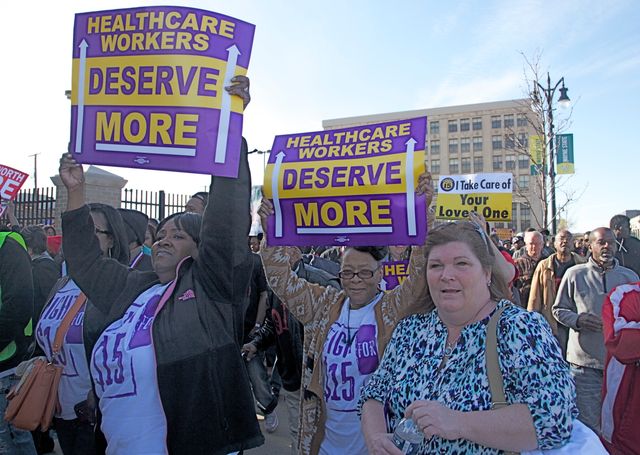
Protest demonstrations against low pay were held in hundreds of cities and on university campuses around the United States Wednesday, in a campaign whose organizers are seeking to help millionaire Democratic Party politicians, not low-wage workers exploited by giant corporations.
The organizers of “Fight for $15,” funded by the Services Employees International Union and other trade unions, claimed that there were protests in 226 cities in the US and outside of fast food restaurants owned by US corporations in many foreign countries.
Given the size of the demonstrations in the largest cities—several thousand in New York City and about a thousand in Los Angeles—it is likely that as many as 20,000 people participated nationwide. These would have been divided between full-time union officials and workers drawn from industries long afflicted by low wages, including fast food, home health, nursing homes and retail sales.
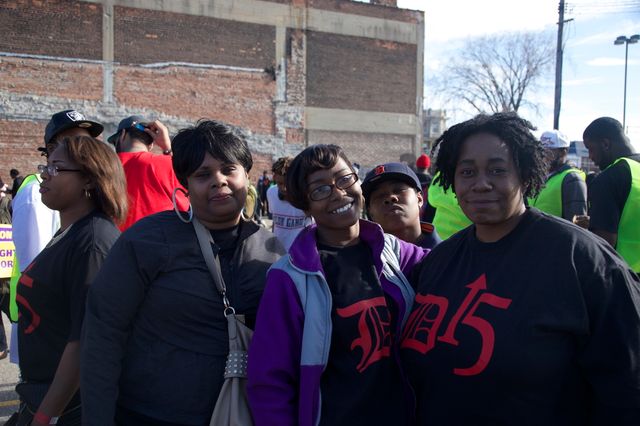
In Detroit, for example, demonstrators assembled near Wayne State University, held a rally on the campus, then moved on to picket a nearby McDonald’s restaurant. Those in attendance including SEIU and United Auto Workers staff, church groups, and members of pseudo-left organizations that support the union bureaucracy, like the Workers World Party. Of the 500 people participating at its height, there appeared to be about 150 actual low-paid workers, as opposed to the well-paid functionaries of the unions and their middle-class entourage.
The union officials did their best to police the rally to insure that there was no dissent from their pro-Democratic Party line. They told protesters not to speak to the press, and sought to interfere with a World Socialist Web Sitereporter who was interviewing workers. The workers ignored the attempted gag order and spoke freely.
The protest was conducted in a perfunctory fashion, with chanting of slogans for $15 an hour, a brief appearance by a hip-hop artist and speeches by lower-ranking union officials.
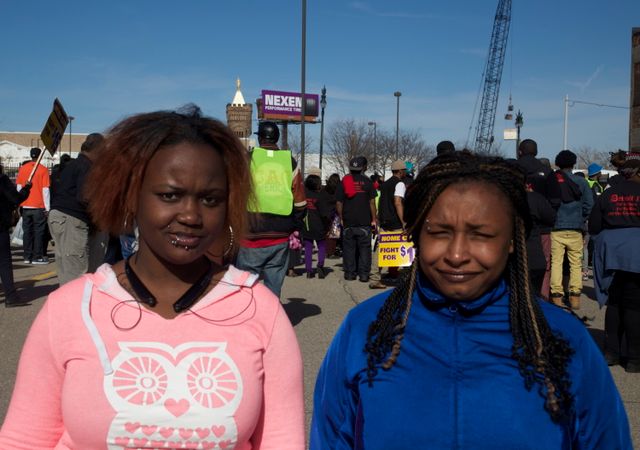
Fast food worker Victoria told the WSWS, “I work at McDonald’s. It is terrible. I can’t raise a family on $8.50 an hour. The only raise I got was when the minimum wage went up.”
Courtney (right), with Victoria (left)
Her friend Courtney added, “I work at Uptown Barbeque, and it is not enough money. I have two kids. We can’t go out to eat. I can’t afford clothes. I get assistance for clothes and food. I am receiving food stamps, and they cut money from that.”
Franchaska, another McDonald’s worker, said, “Rent is $700 a month. You have to pay lights and gas. I am short a pair of gym shoes right now. We stand on our feet all day. We give our 40 hours like anyone else. I make less than $9.”
She spoke about the raise recently announced by McDonald’s. “If you already made $8.15 an hour, you got nothing,” she said. “And you don’t get a raise when you are working for a franchise.
Franchaska (right), and Mile (center)
“You pay for your food and uniforms. There are only certain meals you can have, and you have to pay for them. They won’t let you take off work. It can be a family emergency—they don’t understand.”
Her friend Mile said, “We have no dental, vacations, no sick days. They don’t want you calling in sick. They cut me off food stamps until I am 21.”
Kimani said, “I work at Tim Horton’s, and we do not make enough money. I have a baby. It is hard. After paying all my bills there is nothing left.
“The rich are keeping all the money, but there still needs to be a working class. There are thousands dying all over the world from hunger. Some nights I have no food at home and end up eating ramen noodles.”
Wednesday’s event was the latest in a series of such days of protest, which began in 2012 as an effort by the unions to refurbish their public image by borrowing some of the tactics—and hiring some of the organizers—of the Occupy Wall Street protests of 2011-2012. Initially, the protests were targeted at fast food restaurants, although there were separate days of protest outside Wal-Mart stores.
This year’s protests seemed to have expanded somewhat from earlier events, although not by attracting larger numbers of fast food workers. Instead, workers were mobilized from already unionized low-wage occupations, including home health aides and nursing home staff.
A genuine movement to raise the wages of workers making less than $15 an hour would appeal to tens of millions of people, since a colossal 42 percent of all US workers make less than that figure, according to a report by the National Employment Law Project. The report also found that six of the ten occupations most likely to add jobs in the next few years paid median hourly wages of less than $15: retail sales, food preparation and service, freight and stock, janitors, nursing assistants, and home care.
A full-time worker making $15 an hour would make $30,000 a year before taxes, barely above the US poverty line for a family of four, and well below what is needed to live decently in any major US city.
In 2014, there was majority support for raising the minimum wage in all five states that held referendums on the subject. Both corporate America and the Democratic Party have sought to defuse this mass sentiment: the corporations, like McDonald’s, Wal-Mart and Target, announcing pay hikes to bring workers “up” to $9 or $10 an hour; the Democrats, by adopting minimum wages above the federal level, as high as $13-$15 an hour, although phased in over many years and with numerous loopholes and exceptions.
The unions, however, are incapable of carrying out any genuine mobilization of the working class. The “Fight for $15” campaign has two interrelated purposes: to recruit additional dues-paying members, thus shoring up the six-figure salaries and perks of the union officialdom; and to hustle votes for Democratic Party candidates in the 2016 elections.
One of the more reactionary features of Wednesday’s event was that it was timed for April 15, the deadline for filing income tax returns in the United States. The New York Times, citing as its source Kendall Fells, organizing director of Fight for $15, reported that the date was chosen “to focus public attention on the strain that low wages place on public budgets and taxpayers when working families are forced to rely on public assistance.”
In other words, far from demanding that social programs should be expanded in order to raise the living standards of the poorest sections of the working class, the unions are making the argument—in tune with the austerity policies being carried out by both the Democratic and Republican parties—that raising wages for the lowest-paid would facilitate further cuts in public spending.
A report issued by New York City Comptroller Scott Stringer, a Democrat, issued Tuesday on the eve of the protests, said that raising wages to $15 an hour would allow a cut of as much as $500 million a year in food stamps and Medicaid.
Low wages are one of the hallmarks of the widening social inequality in America. One recent study found that the pay of corporate chief executives has rocketed from 20 times average pay in 1965 to 296 times average pay in 2013. Meanwhile, the US Labor Department estimated that some two million workers nationwide were being paid less than the minimum wage—now an abysmal $7.25 an hour—because of cheating by employers.

Quebec government criminalizes student strike

Laurent Lafrance

The Université du Québec à Montréal (UQAM) was the target of a massive intervention by riot police April 8 that was aimed at intimidating, beating up, and arresting students who were exercising their democratic right to strike on the university campus. The police repression is well documented in videos posted on YouTube by amateur journalists and strike supporters.
According to press reports, Quebec Liberal Premier Philippe Couillard personally contacted the rector of UQAM to demand the police crackdown.
The police invasion of a public educational institution is virtually without precedent in Quebec. It is part of an escalating campaign of state repression mounted by the Liberal government with the full support of Quebec’s big-business elite. The government is determined to break the student protest movement against its sweeping austerity program and to put an end to Quebec’s longstanding democratic tradition of political protest through student strikes.
This authoritarian drive is above all directed against the working class—at demonstrating that the government will mobilize the apparatus of state repression to criminalize any challenge to its program of brutal social spending cuts, user fee hikes, and wage and pension cuts for public sector workers.
The April 8 confrontation began when security guards, recently hired by UQAM, accosted and jostled a group of thirty students who were enforcing the strike mandate democratically decided by their officially recognized student association by seeking to prevent the holding of classes. With the security guards threatening further repression, the students complied with the guards’ demand that they vacate the premises.
A few hours later, however, police intervened massively and provocatively against a second group of striking students who were demonstrating on the UQAM campus. Fearing the police would seize on this as the occasion to mount a violent crackdown, a group of professors attempted to position themselves between the police and the students. In the end, the police arrested 21 people, aged 18 to 36, who have been charged with misdemeanors and unlawful assembly.
Later that evening, some 200 students decided to occupy the J.-A.-DeSève building to protest the police intervention on the campus and the subsequent arrests. They barricaded the building entrance with tables and chairs in a festive atmosphere. During the ensuing four hours, a handful of students committed acts of petty vandalism, leading to tensions with the vast majority of the students who were occupying the building peacefully.
Shortly after midnight and with the express approval of the UQAM administration, police forcibly ended the occupation. Montreal riot police broke down a glass door with axes and charged into the building. The students escaped out a rear exit, but were then chased for several hours by police who fired tear gas at them. Five people were arrested.
The police interventions at UQAM, including the brutal manner in which they ended the occupation, were emphatically supported by Premier Couillard. The corporate media and the entire political establishment, including the Parti Québécois, were quick to echo Couillard’s remarks, denouncing the students as “violent.” Turning reality on its head, they depicted the state repression as the consequence of the striking students’ “unacceptable behavior.ˮ In the face of this slander campaign, the supposedly left-wing Québec Solidaire simply called for dialogue so as to “prevent an undesirable escalationˮ of the situation.
Nothing was said in all of this about the government’s antidemocratic campaign to criminalize the strike and even more importantly about its brutal austerity measures, which target essential public services on which millions of Quebecers depend and the social rights that workers won through bitter struggles over several generations. If truth be told, the real authors of violence and intimidation are sitting in the Quebec National Assembly and in the editorial offices of the big-business media.
Throughout the strike, which was launched March 23 with the goal of pressuring the Liberals to backtrack on their austerity measures, UQAM Rector Robert Proulx has stoked the flames. At the government’s urging, he obtained a Superior Court injunction that makes it illegal for students to block access to classes. He also announced the unprecedented expulsion of nine students involved in student walkouts and other protest actions over the last two years. On April 7, he sent out an e-mail announcing that the academic calendar would not be changed and ordering all professors and contract teachers to continue teaching their courses even if their classrooms were empty. Despite many requests from the striking students, the rector has consistently refused all dialogue with them.
Whilst the media has made much of the fact that some striking UQAM students have donned masks, this was in response to the administration’s installation of numerous additional CTCT cameras and its hiring, at a cost of $500,000, of a large number of additional security guards from the private firm Gardium so as to surveille and police students.
The few acts of vandalism carried out on April 8 were likely the actions of a handful of anarchists—possibly linked to the Black Bloc—whose sole aim was to bring about a confrontation with the police. There is a long history of police infiltration of these anarchist groups and numerous cases of agent sprovocateurs inciting young people to commit illegal acts. On the evening of the occupation, vehicles belonging to the Montreal police (SPVM) were left unsupervised near the entrance to the university, where they could be readily vandalized.
The Parti Québécois, the federation that represents the CEGEPS (pre-university and technical colleges) and several student associations and trade unions have responded to the events at UQAM by calling for a law “framing” students’ right to strike. Such legislation would be utterly reactionary. As its proponents suggest, it would be based on the Quebec labor code, which ties state recognition of the unions to sweeping limitations on workers’ right to strike, in some cases barring it altogether. The purpose of any law “framing” students’ right to strike would be to introduce a whole series of legal obstacles to prevent it from being exercised and to justify the repression of student protests.
The Liberals however want nothing to do with this proposal. Throughout the conflict, they have aggressively asserted that there is no such thing as a student right to strike, underscoring that their objective is to change the rules of the game and repudiate student strikes as an accepted form of political protest. Indeed, Education Minister François Blais has publicly deplored that student strikes have been accepted as a legitimate form of democratic action in Quebec since the 1960s. He has repeatedly avowed that the only “right” the government is constitutionally bound to uphold is students’ “right” to attend classes in defiance of a democratically decided class boycott.
The hard line taken by the government is a serious warning for the working class. The repressive measures directed at the students are only a foretaste of what the government is preparing to suppress worker opposition to its austerity program, including from the half-million public sector workers whose contracts expired March 31 and from whom the government is demanding sweeping concessions.
In the face of this threat, the trade unions are doing nothing to mobilize their members and prepare a counteroffensive. Just as they did during the 2012 student strike, the unions have refused to support the students, facilitating the government repression. At a major conference on March 31, the public sector union leaders insisted that their preoccupation is “good-faith” bargaining with the government and that not before the fall will they even begin to seriously consider resorting to the “ultimate” measure—by which they mean a legal strike.
Despite the fact that the student “anti-austerity” strike has drawn into its ranks tens of thousands of students across Quebec over the course of the past month—and at the beginning of this week as many as 20,000 students remained on strike—it is clearly petering out.
There is still broad opposition to the ruling class’s austerity agenda among the students, and even more so in the working class. However, none of the factions of ASSÉ (Association for Student-Union Solidarity), which as in 2012 is leading the student strike, has presented a viable perspective for social struggle.
The more “conservativeˮ faction, which includes many Quebec Solidaire supporters, continues to subordinate itself completely to the trade unions and after the union officialdom spelled out their forthright opposition to any mobilization of the working class called for a “strategic retreat”—i.e. the strike’s end. The other faction, apparently more “radical,ˮ has pressed for the continuation of the strike, but is making no effort to mobilize workers in the fight against austerity, limiting themselves to futile appeals to the ruling elite.
Like the unions, both wings of the ASSÉ leadership claim the draconian measures of the Couillard government are an “ideological choice,” not the consequence of a systemic crisis of capitalism that the ruling elite in Canada, as around the world, is seeking to resolve at the expense of the working class.
The only viable option to counter austerity is a turn to the international working class, the only social force with the power to break the stranglehold of big business over socioeconomic life, overthrow the profit system, and transform society on the basis of human need. The development of an independent political movement of the working class requires an intransigent struggle against the pro-capitalist union bureaucracy, which subordinates workers to the political representatives of the ruling class and binds them to capitalism.

Report documents carnage of US drone war in Yemen

Niles Williamson

A report released this week by the Open Society Justice Initiative (OSJI), titled “Death by Drone: Civilian Harm Caused by U.S. Targeted Killings in Yemen,” documents the deadly carnage inflicted by Hellfire missile strikes in US President Barack Obama’s criminal drone war in Yemen.
Drone and other airstrikes have been launched under the authority of either the CIA or the Pentagon’s Joint Special Operations Command against suspected members of Al Qaeda in the Arabian Peninsula (AQAP) throughout the country since 2002.
These strikes were permitted by former dictator Ali Abduallah Saleh and the recently ousted Abd Rabbuh Mansour Hadi, who was installed as president by the US and Saudi Arabia. The Yemeni government often claimed responsibility for attacks as a cover for the American government’s actions.
While the US supports Saudi Arabia in its campaign of daily airstrikes against Houthi rebels, who oppose AQAP, it has continued its own air campaign in Yemen. The latest American drone strike hit the city of Mukalla on Sunday, killing as many as seven people.
The first known airstrikes carried out by the Obama administration came on December 17, 2009, when a cruise missile loaded with clusters bombs slammed into the village of Al Majala in Abyan province. While purportedly targeted at an AQAP training camp, it killed at least 44 civilians, including five pregnant women and 21 children. A separate strike the same day killed four people in Arhab.
Since then, there have been at least 121 drone and other airstrikes that have taken the lives of as many as 1,100 people, most of them officially classified as combatants. As a means of limiting the official civilian casualty count in any particular attack, President Obama approved the redefinition of a “combatant” as any male of military service age killed or injured by a drone strike.
In addition to strikes targeted at specific individuals, in 2012 Obama authorized the CIA to use “signature” strikes against targets in Yemen. The decision to launch a signature strike is based purely on patterns of behaviors that the CIA has determined mark a terrorist, meaning many attacks have launched against unknown persons based purely on movements observed from afar by surveillance drones, including their carrying of firearms, which is common in Yemeni tribal society.
Anwar Al Awlaki became the first US citizen to be deliberately targeted and killed by a drone strike on September 30, 2011. Last year, the Obama administration released a legal memo authored by the Justice Department to justify the killing. It asserts that the US President has the power to kill a US citizen, without charges or trial.
President Obama gave a speech at the National Defense University in 2013 in which he outlined supposed guidelines and limits on drone killings. He stated that “before any strike is taken, there must be near-certainty that no civilians will be killed or injured.”
The OSJI review of nine separate drone strikes carried our between 2012 and 2014 reveals this statement to be a blatant lie. The report found that 26 civilians had been killed and 13 injured in this handful of attacks. Investigators traveled to the areas where the strikes occurred and interviewed survivors and the families of those killed.
A drone strike on April 19, 2014 in the Al Sawmaah district of Al Bayda province killed four workers and wounded five others. The men were traveling together in a car when a missile fired from a CIA drone hit a vehicle allegedly carrying AQAP militants approximately thirty meters behind them, blowing up their car as well.
Hussein Nasser Abu Bakr al-Khushm, a father of one of the victims, told investigators that he was devastated by the death of his son, Sanad Hussein, who had just gotten a visa to work in Saudi Arabia.
“The news fell on our ears like thunderbolt,” he said. “I got motionless. Even when his body was brought to the village for burial I could not go to have a last look at him. Until this moment, I’m still unable to figure out what happened to my son. They were killed by an American drone.”
Investigators spoke to Musa Ahmed Ali Al Jarraah a 15-year-old boy who survived a strike by two Hellfire missiles on a home in the village of Silat Al Jaarrah on the night of January 23, 2013.
“It was a US drone,” Al Jaraah said. “I saw it while I was on my way home. It flew so low I could view it easily. It had long wings in the rear, its size was not large and it had a head that looked like a camel’s head.”
A crowd of approximately 30 people had gathered outside the home to watch the village’s only television when the missiles struck. The strike injured five civilians including Al Jaraah, who suffered shrapnel wound to his abdomen. A ten-year-old girl, Iftikar Abdoh Mohammed, sustained minor injuries when she was hit in the head with shrapnel.
On September 2, 2012, a Hellfire missile launched by an American drone blew up a truck carrying a group of qat merchants and several others who were returning home from a day at the market in the city of Radaa. The strike killed 12 out of the 14 passengers in the truck, including Rasilah Ali Al Faqih, who was pregnant, and her 10-year-old daughter Dawlah Nasser Salah.
The truck’s driver, Nasser Mabkhout, who survived despite being severely burned, described the attack and its aftermath to the investigators:
“Before we arrived at the junction that leads to the unpaved road of the village, two aircraft approached the front of the car, one white and the other black, as far as I can remember. They approached us more closely, and we started to exchange humor that they would attack us, and we laughed. Our laughter was cut off by two shells…I saw the dead bodies scattered in and around the car, some of them beheaded. I couldn’t differentiate between the bodies of the dead.”
The Yemeni government paid $4,654 for burial expenses to each victim’s family, and eventually paid out a paltry restitution to the families: $32,578 for each individual killed and $13,962 for each person wounded.
As with other drone strikes, the attack on the merchants continues to terrorize civilians long after the victims’ bodies have been buried and restitution paid out to the families. “Since the incident, my family and I as well as the villagers live in constant fear,” one of the victims’ uncles told investigators. “The horror increases with the constant over-flights of the US aircrafts. We go to our farms in fear, our children are afraid to go to school, and at bedtime, women remain in constant fear.”

A historic attack on Medicare

Kate Randall

US President Barack Obama signed into law on Thursday the Medicare Access and CHIP Reauthorization Act of 2015, marking a new stage in the bipartisan assault on the government health insurance program for 53 million American seniors and the disabled.
The bill, HR 2, was passed this week by the Senate, following approval by the House last month—in both cases by overwhelming bipartisan majorities.
Obama praised the bill as a “milestone,” after the Senate vote Tuesday. On Thursday, he praised the “bipartisan achievement,” saying that it would “be good for people who use Medicare, it’s going to be good for our seniors.”
In fact, the bill expands means testing for Medicare and establishes a new payment system in which doctors will be rewarded for cutting costs while being punished for the volume and frequency of the health care services they provide.
The press has depicted the bill as a miracle of bipartisanship, demonstrating that Democrats and Republicans can work together to end Washington “gridlock” in the interest of the public good. The reality is that the bill is ultimately aimed at gutting health care services for the millions of seniors who rely upon it.
News reports have focused on the “doc fix” contained in the legislation, which establishes a new payment schedule for doctors in place of a formula that since 1997 has tied doctor payments to economic growth, the sustainable growth rate, or SGR. The bill’s passage averts a 21 percent payment cut that would have gone into effect April 1, and provides modest increases in doctor payments through 2019.
Beginning in 2019, however, doctors will qualify for bigger reimbursements if they participate in one of two programs in which they will be paid, according to Obama, based on a “payment model that rewards quality of care instead of quantity of care.” Reference to “quality of care” is a political fraud. Doctors will have a financial incentive to withhold more expensive tests and services, and will be rewarded for rationing care and cutting costs.
The bipartisan backing for the Medicare bill is based on common agreement on one basic issue: Medicare spending must be slashed and a radical shift needs to be instituted in the program—away from the “lavish” fee-for-service system, while transforming Medicare into a poverty program in which the vast majority of beneficiaries receive barebones coverage.
An examination of the bill’s backers provides insight into its reactionary nature. Its chief House sponsor was Representative Michael Burgess, a right-wing Tea Party politician from Texas. Republican House speaker John Boehner, who crafted the bill alongside Democratic House leader Nancy Pelosi, described HR 2 as “The first real entitlement reform we’ve seen in nearly two decades”—a reference to Welfare “reform” passed in 1996 under the Clinton administration.
Representative Paul Ryan (Republican of Wisconsin), a presidential hopeful who has called for privatizing Medicare by replacing it with a voucher system, wrote in an op-ed piece calling for passage of the bill, “Medicare is going broke… that’s why we need these structural reforms.”
And in an article in the right-wing National Review headlined “A Medicare Bill Conservatives Need to Embrace,” Ryan Ellis wrote, “We can very reasonably anticipate a future where my daughter—who will turn 65 in November of 2078—will be a then-typical senior who pays for most of her own Medicare benefit. That will be largely thanks to HR 2…”
The current Medicare “reform” is in line with Obama’s signature domestic initiative, the Affordable Care Act (ACA). Under the ACA’s “individual mandate,” individuals and families without health coverage from their employer or a government program such as Medicare or Medicaid are required to purchase coverage from private insurance companies. There is minimal oversight on what these insurers can charge their captive pool of customers, and many policies carry deductibles and out-of-pocket costs upwards of $5,000 annually.
Obamacare was presented as legislation that would provide near-universal, high-quality health care to millions of Americans. Since its passage into law in 2010, the ACA has been exposed as a boondoggle for the health care industry that has forced millions of people to sign up for overpriced, substandard coverage. Those who remain uninsured have been slapped with tax penalties, while others who did sign up have faced rising premiums and collection calls from the government to pay up.
The New York Times, a fervent supporter of the legislation popularly known as Obamacare, has also campaigned relentlessly for reining in spending on “unnecessary” tests and procedures, particularly for Medicare recipients. Services targeted by the Times include mammograms and breast exams, heart stents, cholesterol drugs and prostate screenings, to name just a few.
Stated simply, the Obama administration and its “liberal” supporters, along with the overwhelming majority of the politicians in the two big-business parties, feel that drastic measures are required to counteract what they perceive as an unpleasant reality: seniors are living too long into retirement and sucking up health care resources.
To reverse this trend, measures being instituted through Obamacare and the new Medicare bill will result in reduced medical care, needless suffering and untimely deaths.
The new Medicare bill has been largely hatched as a conspiracy behind the backs of the American people. There were no Congressional hearings or public debate on the sweeping measures contained in the legislation.
The White House and politicians in Congress are well aware that Medicare and Social Security, the government retirement program, are widely popular and that moves to attack or privatize them will be met with suspicion and opposition. Hence their duplicity in pushing through their “reforms.”
The gutting of Medicare is part of an assault on health care that affects the working class and considerable sections of middle-income families. Obamacare is also having the effect of dismantling employer-provided health care for active workers and retirees, the system that for seven decades has traditionally provided health coverage for most US workers.
The drive to slash Medicare spending and ultimately dismantle it is part of a broader strategy of the ruling elite, which seeks to boost its wealth and profits by clawing back the living standards and gains won by the working class in decades of struggle. These include not only Medicare, Medicaid and Social Security, but public education, the right to decent and affordable housing, and the right to culture.
A solution to the health care crisis cannot be left in the hands of the ruling elite and its political representatives. Medical care must be taken out of the hands of the for-profit health care industry and placed on socialist foundations, guaranteeing free, high-quality health care for all through the establishment of a democratically run, publicly owned socialized health care system.

What’s on Pakistan-based Militants’ Minds?

Rajeshwari Krishnamurthy


On 15 March, terrorists mounted suicide attacks on two churches in Lahore, Pakistan. While this was not the first attack on an institution or individuals related to minority communities in the country, this particular attack was indicative of an emerging trend.

That the minorities in Pakistan aren’t the most protected communities is not news. Over the past four decades, the persecution and/or lack of protection for minorities has resulted in ubiquitous violence, instability and almost-permanent uncertainty vis-à-vis social cohesion, national security, and economy. The religious and sectarian schism only widened with the emergence of armed radical religious insurgent groups. According to the South Asia Terrorism Portal, approximately 143 people belonging to minority communities have been killed in attacks targeted at minorities, in 2015 alone.

Launched in June 2014 to flush out militants, the Pakistan Army’s Operation Zarb-e-Azb, has seen measureable results, and that coupled with internal problems in these groups – such as factionalism and chaos within the ranks vis-à-vis leadership, agendas, aims and goals, and allocation of ‘duties and powers’ – has had a considerable negative impact on these groups’ operating capabilities.  
In this backdrop, why are Pakistan’s religious minorities being especially targeted at this particular point in time? Do these attack signify increased religious and sectarian schism? Or is the frequency of this targeting simply a consequence of strategies formulated keeping circumstances and capabilities in mind?

2014: Rumblings in Terrorist Networks Since June 2014, terrorist activities suggest that that militants based in Pakistan might be thinking laterally, and attempting to carry out their terror-intended activities via new approaches. This isn’t to say that their endgames have changed, but it is likely that the terrorists, in the wake of severe damages to their structures, have been adapting to the altered order of things.

The terror outfits appear to be streamlining their attacks, and have been mounting more attacks on the country’s minority communities, and all entities that are deemed ‘easy targets’.

The March 2015 attacks on the two churches in Lahore, like many others that have taken place over the past year, are indicators of the turmoil underway in the workings of the numerous terrorist groups active in Pakistani territory. This turmoil has been caused in good measure due to Operation Zarb-e-Azb; the internal factionalism in these groups, that which is being exploited by the Pakistan army; and the entry of the Islamic State as a strong competitor in the terrorist market, among others.

Militants, especially those belonging to the Tehrik-i-Taliban Pakistan (TTP), escaping to Afghanistan via the rugged mountain routes are targeted by the Afghan security forces; and they are being sandwiched. As a result, the TTP and its network has been increasingly weakened, and has therefore begun depending on the smaller affiliate groups that have bases and/or presence in various parts of Pakistan.

Post December 2014: What’s on the Terrorists’ Minds?
The foremost difference between the recent attacks and the ones recorded pre-June 2014 is the comparative absence of the state’s complicity and/or apathy vis-à-vis the persecution of minorities.

Moreover, policymaking vis-à-vis the security sector has intensified post the December 2014 attack on the army school in Peshawar. The cogs of the counter-terrorism machinery are moving at a pace comparatively higher than they used to. Security of important government institutions and other majority community related entities have been beefed. Securitisation of the state is visibly increasing; and the army is ensuring that all political parties more or less acquiesce to the new security policies.

The recent attacks can be interpreted as the manifestation of the terrorists’ desperation and frantic efforts to remain relevant and active in Pakistan.

Given the wide variety of challenges Pakistan-based terrorist groups face at the moment, they appear to be preferring effectiveness and relevance over the numbers of attacks. Additionally, compared to non-minorities, attacks on minorities are likelier to have a higher ‘success rate’. Religious minorities have consistently been targeted by insurgent groups in Pakistan, but the likelihood of this phenomenon intensifying is quite high. This is because although the state has implementing various counter-terrorism mechanisms and operations, and upgrading security statuses of government and majority civilian infrastructures, the efforts it has undertaken to actively protect minorities and related entities is negligible.

In this state-of-affairs, individuals and institutions affiliated to religious minorities are the country’s most vulnerable elements. Also, although the Pakistan’s Army Chief General Raheel Sharif has stated that the country’s security forces will target terrorists of “all hues and colours,” the operations appear to place a heavier emphasis on fighting the TTP, as compared to other groups.

It is important to note that the terrorists’ targeting of minorities is not a new tactic or a shift in ideological priorities. It is only an intensified continuation of their previous activities against minorities, in the absence of capacity to carry out attacks against all entities. From the terrorists’ points of view, targeting minorities fits right into their two key priorities:

a.
 remaining operationally relevant, and
b. working towards their goals

In this broad scheme of things, local terror networks gaining traction with help from extra-regional terrorist networks is not difficult to imagine.

The Big PictureIf the civilian violence that followed the March 15 attacks is an indicator, the State might have to prepare to wage its war against terrorism and simultaneously deal with occasional potentially violent civilian unrests, while also ensuring the safety of those very aggrieved civilians in a democratic manner. In an event of such circumstances, the Pakistani government and the army could become increasingly strained for resources, manpower and time as they simultaneously deal with two extremely pressing issues, however much the disparity in context. The need of the hour is to introduce inclusive policies that promote cohesiveness among the citizenry, for that is the only area where the state can expect some relief.