23 Apr 2015

Ukraine: Coup, Couth, and Consequences

Ray McGovern

The controversy over alleged Russian “aggression” in Ukraine is already raining on the Kremlin parade with which Russia will mark the 70th anniversary of the Allies’ victory over Adolf Hitler and the Nazis on May 9. U.S. President Barack Obama set the tone by turning down the Kremlin’s invitation to take part in the celebration, and allies in Western Europe have been equally uncouth in saying No.
The fanfare on Red Square will be a “Last Hurrah” for most surviving World War II veterans, since few are likely to be able to be there for the 75th or 80th anniversaries. Though I was only five years old on V-E Day – marking the victory in Europe – I was delighted to receive an invitation to go to Russia this week for a smaller-scale celebration marking an equally important 70th anniversary – April 25, 1945, the historic day on which U.S. and Russian troops met at the Elbe River.
On V-E Day, which came a couple of weeks later on May 9, 1945, I recall the thundering celebration as one of my most vivid early memories. So I find it a particular shame that for this year’s 70th anniversary the usual thunderclaps of applause will be muted.
Tragically divided once again by hate, greed, and power-lust, Europe lies in the shadow of war, as the violence percolating in Ukraine threatens to result in wider, more open military intervention from outside. Equally sad, responsibility for the turmoil in Ukraine lies mostly at the doorstep of Washington. Worse still for one who normally pretends to understand what drives foreign policy, how shall I explain to my hosts what lies behind U.S. actions in central Europe, when – try as I may to come up with cogent explanations that make some sense – the reasons elude me.
For those who may find my straightforward allocation of blame surprising, do not feel you must rely on me (although I have been watching what happens in Russia and Europe for half a lifetime). I strongly recommend the trenchant insights of John Mearsheimer, pre-eminent political science professor at the University of Chicago, and professor Stephen F. Cohen of Princeton and New York University, a distinguished Russianist who has been a Kremlin watcher even longer than I have.
Last fall, a year into the burgeoning troubles in Ukraine, Mearsheimer stunned those who had been misled by hate-Putin propaganda when he placed an article in the Very-Establishment journal Foreign Affairs entitled “Why the Ukraine Crisis is the West’s Fault,” and more recently followed up with a more recent op-ed entitled “Don’t Arm Ukraine.”
As for Professor Cohen, if you have not already done so, please take the time to read his recent “Why We Must Return to the US-Russian Parity Principle: the Choice is Either a New Détente or a More Perilous Cold War.” and his earlier “Patriotic Heresy vs. the New Cold War.”
You will emerge from that reading far better educated on the realities than those malnourished on the thin gruel of the co-opted corporate media, which – unashamedly – are well into a redux of their familiar drum-beating to send people from our poverty draft merrily off to war. And for extra credit, I highly recommend veteran journalist Patrick L. Smith’s recent interview of Professor Cohen, Part 1 of which Salon has published under the title “The New York Times Basically Rewrites Whatever the Kiev Authorities Say.”
Some Visitors to Moscow
U.S. leaders along with its foreign “vassals” – as Russian President Vladimir Putin has called them – have responded to the Kremlin’s invitations to the V-E celebration with “regrets.” Not so Chinese President Xi Jinping , whose plan to come for the anniversary observance was announced in January. The President of India, Pranab Mukherjee, will also take part.  Signs of the times.
German Chancellor Angela Merkel has devised a compromise. So as not to appear to be breaking ranks with other “vassals,” she will shun the parade but will travel to Moscow on May 10 to lay a wreath at a war memorial. The U.S. will be represented by U.S. Ambassador to Russia John Tefft.
It may be difficult for history-starved Americans to understand why it should be that most Russians react so negatively to what they regard as something more serious than a mere gratuitous snub. From watching Russian media one gets the clear impression that veterans and most men/women-on-the-street view the boycott as more serious than a petulant slight – but rather as a supreme indignity.
For example, during Putin’s four-hour TV tour de force Q&A with Russian citizens on April 16, one questioner said the world leaders who boycott the celebration “insult the memory of war veterans of the Red Army. … We liberated them out of that Nazi plague, or they would still be shouting ‘Heil!’”
And a retired colonel, who fought in the five-month-long, pivotal World War II battle of Stalingrad as a 19-year-old battery commander, had this to say: “In the first years of the war, the Red Army, our people, were fighting all of Europe singlehandedly. … Yes, we had allies, but they opened the second front too late.”
Putin replied with a mix of condescension and feigned understanding: “Some simply do not want to go, but some are not being allowed to go by the ‘Washington apparatchiks,’ who say, ‘No way.’ And they say, ‘We won’t go,’ although many would like to come.”
Putin then underscored what he sees as the importance of the anniversary observance: “We pay tribute to a generation of victors. We do this so that the present generation, both here and abroad, never forgets about this and never allows anything like this to happen again.”
But what about those aging Russian veterans claiming the lion’s share of credit for defeating Germany? Do they exaggerate?
The Facts
As journalist Martin Sieff keeps pointing out, the current crop of young Americans and Russians has grown up fairly ignorant of how crucially important the Grand Alliance of WWII was to the survival of both their great nations, but all serious Western historians recognize that the Russian people made the greatest sacrifices. The nearly 27 million total of Soviet military and civilian dead was more than twice the death toll of all Americans, Britons, Commonwealth citizens, French and even Germans killed in the war combined.
None other than British War Premier Winston Churchill publicly acknowledged, “It was the Red Army that tore the guts out of the Wehrmacht.” Over 80 percent of the German soldiers killed in World War II died fighting the Red Army.
These facts have been largely forgotten on both sides of the Atlantic, in the United States and Western Europe. At next month’s anniversary observance, pity the squandering of such an excellent opportunity to remind the world that there is strength in unity.
It is altogether understandable, of course, that at the end of WWII, many Europeans looked at their liberation by the Red Army with very mixed emotions. To begin with, in central Europe, liberation was followed by decades of Soviet occupation with harsh rule by Kremlin-installed satraps. So V-E has always been regarded there with considerable ambiguity.
In his extended Q & A on April 16, Putin made an unusual allusion to that dark period in addressing “the ugly nature of the Stalin regime” and the reaction that persists to this day. He conceded: “[It] “may not be very pleasant for us to admit. But in truth, we, or rather our predecessors, gave cause for this. Why? Because after World War II, we tried to impose our own development model on many Eastern European countries, and we did so by force.
“This has to be admitted. There is nothing good about this and we are feeling the consequences now. Incidentally, this is more or less what the Americans are doing today, as they try to impose their model on practically the entire world, and they will fail as well.”
More Recent History
The Ukraine crisis and other circumstances now clouding the May 9 celebration are perhaps the inevitable consequence of another lost opportunity, the chance for an enduring peace in Europe after the fall of the Berlin Wall. That hope was squandered by Western leaders who reneged on earlier promises to welcome a very new kind of Russia into European security arrangements, as the Soviet empire fell apart.
In sum, instead of President George H. W. Bush’s 1990-91 vision of a “Europe whole and free” from Portugal to the Ural mountains, the world got the “Wolfowitz doctrine” of 1992 embodied in the draft Defense Policy Guidance drafted by then-Under Secretary of Defense for Policy Paul Wolfowitz: “Our first objective is to prevent the re-emergence of a new rival, either on the territory of the former Soviet Union or elsewhere, that poses a threat on the order of that posed formerly by the Soviet Union.”
While George H. W. Bush softened the rhetoric, the Wolfowitz approach did become the core principle of a “We-Won-the-Cold-War” triumphalist policy, with which Bush the Elder, Bill Clinton and Bush the Younger went back on the elder’s promise “not to take advantage” of the fall of the USSR and not to paint Russia as the big loser.
During an interview late last year, former Russian leader Mikhail Gorbachev reminisced about what could have been: “I remember the Paris Summit in 1990. Europe offered an example of how to build … a new relationship. The Americans – and Bush senior, talked about it. And I spoke about it. … And one wonders how people can object to their own decisions.
“It all began with the fact that the United States suddenly started talking about the creation of a ‘new empire.’ An over-empire, a super-empire. Alas, God and fate had put the task before them. Yes, they thought their moment had come.”
Despite promises by top U.S., German and NATO leaders not to move NATO to the east of a reunited Germany (which joined NATO in 1990), 12 new members – all of them to the east – subsequently joined, bringing total NATO membership to 28. Worse still from Moscow’s point of view, a NATO summit meeting in Bucharest declared on April 3, 2008:  “We agreed that these countries (Ukraine and Georgia) will become members of NATO.”
Russian Foreign Minister Sergei Lavrov had sternly warned U.S. Ambassador to Russia William Burns two months earlier that the Russians would say a loud NYET to that. They did. Accordingly, it should have come as no surprise that the Russians decided that the U.S.-arranged coup d’état of Feb. 22, 2014, in Kiev was one “regime change” too many.
I have watched many government overthrows – oops, sorry, the present term of art is “regime change” – but the way this coup was advertised in advance, for me, that was a first. The key U.S. dramatis personae – Assistant Secretary of State Victoria Nuland and U.S. ambassador in Kiev Geoffrey Pyatt – had been overheard plotting the coup more than two weeks before Feb. 22 in an intercepted telephone conversation that was posted on YouTube. George Friedman, head of the well-connected STRATFOR think tank, has said, “It truly was the most blatant coup in history.”
Annexation of Crimea
What prompted the Kremlin’s strong reaction? Was it the coup d’état on Moscow’s doorstep or the prospect of Ukraine joining NATO or the risk of losing Russia’s only warm-water naval port to NATO or was it concern over U.S. plans for missile defense? The correct answer, of course, is all-of-the-above; indeed, they are inextricably linked.
Putin has been very upfront about what moved him to action on Feb. 23, 2014, the day AFTER the putsch in Kiev. By the way, there is not one scintilla of evidence that either Putin or any other Russian leader planned to annex Crimea BEFORE the Feb. 22, 2014 coup.
After the Crimeans voted overwhelmingly to be rejoined to Russia, Putin permitted himself a somewhat jocular passage following a serious one, in addressing this very serious missile issue in a speech on March 18, 2014. to the Russian Duma and other officials at the Kremlin:
“Let me note too that we have already heard declarations from Kiev about Ukraine soon joining NATO. What would this have meant for Crimea and [the naval base at] Sevastopol in the future? It would have meant that NATO’s navy would be right there in this city of Russia’s military glory, and this would create not an illusory but a perfectly real threat to the whole of southern Russia. These are things that could have become reality were it not for the choice the Crimean people made, and I want to say thank you to them for this. …
“NATO remains a military alliance, and we are against having a military alliance making itself at home right in our backyard or in our historic territory. I simply cannot imagine that we would travel to Sevastopol to visit NATO sailors. Of course, most of them are wonderful guys, but it would be better to have them come and visit us, be our guests, rather than the other way round.”
Putin has not disguised Moscow’s motives regarding the annexing of Crimea. This, for example, is what he said on April 17, 2014, during last year’s marathon Q & A on live TV:
“I’ll use this opportunity to say a few words about our talks on missile defense. This issue is no less, and probably even more important, than NATO’s eastward expansion. Incidentally, our decision on Crimea was partially prompted by this.” (emphasis added)
Clear enough? In Putin’s eyes, missile defense systems in European countries near Russia and in adjacent waters would pose an existential threat to the forces upon which Russia relies as a deterrent. In recent weeks, several top Russian national security officials have weighed in strongly on this issue.
This is not only a mark of their genuine strategic concern; Russian leaders also see it as increasingly difficult, in present circumstances, for the U.S. to justify a European missile defense system by using the same paper-thin rationale that such is needed to defend against missile attack from Iran.
During an interview on April 18, Putin again drew attention to George W. Bush’s unilateral withdrawal from the Anti-Ballistic Missile (ABM) Treaty of 1972 – a key anchor for deterrence. Putin listed it high on the list of serious problems with the U.S.
(On Dec. 13, 2001, President George W. Bush gave Russia notice of the U.S. withdrawal from the treaty, in accordance with the clause that required six months’ notice before terminating the pact. This was the first time in recent history that the United States has withdrawn from a major international arms treaty.)
Speaking the day before at an International Security Conference in Moscow, Russian Foreign Minister Lavrov insisted on the need for “joint efforts based on respect for the legitimate interests of all partners,” if peace is to be preserved. He, too, focused on the U.S. missile defense programs as the primary cause of concern:
“Ground-based missile defense systems will be deployed in Romania this year and in Poland by 2018. More ships with missile defense systems are being deployed. We perceive all this as part of a global project that is creating risks for Russia’s strategic deterrence forces and upsetting regional security balances.
“If the global missile defense program continues to be implemented without any adjustments, even as talks on the Iranian nuclear program are making headway, … then the specific motives for establishing the European missile defense system will become obvious for everyone.”
Lavrov was more soft-spoken than the official statement issued by his own ministry a week before on April 10. That statement quoted President Obama’s public assurance in a speech in Prague in April 2009 about how the elimination of the “Iranian threat” would also eliminate the main reason for the deployment of a missile defense system in Europe.
The Russian Foreign Ministry statement adds: “Against this background, the statements that ‘the missile defense program is not directed against Russia’ look even less convincing.”


Obama in the Everglades

Alan Farago

It makes sense for President Barack Obama to be in the Everglades on Earth Day. According to the White House, he will draw attention to both the Everglades and the massive economic consequences of global warming and climate change.
Obama is likely to echo what a former Friends of the Everglades director said over a decade ago: “The Everglades is a test. If we pass, we may get to save the planet.”
The difference between the time the phrase was first spoken and today is significant.
More than 20 years ago, Everglades restoration was gaining traction as a federal and state priority after years of lawsuits and defensive blocking by Big Sugar, the chief obstructionist in Everglades restoration.
In the early 1990s, at the annual meeting of the Everglades Coalition, a booth featured global warming and the Everglades. Everglades activists skipped past the informational display because it was considered a distraction.
Global warming impacts are no longer abstract in the Everglades or anywhere else. Science filled in the gaps. So has direct observation.
Coastal barriers are eroding under pressure of rising seas. Extreme weather events – whether drought or flood – are defining a new norm. Everglades restoration – once favored by environmentalists mainly for reasons of ecology and Everglades wilderness – now meshes with economic imperative.
Everglades restoration is the best adaptation for millions in South Florida for several reasons: first, as salt water presses in from both coasts because of rising seas, the pressure created by massive volumes of fresh water from Lake Okeechobee through the center of the state can protect industrial drinking water wells serving cities. Some of those wells, near the Atlantic coast, have already been abandoned because of salt water intrusion. Second, if South Florida’s highly managed water system can meet clean water standards required by law, Everglades wildlife and wilderness will benefit and so will our economies.
The GOP, however, is diametrically opposed to this interpretation of economic imperative. Climate change denial is hard-wired into the GOP code.
In various forums and turns of phrase, Florida Republicans are now trying to squirm out of the box Gov. Rick Scott put them in, through a policy prohibiting state agency staffers from even uttering the words, “climate change.” The message machinery is now turned to saying “the weather always changes” but especially that while there is no harm in talking about “climate change,” there is harm in talking about its man-made origins. The reason is simple: if Republicans acknowledge that climate change is man-made, then it follows that solutions are man-made too. Using government policies to solve human-induced climate change is anathema to Republicans because it involves sharply regulating and changing the business models of its largest campaign contributors.
Democrats have been deriding the GOP’s years of climate change denial, but in Florida, Obama should not shy from making the case that Democrats have also been complicit by avoiding conflict with powerful, wealthy special interests that are holding hostage climate change adaptation.
Here are two examples. The Florida Legislature and Scott are defying the will of the people by failing to purchase significant additional acreage required for water treatment and storage that could both help cleanse pollution wrecking coastal real estate values and the Everglades and also provide a way to assure adequate drinking water supplies in a time of climate change.
The property in question belongs to US Sugar, one of the biggest campaign contributors in the state even if you don’t count its all-expense paid hunting trips by private jet for GOP officials to the King Ranch in Texas. In 2010 the corporation agreed to sell all its 130,000 plus acres to the public but now is walking away from a compromise deal for only 46,800 acres.
Second example: $24 billion in new nuclear reactors is being planned by Florida Power and Light, the biggest subsidiary of NextEra Energy, at sea level. Paradoxically, new nuclear is a big piece of the climate change puzzle. Only the piece doesn’t fit in a region likely to be inundated at severe cost to the FPL ratepayer base. What about solar in the Sunshine State? This year, the Legislature and Scott are in the process of making it much harder, not easier, for consumers to install solar energy. Why? Because solar disrupts the electric utilities’ economic model.
Obama, on Wednesday, should make the point that the Legislature and Scott are jamming the last, best chance we have for the Everglades and climate change adaptation by refusing to exercise the option for US Sugar lands. That purchase could begin the process of land acquisition Florida voters endorsed through a 75 percent majority vote for Amendment 1 last November, to protect our environment and our economy.
What Obama could say, is that the shadow hanging over the Everglades and the sustainability of the planet is the failure of political will. He could quote Sir Nicolas Stern, the British economist, who called global warming, “the biggest market failure in history.” He could go so far as to describe climate change and global warming as the UK Guardian recently did: “the biggest story in the history of the world” and why, indeed, shouldn’t we put solar panels on every roof in Florida?
Being a hope and change president, Obama is likely to focus on the positive. He will emphasize how Everglades restoration meshes with climate change adaptation and thank the activists and citizens who have spent so many years in such difficult circumstances. In other words: talking about the Everglades as an example of what can be accomplished.
But if he really wants to seize the bully pulpit, he shouldn’t gloss over the fact that protecting our air and water and special places like the Everglades requires redoubled efforts by government, not caving-in to special interests. If you only take half-steps to your destination, the definition of political expediency, you will never accomplish what you started out to do.
At this point in his remarks, Obama would be all-in. He could then emphasize how campaign finance law in the United States today fundamentally blocks efforts to combat climate change.
On Earth Day, he could use the Everglades as an example and call on political candidates to “take the no money from Big Sugar pledge” because sugar, truly, is the new tobacco. If you are going to stir the pot, Mr. President, that would be a very good place to start.

22 Apr 2015

New Zealand’s WWI exhibitions falsify history and glorify war for a new generation

John Braddock & Tom Peters

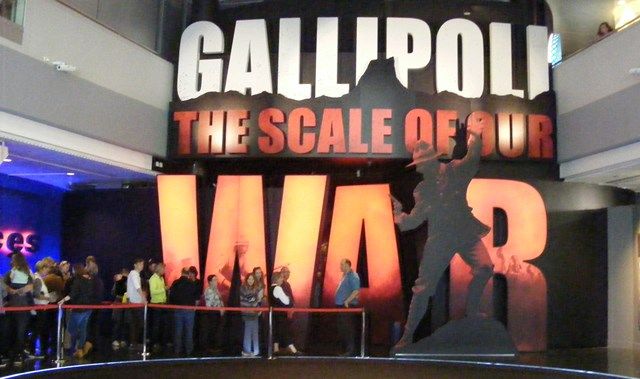
Two four-year museum exhibitions opened last weekend in Wellington as part of the government’s celebrations of the centenary of World War I. The multi-million dollar exhibitions—The Great War Exhibition and Gallipoli: The Scale of Our War—were designed by Lord of the Rings director Peter Jackson and his collaborator Richard Taylor, founder of the special effects company Weta Workshop.
The country has already been inundated with hundreds of WWI-themed projects, including memorial services, parades, cultural events, school projects, films, TV programs and trans-Tasman sports contests, along with incessant media coverage.
The exhibitions were officially opened along with the new $120 million Pukeahu National War Memorial Park. This includes a monument funded by the Australian government to celebrate New Zealand and Australian involvement in imperialist wars, including the Boer War, both World Wars, Malaya, Korea, Vietnam, Afghanistan and Iraq, and the occupations of East Timor and the Solomon Islands. 
Australian monument at Pukeahu National War Memorial Park
The park and exhibitions, described by the Dominion Post as “the greatest World War I show on Earth,” are at the centre of a five-year centenary program. Their purpose is to rewrite the history of the war in order to glorify New Zealand’s involvement and condition the population to accept today’s imperialist interventions and wars.
This agenda was made clear by Australian Prime Minister Tony Abbott, who visited Wellington on Monday. According to the New Zealand Herald Abbott “several times made pointed comparisons” between the Anzac (Australia and New Zealand Army Corps) campaign 100 years ago and the present-day participation of what he called the “sons of Anzacs” in the US-led war in Iraq.
Amid widespread public opposition to the Iraq war and the celebration of WWI, Jackson attempted to sanitise the purpose of his Great War Exhibition, which purports to depict the history of the Western Front. “It is not an anti-war museum,” he told the media, “it’s certainly not a glorifying war museum. It’s just showing reality.”
In fact, the exhibition is not an objective history of WWI. It largely has the character of an army recruitment display, particularly aimed at children. Former Defence Force chief Lieutenant General Rhys Jones, the exhibition’s executive director, told the Dominion Post that Jackson “wants every kid who comes through here to be excited and to be in wonderment about everything they’ve seen.”
It begins with a reproduction of a pre-war Belgian village—falsely implying that Britain and its allies entered the war to defend Belgium from the German invasion. Visitors are surrounded by propaganda posters from Britain, France and the US, all presented entirely uncritically. 
Anti-German recruitment poster
The exhibition contains a large amount of weaponry, including artillery, machine guns, shells, uniforms, a tank and other memorabilia, some of it from Jackson’s private collection. There are detailed trench reproductions but few graphic depictions of the dead and maimed soldiers.
According to Jackson, WWI was “a hopeless war … It was war for no reason.” This is a complete historical falsification. As Trotsky wrote in theZimmerwald Manifesto, the war was “the outcome of imperialism, of the attempt on the part of the capitalist classes of each nation to foster their greed for profit by the exploitation of human labour and of the natural resources of the entire globe.”
Both world wars were the product of the intractable contradictions within the capitalist system, between the development of global economy and its division into antagonistic nation states, in which the private ownership of the means of production is rooted.
As a junior partner of British imperialism, New Zealand’s ruling class joined WWI to expand its wealth and seize more Pacific island colonies. The invasion of German Samoa, which was New Zealand’s first action in WWI, is not mentioned in either of the Wellington exhibitions. In the course of the war, 18,500 New Zealanders died and 40,000 were injured, out of a population of about one million.
Both exhibitions are virtually silent on the widespread opposition to WWI internationally. The exception is a reference in the Great War Exhibition to opposition among the American working class, which delayed Washington’s entry into the war. The wall text then quotes US President Woodrow Wilson’s cynical declaration in April 1917 that “America would ‘make the world safe for democracy’ by joining ‘the war to end all wars.’”
There is no reference to the class struggles against conscription and war, including protests and mass strikes throughout the world. The upsurge prompted the 1916 founding of the NZ Labour Party by the trade unions, which aimed to divert the anti-war movement into safe parliamentary channels.
The Great War Exhibition makes no mention of the Russian Revolution. The overthrow of capitalism by the Russian working class, led by the Bolsheviks, inspired workers internationally and forced the warring powers to agree to an armistice to prevent the revolution from spreading. The display falsely presents the armistice as simply a military victory by the Allied powers.
The entrance to Gallipoli: The Scale of Our War
The second exhibition, Gallipoli: The Scale of Our War housed at the national museum Te Papa, is an intensely nationalistic depiction of the Allies’ failed attempt to invade Turkey. 
In both Australia and New Zealand the catastrophic battle of Gallipoli has been portrayed by successive governments as a pivotal moment in the forging of a “national identity” and values such as “mateship.” The April 25 holiday, Anzac Day, marks the landings at Gallipoli.
Both exhibitions concentrate, according to Jackson, on the purported “experiences” of men who “were there.” The Gallipoli exhibition makes little attempt to provide any historical context. There is cursory acknowledgement of the Ottoman death toll—which numbered 86,692, more than 30 times New Zealand’s 2,779. The focus is a distorted picture of what New Zealand soldiers experienced and felt during the battle.
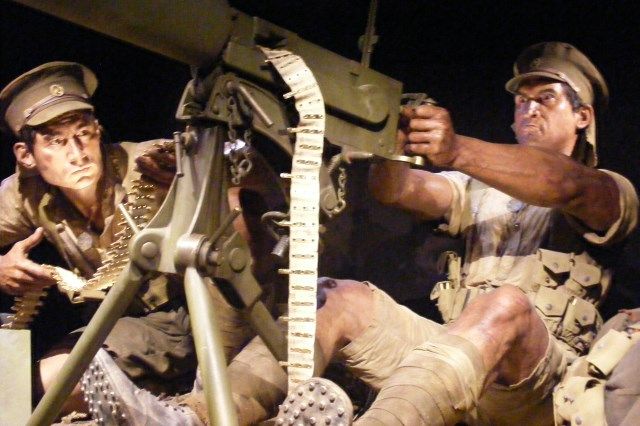
Machine-gunners sculpture
Visitors are immersed in New Zealand soldiers’ “experience” of the battle, with depictions of fighting, disease and squalor. The exhibition uses sculptures, computer animation, photos and selections from letters, diaries and memoirs. Some excerpts praise the Turks’ bravery, while others dehumanise them.
The wall text asserts that New Zealanders greeted the war as a “great adventure” and that “we were keen to do our bit for the empire.” Several quotes from soldiers have been chosen to reflect these excited and patriotic sentiments. Others describe the horrors of the battlefield or the grief of losing a relative but there is almost no hint of opposition to the war itself.
The curators place special emphasis on glorifying the involvement of Maori soldiers at Gallipoli, despite being forced to admit that large numbers of Maori refused to join the army. They do not mention that about 100 Maori men were imprisoned for resisting conscription. 
A section of the Gallipoli exhibition
Former army officer turned historian Christopher Pugsley, who was the main historical advisor for the exhibition, told Radio NZ that he wanted to destroy the “myth” that the soldiers “were victims of Empire. In fact what they were doing was trying to make it work and survive.” The curators’ wall texts, written from the point of view of an imaginary New Zealand soldier, present this pro-imperialist version of history.
For example, in describing the hostility felt by ordinary soldiers towards commander William Malone—who Pugsley intensely admires—the text declares: “We hated the bastard at first, but he worked harder than anyone to make the place safe. We were dead meat without him.” This is obviously the voice of the government and its hirelings. It is precisely this obedience and respect for the military that both the exhibitions aim to instil in young visitors.
The pro-war carnival taking place across Australia and New Zealand must be taken as a sharp warning. The contradictions of capitalism that caused WWI are once again intensifying. Successive New Zealand governments have strengthened the country’s alliance with US imperialism, which is stampeding from one bloody intervention to the next in the Middle East, while building up its military forces against Russia and China.
The Socialist Equality Party calls on workers and youth to attend its public meeting in Lower Hutt on April 26 to discuss the political lessons of the First World War and the Russian Revolution. The meeting will be a preparation for the International Committee of the Fourth International’s online May Day rally, which will present a socialist and internationalist strategy to prevent WWIII.

Syriza plunders Greece’s public finances

Christoph Dreier

As negotiations continue between Greece and the troika of the International Monetary Fund (IMF), the European Central Bank (ECB) and the EU Commission, the Greek government of the Coalition of the Radical Left (Syriza) is plundering the country’s public finances and preparing to suppress protests.
The troika had been expected to announce an agreement with the Greek government by the time the eurozone finance ministers meet on Friday. All the participating parties, however, have now excluded this possibility.
The government in Athens is hoping for a payment of the last tranche of the aid credits amounting to over €7.2 billion. The troika is demanding massive social cuts, privatization, and structural reforms in return. For example, retirement funds face large cuts, with the average retirement rate reportedly to be reduced from €487 to €320. These measures would affect 623,494 pensioners.
This demand of the troika had already been rejected by the current government’s conservative predecessor. Andonis Samaras, then the prime minister, feared social insurrection after previous austerity measures had forced entire families to subsist on the modest retirement funds.
Syriza has already made quite far-reaching concessions to the EU and has complied so far with all its financial obligations. Alexis Tsipras, who heads the government, and Finance Minister Yanis Varoufakis have repeatedly emphasized in the past few weeks that they are ready for every imaginable compromise.
However, the representatives of the EU and the IMF have continued to speak cautiously on the matter. “For a few days a little more momentum has gathered in negotiations between the three institutions and the Greek government,” said Poul Thomsen, head of the IMF in Europe. He told theHandelsblatt that this was a positive development, but they are still “far from the goal.”
“There urgently has to be far greater effort from the Greek side, so that we can reach an agreement on this issue in the interests of both sides,” EU Commission President Jean-Claude Juncker said in Vienna on Tuesday.
The intensity of the discussions has increased in the past four to five days, Juncker said. A conclusion is not in sight, he added. To let Greece fail is out of the question. “But it is not an issue of supporting Greece at any price,” said Juncker.
While Juncker excluded such a scenario, other representatives of the Troika institutions spoke about the possible bankruptcy of Greece. ECB head Mario Draghi said on Saturday in Washington that the eurozone is now better prepared for a possible spillover of the Greek crisis.
French Finance Minister Michel Sapin has also said that the situation has changed in the past few years. If something dramatic happens, according to the finance minister, it will be a serious situation for Greece and its citizens, but not for the other countries in the eurozone.
In Greece, Syriza is applying the axe to what remains of social programs, while preparing to suppress protests. On Monday, the government passed a decree that requires all public authorities and corporations to make financial contributions to the Greek Central Bank and put them into the hands of the government.
Local city management, hospitals, energy and water supply, and public transportation as well as many others services belong to the affected institutions. Only retirement funds are exempted. The government had already tapped these in February on a voluntary basis in order to remain liquid.
The plundering of the public treasury also serves Syriza by allowing it to pay its debts to the IMF and other creditor institutions. In the last two months Athens has already transferred more than €2 billion to the IMF, which is withholding additional aid credits from the country until the Greek government completely subordinates itself to the dictates of the troika.
These €2 billion are now no longer available for wages and retirement. According to reports in the Greek financial press, the government in Athens needs about €1.1 billion for salaries, €850 million for retirement payments and just under a billion for the payment of additional IMF credit payments.
By paying the IMF, Syriza has severely exacerbated the situation of the country in the event of an official bankruptcy and a possible departure from the currency union. If the country is cut off from any financing, in spite of a primary surplus, within a few days it will no longer be able to ensure basic services.
The confiscation of public funds has caused sharp conflicts within Greece. Several mayors have announced that they will fight against it. The mayor of Athens, who is supported by the social democratic Pasok and the Syriza offshoot Democratic Left (Dimar), called the measure unconstitutional. Other mayors announced that they would take the matter to court in order to put a stop to the plans.
The payments to the IMF have already led to a situation in which wages and retirement payments can no longer be paid in full. Hospital doctors have announced a strike for Friday in order to demand the payment of the missing wages. A demonstration is planned in front of the health ministry. Workers at private transportation companies have also announced a strike for May Day, in order to protest the delay—sometimes amounting to months—in receiving their wages.
Support for the course of the government has suffered a massive collapse, according to a recent survey. In March, 72 percent of those questioned were still happy with government policy, while in April this number fell to only 45.5 percent. The survey was carried out by Macedonia University, and on Tuesday it was published on the program Skai.
According to the same survey, only three percent of those questioned are sure that their financial situation will improve. Of those polled, 35.5 percent expect no change, while 41.5 percent expect things to get worse for them. Forty-two percent no longer believe that Syriza feels any duty to keep its campaign promises.
Syriza is responding to opposition to its anti-social policies by arming the state and preparing to deploy the police and the army. In the past week, the government sent a clear signal by deploying the police to end the activist student occupation at the Technical University in Athens.
Since the massacre that the colonels’ dictatorship carried out on November 17, 1973 on the university campus, the deployment of the police on university premises has had a strong symbolic meaning.
On Monday, Tsipras stood behind his vice minister for public protection, Giannis Panousis, who had organized the action. At a joint press conference, he defended the clearing out of the university and cynically declared that his government is about achieving the “reconciliation of the citizen with the policeman.” The policeman should not be seen as someone “who monitors, but as someone who is there when security is threatened.”
With these words, Tsipras defended not only the actions of the university, but also justified Panousis’ suggestion that the police should be restructured. These plans are aimed at creating a special police body for demonstrations and protests that is no longer armed with tear gas, but with clubs and pistols.

Saudi-led coalition halts air assault in Yemen

Niles Williamson

Saudi Arabia announced Tuesday that it was ending the nearly one-month-old air assault it spearheaded against the Houthi rebels and their supporters throughout Yemen. Saudi coalition spokesman Brigadier General Ahmed Al Asiri told reporters that the operation concluded “based on a request by the Yemeni government and President Abd Rabbuh Mansour Hadi.”
Saudi Arabia and its coalition partners, backed by the US, have been dropping bombs on targets throughout Yemen for the last four weeks with the aim of defeating the Houthi rebels, who have taken control of most of the country’s western provinces.
The United States government facilitated the continuous assault by providing the coalition with logistical and intelligence support, approving possible targets and refueling jet fighters after bombing raids. The Saudi monarchy and the US government have been expressly seeking the reinstatement of President Hadi, who fled the country for Riyadh in the face of a Houthi assault at the end of last month.
Asiri told reporters that sustained air strikes were no longer necessary, claiming that they had effectively neutralized the Houthis as a threat. He did not rule out future strikes, and stated that military force would continue to be used prevent the Houthi militia from “moving and carrying out any operations” in Yemen.
With the conclusion of the air campaign the Saudi spokesman announced the beginning of “Operation Restore Hope,” aimed at achieving a “political solution” in Yemen and escalating “anti-terrorist” operations inside Saudi Arabia.
The campaign of intense air strikes has been ineffective in weakening the Houthis, who remain in control of a majority of the country’s western provinces and major urban centers, including the capital of Sanaa and portions of the southern port city of Aden. The Houthis have gained an advantage partly because of support from military forces loyal to the former longtime dictator Ali Abdullah Saleh and his son Ahmed.
Despite their limited impact, a press release from the Saudi Defense Ministry claimed that military operations over the last four weeks had “successfully managed to thwart the threat on the security of the Kingdom of Saudi Arabia and neighboring countries through destruction of the heavy weapons and ballistic missiles seized by the Houthi militias and troops loyal to Ali Abdullah Saleh, including bases and camps of the Yemeni army.”
According to an official estimate from the United Nations, the Saudi air campaign, in addition to fighting on the ground, killed at least 944 people and wounded a further 3,487 between March 19 and April 17. Many of the casualties have been civilians, including women and children, killed when air strikes in residential areas destroyed their homes.
Two air strikes on Tuesday killed approximately 40 people, mostly civilians. A strike on a bridge in Ibb province killed at least 20 people, while an air strike in the northern city of Haradah killed 13 civilians and seven soldiers. The death toll from the bombing of a weapons depot that flattened a residential neighborhood in Sanaa on Monday was raised to 38. The Houthi-controlled Interior Ministry reported that in all 84 people were killed by air strikes throughout the country Monday.
Prior to Tuesday’s announcement of the end to the air campaign, Saudi King Salman bin Abdulaziz Al Saud announced the mobilization of National Guard troops to support military operations in Yemen. The Saudi-led coalition has raised the possibility of a ground invasion, aimed at pushing the Houthis out of southern Yemen and back to their northern home province of Saada.
Meanwhile, US warships, including the aircraft carrier USS Theodore Roosevelt, remain off the coast in the Gulf of Aden, in position to block a convoy of Iranian cargo ships allegedly seeking to deliver aid to the Houthis. US officials have accused Iran of backing and arming the Shiite rebels. The UN Security Council voted last week, with Russia abstaining, to impose an arms embargo on the Houthi rebels.
Speaking to reporters on Tuesday, White House Press Secretary Josh Earnest insisted that the US was committed to blocking any possible arms shipments to the Houthis. “The United States alongside the international community, including the United Nations, is serious about the Iranians not providing weapons to the Houthis,” he stated. “Providing weapons to the Houthis only exacerbates the violence and instability in this region in a way that will have continued terrible impact on the humanitarian situation in the country.”
As the Saudi-led operations entered a new phase Tuesday, the World Health Organization (WHO) released a statement warning that Yemen, already deeply impoverished prior to the Saudi assault, faces the “imminent collapse” of its health care system.
Fighting on the ground, as well as a naval blockade being enforced by the Saudi-led coalition and the US, has resulted in a serious shortage of medical supplies, clean drinking water and fuel. Aid flights have been limited by a no-fly zone enforced by coalition warplanes over the country, creating the conditions for a potential health catastrophe.
Vital power infrastructure throughout the country, necessary for pumping clean water from underground aquifers, has been knocked out, contributing to a deepening of the shortage of clean drinking water in the country.
Dr. Ahmed Shadoul, the WHO Representative for Yemen, stated that over the last four weeks the number of cases of bloody diarrhea in children under the age of five had doubled due to a lack of access to clean drinking water. He also reported that there had been an increase in cases of measles and malaria, in addition to heightened rates of malnutrition among women and young children.
The WHO statement warned that power cuts threaten the country’s blood banks and vaccine stockpiles. The loss of Yemen’s vaccine stockpile would increase the risk of the widespread outbreak of communicable diseases such as measles and polio.
The lack of electricity or fuel for generators has severely hindered the maintenance of crucial hospital operations throughout Yemen. According to the WHO, without the return of consistent power, kidney dialysis as well as cardiac and cancer treatment programs are threatened with complete collapse.

California’s Inland Empire: A model of low-wage “growth”

Marc Wells

An hour east of Los Angeles, two counties, San Bernardino and Riverside, are home to more than 4 million people. This metropolitan area is referred to as the Inland Empire. Along with the Los Angeles metropolitan area, it is part of the Greater Los Angeles Area, with its 18.5 million inhabitants.
Like other regions in the US, the Inland Empire saw a radical transformation in the 1970s, characterized by a shift from agricultural to industrial economy. A large section of migrant workers chose this area for its more reasonable cost of living.
In 2008, the region was devastated by the financial crisis, following the collapse of the real estate market. Between 2009 and 2012, unemployment shot past 14 percent, from slightly above 4 percent in 2000. Three years ago, San Bernardino was thrown into bankruptcy, threatening the obliteration of pensions for hundreds of city workers. May 30 is the deadline for the city’s presentation of a restructuring plan which may duplicate the experience in Detroit.
In the last two years, this area has seen profound changes. Unemployment is officially down to 6.5 percent as of March 2015 and the Inland Empire is being hailed as an economic miracle, having undergone a shift from construction to logistics (transportation, inventory, warehousing) and becoming a crucial node in global commodity distribution.
The region is inseparably linked to the Los Angeles/Long Beach ports, which are the entry point for some 40 percent of all US imports. Goods from China and the rest of the world are then warehoused in the Inland Empire for giants like Amazon, Home Depot, Wal-Mart, Sears, Kohl’s, Nordstrom and Macy’s.
Economists have enthusiastically praised the development, calling it one of the fastest growing regions in California, next to the IT developments in San Francisco and Santa Clara. The growth is based on cheap labor and hazardous working conditions.
John Husing, chief economist for the Inland Empire Economic Partnership, commented for the Los Angeles Times that the growth of warehousing facilities is one of the fastest in the “recovery” and “will be a benefit to our region and Southern California even if nationally that’s not a good thing,” referring to the adverse impact of the strong dollar on US exports affecting other areas of the country. “We were in a hole, but we climbed the ladder and now we’re out in the sunshine,” he said.
The Inland Empire “success” is part of the official narrative proclaiming that “recovery” is underway and unemployment has been defeated. Beneath the hype, however, there lies a different truth.
Despite a substantial boost to the profits of major corporations, conditions for workers have significantly worsened. The highly praised new jobs pay a pittance and conditions are often perilous. This is the direct consequence of Obama’s policies, whose opening shot was his attack on autoworkers in 2009, as he took office.
In the name of competitiveness and corporate profitability, workers are required to bear the brunt of “growth” by suffering a dramatic decline of their living standards. Promises that workers can work up the skill ladder are simply not credible, given the precarious nature of employment contracts.
Commenting on what he defined “poverty wages,” a warehouse worker at California Cartage Company commented: “We have people working here 20 years, still moving boxes and making minimum wage with no benefits.”
Another worker, Jose Rodriguez, said that after 6 years, he received a 40-cent increase, insufficient to avoid late penalty fees on his bills.
The WSWS spoke to Jake Wilson, a sociology professor at California State University, Long Beach. He pointed out, “The question should be not about the number, but the quality of jobs and, within that, wages and working conditions, the ability to organize and live with dignity. “Most workers are hired by temp agencies; working conditions and wages are terrible. These giant corporations rely on the continuous squeezing of workers across the supply chain.”
A large portion of jobs is temporary. As of 2013, more than 60 percent of new positions were handled by temporary agencies or contractors, almost always with no guarantee of hours and benefits. A high percentage of these workers are immigrants, easy and vulnerable preys of exploitation. Standard salaries begin at minimum wage and stay there for years. Tasks are repetitive, shifts are long and injuries frequent.
Citations of violations by California’s Division of Occupational Safety and Health are common. Lawsuits proliferate involving insufficient safety measures and alleged retaliation against employees who stop working because of excessive heat and nonpayment of wages. A token settlement typically ensures the continuation of business as usual.
Only two weeks ago, Amazon was sued for allegedly stealing workers’ pay. The company even demands from its employees a non-compete provision for 18 months after separation date, a trend that is expanding into low-wage work.
Cases of wage theft are common in logistics. Illinois warehouse workers protested last week against Elite Staffing temp agency, accusing the company of stealing from their paychecks.
Nearly three years ago, warehouse workers in the Inland Empire protested over poor job conditions. At the time, several testimonials revealed the reality of poverty wages, inhuman and unsafe conditions and fear of employer retaliation.
None of the issues have been resolved despite the “miraculous” economic boom of the area. Awesome profits don’t reach those who produce them. Their recompense is increased misery.
Professor Wilson commented on this dichotomy: “The growth of the logistics industry in the Inland Empire is an outcome of global capitalism. But over the past 25 years, conservative policies that were anti-worker, anti-poor and pro-capitalist prevailed. We need to be very critical of the dominance of these retailers and giant shippers that have weakened the power of workers.”
Furthermore, he noted, “Looking at the de-radicalization of union politics and their ‘mainstreaming and wedding’ to the Democratic Party, that has had a number of detrimental consequences for workers.” This contributed to a “widening gap in terms of inequality. Clearly, capitalism is only working for a small group of people, benefiting from the crushing of workers. It’s certainly time for change and it won’t come from the Democratic Party.”
In no small part, the responsibility lies with the Warehouse Workers Union (WWU), affiliated to Change to Win Coalition. While these workers are not officially represented by WWU, the union isolated the struggle of these workers, limiting it to single issues, contained protests and toothless lawsuits, under conditions where other sections of the working class (oil and dockworkers especially) are entering into conflict with big business and ready to escalate the struggle as well.
The WWU endorses the campaign for the $15 minimum wage, which in California—the 6th most expensive state in the US—ensures poverty At such a wage, 40 hours a week yields $31,200 yearly, equal to the level of the median wage in 2006. Median rent alone in California is slightly less than $1,900 a month, or 70 percent of median wage.
Without a socialist perspective, workers risk being defeated time and again by the very organizations that claim to represent their interests. The starting point is an independent mobilization aimed at uniting all sections of the working class in a common struggle. The economy must be reorganized rationally on the basis of the satisfaction of human needs, not profit motives.

Family members of disappeared Mexican students appeal for support in US

Seraphine Collins

Family members and friends of the 43 student teachers kidnapped in September from Guererro, Mexico, are touring throughout the United States to speak out on their disappearance.
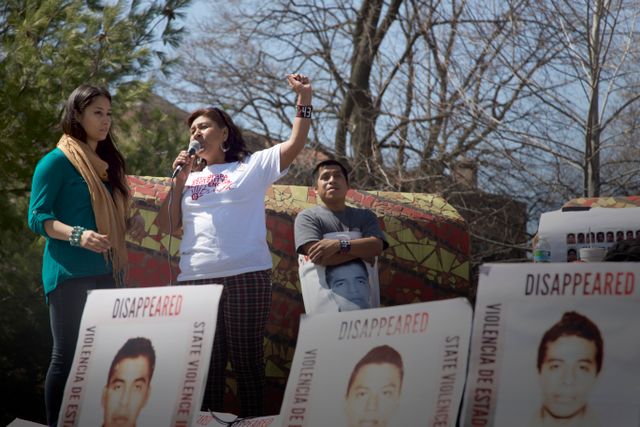
On April 12 and 13, Maria de Jesus, mother of 19-year-old Jose Eduardo, and Cruz Bautista, uncle of 20-year-old Benjamin Ausencio Bautista, spoke at several locations throughout Detroit, Michigan.
Signs honor the disappeared outside St. Anne's Catholic Church
On the morning of the 12th, parishioners gathered to hear their story at historic Saint Anne de Detroit Catholic Church, in Detroit’s Southwest neighborhood, the center of the city’s Mexican-American population. Signs covered the church lawn, bearing the names and ages of the disappeared.
This was the first event on the Detroit leg of Caravana43, as the tour is known. It was immediately followed by a two-mile march from Saint Anne’s to Detroit’s Clark Park, attended by nearly 100 community members.
On September 26, 2014, police in the town of Iguala, in Mexico’s impoverished southern state of Guerrero, violently attacked a group of some 80 young student teachers, leaving at least six dead, 17 wounded and 43 “disappeared.” Among the disappeared were Jose Eduardo and Benjamin Ausencio Bautista.
The students, from the Ayotzinapa Rural Normal School, had been protesting against state cuts to their college and raising funds for a demonstration in Mexico City marking the anniversary of the 1968 Tlatelolco massacre, which left hundreds of students and civilians dead in one of the worst atrocities of modern Mexican history.
The families are touring the United States to expose Mexican political corruption, to demand the return of their children—as the families do not accept the Mexican government’s claim that the kidnapped were murdered—and to speak out against the Merida Initiative, under which the US has supplied some $2 billion in arms aid to the country, while training security forces and sending US “advisors” across the border.
Caravana43 is a project which aims to facilitate the travel of friends and family members of the missing across America in order to raise awareness about Mexican human rights issues.
Three caravans departed from Texas on March 16, where they then branched out to reach Pacific, Central and Atlantic region states; they will converge at a summit in New York City on April 26, the seven-month anniversary of the disappearance, having visited over 50 cities in more than 30 states. Twelve friends and family members rotate amongst the three caravans.
Maria de Jesus, quietly smiling when asked by the WSWS about her son, described Jose and his life-long desire to become a teacher, “[Jose] is a very hard worker. He was the one who took care of his younger siblings—his brother is 15 and his sister is 12. He would teach them how to study. He was my first son, and as a mother you always want the best for your child. He knows how to cook, to work very hard, to do brickwork and build a home. He knows about agriculture. He was well known in the village, and people who worked with him are very saddened by his disappearance. When they see the work that he did, they are reminded and become sad. It’s very hard for them to go day by day, without new information.”
Maria de Jesus speaks at rally
Maria said that when her son became a student, he had no idea that the government of President Peña Nieto had a political agenda of eliminating thenormalista schools, as the rural teachers colleges are known. The disappearance of the 43 took place during his first month at the school.
“He was very happy,” she said. “That was his natural vocation: to be an educator. And it was something in him since he was young, to teach small children. My husband’s family lives outside the city, in a rural area, so he would see the poverty there and he always wanted to help them. He saw education as a way to rise out of poverty. He had hope and vision to change people’s situations.”
The Mexican Normal schools are a legacy of the Mexican Revolution which began in 1910. They are viewed by the government as a hotbed for “leftist” activity. Cruz Bautista, a school teacher, and himself a graduate of a Normal school, said that the attack on these institutions was part of a move to privatize Mexican education.
“Those that want to systemize education say the private schools are best,” he said. “They want to force English language learning. We are from the original communities of Mexico that speak 90 percent indigenous languages, and now the government wants students to learn a third language, English. We have been resisting this as well. We are against this education reform. We won’t allow them to erase our identity.”
Bautista said that when public schools are shut in rural areas and replaced by private schools, those sent to teach in the new schools lack the “context to understand the lives of rural families that they teach.” The teachers in the normal schools, on the other hand, “know the context, they encourage families and students to fight for their rights and take care of their communities.
Some of the schools lack educational materials and require the parents, often unemployed or low-paid workers, to pay a quota for building maintenance and supplies, he explained.
“In Guerrero, education is marginalized and abandoned,” said Bautista. “In our constitution there is an article that says education should be free and supplies and building maintenance should be paid for by the government ... but in real life these laws aren’t followed.”
When asked what life is like in Guerrero, Maria responded, “There is a lot of poverty, few schools, and many communities without water. They have to go to the river to get water. They can only farm during the rainy season, because they don’t have an irrigation system. They grow corn, beans, squash, and cilantro.”
The WSWS explained to Maria the current struggles with water availability in Detroit, where several thousand homes have had their services cut off in a continuing campaign to privatize the water system.
“I definitely see a link between the two countries [and what their workers face],” she replied. “I never thought the US would go through the same thing Mexico is going through.”
Cruz Bautista answers questions at Cafe Con Leche
The daily threats to the lives and safety of the Mexican people was a consistent theme in both the press conferences and interviews over the two-day period.“Political representatives do not care about what has happened or what is happening even though the situation has created a global echo, because no one cares about our security or safety,” said Bautista. “The government is only focused on business and money, and keeps reelecting the same parties. We’ve always known that the history of the government is one of corruption, and the history of the parties as well.”
He continued: “The governments and political officials are working with the drug organizations. They keep saying that the criminal leaders attacked the students, but we have seen videos and pictures and heard testimony from students, that the police and the federal government attacked them. There is obvious evidence that the narcos are working with the federal police, so they are basically one and the same.”
Maria spoke passionately about police violence and the obstacles the government has created to prevent an investigation into the disappearance, “When they oppressed our young people they didn’t ask for our permission, but they tell us we can’t go places [to look for them] because we don’t have a search warrant,” she said. “These young people were taken away by our own government—shot at. Our children were shot at. They suffered that persecution by police officers.”
Those who decided to join the tour were motivated by the need to secure a better life for Mexican youth, within which they can study freely without fear of violence. “As parents we have said we don’t care for our own lives anymore,” said Maria. “We cannot continue. We are very sad, crying in desperation and depressed; that’s why we couldn’t stay at home. We left home to spread the message. We are asked, ‘Are you tired?’ No. It’s an urgent matter; we seek to find these lives.”
Maria, added, “If it was the son of a government official, they would search heaven and earth, but not for us, because we are poor.”
“The US holds a lot of responsibility for what’s happening in Mexico,” she said, citing the flow of weapons across the border and into the hands of the drug cartels. Pointing out that Obama and Peña Nieto have met repeatedly, she added, “There is some kind of agreement between them. ... If Obama knows what’s taking place, why doesn’t he do anything?”
The role of mass poverty in the development of drug trafficking in Mexico was stressed by Bautista. Instead of fighting an endless drug war, he thinks the Mexican government should be funding education and jobs, “The poverty in Mexico is very intense. The minimum wage is 70 pesos: about 4 US dollars an hour, and prices for groceries are disproportionately high.”
When Bautista was asked by a press conference attendee what can be done, he answered: “There are many injustices that come to students, but we don’t know why students are always targeted. There’s always an effort to push down the lower classes and young people. We demand our government officials pass laws that respect the lives of youth. We demand freedom of expression. Many journalists have been harassed as well, and censored.”
He expressed his concern that Mexican media does not report truthfully and called for independent media to visit Mexico to learn what is happening there. “We’ve said before that when we go to rural areas and travel to the US, we always talk about our rights. Each one must fight for their rights. This is our message.”
This message delivered by the relatives of the Mexican students has found enormous resonance in the US under conditions in which American workers and youth are themselves confronting a wave of police killings, attacks on public education and a generalized assault on basic democratic rights.

Trial of former SS soldier begins in Germany

Elisabeth Zimmermann

The trial of 93-year-old former SS sergeant Oskar Gröning began yesterday at the fourth criminal grand chamber of the Luneburg district court. He is charged with assisting murder in 300,000 cases. From September 1942 to October 1944, Gröning was an SS guard and administrator at Auschwitz concentration camp in occupied Poland.
More than 70 years after the liberation of Auschwitz by the Red Army on January 27, 1945, it is certain to be one of the last trials of living perpetrators of the indescribably hideous crimes committed by the Nazis at this and other concentration camps.
The name of the Nazis’ Auschwitz concentration camp has come to symbolise the worst crimes and horrors of the twentieth century, and is a byword for the barbarism of capitalism in its most extreme form. More than 1.1 million people were brutally killed there. Hundreds of thousands were exterminated in the gas chambers immediately after their arrival, while others died from hunger, physical exhaustion or hideous experiments by sadistic doctors like Josef Mengele, nicknamed the angel of death by the prisoners.
Some 90 percent of those killed in the camp were Jews. In addition, 150,000 non-Jewish Poles, including political prisoners, 23,000 Sinti and Roma, 15,000 Soviet prisoners of war, other national minorities, as well as Jehovah’s Witnesses and homosexuals were murdered.
In addition to Gröning, two other former SS soldiers currently face thousands of charges of assisted murder. An investigation by the state prosecutor in Schwerin is underway into 94-year-old Hubert Z from Mecklenburg Pomerania, and another against 94-year-old Reinhold Z from North Rhine-Westphalia led by the Dortmund state prosecutor.
The SS soldiers currently being charged allegedly were not directly involved in the murders, but through their service in Auschwitz, they contributed to the functioning of the Nazi murder machine. Gröning himself described his role at Auschwitz as a “cog in the wheel.”
Oskar Gröning volunteered for the Waffen SS at aged 21 as a committed National Socialist, and was ordered by the SS business and administration head office on September 25, 1942, to be sent to administer the Auschwitz concentration camp.
Since he had previously worked in a savings bank, he was placed in the administration of prisoners’ money. His task was to stand guard as the victims were delivered to the camp in cattle wagons, and collect their possessions and valuables. The stolen money obtained during this process was then sent by him to the SS headquarters in Berlin.
The list of charges from the state prosecutor in Hannover, responsible for pursuing Nazi crimes in Lower Saxony, limits itself to the so-called Hungarian action of May 16 to July 11, 1944. In this two-month time frame, the SS deported some 425,000 Jews from Hungary to Auschwitz. Around 300,000 were sent directly to their deaths in gas chambers on their arrival.
Within this period, 137 trainloads arrived at the Nazis’ death factory. Gröning’s task was to collect the belongings left by those sent to the gas chamber from the train platform and camp entrance. “In so doing, the traces of the mass murder would be eliminated for subsequent prisoners,” states the 85-page charge sheet. His activities had supported the Nazis’ systematic mass murder.
The trial has met with great interest abroad and more than 60 survivors from Hungary, the United Kingdom, United States, Canada, and Israel wish to testify to the court as joint plaintiffs. Accordingly, the trial was moved from the Luneburg court to a larger building.
As with other trials on the subject of crimes during the Nazi period, the question is raised: Why has the trial taken so long?
The answer is largely that within the German political and judiciary systems, many former Nazis were utilised by the state and their careers continued unhindered after the war. A systematic legal investigation into the crimes of the National Socialists was consistently blocked.
Of the many thousands of Nazi criminals, relatively few were brought before the courts. Since the end of the war, the German judiciary has investigated 100,000 cases, but only 6,500 were convicted. They received relatively mild sentences considering the horrendous nature of their crimes. Generally, the perpetrators took the defence that they were just following orders, which the courts recognised as legitimate.
Of the 6,500 SS personnel who carried out their murderous work in Auschwitz and survived the war, only 29 were convicted in the Federal Republic, according to a report in Der Spiegel. In the GDR (East Germany) the figure was 20.
The Frankfurt state prosecutor had already investigated Gröning in 1997, but broke off proceedings in 1985. Lawyer Thomas Walther, who is now representing around 30 joint plaintiffs, victims of the Nazi regime and their relatives, commented on this to the Süddeutsche Zeitung, “They did not abandon the case, but buried it. In the 1970s and 1980s there were still ‘thousands of Grönings,’ so the investigators decided it was preferable to leave it alone.”
In Deutsche Welle, Walther explained, “in the Federal Republic, thousands of men and women would have to have been charged if current criteria had applied in the past.” But this was not desired, so the Nazi collaborators were not to be pursued. Oskar Gröning was never punished for his service in the death factory.
In 2011, the Munich district court sentenced the now-dead SS guard in Sobibor concentration camp John Demjanjuk to five years’ imprisonment for assisting in the murder of 28,000 Jews. Since then, there is no need to prove that a person being charged was directly involved in the murders. This is one of the reasons why trials are being conducted now against those SS soldiers who are still living.
In contrast to many previous defendants in these cases, Oskar Gröning has expressed his readiness to testify before the court on the events in Auschwitz. He had already spoken in interviews openly about his experiences and actions in Auschwitz, and written them down for his friends and family.
When an acquaintance sent him a book about “the Auschwitz lies,” he sent it back with a note saying that everything reported about Auschwitz was true: selections, gassing, burning—1.5 million Jews had been murdered in Auschwitz, and he had experienced it. Nonetheless, he did not feel guilty about the murders because he had not been directly active in the gas chambers.
The course of the current trial will reveal how much it contributes to the uncovering of one of the greatest crimes of the twentieth century. The survivors and relatives of the victims taking part in the trial as joint plaintiffs are hoping for something, even if only very, very delayed justice.