25 Apr 2015

21st Century Challenges To American Democracy: Part I

Jon Kofas

Abstract: It requires several hundred pages to address the complex subject of challenges to American democracy in the post-Cold War era of a global multi-polar economic and political power structure. In this brief essay, I identify only a few of the current challenges to American democracy that appear permanent fixtures of society in the early 21st century. The objective is to provide but a sample of some issues, regardless of how the corporate media, government, and presidential candidates wish to define challenges to democracy.
Introduction: Erosion of Public Confidence in Liberal Democracy
From the writing of the Constitution until the present, there have been many challenges to American democracy. This reflects an ideological struggle between those closer to John Locke’s classical Liberal model of government and those advocating a social democratic model based on jean-Jean Rousseau’s view of the Social Contract.
One of the first challenges to America’s liberal democracy intensified in 1805 during the Federalism vs. Democratic-Republican controversy (10th Amendment) that was not resolved until Civil War (states’ rights issue with slavery at the core – 14th Amendment). A second significant challenge came during the early years in the Age of Progressivism (1900-1920) the struggle to modernize the state to reflect the industrialization of society, to rationalize capitalism and balance pluralistic interests against the very rich demanding control of all institutions from the press to politics was a challenge that made its return in the Great Depression when FDR strengthened the central government and used it to keep capitalism afloat amid its self-destructive course. The last major Constitutional challenge manifested itself during the Cold War followed by the institutionalization of counter-terrorism culminating in the Patriot Act that remains a very serious threat to the US constitution and the tradition of liberal democracy. At the core of national security issues if the violation of the 4th Amendment dealing with privacy and 6th Amendment dealing with due process.
Despite America’s history as a former European colony that would emerge to emulate the imperial motherland, similar challenges confront other open societies as well. Depending on one’s ideological perspective, such challenges can be anything from corporate institutional hegemony to lack of respect for human rights, as far as progressive analysts are concerned, to lack of a strong defense and absence of tough policy on illegal immigrants, according to right wingers. To left-of-center critics, the challenges to American democracy are invariably associated with the dismantling of just about everything that the FDR and to some degree Kennedy-Johnson administrations created as part of a pluralistic multicultural society. The Tea Party movement within the Republican Party has its own list of challenges to American democracy, and those focus on immigration, gun ownership, and complete deregulation of Wall Street. Ironically, everyone from Tea Party Republicans and Libertarians to liberal and leftist Democrats and claim Jeffersonian democracy expresses their ideological position. (Andrew Burstein, Democracy's Muse: How Thomas Jefferson Became an FDR Liberal, a Reagan Republican, and a Tea Party Fanatic, All the While Being Dead)
Some of the challenges facing the US also confront many other developed countries, including all of the richest nations on the basis of GDP. America’s history, traditions and institutions distinguishes it from Europe as well as Canada and Australia for that matter, despite their common heritage as British colonies that industrialized and moved into the core of the world capitalist system. As the world’s economic and military superpower for the last six decades, the US has a different set of challenges confronting its democratic institutions than any other nation on earth. The inherent contradiction between liberal democracy at home and economic imperialism backed by a global military network has always been irreconcilable and will remain so in this century as the US will more than likely become even more militaristic in ordert to counter-balance China’s rising economic and political hegemony.
In so far as democracy operates under the political economy of international capitalism that shapes institutions and molds the class structure, it is inevitable that challenges in American society have common characteristics with other countries far less militaristic than America. Clearly, official corruption, minority rights, human rights, and elitism that the political economy produces, to mention just a few, are challenges in all democracies and they are permanent no matter how ephemeral politicians try to portray them.
Beyond presidential elections that generate vacuous rhetoric about “change” when in fact the basic institutional structure remains unchanged there is the larger question of the evolution of American democracy owing to objective economic and geopolitical conditions at home and abroad. The US is facing challenges of global economic preeminence from China, unconventional warfare around which the US has built an elaborate institutional counter-terrorism structure and culture, and massive social and economic problems at home that are becoming worse with every downward economic cycle.
Challenges to democracy are bound to test the republic in the future partly because China will replace the US as the world’s number one economic power at some point in this century – China is already ahead in PPP (purchasing power parity) terms. The US, which has been the world’s number one economy since 1872 when it overtook UK, will try to compete by placing even greater emphasis on its defense sector and military adventures. The US will continue the current policy of containment and destabilizing various parts of the world, while continuing with corporate welfare that has drained the economy in the last four decades. The result of this at home will be detrimental for the economy and the tradition of liberal democracy, and observance of the Constitution.
Do the American people have the same confidence in their government and institutions – political at all levels of government, media, educational and in corporate businesses – as the media tries to convince its audience? According to one public opinion poll, 75% of all Americans polled indicated they were “angry” with the policies of their federal government, albeit for different reasons depending on their ideological and political orientation. Naturally, people look to government for solutions to serious problems ranging from unemployment to living standards, but they also like to believe their government is fulfilling the social contract and not marginalizing the majority of the people to further the interests of the small minority.
According to Thomas J. Scott (“Democracy and its Discontents” Truthout.org ; January 2015), the Organization of Economic Cooperation and Development (OECD) data for 2013 indicates that only 35% of Americans have confidence in their government. Statistics are even worse among young people who simply become disengaged from the political process. A Rasmussen poll indicates that a tiny 8% of all voters have confidence in US Congress doing a good job, and a Gallop poll suggests 44% approve of the Supreme Court, while a Rasmussen poll for December 2014 notes that more than half of the citizens disapprove of Obama.
While one could argue these are not bad statistics when compared with approval ratings for governments in other developed countries, similar public opinion poll results for European and non-European countries only prove a general decline in confidence for open societies that claim to the name democracy but fail to deliver what the majority believe is the democratic social contract. Again, the percentage of young people dropping out of the political process completely is rather common, reflecting the high level of youth unemployment and expectations of their government vs. reality of “bourgeois democracy” as it is shaped in each country reflecting its dominant culture and heritage.
It is of interest to note that public opinion polls show a sharp drop for democracy and capitalism (from low 70th percentile in favor in the early 1990s to mid-30s today) on the part of people across all of the former Soviet republics. This includes Ukraine where a minority of the population turned to neo-Nazism (SVOBODA) under the guise of freedom and democracy. The reason for the drop in public support of democracy and capitalism is largely because the dust has settled and people have now seen that behind the mask of democracy is a small clique of oligarchs on whose behalf government conducts policy.
The lack of confidence in public and private sector institutions in the US, and other open societies reflects a widespread recognition that these only serve the interests of the small privileged political, social, and financial elites to the exclusion of all the rest. Despite this reality, the corporate-owned media would have the public believe that the single most important challenge to democracy is none other than “foreign threats”. Government must meet these “foreign threats” by becoming even more militaristic in its foreign/defense policy, and more authoritarian at home, all in the name of imposing conformity.
Media-defined Threats to Democracy
On a daily basis, the mass media projects the image that the threat to American democracy comes mainly from abroad and from domestic violence that includes everything from petty crime to gun violence by some emotionally unstable individual. Large crimes that involve billions of dollars in banking scandals are hardly a threat to the integrity of the political economy. In short, the neighborhood burglar and foreign and domestic security are newsworthy, while rarely is the challenge to democracy the growing inequality gap, persistent culture of racism, political alienation by the majority of citizens, to mention only a few problems of major societal significance. Meanwhile, all the media and political focus stays on Islamic unconventional warfare – “terrorism”, Russian foreign policy, Chinese economic hegemony, North Korean adventurist statements and military exercises threatening America’s regional allies, and defiant states such as Syria, Venezuela, Argentina, Iran, etc.
Almost every Republican Party politician embraces the theme of a foreign enemy threatening American democracy. Therefore, the response to such ominous challenges is a massive military buildup and military solutions to international conflicts, so the people at home “feel safer”, regardless of whether they are actually safer. In the absence of the Cold War because there is no longer a Warsaw Pact but under the persistence of Cold War institutions and policies of containment, surveillance, counterinsurgency and militarism, the US has redefined and subordinated democracy to “emergency politics” invariably associated with a state of war or national emergency. In this manner, the government can justify everything from unilateral military interventions to violating the Constitutional rights of its own citizens. Using the politics of “foreign enemy distraction” government uses the fiscal system to favor the top ten percent of the population, while slashing social and environmental programs. (Des Freedman Daya Kishan Thussu, Media and Terrorism: Global Perspective; Bonnie Honnig, Emergency Politics: Paradox, Law, Democracy; Pippa Norris, Montague Kern, Marion Just, eds., Framing Terrorism: The News Media, the Government and the Public; Douglas Kellner, Media Spectacle and the Crisis of Democracy: Terrorism, War, and Election Battles (Cultural Politics & the Promise of Democracy)
Populist rhetoric on the part of the two major political parties is the key in convincing public opinion that “the foreign enemy” threatens democracy and freedom, both in increasingly short supply because of “emergency politics”. Populist rhetoric is the catalyst for winning elections for both the Republic and Democrat parties and for defining democracy and its threats real and perceived in the manner that engenders optimum sociopolitical conformity and distracts from issues significant to the larger population. While Republicans and Democrats agree the threats to democracy are terrorism and foreign enemies, it is mostly Republicans that subscribe to a xenophobic and Islamophobic, often latent racist agenda targeting Latin American immigrants who make up the cheapest labor force, African-Americans, and Muslims.
Perception and reality of what threatens American democracy are two different things, just as there is a huge gap between what politicians promise and what they actually deliver. The populism of the ruling parties in the US is also a characteristic of Europe where both conservative parties and center-leftist under the label of “Socialism” employ similar rhetoric but wind up supporting globalization, neoliberal policies, strong defense and weak social programs, all resulting in downward social mobility of the middle class. (Claire Snyder-Hall and Cynthia Burack, eds., Right-Wing Populism and the Media; Daniele Albatazzi and Duncan McDonnell, Twenty-First Century Populism: The Specter of Western European Democracy)
If indeed people care more about safety and security, or at least if the media and their political, business, and social leaders convinces the public that nothing matters more than safety and security, people will voluntarily surrender any commitment to democracy for the perceived guarantee of safety and security. If the US moves increasingly toward a more authoritarian model under the political shell of “democracy,” as it could if in the future it faces more and deeper economic contractions that result in an increasingly smaller and weaker middle class, the cause will not be the UN, the WTO, Islamic “terrorism,” rogue nations like North Korea, etc.
“Military Keynesianism” in the Age of Counter-terrorism
It is not as ironic as it may appear that American democracy is facing more challenges in 2015 than in 1950. This is because the East-West confrontation (Cold War) provided a consensus that the “war on terror” has not replaced as the Republican and Democrat parties had hoped. The breakdown of consensus revolves around the huge gap between what government, business and media promise and what actually transpires in society. The “open society” would deliver even greater rewards because the Communist threat does not exist. However, there is continued downward socioeconomic mobility and decline in personal freedoms for the vast majority of citizens and not much hope the future has the American Dream in store for most people.
For conservatives the solution is “Military Keynesianism' an early Cold War containment military doctrine refers to defense spending as a means of stimulating the civilian economy by allowing the surplus to be absorbed by the defense sector. This was feasible when the US enjoyed balance of payments surplus in the early 1950s, but in 2015 when its public debt surpasses its annual GDP, “Military Keynesianism” is obviously destructive, especially when combined with the policies of corporate welfare capitalism where the state essentially is steering subsidies and contract to private companies to keep them healthy. (Jerry Sanders, Peddlers of Crisis: The Committee on the Present Danger and the Politics of Containment).
The result of this doctrine can be seen in the immense US sovereign debt that has been skyrocketing in the last fifteen years, as we will see below when analyzing debt as a challenge to American democracy. Moreover, the doctrine of “Military Keynesianism” has weakened the economy with the middle class and laboring classes as the victims paying the price. As David Shreve points out: “Because they sap the strength of the already bastardized Keynesianism built on the weak reed of the defense industry multiplier, the lingering advantages of Keynesianism itself become attenuated even further, devalued and increasingly misconstrued in political circles, and felt only perversely by most affected citizens. “Making the eagle scream” as John Dos Passos once described it, to compensate partly with ever increasing military expenditure, can postpone some of the reckoning, just as it did in the last days of the Soviet Union, but it cannot stave off the inevitable weakening of the overall economic fabric.” (David Shreve, “Defense Spending and the Economy: The Pitfalls of Military Keynesianism”. @War IS A Crime.org
By itself, “Military Keynesianism” does not constitute a threat to American democracy, but when put in the institutional context of a state that violates the constitution by keeping its citizens under surveillance, denying human rights to prisoners, denying due process to citizens, and expanding the “counter-terrorism” institutional structure to the degree that “security transcends democracy”, then there is a very serious problem. The continuation of “Military Keynesianism” and pursuit of counterterrorism measures used as a pretext for police state methods benefits the political, economic, and social status quo. At the same time, counterterrorism precludes societal progress to the benefit of all people, social justice, and above all democratic practices. The result of the “military-solution based foreign policy” invariably weakens democracy at home as domestic institutions mirror the military foreign policy regime. (David C. Unger, The Emergency State: America's Pursuit of Absolute Security at All Costs; James Petras, The New Development Politics: The Age of Empire Building and New Social Movements .)
The irony about “Military Keynesianism” is that its congressional advocates castigate government spending as counterproductive to the free market system, as though such a market exists, but they have no problem with government engaged in deficit financing to dish out contracts to the defense industries. The argument is that despite deficit financing, defense spending, inherently capital-intensive rather than labor intensive, creates jobs as though non-defense spending such as infrastructural development is detrimental to jobs growth. “Because the combination of defense spending, massive tax cuts, and the bailout had led to large budget deficits, the proponents of this perverted military Keynesianism insisted that programs for productive government expenditures had to be cut in the name of fiscal responsibility to make way for (wasteful) military spending.” (Michael Perelman, “The Rise of Free-Trade Imperialism and Military Keynesianism” , May 2014, @Naked Capitalism.com)
At the core of this doctrine that goes back six decades rests the assumptions that: a) the US as an imperial power has enemies that refuse to accept its political, economic and military integration model; and b) whether it is the East-West conflict as its evolved during the Cold War or the ongoing “war on terror”, conflicts between the US and its “enemies” have an inherent military solution. Given that such assumptions impede on the nature of the economy and social structure as well as on the kind of democracy the US has, “Military Keynesianism” will remain a major threat to democracy in the 21st century.

Reading The Stigmata: Filipino Bodies Performing For The U.S Empire

E. San Juan Jr.

"First Evidence of a Blunder in Drone Strike: 2 Extra Bodies"-- so runs the headline of a news report in The New York Times (23 April 2015). President Obama, for the first time, apologized for the accidental killing of Warren Weinstein, an American aid worker, and Giovanni Lo Porto, an Italian development expert, in a CIA-managed drone strike in Pakistan last January. Obama drew a lesson from the accidental sacrifice: "It is a cruel and bitter truth that in the fog of war generally, and our fight against terrorists specifically, mistakes, sometimes deadly mistakes, can occur" (Mazzetti and Schmitt 2015). But how many sacrifices have been made for the sake of profit accumulation since Columbus and then Napoleon and Queen Victoria claimed the world for the mercantile and industrial bourgeoisie?
The fog of imperial war, first against recalcitrant natives of the non-Western regions of the world, and then against the subalterns in the metropolitan centers of slave traders and merchants, was invoked first with reference to the Vietnam carnage. It seems to have settled and remained stagnant since the conquest of Peru, Mexico and the Caribbean islands up to the division of the African continent in the 19th century. More extra bodies turned up in the U.S. annexation of the Philippines in the first decade of the twentieth-century, up to the present search and surveillance of "illegal" aliens within its borders. At least five bodies, cadavers, of contract workers are returned to the Philippines every day from all corners of the world.

In this brief discourse, I sketch an inventory of the U.S. imperial adventure in the Philippines as a background to the work of Carlos Bulosan, the first Filipino writer to gain canonical status, and the ordeal of Filipinos in the era of global capitalism. Today the Philippines ranks as second to Mexico in the number of contract or indentured laborers dispersed around the world, with over 12 million Filipinas functioning as symbolic and real capital of a U.S. neocolony. In this context, the now legendary figure of Jose Antonio Vargas, Filipino "undocumented" immigrant, serves as a palimpsest icon or hieroglyph for the universal predicament of all uprooted peoples, not just Filipinos, wandering for some kind of "belonging" in the era of a flat, borderless planet, as the corporate logo proclaims. Can we seriously practice this kind of hermeneutics of suspicion without us being suspect?
Where Exactly is the Philippines?
Except for horrendous natural disasters, such as the Yolanda/Haiyan storm that devastated whole provinces and killed thousands; or the other memorable eruption of Mt. Pinatubo that led to the forced abandonment of the two huge U.S. military bases in the Philippines, that island-nation scarcely merits occupying the headlines of the mass media here in North America or Europe. It's not worth bothering about. Unless you have a Filipino friend, relative or connection, most people have difficulty locating the Philippines in the map--is it in the Caribbean or somewhere near Hawaii?
Last March 22, six thousand people marched in the white sands missile range in Alamagordo, New Mexico, commemorating the 26th anniversary of the Bataan Death March. World War II (with "Bataan" and "Corregidor" as its iconic markers) seems the live touchstone for celebrating the friendship of two peoples against the horrors of the Japanese occupation (1942-45). The welcomed "liberation" of the Philippines, for both Americans and Filipinos, wiped out the vexed origin of this relationship in the Spanish-American War of 1898 and the bloody Filipino American War in 1899. The defeat of Spain led to the annexation, or "Benevolent Assimilation" (to use Pres. McKinley's famous phrase), of the islands. The result was not so benevolent since 1.4 million Filipinos died in the ensuing carnage which lasted up to 1913. Very few people know about this episode in American history--a blip in the rise of a gllobal empire.
In his book Lies Across America, James Loewen notes that the ship Olympia, Admiral Dewey's flagship during the Battle of Manila Bay in May 1898, is on display in downtown Philadelphia. But not a word is mentioned about the war which became "a moral issue almost unparalleled in American policy and politics" (Wolff quoted by Loewen, [1999, 379]). From 1898 to 1946, the Philippines was the only Asian colony of the U.S. But when independence was granted, so many strings were attached that the new republic virtually remained a colony, more exactly a neocolony, up to now. Philippine sovereignty remains a myth, if not an invention of academic experts.
After 9/11, the U.S. sent several hundred U.S. Special Forces to the Philippines because of the presence of the Abu Sayyaf and the New People's Army, both labelled terrorists. The kidnapping of the Burnham couple in 2001 and the circumstances surrounding the wife's rescue and the death of the husband crystallized the reputation of the country as a haven of extremists. This became the pretext for the Visiting Forces Agreement and the Enhanced Defence Cooperation Agreement, allowing deeper US military intervention, most recently evidenced in the Mamasapano tragedy under the current regime.
Historicizing Contingencies
What compelled the U.S. to be involved in these islands more than 8,000 miles away from the continent? We do not need to review the details of the Spanish-American War, nor the Filipino-American War. The expansion of the Republic into an Empire has been rehearsed in so many books. But the main reason is the need of the industrial economy to open up the China market by projecting its might into the Pacific (with the annexation of Hawaii and Guam) and its domination of the Pacific Basin zone of commerce from its Philippine base. So the geopolitical role of the Philippines at this stage of the growth of U.S. finance capital explains not only the violent seizure of the territory but also the political-ideological hegemony over the inhabitants. The Philippines today still plays the role of first-line defense against perceived threats from China and others (North Korea, Russia, Iran) from Asia up to the Middle East.
We are now in the era of globalized capital where borders seem to evaporate, Electronic communication has more or less leveled some barriers, but a century of scholarship and misinformation may take more time and will to rectify. We still have passports and immigration controls.
A recent popular history of the relations between the U.S. and the Philippines, Stanley Karnow's In Our Image: America's Empire in the Philippines (1989), tried to revive the idea of a paternalist power managing tutelage of an immature people, formerly labelled savages. The anti-imperialist Samuel Gompers then described Filipinos as "semibarbaric," "almost privimitive," while others used the term "yellow-bellies" and "naked Sulus," the latter referring to the Moros or Muslims residing in the Sulu Islands. But it simply reaffirmed the premise that, however earnest the colonial attempts to civilize the Filipinos, Karnow contends that they failed to break the compadrazgo system, the "coils of mutual loyalties" (quoted in San Juan 2000, 72)--in effect, the Filipinos brought upon themselves their backwardness, poverty, and even the "miseducation" that Filipino historian Renato Constantino claims we received from the putative benefactors.
Such "miseducation" may be gleaned from the functionalist Cold War scholarship of Jean Grossholtz, Alden Cutshall, Glenn May, etc. Grossholtz's conclusion may give a clue to the way ahistorical functionalism easily resolve social disparities and inequties: "The blend of Malay, Spanish, and American cultures has resulted in a society closely tied by primary groups and preserving the warm social ties of the barangay but over-laid with a veneer of the Spanish aritocratic style and the joy in political manipulation and achievement of American politics. Filipinos accept their formal institutions but regard them as a framework for the strong personalized leadership that is their Malay heritage" (1964, 45-46). Such categories as "Malay," "Spanish" and "American" serve to draw clean boundaries and cement ruptures, yielding a harmonious polity suspended in a prophylactic glass-case. Invisible are the tensions, conflicts and explosions of popular-democratic struggles against almost 4 centuries of colonial violence.
Respected historians such as David Joel Steinberg. Theodore Friend, Alfred McCoy and others have tried to correct the idyllic picture of a smoothly operating hierarchical system. They tried to prove that Filipinos also had "agency," but they referred mainly to the elite bloc of oligarchic families--the propertied few--with whom the colonial administrators negotiated, whom they coopted to maintain peace and order until a semblance of formal indepence could be established in July 1946.
Sure, the country is both singular and plural, depending on which perspective or evaluative paradigm one uses to triangulate the interminable conflicts of various sectors, classes, and regions in the Philippines. William Blum's optic finds the Philippines "America's oldest colony" right up to the last quarter of the last century when, from the Philippine bases, "the technology and art of counter-insurgency would be imparted to the troops of America's other allies in the Pacific," from the Korean War to the wars in China, Vietnam and Indonesia, and the Middle East (2004, 42).
Failure in apprehending the colonial subject-hood of the Philippines from 1899 to 1946 (and neocolonial status after that) invariably leads to what I consider the cardinal error in diagnosing the actualities of U.S.-Philippines relations. I am referring to the status of Filipinos in the US mainland and Hawaii from 1898 to 1946. From 1898 to 1935, Filipinos (aside from pensionados or government scholars) who were recruited by the Hawaiian Sugar Planters Association in 1907 were colonial subjects, or nationals, not immigrants nor aliens. This move was forced upon the planters by the 1907 Gentleman's Agreement excluding Japanese workers; the Immigration Act of 1924 definitively barred Japanese immigration to Hawaii.
Earlier, of course, the 1882 Chinese Exclusion Act served as the benchmark for what Ronald Takaki would assert as the distinctively "racial and exclusionary," not ethnic, pattern defining the history of US citizenship and suffrage. Thus while Filipinos were exempt from such exclusionary legislation, they did not enjoy citizenship rights. After the colony morphed into a "commonwealth" in 1935, only 50 Filipino bodies were allowed annual entry into the U.S,
The Filipino Menace
The sojourner Filipinos in Hawaii, however, proved recalcitrant and dangerous to capitalist agribusiness. For example, they organized a Filipino Federation of Labor in 1911 and the Filipino Unemployed Association in 1913. In January 1920, Filipino workers struck ahead of their Japanese counterparts; they were later joined by Spaniards and Puerto Ricans. When one of the Filipino labor militants, Pablo Manlapit, was arrested in September 1924, his compatriots staged protests in Hanapepe, Kauwai, where the police fired and killed 16 workers and wounded many others. This surely branded the Filipinos as trouble-makers. Manlapit was compelled to leave in 1927, but later he returned to Hawaii via California and helped revive the Filipino Federation of Labor after which he was deported to the colony (Lopez 2014).
One other Filipino worker in Hawaii, Pedro Calosa formed an association called "Beginning of Progress," was imprisoned and deported for labor agitation in 1927. Back in Pangasinan, he organized a local group in 1929 and led the 1931 Tayug peasant insurrection. Although violently quelled, the uprising signalled a resurgence of populist, transformative energies that nourished the 1896 revolution against Spanish feudal landlordism which continues to this day (Constantino 1975). It is this action by a provincemate, a deported sojourner from Hawaii, that Carlos Bulosan (1913-1956) memorialized in Chapter 8 of his now canonical ethnic history, America is in the Heart..
Bulosan's transformation as a canonical author epitomizes a whole history of Filipino experience in the United States in the last quarter of the 20th century. When Bulosan landed in Seattle in 1930, the global crisis of monopoly capitalism had already begun. The Depression of the thirties and forties served as the formative and catalyzing ground for his development into what Michael Denning calls a popular-front militant activist in which the impulse for national liberation of the colony intertwined with the internationalist struggle against fascism in Europe and Japanese militarism in Asia. Within this larger context, one has to situate Bulosan and his compariot's traumatized predicament as they confronted the nativist, openly white supremacist racism of California and the West Coast in those two decades of the Depression.
Bulosan's narrative was conceived in the middle of World War II, in the anguish over the fate of his family in occupied Philippines. It was designed to celebrate the America of his friends and ethnic kin as a bastion of democratic liberties against European and Japanese fascism. But to do that, he had to recount the hardships, pain and suffering his community endured, together with workers of other nationalities. He had to sum up what he learned, the gap between ideas and actualities.
Critics have long been puzzled by Bulosan's authorial "double consciousness." The contradictions found in Bulosan's texts can be clarified as symptoms of the way the interpellated subject grappled with both the "Americanized" psyche (educated by the civilizing mission in the colony) and the politicized or pedagogical subject as part of the tremendous union mobilization that swept the workers' organizations in which he was deeply involved. These contradictions can be indexed by the last chapter of his book which, ironically or naively, concludes a narrative of disillusionment, fear, escape from mob violence, and desperate struggle for physical survival everyday. After Corregidor fell to the Japanese, many Filipinos joined the US army. Saying goodbye to his brothers in California who had enlisted in the military, Bulosan ends America is in the Heart with a farewell to the Filipino workers in California as he caught a bus to Portland, Oregon:
Then I heard bells ringing from the hills--like the bells that had tolled in the church tower when I had left Binalonan [his birthplace in the Philippines, near Tayug, the site of the peasant uprising alluded to earlier]. I glanced out of the window again to look at the broad land I had dreamed so much about, only to discover with astonishment that the American earth was like a huge heart unfolding warmly to receive me. I felt it spreading throuogh my being, warming me with its glowing reality. It came to me that no man--no one at allo--could destroy my faith in America again. It was something that had grown out of my defeats and successes, something shaped by my struggles for a place in this vast land, digging my hands into the rich soil here and there, catching a freight to the north and to the south, seeking free meals in dingy gambling houses, reading a book that opened up worlds of heroic thoughts. It was something that grew out of the sacrifices and loneliness of my friends, of my brothers in America and my family in the Philippines--something that grew out of our desire to know America, and to become a part of her great tradition, and to contriburte something toward her final fulfillment. I knew that no man could destroy my faither in America that had sprung from all our hopes and aspirations, ever (1973, 326-327).
In his personal letters (from 1937 to 1941), Bulosan confessed that "the terrible truth in America shatters the Filipinos' dream of fraternity" induced by over thirty years of colonial indoctrination. On the eve of Pearl Harbor and the Japanese conquest of the Philippines, he wrote to an American woman friend: "Love would only make it the harder for little guys like us to bear the unbearable terrors of life. Yes, I feel like a criminal running away from a crime I did not commit. And the crime is that I am a Filipino in America" (Bulosan 1995, 173). Cultural-studies cholar Michael Denning argues that the rhetorical excess "is a sign of the narrator's desperate attempt to transcend a United States of violence, 'a world of brutaity and despair' "(1997, 274) which also infected his family and working comrades. Such rhetoric was an attempt to heal or erase the evidence of history and class politics on violated, uprooted and transplanted bodies.
Hemeneutics of Stigmata
One incident that summed up the emergency plight of Filipinos in the thirties is the Watsonville race riot, a culmination of vigilante attacks on Filipinos beginning in Yakima Valley in 1928, throughout the West Coast and up to Florida in 1932. During four nights of rioting in January 1930, about 250 men attacked 46 terror-stricken Filipinos, killing one of them, Fermin Tobera. One historian summarized the incidents thus:
At the inquest over the body of Fermin Tobera, it was decided that the person who had fired the short was unknown...When the body of Fermin Tobera...arrived in Manila, 'thousands of Filipinos took part in orderly demonstrations.' Tober's body lay in state for two days. Tober was declared a national hero and for a time at least occupied a pedestal along with Jose Rizal, the national hero of the Philippines. A member of the Philippine legislature was quoted as having said at the burial services that the bullet which killed Tober 'was not aimed at him particularly, its principal target was the heart of our race... (Bogardus 1976, 56-57).
Pablo Manlapit, the veteran labor leader, organized a march of thoousands in Los Angeles protesting the murder. Concerning the Manila Luneta "necrological service" for Tobera, dubbed as "National Humiliation Day," historian Paul Kramer remarked that it "vividly illustrated the mutual constitution of U.S.. colonialism and Filipino nationalism across transpacific space" (2006, 428). By "mutual constitution," Kramer means that the nativist pogrom disproved the viability of "inclusionary racism," finally giving independence to the U.S. from its colony. Kramer believes that "economic protectionism [by corporate power] and racist nativism" allowed "American racial insularity" the means of granting formal independence to Filipinos.
And so, contrary to the old-fashioned history books, Filipinos did participate in shaping their destiny. This is now the fashionable postmodernist theory which purports to grant agency to the poor colonized subalterns, even though the effective players in this drama remain the corporate political functionaries/officials and nativist white-racial supremacists. We are supposed to enjoy the illusion that the dispersed masses of Filipino peasants and workers exercised equal power and resources as the hegemonic bloc of wealthy landlords, businessmen and bureaucrats. In that ideal world, everyone is a free and equal moral person just like everyone else.
The irony of this tendentious revisionism and the ascription of agency to individual performative bodies of the colonized subalterns seem to be the latest twist in revising Cold War reductionisms. The intention is certainly commendable. One reviewer of the current scholarship insists that the colonized possessed individual agency equal to the colonizers by performing one's own body, which allows "individuals the space to oppose, or perpetuate, the imperial imaginary" (Allen 2014, 221). Pursuing this methodological individualism, in contrast to the allegedly simplistic formulas of an economistic Marxism or the traditional structural-functionalist analysis dealing with anti-imperialist ideologues, the new postmodernizing scholars are devoted to exploring "the liberatory possibilities involved in the performance of one's own body," or of one's own gender or race. Following this logic, Tobera and Contemplacion could have done more with their bodies beyond the confines of the police record or the autopsy report. They need a conceptualist artist like Kenneth Goldsmith, perhaps, to release the performative libidinal impulses hibernating in the bodies of "little brown brothers" and sisters working in the asparagus fields of California and pineapple plantations of Hawaii in Bulosan's time.
In light of the recent controversy over Goldsmith's recital of "The Body of Michael Brown," one wonders if anyone attempted such a feat of artistic transfiguration. Of course, conceptual poetics/aesthetics was unheard of in the thirties. But a clearly analogous situation is that of the national trauma/crisis at the execution in Singapore of Flor Contemplacion, one of the ten-million OFWs/domestic workers sent abroad as a national policy of labor export implemented by the Marcos dictatorship to relieve unemployment and earn foreign currency. After being detained, tortured and tried for four years, Contemplacion was hanged and her body brought for burial in her hometown. An unprecedented spectacle of national mourning, with thousands of Filipinos lining the streeds, awed a worldwide audience. Thousands attended her funeral procession, outraged by both the Singaporean government's straightjacket system and the Philippine politicians' neglect of the brutal treatment of numerous OFWs for years--this time, the anger and grief released transpired in a setting more unsettled than the colonial milieu of Tobera's time.
It is more than likely that Contemplacion's case will be repeated--as it has been with many executions in the Middle East, and one pending in Indonesia today, Over 10 million OFWs are scattered around the planet--5,000-8,000 contractual workers leave everyday, remitting $26 to $28 billion a year, enough to pay the country's foreign debt and keep the economy floating. Right now, there are about 7,000 Filipinos in prisons around the world, 80 in death row. Nine OFWs have been executed so far under Aquino's tenure, the biggest number so far within less than six years. The bodies of Tobera and Contemplacion seem harbingers of what's to come, turning in their graves with the internment of a double or postcolonial mimicry, over a hundred years since Mark Twain penned his savage satire on the "Business of Extending the Blessings of Civilization to Our Brother Who Sits in Darkness."
Vargas as Cosmopolitan Trope?
Which brings me finally to the body of Jose Antonio Vargas, the 2008 Pulitzer Prize-winning journalist and self-declared undocumented immigrant. Vargas is still very much alive, but his figure serves as an exemplary symbolic icon in the long genealogy of Bulosan's characters traversing the American heartland throughout the turbulent twentieth century. He embodies the inscription of "America" in the heart that Bulosan dreamed about.
Brought to the US illegally when he was 12 years old, Vargas was "sitting in darkness," as it were, until at age 16 he tried to apply for a driver's permit and was told that his documents were fake. In a 2012 TIME issue and before that, in a June 2011 essay in The New York Times Magazine, Vargas and other undocumented folks came out of the shadows, in order to promote dialogue about the system and advocate for the DREAM Act, which would provide children in similar circumstances with a path to citizenship. In that same year, Obama halted deportation of undocumented immigrants age 30 and under eligible for the DREAM Act; but Vargas, who just turned 31, did not quallify and remained in limbo.
Vargas claims that the immigration system is broken, preventing many deserving candidates (who identity themselves as American) from residing in the country legally. Vargas' campaign "Define American" is intended to document the lives of an estimated 11.5 million people without a legal claim to exist in the country (Constantini 2012). Vargas declared: "I define 'American' as someone who works really hard, someone who is proud to be in this country and wants to contribute to it. I'm independent. I pay taxes. I'm self-sufficient. I'm an American. I just don't have the right papers. I take full responsibility for my actions and I'm sorry for the laws that I have broken' (Wikipedia 2010).
Prospect of a Muticulturalist Utopia?
Since 2011, Vargas has been no longer just a Filipino but an anchored, (not floating) signifier for all undocumented (he rejects the label "illegal") immigrants, as his 2013 autobiographical film Documented attests. On July 15, 2014, Vargas was arrested by immigration authorities while trying to leave the border town of McAllen, Texas, where he attended a vigil organized by United We Dream at a center for recently released Central American immigrants.
His arrest was due to an oversight, or felicitous negligence. In order to leave the Rio Grande Valley, Vargas had to cross through a U.S. Customs and Border Protection checkpoint. He went through airport security with his Philippine passport and a copy of the US Constitutition--a trope for the double consciousness, the ambivalence of Du Bois' body torn between the two domains of citizenship and alienation. He was cleared by the Transportation Security Administration, but a border agent took his passport, reviewed his documents, asked him some questions, placed him in handcuffs, and escorted him to the McAllen Border Patrol station for further questioning. We learn that he was released later that day due to the fact that he had no history of criminal activity. Lo and behold, being an undocumented alien is no longer a crime.
Was Bulosan wrong about being a criminal in America? Vargas is one of the 3.4 million Filipinos in the U.S. (as per 2010 census), the second largest Asian group, but actually the largest from one single homeland. But Vargas is no longer the one-dimensional Filipino; he has become multiple, a differential or bifurcated signifier of the heterogeneous wanderer. He is no longer just an expatriate, exile, possessing an in-between planetary identity. Vargas' agency, his performative body, is now going to be awarded the 2014 Freedom to Write Award from PEN Center USA. Vargas is a free individual with agency, the transpacific Filipino-American, mutually constituting his existential predicament in the geopolitical fantasy of all persons displaced by the cataclysmic changes in the end of the 20th cenury and the beginning of this new portentous millennium.
With fear and trembling, like Kierkegaard, we wait anxiously for the denouement of Vargas' adventure.

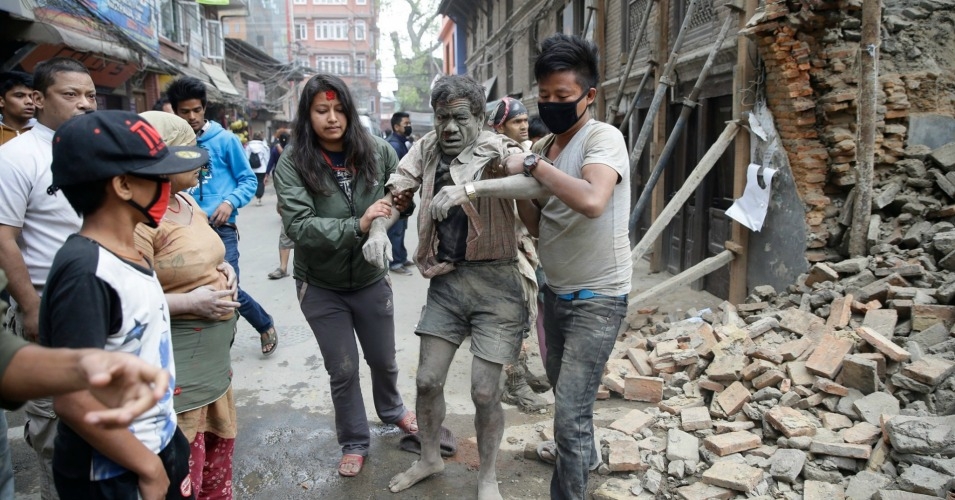
Huge Earthquake Kills Hundreds In Nepal; Sparks Massive Mt. Everest Avalanche

Common Dreams


People free a man from the rubble of a destroyed building following a massive earthquake that struck Nepal early on Saturday. (Photograph: Narendra Shrestha/EPA)
powerful 7.9 magnitude earthquake that struck central Nepal and Northern Indian has devastated populated areas across the Himayalan region, causing buildings to crumble and killing hundreds of people.
A spokesperson for Nepal’s Home Ministry, Laxmi Prasad Dhakal, told the New York Times that the preliminary death toll stood at 686, nearly all in the valley around Katmandu, and that thousands more had been injured.
According to the Guardian, which is offering live updates on the situation, the estimated deathtoll has since risen to an estimated 718 people across four countries. That number is expected to rise. In addition to the highest numbers in Nepal, several deaths and injuries related to the quake were reported in Tibet, India, and further to the east in Bangladesh.
The initial quake, originally calculated by the USGS as 7.8 on the Richter scale but subsequently adjusted to 7.9, occurred just after midnight (GMT) with the epicenter near the city of Lamjung, not far from the capital of Katamandu, where heavy damage and a high number of casualties is being reported. A large aftershock, approximately 30 minutes later, came in at 6.6 magnitude.
The tremors also unleashed a severe avalanche on Mt. Everest, among world's tallest and most famous mountains, which claimed additional lives.
Reuters reports:
The worst quake to hit the impoverished Himalayan nation in 81 years also caused damage in neighboring Indian states and Bangladesh. The quake was shallow, intensifying the amount of energy released over a relatively small area.
A police spokesman said the death toll had reached 449 in Nepal according to an initial estimate, most from the Kathmandu Valley. There was little information coming from the outlying areas of the mountainous country and helicopters were circling overheard to get a better sense of the damage.
"Hundreds of people are feared dead and there are reports of widespread damage to property. The devastation is not confined to some areas of Nepal. Almost the entire country has been hit," said Krishna Prasad Dhakal, deputy chief of mission at Nepal’s Embassy in New Delhi.
The Associated Press provided this early raw footage from impacted areas:

Regarding the avalancy on Mt. Everest, AP reports:
An avalanche swept the face of Mount Everest after the massive earthquake struck Nepal on Saturday, killing at least eight people and leaving an unknown number missing and injured near the mountain's most dangerous spot, an official said.
The avalanche struck between the Khumbu Icefall, a notoriously treacherous rugged area of collapsed ice and snow, and the base camp where most climbing expeditions are, said Ang Tshering of the Nepal Mountaineering Association.
An official with Nepal's mountaineering department, Gyanendra Shretha, said the bodies of eight people had been recovered and an unknown number remain missing or injured.

The Trans-Pacific Partnership and the Death of the Republic

Ellen Brown


“The United States shall guarantee to every State in this Union a Republican Form of Government.”
— Article IV, Section 4, US Constitution
A republican form of government is one in which power resides in elected officials representing the citizens, and government leaders exercise power according to the rule of law. In The Federalist Papers, James Madison defined a republic as “a government which derives all its powers directly or indirectly from the great body of the people . . . .”
On April 22, 2015, the Senate Finance Committee approved a bill to fast-track the Trans-Pacific Partnership (TPP), a massive trade agreement that would override our republican form of government and hand judicial and legislative authority to a foreign three-person panel of corporate lawyers.
The secretive TPP is an agreement with Mexico, Canada, Japan, Singapore and seven other countries that affects 40% of global markets. Fast-track authority could now go to the full Senate for a vote as early as next week. Fast-track means Congress will be prohibited from amending the trade deal, which will be put to a simple up or down majority vote.Negotiating the TPP in secret and fast-tracking it through Congress is considered necessary to secure its passage, since if the public had time to review its onerous provisions, opposition would mount and defeat it.
Abdicating the Judicial Function to Corporate Lawyers
James Madison wrote in The Federalist Papers:
The accumulation of all powers, legislative, executive, and judiciary, in the same hands, . . . may justly be pronounced the very definition of tyranny. . . . “Were the power of judging joined with the legislative, the life and liberty of the subject would be exposed to arbitrary control, for the judge would then be the legislator. . . .”
And that, from what we now know of the TPP’s secret provisions, will be its dire effect.
The most controversial provision of the TPP is the Investor-State Dispute Settlement (ISDS) section, which strengthens existing ISDS procedures. ISDS first appeared in a bilateral trade agreement in 1959.According to The Economist, ISDS gives foreign firms a special right to apply to a secretive tribunal of highly paid corporate lawyers for compensation whenever the government passes a law to do things that hurt corporate profits — such things as discouraging smoking, protecting the environment or preventing a nuclear catastrophe.
Arbitrators are paid $600-700 an hour, giving them little incentive to dismiss cases; and the secretive nature of the arbitration process and the lack of any requirement to consider precedent gives wide scope for creative judgments.
To date, the highest ISDS award has been for $2.3 billion to Occidental Oil Company against the government of Ecuador over its termination of an oil-concession contract, this although the termination was apparently legal. Still in arbitration is a demand by Vattenfall, a Swedish utility that operates two nuclear plants in Germany, for compensation of €3.7 billion ($4.7 billion) under the ISDS clause of a treaty on energy investments, after the German government decided to shut down its nuclear power industry following the Fukushima disaster in Japan in 2011.
Under the TPP, however, even larger judgments can be anticipated, since the sort of “investment” it protects includes not just “the commitment of capital or other resources” but “the expectation of gain or profit.” That means the rights of corporations in other countries extend not just to their factories and other “capital” but to the profits they expect to receive there.
In an article posted by Yves Smith, Joe Firestone poses some interesting hypotheticals:
Under the TPP, could the US government be sued and be held liable if it decided to stop issuing Treasury debt and financed deficit spending in some other way (perhaps by quantitative easing or by issuing trillion dollar coins)? Why not, since some private companies would lose profits as a result?
Under the TPP or the TTIP (the Transatlantic Trade and Investment Partnership under negotiation with the European Union), would the Federal Reserve be sued if it failed to bail out banks that were too big to fail?
Firestone notes that under the Netherlands-Czech trade agreement, the Czech Republic was sued in an investor-state dispute for failing to bail out an insolvent bank in which the complainant had an interest. The investor company was awarded $236 million in the dispute settlement. What might the damages be, asks Firestone, if the Fed decided to let the Bank of America fail, and a Saudi-based investment company decided to sue?
Abdicating the Legislative Function to Multinational Corporations
Just the threat of this sort of massive damage award could be enough to block prospective legislation. But the TPP goes further and takes on the legislative function directly, by forbidding specific forms of regulation.
Public Citizen observes that the TPP would provide big banks with a backdoor means of watering down efforts to re-regulate Wall Street, after deregulation triggered the worst financial crisis since the Great Depression:
The TPP would forbid countries from banning particularly risky financial products, such as the toxic derivatives that led to the $183 billion government bailout of AIG. It would prohibit policies to prevent banks from becoming “too big to fail,” and threaten the use of “firewalls” to prevent banks that keep our savings accounts from taking hedge-fund-style bets.
The TPP would also restrict capital controls, an essential policy tool to counter destabilizing flows of speculative money. . . . And the deal would prohibit taxes on Wall Street speculation, such as the proposed Robin Hood Tax that would generate billions of dollars’ worth of revenue for social, health, or environmental causes.
Clauses on dispute settlement in earlier free trade agreements have been invoked to challenge efforts to regulate big business. The fossil fuel industry is seeking to overturn Quebec’s ban on the ecologically destructive practice of fracking. Veolia, the French behemoth known for building a tram network to serve Israeli settlements in occupied East Jerusalem, is contesting increases in Egypt’s minimum wage. The tobacco maker Philip Morris is suing against anti-smoking initiatives in Uruguay and Australia.
The TPP would empower not just foreign manufacturers but foreign financial firms to attack financial policies in foreign tribunals, demanding taxpayer compensation for regulations that they claim frustrate their expectations and inhibit their profits.
Preempting Government Sovereignty
What is the justification for this encroachment on the sovereign rights of government? Allegedly, ISDS is necessary in order to increase foreign investment. But as noted in The Economist, investors can protect themselves by purchasing political-risk insurance. Moreover, Brazil continues to receive sizable foreign investment despite its long-standing refusal to sign any treaty with an ISDS mechanism. Other countries are beginning to follow Brazil’s lead.
In an April 22nd report from the Center for Economic and Policy Research, gains from multilateral trade liberalization were shown to be very small, equal to only about 0.014% of consumption, or about $.43 per person per month. And that assumes that any benefits are distributed uniformly across the economic spectrum. In fact, transnational corporations get the bulk of the benefits, at the expense of most of the world’s population.
Something else besides attracting investment money and encouraging foreign trade seems to be going on. The TPP would destroy our republican form of government under the rule of law, by elevating the rights of investors – also called the rights of “capital” – above the rights of the citizens.
That means that TPP is blatantly unconstitutional. But as Joe Firestone observes, neo-liberalism and corporate contributions seem to have blinded the deal’s proponents so much that they cannot see they are selling out the sovereignty of the United States to foreign and multinational corporations.
For more information and to get involved, visit:

The Furor Over “Fuck France”

Michel Collon & Saïd Bouamama

In 2010, Saïd Bouamama co-authored the book Fuck France with Saidou from the ZEP group. After its release, an extreme right-wing organization pressed charges for incitement to discrimination, hatred or violence. In January 2015, shortly after the “defend freedom of speech march,” Saïd Bouamama and Saidou appeared before the Court of First Instance. Saïd Bouamama, a sociologist specializing in discrimination toward working class immigrants, analyzes the context of the post-Charlie Hebdo French society.
Michel Collon: In what context did the book, Fuck France, that lately brought you to the District Court of Paris emerge? And for what reason?
Saïd Bouamama: The book “Fuck France” was written in a very particular context, at a moment in the history of French society where the government, through the speeches of Nicolas Sarkozy, initiated a whole debate on national identity. Such a debate has racist connotations, because it’s a debate that only defines identity around culture. And then some people, the citizens of immigrant origin – France’s Black and Arabic people who were born French and who grew up in France – are singled out as those who are posing a problem in the French society: a problem of integration, a problem regarding the Republic’s values and secularism… In short, such a debate is an attempt to create an internal enemy, designating a part of the French population as responsible of all the problems in their society.
The launching of such a debate created a real hysteria: we see a multiplication of openly racist speeches, stating that one cannot be French and Arabic, French and Muslim, French and Black, and that we had to choose. Therefore, in such a context, many young people from working-class neighborhoods reacted. They didn’t especially do so using the usual forms of political expression, writing texts, etc. But they responded by writing songs, they reacted in doing “slam”, in writing graffiti on walls, in which, in order to react to this racist conception of France under Sarkozy, they said: “Fuck France”. It’s in this context, that a rapper and myself  decided not to leave these young people alone, because of the impending repression against them, because they were introduced as savages, described as dangerous people, and so we decided to write a book that would explain how they came to say “Fuck France” in the first place, and which France they were questioning: the France of the ruling class, the France of the Rich, the racist France… Here is the France that was called into question, and we didn’t want to leave them alone facing these impending attacks. And we did the same thing with a CD. Saidous’ ZEP then produced a cd in which he took the content of their texts to put them into songs.
In France there has always been a fight between two conceptions of the nation: a fight between those who considered France in a colonial, imperial and racist way, and another France, which belongs to its people. A France in struggle, always trying to build herself in equality. And then, in this book, we are stating in clear terms that between the France of Versailles, who once put down the Commune of Paris, and the France of the Communards, who tried to set up an equalitarian society, our choice was made. That we were on the Resistance’s side and against the collaborationists, and that we would always have to choose between two Frances: the reactionary France and the progressive France. And as far as we’re concerned, we are on the side of the progressive France.
Could you come back to the events taking place after the attack against Charlie Hebdo?
We had to deal with one of the biggest political manipulations of the last decades. After the attacks took place, after the massive emotion that seized French society, everyone was wondering what was hidden behind those attacks. How do these young people, who should be focused on their future and thinking of building up their lives, reach the stage of adopting such nihilistic behaviours and setting off bombs? The whole of France was in turmoil, and we saw on the side of the dominant class, with Hollande and Valls, the idea to manipulate, to exploit this emotion in order to hijack it in the frame of the setting up of their ultra-liberal security policy. And very soon, instead of having demonstrations against the attacks or protests condemning them, it degenerated in a “Je suis Charlie” demonstration.
Yet plenty of people who were against the attacks could not recognize themselves in Charlie. Even if it doesn’t mean that the attacks were justified, Charlie Hebdo is a newspaper which was on one side Islamophobic (many of its headlines and caricatures did hurt a wide range of Muslim countries’ inhabitants), but it was also sexist (the way in which women are represented inside the paper is a scandal with regard to gender equality), and eventually the newspaper openly despized the working-class: in Charlie Hebdo, the “bof” is a workman shown as alcoholic, stupid, only watching tv… And then, in terms of classes, and in terms of racial and sexual oppression, this newspaper was a reactionary one. It may be added that it supported every single war, like NATO’s wars, whether they were in Eastern Europe, in Iraq or in Afghanistan: Charlie Hebdo always took a stand for them. In brief, the newspaper was putting forward, through humor, the clash of civilizations advocated by the United States of America, and presented Arab and Muslim countries as the main danger. This is why so many people could not recognize themselves as Charlie. And by capturing the emotion to channel it towards “Je suis Charlie”, we were trying to build a national unity around those imperialist wars. For example, on the same night they unanimously sang “La Marseillaise” at the National Assembly, so as to symbolize this national unity, France voted for the continuation of the war in Iraq. This is proof that our government channelled and exploited an emotion for the benefit of its plan. And its current plan is the complete deregulation of economy, through neo-liberalism, along with the wars engaged in the process of dividing up the planet around raw materials and oil resources.
This is the context in which this so-called national unity took place. Moreover, it didn’t take long (similar to the debate on national unity of which we were speaking earlier) to provoke reactions and open the floodgates to the development of Islamophobic actions. We registered more than 200 of them within fifteen days: we saw mosques being attacked, grenades thrown in prayer centers, veiled women whose veil was snatched from them on the street… Indeed we experience more Islamophobic acts in two weeks than during the whole year in 2014. Now we can clearly see that every time the dominant class tries to exploit a situation, it gives way to more racism, it opens the floodgates for more Islamophobic acts. This is the context of the national unity, which can only be reactionary; because this unity is not built on a progressive political project, as  is the case in South America where the national unities are the result of a struggle. This is not this national unity we’re talking about. The rulers of this world want us to forget the inconsistencies, that is to say that we should forget that the workers in this country cannot agree with the economical measures that are being implemented.
We are requested to forget the inconsistencies in cross-border terms: so we should forget the French intervention in Mali or in the Central African Republic (CAR), and we should forget that France is still in Iraq… In brief, that the upper middle class is trying to put all the other classes behind her, by putting forward and exploiting one single element. This is what Chomsky described very well when he said: ”One the first rules in propaganda is to make up a problem in order to suggest a solution”, and here we made up a problem, being the omnipresent terrorist danger so we can exploit it.
Given what France is doing around the world, there is indeed a risk of terrorist attacks, but from that to saying that there is a hyper-terrorist danger in order to justify the questioning of democratic freedoms and control over society is truly a shame.
What posture should we adopt in front of this manipulation?
First of all, a good reaction in the short run would be not to miss the immediate impact of this situation. A first consequence was to impose a minute of silence in every school, around the slogan “Je suis Charlie”. Of course, a whole wide range of pupils (not to say too many of them) could not say “Je suis Charlie”, and then they expressed their opinion. They were told that it was a debate and that they could speak up, so they gave their opinion, but when they did then they were summoned to report to the police, some of them are now facing legal proceedings… France considered that not being Charlie implied an apology for terrorism. Eight-year old children were summoned to the police station to be audited for terrorism apology. The first reaction to have if we want to go further in the future, is not to leave these children alone, and to organize solidarity so that this offense against freedom of speech comes to an end, since they say it’s about freedom of speech… These pupils expressed themselves, and instead of getting an educational answer, instead of getting an answer in terms of debate, we get an answer in terms of repression. This is really the first step:  when human beings are attacked you have to defend them. In the longer term we have to build  popular unity to confront the national unity. Which means that in front of the national unity we could put forward again those who share a same interests. And it is absolutely essential to fight everything that divides the popular classes. What divides them today is an Islamophobia secretely planned and broadcasted from the top.
The declarations of some ministers, journalists and so on have encouraged the spread of this Islamophobia. We must fight this. And secondly, we must understand the strategy of the dominant class in order to respond with a strategy strong enough to defeat it. For me the strategy of the dominant class comes down to uniting those whose interests are divisive and divide those whose interests should unite. Unite those whose interests should divide is to unite the white working class man to his boss, by saying: “Look, there is a terrorist danger in front of us, we must all stick together!” And dividing those who should be united is to divide the white workman and the non-white workman when they share the same interests. And so they are being divided, when it would be in their interest to join forces.
I think this is what we must put forward in the future: fight all the attacks threatening the rights of the minorities, the rights of anyone and then fight against Islamophobia. And on the other side, we must build on the long term a popular unity that unites the French workers and immigrants ones and opposes to the dominant classes just as to its lackeys, because of course you’ll find some Black and Arabic people on the side of the dominant class…

24 Apr 2015

Canada’s Conservatives pledge more austerity and war

Keith Jones

Canada’s Conservative government tabled its pre-election budget Tuesday. It is a blueprint for the continued dismantling of public services, redistribution of wealth to the most privileged sections of society, and expansion of the military and national-security apparatus.
The budget had two main audiences: Canada’s ruling big-business elite and the more privileged and reactionary sections of the middle class.
To the former, its principal constituency, the Conservatives pledged that there would be no let-up in its austerity drive and the intertwined push for ever-lower taxation of big business, the rich and super-rich. With its boasts of “strong leadership” and a “low tax plan for jobs, growth and security,” the budget also constituted an implicit pledge that once the elections are over, Stephen Harper’s nine-year-old government will press forward with unpopular “structural reforms.” Since winning a parliamentary majority in the 2011 federal election, the Conservatives have raised the retirement age to 67, slashed Employment Insurance eligibility and benefits, imposed a health-care financing “accord” that cuts tens of billions from Medicare, and effectively outlawed strikes in the federal public sector and federally administered industries.
The Conservatives’ right-wing electoral base of small businessmen and professionals, meanwhile, was rewarded with further tax cuts and tax shelters. The budget cuts the tax rate on small business to 9 percent over the next four years, in 0.5 percent increments, and it almost doubles the amount Canadians can place in Tax-Free Savings Accounts (TFSAs) annually to $10,000. The budget also reaffirms last November’s introduction of income splitting for couples with children, a measure, like the expansion of TFSAs, that is heavily skewed in favor of those with high incomes.
The Conservatives are making much of the fact that Canada is the first G-7 country to balance its annual budget since the 2008 financial crisis.
This purported “achievement” has come entirely at the expense of working people. While slashing the general corporate tax rate to 11 percent, among the lowest of any industrialized country, the Conservatives have slashed more than $14 billion per year from federal “discretionary” spending, eliminating close to 30,000 federal public service jobs and slashing services, from meat and railway inspection to Canada Parks.
As a result, federal spending as a share of the total economy is now the lowest it has been since the early 1950s, a period that predates the development, under pressure from the working class, of the welfare state.
That said, due to the rapidly deteriorating economic situation, the Conservatives have had to employ a series of accounting tricks and last-minute maneuvers to meet their long-announced goal of eliminating an annual budget deficit by the 2015-16 fiscal year. These include reducing the budget’s contingency fund from $3 billion to just $1 billion, selling the government’s shares in General Motors, once again pinching money from the Employment Insurance Fund, and backdating to last year new expenditures on veterans, among whom there has been a rash of suicides and a surge in mental and physical health problems.
In a report released last week, the Parliamentary Budget Officer warned that the collapse in oil prices and consequent slump in Canada’s economic growth means that the federal government is again threatened with a “structural” budget deficit.
The deepening world economic crisis has undoubtedly disrupted the Conservatives’ electoral agenda. While some in cabinet urged the government to respond with steep cuts in this year’s budget, Harper calculated that such action would too blatantly contradict the Conservatives’ electoral narrative, which paints them as prudent managers who have succeeded in sheltering Canadians from the worst of the world economic storm over the past seven years.
In the medium to long term, however, the emergence of a “structural deficit” will not be unwelcome news for Harper and his Conservatives. Their ever-expanding tax-cutting drive has had a double purpose: to redistribute wealth upwards; and to create perpetual fiscal pressure for further social spending cuts. Nicknamed “starving the beast,” this strategy, borrowed from the US Republican right, is aimed at providing a pretext for dismantling public services and, by systematically starving them of funds, creating a growing constituency in the middle class for privatization, especially of health care.
Tuesday’s budget did announce some new federal spending, but virtually none of it before the 2017-18 fiscal year. Moreover, new outlays on the military and national security apparatus dwarf all others.
Having exploited last October’s killings of two soldiers by disturbed individuals to introduce legislation that vastly increases the state’s coercive powers, the government is now hiking expenditure on “anti-terrorism” measures, all told more than half-a-billion over the next 5 years.
Beginning in 2017 the government will increases base funding of the military by 3 percent per year, instead of the current 2 percent, resulting in a $12 billion increase over 10 years.
This is in addition to the $360 million the government is allotting this year to pay for Canada’s leading role in the new US-led war in Iraq and Syria and the more than $7 million in new money being set aside to pay for the Canadian Armed Forces’ Ukraine training mission.
With the overwhelming support of the corporate elite, the Harper government has deeply implicated Canada in all three of the major military-strategic offensives currently being mounted by the US—in the Middle East and against Russia and China. However, during the past year it has come under sharp criticism from the corporate media for curtailing military spending as part of its austerity program, after rapidly expanding it in its first five years in office. By 2011 Canada was spending more on the military in real (i.e. inflation-adjusted) terms than at any time since the end of World War II.
The budget contained two other politically significant announcements.
Finance Minister Joe Oliver said the government will bank $900 million in savings this year and hundreds of millions more in coming years as a result of cuts to federal employees’ sick-leave benefits. While claiming that the Conservatives are open to “good-faith” bargaining, Oliver declared that the government would impose its concession demands by fiat should the unions not submit to them voluntarily.
The government will increase spending on public transit infrastructure beginning in two years. But this money will only be available for projects that are Public-Private Partnerships (PPPs), i.e. are organized to enrich private investors.
Predictably, the opposition parties decried the budget. NDP and Liberal spokesmen made the obvious points that more austerity will only drive unemployment, now officially at 6.8 percent, higher and that the well-to-do will reap the lion’s share of the “savings” from the Tories’ tax measures. But they also made clear that, were they to come to power, they would leave in place the vast majority of the social spending and tax cuts implemented by the Harper government and its Liberal predecessors.
Liberal leader Justin Trudeau vaunted the Liberals’ fiscal record, a reference to the massive cuts made by the Chretien-Martin government between 1995 and 1997—cuts which are still held up as a model for capitalist governments around the world. “It’s a well-established fact,” said Trudeau, “Liberals balance budgets. Conservatives have been running deficits.” Trudeau went on to pledge a Liberal government would deliver a “fiscally responsible,” “balanced budget.”
The trade union-supported NDP is similarly committed to a “balanced budget.” It has vowed to introduce no increases in personal income taxes—even on the 1 percent, whose net incomes have swelled thanks to years of personal income and capital gains tax cuts—and only modestly increase corporate taxation.
There is massive anger in the working class against the dismantling of public services and the assault on pensions, jobless benefits, and other worker rights. But this opposition is systematically suppressed by the pro-capitalist unions. For decades, they have imposed wage cuts and other concessions, and when they can’t prevent the eruption of strikes, they isolate them and use the imposition or threat of anti-strike legislation to force a return to work. This goes hand in hand with the unions’ efforts to politically smother the working class by harnessing it the pro-austerity Liberals and NDP and, in Quebec, the Parti Quebecois.
The unions have declared that their main objective is the replacement of Harper’s Conservatives in next October’s election by a “progressive” government, that is, by a Liberal or Liberal-NDP coalition. Such a government would employ vague “left” phrases and gestures, the better to implement the ruling elite’s agenda of austerity at home and imperialist aggression and war abroad.

German train drivers strike for seventh time in a year

Dietmar Henning

The German train drivers’ union (GDL) has called a nationwide strike of employees at Deutsche Bahn (DB) for the seventh time in one year. The work stoppage on passenger trains began early on Wednesday at 2:00 a.m. and ended on Thursday at 9:00 p.m. On freight trains, the strike began on Tuesday at 3:00 p.m. Drivers were only due to recommence work at 9:00 a.m. today.
The reasons for the renewed strike are the actions of DB, which is trying to postpone talks until a new law on contract agreements comes into force in the summer. Based on this law, DB intends to make negotiations with GDL, and strikes by the union, impossible.
The German government has revealed it plans to adopt the law in May. According to the law, wage conflicts organised by smaller trade unions, such as the train drivers, the pilots’ association Cockpit, the air traffic controllers (UFO), and doctors (Marburger Bund), will be rendered practically impossible. According to the law, if there are several trade unions active in an organisation and no agreement exists over the workers they represent, only the agreement reached with the largest union will apply.
At DB, this would not be the GDL, but the larger railway union (EVG). EVG, a member of the German trade union confederation (DGB), has already made clear that it stands firmly on the side of management and is prepared to exclude the GDL with the help of the new law.
The GDL-led struggle has now lasted almost a year. Even after 16 rounds of talks, DB continues to refuse a collective agreement. The only exception to this was a one-off payment of €510 for the second half of 2014.
At the most recent round of talks in Frankfurt on April 17, GDL reported that it was presented with a document containing a passage permitting DB to overturn all previous agreements. Since GDL refused to sign, DB management accused the union of blocking the talks.
Without reporting any of the technical details, the media is repeating this accusation and agitating against the striking train drivers.
Another point of conflict is the dividing of the train drivers into different groups, which DB intends to uphold at all costs. According to the GDL, DB has been classifying train drivers’ jobs as yard engineers. While they perform the same work, they are paid much lower wages and there are fewer regulations of their work patterns. GDL head Weselsky has spoken of “internal company wage dumping.”
At the same time, DB’s board has approved multi-million euro management bonuses. According to Handelsblatt, they cashed in target bonuses totaling €7.28 million in 2014. Even though sales and profit targets were not met, this is double the sum of €3.42 million awarded the previous year. The financial newspaper reported that in particular the short-term bonuses paid out immediately had increased, from €1.9 million to €5.2 million. This equated to a rise of 174 percent.
GDL referred to this “self-serving mentality” at the top of the company and, in this context, described the complaints from the board about the cost of the strikes as superficial and dishonest. “An agreement, even with the 100 percent fulfillment of GDL’s demands, would be much cheaper,” a GDL press release stated.
DB is being supported by industrial big business. Dieter Schweer, member of the central management of Germany’s industrial confederation (BDI), vehemently criticised the GDL’s strikes and warned of costs running into the millions. “Economic losses caused by the strikes could quickly rise from a single-figure million sum into the hundreds of millions per day,” he said. Branches hit especially hard are the chemical, steel and auto industries. According to Schweer, the GDL was acting irresponsibly and had “lost all proportionality.”
Employer associations, politicians and large sections of the media are seeking to make the GDL union responsible for the latest strike. DB’s human resources head has been repeatedly cited as saying, “GDL could have had its desired interim outcome at almost every point in the talks.”
However, the emphasis rests on the word “almost.” This is because Weber and DB management continue to insist that GDL defer to the EVG to represent other train staff, which includes conductors, caterers, signallers and yard engineers. Both unions ought to agree to an agreement for all rail workers. By contrast, the GDL is demanding its own agreements for its members.
Although GDL stubbornly insists on its right to negotiate an agreement for all of its members, it has no perspective for breaking through the blocking tactics of DB management. GDL repeatedly calls for “serious talks” and seeks to pressure management to make compromises by offering their own concessions. As they noted in a press release, GDL had “cut its demand for a reduction in weekly working hours to one hour and removed a pay band.”
But this willingness to compromise emboldens DB management to intensify their attacks on train drivers.
The conflict between GDL and DB, just as with the pilots’ association UFO and Lufthansa, makes clear that the employees and the entire working class confront political tasks.
The grand coalition led by Chancellor Angela Merkel (Christian Democrats, CDU) and Foreign Minister Frank-Walter Steinmeier (Social Democrats, SPD) plans to impose cuts in Germany of the type that they are currently imposing on the Greek population. Their revival of militarism demands billions for rearmament, for which the working population is to pay. Organised protests against the coming wars, as well as social attacks, are to be suppressed. The new contract law will serve as a first step in this process. It is to give the DGB-aligned unions unrestrained control over the workers in private industry and public services.
An interview with CDU deputy chairman, Michael Fuchs, in the Süddeutsche Zeitung makes clear the central goal of the contract law. In the entire area of essential services, a practical ban on strikes must apply, Fuchs stated. Along with air and train transport, he named “the provision of energy and water, medical services, childcare and the telecommunications sector.”
Responding to the Süddeutsche Zeitung’s point that in comparison to other countries there are few strikes in Germany, Fuchs answered that with the pilot and train driver strikes a tendency was becoming clear. “This is the problem,” he said. “Nip it in the bud.” By the time a “particular tendency to strike” existed, it would be too late to do anything about it.
An example is to be made of the GDL so as to intimidate all opposition in industry. To fight against the united front of company management, the government and DGB, train drivers and all other workers must turn to a new political perspective.
In an article last November, the WSWS wrote, “The hope that it would be possible to combat the dictatorship of the DGB with a less corrupt and more militant profession-based trade union has proven to be flawed. The problems confronting train drivers cannot be resolved through trade union militancy.” It is necessary to reject the profit logic of capitalism, fight for a socialist program and pursue an international strategy.