9 May 2015

Why Occupy?

Edward Martin & Mateo Pimentel

First in a four-part series.
There is a tendency for democratic self-governing institutions to become oligarchies, specifically because elite interests within these institutions are prioritized over the needs of their members. According to researchers, such as Martin Gilens and Benjamin Page, and conservative theorists, such as Robert Michels, democratic institutions primarily serve elite interests. In “Testing Theories of American Politics: Elites, Interest Groups, and Average Citizens”, (in Perspectives on Politics, September 2014 Vol. 12/No. 3, p.564-581), Gilens and Page argue that oligarchies within democratic institutions ultimately undermine their democratic goals, in which the institution is co-opted by elites. And on the other hand, conservatives like Michels (in his book Political Parties: A Sociological Study of the Organizational Tendencies of Modern Democracy, 1911) argue, “It is organization which gives birth to the domination of the elected over the electors, of the mandatories over the mandators, of the delegates over the delegators. Who says organization, says oligarchy.” Thus, for Michels, democratic institutions undermine themselves precisely because they are held captive by oligarchs and elites.savagestate
So, in order to understand the Occupy Movement, and its rebellion against elite control of democratic institutions and economic organizations, it is important to examine how organizations and institutions become rigid oligarchies in the first place. In light of Michels’ “iron law of oligarchy” and Gilens’ and Page’s research on oligarchies, we urge that anarchist principles, ironically, be examined as a possible counter to oligarchic rule, that is, if democratic institutions are to be salvaged. As such, policy recommendations via anarchic social justice must be discussed in relation to meeting the needs of self-determining people and the challenges awaiting them in the twenty-first century. This is because democratic governance has been thoroughly undermined by elite domination and why the Occupy Movement erupted to demand democratic accountability, not just in governance but in economic matters as well.
Becoming Oligarchy
Michels’ “iron law of oligarchy” refers to organizations and institutions, specifically the left-wing parties of Western Europe in the pre-World War I era, which called for egalitarian reforms through mass democracy and popular governance. Yet, as Michels observed, these same democratically minded organizations and institutions could not resist the tendency to become de facto oligarchies. In spite of their revolutionary identities and democratic structures, the labor parties of Michels’ era were dominated by tightly bound cliques with the intent of perpetuating their own interests rather than the goals of equality and self-rule. The irony, Michels noted, was that in a democratic organization like the German Social-Democratic Party (SPD) to which Michels belonged at the time, only a few people in executive positions actually held power and decision-making privileges. This phenomenon also applied to traditional conservative parties according to Michels. Nevertheless, the “leaders” of the SPD valued their own elite status and social-mobility more than any commitment to the goal of emancipating Germany’s “industrial proletariat,” from exploitation. Inevitably, the SPD’s actual policies became increasingly conservative, often siding with the imperial authorities of Wilhelmian Germany. Eventually, while SPD leaders gained constitutional legislative power and public prestige, they failed to serve the collective will of its mass membership; they were in fact dominating and directing it for their own ends. Research today by Gilens and Page only confirm what took place with Michels’ research a century ago.
Michels concluded that the day-to-day administration of any large-scale, differentiated bureaucratic organization, such as the SPD, by the rank-and-file majority was impossible. Given the “incompetence of the masses,” there was a need for full-time elite professional leadership to manage and direct others in a hierarchical, top-down manner. And the rank and file members were not necessarily opposed to this. In theory, the SPD leaders were subject to control by the rank-and-file through delegate conferences and membership voting; in reality, the elite leadership was firmly in command. The simple organizational need for a division of labor, hierarchy, and specialized leadership roles meant that control over the top functionaries from below was “purely fictitious.” Elected leaders had the experience, skills, and superior knowledge necessary for running the party and controlling all formal means of communication with its membership, including the party press. While proclaiming their devotion to the party program of social democracy, the leaders soon became part of the German political establishment. The mass membership was unable to provide an effective counterweight to this entrenched minority of self-serving party officials who were more committed to internal organizational goals and their own personal interests than to radical social change on behalf of their members. Michels believed that these inevitable oligarchic tendencies were reinforced by a mass predisposition for depending upon, and even glorifying, the party oligarchs. As Michels states, “Though it grumbles occasionally, the majority is really delighted to find persons who will take the trouble to look after its affairs. In the mass, and even in the organized mass of the labor parties, there is an immense need for direction and guidance. This need is accompanied by a genuine cult for the leaders, who are regarded as heroes.” Thus elites maneuver their way into power and the members abdicate their participation in self-governance.
The “iron law of oligarchy” was thus a product of Michels’ own personal experiences as a frustrated idealist and a disillusioned social-democrat. His Political Parties was based upon an empirical study of the SPD and a number of affiliated German trade unions. Michels observed firsthand that the ordinary members of these working-class organizations were practically excluded from any decision-making process within their organizations, either structurally of by their own indifference. Thus Michels argued that the inherent tendency of large and complex organizations – including radical or socialist political parties and labor unions – to develop a mass membership to provide any effective counterweight to a ruling clique of leaders, was doomed. Smaller, less complex organizations also manifested similar tendencies to be controlled by elites as well. Moreover, these inherent organizational tendencies were strengthened by a mass psychology of leadership dependency. This analysis made Michels increasingly skeptical regarding the possibility of democratic governance, precisely as a result of the general frustration he and others, such as Vilfredo Pareto and Gaetano Mosca, had with democratic organizations. Thus one reason why fascism and “elite theory” became increasingly popular by the twentieth century, and specifically for Michels, was because oligarchy in democratic institutions became increasingly embedded. Some have argued that Michels may have formulated an “iron law of bureaucracy,” mistakenly seeking “democracy in structures, not in interactions,” and thus ignoring the real difference between democracies and non-democracies. Nevertheless, the dissatisfaction of people today with democratic governance, co-opted by economic elites, has led to massive frustration by the public at large and thus the emergence of the Occupy Movement.
The decision of Citizens United by the Supreme Court has only fueled this burning discontent and that the Supreme Court is coopted by elite power as well.
Why Oligarchy?
Here are some reasons why oligarchy is deeply embedded in democratic institutions and organizations.
Reason #1: The classic liberal view of society is based on the perspective that a collection of individuals and groups is in essence a free association in which socially defined identities and roles spontaneously emerge. Throughout the course of a person’s life, one’s actions and choices are shaped by social roles and statuses. In every society, certain characteristics such as age, sex, ethnicity, appearance, division of labor, and social class, have a direct impact on the allocation of individual roles in society. These assigned roles are not a random occurrence; they are the outgrowth of deeply embedded interests and power relations which have been institutionalized. In this way status can be understood as either ascribed or achieved: ascribed, meaning it is assigned by tradition, irrespective of individual initiative; achieved, meaning it is the result of personal accomplishments and talent. This is the case since achievement is itself almost always dependent upon arbitrary and antecedent conditions of custom and class.
Reason #2: The term “organization” implies the mobilization of individuals into roles and statuses committed to the performance of some form of collective behavior. “Organization” also describes the precisely defined structures of group authority which can be found in churches, militaries, schools, corporations, political parties, agencies, and governments. While class structure as an organization is not usually defined as such, it is, nevertheless, the composite of people who differ in wealth and social prestige, who then in turn, are served in a relative fashion by the various institutions. What then connects these institutions is a “functionally integrated system” built around networks of communication, interest, power and social class, which comprise what is known as a “social system” or “social structure.” The process in which individuals become socialized into their milieu is determined for the most part by the organizational and institutional roles which they assume. These roles, generally, are not individually determined, but are shaped instead, by the very organizations and institutions in which they are co-opted. In turn, organizations are determined by their essential interests and minimal requisites of role performance. More specifically, the essential interests of organizations are manipulated by the interests of those who have the most power within the organization to control the outcome to their advantage.
Reason #3: Individuals are socialized to believe that their well-being is to avoid conflict and thus secure a place for themselves within the system based on the system’s own terms. The path to success, according to Ralf Miliband, is found in conforming to “the values, prejudices and modes of thought of the world to which entry is sought.” Those who are skeptical and even question the virtues of the given organization discover, either painfully or at great personal risk, that they must conform and adjust to minimal role demands or suffer adverse consequences. Organizational control, nevertheless, conveys attitudes of obedience disseminating among subordinates in any organizational structure within a society. The social norm then becomes the external and internal force for compliance upon the individual and the pressure to obey comes not only from the superior or elite but from the collectivity of subordinates. In this manner pressure for role fulfillment, then, can be felt vertically from the higher authority that controls the agenda of role performances, but also horizontally from similarly situated subordinates who, having internalized the organizational values of obedience, are as critical as any superior of departures in role performance. Such departures, being seen as an unwillingness to carry one’s share of the burden, is perceived as a violation of essential professional duties, a “letting down” not only of one’s superiors, but of one’s peers, be they ordinary co-workers, professional colleagues, or comrades in arms.
Reason #4: To control the essential structures of role behavior, as is the case with organizations, is to shape social consciousness in ways that rational exercises cannot do. Roles, within organizations, become habit and custom. For persons socialized into institutional roles, most alternative forms of behavior either violate their sense of propriety or escape their imagination altogether. They do not think of themselves as responding to a particular arrangement of social reality but to the only social reality there is. In this regard the absolute nature of this social arrangement is not questioned because, in the words of social theorist J. Peter Euben, “realism becomes an unargued and implicit conservatism,” and as Sanford Levinson also argues “the most subtle form of ‘political education’ is the treating of events and conditions which are in fact amenable to change as though they were natural events. This is not a question of treating what is as what ought to be but rather as what has to be.” Organizations and social institutions, nonetheless, are those massive monuments of society which capture and confine the vision of people, and an organization’s very existence becomes its own legitimating force. In economic terms it is a case of supply creating demand. The dominant organizations in the social system lend the legitimacy of substance and practice to the established norms which in turn teach and reinforce adherence to the ongoing social system. What should be recognized is that the social norms or values are not self-sustaining, self-adaptive consensual forces; they are mediated through organizations and institutions, and to the extent that organizations and institutions are instruments of power in the service of elitist interests. Thus, social norms themselves are a product of organizational interests and power relations. This is why oligarchies become embedded in institutions and organizations and preclude democratic governance and popular control of economic resources and accountability.
Basically, a type of dictatorship emerges in which democratic rule and economic security are scuttled by oligarchic rule. But the elites, and their oligarchy, define it as “democratic.” As a result, we get Occupy.
Parts 2, 3, and 4 to follow.

What Just Happened in England?

John Lanchester

Hands up if you saw that one coming. I confess that I didn’t. The first line of the BBC announcement, ‘Conservatives largest party’, was no shock. Then there was a pause a few seconds long, and the projection of 316 Tory seats came up. I nearly fell off my chair. From that point on, the surprises only got bigger.
Why was it so surprising, though? If you’d asked me six weeks ago what was going to happen, I’d have said, a little reluctantly, that the likeliest outcome was a Tory minority government. From that point to an outright majority is a step, but not a gigantic one. If I’d been granted a glimpse ahead to the result, I’d have said the Tories did better and Labour worse than expected, but not amazingly, bizarrely, unforeseeably so. The thing which turned this into such a blindsiding shock was the fact that the election campaign was so flat and eventless. For six weeks, nothing happened. The numbers refused to move. Then everything happened at once. The talk in politics these days is all about ‘narrative’ and ‘momentum’, but there was almost no sign of that in this election. There was little evidence that the electorate were paying any attention. The Tory campaign worked spectacularly, but did so in a new and peculiar way: it was like a pill that the patient refuses to swallow, and holds off swallowing, and then downs all at once.
First-past-the-post is not especially fair, but it is supposed to deliver clear outcomes. In 2010, it didn’t. This time, against all expectations, it did. Lots more detail will come in over the next weeks as the data are analysed and the political scientists do their thing, but for me, a couplelanchestermoneyof things really stand out. If Labour had retained all of their 41 Scottish seats, the Tories would still be the majority government. So that must mean Labour got creamed in England, yes? Actually, no. Labour’s share of the vote in England went up by 3.6 per cent. That’s more than the Tories: their share of the English vote only went up by 1.4 per cent. Labour could even claim that they won the English campaign, in the same sense that the British army could claim it won the Charge of the Light Brigade.
So what did happen in England? The Tories smashed it in the marginals. In the battleground constituencies Labour were down on their 2010 performance by 0.7 per cent. Labour’s overall improvement in England was driven by success on their own turf: 3.5 per cent increase in the North East, 6 per cent in the North West. Where there was a genuine contest with the Tories, the Tories did better. People sometimes say that election campaigns don’t matter, but that is manifestly not the case this time. The Tories out-campaigned Labour in the places where they needed to.
What’s odd about that is that none of this showed up in the polls in advance. Lord Ashcroft has been regularly polling the marginal constituencies, and he found no evidence of this huge shift to the Tories. The Guardian’s last story about polls had the headline ‘Labour has one-point lead over Tories in final Guardian/ICM poll.’ The sample was twice the usual size, which means that it ‘gives more scope than usual for looking for different types of parliamentary seat. Doing so provides additional grounds for Labour optimism. In the English and Welsh battleground constituencies… the poll found the opposition running well ahead.’ That story was posted at half-past twelve yesterday lunchtime. This is the biggest and most embarrassing failure the polling organisations have ever had, and it comes after they’ve had more than two decades to learn from their roughly equivalent failure in 1992. It’s all the odder because the same methods that didn’t work in England worked fine north of the border, where the polling organisations accurately forecast the SNP triumph. The pollsters did something or things very wrong. We’ll find out what soon enough, but it was probably a mix of ‘shy Tories’ and people deciding at the last moment to buy the line about having to vote Tory to keep out the SNP.
As for Nick Clegg and his party… Byron once said that ‘I think it great affectation not to quote oneself’. In that spirit, I’m going to quote the last LRB blog entry I wrote after the last general election in 2010, as the lineaments of the Tory-Lib Dem deal became apparent:
As for the Lib Dems, I imagine about half their voters and activists are feeling physically sick this morning. Let’s hope that referendum on AV feels as if it is worth it. I don’t think Nick Clegg could have played his hand any better, in terms of extracting concessions from the Tories. But his concern must surely be that a. he has permanently alienated a vast segment of his own supporters and b. any moderating effect on Tory actions will benefit David Cameron more than if benefits the Lib Dems. The Lib Dems have wanted power for a long time. As all grown-ups know, more tears are shed over answered prayers.

The Big Winners in the “Muhammad Art Exhibit”

GARY LEUPP

One has the feeling that all parties emerged victorious from the “first annual Muhammad Art Exhibit and Contest” held May 3 in the Dallas suburb of Garland, Texas.
Gunmen Elton Simpson and Nadir Soofi made their statement against insults to the Prophet, confident in their final moments as they died in a hail of bullets that the rewards of Paradise were on the horizon. They earned the martyrdom they sought, impressing those whose estimation they most valued in life.
ISIL scored a propaganda victory with an important first: an attack on the enemy on U.S. soil that could be attributed to the group. Even though the connections between Simpson, Soofi and ISIL appear to have been limited to social media inspiration, ISIL can boast that its rival an-Qaeda no longer enjoys a monopoly on jihadi violence in the U.S.
Publicity-seeking hatemonger Pamela Geller and her “American Freedom Defense Initiative” (AFDI) reaped rewards far beyond their expectations: their event became the leading news story, it was repeatedly reported in the mainstream media as a “free speech” (rather than hate speech) event, and Geller received precious air time to spew her imbecilic message to often deferential interviewers. Contributions from like-minded bigots must be pouring in.
The cluelessness of the interviewers served her cause. CNN’s Brooke Baldwin, for example, who while suggesting she might be Islamophobic, treated her respectfully (and repeatedly referred to her provocative hate fest as a “free speech event”), and failed to challenge her when she referred to (the late) Ayatollah Khomeini of Iran as “the leader of the Muslim world”—as though any leader of Shiite Muslims (maybe 13% of the entire Muslim world, and viewed by many Sunnis as heretics) could ever obtain that status.
Geller, who likens herself to Rosa Parks as freedom fighter, recoiled at any suggestion she hates Muslims in general. No, she says, she’s just against the 25% of Muslims who support violent jihad. (That would be about 375 million people.) She’s only against those who take the Qur’an seriously; she describes the book as inherently vicious. (As though the Book of Joshua, in the Old Testament she reveres, is not; see Joshua 11:12-20 in which God commands His Chosen People to wipe out the non-Hebrews.)
Keynote speaker at the “Art Exhibit and Contest”—Dutch parliamentarian Geert Wilders, who has advocated the banning of the Qur’an in the Netherlands and the expulsion of its Muslim residents—was also a big winner in the Gardner incident. He got his name in the global news again, and some will see the incompetent gun attack as validation of his characterization of Muslims in general.
The losers in this episode are the Muslim community in the U.S., who are once again victimized by a mass media that, while paying lip-service to religious tolerance, treats hate mongers as respectable free speech advocates and fails to challenge the most egregious misrepresentations of Islamic history and doctrine. The entire U.S. public falls victim to the coverage, spanning a spectrum of the malevolent to incompetent.
***
The winner of the $ 10,000 prize for best Muhammad cartoon shows the angry, saber-swinging prophet barking “You can’t draw me!” while a hand with a pencil in the picture bears the speech bubble “That’s why I draw you.” Not very clever, and not very accurate. The Qur’an alludes to the biblical 10 Commandments, which include the first one that forbids the worship of graven images. (The Qur’an does not replicate the commandments but assumes the Muslim’s knowledge of them.) And some hadith (sayings attributed to Muhammad) forbid the depiction of any living creature.
(The disinclination to replicate the human form, associated with idolatry, is a common feature of Middle Eastern monotheisms. The early Christians never depicted Jesus or the saints in art, and Church Fathers like Irenaeus inveighed against the practice. A depiction of Jesus reaching out to Peter on the sea, produced in around 235 and found in Dura-Europus, Syria, is considered the oldest image of Jesus.)
But there are many compilations of hadith, compiled over centuries and accepted by different schools of Islam. There is in any case no record of Muhammad ever ordering his followers not to draw him.
In Persia, visual depictions of the Prophet appear in manuscripts and miniatures from the thirteenth century. In Iran today, Muhammad may be depicted, if respectfully. (Geller, whose whole point is disrespectful, incendiary portrayal, seems unaware of this.) The reluctance to do so is rooted less in scripture than in tradition and sensibility.
Geller wants to trample of Muslim sensibilities in order to provoke. She’s made a career of such provocations. Now two more angry Muslims are dead, proof that such provocation works.
And she’s just getting started. She plans these events to be annual.

Martyr’s Day

Franklin Lamb

Yarmouk Camp, Damascus
This past week, on May 6th, Syria commemorated its national holiday known as Martyr’s Day. This year being the 99th anniversary of the execution of 21 Syrian nationalists, betrayed by retreating Beirut based French officials who were supposedly their allies.
The slaughter took place at Marjeh Square in downtown Damascus for alleged anti-Turkish activities. It was ordered by one Jamal Pasha, also known as “Al Jazzar” (‘The Butcher’) who at the time was the Ottoman, Turkey,“Vilayet” of ‘Greater Syria’. The latter term having been coined to designate the approximate area included in present-day Lebanon, Syria, Jordan, and still Zionist-occupied Palestine, which was a key part of the 1301-1918 Ottoman Empire.
President Bashar Assad, despite rebel social media claims this week that he had been assassinated, appeared well and relaxed at a nearby school amidst throngs of chanting and obviously surprised supporters. In his first remarks since rebels seized Jisr al-Shughour, and the city of Idlib as well as and the Qarmid military base last week, Syria’s President argued to the crowd that “wars involved thousands of battles with ebb and flows, gains and losses, and ups and downs. Everything fluctuates except one thing, which is faith in the soldier and his belief in ultimate victory. So when setbacks occur, it is our duty as a society to boost the morale of the soldier and not wait for him to raise ours.” He added that “Psychological defeat is the final defeat and we are not worried.”
Martyrs’ Day in occupied Palestine, named after Ahmad Musa, who, according to PLO leader Yasser Arafat, was the first martyr to fall in the “Palestinian Revolution” in 1965, is also commemorated in Syria’s 13 Palestinian camps, some now partially destroyed. This year, given all the displacements of Yarmouk residents and continuing carnage and siege of the estimated 8-15,000 still trapped, an additional joint Syrian-Palestinian Martyr’s manifestation is scheduled for 5/8/2015 at 1 p.m. on the north side of Yarmouk camp. An American delegation, which on 5/7/15 was briefed at length on the current humanitarian and military situation by Syrian army and Palestinian commanders just inside the camp, will attend.
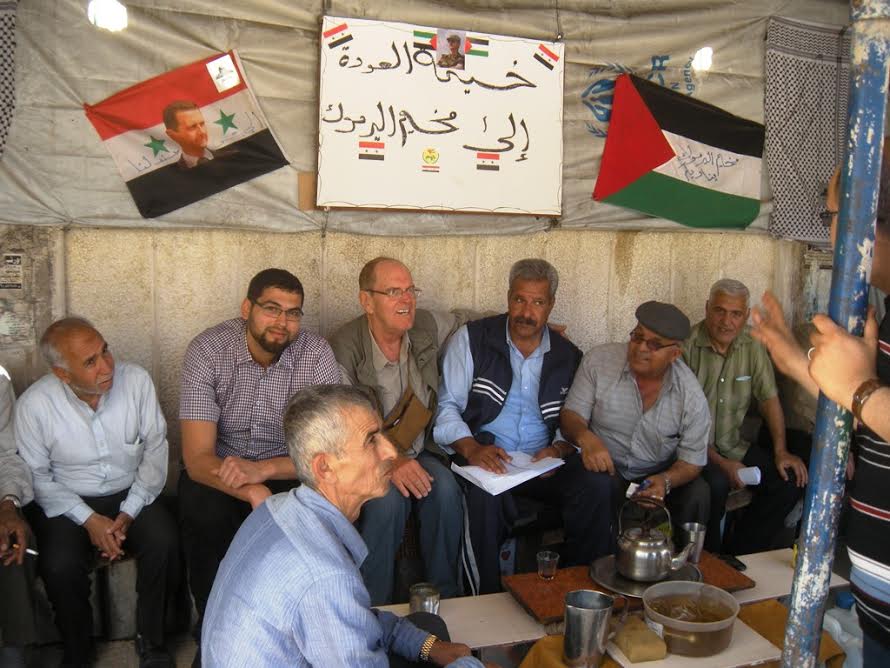
The “Return to Yarmouk” event is being organized by former Yarmouk residents from a beat-up shredded UNHCR tent across the street from the North-side entrance to Yarmouk. The Martyr’s Day event will have the theme “Return to Yarmouk” and will launched a campaign to pressure all the parties to finally achieve, after half a dozen failed attempts over the past nearly two years, enough Musalaha (‘reconciliation’) to acheive a credible ceasefire, allow in humanitarian aid, security and the return of those who since December of 2012 fled for their lives. Thousands of former Yarmouk residents currently exist wherever they can find shelter on the edge of Yarmouk while waiting for a chance to return to what is left of their neighborhood and homes.
There are many conflicting reports these days about current conditions deep inside Yarmouk. Based on briefings this week as well as crossed-checked data, the following tentative ‘snapshot’ comes into focus.
Parts of 4-5 thousand Yarmouk families are still inside for a total estimated current population of between 8 to 15,000 persons, mainly Palestinian but also some Syrian. Most are trapped or being used a human shields. But there are a few who have decided to remain with family members who are fighters in various militia. UNWRA uses the figure 18,000 including 3.500 children still trapped inside and in dire need of humanitarian aid. As of March 2011, according to UNWRA, Palestinians living in Syria numbered some 581,000 – one third of whom had been living in the Yarmouk camp.
As confirmed by other eye-witnesses, including Nour Samaha, the northern section of Yarmouk camp is now under the control of the PFLP-GC, while the Syrian army and the National Defense Force, a government-funded militia, surround the western and northern outskirts. Practically all the rest of the camp is under the control of al-Nusra Front, the Islamic State, and other opposition groups.
Da’ish (ISIS) and Jabhat al Nusra have now joined ranks for mutual benefits as we are seeing in some other parts of Syria. Contrary to some media reports ISIS has not abandoned or retreated from Yarmouk but on the contrary they are actively recruiting, offering approximately $ 400 monthly salaries, free cigarettes (despite their claimed Koranic based rejection of the disgusting habit) and a Kalashnikov or similar weapon.
Contrary to some media reports, the formerly pro-Hamas Palestinian militia Aknaf Bait al-Maqdis, which has been solely active in Yarmouk camp has not disbanded. Rather, Aknaf has split its ranks. Approximately 150 of its fighters have joined the Da’ish-Nusra collaboration inside the camp with roughly the same number joining pro-government forces such as the Popular Front for the Liberation of Palestine-General Command (PFLP-GC), which continues, despite some rumors, to be headed by pro-Syrian, Ahmed Jibril.
The current known allies of Aknaf Bait al-Maqdis include Jaysh al-Islam, Jaysh al-Ababil, Liwa Sham al-Rasul, and Da’ish (ISIS). Its enemies include the Syrian army, Hezbollah, National Defense Force, and the PFLP_GC and al-Nurse Front. But some alliances are shifting. This according to the political and military commander of the PFLP-GC and army sources who requested they not be named.
Rebels currently control between 50-75 percent of the camp according to army and PFLP-GC briefings conducted on 5/7/15. Officers explained to this observer and his colleagues that a laboriously crafted cease-fire was in place and set to be implemented by the end of March 2015, when suddenly Daesh and Nusra launched their attack on the camp, scuttling the efforts of many including most Palestinian factions.
Increasingly the battles inside Yarmouk are being wages from tunnels. Since 1 April, when Da’ish invaded Yamouk, and the government retaliated, at least 18 civilians are reported to have been killed from barrel bombs or from having been caught in cross-fire or shot by snipers. Camp resident report that their greatest fears these days are ISIS snipers and night-time dropped barrel bombs.
As fighting has yet again intensified, the trickle of desperately needed humanitarian aid instantly dried up and residents continue to starve. In mid-2013, approximately 170 Palestinian refugees starved to death when a siege began and has now lasted for nearly 700 days.
All the relief organizations in Yarmouk have now closed down their centers and left the camp. Essentially no medical services remain and six Palestine Hospital staff were recently injured and most of the rest have fled out of fear of Da’ish arriving via tunnels which some claim they can hear being dug. Others claim that since 1 April, at least 18 civilians are reported to have been killed as a result of barrel bombs or from having been caught in cross-fire or shot by snipers, and at least three Palestinian fighters captured by IS forces were beheaded. If they can, Yarmouk residents are fleeing mainly due to fear of increasing numbers of snipers and nighttime barrel bombing.
UNRWA cannot do much given the enormity of the crisis and has repeatedly expressed, so far in vain, strong concern for the security of civilians and has demanded access to those civilians who remain inside Yarmouk. But their courageous staffs and Syrian volunteers have been doing what they can these past several days.
The UN Country Team, representing all UN humanitarian agencies in Syria, was about to arrange this week a 22-truck convoy of critical humanitarian items to Yalda, Babila and Beit Saham in partnership with the Syrian Arab Red Crescent (SARC) and with representatives from the UN Office for the Coordination of Humanitarian Affairs (OCHA), the World Food Program (WFP), the UN Refugee Agency (UNHCR), the UN Children’s Fund (UNICEF), the World Health Organization (WHO), the UN Department for Safety and Security (UNDSS) as well as UNWRA. But failed to achieve their goals. Chris Gunness, a UNRWA spokesman, told the Associated Press that the agency has not been able to send any food or convoys into the camp since the recent fighting started. “That means that there is no food, there is no water and there is very little medicine,” he said. “The situation in the camp is beyond inhumane. People are holed up in their houses, there is fighting going on in the streets. There are reports of bombardments. This has to stop and civilians must be evacuated.”
UNRWA medical personnel did establish a mobile health point in Yalda, treating 325 patients over the course of the day. The team initiated a vaccine campaign, serving 28 children. The UNRWA team also provided food supplies to two community kitchens, sufficient to feed 900 individuals for one week. 1,200 packets of bread were delivered to civilians in Yalda, Babila and Beit Saham. UNRWA missions deliver a broad range of critical humanitarian materials to each of these families, including food, medical supplies, water purification treatments, mattresses, blankets, family kitchen sets and hygiene kits.
UNRWA continues to provide humanitarian assistance to the civilians outside of Yarmouk who remain displaced in Tadamoun, an area on the north-eastern periphery. The Agency is also providing some daily hot lunches for civilians, complemented by regular distribution of canned food.
A Syrian army commander, headquartered on the edge of Yarmouk advised this observer on 6/7/2015 that the Syrian government and UNWRA will relocate hundreds of recently escaped camp residents of secured housing in the coming week.
The Return to Yarmouk campaign announced this week shows potential to become a movement with wide support from the government, civil society and even some militia remnants. It is being led by Yarmouk refugees, some returning from Lebanon.
All people of good will can only hope that this Syrian and Palestinian Martyr’s Day effort succeeds and that despite the odds, Return to Yarmouk, will happen soon.
unnamed
Franklin Lamb with the committee for Return to Yarmouk.

Between Hell and the Deep Blue Sea

PD Lawton

Scenes of the infamous Slave Trade haunt Africans. Boats with rotting sides and water-logged engines hauling human cargo packed and sometimes locked three deep in the hollows. All that is missing are the chains and shackles. For the human cargo the only possession is a dream, a dream of a better life in a country where they believe there exists value to a life.
The drowning of 1,750 people since the start of this year is a great human tragedy of the 21st century. These people are in addition to the 3,419 who drowned last year and the 27, 000 that we know of, who have drowned since the start of the century trying to escape the hell of grinding poverty and war in Africa and the Arabian states.
They symbolize a level of desperation so deep that people will risk ending their lives rather than live the ones they have. Filthy politics has created this tragedy. We are witnessing the tail end of the 20th century’s orgy of exploitation and the deliberate delaying of Africa`s industrialization.
For the young man from Ghana who drowned three weeks ago, his inheritance of Ghanaian independence from 1957 was to live on less than $2 a day. For the Somalian mother who drowned, filthy politics of imperial occupation have gutted, raped and starved her nation for the last 25 years for a piece of a strategic oil pie. And for the Eritrean husband who drowned, what else was there left to fight off except the sea? Filthy politics has created this tragedy and it looks like filthy politics is about to capitalize on it. The human trafficking in the Mediterranean is reaching another level of immorality. And with it are those either directly or indirectly engineering the Mediterranean disasters or simply prepared to capitalize on them for a political agenda.
Before NATO’s destruction, Libya was the economic mecca for East, West , North Africa and the Arabian States. Today it is only the gateway for illegal immigration to Europe. Tens of thousands still make the journey here on foot from as far away as Somalia, a journey of some 5000 km across the Sahara.
Libya’s Coast Guard operate a search and rescue mission as well as illegal immigration control. With resources from the government of the now `democratic` and Gadhaffi-less failed state limited, their job is difficult. Coupled with this is the increasing risk to their own lives. The Libyan Coast Guard operating south of Tripoli are in rebel-held territory. Within this increasingly lawless territory, human smuggling is now big business commanding at least $1000 for a one-way ticket across the Med. The Coast Guard are their only obstacle. The Coast Guard are now being shot at out at sea and hunted down back on shore.
“We carry on working because otherwise these people will die. You have to sacrifice yourself to save these people. Today we`ve recovered 2 dead bodies from the capsized boat. There are kids, there are women. There are old people. Sometimes you are brought to tears as you are working. One time we had someone give birth on the boat. We rescued them and a newborn baby was with us. Once when rescuing people at night, one person died in front of me and I couldn`t save him. There were 108 people who needed rescuing and there were only 4 of us in the team. It was impossible to rescue all 108 people! He drowned in front of me and I could not reach him! People just drowning, it `s horrific!”
It has since been announced that the Libyan Coast Guard will only be responding to May-Day requests; search and rescue will no longer be a standard procedure. (Source: VICE NEWS.)
The Coast Guard’s duty is over once immigrants are handed over to the authorities on shore. The authorities are now in the hands of rebel groups in war torn and NATO destroyed Libya. Those rescued out at sea are then taken to immigration detention centres. Here they are held with thousands of other people arrested for being illegal immigrants in Libya. These detention centres are notorious. Zawiyah Detention Centre is nothing more than a prison; a medieval prison where men are packed 45 to a small room; 200 people share a toilet and medical facilities do not exist. Reports of abuse and torture for entertainment of bored prison officials abound; stories of young children and women humiliated and abused. Here access to UNHCR or any legal representation is a daydream in a cesspit where people are left to rot for indefinite periods of months or years.
A Syrian who made it to Italy said of his time in a detention centre: “ The people in Misrata are not the same as us. It was unbelievable, they`d come in and hit people, embarrass them. There is no mercy in their hearts.”
A spokesman for a group of detained Senegalese said: “They beat us in here. There is no food to eat. We just ask to go home, back to Senegal. Our families don`t even know if we are dead or alive.”
A Ghanaian: “I just want to go back home, home to my country.”
An Ethiopian: “I speak on behalf of all the African countries here. We are tortured everyday, treated like animals. Each day I hear that slavery is over, but slavery is here in Libya.”
Repatriation programs are on hold supposedly due to the instability of the country. Life on the streets of Libya at this time is fragile. Or are the detainees becoming valuable?
What if there was more to this? What if detainees were being given the sole option of buying their way out of prison and directly onto a boat bound for Europe? What if detainees were being conscripted onto boats?
What political agenda would benefit from this? This is how British Prime Minister David Cameron responded after the drowning of 800 people on the 19 April in the worst maritime disaster since WWII:
“We should put the blame squarely with the criminal human traffickers who are the ones managing, promoting and selling this trade, this trade in human life…We are doing everything we can to try and stop them.”
Shortly after, Cameron announced that Britain would be looking into the legality of military strikes against the human traffickers who happen to be based in African hotspots. The first combat vessel is already on its way to the Med, HMS Bulwark, along with three Royal Navy Merlin helicopters.
What a strange response! So we are left wondering, are those with a political agenda involved with human traffickers or are they just capitalizing on human sorrow? Is this human tragedy being carefully crafted into a humanitarian crisis worthy of a humanitarian invasion? Angelina Jolie has recently issued an appeal on behalf of UNHCR for the UN to assist the Syrian refugees being as `they` have failed to topple Assad by military force. She included in her speech a mention of the humanitarian disaster in the Med. Refugees in need of UNHCR`s dubious protection.
The move to bring in combat vessels, like HMS Bulwark, is being heralded as a successor program to the Atalanta Operation that is operated by the European Union Naval Force. Yes, that is correct, the EU has its own navy. This operation is to deter Somali pirates in the world`s most lucrative shipping route covering the Gulf of Aden, Yemeni coastline, Red Sea and Suez Canal. In reality it is the militarization of the seas. And just as Somalis have lost the sovereignty of their coastal waters, Libyans will too. Somalis took to defending their territorial waters in the early 1990s in an attempt to protect what remained of their fish stocks from foreign super-trawlers and to stop the illegal toxic waste disposal off the Somali coast.
The European Union has recently issued its 10-point response to the migrant `problem`:
* Reinforce the Joint Operations in the Mediterranean, namely Triton and Poseidon, by increasing the financial resources and the number of assets. We will also extend their operational area, allowing us to intervene further, within the mandate of Frontex;
* A systematic effort to capture and destroy vessels used by the smugglers. The positive results obtained with the Atalanta Operation should inspire us to similar operations against smugglers in the Mediterranean;
* EUROPOL, FRONTEX, EASO and EUROJUST will meet regularly and work closely to gather information on smugglers modus operandi, to trace their funds and to assist in their investigation;
* EASO to deploy teams in Italy and Greece for joint processing of asylum applications;
* Member States to ensure fingerprinting of all migrants;
* Consider options for an emergency relocation mechanism;
* A EU wide voluntary pilot project on resettlement, offering a number of places to persons in need of protection;
* Establish a new return programme for rapid return of irregular migrants coordinated by Frontex from frontline Member States;
* Engagement with countries surrounding Libya through a joined effort between the Commission and the EEAS; initiatives in Niger have to be stepped up.
* Deploy Immigration Liaison Officers (ILO) in key third countries, to gather intelligence on migratory flows and strengthen the role of the EU Delegations
Now we can make sense of the EU`s refusal to assist the Italian government with its remarkably effective, life saving search and rescue operation called Mare Nostrum. Now we can understand why this Italian response based on compassion after the Lampedusa tragedy, was replaced by a private operation run by a private corporation, Frontex . From human compassion to commercial venture, what kind of mentality is behind the European Union? Is this part of Empire`s masked corporate war against China and France?
Ending slavery is a catch phrase, as of late, within the international community. So well timed, we must think. Genuine compassion or a priming process? Problem, Reaction, Solution. The public outcry against the mass drownings of desperate people at the hands of slave traders demands a solution. The solution being applied does not include the eradication of poverty or resolution of war.
Reporters for the various media seem to be quite capable of speaking to some of the big boys in the smuggling game and reading their profit and loss sheets. But these big boys appear to remain elusive to those who would arrest them.
Which leads to the question, what is behind a billion dollar trade that involves money laundering, arms and drugs smuggling and the increasingly profitable human cargo? Has the Empire become so resourceful that it can use the same element to destabilize Libya, murder Gadhaffi, re -evolve into a rebel movement against the Libyan government, create civil war and now be the excuse for humanitarian military presence in Mali, Niger, Libya, Somalia and the entire Mediterranean Sea?

The Financial Road to Ruin

Ridwan Sheikh

Apologise and carry on, is a ruse played by corporate tax dodgers. And, banks are no exception. The 2007 HSBC scandal, where 106,000 clients from more than 200 countries dodged hundreds of millions of tax dollars has only seen one person prosecuted. With little done, are governments powerless at the financial legal quandary, or is there something we’re not being told?
The whistleblower, Herve Falciani, redefined British understanding of the forces at work. For a bank to assist clients to dodge taxes into secret Swiss banks was unthinkable. But it went further. Falciani also claimed many banks adopt similar tax fraud practices.
It’s a claim familiar to the U.S. In 2012, Bank of America ensured its clients avoided taxes on stock dividends in hedge fund trading by using its subsidiary bank in Europe, all done with government backing.
It saw Bank of America hide $17.2 billion in offshore accounts. An estimated $4.3 billion of federal taxes was evaded. Prior to 2012, the banking giant was bailed out by the Federal Reserve Bank and the Treasury Department of a staggering $1.3 trillion.
It’s the same story with Citigroup, offshoring $42.6 billion resulting in the loss of $11.5 billion in taxes. The bank also received a bailout, to the sum of $2.5 trillion.
This reflects the cosy relationship a State has with banks. It’s rooted in history but has steadily diminished a government’s authority.
Banking took off in the U.S in an event known as the Panic of 1907. The instigators of this public panic were four private bankers, J.D Rockefeller, J.P Morgan, Paul Warburg and Baron Rothschild, which led to the collapse of major banks and trusts.
The bankers decided to combine their wealth to form a private bank, with 100% private shareholding. The bank would create money and lend it to the government under their terms.
The Senate strongly opposed the idea, but in 1910, the four bankers wrote the Federal Reserve Act in secrecy, and the recommendation was pushed through congress by their allies. In 1913, after heavy lobbying and political donations to President Woodrow Wilson, the bill was voted through, and the Federal Reserve Bank was formed.
To make sense of banking irregularities the principle of how money is created needs to be understood.
This was apparent in a landmark Minnesota court case in 1969. In the First National Bank of Montgomery vs. Daly. The defendant, Jerome Daly, an attorney representing himself, opposed the bank’s foreclosure on his home mortgage loan on the basis the bank had put up no real money for his loan. This was known as no actual consideration, (i.e. the thing exchanged), for the loan. When the bank’s president, Mr Morgan, took the stand, to everyone’s astonishment, he admitted the bank created money, ‘out of thin air’, for its loans, adding this was standard banking practice.
In the end, the court rejected the bank’s claim for foreclosure, and the defendant kept his house. The decision wasn’t enough to reform banking practice. It remains standard practice, but questioning continues of why this exclusive treatment of corporations even exists.
In the U.K, the Bank of England confirmed private banks unchecked economic hold. In its 2014 analysis, entitled: “Money Creation in the Modern Economy”, it stated money creation in education is skewed. It is when banks make loans they create new money.
This is explained by Richard Werner, an economist and professor, in his book, New Paradigm in Macroeconomics. He says: ‘the credit extended by banks do not remove purchasing power or claims on resources form anywhere else in the economy. Strictly speaking it cannot be described as ‘lending’. Banks do not lend, they create it.’
The think tank, Citizens for Tax Justice (CTJ) noted that 15 of the Fortune 500 companies paid no federal income tax on $23 billion in profits in 2014 alone, and paid almost no tax on $107 billion in profits over the past five years. Amongst the big hitters of tax breaks were General Electric, the toy makers Mattel, and media giants, Time Warner, and CBS.
Exploiting the loopholes is the reason why corporations get away with paying between 0% and 15% tax, instead of the 35% rate. The FACT (Financial Accountability & Corporate Transparency) coalition reported the U.S treasury loses $150 billion a year in tax revenue, with decade losses of $1.5 trillion.
Lobbying influence also undermines governance. Wells Fargo, for example, spent millions of dollars on lobbying, which influenced laws in 2009, and in 2012, when the legislators were thinking of putting measures on foreclosure practices and reforming property-tax.
A study by Martin Gilens, a Professor at Princeton University, in September 2014, entitled Testing Theories of American Politics: Elites, Interest Groups, and Average Citizens, showed the influential factors involved in determining public policy.
Using data collected from 1981 to 2002, the report looked at the U.S political system from 3 interest groups. The groups were the average citizens, economic elites (affluent Americans), and organized interest groups; mass-based or business-oriented.
After examining nearly 1,800 U.S policies during that period, and comparing them to the groups, the research concluded U.S policy is dominated by its economic elite.
The researchers say, “The central point that emerges from our research is that economic elites and organised groups representing business interests have substantial independent impacts on US government policy, while mass-based interest groups and average citizens have little or no independent influence.”
The researchers conclude government policies rarely meet the preferences of majority of Americans, and instead overwhelmingly express the preferences of special interests and lobbying organisations: “When a majority of citizens disagrees with economic elites and/or with organised interests, they generally lose. Moreover, because of the strong status quo bias built into the U.S political system, even when fairly large majorities of Americans favour policy change, they generally do not get it.”
The Regan era in the 1980’s was seen as the golden age of ‘free’ enterprise capitalism. In truth, this era never really left. Banks are operating beyond their call of duty by seizing public assets, while the government turns a blind eye.
Morgan Stanley imported 4 million barrels of oil and petrol into the U.S in June 2012, Goldman Sachs stored aluminium in warehouses in Detroit, and continues to own and operate airports in many countries, and makes vast profits from toll roads in the U.S, Puerto Rico, India and Australia.
The Colorado toll road is of particular importance. The 50 year contract, covering 18 miles, was approved by the Senate on 20 February 2014. Under the terms of the contract, the Colorado Senators and Representatives were not allowed to read the contract prior to signing, or to amend or vote on the contract. Goldman Sachs is not spending a dime funding the project, instead the $552 million is pocketed from tax payer dollars, while the company will secretly profit from hiked up toll charges.
The challenges are monumental but futile unless there is a political will, to stand against corporations buying their way out of justice. Only then can there be some credibility to the meaning of democracy, a term derived from the Greek language, “Rule by the people”.

The Myth of Peaceful Protest

Allan G. Johnson


It isn’t nice to block the doorway,
It isn’t nice to go to jail,
There are nicer ways to do it,
But the nice ways always fail.
It isn’t nice, it isn’t nice,
You told us once, you told us twice,
But if that is Freedom’s price,
We don’t mind.
— Malvina Reynolds, “It Isn’t Nice”
Whenever peaceful protest turns into something else, when things get out of hand, the chorus of disapproval is loud and clear: Peaceful protest is The American Way, and any kind of disorder or defiance of authority is not only unacceptable, but unnecessary.
It is one of our foundational myths, that, like all such myths, would have us ignore the reality of history. Try to imagine, for example:
The American Revolution, without the revolution.
Abolition, without John Brown, slave revolts, and the Civil War.
Workers’ rights, without strikers being attacked by Pinkertons, police, and troops.
The vote for women, without activists being harassed and arrested and force-fed in jail.
Civil rights legislation, without sit-ins and illegal demonstrations and mass refusals to obey and the violent white response that forced the federal government to act.
Gay rights, without Stonewall.
The American Indian Movement, without the standoffs at Alcatraz and Wounded Knee.
Anti-war movements, without . . . well, here the problem is coming up with an example of any movement—peaceful or otherwise—that ended or prevented a war that the powers-that-be were intent upon, except, perhaps, the Russian Revolution.
As Frederick Douglass noted in the runup to the Civil War, “power concedes nothing without a demand,” which is why peaceful protest has so little effect against oppressive institutional power, whether government or corporations or white privilege. The unspoken rule is that power and privilege will respect the people’s right to peacefully express their grievances, so long as the people respect the right of power and privilege to ignore them and do nothing at all, as with children being allowed to have their say before the grownups tell them how it’s going to be.
But ‘the people’ are not children, and grievances are often born of generations of injustice and oppression and suffering. How, then, are protestors to respond to yet another phalanx of police, enforcers of last resort, armed to the teeth and determined to decide how this will go? Is it any wonder that push will come to shove?
And when it does, what do we call it and how do we explain and why does it matter?
To judge from the news, violence is something that happens spontaneously and all by itself for reasons known only to those who do it—as in, “the peaceful demonstration turned violent” or “violence erupted from the crowd.” The police are presented as just doing their job of keeping ‘it’ from getting out of control, as if ‘it’ has nothing to do with them or the power and privilege they are so heavily armed to protect by keeping things the way they’re supposed to be.
In the aftermath, authorities and the media focus on acts of violence by protestors who can now be written off as criminals who need not be taken seriously beyond cracking heads and hauling them off to jail. But the object of protest—systems of privilege and concentrations of political and economic power—are made invisible, to continue as before.
The demonstrators’ refusal to do as they are told is declared intolerable, but not the patronizing intransigence of power.
Buried deeper still is the reality that the privileged and powerful do not have the burden of having to resort to protest in order to get what they want, to put their lives on the line for justice, or sit quietly while being told to have patience, that change takes time. What they want, they feel entitled and empowered to buy or take, enact or decree, order or direct, lobby or legislate. And when violence is required—invading another country to protect ‘American interests’ or devastating the earth or getting ‘those people’ back in line—they rarely hesitate in the use of force.
Protestors setting things on fire is condemned as violence, but not fracking or poverty or uranium mining on Indian reservations or segregation or mass incarceration. It is the ‘other’ who are supposed to restrain themselves and make the best of it while the privileged and powerful do what they want and chastise protestors who reach their limit and refuse to back down and go home.
When push comes to shove, it is explained as little more than ‘those people’ doing what they are. But things getting out of hand, including violence, like anything in human life, is always in relation to something to which it is a response. This does not make it good or justified, but it does mean that it cannot be explained by itself, cannot be understood only in terms of those who push and shove, but must also account for what people feel compelled to push and shove against, including,*
The suffocation of democracy, with state and federal power increasingly in the hands of the best politicians and government that money can buy, enacting and enforcing laws that serve the interests of the few while ignoring the many.
Soaring levels of inequality along with the disappearance of manufacturing jobs that once provided generations of white immigrants with a path out of poverty.
Rising levels of racial segregation that isolate people of color in urban ghettos without a base for the coalitions that are necessary for political power.
Hundreds of years of demonizing people of color as dangerous, immoral, and criminal, leading to mass incarceration and disenfranchisement enforced by police departments armed for urban warfare.
And, for all the talk of “We, the people,” the long tradition of elites regarding the country as belonging to them, to do with as they see fit, claiming to know what’s best based on the wisdom that supposedly comes with wealth and power; and the rest of the population is either to support the elite or be dismissed as an ignorant mass to be used and ignored, denounced as rabble when they get out of hand, the mob, a threat to social order, to be controlled, if necessary, with violence.
There is no shortage of things to protest in this country, and if demands for change are to remain peaceful, if democracy is to work, there must be a reasonable expectation of a just response, without which patience and restraint become another means of subordination.
Almost fifty years ago, in the aftermath of race riots that make Baltimore look like a picnic, President Johnson formed a commission to study the causes of ‘civil disorder.’ It concluded that the violence was a response to issues of race, racism, and economic inequality that had been ignored for too long.
The report was widely read, selling more than two million copies nationwide.** But thirty years later, a follow-up study concluded that conditions had only gotten worse.
And now, two decades after that, here we are, not again, but still, with peaceful protest against the oppressive use of power having no effect on political and economic elites, or on the white population, much of which is largely oblivious to the reality of race, with a CNN anchor recently expressing amazement that violent protest could still happen in the United States.
Yes, change takes time. We hear that again and again, but almost always in a condescending tone, that we should need to be reminded. But, of course, that isn’t what it means, the real message being that change takes more time, and still more time, as much time, in fact, as those in positions of power and privilege choose to take, because those without power are not to presume to tell them what to do.
Which brings us back to Frederick Douglass. That power does not yield except by demand has two parts, not one, both the power and the demand, and as long as there is the one, there will be the other.
And there is nothing nice about it.

India’s Nuclear Poverty

Brian Cloughley

Voutenay sur Cure, France.
In the week that US President Obama praised India’s Prime Minister Modi for his “ambitious vision to reduce extreme poverty” there were several media reports that placed Mr Modi’s laudable ambition at variance with his expenditure decisions.
First was the announcement on April 10 that India would buy 36 Rafale fighter aircraft from France at a cost of some 4 billion dollars.  The second was six days later when India test fired its nuclear-capable Agni-III ballistic missile with a range of 3,000 km and capable of carrying warheads weighing over a ton..
Nuclear missiles don’t come cheap, and of course we don’t know and will never be told the real cost of any country’s nuclear weapons’ program, but an expert estimate for India in 2011 was five billion dollars a year which is a substantial chunk of the national budget.
Third was the report that “US Defence Secretary Ashton Carter is likely to visit India next month when the two sides are expected to ink the nearly $2.5 billion deal for 22 Apache [attack] and 15 Chinook heavy-lift helicopters.” India’s financial commitment to the purchase of foreign military hardware is increasing day by day and there seems no end to the list of expensive weaponry being acquired.  The billions of dollars are mounting up. There is no apparent ceiling to military expenditure, and neither is there a limit to acquisition of wealth by India’s growing number of mega-rich, as evidenced by the proudly broadcast news that India now has 90 billionaires (total worth $295 billion) and was reported on May 7 as being “home to 56 of the world’s 2,000 largest and most powerful public companies.”
But then there is an interesting description of the other side of the Indian coin by Jean-Pierre Lehman, a visiting professor at a university in Rajasthan, about 70 miles from Delhi, who has no axe to grind but records and evaluates the Indian scene as he sees it at first hand:
Upon reaching the outskirts of Jaipur, the scene switches to hundreds and hundreds of dilapidated makeshift tents beneath which people live – or perhaps more accurately manage more or less to survive. This is far worse than poverty. It is destitution. It is people living in what can only be described as bestial conditions. There is of course no access to sanitation; people cook their meagre repasts on coal furnaces inside the tents — one of the major causes of death in India. The contrast with the swankiness of some of the residential and business districts of Jaipur is of chasm proportions — a vividly desperate illustration of the growing inequality in India. That people, our fellow humans, should live in such conditions in the early 21st century is a terrible indictment of Jaipur, of Rajasthan, of India, and indeed of humanity in general.
It is doubtful that anybody could convince them of a need for jet fighters, nuclear missiles or attack helicopters.
Like all the poor around the world — most notably in India’s neighbors Pakistan and Bangladesh,  but also in America and Britain and almost everywhere else — those at the bottom of the economic pile in India have no voice, no dignity, no hope.  Some politicians do try hard to help them.  Prime Minister Modi is their leader and is certainly not hypocritical in that regard, unlike his enormously rich counterpart in Pakistan, but he won’t be able to alleviate poverty in his country for so long as he permits such massive military expenditure.  India was the world’s largest importer of military material in 2014 and the government authorized over 40 billion dollars in this year’s budget, excluding dozens of new commitments — so the nuclear missiles, fighter jets, and helicopters are only a start.
India’s military equipment order books include 7 frigates, at about ten billion dollars; another 400 helicopters for two billion or so; hundreds of medium artillery guns for at least 3 billion; 6 submarines costing 9 billion; and payment for a galaxy of other equipment whose manufacture will also provide massive employment — but mainly in other countries, and even in India only for the tiny number of those who are trained craftsmen (no women, of course).  India’s poor will benefit from neither profits nor work, because the money will go nowhere near them and they are unqualified for all but the most simple and meanest of jobs.
In his book Being Indian Pavan Varma observes only too accurately that in the Indian upper classes and rich (not by any means the same thing, as elsewhere) “there is a remarkable tolerance of inequity, filth and human suffering” and that “concern for the deprived and the suffering is not a prominent feature of the Indian personality. The rich in India have always lived a life quite oblivious to the ocean of poverty around them”  — from the times of the feudal rulers, the maharajahs and suchlike, whose luxury depended entirely on exploitation  and subjugation of their peasantry.
Most foreigners who have lived in India will have experienced and been aghast at the nonchalance with which the poor are regarded. Indeed they are ignored, even by many decent upright middle-class people, the backbone of the country.
The poor deserve better, as Modi knows very well.  He was not born into privilege or even in moderately secure financial circumstances but was a teenage tea-server in a railway station and has seen at first hand the squalor and despair of the submerged and suffering majority who must be taken out of hopelessness and shown that expectation of a decent, reasonable life is not confined to those born outside poverty.  They should — they must — be given the opportunity to better themselves and rise from destitution and exploitation to a point where they will be able to live as human beings and not as dismal serfs.
It is crucial for progress of humanity that the bodies and brains of human beings develop to the extent at which they can enjoy reasonable health and have the prospect of a variety of avenues of work. This is not happening in India, where over half a billion citizens live in conditions similar to those described by Professor Lehman or — barely believably — in even more dire squalor and misery.
Education is the most important aspect of national development, because it only through education that people can learn about skills they can acquire in order to earn a reasonable wage and live a decent life. Above all, education is vital for people to acquire the rudimentary facts essential for them to understand basic health requirements and improve their standards of hygiene which — as Modi has made a point of highlighting — are  abysmal.
In India over 40 per cent of children suffer from malnutrition.  But “malnutrition” is a fancy word for “verging on starvation.”  It means that countless millions of Indian children are hungry all the time.  In the morning these children wake famished and can’t be given enough food to fill their bellies because their parents can’t afford to feed them.  Most don’t go to school and from a very early age have to find basic menial work ;  if they have a midday mouthful it’s probably a piece of throwaway garbage from the streets.  Back at home in the evening they eat what their parents have managed to scrounge during the day.  They have no clean water or access to hygienic lavatories.  Those who don’t die in childhood will spend their short adult years in casual employment or crime.
Mr Modi is aware of all this.  He lived with it — in it — for many years and, of course, he wants to improve the lot of the starving mega-millions.  But this will take organization and, above all things, money.  And if a country spends vast sums on weapons it will have less to devote to improving infrastructure and education.  We’re not talking about handouts because there is no point at all in that approach, especially in India, where any such funds are systematically plundered by corrupt officials.  No : it’s a matter of devoting funds to innovative job-creation projects.  And it’s not just in India that this applies.  If the leaders of India could manage to sit down with those of Pakistan and China — the nations against whom India’s military policy and posture are directed — and come to agreement about longstanding territorial disputes, then the roads to true prosperity would begin to open in all three countries.
There are faults in the stances of China and Pakistan concerning their disagreements with India on border matters, but India has not helped in any way by being aggressively inflexible concerning mediation and it is time for false pride to be replaced by pragmatism and common sense. Disputes and confrontation over territory are futile and counter-productive and in this case have contributed enormously to these countries’ perceived requirement for masses of vastly expensive nuclear weapons and other military hardware.
Emphasizing national pride is an important political tool, and nuclear weapons are very impressive in an macabre sort of way. Unfortunately in pursuit of both it is always the poor who suffer most. Mr Modi is one of the few world leaders who could move to change this appalling state of affairs, and it must be hoped that he will place the interests of his half-billion poverty stricken citizens to the forefront of national policy.  His “ambitious vision to reduce extreme poverty” must not be allowed to dim.