9 May 2015

Drug Trafficking and the Politics of Vengeance

Ben Debney

Melbourne, Australia.
‘Good people do not need laws to tell them to act responsibly,’ says a quote variously attributed to Plato and Benjamin Franklin, ‘while bad people will find a way around them.’ If this quote applies to anything, it applies as much to the Indonesian state’s execution of Andrew Chan and Myuran Sukumaran as it does to the practice of trafficking in illegal drugs of addiction.
Despite high-level advice provided to the Australian government that the executions were illegal under international law, the execution of Chan and Sukumaran has nevertheless inflamed in Australia the types of passions apparently sought in Indonesia by President Joko Widodo, whose popularity has slumped in the wake of his election last year.
The executions are manna from heaven politically for Widodo. Opinion polling in Indonesia shows execution of drug traffickers is a popular policy, with 86% of respondents to one poll pre-executions agreeing that the Indonesian government should ignore protests from the Australian government and proceed regardless. To them, official killing is an expression of strength.
State sanctioned murder is also a popular policy here at home. One notable Facebook post comes from a page entitled ‘Fair Suck Of The Sav, Mate,’ whose byline reads ‘We will defend Australia against the ideology of Islam; If you are not with us, you are helping the enemy.’ In this post, which has over 30,000 shares, an unnamed Australian police officer weighs in against ‘hype around the Bali executions.’ It is worth quoting at some length.
‘I can’t believe the mentality of people,’ it begins, invoking offence at the outset:
I have been in law enforcement for 34 years and have worked in many areas within the force. After 9 years in, I spent nearly 5 years working as a UC. (Undercover) attempting to infiltrate traffickers of all types of drugs including amphets right down to simple choof. What a world of pain and misery. I was encased by the filth and self-destruction where I witnessed numerous deaths by either ODs or in a lot of cases suicides. Young girls selling their bodies for 10 bucks a go just to get their hands on their next fix.
The unnamed officer goes from these general comments to discussion of a particular case he a teenage girl with whom he was acquainted, who was hooked by the age of 14 and prostituting herself by 15. ‘Her body was so ripped and torn by drug and sexual abuse,’ he writes, ‘she hariscreamhad intestines falling out of her rectum as a result of numerous rapes and sexual encounters where she tried to get payment.’ He describes the girl as having a baby who was taken away from her by Human Services at 15, who could do nothing for her but supply treatment when they could’ until she died at 19, ‘alone in a back street.’
After weighing in against do-gooders (also unnamed) who would ‘pass her on the street and avoid her all the time’ while he would ‘give her
food but she preferred to starve and get some smack rather than eat,’ the officer describes becoming depressed and having to move to another area. This is an experience he seems to feel might only be understood by his fellow police officers, as to this way of thinking the police apparently have a monopoly on compassion and empathy.
Less understood the unnamed police officer feels is the refusal ‘to call on the PM to “bring our boys home,”’ something he would never do as ‘no boy of mine would do this.’ Again who exactly is referring to Chan and Sukumaran as ‘our boys’ is not mentioned, though it does serve well to validate the author’s general sense of pious ire. ‘But,’ as he continues, apparently rallying against those who oppose the death penalty, ‘all I see is you fucking wanna be Samaritans who treat these two drug kings as heroes.’ While he accept that do-gooding Samaritans don’t believe in the death penalty,’ he claims not to like it either — “but.” The “but” is not long in coming:
The media and the solicitors have played you people for the fools you are. You have never lived in the world of drug, crime and despair. You have been protected from it so much you live in the fantasy world where you believe you can hug everyone and all will be better. You are not qualified to even comment as to whether these guys should get parole or not.
One can hardly argue with the idea that the mass media spend a lot of time playing people for fools, but nowhere in this piece does this unnamed officer state which section of the media he imagines has been trying to make Chan and Sukumaran out to be heroes. One does not imagine he means the Murdoch media, for example. Nor does he state which solicitors think the problem of drug trafficking and abuse of drugs of addition is going to be fixed with a group hug, though despite claiming to have been affected by the experience of meeting with one addict, this does not seem to translate into anything much in the way of compassion for slaves of drugs of addiction as a group, which he insolently equates with the belief that ‘you can hug everyone and all will be better.’
This fact in particular would seem to give us some insight into the logic the unnamed writer of this online rant is following. The problem as he sees it apparently has something to do with the culture of permissiveness that resulted in the paroling of Adrian Bayley, currently serving a life sentence for the rape and murder of Jill Meagher in 2012. ‘You paroled him,’ he says angrily. ‘You say the parole board stuffed up and parole him.’ But, he insists, the parole board is full of people just like those who oppose the death penalty and would have had Chan and Sukumaran repatriated to Australia, ‘with your opinions and beliefs.’
Which opinions and beliefs in particular he does not say, nor does he explain what makes his own unqualified opinions any more valid than anyone elses, though he does point out correctly enough the obvious fact that that the paroling of Bayley, whose tally of victims stands at around 20, ‘was a complete and utter failure.’
This piece of shit was a career rapist and the only ones we can blame for what he did is all of us. Not the judge. Not the Parole board or the police. Us. The decisions like this that are being made are by people who never have to deal with these shitheads when they are in street mode committing crimes. You see them all clean shaven and in their court suits or white shirts becoming born again etc. You poor misguided fools. You don’t even care about the effects of what they have done to our society.
In a sense of course, the unnamed police officer is perfectly correct. Bayley was paroled despite being a serial rapist and future murderer because of the actual culture of permissiveness surrounding misogyny and rape, particularly where the tendency to victim blame is concerned. The perceived culture of permissiveness informing a principled defense of civil liberties no more played a part than did the basic moral principle infants are taught to understand in kindergarten that two wrongs don’t make a right.
The confusion, whether accidental or intended, functions as it happens to shift the blame away from the former; while claiming an overarching insight into the nature of crime by virtue of policing it (as opposed to being a victim), the unnamed writer who is presumably white and male accuses civil libertarians of being ignorant of the consequences of crime. At the same time he neglects to refer to the arguments of women writers critical of the paroling of Bayley in the aftermath of his murder of Jill Meagher as if these were at all hard to come by.
Presumably at least some of those who oppose the actual culture of permissiveness surrounding the apportioning of blame onto the victim rather than the perpetrator are themselves victims of rape. This would appear to belie the author’s pretense to having special insight into the nature of victimhood.
Not that this appears to make a great deal of difference. In the face of what the officer seems to see as the casual indifference of do-gooder Samaritans such as those who oppose the culture of permissiveness surrounding misogyny and rape toward the reality on the street, he argues for tougher penalties such as those he claims were in force 34 years ago when he joined the police force. ‘We called it “Marijuana,”’ he says. ‘It was the biggest thing on the street,’ claiming that, as against the drug importing of the present and suspended sentences he claims are the norm in the present, crime back then was not rampant.
‘Now,’ says the unnamed officer says, ‘here we are,’ enjoying the rotten fruits of a system apparently based on permissiveness. ‘Your system has worked hasn’t it,’ he bitterly laments. Not only are those who oppose the death penalty for drug crimes guilty of opposing the death penalty, which this writer seems to equate with raising Chan and Sukumaran to the level of heroes, they are also infamously wont to ‘voice how much you hate police’ while ‘ring[ing] us and run[ing]’ inside and hide whilst we come out and deal with the shit you don’t have the fucking guts to deal with yourself.’
In this way does a piece that apparently begins as an attempt at least to make a disinterested defense of helpless victims against unnamed permissive do-gooders degenerate into a self-righteous screed against critics of the police. ‘But you are right up there on your keyboards bravely shit canning the police for excessive force and filming it on your cameras,’ the writer inveighs, as if it is not those who use excessive force who shit can themselves.
This comment becomes the foundation for the unnamed writer’s final burst of righteous fury, in which he castigates the permissive do-gooders for having no knowledge or interest in Henry Chinn, ‘on death row in China for trying to smuggle 270 grams of meth into our lovely country in 2004.’ The problem in this case appears to be that ‘the media hasn’t spoon fed you the crap to hype you up.’ The same seems to go for Davis and Gardiner, ‘the two Aussies who were caught in China in last year trying to cart 75kg of ice to here? Davis and Gardiner.’ Pointing out that China has executed in excess of 1000 people in a 12 month period, the author lashes his critics for hypocrisy: ‘But you still buy their shit every day.’
These two Australians will be executed and you will still buy their product. Second chance you say. You think these people have no prior convictions. You think this is their first attempt. Wake up fools. Stop hugging yourselves. Two men died today because they broke a law in a country where they knew they faced death if caught. Had they have got away with it, there would be a countless number of 19 year old girls laying in the gutter dead. Quick run inside and tell yourself what a great person you are.
In the face of the author’s obvious anger, it is on first reading not an easy task to rejoinder. On the second, it seems obvious that neither any of the examples cited by the writer, nor the high profile arrest of Schapelle Corby in Bali seven months before the Bali Nine, had much deterrent effect on them, much less to say others executed for heroin trafficking such as Kevin Barlow and Brian Chambers in Malaysia in 1983, nor Michael McAuliffe again in Malaysia in 1985.
The 2002 arrest and conviction in Singapore for drug trafficking offenses of Van Tuong Nguyen from Melbourne appeared to have little effect on any of the Bali Nine, even though that charge carried the death penalty which the Singaporean state carried out in December 2005. Nor do they appear to have any effect on the aforementioned Australians presently languishing in Chinese prisons.
On the face of these examples, it appears that the unnamed police officer writing on Facebook is actually blaming civil libertarians for the shortcomings of the deterrence approach to policing. If deterrence worked the way those who rally against do-gooder Samaritans seem to imagine it does, one would imagine there would be little or no crime.
By the unnamed writer’s own admission, however, if the Indonesian state had not followed through on its policy of executing drug traffickers for the sake of President Joko Widodo, ‘there would be a countless number of 19 year old girls laying in the gutter dead.’ If that is true, as the anonymous author certainly appears to believe it is, then that would appear to be either the consequence of a failed policy, or as good as having no policy, or both.
This being the case, in addition to raising questions about the logic driving apologia for handing the power of life and death to the state, a power freely exercised by tyrants throughout history in the name of defending society, conflated with itself, from any manner of evils, it also brings us back our original question of what to do about those who flout drug trafficking laws in light of the obvious shortcomings cum failure of the policy of deterrence on the one hand, and the puerile attempt to appear strong to those who identify strength with cruelty, malice and vengeance — especially where this is a politically expedient method of boosting political popularity and one’s standing in opinion polls.
If the anonymous Facebook writer who believes the Samaritan do-gooders are to blame for the failures of received policing strategies to deter people from drug trafficking and thus to prevent people from taking drugs of addition, scientists exploring the causes of addiction empirically in laboratories and publishing in peer-reviewed journals perhaps unsurprisingly come up with different arguments — and ones supported by evidence at that.
Reviewing one particularly significant series of experiments, Johann Hari, a Cambridge politics graduate and author of Chasing the Scream: The First and Last Days of the War on Drugs reveals that the traditional tendency to blame the drug problem on the individual addict as per the received wisdom on social media reviewed above is actually at odds the discoveries made therein. He notes:
This theory was first established is through rat experiments, — ones that were injected into the American psyche in the 1980s, in a famous advert by the Partnership for a Drug-Free America. Put a rat in a cage, alone, with two water bottles. One is just water. The other is water laced with heroin or cocaine. Almost every time you run this experiment, the rat will become obsessed with the drugged water, and keep coming back for more and more, until it kills itself. The advert explains: “Only one drug is so addictive, nine out of ten laboratory rats will use it. And use it. And use it. Until dead. It’s called cocaine. And it can do the same thing to you.”
Problematic for this experiment as an explanation for the condition of the addict, Bruce Alexander felt, was that the rat was in the case with nothing to do all day but take drugs. Wondering what would happen if he tried the altered the parameters of the experiment, he built Rat Park, as Hari puts it, ‘a lush cage where the rats would have colored balls and the best rat-food and tunnels to scamper down and plenty of friends: everything a rat about town could want.’
In Rat Park, all the rats obviously tried both water bottles, because they didn’t know what was in them. But what happened next was startling . . . The rats with good lives didn’t like the drugged water. They mostly shunned it, consuming less than a quarter of the drugs the isolated rats used. None of them died. While all the rats who were alone and unhappy became heavy users, none of the rats who had a happy environment did.
As Hari notes, Alexander had a useful human situation to compare to the rat experiment, for anyone given to the thought that the behavior demonstrated in this experiment was ‘merely a quirk of rats.’ This example was the Vietnam War, where ‘Time magazine reported using heroin was “as common as chewing gum” among U.S. soldiers’; Hari notes that a study published in the Archives of General Psychiatryfound that ‘some 20 percent of U.S. soldiers had become addicted to heroin there,’ prompting fears that ‘a huge number of addicts were about to head home when the war ended.’ Fortunately for everyone, and
. . . some 95 percent of the addicted soldiers — according to the same study — simply stopped. Very few had rehab. They shifted from a terrifying cage back to a pleasant one, so didn’t want the drug any more.
The parallel Alexander was able to draw with his rats was revelatory; as Hari points out it was clear to him then that ‘addiction is an adaptation… It’s not you. It’s your cage.’ In other words, it was and is primarily a social problem rather than an individual one — to the extent that we assume that we are all responsible for society at least, though some famous proponents of the Drug War have been known to proclaim that no such thing exists.
In addition to being a ‘profound challenge both to the right-wing view that addiction is a moral failing caused by too much hedonistic partying, and the liberal view that addiction is a disease taking place in a chemically hijacked brain,’ this is likewise a profound challenge to Hari’s eponymous Drug War and the national and international policing strategies associated with it, particularly to the extent that the problem tends to be blamed on individuals rather than being treated as the collective one that it appears to be in reality.
On the one hand then is the lack of evidence to suggest the strategy of deterrence behind the execution of drug traffickers is an effective one, much less to say the tortured logic of some of those who seek to shift the blame for its shortcomings onto civil libertarians. On the other is explicit evidence to suggest that social factors not easy explained away by the belief that the number of people of people who believe an idea determines whether it is true or not are to blame.
In the face of these, one might argue then that, on balance, the continuance of Drug War policies, if not to say the pretense that you practically have to lust for blood to oppose the personal social effects of drugs of addiction, merely up the ante for those who are going to break anti-trafficking laws regardless. They would also appear to provide the crime industry with a never ending supply of deviants requiring social control, and thus never ending reasons to invest more and more heavily in instruments of social repression — music to the ears no doubt of investors in companies operating in the ever-expanding security industry.
Preying on the weak by getting them hooked on drugs of addiction for which they have to pay endlessly is indefensible; purveyors of booze and cigarettes combined kill hundreds of thousands every year. This is no less true of heroin. Why this justifies giving the state the right to kill remains to be explained. In the long run, dealing with the causes of addition might be a better approach than the old two wrongs make a right routine. While shooting traffickers may be immensely gratifying to some in the short term, beyond that it virtually guarantees the continuation of the drug problem as a social ill.
Worse, the use of state power to exact vengeance sets a dangerous precedent; states have throughout history, do and will continue to kill in numbers far outweighing traffickers of heroin, heroin itself or together with all other drugs combined. This is a fact invisible to those whose slander of civil libertarians appears to constitute their means of finding a way around international laws against summary execution for which they don’t feel like exercising responsibility and respect for the rights of the individual in general.

Capitalism is the West’s Dominant Religion

Michael Welton


“One can behold in capitalism a religion, that is to say, capitalism essentially serves to satisfy the same worries, anguish, and disquiet formerly answered by so-called religion.”
— Walter Benjamin
“This yellow slave will knit and break religions”
— William Shakespeare, “Timon of Athens”
David R. Loy, a professor of international studies at Bunkyo University in Japan and a Zen Buddhist teacher, offers us a compelling viewpoint on why we ought to understand our present economic system as the West’s dominant religion. In A Buddhist History of the West (2002), Loy argues that, although religion is “notoriously difficult to define,” if we “adopt a functionalist view and understand religion as what grounds us by teaching us what this world is, and what our role in the world is, then it becomes evident that traditional religions are fulfilling this role less and less, because that function is being supplanted by other belief systems and value systems.”
This is a shocking statement for those of conventional religious sensibility. Certainly the monotheistic faith-traditions have not just disappeared into the thin air of modernity. One could make a solid case that Islamic cultures still contain strong currents of resistance to Western consumer individualism (perceived as decadent and nihilistic). But in the West, Christianity in particular, has lost much of its power to resist the new god that has (and is) conquering the old ones (just like Christianity did in its displacement of Roman deities). Although the monotheistic religions contain many different streams and tendencies (including ascetic and contemplative traditions), these minority anti-materialist traditions have not been able to prevent the market from becoming our “first truly world religion, binding all corners of the globe into a worldview and set of values whose religious role we overlook only because we insist on seeing them as secular” (Loy). Economics is the new theology of this global religion of the market; consumerism its highest good; its language of hedge funds and derivatives as incomprehensibly esoteric as Christian teachings about the Trinity. “Accumulate, accumulate! This is Moses and the prophets! Marx cried out in the first volume of Capital.
Loy wonders why we acquiesce in the appalling realities of global inequities and sleep so peacefully at night. He finds his answer in Rodney Dobell’s explanation that “lies largely in our embrace of a peculiarly European or Western [but now global] religion, an individualistic religion of economics and markets, which explains all of these outcomes as the inevitable results of an objective system in which … intervention is counterproductive.” Any intervention in the “world of business” is perceived as a threat to the “natural order of things,” a direct challenge to the “wisdom of the market.” He claims that: “The hegemony achieved by this particular intellectual construct—a ‘European religion’ or economic religion—is remarkable; it has become a dogma of almost universal application, the dominant religion of our time, shoring up and justifying what would appear to be a patently inequitable status quo. It has achieved an immense influence which dominates human activity” (“Environmental degradation and the religion of the market.” In H. Coward (ed.) Population, Consumption, and the Environment [1995]).
We have made fetishes out of commodities as we believe we can derive sensuous pleasure from their magical properties. We sacrifice our time, our families, our children, our forests, our seas and our land on the altar of the market, the god to whom we owe our deepest allegiance. Forsaking the consumer paradise for a life of
weltonjustpoverty, wandering with an empty begging bowl or devoting one’s life to alleviating the plight of others is scarcely an option for most faith-community members.
Today we can scarcely find a moral perspective resident in the old world religions to challenge the hegemony of the religion of the market. The latter is ascendant; the old religions shunted to the sidelines. Indeed, globalizing capitalism seems the perfect fit with our human nature as essentially greedy and self-interested beings continually at war with one another over scarce resources. But economic historians (Weber,From Max Weber: Essays in Sociology [1946]; Tawney, Religion and the Rise of Capitalism [1926]; Polyani, The Great Transformation[1944]) inform us that in pre-modern societies pre-capitalist man valued material goods only as long as they served moral ends (such as enhancing social status and reinforcing social obligations).
Beginning in the late middle ages and reaching its first plateau in the late eighteenth century, the capitalist market began to assume an autonomous, god-like existence. As Max Weber understood so well (The Protestant Ethic and the Spirit of Capitalism [1946]), gradually the inner world ascetic impulse to know and serve God, who would reveal himself in the silence of the prayer chamber, evaporated. Protestant believers began to measure God’s favour by their economic success. Economic success was the means to achieve the end of God’s favor and eternal salvation. But this fragile link could not abide centuries of unrelenting capitalist achievement and success. Eventually, the means, economic blessings, displaced God himself. God was now The Market–the Source of all Hopes. Who disputes the gospel of sustained economic development? Even Jesus would drive an S.U.V, we can believe the late Rev. Jerry Fallwell, the once formidable American leader of the Christian Right.
Eighteenth-century Scottish Enlightenment thinker Adam Smith warned us over two centuries ago (in his Theory of moral sentiments [1759]) that the market was a “dangerous system because it corrodes the shared common values it needs to restrain its excesses” (Loy). Two hundred years later, Polyani inveighed against a system that annihilated “the human and natural substance of society.” These are prescient words that echo in Habermas’s raging against the “colonization of the lifeworld.” Doesn’t everyone know that the god we serve requires clear cut forests, depleted oceans, empty oil wells, toxics dumped into the biosphere? “A direct line,” Loy observes sadly, “runs from the commodification of land, life, and patrimony during the eighteenth century to the ozone holes and global warming of today.”
Everyone also knows, deep down, in their heart of hearts, that the god we serve actually has no life of its own. In Capital, volume 1, Marx imagined that the god of the market was like a vampire who “lives only by sucking living labor, and lives the more, the more labor it sucks.” This monster feeds on the life force of the natural and human worlds. It needs men and women as slaves who have energy and the motivation to work endlessly with others to produce the goods. Even prolonging the working day, says Marx, “only slightly quenches the vampire thirst for the living blood of labor.”
Serving this monster (capitalism produces lots of them!) generates endless sickness amongst the workers and eternal problems for the biosphere and human lifeworlds, which it depletes of life shamelessly. The money-code is at war with the life-code (John McMurtry, The Cancer Stage of Capitalism [1999]. Ironically, if the money-code (another name for the religion of the market) wins out in the end, that, indeed, is the end. As David McNally expresses it in Monsters of the Market: zombies, vampires, and global capitalism (2011), “If vampires are the dreaded beings who might possess us and turn us into their docile servants, zombies represent our haunted self-image, warning us that we might already be lifeless, disempowered alien powers.”
How the religion of the market meets the needs of its devotees
William Leiss (The Limits of Satisfaction: an Essay on the Problem of Needs and Commodities [1976]) provides us with a lucid account of how the religion of the market seeks to meet the needs of its adherents. He argues that the high intensity market setting manipulates people into believing that they can meet their needs and fulfill their desires through purchasing particular commodities. Leiss sees some serious problems with this mode of needs-meeting. For one thing, individuals must have competent craft knowledge of the product that is supposed to meet the specific need. With goods proliferating endlessly and quickly, most people have neither time nor inclination to research the product. We rely on common-sense judgments. But these judgments are usually questioned by some recent scientific report. Ever attuned to what will sell while appearing to be good (or healthy) for you, corporations marketing wares that only yesterday were bad for you, now tell us so assuredly that the product is free of bad fat and is now good for your family’s nutrition. Just believe!
In the high intensity market settings, individuals are taught to “identify states of feelings systematically with the appropriate type of commodities” (Leiss). This is an insidious and dangerous catechetical learning process because individuals are being carefully led away from finding satisfaction in active citizenship, good work and aesthetic self-expression. The job of advertising within the religion of the market is, as journals like Adbusters proclaim, to miseducate us incessantly to image that there is a real link between an impulse and the sacralized (or fetishized) commodity. To illustrate: advertisers prey upon our authentic needs for self-respect and respect for others by decomposing the body into various parts. Then the authentic need for self-respect is channelled towards the consumption of various chemical mixtures that promise a pleasing appearance and recognition from others.
The religion of the market can maintain is grip on its devotees only by constantly destabilizing the categories of human need. Corporations spend billions of dollars on advertising designed only to make us feel dissatisfied, unsettled, and ill at ease, without any deep harmony between our inner and outer worlds. We must be willing to believe there is something fundamentally defective (sinful?) with our bodies, minds and souls. We must also believe that the act of consuming—both simple and exquisitely executed products—will meet our needs, fulfil our heart’s desires and make us happy (at one with our god). But fulfilment channelled through consumption is mainly a delusion. Leiss observes, tellingly, that, “The constant re-division and recombination of need-fragments renders its increasingly difficult, if not impossible, for individuals to develop a coherent set of objectives for their needs and thus to make judgments about the suitability of particular goods for them” (Leiss). Thus, having displaces being as the core value of the religion of the market.
Having and being
The iconoclastic Buddhist scholar Stephen Batchelor offers penetrating commentary on “having and being” in Alone with Others: an Existential Approach to Buddhism (1983). “Having,” he observes, “is characterized by acquisitiveness. Our worldview is dominated by the notion that the aim of personal existence is fulfilled in proportion to what we are able to amass and possess.” Craving, the source of endless suffering for Buddhist teachers, impels men and women to possess material objects that appear to “offer protection, security, and social status through their tangible and starkly present solidity.” The old God of the Hebrews is faint and wispy, a vague cloud-trace in the sky.
We are also impelled to possess people—husbands, wives, children, friends, acquaintances—“all arranged in a circle around us connected to the center by threads of attachment and possessiveness.” We can also crave immaterial things, like thought, acquiring “new possibilities” for further knowledge acquisition. Batchelor argues that “even our bodies and minds are regarded as “things” we “have.” For Batchelor, “having always presupposes a sharply defined dualism between subject and object. The subject thus seeks his or her well-being, as well as his or her sense of meaning and purpose, in the preservation and acquisition of objects for which he or she is necessarily isolated.” “I am what I have” is the way Fromm (1976) puts it in To Have or to Be.
But any “sense of fulfilment will necessarily be illusory, because there is nothing one can have that one cannot fear to lose. Absorption in the horizontal dimension of having is the origin of all states of ontological insecurity.” Buddhist social philosophers like Loy and Batchelor believe that compulsive motivation to have things attempts to fill the lack in people’s lives. In fact, this motivation to fill the lack through possession has penetrated our consciousness so deeply that the traditional sphere of religion—the “receptacle for the traditional symbols of being”—are approached as “another region of having” (Batchelor). One can possess eternal life, immortality, enlightenment, and the kingdom of heaven.

Trade Wars: Monsanto’s Return to Vietnam

Desiree Hellegers

Ho Chi Minh City.
This past week, as activists gathered in Washington, D.C. for the conference on “Vietnam: the Power of Protest,” in Viet Nam’s Ho Chi Minh City, a delegation led by Veterans for Peace (VFP) Chapter 160 was quietly wrapping up a two week tour. The tour was timed to coincide the VFP’s national “Full Disclosure Campaign”. The VFP initiative, like the D.C.-based conference over the weekend, is geared to counter a Department of Defense (DOD) campaign, funded by the 2008 National Defense Authorization Act (NDAA), to produce commemorative events and historical accounts, including school curriculum, to mark the 50thanniversary of the Vietnam War.
Set against the backdrop of the Obama administration’s push for fast track authority to conclude the Trans-Pacific Partnership (TPP), this year’s VFP 160 tour raised troubling questions not only about the ongoing effects of the war on Viet Nam, but about Monsanto’s introduction of genetically modified (GMO) seeds onto the Vietnamese market. The text of the TPP, which would be the largest trade deal in history, impacting 40% of the world’s economy, remains shrouded in secrecy. But leaked passages indicate that the TPP will heighten the growing income inequality in both Viet Nam and the United States and override local and national laws and policies geared toward protecting the environment and public health. Monsanto, one of the single largest producers of the estimated 20 million gallons of Agent Orange sprayed in Viet Nam between 1961 and 1971, is among the corporations that stand to garner windfall profits if the TPP is passed.
Widespread contamination from the dioxin-laced defoliant Agent Orange (AO), and a landscape littered with unexploded ordinance (UXO)—including landmines and cluster bombs—are among the legacies of what’s known in Viet Nam as the “American War.” One of many troubling aspects of the Pentagon’s 50th anniversary campaign is its Orwellian spin on a high tech war that bathed Vietnamese jungles and waterways in toxic defoliants in one of the largest, most reckless scientific experiments in human history. Among five objectives outlined in the NDAA is the mandate that the DOD history celebrate “advances in technology, science and medicine related to military research conducted during the Vietnam War”.
The leaders of the VFP tour, including Chapter 160 President Suel Jones, Vice President Chuck Searcy, Don Blackburn, Chuck Palazzo, and David Clark, all served in the American War in Viet Nam and each returned, drawn by their memories of the war and their desire to help support Vietnamese NGOs working to address the suffering engendered by the war. With the leadership VFP Chapter 160 ranging from their late sixties to early seventies, the vets anticipate that, at best, they’ll have another five years to lead the tours, their primary fundraising vehicle to cover their limited administrative expenses and provide support for their partner organizations.
The day after we arrived in Viet Nam, on April 17, a class action lawsuit was filed in France on behalf of millions of Agent Orange affected Vietnamese. The lawsuit was filed against Monsanto and 25 other U.S.-based manufacturers of dioxin-contaminated Agent Orange. After years of legal skirmishes, a 1984 settlement provided limited relief to American GIs suffering from a range of health effects linked to Agent Orange exposure, from prostate and lung cancer, to multiple myeloma, diabetes, Parkinsons and heart disease. But attempts to get legal redress and financial support for the estimated three million Vietnamese suffering from Agent Orange exposure have repeatedly failed.
The U.S. has never made good on the promises Nixon made at the 1973 Paris Peace talks to provide Viet Nam with more than $3 billion in reparations, equivalent in today’s currency to more than $16 billion. The relatively paltry aid that the U.S. has supplied the still war-ravaged country comes with string attached: ongoing pressures to enact various forms of “structural adjustment,” which the TPP seems designed to accelerate.
On the same day the lawsuit was filed in France, we met with U.S. Ambassador Ted Osius, the first ambassador since the “normalization” of US-Viet Nam relations in 1995 to openly acknowledge the lingering effects of Agent Orange on the Vietnamese people. By some accounts, the two-decade embargo that the U.S. imposed on Viet Nam after the war exacted suffering equal to the war itself.
Osius told the gathered delegation and journalists that meaningful political relations between the U.S and Viet Nam necessitate “facing the past.” “If we hadn’t addressed the Agent Orange issue, I don’t think we’d have the credibility to address” other shared concerns, chief among which he numbered climate change, global health, education and trade. Osius vaunted the virtues of the TPP and the “huge benefits” it will provide for Vietnamese workers, while ostensibly strengthening environmental protections and regulations governing food safety. Henoroomofherownacknowledged, however, that alongside the benefits that Viet Nam is enjoying from the liberalization of trade in recent years, the country has witnessed the emergence of a new Vietnamese oligarchy. And he also acknowledged the role that the TPP will play in privatizing state institutions, which under the terms of NAFTA and the WTO, are frequently relegated to the status of unfair trade barriers. Under the TPP, he told us, “non-performing state institutions will,” of course, be subject to elimination. When I challenged Ambassador Osius’ claims about the benefits of the TPP, invoked the secrecy of the document and invited him to print out and share a copy of the trade deal with the delegation to substantiate his claims, he declined diplomatically.
On our way to visit Village, a program situated at the outskirts of Hanoi, serving Agent Orange-affected children and veterans, we saw scenes that have become familiar in U.S. cities bent on attracting global investment at all costs. “Development” in Viet Nam, as in the United States, is increasingly code for housing demolition and displacement. Along the edges of Hanoi, which is now home to one Rolls Royce and four Mercedes Benz dealerships, luxury condominiums are springing up, along with sporadic protests. The tensions between “development” and the revolutionary vision and promises of Ho Chi Minh’s Communist Party, are set in stark relief in Doan Hong Le’s 2010 film Who Owns the LandThe award-winning film documents the struggles of poor farmers confronting displacement by a luxury golf course, along with rationalizations from their local Communist Party leadership.
In each city along the path of the tour—from Hanoi to Hue, to A Luoi, Danang, Na Tranh, and Ho Chi Minh City—we saw evidence of the ongoing suffering engendered by the war. And in each city, we met with members of the Veterans Association of Viet Nam (VAVN) along with local chapters of the Vietnamese Association of Victims of Agent Orange (VAVA) which has long been at the forefront of the struggle for legal and financial redress for Vietnamese disabled by AO-exposure. At a meeting in Hanoi with VAVN, our host Gen. Phùng Khắc Đăng, invoked the role of American corporations in the production of Agent Orange, taking care to acknowledge that AO has had “very terrible effects not only on Vietnamese but on U.S. soldiers and citizens.” At a meeting in Danang, standing before a bust of Ho Chi Minh, a VAVA representative remembered “seeing the planes come and the foliage die.” Another representative chimed in: “It destroyed anything with leaves. It kills us. It kills the people. It kills all the trees and animals.” But the focus, he reminded us—and himself—must be on “how to rebuild the country, how to develop the country.” Regarding the war and the U.S. use of Agent Orange, he went on to say, “We just turn the page, [but] we don’t delete it.”
“We appreciate the generosity of the Vietnamese people,” responded VFP 160 Vice President Chuck Searcy, “But we also think we should learn the lessons of the past.” Searcy wanted to know why, after the tragic consequences of Agent Orange, the Vietnamese government has allowed Monsanto to return, open offices and trade in Viet Nam, where the company now markets GMO seeds, including corn. In response, the VAVA representative invoked Viet Nam’s entry into the WTO. “When we signed up for the WTO, we had to take them—they have to be here,” he said.
If the WTO relegated local and national environmental and health laws to the status of “unfair trade barriers,” Mexico’s experience following the passage of the North American Free Trade Agreement (NAFTA) ought to serve as another cautionary tale about the likely impacts of the TPP on Viet Nam. Following passage of NAFTA, the U.S. flooded Mexico with cheap American corn, including Monsanto’s GMO strains. The move not only gutted the Mexican corn market, it resulted in widespread GMO contamination of the country’s diverse indigenous corn strains. In Canada, as Naomi Klein has documented, the WTO and NAFTA have been used to challenge, respectively, the development of local renewable energy in Ontario, and a moratorium on fracking in Quebec. Leaked portions of the TPP indicate that the trade agreement will only expand the profits and corporate impunity that Monsanto and other corporations have long enjoyed.
The human health effects caused by the use of dioxin-contaminated Agent Orange during the American war are most dramatically evidenced in the province of Quang Tri, in the area the U.S. demarcated as the demilitarized zone or DMZ. One of an estimated 28 “hot spots” scattered throughout Viet Nam, many of which were the sites of US bases where Agent Orange was transported and stored, Quang Tri was the most heavily sprayed province. An estimated 15,000 people in Quang Tri suffer from Agent Orange exposure. Our first encounter with the nearly unthinkable damage that Agent Orange has wrought in Viet Nam came during a visit to a family that receives support from VFP 160 and its partner organization Project RENEW. Four out of five adult children in the family are severely disabled. Only the second of the couple’s children, born between 1972 and 1985, seems, along with his own children, to have dodged the chemical bullet of Agent Orange. However, as the Vietnamese are increasingly discovering, the effects of Agent Orange may skip one generation, only to emerge in the next. The four disabled adult children are unable to stand upright as a result of a host of congenital health issues. They scurry about on all fours, with puzzled expressions that are markers of the developmental disabilities that frequently result from AO exposure. In Quang Tri Province, we learn, 1300 families have between 3 and 5 children who suffer from the debilitating effects of Agent Orange exposure.
But Agent Orange is far from the only source of misery that remains in Quang Tri Province. If the U.S. dropped more bombs on Viet Nam than were used throughout World War II in both the European and Pacific theaters combined, Quang Tri was the most heavily bombed region in Viet Nam. The range of prosthetic devices on display at the Quang Tri Mine Action Visitor Center reflect Project RENEW’s work to meet the needs of more than 900 individuals province-wide who have received prosthetic devices following injuries from UXO, which is scattered across an estimated 80% of the Province. Another 1,100 amputees are currently awaiting limbs. Also on display at the Center are crayon drawings by Quang Tri children learning in school-based programs to identify unexploded ordinance and notify authorities of the location. More than two million Vietnamese combatants and civilians were killed during the American War, but the more than 60,000 Vietnamese killed by land mines, cluster bombs and other UXO since the war now exceeds the 58,000 American GIs killed during the war. And still the US remains one of only a handful of countries worldwide which have refused to sign on to UN treaties banning landmines and cluster bombs.
In Nha Trang, we visited a woman and her sister who are caring for two adult children, neither of whom registered signs of AO-exposure until their late teens. The older of the two, now 40, lay moaning in a bedroom in the rear of the house. His 36- year-old sister is still cognizant enough to anticipate her own future when she sees his emaciated and contorted limbs.
In Ho Chi Minh City, our final stop on the tour, we visit the Tu Du Hospital/Peace Village, which is home to some sixty AO-affected children, along with a handful of adults who have grown up at the facility. On the ward, a couple of children eagerly demanded to be hugged, while others, some with feeding tubes in their noses, looked at us with uncomprehending gazes. A child at the far end of a room stared blindly in front of him. Like many AO-affected children, one of his eyes was entirely missing, a blank space where a socket might be. In another room, a hydrocephalic child of indeterminate gender with a head the size of a watermelon lay motionless in a crib. Perched in a chair beside the crib, cradling the child’s hand, sat a girl who appeared to be no more than six or seven years old. She glanced up momentarily, a bit annoyed perhaps by the crowd of American spectators trooping through, then returned to the all-consuming work of comforting her friend.
The following day, April 30th, the anniversary in the U.S. of the “fall of Saigon,” we rose early to attend “Liberation Day” festivities in Ho Chi Minh City. The tightly choreographed parade featured male and female veterans in dress uniforms; sunflower-swirling school girls; and a billboard size image of Ho Chi Minh atop a hot pink float–silhouetted like a modern day pop culture saint against a celestial blue backdrop. Entirely absent from the scene was any hint or interest or participation from the rank and file residents of the city named after the revolutionary figure.
The reception that followed in the “Reunification Palace” was presided over by Deputy Prime Minister Nguyen Xuan Phuc, and attended by about 100 people representing organizations from 40 countries and territories around the world. First among the speakers was Hélène Luc. As Phuc noted, Luc “support[ed] and assist[ed] the Vietnamese delegation” at the Peace Talks, while serving as a member of the Paris City Council. In her comments, Luc invoked Ho Chi Minh’s historic 1945 Declaration of Independence, modeled after the founding document of the United States. She lauded the courage and bravery of the revolutionary struggle, and of the activists who took to the streets around the world to stop the war.
Last to speak when the floor opened up was Virginia Foote, President of the U.S.-Vietnam Trade Council and President of the Board of the International Center in Washington, D.C. “As an American–and I think I speak for all of the Americans in the room,” observed Foote,“we pledge to continue to work on the economic development of the country” as well as “on the war legacy issues.”
She spoke of attending the ground-breaking ceremony at the Land Mine Action Center in Hanoi only a few days before and of the “new money [that] is coming in,” to “support and assist Viet Nam.” “At the same time,” she said, “we are working on some very tough trade negotiations and hoping we can finish those this year as well….We will continue to struggle forward with the TPP,” she said, before the Deputy Prime Minister offered a few ceremonial comments to conclude the meeting.
On April 30th in the United States, with little fan fare, California Representative Barbara Lee introduced the Agent Orange Victims Relief Act of 2015. The bill, supported by the U.S.-based Vietnam Agent Orange Relief and Responsibility Campaign (http://www.vn-agentorange.org/), would provide funds to substantially mitigate AO contamination throughout Viet Nam, and for health care and direct services for Vietnamese AO sufferers. It would also expand relief for American veterans, and provide new support for their children, who suffer from AO-related congenital health problems.
Amid new initiatives to secure justice for Agent Orange survivors and ongoing negotiations for a trade deal that stands to significantly shape the future of both countries, the corporate controlled media in the U.S. has been only too willing to offer up a steady diet of cinematically compelling footage of South Vietnamese forever scrambling toward helicopters and hanging from rooftops. Leaked passages indicate that, if passed, TPP will expand the impunity and profits of corporations like Monsanto that seem every bit as willing today as they were in the 1960s to profit from the misery of Vietnamese peasants and the working poor in both countries. Meanwhile, in Viet Nam, the work of VFP 160 and its partner organizations continues, and in Ho Chi Minh City’s Peace Village sits a little girl who refuses to be distracted, to loosen her grip or turn her back on the suffering that surrounds her.

How the Media Helps ISIS Spread its Propaganda

Ben Norton

Like many of the fascist and extremist groups that came before it in history, ISIS is skilled with propaganda. Its videos are highly doctored and rife with special effects. It has its own 24-hour TV channel, , and even merchandise. ISIS has a brand that it is marketing, as a corporation or even government does.
The central idea in ISIS’ propaganda strategy is to make itself look like a huge, omnipresent global threat when it is in fact relatively small and isolated. The corporate media, whether wittingly or not, helps it to do this.
If one were to only watch and read Western media reports, one would likely think that ISIS is an enormous global presence. Listeners are constantly reminded that “ISIS territory remains larger than many countries,” that the land ISIS controls is larger than Britain, and that ISIS is expanding. What is rarely mentioned is that much of the land ISIS controls is uninhabited or sparsely populated, and that the reason it easily overtook many of these areas is because there was often a weak local government and a feeble or even absent military.
One has to also differentiate the area ISIS controls from ISIS itself. The actual number of ISIS fighters is contested. Western intelligence estimates previously put the figure at around 30,000. At the upper limit, Kurdish intelligence sources hold that there are 200,000. Even if the upper estimate is accurate, this is still not very large vis-à-vis other states’ militaries.
This is not to dispute the fact that ISIS is obscenely violent and indefensible. ISIS does clearly pose a threat—but a threat to those living under or near its control, not those living thousands of miles away. After all, the vast preponderance of those who have been killed by ISIS have been Muslims living in the Middle East. By overstating the threat ISIS poses, the media only serves to amplify ISIS’ voice—which is precisely what the group wants.
Such an approach also draws attention away from the fact that the US invasion and occupation of Iraq that killed over one million people, in conjunction with the US’ subsequent support for a sectarian Iraqi government and Shia death squads that oppressed, brutalized, and even killed the Sunni minority, are the reasons Al-Qaeda came to Iraq in the first place, and are the reasons ISIS, which emerged from Al-Qaeda in Iraq’s ashes, has some support.
In its obsessive and insatiable appetite for histrionic headlines and sensationalist stories, nonetheless, the US media constantly claims that ISIS is behind this, that ISIS is behind that, that ISIS is in Mexico conspiring to topple the US government, that ISIS is on the path to take over the world.
unnamed
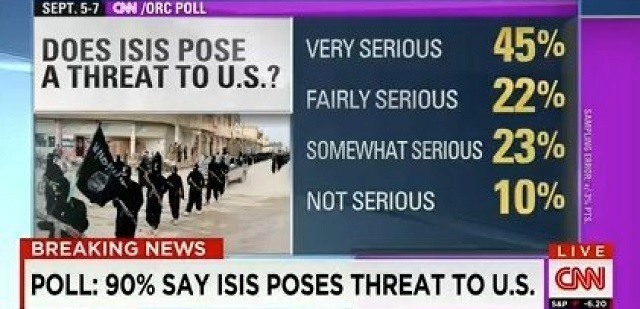
The irrational media paranoia works. A September 2014 CNN poll found that 90% of Americans believe ISIS poses a threat to the US.
Of course, the media accomplishes all of this with little to no evidence (tweets constitute its favorite pieces of “evidence”)—basing its allegations most often simply on what ISIS itself says. The media also fails to emphasize that many of the foiled supposed “ISIS-linked” terrorist plots in the West often involve undercover police informants and/or provocateurs. The FBI and other forces buy bombs and then lure mentally ill people into doing incriminating things. The US government’s intentional entrapment of innocent Muslims is well-documented.
If another fringe fascist group made the threats and statements ISIS does, would the US media instantly eat them up and report them as news? This is not usually the case, fortunately. In these instances, journalists exercise more caution—as they should always do. Yet, every time a crime is committed or a terrorist plot is uncovered and ISIS claims credit, the US media takes the bait. Every time.
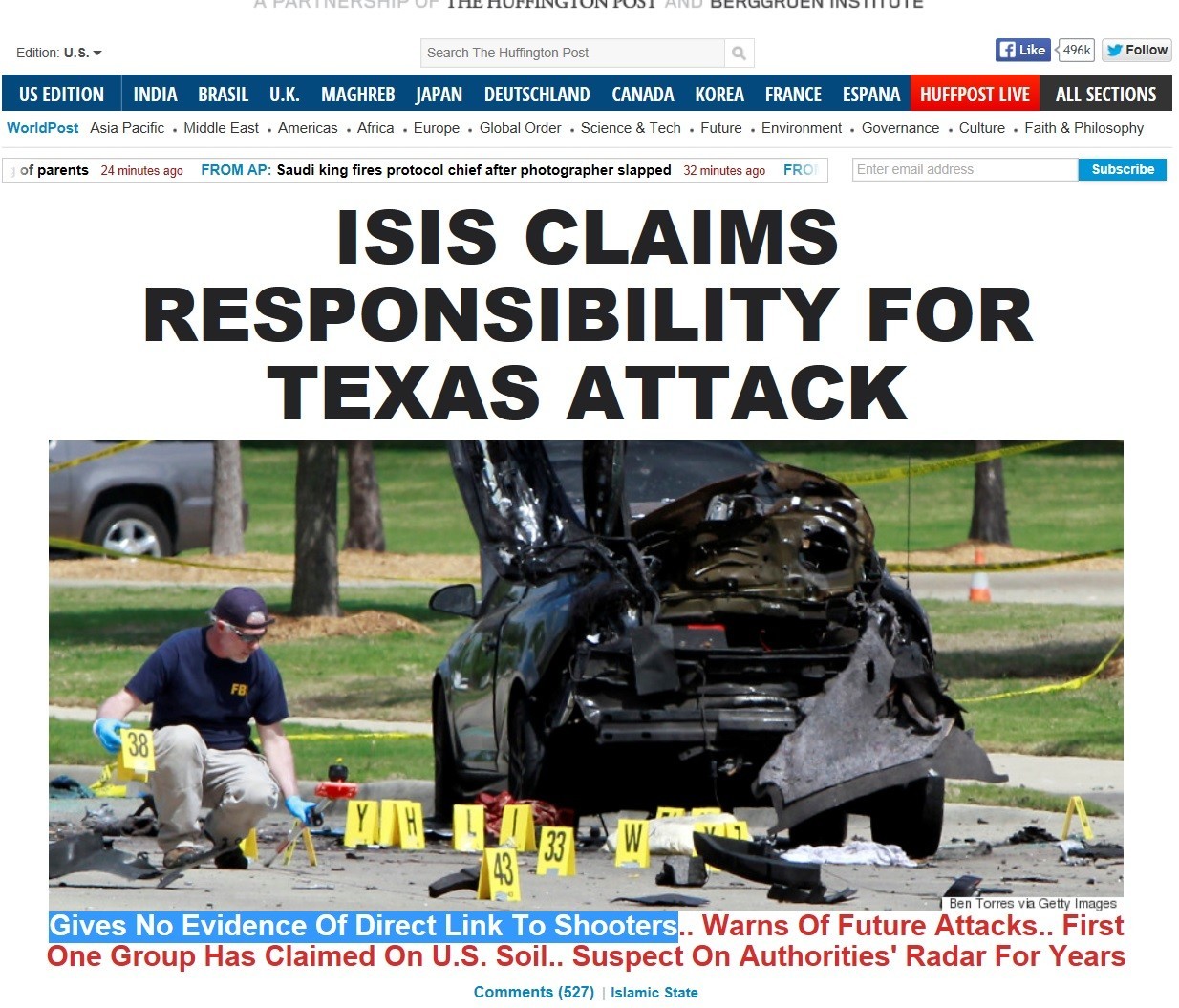
ISIS claimed credit for the May shootings at an anti-Islam event in Garland, Texas, organized by far-right demagogue and leading anti-Muslim crusader Pamela Geller and featuring fascist Dutch politician Geert Wilders.
The Huffington Post put a headline right at the top of its home page reading, in all-caps, “ISIS claims responsibility for Texas attack.” Under the picture, in much smaller text, is the crucial fact that it has given “no evidence of direct link to shooters.”
unnamed-1
The article itself is titled “ISIS Claims Responsibility For Texas Cartoon Attack, Gives No Evidence Of Direct Link.” This headline has much more nuance. But how many readers will click the sensationalist headline on the front page and read the more nuanced one (yet alone the article below it)? Research shows not many will.
Is the media technically reporting a lie? No, it is true that ISIS claimed credit for the attacks. But, in typical corporate media fashion, it is hyper-emphasizing some facts (for which there is no evidence) while simultaneously de-emphasizing other ones. By constantly reporting that ISIS took credit for the attacks, the media draws attention away from the fact that there is not any evidence that the militant group is actually responsible.
Many readers are not very critical in their analysis of news. They see the headline “ISIS takes credit” all over the place, and they just assume that it has been concluded that ISIS is somehow affiliated. A mere day after the attack, far-right Islamophobic websites had already cited these reports as proof that ISIS was behind the attacks and is “waging a war on America.”
The mayor of Garland himself publicly emphasized that there is “no evidence” of ISIS’ supposed involvement in the attack, but the media barely reported this.
To be fair, this is not a problem that is exclusively limited to reports on ISIS—although the Western corporate media loves to exaggerate the supposed threat of “radical Islam.” When a tragic event like a shooting happens, the media, desperate to break the story as soon as possible, often publishes stories without adequate evidence.
This is, after all, the product of the very modus operandi of the corporate media: The more clicks an article gets, the more times advertisements on that article are seen; and the more times advertisements on that article are seen, the more money that publication makes. This is precisely why clickbait is such a widespread (and growing) phenomenon—and why it is so dangerous to real, substantive, fact-based journalism.
In the case of the Garland shooting, the corporate media’s clickbait compulsion is misleading the public, further inflaming Islamophobic sentiment and racism in the US, and simply propagating unsubstantiated claims. The fact that the unsubstantiated claims it is prematurely reporting are convenient to US government interests, effectively working to give legitimacy to the totalitarian lengths to which it has gone in its “War on Terror,” should not go unnoticed.
unnamed-2
The “extremely graphic” warning Fox News posted on the uncensored 22-minute ISIS propaganda video it circulated
Nor is this the first time the US corporate media has essentially served as a willing mouthpiece for ISIS. In February 2015, Fox News faced criticism for circulating a gruesome, uncensored 22-minute ISIS propaganda video of Jordanian hostage Muadh al-Kasasbeh being burned to death on camera.
In effect, Fox decided to literally disseminate ISIS’ propaganda for it. YouTube and Facebook refused to allow users to post the video. Fox News did not exercise such discretion.
Numerous counter-terrorism analysts told The Guardian that, by publishing its videos, Fox was empowering ISIS. Senior associate in homeland security and terrorism at the Center for Strategic and International Studies Rick Nelson remarked groups like ISIS “seek to strike terror in the hearts and minds of people globally, and by perpetuating these videos and putting them out there into the internet, it certainly expands the audience and potential effects.” “These groups need a platform, and this gives them a platform,” he added.
Malcolm Nance, the executive director of the Terror Asymmetrics Project on Strategy, Tactics and Radical Ideology thinktank explained the “whole value of terror is using the media to spread terror.” Fox News producers “are literally – literally – working for al-Qaida and Isis’s media arm,” he averred. “They might as well start sending them royalty checks.”
Fox’ goal in sharing the video was clearly to sensationalize and exaggerate the threat of ISIS—and to, when taken in conjunction with its long history of anti-Muslim bias, portray Islam negatively more generally. ISIS’ particular brand of extremism—which it should be pointed out is much more similar to European-style fascism than it is to most other Islamist groups (the vast majority of which are not violent terrorists)—helps reaffirm the insistence of Islamophobic fanatics that Islam is somehow uniquely and inherently violent.
unnamed-3
Far-right demagogue and “godfather of the modern anti-Muslim movement” David Horowitz publicly thanking ISIS for helping him spread his Islamophobic message
This cozy relationship between right-wing Islamophobes and ISIS is exemplified in a piece by far-right pundit David Horowitz—whom the civil rights organization the Southern Poverty Law Center refers to as “the godfather of the modern anti-Muslim movement“—literally titled “Thank You ISIS.”
Extremism researcher Malcolm Nance insisted that, by publishing the video, Fox News was propagating “exactly what ISIS wants to propagate.”
The idea that ISIS is behind terrorist attacks in the US like the Garland shootings is also exactly what the fascist group wants to propagate, in order to increase fear of it, and thus augment the power (and recruits) it derives from this fear and the subsequent state oppression it engeders. In doing so, it also happens to bolster the deranged rants by xenophobic Islamophobes who claim Islam poses a grave domestic threat to Americans.
In short, thanks in no small part to the irresponsible US media, the Garland shooting is overall “a win for ISIS and Islamophobes—and a loss for everyone else.”

The Wretched of the Sea

Hamza Hamouchene

In the last few weeks, the EU neighbourhood and the Western foreign policies alongside the ongoing economic domination of the African continent have yet again shown their deadly consequences in the immigration tragedy in the Mediterranean Sea.
Thousands of people, mainly from Africa and Syria, risk their lives every year crossing the sea in fragile boats to flee war-torn areas, poverty, persecution and misery in order to reach the shores of Europe for a better and safer life. Sadly a significant number of them perish in the attempts to do so or end up in humiliating camps and prisons in southern European countries only to be deported and returned and see their dreams shattered.
What distinguishes this year’s tragedy from the previous ones is the sheer scale of it as the death toll of drowning this year now stands at over 1,500 – 50 times more than at the same point in 2014. This can be explained mainly by the ongoing conflicts in Syria, Libya and Mali as well as the inhumane decision by several European Union (EU) governments to refuse funding to the Italian-run rescue operation Mare Nostrum, preferring thus to let migrants die, something that was claimed would act as a deterrent for unwanted people who are trying to reach fortress Europe.
Trying to halt this flow of humanity has been the EU’s logic for years with the introductions of sanctions and heavy fines on marine carriers that fail to check the validity of travellers’ passports and visas. Already in September 2007, seven Tunisian fishermen were indicted and jailed by an Italian judge for “support of illegal immigration,” their boats confiscated because they dared to save a boat transporting passengers to Lampedusa (Sicily), preventing it from sinking as stipulated by maritime rules.
It is worth remembering here how European countries externalised the protection of their borders to authoritarian regimes in North Africa. An edifying example was the Berlusconi-Gaddafi agreement to send immigrants back to Libya without screening them for asylum claims in return for lucrative economic deals between both countries. Morocco also  zealously performed its role as the guardian of Fortress Europe. In 2005, 20 people from Sub-Saharan Africa met their deaths while trying to cross the fences in the Spanish-Moroccan border at Ceuta and Melilla, some by falling, others by asphyxiation and others more shockingly under the fire from the Moroccan army.
This delocalisation and militarisation of immigration control was epitomised by the European Union agency Frontex that was created in 2005 to intercept migrants coming between the African shores and the Canary Islands as well as in the Sicily canal, regardless of the legitimacy of certain asylum cases and far from any democratic control.
Algeria did not escape this logic of cooperation with its European neighbours in the “war on migrants”. That’s how, in 2009, it made “illegal immigration” an offence under its law. Algeria, which praises itself as a beacon of stability in the region and which harbours vast wealth from its oil and gas resources, is nevertheless one of the main countries that produces what we call “illegal migrants,” more exactlyHarraga in the Maghrebi language. Harga (the phenomenon) literally refers to the verb “حرق“ (burn in Arabic) in its strict sense (to burn their papers and documents) and metaphorically: to overcome a restriction like going through a red light or jumping the queue – or in this case crossing the borders and the seas.
Algeria and its harragas
In 2014, there were 7,842 detections of illegal border crossings in the Western Mediterranean region that consist of several areas of the southern Spanish coast and the land borders of Ceuta and Melilla. In terms of nationality, most of the migrants are from West Africa, in particular from Cameroon and Mali. Algerians and Moroccans have also been reported among the top ten nationalities, but mostly at the sea border.
According to the 2015 Frontex annual risk analysis, Algeria was ranked third after Syria and Afghanistan for detected clandestine entries at border crossing points (BCPs) in 2014. Algeria was also ranked eighth when it comes to illegal residents.
The Algerian harraga take different maritime routes from Algeria to reach Europe: one from the coasts of Oran (West Algeria) towards continental Spain, the other one (less developed) links the shores of Dellys (100km east of Algiers) to the island of Palma in Majorca; and the last one is from the oriental coasts (Annaba and Skikda) towards the Italian island of Sardinia.
However, they also use other routes through Tunisia, Libya as well as through Turkey. In fact, from November 2010 to March 2011, 11 percent of the 11,808 irregular migrants intercepted in Greece by Frontex were identified as Algerians, behind Pakistanis (16 percent) and Afghans (23 percent). These alarming statistics were surprising because the number of Algerians exceeded those of Moroccans by a factor of two and Tunisians by a factor of six, despite the unrest in these two countries with the start of the Arab uprisings.
Harga - the result of poverty and hogra
All social classes are touched by this phenomenon: working-class people, the unemployed, university graduates and even doctors and engineers. One asks: why is this social scourge so widespread, reaching far beyond the poor classes? This question deserves serious consideration and answering it adequately will be a challenging task – but I will attempt to give a few possible answers.
Harga in a way represents the pursuit of a future that came to a dead-end in the home-country. It is a means to overcome the restrictions on freedom of movement, precariousness of employment and the marginalisation by clientelist networks – in a nutshell everything that makes life unsustainable, in order to realise a life project that we think is impossible to achieve in Algeria given present conditions. One inhabitant of a marginalised village, Sidi Salem in Annaba, eastern Algeria, declared to his Harrag brother: “I lost the keys of my future in a cemetery in Algeria called Sidi Salem.”
Illegal immigration from Algeria is also the logical consequence of more than three decades of liberalisation of the economy that pronounced a death sentence on a productive and job-generating economy, leading to massive unemployment and the perpetuation of a rent-seeking mentality relying on oil and gas exports and importing everything else.
Harga cannot be really understood without looking at another scourge we call Hogra in Algeria. Hogra means contempt, disdain, exclusion and also describes an attitude that condones and propagates violence against the many, the laissés pour compte (the forgotten and marginalised masses).
‘We would rather die eaten by fish than by worms’
Due to the restrictions on freedom of expression and association and also because of the lack of space of entertainment, art and creativity, young people feel suffocated, humiliated, without dignity – foreigners in their own country and the only horizon they can see is the one beyond the sea. In that respect, it is an act of denunciation of authoritarianism and in a sense it is a culture of contestation coming from a social group that feels marginalised and neglected. In a powerful message to the ruling classes in Algeria, the youth says: “Roma Wella Antouma”, meaning “Rome rather than you.” They also say: “We would rather die eaten by fish than by worms.”
Algerian youths risk their lives to reach the northern shores of the Mediterranean in order to escape the despair of being marginalised and relegated to being Hittistes – literally, those who have their backs to the walls, a term used in reference to the unemployed who ceased to be stakeholders of post-colonial Algeria. But instead of reindustrialising the country and investing in its people, the Algerian authorities offer financial support to the IMF, a neo-colonial tool of plunder that crippled the economy in the first place. Endemic corruption, which has become the normal state of affairs in Algeria, has made things even worse.
Harga is only a reflection of what has become of Algeria and other African countries five decades after independence, with ruling elites only content in satisfying foreign capital and abiding by the diktats of their Western masters. It is also the epitome of white supremacy, capitalist exploitation and imperialist domination that go hand in hand with repressive and corrupt regimes in Africa and elsewhere.
The immigration tragedy that we see in the Mediterranean Sea will go on as long as the entrenched authoritarian structures of power and oppression are still in place, as long as the looting of Africa’s natural resources is underway, as long as the profoundly unjust system we live in continues its domination and exclusion of the wretched of the earth and the damned of the sea. It is necessary and urgent to engage in the struggle for global justice against a system that puts profits before humans.