11 May 2015

Macedonia and the Virtues of Corruption

Binoy Kampmark

This will be something for the books of violent dispute. A series of gun battles over the weekend lasting over 16 hours have left eight police officers and fourteen gunmen dead in the town of Kumanovo in Macedonia. The slain police were members of the anti-terrorist Tigers unit. The Macedonian police authorities have since released a video of the captured gunmen, with a few sporting UCK insignia.
Where, then, with the various punters in this latest lethal spat? Officially, the European Union is urging calm between participants. Jens Stoltenberg, the NATO Secretary-General, has also expressed “great concern” while urging all sides to “exercise restraint and avoid any further escalation, in the interest of the country and the whole region.”
But only a few members of the EU refuse to acknowledge the legal status of a state that was given birth in similar circumstances, one waged with a narrative of bullets and ethnic politics. Neighbouring, Albanian-majority Kosovo, long deemed part of Serbia, provides the toxic model of rebellion in the broader context of Balkans politics. The recognition of Kosovo, broadly speaking, is Europe’s green light for secession.
For that reason, various organisations and states are keeping watch on the latest affair: will the argument by the Albanian separatists for a province along Kosovo lines be cleaved off the Macedonian state? In 2001, sparks flew between the security forces and Albanian insurgents, ending with the hastily cobbled Ohrid peace accord. “This Framework,”it reads, “will promote the peaceful and harmonious development of civil society while respecting the ethnic identity and interest of all Macedonian citizens.”
The air has been heavy with prospects of such a confrontation. On April 21, a police outpost in the village of Goschince, part of the predominantly Albanian municipality of Lipkovo 25 kilometres northeast of Skopje, was attacked by a group of 40 armed gunmen wearing the uniforms of the National Liberation Army (NLA). Hostages were taken, and threats issued.
According to the spokesman describing the attacks, “The leader of the group, speaking in Albanian… told the captured police officers the following: ‘We are from the NLA and tell everyone that nobody can save you, neither [Prime Minister] Nikola Gruevski, nor [head of the junior Albanian DUI party] Ali Ahmeti. We want our own state.”
The town of Kumanovo itself demonstrates that dreary repetitiveness of factions seeking advantage and reward, flavoured by a hint of conspiracy and not so grand design. There are the separatists themselves, operating in various guises. There are the corrupt government officials who align themselves with status quo corruption while extolling the virtues of stability. Then there are the indigent civilians who simply wish to continue living in an ethnically mixed city, desperate as it might be. As a resident told the Balkan Insight, “We all know each other, we would have seen if there were any terrorists. Everything seemed normal until yesterday.”
The formidable Albanian presence in Macedonia has led to its fair share of scuffles and grief. But the very basis of the framework agreement in 2001 was based on two neat, if unfortunate delusions: the existence of a nourished, extant civil society, and the “harmonious” existence of the ethnic setting. Neither has come to pass, one feeding the other noxious, undermining gruel. In such a vacuum, nature has done its best to fill it with considerable nastiness.
Such acts of instability also take place in a country run by a government well versed in wire-tapping and profligate misrule. They, it can be said, provide the pretext and the incitement for those who prefer action to empty salutations to constitutional rule. The accord itself notes how, “A modern democratic state in its natural course of development and maturation must continually ensure that its Constitution fully meets the needs of all of its citizens and comports with the highest international standards, which themselves continue to evolve.” There are even suggestions filling the rumour mill that the attacks over the weekend were staged as efforts on the part of the government to retain power. Crisis breeds reactive crisis.
Since 2006, Prime Minister Gruevski has been in charge, leading the VMRO-DPMNE party in a series of coalition governments. Drunk on megalomania and revisionism, Gruevski has drained the public purse for enormous cultural projects, notably around the city of Skopje, emphasising the poorly made point that Macedonia gave birth to western civilisation. This form of “antiquisation” insinuates Disneyland practices into ritualised worship. Heads have invariably swollen in the process.
Since February, opposition leader Zoran Zaev has been busy releasing recordings he claims were provided by the intelligence services concerned about the tilt towards authoritarianism. “After nine years of leading the country, they need to control everything.” Thousands have purportedly figured in the targets, including ambassadors, journalists and members of the opposition. In a twist of some perversion, it has been claimed that Gruevski has himself been a victim of such wiretapping, made more fascinating by the fact that the spy chief is his cousin. Such a climate a healthy civil society do not make.
This did not seem to concern Gruevski, who jumped on the opportunity to remind Macedonians about the role played by the police, who had, he hyperbolically suggested “prevented the murders of 8,000 people.” Internationalising the conflict, he suggested that the attacks were part of a broader trend, facilitated by “participants in several countries, some in the Middle East, which points out to their big experience in guerrilla fighting.” Gruevksi is, however, closer in pointing the finger to a Kosovo connection with the 40-strong group.
As with so much in the affairs of the Balkans, there are suggestions of other hands, powers lurking to alter the balance and move the pieces. “There is foreign intelligence in this scheme,” argues Foreign Minister Nikola Poposki. “There is no proof of who the foreign power is – but the people in the [wiretapping] affair have admitted that a foreign power is involved.”
All, it seems, is woe and shambles. The separatist fires will be well sustained with such figures as Gruevski in power. In turn, the incumbent government draws salvaging political profit, even as the state withers before the strain of spending and poverty. With such rulers in charge, insurrection receives its justifying inspiration.

2016 Electoral Guide

John Halle

Any discussion of U.S. elections needs to be based on the understanding that, at present, voting is carefully designed to, in Chomsky’s words “reduce the population to apathy and obedience”, putting us in a position where we are forced to demonstrate our fealty to the corporate state by actively endorsing one of its two anointed representatives.
It doesn’t have to be that way: Greek voters had an alternative to vote against neoliberal austerity and they exercised it putting Syriza in office. Same with the upcoming elections in Spain where Podemos will offer a similar alternative. And, of course, over the past two decades, voters in Latin America had real choices and made the right decision in electing Morales, Correa, Chavez, Kirchner and other populist left candidates, to the great displeasure of the U.S. State Department.
We are not at that point and so we need to be doing the on-the-ground work which is necessary to get us there. That work involves
1) strongly supporting mass protest movements such as Black Lives Matter, Fight for 15, System Change Not Climate Change and the remnants of OWS the consolidation of which could eventually evolve into an electoral alternative at some point in the future.
and
2) strongly supporting viable local third party campaigns such as those of Kshama Sawant and the candidates from the Richmond Progressive Alliance helping these scale up to statewide and eventually national organizations.
In the meantime, it does no good to pretend that running marginal national candidates is a substitute for 1) and 2). Only once we have satisfied ourselves that we have done the work can we begin to play the rigged game which is the party primary system and the national “electoral extravaganza” in November 2016. We should do so, in my opinion, via one of the following four paths.
Path 1) Support Sanders in the Democratic primaries.
Caveat: Those exercising this option need to be fully aware of Sanders’s likely “sheepdog” role. They should make clear to others involved in the campaign that they plan to return to the fold of independent activists once Sanders is obliterated by Clinton, rejecting DP operatives and Sanders’s own efforts to herd left voters into the toxic Clinton campaign and the graveyard which is Democratic Party Politics.
Path 2) Support Jill Stein, the likely Green Party nominee.
Caveat: The Green Party lacks a sufficient level of organization where it can mount a credible campaign and even achieving ballot access will require a substantial investment of activist energy which (arguably) might be better channeled into option 1 or 2 above. A possible poor showing (Stein received less than 500,000 votes in 2012-down from Nader’s 2,882,995 in 2000) will marginalize rather than legitimate the politics we are trying to advance.
Path 3) Not voting.
Caveat: Lack of participation will be perceived as indicating that the public satisfied with both corporate options. We know otherwise, of course, but we will be unable to get that message out.  Staying uninvolved and uncommitted also prevents the development of organized networks of supporters which can become the nucleus of local campaigns and activist organizations, as happened in the wake of the Nader Green Party 2000 run.
Path 4) One of the above and then voting for the lesser evil in November.
Caveat: This option should only be exercised in a swing state and even then some leftists will regard voting for what may turn out to be not the lesser, but the more effective evil  as indefensible. What’s important is that we not allow the Sanders issue become yet another left circular firing squad of mutual recriminations and personal animosity-as the Democrats are strategizing that it will. We might not agree with lesser-evilism, but we shouldn’t demonize those who do. Nor should lesser evilist pragmatists condescend to those who refuse to be constrained by the worm’s eye, world weary pramatism of those who have resigned themselves to the Democratic Party as our only hope for change-a dangerous delusion as we should have learned in 2008 and 2012.
We need keep all that in mind to get the best possible results from the fatally compromised, corrupt and cynical electoral system in 2016.

The No More War Movement

David Swanson

Remarks at UNAC Conference, May 8, 2015.
This week I read an article by someone I have a lot of respect for and who I know to mean well, and who wrote about being a part of something called “the Less War Movement.”
Now, in my analysis, war murders, it injures, it traumatizes, and it harms huge numbers of people, fuels hostility, makes the aggressor less safe, drains away wealth for both victim and aggressor, wastes resources that could have saved many more lives than war kills, devastates the natural environment, erodes civil liberties, turns police officers into occupying armies, destroys the rule of law, and corrupts morality beyond recognition. So I consider myself part of something I call the No More War Movement.
If I wanted only less war but still some war, that would mean that I believed some wars were good. But, then, wouldn’t I want to make sure to keep the good wars and get rid of the bad ones? I mean, if I just demanded less war, and the wars were reduced or eliminated at random, we might get stuck with all the bad ones and none of the good ones. Wouldn’t it make more sense to start an Only The Good Wars Movement?
But then you’d have to find some good ones, a crusade that carries most of its participants back 70 years in search of their most recent example — an example that transforms into a nightmare monster once examined. An Only the Good Wars Movement ends up making as much sense as an Only the Good Rapes Movement or an Only the Good Child Abuse Movement. There are no good wars.
I suspect the reasoning behind proposing a so-called Less War Movement is actually that all wars are bad but it’s more strategic to pretend otherwise. Of course if this were so and it could get us fewer wars, who would complain? But, in reality, once you’ve proposed that some wars are good, you’re trapped inside the logic of the war machine. If even a single potential war is going to be good, why not make 110% sure — indeed, why not make 1,000% sure — of winning it? And that means weapons, and troops, and mercenaries, and flying killer robots, and personnel in 175 countries, and surveillance of the planet, and emergency authoritarian secrecy and power that generates more wars — all of which, incidentally, are lost, not won.
On this Mother’s Day weekend, recall Julia Ward Howe’s Mother’s Day Proclamation of 1870 which said, “From the bosom of the devastated earth a voice goes up with our own. It says: Disarm, disarm! The sword of murder is not the balance of justice. Blood does not wipe out dishonor, nor violence vindicate possession.”
There’s logic. There’s passion. There’s something to build a movement around. You can’t build a movement around less war. You can’t create a coherent agenda around “Hey Hey LBJ Please kill somewhat less kids today.” Nobody’s moved by “No justice, no peace. U.S. partially out of the Middle East.”
It isn’t the bad wars, whichever ones they may be, that do the major damage. It’s the routine preparation in case of a future good war. The routine so-called non-war military spending is 10 times the war spending. It kills more by how it’s not spent than by how it’s spent. It’s not spent on food, water, medicine, agriculture, and clean energy.
Baltimore City Schools spends $5,336 per student, while Maryland spends $38,383 per prisoner, and every man, woman, and child in Maryland and in the rest of the United States on average each, EACH spends $4,063 per year on the U.S. military — except those who refuse to pay. That the prisons and military do harm, rather than good, compounds the damage.
The routine weapons business, buying by the U.S. government, and marketing to dictatorships abroad is what ends up providing local police with the equipment, training, conditioning, and attitude of war. You can’t sell all the weapons to Yemen and Saudi Arabia, with the latter blowing up the former’s. You have to unload some of them on police ($12 million worth to Maryland), who then figure out what to do with them when you explain that protesters are low-level terrorists, and terrorists are by definition protesters. Many of the police who rioted in Baltimore were trained in Israel, and as Medea just noted in U.S. wars.
This weekend in 1944, in El Salvador, a nonviolent movement overthrew a dictator. The victory did not last, but on average such nonviolent victories last far longer than violent ones, and nonviolent action is more likely to result in a victory to begin with. Notice that I said nonviolent ACTION, not nonviolent inaction, which we have way more than enough of.
Nonviolent action is the answer to the question “What do you replace war with?” You replace it with tools that work better: economic, legal, and political structures that facilitate peace and disarmament, actions of resistance and constructive replacement that disrupt business as usual.
You know, I have to confess that I feel bad for the Baltimore Police. The Pentagon would have immediately announced that it broke its victim’s spine for women’s rights and the spread of democracy. The Baltimore Police had to get the Washington Post to claim that Freddie Gray broke his own spine. It’s hard to have to claim something you yourself cannot believe. Like a drone pilot driving home for dinner, the Baltimore Police have been thrust from participation in a war on poor black people into trying to defend murder in a civilian world. In war you don’t have to defend murder.
What yanked those killers out of a war and into a society under the rule of law? People in Baltimore standing up and acting.
Young people in Baltimore are as trapped in poverty as almost anywhere on earth. Yet we’re told to look for the causes of anger in skin color or culture. In a parallel manner we’re told that Western Asia, the so-called Middle East, is violent because of a religion. Yet it is as heavily armed as anywhere on earth, and armed principally by the United States weapons industry.
We’re told to debate which type of violence to add to the mix, when the answer right in front of us is Disarm, disarm! The sword of murder is not the balance of justice! Stop arming people and beating people and denouncing them as violent.
When we push for disarmament with the logic of reality, that armaments bring wars, and wars bring enemies, and enemies bring the propaganda that brings more armaments, we break a vicious cycle. And perhaps we begin to get somewhere. Of course we won’t achieve an instant result of zero armaments. The government will at best give us less armaments. But that is no reason to pre-compromise. Our job is to speak truth to power, not because it makes us feel better, but because it is believable.
Don’t put your time, energy, or money into a less war movement, much less a less war candidate for president and for kill list decider in chief. Put it into disarmament, disarmament of Israel, disarmament of Egypt, disarmament of Saudi Arabia, of Bahrain, of Washington D.C., of police departments across this country, of secret agencies, of immigration patrols, disarmament of our households, disarmament of our minds.
We have more powerful tools. We just need to stand up and use them.
Peace.

Farewell to the United Kingdom

Tariq Ali

The British General election was dramatic. On the superficial level because three party leaders— Miliband (Labour), Nick Clegg (Liberal-Democrat) and Nigel Farage (UKIP—a racist, right-wing populist outfit)…resigned on the day following the Conservative victory. On a more fundamental level because the Scottish National Party took virtually all the Scottish seats (56 of 59) wiping out Labour as a political force in the region where it had dominated politics for over a century. Scotland was where the Labour Party was founded. Scotland it was that gave Labour its first leaders and Prime Minster (as well as the last one). Scottish working class culture was in most cases much more radical than its English equivalent.
It was Labour’s 1945 victory and social-democratic reforms that had made Home Rule, leave alone independence, an abstraction. It was Margaret Thatcher’s triumph in 1979 that was the first nail in the coffin of the United Kingdom, not because she stigmatized the Scots as some of her successors have done but because the majority of Scots loathed her and everything she stood for. She boasted of putting the ‘Great’ back into Britain, not realizing that the unintended consequences of her policies would be the ‘break-up of Britain’ as the title of the ultra-prescient Tom Nairn’s book had suggested even before her election triumph.tariqaliextreme
A large majority of Scots never voted for her. They reached breaking point under Tony Blair and New Labour. It was the proudly vaunted Thatcherite politics of Blair, Brown and their Scottish toadies that accelerated the rise of civic nationalism and fuelled desertions from Labour to the SNP that realized the only way to defeat Blairite Tories was by positioning themselves to the left of Labour on every major issue: the SNP opposed the Iraq war, defended the welfare state, demanded the removal of nuclear weapons from Scottish soil and slowly began to build up support. Labour remained in denial. The first tremors were ignored. The tectonic plates shifted last week and has destroyed them. It will take time but Scottish independence is now assured and a damn good thing too as it will weaken the neo-imperial and military pretensions of the UK state and could open a real debate (not the fakery witnessed on the BBC and other networks) in England leading to constitutional reform (including a written constitution and a democratic electoral system) and the emergence of a radical alliance in England, an insurgent force that breaks with the decaying Labourism that has crippled the Left for a century, first the official Communists and later their Trotskyist offspring. Remnants of both ended up in New Labour (the thuggish Stalinist John (now Lord) Reid and the creepy Alan Milburn who as Health Secretary opened the doors to privatization and is now a well-paid consultant of private health firms and a virtual Tory. There are others.
As I’ve argued at length in The Extreme Centre: A Warning, this is a Europe-wide phenomenon. There are NO fundamental differences between centre-right and centre-left parties anywhere. In parts of Catholic Europe (Spain and France) gay marriage proved divisive. Not so much in Britain. The notion that a Labour government at Westminster could have reversed the neo-liberal course of capitalism is nonsense. It might have made it more palatable through statistical chicanery and sweet talk. Nothing more. So those on the Left unable to break the Labourist addiction should be happy. Their illusions could not be betrayed.
The tasks facing radicals ands socialists in Scotland and England are very different. In Scotland the young people who dominated Radical Independence Campaign (RIC) played an exemplary role in the referendum and the recent elections. Broad-minded, non-sectarian, realizing what was at stake and focusing all their energies to defeat the common foe. The results have vindicated their approach. They now need to assemble the forces that want a radical Scotland to represent them in the Scottish parliament that will be elected in 2016. This means a constructive left opposition that carries on the tradition of RIC but this time in Parliament preparing the ground for a
Scotland that is both independent and different.
In England the third party in terms of number of votes cast is UKIP. It gained votes from both Labour and Conservatives, but its 4 million votes (12.6 percent) obtained just a single seat in Parliament. The Greens with over a million also have a single MP. The absurdity of an electoral system that gives the Conservatives an overall majority (331 seats) with 36.9 percent of the votes cast, Labour (232 seats) with 30.4 percent reducing the other English parties to nothingness is clearly long past its sell by date. A serious campaign for a proportional system is needed. The first-past-the-post, winner-takes all system is a malignant cancer that needs to be extracted from the body politic.
What of English radicalism? It’s not a pure accident that a right-wing party like UKIP has become the third force. The effective collaboration between the major trades unions and the Labour leadership meant that building social movements to challenge privatizations and demanding public ownership for utilities, more public housing, local democracy, and the renationalization of the railways fell by the wayside. No other force was capable of organizing an extra-parliamentary base for a rejection and reversal of extreme centre policies. This is the challenge that now confronts all those who want a strategic break with the Thatcher-Blair consensus in England. Not an easy task. Possibilities, however, exist but they require forces on the ground to help create a new movement that speaks for the oppressed and exploited.
The Labour leadership contest is a no-hoper for the Left. The names being touted are worse than useless. What would help a great deal is if early in the new parliament, the handful of left MPs effectively broke from Labour and established a new, radical caucus to link up with forces outside. I doubt that they will and here the Bennite tradition is, to put it at its mildest, unhelpful. Its attachment to Labour at a time when the party broke with its own social-democratic past and opted for a full-blown capitalism was wrong-headed and led to an impasse. Ken Livingstone, who defeated Blairism as an independent candidate for the Mayoralty of London then reneged, made his peace with Downing Street and returned to the fold, in the process defending the City of London and deregulated finance capitalism as well as Scotland Yard and its public execution of the Brazilian electrician Jean Menezes (mistaken for a Muslim). Livingstone was one of the few popular leaders produced by Labour who could have played a part now to build something new.
We need an alliance of all radical forces to build an anti-capitalist movement in England. A movement that is both new but also prepared to search the past for help: the Grand Remonstrance of the 17th century, the Chartist rebellions of the 19th century, the more recent developments in South America, Greece and Spain also offer a way forward. As for the Labour Party, I think we should let it bleed. Here the Scottish route offers hope.

10 May 2015

Cheapest Online Advert Rates in Nigeria.

Maximise the Opportunity of a Life Time.
Call this mobile for details ; +2348036842228 or  Email ; kolixmen@gmail.com


9 May 2015

Sri Lanka: Evicted Colombo shanty dwellers face desperate situation

Vilani Peiris

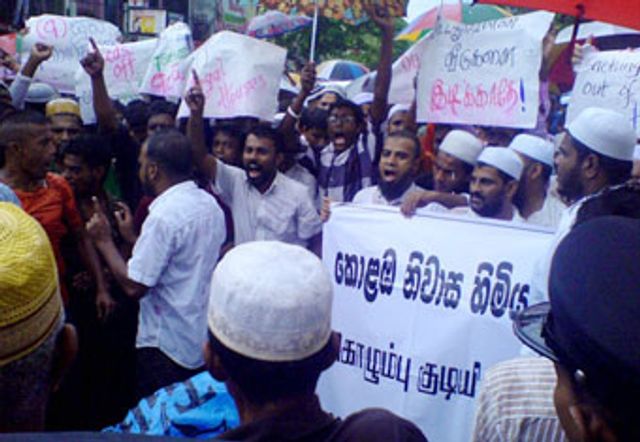
Over 580 poor families evicted in 2013 from Slave Island in central Colombo to make way for a multi-million dollar property development now confront a hopeless situation. After being promised rental money until they were provided with new residences, the shanty dwellers are not receiving adequate payments. Nor will they be provided with new homes.
The former government of President Mahinda Rajapakse evicted the families in 2013 and cleared 2.4 hectares of land as part of its plans to convert Colombo City into a South Asian commercial hub for international investors and tourists. The project involved Tata, the giant Indian corporation, which planned to build luxury condominiums with an estimated value of $US429.5 million.
Under its agreement with the Rajapakse government and the Urban Development Authority (UDA), Tata promised to provide 650 permanent homes for the displaced inner-city families in a four apartment towers. The company also agreed to pay 15,000 rupees ($112) per month for each displaced family to rent a house of 400 square feet for a period of 30 months.
Most of the families received about 15,000 rupees per month for 15 months, but the payments have stopped. A senior UDA official recently told theBusiness Times that Tata’s money was only sufficient for less than 15 months and the UDA had no funds to pay the evicted families. Moreover, no work has started on the promised apartment towers.
Slave Island residents protesting evictions in 2010
The current minority government of President Maithripala Sirisena has suspended the project until it reviews the original agreement between the Rajapakse administration and Tata, claiming that there was financial mishandling by corrupt officials.
On March 9, Finance Minister Ravi Karunanayake told the South China Morning Post that the government was “examining a housing project by Indian conglomerate Tata. Tata came in and said they will put in $250 million, but they put in $20 million, use our land, and sell it back to us for a higher price.”
Tata has rejected these allegations and warned that “arbitrary actions” will adversely impact on future international investments in Sri Lanka.
Under the Rajapakse government’s plans, the UDA and the Land Reclamation and Development Board were taken over by the defence ministry, controlled by its secretary Gotabhaya Rajapakse, one of the president’s brothers. The defence ministry bogusly declared: “The primary goal of the project is to uplift the living standards of the people in the area and providing them a better living environment.”
The Rajapakse government aimed to remove more than 135,000 poor families from Colombo City. Thousands of families have been evicted from Slave Island, Dematagoda, Appalwatta and Ibbawatta during the past six years. The defence ministry mobilised the security forces to intimidate anyone opposing the evictions.
Most of those evicted have not been provided with permanent homes. Some have been forced to accept wooden huts without water and sanitation in the Nagalagam Street camp at Totalanga and in Weligodawatta. Several hundred families were provided with tiny flats of 400 square feet, for which they were forced to pay 100,000 rupees and then 3,900 rupees per month.
Several people who were driven out of Slave Island recently spoke to the WSWS about the conditions they now confront.
Irfan, a three-wheel taxi driver said: “The former government must take the entire responsibility for our current predicament. In the public consultation meeting held before we were evicted, the former Defense Secretary Gotabhaya Rajapakse threatened us and so most of us were compelled to agree with the plan.
“I now live in Makola, a 23-kilometre drive from here. To do my job I have to be here by 8 or 9 a.m. and work till midnight. Since we don’t have an address here, I can’t put my child into a school in Colombo. We don’t want to put him into a school in Makola either because we are waiting to return to Colombo as soon as possible.”
Another three-wheel taxi driver said: “For now we have no other option but going behind [President] Maithripala’s new government. Let’s see until his 100-day program ends. If nothing comes out of it, we’ll all go and re-occupy the land.”
Another resident explained: “We know all about the problems in the multi-storey homes built for Wanathamulla and Dematagoda residents. Generally there are six to seven people in our homes. How can we even keep a coffin in a tiny house like that? There’s no space to keep household animals, like hens and goats, which provided essential food supplements to our households. We can’t afford to buy eggs and fresh milk.”
President Sirisena was a cabinet minister in the Rajapakse government and fully supported the evictions. The original plan to remove city dwellers was prepared during the 1980s by the then United National Party government. While posturing as opponents of the Rajapakse government and its brutal urban development measures, the UNP diverted the attempts of the inner-city poor to stop the evictions into various legal appeals.
When Slave Island families refused to vacate their homes, UNP parliamentarian and lawyer Sujeewa Senasinghe persuaded them to file a petition in the Supreme Court. In September 2013, the then Chief Justice Mohan Peiris declared: “[N]o one should obstruct ongoing development programs in Colombo.” Senasinghe and the UNP told the residents to submit to the court decision.
No evicted worker or poor family should expect any favourable outcome to their plight from the current government. Sirisena’s promised 100-day reform program has ended without any improvement in the conditions of life for workers and the poor.
The UNP exploited the popular hostility to Rajapakse, including among those evicted from their homes, hypocritically promoting Sirisena during the presidential election. After taking office, Sirisena appointed a committee of ministers to investigate the plight of the evicted families. This is nothing more than a cynical attempt by Sirisena and his UNP-led government to buy time before the approaching general election.
Like the former Rajapakse government, the Sirisena-UNP regime is increasingly concerned by falling foreign investment as the economic crisis deepens internationally. Whoever comes to power in the next election, they will continue to ruthlessly impose the pro-investor policies and economic measures demanded by the International Monetary Fund and the World Bank.

Unifor bows to latest GM Canada layoffs

Carl Bronski

General Motors (GM) announced late last month that it will end production of the Chevrolet Camaro sports car at its Oshawa, Ontario, assembly plant this November, axing 1,000 more jobs from its operations in that city.
Production of the Camaro will be moved to GM’s assembly facility in Lansing, Michigan. The downsizing in Oshawa will reduce GM’s total production workforce in the city that has historically been the center of GM Canada to just 2,600. As late as 2007, there were over 10,000 autoworkers employed by GM in Oshawa.
The reduction of three shifts to two at the “flex” assembly plant as a result of the relocation of Camaro production is clearly part of a drive to extort further massive concessions from GM’s Canadian workforce. No new product lines have been announced for either of the two Oshawa plants after 2016, which threatens the jobs of many of the remaining workers. And GM has said it will determine its future plans for the Oshawa plants only after the 2016 contract negotiations.
GM’s plans to end the Camaro line have-long been known by the workers and the Unifor union officialdom that purports to represent them. But rather than mobilize auto workers in a militant fight against the destruction of yet more auto jobs, the union, along with the Ontario Liberal government, have spent the past two years imploring their “partners” at GM for a model to replace the lost production.
Terms of the 2009 $10.8 billion federal and Ontario government bailout of GM and Chrysler stipulated that the companies meet loose domestic production quotas until 2016. With the imminent expiration of that agreement, more production previously located in Canada is expected to move to Mexico and the United States.
For decades now, the unions have responded to the efforts of the automakers and other transnationals to pit workers against each other in a race to the bottom by promoting rabid nationalism and imposing concessions. Unifor (the former Canadian Auto Workers union, or CAW), like the US-based United Auto Workers (UAW), has joined with management time and again in demanding workers make their own particular plants more “competitive,” i.e. accept speed-up and job, wage and benefit cuts.
Indeed the birth of the CAW in 1985 sprang directly from the promulgation of a nationalist program that divided North American workers and gave a huge opening for the Big Three auto companies to begin their practice of “whip-sawing” contracts and jobs back and forth across the Canada-US border.
Unifor’s refusal to lift a finger to fight the Oshawa job cuts should come as no surprise to the thousands of Unifor members who have lost their jobs as a result of plant closures and down-sizing. In a watershed dispute in 2012, the CAW refused to mobilize its extensive province-wide membership in strike action against the closure of the giant Caterpillar plant in London, Ontario, and urged workers there to accept severance packages.
In 2010, the last GM plant closed in Windsor, Ontario. When the announcement of the closure was made in 2008, then union head Buzz Hargrove blustered about strike action to an angry membership whilst quietly moving into discussions with the company for an “orderly shutdown.”
When auto parts plants throughout southern Ontario were closed in the wake of the 2008-2009 economic crisis, CAW officials played an active role in disbanding several plant occupations launched by militant workers. And GM workers in Oshawa will remember the antics of the CAW leadership in 2008 at the soon to be moth-balled truck plant. As workers marched through the city seething with outrage, CAW president Buzz Hargrove counselled against action on the shop floor, instead diverting the anger of the membership into a short-lived photo-op “blockade” of GM headquarters.
What has been the union’s response to the threat of unemployment that now hangs over the heads of their remaining Oshawa membership?
First, Unifor president Jerry Dias and Oshawa Local 222 chief Ron Svajlenko have made it clear that no fight will be undertaken to defend jobs. Instead, they have touted the fact that 2,100 out of the current 3,600-strong Oshawa workforce are eligible for retirement. This comes as little solace to the many workers who may still face the axe, as it is not yet clear how many employees will accept a pensioning-off under conditions where early-retirement would significantly reduce their annual income.
Secondly, the temporary preponderance of veteran workers in the plant is cynically viewed as something of a boon by the union bureaucracy. With over 2,000 workers eligible to take retirement, Unifor has been anxious to point out to management that in the event of a mass exodus from the plants by veteran workers, GM will be able to reap benefits from a two-tier contract system already in operation in the Detroit Three auto plants, under which new hires and workers with low seniority are paid far less in wages and benefits than older workers.
As Dias excitedly told reporters, “If those workers retire, they can be replaced by newly-hired employees who start at $20.50 per hour and whose wages won’t rise to the full seniority level of $34 an hour until they have been there for 10 years.”
In a bid to prepare the ground for further concessions to the auto bosses in the 2016 contract negotiations, several Unifor officials, speaking on condition of anonymity, told the Globe and Mail that ending a “hybrid” pension program for all hourly-paid new hires would be the best way to convince GM to invest in its facilities in Oshawa and St. Catharines, Ontario. Should this concession, which would put an end to even a semblance of a guaranteed “defined” annual pension payment, be granted to GM, it is all but certain Unifor would accept that a similar provision be included in the upcoming contracts with Ford and Fiat-Chrysler.
The pro-company stance the union takes in the auto plants dovetails with its pro-big business political perspective. The CAW/Unifor has developed intimate ties with the Liberal Party, the Canadian ruling class’s preferred party of government for most of the 20th century. In the 2006 federal election, then-CAW President Buzz Hargrove campaigned for Paul Martin, who as finance minister had imposed the greatest social spending cuts in Canadian history. In 2011, then-CAW President Ken Lewenza campaigned alongside the Ontario Liberals, extolling their role in the 2009 bailout of the auto bosses.
Dias has taken up where his former colleagues left off. He stumped in last June’s provincial election for an Ontario Liberal government that, with the backing of the trade union-supported New Democratic Party, has imposed sweeping social spending cuts. In 2015, Unifor has declared its central objective to be the electoral defeat of Stephen Harper and his federal Conservative government. Toward this end, Unifor will support sitting New Democratic Party Members of Parliament, while backing Liberal candidates in the lion’s share of the other 240 constituencies.
Only last week, Dias extolled a speech made by federal Liberal Party leader Justin Trudeau at a meeting of the International Association of Fire Fighters. Trudeau, who leads a party with a record of austerity and militarism similar to that of the Conservatives, values the unions for their role in containing and smothering workers’ struggles and, therefore, takes exception to some of Harper’s union-baiting.
No doubt straining the credulity of hundreds of thousands of workers who have seen their wages, working conditions and jobs cut by Conservative, Liberal and New Democratic Party governments, Trudeau lavished praise on the pro-company unions as “one of the few remaining forces that fight effectively for the fair wages that Canada’s middle class needs to make the economy grow.”
Trudeau’s remarks left Dias ecstatic. “We will be absolutely supporting the Liberals in key ridings, no question about it,” he gushed. “What the Liberals need to do—and, by the sounds of it, what they have just done—is they need to show a strong support for the labour movement in Canada.”
Fewer and fewer workers are fooled today by the bluster of their erstwhile union leaders. But to find a way forward, workers must break politically and organizationally from the unions and the New Democratic Party and Liberals and build new organs of class struggle—above all a mass workers party committed to resolving the capitalist crisis at the expense of big business through the socialist reorganization of socioeconomic life.

Polish presidential election expresses growing hostility towards Russia

Markus Salzmann

The first round of Poland’s presidential election takes place tomorrow. The favourite is the incumbent, Brunoslav Komorovski from the conservative Citizens’ Platform (PO), which is also the party of Prime Minister Eva Kopacz. His most significant challenger is Andrzej Duda from the nationalist and populist Law and Justice Party (PiS).
In February, Komorovski was considered invincible. However, since then his poll ratings have sunk dramatically. It is anticipated that a run-off will take place on May 24. The latest polls predict Komorovski with 40 percent of the vote and Duda with 30 percent. Nonetheless, presidential elections in Poland have frequently produced surprising results.
Although power in Poland rests with the government elected by parliament, the president has considerable authority. The president is supreme commander of the armed forces and, together with the foreign ministry, determines the country’s foreign and defence policy. In addition, he appoints the head of the central bank and can reject draft laws submitted by the government. President Lech Kaczynski (PiS) blocked a number of important laws of the government led by former Prime Minister Donald Tusk (PO) between 2007 and 2010.
The presidential election is also seen as a trial run for the parliamentary elections due in October.
The campaign has been characterised by agitation against Russia and the promotion of a military build-up. It focused almost exclusively on the question of who could best defend Poland against Putin. On this question, the two leading candidates barely have any differences.
Komorovski, the scion of a Polish noble family and a practicing Catholic, maintains close contacts within the army. He introduced a multi-billion rearmament programme with the government three weeks ago.
Billions are to be spent on US Patriot missiles and 70 French Caracal helicopters by 2022. The cost of the helicopters has been estimated at €4 billion, and the air defence missiles at €6.5 billion. Komorovski already proposed the establishment of a Polish missile defence shield in 2011. It is to be part of NATO’s defence systems, and in emergency situations could be equipped with Patriot missiles from other European countries, which could be in Poland within 48 hours.
Along with the Baltic republics, Poland is among the most outspoken aggressors towards Moscow within the European Union. In this it has not only sought to outdo Berlin, but also Washington. As former Prime Minister Donald Tusk, who is now president of the European Council in Brussels, declared last year that, in the confrontation with Russia, Poland was “always a step ahead of the EU and a half step ahead of the US.”
Komorovski recently indicated his support for the formation of a joint Polish-Lithuanian-Ukrainian army unit, the command of which is stationed in Lublin, Poland. It is to be composed of 4,500 men and be ready for deployment in 2017. The brigade is to take part in international operations and, as Komorovski explicitly declared, support Ukraine in its conflict with Russia.
The cost of the massive military build-up will be borne by the Polish population. After the election, Komorovski and the PO government intend to pursue the reform of the Polish coal industry. The coal concern Weglowa already announced plans in January to close four of 15 coalmines and eliminate 5,000 jobs. After two weeks of protests by miners, the Kopacz government temporarily postponed the coal industry reform.
Wide-ranging reforms of the pension and health care systems are also planned after the elections. There is a broad consensus between the PO and PiS on the issue.
The 42-year-old PiS candidate Duda was deputy justice minister in the government of Jaroslav Kaczynski. In addition, he was undersecretary at the chancellery of President Lech Kaczynski. The PiS, which has its base in poorer, strongly Catholic layers in rural areas and small towns, presents itself as being more socially concerned than the PO, which represents the elites in the larger cities and business. But Duda also supports social attacks and has announced a planned pension reform.
In their hostility to Russia, Duda and the PiS are attempting to outdo Komorovski. Former interior minister Ludwig Dorn, a founding PiS member, declared to the daily Gazeta Wyborcza that the abandonment of the 1997 NATO-Russia agreement was a strategic goal for his country. According to that deal, NATO promised not to station large military units any further east than Germany.
Of the 10 other candidates standing in the presidential election, only the rock musician Pavel Kukez is expected to obtain a double-digit result. He has mainly won support among younger voters with strong attacks on those at the top.
The other candidates demonstrate just how far the entire political spectrum in Poland has moved to the right.
Magdalena Ogorek is standing for the Democratic Left Alliance (SLD), which emerged from the former Stalinist state party and, through Alexander Kwaśniewski, held the presidency between 1995 and 2005. The nonaligned church historian puts forward a neo-liberal programme and demands lower taxes for businesses. On the issue of military rearmament, she has complained that too much equipment is being purchased from foreign firms and not from the domestic arms industry. She has around 3 or 4 percent support in the polls.

German court rejects claims of Kunduz victims

Verena Nees

Over five years after the terrible massacre in the Afghan city of Kunduz, perpetrated by the German armed forces, the compensation claims of the victims’ families have been rejected once again.
The higher regional court in Cologne rejected the compensation claims of two surviving relatives on April 30, 2015, following the first instance judgment by the Bonn regional court on December 11, 2013.
The complainants were farm worker Abdul Hannan, whose two sons, aged 8 and 12 years old, were killed in the bombardment, and the widow Qureisha Rauf, whose husband was also killed, leaving her with six children. All together they are seeking €90,000 compensation. Their legal representative, attorney Karim Popal from Bremen, announced that he would now go before the Federal Supreme Court.
On September 4, 2009, the armed forces commander in Kunduz, Colonel Georg Klein, ordered the bombardment of two tankers stuck in a river after they had been hijacked by the Taliban. Residents of the nearby village, including many women and children, had surrounded the tanker and were tapping it for fuel. Over a hundred people died a horrible death in the fiery inferno caused by the bombardment and many others were severely injured.
The event evoked horror worldwide. In Berlin, a frantic effort was made to absolve the military leadership of all responsibility and cover up the devastating extent of the catastrophe. Colonel Klein was not only exonerated by a parliamentary investigative committee and the federal prosecutor, but also promoted to brigadier general by Thomas De Maizière, who was defense minister at the time.
Some of the Afghan families who lost relatives in the bombardment received a lump payment of US$5,000 (€4,470) each shortly thereafter. However, the government has stubbornly refused to admit to the responsibility of the German military leadership for the catastrophe.
To this day, the army high command refuses to reveal how many people were killed, as Popal complained in a press release in March. The armed forces and the defense ministry both claim they do not know how many victims there were. Other sources estimate 139 victims and NATO assumes there were 140. Most of the victims were children whose ages are recorded in available lists. “The Bundeswehr disputes the number of victims with the aim of washing its bloody hands of all guilt,” Popal said.
The Cologne Regional High Court justified its decision with the same arguments as the court of the first instance in Bonn. They denied that armed forces commander Klein was guilty of a “breach of duty by a public servant.” According to the court, Klein made use of all available sources of information before he concluded that there were no civilians present at the targeted location. The court said that he checked with an informant multiple times.
There was also alleged intelligence indicating a possible Taliban attack. According to the court, this implied that there were no grounds for an accusation of a breach of international humanitarian law invoked by the complainants, which calls for the protection of the civilian population. They also therefore had no right to compensation, the court argued.
“It was clear to see that the proceedings anticipated the evaluation of evidence. The Regional High Court made no effort to find a solution,” read the press release from Popal’s office on April 27. The attorney commented on the reference of the court to an informant and to intelligence agency indications of a possible Taliban attack: “The accused … is not in a position to publish the name of the contact person and the actual indications [of Taliban involvement]. It is still unknown today who this contact person was and nothing was reported on this in the jurisdiction either.”
This once again poses the question to what extent the intelligence agencies, army high command and political agencies were entangled in the events in Kunduz.
The rulings in both the first and second instances are also dubious from a legal standpoint. Compensation claims call for a civil court procedure, not criminal proceedings, as the emphasis of the attorney and the other jurists would suggest. The test of a compensation claim is not connected to whether there was criminal intent or a “culpable” breach of duty by a public servant. What is relevant are the facts of the case regarding “negligent breach by a public servant of his duty,” or, as Frankfurt international criminal law expert Denis Basak wrote, an “objective breach of duty.”
According to Basak, the court in Bonn should have carried out a more careful investigation on a number of points. According to Colonel Klein’s deliberately falsified report to the US flight control center, there was “enemy contact” between German soldiers and the Taliban, which he then used to justify airstrikes. He also refused to use a low flying plane to warn civilians, as the pilots of the NATO fighter jets had repeatedly requested. And finally, there was no explanation why Klein based himself on the claims of a single informant who was never at the location.
Both courts rejected such an investigation and consideration of the evidence, as well as an examination of witnesses of ISAF commander Stanley McChristal or Colonel Klein, as the complainants had requested.
Political factors are involved in the judgment. A judgment that the armed forces were obligated to pay compensation would set a precedent for future civilian victims of German military campaigns. From the point of view of the German government, this must be avoided as it prepares to engage in additional, even bloodier wars.
The massacre in 2009 was the baptism by fire of a reemerging German militarism. While official politics was still making an effort at that time to present Germany as a “peace power” and to portray the engagement in Afghanistan as a “peace mission,” it has since then carried out extensive preparations for its reemergence as a war power.
One month after the first Kunduz compensation judgment at the end of 2013, Foreign Minister Frank-Walter Steinmeier and Defense Minister Ursula von der Leyen announced the “end of military restraint” at the Munich Security Conference. Germany was “too big just to comment on foreign policy from the sidelines” and had to “be prepared to intervene earlier, more decisively and more substantially in foreign and security policy.” In Ukraine, this policy has been put into practice. Washington and Berlin have supported a right-wing putsch in Kiev and have since then continued to provoke a confrontation with Russia.
With the help of war propaganda in the media, the government and the military leadership are working systematically to build up the armed forces and train them for war in Russia and other regions of the world. This makes clear that Kunduz was only the first step in preparing the population for future military crimes.

Syriza government endorses “war on terror” to divert opposition to austerity

Kumaran Ira

Greece’s Syriza-led government is endorsing the US-led “war on terror” and promoting militarism to divert rising social opposition to its sweeping austerity policies.
At a conference on defence and security organised by the American-Hellenic Chamber of Commerce in Athens on Tuesday, Syriza’s defence Minister and leader of the far-right Independent Greeks (Anel), Panos Kammenos, said Greece would allow NATO to use its military bases for wars in the Middle East.
Kammenos declared, “Greece is ready to undertake this initiative in NATO’s southern sector.” He added that Greece would allow the use of its “facilities, our armed forces and large bases in the region of the southern Aegean, to facilitate the forces of the alliance in the war against terrorism.”
Kammenos’ comment underscores the reactionary character of the Syriza-led government. Since it came to power in January, having campaigned on promises to end austerity, it has repudiated its promises and intensified draconian austerity measures demanded by the troika—the European Union (EU), European Central Bank (ECB) and International Monetary Fund (IMF).
Now Syriza’s austerity policies are accompanied by its support for reactionary wars conducted by the US and its European allies in the Middle East.
Commenting on Kammenos’ statement of support for US-NATO wars,Kathimerini wrote, “With the stances of Prime Minister Alexis Tsipras and Foreign Minister Nikos Kotzias notably different to those set out by Kammenos yesterday, government sources expressed concern over the defence minister’s comments. Diplomatic sources appeared troubled by the fact that matters of strategic importance were being broached at a conference.”
In fact, the differences inside the Syriza-Anel coalition government on the escalation of imperialist wars in the Middle East are of a purely tactical character, over how quickly and how openly to adopt a pro-war posture. Both Syriza and Anel are committed, however, to supporting US-led wars and the broader geo-strategic interests of the imperialist powers of NATO.
Soon after taking office, Tsipras made clear his support for NATO foreign policy by declining to veto EU financial sanctions against Russia over the conflict in Ukraine. Instead, Syriza voted to escalate EU sanctions against Russia as the US and NATO threatened war with Moscow. Tsipras’ support for NATO provocations against Russia was of a piece, however, with his broad support for the foreign policy of the leading imperialist powers.
Before the election campaign, during Tsipras’ meeting with officials in the major imperialist countries, Tsipras repeatedly made clear that Syriza would not jeopardise NATO policies if it were elected.
During his visit to Washington in 2013 for meetings at the Brookings Institution think tank, the New York Times published an article titled “Only SYRIZA Can Save Greece.” The article, which bore the byline of future Greek Finance Minister Yanis Varoufakis, pledged Syriza’s loyalty to NATO and to US imperialism. If Syriza took office, it said, “nothing vital would change for the United States. Syriza doesn’t intend to leave NATO or close American military bases.”
The Times also praised Syriza’s proposal to restructure Greek debt as a good thing for Greece’s creditors, writing: “Banks and hedge funds know that most Greek debt is held by European taxpayers and by the European Central Bank, and what’s left is being snapped up by investors because they know it will be paid.”
Syriza’s election victory has exposed its reactionary political agenda as a party of austerity and war. As it prepares deeply unpopular measures, including further cuts to wages, pensions, and social spending and privatising state-owned companies, Syriza is considering using military force and supporting imperialist war to divert rising social tension into reactionary channels.
The Syriza-led government is signaling a more aggressive military posture as it plans sweeping austerity measures demanded by the troika.
In order to obtain a further €7.2 billion loan from the troika, Syriza is preparing to provide detailed social cuts, including to pensions and health care and structural reforms. These reforms include reactionary changes to labour laws, layoffs in the public sector, and the privatisation of state-owned companies.
Greek Deputy Prime Minister Yannis Dragasakis, who oversees the Syriza government’s economic policy, said he was optimistic on talks with the troika and hoped to strike an agreement with it at the eurozone finance ministers meeting on May 11.
He told Britain’s Guardian newspaper: “I hope on Monday a sign of progress will be given and [they say] an agreement is visible. Talks, so far, have shown there is common ground in changes and political measures and, therefore, I believe a deal is possible and in the interests of everyone.”
On Wednesday, during a telephone conversation, Tsipras discussed pension and labour reform measures with European Commission President Jean-Claude Juncker. According to their joint statement, “They registered the progress that has been made in the recent days between Greece and its partners on the issue of the detailed package of reforms in order for the evaluation to be completed successfully.”
Amid increasing pressure for Greece to make further cuts and repay its creditors, the financial press reported that the Syriza government is already repaying its loans by increasing taxes and reducing social spending. Syriza is thus proving to be a more convenient tool for the financial elites to impoverish the working class and loot Greece.
Recently, the government ordered state entities, including pension funds, local authorities, hospitals and universities, to hand over their cash reserves to the central bank to pay off the EU. On Wednesday, the government paid the IMF €200 million and it is preparing to pay €700 million on May 12.
Greece must find more than €10 billion for its creditors before the end of August, according to BNP Paribas.
On May 6, the Financial Times wrote, “despite many predictions the country should have gone bust by now, the Syriza-led government has managed to scrape together enough funds to pay its creditors… Not only have tax receipts crept back up to where they’re almost at last year’s levels (and pre-crisis estimates) for the first quarter of the year, but spending has been slashed to where the government has paid out €1.5bn less than anticipated.”
Without any public discussion, Syriza is finding the money to pay off its creditors by systematically starving critical social infrastructure of funding. The Financial Times explained, “Healthcare spending in particular has taken a hit. A line item for ‘cover of hospital deficit’, for example, has seen only €43m in spending thus far, while it will eventually cost the government €1.1bn this year. Investment spending, budgeted at €6.4bn, has only seen €542m in payouts.”

April employment report masks extent of US jobs crisis

Gabriel Black

The US economy added 223,000 jobs in April, according to figures released Friday by the Labor Department. The official unemployment rate dropped to 5.4 percent, the lowest since May 2008.
In an online statement following the release of the figures, the Obama administration praised the report as a reflection of an “ongoing recovery” showing “substantial progress” in the economy. News commentators echoed this line, saying that the report constituted evidence of an economic turnaround.
Speaking at Nike headquarters in Oregon, Obama declared that “obviously” his policies have not “done too bad in terms of employment in this country. I just thought I’d mention that. Since there were a lot of predictions of doom and gloom.”
In reality, the jobs report looks good only in contrast to the dismal performance of recent months. The US economy added only 85,000 jobs in March, according to newly-revised figures released alongside the April statistics.
Stock analysts have called the April jobs figures announcement a “Goldilocks” report: generally positive, but not good enough to encourage the Federal Reserve to raise interest rates more rapidly, which would tend to lower stock values. Ryan Larson of RBC Global Asset Management told CNBC that the jobs report was “Probably [the] best scenario in which the market was hoping for growth but not [so strong] that the Fed needs to hike in June.” Stocks responded to the report with a rally.
Wages rose by 0.1 percent in April compared to March, below economists’ expectations, and were up by only 2.2 percent over the past year, according to the Labor Department report.
The industries that added jobs in April disproportionately pay low wages, and provide temporary and part-time work. As a CNBC headline put it, “Bad job news, good stock news.”
While only 1,000 jobs were added in the higher-paying manufacturing sector in April, a total of 182,000 jobs were added in the service sector. Administrative and waste services, a category that includes janitorial, cleaning staff, and temporary workers, added 41,300 jobs.
Food service and drinking venues added 26,000 jobs. The average wage in this sector is $11.39, with employees working an average workweek of 24.8 hours. Other industries that added jobs included transportation and warehousing, with 15,200 jobs added; hospitals, with 11,800 jobs; social assistance, with 10,400 jobs; and nursing and residential care facilities, with 8,100.
According to the National Employment Law Project (NELP), in the first four years of the “recovery,” low-wage jobs accounted for 44 percent of job growth. However, low-wage jobs were only 22 percent of the jobs lost in the recession.
While the official unemployment rate fell to 5.4 percent, this figure excludes the millions of people who are not counted as unemployed because they have simply given up on the prospect of finding a job. According to the Economic Policy Institute, there are 3.14 million such workers, and if they were counted in the official unemployment rate, it would stand at 7.3 percent.
The latest jobs figures follow a string of mass layoffs. Dow Chemical announced last Monday that it would cut up to 1,750 jobs to save costs. First Data, a tech finance company stationed in Omaha, Nebraska, this month said it would be laying off several thousand people globally in the coming months.
In April, Bell Helicopter announced 1,100 layoffs at its facility in Lafayette, Indiana. The Pennsylvania-based software developer Unisys also announced plans to slash 8 percent of its global workforce, including 1,800 workers in North America. On April 24, pharmaceutical giant Procter & Gamble announced it would cut 6,000 office jobs worldwide. The company has eliminated 20,000 office and manufacturing jobs since 2012.
During his appearance at Nike headquarters Friday, Obama credited his administration’s policies for having set up an economic turnaround, declaring “thanks to the hard work of the American people and entrepreneurs like the ones who are here today—and some pretty good policies from my administration—we’re in a different place today.”
In fact, The Obama Administration’s policies have been aimed at reviving US manufacturing on the basis of a significant reduction of workers’ wages. As a result of these policies, the National Employment Law Project concluded in 2014 that “While the manufacturing sector has grown in recent years, wages are lower, the jobs are increasingly temporary, and the promised benefits have yet to be realized.”