13 May 2015

Africa: The Next Frontier For Mobile Technology

Sophia Bekele


Just to say few words about my journey from Africa, I am from Ethiopia. I was no exception in seeking the success of the “America dream” as it is often said. I have achieved that dream - through education, working in Corporate America, house in a nice suburb, and all the blings you can think about, (I know Berkeley is not into blings, you all graduate to Save the World;). In any case, before I complete the family and two dogs kinda thing, (which I dodged those bullets, looking back) Africa called for me – so then my priorities got refocused - I also tried to save the world with a vision calledbridging the digital divide - and I was there. The rest is history, and I tell you, my experience has been one Epic adventure to another.
My companies and I are very proud to be part of the African history of building the information society and the Super highway (called the internet), getting involved in building capacity, policy development, and empowerment of youth and women in Africa, for that matter, and we are still there.It is never easy, but the struggle continues, as progressives would say.
To summarize briefly these contributions by way of lessons learned  on how we did it in Africa, - the key is “participation.” When I started my first business right here in Walnut Creek, CA in the early 2000 for e.g., I positioned the start up to participate in “International bids” to deliver services in Africa and we found that we were winning bids on technology delivery services, and end up to being the first to introduce and successfully commission (not all projects get finished in Africa trust me ) a fiber optic based integrated Information Infrastructure setting up Campus wide Network for governmental Clients in my country with internet and intranet and all communication capabilities.
Most of these projects have far ranging implications as there were large scale in nature, and were set up to connect regional organization in Africa. Obviously one needs a solid field support to perform well on the ground, you can’t do it alone, so I also set up an affiliate local company to provide the required support and field services and also invested in another that was already doing basic education and training services for capacity building and we built a client base from there.
My own father who was a very successful entrepreneur in his own right, was always surprised how I used to “pull this off” as he used to say to me, particularly as a woman you can imagine in a male dominated business sector. It was through sheer vision, ambition, strong work ethics, of course, also the very disruptive power of the Internet allowing young people and new comers like us to compete fairly with established businesses.
After such works, we were pioneers in introducing many innovations including the DNS business, building web sites, registering domains and providing hosting services etc, which seem trivial now but very innovative and powerful business model at the time and very useful to the beneficiary organizations.
The next impact we made was of course our very famous “Yes2dotafrica” global awareness campaign (also in the DNS business), with an aim to brand Africa on the internet by registering a pan-African “.africa” domain name. Obviously this opportunity also came via participation in the organization that issues the license for it, called ICAN, a California based company. I was appointed as a policy advisor to ICANN when I came across this opportunity and asked what can I do for Africa? And thought I should bring this domain to Africa. I then anchored our campaign on 3 KEY principles. To brand Africa on the internet with the various products and services; to host the infrastructure & services in Africa so as to build capacity, as well as encourage Africans to purchase .africa domain and pay an African company instead of the current .com companies in US, so as to fight capital flight; and finally to utilize the partial profits we get to apply it to projects of social responsibility.
Looking back nearly 5-6 years ago, our “the first mover advantage” for our campaign and what we observed to be next powerful communication tool on the internet was Social Media. The power ofb social media allowed us early success to market entry especially before we got investors interested to fund our project.
We were also pioneers in creating the first ever multi-lingual social media campaign, English, French and Arabic in term of reaching targeting audience. It was very effective and also powerful in making that very emotional connection with our audience in their spoken languages. It was all too rewarding a work not to appreciate.
Currently, we are developing our presence on new media platforms such as digital TV and collaborating with established pan-African digital partners to provide African based content as well as working on mobile apps to use our current platform dotafrica.mobi as a one stop pan Africa product or service. The next frontier as rightfully identified is Mobile technology.
Finally, Social Entrepreneurship has always been important to me personally, since I started my entrepreneurship, therefore, we have therefore successfully launched an education program for youth and girls now, which we recently consolidated under a DCA Academy, to provide digital opportunities and empowerment.
Now that is on our work - What I think is the Next Frontier For Mobile Technology is as follows:
Mobile Technology - comes at an opportune time when Africa is NOT only seen as the most promising continent, in terms of internet technology but also business. Early this year, when we published our company’s 2015 New Year’s newsletter, we titled it “The year of Creative Disruption”, and made several technological predictions such as smart phones to read minds; cognitive computing; blackphone rollout, digital wearables, Streaming, Cloud Security etc.
How many have heard the recent news in Google changing its algorithm for the search engines to favoring mobile friendly websites I knew of it because my people within the 24 hrs of hearing the announcement changed all digital sites we own to comply with this new algorithm and sent me the list.
This is now survival of the fetus. Sink or swim Go Mobile or GO nowhere. Therefore, you can be sure that Web designers now think about how you’ll experience a site on a phone or tablet before they think about how you’ll see it on a desktop. So the future of what I call “Digital Opportunities” is definitely defined by Mobile technologies.
So, if we look to some statistics since the first cellphone call was made 42 years ago (did not know that myself), where are we likely to be headed next globally? The annual growth rate for data traffic, i.e. (volume of data passing through the networks) is a stunning 50% year on year, with a quarter of that demand being for video. Data speeds are on the rise and in demand. Just in past two years we have moved from 3G data rates to 4G 1.5 Mbps to 2.3 Mbps, and expected to reach 4.0 mbps by 2019 (4yrs). This is good for business and so helps boost a country’s GDP (Deloitte. Also by 2019, more than half of all devices connected to the mobile network will be on “smart” devices. The Middle East and Africa are expected to experience this mobile data traffic growth of any region followed by Central and Eastern Europe and Latin America.

To your key questions, relating to Africa - What will the Continent look like in 10 years? How will the adoption of the mobile and Internet transform how business is done?
Mobiles have already made many headlines in Africa playing key role— in education, health, entertainment and politics. But, part of the mobile telecoms revolution is also about building sustainable business models from the provision of services. From the business stand point, creating disruptive business models that will break monopolies through innovative solutions, forms the last mile access point for the users and this is where opportunities lie. It is said, 40% of adults in Africa have a cellphone and the number grows every year. Millions are also converting to smartphones. Africans are already more accustomed to paying with their cellphones than many Americans. In US, our phones are hardwired into our daily lives. Global statistic says; People look at their mobile phones an average of one hundred times every day. But even more so for Africans.
So what are some of innovative “business” models that are working in Africa?
Kenya has been the leader so far in this industry. Kenya’s Equity Bank was the first in the world to offer a completely mobile bank account. One of the best examples (work of a Genius) is the African Mobile money [Mpesa] launched by Safaricom Kenya, with over 18,000 M-Pesa agents in 3 Year launch vs 1,400 traditional banking locations (branches, ATMs, etc.) I recently read the new version of this product is underway (M-Pesa G-2′ platform) as Safaricom refers to it, a huge deal for the Kenya’s mobile money ecosystem. It would be locally hosted infrastructure (I think they are copying our .africa model – By the way, Safaricom is our technology partner in hosting services;), double or triple transactional speed and API capability allowing virtually infinite interface with any new software, making it very ‘future-friendly’. They also announced immediately after that they will be going after 19 African countries in partnership with MTN, which was news to me. Safaricom has always been proudly Kenya i.e. Kenya centric. But this is what happens when monopoles break via competition and this is an excellent example of such.
According to the recent report by “Flurry,” a mobile analytics vendor, Apps Usage Dominate Browser Usage across smart phones and tablet. Looking at some of the success stories in innovative app usage, that have known to solve local problems, which you may already know include, M-Health, iCow, billed as “the world’s first mobile phone cow calendar,” allows dairy farmers to track the gestation periods and progress of their cows. It makes use of SMS and voice services to do so,Weather apps such as FarmSupport, accessed through the Internet and mobile phones, and Crowdsourced apps to enable users manage crisis, information sharing, or fund raising.
Mobile Ads have naturally becomes the next frontier on mobiles, have attracted big US companies to invest in Africa, whereby they are fighting for the mobile ad money which makes part of the annual billions. If you are a marketing professional, you can no longer afford to ignore or leave out mobile advertising as a targeted and effective engagement platform. Global giants such as Visa and MasterCard have both been reported to have launched new mobile card services in Africa, eager to get a slice of the continent’s growing mobile payment industry.
There are various other New Frontiers for internet services complimentary to mobile.
According to Frost & Sullivan, the regions e-commerce market is estimated to reach $50 billion within the next three years, from just $8 billion in 2013, mainly due to a rapidly growth in mobile and Internet markets throughout the continent. - Jumia, Konga, OneMedia Africa are some of the early successes. DHL also expects 2015 to be a year of growth for the logistics industry on the African continent, largely driven by the e-commerce industry.
New Media (NM) is a collection of several platforms that exist in the internet space and as most of you may be familiar with these, it includes Vlogs or video blogs, Blogs, Social Media Platforms, Wiki’s. This is presents a new place of conversation for digital opportunities and as such can be harnessed to provide for not only social but also commercial benefits.
Let me start with the social benefits of NM which are obvious now: People are accessing and purchasing generated mobile data to connect to all social media platforms, as you can see NM also remains disruptive and comes with either a catalyzing or diminishing effect on key areas of our lives.
You all can recall the Arab Spring uprising which started in Africa where how millions were mobilized for, also to co-ordinate efforts in the fight against the most recently conquered Ebola. I know it was very useful to us when we run our “No campaigns”, when our opponents were detracting our progress in our popular “Yes Campaign.” As I mentioned before, NM also creates commercial opportunities for “startups” where marketing budget is limited and is the best platform to start and grow your community of readers and customers and what not.
Individuals are using NM to build personal brands to help them get jobs, sell their expertise and skills or to win fans. More and more African CEOs, Executives and Industry Leaders are becoming visible on social media, particularly Twitter, which makes networking easier than ever. - You don’t have to tell that to Mr. Oseyi. He already knows;) Musicians and actresses are also building huge social media followings and to monetize their work. In Presidential elections as we know it, President Obama has creatively used FaceBook to his advantage. In Nigeria, President Goodluck Jonathan, is said to have appointed (Co-Founder of Social Media Week Lagos), as his Senior Assistant, the first ever cabinet level appointment. Bottom-line is, one can make creative use of NM and develop relevant content that will rake in revenue from adverts or for building brands and or win community support via communicating your message. Either way the upside of NM is huge.
Other New Frontiers include Developing Local Content or Digital migration, as it is called, also, the gaming industry is also trending in Africa, green energy solutions are also getting popular providing solar enabled services to fuel the growth of also the mobile device, so there remains a huge energy gap that needs to be filled.
Finally, if I have to leave you with few thoughts for those who want to starting a new initiative?
Develop a good business model that focuses on the mobile device framework that can take advantage of all what we have talked about, But beyond consumer engagement, think also of ROI. New Media and Local content should be part of your ongoing communication as well as monetization strategy, Please mainstream women into your efforts. The gender gap is more pronounced in the developing world, where according to ITU, 16% fewer women than men use the Internet, compared with only 2% fewer women in developed world. What this means is, if you can create services that can be attractive to serve the gender gap, you can leverage these numbers to make revenue.In closing, the only personal advice I can give you is, by setting up this forum, your vision is already there.
Africa is the land of digital opportunity. However, Africa’s Digital Opportunity is also NOW. So “PARTICIPATE.”
From the perspective of Entrepreneurship and or any initiative you want to start, particularly in Africa “Think digital and Go digital.” And when the going gets tough, hustle harder, listen to PSquare’s “Testimony,” gives you perspective, he is a sort of a modern day Bob Marley for Africa. If you fall, stand up ---again and again. That is our history and this is how we will build Africa. At an individual level, let no one define you but you. This is very important and I promise you, you will know what I mean, when you get there. Because that is how you leave your personal legacy Believe in yourself - just because the majority says they are RIGHT does not mean you (on person) is WRONG. But you already know this in Berkeley ;)

12 May 2015

Iran Nuclear Talks

Patrick. T. Hiller

It is easy to be a cynic listening to some of the more nonsensical chatter coming out of Congress. Despite the most comprehensive international agreement between the United States and its P5+1 partners (the members of the UN Security Council and Germany) with Iran on its nuclear program, the calls to bomb Iran are still too loud for them to be dismissed. In a less publicized speech last week, informed leadership by Oregon’s Senator Jeff Merkley points to a simple yet powerful truth: diplomacy works. Merkley argued, without dismissing the absolute need to prevent an Iranian nuclear weapons program, that the most effective strategy to achieve this outcome is a verifiable, negotiated process. Almost simultaneously, 150 House Democrats wrote a letter supporting the administration’s negotiations over Iran’s nuclear program, urging the exhaustion of every avenue toward a verifiable, enforceable diplomatic solution in order to prevent a nuclear-armed Iran.
This is more than just Congressional politics and debate. We are experiencing a shift in the larger debate about the effectiveness of diplomacy versus war. We are more secure through diplomacy and negotiated agreements, because they are superior to military intervention and war. Therefore it is crucial that diplomatic efforts continue and that we disregard military options which are guaranteed failures in the short and long-term.
There is a poor track-record of military intervention to achieve the stated outcomes. Or to put it differently – wars don’t work. This is especially true for the more recent wars and military interventions in the Middle East. The voices still claiming success in the two major US-led Middle East wars are increasingly shrinking. The war in Afghanistan was an ill-conceived response to the criminal attack of September 11, 2001. The 2003 invasion of Iraq turned into the Iraq War. Astronomical costs, a violent insurgency, the rise of the self-proclaimed Islamic State, and immense casualties and suffering of civilians sum up the current situation.
Diplomats and negotiators are not acting in uncharted landscapes. There is a body of knowledge on why negotiation and other conflict resolution approaches are superior to military options. Negotiation is not a zero-sum game where one party wins at the expense of the other parties. The possible and expected outcomes are mutually acceptable agreements. In multilateral negotiations – in this case the P5 + 1 framework – the potential for more lasting agreements grows substantially, as more groups and interests are interdependent and have to be reconciled. Negotiation is a critical tool to restore and repair broken relationships as well as creating space for agreements in other areas. Whether we like it or not, Iran is a major player in the Middle East and beyond. Foreign policy issues around Syria, Iraq, Yemen, oil, or the Israeli-Palestinian conflict can only be addressed constructively when Iran is an involved participant in creating a path forward.
In a time where people and governments worldwide are calling for nuclear disarmament, there is an understandable fear of a nuclear-armed Iran. Some might argue that swift military air bombardment against Iran is the best option to achieve this goal. This is a purely political statement and out-of-touch with history and expertise of military leaders.  Adm. Mike Mullen (Ret.), former Chairman of the Joint Chiefs of Staff, wrote, “As of today, there is no more credible path of reducing the likelihood of Iran obtaining a nuclear weapon than this potential deal. Those who say the risks are too high with the current deal offer no constructive path forward save the high potential for war.” Due to absolute superiority of U.S. conventional military force, even the threat of military intervention would be an incentive for Iran to actually acquire nuclear weapons and create as much secrecy as possible around those efforts. The tone in Washington’s foreign policy and intelligence community has changed. Having personally sat through briefings with officials from the State Department, the intelligence community and other state agencies recently, I can attest that there was a strong consensus that any application of hard military power leads to uncertain and uncontrollable outcomes and that diplomacy and cooperation with partners was the preferred course of action.
The stakes in P5+1 and Iran nuclear negotiations are high. The only path forward is to seek negotiated agreements based on oversight and control. In doing so, we can prevent war and the inevitable human, social, economic and environmental costs. We can avoid putting American men and women in harm’s way, who then would cause harm to Iranian men, women and children – that’s the nature of war. The way we understand and constructively address global conflict and war now has changed. Senator Merkley has shown that he recognizes that negotiation and understanding its environment is the new realpolitik which makes us more secure. The media and the public have a responsibility to protect and emphasize such voices.

Jean-Michel Basquiat at the Art Gallery of Ontario: Graffiti, fame and the art market

Lee Parsons

Jean-Michel Basquiat: Now’s the Time, at the Art Gallery of Ontario, Toronto, through May 10, 2015
Featuring one of the more problematic figures of the past several decades, the current exhibition at the Art Gallery of Ontario (AGO) in Toronto, Jean-Michel Basquiat: Nows the Time, raises a number of questions about this artist and how he was and continues to be marketed—issues that are ultimately bound up with political and artistic difficulties of the period.
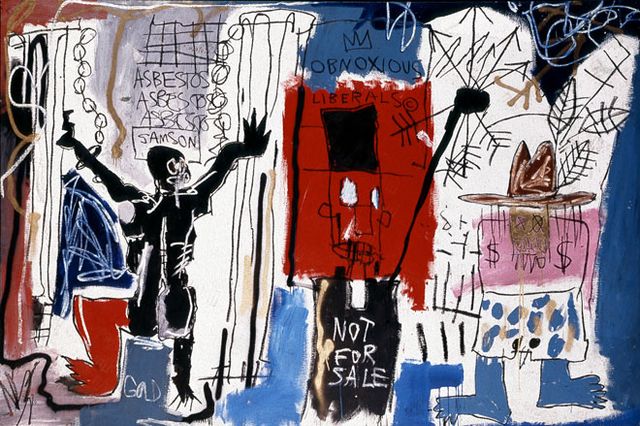
Jean-Michel Basquiat, Obnoxious Liberals, 1982 Acrylic, oilstick, and spray paint on canvas 172.72 x 259.08 cm The Eli and Edythe L. Broad Collection © Estate of Jean-Michel Basquiat (2014) Licensed by Artestar, New York
In the early 1980s, Basquiat became a cause célèbre on the international art scene. He first gained attention as a graffiti artist, distinguishing himself as a sort of sophisticated rebel, charming the New York art world, and famously developing an association with Andy Warhol, before dying of a drug overdose in 1988 at the age of only 27.
The story of his rise from street and graffiti artist to international art “star” virtually overnight, as well as his abrupt and tragic demise, caused a sensation that continues to generate considerable interest—and profit for some. In an increasingly parasitic economy, reflected in the stock market and real estate boom of the period, rapacious art speculators took a particular interest in Basquiat, who was well suited and, sadly, apparently willing to play the part of the latest darling of the art world elite.
Jean-Michel Basquiat, A Panel of Experts, 1982 Acrylic and oil paintstick and paper collage on canvas with exposed wood supports and twine 152.4 x 152.4 cm Montreal Museum of Fine Arts Gift of Ira Young © Estate of Jean-Michel Basquiat / SODRAC (2014) Licensed by Artestar, New York
The exhibition at the AGO, one of its mostly highly promoted events of the year, presents Basquiat’s work as ground-breaking, even historic. In this reviewer’s opinion, this claim is no more based today on the actual merits of Basquiat’s artwork, intriguing as some of it may be, than it was when his career was launched some 35 years ago.
The 88 drawings, paintings and sculpture that have been assembled from collections around the world, for what is billed as the first exhibition of Basquiat’s work in Canada, do reveal a talent, creativity and a lively wit—but it must be said that on balance, these elements do not add up, in his case, to a lasting artistic contribution.
His style is described variously as “primitive,” “naïve” or “neo-expressionist,” denoting a return to emotive, colorful artistic works in contrast to the dry, conceptualist and minimalist work that immediately came before it. Unquestionably, there is a vivacity to Basquiat’s efforts, but there is good reason to doubt the depth of his overall approach.
A typical drawing such as “Trains, boats, cars” (1981) convincingly imitates the skill level of a toddler, and while amusingly ironic, its crudity places in question the artist’s attitude both to the work and to the viewer. If the artist does not take his own work seriously, why should we?
The AGO show’s curators have divided the exhibit into nine categories, from “Street as Studio” to “Music, Concepts and words,” which draw seemingly arbitrary divisions but nevertheless illustrate the breadth of subject matter the artist grappled with. Most of the works are drawings in various media, as simple in their composition as in their style, with some notable exceptions of greater complexity such as “La Hara” (1981). More ambitious works such as that one exhibit a solid sense of color and design, but there is only so much that can be explored within this limited form.

Mixed blessings

Basquiat was born into a relatively comfortable home in the Park Slope neighborhood of Brooklyn, New York, the second of four children. His father, Gerard Basquiat, was a successful accountant, originally from Haiti, and his mother, Matilde Basquiat, was a cultured woman of African-Puerto Rican descent. From early on, it was clear the boy possessed an exceptional intelligence, speaking and writing in three languages, English, French and Spanish, by the age of four.
As a child, he was introduced by his mother to art. She took him regularly to museums and galleries, and even enrolled him at the Brooklyn Museum at age six. At the age of eight, he was badly injured when he was hit by a car while playing in the street and was hospitalized for over a month and had to have his spleen removed. One of his closest companions became an edition of Grays Anatomy, the well-known anatomy textbook, which encouraged an early interest in figurative drawing.
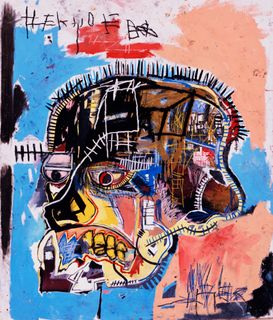
Jean-Michel Basquiat, Untitled, 1981 Acrylic and oilstick on canvas 244.48 x 182.88 cm The Eli and Edythe L. Broad Collection Photography credit: Douglas M. Parker Studio, Los Angeles © Estate of Jean-Michel Basquiat (2014) Licensed by Artestar, New York
That same year, his parents separated, and his mother thereafter was in and out of treatment for mental illness. The children were subsequently raised by their father, but friction soon developed between the young Basquiat and his father over attempts at discipline that reportedly included regular beatings. When Jean-Michel was 13, his father moved the family to Puerto Rico for a job, but within two years they were back in Brooklyn and familial tensions grew.
At the age of 15, Basquiat briefly attended Edward R. Murrow High School, a progressive institution, before transferring to the City-as-School in Manhattan, an alternative high school designed for gifted and talented children and based on John Dewey’s pedagogical theories. Despite this encouraging environment and largely due to his troubles at home, Basquiat quit school before graduating, left home, and stayed with friends for a time before moving in with his girlfriend, Alexis Adler.
The young artist maintained an interest in drawing and in cartoons in particular throughout his youth and, although he came to greatly admire graffiti artists like Keith Haring with whom he developed a life-long friendship, he did not see himself as part of the burgeoning graffiti culture in New York City in the late 1970s.

Fame and sensibility

Basquiat and his partner Al Diaz gained notoriety around this time for their ubiquitous graffiti under the tag SAMO that, among other things, stood for “same old shit.” In Haring’s words, Basquiat “wield[ed] his brush as a weapon,” distinguishing himself from other graffiti artists for his street poetry and sharp social commentary.
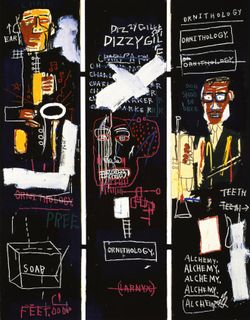
Jean-Michel Basquiat, Horn Players, 1983 Acrylic and oilstick on three canvas panels mounted on wood supports 243.8 x 190.5 cm The Broad Art Foundation Photography credit: Douglas M. Parker Studio, Los Angeles © The Estate of Jean-Michel Basquiat. Licensed by Artestar, New York
As he often made clear, apparently both publicly and privately, Basquiat wanted to be famous and was convinced he would be. The limited scope of his artwork, one might suggest, is bound up with that very ambition. His fascination with stardom and with artists who had gained great fame and died young had a disturbing quality. “Since I was seventeen, I thought I might be a star. I’d think about all my heroes, Charlie Parker, Jimi Hendrix.... I had a romantic feeling of how people had become famous.”
Due to a combination of his energy, his abilities at self-promotion, his talent and his ethnicity, Basquiat became an especially marketable commodity. What he thought of the affirmative action and the “black capitalism” policies that had come to the fore in the aftermath of the inner city riots is only vaguely indicated by some of his work, in paintings with titles like “Irony of Negro Policeman” (1981) and “Obnoxious Liberals” (1982).
To his credit, Basquiat opposed the effort to portray him and his art primarily in racial terms, notably declaring, “I am not a black artist, I am an artist.” While such statements reveal a degree of social insight, his general attitudes are by no means clear.
The contradictions in Basquiat’s character and work have to seen against the backdrop of the unfavorable conditions in the New York art scene in the 1980s. The radical wave of the 1960s and early 1970s had receded, and considerable sections of the middle class were turning to the right, toward hedonism and self-absorption. Superficiality and triviality were more and more the order of the day. And great heaps of money were to be made in the art market, as investment firms began to take a serious interest. One hundred art galleries opened in New York in the years 1983 to 1985. Gallery sales in art in 1984 alone exceeded $1 billion, and prices continued to climb.
Basquiat’s association with Andy Warhol was essentially opportunistic on both sides. Warhol seems to have seen Basquiat as an opportunity to recharge his career, and Basquiat saw in the older artist and celebrity his ticket to fame. Warhol welcomed the suggestion by Swiss art dealer Bruno Bischofberge that the two consider collaborating, which they did and quite lucratively. As one writer put it, “While Basquiat explicitly critiqued capitalism, Warhol embodied the artist as businessman.” Altogether this body of work comprises fully 10 percent of Basquiat’s output and represents some of his more interesting paintings.

A questionable legacy

Despite the verdict by art investors in his favor, the relative merit of his artwork continues to be a matter of debate among critics and the public both. Unquestionably, he had an extraordinary imagination and creative energy, and his works reference a large range of influences and sources. For an artist identified with a return to representation, however, it is not incidental that he felt compelled to publicly offer the assurance that he actually could draw.
Many of his images are distinguished by their classical and esoteric references, as though he wanted everyone to know he was well educated, but, by presenting them in the form of infantile doodlings, he seems at the same to be cancelling his sophistication, such as it was, or treating it as trivial and ultimately worthless.
The late art critic Robert Hughes was relatively scathing about Basquiat, or more precisely, about the art world that elevated the artist to prominence. Speaking of Basquiat’s paintings, he wrote, “The key was not that they were ‘primitive,’ but that they were so arty. Stylistically, they were pastiches of older artists he admired: Cy Twombly, Jean Dubuffet. Having no art training, he never tried to deal with the real world through drawing; he could only scribble and jot, rehearsing his own stereotypes, his pictorial nouns for ‘face’ or ‘body’ over and over again.
“Consequently, though Basquiat’s images look quite vivid and sharp at first sight, and though from time to time he could bring off an intriguing passage of spiky marks or a brisk clash of blaring color, the work quickly settles into the visual monotony of arid overstyling. Its relentless fortissimo is wearisome. Critics made much of Basquiat’s use of sources: vagrant code-symbols, quotes from Leonardo or Grays Anatomy, African bushman art or Egyptian murals. But these were so scattered, so lacking in plastic force or conceptual interest, that they seem mere browsing—homeless representation. The claims made for Basquiat were absurd and already seem like period pieces.”
These comments, on the whole, seem legitimate. There is an ironic attitude and a lack of seriousness in Basquiat’s work. On balance, one can’t help but infer a certain cynicism, a hopelessness about any general improvement in the situation. His overweening pursuit of self-glorification seems linked to that view.
However genuine his opposition to the existing set-up may have been at one point, his outlook never developed beyond a youthful anarchism. Basquiat’s art was limited not only by what he wanted to achieve but also perhaps by what could be achieved at such a time and in such a milieu. Ultimately, he was consumed by the system he reviled, yet wanted so desperately to succeed in.

New Zealand: State-owned mining company announces job cuts

Chris Ross

New Zealand’s state-owned mining company Solid Energy announced on May 8 that it will sack 113 workers at its Stockton Mine, the country’s largest open-cast coal mine. Thirty-eight vacancies will remain unfilled, bringing the total job cuts to 151. The workforce will drop from 397 to 246.
Just three years ago, the mine, in the West Coast region of New Zealand’s South Island, employed 1,103 workers and contractors.
The cuts are the result of an international crisis in the mining industry. In response to a collapse in coal prices, driven by a slowdown in China’s economy, companies in China, Europe, Australia and elsewhere have closed mines and eliminated thousands of jobs.
China’s coal imports for the first four months of 2015 dropped nearly 38 percent, compared with a year earlier. The price for coking coal, used in steel production, fell to $US83 a tonne from $US330 in late 2011.
Solid Energy’s announcement pierced the National Party government’s repeated claims that New Zealand is a “rock star economy,” insulated from the global downturn. In fact, the country’s economic growth, currently 3.5 percent, is largely the result of speculative housing bubbles and a temporary construction boom following the 2010-2011 Christchurch earthquakes. The rest of the economy remains stagnant.
Prices for dairy products, New Zealand’s main export, have also dropped sharply due to the Chinese slowdown.
Solid Energy has carried out a wave of job cuts, including the closure of Spring Creek Mine in 2012 and 150 redundancies at Huntly East Mine in 2012-2013, in addition to those at Stockton Mine.
The company has accumulated a debt of about $321 million, despite government bailouts totalling $155 million. Stockton mine lost $2.1 million per month in the last financial year. CEO Dan Clifford has announced there will be more job cuts “if the coal price continues to slide,” as is widely forecast.
The West Coast region is experiencing depression-like conditions. Development West Coast chairman John Sturgeon, told Radio NZ that Westport, population 3,900, “is a dying town all right; there’s no doubt about that.”
Another major employer, cement company Holcim, will shut its Westport factory next year, axing 120 jobs. In nearby Reefton, Oceana Gold has begun to mothball its Globe Progress Mine, which employs over 100 staff. KiwiRail and the Port of Lyttelton are expected to be impacted by the job losses.
The widespread job destruction follows the 2010 Pike River Coal mine disaster, in which 29 workers were killed in an underground explosion. No one was held accountable, despite evidence that Pike River Coal, the Department of Labour and successive governments worked with the trade union bureaucracy to speed up production and dismantle mine safety inspections.
The opposition Labour Party and the Engineering, Printing and Manufacturing Union (EPMU) have helped police the job cuts and attacks on miners’ working conditions. In 2013 the union convinced Stockton miners to accept a 17 percent wage cut. Organiser Garth Elliot told Radio NZ they had “no choice” and “hopefully this is only a short-term thing.”
The EPMU declared in June 2014 that it would ensure redundancies were made “as fairly as possible.” That is, it would enforce the cuts and contain any attempts by workers to resist them. Now, once again, workers will face off against one another for the dwindling numbers of jobs.
EPMU assistant national secretary Ged O’Connell responded to the latest job losses by declaring his “relief” that the mine would remain open. Union organiser Elliot told Newstalk ZB this was “a bright side” to Solid Energy’s announcement.
While helping to impose redundancies and cost-cutting, the EPMU has blamed workers for supposedly accepting the cuts. Elliot reportedly told a May Day meeting, organised by the Coal Action Network conservation group, that “these days consumer society and TV have lulled many people into accepting the unacceptable or expecting the union to negotiate for them without the collective support of its members.”
Such statements reveal the utter contempt of the trade union bureaucrats for their own members.
The Labour Party has no substantial differences with the government’s austerity agenda, including job cutting at state-owned companies like Solid Energy, NZ Post and KiwiRail. Speaking to Radio NZ, Labour’s local MP Damien O’Connor called on the government to “commit a few million dollars to infrastructure projects on the West Coast.” He added: “People are not unrealistic down there. They know there’s not huge money sloshing around.”
In fact, there is plenty of money in the hands of the rich, who have benefited from government bailouts, corporate tax cuts, the driving down of wages, and uncontrolled speculation in shares and property investments.
Mining and manufacturing companies are responding to the intensification of the global crisis of capitalism by restructuring their operations to increase the exploitation of the working class. At the same time, governments are clawing back the limited concessions granted to the working class in a previous period.
The axing of 151 positions at Solid Energy will not be the last. Industries like mining that are deemed unprofitable face complete destruction, just as New Zealand’s auto industry was shut down in the 1990s.
To defend their jobs and working conditions, workers must carry out a rebellion against the Labour Party and the trade unions, which function as adjuncts of the corporations. Miners need to form their own rank and file committees, independent of the unions. This struggle is only possible if it is based on a socialist and internationalist perspective to reorganise society on the basis of human need, not profit.

Australian government shifts tactics in pursuit of budget austerity

Nick Beams

The tactics being employed by the Abbott government in its second budget, to be brought down later today, have been divulged in a series of pre-budget announcements over the last few days. Under the guise of promoting “fairness,” the government is pursuing its essential strategy, laid out by Treasurer Joe Hockey in 2012 and repeated in last year’s budget, to slash social services and end the “age of entitlement.”
Last year’s budget was met with a wave of opposition. Millions of ordinary people recognised that its cuts to family benefits, university education and pensions were aimed at targeting lower-income earners and widening social inequality. As a result, the Senate blocked some $24 billion worth of spending cuts, after they were opposed by Labor, Greens and the opposition crossbenches, who all understood that it would be electoral suicide to back them.
Having spent the best part of a year in a vain attempt to secure passage of its austerity measures, and following the prime minister’s “near death” experience last February—when some 40 percent of his party voted to remove him, largely because of the budget—the government has changed tack by adopting the mantra of “fairness.”
In true Orwellian style, this turns the meaning of words on its head. “Fairness” has become the means by which the government hopes to win the support of Labor and the Greens in the Senate or, failing that, to ensure sufficient numbers on the crossbenches support the passage of its cuts, aimed, once again, at the poorest strata of society.
The clearest example is the childcare package announced last weekend. Billed as a “jobs for families” measure, the government claims that, under its plan, families earning between $65,000 and $170,000 will be around $30 per week better off.
But the package, expected to cost around $3.5 billion, is to be paid for by the cuts imposed, but not yet legislated, to family tax benefits in last year’s budget. These add up to around $5 billion. The government has made clear that the new childcare measures will be conditional upon the Senate passing the family tax benefit changes. These include stopping payments to families once a child reaches age six rather than 16, and been estimated to reduce the income of lower-income earners by as much as $6,000 per year.
Those on the lower end of the pay scale will then be further disadvantaged by the childcare plan. At present, families earning more than $65,000 a year, with one parent not working, receive childcare subsidies for up to 24 hours a week, without having to meet a so-called “activity test.” Now they will have to meet such a test by showing that they are working, studying or training for a defined number of hours per fortnight.
Announcing the new measures in the manner typically used by those who denounce lower-paid and socially disadvantaged families as “rorters,” social security minister Scott Morrison contemptuously declared: “The something-for-nothing bus for those above $65,000 on child care, where there’s no activity test; that will stop running.”
The Australian Council of Social Service pointed out, however, in a media release, that the “harsh activity tests” would mean that children in disadvantaged families will be adversely affected, as yet another barrier is placed in front of parents seeking a job.
The government’s proposed changes to its paid parental scheme also reveal how the demands of the banks and financial elites for cuts in social services are routinely translated into attacks on welfare recipients as virtual criminals.
Under the present system, recipients are entitled to a payment of $11,500 from the government for 18 weeks leave, in addition to any money they might receive from their employer. The scheme was specifically designed to allow this. But under the new system, any parent receiving the extra employer payment will be denounced for “double dipping.”
“We are going to stop that,” Hockey told Channel Nine’s “Sunday” program. “You cannot get both parental leave from your employer and from taxpayers.”
As a result, it has been estimated that almost half of all new mothers, around 80,000 a year, will lose access to the full amount available under the present system. While declining to name the number involved, Abbott said: “I just want to emphasise the fairness in the system.”
University of Sydney professor of employment relations, Marian Baird, member of a panel examining the existing paid parental leave scheme, attacked the accusation of “double dipping” as “outrageous,” “rude” and “cruel,” because receiving both payments had been part of the original scheme.
The legislation brought down by the Rudd Labor government, enacting the current scheme, stated: “It can be received before, after, or at the same time as existing entitlements such as employer-provided paid leave such as recreation, annual and employer provided maternity leave.” This means that women who were acting completely within the law are now being branded as “rorters” of the system.
“Fairness” is being utilised in a similar way to introduce austerity into the pension system. In its May 2014 budget, the Abbott government sought to dump the indexation of pensions in line with average weekly earnings, tying them instead to the rate of inflation, with the aim of steadily reducing its overall outlay. Again, the Senate blocked the measure after it met with broad opposition.
Now the government is changing tack, once again under the banner of “fairness,” to prepare for a broader offensive in line with its initial plan. Under the new measures, a pensioner couple with assets, excluding the family home, of more than $823,000, will lose the part-pension. Previously the asset limit was $1.15 million. This means that around 91,000 people will lose their part pension. Another 235,000 will have their pensions reduced via a lowering of the asset thresholds and a doubling of the tapering rate. Their payments will be cut by $3 per $1,000 of assets held above the new threshold.
The aim of the measure is not the relatively small amount of savings the government will make—estimated at $2.4 billion over four years—but to open the way for a broader assault on the pension system.
An editorial in the Friday’s Australian laid out the underlying agenda of the financial elites in whose interests the government acts. It declared that Morrison had done a little “pre-budget gardening” around retirement incomes, but “instead of using a lawnmower to cut the knee-high grass and a razor-toothed saw to get rid of overgrown branches” the minister had “taken out a dainty pair of pruning scissors to work around the roses.”
Describing the changes as “puny,” the editorial stated that while the “pension trim” was in the right direction, the pension had to be a “genuine social safety net.” In other words, it should not be regarded as an entitlement after a lifetime of work, enabling recipients to spend the last years of their lives in relative decency, but simply the bare minimum. Emphasising this point it declared: “Many retirees still believe in the false credo: ‘I’ve paid taxes all my life and I’m now entitled to a pension.’”
The editorial pointed to where the government’s attack on pensions is heading, insisting it was time to reappraise placing the family home outside the welfare means test. Many pensioners now own houses valued at more than $1 million, not because they have suddenly become wealthy, but because of the recent property bubble. If homes were to be included in a future assets test, these pensioners would either be forced to sell, or to undertake reverse mortgages, in order to sustain their incomes in the face of crippling pension cuts.
The Australian editorial concluded by insisting that the government should “worry less about the state of the roses” and turn its focus, instead, to the “foundations.” Those foundations comprise, not only pension payments, but the entire social welfare system. It is precisely this that the government is targeting, under the banner of “fairness.”

Twenty two killed during Albanian terror group border post attack in Macedonia

Paul Mitchell

A 16-hour gun battle over the weekend in the northern Macedonian town of Kumanovo ended in the deaths of 14 gunmen and eight members of the anti-terrorist Tigers police unit. Over 37 officers were wounded and some 30 gunmen surrendered.
Police spokesperson Ivo Kotevski told reporters that the battle had involved “one of the most dangerous terrorist groups in the Balkans, whose founders are former NLA [National Liberation Army] members.”
The NLA claimed responsibility for the attack, declaring it was part of an “ongoing fight for freedom and national dignity.” It follows another attack last month on a border post 10 miles from Kumanovo, in which policemen were held hostage.
Macedonia’s population of 2 million includes 64 percent Slav Macedonians, 25 percent ethnic Albanians as well as ethnic Turks, Roma and Serbs.
The NLA, an offshoot of the Kosovo Liberation Army (KLA), was disbanded after the Ohrid Agreement in 2001 ended months of fighting with Macedonian police and army. Sponsoring the KLA and NLA provided the United States with a means of continuing to pressure the new regime in Serbia, following the ousting of President Slobodan Milosevic.
The NLA leaders were brought into mainstream politics, sidelining more established ethnic Albanian leaders, as the US had done with the Rambouillet accords in Kosovo, using the KLA.
NLA leader Ali Ahmeti, a founder member of the KLA, now heads the Democratic Union for Integration (DUI) party, which is in a coalition government with Nikola Gruevski’s right-wing Macedonian nationalist VMRO-DPMNE (Internal Macedonian Revolutionary Organisation-Democratic Party for Macedonian National Unity).
Following the weekend attack, Ahmeti declared that the DUI “wants to be a part of the solution, not a part of the problem.” He insisted, “Albanians in Macedonia have to work within the Ohrid agreement,” before criticising the time it is taking for them to feel “like equals among their fellow citizens.”
The Kosovan and Albanian governments condemned the violence, while Serbia sent troops to reinforce its border area with Macedonia.
Macedonian President Gjorgje Ivanov, a supporter of the VMRO-DPMNE, appealed for calm and called on the European Union and NATO to restart Macedonia’s stalled accession process to the two organisations, saying, “This situation is risky for the country and the region.”
NATO Secretary-General Jens Stoltenberg and European enlargement commissioner Johannes Hahn both expressed “great concern” and called for a full investigation.
Gruevski accused the gunmen of attempting to destabilise the country, saying some had been “participants in several conflicts, some in the Middle East, which points to their big experience in guerrilla fighting.” He criticised “some opposition politicians and so-called journalists” of an “utterly cowardly act” for making “political points on the backs of the killed and wounded.”
This was a reference to the comments of opposition Social Democrat (SDSM) leader, Zoran Zaev, who suggested that Gruevski was orchestrating ethnic unrest to distract from Macedonia’s growing economic and political crisis.
Before the weekend’s events, Zaev had called for a mass protest on May 17 with the intent of toppling Gruevski. “This will not be a protest where we gather, express discontent and go home. We will stay until Gruevski quits,” Zoran Zaev declared.
Since February, the SDSM has been releasing wiretapped tapes of the conversations of senior government officials. Last week, one provoked a demonstration of several thousand, mostly young people, in the capital Skopje against police brutality. The recording suggested Gruevski and other top officials conspired to cover up a high-profile police killing in 2011, which sparked two months of protests.
Gruevski has accused Zaev of being a “traitor” in the pay of unnamed “foreign centres” who acquired the wiretaps and leaked them to the SDSM. Foreign Minister Nikola Poposki told reports, “There is foreign intelligence in this scheme…There is no proof of who the foreign power is but the people in the affair have admitted that a foreign power is involved.”
The Russian Foreign Ministry has come to the defence of Gruevski, accusing the SDSM and “Western-inspired” NGOs of attempting to destabilize the country. The Macedonian government maintains friendly relations with Russia. It refused to join EU/US sanctions on Russia following the coup in Ukraine and has agreed to the construction of a new “Balkan Stream” pipeline to replace the South Stream project, cancelled after put US pressure on Bulgaria.
“The eruption of anti-government activities in Macedonia over the last days is worrying,” a Russian statement said, “The choice of many opposition movements and NGOs, inspired by the West, that favour the logic of the street and the known scenario of a ‘coloured revolution’, is full of dangerous consequences,” it continued.
Regime change in Macedonia, along Ukrainian lines, is indeed being pursued, with the EU brokering talks between the VMRO-DPMNE and the SDSM, believed by many commentators to be a prelude to Gruevski resigning, the calling of snap elections and the creation of a technocratic government opposed to Moscow. At a recent DUI conference, the former EU representative in Macedonia, Erwan Fouere, warned that the longer the DUI remained in the coalition the more it would be seen as Gruevski’s “accomplice.”
The weekend attack is a sign of the simmering ethnic tensions fuelled by the country’s economic and social crisis.
Promises from local politicians and the “international community” that liberalisation of the economy and wholesale privatisation of state assets after independence in 1991 from Yugoslavia would lead to a golden future have not materialised. Macedonia now has Europe’s largest gap between rich and poor. Workers have experienced continuous mass unemployment, officially at 28 percent, and poverty—the minimum wage is a paltry €130 per month.
The Ohrid Agreement has enshrined almost total ethnic separation between Macedonia’s Slavic and ethnic Albanian communities. There are only a handful of intermarriages a year.

Spain lines up behind US-led destabilization campaign against Venezuela

Alejandro Lopez

Spain, the former colonial power in Venezuela with substantial investments in the country, has lined up behind the escalating US-led destabilisation campaign against the government of President Nicolás Maduro.
For decades, successive US governments have intervened in Venezuela’s affairs, sponsoring coups, like the failed attempt to overthrow the late president Hugo Chavez in 2002, and funding and promoting a right-wing opposition that has organized violent campaigns aimed at destabilizing and bringing down the elected government.
In March, President Barack Obama stepped up the US campaign against Venezuela, formally declaring a “national emergency” to deal with what he termed “the unusual and extraordinary threat” posed to the US by the Venezuelan government citing alleged human rights abuses, violence against opponents and public corruption.
In April, former Spanish Prime Ministers Felipe González (1982-1996) and José María Aznar (1996-2004) joined 23 former Latin American heads of state to sign the Declaration of Panama, which echoes virtually word for word the line emanating from Washington. It declared that in Venezuela, there is “obvious absence of independent justice, there is harassment and persecution of those who demonstrate and express dissent about the above mentioned government, there are repeated acts of torture by State officials, the existence of armed pro-government groups, and a total environment of impunity.”
González also agreed to assume the legal defence of the two jailed main opposition leaders—Leopoldo López and Antonio Ledezma. López, one of the principal Venezuelan recipients of funding through the US National Endowment for Democracy, has been jailed since February 2014 on charges of incitement to riot, arson and other offences. Ledezma, a veteran right-wing politician and Caracas mayor, has been charged with conspiracy in relation to an alleged plot to carry out terrorist bombings and other attacks.
The fraudulent and hypocritical character of the Panama Declaration is exposed by the anti-democratic history of the governments of both Spanish prime ministers.
During González’s 14-year premiership, his Socialist Party (PSOE) government was involved in a “dirty war” against the armed Basque separatist organisation ETA (Basque Homeland and Freedom). Aiming to kill ETA’s leadership through state-sponsored assassination squads (GAL, Anti-terrorist Liberation Groups), the campaign led to the murder of 29 people and another 30 wounded, most of them on French territory.
González’s professed democratic credentials are also exposed by his reaction to the 1989 bloodbath in Venezuela, when the right-wing government of president Carlos Andrés Pérez unleashed the military against the mass protests opposed to the International Monetary Fund’s austerity programme, leading to the deaths of 3,000 people. González refused to condemn the massacre, instead phoning Pérez to offer him 600 million dollars to “help him in those critical moments”.
Aznar’s track record is equally repugnant. In 2002, his Popular Party (PP) government supported the military coup that temporarily ousted Chavez and put pressure on other countries to endorse the US State Department calls for recognition of the “transitional government” of Pedro Carmona.
According to the Inter Press Service News Agency, Carmona “phoned Aznar and met with the Spanish ambassador in Caracas at the time, Manuel Viturro de la Torre, who was accompanied to the meeting by the US ambassador Charles Shapiro. While Chavez was being held in a military barracks before being restored to power by his supporters and loyal troops, PP parliamentary spokesman Gustavo de Aristegui published an article in the Spanish newspaper El Mundo endorsing the coup.”
Nearly one year later, the Aznar government, despite the opposition of nine-tenths of the Spanish population, fully supported the illegal US-led war against Iraq, claiming that Iraq’s non-existent weapons of mass destruction represented a military threat to Spain. Spanish troops were then deployed to Iraq in August 2003 as part of the US-led coalition forces, routinely involved in torturing prisoners.
Aznar and his PP government bear their share of responsibility for the deaths of an estimated one million people in that war and its aftermath, and the destruction of an entire society.
That González and Aznar are not acting merely as individuals is shown by the involvement of the Spanish government and Congress in the campaign against Maduro.
In February, PP Prime Minister Mariano Rajoy met with Leopold López’s wife, Lilian Tintori, and the following month met with Ledezma’s wife, Mitzy Capriles.
Last month, Congress passed a law calling for the immediate release of all “political prisoners in Venezuela”, supported by the ruling PP, the PSOE, Union Progress and Democracy (UPyD), the Catalan nationalist CiU bloc, and the Basque Nationalist Party (PNV).
This same Congress, however, raised not a word of criticism against a man proven to have blood on his hands who visited Spain two weeks later. General Al-Sisi, the head of the counter-revolutionary regime in Egypt, was accorded full honours, meeting with the king and Rajoy. Al-Sisi was responsible for the murder of at least 1,000 demonstrators opposed to the July 2013 coup he led against President Mohamed Mursi, who was subsequently sentenced to 20 years imprisonment. Another 1,212 Egyptians have been sentenced to death, and tens of thousands more are languishing in Egyptian prisons.
The PP government has no moral legitimacy to attack Venezuela’s human rights record. It has imposed the Citizens Security Law, commonly called the “Gag Law”, and changes in the Criminal Procedure Code that legitimise mass surveillance. It has legalised on-the-spot deportation of migrants, which violates international law. At the same time, TV and radio channels under the government’s control have become propaganda pieces that glorify its “achievements”.
These latest developments have led to Maduro accusing Madrid of “supporting terrorism” in Venezuela and of being behind “an international conspiracy to overthrow the government”, and Rajoy of belonging to a “group of corrupt [leaders], bandits and thieves”.
However, Maduro has no answer to the intrigues against Venezuela other than repeated attempts to reach an accommodation with US imperialism. His so-called “Bolivarian Socialist” government continues to provide uninterrupted oil supplies to the US, and transnational banks operating in Venezuela enjoy some of the most profitable conditions in the world.
Maduro is seeking to further militarise his government and acquire more dictatorial powers, which will inevitably be turned against the increasingly impoverished Venezuelan working class and poor in defence of capitalist private property and the interests of the bourgeois layers that form the real social base of his government.

Germany: Auschwitz survivors testify against former SS officer

Elisabeth Zimmermann

On April 21, legal proceedings were opened in Lüneburg against 93-year-old former SS officer Oskar Gröning, who worked as a security guard and “accountant” in the Auschwitz concentration and extermination camp from September 1942 to October 1944.
The trial has met with great international interest. More that 60 survivors and relatives of victims from the US, Canada, Israel and Hungary travelled to Lüneburg to attend the trial and testify in court as witnesses.
The trial began with the reading of a charge accusing Gröning of being an accessory to murder in 300,000 cases. His job was to stand guard on the concentration camp’s reception platform. Following the division of victims newly arrived into those suitable and those unsuitable for slave labour, he took their belongings and valuables, counted and registered their looted money and then sent it to the SS headquarters in Berlin.
According to the 85-page indictment, Gröning’s role in the Auschwitz administration had “assisted the Nazi regime economically and contributed to the systematic extermination”.
Prosecuting attorney Jens Lehmann provided details concerning the selection process, gas chambers and the cruel use of Zyklon B, which chokes breathing and cramps muscles to inflict an agonising death. “Some corpses had to be separated with axes,” he said. He read out the names of the dead and summarised what Gröning had done as an assistant of the killing machine and administrator of the valuables and luggage that had belonged to the forced labourers and the dead.
Gröning, who had voluntarily enlisted in the Waffen-SS (armed wing of the Nazi party) as a staunch National Socialist at the age of 21 and was transferred to Auschwitz in 1942, partially admitted to the allegations in the indictment during his approximately hour-long testimony to the court.
He conceded that he had learnt of the gassing of Jews on his arrival in Auschwitz in 1942. He described at length how, during a search for escaped concentration camp inmates, he had witnessed a gassing in a specially converted farmhouse, and heard the slowly dying cries of the victims. He also told of how he witnessed another SS officer bashing a crying baby against a truck and killing it. At the same time, he claimed that he himself had never been involved in the killing of inmates.
He said: “For me it is obvious that I have made myself morally complicit. And I confess as much here, in repentance and humility before the victims.” He concluded his statement with a request for forgiveness. Addressing the court, he said: “You will have to decide on the issue of criminal liability.”
On Thursday, April 23, survivors of the Auschwitz extermination camp also testified for the first time. Among them was 86-year-old Max Eisen from Canada. He was 15 years old when he was forced to part from his father and uncle within a few seconds of arriving in Auschwitz. His father said to him: “If you survive, you will tell the world what happened.” Eisen knew at the time: “This is the end of my family.”
In harrowing detail, he described to the court how his family was carried off to their deaths. People had already died on the rail journey from Hungary to the extermination camp. Upon arrival in Auschwitz, his father and uncle asked people: “Are we going to see our family again today?” The other prisoners answered: “Your families have gone up the chimney.”
Eisen never saw his mother, little sister and two brothers again, or his aunt and grandparents. His father and uncle were gassed. He himself was freed in May 1945, after surviving a death march.
For him and most of the other plaintiffs, the purpose of the trial—so long delayed by the authorities—is not so much about securing a lengthy prison term for Gröning. They believe it is more important that the world knows exactly what happened.
Eighty-seven-year-old Hedy Bohm, who came to the trial in Lüneburg from her adopted home in Toronto, Canada, told the press the day before the trial began: “I see this as a gift of fate.” When she was a teenager, she and her family were deported by the Nazis to Auschwitz-Birkenau. She survived the horror because she was considered fit for work, but her parents and many of her relatives were killed in the gas chamber.
“It’s never too late to have these people face justice,” Bohm said in reply to a reporter’s question. The penalty is a secondary matter. At issue is the determination of guilt.
When asked what she expected from Gröning, 89-year-old Eva Pusztai-Fahidi from Budapest, who also survived the hell of Auschwitz, said: “He stood on the platform when my family arrived. Forty-nine members of my family were murdered in Auschwitz. Can he give me back these 49 family members? I really want to see what he has to say. He’ll probably say that he didn’t do anything. He’ll say he just stood on the platform.”
As one of the co-plaintiffs, Pustai-Fahidi said she was “rather gratified” to be able to testify as a court witness against the former SS officer. After many decades, she could finally expose to a German court “something that was a crime at the time, is still one today and will be one tomorrow and forever”.
“I’m not concerned about punishment. The important thing is the court ruling, society’s legal view of what happened,” said Pustai-Fahidi. She described how in 1944 she had been deported with her family under incredibly barbaric conditions from the Hungarian town of Debrecen to the Auschwitz-Birkenau extermination camp.
A gesture made by Auschwitz survivor and plaintiff Eva Mozes Kor caused something of a stir in the courtroom and later. Testifying during the first week of the trial, she described how she arrived in Auschwitz at the age of ten, and only escaped being gassed because the camp doctor, Josef Mengele, wanted to use her and her twin sister for his medical experiments.
After the proceedings, she went over to Gröning and told him she forgave him. She said he should tell his “fellow Nazis” that they should admit to what happened in Auschwitz. She shook hands with him and hugged him, while previously informed photographers documented the incident.
Following Mozes Kor’s defence of her gesture on the Günther Jauch ARD television talk show on April 26, several other co-plaintiffs and their lawyers stressed in a press statement that Mozes Kor spoke for herself and they did not share her views.
Cornelius Nestler, who together with Thomas Walther represents 49 co-plaintiffs in the criminal proceedings against Gröning, told the Süddeutsche Zeitung newspaper that he did not believe this development amounted to “discord” among his clients. He said the press statement was published only because of the special attention given to Mozes Kor by the media: “We see the need to draw attention to the fact that Ms. Kor’s behaviour is self-contradictory: a person is either a co-plaintiff (seeking a prosecution) or someone who is against a prosecution, as Ms. Kor expressly said on the Jauch programme. One should not use the role of a co-plaintiff to throw doubt on the content of an indictment that is being vehemently pursued by all the other co-plaintiffs.”
The press release states: “We cannot forgive Mr. Gröning his participation in the murder of our relatives and a further 299,000 people—especially because he has always considered himself innocent of any criminal liability. We want justice and we welcome the exposure of crime that this case has made possible.”