25 May 2016

Pain: Man’s Greatest Enemy

B M Hegde

Pain has been man’s greatest enemy from time immemorial and shall be so for all times to come. Pain is also the best method the body can convey that all is not well with the owner to urge him/her to take some remedial action.
The physiology of pain is still not fully understood although from time to time people discover something new to evolve a drug treatment method. Pain killers, as they are called, are the real killers. Aspirin, the first pain killer to the latest complicated pain killers that the greedy drug industry has researched are making a big business, but are the leading killers in the adverse drug reactions (ADR) list. Some of them had to be withdrawn from the market as they led to heart attacks and heart failure even up to five years after their administration!
The dark side of pain killer research is that the most powerful pain killer, morphia, has recently been shown to act through its placebo effect ONLY! (Sc. Transl. Med 2011; 3:70) After this elaborate study from four universities was published I had a new thought on pain management. Why not we use the body’s capacity to contain pain as a tool in treatment? I thought seriously about making use of exercise as a mode of pain treatment. Conventional thinking in medicine was (is) that any bodily injury or disease needs complete rest for good recovery. This myth was blown off by one of my former teachers, Professor Bernard Lown, who invented the first chair treatment for heart attack patients in 1952. Up until then heart attack patients were put to bed permanently, mostly to meet their maker in heaven sooner than later through deep vein thrombosis!
This did not attract as much curiosity as the then American President Eisenhower’s heart attack three years into his first presidency. His two cardiologists, the fathers of modern American Cardiology-Sam Levine and Paul Dudley White, took courage in both of their able hands and asked him to be mobilised soon to not only run the remaining part of his presidency, but to contest for the second term as he was very popular. Eisenhower ran a hectic campaign and won the second term to complete it successfully. Early mobilisation became a reality since then. People started thinking that mobility soon after a major heart attack is one of the ways to keep people healthy and fit. I still remember the early days of heart valve replacement surgery. I was working for Malcolm Towers, a great cardiologist who was the left hand of one of the fathers of British cardiology, Paul Wood along with Evan Bedford. Our surgeon was Miss Mary Sheppard; a lion of a surgeon, tall and well-built she could out beat any man. This chain smoking thoracic surgeon was a dare devil. When she replaces one, two or, even, three valves patients remained in the ICU for eight to ten days and then only mobilised. A new young, dynamic, short built, Egyptian, Magdi Yacoub joined us as a second consultant surgeon by then from the National Heart Hospital where he was senior registrar to Mr. Donald Ross. Magdi’s valve replacement patients were mobilised on the second day even when they were in the ICU and they did much better . Miss. Sheppard stopped doing valve surgery conceding that Magdi did a better job, a magnanimity rarely seen among greedy doctors today. All these convinced me that work is good and rest is not that good for recovery.
I had a major car accident 40 years ago when I had 18 stitches on my scalp and a big bandage. I came home the same night and did not take even a single pain killer that were prescribed telling my mind that after all pain can be controlled by the mind. That did the trick. The role of the mind in controlling pain is now well understood. Mind being not in the brain helps much more in relieving pain.
I used to have a nagging pain in my left deltoid and triceps (shoulder) as I use them once a day to cut open a tender coconut for its water for breakfast. I had to pin the coconut down with my left hand to chop off its front portion with the right hand. Conventional methods, drugless of course, did not help. One day I gave my left shoulder a lot of work, like carrying large beds upstairs and also carrying my loaded suitcases in the left hand. My triceps and deltoid have been free from pain since then. Aches and pains are a sign of life in old age and doctors and patients together drug them so much that some elderly people are on two-three PAIN KILLERS on an average! I advise them to exercise to the best of their ability to get rid of the pain instead of resting and eating the killer pain medicines. Results have been very encouraging.
I travel a bit and each time after a long a hectic travel by plane, car etc. I get pains almost everywhere. When I get back I go for a long walk despite the fact I would have been fagged out completely. The real joy and josh that one gets after this mild exercise is something to be really enjoyed rather than learnt from others. Now I have made walking exercise a must after a hard day’s work and exhaustion to feel fit again. The exhilaration after bad day’s exhaustion is something one must enjoy to get convinced.
The other menace of pain is the misuse and abuse of pain killers. A Field researcher told me that in a village Gogi , in Yadgir District of North Karnataka where he had done a survey for Fluorosis he found 300 tablets of Declofanac were sold daily through Kirana shops in that village in addition to many prescription pain killers doctors there give. His health survey showed many kidney, liver, and heart diseases in that village. If this were the situation in a village, what would be the pain killer load and consequent ADR load on the people and our medical system?
Doctors were useful to treat pain in the past, present and will be useful to treat them in the future as well. We should innovate treatments for pain and suffering. Drugless treatments will not only be inexpensive; they will be healthy as they do not have the added menace of ADR.

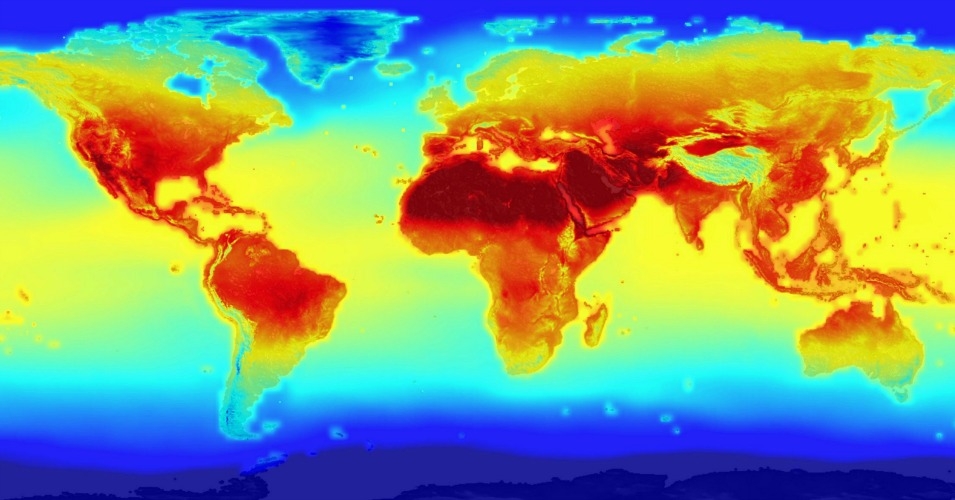
Scientists Warn Of 10C Warming As We “Dial Up Earth’s Thermostat”

Andy Rowell

Nearly every week a new record is being broken on climate.
So far this year we have had warnings that the Great Barrier reef is “dying on our watch” due to coral bleaching caused by record temperatures; dramatic early seasonal melting of the Arctic Ocean sea ice and Greenland’s massive ice sheet; devastating wild-fires in Canada which are being linked to climate change, and month after month of record temperatures.
And now a city in the north of India has registered the highest temperature ever recorded in the country at 51 C, during a chronic heatwave which has been going on for weeks. In nearby Pakistan, three cities recorded temperatures of 50 C or higher last Friday too.
The new Indian record, which breaks the previous one which was set sixty years ago in 1956, was set in the city of Phalodi, in the desert state of Rajasthan. It is the equivalent of 123.8F.
The heatwave is having a devastating effect and has caused the deaths of several hundred so far. Tens of thousands of farmers have also abandoned their land with crops devastated in 13 states. Rivers, lakes and even dams have dried up. Hundreds of farmers who have been left destitute have reportedly committed suicide.
Further south in Gujarat the sizzling temperatures are so bad that bats are falling lifeless from trees and pedestrians are getting their shoes stuck in the melting roads.
The Director General of the Indian Meteorological Association, Laxman Singh Rathore, has blamed climate change for the unprecedented temperatures: “It has been observed that since 2001, places in northern India, especially in Rajasthan, are witnessing a rising temperature trend every year.”
He added: “The main reason is the excessive use of energy and emission of carbon dioxide. Factors like urbanization and industrialization too have added to the global warming phenomenon. I think similar trend would be maintained in Rajasthan in coming days.”
The warnings have been getting stronger. Two months ago, Indian forecasters warned that heat waves are getting longer and more intense. Last year some 2,500 died from heat-related issues too.
And things are going to get worse.
As InsideClimate News reported last week about the annual greenhouse gas index released by the US National Oceanic and Atmospheric Administration: “The level of carbon dioxide in the atmosphere is not just rising, it’s accelerating”.
Last year, the average global concentration of CO2 increased to 399 parts per million, a record jump of almost 3 ppm from the year before.
Jim Butler, director of NOAA’s Global Monitoring Division, said: “This isn’t a model. These are precise and accurate measurements, and they tell us about how humans are changing the balance of heat in the Earth system. We’re dialing up Earth’s thermostat in a way that will lock more heat into the ocean and atmosphere for thousands of years.”
And now scientists, writing in the journal Nature Climate Change, are predicting that we could heat up the earth by a totally unsustainable 10C, if and its a big if, all fossil fuels are burnt. The Arctic could heat up by some 20C within a couple of centuries.
It goes without saying that temperatures like these would cause massive destruction on an unprecedented scale.
“I think it is really important to know what would happen if we don’t take any action to mitigate climate change,” said Katarzyna Tokarska, at the University of Victoria in Canada, the lead author on the research. “Even though we have the Paris climate change agreement, so far there hasn’t been any action.”
Tokarska called the research “a warning message.”

Belgian prison wardens strike met with government repression

Ross Mitchell

A nationwide strike of Belgian prison wardens enters its first month this week.
The strike is against the austerity measures being imposed by the right-wing government of Prime Minister Charles Michel against public sector workers. For this reason, a group normally treated with respect by the ruling class as administrators of its repressive state apparatus is now being subjected to brutal attacks.
The government plans to shrink the public sector by 20 percent, with pay and staffing being cut by 10 percent by 2020 overall. It aims at cutting staffing of prisons by 10 percent while making prison wardens work 12 months for 11 months’ pay. The cuts will reduce substantially what prison services can offer inmates in education, as part of their rehabilitation. Affected services include mental health care, apprenticeships, online learning, and arts activities.
The Belgium prison system is notoriously decrepit. The Forest-Berkaendel prison in Walloon was built in 1910 and 360 inmates currently live in a space designed for 280. A striking warden at the prison told the media that with the cuts, “What is removed from the prisoners is their chance to reintegrate society as a human being, their chance to have a job after doing their time, and their chance to remain a human being in the prison system.”
The cuts to the prison service will further de-humanise prisons. They will lead to increases in cell occupancy alongside the overcrowding of prisons with less wardens able to attend each prisoner. This creates more stress on both prisoners and guards, which produces a vicious circle of violence and repression.
On May 18, one inmate died in the psychiatric ward at the Lantin prison, as a result of a fight with plastic forks between inmates who are kept 22 hours a day in their cells. Lantin, in the Juprelle borough in the Liege district, holds 900 inmates.
According to the Belgian Human Rights League, prisons in Belgium, with 129 detainees to every 100 spaces, are more overcrowded than any in European country except Hungary. President Alexis Deswaef told the BBC the situation was “a complete violation of article three of the European Convention of Human Rights,” which prohibits inhuman or degrading treatment.
In an attempt to force the wardens back to work, when the fire sprinkler system broke at Lantin the mayor of Juprelle, Christine Servaes, took the decision to call in the police and military to operate the prison. Servaes said, “Fire safety equipment is failing so I am calling upon the use of emergency decree.”
The living conditions of the prisoners under the new regime are reported as appalling. On May 19, in St. Gilles prison in Brussels, 700 striking prison workers held a demonstration. Riot police barred access to the prison and manned the prison. Water cannons were used against the strikers, who clashed with the riot police.
Nationwide, basic prison services were lacking for the first 17 days of the strike. On the 18th day, May 13, the government started to use the military to break picket lines and man prisons with prison directors, managers and police.
On May 17, the building of the Justice Ministry in the capital Brussels, headed by Koen Geens, was occupied during the morning by striking prison workers. Trade union representatives opposed this, calling for “peace and quiet so as not to jeopardise negotiations.”
Trade unions representatives of the main prison union federations—the Confederation of Christian Trade Unions (CSC) and General Union of Public Service (CGSP)—convened to meet the minister informally at the Justice Ministry. Striking prison workers demonstrating outside rammed through the main heavy entrance double doors and went upstairs to the justice minister’s office, shouting, “Together, Together!” and “We will not kowtow.”
Riot police were called in, leading to fighting inside the building with police using pepper spray and batons.
Michel Jacobs, a CGSP trade union representative, attempted to defuse the situation. Once back outside the building he said on national TV, “I did not have time to see much. I got hit by police batons and punches. Oh well! It does not matter. I am not dead. Now I am strongly calling out for a peaceful standing down of the strikers. This I want to make it clear. I hope that everyone now is going back to their prisons and we are going to think about the next step.”
Laurence Clamart, a permanent secretary of the CSC, concurred saying, “First of all, let me make it clear that the CSC trade union does not approve, does not sanction these actions taken by striking trade union members.”
Last Monday, a Forest prison striker said, “We are going all the way. Someone must kowtow and it will not be us. It will be the government.”
He added, “We have families and these cuts will take out one month’s salary from our yearly pay.”
The government is opposed to any compromise. Geens has repeated stressed that the prison Rationalisation Plan will go ahead. In this, the trade unions are on his side, as the plan began to be implemented with their collaboration a year ago, region by region.
Gino Hope, a representative of the Flemish trade union ACOD-CGSP, said last week, “I respect the struggle of my Walloon colleagues. But they must also respect the needs of their Flemish colleagues. The Rationalisation Plan started last summer. We struck against the plan in some prisons in Flanders. To no avail. Bruges prison struck for two weeks against the cuts last summer. To no avail. So we chose to go along with the plan. I am not saying that it is working well, 100 percent, but we are starting to get accustomed to it.”
In December last year, the trade unions stopped a strike against the austerity plan in the prisons of Walloon, except in Mons where a determined workforce balloted for the strike to continue.
At the same time, the magistrate service is undergoing a cull, with 245 magistrates to be cut by 2020. This will lead to a saving of around €23 million in salaries. Some 700 jobs are going among personnel working within magistrates’ courts, including clerks and secretaries. A 7 percent cut is being made to the number of trainee magistrates and a 10 percent cut to non-magistrate personnel. Non-magistrate personnel on non-permanent contracts will be cut by 9.3 percent.
Belgium spent just €81 per inhabitant in its justice system in 2012. In the Netherlands €125 was spent, in Germany €114 and in Luxembourg and Switzerland €147 and €198 respectively. Such is the scale of cuts that a magistrate’s verdict, in favour of prison inmates who sued the government for failing to meet their human rights during the strike, cannot be enacted. The verdict compels the government to pay inmates compensation of €200 to €10,000 a month. One magistrate commented regarding the case, “The rule of law cannot be applied evenly in Belgium today.”

Further evidence of ties between German neo-Nazi group and domestic intelligence agency

Dietmar Henning

The trial against the National Socialist Underground (NSU) at Munich’s district court is in the closing stages. For three years, the court and its chair, Judge Manfred Götzl, have looked at thousands of pieces of information. The main question has always remained: How could 10 murders, bomb attacks and a series of bank robberies take place under the noses of the police and intelligence agencies? Who held, and is holding, a protective hand over the right-wing terrorists?
Over recent weeks and months, further evidence has come to light demonstrating close connections between the domestic intelligence agency, police and NSU.
Research by Welt editor Stefan Aust and filmmaker Dirk Laabs recently revealed that Ralf Marschner, who worked for the intelligence agency (BfV) for a decade as agent Primus, most likely employed the three NSU terrorists, Uwe Mundlos, Uwe Böhnhardt and Beate Zschäpe, after they went underground in 1998. Both men worked in his construction firm, Mundlos as a foreman under the name Max Florian Burkhardt, while Zschäpe helped out in one of his businesses.
Aust and Laabs then reported earlier this month that in 2001, Marschner was involved in an attack on a pub in Zwickau together with Susann Eminger, Zschäpe’s best friend. At this point, Zschäpe, Mundlos and Böhnhardt had already lived in the city for a year. Eminger visited Zschäpe in the apartment throughout the entire period of their illegality. Eminger’s boyfriend at the time, André, and her husband since 2005, is charged in the Munich trial with aiding the NSU.
On April 21, 2001, Marschner, Eminger and other skinheads burst into the bar and assaulted guests. According to witness statements from the owner, Marschner was the leader of the group. A political motive was later ruled out by the relevant investigators.
The state prosecutor in Zwickau laid charges of grievous bodily harm against Marschner and Eminger. However, these charges were not included in the Munich proceedings. These charges was kept under wraps by the federal prosecutor’s office as part of its so-called investigation into support structures. “Further investigations on the part of the federal criminal office (BKA) to clarify the extent of relations between Eminger and the agent Marschner remain unknown, even though they would have been required due to the trial over the bar brawl,” wrote Die Welt .
Proceedings against Marschner for the bar assaults were “temporarily suspended” two years later, while Eminger had to perform 20 hours’ community service. Agent Marschner has apparently enjoyed protection from the judiciary for decades. In Saxony alone, several dozen legal proceedings have been led against him since 1990 by the judiciary. The intelligence informant has never been sentenced to prison.
Even when Marschner was accused of killing a 17-year-old on the “Day of German unity” in 1990, he emerged innocent from the proceedings. The files on Marschner and the murder investigation were allegedly destroyed during the flooding in Chemnitz in 2010, authorities announced last week.
A petition by a representative of the joint plaintiffs in the NSU trial to order Marschner, who now lives in Switzerland, to appear as a witness was rejected by Judge Götzl, following consultation with the federal prosecutor. Even if the agent knew and employed Mundlos, Böhnhardt and Zschäpe after they went underground, this was not of immediate relevance in determining the questions of the acts committed and guilt of the defendants, the court said by way of justification.
The inviting of another witness, who was present at a meeting in 1998 between the Brandenburg interior ministry and agents from Thuringia and Saxony, was also rejected by the court. This meeting decided not to provide information to the police about an agent who had supplied the underground trio with a weapon. While a representative of a joint plaintiff concluded from this that the Interior Ministry had “made possible the series of murders by the NSU,” the court declared that it did not draw the conclusion that “joint responsibility of the state existed in the acts of the defendants.”
But this is precisely what is becoming ever clearer. Marschner’s handler at the intelligence service, code-name “Richard Kaldrack,” was at the same time managing agent Thomas Richter, code-name “Corelli.” Richter was also active around the NSU terrorists and was possibly in contact with them. He worked for the intelligence agency for 18 years and received €300,000 for his services.
Among other things, he made available electronic storage space for a neo-Nazi magazine, which published a greeting to the NSU as early as 2002. He was a founding member of the Ku Klux Klan in Baden-Württemberg, which also included two colleagues of police officer Michèle Kiesewetter, who was murdered by the NSU in 2007. A CD containing data with the title “NSDAP/NSU,” which he handed over to the intelligence service in 2005, only emerged years later. In 2014, shortly before he could be questioned about this, the 39-year-old died suddenly of a diabetes illness that apparently nobody was aware of.
Now, a telephone from Richter, “Corelli,” has also appeared. Corelli allegedly used it in 2012 and handed it over to the BfV in autumn 2012. There it was concealed in an armoured cupboard. It was then discovered in a fifth search in the summer of 2015, the intelligence agency now declares. Intelligence agency experts, who were until April this year working on it, have found a series of pictures and names from the radical right-wing scene. It has now been passed to the BKA for further evaluation of the available data.
Journalist Thomas Moser, who has been working on the NSU story for years, told Teleopolis last Tuesday about “overlaps” between the intelligence agency and the NSU.
He cited from protocol notes from a situational briefing in the police directorate (PD) in Gotha from November 5 and 6, 2011, found by the parliamentary NSU committee. As part of its area of responsibility, the bodies of Mundlos and Böhnhardt had been found in a burnt-out caravan the previous day.
In the protocol, among other things, the following statements are cited: “Efforts to locate the trio were abandoned in 2002. It was known that the state domestic intelligence agency (LfV) was concealing the target persons.” “The PD head intended to do everything to locate Ms. Zschäpe before she was withdrawn by the LfV.” And: “At least one member of the trio was allegedly working for the intelligence service until 2003. … The trio or part of it was closely tied to the intelligence agency, or the state intelligence agency had something to do with them, something like that.”
The police in Thuringia therefore assumed that the NSU trio was being protected by the intelligence agency. The situation briefing was led by Michael Menzel, who had led the police directorate in Gotha since 2009 and since 2015 has worked as criminal director in the Thuringia Interior Ministry. Menzel was also on location when the bodies were discovered and could have tampered with evidence. He was invited as a witness by the Munich trial, as well as by a number of parliamentary investigations, but always responded in vague terms.
Menzel, who began his police career in the GDR, is tied by several threads to the NSU. Among his colleagues in Saalfeld, where he headed the criminal police from 1998 to 2001, was Mike Wenzel, who as an intelligence officer dealt with the Thuringia Home Protection (THS), a right-wing organisation out of which the NSU emerged. Wenzel’s niece, Kiesewetter, was believed to be the NSU’s last victim in 2007. Her service weapon was later found in Mundlos and Böhnhardt’s burnt-out caravan. Even though nothing was publicly known about the NSU at that time, Wenzel immediately drew a connection between the so-called “döner murders” and the death of his niece.
It has long been known that over 20 agents of the intelligence service were operating around the NSU. A handler for agents in Hesse, Andreas Temme, was even present when Halit Yozgat was murdered in Kassel in April 2006. Any boundaries between the intelligence services and the NSU terror gang are virtually undetectable.
Whether the intelligence service is jointly responsible for the NSU murders, or whether one of the NSU members collaborated with intelligence, remains unclear, largely thanks to the joint efforts of the interior ministry, intelligence agencies, police authorities, federal prosecutor and the Munich District Court.

Sri Lankan flood and landslide deaths continue to climb

Pani Wijesiriwardena

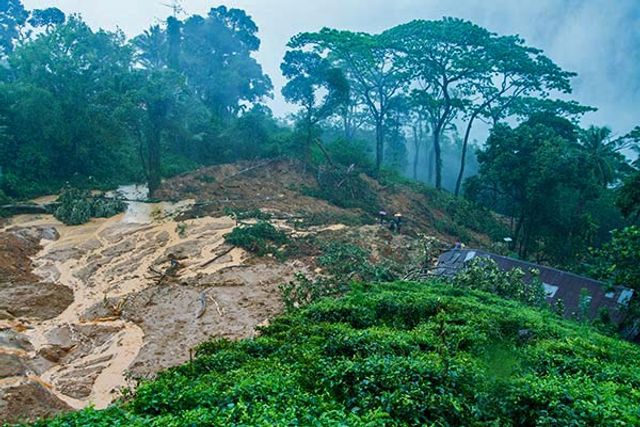
Tens of thousands remain homeless in Sri Lanka, while the number of people killed from Cyclone Roanu continues to rise. According to the Disaster Management Centre’s latest report, 101 people are confirmed dead in flooding and landslides. Rescue operations continue at Aranayake, where three villages were buried in a catastrophic landslide last week. Only 23 bodies have been found, out of the 134 people believed to be buried under tonnes of mud in these villages.
Landslide at Kalupahana Estate
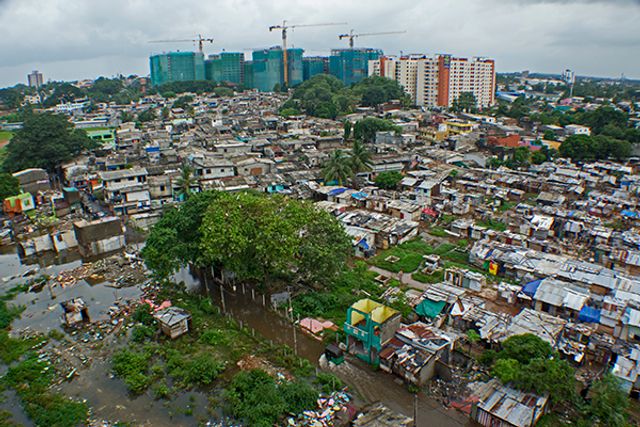
In Colombo, over 200,000 of the city’s 650,000 residents have been displaced by major flooding. Thousands are accommodated in so-called welfare centres at temples and schools, in roadside tents or under the bridges of elevated roads.
Sri Lankan authorities report that over 125,000 homes and more than 300,000 small and medium businesses have been destroyed or damaged by landslides and floods. The finance ministry estimates that the total damage will be between $US1.5 billion and $US2 billion.
Torrential rains associated with Cyclone Roanu also hit Bangladesh last Saturday where an estimated 2 million people have been forced to leave their homes and at least 23 people have been killed.
Apart from perfunctory warnings for the public to be “vigilant,” the Sri Lankan government took no serious measures to counteract the danger of floods and landslides caused by Cyclone Roanu. This was despite consistent scientific predictions of extreme storm events precipitated by the current El Nino period. No evacuation crews or rapid response teams were deployed to potential disaster areas and no emergency shelters established in advance.
Sri Lanka’s disaster preparedness and management is virtually non-existent, despite the passage of the Disaster Management Act in 2005 and the establishment of the Disaster Management Centre (DMC). This toothless institution was introduced in response to deep public anger over the inadequacy of the government’s response to the Indian Ocean tsunami in late 2004 and the so-called recovery process.
In the more than decade of its existence, the DMC has not even established a proper dedicated rapid-response team with search and rescue capacity. This is in a country where deadly landslides occur every year. Military personnel deployed for search operations have been using their bare hands and long sticks.
Kajeemawatta shanty town in Colombo city
On Monday, President Maithripala Sirisena declared that landslide-affected areas should be defined as High Security Zones and action taken to stop the construction of houses in “unsuitable places for living” and to prevent “unauthorised reclamation.”
Media reports said the government would deploy military and police units to prevent such “encroachments.” This unexplained move will be used to prevent poor families from settling in urban areas and to speed up the government eviction of shanty dwellers in order to release land for its Megalopolis project.
Yesterday, the government’s National Building Research Organisation announced that around 2,800 families will not be allowed to resettle in their original communities. This includes hundreds of homeless families in Aranayake. The government has not said whether the displaced families will be given alternative dwellings.
Aranayake residents told the WSWS that displaced villagers were being accommodated in dozens of “welfare centres” without adequate food and other assistance, and voiced their concerns about the future.
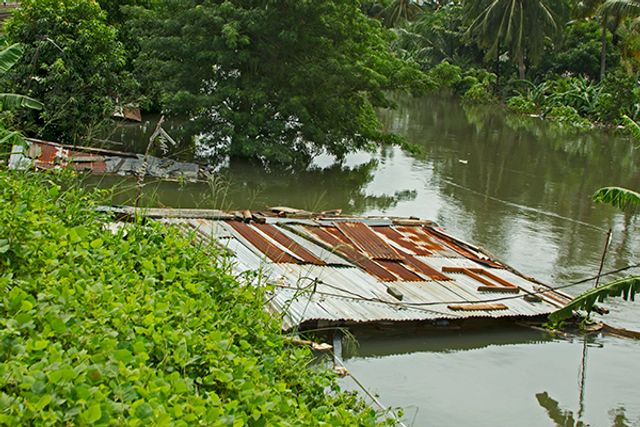
The roofs of small wooden houses at Orugodawath
Tens of thousands of working class and poor families were abandoned by Sri Lankan authorities following the 2004 tsunami. In Colombo, the previous government of President Mahinda Rajapakse spent billions of rupees for the beautification of the city, but slum dwellers and the poor were forced into unsafe, makeshift camps and left to experience yet another disaster.
The Sirisena-Wickremesinghe government has boasted of large donations from various foreign governments. The US has again shown its hypocrisy. Washington’s envoy to Sri Lanka, Atul Keshap, announced that the US has allocated $50,000 (7.2 million rupees) for flood relief in Sri Lanka. This is from a country which spends billions of dollars for wars to establish its global hegemony.
The Cyclone Roanu disaster has again revealed that the ruling elite and its successive governments, whether led by the United National Party or the Sri Lanka Freedom Party, are unwilling and incapable of providing the most rudimentary safety to residents.
In the past few days, the media has featured President Sirisena, Prime Minister Ranil Wickremesinghe and other ministers visiting flood and landslide victims in shelters and camp, feigning concern and making various pledges. Their promises will come to nothing.
Following the 2004 tsunami, the WSWS commented: “Confronting the greatest disaster to have hit the country in centuries, the entire political establishment is appealing for ‘unity’. Various appeals for aid have been made. Statements of sympathy have been issued. But their primary aim is to cover up the gross negligence of governments—both present and past—and to deflect growing anger over the level of assistance and relief being provided.”
This analysis has again been confirmed in the latest catastrophe.

Australian Treasury issues a blunt demand for austerity offensive

Mike Head

One of the central political frauds being perpetrated for the July 2 double-dissolution election was laid bare last Friday. The heads of Australia’s Treasury and Finance departments issued, in effect, a blunt edict to whichever parties take office after the election: slash social spending and launch a deep assault on workers’ conditions.
Less than three weeks after the Turnbull government’s May 3 budget, the country’s financial chiefs declared, in the official Pre-Election Economic and Fiscal Outlook (PEFO), that the budget’s predictions of economic growth and tax revenues were unrealistic and likely to be quickly overtaken by the deepening economic slump globally and in Australia.
The PEFO echoed the demands being issued by the corporate elite internationally for the dismantling of welfare and workers’ conditions. It warned that unless government spending was reduced and “structural reform” pursued with “renewed vigour” to drive up productivity, the international financial markets would strip the Australian government of its AAA credit rating. The statement said this would have disastrous consequences throughout the economy, because of its heavy reliance on overseas borrowing.
This ultimatum points to the reality that all the parties of the political establishment—Liberal-National, Labor and Greens—are trying to keep hidden from public view until after the election. Australian capitalism is facing a worsening crisis, generated by the collapse of the two-decade mining boom and the closure of entire sections of basic industry.
The slowdown in China and stagnation in Japan, Europe and North America are continuing to drive down prices for the resource commodities—such as iron ore, coal and liquefied natural gas—on which the Australian financial elite’s profits, and government revenues, substantially rely. And there are signs that a debt-fuelled property bubble has started to burst, with house prices and rents dropping in mining-related areas and growing predictions that the fall will spread nationally.
Far from the campaign slogans of “jobs and growth” or “putting people first,” Australia is being drawn into what financial commentators have described as a deflationary “vortex” of record low interest rates, declining prices, falling real wages, fewer working hours, reduced consumer spending and a lack of business investment.
All the various spending promises being made by the major parties will be dumped as soon as the voting is out of the way, in order to impose the real agenda: making young people and the working class pay for the growing impact in Australia of the global capitalist breakdown that erupted in the 2008 financial crash.
The PEFO described the assumptions underpinning the May 3 budget as “benign”—a polite term for over-optimistic. It declared: “Should Australia experience a significant negative economic shock, the fiscal position would be expected to deteriorate rapidly and not be consistent with the projections.”
Despite Australia’s “relatively rich endowment,” the country was dependent on “the willingness of foreign savers to finance current account deficits and support higher levels of investment.” Federal government debt levels were “projected to reach recent historical highs, both on a gross and net basis.”
The PEFO declaration triggered a fresh warning from Moody’s, one of the major international ratings agencies, that meeting the budget’s forecasts would be “challenging.”
The May 3 budget forecast that economic growth, as measured by nominal gross domestic product (GDP), would suddenly rise from 1.4 percent last financial year to 5 percent for the foreseeable future. There were equally fanciful revenue calculations, such as that company tax, which fell 2.2 percent this year, will surge 19 percent across the next two years.
With obvious frustration, the PEFO statement alluded to the political impasse that triggered the rare double-dissolution election for all members of both houses of parliament. “Reducing spending growth has proved difficult in practice,” it said, adding that “unlegislated policy decisions” alone would blow out the budget’s deficit predictions by $18 billion by 2019–20.
Prime Minister Malcolm Turnbull called the election in a bid to meet the mounting demands of the financial elite to break through the blockage in the Senate of key cuts to health, education and other social spending that were originally contained in the 2014 federal budget. These measures were stalled by Labor, the Greens and a number of independents, who all feared an electoral backlash if they voted for any of the cuts because of intense public hostility to the austerity program.
Most of these stalled measures—$18 billion worth—remain in the “benign” budget forecasts. The government is still counting on them to help eliminate the budget deficit, currently projected to be $39.9 billion in 2016–17 (up from $35 billion in last year’s budget), by 2020–21.
This logjam is part of a deeper political crisis. Since the 2008 crash, a succession of prime ministers, both Labor and Coalition—Kevin Rudd, Julia Gillard, Tony Abbott and now Malcolm Turnbull—have sought to slash social spending, but none have survived a full three-year term in office.
The PEFO warning was generally buried by the mass media—anxious to keep the truth out of sight during the election. But the financial elite’s main mouthpieces reinforced the message.
The Australian Financial Review’s May 21 editorial declared: “PEFO is intended to be a reality check on overheated campaign spending promises, and in these days of chronic budget deficits, a benchmark against which would-be governments must set their path back to surplus. This year’s document should be a jolt for both parties.”
A Labor government, with or without a coalition with the Greens, would be fully committed to imposing this agenda. Labor’s shadow treasurer Chris Bowen used the PEFO to reiterate his pledge to the financial markets to hand down a mini-budget within three months of taking office that would include “realistic assumptions and forecasts” for the budget.
These pronouncements foreshadow a vicious offensive against working class people, in order to meet the profit demands of a tiny super-rich elite. Already, millions of households in Australia struggle to make ends meet, more than a million workers are unemployed or under-employed and hospitals, schools, social services and other essential facilities are chronically under-funded and substandard.
As we explain in our election statement, the Socialist Equality Party calls for a vast redistribution of wealth to secure the social rights of all, including the right to a stable and decent-paying job, free, high-quality public education and health care, affordable housing, and a living income on retirement. These essential social rights cannot be achieved without ending the domination of a financial and corporate oligarchy over economic life, in Australia and on a global scale.

Obama appeals for closer US-Vietnamese ties

Peter Symonds

In a thoroughly cynical speech yesterday in Hanoi, US President Barack Obama made a public pitch for closer economic and military ties between Vietnam and the United States directed against the unstated enemy—China.
The previous day, Obama announced that the US was lifting its four-decade arms embargo on Vietnam—a longstanding demand of the Vietnamese regime to ensure that its armed forces can access hi-tech American military equipment. While no immediate deals were struck and other announcements were limited, Obama undoubtedly extracted commitments that will align Hanoi more closely with Washington against Beijing.
Obama’s “Address to the People of Vietnam” made clear in unmistakeable terms that the US is seeking a strategic partnership against China. As part of its “pivot to Asia,” the Obama administration has deliberately inflamed age-old territorial disputes in the South China Sea involving China and its neighbours, including Vietnam. Tensions between Beijing and Hanoi erupted in 2014 over the placement of a Chinese oil rig in disputed waters and led to violent anti-Chinese protests in Vietnam.
During his speech, Obama received applause from the handpicked audience when he declared: “Vietnam is an independent, sovereign nation, and no other nation can impose its will on you or decide your destiny.” Everyone in the National Convention Centre in Hanoi understood that he was referring to China, and raised not the slightest murmur of protest at the utter hypocrisy involved.
US imperialism waged a bloody, protracted war in Vietnam and throughout Indochina in an effort to subordinate the region to American interests that cost the lives of at least three million Vietnamese and many American soldiers. The physical scars remain from the devastating air war that involved not only massive quantities of conventional explosives but millions of gallons of toxic chemicals.
Moreover, the US continues to conduct military actions and wage wars that flout national sovereignty in complete disregard for international law. Just days before arriving in Vietnam, Obama boasted of ordering the drone strikes that murdered Taliban leader Akhtar Mohammad Mansour and ignored Pakistan’s protest that the unauthorised US attack breached the UN Charter.
In yesterday’s Hanoi speech, Obama repeated what are now standard declarations in relation to the South China Sea, stating that “the international order upon which our mutual security depends is rooted in certain rules and norms.” The insistence that China abide by the existing “international rules-based order”—that is, a world in which the US sets the rules—is nothing less than the demand that Beijing subordinate its interests to Washington.
Obama reiterated Washington’s determination to uphold “freedom of navigation and overflight” in the South China Sea and ensure the “peaceful resolution of disputes, through legal means, in accordance with international law.” The US is currently backing a Philippine legal case in The Hague based on the UN Convention on the Law of the Sea (UNCLOS) to challenge Chinese maritime claims. Vietnam has supported the Philippine challenge.
US contempt for international law is summed up not only by its failure to ratify UNCLOS, but its repeated military provocations in the South China Sea against China. Even before the Philippine case has been decided, US warships have on three occasions deliberately intruded within the 12-nautical-mile territorial limit surrounding Chinese-claimed and controlled islets.
Obama made no direct mention to China in his speech, but he made a deliberate historical reference which would have been lost on no one in Vietnam, or China for that matter. Posturing on the need for gender equality, he declared: “From the Trung Sisters to today, strong confident women have always helped to move Vietnam forward.” The Trung Sisters were Vietnamese military leaders who led a rebellion against Chinese domination in 40 AD and are promoted in Vietnam today as national heroines.
Obama also made an appeal for closer economic collaboration between the US and Vietnam and touted the importance of the Trans Pacific Partnership (TPP), signed last year. The Obama administration regards the TPP, which involves 12 Pacific countries but not China, as the means for advancing American economic interests in Asia and marginalising China.
Washington is well aware that Vietnam remains heavily reliant on trade with China. Obama pledged to work with Vietnam to “unleash the full potential of your economy” through the TPP, which would “let you sell more of your products to the world” and “attract new investment.”
The US president said the TPP would have “important strategic benefits” as “Vietnam will be less dependent on one trading partner and enjoy broader ties with more partners, including the United States.” In other words, the US is offering a comprehensive compact to the Vietnamese regime, with economic benefits that would allow it to lessen its reliance on China.
During his speech, Obama made ritual expressions of concern for human rights but stressed that “the United States does not seek to impose our form of government in Vietnam.” He held a special meeting with various hand-picked human rights activists, yet did not object when Vietnamese police prevented at least three from attending the meeting. These gestures were aimed at neutralising criticism in Washington that he should have extracted concessions on democratic rights before lifting the arms embargo.
Obama is no more interested in democratic rights in Vietnam than anywhere else in the world, including inside the United States. Rather, “human rights” is a convenient political tool to apply pressure to governments and justify interventions and wars. If Hanoi did a diplomatic about-face and shifted its orientation toward Beijing, it would soon find itself subject to a barrage of propaganda condemning its human rights abuses.
Obama’s trip confirms that the opposite is the case: the Vietnamese regime has made a significant tilt toward Washington that will strengthen the hand of the US as it ratchets up its preparations throughout the region for war with China. Obama stressed that in talks with Vietnamese leaders “we have agreed to elevate our security cooperation and build trust between our men and women in uniform.” While the overt signs of cooperation were limited to enhancing the Vietnamese coast guard, the US will be demanding much more in the coming weeks and months.

International finance capital and the strikes in France

Nick Beams

The mobilisation of the forces of the French state by the Socialist Party government of Francois Hollande against striking oil refinery and other workers is the spearhead of a long-demanded offensive against the French and European working class by the representatives of international finance capital.
Since the global financial crisis in 2008, and particularly since the crisis of the euro in 2012 and the second phase of a double-dip recession, the International Monetary Fund, the European Central Bank and other financial institutions have been demanding the implementation of what are euphemistically described as “structural reforms.” The real agenda is to boost profitability of French and European capitalism as a whole.
“Structural reform” is aimed at savagely attacking the conditions of the working class by opening the way for employers to hire and fire at will, scrapping legal protections against sackings, cutting unemployment benefits and reducing government social services spending.
As police were being brought in to attack striking oil refinery workers in Marseilles, the IMF set out its latest prescriptions for economic policy measures in France. They centred on techniques to increase labour market “flexibility” and reduce pensions and other social services.
It said the implementation of the El Khomri labour law, the focus of the strikes, would be a “step forward, increasing the scope for company-level agreements and reducing judicial uncertainty around dismissals.” But more had to be done, it insisted.
In other words, regulations that govern national pay and working conditions must be continually rolled back to the conditions that prevailed in the 1930s and beyond and legal impediments to the ability of companies to hire and fire removed. This is the agenda that the Hollande government is now seeking to impose with the force of the state.
Setting out the factors which had made France’s labour market “less adaptable” to developments in the global economy, the IMF cited “centralized labour agreements for over 700 branches; long and uncertain judicial procedures around dismissals; relatively easy access to unemployment and welfare benefits” as well as a “relatively high minimum wage.”
The other major demand is for a reduction in government spending which the IMF insisted was “at the heart of France’s fiscal difficulties.” It called for limiting the “wage drift at all levels of government that would help reduce the wage bill,” a reduction in pensions by lifting the retirement age, the extension of means-testing for social benefits and the rationalisation of hospital services to reduce costs.
This offensive comes at a critical turning point in the deepening breakdown of the global economy and the international financial system. Since 2012, and the commitment by ECB president Mario Draghi to do “whatever it takes” to prevent a collapse of the euro, the central bank has pursued a policy of “quantitative easing”—the pumping of trillions of euro into the financial system.
These measures have done nothing to revive the real economy. Their only effect has been to promote speculation in financial markets, leading to ever-widening social inequality. Investment in the real economy, the driving force of economic growth, remains around 25 percent below where it was prior to 2008 and large sections of the euro-zone economy have not returned to the levels of output they reached eight years ago.
The initiation of negative interest rates by the ECB earlier this year has likewise failed to bring any economic revival. In fact, their introduction and similar moves by the Bank of Japan have only added to the instability of global financial markets amid growing tensions among the major capitalist powers as they struggle for markets and profits in a stagnant world economy.
While accommodating the demands of the banks and finance houses with endless supplies of cheap cash, Draghi has been acutely aware that these measures in and of themselves are not sufficient to maintain the position of European capitalism in the intensifying global economic struggle against its rivals. In the view of the ruling financial elites, the entire post-war system of social services and regulations introduced to stave off the threat of social revolution after the experiences of fascism in the 1930s has made Europe noncompetitive and must now be destroyed. This is the essential content of the demand for “structural reforms.”
In a speech on this issue in May 2015, Draghi noted that in every press conference since becoming ECB president, he had ended his introductory remarks “with a call to accelerate structural reform in Europe.” This would raise productivity and increase “price and wage flexibility,” that is, boost profitability.
The increased urgency, from the standpoint of the ruling elite, of this task is underscored in the Annual Report of the ECB issued in April. After claiming that the present policies were working, the report then essentially refuted that assessment by noting that 2016 would be a “challenging year” for the central bank. “We face uncertainty about the outlook for the global economy. We face continued dis-inflationary forces. And we face questions about the direction of Europe and its resilience to new shocks.”
That is, almost eight years since the onset of the global economic breakdown, rather than there being an “economic recovery” on the horizon, the situation confronting global capital is worsening.
Just as in the 1930s, this deepening economic crisis is driving the ruling classes in France and throughout the world to war and militarism, coupled with a renewed onslaught against the working class and attacks on democratic rights at home. What is unfolding in France is, therefore, the most acute expression of global trends and tendencies.
Its significance can only be fully appreciated by placing it within the context of the history of the past quarter-century.
The collapse of the Soviet Union in 1991 was greeted with a wave of triumphalism on the part of the bourgeoisie and its political representatives as they hailed the “death of socialism” and the “triumph” of the market—a reaction which was mirrored in the response of all the petty-bourgeois pseudo left tendencies as they integrated themselves ever more deeply into the structures of the capitalist state and its political establishment.
Only the International Committee of the Fourth International (ICFI) explained that the liquidation of the Soviet Union was not the death of socialism but rather the collapse of Stalinism and its nationalist program of “socialism in one country” under the impact of globalised production, and that, far from establishing a new capitalist equilibrium, the world had entered a new period of wars and revolution.
The collapse of the Soviet Union, however, gave rise to considerable disorientation in the working class. But the essential tendencies identified by the ICFI are now coming to the surface and have produced a resurgence of the class struggle. The urgent immediate task is the mobilisation of the working class across Europe in support of the French workers in the struggle against the Hollande government and the financial elites that stand behind it. This movement must be armed with an international socialist perspective directed to the fight for political power and the building of the ICFI as the revolutionary party to lead it.

Modi in Iran: A Successful Visit

KP Fabian


Indian Prime Minister Narendra Modi’s two-day visit to Iran from 22-23 May 2016 is easily one of the best visits in terms of impact, made by this globe-trotting head of government who went to 26 countries in 2015. This visit has to be viewed in context. Iran is a superpower in energy with 10 and 18 per cent of global oil and gas reserves respectively. Treated as a pariah state by Washington since the 1979 US embassy hostage crisis and later put under more sanctions by others too for the absurd charge of enriching uranium, Iran demonstrated singular skill in playing diplomatic chess by concluding the nuclear agreement in July 2015, leading to the lifting of most of the sanctions by January 2016. China’s President Xi Jinping was the first to reach Tehran after the lifting of sanctions.

Any criticism of Modi for not rushing earlier to Iran is misplaced. He correctly chose the sequencing, Saudi Arabia, UAE, Iran, and soon, Qatar. If Modi had gone to Iran first and then to Saudi Arabia, he would have risked a cold reception in Riyadh, of which US President Barack Obama got a taste with the Saudi media not highlighting his visit.

Modi’s meeting with Iran’s Supreme Leader Ayatollah Ali Khamenei is significant as such a meeting is rarely accorded to a visiting chief of government or state. The Ayatollah had come to India in the early 1980s when he was deputy minister of defence. Twelve agreements on matters ranging from Iran’s Chabahar Port to foreign office-level consultations were signed. The most important themes covered by the agreements are connectivity, trade, and investment. Pakistan permits Afghanistan to send goods to India via the Wagah border but it does not permit Afghanistan to import from India via the same route. Chabahar Port will give India access to Afghanistan and Central Asia. The word ‘Chabahar’ means four springs in Persian, meaning that it is always spring there. There is a road from Chabahar in Iran to Zaranj in Afghanistan, and from there to Delaram (built by India in 2009) which is on the Garden Highway linking the four major Afghan provinces of Herat, Balkh, Ghazni, Kabul, Farah and Kandahar. India will be constructing a railway line in Iran connecting Chabahar to Zahedan.

The immediate takeaway is that apart from India’s gain in improved access to Afghanistan, Iran, and Central Asia, both Afghanistan and Iran stand to gain considerably. A glance at the map will show that Oman and UAE too will gain.

After connectivity comes energy. Some of India’s refineries are designed to take in the crude from Iran, which was a major supplier till the US began ‘dissuading’ importers of crude from Iran. Apart from buying crude and gas, India wants to invest in production. Iran’s Farzad B is a gas field under discussion and the agreement could not be finalised this time. There was a credit of USD 6.5 billion payable to Iran for crude already imported; but the US’ control over the international banking system, amounting to unipolarity, made it difficult for India to pay the sum. However, a part payment of USD 750 million was made before Modi landed in Tehran.

India will invest in the Chabahar Free Trade Zone. It is advantageous for India to produce aluminium and fertiliser given the low priced gas available there.

An agreement to deepen cultural cooperation too was signed. Modi presented a Persian version of Panchatantra and the Jataka tales and quoted Ghalib, “Once we make up our mind, the distance between Kaashi and Kaashan is only half a step.” Kashi, India is an Indian pilgrimage site and Kaashan, Iran, is famous for carpets. What was missing was an announcement about establishing an Indian cultural centre in Tehran. An Iranian cultural centre has been functional in New Delhi for years.

How will Pakistan respond to this coming together of Iran, India, and Afghanistan? Incidentally, the Dawn carried a photo of Iranian President Hassan Rouhani, Indian Prime Minister Narendra Modi, and Afghan President Ashraf Ghani sitting together. One did not find it in some of the mainstream Indian dailies. Pakistan might ask China to move faster with the USD 46 billion worth 2442 kilometre-long China Pakistan Economic Corridor to Gwadar, Balochistan. Still, Pakistan will have to recognise that its policy of not normalising relations with India and arranging for terrorist attacks against Indian targets in Afghanistan from time to time might not pay the expected dividends.

It will be useful to recall that former Iranian President Mohammad Khatami came to Delhi in 2003 as the chief guest for the Republic Day celebrations and signed the Delhi Declaration. Iran was already in the “axis of evil” in the eyes of the then US President George Bush. The Delhi Declaration issued during the visit spoke of a strategic partnership and added that the two sides “will explore opportunities for cooperation in defence in agreed areas.” The Wilson Centre, a US-based think tank, got rather worked up and said, “According to some press accounts, New Delhi will have the right to use Iranian military bases for combat operations against Pakistan should another Indo-Pakistani war break out.” The point to note is that Iran is prepared to get closer to India.

Modi’s worst foreign visit was the hurried and unprepared one to Lahore in December 2015. In contrast, the one to Tehran was well prepared, diligently designed and smartly executed.

The challenge before India can be summed up in two words: timely delivery. There is scope for improvement.

24 May 2016

The Financial Invasion of Greece

Sharmini Peries & Michael Hudson

SHARMINI PERIES: Greece’s economic crisis has perhaps been eclipsed by Europe’s refugee crisis, terrorist attacks, and by the forthcoming Brexit referendum. But it has not gone away.  Greece’s Syriza coalition faced violence on the streets and a 3 day general strike last week that had brought much of the country to a halt. In spite of the protests the government of Alexis Tsipras pushed through legislation to amend the country’s tax and pension system with the backing of 153 MPs, a measure required by the lenders in order to continue the debt negotiations. Addressing the 300 seat house, Prime Minister Alex Tsipras said we are determined to make Greece stand on its 2 feet at any cost.
To discuss these developments, I’m joined by Michael Hudson, a distinguished Research Professor of Economics at the University of Missouri-Kansas City.
Michael the International Monetary Fund is pushing for comprehensive measures to tackle Greece’s debt burden. They want the lenders to get creative in terms of debt cancellation and the measure that they’\’re proposing seems to be fairly progressive compared to what the lenders are talking about. Tell us more about the IMF’s proposal and how the lenders are reacting to it.
HUDSON: The IMF says it will not reduce Greece’s debt by a single penny. It will keep the debt in place. The problem is the way that the European central banks keep their balance sheets, if it breaks down Greece’s debt owed to the IMF, then the countries Germany, France and other countries whose banks are bailed out will have to take a loss and they refuse to lose a single penny. So the IMF has not made a creative proposal. It has repeated what it said a year ago without changing a single word. It says okay, we’re going to keep every penny of debt in place but we’re going to give you a fudging number. We’’e only going to charge you 1.5% interest and you won’t have to pay the debt for 25 years. So you don’t get a debt markdown, but you won’t have to pay interests for 25 years and we’ll charge you only a little bit of interest.
There’s only one kicker. You’re going to have to cancel your pensions, write them down, impose austerity, privatize your government, and you’re going to have to shrink your economy so that it will shrink by about 1, 2, 3% a year so that the 1.5% interest that we’re charging as little as it is, is going to absorb all the income growth you have. Every penny of growth of have from the next 25 years ,you’ll have to end up paying the German banks.
Now we know you can’t do it. We know that when you cancel the pensions you’re going to shrink. We know your labor’s on strike. We know they’re going to emigrate.
But there’s a way out. You can sell your ports, your land, your public utilities, your railroads, your airports, anything you have you can sell to the Germans and at the end of this time you won’t have a single thing and all we ask is that all you Greeks get out of our country, now that we own you. That’s what the IMF is saying. It’s not creative; it’s absolutely brutal. That’s why the Greeks are out on strike.
PERIES: Now why are the lenders then acting the way they are?
HUDSON: Because they’re using finance as the new means of war. There is a war going on in Europe but it’s not a military war anymore. They’re now using finance instead of war and
2KillingTheHost_Cover_rulethey’re using finance to say, we can grab your country. We can put you out of work. We can control you and we don’t have to kill you, we can just make you immigrate by taking away your pensions and taking all your money. There’s a land grab just as if it were an invasion to grab Greece’s ports, to grab Greece’s railroads, and to grab everything else. This is war.
PERIES: Now the international press has been reporting on Monday’s meeting with the finance ministers as if it was a success and Prime Minister Alexis Tsipras and the finance minister came out of it with smiles, why?
HUDSON: Because they sold out. Because you’re supposed to smile before a camera, that’s the polite thing to do. You’re supposed to smile as if you’ve somehow defended your constituency. Mr. Obama always smiles whenever he does another giveaway to Wall Street. But the smile does not reflect anything that’s good for the great people and the great people obviously know this as you can see by their political reaction.
PERIES: And these attack reforms and pension reforms that now they have to swallow, the people of Greece. What does it really mean for the people?
HUDSON: It means, the opposite of what reforms used to mean. For the last 100 years the whole reform movement meant you give more authority to government. You give more emphasis on economic growth. Reform used to mean making the economy fair. But today we’re in a Orwellian doublethink world where we reform means wiping out the reforms that Greece did after WW II. Wiping out the pension reforms, wiping out the tax reforms, and wiping out the tax reforms apparently. It’s a rollback to what you could call neofeudalism. It’s the opposite of the reform movement. So the newspapers use the word reform but it’s exactly the opposite.
PERIES: Alright then the left wing and the Syriza party. What are they saying in light of what we just heard?
HUDSON: Well they’re appalled and as you know Yanis Varoufakis, whom you’ve had on your show resigned rather than become the undertaker imposing austerity on Greece. They’re simply appalled and think nothing could be worse and that they realized there is a war going on and they’d hoped that they’d be supported by other left wing movements and France and Spain and Portugal. But there’s a bitter class war of debtors against creditors or creditors against debtors going on in Europe and all they can do right now is expose the hypocrisy of the IMF. If you’re talking about Greece, let’s juxtapose the IMF supporting a really insolvent economy of kleptocrats in the Ukraine.
The IMF is preparing to bail out Ukraine, to say you don’t have to pay your debts that you owe to Russia or any governments that the U.S. doesn’t like. You have to sell off your land to George Soros and the people whom the U.S. government does like. Look at the duel standard that the IMF is imposing on Greece compared to what it’s doing for the Ukrainian government. You see that the IMF has become a tool of the New Cold War and the Syriza people and the Greeks can do is point out how unfair this is and to try to let the world know that what is happening is a movement way to the right wing of the political spectrum and that finance is war.
PERIES: Finally, Michael, what choice does the Greek government have? What can they do?
HUDSON: Mr. Tsipras says they have no choice. He says the choice is only to surrender and in fact the argument now is not between Greece and the IMF. Not between Greece and Germany or Europe. The arguments that keep going on are solely between the IMF and Germany as to whether the IMF is going to break its traditional rules and make a loan in violation of all of its principles. Under its articles of agreement, the IMF is not allowed to make a loan to a government that cannot afford to repay the loan. All of the staff of the IMF have unanimously found that Greece cannot pay the loan because the terms of IMF loans, the conditionalities, shrink the economy and make it impossible to pay.
So the IMF says that we’re going to break the rules of that and we’re going to lend, essentially because the U.S. tells us to do that and Greece is going to have to pay so we can demonstrate that if Spain tries to stand up and pay its pensions to people, if France pays its labor, if Italy pays its labor, we’re going to smash their economies, we’re going to smash their labor unions, and we’re going to smash their labor just as we do to Greece. Greece is a demonstration very much like when the Nazis bombed Spain, in the Picasso drew the great drawing for. This is the IMF’s version of the Nazi bombing of Spain to say, this is what’s going to happen to labor throughout Europe if you don’t surrender.