31 May 2016

The Funny Business of Farm Credit

Ralph Nader

In May of 1998 we held a conference dedicated to two Government-sponsored Enterprises (GSEs) – Fannie Mae and Freddie Mac. In my statement to that assembly, I noted that both corporations had been enjoying good times, but cautioned that one of the unintended consequences of fat profits over a long period is the tendency of both government and private corporations to start believing in the fantasy of ever-rising profits. GSEs often escape the accountability that Congress or regulatory agencies should impose.
Recent hearings in the U.S. House and Senate have provided some much needed oversight on another GSE―the Farm Credit System (FCS).
The Farm Credit System was the first GSE to be established by the United States in 1916. Unlike Fannie and Freddie, the Farm Credit System can make direct loans to farmers, ranchers and others involved in agriculture. However, as The Wall Street Journal reported back in 1985: “the Farm Credit System would lend money to anyone. Herbert Ashton, an Indiana fruit farmer, recalls being wined and dined at a local country club by bankers from his local [farm credit] system bank who extolled the virtues of inflation and offered to lend him $1 million on the spot. ‘I turned it down,’ he recalls. ‘But they sounded like a soap testimonial. They were giving money to whoever passed their way, and they didn’t ask too many questions.’”
Not surprisingly, The Farm Credit System was also the first GSE to be bailed out by taxpayers at a cost of $4 billion when the farm economy collapsed in 1987.
The Farm Credit System reported a net income of $4.7 billion and assets of $283 billion in 2014.  It gets its huge funding capital from the Federal Farm Credit Banks Funding Corporation which sells bonds on securities markets. It receives exemptions from Dodd-Frank Wall Street reform and pays only a small percentage of state and local taxes. With these facts in mind, the FCS has veered off course from the mission Congress originally intended for it to do―“…to make loans for the production and marketing of agricultural products.”  The FCS’s lending practices are less focused on serving the credit needs of new farmers and ranchers, but instead lending today focuses on large farmers, agribusinesses, utilities and even businesses having nothing to do with farming!
For example, in 2004 twenty-five percent of new FCS loans went to owners of small farms and ranches while seventy-five percent went to owners of large farms.  In 2014, less than 14 percent of new FCS loans went to owners of small farms and ranches, while over 86 percent went to owners of large farms. On their website, FCS addresses the open question of whether or not they exist to just serve farmers and ranchers by elaborating: “The System’s mission is to serve all types of agricultural producers who have a basis for rural credit, as well as others who help ensure that agriculture and rural America are economically successful. This includes farm-related businesses, rural homeowners, rural infrastructure providers, including electric, telecommunications, water and waste, as well as other rural service providers.” This open-ended description leaves a lot of wiggle room about who FCS chooses to lend to―which is problematic.
Providing loans to large corporations, to non-farm enterprises and to wealthy individuals and families for a variety of non-farm investments goes well beyond what the Farm Credit System was set up to do. Some eye-opening examples follow:
* In October 2013 – CoBank, a $93 billion Farm Credit System bank, loaned $725 million to Verizon to help finance its acquisition of Vodafone -a London-based telecom giant. At a June 25, 2014 hearing, Rep. Mike Rogers (R-MI) told Jill Long Thompson, Chairman and CEO of the Farm Credit Administration, “I have been a supporter of the Farm Credit System. But, it is pretty hard for me to explain—I can’t explain why you are financing a merger deal with Verizon, or the Farm Credit System is.”
* In April 2015 – CoBank participated in a $300 million unsecured term loan to Black Hills Corp., a vertically integrated energy company with natural gas and electric utility operations in Colorado, Iowa, Kansas, Montana, Nebraska, South Dakota and Wyoming.
* In January 2015, Greenstone Farm Credit Services ACA/FLCA joined with several large commercial banks in providing “a five-year $750 million revolving line of credit” to Cracker Barrel Old Country Store, Inc., a national restaurant chain.
* In 2007, Farm Credit of the Virginias loaned the Kluge Estate Winery and Vineyard $34 million to increase the winery’s output and construct luxury homes on the estate.
Former Farm Credit Administration Chairman and CEO Leland A. Strom pointed out that Farm Credit System associations “have developed very efficient marketing programs for farmers and ranchers involved in commodity-type agriculture (from corn and soybean production to livestock, for example) in addition to an “ongoing and impressive” effort at “education and outreach to these farmers and their children.”   But he warned, the Farm Credit System was not providing the same level of service to those who “farm and market their products directly to consumers, local restaurants, schools, hospitals, etc., in what many call the Local Foods System.”
The Farm Credit System needs congressional oversight of its operations and lending. In addition to regular congressional oversight―the recent hearings were the first in over a decade―Congress should also consider new legislation that would make the FCS subject to Dodd-Frank, require FCS to increase lending to young, beginning and small farmers and ranchers and limit lending to non-farm corporations and non-farm activities.
Small farmers, let your member of Congress know what you think.

The Intricacies of Language

James Abourezk

I spoke very little English when I was a small boy, mainly because of my mother, who emigrated to America eleven years before I was born in 1931. She spoke very little English after arriving in South Dakota. She did, however, teach me Arabic, most of which I lost as I grew up and attended school in the Rosebud Reservation village of Wood, South Dakota. My father had settled there after traveling throughout small towns in South Dakota peddling goods out of a pack on his back. He had opened the store in Wood in 1912, and another in the Reservation town of Mission in 1920, the year my mother was able to come to America, along with her brother, John Mickel, who my dad appointed to run the store in Mission.
It was my burden to learn about the Arabic word, “Inshalla,” as I grew up.
After moving to Washington, D.C. in the 1970s, I also learned from the Arabic speakers I met there, as well as in the Middle East, great variety of ways to use Inshalla. The most recent experience was watching television news after the disappearance of the Egyptian Air Bus passenger plane in the Mediterranean. I watched one day with amazement as an Egyptian official was asked by a reporter if the search for the “black box” would produce imminent results, divulging the secret of why so many people had tragically died in the crash.
“Inshalla,” the Egyptian official said, increasing the mystery by breaking out in a huge smile. The literal translation of the word “inshalla” is “God willing.” It is a two word phrase that has real meaning only to Arabic speakers. If one breaks down the word into its usage, it can have a plethora of meanings, most of them known only to veteran Arabic speakers who have had years of experience in usinginshalla. It can mean, I’ve learned, something will happen very soon, as in discovery of the airplane’s black boxes. Or it can mean it will happen if God intervenes and desires that the black boxes will be found, as well as a dozen interpretations in between. It would also include the thought that if the searchers are lucky, we will have the answer to the mystery.
But until the boxes are found, inshalla, we are content to speculate on what the Egyptian meant when he gave the answer to the world via American television news, mostly because when answering, he had a mysterious smile on his face.
Which brings to mind another mystery created by people who do not like to be pinned down on the meaning of words.
In Mexican Spanish, the word “manana”means, I understand, “tomorrow.” But it is used in many indefinite ways, meaning mostly the speaker is hopeful that something will happen, as in “when will you be able to finish the work you’re doing for me?”
Manana.” The English speaker can be excused for confusing manana with Inshalla, but these words have two entirely different meanings. I will now bring in the Arabic word, “bukra,” which means tomorrow, and I will illustrate it by relating an anecdote about a Mexican and an Arab debating the meaning of words in their respective languages.
“I understand,” the Arab said to the Mexican, “that the word, manana,means that there is a possibility that something will happen in the near future. We have a similar interpretation of the word, bukras.“But you should know,” the Arab said that bukra does not have the same sense of urgency as “manana.”

Libya: How to Bring Down a Nation

Patrick Howlett-Martin

More than 30,000 Libyans died during seven months of bombing by an essentially tripartite force – France, Great Britain, United States – which clearly favored the rebels. “The most successful mission in NATO’s history”, in the imprudent words of NATO Secretary General, Anders Fogh Rasmussen, a Dane, in Tripoli in October 2011.
French president Nicolas Sarkozy’s eagerness to support a military intervention with the purported aim of protecting the civilian population contrasts with the reception offered to the Libyan president, Muammar Gaddafi, when he visited Paris in December 2007 and signed major military agreements worth some 4.5 billion euros along with cooperation agreements for the development of nuclear energy for peacetime uses. The contracts that Libya seemed no longer willing to pursue focused on 14 Dassault Rafale multirole fighter jets and their armament (the same model that France sold or is trying to sold to Egypt´s General Abdel Fattah al-Sisi, the self-proclaimed marshal), 35 Eurocopter helicopters, six patrol boats, a hundred armored vehicles, and the overhaul of 17 Mirage F1 fighters sold by Dassault Aviation in the 1970s.
The major oil companies (Occidental Petroleum, State Oil, Petro-Canada…) working in Libya helped Libya pay the 1.5 billion dollars in compensation that the Libyan regime had agreed to pay to the families of the victims of Pan Am flight 103. At the time, the compensation was intended to be one of the conditions for Libya to be reaccepted into the community of international relations.
The principal Libyan investment funds (LAFICO-Libyan Arab Foreign Investment Company; LIA-Libyan Investment Authority) were shareholders in many Italian and British corporations (Fiat, UniCredit, Juventus, the Pearson Group, owner of the Financial Times, and the London School of Economics, where Gaddafi was addressed as “Brother Leader” during a video conference in December 2010 and his son Saif was awarded a PhD in 2008). The New York investment bank Goldman Sachs was sued in 2014 by a Libyan fund (Libyan Investment Authority) which had lost more than 1.2 billion dollars between January and April 2008 after the American firm took a commission of 350 million dollars for investing their money in highly speculative derivatives.
Muammar Gaddafi had been received with full honors by the major powers some months earlier: in addition to the reception in grand style in Paris, where he was a guest for five days in 2007, he was received in Spain in December 2007, in Moscow in October 2008, and in Rome in August 2010, two years after accepting the Italian gift of 5 billion dollars as compensation for the Italian occupation of Libya from 1913 to 1943. And also of note are the five trips to Tripoli in three years by former British Prime Minister Tony Blair, a paid senior advisor to the investment bank JPMorgan Chase. Former French president Nicolas Sarkozy was received in Tripoli in July 2007, where he announced the beginning of a partnership for the installation of a nuclear power plant in Libya. The European Union was ready to facilitate access to the European market for Libyan agricultural exports. Libya was invited by the NATO Chiefs of Defense to the Maritime Commanders’ Meeting (MARCOMET) in Toulon on May 25-28, 2008.
A policy that recalls the one towards the Iraqi leader, Saddam Hussein. The Iraqi leader was invited to Paris in June 1972 and September 1975; an agreement was signed in June 1977 for the sale to Baghdad of 32 Mirage F1 combat aircraft. A coincidence that didn’t do either of them any good in the long run.
Arab military leaders (veterans of Afghanistan and members of the Libyan Islamic Fighting Group, with ties to Al-Qaeda) helped overthrow Gaddafi. One of the principal military leaders of the rebellion, Abdel Hakim Belhadj (a.k.a. Abu Abdullah al-Sadik), then Tripoli Security Chief and today the main leader of the conservative Islamist al-Watan Party had been arrested in Bangkok in 2004, tortured by CIA agents, and delivered to Gaddafi’s Abu Salim prison. He is now the main ISIL leader in Lybia. Jaballah Matar was kidnapped from his home in Cairo by the CIA in 1990 and then handed over to Libyan officials Documents seized after the death of Gaddafi reveal close cooperation between Libyan, American (CIA), and British (MI6) intelligence services.
Under Gaddafi, Islamic terrorism was virtually non-existent. Prior to the U.S. led bombing campaign in 2011, Libya had the highest Human Development Index, the lowest infant mortality and the highest life expectancy in all Africa. Today Lybia is a wrecked state.
In January 2012, three months after the end of hostilities, the United Nations High Commissioner for Human Rights, Navi Pillay, reported the widespread use of torture, summary executions, and rape in Libyan prisons. At the same time, the organization Doctors Without Borders decided to withdraw from the prisons in Misrata because of the ongoing torture of detainees.
The NATO intervention in Libya, involving most member countries under a humanitarian pretext, set an unfortunate precedent for efforts to resolve the Syrian crisis: the attack by French and British warplanes on the Warfallah tribe, who remained faithful to Muammar Gaddafi, and on the convoy carrying the Libyan leader and one of his sons, leading directly to Gaddafi’s death under deplorable circumstances. The images by videographer Ali Algadi and journalist Tracey Sheldon provide a graphic account of the Libyan leader being dragged from a drain pipe on October 20, 2011 and killed shortly thereafter. These circumstances belie the pseudo-humanitarian nature of the military intervention and tarnish the image of the “Libyan Spring”.
The death of U.S. Ambassador to Libya, J. Christopher Stevens and one of his aides in a fire set in the U.S. Consulate in Benghazi in September 2012, revealing the breadth of CIA activities, in which the Consulate served as a façade. The recruitment by the CIA on its Benghazi base of combatants from the city of Derna for the conflict in Syria, fief of the Islamists (Al-Bittar brigade), against President Bashar al-Assad, has inescapable parallels with the recruitment in 1979, again by the CIA, of the mujahedeen against the Soviet Union in Afghanistan, with all the consequences that we are well familiar with, and particularly the birth of Sunni jihadism.
The car bomb attack on the French Embassy in Tripoli in April 2013; the escape of 1,200 detainees from the Benghazi prison; the murder of the human rights lawyer Abdel Salam al-Mismari in July; and the attack on the Swedish Consulate in Benghazi in October 2013 all highlighted the inability of the authorities to gain control over the security situation in Libya as it was overrun by heavily armed militias. In July 2013, Libyan Prime Minister Ali Zeidan threatened to bomb Libyan ports in the Benghazi region that were in the hands of militias who were profiting by exporting the oil now under their control. In October, the Prime Minister was kidnapped by 150 armed men in the center of Tripoli and held for six hours to protest the abduction on Libyan soil of Abu Anas al-Libi in a secret American airport operation. Al-Libi was accused of being one of the leaders of Al-Qaeda and later died while in custody in the United States.
The year 2015 began with Libya bereft of all institutions. It is ruled by a motley group of coalitions vying for power, based in Tripoli (Farj Libya, which controls the central bank), Benghazi (Shura Council, consisting of Ansar al-Sharia, facing off against the Libyan National Army of the renegade general Khalifa Hiftar), and in Tobruk-Bayda (offshoot of the National Transition Council, enjoying international diplomatic recognition after the June 2013 elections).
The security and health situation for the civil population is near disastrous. When I visited the country in 1994 it was a model for public health and education, and boasted the highest per capita income in Africa. It was clearly the most advanced of all Arab countries in terms of the legal status of women and families in Libyan society (half of the students at the university of Tripoli were women). The aggression against the presenter Sarah Al-Massalati in 2012, the poet Aicha Almagrabi in February 2013, and the women’s rights activist Magdalene Ubaida, now in exile in London, bear grim testimony to their legal status in post-Gaddafi Libya. The city of Benghazi is now semi-destroyed; schools and universities are mostly closed.
It is the theatre of fratricidal clashes between rival factions financed and armed by a series of sorcerer’s apprentices A general who has been stationed in the United States for 27 years commands a motley coalition with military backing from Egypt, the United Arab Emirates and Saudi Arabia while Islamist groups claiming allegiance to ISIL and well entrenched in Sirte and Derna are able to spread their influence thanks to the institutional crisis. and, Qatar, Turkey, and Sudan supporting Farj Libya on the other.
Gaddafi, leader of the Libyan revolution, the Jamahiriya, in power from 1969 to 2011, gave a warning to Europe in an interview with French journalist Laurent Valdiguié of the Journal du Dimanche on the eve of the NATO intervention, in words that now seem prophetic:
“If one seeks to destabilize [Libya], there will be chaos, Bin Laden, armed factions. That is what will happen. You will have immigration, thousands of people will invade Europe from Libya. And there will no longer be anyone to stop them. Bin Laden will base himself in North Africa […]. You will have Bin Laden at your doorstep. This catastrophe will extend out of Pakistan and Afghanistan and reach all the way to North Africa”.
Libya has become a hub for illegal trafficking, particularly of African emigrants under conditions reminiscent of the slave trade. According to Global Initiative Against Transnational Organized Crime, the refugee smuggling market in Libya was worth 323 million dollars in 2014. In the first five months of 2015, more than 50,000 undocumented immigrants have reached Italy from sub-Saharan Africa via Libya; 1,791 of them lost their lives at sea. Prior to the initiation of hostilities, 1.5 million sub-Saharan Africans worked in Libya in generally menial jobs (oil industry, agriculture, services, public sector). Darker days at sea are still to come.

Imperial Blues: On Whitewashing Dictatorship in the 21st Century

Miguel A. Cruz-Díaz


 “For goodness sake, this is the 21st century. We’ve got to get over what happened 50, 100, 200 years ago and let’s make money for everybody.”
— Hillary Clinton
It seems as though empires also get the blues from time to time. Sometimes empire, like the rest of us, suffers from a crisis of confidence and needs to find itself, and it looks like our American empire has finally found a more relaxing way of flexing its muscles other than bombing brown people in the Middle East. On Friday the 19th of May MSNBC joyously celebrated the push towards a bipartisan deal to approve a bill that would provide Puerto Rico with much needed debt relief for its economic woes. The title of the article says it all: “Despite some issues, Democrats get behind Puerto Rico bill”. Even Hillary Clinton, the Democrat’s presumptive nominee, came out in favor of the bill: “without any means of addressing this crisis”, Clinton said, “too many Puerto Ricans will continue to suffer”. Clinton expressed that she had some “concerns” regarding the nature of the oversight committee that would rule over the island, but nevertheless she supports the bill. All hail bipartisanship! What a stroke of luck that the Puerto Rican debt crisis has joined both parties in their attempt at providing debt relief! Isn’t there a disarming nature to that? No relief effort could be bad. Itch relief, pain relief… all of these things are great. Yet this bill seems awfully familiar, and that familiarity quickly becomes full recognition after a passing glance at it. Regurgitation, it seems, is an old political ploy, and it is present here in full force. The more things change, right? First it was H.R. 4900, and now it’s H.R. 5278. Indeed, this is a second attempt at passing the beloved “Promesa”.
Hillary Clinton’s support for the “Promesa” bill should not be at all surprising. Clinton has time and again trampled on Puerto Rico. The Democratic Party’s Clintonista wing’s preferred scare-tactic revolves around a Donald Trump presidency, but Trump is a symptom of current political indolence, the product of McCarthyism, the Red Scare, and Fox News. Clinton is a vector of transmission of this disease. She is against the release of our political prisoner, Oscar López Rivera. She represents the most reactionary conservative elements of her party and is inexcusably tied to the neoliberal agenda of Wall Street. Is it at all surprising that she would support a bill that seeks to impose a neocolonial Congressional dictatorship on Puerto Rico?
Recognizing the second-hand wolf in shiny new wolf’s clothing explains an overpowering and nauseating sense of déjà vu that I cannot seem to shake off as I write this column. I blame those imperial blues that force this constant revisiting of why these “debt relief” bills are such insults to the very idea of democracy. It is a draining experience that always leaves me feeling as if I were standing in the middle of a field of manure. We have inherited and maintained a neoliberal political class that seems hell-bent on shoveling an ever-expanding pile of feces as a main course all the while the corporate media presents it all tied up in a neat little bow. It is exhausting and demoralizing to the extreme. And yet here we are once more, pushed face-first into the open-air sewer of empire under the cover of “relief”. The rancid stench of waste is what passes for the political system of this here United States in its entire late neoliberal splendor. It is the excrement of a system bought and paid for by vulture capitalists that is being shoveled down the throats of over three million of its citizens, some of whom welcome such a contemptuous feast with rapturous fervor. Any scraps from our masters are, certainly, always welcome are they not?
Before I continue I do believe that some clarification is in order. While my political character is heavily indebted to anti-nationalism and anarchism, my cultural identity as an individual is first and foremost as a Puerto Rican. Our American citizenship was only granted to my forefathers and mothers in 1917, nearly twenty years after the United States invaded the island. I’ve always seen this move as conveniently expedited on the eve of the United State’s entry into the First World War, so that Puerto Ricans could swell the number of troops being massacred in the European killing fields. That citizenship has been paid in blood time and time again. And make no mistake that it’s a second-class citizenship built on a colonial lie that claims that my people have self-determination. Bills like “Promesa”, resurrected in any shape or form from the dead and pushed back into abhorrent life, thoroughly destroys any notion of self-rule.
The annihilation of Puerto Rico’s status quo does, however, bring with it a silver lining. Besides for the festive air of watching local politicos running around like freshly decapitated poultry it also severely damages the standing fiction of a bilateral agreement between colony and colonizer. If anything this situation has served to underscore the complete disconnect between reality and most political factions on the island, a disconnect that can at times provide for darkly humorous undertones. At this point I feel the need to engage in a quick-and-dirty primer on the political culture on the island of Puerto Rico in order to draw a clearer picture for the non-Puerto Rican reader. Bear with me, please; it’s a somewhat Byzantine picture.
The biggest alienated group seems to be the Popular Democratic Party, historically tied to the birth and eventual decomposition of the Commonwealth status quo. Having the current governor, one of the most underwhelming governors in Puerto Rican history, as the party head has terribly weakened the populares, and the ever-present specter of the economic junta only seems to reaffirm the argument that the present political arrangement is done for. The party has also gradually but steadily shifted to the right, becoming more and more conservative as time passes by. This conservative drift is also apparent in the Democratic Party, and many parallels can be drawn between both political groups.
The pro-statehood New Progressive Party, meanwhile, seems to have jettisoned both progressiveness and common sense simultaneously. In the midst of running a contentious primary between the current resident commissioner in Washington Pedro Pieruisi, a voiceless “representative” of the colony with the political relevance of your common variety garden gnome statue, and Ricardo Rosselló, the son of former governor Pedro Rosselló and heir apparent to the governorship. Rosselló Sr.’s eight years in power were marked by controversy and corruption scandals, a reputation that plagues his son who is also followed by allegations of academic plagiarism.
Last and certainly least is the pro-independence Puerto Rican Independence Party. If there ever was a party in need of self-discovery this one is most certainly it. While the PDP is unashamedly pro-colonial, or rather “pro-Commonwealth” and the NPP is also similarly subservient to the whims of the United States while wildly gesturing for attention, the pipiolos (as they are commonly known on the island) claim to represent the independence-centric vote. The truth of the matter is that a large percentage of Puerto Rican independentistas do not vote at all in the general elections as they follow a strategy of electoral non-participation. As a result the PIP is lucky to draw 3% of the electorate in general elections. The PIP is also notoriously male-dominated, with only one female senator currently seated in the island’s legislature.
These three parties represent the mainstream apparatus of colonial administration on the island. They are set up by their respective allegiances to a specific formulation for the island’s political status, but in reality they are set up to administer the island itself. Both the NPP and the PDP share the booty of a two-party monopoly on power while the PIP is there as a symbolic outlier of resistance that has never really had any political weight on the island’s political landscape other than, perhaps, the effective resistance to the U.S. Navy’s occupation of Vieques Island.
In recent years there has been an attempt by non-traditional groups to break this stranglehold on electoral politics. The most important of these is the Puerto Rican Worker’s Party, an attempt at establishing a more inclusive third way approach to Puerto Rican politics that is not implicitly tied to the status question, although there has been a noticeable level of tension between the pro-statehood and nationalist factions within the party as of late. While this movement is generally viewed positively by many it is still a victim of traditional Puerto Rican political sectarianism.
Finally there is the question of the traditional left on the island. I have previously mentioned my misgivings on the state of the left on Puerto Rico, and I will not dwell too long on this subject, but it must be mentioned for completion’s sake. The traditional Puerto Rican left suffers from severe obsolescence brought by a blind obedience to orthodox statism and a problematic lack of self-criticism. In a way the Puerto Rican left is frozen in time: a fossilized cult of personality based on Fidel Castro’s revolutionary Cuba (and later Chavez’s “Bolivarian Revolution”) that demands absolute obedience to discipline. It is almost a Leninist understanding of socialism devoid of critiques from the likes of Rosa Luxemburg and the Continental and British Left. Finally there is also a virulent strand of nationalism that often combines itself with this interpretation of the left and would feel more at home in the late 19th century than the early 21st.
This is of course, a picture painted with wide brush strokes and the Devil is always in the details, but this overview is as possible as a brief primer can be. The real issue, however, is where does this political maelstrom leave Puerto Rican reactions to this new assault on its sovereignty? Not surprisingly in a divided, dysfunctional mess. The two major parties have been caught in the raging (un)civil war taking place within the Democratic Party and severely weakened by the more aggressive strain of U.S. colonialism severely eroding their reasons for existing in the first place. Independentistas and the left have also been divided between those that demand ideological purity and abstention and those that see a chance at serious decolonization efforts with Bernie Sanders. Meanwhile a large number of Puerto Ricans themselves claim to support the imposition of the junta, to the anger of many local public intellectuals. However I believe that this apparent support for the junta is in itself deceptive. After decades of political erosion caused by the local political class’s slow suicide the island’s citizens are feeling a great deal of disenfranchisement. This is probably manifested in open contempt for existing politicians and the belief that the oversight committee will eventually punish those that are perceived as responsible for the crisis in the first place. I do believe that there will be a sharp reversal of this support once the repercussions of this bill become more evident.
Imperial blues are problematic because they affect many across nationalities. Establishing this economic junta, I have stated before, is simply a whitewashed implementation of empire. The media has made a commendable effort at selling this move as economic relief to an American audience that by and large do not even know that Puerto Ricans are American citizens themselves. With its severe divisions and complete lack of communication between fractious factions Puerto Rico is at a severe disadvantage to resisting the imposition of this project and forfeiting its limited democracy under the American empire. The situation looks grim, and a Trump or Clinton presidency will all but guarantee that this project will come to pass.

Obama Violates Nuclear Treaties While Iran Upholds Them

Robert Barsocchini

The IAEA issued a new report reconfirming that Iran is "complying with the P5+1 nuclear deal, and that Iran’s stockpiles have all remained below the limits set forth in the deal."
The 'deal' has been selectively imposed, mainly by the US, as a propaganda and war-weapon against Iran, which the US has sought to reconquer since its proxy dictator was overthrown in 1979. While forcing Iran to comply with the strict regime, Washington ignores nuclear violations and ambitions by its allies or proxies, such as Israel and Saudi Arabia.
The US itself remains the world's leading violator of nuclear weapons law and the only country that has used nuclear weapons on people, including in human experimentation.
New Pentagon figures show that, while accepting peace prizes and preaching disarmament, Obama has worked specifically to'dramatically', as Jason Ditz puts it, slow down the rate at which the US reduces its nuclear arsenal. Instead, he has illegally allocated at least a trillion dollars towards 'modernizing' nuclear weapons, a move experts have said is "counterproductive" and "sure to cause an arms race."
At the same time, Obama has told residents of the impoverished US village of Flint to drink polluted water, and has violated international law by refusing to provide water at all to residents of Detroit, many of whom have been affected by off-shoring of manufacturing in search of workers that are easier to repress.
In better news, the US seems to be caving to international pressure to stop selling illegal cluster bombs to Saudi dictator Salman bin Abdulaziz, who, with US support, has been killing civilians in a war of aggression against Yemen.

Sweden Joins NATO’s Emerging War Against Russia

Eric Zuesse

Sweden, which historically has been a ‘neutral’ country between the U.S. and Russia, is joining the NATO buildup against Russia, allowing NATO to place nuclear weapons in Sweden for an attack against Russia, and, like NATO (of which Sweden isn’t a member) lying about it to their people, and to the world.
The alleged reason for joining the operation is that "Russian aggression against Ukraine breaches international law and challenges the European security order”, according to Sweden’s ‘defence’ minister Peter Hultqvist. He denied nuclear weapons would be part of it.
He also said, "I have sometimes wondered if there has been deliberate disinformation” by opponents of the proposal. (Let him call this report such ‘disinformation’, because I’m going to link here to solid sources that expose his and ‘The West’s’ other vicious lies leading straight to World War III.)
This is being done by Sweden in the leadup to the NATO Summit on July 8-9 against Russia, and in the context of America’s installation on Russia’s borders of weaponry to disable Russia’s capacity to retaliate against a Western blitz-invasion from NATO. The first successful test of that BMD or “Ballistic Missile Defense” system occurred on 19 May 2016 and constituted a breakthrough in the ability of the United States and its allies to conquer Russia; the test had occurred in Hawaii. Just seven days earlier than that test, the first installation of the system had occurred, which took place in Romania on May 12th. So, U.S. rulers have started to install the ultimate mass-killing system, for the ultimate conquest; it’s the system to block an enemy from defending itself from an invasion. Russia is increasingly surrounded by an expanding NATO, and that expansion up to Russia’s borders is supposed to be accepted by Russia as if it’s not a very aggressive move against Russia. And Sweden’s rulers have decided to be on the winning side of World War III.
The news report on Sweden’s joining this mega-disgusting operation against Russia was published on May 26th, in EU Observer, and added this: "Sweden is also likely to join Nato’s strategic communications centre, Stratcom, in an effort to strengthen the country's counter propaganda efforts.”
NATO has already been prominently promoting the lie that Russia invaded Ukraine and stole Crimea from Ukraine — which is the basic lie upon which NATO is preparing to invade Russia. Swedish officials are already using that baldfaced lie in order to fool the Swedish public to accept their country’s becoming a staging area for NATO’s buildup to invade Russia (even though Sweden isn’t in NATO) as a measure supposedly to ‘defend’ Sweden and NATO countries from being invaded by Russia. Get that! Since they can’t find any realistic excuse for preparing to invade Russia, the lie that Russia ‘seized’ Crimea suffices.
Here are the facts about this, the West’s Big Lie:
The most important of all parts of U.S. President Barack Obama’s foreign-policy plan to take over Russia was the one that enabled him to slap economic sanctions against Russia and that enables NATO to treat Russia as an ‘aggressive’ enemy: this is the matter regarding Ukraine and its former peninsula, Crimea, which Russia accepted back into the Russian Federation after Obama’s coup seizing Ukraine had terrified the Crimean people.
Certainly, Obama’s extremely bloody coup in Ukraine isn’t known to most Americans nor to others in The West: the official line, promoted both by the U.S. aristocracy’s government, and by the U.S. aristocracy’s media, and by the media of its associated aristocracies, is that a ‘democratic revolution’ overthrew the democratically elected President of that country, Viktor Yanukovych, in February 2014. The official line is that this ‘revolution’ arose spontaneously after Yanukovych, on 20 November 2013, had rejected the EU’s offer for Ukraine to join the EU. Not part of the official line is that the U.S. Embassy was already starting by no later than 1 March 2013 to organize the overthrow that occurred in February 2014. Also not part of the official line is that the EU’s membership offer to Ukraine came with a $160 billion price tag, and so was entirely unaffordable. Yanukovych had no real choice but to turn it down. After all, The West needed an excuse to explain the ‘Maidan democracy demonstrations’ that provided a pretext for the overthrow. If one is starting on 1 March 2013 to organize a fascist coup that’s to occur a year later, then one won’t want to provide the victim (Yanukovych and the Ukrainian people) an offer that will be accepted by him. One will need the offer to be rejected, in order to have a ‘justification’ to overthrow the victim. Such a ‘justification’ was that he was corrupt, but they didn’t mention that all post-Soviet Ukrainian leaders have been corrupt. Another was that Yanukovych had turned down the proposal from ‘the democratic West.’ All of it was lies.
Ukraine is the key in Obama’s plan for four reasons: it’s the main transit-route pipelining Russia’s gas into Europe; it’s also a large country bordering Russia, and thus ideal for placement of American nuclear missiles against Russia; it has (at that time it was on a lease expiring in 2042) Russia’s premier naval base in Sebastopol Crimea, which, for the U.S. to take, would directly weaken Russia’s defenses; and, most importantly of all, the entire case for sanctions against Russia, and for NATO to be massing troops and weapons on and near Russia’s borders to ‘defend’ NATO (now to include Sweden) against Russia, consists of Russia’s ‘aggression’ exhibited in its ‘seizing’ Crimea, and in its helping the residents in the breakaway Donbass far eastern region of Ukraine, Donbass (where the residents had voted 90% for Yanukovych) to defend themselves against the repeated invasions and bombings coming from the Ukrainian government. Crimea is especially important here, because, though Russia refused to accept Donbass into the Russian Federation (and so America’s accusations that the massive bloodshed in Donbass was another ‘aggression’ by Russia was ridiculously false) Russia did accept Crimea.
However, the people in Crimea had voted 75% for Yanukovych and had also wanted to become again a part of Russia, ever since the Soviet dictator Nikita Khrushchev in 1954 arbitrarily transferred Crimea from Russia to Ukraine. And therefore Russia — not finding acceptable Obama’s soon-to-be seizure of their naval base — supplied protection for Crimeans to be able to hold a peaceful plebiscite on 16 March 2014 in order to exercise their right of self-determination on whether to accept rule by the bloody new Ukrainian coup-regime, or instead to accept Russia’s offer to regain membership (and protection) in the Russian Federation.
97% chose the latter, and Western-sponsored polls in Crimea both before and after the plebiscite showed similarly astronomically high support for rejoining with Russia. But that made no difference in Western countries, because their media never reported these realities but only the official line — as Obama put it: “The days in which conquest of land somehow was a formula for great nation status is [sic] over.” Although he was there describing actually himself (in his ultimate plan to conquer Russia), he was pretending that it described instead Russia’s President, Vladimir Putin, who was merely protecting Crimeans, and, in the process, protecting all Russians (by retaining its key naval base), from an enemy (Obama) whose gift for deceiving the public might have no equal in all of human history.
And that ‘seizure of Crimea’ is actually the pretext upon the basis of which Obama’s NATO alliance is now mobilizing to invade Russia.
Here is how Sweden’s ‘defense’ minister, in his 25 May 2016 Stockholm speech, described his reasons for Sweden to join the Western forces surrounding Russia:
The upcoming NATO Summit will take place in a security environment that continues to be challenging. And these challenges affect us all.
First of all, the security order that was established in Europe after the Cold War is challenged by Russia. The illegal annexation of Crimea is the first example in more than 70 years where one European state has occupied territory belonging to another state using military force. If we allow the annexation to become a status quo we make ourselves guilty of destroying one of the very pillars of the European security order as we know it. We see no signs that Russia has changed its position or have softened that.
Moreover, there are no indications that Russia is planning to leave the Donbass region. Instead, Russia is building up its proxy army there, with 25,000 soldiers and more tanks than any EU Member State has. The intensity of the conflict in eastern Ukraine can be Increased or decreased depending on what best serves the interests of the Kremlin at any given moment.
He alleged that all violations of the Minsk agreement (the agreement regarding the war in Donbass) were from the Donbass side, and none at all from the Ukrainian side — the side that has actually been attacking Donbass — but the evidence clearly contradicts that lie. The residents of Donbass fire back when fired upon. What are they supposed to do? Then he listed Sweden’s military increases, and he said: “We do this from a platform of non-alignment.” He’s as much a liar as Obama is.
The U.S. doesn’t actually need additional military bases in countries such as Sweden. The U.S. already has around 800 military bases in foreign countries, according to researcher David Vine in his 2015 book, Base Nation. But when tightening the noose, every little bit of extra pull helps. And after the coup in Ukraine, America’s aristocracy has been giving an extra yank at every opportunity. And they (actually U.S. taxpayers) pay well for it. Hultqvist will get his. It’s a nice business.
Back in 1990 the precondition (and Western promise) on the basis of which the Soviet and then Russian leader Mikhail Gorbachev dissolved in 1991 both the Soviet Union and its NATO-mirror the Warsaw Pact, was the promise by the representatives of U.S. President George Herbert Walker Bush, that if that happened, then NATO would not expand “one inch eastward” — which also turned out to have been a lie.
And the same news-suppression that causes Western publics (such as in Sweden, where this article was even offered as an exclusive to Dagens Nyheter, and was turned down by them) not to know these facts, will now probably cause this news-report to be likewise rejected by virtually all Western ‘news’ media, to all of whom it has been submitted (after its having been declined there). The ones that don’t publish it are sharing in the blame for causing WW III. The few that do publish it will not be to blame for WW III. They all make their choices. (And, if any of them have any allegation to make against this news-report, then any who have honor will publish that allegation, so that the crucially needed public debate can begin, before WW III itself does. The utter lack of that public debate is what’s especially damning against The West.)

Putin Warns Romania And Poland Against Installing ABM Missiles

Eric Zuesse

On Friday, May 27th, Russia’s President Vladimir Putin again said that American President Barack Obama lies when saying that the reason America’s anti-ballistic missile (“ABM”) or Ballistic Missile Defense (“BMD”) system is being installed in Romania, and will soon be installed in Poland, is to protect Europe from Iranian missiles that don’t even exist and that Obama himself says won’t exist because of Obama’s deal with Iran. Putin is saying: I know that you are lying there, not being honest. You’re aiming to disable our retaliatory capacity here, not Iran’s. I’m not so dumb as to believe so transparent a lie as your assurances that this is about Iran, not about Russia.
Putin says that ABMs such as America is installing, disable a country’s (in this case, Russia’s) ability to retaliate against a blitz invasion — something increasingly likely from NATO now as NATO has extended right up to Russia’s very borders — and that Russia will not allow this disabling of Russia’s retaliatory forces.
He said that “NATO fend us off with vague statements that this is no threat to Russia … that the whole project began as a preventive measure against Iran’s nuclear program. Where is that program now? It doesn’t exist. … We have been saying since the early 2000s that we will have to react somehow to your moves to undermine international security. No one is listening to us.”
In other words, he is saying that the West is ignoring Russia’s words, and that therefore Russia will, if this continues, respond by eliminating the ABM sites before they become fully operational. To do otherwise than to eliminate any fully operational ABM system on or near Russia’s borders would be to leave the Russian people vulnerable to a blitz attack by NATO, and this will not be permitted.
He said: "At the moment the interceptor missiles installed have a range of 500 kilometers, soon this will go up to 1000 kilometers, and worse than that, they can be rearmed with 2400km-range offensive missiles even today, and it can be done by simply switching the software, so that even the Romanians themselves won’t know.”
In other words: Only the Americans, who have designed and control the ABM system, will be able to know if and when Russia is left totally vulnerable. Not even the Romanians will know; and Putin says, “Russia has ‘no choice’ but to target Romania" — and later Poland, if they follow through with their plans to do the same.
By implication, Putin is saying that, whereas he doesn’t need to strike Romania’s site immediately, he’ll need to do it soon enough to block the ABM system’s upgrade that will leave Russia vulnerable to attack and (because of the fully functional ABM) with no ability on Russia’s part to counter-strike.
He is saying: Remove the ABM system, or else we’ll have to do it by knocking it out ourselves.
Putin knows that according to the Article Five, “Mutual Defense,” provision of the NATO Treaty, any attack against a NATO member, such as Romania, is supposed to elicit an attack by all NATO members against the nation that is attacking. However, Putin is saying that, if NATO is going to be attacking Russia, then it will be without any fully operational ABM system, and (by implication) that Russia’s response to any such attack will be a full-scale nuclear attack against all NATO nations, and a nuclear war resulting which will destroy the planet by unleashing all the nuclear weaponry of both sides, NATO and Russia.
Putin is saying that either Romania — and subsequently Poland — will cancel and nullify their cooperation with U.S. President Obama’s ABM installation, or else there will be a surgical strike by Russia against such installation(s), even though that would likely produce a nuclear attack against Russia by NATO, and a counter-strike nuclear attack by Russia against NATO.
When Putin said “No one is listening to us” on the other side, the NATO side, Putin meant: I don’t want to have to speak by means of a surgical strike to eliminate a NATO ABM system, but that’s the way I’ll ‘speak’ if you are deaf to words and to reason and to common decency.
He will not allow the Russian people to become totally vulnerable to a nuclear attack by the United States and its military allies. He is determined that, if NATO attacks Russia, then it will be game-over for the entire world, not only for Russia.
He is saying to Obama and to all of NATO: Please hear and understand my words, and be reasonable, because the results otherwise will be far worse for everyone if you persist in continuing to ignore my words.

Political Implications Of Climate Change

Anandi Sharan


Article 3 of the United Nations Framework on Climate Change (UNFCCC)states“the Parties should take precautionary measures to anticipate, prevent or minimize the causes of climate change and mitigate its adverse effects.” The U.S. is a signatory to the UNFCCC, as are all other countries in the world. Yet there is a free-for-all of fossil-fuel production and consumption. Armies and MNCsbreak the provisions of the treaty and no one takes them to court.
Similarly article 6 of the Convention on Biodiversity (CBD) states that each country shall “integrate, as far as possible and as appropriate, the conservation and sustainable use of biological diversity into relevant sectoral or cross-sectoral plans, programmes and policies.” The U.S. is not a party to the CBD. But Japan, Russia, Ukraine, France, India, China, Canada, UK, Australia and all other countries barring Andorra, are. Yet they continue to manufacture and use nuclear energy, fossil-fuel and nuclear operated ships, plastics and chemicals that destroy millions of plants physically as well as the genetic material of life. A people’s movement is needed to hold the perpetrators of these crimes accountable. But there isn’t one. It shows that the democratic systemthat is supposed to uphold the rule of law has collapsed.
Recently the United Nations Environment Programme (UNEP) brought out a report called "Delivering a Sustainable Financial System in India."The only legally binding duty that requires companies to behave sustainablyis that big companies must spend 2% of profits on corporate social responsibility. The authors list the credit agencies such as the Reserve bank, public and private banks and multilateral fundsthat provide credit. Finally they conclude that companies have no underlying incentive to perform better as far as sustainability goes. They suggest that there should be an incentive for shareholders to send signals to the companies that environmental and social governance is important. Not once do they mention that there is a sovereign nation with a constitution that gives the government in power the power to issue the legal tender of the country. They do not question why money is created as credit, increasingly by private banks, and that governments create public funds through bonds, which, if they are not cancelled, create hardship and cause millions to commit suicide. The fact that a report written for an entire nation by a United Nations agency so painfully lists every flaw of the western capitalist system and then simply laments its inadequacy, without once supporting the government in question to use its constitutional powers to remedy the problem, shows that national sovereignty has become meaningless.
Indigenous people, women, untouchables, religious minorities, the unemployed, the landless and the rest who make up the 90% majority of humans who are not in charge of this world should realize what has happened. Western civilization is incompatible with the UNFCCC and the CBD. The law is not upheld nor can democracy uphold it. Surely this means western civilisation has collapsed and nation states along with it. You cannot be a civilisation based on the rule of law if your continued existence is based on breaking the law. If there is a continued free- for-all by all means we should be a part of it. But we should keep as a back up plan the greater wisdom inherited from our ancestors, -to live within our means and within the means of nature regardless of whatever civilisation comes and goes.
Half recognized as this state of affairs is, problems inevitably arise. Individual political identities are superimposed on a person’s traditions that provide ancestral wisdom. The patterns of behavior from competitive party politics interfere with the live-and-let-live culture of tribal or community living. Land is stolen and humans turned into labourers. Modern education teaches a separation of observer and observed, work and culture, faith and knowledge. Caste based on hierarchy and word-wide division of labour interferes with the instinct for equality in tribal society.
Life if it is to be lived according to ancient wisdom requires a certain innocence with regards to things that cannot be changed, a willingness to exert one’s self and do manual labour with regards to things that can. All this requires huge knowledge and skill learned from daily observation and is alien to those who grew up in western civilization. Democracy and nation-state are things of the past, the new is yet to be born. Land rights are yet to be given.
Manual labour is a key feature of tribal life. Knowledge emerges from doing, from loving, from falling in love and raising a family, from committing to other living creatures, to land, water, trees and animals. Homes must be built, seeds sown and crops harvested. Trees and animals and water must be understood and respected. Everything must be enjoyed. Life does not have a mission, vision or goal. Life simply is, and our work makes it so. Commercial energy and money are irrelevant at best but in reality they are part of the old, destroyers of harmony and environment.
Thus the new is far away from western civilization, from nation state and democracy, hidden away, where it cannot be perverted.But even this idea when spread through modern media, gets perverted, such is the destructiveness of western civilization, democracy and the nation state. The human species will certainly survive but only in those places where it remains untouched.

What A Water Situation!

S.G.Vombatkere


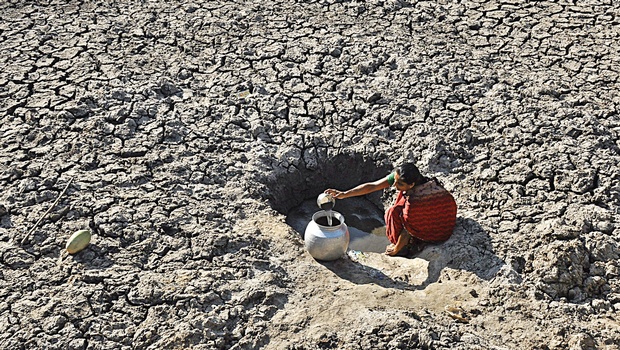
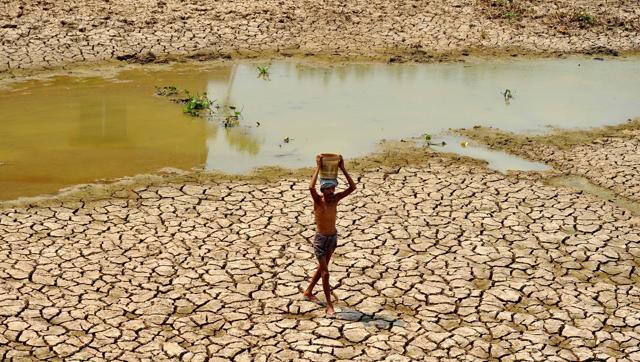
This year has seen the globally hottest-ever April, and indications point to the worst-ever summer. The media is reporting rock bottom reservoir water levels at the start of summer, and dire predictions of worse days to come for farmers and rural people, and also urban dwellers. Due to this worst drought in living memory that has hit most of India, around 300 million people, as estimated by one source, are migrating. One can only wonder why this on-going tragedy does not make it to the front pages of newspapers.
The callousness of many leaders towards this national crisis is revealed by their finding the time to pat themselves on the back, announce and celebrate their “achievements” at public expense and give themselves raises in their own salaries, but not finding time to visit drought-hit people or allocate sufficient funds for drought relief. It needed the Supreme Court of India to goad state and central governments to commence serious action to provide water to thirsty populations.
There are fears of water-based conflicts within and between the societies of rural and urban areas. These have happened in the past, but the scale of conflicts may be more intense and widespread in 2016 if, for example, the heated official exchanges regarding water demands of downstream Delhi and Haryana and upstream Punjab over the Sutlej-Yamuna Link (SYL) Canal are any indication.
While there are several important aspects to the water issue, only two major aspects are addressed here due to space restrictions, namely, the governance involved in urban water supply, and the “solution” of interlinking rivers (ILR).
Water governance in urban areas
Governments are giving conflicting reports in the media, with some officials saying that it is possible to tide over the urban scarcity, and others saying that conditions are going to get much worse. Officials of course insist on anonymity, for fear of action against them, while politicians do their standard politicking, and grandly pass orders to the officials to “ensure that drinking water supply is not interrupted”.
Always at the receiving end of slipshod governance, most people get water for a few hours once in two or three or seven days while some get water daily, enabling their domestics to wash cars and driveways with a hose. When a water pipe bursts (not uncommon because of inferior materials and/or poor workmanship due to corrupt practices) the water supply authority reacts tardily, and millions of litres of precious water gush away into the drains, even while thousands line up with pots at street pipes, and the better-off purchase water from tankers operated by a water-tanker mafia.
Public announcements calling for water conservation are rare and, when issued, they politely call upon citizens to cooperate and use water carefully, even while non-working water meters, illegal water connections and unpaid water bills place financial strain on the water suppy system. The reason for politeness of tone and request for cooperation in a decidedly grim, even desperate situation, is clear evidence of weak governance stemming from systemic corruption. Public determination to handle the worsening situation is essential, to find a viable course of action.
Essential measures
When the sources of water fail, focus needs to shift from demand-driven supply augmentation to managing available water through realistic demand management. Some of its essential facets itemized are:
# Improve system efficiency including planning distribution and delivery, infrastructure and renewals, electrical energy costs, personnel training.
# Revise tariff with steep rates for high consumption.
# Enforce existing by-laws and rules regarding functioning of meters, illegal connections and unpaid bills, with appropriate penal action against defaulting consumers and staff.
# Address system water-loss and assure minimum supply timings.
# Periodic public programs for water conservation.
# Use IT management tools (GIS and MIS) for realizing revenue.
Interlinking rivers
The interlinking rivers (ILR) project estimated in 2002 to cost at least Rs.5,60,000 crores (but more likely Rs.10,00,000 crores), seeks to link 30 major rivers with 37 mega canals, involving acquiring an estimated 6,00,000 hectares of land, for mass-transfer of flood water from “water-surplus” areas to drought-prone “water-deficit” areas, to simultaneously relieve flood and drought. While the proposal appears attractive, it has serious inconsistencies, only two of which are outlined here. (For more details, please see References).
Firstly, flood water is to be sourced from Ganga near Bhagalpur which is at about 60-m elevation above MSL, where flood flow averages 50,000 cumecs. The maximum that a canal of 100-m width and 10-m depth can carry is 2,000 cumecs of water, which will “relieve” the flood by a mere 4%. Apart from the huge initial and annual maintenance costs to keep the water flowing into the canal and removing sediment, this 2,000 cumecs can only flow by gravity to levels lower than 60-m elevation on the East coast, whereas the drought-prone areas are on the Deccan plateau at levels over 1,000-m elevation. Thus neither flood nor drought can be relieved by interlinking.
Secondly, the flood season is for four monsoon months. During 8-months dry season, Ganga flows at an average 5,280 cumecs. The headworks of the interlinking canal will be far from the main flowchannel, and feeding the canal with water will call for expensive heavy engineering every year besides, much more importantly, handling the strong resistance of people of the region who will resist transfer of 2,000 cumecs (38% of water) in the dry season when they need it most.
Thus, since neither flood nor drought can relieved, and the system will have questionable utility during monsoon and be useless in the dry season, making it economically unviable. The argument of mass transfer of water from “water-surplus” to “water-deficit” areas is fundamentally flawed.
The promotion of water-sharing through grandiose plans of dams and canals to interlink rivers, by quoting the mandate of a distant Court of Law will not slake the thirst for water for drinking or agriculture. The fact that there are several unresolved inter-State water disputes before water disputes tribunals indicates that water-sharing between States is essentially problematic. Even between districts within the same State, water disputes have had to be bulldozed by State governments, leaving sullen, disillusioned, water-starved populations. In the general context of national water stress, pressing ILR can only lead to more social unrest and political instability.
The fact is that every State needs and wants water and they are loathe to part with water. In situations of dire water shortages, whatever the method of its computation, local compulsions will predominate over the dictates of distant seats of executive or judicial power. Enforcement of the writ of governments, whether due to their own political expediency or their being forced by superior courts of law, can only be by use of state police, central police and military force. Resort to such strong-arm measures with regard to water will indicate that governance has failed and the situation is outside the scope of political management. Indeed, in Latur (Maharashtra), Police have been posted near water sources to protect the water and ensure that people do not “steal” water from the source!
What a situation!
The present water situation is at best sub-critical. Only efforts to holistically understand the problems and their magnitude can provide genuine relief in the present, and effect a relatively easy transition to a future of certainly lowered water availability.
The ILR project is essentially a demand-based, supply-augmentation, systemically flawed macro “solution”. The examples of the SYL Canal (an incomplete canal for water-sharing between three States) and the Cauvery River (the water of the river being less than the total demand of the riparian states) should be indication enough of the political problems of ILR, which can snowball into constitution-shaking proportions.
India, already severely water-stressed in a warming globe, is in the midst of a water-crisis which is predicted to repeat itself. We have entered the era of the consequences of thoughtless supply-side management practices. The urgent need is for socially sensitive, economically viable demand-side water management.
Failing to build democratic and effective water management structures for democratic governance processes will risk violent social situations due to water conflicts. Political leaders in the States and the Centre need to come out of their “Nero-fiddling” role and firmly steer a course away from impending chaos and disaster. The way forward is local water conservation and management.