28 Jun 2016

New Zealand extends military deployment in Iraq

Tom Peters

The National Party government announced on June 20 that New Zealand’s military deployment in Iraq would be extended by 18 months. The 143 soldiers stationed in Iraq were due to return next May, but will now remain until at least November 2018. The extension is in response to a request by the Obama administration, which recently asked for an increased contribution from about 60 coalition partners in the war in Iraq and Syria.
Until recently, Prime Minister John Key had repeatedly insisted that the troops would be in Iraq for only two years. In an interview with TV3 following the initial deployment last year, Key said, “This is about making a contribution and leaving ... we could be in the Middle East forever if we don’t take that approach.” Now the government has indicated that even the new end date may be pushed back, meaning New Zealand forces could well remain indefinitely.
The decision to join the Obama administration’s renewed US war in Iraq in May 2015 was completely anti-democratic and in defiance of widespread anti-war sentiment. Prior to the September 2014 election, Key publicly supported the war but said he was unlikely to send troops.
The extension was cynically justified on the pretext of fighting terrorism. Defence Minister Gerry Brownlee absurdly told a press conference, “We’re not insulated from the sort of thing that we saw in Orlando,” referring to the mass shooting of 49 people at a gay nightclub in Florida. There is no evidence the gunman was directed by ISIS; he appears to have been driven mainly by psychological problems, including hatred of homosexuals, fuelled by his own conflicted sexuality, and apparent racism.
The US-led intervention is an imperialist operation aimed at securing hegemony over Iraq, Syria and the entire Middle East. ISIS itself is the product of Washington’s criminal wars: the CIA and US allies including Qatar, Turkey and Saudi Arabia, funding and arming Al Qaeda-linked militias as proxies in wars for regime change in Libya and Syria. Now the US-backed Iraqi government’s forces and Shia militias are reportedly carrying out sectarian massacres against Sunni populations as they re-take territory from ISIS.
Key told the media he had turned down a US request to send elite Special Air Service (SAS) commandos to Iraq. Instead, New Zealand troops would continue in a “non-combat” role, providing training for the Iraqi Army at the Taji and Besmaya military camps.
The mission is shrouded in secrecy, however, and the government’s assertions must be treated with great scepticism. Only 16 of the 143 soldiers initially deployed were specialist trainers, with the rest described as “support” forces. Speaking to the Waatea 5th Estate TV program, investigative journalist Jon Stephenson said it was likely NZ soldiers and intelligence agents were “working as part of the kill chain, helping with intelligence relating to air strikes and other activities.”
For several years, New Zealand’s Government Communications Security Bureau (GCSB) spy agency has worked alongside the Defence Force to help identify targets for US air strikes in Afghanistan and Pakistan. This role was kept secret and only revealed by journalist Nicky Hager in 2011, in his bookOther People  s Wars, based on leaked Defence Force documents. In 2014, US journalist Jeremy Scahill confirmed that New Zealand was “directly involved with what is effectively an American assassination program,” including drone strikes in Yemen.
Earlier this month Defence Minister Brownlee announced a separate six-month deployment of up to 40 Defence Force personnel and an air force Hercules plane to work with Australian forces, ostensibly to transport goods and personnel “in Afghanistan, Iraq, and other parts of the world.” No other details have been released about the mission.
The opposition Labour Party criticised the extended deployment in Iraq, but the party supports the US intervention and has openly proposed that the GCSB could assist in planning air strikes in Iraq. Leader Andrew Little has also stated that he would be open to sending the SAS to Iraq as part of a UN-mandated mission.
Speaking to Radio NZ, Little said he opposed the training mission because the Iraq Army was not as effective at fighting ISIS as “the counter-terrorism service, the Shia militias and the Kurds.” Asked whether Labour would withdraw the troops if it wins next year’s election, Little declined to make a definitive statement, adding that Labour might re-deploy soldiers as so-called “peacekeepers” instead.
Following a recent visit to Iraq, Little told TV3 he “saw some great stuff happening in Camp Taji, great work that our folks are doing out there.” Calling for an expanded war, he stated that “the world” had to “push back against ISIS” in Iraq, Libya, Syria and “other parts of the Middle East.”
The 1999–2008 Labour government cemented military and intelligence ties with Washington by sending troops to Afghanistan and Iraq, despite initially claiming to oppose the US invasion of Iraq. A re-elected Labour government will behave in the same way.
The Green Party, which has spoken against the extended deployment in Iraq, supported New Zealand’s participation in the war in Afghanistan. The Greens recently signed a “Memorandum of Understanding” with Labour and the parties hope to form a coalition government after the 2017 election.
New Zealand’s pseudo-left groups, the International Socialist Organisation, Fightback and Socialist Aotearoa, have remained silent on the government’s latest announcement and Labour’s pro-war statements. These groups support the US-backed militias in Syria, fraudulently painting them as the leaders of a “revolution” against the Assad regime.
Every party in parliament, including the Greens, supports the $20 billion in military spending announced in the recent Defence White Paper, aimed at strengthening military interoperability with the US and Australia. The spending will further integrate New Zealand into the US preparations for war, particularly against China, in exchange for Washington’s backing for NZ neo-colonial interventions in the South Pacific.

Australian youth face historic social reversal

John Davis

Young people in Australia, aged 15–24 years, are the first generation since World War II to face lower living standards than their parents. That is the conclusion of a recent report by the Foundation for Young Australians (FYA), which provides an outline of the worsening social and economic conditions.
The report, titled “Renewing Australia’s Promise,” shows that today’s youth confront higher unemployment and under-employment, more insecure part-time and casual work, extreme housing costs, greater debts and higher tuition fees than their counterparts three decades ago. This historical retrogression is a damning indictment of the capitalist profit system.
The job prospects for youth today are among the worst on record. Even on understated official figures, youth unemployment is around 15.7 percent for 15–24 year-olds, and 28.7 percent for those 15–19 years old. In some working class areas, unemployment has reached depression-era levels of over 40 percent.
Combined overall rates for unemployment and under-employment (those unable to find sufficient work) among youth is now almost 30 percent, compared to under 20 percent in 1985. On average, young people currently remain unemployed for five months.
The FYA report notes that, today, approximately 50 percent of young people are in part-time work, 2.8 times higher than 1985, when it was at 16 percent. Youth under-employment is at 17.5 percent, 3.4 times higher than in 1985. In 2015, full-time employment for young workers was at 40 percent, down from approximately 70 percent in 1985.
One of the most staggering aspects of the reversal of workers’ conditions is exorbitant housing costs, facilitated by a speculative property bubble. The report notes that in the mid-1980s the average Sydney home cost six times the average full-time annual income in the state of New South Wales (NSW).
Last year, the average home costs 13 times the average full-time annual income in NSW, and the average Sydney homebuyer required 15 years to save a deposit.
This places home ownership out of reach for many working class youth, while many others have been forced to take on huge mortgages, leaving them vulnerable to fluctuations in their incomes.
The report reveals that the average rental costs have increased by 44 percent since 2005, forcing many youth to continue living with their parents, or move into overcrowded shared housing. Hundreds of thousands of working class households have moved to cheaper housing in the outer suburbs of major cities, producing intolerable travelling times to get to work.
The report also identifies a protracted assault on education. The cost of a three-year university degree in 2016 averages $26,298, up from $19,518 in 2011, and around 2.5 times more that in 1991. From 1974 to 1987, university courses were free. In 1987, the Hawke Labor government introduced HECS payments to shift tuition costs from the government to students, and a mountain of student debt has grown ever since.
There has been an increase in the numbers of students completing school and university, but many end up not working in fields in which they are qualified. Among university graduates, 29 percent are working in jobs not relevant to their degree, while for Vocational Education and Training (VET) graduates the figure is 62 percent.
Overall, regardless of the qualifications and merits of students, there has been a reversal in the conditions of life of thousands of young people.
None of the major parties have addressed these issues during the campaign for the July 2 federal election. Instead, their policies are designed to push more unemployed youth into cheap labour, and use them to drive down wages and conditions for all workers.
Labor Party leader Bill Shorten has proposed a program that will offer minimum wage traineeships for 30,000 young people per year, on the pretence of providing training for non-existent jobs.
Likewise, the Liberal-National government’s PaTH (Prepare, Trial Hire) scheme aims to force unemployed youth under the age of 25 into six-week “pre-employment” courses, providing private employers with low-cost interns, effectively working for $4 an hour on top of their dole payments.
As for the trade unions, they have enforced decades of job destruction and erosion of workers’ conditions, creating the conditions for the super-exploitation of young workers.
The FYA report underscores the historical trajectory of the attack on working people by successive governments, both Labor and Liberal-National. The protracted assault on working conditions over the past 30 years is not simply the outcome of their regressive policies. Their policies are determined by the profit interests of the major banks and corporations, reflecting the relentless processes of the capitalist profit system itself.
Regardless of which party forms government after July 2, the financial and corporate elite will insist that the working class has to bear the brunt of the deepening impact of the 2008 global economic breakdown.
The Socialist Equality Party insists that young people must have the right to free, high-quality education, a decent job, healthcare, affordable housing, and access to leisure, art, culture, sport and entertainment. But this is not possible without breaking the grip of the financial oligarchy and its political servants.
If the living standards of millions of workers and youth are not to be devastated, the capitalist system must be overthrown through an international struggle of the working class on the basis of a socialist program to reorganise society to meet the needs of all, not the profit requirements of a wealthy few.

Taiwanese airline cabin crews strike

Ben McGrath

Flight attendants from Taiwan’s flag carrier China Airlines (CAL) went on strike Friday over attacks on their working conditions. It was the first strike in the history of a Taiwanese airline. After just under five hours of talks between the company and the Taoyuan Flight Attendants Union (TFAU), the company supposedly agreed to the workers’ demands and the walk-out was called off. Strikers were set to return to work today.
The strike was preceded on Thursday night by a protest of nearly 500 union members and supporters outside the CAL offices at Taoyuan International Airport in Taipei, Taiwan’s capital. They were joined by another 1,000 flight attendants at midnight when the industrial action officially began. The crew members chanted, “Reverse labor-capital relations” and carried signs that read, “Strike not arbitration.”
TFAU members had overwhelming voted to strike last Tuesday—2,535 flight attendants, or 96 percent of the union’s total membership, took part in the poll to authorize the action. Only nine votes were cast against the walk-out. However, the union isolated the struggle, even from other CAL workers, whose own working conditions are no less under attack. The supposed adoption of the union’s demands also will apply only to TFAU members.
Founded in 1959 as a state-owned enterprise, the government has since privatized CAL, while remaining a major shareholder.
Anger has been building among flight attendants, as well as other workers in the airline industry, for years. Recent changes by CAL, coming on top of already low pay and long working hours, led to the strike, as well as protests in May where the cabin crews denounced “enslavement contracts.”
Before the strike even began, CAL’s new chief agreed to scrap a new plan aimed at cutting official working hours. Ho Nuan-hsuan was appointed chairman of the company last Thursday by the government in a bid to quell discontent. Ho indicated he would drop a further move to enforce speedups and reduce rest time.
The airline’s plan would have changed where flight crews could report for work, from the downtown Taipei International Airport to Taoyuan International Airport, farther from the city. CAL hoped to eliminate the 80-minute commute time between locations, currently considered part of the total working hours. By doing so, the company planned to halve time for preparation and post-flight duties to 90 minutes and 30 minutes respectively. It would also have cut rest times.
In addition, the company pushed for an agreement that would have raised the number of working hours to 220 per month, more than the 174 hours allowed under the Labor Standards Law. Section 84-1 of this legislation allows certain companies, including those in aviation, to ignore this cap. CAL argued the change was necessary due to some long-haul flights, such as those to the US or Europe.
CAL has also reportedly made further concessions. The company has agreed to raise the subsidy for those working overseas from $3 an hour to $4 on July 1 and then $5 next May. Flight attendants will receive 123 off days, up from 118.
CAL’s supposed acquiescence to union demands is a maneuver to buy time while getting flights back into the air; an estimated 20,000 passengers were affected by the strike. The agreement is only preliminary and could change. “We can sign an agreement based on article 84-1, but its content has to be appropriate to our work conditions and environment,” said TFAU vice-president Betty Hung, indicating that concessions to the airline were still on the table.
The TFAU is attempting to portray itself as a radical workers’ organization, saying in a statement it would “become the vanguard of workers in this battle, and tell capitalists and the state that Taiwan must say goodbye to the era of overwork and long hours.” Rather than appealing to workers throughout Taiwan, let alone internationally, the TFAU said it was trying to “wake up” the government stockholders.
Any agreement reached between the company and TFAU will only apply to its members. The majority of CAL’s workers, however, belong to the pro-company Employees Union (CAEU), whose head Ko Tso-liang, denounced the flight attendants for voting to strike. He compared them to “children,” saying they had “battered the company’s reputation and its sustainable development” as well as “affected the livelihoods of the firm’s employees.” TFAU was founded last September after flight attendants got into a dispute with the CAEU.
Other CAL unions include the China Airlines Maintenance and Engineering Labor Union, which had verbally expressed support for the TFAU, but did not join the strike, despite claiming at the end of May it would. The airline is planning to create a subsidiary called Taiwan Aircraft Maintenance and Engineering Company to service newer planes in their fleet while also hiring more dispatch workers at hourly rates. The existing CAL workers would continue to service older planes, raising fears of job cuts when those models are retired.
Regardless of how “militant” a union may present itself, these organizations are incapable of a genuine defense of workers’ rights and interests. In conditions of increasingly cut-throat struggles in the global airline industry, the unions invariably side with “their” employers to slash pay and conditions and suppress opposition, so as to try to ensure the “international competitiveness” of the national companies.
Tsai Ing-wen, Taiwan’s new president, has postured as a friend of the flight attendants, to deflect widespread anger toward social conditions in general, which her administration is incapable of addressing. Tsai, who was sworn in on May 20, currently has an approval rating of 52.4 percent, considered low for a new president. She claimed to respect and defend the right to strike, but her government will defend the interests of the Taiwanese bourgeoisie no less ruthlessly than her predecessors.

After Brexit, mounting warnings of global slump and financial panic

Andre Damon

The global economic fallout of Thursday’s referendum by Britain to leave the European Union continued over the weekend amid growing warnings that the ongoing market sell-off, which wiped $2.5 trillion from the values of world equities markets Friday, is only the most visible manifestation of a much deeper crisis of the global economy.
Over the past month, both the International Monetary Fund and Federal Reserve chairwoman Janet Yellen have warned in effect that the US and world economy face conditions comparable to what some economists have called “secular stagnation,” characterized by a long-term reduction in growth rates.
On Sunday, the Bank for International Settlements (BIS), sometimes referred to as the “central bankers’ bank,” added its voice to this chorus. It warned of deep-rooted problems in the global economy.
The report, which was drafted prior to Thursday’s referendum, said the world economy was “threatened by a ‘risky trinity’: debt levels that are too high, productivity growth that is too low, and room for policy manoeuvre that is too narrow.” It cast doubt on the ability to continue to combat crises with monetary policy.
These warnings came as virtually every global central bank issued a statement saying it would either begin or was ready to implement a further expansion of liquidity measures in response to the share selloff. Markets are increasingly betting that the Federal Reserve will halt, or even reverse, its announced plans to begin raising interest rates.
In the latest such measure, the Japanese government of Prime Minister Shinzo Abe and the Bank of Japan, announced the provision of additional funds to the financial system. This fueled a small stock market rally in early trading Monday, despite continued turbulence in global currency and other equity markets and the on-going sell-off of the British pound, which fell two percent.
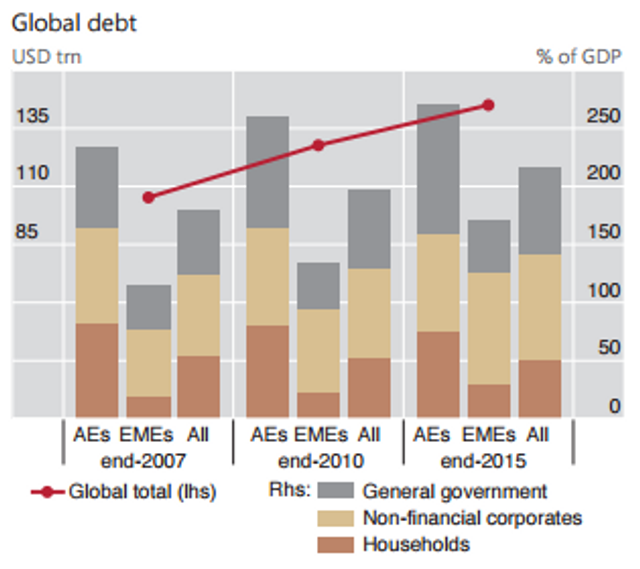
The BIS warned that the response of global central banks to the crisis that erupted in 2008 had been dominated by the creation of asset bubbles through low interest rate policies. These conditions have weakened productive investment, fueled a global expansion of debt, making it near impossible for central banks to respond in an effective manner to the eruption of new crises.
“The global economy cannot afford to rely any longer on the debt-fueled growth model that has brought it to the current juncture,” warned the report, adding “we badly need policies that we will not once again regret when the future becomes today.”
The report, on technical grounds, rejected the use of the term “secular stagnation,” a concept developed in the 1930s to describe the Great Depression and used by former Treasury Secretary Lawrence Summers to refer to the current crisis. But the content of its analysis amounted in effect to the same thing.
“The crisis appears to have permanently reduced the level of output,” it said, adding, “given the almost unprecedented breadth and depth of the recent crisis, it would be unrealistic to think that output could regain its pre-crisis trend.”
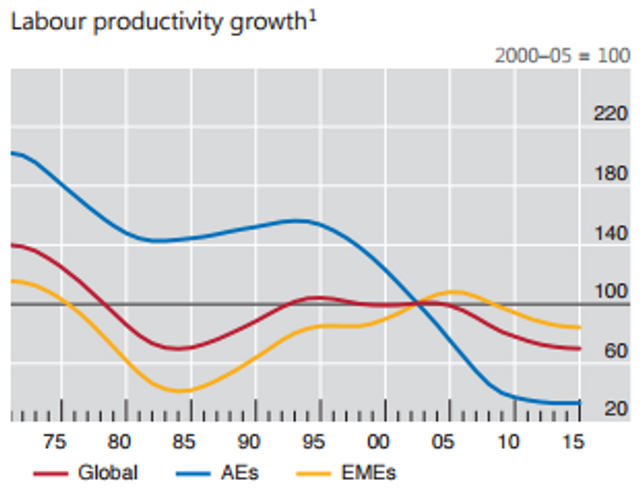
The report pointed to the “persistent and otherwise puzzling” global slowdown in productivity growth. It tellingly attributed the slowdown to the effect of a massive series of booms and busts that have characterized the global economy in recent years as it has become increasingly dominated by financialization and speculative mania, fueled by virtually unlimited cash from global central banks.
Labor productivity has plunged, particularly in advanced economies. Source: Bank for International Settlements
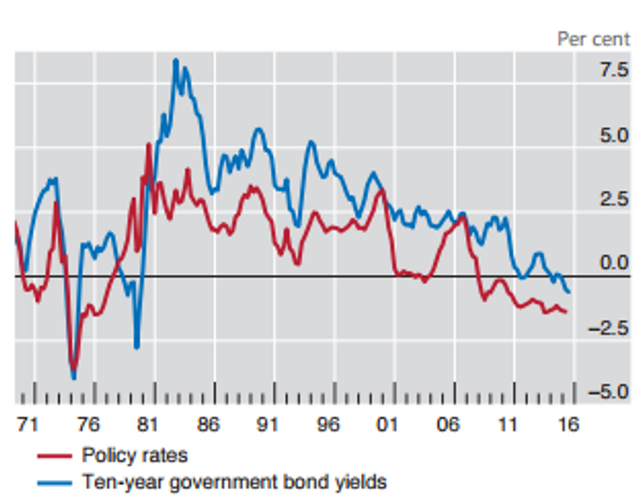
The BIS warned that these policies facilitated “the persistence of exceptionally low interest rates, increasingly negative even in nominal terms.” The growth of negative interest rates, promoted by central banks seeking to reassure the markets, is a risk with “a long fuse, with the damage less immediately apparent and growing gradually over time. Such rates tend to depress risk premiums and stretch asset valuations, making them more vulnerable to a reversal by encouraging financial risk-taking.”
Global central bank interest rates have plunged below zero, leading to the growth of negative-yielding assets. Source: Bank for International Settlements
This refers to a situation where, because interest rates are pushed down on relatively secure assets, speculators have to undertake increasingly risky bets to secure the same rate of return as they did in the past.
In other words, all the actions taken by global central banks since the 2008 crisis, and stretching back as far as the US Federal Reserve’s response to the 1987 stock market crash, have only exacerbated the cancerous growth of financial parasitism. This is the “fuse” that triggered what the BIS calls the “Great Financial Crisis” of 2008, and threatens to blow up again.
The report pointed to the continuation of extraordinarily accommodative monetary policy, leading to an even further build-up of debt trading at negative yields, a phenomenon the BIS first warned about in last year’s annual report. In that period, “Inflation adjusted policy rates have edged deeper below zero, continuing the longest postwar period in negative territory.” It added that “the Bank of Japan has joined the ECB, Sweden’s Riksbank, Denmark’s Nationalbank and the Swiss National Bank in adopting negative nominal policy rates.
As a result, “at the end of May, close to $8 trillion in sovereign debt, including at long maturities, was trading at negative yields—a new record.”
Due to the continuous infusions of cash into world markets, “monetary policymakers have found it harder to push inflation back in line with objectives,” leading to economic slump. It added, “In the process, financial markets have grown increasingly dependent on central banks’ support and the room for policy manoeuvre has narrowed.” These facts are already “shaking public confidence in policymaking.”
Global debt has soared in the aftermath of the 2008 financial crisis. Source: Bank for International Settlements
Tellingly, however, the BIS had no solution to the ongoing crisis besides further austerity measures. It called for slashing government debt while improving the “quality of public spending… notably by shifting the balance away from… transfers.” In other words, too much is being spent on social services—such as Social Security, Medicare, and Medicaid in the United States—and not enough is being used to subsidize business activity.
In reality, the types of fiscal austerity measures and labor market restructuring called for by the BIS have been brought forward in every major economy in response to the 2008 crisis. These range from the United States, where state education spending has been slashed by 25 percent, to Greece, Spain, Portugal and, most recently, France, with the implementation of the El Komri labor reforms by the Hollande government, where sweeping social cuts have been combined with attacks on protections for workers' jobs and conditions.
These policies have transferred ever more wealth to the financial elite, who have proceeded to use their cash hoards for speculation and financial parasitism, fueling a vicious cycle of economic stagnation, rising inequality and financial crisis, in turn inflaming international antagonisms and the growth of protectionism.

Turkey-Israel Deal Leaves Gaza Siege Intact

Ali Abunimah

Palestinians in the Gaza Strip expressed anger and dismay on Monday about the deal normalizing relations between Israel and Turkey that leaves them under a suffocating siege.
An Israeli human rights group that monitors the decade-old Israeli blockade of Gaza has also confirmed that the deal does not end Israel’s tight control over the territory that has greatly exacerbated the devastation to Gaza’s economy and society from three major Israeli military assaults since 2008.
Turkey put its once close military and political relations with Israel in the deep freeze six years ago, after Israel attacked the Turkish-owned Mavi Marmara as it sailed in international waters as part of a flotilla to Gaza in May 2010, killing nine people and fatally injuring a tenth.
Turkey imposed unprecedented military sanctions on Israel in 2011 over the incident.
Efforts at reconciliation had been stalemated by the conditions demanded by Turkish President Recep Tayyip Erdogan: an Israeli apology and compensation over the Mavi Marmara attack and an end to the siege of Gaza.
The breakthrough apparently came when Turkey dropped the third and biggest of these demands and accepted that Israel would maintain its blockade.
In a face-saving measure, Israel will allow Turkey to increase its “humanitarian” role and infrastructure projects in the besieged territory.
Positive spin
The Turkish government has tried to spin the deal positively. A senior official told The Electronic Intifada that under the deal Turkey “will deliver humanitarian aid and other non-military products to Gaza and make infrastructure investments in the area.”
This would include new residential buildings and a 200-bed hospital.
The official added that “concrete steps will be taken to address the energy and water crisis in Gaza. The amount of electricity and drinking water to Gaza residents will increase and new power plants will be constructed.”
At a press conference in Ankara, Turkish Prime Minister Binali Yildirim asserted that the siege on Gaza had been “largely lifted” as a result of the agreement.
Yildirim confirmed that Israel would pay $20 million in compensation to the families of the dead and to injured survivors of the Mavi Marmara raid. He said a first shipment of 10,000 tons of Turkish aid would be delivered to Gaza later this week through the Israeli port of Ashdod.
At a simultaneous news conference in Rome, Israeli Prime Minister Benjamin Netanyahu hailed the agreement for its “strategic importance” to Israel and affirmed that what he called the “defensive maritime blockade” of the occupied Gaza Strip would remain.
Netanyahu also said that the deal gives Israeli soldiers protection from prosecution.
Victims of the Mavi Marmara attack have pursued justice in Turkish and US courts as well as in the International Criminal Court. The deal leaves the status of these lawsuits unclear.
According to the Turkish official, the agreement will also “make it possible for Turkey to launch major projects in the West Bank, including the Jenin industrial zone.”
But as I documented in my 2014 book, The Battle for Justice in Palestine, Palestinian analysts and rights groups say the Jenin industrial zone and others like it, far from helping them, may only make them more vulnerable to environmental, labor and political damage and exploitation.
“Scandal and insult”
Gisha, an Israeli human rights group that monitors Israel’s blockade of Gaza, said the deal did nothing to challenge Israel’s “shameful” control over the lives of 1.9 million Palestinians in Gaza.
“What Netanyahu has given Erdogan is not a change in policy, but rather a circumscribed gesture, like allowing him to put down plastic buildings in a game of Monopoly,” Gisha’s director Tania Hary wrote in a scathing op-ed in the Tel Aviv newspaper Haaretz.
Palestinian commentators from Gaza agreed.
“The Turkish-Israeli deal is a scandal and an insult to Palestine/Gaza and to the blood of Turkish activists,” Refaat Alareer, an educator and writer tweeted.
Alareer called the agreement a “deal of shame.”
“Lifting Gaza siege means freedom of movement, not more food and aid,” Gaza writer Omar Ghraieb tweeted. “Is that too hard to comprehend?”
“It’s not acceptable to speak lightly of [the] Gaza siege saying it’s largely lifted when it’s still affecting [the] lives of two million people,” Ghraieb added in rebuke to the Turkish prime minister.
Gaza-based translator Jason Shawa tweeted, “We want lift of the siege, not your charity Erdogan, Keep it!”
“Turkey’s interests first, ties with Gaza later,” was the succinct reaction of Gaza journalist Nidal al-Mughrabi.
Turkey has been under pressure for years, especially from the administration of US President Barack Obama, to mend its ties with Israel.
As a consequence of the bloody civil war in Syria, in which Ankara has supported forces seeking the overthrow of the government of President Bashar al-Assad, Turkey has faced a deteriorating regional situation.
Bomb attacks that have killed dozens of people in Turkish cities in recent months have contributed to a catastrophic 40 percent decline in tourism, a key sector of the country’s economy.
Netanyahu has also hinted that the rapprochement could pave the way for lucrative deals over Mediterranean gas reserves involving Turkey.
Turkey’s Yildirim was more cautious, saying that future cooperation would “be tied to the efforts of the two countries.”
Shares in Turkish energy firms that work in Israel rose sharply on news of the agreement, as did Israeli energy stocks in Tel Aviv.
Administering siege
The Palestinian Authority in Ramallah welcomed the Israel-Turkey rapprochement, but there was no immediate reaction from Hamas.
In recent days, Hamas, the Palestinian political and resistance movement that rules the interior of the Gaza Strip, has tried to limit the potential negative fallout from the Turkey-Israel negotiations.
Over the weekend, the movement’s leader, Khaled Meshaal, met with President Erdogan in Ankara.
statement from Hamas said that the group’s delegation “confirmed to the Turkish leadership the demands of our people, especially the lifting of the siege, confident that Turkey will succeed in this matter.”
The senior Turkish official informed The Electronic Intifada that “there are absolutely no references to Hamas in the agreement” with Israel, an apparent response to Israeli demands that Erdogan shut down the movement’s activities in Turkey.
But the reality is that while Turkey is going to deliver more aid to Gaza – assuming Israel keeps its side of the bargain – it will only do so under the siege conditions imposed by Israel.
It will be difficult for many Palestinians to avoid the conclusion that Turkey has joined other members of the so-called international community, especially the United Nations, in helping Israel administer the siege rather than challenging its continuation.
The UN has been complicit in administering the siege under the so-called Gaza Reconstruction Mechanism, which allows building supplies to trickle in under tight Israeli control.
The Gaza Reconstruction Mechanism is illegal and violates the very “right to life” of the Palestinian people, according to a confidential legal opinion prepared for a major aid agency that works closely with the UN, as was revealed by The Electronic Intifada in January.

The Turkish Game Plans

Vivek Kumar Srivastava

Turkey has announced to restore its diplomatic relations with Israel almost after six years gap. Turkish President Erdogan has also tendered an apology to Russia for the downing of a Russian  SU-24 plane in last November, after which Russian President Putin had taken strong steps with respect to Turkey. Sanctions were put on Turkey causing a lot of harm to it.
Turkey has also decided to reemphasize for its membership of EU and wants referendum in the country on the issue. Discussions are likely to start between Turkey and EU since 30th June.  Relations with GCC and Saudi Arabia and UAE are also being nurtured. Turkey-GCC relations were on decline since a long time.
These developments are very strange and sudden. These need to be understood in terms of rapidly changing power configuration in the region. Turkey has realized that Russia has succeed in breaking the backbone of IS, its evidence is seen in the battle of Fallujah where IS has lost a big chunk of its fighters and Iraq’s PM Haidar al-Abadi has announced its recapturing. Russia has withdrawn from the region only with respect to air attacks but it has strengthened itself in the region; Syrian President Bashar Al Assad has been strengthened in the mean time and the US-Turkish plan for his removal has been weakened. The Russian policy in the region has paid dividends to Putin. These may move forward and affect the Erdogan’s status and Turkish political structure in the region. The apology is therefore acceptance of the Putin’s win, Assad’s strengthened position.
Along with it Turkey has its own brand of religious conservatism and goals; which differs from Saudi Arabia, but both seem to be working on accepted  agenda but recent changes in the region have reduced the Turkish capability; these cumulative factors have pressed it to reformulate its  foreign policy.
Turkey has decided to restore the diplomatic relations with Israel after six years. Turkey knows that Russia has penetrated in the region. Hence alignment with like minded countries should be initiated. Israel and Turkey both have problems with Assad in Syria; both have common interests in the region. US also seems to have played a role in impressing the Turkey that better relations need to be established with Israel in the wake of  increasing Russian influence in the region. Israel is also aware that there is now fluid condition in the region and the opponent groups including Hamas, Hezbollah are to be contained; hence the Turkish offer will not be rejected by Israel.
Turkey has also decided to renegotiate with EU on its entry in the weak EU after the exit of UK. There is a large group in EU and in UK also which did not want Turkey to be a part of EU for which it has been trying since last decade but without any substantial success. UK was never willing that Turkey be a part of EU, Tory party in England had always believed that its membership will bring influx of Turkish Muslim people in the region and also inside UK; PM David Cameron  had stated sarcastically in May 2016 that by year 3000 Turkey will be able to gain the membership.  The Brexit went against the common expectation because several factors played their role in this decision but one factor was related to the issue of membership of Turkey in EU; now with the exit of Cameroon and UK from the EU, Turkey has now decided to reengage with the EU. At present Turkey is the main transit point of the Syrian refugees going to Europe and houses the most immigrants fleeing from the adjoining area.
The role of the Turkey has become quite important for EU to survive; EU desires that refugee’s burden be borne by Turkey, in return Turkey may get the membership of the European Union. The problem in the region which started from Arab spring got accentuated when refugee problem emerged is a serious way, affecting directly the Turkey and later on took its toll on EU. The UK’s exit is a big shock to the philosophy of European integration and its tremor will cause more withdrawal, Netherland, and ‘the happiest country in the world’ Denmark may follow the suit. Turkish efforts towards the EU will bring more destabilization in the Union. As the issue of integration and coexistence of Christian and Muslim value system have come into fore in Europe. Turkish efforts will accentuate this issue further but at present both needs each other.
Turkey has also decided to come closer to GCC since last few months; main reason is that Turkey and Saudi Arabia have similar policy approach towards Syria. Turkey also knows that its domestic conditions are not positive. US has supported the Kurds in the region, its major worry is therefore to maintain its advanced status in the region and without the support of Israel, Saudi Arabia and EU, it can’t do so. Iran is another cause of worry. For Saudi Arabia the whole balance of power in the region is now altered after lifting of sanction against Iran by world community. Saudi Arabia is not happy with USA on this issue; the regime in the country has already been weakened and is much dependent upon USA. The fundamentalist culture in which Saudi Arabia’s regime has contributed; with violation of human rights are the underlying factors which will lead to the downfall of the regime. These realistic appreciations by Saudi Arabia have impressed it to give a space to Turkey.
The convergence of interests is taking place in the region. The blocks are under formation. Turkey’s recent efforts are expression of it  but Turkey’s efforts for a new foreign policy will not bring any positive successes as long as the region is not  saved from the fundamentalist ideas which are state sponsored effects and the policies of big powers which dictate the terms in the region.
Russian President Vladimir Putin meets with President of Turkey Recep Tayyip Erdogan

The Age of Disintegration: Neoliberalism, Interventionism, The Resource Curse, And A Fragmenting World

Patrick Cockburn


We live in an age of disintegration. Nowhere is this more evident than in the Greater Middle East and Africa. Across the vast swath of territory between Pakistan and Nigeria, there are at least seven ongoing wars — in Afghanistan, Iraq, Syria, Yemen, Libya, Somalia, and South Sudan. These conflicts are extraordinarily destructive. They are tearing apart the countries in which they are taking place in ways that make it doubtful they will ever recover. Cities like Aleppo in Syria, Ramadi in Iraq, Taiz in Yemen, and Benghazi in Libya have been partly or entirely reduced to ruins. There are also at least three other serious insurgencies: in southeast Turkey, where Kurdish guerrillas are fighting the Turkish army, in Egypt’s Sinai Peninsula where a little-reported but ferocious guerrilla conflict is underway, and in northeast Nigeria and neighboring countries where Boko Haram continues to launch murderous attacks.
All of these have a number of things in common: they are endless and seem never to produce definitive winners or losers. (Afghanistan has effectively been at war since 1979, Somalia since 1991.) They involve the destruction or dismemberment of unified nations, their de facto partition amid mass population movements and upheavals — well publicized in the case of Syria and Iraq, less so in places like South Sudan where more than 2.4 million people have been displaced in recent years.
Add in one more similarity, no less crucial for being obvious: in most of these countries, where Islam is the dominant religion, extreme Salafi-Jihadi movements, including the Islamic State (IS), al-Qaeda, and the Taliban are essentially the only available vehicles for protest and rebellion. By now, they have completely replaced the socialist and nationalist movements that predominated in the twentieth century; these years have, that is, seen a remarkable reversion to religious, ethnic, and tribal identity, to movements that seek to establish their own exclusive territory by the persecution and expulsion of minorities.
In the process and under the pressure of outside military intervention, a vast region of the planet seems to be cracking open. Yet there is very little understanding of these processes in Washington. This was recently well illustrated by the protest of 51 State Department diplomats against President Obama’s Syrian policy and their suggestion that air strikes be launched targeting Syrian regime forces in the belief that President Bashar al-Assad would then abide by a ceasefire. The diplomats’ approach remains typically simpleminded in this most complex of conflicts, assuming as it does that the Syrian government’s barrel-bombing of civilians and other grim acts are the “root cause of the instability that continues to grip Syria and the broader region.”
It is as if the minds of these diplomats were still in the Cold War era, as if they were still fighting the Soviet Union and its allies. Against all the evidence of the last five years, there is an assumption that a barely extant moderate Syrian opposition would benefit from the fall of Assad, and a lack of understanding that the armed opposition in Syria is entirely dominated by the Islamic State and al-Qaeda clones.
Though the invasion of Iraq in 2003 is now widely admitted to have been a mistake (even by those who supported it at the time), no real lessons have been learned about why direct or indirect military interventions by the U.S. and its allies in the Middle East over the last quarter century have all only exacerbated violence and accelerated state failure.
A Mass Extinction of Independent States
The Islamic State, just celebrating its second anniversary, is the grotesque outcome of this era of chaos and conflict. That such a monstrous cult exists at all is a symptom of the deep dislocation societies throughout that region, ruled by corrupt and discredited elites, have suffered. Its rise — and that of various Taliban and al-Qaeda-style clones — is a measure of the weakness of its opponents.
The Iraqi army and security forces, for example, had 350,000 soldiers and 660,000 police on the books in June 2014 when a few thousand Islamic State fighters captured Mosul, the country’s second largest city, which they still hold. Today the Iraqi army, security services, and about 20,000 Shia paramilitaries backed by the massive firepower of the United States and allied air forces have fought their way into the city of Fallujah, 40 miles west of Baghdad, against the resistance of IS fighters who may have numbered as few as 900. In Afghanistan, the resurgence of the Taliban, supposedly decisively defeated in 2001, came about less because of the popularity of that movement than the contempt with which Afghans came to regard their corrupt government in Kabul.
Everywhere nation states are enfeebled or collapsing, as authoritarian leaders battle for survival in the face of mounting external and internal pressures. This is hardly the way the region was expected to develop. Countries that had escaped from colonial rule in the second half of the twentieth century were supposed to become more, not less, unified as time passed.
Between 1950 and 1975, nationalist leaders came to power in much of the previously colonized world. They promised to achieve national self-determination by creating powerful independent states through the concentration of whatever political, military, and economic resources were at hand. Instead, over the decades, many of these regimes transmuted into police states controlled by small numbers of staggeringly wealthy families and a coterie of businessmen dependent on their connections to such leaders as Hosni Mubarak in Egypt or Bashar al-Assad in Syria.
In recent years, such countries were also opened up to the economic whirlwind of neoliberalism, which destroyed any crude social contract that existed between rulers and ruled. Take Syria. There, rural towns and villages that had once supported the Baathist regime of the al-Assad family because it provided jobs and kept the prices of necessities low were, after 2000, abandoned to market forces skewed in favor of those in power. These places would become the backbone of the post-2011 uprising. At the same time, institutions like the Organization of Petroleum Exporting Countries (OPEC) that had done so much to enhance the wealth and power of regional oil producers in the 1970s have lost their capacity for united action.
The question for our moment: Why is a “mass extinction” of independent states taking place in the Middle East, North Africa, and beyond? Western politicians and media often refer to such countries as “failed states.” The implication embedded in that term is that the process is a self-destructive one. But several of the states now labeled “failed” like Libya only became so after Western-backed opposition movements seized power with the support and military intervention of Washington and NATO, and proved too weak to impose their own central governments and so a monopoly of violence within the national territory.
In many ways, this process began with the intervention of a U.S.-led coalition in Iraq in 2003 leading to the overthrow of Saddam Hussein, the shutting down of his Baathist Party, and the disbanding of his military. Whatever their faults, Saddam and Libya’s autocratic ruler Muammar Gaddafi were clearly demonized and blamed for all ethnic, sectarian, and regional differences in the countries they ruled, forces that were, in fact, set loose in grim ways upon their deaths.
A question remains, however: Why did the opposition to autocracy and to Western intervention take on an Islamic form and why were the Islamic movements that came to dominate the armed resistance in Iraq and Syria in particular so violent, regressive, and sectarian? Put another way, how could such groups find so many people willing to die for their causes, while their opponents found so few? When IS battle groups were sweeping through northern Iraq in the summer of 2014, soldiers who had thrown aside their uniforms and weapons and deserted that country’s northern cities would justify their flight by saying derisively: “Die for [then-Prime Minister Nouri] al-Maliki? Never!”
A common explanation for the rise of Islamic resistance movements is that the socialist, secularist, and nationalist opposition had been crushed by the old regimes’ security forces, while the Islamists were not. In countries like Libya and Syria, however, Islamists were savagely persecuted, too, and they still came to dominate the opposition. And yet, while these religious movements were strong enough to oppose governments, they generally have not proven strong enough to replace them.
Too Weak to Win, But Too Strong to Lose
Though there are clearly many reasons for the present disintegration of states and they differ somewhat from place to place, one thing is beyond question: the phenomenon itself is becoming the norm across vast reaches of the planet.
If you’re looking for the causes of state failure in our time, the place to start is undoubtedly with the end of the Cold War a quarter-century ago. Once it was over, neither the U.S. nor the new Russia that emerged from the Soviet Union’s implosion had a significant interest in continuing to prop up “failed states,” as each had for so long, fearing that the rival superpower and its local proxies would otherwise take over. Previously, national leaders in places like the Greater Middle East had been able to maintain a degree of independence for their countries by balancing between Moscow and Washington. With the break-up of the Soviet Union, this was no longer feasible.
In addition, the triumph of neoliberal free-market economics in the wake of the Soviet Union’s collapse added a critical element to the mix. It would prove far more destabilizing than it looked at the time.
Again, consider Syria. The expansion of the free market in a country where there was neither democratic accountability nor the rule of law meant one thing above all: plutocrats linked to the nation’s ruling family took anything that seemed potentially profitable. In the process, they grew staggeringly wealthy, while the denizens of Syria’s impoverished villages, country towns, and city slums, who had once looked to the state for jobs and cheap food, suffered. It should have surprised no one that those places became the strongholds of the Syrian uprising after 2011. In the capital, Damascus, as the reign of neoliberalism spread, even the lesser members of the mukhabarat, or secret police, found themselves living on only $200 to $300 a month, while the state became a machine for thievery.
This sort of thievery and the auctioning off of the nation’s patrimony spread across the region in these years. The new Egyptian ruler, General Abdel Fattah al-Sisi, merciless toward any sign of domestic dissent, was typical. In a country that once had been a standard bearer for nationalist regimes the world over, he didn’t hesitate this April to try to hand over two islands in the Red Sea to Saudi Arabia on whose funding and aid his regime is dependent. (To the surprise of everyone, an Egyptian court recently overruled Sisi’s decision.)
That gesture, deeply unpopular among increasingly impoverished Egyptians, was symbolic of a larger change in the balance of power in the Middle East: once the most powerful states in the region — Egypt, Syria, and Iraq — had been secular nationalists and a genuine counterbalance to Saudi Arabia and the Persian Gulf monarchies. As those secular autocracies weakened, however, the power and influence of the Sunni fundamentalist monarchies only increased. If 2011 saw rebellion and revolution spread across the Greater Middle East as the Arab Spring briefly blossomed, it also saw counterrevolution spread, funded by those oil-rich absolute Gulf monarchies, which were never going to tolerate democratic secular regime change in Syria or Libya.
Add in one more process at work making such states ever more fragile: the production and sale of natural resources — oil, gas, and minerals — and the kleptomania that goes with it. Such countries often suffer from what has become known as “the resources curse”: states increasingly dependent for revenues on the sale of their natural resources — enough to theoretically provide the whole population with a reasonably decent standard of living — turn instead into grotesquely corrupt dictatorships. In them, the yachts of local billionaires with crucial connections to the regime of the moment bob in harbors surrounded by slums running with raw sewage. In such nations, politics tends to focus on elites battling and maneuvering to steal state revenues and transfer them as rapidly as possible out of the country.
This has been the pattern of economic and political life in much of sub-Saharan Africa from Angola to Nigeria. In the Middle East and North Africa, however, a somewhat different system exists, one usually misunderstood by the outside world. There is similarly great inequality in Iraq or Saudi Arabia with similarly kleptocratic elites. They have, however, ruled over patronage states in which a significant part of the population is offered jobs in the public sector in return for political passivity or support for the kleptocrats.
In Iraq with a population of 33 million people, for instance, no less than seven million of them are on the government payroll, thanks to salaries or pensions that cost the government $4 billion a month. This crude way of distributing oil revenues to the people has often been denounced by Western commentators and economists as corruption. They, in turn, generally recommend cutting the number of these jobs, but this would mean that all, rather than just part, of the state’s resource revenues would be stolen by the elite. This, in fact, is increasingly the case in such lands as oil prices bottom out and even the Saudi royals begin to cut back on state support for the populace.
Neoliberalism was once believed to be the path to secular democracy and free-market economies. In practice, it has been anything but. Instead, in conjunction with the resource curse, as well as repeated military interventions by Washington and its allies, free-market economics has profoundly destabilized the Greater Middle East. Encouraged by Washington and Brussels, twenty-first-century neoliberalism has made unequal societies ever more unequal and helped transform already corrupt regimes into looting machines. This is also, of course, a formula for the success of the Islamic State or any other radical alternative to the status quo. Such movements are bound to find support in impoverished or neglected regions like eastern Syria or eastern Libya.
Note, however, that this process of destabilization is by no means confined to the Greater Middle East and North Africa. We are indeed in the age of destabilization, a phenomenon that is on the rise globally and at present spreading into the Balkans and Eastern Europe (with the European Union ever less able to influence events there). People no longer speak of European integration, but of how to prevent the complete break-up of the European Union in the wake of the British vote to leave.
The reasons why a narrow majority of Britons voted for Brexit have parallels with the Middle East: the free-market economic policies pursued by governments since Margaret Thatcher was prime minister have widened the gap between rich and poor and between wealthy cities and much of the rest of the country. Britain might be doing well, but millions of Britons did not share in the prosperity. The referendum about continued membership in the European Union, the option almost universally advocated by the British establishment, became the catalyst for protest against the status quo. The anger of the “Leave” voters has much in common with that of Donald Trump supporters in the United States.
The U.S. remains a superpower, but is no longer as powerful as it once was. It, too, is feeling the strains of this global moment, in which it and its local allies are powerful enough to imagine they can get rid of regimes they do not like, but either they do not quite succeed, as in Syria, or succeed but cannot replace what they have destroyed, as in Libya. An Iraqi politician once said that the problem in his country was that parties and movements were “too weak to win, but too strong to lose.” This is increasingly the pattern for the whole region and is spreading elsewhere. It carries with it the possibility of an endless cycle of indecisive wars and an era of instability that has already begun.

Prisons in India: Better Custodial Care Needed for the Marginalised

Saumitra Mohan


Prison administration is an alienable part of our justice delivery system which, many feel, calls for urgent relook and attention. The prison administration in India has existed almost unchanged since its inception though a nomenclatural change has been effected in the meanwhile. Our prisons are  no longer called ‘jails’ and have been christened as correctional homes today in keeping with the changed ethos.

Even though prison infrastructures have improved drastically over the years, a recent report alleges that we still have a long way to go as far as our treatment of the inmates inside these correctional homes are concerned. Whatever has come out through a recent study titled, ‘The Death Penalty Research Project’ is definitely not very uplifting. The researchers at New Delhi’s National Law University (NLU) in this first ever comprehensive study of the socio-economic profile of prisoners serving death sentence in our jails have found most of them to be from economically vulnerable sections, backward communities, and religious minority groups.

The said study found our prison administration plagued with fundamental flaws where the death penalty seemed to be an instrument in systemic marginalisation of prisoners from vulnerable backgrounds. Almost 75 per cent of the prisoners interviewed were from ‘economically vulnerable’ and socially disadvantaged groups. Over half the death sentence awardees worked in unstable unorganised sectors and worked as auto drivers, brick kiln labourers, street vendors, manual scavengers, domestic workers and construction workers. About 19 per cent of those on death row had attended only primary school. Many prisoners were disadvantaged on both counts; nine out of ten who had never attended a school were also economically vulnerable. This is important because a prisoner’s economic status and level of education directly affects his ability to effectively participate in the criminal justice system to secure a fair trial.

Delineating their socio-economic background, the resultant report discovered that over 80 per cent of the prisoners facing capital punishment never completed their schooling and nearly half of them began working before they became a major. Moreover, around 25 per cent of the convicts were juveniles between the age of 18 and 21 or above the age of 60 when the crime was committed. 

Among those facing death penalty, dalits and tribals constituted 24.5 per cent while over 20 per cent belonged to religious minorities. As it appears from the report, Indians belonging to the economically backward and vulnerable sections have found it difficult to bear the burdens imposed by our criminal justice system while handing out death sentences. As a result, it has been noticed that the death penalty often disproportionately affects those who have the least capabilities to negotiate our criminal justice system.

The NLU report makes it clear that its findings do not necessarily suggest that the state authorities intentionally discriminate against poor or less educated prisoners. But the report does allege that the system is so loaded that there is a degree of indirect discrimination at work which worsens the chances of fair trial for prisoners from disadvantaged backgrounds. Yet, issues pertaining to fair trial rights and treatment of prisoners on death row by the criminal justice system are almost never discussed with the required gravitas. Indirect discrimination happens against such prisoners when a seemingly impartial and innocuous practice impacts particular groups negatively, even if it is not purposely directed at the groups.

But given the irreversible nature of the death penalty, it is particularly important that fair trial rights are scrupulously safeguarded in such cases. International human rights discourse agrees that every death sentence imposed following an unfair trial violates the right to life. Hence, the report suggests that the only way to end this perceived injustice is to impose an immediate moratorium on the use of the death penalty as a first step towards abolition of the same. The Law Commission of India, in a report last year, recommended the abolition of the death penalty in phases, beginning with ending it for all offences except those related to terrorism.

Indian criminal justice is allegedly said to follow several practices that hurt the poor and the marginalised much more than others. What needs investigation is whether these practices are the outcomes of entrenched social and economic inequalities or whether they have become a form of institutionalised indirect discrimination? In a report on death penalty, the Law Commission of India in 2015 said the “vagaries of the system also operate disproportionately against the socially and economically marginalized who may lack the resources to effectively advocate their rights within an adversarial criminal justice system.”

In the vaguely feel-good ambience, the Death Penalty India Report comes as a rude shock. Principles of custodial care remain theoretical for them, although it is obligatory for the police to take care of their wellbeing and health. One just hopes that the findings of the report would nudge the prison administrators and policymakers to sit up and take notice to make meaningful interventions to ensure the rights of the under-trials to have a well-oiled justice delivery system in the country.