31 Oct 2016

Eurowings strike grounds domestic German flights

Dietmar Henning

The 24-hour strike by flight attendants at Eurowings on Thursday practically grounded the entire air fleet of the Lufthansa subsidiary. According to the airline, almost all of its domestic German flights were cancelled and European flights were reduced. At Eurowings’ administrative headquarters in Cologne a rally organised by the Independent Flight Attendants’ Organisation (Ufo) drew around 150 employees.
In total, 393 out of 551 Eurowings’ flights were cancelled in Düsseldorf, Cologne/Bonn, Stuttgart, Hamburg and Berlin. The Lufthansa locations at Frankfurt and Munich were unaffected by the strike.
The aim of the strike was “not the fight for luxury privileges,” stated Ufo, but “the question of how to reduce the enormous burdens imposed by collective agreements.”
Eurowings circulated reports that the flight attendants were offered an average pay rise of 7 percent, adding in passing that this offer ran over the course of three years and three months.
Ufo lead negotiator Nicoley Baublies stated, “Eurowings’ offer of a 7 percent pay increase has only been spread by the media. We never received this offer.” Along with a pay increase, Ufo is demanding corresponding provisions for retirement and profit-sharing as exist at other Lufthansa subsidiaries.
The Eurowings board initially thought it could isolate the struggle because only around 400 cabin crew from the Eurowings Deutschland GmbH’s 23 planes could participate.
Ufo has repeatedly threatened to strike in the long-running contract dispute and announced strikes for Monday and Tuesday but then repeatedly acceded to offers from management. They called off planned strikes at the beginning of the week at the last minute to continue talks. Then on Tuesday night, talks broke down without result. At midday on Wednesday, Ufo announced it would take action.
A short time later, Ufo abruptly called upon its members at the larger Lufthansa subsidiary Germanwings to join a 24-hour strike. Germanwings, which is to be merged with Eurowings in the longer term, operates 58 Eurowings planes under a so-called wet-lease contract. Eurowings rents the planes along with the crews. As a result, 81 of the 92 Eurowings planes were affected yesterday by the strike, not just 23.
Ufo, which uses an open collective agreement at Germanwings regulating part-time work, declared negotiations on this a failure on Wednesday evening. This means the Ufo members at Germanwings are in a legal position to strike.
Last Sunday, Ufo informed its members at Germanwings that management had presented for the regulation of part-time working “no viable offer for negotiation despite contrary statements and renewed calls on our part.” Ufo also called again on management to negotiate with the union on Monday and Tuesday. “If these deadlines are not met, or no viable offer for talks is presented, we will have to consider whether job action has to be called to exert the necessary pressure on this issue.”
This was what happened on Wednesday evening. Baublies defended the strike on Thursday morning’s edition of Morgenmagazin on ZDF television, “In the end, the same goals and the same management are involved at both.” If the airline was not prepared to compromise, further strikes could be called. Already the previous evening he spoke of a two-day strike to DPA.
Eurowings immediately threatened to take legal action against the strike. “We will now make legal inquiries about who is responsible for this strike and reserve the right to take corresponding measures,” an Eurowings spokesperson told DPA.
The strike was disproportionate, the airline claimed. Ufo exploited a “seeming conflict” over part-time work to make the larger subsidiary Germanwings “overnight and without warning ready for a strike,” said the spokesperson.
In reality, the strike is more than justified. The Eurowings’ crews are resisting attempts to further reduce their already low wages and pension provisions, and poor working conditions. If the strike was “disproportionate,” then it is so in the opposite sense. The current conflict arose out of Lufthansa’s strategy to cut the wages and benefits of all 120,000 Lufthansa employees to the level of its cut-price airline subsidiary Eurowings. A proportionate response would be a strike by all Lufthansa employees.
With the inclusion of the Germanwings crews, Ufo has taken a small step in resisting the attempt by Lufthansa to play workers off against each other by dividing them into subsidiaries and thus impose wage-dumping. Thus far, the employees of each company, and in addition each group of employees, had been left to fight Lufthansa alone.
But the trade unions, including those like Ufo, Association Cockpit (VC) and others have accepted these divisions. This had the result of artificially separating the struggles and forcing each group of employees to make concessions.
The current strike makes clear how urgent it is to unite all employees at Lufthansa and throughout the airline industry internationally to defend and improve wages, pensions and working conditions.
It is becoming ever clearer that the interests of the airlines’ shareholders are incompatible with those of the workers. The justified demands of the employees, who undertake all the work at the company under increased pressure, can no longer be subordinated to those of the owners of capital.
The trade unions oppose this principled defence of the workers’ interests and pursue a tactic aimed at extracting concessions, not from management, but from workers.
The trade unions associated with the German confederation of trade unions (DGB), such as Verdi in the airline industry, are openly on the side of management and serve as a company police force to suppress all opposition from within the workforce. They are therefore deeply hated by most sections of the workers.
The trade unions accept the capitalist profit system as well as its nation-state framework. They subordinate the working class to the so-called imperative of the international market and conditions of competitiveness. Instead of calling on all airline workers to strike, Ufo turns to management and pleads for more negotiations.
A Ufo statement declared, “It is now in the hands of management to prevent or end further strikes. We are always open to constructive and fair offers or proposals.”

Selloff in global bond markets

Nick Beams

Global bond markets experienced a significant selloff last week, sparking fears that something much more serious could be developing.
German bonds experienced their worst month since 2013. Yields on the country’s 10-year securities, regarded as the benchmark for European financial markets, rose to their highest levels for six months. In the US, the 10-year treasury bond yield climbed to its highest level since June. (The yield on a bond moves in an inverse relationship to its price.)
The biggest selloff and rise in yields was in Britain where the return on a 10-year bond rose to a post-Brexit referendum high. Gilts, as they are called, have recorded their largest loss since the turmoil of the global financial crisis in January 2009.
The yield on these British bonds has risen from an historic low of 0.51 percent in the middle of August to 1.28 percent. This means that an investor who purchased bonds at the end of August has suffered a paper loss of £91,000 on every £1 million outlaid, or just over 9 percent, in the space of less than two months.
There are two main reasons for the bond sell-off. The first is the expectation of a December interest rise by the US Federal Reserve, coupled with uncertainty over the future of the European Central Bank’s (ECB) quantitative easing (QE) program of bond purchases. The second is signs that inflation may be moving upward, which tends to depress bond prices. This is because bonds pay a fixed income and rising prices reduce the income stream and lower the value of the principal in real terms in the future.
Peter Chatwell, head of rates strategy at Mizuho International in London, told Bloomberg: “The premise of the selloff so far was higher inflation and uncertainty on what the ECB is going to do next and particularly about how the next leg of quantitative easing would look.”
The ECB has said it will announce the future of its QE program, under which it purchases €80 billion worth of bonds per month, at the next meeting of its governing council in December. At present the program is due to end in March 2017. While an immediate cut-off appears unlikely, the ECB may decide to “taper” its purchases in the same way that the Fed did when it withdrew from bond purchases. Any move to extend the program without any indication of when it would start to be wound back would increase opposition from German financial authorities, who have been critical of the policy from the outset.
There is a general mood in financial markets that central banks may start to ease back on QE measures. One of the reasons for the sharp movement in Britain is that the economy expanded by 0.5 percent in the September quarter—a better result than expected in the immediate aftermath of the Brexit vote—and so Bank of England governor Mark Carney will be less inclined to further loosen monetary policy.
According to a report in the Financial Times, “investors are now broadly reassessing the willingness of the European Central Bank and the Bank of Japan to maintain their aggressive unconventional measures” as the Fed “prepares markets for another US interest rate increase in December.”
As one fund manager told the newspaper, the bond market was at an “inflection point” as a result. “We’re seeing a general attitude shift. It’s subtle, but it’s there.”
While the movements thus far are relatively small, they can have large consequences. The reason is that the policies of the world’s major central banks in pumping trillions of dollars into financial markets have created a bond market bubble. At one point, the price of bonds rose so high that some $10 trillion worth were trading at negative yields. That is, if an investor purchased these bonds and held them to maturity, they would suffer an overall loss.
The reason such purchases were made, however, was not to hold the bonds but to sell them for a capital gain when their price rose even further.
As the Wall Street Journal noted, the “weak point” for bonds is that their “previous superstrong performance … makes them unusually vulnerable.”
This means that relatively small movements can have a large effect. A rise in the rate of inflation, for example, from 1 percent to 2 percent would not have major consequences in the real economy. But it would have a significant impact on financial markets if it were matched by the same rise in yields.
According to an article published by Dow Jones, it has been estimated that such an increase would reduce the value of Bank of America Merrill Lynch’s Global Broad Market Index, which measures global bond prices, by 6.9 percent, that is, a loss of about $3.36 trillion.
Such calculations throw a spotlight on the explosive contradictions at the very centre of the monetary policies pursued by the major central banks in the eight years since the financial crisis.
The stated aim of their agenda has been to lift the real economy. However, rather than produce any tangible boost—investment, for example, remains well below pre-2008 trends in all the major economies—the most significant effect has been to create a bubble in both equity and bond markets. Consequently, if interest rates do start to rise, either because of an increase in inflation or an uptick in economic growth—the stated aim of QE measures—there is the risk of a major crisis as a result of massive losses incurred in finance markets.
Moreover, there is a significant difference between the situation today and that of eight years ago. In 2008 the central banks stood outside the financial markets. Today they are major players and would therefore be directly involved in any market meltdown.

Sixty killed in new US-Saudi war crime in Yemen

Bill Van Auken

The murderous and criminal character of the US-Saudi war against Yemen, the poorest country of the Middle East, was laid bare once again Sunday with the report of an air strike that claimed the lives of scores of civilians in the Red Sea port city of Al Hudaydah.
The bombs struck a prison facility inside a government compound controlled by the Houthi rebel movement, which controls the north and west of the country.
According to reports from Yemen, more than 60 people were killed in the air strike, which demolished two detention centers, and at least 40 more were wounded. The Saudi warplanes used their familiar tactic of dropping bombs on the facility and then waiting for people to rush to the scene to search for survivors before bombing again to achieve the maximum death toll.
Prisoners and guards alike were buried in the rubble. Photographs released from the scene showed lines of bodies covered in sheets.
The prison bombing, which took place at about midnight Saturday, followed close on the heels of another air strike in the western city of Taiz in the western Yemeni highlands, the country’s third largest population center and a major cultural center.
Taiz has been the scene of bitter fighting between the Houthi rebels and Saudi-backed ground forces for the past year and a half.
Saturday’s raid there targeted the al-Salw residential district near the front lines, demolishing several homes. Among those struck was the house of Abdullah Abdo, in which the US-supplied bombs dropped by Saudi jets took the lives of 11 members of the same family. Many of the victims were children. Reportedly seven of the dead were women.
The air strikes Saturday were the bloodiest since October 8, when Saudi warplanes attacked a funeral home in the capital of Sana’a, killing and wounding at least 700 people. As many as 155 people died in that attack, which left many of the wounded without limbs and otherwise maimed. Like the latest strike on the prisons, it was a “double tap” bombing raid, timed to ensure that those rushing to the aid of the wounded would also be killed.
There is every reason to believe that this earlier attack was not a matter of collateral damage or mistaken targeting, but rather a deliberate attempt to decapitate the Houthi regime in Sana’a. The funeral that was hit was for the father of the government’s interior minister and was attended by a number of senior officials, who lost their lives.
In the aftermath of that horrific bombing, US officials issued mealy-mouthed statements to the effect that Washington’s support for the Saudi war was “not a blank check” and that it would be realigned in accordance with “American values.”
Since then, US aid has continued to flow. US planes are continuing to refuel Saudi fighters in midair so that they can carry out these murderous attacks. And the US Navy has itself joined the onslaught, launching Tomahawk cruise missiles at alleged Houthi radar stations, supposedly in retaliation for missiles fired at a US warship in the Red Sea. US military officials have subsequently acknowledged doubts about the supposed missile attacks, raising the possibility that a US Navy radar malfunction had generated ghost signals.
Just one day before the latest atrocities carried out against the Yemeni people, both the United States and Saudi Arabia were voted onto the United Nations Human Rights Council. The elevation to this panel of the two countries most responsible for killing an estimated 10,200 Yemenis in the past year and a half, the great majority of them civilians, and pushing at least half the population to the brink of starvation serves to unmask the hypocrisy of the entire “human rights” framework for justifying imperialist wars and interventions all over the globe.
This has particularly been evident in Syria, where the fate of eastern Aleppo, occupied by Al Qaeda-linked Islamist militias, has been turned into the object of a crusade to demonize Russia for its support for the Syrian government’s attempt to retake the area and to prepare public opinion for a far wider war.
The propaganda denunciations of Russia over Aleppo have continued, despite a suspension of Russian and Syrian air strikes against the positions of the US-armed Islamist “rebels,” which is now entering its third week.
The Al Qaeda-affiliated militias have used the suspension of air strikes to mount their own offensive, which has been directed in large measure against the civilian population of government-controlled western Aleppo, where the vast majority of the city’s population lives.
The Britain-based Syrian Observatory for Human Rights, a monitoring group hostile to the Syrian government, reported Sunday that “rebel” shelling of western Aleppo had killed at least 41 civilians over a three-day period, at least 16 of them children. The Islamist militias have also used suicide car bombs in an attempt to breach government positions, also claiming civilian victims.
Among the “rebel” attacks Sunday was a barrage of shells containing toxic gases that struck the al-Hamadaniyeh area and the al-Assad residential suburb of Aleppo. According to reports, one person died from gas poisoning, while at least 35 people were sent to the hospital from the effects of chlorine gas.
In 2013, the Obama administration came to the brink of launching a direct military attack on Syria over allegations that the government of President Bashar al-Assad was responsible for a gas attack on the Damascus suburb of Ghouta, which supposedly violated a “red line” set by Obama over the use of poison gas.
The Syrian government denied its responsibility for the attack, which coincided with the arrival of United Nations weapons inspectors in Damascus to investigate previous gas attacks and provided a convenient pretext for US military intervention against the Assad regime.
In the end, Washington accepted a face-saving deal brokered by Russian President Vladimir Putin providing for the UN-supervised destruction of all of Syria’s chemical weapons stockpiles.
Subsequent reports, including by the US investigative journalist Seymour Hersh, pointed to the Ghouta attack having been organized by the Turkish government working in league with the Al Qaeda-affiliated Al Nusra Front in order to blame it on Assad and provide a means for the Obama administration to override popular opposition to another US war in the Middle East and launch military action in Syria.
There is, needless to say, no sign within the US and other western media of the kind of moral outrage and “humanitarian concern” evinced over the Russian bombing of Aleppo or the fabricated charges of Syrian government gas attacks over the recent crimes carried out against the people of western Aleppo. Rather, the New York Times Saturday wrote approvingly that “A coalition of Syrian insurgent groups said it had begun a major offensive on Friday to break the months-long siege of eastern parts of Aleppo.”
The Times went on to advance an alibi for the fact that the forces backed by the US against the Assad government are led by Al Qaeda. “The rebels argue that they cannot afford to shun any potential allies while they are under fire, including well-armed and motivated jihadists, without more robust aid from their international backers,” the report stated, providing an argument for the CIA and the Pentagon pouring more heavy weaponry and anti-aircraft missiles into the hands of Al Qaeda.

Political warfare explodes in Washington

Patrick Martin & Barry Grey

Just a week before Election Day, the crisis gripping the American ruling class and its state, marked by intractable and bitter internal conflicts, has erupted into open political warfare.
Last Friday’s letter from Federal Bureau of Investigation Director James Comey to Congress announcing new “investigative steps” in the probe of Democratic presidential candidate Hillary Clinton, itself a manifestation of the crisis, has brought the underlying tensions to the boiling point. It has exposed raging conflicts within the FBI and, more broadly, the national security apparatus as a whole.
Comey’s cryptic letter acknowledged that the FBI has not actually reviewed a new batch of emails that “appear to be pertinent” to its previous investigation into Clinton’s use of a private email server for official business while she was secretary of state. The agency, he wrote, “cannot yet assess whether or not this material may be significant.” This astonishing admission makes all the more extraordinary Comey’s decision to make the discovery of the new emails a public issue only eleven days before the election.
In a rapid-fire series of developments this weekend, Justice Department officials revealed that they had opposed Comey’s decision to send the letter, arguing that it violated a longstanding principle that no Justice Department or FBI action that might impact on a candidate should be announced within 60 days of an election.
The Clinton campaign and congressional Democrats lashed out at Comey for the timing of the letter. At a campaign rally in Daytona Beach, Florida, Clinton said Comey’s action is “not just strange, it’s unprecedented.” She also tweeted that “FBI Director Comey bowed to partisan pressure,” suggesting that the letter was an effort to appease congressional Republican leaders opposed to Comey’s determination last July that there was no basis for criminal charges against Clinton over her use of a private email server.
Democratic Senate Minority Leader Harry Reid sent a letter to Comey suggesting that he had violated the law forbidding government employees to use their official positions to influence the result of an election. “I am writing to inform you that my office has determined that these actions may violate the Hatch Act,” he wrote. “Through your partisan actions, you may have broken the law.”
He added that Comey had “demonstrated a disturbing double standard for the treatment of sensitive information, with what appears to be clear intent to aid one political party over another,” because he had made public the renewed FBI interest in Clinton’s emails, but was silent on what Reid called “explosive information” supposedly connecting Republican presidential candidate Donald Trump to Russian government officials.
Here Reid was resorting to the Russia-baiting that has been the Clinton campaign’s main response to the publication by WikiLeaks of tens of thousands of emails and other documents sent or received by campaign chairman John Podesta, including devastating information on Bill Clinton’s use of the Clinton Foundation to obtain lucrative speaking engagements with corporations and business associations. Campaign spokesmen have refused to discuss the contents of the emails, claiming that they were hacked by Russian government agents and then handed over to WikiLeaks to damage Clinton and help Trump.
NBC News reported Sunday that the FBI has now obtained a search warrant to go through all 650,000 emails found on the laptop of former congressman Anthony Weiner, the estranged husband of Clinton’s closest aide, Huma Abedin. Weiner is under FBI investigation for allegedly sending sexually explicit text messages to an underage girl.
The Wall Street Journal gave details, in a story posted on its web site Sunday afternoon, of the explosive internal crisis within the FBI that led to Comey’s letter to Congress. By this account, there has been a fierce battle within the FBI and between the FBI and the Justice Department not only over the Clinton email investigation, but over separate investigations involving four FBI field offices (New York, Washington DC, Los Angeles and Little Rock, Arkansas) into the operations of the Clinton Foundation.
More than eight months ago, FBI agents presented plans for a more aggressive investigation of the foundation to career prosecutors in the Justice Department, only to have the proposal blocked on the grounds that there was insufficient evidence. The FBI offices nonetheless continued their investigations, which were intensified after the Clinton email investigation was wound up in July.
The Journal report suggests that a substantial faction within the FBI was either convinced that top FBI officials were covering up criminal activities on the part of Hillary and Bill Clinton, or that the FBI dissidents were politically motivated to use agency resources to undermine Hillary Clinton’s presidential campaign, or both.
When top officials in the FBI and Justice Department opposed these efforts, open rebellion followed, expressed in leaks to the Wall Street Journal centrally targeting FBI Deputy Director Andrew McCabe, whose wife was an unsuccessful Democratic candidate for state senate in Virginia last year. According to some press reports, Comey sent his letter to Congress last week because he was convinced the information would become public anyway through further leaks by FBI subordinates.
The open warfare engulfing Washington on the eve of a presidential election reveals that the entire political system and the state apparatus itself are riven by tensions and conflicts so deep and bitter that they cannot be contained within the traditional framework of bourgeois elections. Fueling these tensions is the convergence of crises on the economic, geopolitical, internal political and social fronts.
The US and world economy remain mired in stagnation more than eight years after the 2008 Wall Street crash, and there are growing fears that central bank policies designed to buttress the banks and drive up stock prices are leading to a new financial disaster. The economic crisis is fueling social anger and alienation from the entire political system, as reflected in different ways in the mass support for the anti-Wall Street campaign of the self-styled “socialist” Bernie Sanders and the “America first” pseudo-populist campaign of Donald Trump.
Twenty-five years of unending war and fifteen years of the “war on terror” have failed to secure US hegemony in the Middle East and only heightened fears within the ruling elite that US imperialism is losing ground to rivals such as Russia and China. The disarray of US policy in the Syria, in particular, has led to bitter conflicts and recriminations over US policy and demands for a major escalation of military violence, not only in Syria, but throughout the Middle East. These are combined with calls for a more aggressive confrontation with Russia and China.
The great danger is that these conflicts are being fought out behind the backs of the working class by different factions of the same reactionary ruling class. Unless the working class intervenes as an independent political and revolutionary force, fighting for its own interests in opposition to all parties and factions of the capitalist class, the crisis will inevitably result in ever more right-wing policies at home and ever wider wars abroad, leading inexorably to a new world war.
The capitalist two-party system offers only two reactionary alternatives: the fascistic billionaire Trump, who demands a vast increase in military spending and authoritarian methods of rule, and the multimillionaire Clinton, the favorite of Wall Street and the military-intelligence apparatus, who would continue and escalate the right-wing policies of the Obama administration.
All factions of the ruling elite agree on concealing the implications of the world capitalist crisis from working people. Hence the degraded character of the bourgeois election campaign, with any serious discussion of the social crisis and the war danger drowned out by media sensationalism over a succession of sex scandals and anti-Russian propaganda.

29 Oct 2016

Egyptian Kangaroo Court Confirms 20-Year-Prison Sentence On Morsi

Abdus Sattar Ghazali


Amid mounting anger against the US-client government of Field Marshal Abdel Fattah Al-Sisi because of tax rises, soaring food prices, inflation and cuts in state subsidies, a kangaroo court in Cairo has confirmed a 20-year prison sentence against Mohamed Morsi, the first democratically elected President who was deposed by Al-Sisi in July 2013.
In April 2015, a Cairo court had sentenced Morsi to 20 years in prison for inciting violence against protesters who had staged a sit-in outside the Ittihadiya presidential palace in December 2012, when Morsi was still in power.
Twenty-year jail sentences were also confirmed against other senior figures from Morsi’s Muslim Brotherhood, including Mohamed el-Beltagy and Essam el-Erian. The men were convicted in April 2015 on charges including kidnapping, torture and the killings of protesters during unrest in 2012.
Morsi, elected in 2012 and overthrown in 2013, is facing several trials. After a controversial trial, he was sentenced to death in May 2015 for allegedly participating in violence against the police during the 2011 uprising against former President Hosni Mubarak, but his court appointed lawyers have appealed that verdict.
An Egyptian court cancelled the life sentences on Tuesday (Oct 25) handed out to former president Mohamed Morsi and Muslim Brotherhood chief Mohamed Badie along with 15 other leaders of the banned group in an espionage case and ordered a retrial.
The court also cancelled death sentences handed out to 16 other Muslim Brotherhood members, including top leaders Khyrat el-Sharer and Mohamed el-Beltagy Ahmed Abdel Aty. Thirteen of the 16 were sentenced in absentia. The defendants were accused of spying, funding terrorism and disclosing national security.
Turkey’s president, Tayyip Erdoğan, had criticized the death sentence for Morsi and accused the west of hypocrisy. “The popularly elected president of Egypt, chosen with 52% of the vote, has unfortunately been sentenced to death,” Erdoğan said at a rally in Istanbul.
“Egypt is turning back into ancient Egypt,” he said, referring to the Pharaonic rule of the land that ended more than two millennia ago. “The west, unfortunately, is still turning a blind eye to Sisi’s coup,” he added. “While they abolished the death penalty in their own countries, they just look on as spectators at this execution in Egypt.”
Morsi, who has also been sentenced to 25 years in prison after being convicted of leaking state secrets to Qatar, has not appointed a lawyer to defend himself and has refused to recognize the legitimacy of the court proceedings, saying he remains Egypt’s legitimate president.
The Muslim Brotherhood has been blamed for the unrest in Egypt, which has resulted in the death of hundreds of people. Al-Sisi’s government designated the Muslim Brotherhood a terrorist group in December 2013, making even verbal expressions of support punishable by imprisonment.
Hundreds of people have been sentenced to death in a crackdown following Morsi’s overthrow. Seven have been executed, including six defendants sentenced to death by a military court for allegedly participating in militant attacks.
More than three years after Sisi ousted Morsi, his promise to restore stability is wearing thin. Desperation and anger among Egyptians is mounting due to increase in food prices, while the double-digit inflation rate squeezes poor Egyptians.
According to the Middle East Monitor, core inflation is at seven-year-highs, near 14 percent, as a foreign exchange shortage and a hike in customs duties bite hard in a country that imports everything from sugar to luxury cars. The government raised electricity prices by 25-40 percent in August and is phasing in a 13 percent value-added tax approved by parliament in the same month.
As part of reforms aimed at clinching a $12 billion IMF loan needed to plug its gaping budget deficit, the government is also expected to cut petrol subsidies and devalue the Egyptian pound, prompting a further cycle of inflation in Egypt, where tens of millions rely on state-subsidized bread, the Middle East Monitor said adding: “Dollar rationing at banks has driven businesses toward the black market where the dollar is now selling for more than 15.5 pounds – a huge mark-up from the official rate of about 8.8.
Rumors have spread that Friday Nov. 11 will be a day of protest over economic conditions, the Middle East Monitor reported. Police have already detained about 70 people for inciting protests, accusing many of loyalty to the banned Muslim Brotherhood.

No Action On Ongoing Repression Of Myanmar’s Muslims

M. Adil Khan

In one of its recent reporting the Guardian reports that at the entrance to Thaungtan village in Myanmar’s Irrawaddy Delta a brand-new signasserts, “No Muslims allowed to stay overnight. No Muslims allowed rent houses. No marriage with Muslims.”
Al-Jajeera also reports of similar rise in systematic eviction, rape, loot and arson of Rohingyas (the Muslim ethnic minority of Myanmar’s Delta) by the military. Similarly Bangkok Post also reports how in a recent incident soldiers in Shey Kya village in Rakhine State “raided their (Rohingya) homes, looted property and raped them at gun point.” In the same Al-Jajeera report it quotes Yanghee Lee, the UN envoy on human rights in Myanmar, who said that she had received “repeated allegations of arbitrary arrests as well as extrajudicial killings occurring within the context of the security operations conducted by the authorities in search of the alleged attackers”.
Myanmar Government neither denies nor confirms these recent outbreaks of violence against Muslims in Myanmar. Instead it claims that some of the army actions are responses to ‘400 strong rebel actions’ of Rohingyas. But this claim of ‘armed resistance with foreign support’ is yet to be verified by any credible source.
This is an irony for Myanmar Muslims for they made important contributions in every aspect of Myanmar’s development – economic, political and social – including that Muslims in Myanmar played a key role in its independence movement first against the British then against the occupying Japan so much so that U Razzak, a Muslim from upper ‘Burma’ who believed in unity in diversity worked closely with Aung San, the Father of the Nation (Aung San Suu Kyi’s father ) and was Minister of Education and Planning in Aung San’s shadow cabinet who was assassinated along with Aung San on the fateful July 19, 1947.
Sadly, history does not seem to play any part in influencing Myanmar’s present day relations with Muslims – persecution of Muslims in Myanmar by now has become not only relentless but more brutal.
Saddest part is also that Nobel Laureate Ms. Aung San Suu Kyi once West’s voice of freedom and democracy who now heads the Myanmar government seems also to have a short memory of history that she herself once was a victim of state persecution. So far Aung San suu Kyi has chosen to remain either deafeningly silent or disturbingly evasive to the on-going horrific acts of violence against Muslims in her country. What is also quite tragic is that in recent times when a handful of conscientious Myanmar citizens condemned and protested in Yangoon against what seems like a well-organized plan of persecution,her police baton-charged the protesters for ‘disturbing public order’.
I, however, do not expect Aung San Suu Kyi or for that most institutions to come to much help in the cause of Myanmar’s Muslims and so far as Aung San Suu Kyi is concerned I expect the least for by now she has become a prisoner of her own ambition and thus is unlikely to do anything that would risk her own self-seeking agenda.
I also do not think the so-called free world would do anything differently either for they are a prisoner of geo-politics where self-interest has taken precedence over principles – they need a friendly Myanmar government in their China containment strategy and thus last thing they would do is annoy Myanmar’s government (more accurately, its army) and close its containment conduit that it believes it has opened by befriending an army that is known for its unenvious record in human rights abuses.
Nor do I expect Bangladesh, Myanmar’s oppressed Muslims’ closest Muslim neighbour to do much about the issue either for their government is but a prisoner of another government where the latter is nothing but a cahoot in the cabal of West’s imperialist geo-politics and also that its brand of politics resonates well with that of Myanmar’s sectarian political culture.
Bangladesh’s one and only Nobel Peace Laureate, Professor Muhammad Yunus is also not saying much for he is but a prisoner of fear.
The world body of Muslims, the Organization of Islamic Countries (OIC) simply has neither the gal nor the moral standing to do much about the issue either for its members are too busy killing and demonizing each other – their own Muslims.
UN, the only body that can and has been raising its concerns from time to time is also a prisoner, of its structural incongruities that enables it to report but not regulate.
Only the people that irrespective of religion, caste, colour or nation they belong to, that believe in human rights as the fundamental tenet – the right to live and co-exist with each other with equal rights and privileges – can make the difference and fortunately, they are not in millions but in billions. They must unite and raise their voices internationally and most importantly within their own countries.
They must petition their respective senators, congressmen, parliamentarians whoever and get their governments to raise their voices in the strongest of terms against these dastardly acts of persecution and repression of Muslims in Myanmar that are happening on a daily basis for as Desmond Tutu oncereminded, “remaining silent at the time of injustices is to be on the side of the tyrants”.

Cyber Warfare: A New Frontier In Foreign Policy

Dillon Aubin

Last week, millions of Americans spent hours without their favorite websites after a series of cyber attacks hit crucial internet infrastructure. Dyn, a prominent internet performance management company, was hit by a wave of distributed denial-of-service attacks that left Twitter, Netflix, Paypal, and other major websites inaccessible. Though a relatively unknown hacker group called The New World Hackers claimed responsibility (1), the FBI and the Department of Homeland Security have not verified these claims in their subsequent investigations (2). Regardless of who’s responsible, the timing of this incident coincides with a global discussion on the dangers cyber warfare.
After the US formally accused the Kremlin of orchestrating the Democratic National Convention Leak from this past summer (3) , Russian relations became an increasingly critical issue in the current presidential race. Earlier this month, Vice President Joe Biden more or less declared cyber war against the Russian government. During an interview with NBC’s Chuck Todd, Biden explained how the White House is working on a cyber retaliation against the Kremlin for its alleged meddling in electoral affairs (4). Though state enforced cyber warfare is not necessarily a new concept, the American people are not accustomed to their leaders openly speaking of it. We may have just experienced a digital Pearl Harbor, or worse, a digital Gulf of Tonkin Incident.
Much like the chlorine gas and machine guns of World War I, our governments have a new generation of weaponry at their disposal. The world has never seen a planet encompassing cyber war, nor could it imagine the consequences of digital attrition and its effects on the real world. Unlike conventional warfare, there was no Geneva Convention outlining the moral standards for cyber attacks on nation states. But most importantly, it is difficult to decipher the point in which a cyber attack warrants a direct military response.
While campaigning in August, Democratic nominee Hillary Clinton promised that her administration would respond to a Russian cyber attack with all branches of power. She pledged:
“We will be ready with serious political, economic and military responses. And we’re going to invest in protecting our governmental networks and our national infrastructure. I want us to lead the world in setting the rules of cyberspace” (5).
Though her methods are questionable, she makes a point in acknowledging that the rules of cyberspace are insufficiently clear. In the information age, all aspects of civilization share a common link to the digital world. The vast number of targets make cyber attacks a vague concept, one that can take various forms depending on the objective. A notable example of this ambiguity is the infamous Stuxnet virus.
Allegedly a joint US-Israel operation, Stuxnet is a piece of malware designed to infiltrate computer systems that monitor industrial machinery. In short, the the malware exploits errors in the programming and aims to cause a mechanical malfunction. In an extensive operation, Stuxnet infiltrated a number of Iranian nuclear facilities for the purpose of disrupting Tehran’s nuclear program (6). Though the operation did not lead to a reactor meltdown, the concept of a computer virus manipulating fragile infrastructure in a nuclear facility is terrifying.
Though we sometimes forget, our daily lives are built around programming. The power grids that provide our electricity rely on programmed machinery. Our bank accounts are filled with digital representations of our wealth. Even sensitive information like credit card numbers and passport photos are often passed around on the internet. In an era of unrestricted cyber warfare, all of these elements could be fair game for manipulation.
So before our leaders start issuing nonchalant threats, we need to lay down some ground rules. A complicated and unexplored concept, cyber warfare leaves a wide spectrum of possibilities and severity. For an extensive period, there must be an international effort to identify these possibilities and design a protocol for acceptable responses. Because in the information age, there is a lot more at stake than a day without Netflix.
Notes
  1. http://6abc.com/news/group-of-hackers-claims-responsibility-for-massive-cyber-attack/1568944/
  2. https://ca.finance.yahoo.com/news/youre-not-ready-for-a-big-internet-outage-140652507.html
  3. https://www.theguardian.com/technology/2016/oct/07/us-russia-dnc-hack-interfering-presidential-election
  4. http://www.nytimes.com/2016/10/16/us/politics/biden-hints-at-us-response-to-cyberattacks-blamed-on-russia.html
  5. http://www.washingtontimes.com/news/2016/sep/1/clinton-us-will-treat-cyberattacks-just-any-other-/
  6. http://www.businessinsider.com/stuxnet-was-far-more-dangerous-than-previous-thought-2013-11

Domestic U.S. Politics Of War With Russia

Eric Zuesse

First, the context in which the issue of war against Russia is being raised:
Syria’s government is allied with Russia’s government, and ‘The West’ is trying to overthrow Syria’s government and is bringing into Syria, and arming, tens of thousands of jihadists there, as the footsoldiers to do it. Syria and Russia are bombing the people that we are bringing in.
The Presidential candidate of the U.S. Democratic Party, Hillary Clinton, is a longstanding and ardent proponent of the U.S. establishing a “no-fly zone” over at least the parts of Syria where non-ISIS jihadists — the jihadists that are financed and armed by the U.S. and its allies (mainly by the Sunni fundamentalist royal families who own Saudi Arabia and Qatar) — have conquered territory from Syria’s (legitimate and internationally recognized) government. It’s conquest of Syria, that the U.S. is backing. The U.S., in both law and fact, is already participating in an invasion of Syria.
Syria’s government is run by the ideologically committed anti-Sharia-law and non-sectarian Ba’ath Party, under President Bashar al-Assad, who happens to be nominally an Alawite Shiite (and fundamentalist Sunnis hate Shiites, and all of the jihadists are fundamentalist Sunnis, just as the royal Saudi and Qatari families are), and Assad has always crushed jihadists in Syria — until Barack Obama became the U.S. President. As soon as Obama came into power, he and Hillary Clinton were working behind the scenes for the overthrow of Bashar al-Assad.
Clinton has committed herself clearly to completing what President Obama has started. And she intends to do it by means of instituting in Syria a no-fly zone like she did in Libya (a big win for her). But there is a big difference: Russian planes weren’t defending Muammar Gaddafi’s Libyan government. Russian planes are defending Bashar al-Assad’s Syrian government.
For the U.S. government to institute a no-fly zone in Syria would mean that the U.S. would shoot down Syrian government planes that are bombing the U.S.-backed jihadists who are fighting to overthrow and replace Assad’s government. Of course many civilians are getting bombed by both the U.S. and Syrian sides, and some of the victims of the Syrian government’s side are publicized on U.S.-allied television in order to stir hatred against Assad and help (the non-ISIS, U.S.-backed) jihadists (such as Al Qaeda in Syria), but this is the way of war — and the propaganda for war — and no “no-fly zone” will improve that situation, but could possibly make it far worse.
Russia’s participation in the Syrian war is not an invasion, but America’s is. The Syrian government had requested assistance from the Russian government to help kill all of the jihadist groups (not only ISIS but Al Qaeda in Syria and all the others, all of which are backed by the U.S. and by the royals who own Saudi Arabia and Qatar). The jihadists are trying to overthrow and replace Syria’s secular government. On 30 September 2015, Russia started its bombing campaign there, which continues.
Consequently, the U.S.-established no-fly zone in Syria would also be shooting down Russian bombers.
At that point, where the U.S. and Russia are at war against each other in Syria due to America’s no-fly zone (in a country where we’re invaders, not invited in by the nation’s government, such as the Russian planes are), either one side or the other would surrender, or else nuclear war would result. How likely would Syria and Russia be to surrender Syria? How likely would the U.S. be to surrender to Russia and Syria? (After all: Hillary Clinton is passionately anti-Russian and anti-Syrian.)
In other words, and in short: nuclear war is the likely outcome if Hillary Clinton becomes elected President of the United States. It would be practically unavoidable, if she is elected.
The domestic U.S. politics that are associated with this shocking but clear fact are complex, but are likewise clear: The American public simply don’t know or understand these facts; and the reason they don’t is that these facts are hidden from them, as will be exemplified in the following ways:
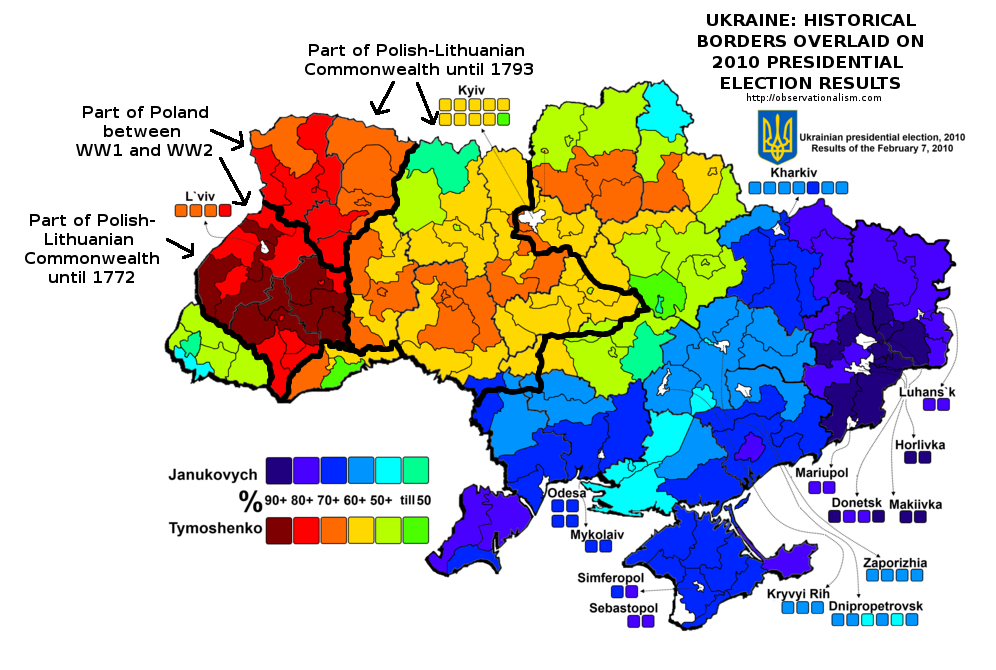
On October 26th, the U.S.-allied propaganda-agency Reuters headlined “Britain, U.S. sending planes, troops to deter Russia in the east” and pretended (without even acknowledging the actual facts of the matter) that this NATO action is a response to ‘deter’ Russia because Russia had accepted in 2014 the overwhelming desire of the residents of Crimea to become Russian citizens after the coup that U.S. President Barack Obama’s Administration had perpetrated in Ukraine during February 2014, overthrowing the democratically elected Ukrainian President Viktor Yanukovych, for whom 75% of Crimeans had voted. Even Western-sponsored polls that were taken of Crimeans both before and after the resulting Crimean 16 March 2014 referendum on whether Crimea should be restored to being again a province of Russia (which Crimea was until the Soviet dictator Khrushchev had arbitrarily transferred Crimea to Ukraine in 1954) showed that over 90% of Crimeans wanted to do this and that even a higher percentage of them were mad as hell against what America was doing and extremely supportive of Russia’s position on this matter, but the U.S. government’s position is that it was instead ‘conquest of land’ by Russia, and the U.S. and its allies are pouring troops and weapons onto and near Russia’s borders in order to defend against ‘Russian aggression. The power of sheer propaganda! It’s crucial in politics.
The way the Reuters ‘news’ report phrased this matter was “NATO’s aim is to make good on a July promise by NATO leaders to deter Russia in Europe’s ex-Soviet states, after Moscow orchestrated the annexation of the Crimea peninsula in 2014.” That’s not as much of a lie as the U.S. President’s use of the word ‘conquest’ to describe Russia’s role there is, but it’s close.
Reuters’s report opened with “Britain said on Wednesday it will send fighter jets to Romania next year and the United States promised troops, tanks and artillery to Poland in NATO’s biggest military build-up on Russia’s borders since the Cold War.” But in order to play down the danger here, they refused to headline their ‘news report’ with that, it’s real, actual, news, which was: “NATO’s biggest military build-up on Russia’s borders since the Cold War.” That headline would have attracted far more readers, but in the ‘news’ business in a dictatorship, that’s not the main objective when reporting news that the government wants to bury instead of to go viral. It’s part of ‘news’-management, which includes burying what is important.
Then, Reuters quoted the U.S. Secretary of ‘Defense’, who said: “It’s a major sign of the U.S. commitment to strengthening deterrence here.”
After the Soviet Union dissolved in 1991, and in the same year terminated its Warsaw Pact military alliance that had been set up by the Soviet Union to mirror America’s NATO alliance, NATO expanded right up to Russia’s borders and is therefore highly aggressive and threatening toward the people of Russia, who don’t like missiles minutes away, any more than Americans would like if Russia took over Mexico and placed troops and missiles on our border. But, according to the U.S.-and-allied propaganda-line, this strangulation of Russia by NATO is ‘deterrence’ against Russia. Then, when Russia responds to such U.S.-aggression by positioning troops and weapons to their side of their border, that’s called ‘aggressive’. And NATO is ‘responding’ to ‘Russia’s aggressive moves’.
It’s like blaming a raped woman for trying to defend against her rapist. Hillary Clinton’s actions (never her rhetoric) show that she wants more of that type of thing, especially regarding the Russian people, whom the U.S. government wants to conquer by eliminating their international allies, one by one — and then by eliminating their own leader Vladimir Putin himself, after the original ‘regime change in Iraq’ (whose Saddam Hussein was the first Russia-friendly leader to be eliminated; then Muammar Gaddafi, then Bashar al-Assad, then Viktor Yanukovych). The pattern is clear. And now NATO is going in for the kill.
But this reality is not how America’s ‘impartial’ press reports what is actually a buildup toward a possible NATO invasion of Russia.
Of course, America’s Republican Party (or conservative) press have long been controlled by neoconservatives (they were all supportive of ‘regime-change in Iraq’, and the American public never punished them for that — mega-criminal deceit goes unpunished), and so they don’t even pretend to be anything more than nationalistic mouthpieces for the U.S. government’s conquests. However, the Democratic Party’s (or liberal) press do need to cater to some progressive anti-nationalistic audiences. Yet still neoconservatism dominates at such newspapers as The New York Times and the Washington Post, as well as in magazines such as The AtlanticThe New Republic, and Foreign Policy, all of which are, if anything, neoconservative Democratic Party organs. All of them endorse Hillary Clinton. But there is a small progressive wing to American ‘journalism’; and, so, here is how one of the progressive sites, Common Dreams, handles this crucial matter, which might soon end the world as we know it: they headlined on October 26th, “NATO Preps ‘Biggest Military Build-Up on Russia’s Borders Since Cold War’,” and opened (quoting from Reuters and other Western sources):
Playing “a dangerous game,” NATO pushes allies to send more troops and military equipment to Eastern Europe. NATO is pushing all allies to deploy more troops and military equipment to Russia’s borders, further ratcheting up tensions as the West prepares for “its biggest military build-up on Russia’s borders since the Cold War,” as Reuters observed.
“France, Denmark, Italy and other allies are expected to join the four battle groups led by the United States, Germany, Britain, and Canada to go to Poland, Lithuania, Estonia, and Latvia, with forces ranging from armored infantry to drones,” Reuters reported.
“Yet with the U.S. openly talking [about] a war with Russia, the continued deployments seem far from a purely defensive measure,” argued Antiwar.com‘s Jason Ditz [who said]:
”Diplomats also suggested it was only partly about sending a message to Russia, and that the real point of the latest push is to get a bunch of nations involved as a ‘message’ to U.S. presidential nominee Donald Trump, who has complained the U.S. is spending too much defending Europe and that Europe isn’t doing enough on its own. That underscores the cynical nature of the deployments, and indeed the sort of thing adding to the sense of NATO being obsolete, that they feel they can afford to organize major deployments just for the sake of scoring political points in member nations’ elections.”
These moves are shortsighted, to say the least, wrote Gilbert Doctorow of the American Committee for East-West Accord [by saying]: “America’s steady campaign of expanding NATO, […] its vilification of Russia, and its information war based on lies” are part of “a dangerous game” that is pulling all sides inevitably closer to war, Doctorow argued.
Nothing was provided there that highlighted the stark contrast between the strongly anti-invasion Republican Presidential candidate Trump, versus the strongly pro-invasion Democratic candidate Clinton. In other words, no essential context was provided — no context of a policy-decision that America’s voters will have to make, choosing the one or the other to be the next President. Instead, ‘progressive’ news-sites treat their readers and audiences as mere fools who think that voting for a third-party candidate in a U.S. Presidential contest is not a wasted vote, like refusing to vote at all is.
The overwhelming majority of the 100+ reader-comments to that Common Dreams report, who expressed a Presidential choice said “Vote Green” or “Jill Stein,” referring to a third-party candidate who stands no chance of winning even one of the 50 U.S. states. In other words: the readers at this progressive site are so unconcerned about the future of the world, that they don’t even care whether the next U.S. President would be Hillary Clinton who would cause nuclear war, or Donald Tump who has consistently argued against her neoconservatism and emphasized the necessity of ending the U.S. government’s rabid hostility toward Russia and ending expansion of NATO up to Russia’s borders. In other words: despite progressive rhetoric, they’re actually oblivious to the world’s future — oblivious to the most important thing of all.
And, so, that is the domestic politics of the war that the U.S. elite are determined to wage against Russia. The fix is in for nuclear war.
To the owners of the media, the people who hire and fire — and promote and demote — the “news’ people, and thus who shape what the public know and understand and what the public don’t, it’s better that the outcome of the U.S. election be determined by whether or not Donald Trump is a rapist, than by whether or not Hillary Clinton will bring about nuclear war with Russia. So, it’s the way things are.
In the U.S.-allied nations such as Britain, the ‘news’ media are similar. For example, Britain’s liberal Guardian headlined on October 27th, “Nato and Russia playing dangerous game with military build-up: Russia wants to detract from problems at home and position itself as a superpower, and Nato troop movements can only help.” It said that, “amid western suspicions the Russian fleet will be used to flatten civilians in Aleppo, Nato’s apparent goal here is to deter future acts of aggression on European territory by Vladimir Putin’s revanchist Russia.” That might as well have been written by the Obama Administration, as by some ‘news’ person.
‘The West’ is clearly behind the plan. Of course, the American public haven’t yet spoken.

Samoan car component plant to shut, eliminating 740 jobs

John Braddock

Samoa’s biggest private sector employer, Yazaki Eds Samoa, announced on October 10 that it will close its local plant in 2017, after 25 years in operation. The Japanese-owned car component manufacturer, which produces electrical harnesses, employs 740 people in the capital, Apia.
The shutdown is a direct result of the destruction of the Australian car industry and underscores the assessment made by the Socialist Equality Party on October 6 which explained that the closure of Ford’s Australian plants demonstrated the need for a global auto workers’ strategy to defend jobs and living standards.
Yazaki is a supplier to General Motors (GM) and Toyota, both of which are in the process of shutting down. Ford Australia closed its two remaining auto plants this month, ending production in the country after 91 years. When GM and Toyota close next year, it will end the country’s auto assembly and related parts industry, resulting in an estimated loss of up to 150,000 jobs.
The ruthless restructuring of the auto industry is being enforced in one country after another by governments and unions, for the benefit of a tiny financial and corporate elite, with devastating consequences for workers internationally.
Yazaki Samoa Employees Association president Uelese Tupuola made it clear the unions would fully collaborate with the company to axe the plant. “We’ve always known at the back of our heads that this day will come but we tried to keep an open mind about the result,” Tupuola said.
Co-ordinator of the Samoa First Union, Jerome Mika, said it was “a good opportunity” for the government to look at legislating redundancy provisions, which do not exist in the Employment Relations Act. Mika praised Yazaki’s president Craig O’Donohue as “very genuine” and falsely claimed that the management-union talks would ensure workers are “looked after.”
The company is preparing a minimal severance package, but workers who resign to find other jobs before the shutdown will miss out on any payment. O’Donohue declared that although the closure may not be “favourable,” Samoan workers had to “remember how happy we should be for the experience that we have and we still have to go.”
This is staggering hypocrisy. Yazaki is yet another example of how transnational companies treat workers as disposable commodities. They shift production to exploit ever-cheaper labour, playing workers in one country off against their fellow workers in others, lowering wages and destroying the conditions of workers everywhere.
The plant was established in 1991 when Yazaki transferred its operations from Melbourne, taking advantage of Samoa’s labour market “flexibility” and poverty-level wages. The Samoan government beat off competition from Fiji and Indonesia, offering 15-year tax holidays and long-term property leases at low rents. Exports were conducted under a concessional arrangement that gave duty-free access to the Australian and New Zealand markets.
Yazaki, which became a major supplier of harnesses to the global auto industry, made millions from the exploitation of its workforce. In Samoa’s first industrial strike in 1993, Yazaki workers protesting sweatshop conditions and 1.24 tala [US 48 cents] an hour wages were defeated through government collusion and the use of scab labour. According to the Samoa Observer, today’s wages average just 130 tala [$US51] a week. The company’s profits have typically ranged up to $US3 million annually.
Like auto workers in Australia and elsewhere, Yazaki workers can expect to be pitilessly flung onto the scrapheap. The Samoan government declared that business closures are a “reality that governments around the world must face.” The government will continue to promote Samoa as “an attractive option for foreign investment” while proactively seeking more “seasonal work” for Samoans in New Zealand and Australia.
Over the past two decades Samoa has been opened up to foreign investment and trade through pro-market reforms with the ruling Human Rights Protection Party at the forefront of cutting business taxes, privatising public assets, removing trade barriers and slashing public services.
The Yazaki plant closure will have a devastating impact on the tiny Pacific island state, which has a population of just 190,000. At its height, the plant employed more than 2,000 workers and made up over 20 percent of the manufacturing sector’s total output. It produced around 70 percent of Samoa’s exports and 6 percent of the country’s gross domestic product.
Thousands will be hit by the job losses and subsequent downturn. According to the Asia Development Bank (ADB), 27 percent of Samoans live below the national poverty line. Only 29.4 percent of those aged over 15 years is formally employed, with the majority are dependent on development aid, remittances from overseas, tourism, agriculture, subsistence farming and fishing. Samoa ranks among the worst in the world for diseases of poverty such as diabetes—the rate of adult obesity is 42 percent.
Responsibility for the dire social conditions that exist throughout the Pacific lies with the imperialist powers that have dominated the region for the past century—Samoa was a New Zealand colony for over 50 years after its seizure from Germany in World War I. The effects of colonial rule have left all the Pacific Islands acutely under-developed and dependent on imports. Trade and commerce statistics overwhelmingly favour Australian and New Zealand interests and those of transnational companies that control banking, mining, oil and fishing.
The axing of Samoa’s most important manufacturing plant comes alongside recent cuts in the New Caledonia nickel industry and a deepening economic crisis in Papua New Guinea. In its July 2016 Pacific Economic Monitor, the ADB forecast that due to the precipitous downturn in commodity prices, the South Pacific region will see economic growth sharply decline from 7.0 percent, recorded last year, to an average of 3.9 percent in 2016. Samoa’s growth is predicted to drop even further, from 3.5 percent this year to 2 percent in 2017.

Ruling Venezuelan party cuts off recall petition drive, provoking protests

Alexander Fangmann

Protests and rallies took place across Venezuela on Wednesday, organized by right-wing opposition parties in response to the National Electoral Council’s (CNE) halting of the signature drive for a recall referendum that would remove President Nicolás Maduro from power. In several areas of the country there were violent clashes between police and armed demonstrators mobilized by right-wing parties. A policeman in the state of Miranda was reportedly shot dead while trying to clear a roadblock on the Pan-American Highway.
A subsequent “civic strike” called by the right on Friday appeared to have little effect. Separately, however, hundreds of workers from the Hipódromo de La Rinconada, Caracas’s main racetrack, blocked a key highway to protest delays in the paying of food tickets, a government-mandated benefit that allows workers to buy food.
Since the crushing defeat suffered by the chavista United Socialist Party of Venezuela (PSUV) in legislative elections last December, the Maduro government has increasingly taken measures to sideline the National Assembly, raising the danger of dictatorship just as conditions for the Venezuelan working class are becoming increasingly dire in the face of the country’s economic collapse.
The CNE based its ruling last week on earlier decisions in four regional court cases, which upheld challenges to the validity of signatures collected during the first step of the recall process. The government is claiming that an enormous percentage of the signatures gathered by the opposition were fraudulent. This move in all likelihood means that the recall is effectively off the table because, according to the constitution, after January 10 a recall would only result in Maduro’s replacement by the vice-president, rather than in new elections as would occur if the recall took place before that date.
Underscoring the deep crisis and divisions between the main factions of the Venezuelan bourgeoisie, the opposition-controlled National Assembly voted to put Maduro on trial following the CNE decision, hoping to emulate the recent impeachment of Dilma Rousseff in Brazil. Meanwhile, Diosdado Cabello, the former speaker of the National Assembly and a leading figure in the PSUV, said in regard to the claims of electoral fraud, “We hope that those responsible will be found, will be detained and will go to prison for what they have done.”
Since the PSUV’s loss of control of the National Assembly, the Maduro government has become increasingly reliant on the courts and other institutions made up primarily of chavista appointees to allow it to circumvent the legislature. Aside from the decision on the recall referendum, the CNE also announced that elections for state governors, which had been scheduled for December, will instead be held in June of next year, likely to prevent further layers of government from being lost by the PSUV.
Earlier this month, the Supreme Court ruled that the Maduro government could send its budget directly to the courts for approval, bypassing the normal legislative process. To provide a fig leaf of legality for its moves, the Maduro government has leaned heavily on a dispute that opened up last year just after the National Assembly voted to seat three deputies from the state of Amazonas, despite a ruling by the Supreme Court which barred those deputies from taking their seats after a challenge to their election results by the PSUV. Since that time, the chavistas have considered all acts of the National Assembly as null and void. As vice-president Aristobulo Isturiz put it, "Legally, the National Assembly does not exist."
The bypassing of the National Assembly on the part of the ruling PSUV poses a grave danger for the Venezuelan working class. The move toward extra-constitutional rule is unfolding as social conditions in the country are rapidly deteriorating due to an economic collapse following from a fall in the price of oil, itself ultimately conditioned by the continued downturn in the world economy. While the recent measures have been aimed in the first instance at the PSUV’s right-wing opposition, the concentration of power will be directed against the working class once it begins to organize itself independently to defend its living conditions.
Conditions in the country are dire. On Thursday, October 27, the government announced it would be raising the minimum wage, including food subsidies, by 40 percent. This does not begin to erase the erosion in purchasing power that has occurred due to the rampant inflation, which the IMF expects will exceed 1,600 percent next year.
There are widespread reports of hunger in the country, with many people skipping meals. It was widely reported earlier this month that workers from the state-run oil giant PDVSA, previously considered among the best-paid in the country, have been selling their uniforms to get money to buy food.
The health care system also appears to be in almost total collapse. Infant mortality has increased by 18.5 percent from the previous year, and is up 50 percent from 2012. Hospitals lack all kinds of basic supplies, which the country has not been able to import, due to the fall in export earnings.
The Venezuelan Health Observatory, part of the Central University of Venezuela in Caracas, says that fewer than 10 percent of operating rooms, emergency rooms, and intensive care units are operational. In addition, over 76 percent of hospitals have a scarcity of medicines, 81 have a scarcity of surgical materials, and 70 percent do not have reliable access to water. Diseases that had once been eradicated are returning to the country, such as diphtheria.
The oil industry is also suffering from a vicious cycle of neglect, as lack of imported parts, machinery, and funds to pay oil service companies have led to a decline in production. According to government figures, oil production fell 11 percent over the past year and the number of working rigs declined by 25 percent. In parts of the countries, wells are simply flaring off oil and gas due to a lack of processing equipment. Oil service companies such as Halliburton and Schlumberger are winding down their operations and exiting the country.
Despite this economic and social meltdown, Venezuelan bonds are providing excellent returns of 46 percent as the Maduro government continues to prioritize paying back its creditors over funding imports that would allow it to meet workers’ needs or even to continue producing the oil it needs to fund imports. In fact, banks and financial firms around the world have historically profited quite handsomely from the so-called “Bolivarian socialist” policies pursued by Maduro and his predecessor Hugo Chávez.