4 Nov 2016

US air strikes kill scores of civilians in Afghanistan

Bill Van Auken

US airstrikes claimed the lives of scores of civilians in northern Afghanistan Thursday, following a firefight between US-backed Afghan troops and Taliban fighters in which at least two US special forces “advisers” were killed.
The bombing, which continued through much of the night, targeted the village of Bouz Kandahari, on the outskirts of the northern city of Kunduz, where US and Afghan special operations troops had mounted an assassination raid late Wednesday aimed at eliminating two senior leaders of the Taliban. They came under heavy fire, leading to the deaths of the two American soldiers and the wounding of four others. Three Afghan special forces troops were also killed. The Pentagon euphemistically described the operation as a “train, advise and assist mission.”
A spokesman for the governor of Kunduz put the number of civilians killed in the air raids at 30. Residents and others, however, said the real number of dead was significantly higher.
Amruddin, the local representative on the provincial council, said at least 100 civilians had been killed or wounded in the bombing raids. A local resident said that 50 had been killed and between 40 and 50 wounded. Another survivor said at least 70 people had been taken to a local hospital.
As many as 50 homes were demolished by the US bombs, and more victims were feared buried in the rubble.
Outraged relatives of the dead and residents of the village staged a protest march on the governor’s palace, chanting, “Death to America” and “Death to [Afghan President Ashraf] Ghani.” The protesters used pickup trucks to carry the bodies of the dead, most of them women and children. One man held aloft the headless body of an infant. Police stopped them before they could reach their destination.
“What did these children do wrong? I want justice for the killers,” one resident told Al Jazeera.
Taza Gul, another local resident, told the Pajhwok Afghan News: “I was working on my farm when the bombardment started. On coming home, I saw seven members of my family, including women and children, killed in the raids.”
The civilian death toll in Thursday’s bombings represented the worst atrocity carried out by the US military since the deliberate targeting of a Doctors without Borders (MSF) hospital in Kunduz by a US AC-130 gunship killed at least 42 patients and medical staff and wounded another 37 in October 2015.
That attack followed the Taliban’s seizure of the strategic northern city. Despite extensive combat operations in the ensuing year, Kunduz remains insecure and surrounded by territory controlled by the Taliban. Last month, Taliban fighters came close to overrunning it once again.
More than 15 years after the US invaded Afghanistan and nearly two years after President Barack Obama claimed an end to American combat operations, nearly 10,000 US troops remain deployed there along with a considerably larger number of military contractors. US warplanes have conducted more than 700 airstrikes so far this year, twice as many as in 2015.
By all discernible measures, the crisis of the US occupation and the regime that it has installed in Kabul is deeper than ever.
More than 1,600 civilians were killed in just the first six months of 2016, the highest death toll for a half-year period since the UN began keeping figures in 2009.
Afghan security forces, meanwhile, have also suffered record losses. Between January and August of this year, 5,523 Afghan National Army and Afghan National Defense and Security Forces troops have been killed (more than twice as many deaths than the US military has suffered in Afghanistan in 15 years), with nearly twice as many wounded.
Between casualties and desertions, the Afghan security forces are growing weaker rather than stronger, despite the more than $60 billion the US has poured into arming and training them.
Last September, Gen. Joseph Dunford, chairman of the Joint Chiefs of Staff, told a congressional committee that the state of the war was “roughly a stalemate.”
A report released last month by the Special Inspector General for Afghanistan Reconstruction (SIGAR) also reported 101 “insider attacks” in which Afghan soldiers turned on their own units, killing 257 and wounding 125 in the first eight months of the year. Three Americans, two soldiers and a civilian, were killed in such an incident last month at a training base near Kabul.
The SIGAR report found that the Taliban today controls more of the country than at any time since the US invasion of 2001. It also stated that the rates of poverty, unemployment, underemployment, violence, emigration and internal displacement are all on the rise.
The United Nations found that more than a million people had been displaced last year and another million Afghans are “on the move” within the country’s borders this year because of the violence, creating the conditions for a massive humanitarian crisis. The country is the second biggest source of refugees, trailing only Syria, and as many as 100,000 could be sent back after being denied asylum in Europe.
Despite the depth of this crisis and the fact that more US troops are fighting in the country than anywhere else in the world, the word Afghanistan has barely been mentioned in the 2016 presidential race by either Democrat Hillary Clinton or Republican Donald Trump. Not a word about the ongoing war appears on the campaign web sites of either candidate.
Whoever takes office in January 2017, however, the prospects for the continuation and escalation of the war are strong. President Barack Obama, having made the war his own with a “surge” that tripled the number of US troops deployed there to 100,000 in 2010, has put the brakes on what had been billed in 2014 as a gradual drawdown of American forces to the level of “normal embassy presence.”
It is now clear that the corrupt and internally divided Afghan regime will not survive without US military power to prop it up. Moreover, the Pentagon has made clear that it intends to keep permanent bases and thousands of troops in the country, which offer a strategic launching pad for operations in South Asia and the former Soviet republics of energy-rich Central Asia, as well as against both Russia and China.
To these ends, the kind of mass slaughter of civilians seen outside Kunduz on Thursday will continue.

War of smears and scandals intensifies in US election campaign

Patrick Martin

With only four days remaining before Election Day in the United States, the two main capitalist candidates have stepped up their campaigns of scandal-mongering to divert public attention from any serious examination of the critical issues of war, economic inequality and attacks on democratic rights.
Republican Donald Trump has focused his campaign almost entirely on Hillary Clinton’s use of a private email server while Secretary of State, and on the operations of the Clinton Foundation, calling her corrupt and demanding she be prosecuted and jailed. Congressional Republicans have chimed in with threats of impeachment if Clinton wins the November 8 vote.
The response of the Clinton campaign and the Democrats has been to intensify their own smear tactics, promoting allegations of sexual misconduct, and even rape, against Trump, and claiming, without any evidence, that Russian President Vladimir Putin has backed the Manhattan billionaire by unleashing Russian intelligence agencies to hack into the communications of the Democratic campaign.
The presidential contest has appeared to narrow significantly since the intervention of the FBI against Clinton last Friday, when FBI Director James Comey sent a letter to Congress announcing additional “investigative steps” in relation to the investigation into Clinton’s private email server.
Clinton retains a small lead in national opinion polls, and in the “battleground” states whose votes in the Electoral College are the most closely contested. She also appears to have benefited from higher Democratic turnout in the early voting that is permitted in 38 of the 50 states. The result of the election remains highly uncertain, as well as the outcome of voting for 33 Senate seats and 435 seats in the House of Representatives, both now controlled by the Republican Party.
Opposition to Clinton’s candidacy within the FBI—a supposedly non-political investigative agency headed by an appointee of President Obama—was underscored by reports in right-wing media outlets Wednesday that agents were pushing an investigation “into possible pay-for-play interaction between Secretary of State Hillary Clinton and the [Clinton] Foundation.”
Fox News anchor Bret Baier, citing unnamed sources close to the FBI investigation, claimed that the investigation into the Clinton Foundation was “a very high priority” and that “agents are actively and aggressively pursuing this case.” He claimed that “an indictment” was believed likely, although he did not indicate who was to be indicted or for what alleged crime.
The Wall Street Journal—like Fox News, owned by ultra-right billionaire Rupert Murdoch—also reported Wednesday that FBI agents were engaged in a major investigation of the Clinton Foundation, during which they had obtained “secret recordings of a suspect talking about the Clinton Foundation,” without giving any details.
The Journal report also revealed that the FBI investigation began in response to the 2015 publication of an anti-Clinton book, Clinton Cash: The Untold Story of How and Why Foreign Governments and Businesses Helped Make Bill and Hillary Rich, written by right-wing activist Peter Schweizer. In other words, FBI agents set out to collect evidence that would vindicate a political screed written to torpedo Hillary Clinton’s presidential campaign.
The various anti-Clinton investigations led to clashes between the FBI agents and career prosecutors in the public integrity section of the Justice Department, who regarded the evidence as flimsy and the probes politically motivated. These conflicts intensified after FBI Director James Comey announced in July that the investigation into the Clinton email server had not uncovered evidence that warranted any criminal prosecution.
Comey’s letter to Congress last week, apparently reviving the email investigation, was prompted by the continuing unrest within his agency. According to former House Majority Leader Tom DeLay, as many as 100 FBI agents had threatened to resign unless Comey took the extraordinary step of dropping a political bombshell only 11 days before Election Day. Other press reports described the ranks of the FBI as “Trumpland,” indicating that there is widespread support in the agency for the Republican candidate and his embrace of authoritarian methods against political opponents.
The Clinton campaign and the Democratic Party have responded in kind to the scandalmongering by Trump and the Republicans. Television advertising for Clinton in the final days of the campaign has focused almost entirely on the allegations that Trump has engaged in abusive conduct towards women, which Clinton uses as the basis of her appeal to those layers of the upper-middle-class obsessed with identity politics—the politics of race, gender and sexual orientation.
On Wednesday, Los Angeles attorney and media commentator Lisa Bloom, the daughter of multi-millionaire defense attorney Gloria Allred, announced a news conference at which her client, a woman now 35 years old, was to detail claims that Donald Trump raped her 22 years earlier, when she was only 13. The press conference was then abruptly cancelled with the claim that “death threats” from Trump supporters made it too dangerous.
The effect was to associate the Republican candidate first with sexual assault and then with threats of violence, without actually presenting any evidence. Bloom is also the attorney for one of the women suing Trump for alleged sexual harassment.
Meanwhile congressional Democrats and the Clinton campaign continue to peddle allegations that the Russian government is the source of the trove of emails, now being made public by WikiLeaks, hacked from the account of John Podesta, Clinton’s campaign chairman.
The WikiLeaks emails have proven highly damaging, detailing efforts by Bill Clinton and his top aides to cash in on the operations of the Clinton Foundation by inducing corporate contributors to the charity to pay Clinton lucrative fees for giving speeches or becoming a “consultant” to their businesses.
On Thursday, WikiLeaks founder Julian Assange flatly denied the claims that the Russian government had supplied the emails to his organization. “The Clinton camp has been able to project a neo-McCarthyist hysteria that Russia is responsible for everything,” Assange said in an interview with Dartmouth Films in Britain, where he has been confined to the Ecuadorian embassy in London.
Assange pointed out that the Clinton campaign has repeatedly lied about the emails, claiming the US intelligence agencies had determined that Russian intelligence agencies were responsible for the hacking. In fact, he said, no such determination had been made. US Director of National Intelligence James Clapper has claimed that the email server of the Democratic National Committee had been hacked by the Russian government—without providing any evidence—but the DNI has been silent on the hacking of Podesta’s emails.
The mutual mudslinging and scandal-mongering between the Democrats and Republicans is not merely an “aspect” of the 2016 presidential campaign. The two parties rely on such degraded methods to fight out bitter internal conflicts within the ruling class while concealing from the American people the right-wing, anti-working-class policies that the next US government, whether headed by Clinton or Trump, will carry out.
Whether it is President Clinton or President Trump, the next administration will be compelled by the deepening global economic crisis of capitalism and intensifying geo-political conflicts to adopt even more aggressive and right-wing policies than those of the Obama administration.
The next administration will employ US military force even more widely than Bush and Obama, not only in the Middle East but against more formidable nuclear-armed opponents like Russia and China. And it will respond to renewed financial crisis with sweeping attacks on jobs, working class living standards and public social services.

Class struggle in US intensifies on eve of election

Jerry White

In the run-up to Tuesday’s national election, a significant number of strikes have broken out among a wide variety of workers in many parts of the United States. The biggest action is a walkout by nearly 5,000 transit workers in Philadelphia. The strike, now in its fifth day, has shut down the nation’s sixth largest public transit system and brought the city of 1.5 million people to a virtual halt.
The main issue in the strike is the demand of the Southeastern Pennsylvania Transportation Authority (SEPTA) for an eleven-fold increase in the workers’ out-of-pocket health costs.
Other workers currently on strike include Pittsburgh Symphony Orchestra musicians, who are in the fifth week of a struggle against wage and pension cuts; 700 chemical workers at Momentive Performance Materials in New York State and Ohio, who are fighting health and pension cuts; and 300 video game voice actors in Los Angeles, who are demanding improved compensation and working conditions.
In addition, some 400 workers in Indiana and New York State are in the seventh month of a lockout imposed after they rejected demands for health care concessions from the aircraft component manufacturer Honeywell International.
Another series of recent strikes were terminated by the trade unions, which are seeking to prevent walkouts wherever possible and quickly end those that break out in the interests of promoting their campaign for the election of Democratic presidential candidate Hillary Clinton.
Over the past several weeks, the unions have shut down strikes by state university faculty members in Pennsylvania, Minnesota nurses, Libbey Glass workers in Ohio, Jim Beam whiskey workers in Kentucky, and cafeteria workers at Harvard University in Massachusetts. These walkouts followed the strike by 40,000 Verizon telecom workers earlier in the year.
Thousands of other workers, including 95,000 California state employees, United Parcel Service aircraft mechanics, General Electric appliance workers in Kentucky, and bus drivers in Ohio and Illinois, could soon be on strike.
The increase in working class struggles in the US coincides with a growth of the class struggle internationally, including last month’s strikes by tens of thousands of autoworkers, rail workers and hospital workers in South Korea, and a record number of strikes in China.
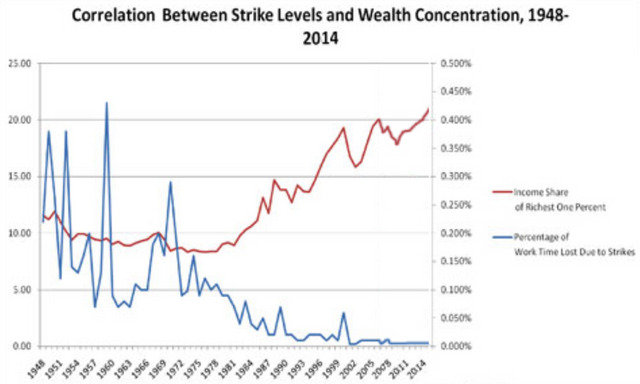
Correlation Between Strike Levels and Wealth Concentration, 1948-2014
The artificial suppression of the class struggle by the unions, which during the Obama presidency held strikes to the lowest level since the end of the Second World War, has allowed the corporations to restructure their operations and slash their labor costs in the aftermath of the 2008 financial crash. This has entailed the shifting of health and pension costs onto the backs of workers and the transformation of millions of workers into casual laborers.
A common thread in virtually all of these struggles is opposition to corporate demands for higher out-of-pocket health care costs. The offloading of the cost of health coverage from the companies to the workers has escalated alongside the implementation of Obamacare, the central domestic “achievement” of the outgoing administration.
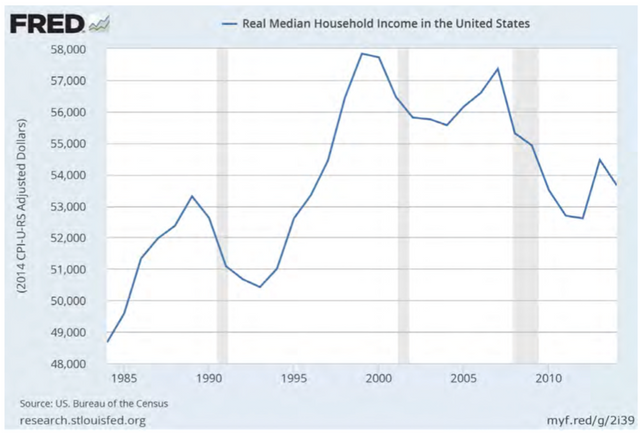
According to a survey by the Kaiser Family Foundation, premiums in the US rose by 3.4 percent and deductibles by 12 percent last year, more than eating up the average 3 percent increase in wages, which followed nearly a decade of falling or stagnant real wages. Another study shows that over the past five years, the share of employees enrolled in high-deductible insurance plans has more than doubled, reaching 29 percent, or 50 million workers.
Between 2002 and 2015 annual earnings for the bottom 90 percent of Americans rose by only 4.5 percent, while earnings for the top 1 percent grew by 22.7 percent, according to the Economic Policy Institute. Under the Obama administration, more than 90 percent of income gains since the so-called “recovery” began have gone to the top one percent.
Real Median Household Income in the United States
Meanwhile, the percent of Americans below 125 percent of the official poverty rate has been higher every year under Obama than during the Bush presidency.
These are the conditions for millions of workers on the eve of an election that pits a billionaire real estate mogul, Donald Trump, against a multi-millionaire long-time politician, Hillary Clinton. Neither of these right-wing defenders of the capitalist system offers any policies to address the social needs of working people.
The elections have been conducted at the most degrading level in order to exclude the real issues confronting the broad mass of working people: economic insecurity and poverty and the growth of militarism and war.
The real sentiments of working people can find no expression within the framework of the existing political system. The ruling elite was shocked and frightened when millions of workers and young people voted for Bernie Sanders to register their opposition to the capitalist system and the tyranny of Wall Street. The 13 million votes for what was presented—falsely and cynically—as a “democratic socialist” campaign reflected a profound shift in consciousness to the left, developing alongside a revival of working class struggle.
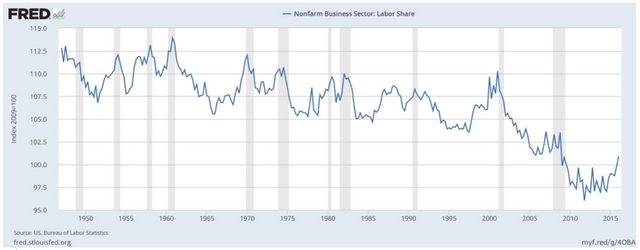
Labor’s share of the GDP has fallen to the lowest level since World War II
Sanders’ endorsement and vote-hustling for Clinton, the favored candidate of the financial-corporate elite, thoroughly exposed his reactionary role as an instrument of the ruling elite for channeling social opposition back into the dead end of the Democratic Party. He has played a central part in giving Trump an open road to exploit the social grievances of those who have been economically devastated and seek to channel discontent in a reactionary nationalist direction.
Clinton, taking advantage of Sanders’ capitulation and the backing of the complacent and reactionary liberal and pseudo-left milieu, has redoubled her efforts to promote race and gender politics, and attribute the support for Trump to the supposed racism of the “white working class.”
The greatest exposure of such lies is the class struggle itself. The initial stirrings of a new period of class struggle, involving workers of all races and nationalities, underscores the basic fact, as Marx put it, that society is split “into two great hostile camps, into two great classes directly facing each other,” the capitalists and the working class.
The political radicalization that found initial expression in the mass support for Sanders has not gone away. It will intensify under a new administration that will escalate US military violence abroad and the attacks on the working class at home.

3 Nov 2016

Borlaug Global Research Alliance Fellowships 2017 for Researchers in Developing Countries

Application Deadline: 30th November, 2016
Eligible Countries: Colombia, Costa Rica, EgyptGhana, Honduras, Indonesia, Malaysia, Mexico, Nicaragua, Panama, Peru, Philippines, Thailand, Vietnam
To be taken at (country): USA, Candidate’s Home Country
Eligible Fields of Research: 
  1. Developing Tools for Greenhouse Gas and Carbon Sequestration Assessments
    • Develop easily used methods for measuring or estimating greenhouse gas emissions in agricultural settings
    • Develop easily used methods for measuring or estimating carbon sequestration in agricultural soils
    • Develop and field test user-friendly software for quantifying and reporting emissions under the United Nations Framework Convention on Climate Change
  2. Reducing Greenhouse Gas Emissions Intensity in Crop Production Systems
    • Identify agricultural management strategies leading to reduced net greenhouse gas emissions per unit of commodity produced in agronomic (including rice), horticultural, or agro-forestry crop systems
    • Develop models for application of experimental data in decision support tools for different crop or agro-forestry systems in different countries
  3. Reducing Greenhouse Gas Emissions Intensity in Livestock Production Systems
    • Identify agricultural management strategies leading to reduced net greenhouse gas emissions per unit of commodity produced in grazing or confined animal production systems
    • Develop models for application of experimental data in decision support tools for livestock production systems in different countries
  4. Developing Databases and Strategies for Synthesis, Integration and Decision Support to Manage Greenhouse Gas Emissions and Carbon Sequestration in Agricultural Systems
    • Develop databases assembled from different research teams working on identifying methods to reduce agricultural greenhouse gas emissions and increase carbon sequestration
    • Develop process models as a foundation for projecting emissions and sequestration in different agricultural systems and for decision support tools
About the Award: The Borlaug Global Research Alliance Fellowships seek to:
  • Provide early-to-midcareer agricultural research scientists, faculty, and policymakers with individual training opportunities in climate change mitigation research
  • Provide practical experience and exposure to new perspectives and/or technologies that can be applied in their home institutions
  • Foster increased collaboration and networking to improve agricultural productivity and trade
  • Facilitate the transfer of new scientific and agricultural technologies to strengthen agricultural practices
  • Address obstacles to the adoption of technology such as ineffectual policies and regulations
Type: Fellowship
Eligibility: To be considered for the Borlaug Global Research Alliance Fellowships, candidates must:
  • Be citizens of an eligible country
  • Be fluent in English
  • Have completed a Master’s or higher degree
  • Be in the early or middle stage of their career, with at least two years of practical experience
  • Be employed by a university, government agency or research entity in their home country
  • Demonstrate their intention to continue working in their home country after completing the fellowship
Selection Criteria: Applicants are selected based on their academic and professional research interests and achievements, level of scientific competence, aptitude for scientific research, leadership potential, likelihood of bringing back new ideas to their home institution, and flexibility and aptitude for success in a cross-cultural environment. Consideration is also given to the relevance of the applicant’s research area to the research topics highlighted in the application announcement and to global food security and trade.
Number of Awardees: Not specified
Value of Fellowship: To be communicated (TBC)
Duration of Fellowship: up to 12 weeks
How to Apply: Candidates must apply via the online application system (link below). The following information will be required:
  • Completed application form
  • 2-3 page program proposal and action plan
  • Signed approval from applicant’s home institution
  • Two letters of recommendation
  • Official copy of transcript for college/university degree(s) received
  • Copy of passport identification page
Award Provider:  U.S. Department of Agriculture

Belgium: Science@Leuven Masters Scholarships for International Students 2017

Application Deadline: 31st January 2017
Offered annually? Yes
Eligible Countries: International
To be taken at (country): Katholieke Universiteit LeuvenBelgium
Eligible Fields of Study: Eligible International Master Programme under the Faculty of Science at K.U. Leuven:
•  Master of Astronomy and Astrophysics
•  Master of Biology
•  Master of Biophysics, Biochemistry and Biotechnology
•  Master of Chemistry
•  Master of Geography
•  Master of Mathematics
•  Master of Physics
•  Master of Statistics
•  Interuniversity Master of Geology (only students applying for the specialisation Geodynamics and Georesources or Surface processes and Paleoenvironments can apply for the scholarship)
•  Erasmus Mundus Master of Theoretical Chemistry and Computational Modelling
•  Erasmus Mundus Master Sustainable and Territorial Development
Type: Masters
Eligibility: Candidates must meet and prove the following requirements:
•  the applicants have not studied or worked at the University of Leuven before,
•  the applicants have a bachelor degree from a foreign university that gives them access to the master programme they are applying for,
• the applicants have not yet acquired a master degree or a PhD,
•  the applicants can prove having had excellent study results during their former training,
•  the applicants can prove a very strong knowledge of English,
•  the applicants show strong motivation to follow a master programme at the Faculty of Science of the K.U.Leuven
•  the applicants are willing to act as an ambassador for the programme.
Selection: The selection procedure involves several steps:
  1. The applicants go through the admission procedure of the Master Programme of their choice.  Only students admitted to a Master Programme of the Faculty of Science are considered for the scholarship.
  2. The applicants with a complete file and meeting all the necessary requirements are selected for the first round.
  3. The list of applicants per master programme is sent to the respective programme director who ranks the students eligible for the Scholarship.
  4. The selection committee receives the list of the selected applicants per programme and agrees on a ranking of all the applicants.
  5. The selection committee selects a number of students to be interviewed via skype.
  6. The selected applicants are interviewed via skype
  7. The selection committee makes a final ranking of all the candidates that have been interviewed.
  8. The Board of the Science@Leuven Fund defines how many scholarships are available and awards the scholarships.
Number of Awardees: Not specified
Value of Scholarship: The amount of the scholarship can be up to 10.000 Euro for 1 year. The scholarship will always cover the tuition fee for 1 year, the insurance and a basic health insurance coverage. The amount awarded for living expenses can vary.
Duration of Scholarship: 1 year.  Most master programmes of the Faculty of Science are 2-year programmes. The scholarship for the second master year will be only be continued for students having had outstanding results the first master year.
How to Apply: 
  • Applicants have to apply for the master programme of their choice through the application form of the KU Leuven.
  • The applicants note in the application form that they want to apply for the Science@Leuven Scholarship.
  • After having completed the application form of the official KULeuven application page, applicants register here.  The id-account asked is the same account as on the application form of the KU Leuven.
  • Additional to the information required by the KU Leuven, the applicants also upload the following information through their application form of the KU Leuven:
    • a complete list of course titles for which they have obtained a credit Indicate the course size (in ECTS-credits) and the result they obtained, preferably according to the ECTS-scale; if a different scale is used, please provide an summary explanation on the meaning of the scores;
    • for the courses that they deem most relevant as a preparation for the master that they are considering, provide a short (about one half to one page) description according to the standard guidelines for an ECTS-study guide;
    • two reference letters of internationally renowned professors;
    • a letter of motivation for the programme.
Award Provider: Katholieke Universiteit Leuven
Important Notes: 
  • Only students who have complied with all the above requirements will be considered for the Scholarship!
  • Students have to register both through the application webpage of the KU Leuven and this website to be considered for selection.
  • The selection committee only considers students who have been accepted in the master programme.

Sweden: Chalmers Adlerbert Study Scholarships (Masters) for Developing Countries 2017/2018

Application Deadline: 16th January 2017
Offered annually? Yes
To be taken at (country): Sweden
Eligible Field of Study: Unrestricted – all of the current Master’s programmes at Chalmers.
Type: Masters
Eligibility: 
  • 1st year Master’s programme applicants
  • Citizens of 143 countries (listed below).
Selection Criteria: The selection is based on the applicants’ relative academic excellence, which primarily includes weighted average grade but also home University’s stature (including position on global ranking lists) and priority order of the application for Chalmers Master’s Programmes.
Number of Awardees: 5
Value of Scholarship: Covers 100% of the tuition fees
Duration of Scholarship: 4 semesters/2 year programme
Eligible Countries: Angola, Kenya, Bolivia, Algeria, Bangladesh, Tajikistan, Cabo Verde, Antigua and Barbuda, Benin, Zimbabwe, Cameroon, Argentina, Bhutan, Congo, Azerbaijan, Burkina Faso, Côte d’Ivoire, Belarus, Burundi, Egypt, Belize, Cambodia, El Salvador, Bosnia and Herzegovina, Central African Republic, Georgia, Botswana, Chad,Ghana, Brazil, Comoros, Guatemala, Chile, Democratic Republic of the Congo,Guyana, Djibouti, Honduras, Colombia, Equatorial Guinea, Cook Islands, Eritrea, Indonesia, Costa Rica, Ethiopia, Kosovo, Cuba, Gambia, Kyrgyzstan, Dominica, Guinea, Micronesia, Dominican Republic, Guinea-Bissau, Moldova, Ecuador, Haiti, Mongolia, Fiji, Kiribati, Morocco, Former Yugoslav, Republic of Macedonia, Lao People’s Democratic, Republic Nicaragua, Gabon, Lesotho, Nigeria, Grenada, Liberia, Pakistan, Iran, Madagascar, Papua New Guinea, Iraq, Malawi, Paraguay, Jamaica, Mali, Philippines, Jordan, Mauritania, Samoa, Kazakhstan, Mozambique, Sri Lanka, Lebanon, Myanmar, Swaziland, Libya, Nepal, Syrian Arab Republic, Malaysia Niger, Tokelau, Maldives, Rwanda, Ukraine, Marshall Islands, Sao Tome and Principe, Uzbekistan, Mauritius, Senegal, Viet Nam, Mexico, Sierra Leone, West Bank and Gaza Strip, Montenegro, Solomon Islands, Montserrat, Somalia, Namibia, South Sudan,Nauru, Sudan, Niue, Tanzania, Palau, Timor-Leste, Panama, Togo, Peru, Tuvalu, Saint Helena, Uganda, Saint Lucia, Vanuatu, Saint Vincent and the Grenadines, Yemen, Serbia, Zambia,Seychelles, South Africa, Suriname, Thailand, Tonga, Tunisia, Turkey, Turkmenistan, Uruguay, Venezuela.
How to Apply: It is important to go through the Application Requirements before applying
Award Provider: Chalmers University of Technology

MasterCard Global Justice Academy Scholarships for International Masters Students 2017/2018

Application Deadline: 30th November, 2016
Eligible Countries: African countries
To be taken at (country): University of Edinburgh, Scotland
Eligible Fields of Study: The Global Justice Academy is delighted that its LLM in Human Rights is eligible for the award, along with the following postgraduate Masters programmes:
  • MSc Africa and International Development
  • MSc Education
  • MSc Environment and Development
  • MSc Global Health Policy
  • LLM Human Rights
  • MSc Product Design
  • MSc Sustainable Energy Systems
Type: Masters
Eligibility: 
  • You must qualify academically for admission to the University of Edinburgh in the programmes listed above. We encourage applicants to apply to this scholarship BEFORE applying to the University. Have a look at entry requirements for postgraduate students at http://www.ed.ac.uk/studying/international/postgraduate-entry/africa Please see section on applying below for more information;
  • You must be a resident and citizen of a Sub-Saharan African country, whose personal circumstances would make accepting an offer from the University of Edinburgh difficult.  Applications from Malawi, Nigeria, Rwanda, Tanzania, and Zimbabwe are particularly welcome;
  • You must demonstrate a track record of leadership and service within your community; and
  • You are able to present economically disadvantaged circumstances and be able to show that you lack financial means from family or other sources to pursue post-secondary (university) education in your home country or elsewhere.
Preference will be given to candidates who have not already had the opportunity to study in Scotland.
Selection Criteria: 
The scholarships are competitive and awarded broadly on the basis of academic merit. Candidates must have, or expect to obtain, the overseas equivalent of a UK first-class honours degree. Applicants financial, personal, and family circumstances will also be taken into account.
Applicants must also be committed to returning to Africa following their graduation to give back to their home community and country.
Number of Awardees: Ten scholarships are available in 2017/2018
Value of Scholarship: The scholarships will cover the full tuition fees and expenses for accommodation and maintenance.
Duration of Scholarship: Awards are tenable for one academic year, and at the end of the award candidates will be required to return to Africa.
How to Apply: We encourage applicants to apply to this scholarship BEFORE applying to the University (unless they are also applying to funding elsewhere). By completing a short online pre-application assessment, the MCF team will assess the student’s eligibility for the scholarship and if appropriate, provide a full application form.
It is important to go through the Application Requirements before applying.
Award Provider: Mastercard Foundation, University of Edinburgh

Mansions and Slums: the Inequality of Living Space

Tamara Pearson

Australians have the biggest homes in the world. New free-standing homes are an average 245.3 sqm – three times bigger than UK homes, and 22 times bigger than the average Hong Kong home.
For Australia, this space privilege shows up the all pervasive myth that the country has no room for refugees. But for the world, there’s a deeper story of a global inequality of space – a story that goes well beyond mere population density differences.
Inequality of space 
With 7 billion people in the world, how much space did each person get?
Thousands got mansion amounts of space and hundreds of rooms each. US heir (his only occupation) William Amherst Vanderbilt Cecil’s mansion had a banquet hall alone that was double the size of the average first world house.
1 billion people got slum-space – barely enough for the family to huddlesleep on one improvised mattress. The corrugated iron walls of their cupboard homes built on the edge of mountains and on the edge of cities and the edge of life, let the arguments in.
9 million people got prison space, and understood that the closer walls are, the more arguments there are.
65 million refugees got tent space or prisons, as they waited years for help. Photos weren’t hung up, because this wasn’t home yet, this was limbolife.
And over 100 million people got shop steps of space, their dragon hearts mistaken for street stains and their sleep adjusted to the shape of stairs and to office opening hours. Cardboard softened the ground.
The housing hierarchy
The unequal distribution of living space is part of the fabricated global hierarchy of human value. Living space, in a similar way to work space, or space on public transport, subtly communicates that some people are worth more, and have more power. Offices around the world play the desk game, where the boss has the big desk and the large office, supervisors have medium sized desks, and the rest share a desk with an assembly line of other workers. On buses, men will often spread their legs out, leaving women quietly squished on their half of the seat. Likewise, the world’s mansion owners don’t actually need the two pools and the 40 car spaces. Like immature territorial animals, these space-stealers are making big statements about their small selves – about their worth and power.
For the mainstream media, poor people’s lives and third world lives matter less. The less you own, the less space you take up, the less heart strings your home, broken in an earthquake, will pull.
The average floor space per person is less than 20 sqm in all African countries covered by a UN study. Meanwhile, France has an average43 sqm per person, Canada 72, Japan 35, UK 33, Germany 55, US 77, and Australia 89.
How much space does each person need for dignity and privacy?
And while the need for one’s own space and for privacy may have cultural variations, it is also deeply human. Virginia Woolf said that every woman needs a room of her own if she is to write. Women, often spending the whole day attending to others’ needs (through work, family, or partners) tend to lack space where they can process the day, think, and dream. Likewise, a lot of poor people don’t have the space or time to dwell and dream.
A crampled home is often a reflection of a narrow world: with poverty limiting how far people can travel, what work they can aspire to, who they meet, and what they experience. Many people see their home and their rooms as part of expressing their identity. But slums and other kinds of crowded housing can be repetitive, dysfunctional, and depersonalising. Dense urban living is often paired with apathy, and indifference. And people who live in informal housing tend to be excluded from society, while even people who rent are often excluded from communities as those who have permanent housing see them as temporary, passing, and less invested. On the other hand, when people have secure land tenure and housing, they are more likely to invest in their communities.
Homes are meant to be safe places, but research has found that crowding-related stress can increase domestic violence, and substance abuse, and overcrowding is often associated with greater competition for work. Children in crowded apartments and low-income housing can end up being withdrawn and have trouble concentrating, according to The Atlantic.
Meanwhile, unnecessarily large homes, beyond the status and value they dote on their owners, also encourage consumerism – becoming giant storage warehouses for useless, expensive items.
Ultimately, the exact amount of space people need varies according to cultural and personal preferences and individual situations. But there is a line, with the majority of the world living below it.
India
In India, the average living space per person is 6 sqm. A third of the population have less space than US prisoners, according to a national survey. In this complex country of study, struggle, hope, failing infrastructure, crowded trains, and dusty Delhi streets, alcohol is often cheaper than food, and many cities in India have just one hour of water a day, with not a single city completely sewered, despite the searing summer heat.
Sometimes, five to six people live in one room – and in that small room, people sleep, cook, wash, and play. In the slums, mental health issues tend to be sidelined by physical health issues. But people in such situations deal with a higher proportion of mental disorders, as they sleep sitting up due to overcrowding, and face rats and food insecurity.
In the Kaula Bandar slum, adults often sleep outside, women sleep while children are at school and men often take night shift work so others have space to sleep. Aggressive policing and demolitions stop people expanding their homes. People rarely invite guests over to visit, and when they do, the adults go outside, or guests stay in nearby communal religious spaces. Families eat food in shifts, and when an adult is sick, children sleep in a neighbour’s home.
White wall face
Their home was one room, and the bed was a desk and the cupboard was for cooking and clothes. Rain flavoured breakfast eaten on the edge of the bed, a gas sooted sink, paint covering up old walls, plasticbag bin that always slipped with a crashspill off the sink drawer, paint in her throat and a white powdered cough for weeks. No place to pace.
Gashes in the concrete because this whole city was crumbling super slowly and all the people with it, year by year. They rearranged things to stop the walls shrinking and create space, like magic, but the narrow walls continued to steal their ideas and dreamings, leaving them with blank eyes.
Where does housing inequality come from?
Perhaps with the exception of the UK, countries with higher average housing sizes tend to be those countries that have benefited from invading countries that are hence now poor, or from directly stealing their natural resources. On a more local scale, building dignified housing for the poor, especially in cities, isn’t profitable, and so it doesn’t happen. Poor people receiving exploitative wages struggle with paying rent, or end up in informal housing. Meanwhile, the mansion dwellers play games with housing – their speculation bringing up prices and seeing many homes left empty for years.

Is Popular Support For Suicide Terrorism Growing In Bangladesh?

Taj Hashmi


It’s absurd! It’s preposterous to suggest that around 40 per cent of Bangladeshis favour suicide terrorism. Yet this is what some American think tanks and “expert analysts” have recently come up with in their reports, to the detriment of Bangladesh’s reputation. Muslims in Bangladesh – around 90 per cent of the population – are peaceful, liberal, devotional, and even syncretistic, unlike their counterparts in the Middle East, Africa, Afghanistan, and Pakistan.
Roughly two years after the publication of the Pew Research Center’s findings on the so-called “popular support for suicide terrorism” in Bangladesh in 2014, Christine Fair, Ali Hamza, and Rebecca Heller published an essay in the Foreign Policy magazine, titled “Popular Support for Suicide Terrorism in Bangladesh: Worse Than You Think” (Sept 4, 2016). This alarmist, prejudicial, and provocative piece reminds me of similar smear campaigns against Bangladesh by several Western and Indian journalists during the first decade of this century, which lasted during the entire period of the BNP-led coalition government under Khaleda Zia (2001-2006), and beyond up to 2008.
There’s a laundry list of such sensational, biased, and motivated writings against Bangladesh. I cite a few just to highlight that reputed individuals working for prestigious institutions often never shy away from saying or writing ridiculous things, out of ideological commitments, ignorance, political bias / prejudice, and even for material incentives. The following examples of vitriolic attacks on Bangladesh as a safe haven for al Qaeda and its ilk make us understand why scholars like Christine Fair and organizations like the Pew Research Center have come up with absolutely motivated reports on the state of Islamist terrorism in Bangladesh.
Bertil Lintner wrote the most alarmist piece, “Beware of Bangladesh – Bangladesh a Cocoon of Terror” in the Far Eastern Economic Review (April 4, 2002), giving the impression that terrorists were going to stage a successful Islamist revolution in the country. Soon, another Western journalist, Alex Perry unloaded his “deadly cargo” to attack Bangladesh. His write up in the Time magazine, “Deadly Cargo – Bangladesh has become a safe haven for al Qaeda” (Oct 21, 2002) boosted the morale of those who desperately wanted to tarnish the image of the Government as the harbinger of al Qaeda in Bangladesh, notwithstanding the bad reputation for the country.
While Bangladesh was fighting the homegrown Islamist terror outfits, HUJI (B) and JMB in 2005 (and soon crushed them by early 2006), yet another nasty piece against Bangladesh came out in the prestigious New York Times. Eliza Griswold’s piece, “The Next Islamist Revolution?” (Jan 23, 2005), “convincingly” argued about an “impending” Islamist takeover of Bangladesh. The rubble-rousers didn’t stop until late 2008. While Indian journalist Hiranmay Karlekar (a former editor of the Hindustan Times) came up with a poorly written book with a hyper-sensational title, Bangladesh: The Next Afghanistan? (Sage, New Delhi) in 2005, Harvard-educated renowned author/journalist Selig Harrison wrote a sensational nonsense, “Terrorism in Bangladesh”, in the Christian Science Monitor (July 8, 2008).
As scholars cite Pew Center reports, I have also cited them in support of my arguments on the states of governance, poverty, terrorism, and other aspects of society in various countries, as I always considered the organization “a nonpartisan fact tank that informs the public about the issues, attitudes and trends shaping America and the world”. I also believed that it “conducts public opinion polling, demographic research, media content analysis and other empirical social science research” and “does not take policy positions”. Now, in view of Pew Center’s latest bombshell on Bangladesh that around 37 per cent of Bangladeshis support suicide terrorism, I no longer consider it a “nonpartisan fact tank”.
Christine Fair and her colleagues’ (all of Georgetown University) latest piece on Bangladesh in the Foreign Policy is an eye-opener for me, not to agree with them that there’s a huge support for suicide terrorism in the country but to see the other side of the coin, which in the name of objective research is spewing hate and prejudice against Bangladesh. I have reasons to believe, as were the vitriolic Western/Indian writings on Bangladesh during 2001-2008 were politically motivated, so are the recent Pew Report and the Foreign Policy article on Bangladesh. There’s nothing academic, objective, or nonpartisan about them.
At the very outset, Christine Fair et al strongly disagreed with former US Ambassador Dan Mozena, who in March 2014 considered Bangladesh to be “a moderate and generally secular and tolerant” country, in the following manner: “While Mozena’s statement reflects the general perception that Bangladesh is a success story of a moderate, secular, Muslim democracy, this view never rested on strong empirical grounds”. Then Fair and her colleagues tell us about the slow and steady growth of Islamism in Bangladesh, that they think, “enjoy popular support”. What’s exceedingly disturbing is the blatant lie, as one comes across in this piece: “Between January 2005 and June 2015, nearly 600 people have died in Islamist terrorist attacks, but 90 percent of those have taken place since 2013”. If one buys this grossly exaggerated account, then it appears that 540 people got killed at the hands of Islamist terrorists since 2013! We don’t have the evidence if Islamist terrorists were the killers of innocent people in late 2013 and early 2014, up to the February 5th Elections in Bangladesh.
Although it’s true scholars have paid more attention to Pakistan and other Muslim-majority countries with regard to Islamist terrorism than they have done to Bangladesh, nevertheless it’s impossible to agree with Christine Fair and her co-writers that “almost half of the population” in Bangladesh justifies suicide terrorism. It’s ludicrous to suggest: “Levels of justification for suicide attacks in Bangladesh are considerably higher than in Pakistan, Indonesia, or Malaysia.” For some strange reasons, they have correlated Bangladeshi Muslim-support for Sharia and Hudud Law with their support for suicide terrorism!
Researchers at the Pew Center and Christine Fair et all should have applied some common sense before making such a sweeping assertion that almost 40 per cent of the population or almost 65 million people in Bangladesh favour suicide terrorism. Did they ever think before publishing their reports that even if a fraction of that population “who favour suicide terrorism” been actively engaged in terrorism – which would have been the most logical thing one could think of – how many thousands of suicide terrorists would have been around, killing tens of thousands of people within and beyond Bangladesh? They should have learnt from counterterrorism (CT) experts about the ratio of population in favour of suicide terrorism and the number of actual suicide terrorists in given populations, before making such sweeping assertions. Terrorism is such a formidable security threat that in 2008 the MI5 (British Intelligence) officials were very worried that as many as 80 IRA terrorist bombers were around in Britain, posing grave security threat to the nation.
One wonders as to how basing on a tiny sample of respondents in Bangladesh – who are always vulnerable to loaded questions – Pew Research Center could come up with such an absurd figure of 37 per cent of Bangladeshis favouring suicide terrorism. One’s not sure why Christine Fair and her co-writers have used the Pew data to write such an unconvincing essay in the Foreign Policy, which is again a prestigious magazine! Now, it’s not Bangladesh’s reputation that’s at stake; it’s Pew Research Center, Foreign Policy, Christine Fair and her co-writers’ turn to defend themselves for publishing something devoid of facts and logic, simply not defensible at all!
We know quantitative research is better than generalized assumption-based studies, but unscientific data from micro-studies could backfire as well. Common sense is more important than randomly collected statistics, often collected for the sake of defending a hypothesis, or even worse, out of malice, political bias, and prejudice. Last but not least, I strongly believe the Bangladesh government should immediately file defamation suits against the Pew Center and Foreign Policy magazine, demanding unconditional apologies from them for their attempts to tarnish the image of Bangladesh. Sooner the better!