9 Nov 2016

American Liberals Unleashed The Trump Monster

Jonathan Cook


The earth has been shifting under our feet for a while, but all liberals want to do is desperately cling to the status quo like a life-raft. Middle-class Britons are still hyperventiliating about Brexit, and now middle-class America is trembling at the prospect of Donald Trump in the White House.
And, of course, middle-class Americans are blaming everyone but themselves. Typifying this blinkered self-righteousness was a column yesterday, written before news of Trump’s success, from Guardian journalist Jonathan Freedland, Britain’s unofficial stenographer to power and Washington fanboy. He blamed everyone but Hillary Clinton for her difficult path to what he then assumed was the White House.
Well, here is some news for Freedland and American liberals. The reason Trump is heading to the Oval Office is because the Democratic party rigged the primaries to ensure that a candidate who could have beaten Trump, Bernie Sanders, did not get on the ticket. You want to blame someone, blame Clinton and the rotten-to-the-core Democratic party leadership.
But no, liberals won’t be listening because they are too busy blaming Julian Assange and Wikileaks for exposing the truth about the Democratic leadership set out in the Clinton campaign emails – and Russia for supposedly stealing them.
Blame lies squarely too with Barack Obama, the great black hope who spent eight years proving how wedded he was to neoliberal orthodoxy at home and a neoconservative agenda abroad.
While liberals praised him to the heavens, he poured the last US treasure into propping up a failed banking system, bankrupting the country to fill the pockets of a tiny, already fabulously wealthy elite. The plutocrats then recycled vast sums to lobbyists and representatives in Congress to buy control there and make sure the voice of ordinary Americans counted for even less than it did before.
Obama also continued the futile “war on terror”, turning the world into one giant battlefield that made every day a payday for the arms industry. The US has been dropping bombs on jihadists and civilians alike, while supplying the very same jihadists with arms to kill yet more civilians.
And all the while, have liberals been campaigning against the military-industrial complex that stole their political system? No, of course not. They have been worrying about the mass migrations of refugees – those fleeing the very resource wars their leaders stoked.
Then there is the liberal media that served as a loyal chorus to Clinton, trying to persuade us that she would make a model president, and to ignore what was in plain sight: that Clinton is even more in the pocket of the bankers and arms dealers than Obama (if that were possible) and would wage more, not less war.
Do I sound a little like Trump as I rant against liberals? Yes, I do. And while you are busy dismissing me as a closet Trump supporter, you can continue your furious refusal to examine the reasons why a truly progressive position appears so similar to a far-right one like Trump’s.
Because real progressives are as frustrated and angry about the status quo as are the poor, vulnerable and disillusioned who turned to Trump. And they had no choice but to vote for Trump because there was no one aside from him in the presidential race articulating anything that approximated the truth.
Sanders was ousted by Clinton and her corrupt coterie. Jill Stein of the Greens was made invisible by a corrupt electoral system. It was either vote for Clinton and the putrid status quo, or vote for Trump and a possibility for change.
Yes, Trump is very bad. He is as much a product of the plutocracy that is now America as Clinton. He, like Clinton, will do nothing to fix the most important issue facing humankind: runaway climate change. He is a climate denier, she is a climate evader.
But unlike Clinton, Trump understood the rising popular anger at the “system”, and he was articulate enough to express it – all it took was a howl of pain.
Trump isn’t the antithesis of liberal America. You liberals created him. You unleashed this monster. It is you in the mirror. You stayed silent, you took no stand while your country was stolen from you. In fact, you did worse: you enthusiastically voted time after time for those who did the stealing.
Now the path is clear and the route fast. The precipice is ahead, and American liberals are firmly in the driving seat.

Papua New Guinea budget further undermines living standards

John Braddock

The Papua New Guinea government of Prime Minister Peter O’Neill handed down its 2017 budget on November 1, marked by falling revenues and deepening cutbacks across all sectors of the public sector. It is the last budget before national elections next year.
With revenues forecast to fall by 2 percent, the government has slashed spending by 3.5 percent in a bid to rein in the budget deficit. The shortfall will be met by seeking more off-shore loans. Overall debt to GDP ratio will remain at 28.8 percent, the same as 2016, but a further revenue downturn could take it over the legislated limit of 30 percent.
Treasury Minister Patrick Pruaitch said total spending will be down to 12.9 billion kina ($US4.1 billion), compared to K14.2 billion in 2016. Another swathe of cuts to public services is foreshadowed with “strict conditions” imposed across the public sector. An allocation of K20 million has been made to fund forthcoming public service retrenchments.
Public health and education services remain under heavy attack after budget cutbacks of up to 40 percent over the past year. For 2017, the health sector has been allocated K1.2 billion, down from K1.5 billion, while education will receive K1.1 billion, down from K1.3 billion.
Capital investment has been slashed by 21 percent. Transport, in a country plagued by geographic isolation, is to be cut by 12.5 percent, to K897 million. While the police and defence budget faces a reduction, it remains the fifth-ranked recipient of funds at 8.7 percent of the total, with K1.1 billion.
The biggest expenditure item is government administration, including funding for “improvement” projects. The provinces and districts will get K3.6 billion and K2.7 billion respectively, or taken together 48.9 percent of the budget.
No special provision has been announced to deal with the destruction caused by last summer’s devastating El Nino weather patterns, or to prepare for further drought conditions. An estimated 2.7 million people were affected with water shortages, food insecurity and disease. PNG has the highest percentage of people in the world—60 percent—living without access to safe water.
O’Neill told parliament that while K400 million had been allocated to run the 2017 elections, there will be increase in the nomination fee from K1000 to K10,000 to help fund the “expensive” exercise. The move has been heavily criticised on social media as discriminating against those without the necessary finances to stand. It was expected that more than 4,000 candidates would contest the 111 seats.
Pruaitch said it was “no secret” that the government faced a “tight” budget. The “weakening” global situation and low commodity prices has seen government revenues decline and “flatten” in the past four years. “We have been forced by circumstances to tighten our budgetary situation further through supplementary budgets in 2015 and 2016,” he declared.
The government’s chief secretary, Isaac Lupari, was more forthright, declaring last month that the country would have to “brace for the worst next year” as fiscal conditions will be “very tough”.
PNG’s growth rate is forecast to drop further in 2017. Figures from the Bank of PNG and the National Statistics Office revealed that PNG is two years into a severe recession. The real growth rate over 2014 and 2015 was negative 1.3 percent. The combined budget deficits of 24 percent of GDP over the past three years were the largest for any three-year period in PNG’s 40-year history. Employment has dropped by 7 percent over two years. Business sales have declined by 16 percent from 2014 to 2015, which, along with sharply reduced lending to the private sector, has undermined investment.
According to Australian economist Paul Flanagan, there was a “frightening” fall of 20 percent in government revenues in the past year. The government has imposed austerity measures similar in scope to those in Greece, greatly exacerbating the social crisis facing the working class and rural poor. The 2016 supplementary budget imposed a swathe of cutbacks to government programs, causing many essential services to begin failing.
The assault has fuelled a series of struggles by students and sections of the working class, including doctors, nurses, pilots and dock workers. The ruling elite has relied on police repression and the trade unions to suppress this movement and shut down strikes.
The unions have channelled hostility over declining living standards into support for the parliamentary opposition, which has no fundamental differences with the austerity agenda. In August, O’Neill, faced down an opposition motion of no-confidence over his alleged corruption.
Pruaitch boasted that the government was looking towards significant export growth. Export revenues stagnated at around K20.8 billion in 2014 and 2015, even though last year was the first full year of Liquefied Natural Gas exports. Export revenues, he claimed, were forecast to improve for copper, palm oil, coffee, cocoa and forest products. Pruaitch said the current foreign exchange “imbalance” will improve as the massive OK Tedi gold and copper mine ramps up to full production. The government is also counting on the APEC summit, which it is due to host in 2018, to also bring in new expenditure.
The government’s projections have already been questioned. Former planning secretary Valentine Kambori declared that the forecast budget revenue from dividends from state-owned enterprises (SOEs) was “unrealistic.”
Speaking to Australian Broadcasting Corporation last week, Flanagan, a former PNG treasury official, said it would take, even on optimistic figures, at least another six years for PNG to get back to the high levels of economic activity recorded in the 2013–14 financial year when global commodity prices were at their peak. This would mean years of minimal growth even as the population continued to increase.
Foreshadowing deepening attacks on living standards, Pruaitch warned of an increase in prices for basic goods and services. Inflation is expected to be 6.6 percent, alongside an ongoing depreciation of the kina against major trading currencies. The government will increase taxes on tobacco, alcohol and gambling. Personal income tax is expected to increase by K186.6 million after failing to reach the 2016 budget estimate of K2.9 billion.
According to a report by the National Research Institute in September, costs are “high and increasing almost every day” across the country, particularly in the capital, Port Moresby. Director Charles Yala said that the impact was not shared equally by all. “Those who receive higher income can happily live with the rising prices. This is not the case for the middle to low income earners,” Yala declared.
In other words, the government’s budget will place new economic burdens on those who can least afford it—the working class and the urban and rural poor.

Brazil’s high school students continue occupations in face of repression

Gabriel Lemos and Miguel Andrade


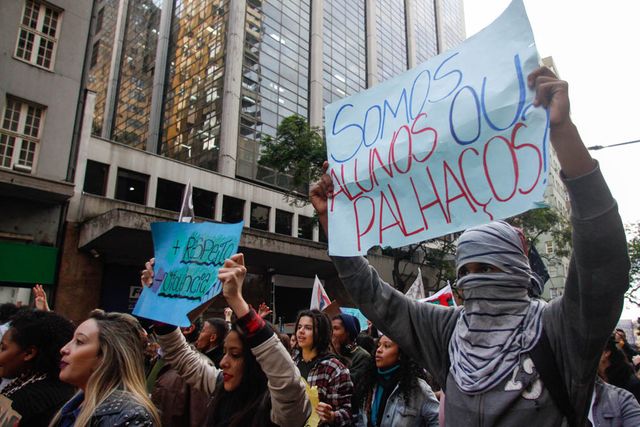
Brazilian high school students have been engaged since October 4 in their fourth wave of school occupations in less than a year against crippling attacks on the right to education by the federal and several state governments. Beginning in November 2015, threats of mass school closures, cuts to the education budget and attacks on teachers’ working conditions drove hundreds of thousands of pupils, many of them as young as 12, to shut down and camp out in schools.
Occupying students protest in Porto Alegre [Photo: Editorial J]
In every mobilization so far, students have resisted harassment by not only right-wing parents and petty school bureaucrats, but also the state, the police and organized crime. Hundreds have been detained over the year and taken to correctional facilities or even prisons, in the case of seniors, and hundreds more have faced retaliation in the form of suspensions, retentions and expulsions.
The escalation of harassment against the students reached a high point last week, when a judge authorized the Military Police in the capital Brasília to lay siege to an occupied school, cutting water and power, preventing parents from bringing food and cleaning supplies to their children and using sleep-deprivation techniques to force the students out. Frightened students decided to leave the school the following day.
The most recent movement has been largely concentrated in the southern state of Paraná, one of the country’s richest, where half of the 1,700 high schools are occupied. It has now spread, however, to 19 states and more than 100 universities, with more than 1,000 facilities blocked nationwide.
The occupations’ most immediate motivation is the imminent approval of a proposed constitutional amendment (named PEC 241 by Congress) to freeze government spending for 20 years, ostensibly to allow the country to overcome its worst economic crisis in a century following two consecutive years of economic contraction.
Economists estimate that the measure would withdraw from education and health funding more than 1 trillion reais (US$317 billion) over the 20-year period, an impact that led the population to ironically nickname the proposal the “end of the world amendment” (“PEC do fim do mundo”).
For students and teachers, the amendment comes on top of a sweeping education reform promulgated by the new government of President Michel Temer. The measure, imposed by decree just days after Temer was sworn in following the impeachment of Workers Party (PT) President Dilma Rousseff in September, is also expected to freeze teachers’ wages and cripple working and studying conditions in most schools.
Its pro-corporate character is an enormous attack on public education and will extend nationwide the privatization of education already experienced in the states of Pernambuco and Sao Paulo.
The education reform establishes a policy to implement full-time high schools, expanding from five to seven hours per day the time students spend in school, and allowing “flexible,” pro-market curriculums, supposedly at each student’s discretion.
In particular, the reform turns arts education, physical education, philosophy and sociology into optional subjects, raising the likelihood that they will rapidly disappear from the curriculum due to budget cuts, or even more likely, political intervention by right-wing and religious elements on local advisory boards. The optional character of art in full-time high school, and its possible end, means taking away from working class students one of their few accesses to culture.
A law for the extension of hours at schools has for years been demanded by educators with support of parents and students. Currently, 94 percent of Brazilian students attend one of three daily shifts—morning, afternoon and night. Of the 24 percent of high school students attending the night shift, the great majority work throughout the day. Parents have for a long time claimed that the three-shift system, which doesn’t allow students to stay in school before or after classes, makes pupils vulnerable to harassment by organized crime or exploitative family relations that amount to under-the-radar child labor occurring upon their daily return home.
Longer hours have also been considered for a long time as a solution to poor performance in schools. According to the results on Brazil’s standard testing exam, Prova Brasil, released in early September, 40 percent of high school students have extremely unsatisfactory educational results.
On the other hand, students fear that the change from a three-shift system to full-time schooling may force many out of school, not allowing them to combine attendance with work from the legal age of 16 in the context of the deep economic crisis.
The measures being proposed were first implemented in the northeastern state of Pernambuco in 2008 and involved the private Educational Co-Responsibility Institute (ICE—Instituto de Co-Responsabilidade Educacional) and Pernambuco’s secretary of education. At the time, ICE was chaired by a former CEO of Philips, and financed by educational institutes controlled by private companies and banks, such as Natura, Itau and Bradesco.
The participation of ICE in Pernambuco’s high schools takes place through reforms that fund and implement the management of schools by private companies. This means that the work regime of teachers includes periodic performance evaluations and bonuses if the students meet goals set in the standardized exams. Today, 44 percent of high schools in Pernambuco are full-time.
As usual in privatization drives, the Temer government alleges that expansion of hours would be impossible without the pro-corporate measures, given the state of the education system, in which teachers have the longest hours and the third-lowest wages compared with other OECD countries, and 84 percent of schools lack libraries, science laboratories and sports facilities. The privatization drive is further presented as an alternative in the face of the government’s proposed constitutional amendment that will cut the Brazilian educational budget to an extent never seen before.
The education reform also has the explicit aim of expanding the coverage of technical education, which is currently attended by 8 percent of Brazilian high school students, in alignment with the World Bank and the United Nations Children Fund (UNICEF) recommendations. As the Education Ministry wrote to Congress in justifying the decree, “otherwise there is no guarantee of an economically active population sufficiently qualified to drive economic development.”
The relationship between the World Bank and Brazilian education goes back to the 1950s, but was intensified during the 1964-1985 US-backed military dictatorship precisely in relation to technical education. Between 1971 and 1978, the World Bank financed the construction and reform of industrial and agricultural technical schools, with support from the Food and Agriculture Organization of the United Nations (FAO), the United Nations Educational, Scientific and Cultural Organization (UNESCO) and Ford Motor Company.
Prior to these agreements, the Brazilian military dictatorship reached a series of educational agreements with the United States Agency for International Development (USAID), which led to an enormous expansion of private higher education, with 75 percent of Brazilian students funneled into private faculties. At the same time, philosophy and sociology were removed from the curriculum. Only in 2008 were these subjects once again made obligatory.
While the educational reform and the brutal attack it represents on public education has been announced by Temer government, it was prepared by the PT governments of Lula da Silva (2003-2010) and Dilma Rousseff (2011-2016), and is based on a 2013 bill introduced by Workers Party federal deputy Reginaldo Lopes. Moreover, the whole standard evaluation framework that paved the way for the current measures was set up by the PT’s Sao Paulo Mayor Fernando Haddad when he was education minister in 2005.
Nonetheless, the fact that the pioneering states to implement such worked-out measures were, in the last election cycle, under control of the right-wing opposition to the PT, and that most officials implementing these policies have been drawn from those state governments after Rousseff’s removal from office, has been used as a pretext to corral the student struggles behind the PT-controlled teachers’ unions around the country. At the same time, this is being used to refurbish the image of the unions with students and teachers after their actions resulted in concessions contracts all over the country last year, which saw record strike activity among teachers.
Likewise, the historic association of the measures with the military dictatorship and traditional right-wing forces in Brazil, including Christian chauvinists, is being used by unions and the PT-linked media to foster the PT’s “coup” narrative, hiding the party’s complicity not only in the attacks on workers, but in strengthening the same political forces that removed it from power and which are now accelerating these attacks.

Sandinista President Ortega gains third term in Nicaragua

Andrea Lobo

Nicaraguan president and ex-guerilla leader Daniel Ortega and his Sandinista Front for National Liberation (FLSN) were reelected for a third consecutive five-year term, amid deepening inequality and increasingly autocratic methods of rule. Although they ran under their old slogan, “Nicaragua: Christian, Socialist, in Solidarity,” he and his wife, Rosario Murillo, who will be his vice-president, plan to deepen their pro-business and reactionary agenda.
The Supreme Electoral Council reported on Monday that out of 2.6 million ballots cast, a 68 percent voter turnout, the FSLN received 72.5 percent, followed by the Constitutionalist Liberal Party (PLC) with 15 percent and the Liberal Independent Party with 4.5 percent. Congress will be split similarly.
The main opposition front, the National Coalition for Democracy, did not participate, and called on voters to abstain or cast blank ballots. Even so, the turnout was only slightly lower than previous elections, and only 3.5 percent of votes were cast blank. Back in June, the Supreme Court had removed the Coalition’s top leader, Eduardo Montealegre, from his position in the party, leading to the invalidation of the Coalition’s candidates. This allowed Ortega to run without any significant opposition, but it still doesn’t explain the huge margin of victory.
The second-tier right-wing opposition parties offer no alternative to the masses of Nicaraguans concerned about reduced social spending and the widening gulf between the country’s rich and poor. As for the ruling elite, they offer no viable means of quelling an upsurge in the class struggle.
The absence of an independent party of the working class, along with popular disdain for the right-wing opposition, chiefly explain the in FSLN’s huge margin of victory.
Back in June, Ortega had announced that he would not accept any international observers, but given mounting international and national condemnation, he invited the Organization of American States (OAS) to send a delegation. The OAS accepted an invitation to be present throughout the elections and to start a “dialogue,” but it did not act as an official “observer.” The US ambassador to Nicaragua and the US State Department “embraced” this decision.
Ortega’s tightened grip over national politics, however, has given fodder to the international press and the US government to pressure the FSLN. Most significantly, the US House of Representatives passed a bill in September, the “Nicaragua Investment Conditionality Act” or Nica Act, which would place a hold on economic aid from the World Bank and other credit agencies until Ortega “adopts reforms that promote democracy.”
On Monday, US State Department spokesperson Mark Toner reacted to the elections, declaring: “The United States is deeply concerned by the flawed presidential and legislative electoral process in Nicaragua, which precluded the possibility of a free and fair election.”
Back in an August opinion piece, the Wall Street Journal called upon the Obama administration to act as it did in the US-backed 2009 coup in Honduras. The Journal stated: “He [Daniel Ortega] is believed to be one of the richest men in the country. Many in the business community went along with his gradual accretions of power, and now it may be too late to prevent a full-fledged dictatorship.”
After he cast his ballot right before poll stations closed on Sunday, Ortega gave what amounted to a victory speech. Referring to the US occupations during the 1920s, he remarked, “Now, we Nicaraguans have become the organizers of the electoral power. … It will not be the American troops ‘taming’ our fatherland, but Nicaraguans.”
“Thank God that elections here don’t need hate, confrontation, and death. This is a vote for peace,” concluded Ortega.
Rosario Murillo then repeated exactly what Ortega said, adding that they won “in the name of Jesus,” and stressed the importance of conserving the “alliance” ruling the country. Ever since its assumption of power, the FSLN has combined “liberation theology,” Marxist rhetoric and pro-business policies to consolidate—particularly after regaining the presidency in 2006—a reactionary coalition between the national business elite, the Church, the state and the unions.
The Ortega family, along with several other Sandinista leaders and prominent business people, have built a powerful business conglomerate, including large land holdings and media outlets.
Competing for a larger share of the profits from the exploitation of Nicaraguan workers and peasants, Ortega’s bourgeois nationalist clique and US and European imperialism are entering into a deeper conflict, particularly because global economic stagnation is eroding the economic basis to strengthen their relative power and curb class tensions.
Since 2007, Ortega’s government has depended on Venezuelan oil and $4.8 billion of out-of-budget loans and investments from the Venezuelan government to pay for social programs and establish generous concessions to local business groups. Ortega has desperately sought to increase its trade and economic and military assistance from a variety of other sources—including Venezuela, Brazil, the European Union, China, and Russia—to lessen its dependence on the US.
However, his government is increasingly finding itself facing a blind alley. Nicaragua’s $214 per capita social spending is already one of the lowest in the region, so the drawing down of Venezuelan aid and the yearly $250 million of assistance and loans now threatened by the Nica Act (19 percent of Nicaragua’s total social spending) are making Ortega’s short levers get even shorter.
During the 1980s, the Sandinista government was spending about 60 percent of its budget to fight the war against the CIA-backed contras, and the US embargo placed an enormous pressure on the economy. According to Mexican economic historian Mario Trujillo, “The choices taken by the Sandinista government were promoting the mixed economy, sustaining the free market, and seeking loans (mainly small and limited); and particularly, by February 1988, it resorted to the orthodox program of economic stabilization that adjusted itself to the norms proposed by the IMF for the Latin American countries to confront the economic recession and the foreign debt payments throughout the eighties.” (Nicaragua: Elections and perspectives of a neo-social-democratic government, 1990)
Once the Stalinist bureaucracy in the Soviet Union stopped sending economic aid, the country fell into a decade-long crisis that kept 75 percent of the population under the poverty line. This led to the Sandinistas’ electoral defeat in 1990 and their even further lurch to the right and, although with some rhetorical resistance, into the sphere of US imperialism. This process continues today, even through the so-called left turn of Latin American bourgeois governments that began in the early 2000s.
Ortega is still credited by the Western media with having maintained pro-business policies and, over the course of his two administrations, having reduced the official poverty rate by over 15 percent. While many of Nicaragua’s poor have partially benefited, the largest benefits have gone to the national bourgeoisie and its imperialist partners. According to data from the National Information Development Institute (INIDE), the Gini inequality index is almost the same as in 2007, and 62 percent of families still cannot afford the basic basket of goods and services.
At the same time, Oxfam reports that Nicaragua’s 254 multimillionaires have an average annual income more than 12,000 times that of someone in the poorest quintile.
While the IMF had closed its offices in Nicaragua this year in recognition of Nicaragua’s fiscal obedience, the government’s timely payments still amount to on the order of 35 percent of its public budget, a pressure that, under increasingly unfavorable economic conditions, will require deeper austerity measures. To prepare for this scenario and the intensification of the class struggle, Ortega and US imperialism both ultimately support more-autocratic forms of rule, including a strengthened military and police, both of which has been under expansion and modernization since 2013.
Washington is pressuring Ortega to move forward with unpopular economic and political measures and to distance himself from China and Russia in support of Obama’s “pivot to Asia” and increasing confrontation with Moscow.
As a sign of cooperation and of acknowledging its anticipated electoral victory, the FSLN government and the Central Bank presented in October their economic plan for 2017-2021, “Let’s Grow Together!” The document upholds the free trade agreements with the US (CAFTA) and with the European Union and notes the desire to join the US-led Trans-Pacific Partnership. In terms of financing, it calls for “the emission of sovereign debt titles to international markets” and developing “Public-Private association” investments.
The World Bank representative at the plan’s presentation, Luis Constantino, declared that, “It seems to me like a very good planning process and we like it very much.”
Most of the government’s projects for this period are in transport and telecommunications, while no health programs are mentioned, and only two unfinanced education programs are included regarding didactic technologies. Suggestively, the $50 billion interoceanic canal that the government granted a Chinese firm a concession to build is not even mentioned, and, in spite of claims of having all the financing needed, the beginning of construction on the project continues to be postponed.

Egypt plunges into economic and social nightmare

Jean Shaoul 

The Egyptian pound fell by 50 percent to E£14 to the US dollar following the announcement by the country’s Central Bank that it would allow the currency to float on the currency markets. The pound has previously been pegged to the dollar.
The oil ministry followed suit, announcing a 50 percent increase in the price of petrol and a 30 percent rise in fuel, both of which have been subsidised for decades. Food prices are likewise expected to soar. Egypt imports more than half its basic foodstuffs and is the world’s largest importer of wheat. Alongside cuts in subsidies and the introduction of VAT (value-added tax), this will increase the cost of living, stoking fears of hyperinflation.
Inflation is already running at 16.4 percent a year, under conditions where wages have not kept up with inflation and 40 percent of the population are officially below or only marginally above the poverty line.
Earlier last week, Egypt’s Supreme Investment Council approved a raft of pro-business measures in a bid to boost investment, extending a temporary suspension of capital gains tax on shares and introducing tax exemptions for producers in some sectors.
Another devaluation, hard on the heels of a 13 percent devaluation last March, was widely expected as part of the packet of measures demanded by the International Monetary Fund (IMF) in August. The measures, the full extent of which have not been made public, are in return for a $12 billion loan—with a further $9 billion to be raised elsewhere—to cover Egypt’s 2015-16 budget deficit of 12 percent of GDP, and a shortage of foreign currency. The IMF insisted last month that Egypt had to implement reforms, including a flexible currency, slashing subsidies, VAT, and privatisation of state-owned enterprises and banks, before receiving the loan, now worth considerably less than originally agreed.
Currency reserves have fallen from $36 billion in 2010 to about $19.6 billion in September, despite tens of billions of dollars in aid from Egypt’s Gulf allies since 2013. After the authorities introduced controls in early 2015 to stem the flight of capital, importers turned to the black market where the rate soared to more than double the official rate. In June, the Central Bank raised the interest rate to 10 percent, a 10-year high.
Many small producers complained that they were being forced out of business. Last month, two of Egypt’s largest listed companies said they would be forced to halt production if dollar shortages continued. Others have turned to China to source their imports where prices and quality are lower.
Both the timing of the devaluation—far sooner than expected—and the scale came as a shock. It reflects the depth of the economic, social and political crisis confronting General Abdul Fatah el-Sisi’s brutal dictatorship.
Rising prices and periodic shortages of state-subsidised foods have forced the government to increase costly imports. Deteriorating relations with Saudi Arabia, the junta’s sponsor, led to Riyadh suspending its agreement to supply Egypt with refined oil products, adding $500 million a month to the import bill and government spending.
So great was public anger over a shortage of sugar, which some have accused the military’s enterprises of seeking to monopolise as it has with other goods and services, that the Central Bank was forced to allocate $1.8 billion to build a six-month food reserve. At the same time, the military has prepared 8 million “ration” packages of basic foodstuffs to be sold at half price, predominantly in Cairo.
The IMF, which speaks for the Western banks that will profit from the deal, welcomed the decision. It said that the currency flotation would “make more foreign exchange available,” and “improve Egypt’s external competitiveness, support exports and tourism and attract foreign investment.” It will do nothing of the sort. Its only purpose is to put Egypt’s assets up for sale at knockdown prices and open up the Egyptian working class to super-exploitation by the transnational corporations and international banks.
The IMF’s brutal diktats, which will impoverish the Egyptian people, can only be implemented by brute force, which el-Sisi indicated he is more than ready to use on behalf of the Egyptian bourgeoisie and the imperialist powers.
Last August, when the deal was initialled, El-Sisi said he would not shy away from the reforms that previous rulers had shunned in a bid to avoid unrest, declaring, “The first attempt at real reform was in 1977.” Riots broke out in 1977, after then-President Anwar Sadat said he would end basic subsidies on wheat in return for a World Bank loan.
El-Sisi added, “The people’s reaction caused the state to backtrack, and it has continued to delay [the reforms] till now. All the hard decisions that many over the years were scared to take: I will not hesitate for a second to take them.”
Since overthrowing the Muslim Brotherhood-led government of Mohammed Mursi in a bloody coup in July 2013, el-Sisi has imposed a brutal dictatorship on behalf of the military, police and intelligence faction of the ruling class that has dominated Egyptian political and economic life since the 1952 Free Officers’ coup. He has ruthlessly targeted the military’s economic rivals, dominated by the Muslim Brotherhood, other bourgeois political opponents, liberal activists and, most importantly, the working class.
The junta has outlawed protests, imprisoned at least 60,000 of its political opponents, sentenced hundreds to death and introduced a sweeping counter-terrorism law vastly expanding the authorities’ powers. Mass trials, mostly of Brotherhood supporters, failed to establish individual guilt. Several thousand have been tried in military courts. Torture and enforced disappearances are commonplace, with many detainees dying in custody from mistreatment.
At the same time, el-Sisi has carried out extensive military operations against Islamic militants in the Sinai Peninsula who have capitalised on the seething unrest among impoverished Bedouin. The regime has imposed a state of emergency, killing hundreds of civilians, demolishing hundreds of homes and evacuating thousands of residents. The security forces’ brutality, which has included curfews, detention without trial or even charges, the shutting down of cell phone and internet networks and routine abuse, has only served to increase social tensions in Sinai and throughout the country.
The class tensions that exploded into the revolutionary events of January 2011, which led to the removal of long-time dictator Hosni Mubarak, are exploding once again in response to the economic disaster and the junta’s repression.
Last week, Egyptians took to the streets to protest the government’s failure to provide fast and adequate relief in the flood-stricken areas where 29 people were killed and at least 73 were injured at the end of October. In Ras Gharib in South Sinai, where hundreds of homes were under water and all of the main roads out of the town were closed, Prime Minister Sharif Ismail was forced to abandon his visit in the face of angry protests over power and water cuts in the town.
Two weeks ago, thousands took to the streets of the northeastern port city of Port Said to protest against the rising cost of housing, chanting, “House us or kill us” and calling for el-Sisi’s resignation.
In September, social media issued a call, known as Thawra el-Ghalabiya (revolution of the majority), for a mass anti-government rally on November 11 against the rising cost of living. The security forces responded by detaining eight people for 15 days on charges connected to calling the rally.
Last month, a video of a furious tuk-tuk (motorized rickshaw) driver filmed in a working class district in Cairo went viral. It showed the driver, surrounded by crowds, haranguing the government for its lavish spending at state ceremonies while the poor suffer.

German media calls for massive rearmament after US elections

Johannes Stern

The German elites are using the US presidential election and the “dirtiest election campaign of modern times” (Der Spiegel) as an excuse to promote the return of German militarism.
In the past week, the World Socialist Web Site commented on a paper of the German government-connected think tank Stiftung Wissenschaft und Politik (SWP), titled “Even without Trump much will change.” It calls for a more aggressive German and European foreign policy that is ready, “whatever the election result” to pursue economic and geopolitical aims independently of the United States and, if necessary, against Washington.
Just before the election, a column on Spiegel Online provided a taste of what this means. Under the title, “How Trump could force Germany to rearm,” a certain Henrik Müller forecasts: “Should Donald Trump be elected US president on Tuesday, Germany will face a great debate regarding rearming. It could become the decisive theme of the [German] federal elections in 2017—an intense controversy with the potential to divide the country.”
But “also if Hillary Clinton wins,” Germany would face high costs. Germany would “not be able to continue as before, neither politically nor economically.” The US elections were “a turning point.” With a win for Trump, “the post-war era, when America’s nuclear shield and its European military presence initially provided protection for the West and later the Central European countries, ... is finally over.” Europe “would have to provide its own security” and “in particular, Germany, the continent’s largest economy.”
“This will be expensive,” states Müller, a professor of journalism who teaches at the University of Dortmund and has a doctorate from the University of the Bundeswehr [Armed Forces] Hamburg. Until now, Germany spent “comparatively little for the military: just 1.19 percent of gross domestic product (GDP).” That lies “well below” the NATO limit of 2 per cent, to which the members of the military alliance had agreed in 2002. Britain “spends twice as much on arms and soldiers in relation to GDP, the United States three times as much.”
The scenario outlined by Müller recalls the German armaments madness on the eve of the First and Second World Wars: it ranges from the doubling of the military budget to the acquisition of nuclear weapons! “Instead of the current 37 billion euros per year, in future Germany must spend 80 billion, perhaps even more,” writes Müller. “In the event of NATO breaking apart and the complete elimination of the American security guarantee, a new arms race could be the result, as is happening elsewhere in the world already. Even a debate on Germany’s own nuclear weapons would be conceivable.”
Although this was “not desirable,” warns Müller, “Military instability and economic inefficiency would be the consequences. For Europe, it would be much better and cheaper if the United States remained involved.” But, “Given the isolationist mood across the Atlantic,” one must be “mentally prepared for such a scenario.”
Another reason for the armaments offensive cited by Müller is the deep crisis of the European Union. He writes: “Germany would be better prepared for the new situation if the EU was united and strong. But there can be no question of this. Europe is divided and threatened by decay. Accordingly, we must prepare ourselves for Germany facing high costs. One way or another.”
While the rearmament plans postulated by Müller are presented as being externally “imposed” by the deep crises in the US and the EU, in fact, they correspond to official government policy. At the 2014 Munich Security Conference, the Social Democratic Foreign Minister Frank-Walter Steinmeier, speaking for the entire ruling class, said, “Germany must be ready for earlier, more decisive and more substantive engagement in the foreign and security policy sphere.” It was simply “too big merely to comment on world affairs from the sidelines.”
At the time, the PSG warned in its resolution “The return of German militarism” that the post-war order had “resolved none of the problems that had led to war. The economic power of the US made possible a temporary stabilisation and the post-war boom. The Cold War not only kept the Soviet Union at bay, but also kept Germany under control. But with the reunification of Germany and the dissolution of the Soviet Union, the period in which German business could conduct its affairs in the wake of the US and the German army could restrict itself to national defence was irrevocably over.”
It continued: “The revival of militarism is the response of the ruling class to the explosive social tensions, the deepening economic crisis and the growing conflicts between European powers. Its aim is the conquest of new spheres of influence, markets and raw materials upon which the export-dependent German economy relies; the prevention of a social explosion by deflecting social tensions onto an external enemy; and the militarization of society as a whole, including the development of an all embracing national surveillance apparatus, the suppression of social and political opposition, and the bringing into line of the media.”
This analysis has now been confirmed. But there is a social force that is capable of halting the return of German militarism and the risk of renewed war between the great powers: the international working class. Following the US elections, the struggle waged by the International Committee of the Fourth International (ICFI) for the establishment of an international anti-war movement of the working class against imperialism and capitalism takes on even greater urgency.

Trump’s victory and the debacle of American democracy

Joseph Kishore

The victory of Donald Trump in the US presidential election is a political earthquake that has exposed before the entire world the terminal crisis of American democracy. Such is the degeneration of bourgeois rule that it has elevated an obscene charlatan and billionaire demagogue to the highest office in the land.
Whatever conciliatory phrases he may issue in the coming days, a president Trump will lead a government of class war, national chauvinism, militarism and police state violence. In addition to the executive branch, all the major political institutions in the United States—including both houses of Congress and the Supreme Court—will be in the hands of the far right.
Under Trump, America will not be made “great again.” It will be driven into the dirt.
Media commentators, none of whom foresaw this outcome, fell back on now routine explanations focused on the voting patterns of various racial and identity groups. They all ignored the fact that the election became a referendum on the devastating social crisis and decay in the United States, which Trump was able to channel and direct to the right.
Who and what is responsible for the victory of Trump? First, the Clinton campaign and the Democratic Party, which were unwilling and incapable of presenting a program that could attract any significant popular support.
Clinton waged her campaign on the lowest and most reactionary level. She combined claims that Trump was an agent of Putin—aimed at creating the framework for aggression against Russia—with denunciations of the working class as racist and “privileged.”
Second, the administration of Barack Obama, elected eight years ago on pledges of “hope” and “change.” Obama won the support of large sections of the working class, including white workers, bitterly opposed to social inequality and the Bush administration’s policies of war and social reaction.
During two full terms in office, Obama presided over unending war, a historic transfer of wealth to the ruling class, and the continued erosion of the living standards of the vast majority of the population.
Obama’s signature domestic program, the Affordable Care Act, was an assault on health care packaged as a reform. In the final weeks of the election, millions of workers discovered that they are facing double-digit increases in health care costs. This was likely far more important in affecting the outcome of the election than the actions of FBI director James Comey in reviving the Clinton email scandal.
Third, the trade unions, which for the past four decades of increasing social inequality have worked systematically to suppress the class struggle and maintain the political stranglehold of the Democratic Party. They have as well assiduously promoted reactionary economic nationalism, which is in line with Trump’s own platform.
Fourth, Vermont Senator Bernie Sanders and those organizations that promoted him. Sanders’ craven capitulation to Clinton—the logical outcome of his strategy of channeling opposition into the Democratic Party—ensured that opposition to the status quo would be monopolized by the political right. The most significant Trump upsets came in states where Sanders had defeated Clinton by large margins in the Democratic Party primaries.
Behind all of this was the central ideological role of identity politics and the systematic effort to conceal the real social divisions within society. The relentless and obsessive focus on race and gender over the past four decades has been used to give the Democratic Party a left cover for a thoroughly right-wing political agenda at home and abroad. At the same time, it articulates the interests of the most privileged sections of the upper-middle class.
The notion that the basic divisions in society are along the lines of race and gender is not only politically reactionary, it is fundamentally false. The Democrats and Clinton were hoisted on their own petard. They not only lost in regions that are predominantly poor and white, but also suffered from a decline in voter turnout in majority black regions, as African-American workers and youth saw no reason to back the candidate of the status quo.
The coming period will be one of shock, outrage and increasingly bitter struggles. It will not take long for workers, including those who voted for him, to realize what they have in a President Trump. At the same time, the explosive divisions within the state apparatus expressed in the election will emerge in new and more violent forms.

Iskander-M in Kaliningrad: The Changing Equations of Deterrence

Adarsh Vijay


The Baltic Coast has descended, again, into a quandary against the backdrop of the placement of the Iskander Missile System in the Kaliningrad Oblast, a Russian enclave sandwiched between Lithuania and Poland. Concerns about Russian attempts at “nuclearisation” are increasing in its backyard. This move, which has already invited skirmishes and diatribes in the region, is bound to have varying repercussions. The implications of this altered strategic landscape can be decoded under the following heads: Was Moscow’s action a reciprocation to any geopolitical stimulus? Does it hold the prospects of escalating risks in the region? If so, are there options available to minimise the expected tensions?

Emerging Strategic Quagmire
The move comes at a time when the North Atlantic Treaty Organisation (NATO) is expanding its wings across the Baltics. The US interests in this region are purely guided by NATO’s commitments to its member states - Estonia, Latvia and Lithuania. Washington is apprehensive of the Russian revisionist tendency that seeks to retrieve the erstwhile Soviet territories, and which caused alarm bells with the annexation of Crimea from Ukraine in 2014. The consequent fear among the NATO countries over the likelihoods of further aggressive policies by Russia had induced the former to redevise its style of presence on its eastern flank. 

The White House has been wary of the fate of their Baltic counterparts, which were once part of the former USSR. A check over the security of Tallinn, Riga and Vilnius has been brought within a first-of-its-kind deterrence mechanism. The deployment of an enhanced four-battalion sized troops in Estonia, Latvia, Lithuania and Poland as decided at the NATO Summit at Warsaw (2016) reflected a change from the earlier policy of “reassurance” as promised at the Wales Summit (2014) against possible threats posed by Russia. The galloping presence of NATO in the Baltic Republics since the Crimean annexation under the pretext of joint-military exercises and drills had already been a perplexing concern for the Russians. 

NATO vis-à-vis Russia: an Offensive and Defensive Equation
The installation of 9K720 Iskander, a short-range and nuclear-capable tactical ballistic missile system, in the Kaliningrad; home to the Baltic Sea Fleet, during the first week of October 2016 can be viewed as the materialisation of a belated, but apt, reaction. Nonetheless, the Kremlin underplays fears about a possible nuclearisation of Baltic sphere and a direct military confrontation against the West. The placement of this mobile missile system reveals the chances of relocation in due course and it has been projected as part of the routine military drills of the Russian Armed Forces. Despite this claim by Moscow’s defence ministry, the NATO members see this as a provocation. Iskander with its range of 440 miles brings even Germany, a NATO member, within its scope of target. 
The arrival of an E-3A AWACS (Airborne Warning and Control System) aircraft on 13 October at the Siauliai airbase in Lithuania was a natural counter-reaction of NATO. The situation seems to be even more tense when seen in conjunction with the altercations between the US and Russia over the ongoing Syrian War.

Solutions as Uncertainties
Should Russia invade any of these Baltic NATO allies on its western border, the alliance would have no option but to invoke Article V of the treaty that sanctions a collective action against the aggressor state. By considering the precedents of failures with regard to non-coercive measures such as sanctions that were adopted in the wake of the Crimean annexation, a military response is what the NATO might rely upon in a next crisis. The Iskander-M, which is known as SS-26 Stone in the NATO circles, has been placed as a reaction to the US missile establishments in Poland. What makes the alliance suspicious is the hesitance of Moscow to be transparent in its policies with respect to the region. Apart from that, the military geography also stands in favour of Russia in the event of a conventional battle. According to a report of the RAND Corporation, the optimum time that the NATO could buy, in a hypothetic crisis, to avert the entry of Russian forces into the Baltic capitals is 60 hours. It is also unthinkable to ensure the presence of a permanent combat troops from NATO countries on the eastern flank owing to the lack of unanimity among the member states. Therefore, what seems feasible as of now is the stationing of rotational troops across the region in defence of the Baltics. NATO would also have to consider an additional withdrawal of forces from Germany to Poland and beyond as conventional deterrence continues to be the only means for tackling a Baltic crisis. As a mutual withdrawal from force-restructuring and postures is unlikely, the only effort that can prevent NATO and Russia from a collision is to let the deterrence-building measures continue without any disruption.

8 Nov 2016

Women’s Leadership Accelerator for Women in Digital Journalism 2017 – University of Southern California

Application Timeline: Applications close: 15th November 2016
Participants notified: mid-December
Women’s Leadership Accelerator: Feb. 5-10, 2017
Eligible Countries: All
To be taken at (country): USA
About the Award: The Accelerator, to be held Feb. 5-10, 2017, at the University of Southern California’s Annenberg School for Communication and Journalism, is open to 25 promising women leaders who are pushing innovation in their organization.
In addition to learning leadership skills and tools for navigating change, participants will focus on a challenge specific to their careers, whether an obstacle to overcome or an aspirational goal to achieve, either within their organizations or as an independent project.
The tuition-free program offers:
  • A focus on developing leadership and management skills, with special attention to challenges faced by women in media
  • Discussions, deep dives and one-on-one mentoring from some of the top women leaders in digital journalism
  • Proven creative approaches to pushing innovation in newsrooms
  • Practical, targeted guidance to working through individual challenges
  • Open, candid discussions about leadership, work-life balance and problem-solving in the newsroom
  • The opportunity to build a cohort of peers to serve as a strong career-long support system
wla-pic-1
Type: Entrepreneurship, Training
Eligibility: 
  • The programme is open to English-speaking women from around the world.
  • The Accelerator, supported by a generous grant from the Dow Jones Foundation, is open to practitioners working in digital media, including freelancers, entrepreneurs and independent journalists.
Selection Criteria:  ONA will screen candidates for potential, need and diversity across ethnicity, age, geography, technology platforms and skill sets.
Number of Awardees: 25
Value of Programme:  Thanks to the generous support of lead funder, the Dow Jones Foundation, and support from Google, the Women’s Leadership Accelerator training is tuition-free. We also provide breakfast, lunch and some dinners throughout the week. Participants will cover their own travel and accommodation costs. ONA has secured a hotel within walking distance of USC Annenberg that with a special room rate of $175 a night, so an estimated budget for accommodations is $1,000 ($875 for five nights, plus taxes and any hotel fees).
We realize that not everyone has a newsroom to fund them or an organization with a budget for professional development, so we’re happy to be able by offering a limited number of travel stipends to participants who need them.
Duration of Programme: Feb. 5-10, 2017
How to Apply: Apply here
Award Provider: Online News Association

Mid Sweden University Masters Scholarship for International Students 2017/2018

Application Deadline: 16th January, 2017
Offered annually? Yes
Eligible Countries: International
To be taken at (country): Sweden
Eligible Field of Study:  The Mid Sweden University Tuition Fee Scholarship is aimed at top academic students from countries outside the EU/EEA (and Switzerland). Students who have applied to the following study programmes at Mid Sweden University starting autumn semester 2017, and who are required to pay tuition fees are welcome to apply for a Mid Sweden University Tuition fee Scholarship. The scholarships can be applied for by applicants of the following programmes:
A fee waiver of the tuition fee with 70 000 SEK:
  • Master (one year) in Tourism Studies, 60 higher education credits
  • Master programme (one year) in Business Administration, Marketing and Management, 60 higher education credits
A fee waiver of the tuition fee with 140 000 SEK:
  • Master in Tourism, 120 higher education credits
A fee waiver of the tuition fee with 250 000 SEK:
  • International Master’s Programme in Computer Engineering, 120 higher education credits
  • International Master’s Programme in Ecotechnology and Sustainable Development, 120 higher education credits
  • Master’s Programme in Embedded Sensor Systems
Type: Masters
Eligibility: All students who have applied to a study programme at Mid Sweden University starting autumn semester 2017, and who are required to pay tuition fees are welcome to apply for a Mid Sweden University Tuition Fee Scholarship.
  • The applicant must be citizen of a country outside the EU/EEA/Switzerland.
  • The applicant must be required to pay a tuition fee.
If awarded a scholarship the Scholarship holder is obliged to:
  • Pay the tuition fee according to the tuition fee invoice. If payment is not made on time the scholarship will be withdrawn.
  • Enter into a written scholarship contract with Mid Sweden University before starting the studies.
  • Confirm his or her citizenship by means of a passport photocopy before starting the studies. Inform Mid Sweden University if personal conditions change and the student is no longer required to pay a tuition fee. The scholarship will then be withdrawn for that part of your studies.
  • If the scholarship holder does not enroll at Mid Sweden University, the scholarship will be withdrawn.
  • If the scholarship holder intermits his/her studies at Mid Sweden University, the scholarship will be withdrawn for the remaining part of his/her studies.
  • If the scholarship holder wrongly has stated that he or she met the conditions for the scholarship, by a misunderstanding or for another reason, the scholarship will be withdrawn.
Selection Criteria: The scholarships are awarded on the basis of academic excellence.
Number of Awardees: Not specified
Duration of Scholarship: 1 year
How to Apply: 
  • The application for studies must be made no later than January 16, 2017, at www.universityadmissions.se.
  • The applicant must be admitted to one of the above mentioned programmes starting in the autumn semester 2017.
  • The application for the scholarship is done by filling out an online application.
  • The academic excellence of applicant will be assessed in accordance with the supporting documents submitted when applying for admission at Mid Sweden University.
  • The applicants do not have to send in the supporting documents again.The application form can be found here.
    Last day to apply for scholarship is February 12, 2017.
Award Provider: Mid Sweden University